EP3931490B1 - Procédé de traitement de cendres - Google Patents
Procédé de traitement de cendres Download PDFInfo
- Publication number
- EP3931490B1 EP3931490B1 EP20703070.1A EP20703070A EP3931490B1 EP 3931490 B1 EP3931490 B1 EP 3931490B1 EP 20703070 A EP20703070 A EP 20703070A EP 3931490 B1 EP3931490 B1 EP 3931490B1
- Authority
- EP
- European Patent Office
- Prior art keywords
- ash
- furnace
- volatilizing
- temperature
- metals
- Prior art date
- Legal status (The legal status is an assumption and is not a legal conclusion. Google has not performed a legal analysis and makes no representation as to the accuracy of the status listed.)
- Active
Links
Images
Classifications
-
- F—MECHANICAL ENGINEERING; LIGHTING; HEATING; WEAPONS; BLASTING
- F23—COMBUSTION APPARATUS; COMBUSTION PROCESSES
- F23G—CREMATION FURNACES; CONSUMING WASTE PRODUCTS BY COMBUSTION
- F23G7/00—Incinerators or other apparatus for consuming industrial waste, e.g. chemicals
-
- C—CHEMISTRY; METALLURGY
- C22—METALLURGY; FERROUS OR NON-FERROUS ALLOYS; TREATMENT OF ALLOYS OR NON-FERROUS METALS
- C22B—PRODUCTION AND REFINING OF METALS; PRETREATMENT OF RAW MATERIALS
- C22B7/00—Working up raw materials other than ores, e.g. scrap, to produce non-ferrous metals and compounds thereof; Methods of a general interest or applied to the winning of more than two metals
- C22B7/02—Working-up flue dust
-
- B—PERFORMING OPERATIONS; TRANSPORTING
- B09—DISPOSAL OF SOLID WASTE; RECLAMATION OF CONTAMINATED SOIL
- B09B—DISPOSAL OF SOLID WASTE NOT OTHERWISE PROVIDED FOR
- B09B3/00—Destroying solid waste or transforming solid waste into something useful or harmless
- B09B3/40—Destroying solid waste or transforming solid waste into something useful or harmless involving thermal treatment, e.g. evaporation
-
- C—CHEMISTRY; METALLURGY
- C22—METALLURGY; FERROUS OR NON-FERROUS ALLOYS; TREATMENT OF ALLOYS OR NON-FERROUS METALS
- C22B—PRODUCTION AND REFINING OF METALS; PRETREATMENT OF RAW MATERIALS
- C22B7/00—Working up raw materials other than ores, e.g. scrap, to produce non-ferrous metals and compounds thereof; Methods of a general interest or applied to the winning of more than two metals
- C22B7/001—Dry processes
-
- C—CHEMISTRY; METALLURGY
- C22—METALLURGY; FERROUS OR NON-FERROUS ALLOYS; TREATMENT OF ALLOYS OR NON-FERROUS METALS
- C22B—PRODUCTION AND REFINING OF METALS; PRETREATMENT OF RAW MATERIALS
- C22B7/00—Working up raw materials other than ores, e.g. scrap, to produce non-ferrous metals and compounds thereof; Methods of a general interest or applied to the winning of more than two metals
- C22B7/04—Working-up slag
-
- F—MECHANICAL ENGINEERING; LIGHTING; HEATING; WEAPONS; BLASTING
- F23—COMBUSTION APPARATUS; COMBUSTION PROCESSES
- F23G—CREMATION FURNACES; CONSUMING WASTE PRODUCTS BY COMBUSTION
- F23G5/00—Incineration of waste; Incinerator constructions; Details, accessories or control therefor
-
- F—MECHANICAL ENGINEERING; LIGHTING; HEATING; WEAPONS; BLASTING
- F23—COMBUSTION APPARATUS; COMBUSTION PROCESSES
- F23G—CREMATION FURNACES; CONSUMING WASTE PRODUCTS BY COMBUSTION
- F23G2203/00—Furnace arrangements
- F23G2203/20—Rotary drum furnace
-
- F—MECHANICAL ENGINEERING; LIGHTING; HEATING; WEAPONS; BLASTING
- F23—COMBUSTION APPARATUS; COMBUSTION PROCESSES
- F23G—CREMATION FURNACES; CONSUMING WASTE PRODUCTS BY COMBUSTION
- F23G2209/00—Specific waste
- F23G2209/30—Solid combustion residues, e.g. bottom or flyash
-
- F—MECHANICAL ENGINEERING; LIGHTING; HEATING; WEAPONS; BLASTING
- F23—COMBUSTION APPARATUS; COMBUSTION PROCESSES
- F23J—REMOVAL OR TREATMENT OF COMBUSTION PRODUCTS OR COMBUSTION RESIDUES; FLUES
- F23J2700/00—Ash removal, handling and treatment means; Ash and slag handling in pulverulent fuel furnaces; Ash removal means for incinerators
- F23J2700/001—Ash removal, handling and treatment means
-
- F—MECHANICAL ENGINEERING; LIGHTING; HEATING; WEAPONS; BLASTING
- F23—COMBUSTION APPARATUS; COMBUSTION PROCESSES
- F23J—REMOVAL OR TREATMENT OF COMBUSTION PRODUCTS OR COMBUSTION RESIDUES; FLUES
- F23J2900/00—Special arrangements for conducting or purifying combustion fumes; Treatment of fumes or ashes
- F23J2900/01007—Thermal treatments of ash, e.g. temper or shock-cooling for granulation
-
- Y—GENERAL TAGGING OF NEW TECHNOLOGICAL DEVELOPMENTS; GENERAL TAGGING OF CROSS-SECTIONAL TECHNOLOGIES SPANNING OVER SEVERAL SECTIONS OF THE IPC; TECHNICAL SUBJECTS COVERED BY FORMER USPC CROSS-REFERENCE ART COLLECTIONS [XRACs] AND DIGESTS
- Y02—TECHNOLOGIES OR APPLICATIONS FOR MITIGATION OR ADAPTATION AGAINST CLIMATE CHANGE
- Y02P—CLIMATE CHANGE MITIGATION TECHNOLOGIES IN THE PRODUCTION OR PROCESSING OF GOODS
- Y02P10/00—Technologies related to metal processing
- Y02P10/20—Recycling
Definitions
- the invention is concerned with an ash treatment method for recovering metals from combustion ashes.
- Waste are unwanted or unusable materials and can consist of any substance, which is discarded after primary use, or is worthless, defective and of no use. Waste is produced by human activity, such as extraction and processing of raw materials.
- Waste treatment refers to the activities required to ensure that waste has the least practicable impact on the environment. In many countries various forms of waste treatment are required by law.
- Waste can be solid, liquid, or gaseous and each type has different methods of disposal and management. Waste management deals with all types of waste, including industrial, biological and household. The treatment of solid wastes is a key component of waste management.
- Waste management are the activities and actions required to manage waste from its inception to its final disposal. This includes the collection, transport, treatment and disposal of waste, together with monitoring and regulation of the waste management process.
- Resource recovery is using wastes as an input material to create valuable products as new outputs.
- the aim is to reduce the amount of waste generated. Resource recovery delays the need to use new raw materials in the manufacturing process. Materials found in municipal solid waste can be used to make new products. Plastic, paper, aluminum, glass and metal are examples of where value can be found in waste.
- Incineration is a high-temperature waste treatment process that involves combustion of organic substances contained in waste materials, systems in such processes described as "thermal treatment".
- Systems that are generally considered to be thermal treatment include in general waste storage and feed preparation as well as combustion in a furnace, producing hot gases and a bottom ash residue for disposal.
- Any incineration facility will incorporate processes as waste storage and handling, processing to prepare waste, combustion, air-pollution control, and residue (ash) handling.
- Waste incineration facilities generally consist of a number of unit operations associated with waste storage and reactor feedstock preparation; combustion of the waste itself; and handling of the hot product gases and ash residues.
- Incineration of waste materials converts the waste into ash, flue gas and heat.
- the ash is mostly formed by the inorganic constituents of the waste.
- Bottom ash also called bottom slag
- Fly ash or flue ash is a coal combustion product that is composed of the particulates (fine particles of burned fuel) that are driven out of boilers together with the flue gases. Ash that falls to the bottom of the boiler is also called bottom ash or bottom slag.
- Ash treatment is a way of recovering metals from ash while simultaneously decreasing the toxicity of the ash.
- Fly ash is generated in large quantities in waste incineration processes. Chlorides are commonly present in the fly ash produced by the incineration of hazardous materials, such as polyvinylchloride plastic. High concentrations of certain contaminants in fly ash make handling and disposal of fly ash difficult. These contaminants include readily leached chlorides, heavy metals, and persistent organic pollutants. In order to avoid adverse environmental effects from the disposal of fly ash, the content of soluble chlorides must be reduced.
- One of the options available today for chloride removal is leaching and displacement washing with a filter press.
- Plasma technology is another prior art method for the management of fly ash and Air Pollution Control residues (APCr) generated from incinerators and other processes, wherein waste is processed through combustion e.g. to produce a fuel source as in waste-to-energy processes. It is used as a technology to deal with APC and fly ash disposal.
- APC Air Pollution Control residues
- Such a plasma-enhanced process allows material feedstocks to be fed into a sealed furnace and heated in a controlled environment using a plasma arc created by either a single or multiple plasma electrodes/torches. Applying intense temperature and ultraviolet light results in high rates of resource recovery and destruction and removal of hazardous components for waste disposal and waste treatment.
- the process chemistry can be designed to separate and recover valuable metals, minerals and other materials from the feedstock while destroying the hazardous elements, leaving behind a non-hazardous vitrified material.
- This vitrified material can e.g. be employed as a building product for the construction industry.
- a problem of the final disposal of the combustion ashes is their high content of chlorides and/or heavy metals, such as Lead (Pb), Cadmium (Cd) and Zinc (Zn).
- Pb Lead
- Cd Cadmium
- Zn Zinc
- fly ash is considered to be hazardous waste and special environmental aspects have to be taken into consideration at its treatment and disposal.
- metal production refers to all processes involved in the conversion of a raw material, such as a metallic ore, to a final form in which the metal can be used for some commercial or industrial purpose.
- An ore is an occurrence of geological materials that contains sufficient minerals with economically important elements, typically metals, that can be economically extracted from the deposit.
- the ores are extracted from the earth through mining in its free or combined state.
- the first step in conventional metal production involves some form of mining. They are then refined (often via smelting) to extract the valuable element, or elements.
- Metal extraction from the incineration residue of municipal waste is not only environmentally beneficial but also profitable.
- Various types of ashes from different incineration techniques such as fly ash, bottom ash and boiler ash, contain high concentrations of toxic metals compounds that are very hazardous from an environmental point of view and from a health perceptive.
- bottom ashes produced by the industrial incinerators, is a raw material resource that has been drawing attention to recover economically important metals.
- two acidic reagents HCl and H 2 SO 4
- an alkali reagent NaOH
- metal values such as Molybdenum (Mo), Vanadium (V), Nickel (Ni), Iron (Fe) and Copper (Cu) from the pre-treated bottom ash samples at varying concentrations.
- US 4,643,110 discloses a method for treatment of combustion ash for metal recovery, the method comprising the steps of heating a continuous flow-through furnace to a first temperature and feeding a combustion ash into the furnace. Oxidizing gas is fed through the furnace to heat the combustion ash to the first temperature for volatilizing arsenic and sulfur contained in the ash and for removing them. Then the conditions in the furnace are changed by feeding a reducing gas flow through the furnace thereby changing the temperature to a second temperature for heating the combustion ash in the furnace for volatilizing one or more metals contained in the ash for recovery in collection units.
- Waste incineration ash residues generally have lower concentrations of metal values and different mineralogy to mined metal ores. Existing processes used for the beneficiation of mined metal ores are therefore seldom suitable for beneficiation of ashes.
- the main recycling target of ashes today is to utilize the ashes as an earth filling material or as building material.
- fly ashes from waste incineration processes contain a considerable amount of chlorides and hazardous metals, such as Cadmium (Cd), Copper (Cu), Zinc (Zn), and Lead (Pb) and therefore cannot be used without some form of treatment. It would be much more economic to recover metals and remove chlorides from fly ashes and use the ashes in a useful application e.g. in the manufacture of building materials and end products of valuable metals.
- the object of this invention is, therefore, a more efficient process with which valuable metals are obtained for use and further processing.
- the method of the invention for treatment of particulate material for metal recovery comprises the steps as defined in claim 1.
- a system for treatment of particulate material for metal recovery comprises a heated furnace for receiving flows of reducing gas and particulate material, a collection unit for volatilized aerosol particles, and a collection unit for non-volatilized material is also disclosed.
- the heating step of the method can be performed in a flow-through reactor, such as a rotary kiln furnace, or in an induction furnace. If an induction furnace is used, no quenching is needed since the reducing gas is not significantly warmed up.
- the volatilized metals to be recovered are diluted in a separate unit or in the cooling unit by rapid quenching when a flow-through reactor, such as a rotary kiln reactor, is used.
- the quenched metals can be recovered by collecting in e.g. a filter bag.
- the recovered metals can be utilized in various applications.
- NaCl, KCI, and CaCl 2 can be used as road salt and compounds like Zn/ZnO and Cu/CuO in electronics, paints, sunscreens, cosmetics, sensors, solar cells etc.
- the non-volatilized metals and compounds being one or more of Silicon (Si), Calcium (Ca), Aluminum (Al), Iron (Fe), Cobalt (Co), Magnesium (Mg), Nickel (Ni), Phosphorus (P), Titanium (Ti), Arsenic (As), and Vanadium (V) and non-volatile forms of Sodium (Na) and Potassium (K) are residuals and separated, heated, and pulverized.
- the residual ash can be utilized in landfills, in concrete mixtures and as oxidation catalysts.
- the raw material used in the invention is in the first-hand combustion ash, such as fly ash or bottom ash, but can also consist of other particulate material, such as construction waste, municipal waste, electronic waste or glass waste, which contain valuable volatile metals.
- the raw material can e.g. be residual material from combustion processes in power stations or from waste incineration plants, such as slag or ash, usually called bottom ash or bottom slag.
- waste incineration plants such as slag or ash, usually called bottom ash or bottom slag.
- bottom ash is part of the non-combustible residue of combustion in a furnace or incinerator.
- Bottom ash is also ash that falls to the bottom of a coal-fired boiler.
- Waste incineration produces about 250 - 350 kg of ash or slag as a residual product from every ton of waste.
- bottom ash as used in this text includes all these residual products and materials.
- Fly ash or flue ash also known as pulverized fuel ash, is a coal combustion product that is composed of the particulates (fine particles of burned fuel) that are driven out of coal-fired boilers together with the flue gases.
- the components of fly ash vary considerably. All fly ash, however, includes substantial amounts of silicon dioxide (SiO 2 ) (both amorphous and crystalline), aluminum oxide (Al 2 O 3 ) and calcium oxide (CaO).
- the minor constituents of fly ash depend upon the specific coal bed composition but may include one or more of the following elements or compounds found in trace concentrations (up to hundreds ppm): Arsenic (As), Beryllium (Be), Boron (B), Cadmium (Cd), Chromium (Cr), hexavalent chromium, Cobalt (Co), Lead (Pb), Manganese (Mn), Mercury (Hg), Molybdenum (Mo), Selenium (Se), Strontium (Sr), Thallium (TI), and Vanadium (V), along with very small concentrations of dioxins and PAH compounds. It also has unburnt carbon.
- fly ash In addition to boiler ash, the fly ash can be Air Pollution Control (APC) ash, which is ash from flue gas cleaning devices i.e. Electrostatic Precipitators (ESP) or Fabric Filters (FF).
- API Air Pollution Control
- ESP Electrostatic Precipitators
- FF Fabric Filters
- combustion ash includes both bottom ash and fly ash.
- the combustion ash used in the inventio is especially bottom ash or fly ash and generally contains Silicon (Si), Calcium (Ca), Aluminum (Al), Chlorine (CI), Sulphur (S), Cadmium (Cd), Zinc (Zn), Sodium (Na), Potassium (K), Iron (Fe), Cobalt (Co), Nickel (Ni), Copper (Cu), Lead (Pb), Bismuth (Bi), Zinc (Zn), Antimony (Sb)and Vanadium (V).
- Si Silicon
- Ca Calcium
- Al Aluminum
- S Sulphur
- S Cadmium
- Zinc (Zn) Zinc
- Sodium (Na), Potassium (K) Iron (Fe), Cobalt (Co), Nickel (Ni), Copper (Cu), Lead (Pb), Bismuth (Bi), Zinc (Zn), Antimony (Sb)and Vanadium (V).
- Cu, Bi, Zn, and Sb are of special interest in the invention what comes to
- the heating steps generally include
- the raw material is in the invention heated so that valuable metals could be recovered by volatilizing them in reducing conditions and by subsequent collecting.
- the raw material contains chlorides, those have to be removed first, which also take place by heating, but in oxidizing conditions, so that the chlorides would be volatilized and thereafter collected.
- the heating of the combustion ash is in the invention performed by thermal treatment in a furnace that e.g. can be a flow-through reactor, such as a rotary kiln furnace, or an induction furnace.
- a furnace e.g. can be a flow-through reactor, such as a rotary kiln furnace, or an induction furnace.
- the advantage with using an induction furnace is that the temperature of the ash can be raised to a high temperature very fast. Another advantage is that the gas flowing over the ash sample will not be warmed up significantly in an induction furnace.
- the flowing gas is warmed up and is more easily interacting with the ash sample at least partly since the ash is more spread and along the walls of the furnace.
- the heating is performed by thermal treatment in one or more steps in order to achieve volatilization of metals to be recovered, whereby the furnace is, depending on method step and metal to be volatilized, heated into a temperature of 800 - 1600°C, whereby the combustion ash is heated in 600 - 1400°C.
- the heating is performed in temperatures and gaseous atmospheres, wherein the volatile compounds are vaporized in successive steps for removal of chlorides (when necessary) and for recovery of Zn and heavy metals.
- a typical recovery percentage for Zn, Cu, Sb, and Bi is 90%.
- the thermal treatment can be combined with dissolution. E.g. Zn is partly solved in acids.
- the combustion ashes do not necessarily contain Cd but when that is the case, Cd is preferably volatilized and removed in a preliminary heating step in reducing conditions before performing the step of volatilizing chlorides in oxidizing conditions.
- the preliminary step is performed since Cd is valuable and hazardous and it is therefore more practical to remove the Cd separately.
- Cd is volatilized in reducing conditions in a relatively low temperature.
- CdCl 2 can also be volatilized in oxidizing conditions together with the other chlorides.
- Cd When Cd is volatilized separately, it is performed by leading a reducing gas through the furnace heated into a preliminary temperature for volatilizing Cd.
- the recovery of Cd is preferably performed in a temperature of around 500°C, especially when a rotary kiln furnace is used, and in a reducing H 2 /N 2 atmosphere.
- Cd when heated in air, Cd can be recovered as CdCl 2 , whereby a typical recovery percentage is 80%. The recovery takes place by quenching (when necessary) and subsequent collecting with filter bags.
- the oxidizing gas for volatilizing chlorides being in the form of chlorides of one or more of Na, K, Cu, Pb, is a gas flow of air lead into the furnace. Especially fly ash contains Cu and Pb to be volatilized.
- the temperature in the first step for volatilizing the chlorides is sufficient for volatilizing those but below a temperature for volatilizing Zn, Sb and Bi.
- the temperature for volatilizing the chlorides is a temperature within 800°C - 1000°C without volatilizing Zn, Bi, or Sb. Also, when the furnace is an induction furnace, the temperature for volatilizing the chlorides is a temperature within 800°C - 900°C.
- the chlorides are removed by collecting by e.g. filter bags (after quenching when necessary) and they can be used as road salt in the form of chlorides. Typically, almost 100% of the chlorides can be recovered in the form of chlorides of Na, K, Cu, and/or Pb. Typical recovery percentages calculated as recovered metal from fly ash are Na (60%), K (80%), Cu (50%), and Pb (50%).
- the temperature in the second heating step is raised to be suitable for volatilizing Zn, Bi and/or Sn.
- the temperature is around 1000°C.
- the furnace is an induction furnace, the temperature is also around 1000°C.
- This step is preformed in reducing conditions of e.g. a mixture of nitrogen and hydrogen gases and/or carbon monoxide, CO, gas.
- Sb, Bi, and/or Zn are volatilized as such and collected on e.g. filter bags (after quenching when necessary).
- Typical recovery percentages are 80% for Zn and 50% for Cu when using fly ash.
- the recovery percentage of Cu can be up to 90% when using bottom ash.
- Typical recovery percentages are 90% for Bi and 80% for Sb.
- the volatilized Zn is then separated from the combustion ash. End products from Zn (and Cu) such as cosmetics, paints, electronics, sensors, and nanomaterials can be manufactured.
- the reducing gas for volatilizing Zn is a mixture of nitrogen and hydrogen gases and/or carbon monoxide, CO, gas.
- the temperature in the second step is sufficient for volatilizing Cu and/or other heavy metals (such as e.g. Silver (Ag).
- the temperature is within 1000 - 1400°C.
- the temperature is 1000 - 1400°C.
- the reducing gas for volatilizing Cu is as for Zn a mixture of nitrogen and hydrogen gases and/or carbon monoxide, CO, gas. Typical percentages for recovery for Cu is 50% - 90%.
- Cu is volatilized as such and collected on e.g. filter bags (after quenching when necessary).
- the reducing conditions are caused by a mixture of nitrogen and hydrogen gases or by carbon monoxide.
- the heating can be performed in different atmospheres, such as in mixtures of air, nitrogen and hydrogen-nitrogen as well as in different heating rates and delays.
- the reduction of the metals takes place by means of the hydrogen or carbon monoxide. Metal reduction can be used for manufacturing of suitable materials for catalyst and water cleaning.
- the preliminary heating step and the first heating step are missing and only the second and third heating steps are performed.
- the compounds to be recovered are flowing out from the furnace and they are cooled and collected on a filter and a cleaner, such as an ElectroStatic Precipitator (ESP) or a bag filter.
- ESP ElectroStatic Precipitator
- the volatilized metals are first quenched in a separate unit or in the cooling unit when the reactor used is a flow-through reactor, such as a rotary kiln reactor. Quenching is not needed when an induction furnace is used.
- nanoparticles are naturally formed when the heated material and volatilized material gets into contact with and is mixed with the reducing gas not warmed up.
- the recovery is preferably performed in room temperature and in an atmosphere of air.
- the volatilized metals can be recovered by collecting on e.g. filter bags after a possible quenching step.
- the non-volatilized metals and other compounds are the residual ash what is left after heat treatment and collected from the bottom of the reactor. They are separated, heated, and pulverized by e.g. grinding and heat treatment in hydrogen gas (H 2 ) at a temperature of e.g. 850°C.
- the non-volatilized metals and compounds are one or more of Si, Ca, Al, Fe, Co, Cu, Ni, and V especially when using fly ash. End products for use as catalysts or treatment chemicals can be prepared from these.
- Such residual compounds are heated in 1300°C and volatilized and quenched and collected on filter bags.
- End products such as catalysts or water treatment chemicals can be prepared.
- the invention solves the problems referred to in the background section and provides a method on one hand for removing volatile chlorine containing compounds (such as chlorides) and on the other hand for recovering valuable metals, where after the ash is not classified as dangerous anymore and can be prepared for final disposal in a safe way.
- volatile chlorine containing compounds such as chlorides
- a further advantage is that the amount of the ash for final disposal can be reduced or totally neglected by treating the residual ash so that the metals therein (such as Ni, Co, and Fe) can be made to catalytic active materials and other minerals, such as silicon (Si), calcium (Ca), and aluminum oxides (Al x O y ) work as carrier materials for active catalyst elements (such as Ni, Co, and Fe), whereby the need for stacking is removed or reduced.
- the metals therein such as Ni, Co, and Fe
- the metals therein can be made to catalytic active materials and other minerals, such as silicon (Si), calcium (Ca), and aluminum oxides (Al x O y ) work as carrier materials for active catalyst elements (such as Ni, Co, and Fe), whereby the need for stacking is removed or reduced.
- Nanomaterials are advantageously prepared from volatilized compounds, such as Zn, Cu, Bi, and Sn when they are collected by rapid cooling, i.e. quenching. Care has to be taken at cooling and dilution so that the compounds are collected on the filter in a safe and careful manner.
- the recovered chlorides can be used as road salt, which can have minor amounts of chlorides of Pb and Cu. They can be separated from the road salt if needed.
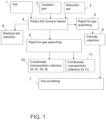
- Figure 1 is a schematic view of a first embodiment of the system used and the method of the invention, wherein a one phase rotary kiln furnace is used for recovering metals from fly ash.
- the embodiment of figure 1 comprises the following steps and units.
- Unit 1 is a container for combustion ash, fly ash in this embodiment, from which it is fed into a continuous rotary kiln furnace referred to with reference number 4.
- Unit 2 is a container for oxidizing gas, such as air, which is fed into and through the furnace 4.
- Unit 3 is a container for reduction gas, such as a hydrogen gas/nitrogen gas (H 2 /N 2 ) mixture, which also is fed into the furnace 4 and through that.
- reduction gas such as a hydrogen gas/nitrogen gas (H 2 /N 2 ) mixture
- the fly ash contains Cd it is volatilized in a preliminary step by feeding reducing gas, such as a H 2 /N 2 mixture, from unit 3 into the furnace 4 and by heating the furnace 4 to a preliminary temperature of ca 500°C.
- reducing gas such as a H 2 /N 2 mixture
- the volatilized Cd is quenched in a cooling unit (not shown) with e.g. nitrogen or possibly with air and collected in a collection unit (not shown), which can consist of one or more filter bags.
- the furnace 4 is then heated into a first temperature of approximately 850°C for volatilizing (other) existing chlorides contained in the fly ash in oxidation gas, such as air.
- the chlorides which mostly are in the form of NaCl and KCI, are volatilized as such.
- the ash contains CaCl 2 , the chloride is freed from CaCl 2 as HCl, and the Ca remains in the ash converted into CaO.
- chlorides of Pb and/ or Cu which also are collected as such.
- the gas flow of volatilized chlorides of Na and/or K is then fed into a cooling unit 5, where they are quenched with air so that they can be collected in unit 6, unit 5 and 6 being separate from those used for quenching and collecting CdCl 2 .
- Volatilized NaCl and/or KCI are collected in a collecting unit referred to with reference number 6, which can consist of one or more filter bags. Minor amounts of lead (II) chloride (PbCl 2 ) and copper(II) chloride (CuCI) might also be found in the volatilizing chlorides. Even Cadmium chloride (CdCl 2 ) can be found, if Cd has not been removed in a preliminary step referred to above. PbCl 2 and CuCl can be precipitated (chrystallized) from NaCl and/or KCl products if their concentrations exceed acceptable ranges.
- PbCl 2 and CuCl can be precipitated (chrystallized) from NaCl and/or KCl products if their concentrations exceed acceptable ranges.
- HCl hydrogen chloride
- Such a scrubber can generally be used to remove some particulates and/or gases from industrial exhaust streams.
- the term “scrubber” has referred to pollution control devices that use liquid to wash unwanted pollutants from a gas stream. Recently, the term has also been used to describe systems that inject a dry reagent or slurry into a dirty exhaust stream to "wash out" acidic gases.
- the part of the volatilizing chlorides, which are in the form of HCl gas, is left in the reactor 4 to be removed in step 7 with a scrubber.
- the conditions in the furnace 4 are changed by feeding a reducing gas flow, e.g. a H 2 /N 2 mixture, from gas container 3 to and through the furnace 4 and by stopping the flow of oxidation gas from container 2 to furnace 4.
- a reducing gas flow e.g. a H 2 /N 2 mixture
- the heating of the fly ash is continued in the furnace 4 by heating to a temperature of approximately 1000°C for volatilizing Zn, Bi, and Sb in the atmosphere of said reducing gas.
- Non-volatilized compounds of the ash are residuals that are collected in unit 8 e.g. for manufacturing end products like catalysts or water treatment chemicals.
- the gas flow with the vaporized Zn, Bi, and/or Sb is then fed into a cooling unit 9 for quenching with nitrogen or possibly air with a speed with which the vaporized metals form nanosized aerosol particles.
- a cooling unit 9 for quenching with nitrogen or possibly air with a speed with which the vaporized metals form nanosized aerosol particles.
- the nanosized aerosol Zn, Bi, and Sb particles are then recovered in a collection unit 10, which e.g. can be a filter bag.
- the heating of the fly ash is continued in the furnace 4, which now is heated into a temperature of 1000 - 1400°C, whereby a further part of volatilizing metals, such as Cu, in the combustion ash are volatilized in gaseous form into the gas flow.
- the gas flow with the volatilized Cu and other volatilizing metals is then fed into the same cooling unit 9 as for Zn, Bi and Sb for quenching with nitrogen or air and with a velocity with which these further part of volatilized metals form nanosized aerosol particles.
- the velocity, temperature, and place of the quenching and diluting gas is crucial so that particles of nanosized would be formed, since the gas flow should not cool down before the quenching.
- the nanosized aerosol Cu and possible other metals are then recovered in a separate collection unit 11, which also ca be a filter bag.
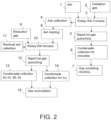
- Figure 2 is a schematic view of a second embodiment of the system used and the method of the invention, wherein a two-phase process is used for recovering metals from fly ash.
- the embodiment of figure 2 comprises the following steps and units.
- Unit 1 is a container for combustion ash, fly ash in this embodiment, from which it is fed into a continuous rotary kiln furnace referred to with reference number 3.
- Unit 2 is a container for oxidizing gas, such as air, which is fed into and through the furnace 3.
- the fly ash contains Cd it can be volatilized in a preliminary step by feeding reducing gas, such as a H 2 /N 2 mixture, from unit 9 into the furnace 3 and by heating the furnace 3 to a preliminary temperature of ca 500°C.
- reducing gas such as a H 2 /N 2 mixture
- the volatilized Cd is quenched in a cooling unit (not shown) with nitrogen or possibly with air and collected in a collection unit (not shown) by filter bags.
- Furnace 3 is then heated into a temperature of approximately 850°C for volatilizing existing chlorides contained in the fly ash in oxidation gas, such as air.
- the chlorides which mostly are in the form of NaCl and KCl, are volatilized as such. There might also be minor amounts of CdCl 2 . If the ash contains CaCl 2 , the chloride is freed from CaCl 2 as HCl, and the Ca remains in the ash converted into CaO.
- the gas flow of volatilized chlorides is then fed into a cooling unit 5, where it is quenched with air so that they could be collected.
- Volatilized NaCl and/or KCl are collected in a collecting unit referred to with reference number 6, which can consist of one or more filter bags. Minor amounts of PbCl 2 and CuCl might also be found in the volatilizing chlorides. Even CdCl 2 can be found, if Cd is not removed not removed in a preliminary step referred to above. PbCl 2 and CuCI can be precipitated (chrystallized) from the mixture of chlorides if their concentrations exceed acceptable ranges.
- the part of the volatilizing chlorides in the form of HCl gas is left in the reactor 3 to be removed in a later step with a scrubber (see reference number 7).
- non-volatilized compounds of the fly ash are collected in unit 4 for further treatment and recovery of metals.
- This ash is fed to unit 8 and from there further to a rotary kiln furnace 10.
- Unit 9 is a container for reducing gas, such as a H 2 /N 2 mixture, which also is fed as a gas flow into the rotary kiln furnace 10.
- reducing gas such as a H 2 /N 2 mixture
- the heating of the fly ash is continued in the furnace 10 by heating to a temperature of approximately 1000°C for volatilizing Zn, Bi, and/or Sb in the atmosphere of said reducing gas.
- the gas flow with the vaporized Zn, Bi, and/or Sb is then fed into a cooling unit 12 for quenching with nitrogen or possibly air with a speed and in conditions with which the vaporized Zn, Bi, and/or Sb form nanosized aerosol particles.
- the nanosized aerosol Zn, Bi, and Sb particles are then recovered in a collection unit 13, which e.g. can be a filter bag.
- the heating of the fly ash is continued in the furnace 10 by heating to a temperature of approximately 1000°C - 1400 °C for volatilizing a resting part of volatilizing metals, such as Cu in the atmosphere of said reducing gas.
- Cu is vaporized in gaseous form into the gas flow.
- the gas flow with the vaporized Cu and other resting volatilizing metals is then fed into the same cooling unit 12 as for Zn, Bi and Sb for quenching with nitrogen or possibly air with a speed and in conditions with which this part of volatilized metals form nanosized aerosol particles.
- the nanosized aerosol Cu and other possible metals are then recovered in a separate collection unit 14, which also can be a filter bag.
- Non-volatilized compounds of the ash are residuals that are collected in unit 11 e.g. for manufacturing end products like catalysts or water treatment chemicals.
- a gas scrubber 15 can generally be used to remove some particulates and/or gases from industrial exhaust streams.
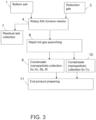
- Figure 3 is a schematic view of a third embodiment of the system used and the method of the invention for recovering metals from bottom ash in a rotary kiln furnace.
- the embodiment of figure 3 comprises the following steps and units.
- Unit 1 is a container for combustion ash, bottom ash in this embodiment, from which it is fed into a continuous rotary kiln furnace referred to with reference number 4.
- Unit 3 is a container for reduction gas, such as a H 2 /N 2 mixture, which is fed into and through the furnace 4.
- reduction gas such as a H 2 /N 2 mixture
- the heating of the bottom ash is continued in the furnace 4 by heating to a temperature of approximately 1000°C for volatilizing Zn, Bi and/or Sb in the atmosphere of said reduction gas.
- the gas flow with the volatilized Zn, Bi and/or Sb is then fed into a cooling unit 8 for quenching with nitrogen or possibly air with a speed and in conditions with which the volatilized metals form nanosized aerosol particles.
- the nanosized aerosol Zn, Bi, and Sb particles are then recovered in a collection unit 9, which e.g. can be a filter bag.
- the heating of the bottom ash is still continued in the furnace 4 by heating to a temperature of approximately 1000°C - 1400°C for volatilizing also a further part of volatilizing metals, such as Cu, in the atmosphere of said reducing gas and Cu is vaporized in gaseous form into the gas flow.
- Non-volatilized compounds of the ash are residuals that are collected in unit 7 e.g. for manufacturing end products like catalysts or water treatment chemicals.
- the gas flow containing volatilized Cu and other volatilizing metals is then fed into the same cooling unit 8 as for Zn, Bi and Sb for quenching with nitrogen or possibly air in conditions in which and with a speed with which this further part of volatilized metals form nanosized aerosol particles.
- the nanosized aerosol Cu and other metals are then recovered in a separate collection unit 10, which also ca be a filter bag.
- Reference number 11 stands for preparing end products. End products from Cu and Zn might be needed in cosmetics, paints, electronics, and different nanomaterials.
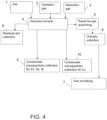
- Figure 4 is a schematic view of a fourth embodiment of the system used and the method of the invention for recovering metals from fly ash in an induction furnace.
- the embodiment of figure 4 comprises the following steps and units.
- Unit 1 is a container for combustion ash, fly ash in this embodiment, from which it is fed into an induction furnace referred to with reference number 4.
- Unit 2 is a container for oxidizing gas, such as air, which is fed into and through the furnace 4.
- Unit 3 is a container for reducing gas, such as a H 2 /N 2 mixture, which also is fed into the furnace 4 and through that.
- reducing gas such as a H 2 /N 2 mixture
- the fly ash contains Cd, it is volatilized in a preliminary step by feeding reducing gas, such as a H 2 /N 2 mixture, from unit 3 into the furnace 4 and by heating furnace 4 to a preliminary temperature of ca 500°C.
- reducing gas such as a H 2 /N 2 mixture
- the volatilized Cd is quenched in a cooling unit (not shown) with e.g. nitrogen or possibly with air and collected in a collection unit (not shown), which can consist of one or more filter bags.
- the furnace 4 is then heated into a first temperature of approximately 850°C for volatilizing (other) existing chlorides contained in the fly as in oxidation gas, such as air.
- the other chlorides which mostly are in the form of NaCl and KCl, are volatilized as such. There might be minor amounts of CdCl 2 . If the ash contains CaCl 2 , the chloride is freed from CaCl 2 as HCl, and the Ca remains in the ash converted into CaO. There can also be chlorides of Pb and/ or Cu, which also are collected as such.
- the gas flow of volatilized chlorides of Na and/or K is then fed into a cooling unit 5, where they are quenched with air so that they could be collected in unit 6, unit 5 and 6 being separate from those used for quenching and collecting CdCl 2 .
- Volatilized NaCl and/or KCI are collected in a collecting unit referred to with reference number 6, which can consist of one or more filter bags. Minor amounts of PbCl 2 and CuCI might also be found in the volatilizing chlorides. Even CdCl 2 can be found, if not removed in a preliminary step referred to above. PbCl 2 and CuCl can be precipitated (chrystallized) from NaCl and/or KCl products if their concentrations exceed acceptable ranges.
- the part of the volatilizing chlorides, which are in the form of HCl gas, is left in the reactor 4 to be removed in step 7 with a scrubber.
- a scrubber can generally be used to remove some particulates and/or gases from industrial exhaust streams.
- the conditions in the furnace 4 are changed by feeding a reducing gas flow, e.g. a H 2 /N 2 mixture, from gas container 3 to and through the furnace 4.
- a reducing gas flow e.g. a H 2 /N 2 mixture
- the heating of the fly ash is continued in the furnace 4 by heating to a temperature of approximately 1000°C for volatilizing Zn, Bi, and Sb in the atmosphere of said reducing gas.
- Non-volatilized compounds of the ash are residuals that are collected in unit 8 e.g. for manufacturing end products like catalysts or water treatment chemicals.
- the vaporized metals form nanosized aerosol particles in the interaction with the gas flow.
- the nanosized aerosol Zn, Bi, and Sb particles are then recovered in a collection unit 9, which e.g. can be a filter bag.
- the heating of the fly ash is continued in the furnace 4, which now is heated to a temperature of 1000 - 1400°C, whereby a further part of volatilizing metals, such as Cu, in the combustion ash are volatilized in gaseous form into the gas flow.
- the nanosized aerosol Cu and possible other metals are then recovered in a separate collection unit 10, which also ca be a filter bag.
- a porous tube dilutor connected to the outlet of the reactor tube and positioned inside the reactor, was used to quench and dilute the hot product gases (Lyyränen et al., 2004; Backman et al. 2002) vaporized as a consequence of the heating.
- FTIR Fourier-Transform Infrared
- the release of Cd commenced between 700 and 750 °C and reached 95% by 1050 °C.
- the release of Pb commenced between 650 and 720 °C and reached 94% by 1050 °C.
- the release of Zn commenced around 850 °C. Only a minor fraction of Zn ( ⁇ 15%) was released by 1050 °C. Copper was released within the temperature range 700 - 900 °C. Around 50% of Cu was released following heating at temperatures above 900 °C.
- Bismuth was non-volatile below 1000 °C. Only a minor fraction of Bi (15%) was released at 1050 °C.
- the following elements showed negligible volatility in air below 1050 °C: P, Ca, Mg, Ti, Al, Sb, Sn, and As.
- the metals to be recovered in the invention are not significantly vaporized in oxidizing conditions.
- the release profiles for CI and K in 10% H 2 were similar to their release profiles in air.
- the release of Na in 10% H 2 was almost identical to that in the air gas atmosphere for temperatures below 900 °C. Above this temperature, Na was released to a greater extent in 10% H 2 than in air.
- the release of Na at 1050 °C in 10% H 2 was 78% (c.f. 53% in air at 1050 °C).
- Sulphur was released to a greater extent in 10% H 2 than in air.
- the release of S in 10% H 2 commenced between 600 and 700 °C (at least 100 °C lower than the onset temperature for S release in air).
- the hydrogen gas atmosphere inhibited the complete release of carbon.
- the release of Cu was minor below 880 °C ( ⁇ 10% release). At 1050 °C, around 25% of Cu was released to the gas phase. The release of Sb and Sn commenced between 600 and 700 °C and reached around 70-75% by 1000 °C. Arsenic was released to only a minor extent (around 30% at 1050 °C). The onset of As release commenced around 700 - 800 °C. The release of Bi commenced around 500 - 600 °C and reached around 85 - 90% by 880 °C. The following elements showed negligible volatility in 10% H 2 below 1050 °C: P, Ti, Ca, Mg, and Al.
- Example 2 Induction furnace.
- Example 2 The same fly ash sample used in Example 1 was heated in an induction furnace in a gas atmosphere consisting of H 2 (10% v/v) and N 2 (90% v/v). Samples of fly ash (10 - 14 g) were loaded into the induction furnace. The induction furnace was then sealed and heated to 1100 °C. Material which volatilized from the fly ash at 1100°C was quenched and then collected on a filter.
- the collected condensate was composed of Zn (36.8%), K (19.0%), Na (11.5%), Pb (2.6%), Sn (0.9%) of the gravimetrically weighted mass.
- the resting 1,2% was composed of minor elements (Cr, Mn, Co, Ni, Cu, As, Mo, Ag, Cd, Sb, Ti, Bi) and unanalyzed, probably chlorine and sulphur, 28 %.
- ICP-MS inductively-coupled plasma mass spectrometry
- XRF X-ray fluorescence
- Metal and metalloid contaminated MSWI fly ash can be heat-treated in two stages to achieve favourable fractionation of metals and metalloids.
- fly ash is heated at 900°C in air to remove chlorides (>99% removal calculated as CI), C (>98% removal), and significant amounts of K, Na, Cd, Pb, and Cu from the ash removed in the form of chlorides.
- the volatilized material can be quenched by hot gas dilution (Lyyränen et al., 2004, Backman et al. 2002) and then collected in an electrostatic precipitator (ESP) or bag filter.
- ESP electrostatic precipitator
- the collected material can potentially be utilized as road salt.
- the hot (900 °C) reactor is purged of oxygen by flushing with nitrogen gas, and then hydrogen is fed into the reactor to create a gas atmosphere consisting of both hydrogen and nitrogen.
- the second stage of treatment causes Zn to volatilize and small amounts of valuable commodity elements, particularly Sn, Sb, and Bi, to volatilize.
- Antimony and bismuth are both classified as critical raw materials by the EU
- Volatilized material is then quenched by hot gas dilution (Lyyränen et al., 2004) to form a zinc-rich condensate.
- the condensate can be collected in an ESP or bag filter.
- Gaseous zinc is transformed into zinc nanoparticles during hot gas dilution.
- the zinc nanoparticles can potentially be used to produce various high-value products (e.g. sunscreens, paints, electronics, solar cells, sensors etc.).
- a similar procedure as for Zn can be performed later for Cu, especially for bottom ash, because there are no chlorides a relatively large amounts of Cu, but at a higher reactor temperature as Cu starts to vaporize at around 1100°C and is completed at around 1350°C according to chemical equilibrium.
Landscapes
- Engineering & Computer Science (AREA)
- Chemical & Material Sciences (AREA)
- Mechanical Engineering (AREA)
- Environmental & Geological Engineering (AREA)
- Metallurgy (AREA)
- Manufacturing & Machinery (AREA)
- General Life Sciences & Earth Sciences (AREA)
- Materials Engineering (AREA)
- Life Sciences & Earth Sciences (AREA)
- Geology (AREA)
- Organic Chemistry (AREA)
- General Engineering & Computer Science (AREA)
- Physics & Mathematics (AREA)
- Thermal Sciences (AREA)
- Manufacture And Refinement Of Metals (AREA)
- Processing Of Solid Wastes (AREA)
- Gasification And Melting Of Waste (AREA)
Claims (18)
- Procédé pour traiter des cendres de combustion afin de récupérer des métaux, ledit procédé comprenant les étapes consistant àa) chauffer un four à passage continu à une première température,b) introduire des cendres de combustion dans le four,c) introduire un gaz oxydant traversant le four,d) chauffer les cendres de combustion introduites dans le four à la première température pour volatiliser des chlorures contenus dans les cendres, et éliminer les chlorures,e) changer les conditions dans le four en introduisant un flux de gaz réducteur traversant le four,f) varier la température à une deuxième température pour chauffer les cendres de combustion dans le four afin de volatiliser vers le flux de gaz un ou plusieurs métaux contenus dans les cendres, etg) récupérer les particules volatilisées dans une ou plusieurs unités de collecte.
- Procédé selon la revendication 1, dans lequel les cendres de combustion sont choisies parmi les cendres de grille ou les cendres volantes, lesdites cendres volantes contenant un ou plusieurs parmi Si, Ca, Al, Zn, Na, Sb, Bi, K, Fe, Co, Cu, Ni et V et lesdites cendres de grille contenant un ou plusieurs parmi Si, Al, Zn, Sb, Bi, Fe, Co, Cu, Ni et V.
- Procédé selon la revendication 2, dans lequel les cendres de combustion sont des cendres de grille et la première température est suffisante pour volatiliser Zn, Bi et/ou Sb, préférablement d'environ 1000 °C.
- Procédé selon l'une des revendications 1 à 3, dans lequel, dans l'étape f), les métaux à volatiliser restant dans les cendres de combustion, tels que le Cu, sont volatilisés sous forme gazeuse vers le flux de gaz, et ensuite, l'étape g) est réalisée également pour le Cu.
- Procédé selon l'une des revendications 1 à 4, dans lequel le gaz réducteur dans l'étape e) est un mélange de gaz d'azote et d'hydrogène et/ou de gaz de monoxyde de carbone, CO.
- Procédé selon l'une des revendications 1 à 5, dans lequel le flux de gaz avec les gaz volatilisés est trempé avant l'étape de récupération g).
- Procédé selon la revendication 6, dans lequel la trempe est réalisée avec un gaz de trempe avant que le flux de gaz avec les métaux volatilisés soit refroidi sous de telles conditions et à une telle vitesse que des particules d'aérosol de taille nano sont formées.
- Procédé selon l'une des revendications 1 à 2 et 5 à 7, dans lequel les cendres de combustion sont des cendres volantes comprenant également des chlorures de l'un ou plusieurs parmi Na, K, Ca et/ou Cd.
- Procédé selon la revendication 8, dans lequel la première température pour volatiliser des chlorures est de 800 - 900 °C et la deuxième température pour volatiliser des métaux dans l'étape f) est suffisante pour volatiliser Zn, Bi et Sb, préférablement d'environ 1000 °C.
- Procédé selon la revendication 8 ou 9, dans lequel le gaz oxydant pour volatiliser des chlorures de l'un ou plusieurs parmi Na, K, Cu, Pb est un flux de gaz constitué d'air introduit dans le four.
- Procédé selon l'une des revendications 8 à 10, dans lequel les chlorures sont éliminés après la volatilisation et la trempe par collecte par sacs filtrants.
- Procédé selon l'une des revendications 8 à 11, dans lequel le chauffage des cendres de combustion est poursuivi après l'étape f) dans le four en élevant la température à une troisième température par quoi des métaux à volatiliser restant dans les cendres de combustion, tels que le Cu, sont volatilisés sous forme gazeuse vers le flux de gaz, et ensuite, l'étape g) est réalisée pour le Cu et lesdits autres gaz volatilisés.
- Procédé selon l'une des revendications 1 à 2 et 5 à 12, dans lequel le Cd est volatilisé et éliminé avant l'étape a) par l'introduction d'un gaz réducteur traversant le four chauffé à une température préliminaire pour volatiliser le Cd, et préférablement à une température de l'ordre de 500 °C environ.
- Procédé selon l'une des revendications 8 à 13, dans lequel l'élimination des chlorures est réalisée dans un four rotatif et les cendres de combustion sont, après élimination des chlorures, introduites dans un autre four rotatif pour la réalisation de l'étape f).
- Procédé selon l'une des revendications 8 à 13, dans lequel l'étape f) est réalisée dans le même réacteur-four rotatif que l'élimination des chlorures.
- Procédé selon l'une des revendications 1 à 15, dans lequel les métaux sont récupérés par collecte sur un filtre.
- Procédé selon l'une des revendications 1 à 16, dans lequel des composés non volatilisés dans l'étape f) sont des résidus et ils sont séparés, chauffés et pulvérisés.
- Procédé selon la revendication 17, dans lequel les composés non volatilisés sont Si, Ca, AI, Fe, Co, Mg, Ni, P, Ti, As et V et des formes non volatiles de Na et K.
Applications Claiming Priority (2)
| Application Number | Priority Date | Filing Date | Title |
|---|---|---|---|
| FI20195150A FI128915B (en) | 2019-02-28 | 2019-02-28 | PROCEDURE FOR ASH TREATMENT |
| PCT/FI2020/050027 WO2020174123A1 (fr) | 2019-02-28 | 2020-01-16 | Procédé et système de traitement de cendres |
Publications (3)
| Publication Number | Publication Date |
|---|---|
| EP3931490A1 EP3931490A1 (fr) | 2022-01-05 |
| EP3931490C0 EP3931490C0 (fr) | 2024-09-25 |
| EP3931490B1 true EP3931490B1 (fr) | 2024-09-25 |
Family
ID=69411468
Family Applications (1)
| Application Number | Title | Priority Date | Filing Date |
|---|---|---|---|
| EP20703070.1A Active EP3931490B1 (fr) | 2019-02-28 | 2020-01-16 | Procédé de traitement de cendres |
Country Status (8)
| Country | Link |
|---|---|
| US (1) | US12281372B2 (fr) |
| EP (1) | EP3931490B1 (fr) |
| JP (1) | JP7441237B2 (fr) |
| KR (1) | KR20210141943A (fr) |
| CN (1) | CN113710959A (fr) |
| ES (1) | ES2994515T3 (fr) |
| FI (1) | FI128915B (fr) |
| WO (1) | WO2020174123A1 (fr) |
Families Citing this family (4)
| Publication number | Priority date | Publication date | Assignee | Title |
|---|---|---|---|---|
| US12104223B2 (en) * | 2021-10-22 | 2024-10-01 | Advanced Fusion Systems Llc | Advanced beneficiation process for beneficiation, mobilization, extraction, separation, and concentration of mineralogical resources |
| CN117448582B (zh) * | 2023-10-07 | 2024-04-26 | 中国矿业大学 | 一种基于分布赋存的粉煤灰中关键金属高效提取的方法 |
| CN117732829A (zh) * | 2023-11-08 | 2024-03-22 | 湖南大学 | 一种压电材料协同球磨去除二恶英类污染物的方法 |
| CN118497486B (zh) * | 2024-05-30 | 2025-02-25 | 北方工业大学 | 一种利用垃圾焚烧飞灰和铁尾矿制备铁合金和地聚物材料的方法 |
Family Cites Families (15)
| Publication number | Priority date | Publication date | Assignee | Title |
|---|---|---|---|---|
| US2948948A (en) * | 1956-12-10 | 1960-08-16 | Babcock & Wilcox Co | Fly ash reclamation by pelletizing |
| US4159310A (en) * | 1978-01-30 | 1979-06-26 | Public Service Company Of New Mexico | Process for recovering aluminum and other metal values from fly ash |
| SE444956B (sv) * | 1980-06-10 | 1986-05-20 | Skf Steel Eng Ab | Sett att ur metalloxidhaltiga material utvinna ingaende lettflyktiga metaller eller koncentrat av dessa |
| US4643110A (en) * | 1986-07-07 | 1987-02-17 | Enron, Inc. | Direct fuel-fired furnace arrangement for the recovery of gallium and germanium from coal fly ash |
| JPH09227964A (ja) | 1996-02-20 | 1997-09-02 | Daido Steel Co Ltd | ダスト処理装置 |
| JPH11114530A (ja) * | 1997-10-16 | 1999-04-27 | Shinsei Dental Laboratory:Kk | 焼却灰または飛灰の無害化処理方法 |
| JPH11293352A (ja) | 1998-02-12 | 1999-10-26 | Nkk Corp | 複数種の金属酸化物を含む金属源を還元分離し金属を回収する方法および装置 |
| US6379421B1 (en) | 1999-02-25 | 2002-04-30 | Hylsa S.A. De C.V. | Method and apparatus removing undesirable metals from iron-containing materials |
| US6682586B2 (en) | 2001-10-09 | 2004-01-27 | Heritage Environmental Services, Llc. | Assemblies and methods for processing zinc-bearing materials |
| JP2003245642A (ja) * | 2001-12-19 | 2003-09-02 | Taiheiyo Cement Corp | 重金属含有物質の無害化方法及び加熱炉 |
| DE102008004796B3 (de) * | 2008-01-17 | 2009-03-19 | Forschungszentrum Karlsruhe Gmbh | Verfahren zur Behandlung von Flugasche |
| EP2375153B1 (fr) | 2010-04-12 | 2018-09-26 | Heiner Zwahr | Traitement de cendres volantes |
| EP2428493A1 (fr) * | 2010-09-08 | 2012-03-14 | Kalogeo Anlagenbau GmbH | Traitement thermique de cendre |
| FI123432B (fi) | 2011-12-02 | 2013-04-30 | Jyvaeskylaen En Oy | Menetelmä tuhkan, erityisesti lentotuhkan käsittelemiseksi |
| CN104070053B (zh) * | 2014-07-02 | 2017-01-18 | 天津壹鸣环境科技股份有限公司 | 一种垃圾焚烧飞灰分级煅烧减量化处理技术 |
-
2019
- 2019-02-28 FI FI20195150A patent/FI128915B/en active IP Right Grant
-
2020
- 2020-01-16 CN CN202080032052.0A patent/CN113710959A/zh active Pending
- 2020-01-16 EP EP20703070.1A patent/EP3931490B1/fr active Active
- 2020-01-16 WO PCT/FI2020/050027 patent/WO2020174123A1/fr not_active Ceased
- 2020-01-16 JP JP2021550300A patent/JP7441237B2/ja active Active
- 2020-01-16 ES ES20703070T patent/ES2994515T3/es active Active
- 2020-01-16 KR KR1020217031005A patent/KR20210141943A/ko active Pending
-
2021
- 2021-08-26 US US17/445,998 patent/US12281372B2/en active Active
Also Published As
| Publication number | Publication date |
|---|---|
| US12281372B2 (en) | 2025-04-22 |
| ES2994515T3 (en) | 2025-01-24 |
| EP3931490C0 (fr) | 2024-09-25 |
| WO2020174123A1 (fr) | 2020-09-03 |
| US20210388463A1 (en) | 2021-12-16 |
| EP3931490A1 (fr) | 2022-01-05 |
| FI128915B (en) | 2021-03-15 |
| KR20210141943A (ko) | 2021-11-23 |
| JP7441237B2 (ja) | 2024-02-29 |
| FI20195150A1 (en) | 2020-08-29 |
| JP2022521804A (ja) | 2022-04-12 |
| CN113710959A (zh) | 2021-11-26 |
Similar Documents
| Publication | Publication Date | Title |
|---|---|---|
| US12281372B2 (en) | Method and system for ash treatment | |
| Weibel et al. | Chemical associations and mobilization of heavy metals in fly ash from municipal solid waste incineration | |
| Nowak et al. | Heavy metal removal from municipal solid waste fly ash by chlorination and thermal treatment | |
| Chan et al. | The behaviour of selected heavy metals in MSW incineration electrostatic precipitator ash during roasting with chlorination agents | |
| Song et al. | Characteristics of ashes from different locations at the MSW incinerator equipped with various air pollution control devices | |
| Lane et al. | Thermal separation of zinc and other valuable elements from municipal solid waste incineration fly ash | |
| Biganzoli et al. | Volatilisation and oxidation of aluminium scraps fed into incineration furnaces | |
| Wang et al. | Estimating mercury emissions from a zinc smelter in relation to China’s mercury control policies | |
| Li et al. | Mercury emission to atmosphere from primary Zn production in China | |
| JP2020532425A (ja) | 塩素を含む廃棄材料又は産業副産物の精製のための方法 | |
| Zhan et al. | Recycling arsenic from gallium arsenide scraps through sulfurizing thermal treatment | |
| Weng et al. | Fixing sulfur dioxide by feeding calcine oxide into the rotary volatilization kiln in zinc smelting plant | |
| Shu et al. | Metal mobility and toxicity of reclaimed copper smelting fly ash and smelting slag | |
| Fan et al. | Synergy of directional oxidation and vacuum gasification for green recovery of As2O3 from arsenic-containing hazardous secondary resources | |
| Fan et al. | Efficient disposal of lead anode slime for green separation and recycling of hazardous materials As, Sb, and Te | |
| Biganzoli et al. | Aluminium mass balance in waste incineration and recovery potential from the bottom ash: a case study | |
| CA2182168C (fr) | Procede de traitement de dechets solides contenant des contaminants inorganiques volatils | |
| Min et al. | Selective separation of thallium and fluorine from thallium sulfide sludge via dual-stage roasting for sustainable resource recovery | |
| Weibel | Optimized metal recovery from fly ash from municipal solid waste incineration | |
| Tanutrov et al. | Features of Waste Chemical Processing Germanium Concentrates | |
| Lee et al. | Characterization, decontamination and health effects of fly ash from waste incinerators | |
| CN108350520A (zh) | 一种从锌生产链中生成的残留物生产包含金属、稀有金属和稀土金属的浓缩物的方法以及通过所述方法获得的浓缩物 | |
| JP3564625B2 (ja) | 排ガス中の媒塵の処理方法 | |
| JP2002119945A (ja) | 廃棄物焼却排ガスとダストの処理方法 | |
| Berry et al. | Removal of mercury enables recycle of copper smelter acid plant sludge |
Legal Events
| Date | Code | Title | Description |
|---|---|---|---|
| STAA | Information on the status of an ep patent application or granted ep patent |
Free format text: STATUS: UNKNOWN |
|
| STAA | Information on the status of an ep patent application or granted ep patent |
Free format text: STATUS: THE INTERNATIONAL PUBLICATION HAS BEEN MADE |
|
| PUAI | Public reference made under article 153(3) epc to a published international application that has entered the european phase |
Free format text: ORIGINAL CODE: 0009012 |
|
| STAA | Information on the status of an ep patent application or granted ep patent |
Free format text: STATUS: REQUEST FOR EXAMINATION WAS MADE |
|
| 17P | Request for examination filed |
Effective date: 20210826 |
|
| AK | Designated contracting states |
Kind code of ref document: A1 Designated state(s): AL AT BE BG CH CY CZ DE DK EE ES FI FR GB GR HR HU IE IS IT LI LT LU LV MC MK MT NL NO PL PT RO RS SE SI SK SM TR |
|
| DAV | Request for validation of the european patent (deleted) | ||
| DAX | Request for extension of the european patent (deleted) | ||
| GRAP | Despatch of communication of intention to grant a patent |
Free format text: ORIGINAL CODE: EPIDOSNIGR1 |
|
| STAA | Information on the status of an ep patent application or granted ep patent |
Free format text: STATUS: GRANT OF PATENT IS INTENDED |
|
| INTG | Intention to grant announced |
Effective date: 20240426 |
|
| GRAS | Grant fee paid |
Free format text: ORIGINAL CODE: EPIDOSNIGR3 |
|
| GRAA | (expected) grant |
Free format text: ORIGINAL CODE: 0009210 |
|
| STAA | Information on the status of an ep patent application or granted ep patent |
Free format text: STATUS: THE PATENT HAS BEEN GRANTED |
|
| AK | Designated contracting states |
Kind code of ref document: B1 Designated state(s): AL AT BE BG CH CY CZ DE DK EE ES FI FR GB GR HR HU IE IS IT LI LT LU LV MC MK MT NL NO PL PT RO RS SE SI SK SM TR |
|
| REG | Reference to a national code |
Ref country code: GB Ref legal event code: FG4D |
|
| REG | Reference to a national code |
Ref country code: CH Ref legal event code: EP |
|
| REG | Reference to a national code |
Ref country code: DE Ref legal event code: R096 Ref document number: 602020038256 Country of ref document: DE |
|
| RAP2 | Party data changed (patent owner data changed or rights of a patent transferred) |
Owner name: BETOLAR OYJ |
|
| REG | Reference to a national code |
Ref country code: IE Ref legal event code: FG4D |
|
| U01 | Request for unitary effect filed |
Effective date: 20241024 |
|
| U07 | Unitary effect registered |
Designated state(s): AT BE BG DE DK EE FI FR IT LT LU LV MT NL PT RO SE SI Effective date: 20241126 |
|
| PG25 | Lapsed in a contracting state [announced via postgrant information from national office to epo] |
Ref country code: GR Free format text: LAPSE BECAUSE OF FAILURE TO SUBMIT A TRANSLATION OF THE DESCRIPTION OR TO PAY THE FEE WITHIN THE PRESCRIBED TIME-LIMIT Effective date: 20241226 |
|
| REG | Reference to a national code |
Ref country code: ES Ref legal event code: FG2A Ref document number: 2994515 Country of ref document: ES Kind code of ref document: T3 Effective date: 20250124 |
|
| PG25 | Lapsed in a contracting state [announced via postgrant information from national office to epo] |
Ref country code: RS Free format text: LAPSE BECAUSE OF FAILURE TO SUBMIT A TRANSLATION OF THE DESCRIPTION OR TO PAY THE FEE WITHIN THE PRESCRIBED TIME-LIMIT Effective date: 20241225 |
|
| PG25 | Lapsed in a contracting state [announced via postgrant information from national office to epo] |
Ref country code: RS Free format text: LAPSE BECAUSE OF FAILURE TO SUBMIT A TRANSLATION OF THE DESCRIPTION OR TO PAY THE FEE WITHIN THE PRESCRIBED TIME-LIMIT Effective date: 20241225 Ref country code: GR Free format text: LAPSE BECAUSE OF FAILURE TO SUBMIT A TRANSLATION OF THE DESCRIPTION OR TO PAY THE FEE WITHIN THE PRESCRIBED TIME-LIMIT Effective date: 20241226 |
|
| U20 | Renewal fee for the european patent with unitary effect paid |
Year of fee payment: 6 Effective date: 20250218 |
|
| PG25 | Lapsed in a contracting state [announced via postgrant information from national office to epo] |
Ref country code: IS Free format text: LAPSE BECAUSE OF FAILURE TO SUBMIT A TRANSLATION OF THE DESCRIPTION OR TO PAY THE FEE WITHIN THE PRESCRIBED TIME-LIMIT Effective date: 20250125 |
|
| PG25 | Lapsed in a contracting state [announced via postgrant information from national office to epo] |
Ref country code: SM Free format text: LAPSE BECAUSE OF FAILURE TO SUBMIT A TRANSLATION OF THE DESCRIPTION OR TO PAY THE FEE WITHIN THE PRESCRIBED TIME-LIMIT Effective date: 20240925 |
|
| PG25 | Lapsed in a contracting state [announced via postgrant information from national office to epo] |
Ref country code: PL Free format text: LAPSE BECAUSE OF FAILURE TO SUBMIT A TRANSLATION OF THE DESCRIPTION OR TO PAY THE FEE WITHIN THE PRESCRIBED TIME-LIMIT Effective date: 20240925 Ref country code: CZ Free format text: LAPSE BECAUSE OF FAILURE TO SUBMIT A TRANSLATION OF THE DESCRIPTION OR TO PAY THE FEE WITHIN THE PRESCRIBED TIME-LIMIT Effective date: 20240925 |
|
| PG25 | Lapsed in a contracting state [announced via postgrant information from national office to epo] |
Ref country code: SK Free format text: LAPSE BECAUSE OF FAILURE TO SUBMIT A TRANSLATION OF THE DESCRIPTION OR TO PAY THE FEE WITHIN THE PRESCRIBED TIME-LIMIT Effective date: 20240925 |
|
| PLBE | No opposition filed within time limit |
Free format text: ORIGINAL CODE: 0009261 |
|
| STAA | Information on the status of an ep patent application or granted ep patent |
Free format text: STATUS: NO OPPOSITION FILED WITHIN TIME LIMIT |
|
| REG | Reference to a national code |
Ref country code: CH Ref legal event code: PL |
|
| 26N | No opposition filed |
Effective date: 20250626 |
|
| PG25 | Lapsed in a contracting state [announced via postgrant information from national office to epo] |
Ref country code: MC Free format text: LAPSE BECAUSE OF FAILURE TO SUBMIT A TRANSLATION OF THE DESCRIPTION OR TO PAY THE FEE WITHIN THE PRESCRIBED TIME-LIMIT Effective date: 20240925 |
|
| GBPC | Gb: european patent ceased through non-payment of renewal fee |
Effective date: 20250116 |
|
| PG25 | Lapsed in a contracting state [announced via postgrant information from national office to epo] |
Ref country code: GB Free format text: LAPSE BECAUSE OF NON-PAYMENT OF DUE FEES Effective date: 20250116 |
|
| PG25 | Lapsed in a contracting state [announced via postgrant information from national office to epo] |
Ref country code: CH Free format text: LAPSE BECAUSE OF NON-PAYMENT OF DUE FEES Effective date: 20250131 |
|
| PG25 | Lapsed in a contracting state [announced via postgrant information from national office to epo] |
Ref country code: HR Free format text: LAPSE BECAUSE OF FAILURE TO SUBMIT A TRANSLATION OF THE DESCRIPTION OR TO PAY THE FEE WITHIN THE PRESCRIBED TIME-LIMIT Effective date: 20240925 |
|
| PG25 | Lapsed in a contracting state [announced via postgrant information from national office to epo] |
Ref country code: IE Free format text: LAPSE BECAUSE OF NON-PAYMENT OF DUE FEES Effective date: 20250116 |
|
| U20 | Renewal fee for the european patent with unitary effect paid |
Year of fee payment: 7 Effective date: 20260116 |
|
| PGFP | Annual fee paid to national office [announced via postgrant information from national office to epo] |
Ref country code: ES Payment date: 20260204 Year of fee payment: 7 |
|
| PGFP | Annual fee paid to national office [announced via postgrant information from national office to epo] |
Ref country code: NO Payment date: 20260126 Year of fee payment: 7 |