EP3932251A1 - Bildverarbeitungsvorrichtung, bildverarbeitungsverfahren und folie - Google Patents
Bildverarbeitungsvorrichtung, bildverarbeitungsverfahren und folie Download PDFInfo
- Publication number
- EP3932251A1 EP3932251A1 EP19916739.6A EP19916739A EP3932251A1 EP 3932251 A1 EP3932251 A1 EP 3932251A1 EP 19916739 A EP19916739 A EP 19916739A EP 3932251 A1 EP3932251 A1 EP 3932251A1
- Authority
- EP
- European Patent Office
- Prior art keywords
- region
- layer
- discolored
- image
- color
- Prior art date
- Legal status (The legal status is an assumption and is not a legal conclusion. Google has not performed a legal analysis and makes no representation as to the accuracy of the status listed.)
- Withdrawn
Links
Images



Classifications
-
- G—PHYSICS
- G06—COMPUTING OR CALCULATING; COUNTING
- G06V—IMAGE OR VIDEO RECOGNITION OR UNDERSTANDING
- G06V40/00—Recognition of biometric, human-related or animal-related patterns in image or video data
- G06V40/10—Human or animal bodies, e.g. vehicle occupants or pedestrians; Body parts, e.g. hands
- G06V40/16—Human faces, e.g. facial parts, sketches or expressions
- G06V40/168—Feature extraction; Face representation
-
- A—HUMAN NECESSITIES
- A45—HAND OR TRAVELLING ARTICLES
- A45D—HAIRDRESSING OR SHAVING EQUIPMENT; EQUIPMENT FOR COSMETICS OR COSMETIC TREATMENTS, e.g. FOR MANICURING OR PEDICURING
- A45D44/00—Other cosmetic or toiletry articles, e.g. for hairdressers' rooms
- A45D44/12—Ear, face, or lip protectors
-
- A—HUMAN NECESSITIES
- A45—HAND OR TRAVELLING ARTICLES
- A45D—HAIRDRESSING OR SHAVING EQUIPMENT; EQUIPMENT FOR COSMETICS OR COSMETIC TREATMENTS, e.g. FOR MANICURING OR PEDICURING
- A45D44/00—Other cosmetic or toiletry articles, e.g. for hairdressers' rooms
- A45D44/22—Face shaping devices, e.g. chin straps; Wrinkle removers, e.g. stretching the skin
-
- A—HUMAN NECESSITIES
- A61—MEDICAL OR VETERINARY SCIENCE; HYGIENE
- A61K—PREPARATIONS FOR MEDICAL, DENTAL OR TOILETRY PURPOSES
- A61K8/00—Cosmetics or similar toiletry preparations
- A61K8/02—Cosmetics or similar toiletry preparations characterised by special physical form
- A61K8/0216—Solid or semisolid forms
-
- A—HUMAN NECESSITIES
- A61—MEDICAL OR VETERINARY SCIENCE; HYGIENE
- A61K—PREPARATIONS FOR MEDICAL, DENTAL OR TOILETRY PURPOSES
- A61K8/00—Cosmetics or similar toiletry preparations
- A61K8/18—Cosmetics or similar toiletry preparations characterised by the composition
- A61K8/72—Cosmetics or similar toiletry preparations characterised by the composition containing organic macromolecular compounds
- A61K8/84—Cosmetics or similar toiletry preparations characterised by the composition containing organic macromolecular compounds obtained by reactions otherwise than those involving only carbon-carbon unsaturated bonds
- A61K8/85—Polyesters
-
- A—HUMAN NECESSITIES
- A61—MEDICAL OR VETERINARY SCIENCE; HYGIENE
- A61Q—SPECIFIC USE OF COSMETICS OR SIMILAR TOILETRY PREPARATIONS
- A61Q1/00—Make-up preparations; Body powders; Preparations for removing make-up
- A61Q1/02—Preparations containing skin colorants, e.g. pigments
-
- G—PHYSICS
- G06—COMPUTING OR CALCULATING; COUNTING
- G06V—IMAGE OR VIDEO RECOGNITION OR UNDERSTANDING
- G06V10/00—Arrangements for image or video recognition or understanding
- G06V10/10—Image acquisition
- G06V10/12—Details of acquisition arrangements; Constructional details thereof
- G06V10/14—Optical characteristics of the device performing the acquisition or on the illumination arrangements
- G06V10/141—Control of illumination
-
- G—PHYSICS
- G06—COMPUTING OR CALCULATING; COUNTING
- G06V—IMAGE OR VIDEO RECOGNITION OR UNDERSTANDING
- G06V10/00—Arrangements for image or video recognition or understanding
- G06V10/40—Extraction of image or video features
- G06V10/56—Extraction of image or video features relating to colour
-
- H—ELECTRICITY
- H04—ELECTRIC COMMUNICATION TECHNIQUE
- H04N—PICTORIAL COMMUNICATION, e.g. TELEVISION
- H04N1/00—Scanning, transmission or reproduction of documents or the like, e.g. facsimile transmission; Details thereof
- H04N1/46—Colour picture communication systems
- H04N1/56—Processing of colour picture signals
- H04N1/60—Colour correction or control
- H04N1/62—Retouching, i.e. modification of isolated colours only or in isolated picture areas only
-
- B—PERFORMING OPERATIONS; TRANSPORTING
- B44—DECORATIVE ARTS
- B44C—PRODUCING DECORATIVE EFFECTS; MOSAICS; TARSIA WORK; PAPERHANGING
- B44C1/00—Processes, not specifically provided for elsewhere, for producing decorative surface effects
- B44C1/10—Applying flat materials, e.g. leaflets, pieces of fabrics
- B44C1/105—Applying flat materials, e.g. leaflets, pieces of fabrics comprising an adhesive layer
Definitions
- the present disclosure relates to an image processing apparatus, an image processing method, and a sheet.
- Patent Literature 1 Japanese Unexamined Patent Application Publication No. 2015-43836
- a discolored portion such as a spot or a blotch, having a lightness (low L* value) lower than that of a periphery thereof and a discolored portion, such as a vitiligo, having a lightness (high L* value) higher than that of a periphery thereof.
- the discolored portion having a lightness higher than that of the periphery thereof may have a clear outline in many cases.
- the discolored portion having a lightness higher than that of the periphery thereof cannot be appropriately made inconspicuous.
- the present disclosure provides an image processing apparatus and an image processing method each of which produces image data to make a discolored portion having a lightness higher than that of a periphery thereof inconspicuous.
- the present disclosure also provides a sheet which makes a discolored portion having a lightness higher than that of a periphery thereof inconspicuous.
- An image processing apparatus is an image processing apparatus which produces image data to correct a color of a discolored portion having a lightness higher than that of a normal portion of a skin to a color of the normal portion, the image processing apparatus comprising: an image analysis section which identifies a discolored region corresponding to the discolored portion from a photographed image of the discolored portion; and an image data production section which produces, based on information of a color of a normal region of the image corresponding to the normal portion and a color of the discolored region, the image data to correct the color of the discolored portion to the color of the normal portion.
- the image data includes a first layer located at a skin side, a second layer located on the first layer, and a third layer located on the second layer, and the image data production section sets an L* value of a region of the first layer corresponding to the discolored region to a value lower than an L* value of the normal region by higher than or equal to 5 and lower than or equal to 20.
- the image processing apparatus, the image processing method, and the sheet according to the present disclosure are each able to make a discolored portion having a lightness higher than that of a periphery thereof inconspicuous without generating a thick coating feeling.
- An image processing apparatus produces image data to correct a color of a discolored portion having a lightness higher than that of a normal portion of a skin to a color of the normal portion.
- the image processing apparatus according to the present disclosure may further have, based on the image data described above, a function to form on a skin or a thin film, an image which corrects the color of the discolored portion to the color of the normal portion.
- the image processing apparatus as described above is also called a makeup support system.
- a correction object is a discolored portion having a lightness higher than that of a peripheral normal portion (non-discolored portion).
- a discolored portion of the skin for example, there may be mentioned a vitiligo, a skin grafted portion to which a skin having a lightness higher than that of a periphery thereof is grafted, a non-sunburnt region surrounded by a sunburnt region, a portion (such as a portion having a color irregularity or a portion formed by an operator's mistake) unintentionally having a lightness higher than that of a periphery thereof by body painting or the like, a non-makeup portion surrounded by a makeup portion, or a makeup- portion surrounded by a non-makeup portion.
- L* value represents the L* value, the a* value, and the b* value of the L*a*b* color system (CIE1976), respectively.
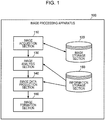
- Fig. 1 is a block diagram showing the structure of an image processing apparatus (makeup support system) 100 according to an embodiment of the present disclosure.
- the image processing apparatus (makeup support system) 100 includes an image acquisition section 110, an image storage section 120, an image analysis section 130, an image data production section 140, an information storage section 150, and an image formation section 160.
- the image acquisition section 110 acquires an image of a skin including a discolored portion. For example, the image acquisition section 110 photographs a user's face by a camera. Alternatively, the image acquisition section 110 may acquire an image photographed by an external apparatus by input therefrom or an image stored in the image storage section 120 by input therefrom. The image acquisition section 110 transmits the acquired image to the image analysis section 130 and, if needed, also stores the acquired image in the image storage section 120.
- the image acquisition section 110 includes lighting which radiates visible light rays, a camera, and a display portion, such as a touch-panel equipped liquid crystal display, which also functions as an input portion (see Fig. 2 ).
- the lighting and the camera are preferably disposed in the vicinity of the display portion.
- the image acquisition section 110 photographs the user's face located at a front side of the display portion by the camera.
- the image acquisition section 110 displays the image on the display portion. Accordingly, while feeling as if looking in a mirror, the user is able to photograph his or her face.
- the image acquired by the image acquisition section 110 is stored.
- the image analysis section 130 identifies a discolored region corresponding to the discolored portion from the image acquired by the image acquisition section 110. In addition, the image analysis section 130 also identifies a normal region corresponding to the normal portion in the periphery of the discolored portion from the same image. In addition, the image analysis section 130 identifies a shape and a color of the discolored region and also identifies a color of the normal region. The image analysis section 130 transmits the information thus identified to the image data production section 140. When the image is analyzed, if needed, the image analysis section 130 may use various types of information (such as a first threshold value and a second threshold value, each of which will be described later) stored in the information storage section 150.
- various types of information such as a first threshold value and a second threshold value, each of which will be described later
- a method in which the image analysis section 130 identifies the discolored region is not particularly limited.
- the image analysis section 130 may identify the discolored region by allowing the user to designate a range of the discolored region in the image using the display portion, such as the touch-panel equipped liquid crystal display described above, which also functions as the input portion (see Fig. 2 ).
- photographing and image acquisition may be performed by a probe connected to the display portion.
- the image analysis section 130 may identify in the image, a region in which a lightness (such as the L* value) is the first threshold value or more as the discolored region.
- the first threshold value is not particularly limited and may be appropriately determined by a skin color in a normal region (non-discolored region) of the user.
- the first threshold value is in a range of 60 to 100 as the L* value.
- the image analysis section 130 may immediately identify this region as the discolored region, in order to improve identification accuracy of the discolored region, only when other conditions are also satisfied, this region may be identified as the discolored region.
- the image analysis section 130 may identify this region as the discolored region. Accordingly, the identification accuracy of the discolored region with respect to a user (a fair user) having an entire skin of high lightness can be improved.
- the image analysis section 130 may identify this region as the discolored region. Accordingly, the identification accuracy of the discolored region can also be improved.
- the image analysis section 130 may identify this region as the discolored region. Accordingly, the identification accuracy of the discolored region with respect to a user having an entire skin of high lightness can be improved.
- the image analysis section 130 may identify the shape and the like of the discolored region other than those regions described above.
- the image analysis section 130 may identify in the image, a region in which a saturation (such as the S value in the HSV color space) is a predetermined first threshold value or less as the discolored region.
- a saturation such as the S value in the HSV color space
- the first threshold value is not particularly limited and may be appropriately determined in accordance with the color or the like of the skin of the normal region (non-discolored region) of the user.
- the image analysis section 130 may immediately identify this region as the discolored region, in order to improve the identification accuracy of the discolored region, only when other conditions are also satisfied, the region described above may be identified as the discolored region.
- the image analysis section 130 may identify this region as the discolored region. Accordingly, the identification accuracy of the discolored region with respect to a user (a fair user) having an entire skin of low saturation can be improved.
- the image analysis section 130 may identify this region as the discolored region. Accordingly, the identification accuracy of the discolored region with respect to a user having an entire skin of low saturation can be improved.
- the image analysis section 130 identifies the plurality of regions in each of which the S value is higher than the first threshold value present at the intervals of the second threshold value or less as spots or the like and may also identify the shape or the like of the discolored region other than those regions described above.
- the image analysis section 130 may identify a region in which a spectral reflection spectrum in a visible light wavelength range (400 nm to 700 nm) is uniformly higher than a spectral reflection spectrum of the normal region as the discolored region.
- the image data production section 140 Based on the information (such as the information of the color of the normal region of the image and the information of the shape and the color of the discolored region) obtained from the image analysis section 130 and various types of information stored in the information storage section 150, the image data production section 140 produces image data to correct the color of the discolored portion to the color of the normal portion. As described later, since the image formed based on this image data is disposed on the discolored portion of the user's skin, the discolored portion can be made inconspicuous without generating a thick coating feeling. The image data production section 140 transmits the produced image data to the image formation section 160.
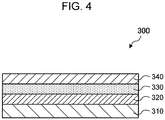
- the image formation section 160 forms an image including at least three layers, that is, a first layer located closest to a skin side, a second layer located on the first layer, and a third layer located on the second layer (see a first layer 320, a second layer 330, and a third layer 340 shown in Fig. 4 ).
- the image data production section 140 also produces image data including at least three layers, that is, a first layer located closest to a skin side, a second layer located on the first layer, and a third layer located on the second layer.
- the first layer is primarily responsible to have a function so that the lightness of the discolored portion is made similar to that of the normal portion.
- the second layer is primarily responsible to have a function so that the hue of the image is made similar to that of the normal portion.
- the third layer is primarily responsible to have a function so that the appearance of the image is made approximately the same as that of the peripheral normal portion.
- the first layer is primarily responsible to have a function so that the lightness of the discolored portion having a lightness higher than that of the peripheral normal portion is made similar to that of the peripheral normal portion.
- the image data production section 140 sets the L* value of the region of the first layer corresponding to the discolored region to a value lower than the L* value of the normal region by higher than or equal to 5 and lower than or equal to 20 and preferably by higher than or equal to 10 and lower than or equal to 20. Accordingly, the discolored portion having a high lightness can be effectively shielded.
- the chromaticity (such as the a* value and the b* value) of the region of the first layer corresponding to the discolored region is not particularly limited, the chromaticity described above is preferably substantially the same as the chromaticity of the peripheral normal region.
- the substantially the same chromaticity between the two regions indicates, for example, that the difference (absolute value) in a* value between the two regions and the difference (absolute value) in b* value between the two regions are each 3.2 or less and preferably 1.5 or less.
- the second layer is primarily responsible to have a function so that the hue of the image is made similar to that of the normal portion.
- the image data production section 140 preferably sets the chromaticity (such as the a* value and the b* value) and/or the lightness (such as the L* value) of the region of the second layer corresponding to the discolored region so that the hue of a laminated image is made similar to the hue of the normal portion.
- the image data production section 140 may set the chromaticity (such as the a* value and the b* value) of the region of the second layer corresponding to the discolored region to a chromaticity substantially having a complementary color relationship with that of the region of the first layer corresponding to the discolored region.
- chromaticities having a complementary color relationship with each other indicate two colors facing each other along a straight line passing through the white point in the chromaticity diagram with the white point interposed therebetween.
- two different colors which form an achromatic color such as white, gray, or black
- color B formed by collecting the remaining light has a complementary color relationship with the color A.
- the chromaticity having substantially a complementary color relationship with the region of the first layer corresponding to the discolored region includes not only a perfect complementary color of the region of the first layer corresponding to the discolored region but also a chromaticity of a color approximately similar to the above complementary color.
- the image data production section 140 may set the lightness (such as the L* value) of the region of the second layer corresponding to the discolored region to a lightness between the lightness of the region of the first layer corresponding to the discolored region and the lightness of the region of the third layer corresponding to the discolored region.
- the image data production section 140 may set the lightness (such as the L* value) of the region of the second layer corresponding to the discolored region in a range of (an intermediate value between the L* value of the region of the first layer corresponding to the discolored region and the L* value of the region of the third layer corresponding to the discolored region) ⁇ (an absolute value of the difference between the L* value of the region of the first layer or the third layer corresponding to the discolored region and the intermediate value described above).
- the image data production section 140 may also set the lightness (such as the L* value) of the region of the second layer corresponding to the discolored region in a range in which (the intermediate value-1.5) or (the intermediate value+1.5) is regarded as a lower limit, and a value obtained by adding (the absolute value of the difference between the L* value of the region of the first layer or the third layer corresponding to the discolored region and the intermediate value described above) to the above lower limit is regarded as an upper limit.
- the range described above is particularly effective when the lightness of the normal portion is low (such as an L* value of less than 65).
- the image data production section 140 may set the lightness (such as the L* value) of the region of the second layer corresponding to the discolored region to a lightness higher than the lightness of the region of the first layer corresponding to the discolored region and the lightness of the region of the third layer corresponding to the discolored region. Accordingly, the discolored portion darkened by the first layer is made brighter by the second layer and then can be likely to be corrected to the color of the normal portion by the third layer.
- the case described above is particularly effective when the lightness of the normal portion is high (such as an L* value of 65 or more).
- the third layer is primarily responsible to have a function so that the appearance of the image is made approximately the same as that of the peripheral normal portion.
- the image data production section 140 preferably sets so that the lightness (such as the L* value) and the chromaticity (such as the a* value and the b* value) of the region of the third layer corresponding to the discolored region are substantially the same as the lightness and the chromaticity of the normal region. Accordingly, when the image is placed on the discolored portion, the discolored portion can be made inconspicuous.
- the case in which the lightness and the chromaticity in one region are substantially the same as those in the other region indicates, for example, that the difference (absolute value) in the L* value between the two regions, the difference (absolute value) in the a* value between the two regions, and the difference (absolute value) in the b* value between the two regions are each 3.2 or less and preferably 1.5 or less.
- the case in which the lightness and the chromaticity in one region are substantially the same as those in the other region indicates, for example, that the color difference, ⁇ E*ab, between the two regions is 3.2 or less, preferably 2.5 or less, and more preferably 1.5 or less.
- the image data production section 140 may set a gradation region between the region corresponding to the discolored region and the region corresponding to the peripheral normal region so that a color is continuously changed from a color of the region corresponding to the discolored region to a color of the region corresponding to the normal region.
- a discolored portion such as a spot, having a low lightness
- a discolored portion such as a vitiligo, having a high lightness has a clear outline in many cases.
- the outline of the discolored portion having a high lightness can be made more inconspicuous.
- the image data production section 140 may also set in the first layer, a gradation region between the region corresponding to the discolored region and the region corresponding to the normal region so that a color is continuously changed from a color in the region corresponding to the discolored region to a color of the region corresponding to the normal region.
- the image data production section 140 may also set a gradation region between the region corresponding to the discolored region and the region corresponding to the normal region so that a color is continuously changed from a color of the region corresponding to the discolored region to a color of the region corresponding to the normal region.
- a width of the gradation region in the second layer or the third layer is preferably larger than a width of the gradation region in the first layer.
- an inner edge of the gradation region in the second layer or the third layer is preferably located outside than an inner edge of the gradation region in the first layer. Since the gradation regions are set as described above, the outline of the discolored portion can be made more inconspicuous.
- various types of information necessary for the image analysis by the image analysis section 130 and various types of information necessary for the production of the image data by the image data production section 140 are stored in advance.
- the image formation section 160 forms an image on a skin or a thin film based on the image data produced by the image data production section 140. Since this image is placed on the discolored portion, the discolored portion can be made inconspicuous without generating a thick coating feeling (see Fig. 2 ).
- a method in which the image formation section 160 forms an image is not particularly limited and may be appropriately selected in accordance with an object from which the image is formed.
- the image formation section 160 may form the image by either a spray coating or an ink jet printing.
- the image can be easily formed for a short time.
- the image formation section 160 may print the image (the first layer, the second layer, and the third layer) on the thin film.
- a sheet to be adhered to the discolored portion can be produced (see Fig. 2 ).
- irritation to the skin can be reduced.
- the image formation section 160 forms the first layer, the second layer, and the third layer on the user's skin by sequentially applying inks containing colorants by a spray method.
- the image formation section 160 forms the first layer on the user's skin by spraying a first ink containing a predetermined amount of a predetermined colorant, followed by drying.
- the image formation section 160 forms the second layer on the first layer by spraying a second ink containing a predetermined amount of a predetermined colorant, followed by drying.
- the image formation section 160 forms the third layer on the second layer by spraying a third ink containing a predetermined amount of a predetermined colorant, followed by drying.
- the image formed as described above can be removed by a cleansing agent in a manner similar to that of a general makeup.
- the ink containing a colorant will be described later.
- the structure of the image formation section 160 is not particularly limited.
- the image formation section 160 includes a fixing stage to fix a user's face, ink storage portions to store at least two types of inks, an ink mixing portion to mix the inks in the ink storage portions, an ink storage chamber to receive an ink mixed in the ink mixing portion, a nozzle to spray the ink in the ink storage chamber, and a control portion to control all the portions described above.
- the control portion allows, based on the image data produced by the image data production section 140, the ink mixing portion to mix inks having hues necessary to form the image.
- the nozzle sprays the ink in the ink storage chamber using compressed air.
- the control portion adjusts the position of the nozzle, the intensity of air pressure, and the like, so that a desired image is formed.
- the image formation section 160 may have a plurality of nozzles, such as a nozzle of an ink containing a colorant for color expression, a nozzle of an ink containing lame and/or pearl for texture expression, and a nozzle of an ink containing an oil or a moisturizer.
- the image formation section 160 forms the first layer, the second layer, and the third layer by sequentially printing inks containing colorants on the user's skin by an ink jet method.
- the image formation section 160 forms the first layer on the user's skin by ejecting liquid droplets of a first ink containing a predetermined amount of a predetermined colorant, followed by drying.
- the image formation section 160 forms the second layer on the first layer by ejecting liquid droplets of a second ink containing a predetermined amount of a predetermined colorant, followed by drying.
- the image formation section 160 forms the third layer on the second layer by ejecting liquid droplets of a third ink containing a predetermined amount of a predetermined colorant, followed by drying.
- a desired color may be reproduced by using a plurality of inks having different colors in combination.
- the image formed as described above can be removed by a cleansing agent in a manner similar to that of a general makeup.
- the ink containing a colorant will be described later.
- the structure of the image formation section 160 is not particularly limited.
- the image formation section 160 includes a fixing stage to fix a user's face, ink storage portions to store at least two types of inks, an ink jet head to eject liquid droplets of the inks in the ink storage portions, and a control portion to control all the portions described above.
- the ink jet head ejects the liquid droplets of the inks in the ink storage portions by a piezoelectric method or a thermal method.
- the control portion adjusts the sizes of the liquid droplets of the various types of inks, the positions thereof, the combination therebetween, and the like, so that a desired image is formed.
- the image formation section 160 may have a plurality of ink jet heads, such as an ink jet head of an ink containing a colorant for color expression, an ink jet head of an ink containing lame and/or pearl for texture expression, and an ink jet head of an ink containing an oil or a moisturizer.
- the image formation section 160 When the image formation section 160 produces a sheet by forming an image on a thin film which can be adhered to a skin, the image formation section 160 forms the sheet such that the first layer, the second layer, and the third layer are formed by sequentially applying inks containing colorants on the thin film.
- the image formation section 160 forms the first layer on the thin film by applying a first ink containing a predetermined amount of a predetermined colorant, followed by drying.
- the image formation section 160 forms the second layer on the first layer by applying a second ink containing a predetermined amount of a predetermined colorant, followed by drying.
- the image formation section 160 forms the third layer on the second layer by applying an third ink containing a predetermined amount of a predetermined colorant, followed by drying.
- a desired color may be reproduced by using inks having different colors in combination.
- a sheet 300 includes a thin film 310 having one surface to be adhered to a skin, a first layer 320 disposed on the other surface of the thin film 310, a second layer 330 disposed on the first layer 320, and a third layer 340 disposed on the second layer 330.
- the L* value of the region of the first layer 320 corresponding to the discolored portion is lower than the L* value of the normal portion by higher than or equal to 10 and lower than or equal to 20, and the lightness and the chromaticity of the region of the third layer 340 corresponding to the discolored portion are substantially the same as the lightness and the chromaticity of the normal portion.
- the chromaticity of the region of the second layer 330 corresponding to the discolored region is preferably a chromaticity substantially having a complementary color relationship with that of the region of the first layer 320 corresponding to the discolored region
- the lightness of the region of the second layer 330 corresponding to the discolored region is preferably substantially an intermediate lightness between the lightness of the region of the first layer 320 corresponding to the discolored region and the lightness of the region of the third layer 340 corresponding to the discolored region.
- the thin film 310 is preferably a sheet-shaped member which generates no uncomfortable feeling even if being adhered to a human's skin and which has a biocompatible property.
- the thin film 310 may be colored as long as the aim and the effect of the present disclosure are not deteriorated or may be colorless transparent or translucent.
- the thickness of the thin film 310 is preferably 10 nm to 10 ⁇ m. When the thin film 310 has a hydrophobic property, the thickness of the thin film 310 is more preferably 10 nm to 1,000 nm and particularly preferably 10 nm to 800 nm.
- the shape of the thin film 310 may be a rectangular shape or a shape compatible with the shape of the discolored region or with the shape of the periphery thereof.
- an outer circumferential portion and/or an inside of the thin film 310 may be notched so that the thin film 310 is compatible with the shape of the discolored region or the periphery thereof.
- the thin film 310 may be a sheet formed by a spin coating method, a roll-to-roll method, an LB method (Langmuir-Blodgett method), or the like or may also be a fiber sheet in which fibers formed by an electrospinning method or the like are folded and laminated to each other.
- the thin film 310 for example, there may be mentioned a polyester, such as a polyglycolic acid, a polylactic acid, a polycaprolactone, a poly(ethylene succinate), a poly(ethylene terephthalate), or a copolymer thereof; a polyether, such as a polyethylene glycol or a polypropylene glycol; a polyamide, such as a nylon, a polyglutamic acid, a polyaspartic acid, or a salt thereof; a polysaccharide, such as a pullulan, a cellulose, a starch, a chitin, a chitosan, an alginic acid, a hyaluronic acid, a cornstarch, or a salt thereof; a silicone, such as an acrylic silicone or a trimethylsiloxysilicate; an acrylic acid, such as an alkyl acrylate, a silicon acrylate, an acrylamide, or a copolymer
- a polylactic acid for example, a polylactic acid, a cellulose (such as a carboxymethyl cellulose or a hydroxyethyl cellulose), a starch, a chitin, a chitosan, an alginic acid, a cornstarch, or a polyurethane is preferable.
- the first layer 320, the second layer 330, and the third layer 340 are each a layer primarily containing a colorant and a binder.
- the chromaticity and the lightness of each of the first layer 320, the second layer 330, and the third layer 340 may be adjusted by combination of colorants, the thickness, and the like.
- the first layer 320, the second layer 330, and the third layer 340 may further contain a film forming agent, various types of additives, and the like.
- an inorganic red pigment such as iron titanate including iron oxide or iron hydroxide
- an inorganic brown-based pigment such as ⁇ -iron oxide
- an inorganic yellow-based pigment such as yellow iron oxide or yellow soil
- an inorganic black pigment such as black iron oxide or carbon black
- an inorganic purple pigment such as manganese violet or cobalt violet
- an inorganic green pigment such as chromium hydroxide, chromium oxide, cobalt oxide, or cobalt titanate
- an inorganic blue-based pigment such as Prussian blue (ferric ferrocyanide), navy blue (ultramarine blue), lapis lazuli, rock ultramarine, aluminum-cobalt oxide, aluminum-zinc-cobalt oxide, silicon-cobalt oxide, silicon-zinc-cobalt oxide, a cobalt pigment, smalt, cobalt blue, cobalt stannate, cobalt chromium blue, cobalt
- the first layer 320, the second layer 330, and the third layer 340 may contain either only one type of colorant or at least two types of colorants.
- the shapes of those colorants are not particularly limited, and for example, any one of a needle shape, an indeterminate shape, a spherical shape, and a plate shape may be used.
- particles formed from a (meth)acrylic resin such as an alkyl (meth)acrylate polymer, a styrene-(meth)acrylate copolymer, an alkyl (meth)acrylate-vinyl acetate copolymer, a (meth)acrylic acid-alkyl (meth)acrylate copolymer, or a (meth)acrylic acid-alkyl dimethicone polymer; a vinyl acetate polymer; or a vinylpyrrolidone-styrene copolymer.
- a (meth)acrylic resin such as an alkyl (meth)acrylate polymer, a styrene-(meth)acrylate copolymer, an alkyl (meth)acrylate-vinyl acetate copolymer, a (meth)acrylic acid-alkyl (meth)acrylate copolymer, or a (meth)acrylic acid-alkyl dimethicon
- the (meth)acryl indicates an acryl, a methacryl, or a mixture of an acryl and a methacryl.
- the binder is preferably particles (hereinafter, also simply referred to as "acrylic particles" in some cases) formed from a (meth)acrylic resin.
- acrylic particles When the binder is formed from acrylic particles, a fixing property of the colorant can be improved.
- the binder is further preferably formed from a (meth)acrylic resin having no skin irritation.
- the acrylic particles described above are preferably selected, for example, from components listed in the component display name list of cosmetics based on the Pharmaceutical Affairs Law of Japan, components in accordance the EU Cosmetics directive 76/768/EEC, and components listed International Cosmetic Ingredient Dictionary and Handbook (9th edition, January 1, 2002) by the US CTFA (Cosmetic, Toiletry and Fragrance Association, U.S .) and are preferably formed from an acrylic resin which has been used for known cosmetics.
- the (meth)acrylic resin forming the acrylic particles for example, there may be mentioned a homopolymer of a (meth)acrylic monomer, a copolymer of at least two types of (meth)acrylic monomers, or a copolymer of a (meth)acrylic monomer and another monomer.
- (meth)acrylic monomer there may be mentioned acrylic acid, methyl acrylate, ethyl acrylate, acrylamide, n-propyl acrylate, n-butyl acrylate, isobutyl acrylate, octyl acrylate, 2-ethylhexyl acrylate, N,N-dimethylamino ethyl acrylate, acrylonitrile, methacrylic acid, ethyl methacrylate, methacrylamide, n-propyl methacrylate, n-butyl methacrylate, isobutyl methacrylate, 2-ethylhexyl methacrylate, octyl methacrylate, hydroxyethyl methacrylate, or N,N-dimethylamino ethyl methacrylate.
- the another monomer copolymerizable with the (meth)acrylic monomer for example, styrene, vinyl acetate, a silicone macromer, a fluorine-based monomer, or an alkoxysilane unsaturated monomer may be mentioned.
- a content of the binder contained in the first layer 320, the second layer 330, or the third layer 340 is preferably 0.5 to 10 parts by mass and more preferably 1.5 to 5.7 parts by mass.
- the fixing property of the colorant is increased.
- the content of the binder is likely to be relatively sufficient, and the first layer 320, the second layer 330, or the third layer 340 is able to have a desired color.
- a method of applying an ink on the thin film by the image formation section 160 is not particularly limited and may be selected from known methods.
- an ink jet method for example, an ink jet method, a screen printing, an off-set printing, or a gravure printing may be mentioned.
- an ink jet method is preferable.
- the present disclosure is not limited to this method.
- an ink jet device When printing is performed by an ink jet method, the structure of an ink jet device is not particularly limited and may be selected from known methods (such as a piezoelectric method, a thermal method, and an electrostatic method). Since heating is not required, among those methods mentioned above, an ink jet device using a piezoelectric element method is preferable.
- the image formation section 160 may applying the ink only one time or at least two times.
- drying may be performed every time after the ink is applied or may be collectively performed after the ink is applied at least two times.
- a method to dry the ink is not particularly limited as long as a solvent (such as a higher alcohol or purified water which will be described later) of the ink can be removed.
- the ink may be dried at room temperature and an atmospheric pressure or may be dried by heating to a predetermined temperature and/or by reducing the pressure.
- the temperature is preferably increased, for example, to 25°C to 50°C.
- the pressure is preferably reduced to -0.1 to 0 MPa. When the pressure is reduced to this range, the ink can be efficiently dried.
- the image processing apparatus (makeup support system) 100 including the image formation section 160 may include no image formation section 160.
- the image data produced by the image data production section 140 is transmitted to an exterior coating device or printing device, and this exterior coating device or printing device may form on a skin or a thin film, an image to correct the color of the discolored portion to the color of the normal portion.
- Fig. 2 is a schematic view showing one example of the image processing apparatus (makeup support system) 100 including the image formation section 160 which forms the sheet 300.
- the image processing apparatus 100 has a first device 170 which includes the image acquisition section 110, the image storage section 120, the image analysis section 130, the image data production section 140, and the information storage section 150 and a second device 180 which includes the image formation section 160.
- the first device 170 functions as a device to produce the image data
- the second device 180 functions as a device to form the sheet 300 based on the image data produced by the first device 170.
- the first device 170 and the second device 180 are connected to each other by wire communication or wireless communication.
- the first device 170 photographs a face of a user 400 positioned at a front side of a display portion 113 by a camera 112 disposed in the vicinity of the display portion 113.
- a face image 410 is produced by reversing a photographed image from left to right and is then displayed on the display portion 113. Accordingly, the user 400 is able to photograph the face image 410 while feeling as if looking in a mirror.
- the lighting portion 111, the camera 112, and the display portion 113 cooperatively function as the image acquisition section 110.
- the first device 170 identifies at least one discolored region 420 from the face image 410 (or the face image before the reversal). In addition, the first device 170 produces the image data to produce the sheet 300 which makes a discolored portion of a skin 430 corresponding to a discolored region 420 of the identified face image 410 inconspicuous. In addition, the first device 170 transmits this image data to the second device 180 by wire communication or wireless communication.
- the second device 180 Based on the image data transmitted from the first device 170, the second device 180 forms using various types of inks filled in ink tanks in combination, the sheet 300 by forming (lamination printing) the first layer 320, the second layer 330, and the third layer 340 on the thin film 310 to have a desired pattern.
- the user 400 is able to make the discolored portion inconspicuous by adhering the sheet 300 thus formed on the discolored portion of the skin 430.
- the second device 180 may form a sheet including neither first layer 320 nor second layer 330, that is, a sheet 300 in which the third layer 340 is laminated on the thin film 310 to have an individual skeleton size.
- the absence of the discolored portions is displayed on the display portion 113, and the user 400 may be allowed to select whether no printing is performed or a printing of the third layer 340 corresponding to foundation is performed.
- the first device 170 and the second device 180 are installed in, for example, a work, a cosmetics store, a beauty salon, a medical institution, a makeup room to adjust his or her appearance, an event site, or a private house.
- the first device 170 and the second device 180 each may also be a portable device which can be easily carried.
- the image processing apparatus (makeup support system) 100 in which the first device 170 and the second device 180 are separately provided
- the image processing apparatus according to the present disclosure is not limited thereto.
- the image processing apparatus according to the present disclosure may include the image acquisition section 110, the image storage section 120, the image analysis section 130, the image data production section 140, the information storage section 150, and the image formation section 160 in one housing.
- Fig. 3 is a view showing a hardware structure of a computer which realizes by a program, the functions of the image acquisition section 110, the image storage section 120, the image analysis section 130, the image data production section 140, and the information storage section 150 of the image processing apparatus 100.
- This computer 200 includes an input device 210, such as a keyboard, a mouse, a camera, and/or a touch pad; an output device 220, such as a display and/or a speaker; a CPU (central processing unit) 230, a ROM (read only memory) 240, a RAM (random access memory) 250, a memory device 260, such as a hard disc device and/or a SSD (solid state drive), a reading device 270 to read information from a recording medium, such as a DVD-ROM (digital versatile disk read only memory) and/or an USB (universal serial bus), and a transceiver device 280 to perform communication through a network, and the components described above are connected to each other with a bus 290.
- a bus 290 such as a keyboard, a mouse, a camera, and/or a touch pad
- an output device 220 such as a display and/or a speaker
- a CPU central processing unit
- ROM read only memory
- RAM random access memory
- the reading device 270 reads this program and stores it in the memory device 260.
- the transceiver device 280 communicates with a server device connected to the network and stores in the memory device 260, a program downloaded from the server device to realize the functions of the above devices.
- the CPU 230 copies the program stored in the memory device 260 into the RAM 250, and commands contained in this program are sequentially read from the RAM 250 and carried out, so that the function of the image processing apparatus 100 can be realized.
- the first ink to form the first layer, the second ink to form the second layer, and the third ink to form the third layer (hereinafter, collectively referred to as "cosmetic ink" in some cases) which are used by the image formation section 160 are each an ink containing a colorant which adjusts the lightness (such as the L* value) and the chromaticity (such as the a* value and the b* value) of each layer.
- the cosmetic ink contains a colorant, a binder, a higher alcohol, and purified water.
- the cosmetic ink may also contain, if needed, a film forming agent, various types of additives, and the like.
- an inorganic red pigment such as iron titanate including iron oxide or iron hydroxide
- an inorganic brown-based pigment such as ⁇ -iron oxide
- an inorganic yellow-based pigment such as yellow iron oxide or yellow soil
- an inorganic black pigment such as black iron oxide or carbon black
- an inorganic purple pigment such as manganese violet or cobalt violet
- an inorganic green pigment such as chromium hydroxide, chromium oxide, cobalt oxide, or cobalt titanate
- an inorganic blue-based pigment such as Prussian blue (ferric ferrocyanide), navy blue (ultramarine blue), lapis lazuli, rock ultramarine, aluminum-cobalt oxide, aluminum-zinc-cobalt oxide, silicon-cobalt oxide, silicon-zinc-cobalt oxide, a cobalt pigment, smalt, cobalt blue, cobalt stannate, cobalt chromium
- the cosmetic ink may also contain a brightening agent, and as the brightening agent, for example, there may be mentioned a white pigment, such as titanium oxide, zinc oxide, cerium oxide, or barium sulfate; a white extender powder, such as talc, muscovite, phlogopite, lepidolite, biotite, synthetic mica, silk mica (sericite), synthetic sericite, kaolin, silicon carbide, bentonite, smectite, silicic anhydride, aluminum oxide, magnesium oxide, zirconium oxide, antimony oxide, diatomite, aluminum silicate, magnesium aluminometasilicate, calcium silicate, barium silicate, magnesium silicate, calcium carbonate, magnesium carbonate, hydroxyapatite, or boron nitride; a glitter powder, such as calcium aluminum borosilicate, titanium dioxide coated mica, powdered titanium dioxide coated glass, titanium dioxide coated bismuth oxychloride, titanium dioxide
- particles formed from a (meth)acrylic resin such as an alkyl (meth)acrylate polymer, a styrene-(meth)acrylate copolymer, an alkyl (meth)acrylate-vinyl acetate copolymer, a (meth)acrylic acid-alkyl (meth)acrylate copolymer, or a (meth)acrylic acid-alkyl dimethicone polymer; a vinyl acetate polymer; or a vinylpyrrolidone-styrene copolymer.
- a (meth)acrylic resin such as an alkyl (meth)acrylate polymer, a styrene-(meth)acrylate copolymer, an alkyl (meth)acrylate-vinyl acetate copolymer, a (meth)acrylic acid-alkyl (meth)acrylate copolymer, or a (meth)acrylic acid-alkyl dimethicon
- the (meth)acryl indicates an acryl, a methacryl, or a mixture of an acryl and a methacryl.
- the binder is preferably particles (hereinafter, also simply referred to as "acrylic particles" in some cases) formed from a (meth)acrylic resin.
- the binder is formed from acrylic particles, the fixing property of the colorant can be improved.
- the binder is further preferably formed from a (meth)acrylic resin having no skin irritation.
- the acrylic particles described above are preferably selected, for example, from components listed in the component display name list of cosmetics based on the Pharmaceutical Affairs Law of Japan, components in accordance the EU Cosmetics directive 76/768/EEC, and components listed International Cosmetic Ingredient Dictionary and Handbook (9th edition, January 1, 2002) by the US CTFA (Cosmetic, Toiletry and Fragrance Association, U.S .) and are preferably formed from an acrylic resin which has been used for known cosmetics.
- the (meth)acrylic resin forming the acrylic particles for example, there may be mentioned a homopolymer of a (meth)acrylic monomer, a copolymer of at least two types of (meth)acrylic monomers, or a copolymer of a (meth)acrylic monomer and another monomer.
- (meth)acrylic monomer for example, there may be mentioned acrylic acid, methyl acrylate, ethyl acrylate, acrylamide, n-propyl acrylate, n-butyl acrylate, isobutyl acrylate, octyl acrylate, 2-ethylhexyl acrylate, N,N-dimethylamino ethyl acrylate, acrylonitrile, methacrylic acid, ethyl methacrylate, methacrylamide, n-propyl methacrylate, n-butyl methacrylate, isobutyl methacrylate, 2-ethylhexyl methacrylate, octyl methacrylate, hydroxyethyl methacrylate, or N,N-dimethylamino ethyl methacrylate.
- the another monomer copolymerizable with the (meth)acrylic monomer for example, styrene, vinyl acetate, a silicone macromer, a fluorine-based monomer, or an alkoxysilane unsaturated monomer may be mentioned.
- the type of higher alcohol is not particularly limited as long as having at least three carbon atoms and being compatible with purified water.
- the higher alcohol functions as a solvent of the cosmetic ink.
- the higher alcohol is absorbed in the thin film or is vaporized.
- the number of carbon atoms of the higher alcohol is preferably 3 to 5 and more preferably 3 or 4.
- the higher alcohol is likely to be compatible with purified water.
- the higher alcohol preferably includes a trivalent alcohol. As long as having no skin irritation, although the type of trivalent alcohol is not particularly limited, in view of biological safety and ink stability, glycerin is preferable.
- the higher alcohol may also include a divalent alcohol or a monovalent alcohol.
- a divalent alcohol for example, diethylene glycol, propylene glycol, 1,3-propanediol, butylene glycol, or hexanediol may be mentioned.
- the monovalent alcohol for example, propanol, isopropanol, or butyl alcohol may be mentioned.
- the higher alcohol preferably contains a divalent alcohol and particularly preferably contains propylene glycol.
- the purified water also functions as a solvent of the cosmetic ink and is absorbed in the thin film or vaporized after the cosmetic ink is printed.
- the type of purified water is not particularly limited as long as being generally used for cosmetics.
- the purified water may be water purified by various types of methods, such as a distillation and ion exchange or may be, for example, hot spring water, deep water, or steam distilled water of plants.
- the film forming agent is a compound which enhances a film forming property (such as a drying property) of the cosmetic ink.
- the "film forming agent” is assumed as a compound dispersible in water at room temperature (however, a component corresponding to the binder described above is excluded).
- the cosmetic ink either only one type of film forming agent or at leas two types thereof may be contained.
- the film forming agent a compound which can be dispersed or dissolved in a higher alcohol and/or in purified water may be used, and for example, at least one compound selected from the group consisting of an acrylic polymer, a polysaccharide-based polymer, a sugar alcohol, a sterol, an ester, and a modified cornstarch may be used.
- the cosmetic ink may contain either only one type of film forming agent or at least two types thereof. When the film forming agent is a compound selected from the above group, a coating film formed from the cosmetic ink is very rapidly dried.
- an HLB value of the film forming agent is preferably 8 o more and more preferably 8 to 19.
- the HLB value of the film forming agent is 8 or more, the film forming agent is likely to be uniformly dispersed or dissolved in a higher alcohol or purified water.
- the HLB value is an index showing a ratio between relative affinities with respect to two types of liquids in an oil-water system, and a higher HLB value indicates a higher affinity to water.
- the HLB value of the present disclosure is assume to be calculated by Griffin method.
- the film forming agent is also preferably a material having no skin irritation.
- an acrylic acid alkyl copolymer for example, there may be mentioned an acrylic acid alkyl copolymer, a 2-amino-2-methyl-1-propanol salt (hereinafter, also referred to as "AMP") of an acrylic acid alkyl copolymer, a sodium salt (hereinafter, also referred to as "Na”) of an acrylic acid alkyl copolymer, an acrylic acid alkyl copolymer-ammonium, an acrylic acid-acrylic acid alkyl copolymer, an acrylic acid alkyl-diacetone acrylamide copolymer, an acrylic acid alkyl-diacetone acrylamide copolymer AMP, a 2-amino-2-methyl-1,3-propanediol salt (hereinafter, also referred to as "AMPD”) of an acrylic acid alkyl-diacetone acrylamide copolymer, an acrylic acid hydroxyethyl-acryl
- polysaccharide-based polymer for example, there may be mentioned gum arabic, glucan, succinoglycan, carrageenan, karaya gum, tragacanth gum, guar gum, locust bean gum, galactomannan gum, xanthan gum, starch, carob gum, quince seed (marmelo), casein, dextrin, gelatin, sodium pectinate, sodium alginate, methyl cellulose, ethyl cellulose, carboxymethyl cellulose, hydroxyethyl cellulose, hydroxypropyl cellulose, crystalline cellulose, chloride O- [2-hydroxy-3- (trimethylammonio)propyl] hydroxyethyl cellulose, chloride O- [2-hydroxy-3- (trimethylammonio)propyl] guar gum, chloride O- [2-hydroxy-3- (trimethylammonio)propyl] locust bean gum, chloride hydroxypropyltrimonium starch, gly
- sorbitol maltitol, or glucose
- sterol any compound having a sterol skeleton may be used, and as an example thereof, for example, there may be mentioned a phytosterol, such as campesterol, campestanol, brassicasterol, 22-dehydrocampesterol, stigmasterol, stigmastanol, 22-dihydrospinasterol, 22-dehydrostigmastanol, 7-dehydrostigmasterol, sitosterol, tirucallol, euphol, fucosterol, isofucosterol, codisterol, clionasterol, poriferasterol, clerolosterol, 22-dehydroclerosterol, fungisterol, condrillasterol, avenasterol, vernosterol, or polynastanol; a zoosterol, such as cholesterol, dihydrocholesterol, cholestano
- a dipentaerythritol fatty acid ester such as dipentaerythrityl hexa(hydroxystearic acid/stearic acid/rosin acid), dipentaerythrityl (hydroxystearic acid/stearic acid /rosin acid), dipentaerythrityl hexahydroxystearate, dipentaerythrityl tetra(hydroxystearic acid/isostearic acid), or dipentaerythrityl (hydroxystearic acid/isostearic acid); a hydrogenated castor oil fatty acid ester, such as stearic acid hydrogenated castor oil, isostearic acid hydrogenated castor oil, or hydroxystearic acid hydrogenated castor oil; a cholesterol fatty acid ester such as cholesteryl hydroxystearate; a phytosterol fatty acid ester, such as phytosteryl oleate or phytosteryl macadamia nut
- a compound obtained such that a cornstarch is modified by an arbitrary compound may be used, and for example, a hydroxypropyl modified starch obtained by a reaction between a cornstarch and 3-(dodecenyl)dihydro-2,5-furandione may also be used.
- an acrylate copolymer for example, an acrylate copolymer, an acrylate (ethylhexyl acrylate) copolymer, a polyurethane-14/acrylate copolymer AMP, an acrylic aid alkyl copolymer-ammonium, a dimer dilinoleic acid dimer dilinoleyl bis(behenyl/isostearyl/phytosteryl)-triglyceryl hydrogenated rosin acid, a xanthan gum cross polymer-hydroxyethyl cellulose, a tremella fuciformis polysaccharide, a modified corn starch, or dextrin isostearate is preferable, and an acrylate copolymer, an acrylate (ethylhexyl acrylate) copolymer, a polyurethane-14/acrylate copolymer AMP, an acrylic acid alkyl copolymer-ammoni
- a content of the film forming agent contained in 100 parts by mass of the cosmetic ink is preferably 20 parts by mass or less and more preferably 0.3 to 5 parts by mass.
- the content of the film forming agent is 0.3 parts by mass or more, as described above, the drying property of the cosmetic ink is improved.
- the content of the film forming agent is excessively large, although the viscosity of the cosmetic ink is excessively increased in some cases, when the content is 20 parts by mass or less, the cosmetic ink can be made to have a viscosity at which printing is easily performed by various application methods or printing methods.
- the film forming agent is mixed with a colorant, a reflective material, a higher alcohol, purified water, and/or the like.
- the solvent to be used in this case is also preferably a solvent having no skin irritation, and the higher alcohol or purified water described above is preferable.
- a water-soluble polymer may also be contained in the cosmetic ink to bond a reflective material, a colorant, and/or the like to an object to be printed.
- the various types of additives are also preferably compounds having no skin irritation.
- a surfactant for example, there may be mentioned a surfactant, a pH adjuster, a thickening agent, an ultraviolet absorber, an ultraviolet scatter, an antiseptic/antifungal agent, a deoxidizer, an oxidation inhibitor, a corrosion inhibitor, an antifading agent, a defoaming agent, a fragrance, or a solvent other than a higher alcohol and purified water.
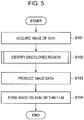
- the image acquisition section 110 acquires an image of a skin including a discolored portion, stores the image in the image storage section 120, and further transmits the image to the image analysis section 130 (S101).
- the image analysis section 130 identifies a discolored region corresponding to the discolored portion from the image acquired by the image acquisition section 110 (S102). In more particular, the image analysis section 130 identifies a color and a shape of the discolored region corresponding to the discolored portion from the image acquired by the image acquisition section 110 and also identifies a color of a normal region (non-discolored region) present along a periphery of the discolored region. The identified information is transmitted to the image data production section 140.
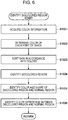
- Fig. 6 is a flowchart showing one example of processing of the image analysis section 130 in Step S102.
- the image analysis section 130 acquires color information to correct the color of the image of the skin (S1021).
- the image analysis section 130 performs color correction of the image of the skin acquired by the image acquisition section 110 and determines the color of each point of the skin (S1022).
- the image analysis section 130 sorts the image of the skin in accordance with colors (S1023).
- the image analysis section 130 sets a plurality of ranges of the chromaticity (such as the a* value and the b* value) and/or the lightness (such as the L* value), and the image of the skin is sorted in accordance with the respective ranges.
- the image analysis section 130 sorts the image of the skin into a region (corresponding to the normal region (non-discolored region) corresponding to the normal portion) in which the L* value is less than the first threshold value and higher than or equal to a third threshold value, a region (corresponding to the discolored region having a high lightness corresponding to a discolored portion (such as a vitiligo) having a high lightness) in which the L* value is the first threshold value or more, and a region (corresponding to a discolored region having a low lightness corresponding to a discolored portion (such as a spot) having a low lightness) in which the L* value is less than the third threshold value.
- a region corresponding to the normal region (non-discolored region) corresponding to the normal portion in which the L* value is less than the first threshold value and higher than or equal to a third threshold value
- a region corresponding to the discolored region having a high lightness corresponding to a discolored portion (such as a
- the image analysis section 130 identifies from the image, a discolored region having a high lightness corresponding to a discolored portion having a high lightness (S1024).
- the method of the image analysis section 130 to identify the discolored region is not particularly limited.
- the image analysis section 130 may identify the discolored region by allowing the user 400 to designate a range of the discolored region 420 in the image 410 using the display portion 113, such as the touch panel-equipped liquid crystal display described above, also functioning as the input portion (see Fig. 2 ).
- the image analysis section 130 may identify in the image, a region in which the lightness (such as the L* value) is the predetermined first threshold value or more as the discolored region.
- the image analysis section 130 may immediately identify this region as the discolored region, in order to improve the identification accuracy of the discolored region, only when the other conditions are also satisfied, the region described above may be identified as the discolored region.
- the image analysis section 130 identifies the color (the lightness and the chromaticity) and the shape of the identified discolored region and the color (the lightness and the chromaticity) of the peripheral normal region (S1025).
- the image analysis section 130 identifies the color difference between the discolored region and the normal region (S1026).
- the image data production section 140 produces image data to correct the color of the discolored portion to the color of the normal portion based on the information of the color of the normal region of the image corresponding to the normal portion and the color of the discolored region acquired by the image acquisition section 110 (S103).
- the produced image data is transmitted to the image formation section 160.
- the image data production section 140 sets an L* value of a region of the first layer corresponding to the discolored region to a value lower than the L* value of the normal region by higher than or equal to 5 and lower than or equal to 20 and preferably by higher than or equal to 10 and lower than or equal to 20.
- the L* value may be uniformly set to a value lower than the L* value of the normal region by higher than or equal to 10 and lower than or equal to 20, for example, when the lightness L* of the normal region is 50 or less, the L* value of the region of the first layer corresponding to the discolored region may be set to a value lower than the L* value of the normal region by higher than or equal to 5 and lower than or equal to 10.
- the image formation section 160 forms the image on a skin or a thin film (s104).
- the image formation section 160 sequentially applies on the skin or the thin film, a first ink to form the first layer, a second ink to form the second layer, and a third ink to form the third layer and then dries those inks, so that the first layer located at a skin side, the second layer disposed on the first layer, and the third layer disposed on the second layer are formed.
- the drying may be collectively performed after all the first ink, the second ink, and the third ink are applied or may be performed at each time when the first ink, the second ink, or the third ink is applied.
- first ink, the second ink, and the third ink may be applied while the skin or the thin film is heated, so that the application of the ink and the drying thereof are simultaneously performed.
- the drying is performed every time after the first ink, the second ink, or the third ink is applied or is performed in parallel with the application thereof, the ink adhered to the skin or the thin film is rapidly dried, and hence, color irregularity caused by mixing between adjacent inks can be prevented from being generated.
- the image processing apparatus 100 is able to produce the image data to correct the color of the discolored portion having a lightness higher than that of the normal portion of the skin to the color of the normal portion and, based on this image data, is also able to form the image to correct the color of the discolored portion to the color of the normal portion on the skin or the thin film.
- the image processing apparatus 100, the image processing method, and the sheet 300 according to the present disclosure are each able to make the discolored portion having a lightness higher than that of the periphery thereof inconspicuous without generating a thick coating feeling.
- Fig. 7A is a photo of the formed vitiligo pattern.
- a region colored white by the cosmetic material corresponds to a discolored portion.
- the discolored portion is surrounded by a normal portion having a pale orange color similar to a color of a skin of a yellow race person.
- a lightness (L* value) of the discolored portion is higher than a lightness (L* value) of the normal portion.
- Inks containing various types of colorants were applied by a spray method on a thin film formed form a polylactic acid having a thickness of 200 nm, so that three types of sheets, that is, a first sheet, a second sheet, and a third sheet, were formed. Those sheets each included only a first layer without including a second layer and a third layer. Those sheets were each set so that the L* value, the a* value, and the b* value of a region corresponding to the discolored portion were set as described below.
- Fig. 7B is a photo of the vitiligo pattern on which the first sheet was placed
- Fig. 7C is a photo of the vitiligo pattern on which the second sheet was placed
- Fig. 7D is a photo of the vitiligo pattern on which the third sheet was placed.
- Inks containing various types of colorants were applied by an ink jet method on a thin film formed form a polylactic acid having a thickness of 200 nm, so that two types of sheets, that is, a fourth sheet and a fifth sheet, were formed. Those sheets each included three layers, that is, a first layer, a second layer, and a third layer. In the sheets described above, the L* value, the a* value, and the b* value of a region of each layer corresponding to the discolored portion were set as described below.
- the lightness and the chromaticity of the first layer of the fifth sheet were each set in a different manner from that of the first layer of the fourth sheet, the lightness and the chromaticity of the second layer of the fifth sheet were each set in the same manner as the second layer of the fourth sheet, and the lightness and the chromaticity of the third layer of the fifth sheet were each also set in the same manner as the third layer of the fourth sheet.
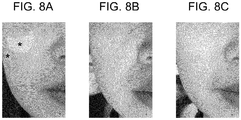
- Fig. 8A is a photo of a face having the discolored portions. As shown by two asterisks in Fig. 8A , in this experiment, two discolored portions were formed. As apparent from Fig. 8A , the lightness (L* value) of the discolored portion is higher than the lightness (L* value) of the normal portion, and the boundary between the discolored portion and the normal portion can be clearly confirmed.
- Fig. 8B is a photo of the face to which the fourth sheet is adhered
- Fig. 8C is a photo of the face to which the fifth sheet is adhered.
- the sheet according to the present disclosure was able to effectively shield the discolored portion having a lightness higher than that of the normal portion.
- the image processing apparatus, the image processing method, and the sheet of the present disclosure are able to make a discolored portion having a lightness higher than that of a periphery thereof inconspicuous without generating a thick coating feeling.
- the image processing apparatus, the image processing method, and the sheet of the present disclosure are each effective, for example, as a cosmetic technique which corrects a vitiligo or the like.
Landscapes
- Engineering & Computer Science (AREA)
- Health & Medical Sciences (AREA)
- Multimedia (AREA)
- Physics & Mathematics (AREA)
- Theoretical Computer Science (AREA)
- General Physics & Mathematics (AREA)
- General Health & Medical Sciences (AREA)
- Life Sciences & Earth Sciences (AREA)
- Oral & Maxillofacial Surgery (AREA)
- Animal Behavior & Ethology (AREA)
- Public Health (AREA)
- Veterinary Medicine (AREA)
- Human Computer Interaction (AREA)
- Computer Vision & Pattern Recognition (AREA)
- Birds (AREA)
- Epidemiology (AREA)
- Signal Processing (AREA)
- Image Processing (AREA)
- Spectrometry And Color Measurement (AREA)
Applications Claiming Priority (2)
| Application Number | Priority Date | Filing Date | Title |
|---|---|---|---|
| JP2019035697 | 2019-02-28 | ||
| PCT/JP2019/044260 WO2020174766A1 (ja) | 2019-02-28 | 2019-11-12 | 画像処理装置、画像処理方法およびシート |
Publications (2)
| Publication Number | Publication Date |
|---|---|
| EP3932251A1 true EP3932251A1 (de) | 2022-01-05 |
| EP3932251A4 EP3932251A4 (de) | 2022-03-09 |
Family
ID=72238906
Family Applications (1)
| Application Number | Title | Priority Date | Filing Date |
|---|---|---|---|
| EP19916739.6A Withdrawn EP3932251A4 (de) | 2019-02-28 | 2019-11-12 | Bildverarbeitungsvorrichtung, bildverarbeitungsverfahren und folie |
Country Status (4)
| Country | Link |
|---|---|
| EP (1) | EP3932251A4 (de) |
| JP (1) | JP7398750B2 (de) |
| CN (1) | CN113163930B (de) |
| WO (1) | WO2020174766A1 (de) |
Family Cites Families (12)
| Publication number | Priority date | Publication date | Assignee | Title |
|---|---|---|---|---|
| DE10317692A1 (de) * | 2003-04-17 | 2004-11-11 | Lts Lohmann Therapie-Systeme Ag | Medizinische Wirkstoffpflaster mit veringerter optischer Auffälligkeit auf der Haut |
| US8518445B2 (en) * | 2006-01-20 | 2013-08-27 | Research Foundation Of The City University Of New York | Changing skin-color perception using quantum and optical principles in cosmetic preparations |
| US20100322981A1 (en) * | 2007-11-16 | 2010-12-23 | Basf Se | Bright interference pigments |
| JP5514014B2 (ja) * | 2010-06-30 | 2014-06-04 | 花王株式会社 | メイクアップ用シート状化粧料 |
| JP6063271B2 (ja) * | 2013-01-28 | 2017-01-18 | 花王株式会社 | 吸収性物品 |
| JP5372275B1 (ja) * | 2013-03-22 | 2013-12-18 | パナソニック株式会社 | メイクアップ支援装置、メイクアップ支援方法、およびメイクアップ支援プログラム |
| WO2014167831A1 (ja) * | 2013-04-08 | 2014-10-16 | パナソニック インテレクチュアル プロパティ コーポレーション オブ アメリカ | メイクアップ塗材が塗布された状態を仮想的に再現することができる画像処理装置、画像処理方法、プログラム |
| EP3131637A1 (de) * | 2014-04-16 | 2017-02-22 | The Procter & Gamble Company | Vorrichtung und verfahren zum auftragen einer kosmetischen zusammensetzung |
| JP6657893B2 (ja) * | 2015-12-09 | 2020-03-04 | 株式会社島津製作所 | 画像処理装置、プログラムおよび放射線撮影装置 |
| JP6655789B2 (ja) * | 2016-03-08 | 2020-02-26 | パナソニックIpマネジメント株式会社 | 画像処理装置および画像処理方法 |
| JP2018201751A (ja) * | 2017-06-01 | 2018-12-27 | 株式会社グランブルー | 隠蔽シート |
| WO2019003649A1 (ja) * | 2017-06-29 | 2019-01-03 | パナソニックIpマネジメント株式会社 | シート、画像処理装置、及び、画像処理方法 |
-
2019
- 2019-11-12 EP EP19916739.6A patent/EP3932251A4/de not_active Withdrawn
- 2019-11-12 CN CN201980076798.9A patent/CN113163930B/zh active Active
- 2019-11-12 WO PCT/JP2019/044260 patent/WO2020174766A1/ja not_active Ceased
- 2019-11-12 JP JP2021501568A patent/JP7398750B2/ja active Active
Also Published As
| Publication number | Publication date |
|---|---|
| CN113163930B (zh) | 2024-11-08 |
| CN113163930A (zh) | 2021-07-23 |
| JPWO2020174766A1 (de) | 2020-09-03 |
| JP7398750B2 (ja) | 2023-12-15 |
| EP3932251A4 (de) | 2022-03-09 |
| WO2020174766A1 (ja) | 2020-09-03 |
Similar Documents
| Publication | Publication Date | Title |
|---|---|---|
| US11273109B2 (en) | Cosmetic ink, ink jet printing ink and ink cartridge containing cosmetic ink, cosmetic sheet, and method for producing cosmetic sheet | |
| JP7499478B2 (ja) | 化粧料インク、これを含むインクジェット用インク、およびインクカートリッジ、ならびに化粧用シートの製造方法 | |
| JP6961250B2 (ja) | 皮膚用パッチ | |
| US20120164195A1 (en) | Cosmetic Films | |
| US20200215356A1 (en) | Cosmetic sheet and method for producing the same, image-processing apparatus, and image-processing method | |
| TW201121577A (en) | Cosmetic compositions comprising fibrous pigments | |
| JP2008500341A (ja) | 新規なカラーコスメチック組成物 | |
| US10493020B2 (en) | Method of improving the appearance of periorbital dyschromia | |
| JP2010235489A (ja) | 含水化粧料 | |
| JP2010059121A (ja) | 油性睫用化粧料 | |
| JP7398750B2 (ja) | 画像処理装置、画像処理方法およびシート | |
| JP7246006B2 (ja) | 化粧用シートおよびその製造方法 | |
| JP7117541B2 (ja) | シート | |
| JP2021130786A (ja) | インク、貼付用キット、貼付用シート、及び貼付用シートを製造する方法 | |
| JPH10291917A (ja) | 睫用化粧料 | |
| JP3332253B2 (ja) | 紫外線吸収性顔料 | |
| EP2655065A1 (de) | Kosmetikprobenfolie | |
| JP2008266479A (ja) | 耐溶出性着色球状セルロース顔料およびそれを含有する化粧料 | |
| EP3442664A1 (de) | Verfahren zur verbesserung des aussehens von periorbitaler dyschromie | |
| WO2023210239A1 (ja) | 化粧料インクおよび化粧用シート |
Legal Events
| Date | Code | Title | Description |
|---|---|---|---|
| STAA | Information on the status of an ep patent application or granted ep patent |
Free format text: STATUS: THE INTERNATIONAL PUBLICATION HAS BEEN MADE |
|
| PUAI | Public reference made under article 153(3) epc to a published international application that has entered the european phase |
Free format text: ORIGINAL CODE: 0009012 |
|
| STAA | Information on the status of an ep patent application or granted ep patent |
Free format text: STATUS: REQUEST FOR EXAMINATION WAS MADE |
|
| 17P | Request for examination filed |
Effective date: 20210602 |
|
| AK | Designated contracting states |
Kind code of ref document: A1 Designated state(s): AL AT BE BG CH CY CZ DE DK EE ES FI FR GB GR HR HU IE IS IT LI LT LU LV MC MK MT NL NO PL PT RO RS SE SI SK SM TR |
|
| REG | Reference to a national code |
Ref country code: DE Ref legal event code: R079 Free format text: PREVIOUS MAIN CLASS: A45D0044220000 Ipc: H04N0001620000 |
|
| A4 | Supplementary search report drawn up and despatched |
Effective date: 20220207 |
|
| RIC1 | Information provided on ipc code assigned before grant |
Ipc: B44C 1/10 20060101ALI20220201BHEP Ipc: A61Q 1/02 20060101ALI20220201BHEP Ipc: A61K 8/02 20060101ALI20220201BHEP Ipc: G06V 40/16 20220101ALI20220201BHEP Ipc: G06V 10/56 20220101ALI20220201BHEP Ipc: A45D 44/12 20060101ALI20220201BHEP Ipc: G06T 1/00 20060101ALI20220201BHEP Ipc: A61F 13/02 20060101ALI20220201BHEP Ipc: A61F 13/00 20060101ALI20220201BHEP Ipc: A45D 44/22 20060101ALI20220201BHEP Ipc: H04N 1/62 20060101AFI20220201BHEP |
|
| DAV | Request for validation of the european patent (deleted) | ||
| DAX | Request for extension of the european patent (deleted) | ||
| STAA | Information on the status of an ep patent application or granted ep patent |
Free format text: STATUS: THE APPLICATION HAS BEEN WITHDRAWN |
|
| 18W | Application withdrawn |
Effective date: 20230202 |