EP3932296A1 - Système pour une thérapie contre le manque de sommeil - Google Patents
Système pour une thérapie contre le manque de sommeil Download PDFInfo
- Publication number
- EP3932296A1 EP3932296A1 EP20183389.4A EP20183389A EP3932296A1 EP 3932296 A1 EP3932296 A1 EP 3932296A1 EP 20183389 A EP20183389 A EP 20183389A EP 3932296 A1 EP3932296 A1 EP 3932296A1
- Authority
- EP
- European Patent Office
- Prior art keywords
- sleep
- time
- subject
- data
- target
- Prior art date
- Legal status (The legal status is an assumption and is not a legal conclusion. Google has not performed a legal analysis and makes no representation as to the accuracy of the status listed.)
- Withdrawn
Links
- 230000007958 sleep Effects 0.000 title claims abstract description 236
- 238000002560 therapeutic procedure Methods 0.000 title claims abstract description 35
- 238000000034 method Methods 0.000 claims description 18
- 238000012544 monitoring process Methods 0.000 claims description 12
- 230000004622 sleep time Effects 0.000 claims description 8
- 238000004590 computer program Methods 0.000 claims description 5
- 238000012545 processing Methods 0.000 claims description 4
- 208000013738 Sleep Initiation and Maintenance disease Diseases 0.000 description 6
- 206010022437 insomnia Diseases 0.000 description 6
- 230000006870 function Effects 0.000 description 5
- 238000004458 analytical method Methods 0.000 description 4
- 238000013459 approach Methods 0.000 description 4
- 210000000707 wrist Anatomy 0.000 description 4
- 206010062519 Poor quality sleep Diseases 0.000 description 3
- 230000000144 pharmacologic effect Effects 0.000 description 3
- 238000011282 treatment Methods 0.000 description 3
- 238000013542 behavioral therapy Methods 0.000 description 2
- 230000000694 effects Effects 0.000 description 2
- 230000002708 enhancing effect Effects 0.000 description 2
- 230000007613 environmental effect Effects 0.000 description 2
- 230000001965 increasing effect Effects 0.000 description 2
- 238000010321 sleep therapy Methods 0.000 description 2
- 239000013589 supplement Substances 0.000 description 2
- 230000002618 waking effect Effects 0.000 description 2
- LFQSCWFLJHTTHZ-UHFFFAOYSA-N Ethanol Chemical compound CCO LFQSCWFLJHTTHZ-UHFFFAOYSA-N 0.000 description 1
- 208000010340 Sleep Deprivation Diseases 0.000 description 1
- 206010041349 Somnolence Diseases 0.000 description 1
- 238000003491 array Methods 0.000 description 1
- 230000006399 behavior Effects 0.000 description 1
- 230000003542 behavioural effect Effects 0.000 description 1
- 230000009286 beneficial effect Effects 0.000 description 1
- 239000003086 colorant Substances 0.000 description 1
- 230000001419 dependent effect Effects 0.000 description 1
- 229940079593 drug Drugs 0.000 description 1
- 239000003814 drug Substances 0.000 description 1
- 230000002650 habitual effect Effects 0.000 description 1
- 230000005923 long-lasting effect Effects 0.000 description 1
- 230000003287 optical effect Effects 0.000 description 1
- 230000008447 perception Effects 0.000 description 1
- 238000012552 review Methods 0.000 description 1
- 208000019116 sleep disease Diseases 0.000 description 1
- 230000008454 sleep-wake cycle Effects 0.000 description 1
- 208000024891 symptom Diseases 0.000 description 1
- 238000012549 training Methods 0.000 description 1
- 230000001052 transient effect Effects 0.000 description 1
Images




Classifications
-
- G—PHYSICS
- G16—INFORMATION AND COMMUNICATION TECHNOLOGY [ICT] SPECIALLY ADAPTED FOR SPECIFIC APPLICATION FIELDS
- G16H—HEALTHCARE INFORMATICS, i.e. INFORMATION AND COMMUNICATION TECHNOLOGY [ICT] SPECIALLY ADAPTED FOR THE HANDLING OR PROCESSING OF MEDICAL OR HEALTHCARE DATA
- G16H20/00—ICT specially adapted for therapies or health-improving plans, e.g. for handling prescriptions, for steering therapy or for monitoring patient compliance
- G16H20/70—ICT specially adapted for therapies or health-improving plans, e.g. for handling prescriptions, for steering therapy or for monitoring patient compliance relating to mental therapies, e.g. psychological therapy or autogenous training
-
- G—PHYSICS
- G16—INFORMATION AND COMMUNICATION TECHNOLOGY [ICT] SPECIALLY ADAPTED FOR SPECIFIC APPLICATION FIELDS
- G16H—HEALTHCARE INFORMATICS, i.e. INFORMATION AND COMMUNICATION TECHNOLOGY [ICT] SPECIALLY ADAPTED FOR THE HANDLING OR PROCESSING OF MEDICAL OR HEALTHCARE DATA
- G16H20/00—ICT specially adapted for therapies or health-improving plans, e.g. for handling prescriptions, for steering therapy or for monitoring patient compliance
- G16H20/30—ICT specially adapted for therapies or health-improving plans, e.g. for handling prescriptions, for steering therapy or for monitoring patient compliance relating to physical therapies or activities, e.g. physiotherapy, acupressure or exercising
-
- G—PHYSICS
- G16—INFORMATION AND COMMUNICATION TECHNOLOGY [ICT] SPECIALLY ADAPTED FOR SPECIFIC APPLICATION FIELDS
- G16H—HEALTHCARE INFORMATICS, i.e. INFORMATION AND COMMUNICATION TECHNOLOGY [ICT] SPECIALLY ADAPTED FOR THE HANDLING OR PROCESSING OF MEDICAL OR HEALTHCARE DATA
- G16H40/00—ICT specially adapted for the management or administration of healthcare resources or facilities; ICT specially adapted for the management or operation of medical equipment or devices
- G16H40/60—ICT specially adapted for the management or administration of healthcare resources or facilities; ICT specially adapted for the management or operation of medical equipment or devices for the operation of medical equipment or devices
- G16H40/63—ICT specially adapted for the management or administration of healthcare resources or facilities; ICT specially adapted for the management or operation of medical equipment or devices for the operation of medical equipment or devices for local operation
-
- G—PHYSICS
- G16—INFORMATION AND COMMUNICATION TECHNOLOGY [ICT] SPECIALLY ADAPTED FOR SPECIFIC APPLICATION FIELDS
- G16H—HEALTHCARE INFORMATICS, i.e. INFORMATION AND COMMUNICATION TECHNOLOGY [ICT] SPECIALLY ADAPTED FOR THE HANDLING OR PROCESSING OF MEDICAL OR HEALTHCARE DATA
- G16H50/00—ICT specially adapted for medical diagnosis, medical simulation or medical data mining; ICT specially adapted for detecting, monitoring or modelling epidemics or pandemics
- G16H50/30—ICT specially adapted for medical diagnosis, medical simulation or medical data mining; ICT specially adapted for detecting, monitoring or modelling epidemics or pandemics for calculating health indices; for individual health risk assessment
-
- A—HUMAN NECESSITIES
- A61—MEDICAL OR VETERINARY SCIENCE; HYGIENE
- A61B—DIAGNOSIS; SURGERY; IDENTIFICATION
- A61B5/00—Measuring for diagnostic purposes; Identification of persons
- A61B5/48—Other medical applications
- A61B5/4806—Sleep evaluation
- A61B5/4809—Sleep detection, i.e. determining whether a subject is asleep or not
-
- A—HUMAN NECESSITIES
- A61—MEDICAL OR VETERINARY SCIENCE; HYGIENE
- A61B—DIAGNOSIS; SURGERY; IDENTIFICATION
- A61B5/00—Measuring for diagnostic purposes; Identification of persons
- A61B5/48—Other medical applications
- A61B5/4836—Diagnosis combined with treatment in closed-loop systems or methods
Definitions
- This invention relates to sleep restriction therapy, and in particular a system for automating the decision making in sleep restriction therapy.
- Insomnia is defined as the perception or complaint of inadequate or poor-quality sleep due to a number of factors, such as difficulty falling asleep, waking up frequently during the night with difficulty returning to sleep, waking up too early in the morning, or unrefreshing sleep. It is one of the most prevalent sleep disorders in the world, since it is generally believed that 10% to 15% of the adult population suffers from chronic insomnia, and an additional 25% to 35% have transient or occasional insomnia.
- insomnia has been treated using pharmacologic therapies.
- non-pharmacologic behavioral therapies have been shown to be effective for the treatment of insomnia. They have many advantages over pharmacologic therapies, including no risk of tolerance, dependence or side effects and also they work on correcting core behavior instead of treating the associated symptoms. Examples of behavioral therapies include: stimulus control therapy, sleep restriction therapy and relaxation training.
- Sleep restriction therapy is a very effective behavioral treatment for insomnia that works to decrease variability in the timing of sleep while increasing the depth of sleep. The goal is to shorten the amount of time spent in bed in order to consolidate sleep. It takes however several weeks of diligent dedication to altering a subject's sleep schedule in order to observe improvements in sleep. Subjects feel sleepier and experience more disrupted sleep initially, but the eventual beneficial effects are long lasting.
- Bright light is the most powerful controller of the sleep wake cycle. Using light will help retune a normal sleep/wake pattern, and trying a sleep restriction therapy without a bright light is not nearly as successful. For example, using light for 30 minutes upon awakening is sufficient to regulate the sleep/wake cycle. The subject should avoid napping (as this will decrease night-time sleep drive).
- Step 3 An issue with the current approach arises in particular in Step 3.
- the go to bed time calculated can be quite late for subjects, and much later than their habitual time to go to bed. This is especially when the calculated Average Total Sleep Time in Step 1 is less than would be desired by the subject. As a result, subjects might resist this sleep window and as such are less motivated to adhere to the new bedtime schedule.
- a processor for a system for sleep restriction therapy comprising:
- the output may be intended for the subject undergoing the therapy, or for a clinician, or both.
- This processor receives sleep data for a plurality of sleep sessions.
- One sleep session is one period of intended sleep, i.e. one night.
- the actual sleep performance of the subject is analyzed over a sequence of sleep sessions (i.e. nights) and from this analysis a sleep restriction recommendation is generated.
- the sleep data is for example based on self-reporting by the subject, for example by indicating for a sequence of epochs during the night whether they were asleep or awake.
- the sleep restriction recommendation comprises a go to bed time and a get up time.
- it defines both the duration of the allowed time in bed, but also the best timing.
- the time window is set in order to achieve the best sleep results for that subject. This is based on the sleep pattern of the subject, i.e. when they are awake and when they are asleep during the night. In this way, the system improves the success rate of the sleep restriction therapy.
- the processor thus provides automatic determination of the so-called consolidated sleep window, and thereby provides a way to optimize the sleep restriction therapy for a subject.
- the invention may for example enable sleep care professionals to increase the success of the therapy.
- Each epoch is for example a period with a duration of 15 minutes. This is the most common time interval for self reporting in the case of sleep restriction therapy. However, shorter epochs (5 minutes, or 10 minutes) or longer epochs (30 minutes, 45 minutes, 1 hour) may be used.
- the sleep restriction recommendation may be used to control a system which provides a bed time indicator and a wake up time indicator.
- a system which provides a bed time indicator and a wake up time indicator.
- Such a system may be a basic alarm or it may be a more elaborate sleep control system (e.g. which controls the lighting and/or sound at bed time and controls the lighting and/or sound at wake up time).
- the processor may for example be part of a mobile phone or tablet on which a suitable app has been loaded.
- the processor may be part of an output device by which the sleep restriction recommendation is provided to the subject or clinician, or it may be a different device.
- the processor may derive the target timing by determining the number of occurrences of actual sleep during the time epochs of the plurality of sleep sessions.
- each time epoch is assessed to determine if the subject was asleep (for all of the time epoch) or had a period of wakefulness within the time epoch.
- the processor may then be further adapted to derive the target timing by determining the probability of achieving sleep in each time epoch based on the occurrences of actual sleep during the time epochs of the plurality of sleep sessions.
- each time epoch is associated with a probability of the subject being able to sleep at that particular portion of the sleep session (i.e. at that time of night).
- the in-bed duration can then be positioned with respect to time to maximize the total probability.
- the input may be further for receiving sleep preferences of the subject, wherein the processor is adapted to derive the target timing taking into account the sleep preferences.
- the sleep preferences for example may relate to latest times the subject can stay in bed (e.g. because of work commitments), so that the wake up time has a latest possible time point.
- the plurality of sleep sessions for example comprises between 7 and 21 sleep sessions.
- the sleep pattern may be analyzed for one to three weeks before a sleep restriction recommendation is generated.
- the processor may derive the target in-bed duration based on an estimate of the average total actual sleep time for the plurality of sleep sessions.
- the allocated time in bed thus corresponds to the actual amount of sleep the subject generally achieves. This is the basic operation of a sleep restriction therapy approach.
- the go to bed time may be set never to be earlier than the actual fall asleep time which has been observed historically. Thus the subject should be ready for sleep when they go to bed.
- the processor may be further adapted to modify the sleep restriction recommendation over time based on new sleep data received over time.
- the progression over time of a sleep restriction therapy may also be handled by the system based on the continuously collected sleep data.
- the sleep data for example comprises subject input.
- Sleep questionnaires/diaries can be used to provide at least the initial the sleep data.
- self-reporting of the sleep performance during a preceding night may be used as the primary source of data. This typically the case for sleep restriction therapy.
- the probable over-exaggeration of lack of sleep which is typical in self-reported sleep data is factored into the analysis of the data.
- the sleep data may optionally also comprise sensor data.
- Sensor data may allow more accurate data than self reporting, for example for periods in the middle of a sleep session. It may also allow shorter time epochs to be used.
- the invention also provides a system for sleep restriction therapy, comprising:
- a system includes sensors to supplement the self-reporting data.
- the sensor arrangement may comprise a single sensor unit or a system of sensor units.
- the sensor arrangement may comprise at least one body-worn sleep sensor. This may be a head band or a wrist band.
- a head band for example enables EEG monitoring, and such sleep tracking headband devices are well known.
- PPG and motion monitoring using a wrist watch type device is also well known for providing sleep data.
- the sensor arrangement may instead or additionally comprise at least one monitoring sensor remote from the subject. This may for example monitor movements, but also provide additional environmental information of interest. This sensor arrangement may for example report times when lights are turned on or off, or provide temperature monitoring (to sense the presence of a body) etc. These may provide additional data for verifying or enhancing the self reporting data or data from body-worn sensors.
- the invention also provides a computer-implemented method of generating a sleep restriction recommendation for sleep restriction therapy, comprising:
- the method may comprises:
- the method may further comprise adapting the sleep restriction recommendation over time based on new sleep data received over time.
- the invention also provides a computer program comprising computer program code which is adapted, when said program is run on a computer, to implement the method defined above.
- the invention provides a sleep restriction therapy system in which historical sleep data of a subject (e.g. based on self-reporting by the subject) is used to derive a target in-bed duration and additionally a target timing for the target in-bed duration.
- the timing aims to achieve the most sleep during the in-bed duration.
- a sleep restriction recommendation is then output based on the target in-bed duration and the target timing.
- Figure 1 shows a system for sleep restriction therapy, comprising a processor 10 and a user interface device 20.
- the user interface device is a device for providing instructions to the subject, such as an alarm clock which may set both a go to bed time and a wake up time.
- the user interface device may simply comprise a mobile phone or tablet on which suitable software is loaded, and the processor 10 may then be the processor of that device. Alternatively, the processor may be part of a separate device which then communicates with the user interface device 20.
- the processor has an input 12 for receiving sleep data DATA sleep for a subject for a plurality of nightly sleep sessions, which indicates at least time epochs during a sleep session that the subject is asleep and time epochs during the sleep session that the subject is awake.
- the processor includes a memory (database) for storing the data for subsequent analysis.
- This sleep data is for example based on a self-reporting sleep report such as a sleep diary.
- a sensor arrangement 14 is provided for collecting sensor data DATA sensor .
- the processor additionally processes the sensor data.
- the sensor arrangement is for example used to supplement the self-reporting data.
- the sensor arrangement 14 may comprise at least one body-worn sleep sensor. This may be a head band or a wrist band. A head band for example enables EEG monitoring, and such sleep tracking headband devices are well known. PPG and motion monitoring using a wrist watch type device is also well known for providing data indicating sleep information. Contact-less sensors may also be used for remote sensing.
- the processor 10 processes the sleep data to derive from the sleep data (and optionally also the sensor data) a target in-bed duration. It also derives from the sleep data (and optionally also the sensor data) a target timing for the target in-bed duration which timing is selected to achieve the most sleep during the in-bed duration.
- a sleep restriction recommendation 18 is then generated based on the target in-bed duration and the target timing. This is provided to the user interface device 20.
- This processor receives sleep data for a plurality of sleep sessions.
- One sleep session is one period of intended sleep, i.e. a time in bed during one night.
- the actual sleep performance of the subject is analyzed over a sequence of sleep sessions (i.e. nights) and from this analysis the sleep restriction recommendation is generated.
- the sleep data is for example based on self-reporting by subject, for example by indicating for a sequence of epochs during the night whether they were asleep or awake.
- FIG. 2 shows the method implemented by the processor.
- the method comprises, in step 30, receiving sleep data for a subject for a plurality of nightly sleep sessions, which indicates at least time epochs during a sleep session that the subject is asleep and time epochs during the sleep session that the subject is awake.
- step 32 a target in-bed duration is derived from the sleep data.
- a target timing for the target in-bed duration is derived. This timing is selected to achieving the most sleep during the in-bed duration.
- a sleep restriction recommendation is output based on the target in-bed duration and the target timing.
- the sleep data input may for example be based on a digital sleep/wake diary maintained by the subject for self-reporting of their sleep/awake timings.
- the reporting to the diary could be achieved using a user interface to a digital diary, for example by means of a dedicated app on their smartphone or tablet, or an existing app associated with the user interface device 20.
- the diary is for example maintained for a period of sleep 1 or 2 weeks prior to the intervention.
- the digital sleep diary and optionally also a sensor arrangement for sleep tracking, insights into the sleep characteristics prior to the therapy are provided to the processor.
- the aim of the sleep restriction recommendation is to select a time window during the night during which the probability of the subject being asleep is the highest.
- Figure 3 shows the dashboard of a subject sleep report logging system, by which subjective data is collected from a subject during a period of 14 days (the left y-axis shows dates from 8 December to 21 December). Such a logging system may then be adapted to provide the sleep restriction recommendation in accordance with the invention.
- the subject reports various events (such as their exercise and food and drink intake) during awake periods (discussed below) and their sleep report.
- the time in bed for the first day is shown as period 40. This time period may be considered to be a "sleep session”.
- the initial part 42 of the sleep session is coded with a first color, to represent the time to fall asleep after going to bed. After this, there are periods 44 of sleep and periods 46 of wakefulness, again coded with different colors. After the final period of sleep, there is a period 48 when the subject is awake in bed before they get up.
- a consolidated sleep window 50 is identified. This corresponds to the sleep restriction recommendation, and the way it is derived is explained below.
- the consolidated sleep window 50 is for example a time window of at least 5 hours, and it is selected such that the chance of being asleep is highest.
- the start time (the time to go to bed) and the end time (the time to get out of bed) is used by the subject or his clinician as the sleep restriction recommendation for a new bedtime schedule.
- the recommendation can for example be discussed together with the subject and may be visualized via a daily reminder in a connected smartphone application.
- the dashboard of Figure 3 includes additional information which may be of use to a clinician, but not directly relevant to the process of determining the consolidated sleep window.
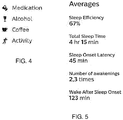
- Figure 4 shows a key for the symbols in the dashboard of Figure 3 , indicating the timings at which medication, alcohol or coffee were taken and the time when exercise was undertaken.
- Figure 5 shows a summary which may be prepared in respect of the two week sleep reporting period, showing the sleep efficiency, average total sleep time, sleep onset latency, number of awakenings and the time to wake after the first onset of sleep. These may all be of relevance to the clinician in providing suitable advice.
- Figure 6 is used to show, in simplified form, how the sleep restriction recommendation is determined.
- the sleep data is converted into binary form.
- Each sleep session is divided into time epochs. These are typically 15 minute time periods.
- Figure 6 shows time epochs of 1 hour.
- Each time epoch is allocated a binary value.
- 1 represents a time epoch when the subject was asleep the whole time.
- 0 represents a time when the subject was awake for at least part of that time epoch.
- Other coding approaches are of course possible, such as 1 for asleep for at least most of the time, and 0 for awake for at least most of the time.
- the chance of being asleep, looking at the previous monitoring period, e.g. 14 days, is calculated. For example, for the time slot 11:30pm to 12:30pm, the subject was asleep for 11/14 of the previous 14 days, hence a probability of 0.79 as shown in the bottom row.
- the processor determines the number of occurrences of actual sleep during the time epochs of the plurality of sleep sessions.
- the consolidated sleep window 50 which is the allowed time in bed, has an initial duration of 5 hours. This will typically adapt over time as the therapy advances.
- the timing of the 5 hour window i.e. the target timing of the in-bed duration, can then be positioned within the night to maximize the total probability.
- the position in time is selected to maximize the sum of the five consecutive values of the probability values in the last row. In this case, there are two equal positions; 0:30am to 5:30am or 12:30am to 4:30am.
- Figure 7 shows an example of a sleep restriction recommendation provided to the subject with a finer 10 minute resolution, based on the data of Figure 3 . It shows the go to bed time and the get up time, as well as the duration. This will be provided as part of the dashboard shown in Figure 3 .
- the processor may also take account of sleep preferences of the subject. For example, a subject may prefer to go to bed early and get up early if the probability of success of the sleep therapy is the same.
- the sleep preferences for example may relate to latest times the subject can stay in bed (e.g. because of work commitments), or the earliest time the subject can go to bed (e.g. because of evening commitments).
- the plurality of sleep sessions does not have to be two weeks. More generally it may be between 7 and 21 sleep sessions.
- the sleep pattern may be analyzed for one to three weeks before a sleep restriction therapy recommendation is generated.
- the sleep restriction therapy may start with a fixed time in bed window, e.g. of 5 hours as explained above.
- the target in-bed duration may instead be based on an estimate of the average total actual sleep time for the plurality of sleep sessions.
- the starting point may be based on the actual amount of sleep the subject generally achieves. This is the basic operation of a sleep restriction therapy approach.
- the go to bed time may be set never to be earlier than the actual fall asleep time which has been observed historically. Thus the subject should be ready for sleep when they go to bed.
- the sleep restriction recommendation will evolve over time.
- the processor may thus modify the sleep restriction recommendation over time based on new sleep data received over time.
- the progression over time of a sleep restriction therapy may also be handled by the system based on the continuously collected sleep data.
- the sensor arrangement mentioned above may be a body-worn sensor, so that the processor may for example be used to extend the functionality of a sleep monitoring headband.
- the sensor arrangement may instead or additionally comprise at least one monitoring sensor which is contact-less. This may for example monitor movements, but also provide additional environmental information of interest. This sensor arrangement may for example report times when lights are turned on or off, or provide temperature monitoring (to sense the presence of a body) etc. These may provide additional data for verifying or enhancing the self reporting data or data from body-worn sensors.
- the processing of the data may be handled in various ways, either locally to the subject, or remotely.
- data may be stored in a remote database.
- the system may for example automatically generate summarizing reports to give the specialist a quick overview of the data.
- the clinician/doctor can review the data in a graphical interface and use this to discuss the new bedtime schedule with the subject. This may enable easy adaption of treatment to maximize individual adherence.
- the system makes use of processor to perform the data processing.
- the processor can be implemented in numerous ways, with software and/or hardware, to perform the various functions required.
- the processor typically employs one or more microprocessors that may be programmed using software (e.g., microcode) to perform the required functions.
- the processor may be implemented as a combination of dedicated hardware to perform some functions and one or more programmed microprocessors and associated circuitry to perform other functions.
- circuitry examples include, but are not limited to, conventional microprocessors, application specific integrated circuits (ASICs), and field-programmable gate arrays (FPGAs).
- ASICs application specific integrated circuits
- FPGAs field-programmable gate arrays
- the processor may be associated with one or more storage media such as volatile and non-volatile computer memory such as RAM, PROM, EPROM, and EEPROM.
- the storage media may be encoded with one or more programs that, when executed on one or more processors and/or controllers, perform the required functions.
- Various storage media may be fixed within a processor or controller or may be transportable, such that the one or more programs stored thereon can be loaded into a processor.
- a computer program may be stored/distributed on a suitable medium, such as an optical storage medium or a solid-state medium supplied together with or as part of other hardware, but may also be distributed in other forms, such as via the Internet or other wired or wireless telecommunication systems.
- a suitable medium such as an optical storage medium or a solid-state medium supplied together with or as part of other hardware, but may also be distributed in other forms, such as via the Internet or other wired or wireless telecommunication systems.
Landscapes
- Health & Medical Sciences (AREA)
- Engineering & Computer Science (AREA)
- Medical Informatics (AREA)
- Public Health (AREA)
- Primary Health Care (AREA)
- Epidemiology (AREA)
- General Health & Medical Sciences (AREA)
- Biomedical Technology (AREA)
- Business, Economics & Management (AREA)
- Hospice & Palliative Care (AREA)
- Life Sciences & Earth Sciences (AREA)
- Data Mining & Analysis (AREA)
- Databases & Information Systems (AREA)
- Pathology (AREA)
- Biophysics (AREA)
- Child & Adolescent Psychology (AREA)
- Physical Education & Sports Medicine (AREA)
- Developmental Disabilities (AREA)
- General Business, Economics & Management (AREA)
- Psychiatry (AREA)
- Psychology (AREA)
- Social Psychology (AREA)
- Measurement Of The Respiration, Hearing Ability, Form, And Blood Characteristics Of Living Organisms (AREA)
Priority Applications (1)
| Application Number | Priority Date | Filing Date | Title |
|---|---|---|---|
| EP20183389.4A EP3932296A1 (fr) | 2020-07-01 | 2020-07-01 | Système pour une thérapie contre le manque de sommeil |
Applications Claiming Priority (1)
| Application Number | Priority Date | Filing Date | Title |
|---|---|---|---|
| EP20183389.4A EP3932296A1 (fr) | 2020-07-01 | 2020-07-01 | Système pour une thérapie contre le manque de sommeil |
Publications (1)
| Publication Number | Publication Date |
|---|---|
| EP3932296A1 true EP3932296A1 (fr) | 2022-01-05 |
Family
ID=71409324
Family Applications (1)
| Application Number | Title | Priority Date | Filing Date |
|---|---|---|---|
| EP20183389.4A Withdrawn EP3932296A1 (fr) | 2020-07-01 | 2020-07-01 | Système pour une thérapie contre le manque de sommeil |
Country Status (1)
| Country | Link |
|---|---|
| EP (1) | EP3932296A1 (fr) |
Cited By (1)
| Publication number | Priority date | Publication date | Assignee | Title |
|---|---|---|---|---|
| US20240108282A1 (en) * | 2022-09-30 | 2024-04-04 | Koninklijke Philips N.V. | System and method for providing sleep consolidation therapy |
Citations (2)
| Publication number | Priority date | Publication date | Assignee | Title |
|---|---|---|---|---|
| WO2017194450A1 (fr) * | 2016-05-09 | 2017-11-16 | Koninklijke Philips N.V. | Surveillance du sommeil |
| WO2020087114A1 (fr) * | 2018-10-29 | 2020-05-07 | Alertness CRC Ltd | Planificateur de sommeil personnalisé |
-
2020
- 2020-07-01 EP EP20183389.4A patent/EP3932296A1/fr not_active Withdrawn
Patent Citations (2)
| Publication number | Priority date | Publication date | Assignee | Title |
|---|---|---|---|---|
| WO2017194450A1 (fr) * | 2016-05-09 | 2017-11-16 | Koninklijke Philips N.V. | Surveillance du sommeil |
| WO2020087114A1 (fr) * | 2018-10-29 | 2020-05-07 | Alertness CRC Ltd | Planificateur de sommeil personnalisé |
Non-Patent Citations (1)
| Title |
|---|
| BEGUM ERTEN-UYUMAZ ET AL: "A Digital Sleep Restriction System for Insomnia Therapy Based on Sleep Window Shift Negotiation", PROCEEDINGS OF THE 11TH PERVASIVE TECHNOLOGIES RELATED TO ASSISTIVE ENVIRONMENTS CONFERENCE ON, PETRA '18, 26 June 2018 (2018-06-26), New York, New York, USA, pages 58 - 61, XP055750790, ISBN: 978-1-4503-6390-7, DOI: 10.1145/3197768.3201531 * |
Cited By (1)
| Publication number | Priority date | Publication date | Assignee | Title |
|---|---|---|---|---|
| US20240108282A1 (en) * | 2022-09-30 | 2024-04-04 | Koninklijke Philips N.V. | System and method for providing sleep consolidation therapy |
Similar Documents
| Publication | Publication Date | Title |
|---|---|---|
| US11626031B2 (en) | Systems and techniques for tracking sleep consistency and sleep goals | |
| US7608041B2 (en) | Monitoring and control of sleep cycles | |
| Vickers et al. | Perceptual indices of performance: the measurement of ‘inspection time’and ‘noise’in the visual system | |
| JP4192127B2 (ja) | 睡眠状態管理装置及び睡眠状態管理方法 | |
| US11793454B2 (en) | Method and system for providing feedback to user for improving performance level management thereof | |
| US9466200B2 (en) | Wake-up device | |
| US20200338303A1 (en) | Sleep induction device and method for inducting a change in a sleep state | |
| CN115153454B (zh) | 一种助眠刺激控制方法、装置、助眠设备及存储介质 | |
| US20070282930A1 (en) | System and methodology for management and modification of human behavior within a goal-oriented program | |
| CN111281341A (zh) | 一种睡眠评估方法、装置、电子设备及存储介质 | |
| US12539078B2 (en) | System and method for personalized biofeedback from a wearable device | |
| WO2020087114A1 (fr) | Planificateur de sommeil personnalisé | |
| CN113398424A (zh) | 一种失眠治疗系统及其工作方法 | |
| JP7794194B2 (ja) | 睡眠制限療法を個人化するためのシステム及び方法 | |
| CN117531090B (zh) | 基于智能手表进行舒缓助眠的处理方法及系统 | |
| CN110420373B (zh) | 睡眠训练方法、装置、计算机设备及存储介质 | |
| CN114694802A (zh) | 运动指导方法、装置、智能终端及计算机可读存储介质 | |
| EP4582014A1 (fr) | Système et procédés pour améliorer la qualité du sommeil | |
| US20260137897A1 (en) | System and method for delivering cognitive behaviour therapy for insomnia | |
| US20250281103A1 (en) | Apparatus and methods for active-feedback | |
| CN111588630A (zh) | 经皮神经调控策略生成方法及装置 | |
| US20240232746A1 (en) | Determining a sleep schedule | |
| CN118398169A (zh) | 基于深度学习的睡眠调控方法、系统、存储介质及设备 | |
| US20240108282A1 (en) | System and method for providing sleep consolidation therapy | |
| CN122050763A (zh) | 用于输送失眠认知行为疗法的系统和方法 |
Legal Events
| Date | Code | Title | Description |
|---|---|---|---|
| PUAI | Public reference made under article 153(3) epc to a published international application that has entered the european phase |
Free format text: ORIGINAL CODE: 0009012 |
|
| STAA | Information on the status of an ep patent application or granted ep patent |
Free format text: STATUS: THE APPLICATION HAS BEEN PUBLISHED |
|
| AK | Designated contracting states |
Kind code of ref document: A1 Designated state(s): AL AT BE BG CH CY CZ DE DK EE ES FI FR GB GR HR HU IE IS IT LI LT LU LV MC MK MT NL NO PL PT RO RS SE SI SK SM TR |
|
| B565 | Issuance of search results under rule 164(2) epc |
Effective date: 20201125 |
|
| STAA | Information on the status of an ep patent application or granted ep patent |
Free format text: STATUS: THE APPLICATION IS DEEMED TO BE WITHDRAWN |
|
| 18D | Application deemed to be withdrawn |
Effective date: 20220706 |