EP3933372B1 - Système de simulation de freinage pour wagons de chemin de fer continental - Google Patents
Système de simulation de freinage pour wagons de chemin de fer continental Download PDFInfo
- Publication number
- EP3933372B1 EP3933372B1 EP20888732.3A EP20888732A EP3933372B1 EP 3933372 B1 EP3933372 B1 EP 3933372B1 EP 20888732 A EP20888732 A EP 20888732A EP 3933372 B1 EP3933372 B1 EP 3933372B1
- Authority
- EP
- European Patent Office
- Prior art keywords
- braking
- freight
- modules
- carriage
- carriages
- Prior art date
- Legal status (The legal status is an assumption and is not a legal conclusion. Google has not performed a legal analysis and makes no representation as to the accuracy of the status listed.)
- Active
Links
Images



Classifications
-
- G—PHYSICS
- G01—MEASURING; TESTING
- G01M—TESTING STATIC OR DYNAMIC BALANCE OF MACHINES OR STRUCTURES; TESTING OF STRUCTURES OR APPARATUS, NOT OTHERWISE PROVIDED FOR
- G01M17/00—Testing of vehicles
- G01M17/08—Railway vehicles
-
- B—PERFORMING OPERATIONS; TRANSPORTING
- B60—VEHICLES IN GENERAL
- B60T—VEHICLE BRAKE CONTROL SYSTEMS OR PARTS THEREOF; BRAKE CONTROL SYSTEMS OR PARTS THEREOF, IN GENERAL; ARRANGEMENT OF BRAKING ELEMENTS ON VEHICLES IN GENERAL; PORTABLE DEVICES FOR PREVENTING UNWANTED MOVEMENT OF VEHICLES; VEHICLE MODIFICATIONS TO FACILITATE COOLING OF BRAKES
- B60T13/00—Transmitting braking action from initiating means to ultimate brake actuator with power assistance or drive; Brake systems incorporating such transmitting means, e.g. air-pressure brake systems
- B60T13/10—Transmitting braking action from initiating means to ultimate brake actuator with power assistance or drive; Brake systems incorporating such transmitting means, e.g. air-pressure brake systems with fluid assistance, drive, or release
- B60T13/66—Electrical control in fluid-pressure brake systems
- B60T13/665—Electrical control in fluid-pressure brake systems the systems being specially adapted for transferring two or more command signals, e.g. railway systems
-
- B—PERFORMING OPERATIONS; TRANSPORTING
- B60—VEHICLES IN GENERAL
- B60T—VEHICLE BRAKE CONTROL SYSTEMS OR PARTS THEREOF; BRAKE CONTROL SYSTEMS OR PARTS THEREOF, IN GENERAL; ARRANGEMENT OF BRAKING ELEMENTS ON VEHICLES IN GENERAL; PORTABLE DEVICES FOR PREVENTING UNWANTED MOVEMENT OF VEHICLES; VEHICLE MODIFICATIONS TO FACILITATE COOLING OF BRAKES
- B60T17/00—Component parts, details, or accessories of power brake systems not covered by groups B60T8/00, B60T13/00 or B60T15/00, or presenting other characteristic features
- B60T17/18—Safety devices; Monitoring
- B60T17/22—Devices for monitoring or checking brake systems; Signal devices
- B60T17/228—Devices for monitoring or checking brake systems; Signal devices for railway vehicles
-
- B—PERFORMING OPERATIONS; TRANSPORTING
- B61—RAILWAYS
- B61H—BRAKES OR OTHER RETARDING DEVICES SPECIALLY ADAPTED FOR RAIL VEHICLES; ARRANGEMENT OR DISPOSITION THEREOF IN RAIL VEHICLES
- B61H13/00—Actuating rail-vehicle brakes
Definitions
- the present invention relates to a braking simulation system for a continental railroad car and, more particularly, to a braking simulation system for a continental railroad car, wherein it is possible to perform a field test in which a plurality of air brake system modules of the railroad car is loaded on two or more freight carriages and actually driven to be simulated, and the space in which the air brake system modules are able to be loaded may be utilized as much as possible by using an articulated bogie, so that air braking simulation applied to large-scale freight carriages may be performed more effectively.
- a freight carriage for loading and transporting cargo uses a pneumatic brake system using compressed air.
- a pneumatic pressure braking device for such a freight carriage, it may be essential to perform a sufficient braking test, by using a separate tester before actually installing the braking system, in order to measure idle running time, release time, braking pressure, and the like in advance.
- a conventional braking tester performs a braking test based on a braking device installed in a single freight carriage, although it is possible to accurately measure the idle running time, release time, and braking pressure according to an operation of the brake system loaded on the single freight carriage, there is a problem in that the braking test may not be performed for a braking system installed on a large number of freight carriages.
- freight carriages are operated by organizing a large number of carriages at a time, ranging from twenty to thirty carriages at a minimum to more than one hundred carriages.
- a braking device installed in each carriage is supplied with compressed air by using a single compressed air supply pipe to perform braking, there occurs differences in data including: idle running time, release time, and braking pressure, depending on delay in supply time of compressed air.
- Korean Utility Model Application Publication No. 20-0336616 discloses a "FREIGHT CAR ORGANIZATION BREAK TESTER", wherein, the main technical configuration has characteristics in which known braking systems for freight carriages are organized by about 20 to 30 carriages, a pressure sensor is attached to a braking tank configured in each braking system, and then an operating time of the pressure sensor is measured by using a digital timer, whereby it is possible to accurately measure idle running time, release time, and braking pressure according to the braking system of a large number of freight carriages.
- a digital timer whereby it is possible to accurately measure idle running time, release time, and braking pressure according to the braking system of a large number of freight carriages.
- there is a problem in that only 20 to 30 carriages are available for the braking test which is limited, and as before, a field test that tests the braking system in an actual driving condition of the freight carriages is not possible.
- the present invention is devised to solve the above problems, and an objective of the present invention is to provide a braking simulation system for a continental railroad car, wherein not only it is possible to perform a field test by loading a plurality of braking modules of a railroad car on one or more freight carriages and actually driving and simulating the railroad car, but also a ground test of the braking modules is possible in a state of parking for each freight carriage loaded with the braking modules in an inspection station, so the size of an indoor space required for the braking simulation may be drastically reduced, and moreover, an interworking test with railroad cars of different countries respectively having different braking systems is possible.
- another objective of the present invention is to provide a braking simulation system for a continental railroad car, wherein an articulated bogie is used for a field test of braking modules, and at the same time, the braking modules loaded on an upper part of the articulated bogie are hingedly coupled to neighboring front and rear braking modules by links, so that a more stable field test is possible and it is possible to reduce operating cost of the braking simulation system required for the field test.
- a braking simulation system for a continental railroad car including: a locomotive provided with a braking system; two or more freight carriages installed at a rear of the locomotive and connected thereto, the two or more freight carriages being connected to each other; a running rail on which the locomotive and freight carriages are driven; and a braking module in which braking devices provided in the two or more freight carriages of the railroad car are modularized in a stackable form, wherein the braking module includes braking modules connected in series to the braking system of the locomotive and stacked in multiple layers on an upper part of each freight carriage.
- the braking simulation system may further include: an inspection station for a ground test of each of the braking modules; and a transfer rail installed between the running rail and the inspection station and connecting therebetween.
- a parking space for allowing each freight carriage to be parked may be formed in the inspection station so that the ground test of each of the braking modules may be able to be performed in a state where the braking modules are loaded on the upper part of each freight carriage.
- the parking space may be configured to correspond to the number of organized freight carriages.
- the braking simulation system may further include a tractor for moving each freight carriage to the parking space along the transfer rail.
- the locomotive may include: a controller for overall controlling movement of compressed air used for braking and an operation of each of the braking modules; and a monitoring means for monitoring braking performance of each braking module, wherein each braking module may be provided with an abnormality detecting means for generating a signal to the monitoring means when an abnormality occurs during a test.
- a further freight carriage in which other braking modules each having a configuration different from those of the braking modules are stacked in the multiple layers may be installed at and connected to a front or rear of the freight carriage in which the braking modules are stacked in the multiple layers.
- each of the two or more freight carriages may be connected to each other by an articulated bogie, and each freight carriage may include: a first loading part positioned on the upper part of each of the freight carriages; and a second loading part positioned on a connection part between neighboring freight carriages each supported by the articulated bogie.
- first and second loading parts may respectively include: first and second support plates respectively installed on the upper part of each freight carriage and on which the braking modules are loaded; a hinge connection part installed between the first and second support plates and configured to connect therebetween; and a fixing means for fixing the first and second support plates to the upper part of the freight carriage.
- the braking modules in which the braking devices using different braking systems are modularized may be respectively loaded on the upper parts of the first loading part and the second loading part of the freight carriage, or on the upper parts of the first loading parts provided in the neighboring freight carriages.
- the present invention there is an excellent effect in that not only it is possible to perform a field test by loading a plurality of braking modules of a railroad car on one or more freight carriages and actually driving and simulating the railroad car, but also a ground test of the braking modules is possible in a state of parking for each freight carriage loaded with the braking modules in an inspection station.
- the braking modules may be loaded on a connection part positioned on an upper part of the articulated bogie between neighboring freight carriages, so that there is an excellent effect in that it is possible to maximally utilize the space in which the braking modules are able to be loaded, and accordingly, it is possible to reduce the time and cost required for the field test of the braking system applied to large-scale freight carriages.
- an articulated bogie is used for a field test of braking modules, and at the same time, the braking modules loaded on an upper part of the articulated bogie are hingedly coupled to neighboring front and rear braking modules by links, so that a more stable field test is possible, stability in the curve section is improved, and vibration generated during the driving process may be reduced, thereby having an additional effect in that disturbance that affects the field test may be reduced.
- each of braking modules in which the braking device used in each freight carriage of different countries is modularized, is loaded on an upper part of each freight carriage and connected to each other, so as to have an additional effect in that an interworking test with railroad cars of different countries respectively having different braking systems is possible.
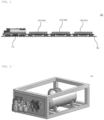
- FIG. 1 is a view showing a state of a field test using a braking simulation system for a continental railroad car according to an exemplary embodiment of the present invention.
- FIG. 2 is a view showing a braking module of the present invention shown in FIG. 1 .
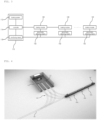
- FIG. 3 is a view conceptually showing components provided in a locomotive and freight carriages in the present invention shown in FIG. 1 .
- FIGS. 4 to 10 are views showing states of a ground test using the braking simulation system for a continental railroad car according to the present invention.
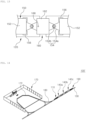
- FIG. 11 is a view showing a state of a field test using another exemplary embodiment of the braking simulation system for a continental railroad car according to the present invention.
- FIG. 12 is a view showing in detail a connection part between neighboring freight carriages to which an articulated bogie is applied in the present invention shown in FIG. 11 .
- FIG. 13 is a plan view showing in detail first and second loading parts respectively installed on upper parts of the freight carriage of the present invention shown in FIG. 11 .
- FIGS. 14 and 15 are views showing states of the ground test using the braking simulation system for a continental rail vehicle according to the present invention shown in FIG. 11 .
- the present invention relates to a braking simulation system 100 for a continental railroad car, wherein it is possible to perform a field test in which a plurality of air brake system modules of the railroad car is loaded on two or more freight carriages and actually driven to be simulated, and the space in which the air brake system modules are able to be loaded may be utilized as much as possible by using an articulated bogie, so that air braking simulation applied to large-scale freight carriages may be performed more effectively.
- the braking simulation system is mainly configured to include a locomotive 110, a freight carriage 120, a running rail 130, and a braking module 140.
- the locomotive 110 serves to perform a field test of braking modules 140, and pulls the freight carriages 120 loaded with the braking modules 140 to be described later to drive on a running rail 130, so that it is possible to perform the field test that simulates an operation of the braking system 112 during a driving process of an actual railroad car.
- the locomotive 110 is provided with a braking system 112 for supplying braking force to each freight carriage 120 connected to a rear thereof and each braking module 140 loaded on the freight carriage 120.
- the braking system 112 may be configured to include: a storage tank for storing compressed air used for braking; a compressor for supplying the compressed air stored in the storage tank to each braking module 140; a compressed air supply pipe through which the compressed air moves by driving of the compressor; and the like. Since a configuration of such a braking system 112 is the same as that of a braking system 112 of a railroad car provided in the conventional locomotive 110 using pneumatic pressure, a detailed description will be omitted.
- the locomotive 110 is provided with a controller 114 and a monitoring means 116, wherein the controller 114 serves to overall control an operation of each braking module 140 loaded on the freight carriage 120, and the monitoring means 116 serves to monitor braking performance of each braking module 140 loaded on the freight carriage 120. Since it is configured such that a signal from an abnormality detecting means 142 provided in the corresponding braking module 140 may be displayed on the monitoring means 116 when an abnormality occurs in a specific braking module 140 during simulation, a driver may immediately check the braking module 140 in which the abnormality has occurred, and perform a control such as stopping driving of the braking module 140 through the controller 114.
- the freight carriage 120 is installed and connected to the rear of the locomotive 110 and serves to allow the braking modules 140 for braking simulation to be loaded on the upper part thereof, and about 2 to 5 carriages of the freight carriages 120 may be used for the braking simulation.
- the running rail 130 serves as a track to enable a railroad car composed of the locomotive 110 and two or more freight carriages 120 connected to the locomotive 110 to drive, and some of the existing railroad tracks may be used.
- the braking module 140 is a module that modularizes in a stackable form: braking devices provided in one carriage of a railroad car, that is, one carriage of a railroad car such as a freight carriage 120 excluding the locomotive 110; and equipment for testing performance of the braking devices. While loaded on the upper part of the freight carriage 120, each braking module 140 is configured to perform a field test and a ground test.
- the braking devices provided on one carriage of the railroad car are installed the inside and outside of a hard case made in a stackable form, and although not shown in the drawing, the braking module 140 may include: a compressed air tank for storing compressed air used for braking; a braking cylinder for generating braking force by pneumatic pressure supplied from the compressed air tank; a valve part for adjusting the flow of compressed air supplied from the braking system 112 of the locomotive 110 and the flow of compressed air inside the braking module 140; and a piping part for serving as a passage through which the compressed air supplied from the braking system 112 and the compressed air used in the braking module 140 move.
- valve part may include: a control valve for controlling the pressure inside the compressed air tank and the braking cylinder; a response load valve for automatically increasing or decreasing braking force depending on loading weight of a railroad car; and a load detection valve for sensing the loading weight of the railroad car and converting the loading weight into pneumatic pressure and transmitting the pneumatic pressure to the response load valve.
- the components of the braking devices as described above, that is, the components of the braking devices that may be included in the braking module 140 are the same as those of the braking devices installed in one carriage of the existing railroad cars, so a more detailed description such as roles, and an installation location of each component will be omitted.
- the components installed in one carriage may vary depending on the type of a braking system 112 used in a railroad car
- the components of the braking device constituting the braking module 140 may also vary depending on the type of braking system 112 used in the entire railroad car.
- the braking module 140 may include a load generator for applying a load detected by a load detection valve according to a signal from the controller 114 provided in the locomotive 110, that is, the controller 114 that controls the operation of each braking module 140, and additionally, may include numerous equipment for testing the performance of the braking devices including various valves for controlling movement of compressed air and sensors for detecting the valves.
- an abnormality detecting means 142 may be installed in each braking module 140.
- the abnormality detecting means 142 serves to generate a signal when an abnormality occurs in a braking module 140 during a field test using the braking module 140, wherein the signal generated from the abnormality detecting means 142 is displayed on the monitoring means 116 provided in the locomotive 110, so that an engine driver may easily recognize the braking module 140 where the abnormality has occurred during the field test.
- the braking system 112 of a railroad car differs by country, and may also vary depending on the type or use purpose of the railroad car. Depending on the type of braking system 112, the configuration of the braking device installed in one carriage of a railroad car is also different.
- the detailed configuration of the braking device installed in the braking module 140 and the equipment configured to test the performance of the braking device may be variously changed as well.
- the braking modules 140 of South Korea, China, and Russia composed of both the braking devices installed in one freight carriage 120 and the equipment configured to test performance of the braking devices are respectively called as the first to third braking modules 140a, 140b, and 140c
- three freight carriages 120 connected to the locomotive 110 and on which the braking modules 140 are loaded are respectively called the first to third freight carriage 120a, 120b, and 120c
- a field test or ground test to be described later may be performed in a state where the first freight carriage 120a is loaded with a first braking module 140a, the second freight carriage 120b is loaded with a second braking module 140b, and the third freight carriage 120c is loaded with a third braking module 140c.
- the field test and ground test may be performed by respectively loading braking modules 140 that modularizes braking devices of a railroad car using different braking systems 112 on freight carriages 120 different from each other.
- the freight carriages 120a and 120c on which braking modules 140a and 140c composed of components and braking systems different from those of the braking module 140b are stacked in multiple layers are respectively installed and connected to the front and rear of the freight carriage 120b on which the braking modules 140b are stacked in multiple layers, so that there is an advantage in that a simulation is performed on the braking modules 140 respectively having different structures and it is possible to simulate an interworking test with railroad cars of different countries each having braking systems 112 different from each other.
- the braking simulation system 100 for a continental railroad car may further include: an inspection station 170; and a transfer rail 180, wherein the inspection station 170 serves to perform a ground test of the braking module 140, i.e., a performance test while stationary on the ground, and is installed on the ground in an area neighboring to the running rail 130 on which the field test is performed.
- a ground test of the braking module 140 i.e., a performance test while stationary on the ground, and is installed on the ground in an area neighboring to the running rail 130 on which the field test is performed.
- parking spaces 172 in which two or more freight carriages 120 connected to the locomotive 110 are allowed to be respectively parked are formed in the inspection station 170, and equipment for a performance test of the braking modules 140 in a state loaded on each freight carriage 120 is installed around the parking spaces 172.
- the transfer rails 180 are installed between the running rail 130 on which the field test of the braking modules 140 is performed and the inspection station 170, that is, the parking spaces 172 formed in the inspection station 170, wherein each freight carriage 120 loaded with the braking modules 140 for which the field test has been completed is towed into and parked in one of the parking spaces 172 of the inspection station 170 via one of the transfer rails 180 from the running rail 130 by the locomotive 110 or a separate tractor 190, whereby the ground test of the braking module 140 may be performed while still loaded on the upper part of the freight carriage 120.
- each freight carriage 120 may be moved to the running rail 130 via the one of the transfer rails 180 by using the locomotive 110 or the separate tractor 190, so as to perform a field test as well.
- a connection part positioned between neighboring freight carriages 120 may be supported by an articulated bogie 122.
- the braking module 140 may be installed only on the upper part of an underframe of each carriage.
- the braking modules 140 is also able to be loaded in a space positioned on an upper part of the articulated bogie 122 between neighboring carriages, whereby it is possible to use the space in the upper part of the freight carriage 120 more efficiently.
- a height of the freight carriage may be lowered to enable a more stable field test, stability may be improved in a curved section, and vibration generated during a driving process may be reduced, whereby there may be an effect of reducing disturbance that affects the field test.
- a first loading part 150 and a second loading part 160 may be provided on upper parts of a freight carriage 120 on which braking modules 140 to be described later are loaded.
- the first and second loading parts 150 and 160 serve to more stably support the braking modules 140 loaded on an upper part of the freight carriage 120, wherein the first loading part 150 is installed on an upper part of each freight carriage 120 and the second loading part 160 is installed on a connection part between neighboring freight carriages 120 each supported by an articulated bogie 122.
- the first and second loading parts 150 and 160 may be configured to include: first and second support plates 152 and 162; a hinge connection part 154; and fixing means 156 and 166.
- the first and second support plates 152 and 162 are respectively installed on upper parts of a freight carriage 120 to support the lower part of the braking module 140, wherein the first support plate 152 constituting the first loading part 150 is installed on an upper part of each freight carriage 120, and the second support plate 162 constituting the second loading part 160 is installed on an upper part of a connection part between neighboring freight carriages 120.
- a hinge connection part 154 is installed between the first support plate 152 and the second support plate 162 and connects therebetween, and includes: a pair of connection members 154a having ends thereof respectively installed at ends of the first support plate 152 and the second support plate 162; and a hinge coupling part 154b provided at a connection part between the connection members 154a, wherein each braking module 140 loaded on the second support plate 162 serves to stably maintain a loaded state even when a railroad car is driving in a curved section during a field test of each braking module 140.
- a refracted angle is generated at a connection part positioned at an upper part of the articulated bogie 122 between neighboring freight carriages 120, that is, at a position between a rear end of the front freight carriage 120 and a front end of the rear freight carriage 120.
- the second support plate 162 may be deformed or damaged when the second support plate 162, installed on the connection part between the front freight carriage 120 and the rear freight carriage 120, is fixedly installed on the freight carriage 120.
- the second support plate 162 is supported by the first support plates 152 each positioned at the front and rear freight carriages 120 and is able to be freely rotated according to an angle change at the connection part between the front freight carriage 120 and the rear freight carriage 120, so that the braking modules 140 loaded on the upper part of the second support plate 162 maintain a stable loading state even in the curved section.
- connection members 154a respectively installed at ends of the first support plate 152 and the second support plate 162 may be formed to have various shapes such as wires, chains, and belts.
- the fixing means 156 and 166 respectively serves to fix the first and second support plates 152 and 162 to upper parts of each freight carriage 120, and in the case of the first support plate 152, each of four corner parts is fixed to an upper part of a freight carriage 120 by a fastening means (not shown) such as a bolt, or by a fixing means 156 such as a fixing frame.
- a second support plate 162 when a railroad car under a field test is driving on a curved section, a second support plate 162 should also have a structure to be able to be rotated by an angle change of a connection part between a front freight carriage 120 and a rear freight carriage 120 each supported by an articulated bogie 122, a front or rear central part, or each opposite corner part of the second support plate 162 is fixed to an upper part of a freight carriage 120 by the fixing means 166 such as a hinge pin.
- the detailed configuration of the braking device installed in the braking module 140 and the equipment configured to test the performance of the braking device may be variously changed as well.
- the braking modules 140 of South Korea, China, and Russia composed of both the braking devices installed in one freight carriage 120 and the equipment configured to test performance of the braking devices are respectively called as the first to third braking modules 140a, 140b, and 140c
- a field test or a ground test to be described later may be performed in a state where the first braking module 140a is loaded on a first loading part 150 on an upper part of the first carriage 120a
- the second braking module 140b is loaded on the second loading part 160 on an upper part of a connection part between the first and second freight carriages 120a and 120b
- the third braking module 140c is loaded on a first loading part 150 on an upper part of the second freight
- a parking space 172 is formed in an inspection station 170 so that two or more freight carriages 120 each connected by an articulated bogie 122 may be parked.
- the parking space 172 may be formed to have an arc shape or a curved shape as a whole in consideration that an angle of a connection part positioned on an upper part of the articulated bogie 122 between neighboring freight carriages 120 is adjustable, and is configured to allow about two to five freight carriages 120 to be parked therein.
- a transfer rail 180 is installed between the running rail 130 on which a field test of the braking modules 140 is performed and the inspection station 170, that is, the parking space 172 formed in the inspection station 170, and connects therebetween, wherein each freight carriage 120 loaded with the braking modules 140 for which the field test has been completed is towed into the parking space 172 of the inspection station 170 via the transfer rail 180 from the running rail 130 by a locomotive 110 or a separate tractor 190, and then parked therein, so that a ground test of the braking modules 140 may be performed still in the same state of being loaded on the upper part of each freight carriage 120.
- the freight carriages 120 may be moved to the running rail 130 via the transfer rail 180 by using the locomotive 110 or the separate tractor 190, so as to perform a field test as well.
- braking modules 140 may also be loaded at a connection part positioned on an upper part of an articulated bogie 122 between neighboring freight carriages 120 plurality of braking modules 140 in which braking devices installed in each freight carriage 120 of a railroad car are modularized is loaded and actually driven to be simulated, so that the space where the braking modules 140 are able to be loaded may be utilized as much as possible, it is possible to reduce time and cost required for the field test of the braking system applied to large-scale freight carriages 120 accordingly, a more stable field test is possible by allowing the braking modules 140 loaded on the upper part of the articulation bogie 122 to be hingedly coupled to neighboring front and rear braking modules by links, disturbances affecting the field test may be reduced due to the fact that stability may be improved in a curved section, and vibrations generated during the driving process may be reduced, and at the same time, the braking modules 140 in which braking devices used in freight carriages
- the present invention relates to a braking simulation system for a continental railroad car and, more particularly, to a braking simulation system for a continental railroad car, wherein it is possible to perform a field test in which a plurality of air brake system modules of the railroad car is loaded on two or more freight carriages and actually driven to be simulated, and the space in which the air brake system modules are able to be loaded may be utilized as much as possible by using an articulated bogie, so that air braking simulation applied to large-scale freight carriages may be performed more effectively.
Landscapes
- Engineering & Computer Science (AREA)
- Mechanical Engineering (AREA)
- Transportation (AREA)
- Physics & Mathematics (AREA)
- General Physics & Mathematics (AREA)
- Valves And Accessory Devices For Braking Systems (AREA)
- Braking Arrangements (AREA)
- Train Traffic Observation, Control, And Security (AREA)
Claims (10)
- Système de simulation de freinage (100, 100') pour un wagon de chemin de fer continental, le système de simulation de freinage comprenant :une locomotive (110) munie d'un système de freinage (112) ;deux ou plusieurs wagons de marchandises (120) installés à l'arrière de la locomotive (110) et reliés à celle-ci, les deux ou plusieurs wagons de marchandises (120) étant reliés l'un à l'autre ;un rail de roulement (130) sur lequel la locomotive (110) et les wagons de marchandises (120) sont entraînés ;caractérisée en ce qu'il comprendun module de freinage (140) dans lequel les dispositifs de freinage prévus dans les deux wagons de marchandises ou plus (120) du wagon de chemin de fer sont modulaires sous une forme empilable,dans lequel le module de freinage (140) comprend des modules de freinage reliés en série au système de freinage (112) de la locomotive (110) et empilés en plusieurs couches sur une partie supérieure de chaque wagon de marchandises (120).
- Système de simulation de freinage (100, 100') selon la revendication 1, comprenant en outre :un poste d'inspection (170) pour un essai au sol de chacun des modules de freinage (140) ; etun rail de transfert (180) installé entre le rail de roulement (130) et le poste d'inspection (170) et reliés entre eux.
- Système de simulation de freinage (100, 100') selon la revendication 2, dans lequel un espace de stationnement (172) pour permettre à chaque wagon de marchandises (120) d'être garé est formé dans le poste d'inspection (170) de sorte que l'essai au sol de chacun des modules de freinage puisse être effectué dans un état où les modules de freinage sont chargés sur la partie supérieure de chaque wagon de marchandises (120).
- Système de simulation de freinage (100, 100') selon la revendication 3, dans lequel l'espace de stationnement (172) est configuré pour correspondre au nombre de wagons de marchandises organisés (120).
- Système de simulation de freinage (100, 100') selon la revendication 3, comprenant en outre :
un tracteur (190) pour déplacer chaque wagon de marchandises (120) vers l'espace de stationnement (172) le long du rail de transfert (180). - Système de simulation de freinage (100, 100') selon la revendication 1, dans lequel la locomotive (110) comprend :un dispositif de commande (114) pour commander globalement le mouvement de l'air comprimé utilisé pour le freinage et un fonctionnement de chacun des modules de freinage (140) ; etun moyen de surveillance (116) pour surveiller les performances de freinage de chaque module de freinage (140),dans lequel chaque module de freinage (140) est pourvu d'un moyen de détection d'anomalie (142) pour générer un signal vers le moyen de surveillance lorsqu'une anomalie se produit pendant un essai.
- Système de simulation de freinage (100, 100') selon la revendication 1, dans lequel un autre wagon de marchandises (120a, 120c) dans lequel d'autres modules de freinage (140a, 140c) ayant chacun une configuration différente de celles des modules de freinage (140b) sont empilés dans les multiples couches est installé et relié à l'avant ou à l'arrière du wagon de marchandises (120b) dans lequel les modules de freinage (140b) sont empilés dans les multiples couches.
- Système de simulation de freinage (100, 100') selon la revendication 1, dans lequel chacun des deux ou plusieurs wagons de marchandises (120) est relié l'un à l'autre par un bogie articulé (122), et
chaque wagon de marchandises (120) comprend :une première partie de chargement (150) positionnée sur la partie supérieure de chacun des wagons de marchandises (120) ; etune seconde partie de chargement (160) positionnée sur une partie de connexion entre les wagons de marchandises voisins (120), chacun supporté par le bogie articulé (122). - Système de simulation de freinage (100, 100') selon la revendication 8, dans lequel les première et seconde parties de chargement (150, 160) comprennent respectivement :des première et seconde plaques de support (152, 162) respectivement installées sur la partie supérieure de chaque wagon de marchandises (120) et sur lesquelles les modules de freinage (140) sont chargés ;une partie de connexion de charnière (154) installée entre les première et seconde plaques de support (152, 162) et configurée pour être reliées entre elles ; etun moyen de fixation (156, 166) pour fixer les première et seconde plaques de support (152, 162) à la partie supérieure du wagon de marchandises (120).
- Système de simulation de freinage (100, 100') selon la revendication 8, dans lequel les modules de freinage (140) dans lesquels les dispositifs de freinage utilisant différents systèmes de freinage sont modularisés sont respectivement chargés sur les parties supérieures de la première partie de chargement (150) et de la seconde partie de chargement (160) du wagon de marchandises (120), ou sur les parties supérieures des premières parties de chargement (150) prévues dans les wagons de marchandises voisins (120).
Applications Claiming Priority (3)
| Application Number | Priority Date | Filing Date | Title |
|---|---|---|---|
| KR1020200055060A KR102430916B1 (ko) | 2020-05-08 | 2020-05-08 | 대륙철도차량용 제동 시뮬레이션 시스템 |
| KR1020200098060A KR102387013B1 (ko) | 2020-08-05 | 2020-08-05 | 관절대차를 이용한 철도차량 제동 시뮬레이션 시스템 |
| PCT/KR2020/018299 WO2021225246A1 (fr) | 2020-05-08 | 2020-12-15 | Système de simulation de freinage pour wagons de chemin de fer transcontinental |
Publications (4)
| Publication Number | Publication Date |
|---|---|
| EP3933372A1 EP3933372A1 (fr) | 2022-01-05 |
| EP3933372A4 EP3933372A4 (fr) | 2023-01-11 |
| EP3933372C0 EP3933372C0 (fr) | 2024-08-28 |
| EP3933372B1 true EP3933372B1 (fr) | 2024-08-28 |
Family
ID=78468036
Family Applications (1)
| Application Number | Title | Priority Date | Filing Date |
|---|---|---|---|
| EP20888732.3A Active EP3933372B1 (fr) | 2020-05-08 | 2020-12-15 | Système de simulation de freinage pour wagons de chemin de fer continental |
Country Status (2)
| Country | Link |
|---|---|
| EP (1) | EP3933372B1 (fr) |
| WO (1) | WO2021225246A1 (fr) |
Families Citing this family (3)
| Publication number | Priority date | Publication date | Assignee | Title |
|---|---|---|---|---|
| CN116147942B (zh) * | 2023-04-23 | 2023-06-30 | 眉山中车制动科技股份有限公司 | 一种列车制动模拟试验编组系统及其编组方法 |
| CN116678649B (zh) * | 2023-06-07 | 2024-05-24 | 眉山中车制动科技股份有限公司 | 铁路货车多系统单车试验平台空气制动系统 |
| CN119198145B (zh) * | 2024-11-27 | 2025-02-25 | 常州中量高新技术有限公司 | 一种用于列车制动状态下的智能测试系统 |
Family Cites Families (7)
| Publication number | Priority date | Publication date | Assignee | Title |
|---|---|---|---|---|
| KR100493562B1 (ko) * | 2002-02-04 | 2005-06-08 | 윤대원 | 철도차량 제동상태의 측정장치 및 방법 |
| KR200336616Y1 (ko) | 2003-09-19 | 2003-12-18 | 한국철도부품 주식회사 | 화차 편성 제동 시험기 |
| KR100611196B1 (ko) * | 2004-07-09 | 2006-08-10 | 한국철도기술연구원 | 도시철도차량의 제동력 측정 시스템 |
| KR101486910B1 (ko) * | 2013-10-29 | 2015-02-04 | 디알에스테크 주식회사 | 전동차 차고 진출입 경보 시스템 |
| IT201700040680A1 (it) * | 2017-04-12 | 2018-10-12 | Faiveley Transport Italia Spa | Sistema di controllo elettronico della frenatura di emergenza e di servizio, per un veicolo ferroviario. |
| AT519966B1 (de) * | 2017-05-05 | 2018-12-15 | Pj Messtechnik Gmbh | Verfahren zur Durchführung einer automatischen Bremsprobe an einem Zug und dazu ausgebildeter Wagen |
| CN111006887B (zh) * | 2019-11-21 | 2024-04-26 | 广州地铁集团有限公司 | 一种城轨列车制动系统试验平台 |
-
2020
- 2020-12-15 EP EP20888732.3A patent/EP3933372B1/fr active Active
- 2020-12-15 WO PCT/KR2020/018299 patent/WO2021225246A1/fr not_active Ceased
Also Published As
| Publication number | Publication date |
|---|---|
| EP3933372A1 (fr) | 2022-01-05 |
| EP3933372C0 (fr) | 2024-08-28 |
| WO2021225246A1 (fr) | 2021-11-11 |
| EP3933372A4 (fr) | 2023-01-11 |
Similar Documents
| Publication | Publication Date | Title |
|---|---|---|
| EP3933372A1 (fr) | Système de simulation de freinage pour wagons de chemin de fer transcontinental | |
| US8230730B2 (en) | Comprehensive test bed for vehicle body | |
| CN103048149B (zh) | 一种龙门框架式轨道车辆转向架参数测定试验台 | |
| CN102042901B (zh) | 基于正弦扫频法的轨道车辆转向架悬挂自振特性试验台 | |
| CN103175698B (zh) | 铁道车辆抗大风倾覆能力测试方法及其装置 | |
| CN106370434B (zh) | 一种汽车列车制动系统检测的台架 | |
| CN113804395B (zh) | 用于模拟轨道列车与桥梁受载情况的测试装置 | |
| CN203024964U (zh) | 汽车板簧实验运动轨迹测量装置 | |
| CN109682615B (zh) | 一种吊挂式单轨车体强度试验装置 | |
| CN111103809B (zh) | 一种用于高速和中低速磁悬浮列车的悬浮控制仿真平台 | |
| CN105571843B (zh) | 轨道车辆车端关系万变结构试验台 | |
| CN112763242B (zh) | 一种轨道状态车载检测系统可靠性评估试验台 | |
| KR102387013B1 (ko) | 관절대차를 이용한 철도차량 제동 시뮬레이션 시스템 | |
| CN202547845U (zh) | 转臂式轴箱测力装置 | |
| CN209182041U (zh) | 一种吊挂式单轨车辆滚动振动试验装置 | |
| CN202420880U (zh) | 铁道车辆抗大风倾覆能力测试装置 | |
| CN204177586U (zh) | 模拟机车车辆转向架构架试验自由度的装置 | |
| CN116990047A (zh) | 一种悬挂系统试验台及方法 | |
| KR102194170B1 (ko) | 모듈화된 철도차량용 제동 시뮬레이터를 이용한 제동 시뮬레이션 시스템 | |
| KR102430916B1 (ko) | 대륙철도차량용 제동 시뮬레이션 시스템 | |
| CN203908796U (zh) | 背装布置ng气瓶支架强度校验装置 | |
| CN107271205B (zh) | 铁路车辆压车梁的疲劳试验装置及疲劳试验方法 | |
| CN202547918U (zh) | 空气弹簧失效过程模拟实验装置 | |
| CN206563650U (zh) | 一种用于erv电子中继阀的测试设备 | |
| CN115096608A (zh) | 铁路货车故障预测方法 |
Legal Events
| Date | Code | Title | Description |
|---|---|---|---|
| STAA | Information on the status of an ep patent application or granted ep patent |
Free format text: STATUS: UNKNOWN |
|
| STAA | Information on the status of an ep patent application or granted ep patent |
Free format text: STATUS: THE INTERNATIONAL PUBLICATION HAS BEEN MADE |
|
| PUAI | Public reference made under article 153(3) epc to a published international application that has entered the european phase |
Free format text: ORIGINAL CODE: 0009012 |
|
| STAA | Information on the status of an ep patent application or granted ep patent |
Free format text: STATUS: REQUEST FOR EXAMINATION WAS MADE |
|
| 17P | Request for examination filed |
Effective date: 20210526 |
|
| AK | Designated contracting states |
Kind code of ref document: A1 Designated state(s): AL AT BE BG CH CY CZ DE DK EE ES FI FR GB GR HR HU IE IS IT LI LT LU LV MC MK MT NL NO PL PT RO RS SE SI SK SM TR |
|
| A4 | Supplementary search report drawn up and despatched |
Effective date: 20221208 |
|
| RIC1 | Information provided on ipc code assigned before grant |
Ipc: B61J 3/12 20060101ALI20221202BHEP Ipc: B61H 13/34 20060101ALI20221202BHEP Ipc: B61H 13/20 20060101ALI20221202BHEP Ipc: G08B 21/18 20060101ALI20221202BHEP Ipc: G01L 3/16 20060101ALI20221202BHEP Ipc: G01M 17/08 20060101AFI20221202BHEP |
|
| DAV | Request for validation of the european patent (deleted) | ||
| DAX | Request for extension of the european patent (deleted) | ||
| GRAP | Despatch of communication of intention to grant a patent |
Free format text: ORIGINAL CODE: EPIDOSNIGR1 |
|
| STAA | Information on the status of an ep patent application or granted ep patent |
Free format text: STATUS: GRANT OF PATENT IS INTENDED |
|
| INTG | Intention to grant announced |
Effective date: 20240322 |
|
| GRAS | Grant fee paid |
Free format text: ORIGINAL CODE: EPIDOSNIGR3 |
|
| GRAA | (expected) grant |
Free format text: ORIGINAL CODE: 0009210 |
|
| STAA | Information on the status of an ep patent application or granted ep patent |
Free format text: STATUS: THE PATENT HAS BEEN GRANTED |
|
| AK | Designated contracting states |
Kind code of ref document: B1 Designated state(s): AL AT BE BG CH CY CZ DE DK EE ES FI FR GB GR HR HU IE IS IT LI LT LU LV MC MK MT NL NO PL PT RO RS SE SI SK SM TR |
|
| REG | Reference to a national code |
Ref country code: CH Ref legal event code: EP |
|
| REG | Reference to a national code |
Ref country code: DE Ref legal event code: R096 Ref document number: 602020036861 Country of ref document: DE |
|
| REG | Reference to a national code |
Ref country code: IE Ref legal event code: FG4D |
|
| U01 | Request for unitary effect filed |
Effective date: 20240924 |
|
| U07 | Unitary effect registered |
Designated state(s): AT BE BG DE DK EE FI FR IT LT LU LV MT NL PT RO SE SI Effective date: 20241016 |
|
| PG25 | Lapsed in a contracting state [announced via postgrant information from national office to epo] |
Ref country code: NO Free format text: LAPSE BECAUSE OF FAILURE TO SUBMIT A TRANSLATION OF THE DESCRIPTION OR TO PAY THE FEE WITHIN THE PRESCRIBED TIME-LIMIT Effective date: 20241128 |
|
| PG25 | Lapsed in a contracting state [announced via postgrant information from national office to epo] |
Ref country code: GR Free format text: LAPSE BECAUSE OF FAILURE TO SUBMIT A TRANSLATION OF THE DESCRIPTION OR TO PAY THE FEE WITHIN THE PRESCRIBED TIME-LIMIT Effective date: 20241129 Ref country code: PL Free format text: LAPSE BECAUSE OF FAILURE TO SUBMIT A TRANSLATION OF THE DESCRIPTION OR TO PAY THE FEE WITHIN THE PRESCRIBED TIME-LIMIT Effective date: 20240828 |
|
| PG25 | Lapsed in a contracting state [announced via postgrant information from national office to epo] |
Ref country code: IS Free format text: LAPSE BECAUSE OF FAILURE TO SUBMIT A TRANSLATION OF THE DESCRIPTION OR TO PAY THE FEE WITHIN THE PRESCRIBED TIME-LIMIT Effective date: 20241228 |
|
| PG25 | Lapsed in a contracting state [announced via postgrant information from national office to epo] |
Ref country code: HR Free format text: LAPSE BECAUSE OF FAILURE TO SUBMIT A TRANSLATION OF THE DESCRIPTION OR TO PAY THE FEE WITHIN THE PRESCRIBED TIME-LIMIT Effective date: 20240828 |
|
| PG25 | Lapsed in a contracting state [announced via postgrant information from national office to epo] |
Ref country code: RS Free format text: LAPSE BECAUSE OF FAILURE TO SUBMIT A TRANSLATION OF THE DESCRIPTION OR TO PAY THE FEE WITHIN THE PRESCRIBED TIME-LIMIT Effective date: 20241128 Ref country code: ES Free format text: LAPSE BECAUSE OF FAILURE TO SUBMIT A TRANSLATION OF THE DESCRIPTION OR TO PAY THE FEE WITHIN THE PRESCRIBED TIME-LIMIT Effective date: 20240828 |
|
| U20 | Renewal fee for the european patent with unitary effect paid |
Year of fee payment: 5 Effective date: 20241220 |
|
| PG25 | Lapsed in a contracting state [announced via postgrant information from national office to epo] |
Ref country code: RS Free format text: LAPSE BECAUSE OF FAILURE TO SUBMIT A TRANSLATION OF THE DESCRIPTION OR TO PAY THE FEE WITHIN THE PRESCRIBED TIME-LIMIT Effective date: 20241128 Ref country code: PL Free format text: LAPSE BECAUSE OF FAILURE TO SUBMIT A TRANSLATION OF THE DESCRIPTION OR TO PAY THE FEE WITHIN THE PRESCRIBED TIME-LIMIT Effective date: 20240828 Ref country code: NO Free format text: LAPSE BECAUSE OF FAILURE TO SUBMIT A TRANSLATION OF THE DESCRIPTION OR TO PAY THE FEE WITHIN THE PRESCRIBED TIME-LIMIT Effective date: 20241128 Ref country code: IS Free format text: LAPSE BECAUSE OF FAILURE TO SUBMIT A TRANSLATION OF THE DESCRIPTION OR TO PAY THE FEE WITHIN THE PRESCRIBED TIME-LIMIT Effective date: 20241228 Ref country code: HR Free format text: LAPSE BECAUSE OF FAILURE TO SUBMIT A TRANSLATION OF THE DESCRIPTION OR TO PAY THE FEE WITHIN THE PRESCRIBED TIME-LIMIT Effective date: 20240828 Ref country code: GR Free format text: LAPSE BECAUSE OF FAILURE TO SUBMIT A TRANSLATION OF THE DESCRIPTION OR TO PAY THE FEE WITHIN THE PRESCRIBED TIME-LIMIT Effective date: 20241129 Ref country code: ES Free format text: LAPSE BECAUSE OF FAILURE TO SUBMIT A TRANSLATION OF THE DESCRIPTION OR TO PAY THE FEE WITHIN THE PRESCRIBED TIME-LIMIT Effective date: 20240828 |
|
| PG25 | Lapsed in a contracting state [announced via postgrant information from national office to epo] |
Ref country code: SM Free format text: LAPSE BECAUSE OF FAILURE TO SUBMIT A TRANSLATION OF THE DESCRIPTION OR TO PAY THE FEE WITHIN THE PRESCRIBED TIME-LIMIT Effective date: 20240828 |
|
| PG25 | Lapsed in a contracting state [announced via postgrant information from national office to epo] |
Ref country code: CZ Free format text: LAPSE BECAUSE OF FAILURE TO SUBMIT A TRANSLATION OF THE DESCRIPTION OR TO PAY THE FEE WITHIN THE PRESCRIBED TIME-LIMIT Effective date: 20240828 |
|
| PG25 | Lapsed in a contracting state [announced via postgrant information from national office to epo] |
Ref country code: SK Free format text: LAPSE BECAUSE OF FAILURE TO SUBMIT A TRANSLATION OF THE DESCRIPTION OR TO PAY THE FEE WITHIN THE PRESCRIBED TIME-LIMIT Effective date: 20240828 |
|
| PLBE | No opposition filed within time limit |
Free format text: ORIGINAL CODE: 0009261 |
|
| STAA | Information on the status of an ep patent application or granted ep patent |
Free format text: STATUS: NO OPPOSITION FILED WITHIN TIME LIMIT |
|
| PG25 | Lapsed in a contracting state [announced via postgrant information from national office to epo] |
Ref country code: MC Free format text: LAPSE BECAUSE OF FAILURE TO SUBMIT A TRANSLATION OF THE DESCRIPTION OR TO PAY THE FEE WITHIN THE PRESCRIBED TIME-LIMIT Effective date: 20240828 |
|
| REG | Reference to a national code |
Ref country code: CH Ref legal event code: PL |
|
| 26N | No opposition filed |
Effective date: 20250530 |
|
| GBPC | Gb: european patent ceased through non-payment of renewal fee |
Effective date: 20241215 |
|
| PG25 | Lapsed in a contracting state [announced via postgrant information from national office to epo] |
Ref country code: GB Free format text: LAPSE BECAUSE OF NON-PAYMENT OF DUE FEES Effective date: 20241215 |
|
| PG25 | Lapsed in a contracting state [announced via postgrant information from national office to epo] |
Ref country code: CH Free format text: LAPSE BECAUSE OF NON-PAYMENT OF DUE FEES Effective date: 20241231 |
|
| PG25 | Lapsed in a contracting state [announced via postgrant information from national office to epo] |
Ref country code: IE Free format text: LAPSE BECAUSE OF NON-PAYMENT OF DUE FEES Effective date: 20241215 |
|
| U20 | Renewal fee for the european patent with unitary effect paid |
Year of fee payment: 6 Effective date: 20251110 |