EP3934193A1 - Autorisation d'un terminal utilisateur lors de l'utilisation d'un service sur internet - Google Patents
Autorisation d'un terminal utilisateur lors de l'utilisation d'un service sur internet Download PDFInfo
- Publication number
- EP3934193A1 EP3934193A1 EP20182907.4A EP20182907A EP3934193A1 EP 3934193 A1 EP3934193 A1 EP 3934193A1 EP 20182907 A EP20182907 A EP 20182907A EP 3934193 A1 EP3934193 A1 EP 3934193A1
- Authority
- EP
- European Patent Office
- Prior art keywords
- user terminal
- server
- audio
- audio signal
- service
- Prior art date
- Legal status (The legal status is an assumption and is not a legal conclusion. Google has not performed a legal analysis and makes no representation as to the accuracy of the status listed.)
- Pending
Links
Images
Classifications
-
- H—ELECTRICITY
- H04—ELECTRIC COMMUNICATION TECHNIQUE
- H04L—TRANSMISSION OF DIGITAL INFORMATION, e.g. TELEGRAPHIC COMMUNICATION
- H04L63/00—Network architectures or network communication protocols for network security
- H04L63/08—Network architectures or network communication protocols for network security for authentication of entities
- H04L63/0861—Network architectures or network communication protocols for network security for authentication of entities using biometrical features, e.g. fingerprint, retina-scan
-
- G—PHYSICS
- G06—COMPUTING OR CALCULATING; COUNTING
- G06F—ELECTRIC DIGITAL DATA PROCESSING
- G06F21/00—Security arrangements for protecting computers, components thereof, programs or data against unauthorised activity
- G06F21/30—Authentication, i.e. establishing the identity or authorisation of security principals
- G06F21/44—Program or device authentication
-
- G—PHYSICS
- G06—COMPUTING OR CALCULATING; COUNTING
- G06F—ELECTRIC DIGITAL DATA PROCESSING
- G06F3/00—Input arrangements for transferring data to be processed into a form capable of being handled by the computer; Output arrangements for transferring data from processing unit to output unit, e.g. interface arrangements
- G06F3/16—Sound input; Sound output
- G06F3/167—Audio in a user interface, e.g. using voice commands for navigating, audio feedback
-
- H—ELECTRICITY
- H04—ELECTRIC COMMUNICATION TECHNIQUE
- H04L—TRANSMISSION OF DIGITAL INFORMATION, e.g. TELEGRAPHIC COMMUNICATION
- H04L63/00—Network architectures or network communication protocols for network security
- H04L63/08—Network architectures or network communication protocols for network security for authentication of entities
- H04L63/083—Network architectures or network communication protocols for network security for authentication of entities using passwords
-
- H—ELECTRICITY
- H04—ELECTRIC COMMUNICATION TECHNIQUE
- H04L—TRANSMISSION OF DIGITAL INFORMATION, e.g. TELEGRAPHIC COMMUNICATION
- H04L63/00—Network architectures or network communication protocols for network security
- H04L63/08—Network architectures or network communication protocols for network security for authentication of entities
- H04L63/0876—Network architectures or network communication protocols for network security for authentication of entities based on the identity of the terminal or configuration, e.g. MAC address, hardware or software configuration or device fingerprint
-
- H—ELECTRICITY
- H04—ELECTRIC COMMUNICATION TECHNIQUE
- H04L—TRANSMISSION OF DIGITAL INFORMATION, e.g. TELEGRAPHIC COMMUNICATION
- H04L2463/00—Additional details relating to network architectures or network communication protocols for network security covered by H04L63/00
- H04L2463/082—Additional details relating to network architectures or network communication protocols for network security covered by H04L63/00 applying multi-factor authentication
Definitions
- the invention relates to a method, a user's terminal and a communication system for authorizing the user terminal when using a service on the Internet
- User devices - in particular smartphones, tablets, but also intelligent loudspeakers - are increasingly linked to one another through networks. This offers various advantages, on the one hand, users can communicate with each other through the networking of their end devices, even in larger groups, and on the other hand, user end devices can be connected to high-performance servers, especially via the Internet, with the servers on the one hand having increased billing capacity for outsourcing of processes and / or can also provide a wide range of services.
- a provider provides a service in this way, the provider must - for cost and / or security reasons - ensure that only authorized end devices can use the service provided on a platform. This is not only done to protect the platform against unauthorized access, but also allows devices to be identified and to be able to offer them a tailor-made service.
- the services that can be provided by such a service are diverse in nature. For example, sports results can be queried, a weather forecast can be announced and / or music from a streaming provider can be played.
- the method thus enables convenient and secure authorization of the user terminal on the basis of an audio signal.
- Another advantage is that there are in principle a large number of algorithms that can be implemented on the server in order to compare audio signals with one another. Certain parameters can be transferred to these algorithms, which specify how far two different audio signals may differ from one another in order to still be identified as the same audio signal. It should be noted here that there are many circumstances that can lead to the audio signal experiencing small distortions, which would mean that it would no longer be successfully authenticated if the criteria for the conformity of the transmitted audio were too strict. Signals with the stored audio signal.
- the characteristic audio signal is expediently generated analogously by operating noises of the user terminal and / or digitally by an app running on the user terminal.
- the operating noises characteristic of the user terminal can, for example, already be those that are generated by the user terminal itself - without any further measures.
- each user terminal - also due to its individual assembly - has different operating noises during operation. It is true that these different operating noises can often not be perceived at all or only very softly by the human ear, but they can nonetheless be recorded by corresponding internal microphones of the user terminal. It is also possible to artificially generate characteristic operating noises by, for example, storing a code on the processor, which controls the loudspeaker of the user terminal to generate very specific characteristic frequencies. Another possibility is to initially generate the audio ID digitally using an app running on the user terminal.
- the characteristic audio signal generated by the app is preferably generated based on a password and / or automatically based on a fixed key.
- an algorithm is started that generates an audio ID based on this password.
- Another audio ID follows from another password.
- the app can also be given a fixed key that serves as the basis for this algorithm. In this case, the process is even more convenient for the user.
- the characteristic audio signal is preferably enriched with the audio signal of the app based on the password.
- An increased information content generally allows more extensive data analysis or data processing.
- the enrichment of the characteristic audio signal can help ensure further distinguishing features between different audio IDs.
- the audio signal based on the password is added to a defined harmonic.
- a multi-factor authentication is preferably carried out with the enriched audio signal.
- keys for checksum comparison are held, in particular in the database, and the audio ID is verified on the basis of a checksum comparison.
- the principle of secure multi-factor authentication enables the advantage that, thanks to higher harmonics, in addition to the voice and audible audio signals on other frequencies, information in the form of the audio ID that is inaudible to people can be transmitted, such as a personal PIN or a personal password.
- the digitally generated characteristic audio signals are expediently played through a loudspeaker of the user terminal.
- the digital audio signals can be made audible so that they can be recorded and then sent to the server for authentication.
- the analog audio signals can also be made audible through the loudspeaker, although this may not even be necessary since the operating noises of the user terminal are already audible per se as frequency oscillations in the air.
- the user terminal preferably has a digital-to-analog converter.
- the loudspeakers can be controlled by means of a digital-to-analog converter in order to convert the digital audio ID into a corresponding analog frequency signal.
- the analog characteristic audio signals are recorded by a microphone of the user terminal.
- the user terminal Since the data to the server via the data connection is preferably digital are sent, the user terminal also includes an analog-digital converter that converts analog signals into digital.
- the digital characteristic audio signals are preferably sent directly from the application to the first communication interface for transmission to the server.
- the digital audio signals are converted into analog signals by the loudspeaker, which in turn are recorded by the microphone of the user terminal, a potential security risk is created. Since the audio ID is played over the loudspeaker, it is possible for a third party to record the audio ID through a microphone, even if it is not audible, and then use this data in turn to inform unauthorized user terminals during the service to register or to the authorized. In principle, however, it is not necessary at all to first convert the digital audio ID into an analog audio ID and then convert it back into a digital audio ID.
- the processor can advantageously forward the digital audio ID directly to the communication interface for transmission to the server. In this way, it is made impossible for a third party, or at least made significantly more difficult, to record the audio ID unnoticed with a microphone.
- a registration process is preferably started by the server or the user terminal is rejected.
- the registration process now advantageously enables the user to make the signature keys known to the database himself so that they can be stored in the database and used for future authentication processes. If the audio ID is not stored in the database and the user does not carry out a registration process either, the audio ID and thus access to the service is rejected, since in this case it is an unauthorized user terminal.
- the server expediently extracts the characteristic audio signals from the other audio signals in an audio stream before determining the match. If the characteristic audio signals are in a predetermined frequency range, an algorithm can filter out this specific frequency range and thus separate the characteristic audio signals from other audio signals, such as the normal voice commands of a user when communicating with the service. This offers the advantage that it is easier to check the correspondence or that it is possible in the first place.
- the user terminal preferably has an audio signal acquisition unit.
- the audio signal acquisition unit is expediently a microphone. This can be the microphone via which the user communicates his voice commands to the service, but it can also be an additional microphone that has been specially optimized for the frequency range of the characteristic audio signal. Such a microphone specially provided for this purpose can also be attached inside the user terminal; this can be particularly advantageous if the operating noises of the user terminal are used as characteristic audio signals.
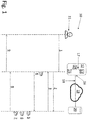
- Fig. 1 shows the data processing flow of the method according to the invention together with the communication system 10 according to the invention.
- a user 11 can communicate with the user terminal 12, in this case a smartphone 12, via voice commands.
- the smartphone 12 has a processor 14 that carries out calculations and can control a microphone 13 and a loudspeaker 15 and also a communication interface 16.
- the internal communication between the components of the smartphone 12 is implemented by an internal communication network 17 of the smartphone.
- the smartphone 12 can set up a data connection 18 via the Internet 19 with a server 20, with a service being offered to the user 11 on the server 20.
- a service can for example be a music streaming service, a weather forecast, a smart home functionality, etc.
- the idea according to the invention is to carry out an authorization process using an audio ID that can be assigned to the smartphone 12 in a manner similar to a fingerprint.
- This audio ID has audio signals that can consist of audible or inaudible frequency oscillations.
- Each smartphone 12 generates such an audio ID either itself and / or by means of a mobile app.
- Such an audio ID can preferably not be changed and is sent to the service operated on the server 20 in the case of voice and audio transmission.
- the smartphone 12 is identified by means of this audio ID and only a valid and genuine audio ID is accepted by the service.
- a possible example of such a service that runs on a server is the "Hallo Magenta Platform" operated byInstitut.
- Authentication by means of the audio ID enables the use of an even more secure multi-factor authentication, in which, by encouraging, in addition to the voice and audible audio signals on other frequencies, inaudible information for humans in the form of an audio ID enriched with this information is transmitted.
- the audio ID can therefore be enriched with audio signals based on a personal PIN or a password.
- Each user terminal 12 with access to the service service generates a unique audio ID during commissioning and / or upon request, with which the device can register for the service and is thus authorized for future use.
- the transmission of the audio ID can be transmitted in parallel in addition to the actual language in a common audio stream.
Landscapes
- Engineering & Computer Science (AREA)
- General Engineering & Computer Science (AREA)
- Computer Security & Cryptography (AREA)
- Computer Hardware Design (AREA)
- Computer Networks & Wireless Communication (AREA)
- Computing Systems (AREA)
- Signal Processing (AREA)
- Theoretical Computer Science (AREA)
- General Health & Medical Sciences (AREA)
- Health & Medical Sciences (AREA)
- Biomedical Technology (AREA)
- Power Engineering (AREA)
- Physics & Mathematics (AREA)
- General Physics & Mathematics (AREA)
- Human Computer Interaction (AREA)
- Audiology, Speech & Language Pathology (AREA)
- Multimedia (AREA)
- Software Systems (AREA)
- Telephonic Communication Services (AREA)
Priority Applications (3)
| Application Number | Priority Date | Filing Date | Title |
|---|---|---|---|
| EP20182907.4A EP3934193A1 (fr) | 2020-06-29 | 2020-06-29 | Autorisation d'un terminal utilisateur lors de l'utilisation d'un service sur internet |
| PCT/EP2021/067671 WO2022002841A1 (fr) | 2020-06-29 | 2021-06-28 | Autorisation d'un terminal utilisateur lors de l'utilisation d'un service sur internet |
| US18/003,502 US12363108B2 (en) | 2020-06-29 | 2021-06-28 | Authorization of a user terminal using an audio signal |
Applications Claiming Priority (1)
| Application Number | Priority Date | Filing Date | Title |
|---|---|---|---|
| EP20182907.4A EP3934193A1 (fr) | 2020-06-29 | 2020-06-29 | Autorisation d'un terminal utilisateur lors de l'utilisation d'un service sur internet |
Publications (1)
| Publication Number | Publication Date |
|---|---|
| EP3934193A1 true EP3934193A1 (fr) | 2022-01-05 |
Family
ID=71401610
Family Applications (1)
| Application Number | Title | Priority Date | Filing Date |
|---|---|---|---|
| EP20182907.4A Pending EP3934193A1 (fr) | 2020-06-29 | 2020-06-29 | Autorisation d'un terminal utilisateur lors de l'utilisation d'un service sur internet |
Country Status (3)
| Country | Link |
|---|---|
| US (1) | US12363108B2 (fr) |
| EP (1) | EP3934193A1 (fr) |
| WO (1) | WO2022002841A1 (fr) |
Families Citing this family (2)
| Publication number | Priority date | Publication date | Assignee | Title |
|---|---|---|---|---|
| EP3934193A1 (fr) * | 2020-06-29 | 2022-01-05 | Deutsche Telekom AG | Autorisation d'un terminal utilisateur lors de l'utilisation d'un service sur internet |
| US20230177489A1 (en) * | 2021-12-08 | 2023-06-08 | Paypal, Inc. | Utilization of biometrics in creation of secure key or digital signature |
Citations (4)
| Publication number | Priority date | Publication date | Assignee | Title |
|---|---|---|---|---|
| US20120252411A1 (en) * | 2011-03-30 | 2012-10-04 | Qualcomm Incorporated | Continuous voice authentication for a mobile device |
| WO2014063363A1 (fr) * | 2012-10-26 | 2014-05-01 | Baina Innovation (Chengdu) Technology Co., Limited | Procédé et système pour l'authentification de dispositifs informatiques |
| WO2018004935A1 (fr) * | 2016-06-30 | 2018-01-04 | Amazon Technologies, Inc. | Authentification à facteurs multiples destinée à accéder à des services |
| US20190182176A1 (en) * | 2016-12-21 | 2019-06-13 | Facebook, Inc. | User Authentication with Voiceprints on Online Social Networks |
Family Cites Families (7)
| Publication number | Priority date | Publication date | Assignee | Title |
|---|---|---|---|---|
| GB2375205A (en) * | 2001-05-03 | 2002-11-06 | Orange Personal Comm Serv Ltd | Determining identity of a user |
| US9118488B2 (en) * | 2010-06-17 | 2015-08-25 | Aliphcom | System and method for controlling access to network services using biometric authentication |
| SG11201504186UA (en) * | 2012-12-19 | 2015-07-30 | Visa Int Service Ass | System and method for voice authentication |
| GB2567018B (en) * | 2017-09-29 | 2020-04-01 | Cirrus Logic Int Semiconductor Ltd | Microphone authentication |
| US10715522B2 (en) * | 2018-01-31 | 2020-07-14 | Salesforce.Com | Voiceprint security with messaging services |
| US11436311B2 (en) * | 2018-05-22 | 2022-09-06 | Arizona Board Of Regents On Behalf Of Arizona State University | Method and apparatus for secure and usable mobile two-factor authentication |
| EP3934193A1 (fr) * | 2020-06-29 | 2022-01-05 | Deutsche Telekom AG | Autorisation d'un terminal utilisateur lors de l'utilisation d'un service sur internet |
-
2020
- 2020-06-29 EP EP20182907.4A patent/EP3934193A1/fr active Pending
-
2021
- 2021-06-28 WO PCT/EP2021/067671 patent/WO2022002841A1/fr not_active Ceased
- 2021-06-28 US US18/003,502 patent/US12363108B2/en active Active
Patent Citations (4)
| Publication number | Priority date | Publication date | Assignee | Title |
|---|---|---|---|---|
| US20120252411A1 (en) * | 2011-03-30 | 2012-10-04 | Qualcomm Incorporated | Continuous voice authentication for a mobile device |
| WO2014063363A1 (fr) * | 2012-10-26 | 2014-05-01 | Baina Innovation (Chengdu) Technology Co., Limited | Procédé et système pour l'authentification de dispositifs informatiques |
| WO2018004935A1 (fr) * | 2016-06-30 | 2018-01-04 | Amazon Technologies, Inc. | Authentification à facteurs multiples destinée à accéder à des services |
| US20190182176A1 (en) * | 2016-12-21 | 2019-06-13 | Facebook, Inc. | User Authentication with Voiceprints on Online Social Networks |
Also Published As
| Publication number | Publication date |
|---|---|
| WO2022002841A1 (fr) | 2022-01-06 |
| US20230239292A1 (en) | 2023-07-27 |
| US12363108B2 (en) | 2025-07-15 |
Similar Documents
| Publication | Publication Date | Title |
|---|---|---|
| DE102007021772B4 (de) | Digitales Verfahren und Anordnung zur Authentifizierung eines Nutzers einer Datenbasis | |
| DE102007033812B4 (de) | Verfahren und Anordnung zur Authentifizierung eines Nutzers von Einrichtungen, eines Dienstes, einer Datenbasis oder eines Datennetzes | |
| DE10144023B4 (de) | Vorrichtung und Verfahren zur automatischen Benutzerprofil-Konfiguration | |
| DE102007014885B4 (de) | Verfahren und Vorrichtung zur Steuerung eines Nutzerzugriffs auf einen in einem Datennetz bereitgestellten Dienst | |
| EP3108477B1 (fr) | Procédé et dispositif d'identification ou d'authentification d'une personne et/ou d'un objet par des informations de sécurité acoustiques dynamiques | |
| EP1956814A1 (fr) | Procédé numérique et agencement d'authentification d'un utilisateur d'un réseau de télécommunication ou de données | |
| EP2112797B1 (fr) | Procédé destiné à permettre l'échange de données entre un dispositif de traitement de données à l'extérieur et une unité de traitement de données à l'intérieur d'un véhicule et véhicule automobile | |
| DE102007025162A1 (de) | Alarmgesteuerte Zugriffskontrolle in einem Unternehmensnetz | |
| DE102009009310A1 (de) | Kommunikation und Identifizierung zwischen einem Kraftfahrzeugbenutzergerät mit Head Unit und davon entfernt gelegener Vorrichtung | |
| WO2022002841A1 (fr) | Autorisation d'un terminal utilisateur lors de l'utilisation d'un service sur internet | |
| EP2632104B1 (fr) | Procédé et système de télécommunication pour l'inscription d'un utilisateur à un service IPTV personnalisé sécurisé | |
| EP3116237B1 (fr) | Procédé d'exploitation d'un système d'appareil auditif et système d'appareil auditif | |
| EP2380330B1 (fr) | Procédé et dispositif d'authentification d'utilisateurs d'un terminal hybride | |
| EP3376419B1 (fr) | Système et méthode de signature électronique d'un document | |
| EP3271855B1 (fr) | Procédé de génération d'un certificat pour un jeton de sécurité | |
| EP4064081B1 (fr) | Procédé et système d'identification et d'authentification d'un utilisateur dans un réseau ip | |
| DE102019219385A1 (de) | Verfahren zur Ermittlung der Hörschwelle einer Testperson | |
| EP3836566B1 (fr) | Procédé de fonctionnement d'un système auditif et système auditif | |
| DE102018209719A1 (de) | Verfahren zum Betrieb eines Hörsystems sowie Hörsystem | |
| EP1624350A1 (fr) | Procédé d'authentification dans un système d'automatisation | |
| DE102020202915A1 (de) | Verfahren zur Übertragung eines Hörgeräteeinstelldatensatzes von einem ersten Hörgerät auf ein zweites Hörgerät, Hörgerätesystem und Hörgerät | |
| EP1754358A1 (fr) | Procede d'authentification d'une unite de communication a l'aide d'un mot de code secret stocke de maniere permanente dans un programme | |
| EP1419638A2 (fr) | Systeme informatique et procede de controle d'acces aux donnees | |
| DE10204436A1 (de) | Kontinuierliche Benutzerauthentisierung mittels Spracheingabe | |
| DE102021103769B4 (de) | Verfahren zur Signalverarbeitung |
Legal Events
| Date | Code | Title | Description |
|---|---|---|---|
| PUAI | Public reference made under article 153(3) epc to a published international application that has entered the european phase |
Free format text: ORIGINAL CODE: 0009012 |
|
| STAA | Information on the status of an ep patent application or granted ep patent |
Free format text: STATUS: REQUEST FOR EXAMINATION WAS MADE |
|
| 17P | Request for examination filed |
Effective date: 20210629 |
|
| AK | Designated contracting states |
Kind code of ref document: A1 Designated state(s): AL AT BE BG CH CY CZ DE DK EE ES FI FR GB GR HR HU IE IS IT LI LT LU LV MC MK MT NL NO PL PT RO RS SE SI SK SM TR |
|
| B565 | Issuance of search results under rule 164(2) epc |
Effective date: 20201221 |
|
| STAA | Information on the status of an ep patent application or granted ep patent |
Free format text: STATUS: EXAMINATION IS IN PROGRESS |
|
| 17Q | First examination report despatched |
Effective date: 20220711 |
|
| RIN1 | Information on inventor provided before grant (corrected) |
Inventor name: PLATSCHEK, MARTIN MICHAEL Inventor name: EL-MALLOUKI, SAID Inventor name: JAHN, CARL Inventor name: MINOW, JASCHA |
|
| REG | Reference to a national code |
Ref country code: DE Ref legal event code: R079 Free format text: PREVIOUS MAIN CLASS: H04L0029060000 Ipc: H04L0009400000 |
|
| GRAP | Despatch of communication of intention to grant a patent |
Free format text: ORIGINAL CODE: EPIDOSNIGR1 |
|
| STAA | Information on the status of an ep patent application or granted ep patent |
Free format text: STATUS: GRANT OF PATENT IS INTENDED |
|
| RIC1 | Information provided on ipc code assigned before grant |
Ipc: H04L 9/40 20220101AFI20260326BHEP Ipc: G06F 3/16 20060101ALI20260326BHEP Ipc: G06F 21/44 20130101ALI20260326BHEP |