EP3935457B1 - Verfahren zur produktführung in einer abfüllanlage und abfüllanlage für glasflaschen - Google Patents
Verfahren zur produktführung in einer abfüllanlage und abfüllanlage für glasflaschen Download PDFInfo
- Publication number
- EP3935457B1 EP3935457B1 EP20704835.6A EP20704835A EP3935457B1 EP 3935457 B1 EP3935457 B1 EP 3935457B1 EP 20704835 A EP20704835 A EP 20704835A EP 3935457 B1 EP3935457 B1 EP 3935457B1
- Authority
- EP
- European Patent Office
- Prior art keywords
- bottles
- empty
- filling
- data
- parameters
- Prior art date
- Legal status (The legal status is an assumption and is not a legal conclusion. Google has not performed a legal analysis and makes no representation as to the accuracy of the status listed.)
- Active
Links
Images
Classifications
-
- G—PHYSICS
- G05—CONTROLLING; REGULATING
- G05B—CONTROL OR REGULATING SYSTEMS IN GENERAL; FUNCTIONAL ELEMENTS OF SUCH SYSTEMS; MONITORING OR TESTING ARRANGEMENTS FOR SUCH SYSTEMS OR ELEMENTS
- G05B19/00—Program-control systems
- G05B19/02—Program-control systems electric
- G05B19/418—Total factory control, i.e. centrally controlling a plurality of machines, e.g. direct or distributed numerical control [DNC], flexible manufacturing systems [FMS], integrated manufacturing systems [IMS] or computer integrated manufacturing [CIM]
- G05B19/41875—Total factory control, i.e. centrally controlling a plurality of machines, e.g. direct or distributed numerical control [DNC], flexible manufacturing systems [FMS], integrated manufacturing systems [IMS] or computer integrated manufacturing [CIM] characterised by quality surveillance of production
-
- B—PERFORMING OPERATIONS; TRANSPORTING
- B67—OPENING, CLOSING OR CLEANING BOTTLES, JARS OR SIMILAR CONTAINERS; LIQUID HANDLING
- B67C—CLEANING, FILLING WITH LIQUIDS OR SEMILIQUIDS, OR EMPTYING, OF BOTTLES, JARS, CANS, CASKS, BARRELS, OR SIMILAR CONTAINERS, NOT OTHERWISE PROVIDED FOR; FUNNELS
- B67C3/00—Bottling liquids or semiliquids; Filling jars or cans with liquids or semiliquids using bottling or like apparatus; Filling casks or barrels with liquids or semiliquids
- B67C3/007—Applications of control, warning or safety devices in filling machinery
-
- B—PERFORMING OPERATIONS; TRANSPORTING
- B67—OPENING, CLOSING OR CLEANING BOTTLES, JARS OR SIMILAR CONTAINERS; LIQUID HANDLING
- B67C—CLEANING, FILLING WITH LIQUIDS OR SEMILIQUIDS, OR EMPTYING, OF BOTTLES, JARS, CANS, CASKS, BARRELS, OR SIMILAR CONTAINERS, NOT OTHERWISE PROVIDED FOR; FUNNELS
- B67C3/00—Bottling liquids or semiliquids; Filling jars or cans with liquids or semiliquids using bottling or like apparatus; Filling casks or barrels with liquids or semiliquids
- B67C3/02—Bottling liquids or semiliquids; Filling jars or cans with liquids or semiliquids using bottling or like apparatus
- B67C3/22—Details
-
- B—PERFORMING OPERATIONS; TRANSPORTING
- B67—OPENING, CLOSING OR CLEANING BOTTLES, JARS OR SIMILAR CONTAINERS; LIQUID HANDLING
- B67C—CLEANING, FILLING WITH LIQUIDS OR SEMILIQUIDS, OR EMPTYING, OF BOTTLES, JARS, CANS, CASKS, BARRELS, OR SIMILAR CONTAINERS, NOT OTHERWISE PROVIDED FOR; FUNNELS
- B67C7/00—Concurrent cleaning, filling, and closing of bottles; Processes or devices for at least two of these operations
-
- G—PHYSICS
- G06—COMPUTING OR CALCULATING; COUNTING
- G06T—IMAGE DATA PROCESSING OR GENERATION, IN GENERAL
- G06T7/00—Image analysis
- G06T7/0002—Inspection of images, e.g. flaw detection
- G06T7/0004—Industrial image inspection
-
- G—PHYSICS
- G05—CONTROLLING; REGULATING
- G05B—CONTROL OR REGULATING SYSTEMS IN GENERAL; FUNCTIONAL ELEMENTS OF SUCH SYSTEMS; MONITORING OR TESTING ARRANGEMENTS FOR SUCH SYSTEMS OR ELEMENTS
- G05B2219/00—Program-control systems
- G05B2219/30—Nc systems
- G05B2219/32—Operator till task planning
- G05B2219/32212—If parameter out of tolerance reject product
-
- G—PHYSICS
- G05—CONTROLLING; REGULATING
- G05B—CONTROL OR REGULATING SYSTEMS IN GENERAL; FUNCTIONAL ELEMENTS OF SUCH SYSTEMS; MONITORING OR TESTING ARRANGEMENTS FOR SUCH SYSTEMS OR ELEMENTS
- G05B2219/00—Program-control systems
- G05B2219/30—Nc systems
- G05B2219/45—Nc applications
- G05B2219/45009—Glassforming
-
- Y—GENERAL TAGGING OF NEW TECHNOLOGICAL DEVELOPMENTS; GENERAL TAGGING OF CROSS-SECTIONAL TECHNOLOGIES SPANNING OVER SEVERAL SECTIONS OF THE IPC; TECHNICAL SUBJECTS COVERED BY FORMER USPC CROSS-REFERENCE ART COLLECTIONS [XRACs] AND DIGESTS
- Y02—TECHNOLOGIES OR APPLICATIONS FOR MITIGATION OR ADAPTATION AGAINST CLIMATE CHANGE
- Y02P—CLIMATE CHANGE MITIGATION TECHNOLOGIES IN THE PRODUCTION OR PROCESSING OF GOODS
- Y02P90/00—Enabling technologies with a potential contribution to greenhouse gas [GHG] emissions mitigation
- Y02P90/02—Total factory control, e.g. smart factories, flexible manufacturing systems [FMS] or integrated manufacturing systems [IMS]
Definitions
- the invention relates to a method for product guidance in a filling plant and a filling plant for glass bottles.
- Empty reusable glass bottles are usually inspected for cleanliness, integrity, wear and tear, and any residual contents after rinsing with lye or similar liquids before they are fed into a filling machine for filling a liquid product. Empty bottles that are not in the correct condition are known to be rejected before the filling machine.
- bottles can occasionally break in the area of the filling machine, possibly also in the treatment stages before and/or after.
- the disadvantages are the interruptions in production that this causes and the possible entry of glass splinters into bottles running ahead or behind. These must then be diverted for safety reasons and are recorded as product loss.
- fill levels can also fluctuate too much and/or leaks can occur when filling the product and/or when closing the full bottles produced in this way. These are therefore inspected downstream of the closing machine for fill level, position of the closure and, if necessary, for leaks. Full bottles identified as faulty can then be reliably rejected. However, too little conclusions can be drawn as to how the respective condition of the empty bottles affects the result of the filling and closing process.
- EN 10 2011 017 448 A1 A method for preventing faults in a full bottle treatment plant is known, in which reference values and test values are defined for individual plant components. This is intended to optimize relationships between causes of faults and fault states using computer-aided artificial intelligence, for example with a neural network. In this context, automatic or semi-automatic learning processes for the treatment plant are also known in principle.
- At least one of the stated objects is achieved with a method according to claim 1. Accordingly, this is used for product management in a filling system.
- empty container parameters are automatically measured for filling provided empty glass bottles.
- initial data for filling a liquid product into the empty bottles is obtained and stored.
- full container parameters are measured when filling full bottles made from the empty bottles, whereby in particular machine error states occurring during filling are automatically determined, and the resulting filling data is stored and assigned individually to the empty bottles.
- At least one rejection criterion subsequently applicable in the production operation is calculated for deciding on the rejection of faulty empty bottles or full bottles on the basis of a data analysis of the stored initial data and result data, wherein the calculation of the rejection criterion is updated in particular automatically taking into account initial data and result data acquired in the production operation.
- rejection criteria can be calculated with increasing precision as the production time increases in order to reject empty or full bottles as precisely as possible, for example at a suitable point in the production process, in order to obtain as much result data as possible to optimize the production process and to avoid machine errors as reliably as possible. This also minimizes production interruptions.
- a machine learning process that progresses during production is possible, which runs automatically on the basis of calculation rules and can also optionally be controlled by operators.
- the acquired initial data and result data are incorporated into production operations through manual and/or automatic updating of the control system.
- Machine parameters for example of a rinsing station for rinsing the empty bottle, a filling machine for producing the full bottles from the empty bottles and a liquid product, and/or a capping machine for capping the full bottles, can be adjusted on the basis of the initial data and result data obtained to optimize product quality.
- rejection criteria priority is given to optimizing the quality of production over the most comprehensive collection of initial data and/or result data possible. This means that, when weighing up the options, an empty bottle that is unsuitable for further processing is rejected from the product stream as early as possible, as is necessary or can be predicted to achieve a certain product quality.
- the rejection criterion is automatically changed in such a way that a proportional frequency of permissible values of the full goods parameters predicted by means of the data analysis increases and, optionally, a predicted proportional frequency of machine error states also decreases.
- a proportional frequency of permissible values of the full goods parameters predicted by means of the data analysis increases and, optionally, a predicted proportional frequency of machine error states also decreases.
- the proportional frequency is understood to mean, for example, the number of correctly manufactured and closed full bottles per number of checked empty bottles, particularly under the assumption of consistent average quality of the empty bottles provided.
- the data analysis preferably includes data mining, in particular an association analysis and/or a regression analysis and/or a data classification of the initial data and/or result data.
- Classification, regression analysis and association analysis are particularly suitable for evaluating newly acquired initial data and result data as part of a forecast of the effect of certain empties parameters on the full goods parameters to be achieved.
- Such analysis methods can be used as part of machine learning processes and self-optimization of the filling system in the sense of artificial intelligence or the like.
- additional, possibly previously unknown or underestimated correlations between individual empties parameters and/or full goods parameters can be established and/or included in the data analysis.
- fulfilling the rejection criterion based on the initial data of a specific empty bottle triggers one of the following steps: rejecting the associated empty bottle in front of a filling device of a filling machine provided for this purpose; passing the empty bottle through the filling device without filling, but with closing and rejecting the empty bottle; or producing and rejecting a closed full bottle.
- the empty bottles are then diverted further upstream the greater the extent of a detected deviation of initial data from assigned target values.
- machine error states can be avoided particularly reliably, but on the other hand, certain empty bottles can also go through as many inspection steps and/or production steps as possible in order to use the initial data and result data obtained for data analysis. Even empty bottles into which the liquid product cannot be filled properly are then used for optimization and the automatic self-learning process, for example by automatically checking or establishing certain correlations between empty container parameters and full container parameters.
- target ranges are defined for the empty bottle parameters on the basis of data analysis, whereby rejection criteria are met, for example, if initial data of a tested empty bottle deviate from the respective target ranges, deviate to a certain extent and/or deviate for a certain combination of empty bottle parameters.
- rejection criteria are met, for example, if initial data of a tested empty bottle deviate from the respective target ranges, deviate to a certain extent and/or deviate for a certain combination of empty bottle parameters.
- the target ranges and/or the rejection criteria are automatically updated based on the progressive accumulation of newly acquired initial data and result data.
- the data analysis can thus be refined and made more precise as production progresses. It is also possible to ignore or delete certain sets of initial data and result data, for example outdated data sets or those that refer to parameter sets with empties parameters and/or result parameters that are not applicable to certain empty bottles.
- Deviations of measured empties parameters from their target ranges are included in the definition of rejection criteria with an appropriate weighting.
- the deviations are preferably weighted dynamically on the basis of the initial data and result data obtained.
- empties parameters for which deviations from their assigned target ranges have proven to be less critical in the course of data analysis progressing in production operations can be given a lower weighting and vice versa.
- the empty bottle parameters indicate at least three, in particular at least five, of the following properties and/or conditions of the respective empty bottle: correct bottle type, extent of friction edges, contamination and/or damage to the side wall; contamination, rust deposits and/or damage to lateral mouth areas and/or closure threads; contamination and/or damage to sealing surfaces; contamination and/or damage to base areas; and/or presence of lye residues or other liquid inside the empty bottle.
- Bottle types can be identified, for example, by measuring in light barriers or by imaging. Friction edges can also be assessed using imaging. Side walls can be assessed using imaging for transparent and non-transparent contamination and breakage points using several cameras and suitable rotational positioning of the empty bottles. In this way, contamination and vertical cracks on the bottle mouth as well as damage and roughness of threads can also be identified. Damage, contamination and over-pressing on sealing surfaces in the mouth area can be identified using imaging, as can contamination, damage and broken glass in the area of the bottle base. Residual liquids can be identified by absorbing infrared radiation or high-frequency radiation.
- the empty bottle parameters are recorded by imaging before an inlet area to a filling machine, in particular after a rinsing/washing station for rinsing the empty bottles.
- data analysis provides comprehensive and flexible initial data that can be evaluated as much as possible. far upstream of the filling machine in order to be able to carry out any rejection processes and any full bottle inspections in a targeted and timely manner.
- the full product parameters indicate at least two of the following properties and/or conditions of the full bottles: a fill level of the filled product; absence, damage or incorrect seating of an attached closure; and tightness of the closure.
- the fill level can be measured, for example, by measuring bridges using high-frequency rays, infrared rays, gamma rays or X-rays, as well as by imaging.
- the presence of closures can be checked contactlessly using sensors. Imaging can also be used to check the closure for correct fit, diameter, type, print, integrity, presence and correct fit of retaining rings and the like.
- the machine error states preferably include: bottle breakage at the assigned filling device; bottle breakage after or before the assigned filling device; inadequate evacuation of the empty bottle at the filling device; and/or force/torque incorrect when attaching the assigned closure.
- the inspected empty bottles can be tracked to the filling machine/closing machine, for example, by a first-in-first-out register, using a printed code or the like, and/or by imaging based on individual characteristics, such as friction rings that are designed differently depending on individual wear.
- the tracking of full bottles is preferably based on magnetic coding of metallic closures, coding using UV ink, bar coding or two-dimensional coding.
- the treatment devices used such as filling devices, can be individually assigned to the empty/full bottles tracked in this way. This can be included in the updated data analysis.
- the filling system comprises a filling machine for empty glass bottles, an associated closing machine for full bottles produced therefrom and furthermore: at least one diversion device arranged upstream of the filling machine for defective empty bottles; at least one diversion device for full bottles and/or closed empty bottles arranged downstream of the closing machine; inspection units for the empty bottles and the full bottles for collecting initial data and result data using the method according to at least one of the embodiments described above; and a controller for triggering the diversion devices on the basis of at least one diversion criterion calculated using the method according to at least one of the embodiments described above.
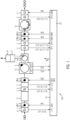
- FIG.1 shows a schematic top view of a production plant with associated data streams.
- the method according to the invention for product management/production control is preferably carried out in a filling system 100 for glass bottles.
- the filling system 100 accordingly comprises inspection units 1 - 3 for empty bottles, inspection units 4 - 6 for full bottles, rejection devices 7 - 9 for empty bottles and rejection devices 10, 11 for full bottles, each shown as an example.
- the filling system 100 described can also include a rinsing station 12 for rinsing the empty bottles intended for filling.
- a filling machine 13 in particular of a rotating design, with a large number of filling elements (not shown) for filling a liquid product, in particular a beverage, into the empty bottles and a closing machine 14 for closing the full bottles with closure caps, for example crown caps or screw caps.
- a labeling machine 15 for labeling properly filled and closed full bottles can also be a component of the filling system 100.
- the closing machine 14 can be preceded by an inspection unit 16 for closure caps and a rejection device 17 for closure caps identified as defective.
- the filling system 100 further comprises a controller 20 which controls the rejection devices 7 - 11 on the basis of rejection criteria described below.
- the production control is schematically indicated using seven supplied/provided empty bottles A - G, and/or full bottles A', C ⁇ , F' and G' produced from them. Black circles indicate negative inspection results. Accordingly, the two empty bottles B, D are diverted at the first and/or second diversion device 7, 8 in front of the filling machine 13 due to negative inspection results in at least one of the inspection units 1 - 3 arranged upstream of the filling machine 13 and on the input side in this regard.
- the empty bottle E is initially fed empty through the filling machine 13 despite at least one negative inspection result in the input-side inspection units 1 - 3 and is only discharged onto a discharge path, into a collecting container (not shown in each case) or the like after being closed at the third discharge device 9 arranged downstream of the closing machine 14 and on the output side in this respect.
- the four empty bottles A, C, F and G (not all of them in the Fig.1 separately referred to) pass the first, second and third inspection units 1 - 3 with proper inspection results and are consequently filled with product and sealed; this corresponds to the regular production / manufacture of full bottles A', C', F' and G'.
- a first empties parameter LP1 is measured/checked, for example the presence and/or extent of scuffing on the empty bottles A - G caused by wear.
- a second and third empty container parameter LP2, LP3 is measured in the second and third inlet-side inspection units 2, 3, for example the presence of residual lye or other liquid in the (remaining) empty bottles A and C - G and the extent of any side wall contamination of the empty bottles A and C - G.
- inlet-side inspection units may differ from the example described and, for example, be modularly adapted to the empty bottles to be processed and/or to control certain treatments carried out upstream.
- the first inspection unit 1 supplies at least one measured value of the first empty bottle parameter LP1 in the form of first initial data ID1 for each empty bottle A - G measured there.
- the second and third inspection units 2, 3 supply correspondingly for each empty bottle A, C - G measured there, measured values of the second and third empty bottle parameter LP2, LP3 in the form of second and third initial data ID2, ID3. These are each transmitted to the controller 20.
- the first initial data ID1 is assigned to all empty bottles A - G, the second and third initial data ID2, ID3 to the remaining empty bottles A and C - G.
- the closed full bottles A', C ⁇ , F', G' (not all of which are shown as a circle) are examined with regard to full product parameters VP1, VP2 generated during filling, such as a fill level of the product in the full bottles A', C ⁇ , F', G' and the correctness of their closure.
- the fourth inspection unit 4 supplies at least one measured value of the first full-goods parameter VP1 in the form of first result data ED1 for each full bottle measured there, and the fifth inspection unit 5 supplies at least one measured value of the second full-goods parameter VP2 in the form of second result data ED2. These are each transmitted to the controller 20.
- the first and second result data ED1, ED2 are assigned as full bottles A', C ⁇ , F', G' to filled empty bottles A, C, F, G and thus their initial data ID1 - ID2.
- the empty bottle E could be incompletely processed during/after passing through the filling machine 13, for example only by closing, and inspected in the fourth and/or fifth inspection unit 4, 5 with regard to at least one of the full-goods parameters VP1, VP2 or with regard to a parameter relevant only for closing or another treatment step carried out.
- the result data ED2 for the empty bottle E can be obtained as in a corresponding full-bottle inspection.
- This result data ED2 can then also be stored in the control system 20 and assigned to the empty bottle E and its stored initial data ID1 - ID3.
- the labeled full bottles A', C', F' are measured with regard to at least one full-goods parameter VP3 that is relevant after labeling, for example for correct label placement or the like.
- Third result data ED3 obtained in this way can then also be stored in the control system 20 and assigned to the underlying empty bottles A, C, F and their stored initial data ID1 - ID3.
- the filling machine 13 and/or the closing machine 14 and/or the rinsing/washing station 12 and/or the labeling machine 15 can be monitored with regard to the occurrence of machine error states FZ1, FZ2, for example with regard to the occurrence of a bottle breakage in the inlet and/or outlet of the filling machine 13 and/or a leak detected in the area of the filling machine 13 or the closing machine 14 and/or incorrect closing forces/torques.
- a machine error condition can be a failure to detect or sort out dirty or otherwise contaminated containers.
- a shard in a bottle that is not detected during the empty bottle inspection (for example in one of the inspection units 1 - 3) can then still be detected during the subsequent full bottle inspection (for example in one of the inspection units 4 and 5).
- initial data, result data and/or error states are recorded using imaging and/or sensor-based methods.
- the controller 20 carries out a data analysis at predetermined intervals based on the initial data ID1 - ID3 collected for a large number of empty bottles and the result data ED1 - ED5 available for each of them.
- the data analysis includes, for example, data mining with classification and/or regression analysis and/or association analysis and is preferably based on self-learning algorithms in the sense of artificial intelligence.
- rejection criteria AK1 - AK5 are calculated automatically, which determine which initial data ID1 - ID3 or which result data ED1 - ED5 result in empty bottles / full bottles being rejected at one of the rejection devices 7 - 11.
- a first rejection criterion AK1 is used, for example, to decide whether an empty bottle identified as faulty in the first inspection unit 1 should be rejected from the product flow by the first rejection device 7. In the example shown, this is the case for the empty bottle B, as shown schematically by a rejection arrow.
- the empty bottle B meets the first rejection criterion AK1, for example, if the measured initial data ID1 deviate in an inadmissible manner from a setpoint value SW1 of the associated empties parameter LP1 calculated in the controller 20 on the basis of the data analysis.
- initial data ID2, ID3 and/or result data ED1 - ED5 for cosmetically defective empty bottles, if necessary, in order to establish and/or specify and/or weight correlations between initial data ID2, ID3 and/or result data ED1 - ED5.
- the data analysis and with it the rejection criteria AK1 - AK5 can then be dynamically optimized.
- the rejection criteria AK1 - AK5 are continuously optimized in order to meet the requirements for meaningful data analysis as well as the requirements for an economical and smooth production process and the desired product quality.
- a second rejection criterion AK2 previously calculated in the control 20 on the basis of the data analysis is met. This is met, for example, if at least the second initial data ID2 or the third initial data ID3 of a specific empty bottle A, C - G deviates in an inadmissible manner from a target value SW2, SW3 of the respective associated empty bottle parameter LP2, LP3. In the example shown, this is the case for the empty bottle D. This is therefore separated from the product flow by the second rejection device 8.
- Each rejection criterion AK1 - AK5 can be calculated almost arbitrarily on the basis of the previously collected initial data ID1 - ID3 and the individually assigned result data ED1 - ED5. For example, if it turns out that a certain constellation of initial data ID1 - ID3 correlates with result data ED1 - ED5 that are negative for product quality and/or harmful for the production process.
- rejection criteria AK1 - AK5 can also be relaxed if this is concluded from an updated data analysis.
- the initial data ID1 - ID3 of the empty bottles A and C - G do not meet the second rejection criterion AK2, so they are fed to the filling machine 13.
- an empty bottle E that was not previously rejected does not meet the second rejection criterion AK2 due to its initial data ID1 - ID3, but does meet a third rejection criterion AK3, whereby the empty bottle E is rejected from the product flow downstream of the filling machine 13 and closing machine 14 at the third rejection device 9.
- the empty bottle E can therefore either be rejected before the filling machine 13 or fed empty through the filling machine 13, closed in the closing machine 14 and rejected after inspection of the closure produced. Other inspections would also be conceivable at the fourth and/or fifth inspection unit 4, 5.
- first and/or second result data ED1, ED2 could also be fed to the labeling machine 15 and the downstream inspection unit 6 to obtain further result data ED3.
- All empty bottles whose initial data ID1 ID3 do not meet either the first or the second rejection criteria AK1, AK2, here the empty bottles A, C, F and G, are processed into full bottles in the filling machine 13, closed in the closing machine 14 and inspected in the fourth and fifth inspection units 4, 5.
- the first and second result data ED1, ED2 obtained in this way are assigned to the underlying empty bottles A, C, F and G and can be correlated in the data analysis both with each other and with the assigned initial data ID1 - ID3 of the empty bottles A, C, F and G.
- a fourth rejection criterion AK4 is met for the full bottles examined in this way, for example because the first result data ID1 and/or second result data ED2 deviate in an inadmissible manner from a fourth or fifth target value SW4, SW5 of the respective associated full product parameter VP1, VP2, the affected full bottles, in the example the full bottle G', are separated from the product stream at the fourth rejection device 10.
- Properly filled and sealed full bottles A', C' and F' are fed to the labeling machine 15 and provided with a label there and/or printed directly if necessary.
- the labeled/printed full bottles A', C', F' are then checked, for example, in a fifth inspection unit 6.
- Third result data ED3 obtained in this process are also transmitted to the control unit 20.
- a fifth rejection device 11 arranged downstream of the labeling machine 15 is also schematically indicated. This rejects incorrectly labeled/printed full bottles (or possibly partially treated empty bottles) for which a fifth rejection criterion AK5 is met, for example based on a comparison of the third result data ED3 with a sixth target value SW6 of the associated third full product parameter VP3.
- the continuously monitored machine error states FZ1, FZ2 are optionally also transmitted to the controller 20 with an assignment to the affected or underlying empty bottle in order to take these into account in the data analysis in the sense of fourth and fifth result data ED4, ED5. All result data ED1 - ED5 can thus be correlated with individual or groups of initial data ID1 - ID3 individually for individual empty bottles and/or for groups of empty bottles.
- the initial data ID1 - ID3 and the result data ED1 - ED5 are assigned to each other and accumulated.
- correlations between individual empty parameters LP1 - LP3, full parameters VP1 - VP3 and/or machine error states FZ1, FZ2 can be calculated and continuously updated and, if necessary, made more precise by gaining initial data and result data during production.
- individual rejection criteria AK1 - AK5 that subsequently apply in production operations can be continuously recalculated in order to selectively reject individual empty bottles in such a way that production interruptions and/or damage are avoided and at the same time as much information as possible about correlations between initial data and result data can be produced.
- individual empty container parameters LP1 - LP3 or the initial data ID1 - ID3 assigned to them can be processed in a weighted manner depending on their effect on result data ED1 - ED5.
- Such a weighting of parameters and/or parameter sets can also be continuously adjusted during ongoing production in the sense of self-optimization of the filling system 100 in order to produce as many high-quality full bottles as possible from the empty bottles and/or to improve the meaningfulness of the data analysis.
- any algorithm can be used in the controller 20 to process the initial data ID1 - ID3 and the result data ED1 - ED5.
- algorithms that enable machine-internal optimization and/or machine-internal learning in the sense of artificial intelligence. Such algorithms are known in principle.
- rejection criteria AK1 - AK5 can be dynamically adjusted depending on the accumulating and/or updated data volume with associated initial data of the empty bottle and result data of the full bottles produced from it.
- the inspection unit 16 for closure caps located upstream of the closing machine 14 and the rejection device 17 for closure caps identified as faulty can also be included in the data analysis and control described above.
- the inspection unit 16 can provide at least one measured value of another empty container parameter in the form of further initial data for each closure cap measured there.
- a separate rejection criterion can also be calculated for the rejection device 17 and applied in principle to closure caps in the same way as was described above for the rejection devices 7 - 11.
- rejection devices such as the rejection devices 9, 10 downstream of the capping machine 14, can also be combined with one another.
- the third rejection criterion AK3 could be used to sort partially treated empty bottles into a specific rejection track
- the fourth rejection criterion to sort faulty full bottles into another rejection track. In principle, this is possible in a single or in several rejection devices.
- Machine parameters MP for example of the rinsing/washing station 12, the filling machine 13, the closing machine 14 and/or the labeling machine 15, can be continuously adjusted on the basis of the acquired initial data ID1 - ID3 and result data ED1 - ED5 in order to optimize product quality.
- the acquired initial data ID1 - ID3 and result data ED1 - ED5 can be incorporated into production operations both through manually triggered and automatic updating of rejection criteria AK1 - AK5 and/or machine parameters MP.
- the invention described thus simultaneously enables the minimization of machine error conditions and the optimization of quality when filling and filling full bottles during operation.
Landscapes
- Engineering & Computer Science (AREA)
- Quality & Reliability (AREA)
- Physics & Mathematics (AREA)
- General Physics & Mathematics (AREA)
- Computer Vision & Pattern Recognition (AREA)
- Theoretical Computer Science (AREA)
- General Engineering & Computer Science (AREA)
- Manufacturing & Machinery (AREA)
- Automation & Control Theory (AREA)
- Filling Of Jars Or Cans And Processes For Cleaning And Sealing Jars (AREA)
Description
- Die Erfindung betrifft ein Verfahren zur Produktführung in einer Abfüllanlage und eine Abfüllanlage für Glasflaschen.
- Leere Mehrwegflaschen aus Glas werden in der Regel nach ihren Spülen (Rinsen) hinsichtlich Sauberkeit, Unversehrtheit, Abnutzung und einem gegebenenfalls vorhandenen Restinhalt mit Lauge oder dergleichen Flüssigkeiten inspiziert, bevor sie einer Füllmaschine zur Abfüllung eines flüssigen Produkts zugeführt werden. Nicht ordnungsgemäße Leerflaschen werden bekanntermaßen vor der Füllmaschine ausgeleitet.
- Trotz solcher Vorsichtsmaßnahmen kann es vereinzelt zum Flaschenbruch im Bereich der Füllmaschine kommen, gegebenenfalls auch in Behandlungsstufen davor und/oder danach. Nachteilig sind die dadurch verursachten Produktionsunterbrechungen und ein möglicher Eintrag von Glassplittern in voraus-/ nachlaufende Flaschen. Diese müssen dann sicherheitshalber ausgeleitet werden und schlagen als Produktverlust zu Buche.
- Außerdem können prinzipiell Füllhöhen zu stark schwanken und/oder Undichtigkeiten beim Abfüllen des Produkts und/oder beim Verschließen der so hergestellten Vollflaschen auftreten. Diese werden daher stromabwärts der Verschließmaschine hinsichtlich Füllhöhe, Sitz des Verschlusses und gegebenenfalls auf Undichtigkeit inspiziert. Zwar können dann als fehlerhaft erkannte Vollflaschen zuverlässig ausgeleitet werden. Jedoch können bisher zu wenig Rückschlüsse gezogen werden, wie sich der jeweilige Zustand der Leerflaschen auf das Ergebnis der Abfüllung samt Verschließen auswirkt.
- Es hat sich als besonders schwierig und zeitaufwendig erwiesen, erhobene Messdaten so auszuwerten, dass möglichst nur diejenigen Leerflaschen aus dem Produktstrom ausgeleitet werden, die mit großer Wahrscheinlichkeit zu einer fehlerhaften Vollflasche führen und/oder einen Maschinenfehlerzustand im Bereich der Füllmaschine und/oder einer nachgeschalteten Verschließmaschine verursachen. Insbesondere wäre es wünschenswert, möglichst viele der festgestellten Eigenschaften der Leerflaschen mit Ergebnisdaten der Vollflaschen und/oder aufgetreten Maschinenfehlern, wie beispielsweise Flaschenbruch, korrelieren zu können, um die Abfüllung des Produkts und die Produktion der Vollflaschen insgesamt für den laufenden Produktionsprozess qualitativ zu optimieren und Ausfallzeiten und/oder Produktionslücken im Produktionsstrom zu minimieren.
- Zwar ist aus
DE 10 2011 017 448 A1 ein Verfahren zur Störungsvermeidung in einer Vollflaschenbehandlungsanlage bekannt, bei dem für einzelne Anlagenbestandteile Referenzkennwerte und Prüfkennwerte festgelegt werden. Damit sollen Zusammenhänge zwischen Fehlerursachen und Fehlerzuständen mittels rechnergestützter künstlicher Intelligenz optimiert werden, beispielsweise mit einem neuronalen Netz. In diesem Zusammenhang sind auch automatische oder halbautomatische Einlernprozesse für die Behandlungsanlage prinzipiell bekannt. - Es wäre jedoch wünschenswert, nicht nur Fehlerzustände solcher Anlagen möglichst zu vermeiden, sondern die Produktqualität und die Maschinenauslastung insgesamt zu optimieren.
- Wenigstens eine der gestellten Aufgaben wird mit einem Verfahren nach Anspruch 1 gelöst. Demnach dient dieses zur Produktführung in einer Abfüllanlage. Hierzu misst man automatisch Leergut-Parameter zum Abfüllen bereitgestellter Leerflaschen aus Glas. Ferner werden dabei Initialdaten zum Abfüllen eines flüssigen Produkts in die Leerflaschen gewonnen und abgespeichert. Ferner misst man Vollgut-Parameter beim Abfüllen aus den Leerflaschen hergestellter Vollflaschen, wobei man insbesondere auch beim Abfüllen auftretende Maschinenfehlerzustände automatisch feststellt, und speichert dabei jeweils gewonnene Ergebnisdaten des Abfüllens ab und ordnet diese den Leerflaschen individuell zu.
- Ferner berechnet man wenigstens ein im Produktionsbetrieb nachfolgend geltendes Ausleitkriterium zur Entscheidung über ein Ausleiten fehlerhafter Leerflaschen oder Vollflaschen auf der Grundlage einer Datenanalyse der gespeicherten Initialdaten und Ergebnisdaten, wobei die Berechnung des Ausleitkriteriums unter Berücksichtigung im Produktionsbetrieb hinzugewonnener Initialdaten und Ergebnisdaten insbesondere automatisch aktualisiert wird.
- Ausleitkriterien können folglich mit zunehmender Produktionsdauer zunehmend genauer berechnet werden, um die Leerflaschen oder Vollflaschen möglichst zielgerichtet auszuleiten, also beispielsweise an geeigneter Stelle im Produktionsablauf, um einerseits möglichst viele Ergebnisdaten zur Optimierung des Produktionsablaufs zu gewinnen andererseits Maschinenfehlerzustände möglichst zuverlässig zu vermeiden. Somit lassen sich auch Produktionsunterbrechungen minimieren.
- Insbesondere ist ein im Produktionsbetrieb voranschreitender Maschinenlernprozess möglich, der auf der Grundlage von Rechenregeln automatisch abläuft und ferner optional von Bedienern gesteuert werden kann.
- Vorzugsweise fließen die hinzugewonnenen Initialdaten und Ergebnisdaten in den Produktionsbetrieb durch manuelle und/oder automatische Aktualisierung der Steuerung ein.
- Maschinenparameter, beispielsweise einer Spülstation (Rinsstation) zum Spülen der Leerflasche, einer Füllmaschine zum Herstellen der Vollflaschen aus den Leerflaschen und einem flüssigen Produkt, und/oder einer Verschließmaschine zum Verschließen der Vollflaschen können auf der Grundlage der hinzugewonnenen Initialdaten und Ergebnisdaten zur Optimierung der Produktqualität angepasst werden.
- Dies dient einer laufenden Qualitätssicherung und/oder Qualitätsverbesserung hergestellter / gefüllter Vollflaschen. Vor allem lässt sich so der Ausschussanteil (scrap rate) an der Produktion reduzieren.
- Bei der Ermittlung von Ausleitkriterien gibt man vorzugsweise der Qualitätsoptimierung der Produktion Vorrang vor einer möglichst umfassenden Erhebung von Initialdaten und/oder Ergebnisdaten. Das heißt, im Abwägungsfall leitet man eine zur Weiterverarbeitung ungeeignete Leerflasche möglichst so frühzeitig aus dem Produktstrom aus, wie es zur Erzielung einer bestimmten Produktqualität nötig ist oder prognostiziert werden kann.
- Vorzugsweise wird das Ausleitkriterium derart automatisch verändert, dass eine mittels der Datenanalyse prognostizierte anteilige Häufigkeit zulässiger Werte der Vollgut-Parameter steigt und optional ferner eine prognostizierte anteilige Häufigkeit der Maschinenfehlerzustände sinkt. Dies ermöglicht einen sich laufend selbst verbessernden Optimierungsprozess. Somit kann die Produktqualität der verschlossenen Vollflaschen verbessert werden bei gleichzeitiger Minimierung von Produktionsausfallzeiten und/oder Produktlücken im Produktstrom. Unter der anteiligen Häufigkeit ist beispielsweise die Anzahl korrekt hergestellter und verschlossener Vollflaschen pro Anzahl überprüfter Leerflaschen, insbesondere unter der Voraussetzung gleichbleibender mittlerer Qualität der bereitgestellten Leerflaschen, zu verstehen.
- Vorzugsweise umfasst die Datenanalyse ein Data-Mining, insbesondere eine Assoziationsanalyse und/oder eine Regressionsanalyse und/oder eine Datenklassifikation der Initialdaten und/oder Ergebnisdaten. Klassifikation, Regressionsanalyse und Assoziationsanalyse eignen sich insbesondere dazu, neu hinzugewonnene Initialdaten und Ergebnisdaten im Rahmen einer Prognose über die Auswirkung bestimmter Leergut-Parameter auf zu erzielende Vollgut-Parameter zu bewerten.
- Derartige Analyseverfahren können im Rahmen von maschinellen Lernprozessen und einer Selbstoptimierung der Abfüllanlage im Sinne einer künstlichen Intelligenz oder dergleichen verwendet werden. Zudem lassen sich zusätzliche, gegebenenfalls zuvor unbekannte oder unterbewertete Korrelationen zwischen einzelnen Leergut-Parametern und/oder Vollgut-Parametern herstellen und/oder in die Datenanalyse einbeziehen.
- Vorzugsweise löst ein Erfüllen des Ausleitkriteriums anhand der Initialdaten einer bestimmten Leerflasche einen der nachfolgenden Schritte aus: ein Ausleiten der zugeordneten Leerflasche vor einem dafür vorgesehenen Füllorgan einer Füllmaschine; ein Durchleiten der Leerflasche am Füllorgan ohne Abfüllen, jedoch mit Verschließen und Ausleiten der Leerflasche; oder ein Herstellen und Ausleiten einer verschlossenen Vollflasche.
- Vorzugsweise werden die Leerflaschen dann umso weiter stromaufwärts ausgeleitet, je größer das Ausmaß einer festgestellten Abweichung von Initialdaten von zugeordneten Sollwerten ist. Zum einen können Maschinenfehlerzustände besonders zuverlässig vermieden werden, andererseits aber auch bestimmte Leerflaschen gegebenenfalls noch möglichst viele Inspektionsschritte und/oder Produktionsschritte durchlaufen, um damit gewonnene Initialdaten und Ergebnisdaten für die Datenanalyse zu verwenden. Auch solche Leerflaschen, in die das flüssige Produkt nicht ordnungsgemäß abgefüllt werden kann, dienen dann der Optimierung und dem automatischen Selbstlernprozess, beispielsweise durch automatisches Überprüfen oder Herstellen bestimmter Korrelationen von Leergut-Parametern und Vollgut-Parametern.
- Vorzugsweise werden für die Leergut-Parameter Sollbereiche auf der Grundlage der Datenanalyse festgelegt, wobei Ausleitkriterien beispielsweise dann erfüllt sind, wenn Initialdaten einer geprüften Leerflasche von den jeweiligen Sollbereichen abweichen, in einem bestimmten Ausmaß abweichen und/oder für eine bestimmte Kombination von Leergut-Parametern abweichen. Dies ermöglicht eine vergleichsweise einfache Steuerung und Zuordnung einzelner Ausleitvorgänge an bestimmten Stellen des Produktionsstroms, beispielsweise durch dort jeweils geltende Ausleitkriterien, sowohl für die geprüften Leerflaschen als auch für gegebenenfalls daraus hergestellten Vollflaschen.
- Vorzugsweise werden die Sollbereiche und/oder das Ausleitkriterium auf der Grundlage fortschreitender Anhäufung hinzugewonnener Initialdaten und Ergebnisdaten automatisch aktualisiert. Die Datenanalyse kann somit bei fortschreitender Produktion verfeinert und präzisiert werden. Hierbei ist es auch möglich, bestimmte Datensätze von Initialdaten und Ergebnisdaten außer Acht zu lassen oder zu löschen, beispielsweise veraltete Datensätze oder solche, die sich auf Parametersätze mit bei einem bei bestimmten Leerflaschen nicht anwendbaren Leergut- Parameter und/oder Ergebnisparameter beziehen.
- Vorzugsweise berücksichtig man bei der Datenanalyse mehrere Parametersätze, die jeweils assoziierte Leergut-Parameter und Vollgut-Parameter umfassen. Dabei gehen Abweichungen gemessener Leergut-Parameter von ihren Sollbereichen mit einer geeigneten Gewichtung in die Festlegung von Ausleitkriterien ein. Hierbei werden die Abweichungen vorzugsweise auf der Grundlage der hinzugewonnenen Initialdaten und Ergebnisdaten dynamisch gewichtet.
- Beispielsweise können Leergut-Parameter, bei denen sich Abweichungen von ihren zugeordneten Sollbereichen sich im Laufe der im Produktionsbetrieb fortschreitenden Datenanalyse als weniger kritisch herausgestellt haben, geringer gewichtet werden und umgekehrt.
- Vorzugsweise geben die Leergut-Parameter wenigstens drei, insbesondere wenigstens fünf, der folgenden Eigenschaften und/oder Zustände der jeweiligen Leerflasche an: korrekter Flaschentyp, Ausmaß von Reibrändern, Verschmutzung und/oder Beschädigung der Seitenwand; Verschmutzung, Rostablagerungen und/oder Beschädigung seitlicher Mündungsbereiche und/oder von Verschlussgewinden; Verschmutzung und/oder Beschädigung von Dichtflächen; Verschmutzung und/oder Beschädigung von Bodenbereichen; und/oder Vorhandensein von Laugenresten oder anderweitiger Flüssigkeit im Inneren der Leerflasche.
- Flaschentypen können beispielsweise durch Vermessen in Lichtschranken oder bildgebend erkannt werden. Auch Reibränder lassen sich bildgebend beurteilen. Seitenwände können durch mehrere Kameras und geeigneter Drehlagenpositionierung der Leerflaschen bildgebend hinsichtlich transparenter und intransparenter Verschmutzung sowie Bruchstellen beurteilt werden. Auf diese Weise lassen sich zudem Verschmutzungen und vertikale Risse an der Flaschenmündung sowie Beschädigungen und Rauigkeiten von Gewinden erkennen. Beschädigungen, Verschmutzungen und Überpressungen an Dichtflächen im Mündungsbereich können ebenso bildgebend erkannt werden wie Verschmutzungen, Beschädigungen und Glasscherben im Bereich des Flaschenbodens. Restflüssigkeiten können mittels Absorption von Infrarotstrahlung oder Hochfrequenzbestrahlung erkannt werden.
- Vorzugsweise werden wenigstens einige der Leergut-Parameter bildgebend vor einem Einlaufbereich zu einer Füllmaschine erfasst, insbesondere nach einer Rins-/ Spülstation zum Spülen der Leerflaschen. Bildgebend erhält man aus vergleichsweise wenigen Messvorgängen mit der Datenanalyse umfassend und flexibel auswertbare Initialdaten, die so zudem möglichst weit stromaufwärts der Füllmaschine ermittelt werden, um gegebenenfalls auszuführende Ausleitvorgänge und gegebenenfalls auszuführenden Vollflascheninspektionen gezielt und rechtzeitig ausführen zu können.
- Vorzugsweise geben die Vollgut-Parameter wenigstens zwei der folgenden Eigenschaften und/oder Zustände der Vollflaschen an: eine Füllhöhe des abgefüllten Produkts; Fehlen, Beschädigung oder fehlerhafter Sitz eines angebrachten Verschlusses; und Dichtigkeit des Verschlusses.
- Die Füllhöhe lässt sich beispielsweise durch Messbrücken mittels Hochfrequenzstrahlen, Infrarotstrahlen, Gammastrahlen oder Röntgenstrahlen sowie bildgebend messen. Die Anwesenheit von Verschlüssen kann mittels Sensoren berührungslos überprüft werden. Bildgebend kann der Verschluss zudem auf korrekten Sitz, Durchmesser, Typ, Aufdruck, Unversehrtheit, Anwesenheit und korrekter Sitz von Sicherungsringen und dergleichen überprüft werden. en Vorzugsweise umfassen die Maschinenfehlerzustände: Flaschenbruch an dem zugeordneten Füllorgan; Flaschenbruch nach oder vor dem zugeordneten Füllorgan; unzureichende Evakuierung der Leerflasche am Füllorgan; und/oder Kraft / Drehmoment beim Anbringen des zugeordneten Verschlusses fehlerhaft.
- Die inspizierten Leerflaschen können bis zur Füllmaschine / Verschließmaschine beispielsweise durch ein First-In-First-Out-Register, anhand eines aufgedruckten Codes oder dergleichen, und/oder bildgebend anhand individueller Merkmale, wie beispielsweise durch je nach individuellem Verschleiß unterschiedlich ausgebildete Reibringe, nachverfolgt werden.
- Stromabwärts der Füllmaschine / Verschließmaschine basiert die Nachverfolgung der Vollflaschen vorzugsweise auf einem magnetischen Kodieren metallischer Verschlüsse, Kodierung mittels UV-Farbe, Balkenkodierung oder zweidimensionaler Kodierung.
- Den so nachverfolgten Leerflaschen / Vollflaschen können die jeweils eingesetzten Behandlungsorgane, wie beispielsweise Füllorgane, einzeln zugeordnet werden. Dies kann in die aktualisierte Datenanalyse einbezogen werden.
- Die gestellte Aufgabe wird ebenso mit einer Abfüllanlage für Glasflaschen gemäß Anspruch 14 gelöst. Demnach umfasst die Abfüllanlage eine Füllmaschine für Leerflaschen aus Glas, eine zugeordnete Verschließmaschine für daraus hergestellte Vollflaschen und ferner: wenigstens eine stromaufwärts der Füllmaschine angeordnete Ausleitvorrichtung für fehlerhafte Leerflaschen; wenigstens eine stromabwärts der Verschließmaschine angeordneten Ausleitvorrichtung für Vollflaschen und/oder verschlossene Leerflaschen; Inspektionseinheiten für die Leerflaschen und die Vollflaschen zum Erheben von Initialdaten und Ergebnisdaten mit dem Verfahren nach wenigstens einer der voranstehend beschriebenen Ausführungsformen; und eine Steuerung zum Auslösen der Ausleitvorrichtungen auf der Grundlage wenigstens eines mit dem Verfahren nach wenigstens einer der voranstehend beschriebenen Ausführungsformen berechneten Ausleitkriteriums. Damit lassen sich die bezüglich des Verfahrens beschriebenen Vorteile erzielen.
- Eine bevorzugte Ausführungsform der Erfindung ist zeichnerisch dargestellt. Die
Fig. 1 zeigt eine schematische Draufsicht auf eine Produktionsanlage mit zugehörigen Datenströmen. - Wie die
Fig. 1 erkennen lässt, wird das erfindungsgemäße Verfahren zur Produktführung / Produktionssteuerung vorzugsweise in einer Abfüllanlage 100 für Glasflaschen durchgeführt. Die Abfüllanlage 100 umfasst demnach jeweils beispielhaft dargestellte Inspektionseinheiten 1 - 3 für Leerflaschen, Inspektionseinheiten 4 - 6 für Vollflaschen, Ausleitvorrichtungen 7 - 9 für Leerflaschen und Ausleitvorrichtungen 10, 11 für Vollflaschen. Zur beschriebenen Abfüllanlage 100 kann ferner eine Spül-/ Rinsstation 12 zum Spülen der zum Abfüllen vorgesehenen Leerflaschen gehören. In jedem Fall vorhanden ist eine Füllmaschine 13 von insbesondere umlaufender Bauart mit einer Vielzahl von (nicht dargestellten) Füllorganen zum Abfüllen eines flüssigen Produkts, insbesondere Getränks, in die Leerflaschen und eine Verschließmaschine 14 zum Verschließen der Vollflaschen mit Verschlusskappen, beispielsweise Kronkorken oder Schraubverschlüssen. Ferner kann eine Etikettiermaschine 15 zum Etikettieren ordnungsgemäß befüllter und verschlossener Vollflaschen Bestandteil der Abfüllanlage 100 sein. - Der Verschließmaschine 14 kann eine Inspektionseinheit 16 für Verschlusskappen und eine Ausleitvorrichtung 17 für als fehlerhaft erkannte Verschlusskappen vorgelagert sein.
- Die Abfüllanlage 100 umfasst ferner eine Steuerung 20, die die Ausleitvorrichtungen 7 - 11 auf der Grundlage nachfolgend noch beschriebener Ausleitkriterien steuert.
- Die Produktionssteuerung ist beispielhaft anhand von sieben zugeleiteten / bereitgestellten Leerflaschen A - G, und/oder daraus hergestellten Vollflaschen A', C`, F' und G' schematisch angedeutet. Schwarze Kreisfüllungen bezeichnen dabei negative Inspektionsergebnisse. Demnach werden die zwei Leerflaschen B, D aufgrund negativer Inspektionsergebnisse in wenigstens einer der stromaufwärts der Füllmaschine 13 angeordneten und diesbezüglich eingangsseitigen Inspektionseinheiten 1 - 3 vor der Füllmaschine 13 an der ersten und/oder zweiten Ausleitvorrichtung 7, 8 ausgeleitet.
- Der Leerflasche E wird dagegen trotz wenigstens eines negativen Inspektionsergebnisses in den eingangsseitigen Inspektionseinheiten 1 - 3 zunächst leer durch die Füllmaschine 13 geleitet und erst nach dem Verschließen an der stromabwärts der Verschließmaschine 14 angeordneten und diesbezüglich ausgangsseitigen, dritten Ausleitvorrichtung 9 auf eine Ausleitbahn, in einen Sammelbehälter (jeweils nicht dargestellt) oder dergleichen ausgeleitet.
- Die vier Leerflasche A, C, F und G (davon nicht alle in der
Fig. 1 separat bezeichnet) passieren die erste, zweite und dritte Inspektionseinheit 1 - 3 mit ordnungsgemäßen Inspektionsergebnissen und werden folglich mit Produkt gefüllt und verschlossen; dies entspricht der regulären Produktion / Herstellung von Vollflaschen A', C', F' und G'. - In der ersten eingangsseitigen Inspektionseinheit 1 wird stromaufwärts der Spül-/ Rinsstation 12 ein erster Leergut-Parameter LP1 gemessen / überprüft, beispielsweise das Vorhandensein und/oder Ausmaß von an den Leerflaschen A - G durch Abnutzung verursachten Reibrändern (Scuffing).
- Stromabwärts der Rinsstation 12 werden in der zweiten und dritten eingangsseitigen Inspektionseinheit 2, 3 ein zweiter und dritter Leergut-Parameter LP2, LP3 gemessen, beispielsweise das Vorhandensein einer Restlauge oder anderweitigen Flüssigkeit in den (verbliebenen) Leerflaschen A und C - G und das Ausmaß einer gegebenenfalls vorhandenen Seitenwandverschmutzung der Leerflaschen A und C - G.
- Art und Anzahl eingangsseitiger Inspektionseinheiten können vom beschriebenen Beispiel abweichen und beispielsweise modular an die jeweils zu verarbeitenden Leerflaschen und/oder zur Kontrolle bestimmter stromaufwärts vorgenommener Behandlungen angepasst werden.
- Die erste Inspektionseinheit 1 liefert für jede dort vermessene Leerflasche A - G wenigstens einen Messwert des ersten Leergut-Parameters LP1 in Form von ersten Initialdaten ID1. Die zweite und dritte Inspektionseinheit 2, 3 liefern entsprechend für jede dort vermessene Leerflasche A, C - G Messwerte des zweiten und dritten Leergut-Parameters LP2, LP3 in Form von zweiten und dritten Initialdaten ID2, ID3. Diese werden jeweils an die Steuerung 20 übermittelt. Die ersten Initialdaten ID1 werden allen Leerflaschen A - G zugeordnet, die zweiten und dritten Initialdaten ID2, ID3 den verbliebenen Leerflaschen A und C - G.
- In der stromabwärts der Füllmaschine 13 angeordneten und diesbezüglich ausgangsseitigen vierten und fünften Inspektionseinheit 4, 5 werden die verschlossenen Vollflaschen A', C`, F', G' (davon nicht alle als Kreis dargestellt) hinsichtlich beim Abfüllen erzeugter Vollgut-Parameter VP1, VP2 untersucht, wie beispielsweise einer Füllhöhe des Produkts in den Vollflaschen A', C`, F', G' und Ordnungsmäßigkeit ihres Verschlusses.
- Die vierte Inspektionseinheit 4 liefert für jede dort vermessene Vollflasche wenigstens einen Messwert des ersten Vollgut-Parameters VP1 in Form von ersten Ergebnisdaten ED1, die fünfte Inspektionseinheit 5 entsprechend wenigstens einen Messwert des zweiten Vollgut-Parameters VP2 in Form von zweiten Ergebnisdaten ED2. Diese werden jeweils an die Steuerung 20 übermittelt.
- Die ersten und zweiten Ergebnisdaten ED1, ED2 werden als Vollflaschen A', C`, F', G' gefüllten Leerflaschen A, C, F, G zuordnet und somit deren Initialdaten ID1 - ID2.
- Optional könnte die Leerflasche E bei/nach dem Durchleiten durch die Füllmaschine 13 unvollständig bearbeitet werden, beispielsweise nur durch Verschließen, und in der vierten und/oder fünften Inspektionseinheit 4, 5 hinsichtlich wenigstens eines der Vollgut-Parameter VP1, VP2 oder hinsichtlich eines nur für das Verschließen oder eines anderen ausgeführten Behandlungsschritts relevanten Parameters inspiziert werden. Es können dadurch beispielsweise die Ergebnisdaten ED2 für die Leerflasche E wie bei einer entsprechenden Vollflascheninspektion gewonnen werden. Diese Ergebnisdaten ED2 können dann ebenso in der Steuerung 20 gespeichert und der Leerflasche E sowie ihren abgespeicherten Initialdaten ID1 - ID3 zugeordnet werden.
- In der bezogen auf die Etikettiermaschine 15 ausgangsseitigen sechsten Inspektionseinheit 6 werden die etikettierten Vollflaschen A', C', F' hinsichtlich wenigstens eines nach dem Etikettieren relevanten Vollgut-Parameters VP3 vermessen, beispielsweise auf korrekten Etikettensitz oder dergleichen. Dabei gewonnene dritte Ergebnisdaten ED3 können dann ebenso in der Steuerung 20 gespeichert und den zugrundeliegenden Leerflaschen A, C, F sowie ihren abgespeicherten Initialdaten ID1 - ID3 zugeordnet werden.
- Schematisch angedeutet ist ferner, dass beispielsweise die Füllmaschine 13 und/oder die Verschließmaschine 14 und/oder die Spül-/ Rinsstation 12 und/oder die Etikettiermaschine 15 hinsichtlich des Auftretens von Maschinenfehlerzuständen FZ1, FZ2 überwacht werden kann/können, beispielsweise hinsichtlich des Auftretens eines Flaschenbruchs im Einlauf und/oder Auslauf der Füllmaschine 13 und/oder eine im Bereich der Füllmaschine 13 oder der Verschließmaschine 14 festgestellte Undichtigkeit und/oder inkorrekte Verschließkräfte /-drehmomente.
- Im erweiterten Sinn kann ein Maschinenfehlerzustand ein Nichterkennen oder Nichtaussortieren von verschmutzten oder anderweitig kontaminierten Behältern sein. Beispielsweise kann eine bei der Leerflascheninspektion (beispielsweise in einer der Inspektionseinheiten 1 - 3) nicht erkannte Scherbe in einer Flasche dann noch bei nachgeordneter Vollflascheninspektion (beispielsweise in einer der Inspektionseinheiten 4 und 5) erkannt werden.
- Bei Vorliegen eines Maschinenfehlerzustands FZ1, FZ2 werden zugehörige vierte bzw. fünfte Ergebnisdaten ED4, ED5 in der Steuerung 20 gespeichert und der jeweils betroffenen Leerflasche sowie seinen abgespeicherten Initialdaten ID1 - ID3 zugeordnet.
- Bevorzugt werden Initialdaten, Ergebnisdaten und/oder Fehlerzustände bildgebend und/ oder sensorbasiert erfasst.
- Die Steuerung 20 führt während des Produktionsbetriebs in vorgegebenen Intervallen eine Datenanalyse auf der Grundlage der für eine Vielzahl von Leerflaschen erhobenen Initialdaten ID1 - ID3 und jeweils dafür vorliegenden Ergebnisdaten ED1 - ED5 durch. Die Datenanalyse umfasst beispielsweise ein Data-Mining mit Klassifikation und/oder Regressionsanalyse und/oder Assoziationsanalyse und beruht vorzugsweise auf selbstlernenden Algorithmen im Sinne einer künstlichen Intelligenz.
- Basierend auf der Datenanalyse werden Ausleitkriterien AK1 - AK5 maschinell berechnet, die festlegen, welche Initialdaten ID1 - ID3 oder welche Ergebnisdaten ED1 - ED5 ein Ausleiten von Leerflaschen / Vollflaschen an einer der Ausleitvorrichtungen 7 - 11 zur Folge haben.
- Ein erstes Ausleitkriterium AK1 dient beispielsweise der Entscheidung darüber, ob eine als fehlerhaft in der ersten Inspektionseinheit 1 erkannte Leerflasche von der ersten Ausleitvorrichtung 7 aus dem Produktstrom ausgesondert werden soll. In gezeigten Beispiel ist dies für die Leerflasche B der Fall, wie durch einen Ausleitpfeil schematisch dargestellt ist. Die Leerflasche B erfüllt das erste Ausleitkriterium AK1 beispielsweise, wenn die für den Leerflasche B gemessen Initialdaten ID1 von einem in der Steuerung 20 auf der Grundlage der Datenanalyse berechneten Sollwert SW1 des zugehörigen Leergut-Parameters LP1 in unzulässiger Weise abweichen.
- Nach Ausleiten der Leerflasche B an der ersten Ausleitvorrichtung 7, ausgelöst vom ersten Ausleitkriterium AK1, können für diese Leerflasche B weder weitere Initialdaten ID2, ID3 noch Ergebnisdaten ED1 - ED5 erhoben werden.
- Im Sinne einer möglichst umfassenden Optimierung des Produktionsablaufs ist es jedoch wünschenswert, gegebenenfalls auch für kosmetisch fehlerhafte Leerflaschen zusätzliche Initialdaten ID2, ID3 und/oder Ergebnisdaten ED1 - ED5 zu gewinnen, um Korrelationen zwischen Initialdaten ID2, ID3 und/oder Ergebnisdaten ED1 - ED5 herzustellen und/oder zu präzisieren und/oder zu gewichten. Auf dieser Grundlage können dann die Datenanalyse und mit ihr die Ausleitkriterien AK1 - AK5 dynamisch optimiert werden.
- Zur Vermeidung von Keimverschleppung ist jedoch sicherzustellen, dass keine kontaminierten Leerflaschen die Füllmaschine 13 erreichen. Auch sind Beschädigungen der Abfüllanlage 100, Produktionsunterbrechungen und Produktverluste möglichst umfassend zu vermeiden. Folglich werden die Ausleitkriterien AK1 - AK5 laufend optimiert, um sowohl den Anforderungen an eine aussagekräftige Datenanalyse als auch den Anforderungen an einen wirtschaftlichen und reibungslosen Produktionsablauf sowie der angestrebten Produktqualität zu genügen.
- Unter dieser Prämisse werden möglichst viele Leerflaschen an der ersten Ausleitvorrichtung 7 nicht ausgeleitet, sondern, wie im Falle der Leerflasche A und C - G, der Spül-/ Rinsstation 12 zugeführt und dort für das anschließende Abfüllen gereinigt / gespült. Danach werden die Leerflasche A und C - G in der zweiten und dritten Inspektionseinheit 2, 3 inspiziert und deren so gewonnene Initialdaten ID2 und ID3 an die Steuerung 20 übermittelt.
- Für jede der derart inspizierten Leerflaschen A, C - G wird geprüft, ob ein zuvor in der Steuerung 20 auf Grundlage der Datenanalyse berechnetes zweites Ausleitkriterium AK2 erfüllt ist. Dieses ist beispielsweise erfüllt, wenn wenigstens die zweiten Initialdaten ID2 oder die dritten Initialdaten ID3 einer bestimmten Leerflasche A, C - G in unzulässiger Weise von einem Sollwert SW2, SW3 des jeweils zugehörigen Leergut-Parameters LP2, LP3 abweicht. Im gezeigten Beispiel ist dies für die Leerflasche D der Fall. Diese wird daher von der zweiten Ausleitvorrichtung 8 aus dem Produktstrom ausgesondert.
- Hierbei kann jedes Ausleitkriterium AK1 - AK5 nahezu beliebig auf der Grundlage der zuvor erhobenen Initialdaten ID1 - ID3 und der individuell zugeordneten Ergebnisdaten ED1 - ED5 berechnet werden. Beispielsweise falls sich herausgestellt hat, dass eine bestimmte Konstellation von Initialdaten ID1 - ID3 mit für die Produktqualität negativen und/oder für den Produktionsablauf schädlichen Ergebnisdaten ED1 - ED5 korreliert.
- Das erste und/oder zweite Ausleitkriterium AK1, AK2 würde bei einer derart negativen Prognose für eine bestimmte Leerflasche dessen Weiterleiten zur Rinsstation 12, Füllmaschine 13 und Verschließmaschine 14 und/oder Etikettiermaschine 15 unterbinden, indem die betroffene Leerflasche an der ersten oder zweiten Ausleitvorrichtung 7, 8 ausgeleitet wird. Entsprechend können Ausleitkriterien AK1 - AK5 auch gelockert werden, falls dies aus einer aktualisierten Datenanalyse geschlossen wird.
- Die Initialdaten ID1 - ID3 der Leerflaschen A und C - G erfüllen das zweite Ausleitkriterium AK2 nicht, sodass sie der Füllmaschine 13 zugeführt werden. Im Bereich der Füllmaschine 13 ist schematisch angedeutet, dass eine zuvor nicht ausgeleitete Leerflasche E aufgrund seiner Initialdaten ID1 - ID3 zwar nicht das zweite Ausleitkriterium AK2 erfüllt, jedoch ein drittes Ausleitkriterium AK3, wodurch die Leerflasche E stromabwärts der Füllmaschine 13 und Verschließmaschine 14 an der dritten Ausleitvorrichtung 9 aus dem Produktstrom ausgesondert wird. Die Leerflasche E kann also entweder vor der Füllmaschine 13 ausgeleitet werden oder leer durch die Füllmaschine 13 geschleust, in der Verschließmaschine 14 verschlossen und nach Inspektion des erzeugten Verschlusses ausgesondert werden. Auch andere Inspektionen wären an der vierten und/oder fünften Inspektionseinheit 4, 5 denkbar. Dadurch ließen sich im Rahmen der Datenanalyse verwertbare erste und/oder zweite Ergebnisdaten ED1, ED2 für die gegebenenfalls verschlossene Leerflasche E gewinnen. Die nicht oder teilweise behandelte Leerflasche E könnte auch zur Gewinnung weitere Ergebnisdaten ED3 der Etikettiermaschine 15 und der nachgelagerten Inspektionseinheit 6 zugeführt werden.
- Alle Leerflaschen, deren Initialdaten ID1 ID3 weder das erste noch das zweite Ausleitkriterium AK1, AK2 erfüllen, hier die Leerflaschen A, C, F und G, werden in der Füllmaschine 13 zu Vollflaschen verarbeitet, in der Verschließmaschine 14 verschlossen und in der vierten und fünften Inspektionseinheit 4, 5 inspiziert. Die dabei gewonnenen ersten und zweiten Ergebnisdaten ED1, ED2 werden den zugrundeliegenden Leerflaschen A, C, F und G zugeordnet und können in der Datenanalyse sowohl untereinander als auch mit den zugeordneten Initialdaten ID1 - ID3 der Leerflasche A, C, F und G korreliert werden.
- Ist für die derart untersuchten Vollflaschen ein viertes Ausleitkriterium AK4 erfüllt, beispielsweise da die ersten Ergebnisdaten ID1 und/oder zweiten Ergebnisdaten ED2 in unzulässiger Weise von einem vierten bzw. fünften Sollwert SW4, SW5 des jeweils zugehörigen Vollgut-Parameters VP1, VP2 abweichen, so werden betroffene Vollflaschen, in Beispiel die Vollflasche G', an der vierten Ausleitvorrichtung 10 aus dem Produktstrom ausgesondert.
- Ordnungsgemäß gefüllte und verschlossene Vollflaschen A', C' und F' werden der Etikettiermaschine 15 zugeführt und dort mit einem Etikett ausgestattet und/oder gegebenenfalls direkt bedruckt. Danach werden die etikettierten / bedruckten Vollflaschen A', C', F' beispielsweise in einer fünften Inspektionseinheit 6 geprüft. Dabei gewonnene dritte Ergebnisdaten ED3 werden ebenso an die Steuerung 20 übermittelt.
- Der Vollständigkeit halber ist ferner eine stromabwärts der Etikettiermaschine 15 angeordnete fünfte Ausleitvorrichtung 11 schematisch angedeutet. Diese leitet fehlerhaft etikettierte / bedruckte Vollflaschen (oder gegebenenfalls auch teilbehandelte Leerflaschen) aus, für die ein fünftes Ausleitkriterium AK5 erfüllt ist, beispielsweise basierend auf einem Vergleich der dritten Ergebnisdaten ED3 mit einem sechsten Sollwert SW6 des zugehörigen dritten Vollgut-Parameters VP3.
- Die laufend überwachten Maschinenfehlerzustände FZ1, FZ2 werden optional ebenso unter Zuordnung zur betroffenen bzw. zugrundeliegenden Leerflasche an die Steuerung 20 übermittelt, um diese im Sinne von vierten und fünften Ergebnisdaten ED4, ED5 in der Datenanalyse zu berücksichtigen. Sämtliche Ergebnisdaten ED1 - ED5 lassen sich so mit einzelnen oder Gruppen von Initialdaten ID1 - ID3 individuell für einzelne Leerflasche und/oder für Gruppen von Leerflaschen miteinander korrelieren.
- Im laufenden Produktionsbetrieb werden die Initialdaten ID1 - ID3 und die Ergebnisdaten ED1 - ED5, soweit sie für die einzelnen Leerflaschen und Vollflaschen verfügbar sind, einander zugeordnet und angehäuft. Durch die Datenanalyse beispielsweise im Sinne eines Data-Mining, können Korrelationen zwischen einzelnen Leergut-Parametern LP1 - LP3, Vollgut-Parametern VP1 - VP3 und/oder Maschinenfehlerzuständen FZ1, FZ2 berechnet und durch Zugewinn von Initialdaten und Ergebnisdaten im Produktionsbetrieb laufend aktualisiert und gegebenenfalls präzisiert werden.
- Auf dieser Grundlage können einzelne, im Produktionsbetrieb nachfolgend geltende Ausleitkriterien AK1 - AK5 laufend neu berechnet werden, um einzelne Leerflaschen gezielt so auszuleiten, dass Produktionsunterbrechungen und/oder Beschädigungen vermieden werden können und gleichzeitig möglichst viel Information über Korrelationen zwischen Initialdaten und Ergebnisdaten hergestellt werden können.
- Hierbei können einzelne Leergut-Parameter LP1 - LP3 bzw. die diesen zugeordneten Initialdaten ID1 - ID3 je nach Auswirkung auf Ergebnisdaten ED1 - ED5 gewichtet verarbeitet werden. Eine derartige Gewichtung von Parametern und/oder Parametersätzen kann zudem im laufenden Produktionsbetrieb im Sinne einer Selbstoptimierung der Abfüllanlage 100 ständig angepasst werden, um möglichst viele und qualitativ hochwertige Vollflaschen aus den Leerflaschen zu erzeugen und/oder die Aussagekraft der Datenanalyse zu verbessern.
- Für die Verarbeitung der Initialdaten ID1 - ID3 und der Ergebnisdaten ED1 - ED5 sind prinzipiell beliebige Algorithmen in der Steuerung 20 anwendbar. Insbesondere auch solche, die im Sinne einer künstlichen Intelligenz eine maschineninterne Optimierung und/oder ein maschineninternes Lernen ermöglichen. Derartige Algorithmen sind prinzipiell bekannt.
- Entscheidend ist, dass die Ausleitkriterien AK1 - AK5 dynamisch in Abhängigkeit der sich anhäufenden und/oder aktualisierten Datenmenge mit einander zugeordneten Initialdaten der Leerflasche und Ergebnisdaten der daraus hergestellten Vollflaschen angepasst werden können.
- In die oben beschriebene Datenanalyse und Steuerung können auch die der Verschließmaschine 14 vorgelagerte Inspektionseinheit 16 für Verschlusskappen und die Ausleitvorrichtung 17 für als fehlerhaft erkannte Verschlusskappen einbezogen werden. Beispielsweise kann die Inspektionseinheit 16 für jede dort vermessene Verschlusskappe wenigstens einen Messwert eines weiteren Leergut-Parameters in Form von weiteren Initialdaten liefern. Ebenso kann für die Ausleitvorrichtung 17 ein separates Ausleitkriterium berechnet und prinzipiell auf die gleiche Weise für Verschlusskappen angewendet werden, wie dies oben für die Ausleitvorrichtungen 7 - 11 beschrieben wurde.
- Separat dargestellte Ausleitvorrichtungen, wie beispielsweise die Ausleitvorrichtungen 9, 10 stromabwärts der Verschließmaschine 14 können auch miteinander kombiniert werden. Das heißt, es können unterschiedliche Ausleitkriterien für eine bestimmte Ausleitvorrichtung berechnet werden. Beispielsweise könnte das dritte Ausleitkriterium AK3 dazu verwendet werden, teilbehandelte Leerflaschen auf eine bestimmte Ausleitspur auszusondern, das vierte Ausleitkriterium dazu, fehlerhafte Vollflaschen auf eine andere Ausleitspur auszusondern. Dies ist prinzipiell in einer einzigen oder in mehreren Ausleitvorrichtungen möglich. Maschinenparameter MP, beispielsweise der Rins-/ Spülstation 12, der Füllmaschine 13, der Verschließmaschine 14 und/oder der Etikettiermaschine 15 können auf der Grundlage der hinzugewonnenen Initialdaten ID1 - ID3 und Ergebnisdaten ED1 - ED5 zur Optimierung der Produktqualität laufend angepasst werden.
- Die hinzugewonnenen Initialdaten ID1 - ID3 und Ergebnisdaten ED1 - ED5 können in den Produktionsbetrieb sowohl durch manuell ausgelöste als auch durch automatische Aktualisierung von Ausleitkriterien AK1 - AK5 und/oder Maschinenparametern MP einfließen.
- Die beschriebene Erfindung ermöglicht somit gleichzeitig die Minimierung von Maschinenfehlerzuständen und die Qualitätsoptimierung beim Abfüllen und Füllen von Vollflaschen im laufenden Betrieb.
Claims (14)
- Verfahren zur Produktführung in einer Abfüllanlage (100),wobei man Leergut-Parameter (LP1 - LP3) zum Abfüllen bereitgestellter Leerflaschen (A - G) aus Glas automatisch misst und dabei Initialdaten (ID1 - ID3) zum Abfüllen eines flüssigen Produkts in die Leerflaschen gewinnt und abspeichert,wobei man Vollgut-Parameter (VP1 - VP3) beim Abfüllen hergestellter Vollflaschen (A', C` , F`, G') misst, man insbesondere beim Abfüllen auftretende Maschinenfehlerzustände (FZ1, FZ2) automatisch feststellt, und man dabei jeweils gewonnene Ergebnisdaten (ED1 - ED5) des Abfüllens den Leerflaschen individuell zuordnet und abspeichert, wobei man wenigstens ein im Produktionsbetrieb nachfolgend geltendes Ausleitkriterium (AK1 - AK5) zur Entscheidung über ein Ausleiten fehlerhafter Leerflaschen oder Vollflaschen auf der Grundlage einer Datenanalyse der gespeicherten Initialdaten und Ergebnisdaten berechnet,und wobei die Berechnung des Ausleitkriteriums unter Berücksichtigung im Produktionsbetrieb hinzugewonnener Initialdaten und Ergebnisdaten aktualisiert wird.
- Verfahren nach Anspruch 1, wobei die hinzugewonnenen Initialdaten (ID1 - ID3) und Ergebnisdaten (ED1 - ED5) in den Produktionsbetrieb manuell und/oder automatisch aktualisiert übernommen werden.
- Verfahren nach Anspruch 1 oder 2, wobei Maschinenparameter (MP), insbesondere einer vorgelagerten Rinsstation (12) zum Spülen der Leerflasche (A - G), einer Füllmaschine (13) zum Herstellen der Vollflaschen (A', C`, F', G') und/oder einer Verschließmaschine (14) zum Verschließen der Vollflaschen, zur Optimierung der erzielten Produktqualität angepasst werden.
- Verfahren nach einem der vorigen Ansprüche, wobei das Ausleitkriterium (AK1 - AK5) derart automatisch optimiert wird, dass eine mittels der Datenanalyse prognostizierte anteilige Häufigkeit zulässiger Werte der Vollgut-Parameter (VP1 - VP3) steigt und optional ferner die prognostizierte anteilige Häufigkeit von Maschinenfehlerzuständen (FZ1, FZ2) sinkt.
- Verfahren nach wenigstens einem der vorigen Ansprüche, wobei die Datenanalyse ein Data-Mining umfasst, insbesondere eine Assoziationsanalyse und/oder eine Regressionsanalyse und/oder eine Datenklassifikation.
- Verfahren nach wenigstens einem der vorigen Ansprüche, wobei ein Erfüllen des Ausleitkriteriums (AK1 - AK5) auslöst: ein Ausleiten der zugeordneten Leerflasche (A - G) vor einem dafür vorgesehenen Füllorgan; ein Durchleiten der Leerflasche am Füllorgan ohne Abfüllen, jedoch mit Verschließen und Ausleiten der Leerflasche; oder Herstellen und Ausleiten einer verschlossenen Vollflasche.
- Verfahren nach wenigstens einem der vorigen Ansprüche, wobei Sollbereiche (SW1 - SW3) der Leergut-Parameter (LP1 - LP3) auf der Grundlage der Datenanalyse festgelegt werden, und wobei das Ausleitkriterium (AK1 - AK3) vorgibt, welche und/oder in welchem Ausmaß Initialdaten (ID1 - ID3) einer geprüften Leerflasche (A - G) von den jeweiligen Sollbereichen abweichen dürfen.
- Verfahren nach einem der vorigen Ansprüche, wobei die Sollbereiche (SW1 - SW6) und/oder das Ausleitkriterium (AK1 - AK5) auf der Grundlage fortschreitender Anhäufung hinzugewonnener Initialdaten (ID1 - ID3) und Ergebnisdaten (ED1 - ED3) aktualisiert wird/werden.
- Verfahren nach wenigstens einem der vorigen Ansprüche, wobei man bei der Datenanalyse mehrere Parametersätze berücksichtigt, die jeweils assoziierte Leergut-Parameter (LP1 - LP3) und Vollgut-Parameter (VP1 - VP3) umfassen, und wobei Abweichungen gemessener Leergut-Parameter von ihren Sollbereichen (SW1 - SW3) gewichtet, insbesondere auf der Grundlage hinzugewonnener Initialdaten (ID1 - ID3) und Ergebnisdaten (ED1 - ED3) dynamisch gewichtet, in die Festlegung des Ausleitkriteriums (AK1 - AK5) eingehen.
- Verfahren nach wenigstens einem der vorigen Ansprüche, wobei die Leergut-Parameter (LP1 - LP3) wenigstens drei, insbesondere wenigstens fünf, der folgenden Eigenschaften / Zustände der jeweiligen Leerflasche (A - G) angeben: korrekter Flaschentyp, Ausmaß von Reibrändern, Verschmutzung und/oder Beschädigung der Seitenwand; Verschmutzung, Rostablagerungen und/oder Beschädigung seitlicher Mündungsbereiche / Verschlussgewinde; Verschmutzung und/oder Beschädigung von Dichtflächen; Verschmutzung und/oder Beschädigung von Bodenbereichen; und/oder Reste von Lauge oder anderweitiger Flüssigkeit im Inneren vorhanden.
- Verfahren nach wenigstens einem der vorigen Ansprüche, wobei wenigstens einige der Leergut-Parameter (LP1 - LP3) bildgebend vor und/oder im Einlaufbereich einer Füllmaschine (13) erfasst werden, insbesondere vor, nach einer Rinsstation (12) zum Spülen der Leerflasche (A - G).
- Verfahren nach wenigstens einem der vorigen Ansprüche, wobei die Vollgut-Parameter (VP1 - VP3) wenigstens zwei der folgenden Eigenschaften / Zustände der Vollflaschen (A', C`, F', G') angeben: eine Füllhöhe des abgefüllten Produkts; Fehlen, Beschädigung oder fehlerhafter Sitz eines angebrachten Verschlusses; Dichtigkeit des Verschlusses.
- Verfahren nach wenigstens einem der vorigen Ansprüche, wobei die Maschinenfehlerzustände (FZ1, FZ2) umfassen: Flaschenbruch vor dem zugeordneten Füllorgan; Flaschenbruch nach dem zugeordneten Füllorgan; unzureichende Evakuierung der Leerflasche am Füllorgan; und Kraft / Drehmoment beim Anbringen des zugeordneten Verschlusses fehlerhaft.
- Abfüllanlage (100) mit einer Füllmaschine (13) für Leerflaschen aus Glas und einer zugeordneten Verschließmaschine (14) für daraus hergestellte Vollflaschen (A', C`, F`, G') und ferner umfassend: wenigstens eine stromaufwärts der Füllmaschine angeordnete Ausleitvorrichtung (7, 8) für Leerflaschen (A - G); wenigstens eine stromabwärts der Verschließmaschine angeordneten Ausleitvorrichtung (9 - 11) für Vollflaschen und/oder verschlossene Leerflaschen; Inspektionseinheiten (1 - 6) für die Leerflaschen und die Vollflaschen zum Erheben von Initialdaten (ID1 - ID3) und Ergebnisdaten (ED1 - ED3) mit dem Verfahren nach wenigstens einem der vorigen Ansprüche; und eine Steuerung (20) zum Auslösen der Ausleitvorrichtungen (7 - 11) auf der Grundlage wenigstens eines mit dem Verfahren nach wenigstens einem der vorigen Ansprüche berechneten Ausleitkriteriums (AK1 - AK5).
Applications Claiming Priority (2)
| Application Number | Priority Date | Filing Date | Title |
|---|---|---|---|
| DE102019203060.2A DE102019203060B4 (de) | 2019-03-06 | 2019-03-06 | Verfahren zur Produktführung in einer Abfüllanlage und Abfüllanlage für Glasflaschen |
| PCT/EP2020/053301 WO2020177983A1 (de) | 2019-03-06 | 2020-02-10 | Verfahren zur produktführung in einer abfüllanlage und abfüllanlage für glasflaschen |
Publications (2)
| Publication Number | Publication Date |
|---|---|
| EP3935457A1 EP3935457A1 (de) | 2022-01-12 |
| EP3935457B1 true EP3935457B1 (de) | 2024-08-07 |
Family
ID=69570664
Family Applications (1)
| Application Number | Title | Priority Date | Filing Date |
|---|---|---|---|
| EP20704835.6A Active EP3935457B1 (de) | 2019-03-06 | 2020-02-10 | Verfahren zur produktführung in einer abfüllanlage und abfüllanlage für glasflaschen |
Country Status (5)
| Country | Link |
|---|---|
| US (1) | US12515935B2 (de) |
| EP (1) | EP3935457B1 (de) |
| CN (1) | CN113518955B (de) |
| DE (1) | DE102019203060B4 (de) |
| WO (1) | WO2020177983A1 (de) |
Families Citing this family (7)
| Publication number | Priority date | Publication date | Assignee | Title |
|---|---|---|---|---|
| DE102021112484A1 (de) | 2021-05-12 | 2022-11-17 | Krones Aktiengesellschaft | Etikettiermaschine und Verfahren zum Konfigurieren einer Etikettiermaschine |
| DE102021121305A1 (de) | 2021-08-17 | 2023-02-23 | Krones Aktiengesellschaft | Produktionsanlage zur Herstellung, Behandlung und/oder Abfüllung von Behältern und Verfahren zu dessen Produktionssteuerung und/oder Anlagenspezifikation |
| CN114618786A (zh) * | 2022-03-04 | 2022-06-14 | 重庆理工大学 | 基于机器视觉的缺陷检测方法以及缺陷检测系统 |
| DE102022133864A1 (de) * | 2022-12-19 | 2024-06-20 | Espera-Werke Gmbh | Verfahren zum Betrieb eines Etikettiersystems |
| CN117163897A (zh) * | 2023-08-29 | 2023-12-05 | 百威(四川)啤酒有限公司 | 一种玻璃瓶灌装机破瓶喷冲的点检技术 |
| CN117766956B (zh) * | 2024-02-22 | 2024-07-23 | 宁德时代新能源科技股份有限公司 | 注液系统及注液方法 |
| CN118153781B (zh) * | 2024-05-09 | 2024-08-06 | 山东国泰民安玻璃科技有限公司 | 一种管制注射剂瓶的智能生产优化方法、设备及介质 |
Family Cites Families (20)
| Publication number | Priority date | Publication date | Assignee | Title |
|---|---|---|---|---|
| US7035877B2 (en) | 2001-12-28 | 2006-04-25 | Kimberly-Clark Worldwide, Inc. | Quality management and intelligent manufacturing with labels and smart tags in event-based product manufacturing |
| DE102006001223A1 (de) * | 2006-01-10 | 2007-07-12 | Khs Ag | Vorrichtung zum Bedrucken von Flaschen oder dergleichen Behälter |
| DE102006038747A1 (de) * | 2006-08-17 | 2008-03-20 | Khs Ag | Dichtanordnung für eine Drehlagervorrichtung |
| DE102009035585A1 (de) * | 2009-07-31 | 2011-02-03 | Krones Ag | Inspektionsvorrichtung und Inspektionsverfahren zum Erkennen von Fremdkörpern in einem gefüllten Behälter |
| US8381494B2 (en) * | 2010-01-25 | 2013-02-26 | Stork Food & Dairy Systems B.V. | Method for controlling the operation of an aseptic filling machine |
| DE102010031564A1 (de) * | 2010-07-20 | 2012-01-26 | Krones Aktiengesellschaft | Intelligente Steuerung einer Flaschenwaschmaschine |
| DE102010033171A1 (de) * | 2010-08-03 | 2012-02-09 | Krones Aktiengesellschaft | Verfahren und Vorrichtung zum Betreiben einer Anlage zum Behandeln von Behältnissen mit übergeordneter Parameteranwahl |
| DE102010042624A1 (de) * | 2010-10-19 | 2012-04-19 | Krones Aktiengesellschaft | Verfahren zum Betreiben einer Abfüllanlage |
| DE102011017448A1 (de) * | 2011-04-18 | 2012-10-18 | Krones Aktiengesellschaft | Verfahren zum Betreiben einer Behältnisbehandlungsanlage mit Störungsdiagnose |
| DE102011103836A1 (de) | 2011-06-01 | 2012-12-06 | Khs Gmbh | Behältervolumenkontrolle vorlaufend zur Füllhöhenkontrolle |
| DE102013207139A1 (de) * | 2013-04-19 | 2014-10-23 | Krones Ag | Verfahren zur Überwachung und Steuerung einer Abfüllanlage und Vorrichtung zur Durchführung des Verfahrens |
| DE102014216188A1 (de) * | 2014-08-14 | 2016-02-18 | Krones Ag | Optisches Inspektionsverfahren und optische Inspektionsvorrichtung für Behälter |
| EP3118131B1 (de) * | 2015-07-16 | 2018-01-31 | Sidel Participations | Maschine und verfahren zur befüllung von behältern |
| JP6450704B2 (ja) * | 2016-04-28 | 2019-01-09 | ファナック株式会社 | 複数の機械による製造状況を調整する製造調整システム |
| DE102017111066A1 (de) | 2017-05-22 | 2018-11-22 | Khs Gmbh | Verfahren zur Überwachung eines Prozesses |
| DE102017126240A1 (de) * | 2017-11-09 | 2019-05-09 | Krones Ag | Verfahren und Vorrichtung zum Behandeln von Kunststoffbehältnissen mit geschwindigkeitsregelbarer Blasmaschine |
| DE102018107689A1 (de) * | 2018-03-29 | 2019-10-02 | Krones Ag | Verfahren und Vorrichtung zum Inspizieren von Behältnissen |
| AU2019245406A1 (en) * | 2018-03-30 | 2020-10-08 | G3 Enterprises, Inc. | A bottle with sensors for probing and optimizing bottling line performance |
| CN108803517A (zh) * | 2018-06-22 | 2018-11-13 | 江苏高远智能科技有限公司 | 一种酒类灌装机产速的智能化调节系统及其方法 |
| DE102018216138A1 (de) * | 2018-09-21 | 2020-03-26 | Krones Ag | Getränkeverarbeitungsanlage und -verfahren zum Abfüllen eines Getränks in Behälter |
-
2019
- 2019-03-06 DE DE102019203060.2A patent/DE102019203060B4/de active Active
-
2020
- 2020-02-10 EP EP20704835.6A patent/EP3935457B1/de active Active
- 2020-02-10 US US17/593,031 patent/US12515935B2/en active Active
- 2020-02-10 WO PCT/EP2020/053301 patent/WO2020177983A1/de not_active Ceased
- 2020-02-10 CN CN202080018834.9A patent/CN113518955B/zh active Active
Also Published As
| Publication number | Publication date |
|---|---|
| DE102019203060B4 (de) | 2026-03-19 |
| CN113518955A (zh) | 2021-10-19 |
| EP3935457A1 (de) | 2022-01-12 |
| DE102019203060A1 (de) | 2020-09-10 |
| US12515935B2 (en) | 2026-01-06 |
| US20220135387A1 (en) | 2022-05-05 |
| CN113518955B (zh) | 2024-09-24 |
| WO2020177983A1 (de) | 2020-09-10 |
Similar Documents
| Publication | Publication Date | Title |
|---|---|---|
| DE102019203060B4 (de) | Verfahren zur Produktführung in einer Abfüllanlage und Abfüllanlage für Glasflaschen | |
| EP3935456B1 (de) | Verfahren zur produktführung in einer streckblas- und/oder abfüllanlage und streckblas- und/oder abfüllanlage für flaschen | |
| DE102009037172A1 (de) | Behältnis - Behandlungsanlage mit rückwirkender Korrekturmöglichkeit | |
| EP2350755A1 (de) | Verfahren zum kontrollieren einer anlage | |
| EP4230313B1 (de) | Verfahren und prüfsystem zum prüfen von behältern und abfüllanlage mit einem derartigen prüfsystem | |
| EP2344392B1 (de) | Testverfahren für inspektionseinrichtung, insbesondere für etikettensitzkontrolleinrichtung | |
| DE102013105460A1 (de) | Verfahren zur Behandlung von Behältern sowie Behälterbehandlungsmaschine | |
| DE102021121327B4 (de) | Prüfsystem zur Prüfung von Behältern und Abfüllanlage mit einem derartigen Prüfsystem | |
| DE102021133164B3 (de) | Verfahren zum Durchführen eines Einstellbetriebs einer Behältnisinspektionsvorrichtung und Behältnisinspektionsvorrichtung | |
| DE4408842C2 (de) | Verfahren und Anlage zur Steuerung von Gebinden in Reinigungs- und/oder Abfüllanlagen | |
| DE102010009137A1 (de) | Überwachungsvorrichtung für Behältnis-Behandlungsanlagen | |
| DE102015203060B4 (de) | Inspektionsvorrichtung und Verfahren zum Inspizieren von Behältern | |
| EP2932336B1 (de) | Verfahren zur ermittlung einer ressourceneffizienz einer anlage zum herstellen von getränkebehältnissen | |
| DE102016113006B4 (de) | Behältnisbehandlungsanlage mit redundanten Sicherheitssystemen | |
| EP4276450A1 (de) | Vorrichtung und verfahren zum inspizieren von behältnissen mit positionserfassung | |
| EP3482187B1 (de) | Vorrichtung und verfahren zum untersuchen von behältern auf fremdstoffe | |
| DE202018104327U1 (de) | System zum Erfassen von Defekten in einem zu füllenden Behälter und dazugehörige kombinierte Anlage zur Behandlung von Behältern | |
| DE102008010014A1 (de) | Verfahren und Vorrichtung zur Überprüfung von Greifelementen | |
| EP4703303A1 (de) | Verfahren und system zum ausleiten mindestens eines auszuleitenden objekts | |
| EP4509811B1 (de) | Verfahren zum prüfen von behältern | |
| DE102024123890A1 (de) | Verfahren und System zur Zustandsüberwachung einer Behälterbehandlungslinie | |
| EP3301070B1 (de) | Vorrichtung und verfahren zum ermitteln eines stillstandsverursachers einer anlage | |
| DE102017113359A1 (de) | Verfahren und Vorrichtung zum Behandeln von Behältern | |
| WO2014177685A1 (de) | Vorrichtung und verfahren zum behandeln von behältnissen mit statistischer auswertung |
Legal Events
| Date | Code | Title | Description |
|---|---|---|---|
| STAA | Information on the status of an ep patent application or granted ep patent |
Free format text: STATUS: UNKNOWN |
|
| STAA | Information on the status of an ep patent application or granted ep patent |
Free format text: STATUS: THE INTERNATIONAL PUBLICATION HAS BEEN MADE |
|
| PUAI | Public reference made under article 153(3) epc to a published international application that has entered the european phase |
Free format text: ORIGINAL CODE: 0009012 |
|
| STAA | Information on the status of an ep patent application or granted ep patent |
Free format text: STATUS: REQUEST FOR EXAMINATION WAS MADE |
|
| 17P | Request for examination filed |
Effective date: 20210708 |
|
| AK | Designated contracting states |
Kind code of ref document: A1 Designated state(s): AL AT BE BG CH CY CZ DE DK EE ES FI FR GB GR HR HU IE IS IT LI LT LU LV MC MK MT NL NO PL PT RO RS SE SI SK SM TR |
|
| DAV | Request for validation of the european patent (deleted) | ||
| DAX | Request for extension of the european patent (deleted) | ||
| GRAP | Despatch of communication of intention to grant a patent |
Free format text: ORIGINAL CODE: EPIDOSNIGR1 |
|
| STAA | Information on the status of an ep patent application or granted ep patent |
Free format text: STATUS: GRANT OF PATENT IS INTENDED |
|
| INTG | Intention to grant announced |
Effective date: 20240314 |
|
| GRAS | Grant fee paid |
Free format text: ORIGINAL CODE: EPIDOSNIGR3 |
|
| GRAA | (expected) grant |
Free format text: ORIGINAL CODE: 0009210 |
|
| STAA | Information on the status of an ep patent application or granted ep patent |
Free format text: STATUS: THE PATENT HAS BEEN GRANTED |
|
| AK | Designated contracting states |
Kind code of ref document: B1 Designated state(s): AL AT BE BG CH CY CZ DE DK EE ES FI FR GB GR HR HU IE IS IT LI LT LU LV MC MK MT NL NO PL PT RO RS SE SI SK SM TR |
|
| REG | Reference to a national code |
Ref country code: GB Ref legal event code: FG4D Free format text: NOT ENGLISH |
|
| REG | Reference to a national code |
Ref country code: CH Ref legal event code: EP |
|
| REG | Reference to a national code |
Ref country code: IE Ref legal event code: FG4D Free format text: LANGUAGE OF EP DOCUMENT: GERMAN |
|
| REG | Reference to a national code |
Ref country code: DE Ref legal event code: R096 Ref document number: 502020008793 Country of ref document: DE |
|
| REG | Reference to a national code |
Ref country code: LT Ref legal event code: MG9D |
|
| REG | Reference to a national code |
Ref country code: NL Ref legal event code: MP Effective date: 20240807 |
|
| PG25 | Lapsed in a contracting state [announced via postgrant information from national office to epo] |
Ref country code: NO Free format text: LAPSE BECAUSE OF FAILURE TO SUBMIT A TRANSLATION OF THE DESCRIPTION OR TO PAY THE FEE WITHIN THE PRESCRIBED TIME-LIMIT Effective date: 20241107 |
|
| PG25 | Lapsed in a contracting state [announced via postgrant information from national office to epo] |
Ref country code: NL Free format text: LAPSE BECAUSE OF FAILURE TO SUBMIT A TRANSLATION OF THE DESCRIPTION OR TO PAY THE FEE WITHIN THE PRESCRIBED TIME-LIMIT Effective date: 20240807 Ref country code: PT Free format text: LAPSE BECAUSE OF FAILURE TO SUBMIT A TRANSLATION OF THE DESCRIPTION OR TO PAY THE FEE WITHIN THE PRESCRIBED TIME-LIMIT Effective date: 20241209 Ref country code: FI Free format text: LAPSE BECAUSE OF FAILURE TO SUBMIT A TRANSLATION OF THE DESCRIPTION OR TO PAY THE FEE WITHIN THE PRESCRIBED TIME-LIMIT Effective date: 20240807 Ref country code: PL Free format text: LAPSE BECAUSE OF FAILURE TO SUBMIT A TRANSLATION OF THE DESCRIPTION OR TO PAY THE FEE WITHIN THE PRESCRIBED TIME-LIMIT Effective date: 20240807 Ref country code: GR Free format text: LAPSE BECAUSE OF FAILURE TO SUBMIT A TRANSLATION OF THE DESCRIPTION OR TO PAY THE FEE WITHIN THE PRESCRIBED TIME-LIMIT Effective date: 20241108 |
|
| PG25 | Lapsed in a contracting state [announced via postgrant information from national office to epo] |
Ref country code: BG Free format text: LAPSE BECAUSE OF FAILURE TO SUBMIT A TRANSLATION OF THE DESCRIPTION OR TO PAY THE FEE WITHIN THE PRESCRIBED TIME-LIMIT Effective date: 20240807 |
|
| PG25 | Lapsed in a contracting state [announced via postgrant information from national office to epo] |
Ref country code: LV Free format text: LAPSE BECAUSE OF FAILURE TO SUBMIT A TRANSLATION OF THE DESCRIPTION OR TO PAY THE FEE WITHIN THE PRESCRIBED TIME-LIMIT Effective date: 20240807 |
|
| PG25 | Lapsed in a contracting state [announced via postgrant information from national office to epo] |
Ref country code: IS Free format text: LAPSE BECAUSE OF FAILURE TO SUBMIT A TRANSLATION OF THE DESCRIPTION OR TO PAY THE FEE WITHIN THE PRESCRIBED TIME-LIMIT Effective date: 20241207 |
|
| PG25 | Lapsed in a contracting state [announced via postgrant information from national office to epo] |
Ref country code: HR Free format text: LAPSE BECAUSE OF FAILURE TO SUBMIT A TRANSLATION OF THE DESCRIPTION OR TO PAY THE FEE WITHIN THE PRESCRIBED TIME-LIMIT Effective date: 20240807 |
|
| PG25 | Lapsed in a contracting state [announced via postgrant information from national office to epo] |
Ref country code: RS Free format text: LAPSE BECAUSE OF FAILURE TO SUBMIT A TRANSLATION OF THE DESCRIPTION OR TO PAY THE FEE WITHIN THE PRESCRIBED TIME-LIMIT Effective date: 20241107 Ref country code: ES Free format text: LAPSE BECAUSE OF FAILURE TO SUBMIT A TRANSLATION OF THE DESCRIPTION OR TO PAY THE FEE WITHIN THE PRESCRIBED TIME-LIMIT Effective date: 20240807 |
|
| PG25 | Lapsed in a contracting state [announced via postgrant information from national office to epo] |
Ref country code: RS Free format text: LAPSE BECAUSE OF FAILURE TO SUBMIT A TRANSLATION OF THE DESCRIPTION OR TO PAY THE FEE WITHIN THE PRESCRIBED TIME-LIMIT Effective date: 20241107 Ref country code: PT Free format text: LAPSE BECAUSE OF FAILURE TO SUBMIT A TRANSLATION OF THE DESCRIPTION OR TO PAY THE FEE WITHIN THE PRESCRIBED TIME-LIMIT Effective date: 20241209 Ref country code: PL Free format text: LAPSE BECAUSE OF FAILURE TO SUBMIT A TRANSLATION OF THE DESCRIPTION OR TO PAY THE FEE WITHIN THE PRESCRIBED TIME-LIMIT Effective date: 20240807 Ref country code: NO Free format text: LAPSE BECAUSE OF FAILURE TO SUBMIT A TRANSLATION OF THE DESCRIPTION OR TO PAY THE FEE WITHIN THE PRESCRIBED TIME-LIMIT Effective date: 20241107 Ref country code: NL Free format text: LAPSE BECAUSE OF FAILURE TO SUBMIT A TRANSLATION OF THE DESCRIPTION OR TO PAY THE FEE WITHIN THE PRESCRIBED TIME-LIMIT Effective date: 20240807 Ref country code: LV Free format text: LAPSE BECAUSE OF FAILURE TO SUBMIT A TRANSLATION OF THE DESCRIPTION OR TO PAY THE FEE WITHIN THE PRESCRIBED TIME-LIMIT Effective date: 20240807 Ref country code: IS Free format text: LAPSE BECAUSE OF FAILURE TO SUBMIT A TRANSLATION OF THE DESCRIPTION OR TO PAY THE FEE WITHIN THE PRESCRIBED TIME-LIMIT Effective date: 20241207 Ref country code: HR Free format text: LAPSE BECAUSE OF FAILURE TO SUBMIT A TRANSLATION OF THE DESCRIPTION OR TO PAY THE FEE WITHIN THE PRESCRIBED TIME-LIMIT Effective date: 20240807 Ref country code: GR Free format text: LAPSE BECAUSE OF FAILURE TO SUBMIT A TRANSLATION OF THE DESCRIPTION OR TO PAY THE FEE WITHIN THE PRESCRIBED TIME-LIMIT Effective date: 20241108 Ref country code: FI Free format text: LAPSE BECAUSE OF FAILURE TO SUBMIT A TRANSLATION OF THE DESCRIPTION OR TO PAY THE FEE WITHIN THE PRESCRIBED TIME-LIMIT Effective date: 20240807 Ref country code: ES Free format text: LAPSE BECAUSE OF FAILURE TO SUBMIT A TRANSLATION OF THE DESCRIPTION OR TO PAY THE FEE WITHIN THE PRESCRIBED TIME-LIMIT Effective date: 20240807 Ref country code: BG Free format text: LAPSE BECAUSE OF FAILURE TO SUBMIT A TRANSLATION OF THE DESCRIPTION OR TO PAY THE FEE WITHIN THE PRESCRIBED TIME-LIMIT Effective date: 20240807 |
|
| PG25 | Lapsed in a contracting state [announced via postgrant information from national office to epo] |
Ref country code: SM Free format text: LAPSE BECAUSE OF FAILURE TO SUBMIT A TRANSLATION OF THE DESCRIPTION OR TO PAY THE FEE WITHIN THE PRESCRIBED TIME-LIMIT Effective date: 20240807 Ref country code: DK Free format text: LAPSE BECAUSE OF FAILURE TO SUBMIT A TRANSLATION OF THE DESCRIPTION OR TO PAY THE FEE WITHIN THE PRESCRIBED TIME-LIMIT Effective date: 20240807 |
|
| PG25 | Lapsed in a contracting state [announced via postgrant information from national office to epo] |
Ref country code: EE Free format text: LAPSE BECAUSE OF FAILURE TO SUBMIT A TRANSLATION OF THE DESCRIPTION OR TO PAY THE FEE WITHIN THE PRESCRIBED TIME-LIMIT Effective date: 20240807 |
|
| PG25 | Lapsed in a contracting state [announced via postgrant information from national office to epo] |
Ref country code: CZ Free format text: LAPSE BECAUSE OF FAILURE TO SUBMIT A TRANSLATION OF THE DESCRIPTION OR TO PAY THE FEE WITHIN THE PRESCRIBED TIME-LIMIT Effective date: 20240807 |
|
| PG25 | Lapsed in a contracting state [announced via postgrant information from national office to epo] |
Ref country code: SK Free format text: LAPSE BECAUSE OF FAILURE TO SUBMIT A TRANSLATION OF THE DESCRIPTION OR TO PAY THE FEE WITHIN THE PRESCRIBED TIME-LIMIT Effective date: 20240807 |
|
| REG | Reference to a national code |
Ref country code: DE Ref legal event code: R097 Ref document number: 502020008793 Country of ref document: DE |
|
| PLBE | No opposition filed within time limit |
Free format text: ORIGINAL CODE: 0009261 |
|
| STAA | Information on the status of an ep patent application or granted ep patent |
Free format text: STATUS: NO OPPOSITION FILED WITHIN TIME LIMIT |
|
| 26N | No opposition filed |
Effective date: 20250508 |
|
| PG25 | Lapsed in a contracting state [announced via postgrant information from national office to epo] |
Ref country code: SE Free format text: LAPSE BECAUSE OF FAILURE TO SUBMIT A TRANSLATION OF THE DESCRIPTION OR TO PAY THE FEE WITHIN THE PRESCRIBED TIME-LIMIT Effective date: 20240807 |
|
| PG25 | Lapsed in a contracting state [announced via postgrant information from national office to epo] |
Ref country code: MC Free format text: LAPSE BECAUSE OF FAILURE TO SUBMIT A TRANSLATION OF THE DESCRIPTION OR TO PAY THE FEE WITHIN THE PRESCRIBED TIME-LIMIT Effective date: 20240807 |
|
| REG | Reference to a national code |
Ref country code: CH Ref legal event code: PL |
|
| PG25 | Lapsed in a contracting state [announced via postgrant information from national office to epo] |
Ref country code: LU Free format text: LAPSE BECAUSE OF NON-PAYMENT OF DUE FEES Effective date: 20250210 |
|
| PG25 | Lapsed in a contracting state [announced via postgrant information from national office to epo] |
Ref country code: CH Free format text: LAPSE BECAUSE OF NON-PAYMENT OF DUE FEES Effective date: 20250228 |
|
| GBPC | Gb: european patent ceased through non-payment of renewal fee |
Effective date: 20250210 |
|
| REG | Reference to a national code |
Ref country code: BE Ref legal event code: MM Effective date: 20250228 |
|
| PG25 | Lapsed in a contracting state [announced via postgrant information from national office to epo] |
Ref country code: GB Free format text: LAPSE BECAUSE OF NON-PAYMENT OF DUE FEES Effective date: 20250210 |
|
| PG25 | Lapsed in a contracting state [announced via postgrant information from national office to epo] |
Ref country code: IT Free format text: LAPSE BECAUSE OF NON-PAYMENT OF DUE FEES Effective date: 20250210 |
|
| PGFP | Annual fee paid to national office [announced via postgrant information from national office to epo] |
Ref country code: FR Payment date: 20251231 Year of fee payment: 7 |
|
| PG25 | Lapsed in a contracting state [announced via postgrant information from national office to epo] |
Ref country code: BE Free format text: LAPSE BECAUSE OF NON-PAYMENT OF DUE FEES Effective date: 20250228 |
|
| PG25 | Lapsed in a contracting state [announced via postgrant information from national office to epo] |
Ref country code: IE Free format text: LAPSE BECAUSE OF NON-PAYMENT OF DUE FEES Effective date: 20250210 |
|
| PGFP | Annual fee paid to national office [announced via postgrant information from national office to epo] |
Ref country code: DE Payment date: 20251230 Year of fee payment: 7 |
|
| PG25 | Lapsed in a contracting state [announced via postgrant information from national office to epo] |
Ref country code: AT Free format text: LAPSE BECAUSE OF NON-PAYMENT OF DUE FEES Effective date: 20250210 |
|
| PG25 | Lapsed in a contracting state [announced via postgrant information from national office to epo] |
Ref country code: RO Free format text: LAPSE BECAUSE OF FAILURE TO SUBMIT A TRANSLATION OF THE DESCRIPTION OR TO PAY THE FEE WITHIN THE PRESCRIBED TIME-LIMIT Effective date: 20240807 Ref country code: IT Free format text: LAPSE BECAUSE OF NON-PAYMENT OF DUE FEES Effective date: 20250210 |
|
| PGFP | Annual fee paid to national office [announced via postgrant information from national office to epo] |
Ref country code: IT Payment date: 20260122 Year of fee payment: 7 |
|
| PGRI | Patent reinstated in contracting state [announced from national office to epo] |
Ref country code: IT Effective date: 20250630 |
|
| REG | Reference to a national code |
Ref country code: AT Ref legal event code: MM01 Ref document number: 1711631 Country of ref document: AT Kind code of ref document: T Effective date: 20250210 |