EP3936878A1 - Verfahren zur bestimmung einer alterungsfunktion eines akkumulators - Google Patents
Verfahren zur bestimmung einer alterungsfunktion eines akkumulators Download PDFInfo
- Publication number
- EP3936878A1 EP3936878A1 EP21184387.5A EP21184387A EP3936878A1 EP 3936878 A1 EP3936878 A1 EP 3936878A1 EP 21184387 A EP21184387 A EP 21184387A EP 3936878 A1 EP3936878 A1 EP 3936878A1
- Authority
- EP
- European Patent Office
- Prior art keywords
- charge
- accumulator
- instant
- discharge
- estimation
- Prior art date
- Legal status (The legal status is an assumption and is not a legal conclusion. Google has not performed a legal analysis and makes no representation as to the accuracy of the status listed.)
- Granted
Links
Images




Classifications
-
- G—PHYSICS
- G01—MEASURING; TESTING
- G01R—MEASURING ELECTRIC VARIABLES; MEASURING MAGNETIC VARIABLES
- G01R31/00—Arrangements for testing electric properties; Arrangements for locating electric faults; Arrangements for electrical testing characterised by what is being tested not provided for elsewhere
- G01R31/36—Arrangements for testing, measuring or monitoring the electrical condition of accumulators or electric batteries, e.g. capacity or state of charge [SoC]
- G01R31/392—Determining battery ageing or deterioration, e.g. state of health
-
- G—PHYSICS
- G01—MEASURING; TESTING
- G01R—MEASURING ELECTRIC VARIABLES; MEASURING MAGNETIC VARIABLES
- G01R31/00—Arrangements for testing electric properties; Arrangements for locating electric faults; Arrangements for electrical testing characterised by what is being tested not provided for elsewhere
- G01R31/36—Arrangements for testing, measuring or monitoring the electrical condition of accumulators or electric batteries, e.g. capacity or state of charge [SoC]
- G01R31/367—Software therefor, e.g. for battery testing using modelling or look-up tables
-
- G—PHYSICS
- G01—MEASURING; TESTING
- G01R—MEASURING ELECTRIC VARIABLES; MEASURING MAGNETIC VARIABLES
- G01R31/00—Arrangements for testing electric properties; Arrangements for locating electric faults; Arrangements for electrical testing characterised by what is being tested not provided for elsewhere
- G01R31/36—Arrangements for testing, measuring or monitoring the electrical condition of accumulators or electric batteries, e.g. capacity or state of charge [SoC]
- G01R31/382—Arrangements for monitoring battery or accumulator variables, e.g. SoC
- G01R31/3828—Arrangements for monitoring battery or accumulator variables, e.g. SoC using current integration
- G01R31/3832—Arrangements for monitoring battery or accumulator variables, e.g. SoC using current integration without measurement of battery voltage
-
- G—PHYSICS
- G01—MEASURING; TESTING
- G01R—MEASURING ELECTRIC VARIABLES; MEASURING MAGNETIC VARIABLES
- G01R31/00—Arrangements for testing electric properties; Arrangements for locating electric faults; Arrangements for electrical testing characterised by what is being tested not provided for elsewhere
- G01R31/36—Arrangements for testing, measuring or monitoring the electrical condition of accumulators or electric batteries, e.g. capacity or state of charge [SoC]
- G01R31/389—Measuring internal impedance, internal conductance or related variables
-
- Y—GENERAL TAGGING OF NEW TECHNOLOGICAL DEVELOPMENTS; GENERAL TAGGING OF CROSS-SECTIONAL TECHNOLOGIES SPANNING OVER SEVERAL SECTIONS OF THE IPC; TECHNICAL SUBJECTS COVERED BY FORMER USPC CROSS-REFERENCE ART COLLECTIONS [XRACs] AND DIGESTS
- Y02—TECHNOLOGIES OR APPLICATIONS FOR MITIGATION OR ADAPTATION AGAINST CLIMATE CHANGE
- Y02E—REDUCTION OF GREENHOUSE GAS [GHG] EMISSIONS, RELATED TO ENERGY GENERATION, TRANSMISSION OR DISTRIBUTION
- Y02E60/00—Enabling technologies; Technologies with a potential or indirect contribution to GHG emissions mitigation
- Y02E60/10—Energy storage using batteries
Definitions
- the technical field of the invention is the prediction of the state of health of a battery.
- Certain operating parameters are considered to have a predominant effect on cycling degradation. These are, for example, the temperature, the total charge exchanged by the battery during the various cycles, or the evolution over time of the state of charge.
- Aging results in a decrease in battery capacity. It can be quantified by a state of health indicator (SOH - State of Health), the latter being representative of a variation in the capacity of the battery between an initial instant and an instant subsequent to the initial instant.
- SOH - State of Health state of health indicator
- the state of health of the battery is usually quantified by a ratio between the capacity, at a given instant, and the initial capacity of the battery. It can also be quantified by a ratio between the resistance, at a given moment, and the initial resistance of the battery, or a ratio of energy available in discharge.
- the document US8332342 proposes an analytical model allowing a follow-up of the state of a battery. This analytical model does not consider depth of discharge as a variable.
- the document US2010121587 addresses the issue of determining the lifetime and residual capacity of a battery, taking into account a fixed, or average, depth of discharge over different charge-discharge cycles.
- the depth of discharge is not taken into account as a variable of a function making it possible to estimate the aging of the battery.
- the document DE19540827 describes an evaluation of the aging of a battery by assigning a maximum number of cycles when the battery is subjected to charge/discharge cycles having the same depth of discharge. For different depths of discharge, a maximum number of cycles is thus determined.
- the lifetime of the battery is estimated by weighting the maximum number of cycles assigned to each depth of discharge by the respective frequencies of occurrence of the different depths of discharge.
- the inventors have noted certain limits to the use of the aging functions mentioned above. They propose another approach, considered to be more precise and easier to use.
- the aging function depends on both the state of charge and the depth of discharge at different times during charge/discharge cycles.
- aging function is meant a function representative of a variation in the capacity or resistance of the accumulator.
- the aging function may include a cycling aging component, and optionally a calendar aging component.
- the variables of the aging function include, in addition to the depth of discharge and the state of charge: the temperature and/or the charge or discharge intensity and/or the total charge exchanged by the accumulator.
- the variables of the aging function can be at least the charge or discharge intensity, the state of charge and the depth of discharge.
- At least two different test accumulators are subjected to charge cycles whose initial charge and final charge are different.
- the aging function can be established by implementing a method according to the first object of the invention.
- the Figure 1A represents a battery 10, formed of a group of accumulators 1.
- Each accumulator 1 comprises an electrolyte connected to two electrodes.
- the accumulator defines a reversible electrochemical system, allowing conversion between chemical energy and electrical energy and vice versa.
- the accumulator is of the Lithium ion type, the electrolyte being an organic solvent based on lithium salt.
- an accumulator of the battery, or a group of accumulators is the subject of experimental tests, so as to determine a function representative of an aging of the accumulator or of the group of accumulators.
- the aging of an accumulator results in a progressive reduction in capacity, or a progressive increase in resistance.
- the capacity C(t) corresponds to the quantity of charges obtained during a complete discharge of the accumulator. It is usually expressed in Ah (Ampere hour). Aging results in a variation of the storage capacity ⁇ C ( t ) from an initial capacity C 0 . It can also result in a variation of the resistance of the accumulator ⁇ R ( t ) from an initial resistance R 0 .
- the aging function corresponds to a variation of the capacity during the use of the accumulator.
- the invention also covers the establishment and the use of an aging function corresponding to a variation of the resistance during the use of the accumulator.
- the amount d ⁇ VS you dt corresponds to a degradation rate of the accumulator linked to calendar ageing. It can be expressed in Ah.s -1 .
- the height d ⁇ VS you dQ early corresponds to a rate of degradation of the accumulator linked to the aging cycle, that is to say according to the total charge exchanged by the accumulator.
- Expression (2) shows that the variation in capacity, the intensity of the current, the total charge exchanged and the temperature are usually considered to be the most influential parameters on the aging cycling of the accumulator.
- the empirical functions g and h are generally obtained experimentally, using a test bench.
- the figure 1B diagrams a test bench 20, intended to place an accumulator, or a group of accumulators, in different states of charge, determined in advance, and to measure the operating parameters of the accumulator or of the group of accumulators .
- the test bench includes an accumulator, knowing that it can include a group of accumulators.
- the different states of charge follow a stress time profile, comprising different successive charge and discharge cycles, and possibly pause phases. The measurement of operating parameters during the cycles makes it possible to experimentally define the empirical functions g and h .
- the test bench 20 comprises a charging circuit 21, intended to send a charging current I CH to the accumulator during each charging cycle.
- the charging circuit 21 comprises an electrical power supply 22 generating the charging current I CH .
- the test bench 20 also comprises a discharge circuit 23 in which flows a discharge current I DCH of the battery.
- the discharge circuit comprises, in this example, a resistor 24.
- the test bench 20 comprises an electric measurement circuit 25, configured to measure an intensity and/or a voltage of the electric current flowing between terminals 2 of the accumulator.
- the test bench also has a temperature sensor 26.
- the test bench comprises a control unit 27, making it possible to control the charging and discharging cycles of the accumulator.
- the control unit can be an industrial computer allowing the display and recording of test results.
- the test bench 20 is connected to a processing unit 30, configured to implement the invention.
- the processing unit comprises a microprocessor.
- the processing unit is configured to parameterize the charge/discharge cycles of the accumulator, and to establish an aging function of the accumulator from the operating parameters measured during the charge and discharge cycles.
- the processing unit 30 also makes it possible to estimate operating parameters from the data measured by the test bench 20. This is for example the state of charge, the latter being determined from the capacity of the accumulator and the intensity of the charging or discharging current. It is also the total charge exchanged by the accumulator. According to one possibility, the state of charge and the total charge exchanged are directly estimated by the measurement circuit 25.
- the test bench 20 allows a regular measurement of operating parameters of the accumulator 1.
- the test bench 20 makes it possible to measure the operating parameters, as described below. From the measurements made by the test bench, the empirical functions g and/or h are obtained.
- the aging function i.e. the function d ⁇ VS you dQ early comprises an empirical function h ( T,SOC,I,DOD ), whose variables are the temperature, the state of charge, the intensity of charge or discharge, as well as the depth of discharge.
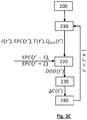
- the aging function can be established experimentally, following the steps described in connection with the figures 2A and 2B .
- a test accumulator is used, connected to a test bench 20, as described in connection with the figure 1B .
- the test battery is representative of the type of battery whose aging is to be studied. It is subject to different charging and discharging cycles.
- the objective is to obtain the empirical function h , taking into account, at different instants of each cycle, both at least the state of charge SOC and the depth of discharge DOD.
- Step 100 Initialization. This step is implemented at an initial time t 0 . During this step, a stress profile is defined, which corresponds to different charging and discharging cycles of the accumulator as well as certain operating parameters of the accumulator, for example the temperature.
- Each charge and each discharge can be parameterized by an initial state of charge SOC ( t init ) and a final state of charge SOC ( t end ).
- the depth of total discharge DOD tot corresponds to the absolute value of the difference between the initial state of charge and the final state of charge:
- tests are carried out by successively using different test accumulators, the latter being representative of the accumulator which it is desired to characterize.
- a same test accumulator is preferably subjected to charge/discharge cycles between a same initial state of charge and a same final state of charge, which translates into a same total depth of discharge.
- Different test accumulators are subjected to different cycles, by modifying, between two different test accumulators, the initial state of charge and/or the final state of charge and/or the total depth of discharge.
- Steps 110 and 120 are implemented at different measurement instants t , during charging and discharging.
- Two successive measurement instants t, t +1 can be spaced apart by a duration generally between a few seconds, for example 10 s, and a few minutes.
- Step 110 measurement of operating parameters at each measurement instant.
- operating parameters of the accumulator are determined from the test bench, which constitute variables of the aging function. These include I ( t ) ,SOC ( t ), T ( t ). It is assumed that during the same charge/discharge cycle, the capacity C ( t ) of the accumulator is constant. From the measured intensity values I ( t ), the operating parameters SOC ( t ). Q tot ( t ) are calculated. The capacitance C ( t ) is checked periodically.
- Step 120 determination of the depth of discharge DOD(t) at the measurement time t.
- step 120 assumes knowledge of the two previous charge states, that is to say the charge states at times t - 1 and t - 2. Also, the implementation of step 120 assumes that step 110 has been implemented at least two instants preceding the instant of measurement t . At during this step, from the state of charge SOC ( t ), determined at the instant of measurement t, and the states of charge SOC ( t - 1), and SOC ( t - 2), the depth of discharge DOD(t).
- Step 120 comprises sub-steps 121 to 123, schematized on the figure 2B .
- a direction of variation of the state of charge is determined. It is a question of knowing whether the accumulator undergoes a charge, or a discharge, or is in a transitory state between a charge and a discharge or in a state of pause.
- Step 120 allows determination of the depth of discharge at each measurement instant.
- Step 130 Reiteration
- Steps 110 to 120 are then repeated until the end of the iterations.
- the outcome of the iterations may correspond to the end of the stress profile to which the accumulator is subjected in the test bench.
- Step 140 optimization
- the optimization algorithm can also estimate a value of the constant A.
- the optimization algorithm makes it possible to minimize a difference between the values d ⁇ VS you dQ early respectively measured dQtot and estimated by expression (10).
- the optimization algorithm can be a recursive algorithm, of the recursive least squares or Kalman filter type. It may also be an artificial intelligence algorithm, of the neural network type.
- the empirical function h can be of predetermined form, on the basis of a battery model, relating the voltage at the terminals of the battery, the state of charge and the charging or discharging current.
- the empirical function h is determined, for different values assumed by the operating parameters T, SOC, I and DOD during the experimental charge/discharge cycles.
- the method may include an interpolation phase, during which the empirical function h is determined between different values of the same parameters.
- an aging function is available d ⁇ VS dQ early , representative of the aging cycle of the battery.
- Steps 100 to 140 correspond to a method for determining the cycling aging function d ⁇ VS dQ early .
- the latter can be combined with a calendar aging function, as expressed in expression (1), so as to obtain an estimate of a variation in the capacity of the accumulator, according to expression (3).
- the aging function represents a variation in the capacity of an accumulator.
- the invention also applies to a group of accumulators or other types of aging functions.
- the aging function translates a variation of the resistance as a function of time (calendar ageing) and as a function of the charging and discharging cycles of the accumulator (cycling ageing).
- the variation in resistance due to cycling aging can be modeled as described in connection with steps 100 to 140. It can then be implemented, for prediction purposes, as described in connection with steps 200 to 240.
- test accumulators representative of an accumulator of a Lithium ion battery, in a Digatron type test bench, to perform endurance tests.
- the battery temperature was kept constant at 45°C.
- the test accumulators underwent various charge/discharge cycles, the parameters of which are listed in table 1. ⁇ u>Table 1 ⁇ /u> Test reference SOCmin (%) SOCmax (%) DOD (%) 1 47.5 52.5 5 2 0 40 40 3 40 70 30 4 70 100 30 5 0 100 100
- Each charge is carried out at a charge rate of C/2, which means that the accumulator is fully recharged in 2 hours.
- Each discharge was carried out according to a 1C regime, which means that the accumulator was completely discharged in 1 hour.
- an aging function established without taking into account the depth of discharge, according to expression (2), and an aging function one variable of which is the depth of discharge , measured during each cycle, according to expression (10).
- the aging function taking into account the depth of discharge was established by following the steps 100 to 140 previously described, so as to obtain an aging component due to cycling.
- the cycling aging function is defined by combining these two variables, the combination being defined empirically, and not by a simple analytical relation.
- the inventors established empirical functions h 1 and h 2 as described in connection with the expression (10').
- the product of the empirical functions h 1 and h 2 corresponds to the empirical function h described in connection with steps 100 to 140.
- the figures 4A and 4B show different values respectively taken by the functions h 1 and h 2 for the same charging intensity, respectively as a function of the state of charge (axis of abscissas of the figure 4A ) and the depth of discharge (axis of the abscissas of the figure 4B ).
- the function h 1 is an empirical function as described in expression (2).
- the h 2 function can be considered as a corrective applied to the h 1 function, taking into account the depth of discharge to establish the aging function.
- an empirical function h can be represented in a space whose dimension depends on the number of variables.
- the temperature was kept fixed.
- the empirical function h then depends on 3 variables, corresponding respectively to the charge and discharge intensity (the charge intensity being of the opposite sign to the discharge intensity), the state of charge and the depth of discharge.
- the invention can be implemented to configure battery management systems (BMS - Battery Management System), so as to predict and optimize the duration of batteries.
- BMS Battery Management System
- the invention can be applied to other types of batteries.
Landscapes
- Physics & Mathematics (AREA)
- General Physics & Mathematics (AREA)
- Secondary Cells (AREA)
Applications Claiming Priority (1)
| Application Number | Priority Date | Filing Date | Title |
|---|---|---|---|
| FR2007309A FR3112394A1 (fr) | 2020-07-09 | 2020-07-09 | Procédé de détermination d’une fonction de vieillissement d’un accumulateur |
Publications (2)
| Publication Number | Publication Date |
|---|---|
| EP3936878A1 true EP3936878A1 (de) | 2022-01-12 |
| EP3936878B1 EP3936878B1 (de) | 2024-08-28 |
Family
ID=73013587
Family Applications (1)
| Application Number | Title | Priority Date | Filing Date |
|---|---|---|---|
| EP21184387.5A Active EP3936878B1 (de) | 2020-07-09 | 2021-07-07 | Verfahren zur bestimmung einer alterungsfunktion eines akkumulators |
Country Status (3)
| Country | Link |
|---|---|
| US (1) | US20220011374A1 (de) |
| EP (1) | EP3936878B1 (de) |
| FR (1) | FR3112394A1 (de) |
Cited By (1)
| Publication number | Priority date | Publication date | Assignee | Title |
|---|---|---|---|---|
| EP4386403A1 (de) * | 2022-12-14 | 2024-06-19 | Commissariat À L'Énergie Atomique Et Aux Énergies Alternatives | Verfahren und vorrichtung zur bestimmung eines die zukünftigen nutzung einer batterie repräsentativen belastungsprofils für eine bestimmte anwendung |
Families Citing this family (2)
| Publication number | Priority date | Publication date | Assignee | Title |
|---|---|---|---|---|
| KR102871577B1 (ko) * | 2019-09-04 | 2025-10-17 | 삼성전자주식회사 | 배터리 충전 장치 및 방법 |
| CN117872188B (zh) * | 2024-01-15 | 2024-09-03 | 广州邦禾检测技术有限公司 | 一种便携式多功能电源循环测试方法 |
Citations (4)
| Publication number | Priority date | Publication date | Assignee | Title |
|---|---|---|---|---|
| DE19540827A1 (de) | 1994-11-17 | 1996-05-23 | Daimler Benz Ag | Verfahren zur Bestimmung des Alterungszustandes einer Batterie |
| US20100121587A1 (en) | 2006-11-30 | 2010-05-13 | The Boeing Company | Health Management of Rechargeable Batteries |
| US8332342B1 (en) | 2009-11-19 | 2012-12-11 | The United States of America as represented by the Administrator of the National Aeronautics & Space Administration (NASA) | Model-based prognostics for batteries which estimates useful life and uses a probability density function |
| WO2017197383A1 (en) * | 2016-05-13 | 2017-11-16 | Schumacher Electric Corporation | Battery state detection system and method |
Family Cites Families (7)
| Publication number | Priority date | Publication date | Assignee | Title |
|---|---|---|---|---|
| US5659240A (en) * | 1995-02-16 | 1997-08-19 | General Electric Company | Intelligent battery charger for electric drive system batteries |
| EP1451915A4 (de) * | 2001-10-03 | 2004-12-22 | Trojan Battery Co | System und verfahren zur batterieladung |
| JP5562617B2 (ja) * | 2009-11-30 | 2014-07-30 | 三洋電機株式会社 | 均等化装置、バッテリシステムおよび電動車両 |
| FR2963109B1 (fr) * | 2010-07-23 | 2012-08-17 | Saft Groupe Sa | Procede de determination d'un parametre d'au moins un accumulateur d'une batterie |
| US20140350875A1 (en) * | 2013-05-27 | 2014-11-27 | Scott Allen Mullin | Relaxation model in real-time estimation of state-of-charge in lithium polymer batteries |
| US9742042B2 (en) * | 2013-11-23 | 2017-08-22 | Hrl Laboratories, Llc | Voltage protection and health monitoring of batteries with reference electrodes |
| DE102018116472A1 (de) * | 2018-07-06 | 2020-01-09 | Torqeedo Gmbh | Verfahren, Computerprogrammprodukt und Prognosesystem zur Bestimmung der Lebensdauer einer Antriebsbatterie eines Fahrzeugs, insbesondere eines Boots |
-
2020
- 2020-07-09 FR FR2007309A patent/FR3112394A1/fr active Pending
-
2021
- 2021-07-07 EP EP21184387.5A patent/EP3936878B1/de active Active
- 2021-07-09 US US17/305,527 patent/US20220011374A1/en active Pending
Patent Citations (4)
| Publication number | Priority date | Publication date | Assignee | Title |
|---|---|---|---|---|
| DE19540827A1 (de) | 1994-11-17 | 1996-05-23 | Daimler Benz Ag | Verfahren zur Bestimmung des Alterungszustandes einer Batterie |
| US20100121587A1 (en) | 2006-11-30 | 2010-05-13 | The Boeing Company | Health Management of Rechargeable Batteries |
| US8332342B1 (en) | 2009-11-19 | 2012-12-11 | The United States of America as represented by the Administrator of the National Aeronautics & Space Administration (NASA) | Model-based prognostics for batteries which estimates useful life and uses a probability density function |
| WO2017197383A1 (en) * | 2016-05-13 | 2017-11-16 | Schumacher Electric Corporation | Battery state detection system and method |
Non-Patent Citations (2)
| Title |
|---|
| GEWALD T.: "Accelerated aging characterization of Lithium-ion cells : using sensitivity analysis to identify the stress factors relevant to cyclic aging", BATTERIES, vol. 6, 2020, pages 6 |
| SARAKESTA-ZABALA: "Cycle ageing analysis of a LiFeP04/graphite cell with dynamic model validations : towards realistic lifetime prédictions", JOURNAL OF POWER SOURCES, vol. 275, 2015, pages 573 - 587, XP029109266, DOI: 10.1016/j.jpowsour.2014.10.153 |
Cited By (2)
| Publication number | Priority date | Publication date | Assignee | Title |
|---|---|---|---|---|
| EP4386403A1 (de) * | 2022-12-14 | 2024-06-19 | Commissariat À L'Énergie Atomique Et Aux Énergies Alternatives | Verfahren und vorrichtung zur bestimmung eines die zukünftigen nutzung einer batterie repräsentativen belastungsprofils für eine bestimmte anwendung |
| FR3143765A1 (fr) * | 2022-12-14 | 2024-06-21 | Commissariat A L'energie Atomique Et Aux Energies Alternatives | Procédé et dispositif de détermination d’un profil de sollicitation représentatif de l’usage futur d’une batterie pour une application donnée |
Also Published As
| Publication number | Publication date |
|---|---|
| US20220011374A1 (en) | 2022-01-13 |
| FR3112394A1 (fr) | 2022-01-14 |
| EP3936878B1 (de) | 2024-08-28 |
Similar Documents
| Publication | Publication Date | Title |
|---|---|---|
| EP3443370B1 (de) | Verfahren zur bestimmung des parameterwerts bezüglich des zustands eines akkumulators einer batterie, batterie und elektronisches batterieverwaltungssystem | |
| EP2634591B1 (de) | Methode und System zum Abschätzen des Ladungszustands eines elektrochemischen Elements mit Lithium, das eine positive Elektrode vom Typ Lithium-Phosphat umfasst | |
| EP3936878B1 (de) | Verfahren zur bestimmung einer alterungsfunktion eines akkumulators | |
| EP2293090A2 (de) | Verbessertes Verfahren zur Schätzung nicht messbarer Charakteristiken eines elektrochemischen Systems | |
| CA3114194A1 (fr) | Procede et dispositif de mesure en temps reel et in situ des donnees thermodynamiques d'une batterie (enthalpie et entropie) | |
| EP2537040A1 (de) | Verfahren zur vorort-diagnose von batterien durch elektrochemische impedanzspektroskopie | |
| WO2018091904A1 (en) | Determining a state of health of a battery and providing an alert | |
| WO2015049300A1 (fr) | Procede et appareil d'evaluation de l'etat de sante d'une batterie lithium | |
| WO2022136098A1 (fr) | Procédé pour estimer la durée de vie d'un système de stockage d'énergie | |
| EP3974853B1 (de) | Vorhersage des zukünftigen state of health von zellen einer elektrischen batterie | |
| FR3003038A1 (fr) | Procede de determination de la capacite residuelle d'une batterie | |
| EP3824305B1 (de) | Verfahren und vorrichtung zur bestimmung einer maximalen verwendungsdauer einer batterie | |
| EP3667345A1 (de) | Verfahren zur bestimmung des gesundheitszustands der zellen einer batterie | |
| EP3899561B1 (de) | Gesundheitszustand einer batterie | |
| EP4286872A1 (de) | Verfahren zur erzeugung eines leichten belastungsprofils aus einem batterievorspannungsprofil | |
| EP3559688B1 (de) | Verbesserte charakterisierung einer elektrochemischen vorrichtung im betrieb zur vorhersage des künftigen betriebs der vorrichtung | |
| EP4206705A1 (de) | Bestimmung der effizienz eines elektrischen akkumulators durch umwandlung | |
| WO2021123063A1 (fr) | Procede de determination de la valeur d'un parametre relatif a l'etat de sante d'un element electrochimique dans une batterie, systeme de gestion electronique d'une batterie, et batterie correspondante | |
| EP3221710B1 (de) | Verfahren zur charakterisierung eines akkumulators | |
| EP4386403A1 (de) | Verfahren und vorrichtung zur bestimmung eines die zukünftigen nutzung einer batterie repräsentativen belastungsprofils für eine bestimmte anwendung | |
| EP4639189A1 (de) | Vorhersage des gesundheitszustands einer batterie |
Legal Events
| Date | Code | Title | Description |
|---|---|---|---|
| PUAI | Public reference made under article 153(3) epc to a published international application that has entered the european phase |
Free format text: ORIGINAL CODE: 0009012 |
|
| STAA | Information on the status of an ep patent application or granted ep patent |
Free format text: STATUS: REQUEST FOR EXAMINATION WAS MADE |
|
| 17P | Request for examination filed |
Effective date: 20210707 |
|
| AK | Designated contracting states |
Kind code of ref document: A1 Designated state(s): AL AT BE BG CH CY CZ DE DK EE ES FI FR GB GR HR HU IE IS IT LI LT LU LV MC MK MT NL NO PL PT RO RS SE SI SK SM TR |
|
| B565 | Issuance of search results under rule 164(2) epc |
Effective date: 20211201 |
|
| GRAP | Despatch of communication of intention to grant a patent |
Free format text: ORIGINAL CODE: EPIDOSNIGR1 |
|
| STAA | Information on the status of an ep patent application or granted ep patent |
Free format text: STATUS: GRANT OF PATENT IS INTENDED |
|
| RIC1 | Information provided on ipc code assigned before grant |
Ipc: G01R 31/367 20190101ALI20240222BHEP Ipc: G01R 31/392 20190101AFI20240222BHEP |
|
| INTG | Intention to grant announced |
Effective date: 20240307 |
|
| GRAS | Grant fee paid |
Free format text: ORIGINAL CODE: EPIDOSNIGR3 |
|
| GRAA | (expected) grant |
Free format text: ORIGINAL CODE: 0009210 |
|
| STAA | Information on the status of an ep patent application or granted ep patent |
Free format text: STATUS: THE PATENT HAS BEEN GRANTED |
|
| AK | Designated contracting states |
Kind code of ref document: B1 Designated state(s): AL AT BE BG CH CY CZ DE DK EE ES FI FR GB GR HR HU IE IS IT LI LT LU LV MC MK MT NL NO PL PT RO RS SE SI SK SM TR |
|
| REG | Reference to a national code |
Ref country code: CH Ref legal event code: EP |
|
| REG | Reference to a national code |
Ref country code: DE Ref legal event code: R096 Ref document number: 602021017789 Country of ref document: DE |
|
| REG | Reference to a national code |
Ref country code: IE Ref legal event code: FG4D Free format text: LANGUAGE OF EP DOCUMENT: FRENCH |
|
| RAP4 | Party data changed (patent owner data changed or rights of a patent transferred) |
Owner name: COMMISSARIAT A L'ENERGIE ATOMIQUE ET AUX ENERGIESALTERNATIVES |
|
| REG | Reference to a national code |
Ref country code: LT Ref legal event code: MG9D |
|
| PG25 | Lapsed in a contracting state [announced via postgrant information from national office to epo] |
Ref country code: NO Free format text: LAPSE BECAUSE OF FAILURE TO SUBMIT A TRANSLATION OF THE DESCRIPTION OR TO PAY THE FEE WITHIN THE PRESCRIBED TIME-LIMIT Effective date: 20241128 |
|
| REG | Reference to a national code |
Ref country code: AT Ref legal event code: MK05 Ref document number: 1718532 Country of ref document: AT Kind code of ref document: T Effective date: 20240828 |
|
| PG25 | Lapsed in a contracting state [announced via postgrant information from national office to epo] |
Ref country code: NL Free format text: LAPSE BECAUSE OF FAILURE TO SUBMIT A TRANSLATION OF THE DESCRIPTION OR TO PAY THE FEE WITHIN THE PRESCRIBED TIME-LIMIT Effective date: 20240828 Ref country code: PT Free format text: LAPSE BECAUSE OF FAILURE TO SUBMIT A TRANSLATION OF THE DESCRIPTION OR TO PAY THE FEE WITHIN THE PRESCRIBED TIME-LIMIT Effective date: 20241230 Ref country code: GR Free format text: LAPSE BECAUSE OF FAILURE TO SUBMIT A TRANSLATION OF THE DESCRIPTION OR TO PAY THE FEE WITHIN THE PRESCRIBED TIME-LIMIT Effective date: 20241129 Ref country code: PL Free format text: LAPSE BECAUSE OF FAILURE TO SUBMIT A TRANSLATION OF THE DESCRIPTION OR TO PAY THE FEE WITHIN THE PRESCRIBED TIME-LIMIT Effective date: 20240828 Ref country code: FI Free format text: LAPSE BECAUSE OF FAILURE TO SUBMIT A TRANSLATION OF THE DESCRIPTION OR TO PAY THE FEE WITHIN THE PRESCRIBED TIME-LIMIT Effective date: 20240828 |
|
| PG25 | Lapsed in a contracting state [announced via postgrant information from national office to epo] |
Ref country code: BG Free format text: LAPSE BECAUSE OF FAILURE TO SUBMIT A TRANSLATION OF THE DESCRIPTION OR TO PAY THE FEE WITHIN THE PRESCRIBED TIME-LIMIT Effective date: 20240828 |
|
| PG25 | Lapsed in a contracting state [announced via postgrant information from national office to epo] |
Ref country code: LV Free format text: LAPSE BECAUSE OF FAILURE TO SUBMIT A TRANSLATION OF THE DESCRIPTION OR TO PAY THE FEE WITHIN THE PRESCRIBED TIME-LIMIT Effective date: 20240828 |
|
| REG | Reference to a national code |
Ref country code: NL Ref legal event code: MP Effective date: 20240828 |
|
| PG25 | Lapsed in a contracting state [announced via postgrant information from national office to epo] |
Ref country code: AT Free format text: LAPSE BECAUSE OF FAILURE TO SUBMIT A TRANSLATION OF THE DESCRIPTION OR TO PAY THE FEE WITHIN THE PRESCRIBED TIME-LIMIT Effective date: 20240828 Ref country code: IS Free format text: LAPSE BECAUSE OF FAILURE TO SUBMIT A TRANSLATION OF THE DESCRIPTION OR TO PAY THE FEE WITHIN THE PRESCRIBED TIME-LIMIT Effective date: 20241228 |
|
| PG25 | Lapsed in a contracting state [announced via postgrant information from national office to epo] |
Ref country code: HR Free format text: LAPSE BECAUSE OF FAILURE TO SUBMIT A TRANSLATION OF THE DESCRIPTION OR TO PAY THE FEE WITHIN THE PRESCRIBED TIME-LIMIT Effective date: 20240828 |
|
| PG25 | Lapsed in a contracting state [announced via postgrant information from national office to epo] |
Ref country code: ES Free format text: LAPSE BECAUSE OF FAILURE TO SUBMIT A TRANSLATION OF THE DESCRIPTION OR TO PAY THE FEE WITHIN THE PRESCRIBED TIME-LIMIT Effective date: 20240828 Ref country code: RS Free format text: LAPSE BECAUSE OF FAILURE TO SUBMIT A TRANSLATION OF THE DESCRIPTION OR TO PAY THE FEE WITHIN THE PRESCRIBED TIME-LIMIT Effective date: 20241128 |
|
| PG25 | Lapsed in a contracting state [announced via postgrant information from national office to epo] |
Ref country code: RS Free format text: LAPSE BECAUSE OF FAILURE TO SUBMIT A TRANSLATION OF THE DESCRIPTION OR TO PAY THE FEE WITHIN THE PRESCRIBED TIME-LIMIT Effective date: 20241128 Ref country code: PT Free format text: LAPSE BECAUSE OF FAILURE TO SUBMIT A TRANSLATION OF THE DESCRIPTION OR TO PAY THE FEE WITHIN THE PRESCRIBED TIME-LIMIT Effective date: 20241230 Ref country code: PL Free format text: LAPSE BECAUSE OF FAILURE TO SUBMIT A TRANSLATION OF THE DESCRIPTION OR TO PAY THE FEE WITHIN THE PRESCRIBED TIME-LIMIT Effective date: 20240828 Ref country code: NO Free format text: LAPSE BECAUSE OF FAILURE TO SUBMIT A TRANSLATION OF THE DESCRIPTION OR TO PAY THE FEE WITHIN THE PRESCRIBED TIME-LIMIT Effective date: 20241128 Ref country code: NL Free format text: LAPSE BECAUSE OF FAILURE TO SUBMIT A TRANSLATION OF THE DESCRIPTION OR TO PAY THE FEE WITHIN THE PRESCRIBED TIME-LIMIT Effective date: 20240828 Ref country code: LV Free format text: LAPSE BECAUSE OF FAILURE TO SUBMIT A TRANSLATION OF THE DESCRIPTION OR TO PAY THE FEE WITHIN THE PRESCRIBED TIME-LIMIT Effective date: 20240828 Ref country code: IS Free format text: LAPSE BECAUSE OF FAILURE TO SUBMIT A TRANSLATION OF THE DESCRIPTION OR TO PAY THE FEE WITHIN THE PRESCRIBED TIME-LIMIT Effective date: 20241228 Ref country code: HR Free format text: LAPSE BECAUSE OF FAILURE TO SUBMIT A TRANSLATION OF THE DESCRIPTION OR TO PAY THE FEE WITHIN THE PRESCRIBED TIME-LIMIT Effective date: 20240828 Ref country code: GR Free format text: LAPSE BECAUSE OF FAILURE TO SUBMIT A TRANSLATION OF THE DESCRIPTION OR TO PAY THE FEE WITHIN THE PRESCRIBED TIME-LIMIT Effective date: 20241129 Ref country code: FI Free format text: LAPSE BECAUSE OF FAILURE TO SUBMIT A TRANSLATION OF THE DESCRIPTION OR TO PAY THE FEE WITHIN THE PRESCRIBED TIME-LIMIT Effective date: 20240828 Ref country code: ES Free format text: LAPSE BECAUSE OF FAILURE TO SUBMIT A TRANSLATION OF THE DESCRIPTION OR TO PAY THE FEE WITHIN THE PRESCRIBED TIME-LIMIT Effective date: 20240828 Ref country code: BG Free format text: LAPSE BECAUSE OF FAILURE TO SUBMIT A TRANSLATION OF THE DESCRIPTION OR TO PAY THE FEE WITHIN THE PRESCRIBED TIME-LIMIT Effective date: 20240828 Ref country code: AT Free format text: LAPSE BECAUSE OF FAILURE TO SUBMIT A TRANSLATION OF THE DESCRIPTION OR TO PAY THE FEE WITHIN THE PRESCRIBED TIME-LIMIT Effective date: 20240828 |
|
| PG25 | Lapsed in a contracting state [announced via postgrant information from national office to epo] |
Ref country code: SM Free format text: LAPSE BECAUSE OF FAILURE TO SUBMIT A TRANSLATION OF THE DESCRIPTION OR TO PAY THE FEE WITHIN THE PRESCRIBED TIME-LIMIT Effective date: 20240828 Ref country code: DK Free format text: LAPSE BECAUSE OF FAILURE TO SUBMIT A TRANSLATION OF THE DESCRIPTION OR TO PAY THE FEE WITHIN THE PRESCRIBED TIME-LIMIT Effective date: 20240828 Ref country code: RO Free format text: LAPSE BECAUSE OF FAILURE TO SUBMIT A TRANSLATION OF THE DESCRIPTION OR TO PAY THE FEE WITHIN THE PRESCRIBED TIME-LIMIT Effective date: 20240828 |
|
| PG25 | Lapsed in a contracting state [announced via postgrant information from national office to epo] |
Ref country code: EE Free format text: LAPSE BECAUSE OF FAILURE TO SUBMIT A TRANSLATION OF THE DESCRIPTION OR TO PAY THE FEE WITHIN THE PRESCRIBED TIME-LIMIT Effective date: 20240828 |
|
| PG25 | Lapsed in a contracting state [announced via postgrant information from national office to epo] |
Ref country code: CZ Free format text: LAPSE BECAUSE OF FAILURE TO SUBMIT A TRANSLATION OF THE DESCRIPTION OR TO PAY THE FEE WITHIN THE PRESCRIBED TIME-LIMIT Effective date: 20240828 |
|
| PG25 | Lapsed in a contracting state [announced via postgrant information from national office to epo] |
Ref country code: IT Free format text: LAPSE BECAUSE OF FAILURE TO SUBMIT A TRANSLATION OF THE DESCRIPTION OR TO PAY THE FEE WITHIN THE PRESCRIBED TIME-LIMIT Effective date: 20240828 Ref country code: SK Free format text: LAPSE BECAUSE OF FAILURE TO SUBMIT A TRANSLATION OF THE DESCRIPTION OR TO PAY THE FEE WITHIN THE PRESCRIBED TIME-LIMIT Effective date: 20240828 |
|
| REG | Reference to a national code |
Ref country code: DE Ref legal event code: R097 Ref document number: 602021017789 Country of ref document: DE |
|
| PLBE | No opposition filed within time limit |
Free format text: ORIGINAL CODE: 0009261 |
|
| STAA | Information on the status of an ep patent application or granted ep patent |
Free format text: STATUS: NO OPPOSITION FILED WITHIN TIME LIMIT |
|
| 26N | No opposition filed |
Effective date: 20250530 |
|
| PG25 | Lapsed in a contracting state [announced via postgrant information from national office to epo] |
Ref country code: SE Free format text: LAPSE BECAUSE OF FAILURE TO SUBMIT A TRANSLATION OF THE DESCRIPTION OR TO PAY THE FEE WITHIN THE PRESCRIBED TIME-LIMIT Effective date: 20240828 |
|
| PGFP | Annual fee paid to national office [announced via postgrant information from national office to epo] |
Ref country code: DE Payment date: 20250722 Year of fee payment: 5 |
|
| PGFP | Annual fee paid to national office [announced via postgrant information from national office to epo] |
Ref country code: GB Payment date: 20250724 Year of fee payment: 5 |
|
| PGFP | Annual fee paid to national office [announced via postgrant information from national office to epo] |
Ref country code: FR Payment date: 20250722 Year of fee payment: 5 |
|
| REG | Reference to a national code |
Ref country code: CH Ref legal event code: H13 Free format text: ST27 STATUS EVENT CODE: U-0-0-H10-H13 (AS PROVIDED BY THE NATIONAL OFFICE) Effective date: 20260224 |
|
| PG25 | Lapsed in a contracting state [announced via postgrant information from national office to epo] |
Ref country code: LU Free format text: LAPSE BECAUSE OF NON-PAYMENT OF DUE FEES Effective date: 20250707 |
|
| REG | Reference to a national code |
Ref country code: BE Ref legal event code: MM Effective date: 20250731 |
|
| PG25 | Lapsed in a contracting state [announced via postgrant information from national office to epo] |
Ref country code: BE Free format text: LAPSE BECAUSE OF NON-PAYMENT OF DUE FEES Effective date: 20250731 |
|
| PG25 | Lapsed in a contracting state [announced via postgrant information from national office to epo] |
Ref country code: CH Free format text: LAPSE BECAUSE OF NON-PAYMENT OF DUE FEES Effective date: 20250731 |