EP3939748A1 - Outil doté d'une structure en saillie - Google Patents
Outil doté d'une structure en saillie Download PDFInfo
- Publication number
- EP3939748A1 EP3939748A1 EP20186368.5A EP20186368A EP3939748A1 EP 3939748 A1 EP3939748 A1 EP 3939748A1 EP 20186368 A EP20186368 A EP 20186368A EP 3939748 A1 EP3939748 A1 EP 3939748A1
- Authority
- EP
- European Patent Office
- Prior art keywords
- tool
- protruding structure
- longitudinal axis
- shaft
- hardened
- Prior art date
- Legal status (The legal status is an assumption and is not a legal conclusion. Google has not performed a legal analysis and makes no representation as to the accuracy of the status listed.)
- Pending
Links
Images
Classifications
-
- B—PERFORMING OPERATIONS; TRANSPORTING
- B23—MACHINE TOOLS; METAL-WORKING NOT OTHERWISE PROVIDED FOR
- B23P—METAL-WORKING NOT OTHERWISE PROVIDED FOR; COMBINED OPERATIONS; UNIVERSAL MACHINE TOOLS
- B23P15/00—Making specific metal objects by operations not covered by a single other subclass or a group in this subclass
-
- B—PERFORMING OPERATIONS; TRANSPORTING
- B25—HAND TOOLS; PORTABLE POWER-DRIVEN TOOLS; MANIPULATORS
- B25D—PERCUSSIVE TOOLS
- B25D17/00—Details of, or accessories for, portable power-driven percussive tools
- B25D17/02—Percussive tool bits
-
- B—PERFORMING OPERATIONS; TRANSPORTING
- B28—WORKING CEMENT, CLAY, OR STONE
- B28D—WORKING STONE OR STONE-LIKE MATERIALS
- B28D1/00—Working stone or stone-like materials, e.g. brick, concrete or glass, not provided for elsewhere; Machines, devices, tools therefor
- B28D1/26—Working stone or stone-like materials, e.g. brick, concrete or glass, not provided for elsewhere; Machines, devices, tools therefor by impact tools, e.g. by chisels or other tools having a cutting edge
-
- C—CHEMISTRY; METALLURGY
- C21—METALLURGY OF IRON
- C21D—MODIFYING THE PHYSICAL STRUCTURE OF FERROUS METALS; GENERAL DEVICES FOR HEAT TREATMENT OF FERROUS OR NON-FERROUS METALS OR ALLOYS; MAKING METAL MALLEABLE, e.g. BY DECARBURISATION OR TEMPERING
- C21D1/00—General methods or devices for heat treatment, e.g. annealing, hardening, quenching or tempering
- C21D1/06—Surface hardening
- C21D1/09—Surface hardening by direct application of electrical or wave energy; by particle radiation
- C21D1/10—Surface hardening by direct application of electrical or wave energy; by particle radiation by electric induction
-
- C—CHEMISTRY; METALLURGY
- C21—METALLURGY OF IRON
- C21D—MODIFYING THE PHYSICAL STRUCTURE OF FERROUS METALS; GENERAL DEVICES FOR HEAT TREATMENT OF FERROUS OR NON-FERROUS METALS OR ALLOYS; MAKING METAL MALLEABLE, e.g. BY DECARBURISATION OR TEMPERING
- C21D1/00—General methods or devices for heat treatment, e.g. annealing, hardening, quenching or tempering
- C21D1/18—Hardening; Quenching with or without subsequent tempering
-
- C—CHEMISTRY; METALLURGY
- C21—METALLURGY OF IRON
- C21D—MODIFYING THE PHYSICAL STRUCTURE OF FERROUS METALS; GENERAL DEVICES FOR HEAT TREATMENT OF FERROUS OR NON-FERROUS METALS OR ALLOYS; MAKING METAL MALLEABLE, e.g. BY DECARBURISATION OR TEMPERING
- C21D1/00—General methods or devices for heat treatment, e.g. annealing, hardening, quenching or tempering
- C21D1/34—Methods of heating
- C21D1/42—Induction heating
-
- Y—GENERAL TAGGING OF NEW TECHNOLOGICAL DEVELOPMENTS; GENERAL TAGGING OF CROSS-SECTIONAL TECHNOLOGIES SPANNING OVER SEVERAL SECTIONS OF THE IPC; TECHNICAL SUBJECTS COVERED BY FORMER USPC CROSS-REFERENCE ART COLLECTIONS [XRACs] AND DIGESTS
- Y02—TECHNOLOGIES OR APPLICATIONS FOR MITIGATION OR ADAPTATION AGAINST CLIMATE CHANGE
- Y02P—CLIMATE CHANGE MITIGATION TECHNOLOGIES IN THE PRODUCTION OR PROCESSING OF GOODS
- Y02P10/00—Technologies related to metal processing
- Y02P10/25—Process efficiency
Definitions
- the present invention relates to a tool, in particular a chisel, for a power tool, the tool having a longitudinal axis and comprising a working section and a shaft with a connection end for connecting the tool to a tool holder of the power tool, wherein the shaft comprises at least one protruding structure protruding from the shaft.
- a first aspect is a tool, in particular a chisel, for a power tool, the tool having a longitudinal axis and comprising a working section and a shaft with a connection end for connecting the tool to a tool holder of the power tool, wherein the shaft comprises at least one protruding structure protruding from the shaft, wherein at least within a first of two halves of the protruding structure, which are separated from each other by a plane perpendicular to the longitudinal axis, the surface of the protruding structure has a finite gradient along a direction parallel to the longitudinal axis.
- the surface of the protruding structure may be formed such that there exists at least one angle in relation to the longitudinal axis, along which the surface of the protruding structure does not even partly shade itself.
- the protruding structure is formed such that its whole surface is accessible along at least one direction, the direction being non-perpendicular to the longitudinal axis. This allows to treat different sections of the tool differentially. For example, the tool may be hardened to different hardnesses depending on the respective section of the tool. Due to the specific surface of the protruding structure, the protruding structure does not stand in its own way during the treatment. Hence, the protruding structure and its surroundings as well as the rest of the tool may be treated in a well-controlled fashion.
- the tool may be a chisel, in particular a pointed chisel or a flat chisel.
- the protruding structure may be part of the connection end.
- at least the shaft and the protruding structure may be formed as one single body.
- the protruding structure may be welded onto and around the shaft.
- the protruding structure may be a ring structure. It may thus form a connection end of a tool for high power tools.
- the protruding structure may be asymmetrical to a center plane of the protruding structure, the center plane being perpendicular to the longitudinal axis.
- the protruding structure and in particular its surface may have two sides, one side facing towards the working section and the other side facing into the counter-direction, i. e. towards a free end of the connection end. At least one of the sides may have a S-shaped or at least a basically S-shaped form.
- a further aspect of the invention is that the tool may be hardened by inductive hardening.
- inductive hardening an applied heating power and a feed rate of the tool may be changed along the entire length of the tool, thus providing a simple way of treating the tool differentially in different sections.
- the tool may be through-hardened and in some sections the tool may be shell-hardened.
- each section of the tool i. e. the chisel
- the tool may contain at least two sections of different microstructure.
- the working section may be through-hardened.
- the working section of the chisel is usually subjected to abrasive stress during e. g. demolition works. Due to wear, the cross-section of the tool decreases continuously, so a through-hardened structure is required in order to prevent the chisel from getting blunt.
- the shaft may be shell-hardened.
- the connection end or at least a part of the connection end may be shell-hardened.
- the surface may be hardened to achieve a hard, wear-resistant layer.
- the thickness of the layer may be between 0.5 and 5 mm, preferably 2 mm.
- the central core of the connection end or at least of the part of the connection end may remain non-hardened and soft. The combination of the hardened surface and the soft core may provide a high toughness against bending and may, nevertheless, retain a sufficient abrasion resistance.
- connection end may be through-hardened in order to withstand, for example, strikes of a chiseling machine the tool is used with.
- connection end may have six grooves, which may preferentially be distributed evenly around the connection end.
- at least the shaft may have a hexagonal or at least basically hexagonal cross-section.
- Another aspect of the invention is a method for producing a tool according to the invention one of the preceding claims, wherein the method comprises a first step of inductively heating the tool.
- the method may comprise a second step of cooling the tool by spraying a coolant along a direction along which the surface of the protruding structure of the tool does not even partly shade itself. This is possible due to the specific shape of the protruding structure. Thus, it is possible to heat one section of the tool and to cool another section of the tool at the same time.
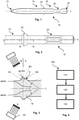
- Figure 1 schematically shows a side view of a tool 10 with a working section 12, a shaft 14, the shaft comprising a connection end 16 with a protruding structure 18 and grooves 20.
- the tool 10 has a longitudinal axis L.
- the shaft 14 and thus the connection end 16 may have hexagonal cross-sections. Their diameters may be more than 20 mm, in particular it may be between 25 and 35 mm, preferably 28 mm.
- the working section 12 and a striking end 22, located at a free end of the connection end 16, are through-hardened.
- the rest of the tool 10 is soft-hardened.
- the tool 10 contains several sections of different microstructure.
- FIG. 2 shows an enlarged side view of the connection end 16.
- the connection end 16 comprises six grooves 20.
- the grooves 20 are evenly and circumferentially distributed around the connection end 16.
- the protruding structure 18 has a ring structure. It surrounds the rest of the shaft 14 and thus protrudes radially from the rest of the shaft 14.
- Figure 3 shows a longitudinal cross-section according to the reference signs III of figure 2 and cut along a central plane comprising the longitudinal axis L.
- the surface of the protruding structure 18 comprises several sections with different radii of curvature R1, R2, R3, R4, and R5.
- the radii may, for example, be between 5 and 7 mm.
- the largest diameter of the protruding structure 18 may be between 40 and 45 mm, preferably 42.5 mm.
- the protruding structure 18 has a first half A and a second half B both being separated from each other by a plane perpendicular to the longitudinal axis L.
- the surface of the protruding structure 18 has a finite gradient along a direction parallel to longitudinal axis L.
- figure 3 shows an angle alpha between a tangent through a point P of the surface of the protruding structure 18 and the longitudinal axis L within the plane of the cross-section shown in figure 3 and thus along a direction parallel to the longitudinal axis L.
- the angle alpha is an acute angle and thus less than 90° in relation to the longitudinal axis L. The same applies for all other points along the surface within the first half A of the protruding section 18.
- the surface within the first half A and according to the cross-section shown in figure 3 is basically S-shaped.
- a ring-shaped spraying apparatus 24 By means of a ring-shaped spraying apparatus 24 it is thus possible to spray a coolant along a spraying direction S onto the surface of the tool 10 ( figure 1 ) and in particular onto the surface of the protruding structure 18.
- the spraying direction S is steeper relative to the longitudinal axis L than the steepest tangent of the surface within the first half A. Hence, the surface of the protruding structure 18 does not even partly shade itself along the spraying direction S.
- Figure 4 shows a flow chart of a method 100 for producing a tool 10, for example the tool 10 according to the embodiment as described in relation to figures 1 to 3 .
- a first step 110 the tool 10 is formed from a raw material.
- the protruding structure 18 may be welded onto a, basically rod-shaped, raw form of the shaft 14.
- the tool 10 is hardened:
- a second step 120 the tool 10 is inductively heated section by section along its longitudinal axis L by an inductive heating apparatus.
- a third step 130 which preferably may take place in parallel to the second step 120, at least one of the already heated sections is cooled by spraying a coolant along the direction S onto the surface of the section.
- the spraying apparatus 24 may preferably be used.
- the spraying apparatus 24 may be moved from one end of the tool 10, in particular the left end according to figure 3 , to its other end, thus for example its right end.
- the feed rate, the heating power and duration, the intensity of spraying and thus the cooling power, etc. may be changed from section to section.
- the tool 10 may be specifically hardened in each of the sections.
Landscapes
- Engineering & Computer Science (AREA)
- Chemical & Material Sciences (AREA)
- Mechanical Engineering (AREA)
- Physics & Mathematics (AREA)
- Thermal Sciences (AREA)
- Crystallography & Structural Chemistry (AREA)
- Materials Engineering (AREA)
- Metallurgy (AREA)
- Organic Chemistry (AREA)
- Mining & Mineral Resources (AREA)
- Heat Treatment Of Articles (AREA)
Priority Applications (3)
| Application Number | Priority Date | Filing Date | Title |
|---|---|---|---|
| EP20186368.5A EP3939748A1 (fr) | 2020-07-17 | 2020-07-17 | Outil doté d'une structure en saillie |
| US18/014,648 US12403578B2 (en) | 2020-07-17 | 2021-07-07 | Tool with protruding structure |
| PCT/EP2021/068764 WO2022013026A1 (fr) | 2020-07-17 | 2021-07-07 | Outil doté d'une structure en saillie |
Applications Claiming Priority (1)
| Application Number | Priority Date | Filing Date | Title |
|---|---|---|---|
| EP20186368.5A EP3939748A1 (fr) | 2020-07-17 | 2020-07-17 | Outil doté d'une structure en saillie |
Publications (1)
| Publication Number | Publication Date |
|---|---|
| EP3939748A1 true EP3939748A1 (fr) | 2022-01-19 |
Family
ID=71670054
Family Applications (1)
| Application Number | Title | Priority Date | Filing Date |
|---|---|---|---|
| EP20186368.5A Pending EP3939748A1 (fr) | 2020-07-17 | 2020-07-17 | Outil doté d'une structure en saillie |
Country Status (3)
| Country | Link |
|---|---|
| US (1) | US12403578B2 (fr) |
| EP (1) | EP3939748A1 (fr) |
| WO (1) | WO2022013026A1 (fr) |
Citations (2)
| Publication number | Priority date | Publication date | Assignee | Title |
|---|---|---|---|---|
| US3655244A (en) * | 1970-07-30 | 1972-04-11 | Int Tool Sales | Impact driven tool with replaceable cutting point |
| DE19757271A1 (de) * | 1997-12-22 | 1999-06-24 | Hilti Ag | Werkzeug |
Family Cites Families (13)
| Publication number | Priority date | Publication date | Assignee | Title |
|---|---|---|---|---|
| US3336081A (en) * | 1965-08-02 | 1967-08-15 | Samuel S Ericsson | Percussion tool with replaceable point |
| US4911504A (en) * | 1988-07-20 | 1990-03-27 | Kennametal Inc. | Cutter bit and tip |
| US4893875A (en) * | 1988-12-16 | 1990-01-16 | Caterpillar Inc. | Ground engaging bit having a hardened tip |
| EP1273396B1 (fr) * | 2001-07-06 | 2009-12-30 | Robert Bosch Gmbh | Ciseau resp. forêt |
| US8328477B2 (en) * | 2006-03-02 | 2012-12-11 | Milwaukee Electric Tool Corporation | Cutting tool |
| US8038223B2 (en) * | 2007-09-07 | 2011-10-18 | Schlumberger Technology Corporation | Pick with carbide cap |
| EP2502708B1 (fr) * | 2011-03-22 | 2017-02-01 | Black & Decker Inc. | Ciseaux |
| EP3281748A1 (fr) * | 2016-08-08 | 2018-02-14 | HILTI Aktiengesellschaft | Burin |
| US12544898B2 (en) * | 2016-11-16 | 2026-02-10 | Schley Products, Inc. | Quick change pneumatic hammer |
| US10792798B2 (en) * | 2018-09-12 | 2020-10-06 | Jian-Shiou Liaw | Pneumatic hammer |
| US11945087B2 (en) * | 2019-03-29 | 2024-04-02 | Tien-I Industrial Co., Ltd. | Impact tool head |
| EP3978195A1 (fr) * | 2020-09-30 | 2022-04-06 | Hilti Aktiengesellschaft | Burin et porte outil |
| US20230191578A1 (en) * | 2021-12-22 | 2023-06-22 | Robert Bosch Gmbh | Air Hammer Cone Washer Removal Tool |
-
2020
- 2020-07-17 EP EP20186368.5A patent/EP3939748A1/fr active Pending
-
2021
- 2021-07-07 US US18/014,648 patent/US12403578B2/en active Active
- 2021-07-07 WO PCT/EP2021/068764 patent/WO2022013026A1/fr not_active Ceased
Patent Citations (2)
| Publication number | Priority date | Publication date | Assignee | Title |
|---|---|---|---|---|
| US3655244A (en) * | 1970-07-30 | 1972-04-11 | Int Tool Sales | Impact driven tool with replaceable cutting point |
| DE19757271A1 (de) * | 1997-12-22 | 1999-06-24 | Hilti Ag | Werkzeug |
Also Published As
| Publication number | Publication date |
|---|---|
| US20230356378A1 (en) | 2023-11-09 |
| WO2022013026A1 (fr) | 2022-01-20 |
| US12403578B2 (en) | 2025-09-02 |
Similar Documents
| Publication | Publication Date | Title |
|---|---|---|
| EP3616842B1 (fr) | Trépan d'outil | |
| US20170072477A1 (en) | Partially hardened rotary tool and corresponding production method | |
| US20260034656A1 (en) | Impact tool anvil and method of manufacture | |
| US12403578B2 (en) | Tool with protruding structure | |
| HU221837B1 (hu) | Szerszám és eljárás az előállításához | |
| CN110303305B (zh) | 一种外圈的加工工艺方法 | |
| US20080189930A1 (en) | Method for making a hammer | |
| US20230124502A1 (en) | Hammer bushings with softened outer region | |
| US20150211213A1 (en) | Aggregate crushing tool | |
| CZ2002417A3 (cs) | Způsob výroby vyčesávacího válečku bezvřetenového dopřádacího zařízení a vyčesávací váleček vyrobený takovým způsobem | |
| KR101606288B1 (ko) | 벤딩현상 억제를 위한 노치휠 중앙에 열처리강 봉재 또는 초경합금 봉재가 열박음된 다이아몬드 다층 전착 노치휠 제조방법 및 이를 이용한 노치휠 | |
| JP2003329048A (ja) | 軸受軌道部材の製造方法 | |
| KR20030076396A (ko) | 중공강 육각 로드 및 그 고주파 담금질 방법 | |
| RU2137590C1 (ru) | Способ упрочнения твердосплавного инструмента | |
| US11124866B2 (en) | Method of treating the surfaces of mould parts for casting moulds consisting of a steel material | |
| JPH1161264A (ja) | 履帯ブッシュおよびその製造方法 | |
| US10968738B1 (en) | Remanufactured conical bit | |
| WO2003097885A1 (fr) | Element de forage de roche et procede | |
| RU2183681C1 (ru) | Способ упрочнения рабочих поверхностей дискового ножа | |
| SU952975A1 (ru) | Способ поверхностного упрочнени изделий | |
| EP4155031A1 (fr) | Outil de rupture, marteau de rupture et procédé de maintien de la forme de l'outil de rupture | |
| KR102870516B1 (ko) | 중주파 유도가열 열처리를 이용한 토목용 장비의 표면 강화 공법 | |
| RU2716329C1 (ru) | Способ упрочнения твердосплавного инструмента | |
| RU2279961C1 (ru) | Устройство для восстановления металлических внутренних поверхностей статико-импульсным раскатыванием | |
| RU2286237C1 (ru) | Способ восстановления и упрочнения внутренних поверхностей отверстий статико-импульсным раскатыванием |
Legal Events
| Date | Code | Title | Description |
|---|---|---|---|
| PUAI | Public reference made under article 153(3) epc to a published international application that has entered the european phase |
Free format text: ORIGINAL CODE: 0009012 |
|
| STAA | Information on the status of an ep patent application or granted ep patent |
Free format text: STATUS: THE APPLICATION HAS BEEN PUBLISHED |
|
| AK | Designated contracting states |
Kind code of ref document: A1 Designated state(s): AL AT BE BG CH CY CZ DE DK EE ES FI FR GB GR HR HU IE IS IT LI LT LU LV MC MK MT NL NO PL PT RO RS SE SI SK SM TR |
|
| STAA | Information on the status of an ep patent application or granted ep patent |
Free format text: STATUS: REQUEST FOR EXAMINATION WAS MADE |
|
| 17P | Request for examination filed |
Effective date: 20220719 |
|
| RBV | Designated contracting states (corrected) |
Designated state(s): AL AT BE BG CH CY CZ DE DK EE ES FI FR GB GR HR HU IE IS IT LI LT LU LV MC MK MT NL NO PL PT RO RS SE SI SK SM TR |
|
| STAA | Information on the status of an ep patent application or granted ep patent |
Free format text: STATUS: EXAMINATION IS IN PROGRESS |
|
| 17Q | First examination report despatched |
Effective date: 20240722 |