EP3940586A1 - Dispositif électronique et procédé associé de détection et de comptage d'une action - Google Patents
Dispositif électronique et procédé associé de détection et de comptage d'une action Download PDFInfo
- Publication number
- EP3940586A1 EP3940586A1 EP21178558.9A EP21178558A EP3940586A1 EP 3940586 A1 EP3940586 A1 EP 3940586A1 EP 21178558 A EP21178558 A EP 21178558A EP 3940586 A1 EP3940586 A1 EP 3940586A1
- Authority
- EP
- European Patent Office
- Prior art keywords
- action
- sub
- scheme
- electronic device
- nfa
- Prior art date
- Legal status (The legal status is an assumption and is not a legal conclusion. Google has not performed a legal analysis and makes no representation as to the accuracy of the status listed.)
- Granted
Links
Images



Classifications
-
- G—PHYSICS
- G06—COMPUTING OR CALCULATING; COUNTING
- G06V—IMAGE OR VIDEO RECOGNITION OR UNDERSTANDING
- G06V40/00—Recognition of biometric, human-related or animal-related patterns in image or video data
- G06V40/20—Movements or behaviour, e.g. gesture recognition
-
- G—PHYSICS
- G06—COMPUTING OR CALCULATING; COUNTING
- G06V—IMAGE OR VIDEO RECOGNITION OR UNDERSTANDING
- G06V40/00—Recognition of biometric, human-related or animal-related patterns in image or video data
- G06V40/20—Movements or behaviour, e.g. gesture recognition
- G06V40/23—Recognition of whole body movements, e.g. for sport training
-
- A—HUMAN NECESSITIES
- A63—SPORTS; GAMES; AMUSEMENTS
- A63B—APPARATUS FOR PHYSICAL TRAINING, GYMNASTICS, SWIMMING, CLIMBING, OR FENCING; BALL GAMES; TRAINING EQUIPMENT
- A63B24/00—Electric or electronic controls for exercising apparatus of preceding groups; Controlling or monitoring of exercises, sportive games, training or athletic performances
- A63B24/0062—Monitoring athletic performances, e.g. for determining the work of a user on an exercise apparatus, the completed jogging or cycling distance
-
- G—PHYSICS
- G06—COMPUTING OR CALCULATING; COUNTING
- G06F—ELECTRIC DIGITAL DATA PROCESSING
- G06F18/00—Pattern recognition
- G06F18/20—Analysing
- G06F18/21—Design or setup of recognition systems or techniques; Extraction of features in feature space; Blind source separation
-
- G—PHYSICS
- G06—COMPUTING OR CALCULATING; COUNTING
- G06F—ELECTRIC DIGITAL DATA PROCESSING
- G06F18/00—Pattern recognition
- G06F18/20—Analysing
- G06F18/24—Classification techniques
-
- G—PHYSICS
- G06—COMPUTING OR CALCULATING; COUNTING
- G06F—ELECTRIC DIGITAL DATA PROCESSING
- G06F18/00—Pattern recognition
- G06F18/20—Analysing
- G06F18/29—Graphical models, e.g. Bayesian networks
- G06F18/295—Markov models or related models, e.g. semi-Markov models; Markov random fields; Networks embedding Markov models
-
- G—PHYSICS
- G06—COMPUTING OR CALCULATING; COUNTING
- G06N—COMPUTING ARRANGEMENTS BASED ON SPECIFIC COMPUTATIONAL MODELS
- G06N20/00—Machine learning
-
- G—PHYSICS
- G06—COMPUTING OR CALCULATING; COUNTING
- G06V—IMAGE OR VIDEO RECOGNITION OR UNDERSTANDING
- G06V10/00—Arrangements for image or video recognition or understanding
- G06V10/70—Arrangements for image or video recognition or understanding using pattern recognition or machine learning
- G06V10/764—Arrangements for image or video recognition or understanding using pattern recognition or machine learning using classification, e.g. of video objects
-
- G—PHYSICS
- G06—COMPUTING OR CALCULATING; COUNTING
- G06V—IMAGE OR VIDEO RECOGNITION OR UNDERSTANDING
- G06V10/00—Arrangements for image or video recognition or understanding
- G06V10/70—Arrangements for image or video recognition or understanding using pattern recognition or machine learning
- G06V10/84—Arrangements for image or video recognition or understanding using pattern recognition or machine learning using probabilistic graphical models from image or video features, e.g. Markov models or Bayesian networks
- G06V10/85—Markov-related models; Markov random fields
-
- G—PHYSICS
- G06—COMPUTING OR CALCULATING; COUNTING
- G06V—IMAGE OR VIDEO RECOGNITION OR UNDERSTANDING
- G06V20/00—Scenes; Scene-specific elements
- G06V20/40—Scenes; Scene-specific elements in video content
- G06V20/41—Higher-level, semantic clustering, classification or understanding of video scenes, e.g. detection, labelling or Markovian modelling of sport events or news items
- G06V20/42—Higher-level, semantic clustering, classification or understanding of video scenes, e.g. detection, labelling or Markovian modelling of sport events or news items of sport video content
-
- A—HUMAN NECESSITIES
- A63—SPORTS; GAMES; AMUSEMENTS
- A63B—APPARATUS FOR PHYSICAL TRAINING, GYMNASTICS, SWIMMING, CLIMBING, OR FENCING; BALL GAMES; TRAINING EQUIPMENT
- A63B2220/00—Measuring of physical parameters relating to sporting activity
- A63B2220/05—Image processing for measuring physical parameters
-
- A—HUMAN NECESSITIES
- A63—SPORTS; GAMES; AMUSEMENTS
- A63B—APPARATUS FOR PHYSICAL TRAINING, GYMNASTICS, SWIMMING, CLIMBING, OR FENCING; BALL GAMES; TRAINING EQUIPMENT
- A63B2220/00—Measuring of physical parameters relating to sporting activity
- A63B2220/17—Counting, e.g. counting periodical movements, revolutions or cycles, or including further data processing to determine distances or speed
Definitions
- the present disclosure pertains to the field of Internet of things.
- the present disclosure relates to an electronic device and a related method for detecting and counting an action.
- Real-time automated activity logging using for example action recognition and temporal action detection approaches, is used in many real-world settings, with applications in areas such as gym exercise logging, sports event analytics (such as soccer games or Olympics), manufacturing performance monitoring and agricultural monitoring (such as health monitoring of livestock).
- sports event analytics such as soccer games or Olympics
- manufacturing performance monitoring such as health monitoring of livestock.
- Action recognition and temporal action detection approaches may require complex trained models and a large amount of data causing a high computational load, in order to generalize sufficiently to different situations, such as different individuals performing the action. Such models are thus impractical to deploy, in particular on resource-constrained devices, such as handheld electronic devices.
- Some action recognition and temporal action detection approaches may extract key points from video sequences using a sliding-window approach, and then train action detection models based on key-point trajectories. Such approaches may determine that a window comprising a plurality of frames corresponds to a specific action based on a detected action of one or more frames of the window and may predict one label, such as action or non-action, for the entire window. However, since the window comprises a plurality of frames, where some of the frames may relate to an action and some may not, the prediction of the labelling of the entire window may be ambiguous. This makes training of the action detection model difficult, which may lead to erroneous detections of actions when using the trained action detection model for action detection purposes.
- An electronic device comprising memory circuitry and processor circuitry.
- the processor circuitry comprising an action detection circuitry configured to operate according to an action detection model for detecting an action based on a machine-learning scheme.
- the processor circuitry is configured to obtain sensor data.
- the processor circuitry may be configured to obtain sensor data by receiving and/or retrieving sensor data.
- the processor circuitry is configured to generate, based on the sensor data, a set of features associated with a frame.
- the processor circuitry is configured to determine, based on the set, using the action detection model, whether the frame corresponds to a sub-action.
- the processor circuitry is configured to apply a nondeterministic finite automaton, NFA, scheme, to the determined sub-action for the frame, wherein the NFA scheme has a set of states associated with corresponding sub-actions and is configured to output one or more action classes.
- the processor circuitry is configured to determine, using the NFA scheme, an action class.
- the processor circuitry is configured to detect the action based on the action class.
- the processor circuitry is configured to increment an action counter based on the detected action.
- a method is disclosed, performed by an electronic device, for counting an action.
- the method comprises obtaining sensor data.
- the method comprises generating, based on the sensor data, a set of features associated with a frame.
- the method comprises determining, based on the set, using an action detection model, whether the frame corresponds to a sub-action, wherein the action detection model is based on a machine-learning scheme.
- the method comprises applying a nondeterministic finite automaton, NFA, scheme to the determined sub-action for the frame, wherein the NFA scheme has a set of states associated with corresponding sub-actions and is configured to output one or more action classes.
- the method comprises determining, using the NFA scheme, an action class.
- the method comprises detecting the action based on the action class.
- the method comprises incrementing an action counter based on the detected action.
- the learning task is simplified and less ambiguous. Thereby, a more lightweight model may be used.
- the action detection model may be used on electronic user devices in a real-time setting, such as for monitoring and counting gym exercises using a handheld device, such as a smart phone, or other low-powered embedded edge devices, such as a computer that extracts features from a video stream.
- Action recognition and temporal action detection approaches may be divided into two main categories, methods using sensors mounted on a tracked subject, such as accelerometers and gyroscopes, and relying on e.g. Inertial Measurement Unit (IMU) data from the sensors mounted on the tracked subject, and methods using sensors arranged at a distance from the tracked subject, such as image sensors, operating on visual input data, such as color, optical flows, light intensity, and depth.
- IMU Inertial Measurement Unit
- Action recognition and temporal action detection methods using sensors mounted on the tracked subject may be limited by the fact that the sensors are only able to track the movements of the parts of the objects that they are attached to, thus restricting their possible use-cases.
- Action recognition and temporal action detection methods using sensors arranged at a distance from the tracked subject may be divided into two subcategories. End-to-end methods that learn complex mappings from video directly to the target action classes, requiring complex models and a large amount of data in order to generalize well to different situations, making them impractical to deploy, in particular on resource-constrained devices.
- An alternative is to first extract key points (such as human joints) from video sequences, and then to train action detection models based on key-point trajectories.
- the trajectories may comprise two-dimensional (2D) key point coordinates, or three-dimensional (3D) key point coordinates triangulated via a multi camera setup.
- the required amount and the complexity of the training data can be significantly reduced when working with key points, making this a more attractive option for real world deployment.
- the model takes as input a window of key-point trajectories, and outputs an action class prediction for each frame of the window.
- the present disclosure provides for implementations in a real-time setting, where the sliding-window approach may be applied.
- the present disclosure provides a solution for detecting and counting actions, such as well-defined actions and sub-actions, such as performing deadlifts, squats, or swinging a bat, where salient action motion patterns are similar for all instances of an action and where appearance features are not critical for detection of an action. Counting may be important for logging of actions, useful for the gym, and manufacturing processes for checking how many times the process is repeated.
- a difference between the solution provided in the current disclosure and existing sliding-window approaches is in the formulation of the learning problem.
- Existing approaches typically classify the action class for each window or frame.
- the machine learning scheme of the current disclosure is trained to classify whether a frame corresponds to a start or an end of a fine-grained and precisely defined sub-action. For example, to detect repetitions of a deadlift exercise, existing approaches output whether a window or frame corresponds to the deadlift action class or not, wherein the disclosed technique outputs whether a specific frame in a window corresponds to the start or end of the deadlift, or the start or end of intermediate steps (sub-actions) of performing the deadlift.
- An advantage of the present disclosure is that it simplifies the learning task and reduces ambiguity in predicting the labelling. This may be especially beneficial if there are non-activity segments intertwined within an action segment.
- the detecting and counting of the action may be performed in real-time, for example using video from an image sensor as input data, such as when recording an exercise in a gym.
- Fig. 1 discloses a data set relating to an exercise set of a person doing a workout session, according to an example embodiment of the current disclosure.
- the data set comprises a plurality of frames, such as data points, such as image frames.
- the person may briefly pause in the middle of the exercise set.
- "A" denotes a frame with an action or sub-action
- "P” denotes a frame where the person paused.
- the legacy sliding window 101L covering these the data set may in many cases contain both frames with an action and frames without an action (such as frames where the person pauses).
- the learning of the model may be focused on a time point, such as a frame, where the action changes, such as when the action starts or ends.
- a window 101 may be labelled with an action class when a specific frame 102 in the window (e.g. the last frame) corresponds to a precisely defined point of the action, such as the start point or the end point of the action, and otherwise be labelled with the non-activity NULL class. Accordingly, in the example shown in Fig. 1 , only when the specific frame 102 in the window corresponds to the frame circled out, which in this case is the end of an action or sub-action, then the window 101 may be determined and labelled by the model as an action or sub-action.
- the window may be labelled by the model as a background NULL class. Whether the end or the start of an action is used for determining the action class for the window may depend on the application, such as depend on the type of action or sub-action that is monitored.
- the solution provided in the current disclosure may further be enhanced to handle more complex action classes where one has a choice of different sub-actions, or where the order of the sub-actions is flexible.
- An example of a scenario for which the order of the sub-actions is flexible is manufacturing where several sub-actions may be required to assemble a product. The sub-actions may for example be performed in different orders but leading to the same final result, such as to the same action. This may be done using a nondeterministic finite automaton (NFA).
- NFA nondeterministic finite automaton
- An NFA is represented formally by a finite set of states (such as an initial state, one or more intermediate states and a set of end states distinguished as accepted final states), a finite set of input symbols, and a transition function for transitioning between states.
- the initial state and all intermediate states may have self-loops associated with all sub-actions to allow for false detections. State transitions may be triggered by the detection of sub-actions.
- an output such as an action class may be reached.
- the NFA may output the action class of the action associated with the terminal state and an action is detected.
- the initial state is reinstated, and the NFA is reinitialized (such as by defining a path of sub-actions until output of an action class).
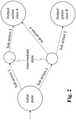
- Fig. 2 shows an example of an NFA according to the present disclosure.
- the NFA may comprise an initial state, zero or more intermediate states and one or more end states, such as one or more terminal states.
- the NFA comprises two intermediate states and two terminal states, each terminal state corresponding to an output action class, such as an output class A or an output class B as shown in Fig. 2 .
- the NFA may be related to e.g. training, and may comprise a first action class A associated with a first exercise, such as to a deadlift, and a second action class B associated with a second exercise, such as to a squat.
- Each action may comprise sub-actions for parts of the exercise, such as to a motion of the exercise.
- a first sub-action may for example be "standing upright" and a second sub-action may for example be "placing bar back on the ground”.
- the NFA transitions to a first intermediate state associated with the determined sub-action.
- the NFA remains in the intermediate state until a second sub-action is detected.
- the second sub action is detected, such as sub-action 4 in Fig. 2
- the NFA transitions to a first end state associated with the second sub action, and outputs an action class associated with the end state, such as output action class A in Fig. 2 .
- action class A is associated with the deadlift and thus the action deadlift is detected based on the output class.
- Fig. 3 shows a block diagram of an example electronic device 300, 300A according to some embodiments of the present disclosure.
- the electronic device 300 comprises memory circuitry 301, processor circuitry 302 comprising an action detection circuitry 302A configured to operate according to an action detection model for detecting an action based on a machine-learning scheme.
- the action comprises one or more sub-actions. Where an action only has one sub-action, the sub action and the action are effectively the same.
- An action detection model may be seen as a model configured to detect an action based on sensor data, wherein an action may be performed by an object and/or a subject.
- an action detection model may exploit media processing, such as image processing, such as video processing.
- the action may be detected based on a processing of the obtained sensor data, wherein the sensor data may comprise media data.
- the action may be detected based on a processing of media data.
- the action may be or comprise a movement and/or a combination of movements of an object and/or a subject, such as of a person, such as of a body part of a person.
- the sensor data may be indicative of a movement and/or a combination of movements of the object and/or the subject (such as a body part of the subject and/or a part of the object).
- the electronic device 300 may comprise associated sensor circuitry 304 configured to generate the sensor data.
- the electronic device 300 may be an electronic user device 300A, such as a handheld device, a tablet or a smartphone.
- the processor circuitry 302 is configured to obtain sensor data, such as a stream of sensor data.
- the sensor data may comprise one or more of: accelerometer data from a sensor device such as an accelerometer, light data from a photo-sensor, sound data (such as voice) data from a microphone, image sensor data (such as photo or video data from a camera), temperature data from a thermometer, pressure data from a pressure sensor, positioning data from a global positioning system (GPS) and/or humidity data from a hygrometer.
- GPS global positioning system
- the sensor data may be obtained from for example an associated sensor circuitry 304.
- the associated sensor circuitry 304 is internal in the electronic device 300A.
- the associated sensor circuitry 304 may be an external sensor circuitry.
- the sensor circuitry may e.g. be an image-sensor (such as a camera), an accelerometer, a photo sensor (such as an infrared sensor), a sound sensor (such as a microphone), a temperature sensor (such as a thermometer), a pressure sensor, and/or a hygrometer.
- the sensor data may be raw sensor data or a processed and/or aggregated version of the sensor data.
- the processor circuitry 302 is configured to generate, based on the sensor data, a set of features associated with a frame.
- a feature may be seen as a data point characterizing an individual measurable property or characteristic of a phenomenon being observed, such as a joint of a subject.
- the set of features may e.g. comprise a set of key points and/or a set of key point trajectories, such as 2D or 3D key-point trajectories of arbitrary length. These set of features may be obtained using a range of techniques and technologies; such as computer vision and machine learning techniques or using specialized technologies such as motion capture systems.
- the set of features may be key points, such as joints of a person performing an action, such as a deadlift.
- a key point trajectory may be seen as a time-series comprising a 2D and/or 3D position, such as a coordinate, of a key point over time.
- the processor circuitry 302 may be configured to generate the set of features associated with the frame using a sliding window with a number of frames.
- a window may comprise one or more frames.
- the sliding window approach may be used on a stream of input data, such as on a stream of obtained sensor data, to extract a window of key-point trajectories.
- the sensor data may be sampled at various time steps, where each sample may comprise a fixed or varying number of features.
- Each frame of the window may represent one sample of sensor data.
- the processor circuitry 302 may be configured to generate, based on sensor data in a sliding window with a number of samples, the set of features associated with a frame. This input may be fed into a trained model, such as the action detection model, to detect sub-actions.
- the processor circuitry 302 is configured to update, such as move, the sliding window.
- the sliding window may be updated once a set of features has been generated for each frame in a window.
- the sliding window is then moved to a new set of frames, such as a new set of frames from the obtained sensor data.
- the processor circuitry 302 is configured to determine, based on the set of features, using the action detection model, whether the frame corresponds to a sub-action.
- processor circuitry 302 may be configured to determine whether the frame corresponds to the sub-action, based on a detection of a start of the sub-action or an end of the sub-action using the set and the action detection model.
- the processor circuitry may e.g. be configured to determine that the frame corresponds to the sub-action when the frame is determined to correspond to a start or an end of the sub-action.
- the machine learning scheme of the current disclosure may be capable (such as trained) of classifying whether a frame corresponds to a start or an end of a sub-action (such as a fine-grained and precisely defined sub-action). For example, to detect repetitions of a deadlift exercise, the electronic device can output whether a specific frame in a window corresponds to the start or end of the deadlift, or the start or end of intermediate steps (sub-actions) of performing the deadlift.
- a sub-action such as a fine-grained and precisely defined sub-action
- the processor circuitry 302 may be configured to determine, using the action detection model, whether the frame corresponds to a sub-action based on detection of key-point trajectories.
- the processor circuitry 302 may use a sliding-window action prediction method, in which the action detection model uses a window of key-point trajectories as input, and outputs whether a specific frame in the window corresponds to the start or end of an action, such as a deadlift, or the start or end of an sub-action, such as an intermediate step of performing the deadlift.
- a size of the window may determine how much context, such as data points, such as frames, is taken into account for each prediction.
- the processor circuitry 302 is configured to apply a nondeterministic finite automaton, NFA, scheme, to the determined sub-action for the frame.
- the NFA scheme has a set of states associated with corresponding sub-actions and is configured to output one or more action classes.
- the NFA may comprise a plurality of actions and/or sub actions. Terminal states may relate to actions, while transitions between states relate to sub-actions.
- the processor circuitry 302 is configured to determine, using the NFA scheme, an action class.
- the determination of the action class comprises labelling of the frame with the action class.
- the determination of the action class may comprise predicting and/or labelling of a specific frame, such as the frame corresponding to the start and/or the end of the action, within a window with the action class.
- Fig. 2 illustrates an example of an NFA.
- the processor circuitry 302 is configured to detect the action based on the action class.
- An action class may be seen as a type of actions, such as a category of actions, to be used for classifying.
- An action class may for example be, such as may be associated with, a type of activity, such as performing a deadlift, waving or jumping.
- An action class may, in one or more examples, be indicative of an action.
- an action class may be a type of activity, such as a type of an exercise. Examples of types of activity may include types of training exercises, such as a deadlift, a squat and/or a bench press.
- an action class may be associated with and/or indicative of a movement and/or a combination of movements, such as a predetermined movement and/or combination of movements.
- the movement and/or combination of movements may be a movement performed by an object and/or a subject, such as by a person, such as by a body part of a person.
- the processor circuitry 302 is configured to increment an action counter based on the detected action. Once an action has been detected the processor circuitry may increment an action counter associated with the detected action. The processor circuitry 302 may thus count the number of times an action is repeated, such as the number of repetitions of deadlifts a person performs during a training session. The processor circuitry 302 may be configured to, based on other information, such as an amount of time between repetitions or a particular training program that the individual is on, count sets of repetitions of an action. This may also be applied to other scenarios where knowledge can be derived from time of start and/or completion of one or more actions.
- the processor circuitry 302 is configured to perform, using the NFA scheme, a state transition from a state associated with the sub-action to another state associated with another sub-action.
- the state transition in the NFA may be triggered by the determination of a sub-action. In other words, when the sub action is determined the state transition is performed.
- the processor circuitry 302 may be configured to initialize the NFA scheme.
- the NFA scheme may be initialized when subject to be tracked, such as an individual, such as a person, is detected.
- the NFA may be implemented by keeping track of a set of states during runtime.
- Kleene's algorithm may be used to convert the NFA into a deterministic finite automaton (DFA), against which the action detection sequence may be checked.
- DFA deterministic finite automaton
- the processor circuitry 302 is configured to repeat for a series of frames, such as for each frame of a series of frames: the determination, based on the set, using the action detection model, of whether the frame corresponds to a sub-action, and the application of the NFA scheme to the determined sub-action for the frame.
- the processor circuitry 302 is configured to perform post-processing of a sub-action prediction, such as online post-processing of the sub-action prediction, to filter out false determinations of sub-actions.
- the processor circuitry 302 is configured to perform a number of determinations for a number of consecutive frames above a threshold before detecting a sub-action.
- the threshold may correspond to a minimum number (e.g. 2 or more) of consecutive frame predictions to be made before a sub-action is determined.
- the threshold may be a configurable threshold based on e.g. sampling rate, false positive and/or false negative requirements. This logic may be incorporated into the NFA.
- the determination of the sub-action is performed after expiry of a time period.
- the processor circuitry may be configured to require a minimum number of time steps, minTimeSteps, between two sub-action determinations.
- the NFA may be augmented to comprise temporal information.
- the NFA may e.g. comprise a chain of minTimeSteps states after each sub-action detection state, with all possible actions resulting in a transition to the next state.
- a variable may be used to keep track of the number of time-steps that have passed since the most recent sub-action determination, to determine whether a transition can be made in the NFA.
- the NFA can be implemented by using a set data structure of all states which the NFA might currently be in.
- the machine-learning scheme, and the action detection model based on the machine learning scheme is trained using a supervised scheme on the features for sub-action determination.
- the machine learning scheme may be trained by extracting key points (such as human joints) from one or more video sequences, such as video sequences of the subject performing the action, and then train the machine learning scheme based on the extracted key points, such as based on extracted key-point trajectories.
- the trajectories may comprise 2D key point coordinates, or 3D key point coordinates triangulated via a multi camera setup. Since different actions have different key-point trajectories, the key point trajectories allow actions to be distinguished from each other. Furthermore, by using key point trajectories, instead of high-dimensional image/video data, the required amount and the complexity of the training data can be significantly reduced.
- the machine-learning scheme comprises a supervised machine learning scheme.
- the supervised machine learning scheme may comprise one or more of: a Convolutional Neural Network, Graph Convolutional Network, a random forest scheme, a gradient boosting scheme, linear models and Recurrent Neural Network.
- the machine learning scheme may be trained in a supervised fashion on the key-point trajectories for the task of action detection, such as sub-action detection.
- the machine learning scheme may be trained using a gradient-based optimizer, such as Adam.
- a window may be labelled with an action class when a specific frame in the window (e.g. the last frame) corresponds to a precisely defined point of the action, such as the start point or the end point of the action, and otherwise be labelled with the non-activity NULL class.
- the machine learning scheme may be trained by optimizing an objective function.
- the machine learning scheme may be trained using a gradient based optimizer, such as a formal loss function, such as a formal loss function with a combination of cross-entropy classification loss and a mean squared error loss, that penalizes predictions that are far away in time from a matching ground truth sub-action label.
- a gradient based optimizer such as a formal loss function, such as a formal loss function with a combination of cross-entropy classification loss and a mean squared error loss, that penalizes predictions that are far away in time from a matching ground truth sub-action label.
- Data augmentation such as perturbing a individual's, such as a person's, joints with gaussian noise, random scaling, rotation, temporal augmentation
- a window may be defined to correspond to the end of a sub-action during training, if the last data sample in the window is annotated with an end of that sub-action), tc is the time-step of the nearest-in-time ground-truth class c activity, ⁇ is a parameter to limit the size of the second loss term, and ⁇ controls the contribution of the second loss term.
- the first loss term is the cross-entropy loss, which is widely used in classification problems.
- the second loss term is designed to incur a higher loss on predictions that are further away from the nearest ground-truth label, with the objective of guiding the network to make more precise predictions of a start and/or an end of action.
- the ⁇ parameter limits the size of the squared term to avoid very large losses for predictions that are very far away from a ground-truth label.
- Other loss functions for binary and/or multi-class classification such as focal loss, class-weighted cross entropy loss or hinge loss functions, may also be used for training the machine learning scheme according to the current disclosure.
- the electronic device 300 may comprise an interface 303 configured to communicate with an external device (such as a server, a sensor, another electronic device).
- an external device such as a server, a sensor, another electronic device.
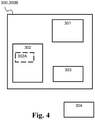
- Fig. 4 shows a block diagram of an example electronic device 300, 300B according to some embodiments of the present disclosure.
- the electronic device 300, 300B comprises memory circuitry 301, processor circuitry 302 comprising an action detection circuitry 302A configured to operate according to an action detection model for detecting an action based on a machine-learning scheme.
- the action comprises one or more sub-actions. Where an action only has one sub-action, the sub action and the action are effectively the same.
- the electronic device 300 may comprise an interface 303 configured to communicate with an external device (such as a server, a sensor, another electronic device).
- the electronic device 300 is configured to communicate, such as via the interface 303, with an associated sensor circuitry 304, such as an external sensor device, configured to generate the sensor data.
- the electronic device 300 may be a server device 300B.
- the server device 300B may be configured to communicate with the associated sensor circuitry 304 via an interface 303, such as a wireless or wired interface, to obtain sensor data.
- the processor circuitry 302 is configured to obtain sensor data, such as a stream of sensor data.
- the processor circuitry 302 is configured to generate, based on the sensor data, a set of features associated with a frame.
- the processor circuitry 302 is configured to determine, based on the set, using the action detection model, whether the frame corresponds to a sub-action.
- the processor circuitry 302 is configured to apply the nondeterministic finite automaton, NFA, scheme, to the determined sub-action for the frame, wherein the NFA scheme has a set of states associated with corresponding sub-actions and is configured to output one or more action classes.
- NFA nondeterministic finite automaton
- the processor circuitry 302 is configured to detect the action based on the action class.
- the processor circuitry 302 is configured to increment an action counter based on the detected action.
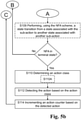
- the electronic device 300, 300A, 300B is optionally configured to perform any of the operations disclosed in Fig. 5A and 5B (such as any one or more of S101, S102, S103, S103A, S104, S104A, S105, S106, S106A, S108, S109, S110, S112, S114).
- the operations of the electronic device 300 may be embodied in the form of executable logic routines (for example, lines of code, software programs, etc.) that are stored on a non-transitory computer readable medium (for example, memory circuitry 301) and are executed by processor circuitry 302.
- the operations of the electronic device 300, 300A, 300B may be considered a method that the electronic device 300, 300A, 300B is configured to carry out. Also, while the described functions and operations may be implemented in software, such functionality may as well be carried out via dedicated hardware or firmware, or some combination of hardware, firmware and/or software.
- Memory circuitry 301 may be one or more of a buffer, a flash memory, a hard drive, a removable media, a volatile memory, a non-volatile memory, a random access memory (RAM), or other suitable device.
- memory circuitry 301 may include a non-volatile memory for long term data storage and a volatile memory that functions as system memory for processor circuitry 302.
- Memory circuitry 301 may exchange data with processor circuitry 302 over a data bus. Control lines and an address bus between memory circuitry 301 and processor circuitry 302 also may be present (not shown in Fig. 3 and 4 ).
- Memory circuitry 301 is considered a non-transitory computer readable medium.
- Memory circuitry 301 may be configured to store information (such as information indicative of sub-actions or actions, NFA schemes, information related to the action counter, training data, trained action detection model) in a part of the memory.
- information such as information indicative of sub-actions or actions, NFA schemes, information related to the action counter, training data, trained action detection model
- Figs. 5a-5b are flow-charts illustrating an example method 100, performed at an electronic device (such as the sensor device 300, 300A, 300B of Fig. 3 and 4 ), for counting an action according to this disclosure.
- the action comprises one or more sub-actions. Where an action only has one sub-action, the sub action and the action are effectively the same.
- the method 100 comprises obtaining S103 sensor data.
- the method 100 comprises generating S104, based on the sensor data, a set of features associated with a frame.
- the method 100 comprises determining S106, based on the set, using an action detection model, whether the frame corresponds to a sub-action, wherein the action detection model is based on a machine-learning scheme.
- the method 100 comprises applying S108 a nondeterministic finite automaton, NFA, scheme to the determined sub-action for the frame, wherein the NFA scheme has a set of states associated with corresponding sub-actions and is configured to output one or more action classes.
- NFA nondeterministic finite automaton
- the method 100 comprises determining S110, using the NFA scheme, an action class.
- the action class may be determined upon the scheme reaching a terminal state.
- the method 100 comprises detecting S112 the action based on the action class.
- the method 100 comprises incrementing S114 an action counter based on the detected action.
- the method 100 comprises performing S109, using the NFA scheme, a state transition from a state associated with the sub-action to another state associated with another sub-action.
- determining S110 of the action class comprises labelling S110A of the frame with the action class.
- the method 100 comprises initializing S102 the NFA scheme.
- the method 100 comprises training S101 the machine-learning scheme using a supervised scheme on the features for sub-action determination.
- the machine-learning scheme comprises a supervised machine learning scheme.
- the supervised machine learning scheme comprises one or more of: a Convolutional Neural Network, Graph Convolutional Network, a random forest scheme, a gradient boosting scheme, linear models and Recurrent Neural Network.
- the method 100 comprises repeating, for a series of frames: determining S106, based on the set, using the action detection model, whether the frame corresponds to a sub-action, and applying S108 the NFA scheme to the determined sub-action for the frame.
- the method 100 comprises performing a number of determinations S106A for a number of consecutive frames above a threshold before detecting a sub-action.
- the detection of the sub-action is performed after expiry of a time period.
- obtaining S103 sensor data comprises generating S103A, using associated sensor circuitry, the sensor data.
- the generating S104 the set of features associated with the frame comprises generating S104A the set of features using a sliding window with a number of frames.
- the method 100 comprises updating S105 the sliding window.
- determining S106, based on the set, using the action detection model, whether the frame corresponds to the sub-action comprises detecting S106B a start of the sub-action or an end of the sub-action using the set and the action detection model.
- Embodiments of methods and products (electronic device) according to the disclosure are set out in the following items:
- Figs. 1-5B comprises some circuitries or operations which are illustrated with a solid line and some circuitries or operations which are illustrated with a dashed line. Circuitries or operations which are comprised in a solid line are circuitries or operations which are comprised in the broadest example embodiment. Circuitries or operations which are comprised in a dashed line are example embodiments which may be comprised in, or a part of, or are further circuitries or operations which may be taken in addition to circuitries or operations of the solid line example embodiments. It should be appreciated that these operations need not be performed in order presented. Furthermore, it should be appreciated that not all of the operations need to be performed. The example operations may be performed in any order and in any combination.
- a computer-readable medium may include removable and non-removable storage devices including, but not limited to, Read Only Memory (ROM), Random Access Memory (RAM), compact discs (CDs), digital versatile discs (DVD), etc.
- program circuitries may include routines, programs, objects, components, data structures, etc. that perform specified tasks or implement specific abstract data types.
- Computer-executable instructions, associated data structures, and program circuitries represent examples of program code for executing steps of the methods disclosed herein. The particular sequence of such executable instructions or associated data structures represents examples of corresponding acts for implementing the functions described in such steps or processes.
Landscapes
- Engineering & Computer Science (AREA)
- Theoretical Computer Science (AREA)
- Physics & Mathematics (AREA)
- General Physics & Mathematics (AREA)
- Computer Vision & Pattern Recognition (AREA)
- Data Mining & Analysis (AREA)
- Software Systems (AREA)
- Evolutionary Computation (AREA)
- Artificial Intelligence (AREA)
- General Health & Medical Sciences (AREA)
- Health & Medical Sciences (AREA)
- Multimedia (AREA)
- General Engineering & Computer Science (AREA)
- Evolutionary Biology (AREA)
- Life Sciences & Earth Sciences (AREA)
- Bioinformatics & Cheminformatics (AREA)
- Computing Systems (AREA)
- Bioinformatics & Computational Biology (AREA)
- Medical Informatics (AREA)
- Psychiatry (AREA)
- Social Psychology (AREA)
- Human Computer Interaction (AREA)
- Databases & Information Systems (AREA)
- Mathematical Physics (AREA)
- Physical Education & Sports Medicine (AREA)
- Probability & Statistics with Applications (AREA)
- Computational Linguistics (AREA)
- Image Analysis (AREA)
Applications Claiming Priority (1)
| Application Number | Priority Date | Filing Date | Title |
|---|---|---|---|
| SE2050907 | 2020-07-17 |
Publications (2)
| Publication Number | Publication Date |
|---|---|
| EP3940586A1 true EP3940586A1 (fr) | 2022-01-19 |
| EP3940586B1 EP3940586B1 (fr) | 2025-09-17 |
Family
ID=76374903
Family Applications (1)
| Application Number | Title | Priority Date | Filing Date |
|---|---|---|---|
| EP21178558.9A Active EP3940586B1 (fr) | 2020-07-17 | 2021-06-09 | Dispositif électronique et procédé associé de détection et de comptage d'une action |
Country Status (2)
| Country | Link |
|---|---|
| US (1) | US12087093B2 (fr) |
| EP (1) | EP3940586B1 (fr) |
Families Citing this family (3)
| Publication number | Priority date | Publication date | Assignee | Title |
|---|---|---|---|---|
| EP3940586B1 (fr) * | 2020-07-17 | 2025-09-17 | Sony Group Corporation | Dispositif électronique et procédé associé de détection et de comptage d'une action |
| US12417439B2 (en) * | 2022-03-23 | 2025-09-16 | Nec Corporation | Offline machine learning for automatic action determination or decision making support |
| CN116486298B (zh) * | 2023-01-05 | 2026-04-21 | 中国科学院大学 | 基于轻量Transformer的在线动作检测方法 |
Citations (4)
| Publication number | Priority date | Publication date | Assignee | Title |
|---|---|---|---|---|
| US20140214749A1 (en) * | 2013-01-31 | 2014-07-31 | Lsi Corporation | System and method for dfa-nfa splitting |
| US20150269744A1 (en) * | 2014-03-24 | 2015-09-24 | Tata Consultancy Services Limited | Action based activity determination system and method |
| US20170277521A1 (en) * | 2016-03-23 | 2017-09-28 | FogHorn Systems, Inc. | Tools and Methods for Real-Time Dataflow Programming Language |
| US20200184278A1 (en) * | 2014-03-18 | 2020-06-11 | Z Advanced Computing, Inc. | System and Method for Extremely Efficient Image and Pattern Recognition and Artificial Intelligence Platform |
Family Cites Families (13)
| Publication number | Priority date | Publication date | Assignee | Title |
|---|---|---|---|---|
| CN101868816B (zh) * | 2007-10-25 | 2014-06-18 | 马维尔国际贸易有限公司 | 一种用于降低视频显示中的运动模糊的方法和系统 |
| US8295591B2 (en) * | 2009-08-18 | 2012-10-23 | Behavioral Recognition Systems, Inc. | Adaptive voting experts for incremental segmentation of sequences with prediction in a video surveillance system |
| US8611670B2 (en) * | 2010-02-25 | 2013-12-17 | The Board Of Trustees Of The Leland Stanford Junior University | Intelligent part identification for use with scene characterization or motion capture |
| WO2016111067A1 (fr) | 2015-01-05 | 2016-07-14 | ソニー株式会社 | Dispositif de traitement d'informations, procédé de traitement d'informations et programme |
| US12443866B2 (en) | 2016-04-07 | 2025-10-14 | University Of Virginia Patent Foundation | Sequential pattern mining with the micron automata processor |
| US10872149B1 (en) | 2017-07-25 | 2020-12-22 | Perspecta Labs Inc. | Anomaly detection based on side-channel emanations |
| US20190139441A1 (en) | 2017-11-03 | 2019-05-09 | Drishti Technologies, Inc. | Contextual training systems and methods |
| US10755115B2 (en) | 2017-12-29 | 2020-08-25 | Here Global B.V. | Method, apparatus, and system for generating synthetic image data for machine learning |
| US20210001172A1 (en) * | 2018-08-05 | 2021-01-07 | Manu Pallatheri Namboodiri | Exercise Counting and Form Guidance System |
| CN110457995A (zh) | 2019-06-26 | 2019-11-15 | 山东师范大学 | 一种基于计算机视觉的人体运动量估计方法和系统 |
| CN110490064B (zh) | 2019-07-11 | 2024-05-14 | 平安科技(深圳)有限公司 | 体育视频数据的处理方法、装置、计算机设备及计算机存储介质 |
| JP7396517B2 (ja) * | 2020-06-12 | 2023-12-12 | 日本電気株式会社 | 意図検出装置、意図検出方法及びプログラム |
| EP3940586B1 (fr) * | 2020-07-17 | 2025-09-17 | Sony Group Corporation | Dispositif électronique et procédé associé de détection et de comptage d'une action |
-
2021
- 2021-06-09 EP EP21178558.9A patent/EP3940586B1/fr active Active
- 2021-06-16 US US17/349,853 patent/US12087093B2/en active Active
Patent Citations (4)
| Publication number | Priority date | Publication date | Assignee | Title |
|---|---|---|---|---|
| US20140214749A1 (en) * | 2013-01-31 | 2014-07-31 | Lsi Corporation | System and method for dfa-nfa splitting |
| US20200184278A1 (en) * | 2014-03-18 | 2020-06-11 | Z Advanced Computing, Inc. | System and Method for Extremely Efficient Image and Pattern Recognition and Artificial Intelligence Platform |
| US20150269744A1 (en) * | 2014-03-24 | 2015-09-24 | Tata Consultancy Services Limited | Action based activity determination system and method |
| US20170277521A1 (en) * | 2016-03-23 | 2017-09-28 | FogHorn Systems, Inc. | Tools and Methods for Real-Time Dataflow Programming Language |
Non-Patent Citations (5)
| Title |
|---|
| AMRIT SARKAR: "Human Activity and Behavior Recognition in Videos. A Brief Review", 1 January 2014 (2014-01-01), XP055768051, Retrieved from the Internet <URL:https://www.grin.com/document/276054> [retrieved on 20210122] * |
| LAVEE G ET AL: "Understanding Video Events: A Survey of Methods for Automatic Interpretation of Semantic Occurrences in Video", IEEE TRANSACTIONS ON SYSTEMS, MAN, AND CYBERNETICS: PART C:APPLICATIONS AND REVIEWS, IEEE SERVICE CENTER, PISCATAWAY, NJ, US, vol. 39, no. 5, 1 September 2009 (2009-09-01), pages 489 - 504, XP011346055, ISSN: 1094-6977, DOI: 10.1109/TSMCC.2009.2023380 * |
| WADA T ET AL: "MULTIOBJECT BEHAVIOR RECOGNITION BY EVENT DRIVEN SELECTIVE ATTENTION METHOD", IEEE TRANSACTIONS ON PATTERN ANALYSIS AND MACHINE INTELLIGENCE, IEEE COMPUTER SOCIETY, USA, vol. 22, no. 8, 1 August 2000 (2000-08-01), pages 873 - 887, XP000976491, ISSN: 0162-8828, DOI: 10.1109/34.868687 * |
| WADA T ET AL: "MULTIOBJECT BEHAVIOR RECOGNITION BY SELECTIVE ATTENTION", ELECTRONICS AND COMMUNICATIONS IN JAPAN, SCRIPTA TECHNICA. NEW YORK, US, vol. 84, no. 9, PART 03, 1 June 2001 (2001-06-01), pages 56 - 66, XP001063557, DOI: 10.1002/ECJC.1035 * |
| YONGHENG WANG ET AL: "Complex Event Processing over distributed probabilistic event streams", FUZZY SYSTEMS AND KNOWLEDGE DISCOVERY (FSKD), 2012 9TH INTERNATIONAL CONFERENCE ON, IEEE, 29 May 2012 (2012-05-29), pages 1489 - 1493, XP032455914, ISBN: 978-1-4673-0025-4, DOI: 10.1109/FSKD.2012.6234083 * |
Also Published As
| Publication number | Publication date |
|---|---|
| EP3940586B1 (fr) | 2025-09-17 |
| US20220019778A1 (en) | 2022-01-20 |
| US12087093B2 (en) | 2024-09-10 |
Similar Documents
| Publication | Publication Date | Title |
|---|---|---|
| Filtjens et al. | Skeleton-based action segmentation with multi-stage spatial-temporal graph convolutional neural networks | |
| Pervaiz et al. | Artificial neural network for human object interaction system over Aerial images | |
| CN109086873B (zh) | 递归神经网络的训练方法、识别方法、装置及处理设备 | |
| Subetha et al. | A survey on human activity recognition from videos | |
| Zanfir et al. | The moving pose: An efficient 3d kinematics descriptor for low-latency action recognition and detection | |
| US12087093B2 (en) | Electronic device and a related method for detecting and counting an action | |
| Giorgi et al. | Try walking in my shoes, if you can: Accurate gait recognition through deep learning | |
| Adhikari et al. | A Novel Machine Learning-Based Hand Gesture Recognition Using HCI on IoT Assisted Cloud Platform. | |
| Yu et al. | Human motion based intent recognition using a deep dynamic neural model | |
| CN109325440A (zh) | 人体动作识别方法及系统 | |
| Abbass et al. | Violence detection enhancement by involving convolutional block attention modules into various deep learning architectures: comprehensive case study for ubi-fights dataset | |
| Mesbahi et al. | Hand gesture recognition based on various deep learning YOLO models | |
| CN110263916A (zh) | 数据处理方法和装置、存储介质及电子装置 | |
| Ji et al. | IoT based dance movement recognition model based on deep learning framework | |
| Bukht et al. | A Novel Activity Pattern Recognition via Convolutional Neural Networks and Advanced Skeleton Models. | |
| JP6812076B2 (ja) | ジェスチャ認識装置およびジェスチャ認識プログラム | |
| Elnady et al. | A novel YOLO LSTM approach for enhanced human action recognition in video sequences | |
| Giorgi et al. | Walking through the deep: Gait analysis for user authentication through deep learning | |
| CN112036291A (zh) | 基于运动大数据和深度学习的运动学数据模型构建方法 | |
| Vainstein et al. | Modeling video activity with dynamic phrases and its application to action recognition in tennis videos | |
| Truong et al. | Skeleton-based posture estimation for human action recognition using deep learning | |
| CN117557810A (zh) | 一种基于注意力机制和尺度融合的检测跟踪一体化算法研究 | |
| Xie et al. | Unsupervised learning of hierarchical models for hand-object interactions | |
| Marín-Jiménez et al. | On how to improve tracklet-based gait recognition systems | |
| CN119339303B (zh) | 一种视频处理方法、装置及设备 |
Legal Events
| Date | Code | Title | Description |
|---|---|---|---|
| PUAI | Public reference made under article 153(3) epc to a published international application that has entered the european phase |
Free format text: ORIGINAL CODE: 0009012 |
|
| STAA | Information on the status of an ep patent application or granted ep patent |
Free format text: STATUS: THE APPLICATION HAS BEEN PUBLISHED |
|
| AK | Designated contracting states |
Kind code of ref document: A1 Designated state(s): AL AT BE BG CH CY CZ DE DK EE ES FI FR GB GR HR HU IE IS IT LI LT LU LV MC MK MT NL NO PL PT RO RS SE SI SK SM TR |
|
| STAA | Information on the status of an ep patent application or granted ep patent |
Free format text: STATUS: REQUEST FOR EXAMINATION WAS MADE |
|
| 17P | Request for examination filed |
Effective date: 20220329 |
|
| RBV | Designated contracting states (corrected) |
Designated state(s): AL AT BE BG CH CY CZ DE DK EE ES FI FR GB GR HR HU IE IS IT LI LT LU LV MC MK MT NL NO PL PT RO RS SE SI SK SM TR |
|
| STAA | Information on the status of an ep patent application or granted ep patent |
Free format text: STATUS: EXAMINATION IS IN PROGRESS |
|
| 17Q | First examination report despatched |
Effective date: 20230623 |
|
| REG | Reference to a national code |
Ref country code: DE Ref legal event code: R079 Free format text: PREVIOUS MAIN CLASS: G06K0009000000 Ipc: G06F0018200000 Ref country code: DE Ref legal event code: R079 Ref document number: 602021038637 Country of ref document: DE Free format text: PREVIOUS MAIN CLASS: G06K0009000000 Ipc: G06F0018200000 |
|
| GRAP | Despatch of communication of intention to grant a patent |
Free format text: ORIGINAL CODE: EPIDOSNIGR1 |
|
| STAA | Information on the status of an ep patent application or granted ep patent |
Free format text: STATUS: GRANT OF PATENT IS INTENDED |
|
| RIC1 | Information provided on ipc code assigned before grant |
Ipc: G06V 40/20 20220101ALI20250522BHEP Ipc: G06V 20/40 20220101ALI20250522BHEP Ipc: G06V 10/84 20220101ALI20250522BHEP Ipc: G06V 10/764 20220101ALI20250522BHEP Ipc: G06F 18/20 20230101AFI20250522BHEP |
|
| INTG | Intention to grant announced |
Effective date: 20250618 |
|
| GRAS | Grant fee paid |
Free format text: ORIGINAL CODE: EPIDOSNIGR3 |
|
| GRAA | (expected) grant |
Free format text: ORIGINAL CODE: 0009210 |
|
| STAA | Information on the status of an ep patent application or granted ep patent |
Free format text: STATUS: THE PATENT HAS BEEN GRANTED |
|
| P01 | Opt-out of the competence of the unified patent court (upc) registered |
Free format text: CASE NUMBER: UPC_APP_1786_3940586/2025 Effective date: 20250731 |
|
| AK | Designated contracting states |
Kind code of ref document: B1 Designated state(s): AL AT BE BG CH CY CZ DE DK EE ES FI FR GB GR HR HU IE IS IT LI LT LU LV MC MK MT NL NO PL PT RO RS SE SI SK SM TR |
|
| REG | Reference to a national code |
Ref country code: GB Ref legal event code: FG4D |
|
| REG | Reference to a national code |
Ref country code: CH Ref legal event code: EP |
|
| REG | Reference to a national code |
Ref country code: DE Ref legal event code: R096 Ref document number: 602021038637 Country of ref document: DE |
|
| REG | Reference to a national code |
Ref country code: IE Ref legal event code: FG4D |
|
| PG25 | Lapsed in a contracting state [announced via postgrant information from national office to epo] |
Ref country code: NO Free format text: LAPSE BECAUSE OF FAILURE TO SUBMIT A TRANSLATION OF THE DESCRIPTION OR TO PAY THE FEE WITHIN THE PRESCRIBED TIME-LIMIT Effective date: 20251217 |
|
| REG | Reference to a national code |
Ref country code: LT Ref legal event code: MG9D |
|
| PG25 | Lapsed in a contracting state [announced via postgrant information from national office to epo] |
Ref country code: FI Free format text: LAPSE BECAUSE OF FAILURE TO SUBMIT A TRANSLATION OF THE DESCRIPTION OR TO PAY THE FEE WITHIN THE PRESCRIBED TIME-LIMIT Effective date: 20250917 |
|
| PG25 | Lapsed in a contracting state [announced via postgrant information from national office to epo] |
Ref country code: HR Free format text: LAPSE BECAUSE OF FAILURE TO SUBMIT A TRANSLATION OF THE DESCRIPTION OR TO PAY THE FEE WITHIN THE PRESCRIBED TIME-LIMIT Effective date: 20250917 |
|
| PG25 | Lapsed in a contracting state [announced via postgrant information from national office to epo] |
Ref country code: GR Free format text: LAPSE BECAUSE OF FAILURE TO SUBMIT A TRANSLATION OF THE DESCRIPTION OR TO PAY THE FEE WITHIN THE PRESCRIBED TIME-LIMIT Effective date: 20251218 |
|
| PG25 | Lapsed in a contracting state [announced via postgrant information from national office to epo] |
Ref country code: SE Free format text: LAPSE BECAUSE OF FAILURE TO SUBMIT A TRANSLATION OF THE DESCRIPTION OR TO PAY THE FEE WITHIN THE PRESCRIBED TIME-LIMIT Effective date: 20250917 |
|
| REG | Reference to a national code |
Ref country code: NL Ref legal event code: MP Effective date: 20250917 |
|
| PG25 | Lapsed in a contracting state [announced via postgrant information from national office to epo] |
Ref country code: LV Free format text: LAPSE BECAUSE OF FAILURE TO SUBMIT A TRANSLATION OF THE DESCRIPTION OR TO PAY THE FEE WITHIN THE PRESCRIBED TIME-LIMIT Effective date: 20250917 |
|
| PG25 | Lapsed in a contracting state [announced via postgrant information from national office to epo] |
Ref country code: BG Free format text: LAPSE BECAUSE OF FAILURE TO SUBMIT A TRANSLATION OF THE DESCRIPTION OR TO PAY THE FEE WITHIN THE PRESCRIBED TIME-LIMIT Effective date: 20250917 |
|
| PG25 | Lapsed in a contracting state [announced via postgrant information from national office to epo] |
Ref country code: RS Free format text: LAPSE BECAUSE OF FAILURE TO SUBMIT A TRANSLATION OF THE DESCRIPTION OR TO PAY THE FEE WITHIN THE PRESCRIBED TIME-LIMIT Effective date: 20251217 |
|
| PG25 | Lapsed in a contracting state [announced via postgrant information from national office to epo] |
Ref country code: NL Free format text: LAPSE BECAUSE OF FAILURE TO SUBMIT A TRANSLATION OF THE DESCRIPTION OR TO PAY THE FEE WITHIN THE PRESCRIBED TIME-LIMIT Effective date: 20250917 |
|
| REG | Reference to a national code |
Ref country code: AT Ref legal event code: MK05 Ref document number: 1838914 Country of ref document: AT Kind code of ref document: T Effective date: 20250917 |
|
| PG25 | Lapsed in a contracting state [announced via postgrant information from national office to epo] |
Ref country code: SM Free format text: LAPSE BECAUSE OF FAILURE TO SUBMIT A TRANSLATION OF THE DESCRIPTION OR TO PAY THE FEE WITHIN THE PRESCRIBED TIME-LIMIT Effective date: 20250917 |
|
| PG25 | Lapsed in a contracting state [announced via postgrant information from national office to epo] |
Ref country code: ES Free format text: LAPSE BECAUSE OF FAILURE TO SUBMIT A TRANSLATION OF THE DESCRIPTION OR TO PAY THE FEE WITHIN THE PRESCRIBED TIME-LIMIT Effective date: 20250917 |
|
| PG25 | Lapsed in a contracting state [announced via postgrant information from national office to epo] |
Ref country code: AT Free format text: LAPSE BECAUSE OF FAILURE TO SUBMIT A TRANSLATION OF THE DESCRIPTION OR TO PAY THE FEE WITHIN THE PRESCRIBED TIME-LIMIT Effective date: 20250917 |
|
| PG25 | Lapsed in a contracting state [announced via postgrant information from national office to epo] |
Ref country code: IT Free format text: LAPSE BECAUSE OF FAILURE TO SUBMIT A TRANSLATION OF THE DESCRIPTION OR TO PAY THE FEE WITHIN THE PRESCRIBED TIME-LIMIT Effective date: 20250917 |
|
| PG25 | Lapsed in a contracting state [announced via postgrant information from national office to epo] |
Ref country code: IS Free format text: LAPSE BECAUSE OF FAILURE TO SUBMIT A TRANSLATION OF THE DESCRIPTION OR TO PAY THE FEE WITHIN THE PRESCRIBED TIME-LIMIT Effective date: 20260117 |
|
| PG25 | Lapsed in a contracting state [announced via postgrant information from national office to epo] |
Ref country code: PT Free format text: LAPSE BECAUSE OF FAILURE TO SUBMIT A TRANSLATION OF THE DESCRIPTION OR TO PAY THE FEE WITHIN THE PRESCRIBED TIME-LIMIT Effective date: 20260119 Ref country code: CZ Free format text: LAPSE BECAUSE OF FAILURE TO SUBMIT A TRANSLATION OF THE DESCRIPTION OR TO PAY THE FEE WITHIN THE PRESCRIBED TIME-LIMIT Effective date: 20250917 |
|
| PG25 | Lapsed in a contracting state [announced via postgrant information from national office to epo] |
Ref country code: PL Free format text: LAPSE BECAUSE OF FAILURE TO SUBMIT A TRANSLATION OF THE DESCRIPTION OR TO PAY THE FEE WITHIN THE PRESCRIBED TIME-LIMIT Effective date: 20250917 |
|
| PG25 | Lapsed in a contracting state [announced via postgrant information from national office to epo] |
Ref country code: SK Free format text: LAPSE BECAUSE OF FAILURE TO SUBMIT A TRANSLATION OF THE DESCRIPTION OR TO PAY THE FEE WITHIN THE PRESCRIBED TIME-LIMIT Effective date: 20250917 Ref country code: EE Free format text: LAPSE BECAUSE OF FAILURE TO SUBMIT A TRANSLATION OF THE DESCRIPTION OR TO PAY THE FEE WITHIN THE PRESCRIBED TIME-LIMIT Effective date: 20250917 |