EP3942007B1 - Nouveaux tensioactifs anioniques et produits détergents et nettoyants les contenant - Google Patents
Nouveaux tensioactifs anioniques et produits détergents et nettoyants les contenant Download PDFInfo
- Publication number
- EP3942007B1 EP3942007B1 EP20711886.0A EP20711886A EP3942007B1 EP 3942007 B1 EP3942007 B1 EP 3942007B1 EP 20711886 A EP20711886 A EP 20711886A EP 3942007 B1 EP3942007 B1 EP 3942007B1
- Authority
- EP
- European Patent Office
- Prior art keywords
- general formula
- weight
- water
- alkyl
- carbon atoms
- Prior art date
- Legal status (The legal status is an assumption and is not a legal conclusion. Google has not performed a legal analysis and makes no representation as to the accuracy of the status listed.)
- Active
Links
Classifications
-
- C—CHEMISTRY; METALLURGY
- C07—ORGANIC CHEMISTRY
- C07C—ACYCLIC OR CARBOCYCLIC COMPOUNDS
- C07C305/00—Esters of sulfuric acids
- C07C305/02—Esters of sulfuric acids having oxygen atoms of sulfate groups bound to acyclic carbon atoms of a carbon skeleton
- C07C305/12—Esters of sulfuric acids having oxygen atoms of sulfate groups bound to acyclic carbon atoms of a carbon skeleton being saturated and containing rings
-
- C—CHEMISTRY; METALLURGY
- C11—ANIMAL OR VEGETABLE OILS, FATS, FATTY SUBSTANCES OR WAXES; FATTY ACIDS THEREFROM; DETERGENTS; CANDLES
- C11D—DETERGENT COMPOSITIONS; USE OF SINGLE SUBSTANCES AS DETERGENTS; SOAP OR SOAP-MAKING; RESIN SOAPS; RECOVERY OF GLYCEROL
- C11D1/00—Detergent compositions based essentially on surface-active compounds; Use of these compounds as a detergent
- C11D1/02—Anionic compounds
- C11D1/12—Sulfonic acids or sulfuric acid esters; Salts thereof
- C11D1/14—Sulfonic acids or sulfuric acid esters; Salts thereof derived from aliphatic hydrocarbons or mono-alcohols
- C11D1/146—Sulfuric acid esters
-
- C—CHEMISTRY; METALLURGY
- C07—ORGANIC CHEMISTRY
- C07C—ACYCLIC OR CARBOCYCLIC COMPOUNDS
- C07C305/00—Esters of sulfuric acids
- C07C305/20—Esters of sulfuric acids having oxygen atoms of sulfate groups bound to carbon atoms of rings other than six-membered aromatic rings
-
- C—CHEMISTRY; METALLURGY
- C11—ANIMAL OR VEGETABLE OILS, FATS, FATTY SUBSTANCES OR WAXES; FATTY ACIDS THEREFROM; DETERGENTS; CANDLES
- C11D—DETERGENT COMPOSITIONS; USE OF SINGLE SUBSTANCES AS DETERGENTS; SOAP OR SOAP-MAKING; RESIN SOAPS; RECOVERY OF GLYCEROL
- C11D1/00—Detergent compositions based essentially on surface-active compounds; Use of these compounds as a detergent
- C11D1/02—Anionic compounds
- C11D1/37—Mixtures of compounds all of which are anionic
-
- C—CHEMISTRY; METALLURGY
- C07—ORGANIC CHEMISTRY
- C07C—ACYCLIC OR CARBOCYCLIC COMPOUNDS
- C07C2601/00—Systems containing only non-condensed rings
- C07C2601/06—Systems containing only non-condensed rings with a five-membered ring
- C07C2601/08—Systems containing only non-condensed rings with a five-membered ring the ring being saturated
-
- C—CHEMISTRY; METALLURGY
- C11—ANIMAL OR VEGETABLE OILS, FATS, FATTY SUBSTANCES OR WAXES; FATTY ACIDS THEREFROM; DETERGENTS; CANDLES
- C11D—DETERGENT COMPOSITIONS; USE OF SINGLE SUBSTANCES AS DETERGENTS; SOAP OR SOAP-MAKING; RESIN SOAPS; RECOVERY OF GLYCEROL
- C11D2111/00—Cleaning compositions characterised by the objects to be cleaned; Cleaning compositions characterised by non-standard cleaning or washing processes
- C11D2111/10—Objects to be cleaned
- C11D2111/12—Soft surfaces, e.g. textile
-
- C—CHEMISTRY; METALLURGY
- C11—ANIMAL OR VEGETABLE OILS, FATS, FATTY SUBSTANCES OR WAXES; FATTY ACIDS THEREFROM; DETERGENTS; CANDLES
- C11D—DETERGENT COMPOSITIONS; USE OF SINGLE SUBSTANCES AS DETERGENTS; SOAP OR SOAP-MAKING; RESIN SOAPS; RECOVERY OF GLYCEROL
- C11D2111/00—Cleaning compositions characterised by the objects to be cleaned; Cleaning compositions characterised by non-standard cleaning or washing processes
- C11D2111/10—Objects to be cleaned
- C11D2111/14—Hard surfaces
Definitions
- the invention relates to anionic surfactants which can be produced on the basis of renewable raw materials and which have low critical micelle concentrations (CMC) and produce low interfacial tensions.
- CMC critical micelle concentrations
- the invention also relates to a process for the production of such surfactants and detergents or cleaning agents which contain these surfactants.
- surfactants to reduce the surface tension of water, to form dispersions and to provide solubility has long been well known in the field of detergents and cleaning agents. Although many surfactants are made wholly or partly based on renewable raw materials, some powerful and widely used representatives are still based on petrochemicals. In addition, there is a constant desire to provide surfactants with outstanding performance properties in order to be able to achieve high performance even with low surfactant use.
- the surfactants should be kind to the skin and also able to be formulated together with other surfactants, so that they are particularly suitable for use in detergents and cleaning agents.
- Some anionic surfactants based on renewable raw materials are used in WO 2018/029202 A1 , WO 2019/042805 A1 , WO 2019/042805 A1 and WO 2019/042803 A1 disclosed.
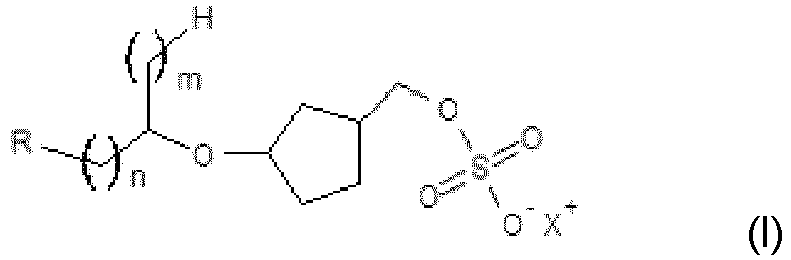
- the present invention relates to an anionic surfactant of the general formula (I) or the general formula (II) or a mixture of these, in which R is hydrogen or a linear or branched alkyl, alkenyl, alkylaryl or alkenylaryl group having 5 to 25 carbon atoms, n is a number from 1 to 21 and m is a number from 0 to 20, the sum of n and m is less than 22, and X + is a charge-balancing cation.
- X + is preferably selected from the group comprising the proton, alkali metal cations and the group N + R 1 R 2 R 3 in which R 1 , R 2 and R 3 independently represent hydrogen, an alkyl group having 1 to 6 carbon atoms or a hydroxyalkyl group having 2 to 6 carbon atoms.
- Preferred surfactants of the general formula (I) or the general formula (II) are those in which R is hydrogen, n is a number from 7 to 17, m is a number from 0 to 9 and/or the sum of n and m ranges from 7 to 18.
- Surfactants of general formula (I) can be obtained by sulfating compounds of general formula (III) and surfactants of general formula (II) can be obtained by sulfation of compounds of general formula (IV), in which R, m and n have the meanings given above, with a sulfating agent, for example chlorosulfonic acid or sulfur trioxide-pyridine, and optionally neutralization by subsequent reaction with X + OH - , X + HCO - 3 or X + 2 CO 2- 3 , where X + has the meaning given above, where mixtures of compounds of the general formula (I) and general formula (II) can be obtained from mixtures of compounds of the general formula (III) and general formula (IV).
- a sulfating agent for example chlorosulfonic acid or sulfur trioxide-pyridine
- Another subject of the invention is a process for preparing compounds of the general formulas (I) or (II) defined above or mixtures thereof by reacting a 3-hydroxymethylcyclopentanol monoalkoxide with an electrophilic alkyl, alkenyl, alkylaryl or alkenylaryl derivative , in particular an alkyl chloride, alkyl bromide, alkyl iodide or alkyl sulfonic acid ester such as p-toluenesulfonic acid or methanesulfonic acid ester, and subsequent sulfation with a sulfating agent and optionally neutralization by subsequent reaction with X + OH - , X + HCO - 3 or X + 2 CO 2- 3 , where X + is an alkali metal cation or an N + group R 1 R 2 R 3 is in which R 1 , R 2 and R 3 are independently hydrogen, an alkyl group having 1 to 6 carbon atoms or a hydroxyalkyl
- the reaction with the electrophilic alkyl derivative produces a compound of the general formula (III) or a compound of the general formula (IV); if, for example, by reacting 3-hydroxymethylcyclopentanol with one molar equivalent of a customary base such as potassium tert-butanolate or sodium hydride, a mixture of secondary and primary alcoholate functions is present, mixtures of a compound of general formula (III) and a compound of general formula (IV); the sulfation of such mixtures produces mixtures of a compound of the general formula (I) and a compound of the general formula (II).
- Mixtures of anionic surfactant of the general formula (I) and anionic surfactant of the general formula (II) which can be obtained in this way are a further subject of the invention.
- the surfactants according to the invention have very low CMC values and lead to very low interfacial tensions with respect to oil with fast dynamics in the organization at the interface.
- Particularly preferred surfactants according to the invention have a CMC of 0.01 g/l to 0.9 g/l in water at pH 8.5 and 25° C. and produce a CMC which can be determined using the spinning drop method (20-minute equilibration time) against isopropyl myristate Interfacial tension at a concentration of 1 g/l in water at pH 8.5 and 25° C. of less than 10 mN/m, in particular in the range from 1 mN/m to 7 mN/m.
- the surfactants according to the invention can be obtained from renewable raw materials such as cellulose and hemicellulose. They also have the advantage that the renewable raw materials from which they can be produced include those that do not constitute a basis for the production of food, so that the food competition situation observed with some surfactants obtainable from other renewable raw materials does not exist here.
- the surfactants according to the invention are preferably prepared by adding a base X + O t Bu or X + H - to 3-hydroxymethylcyclopentanol, where X + represents an alkali metal cation, at temperatures of preferably -5° C. to 25° C., in particular 0 ° C to 5 ° C is added, then a haloalkane is added dropwise and at temperatures of preferably 70 ° C to 150 ° C, in particular 100 ° C to 120 ° C for a period of preferably 12 hours to 36 hours, in particular 20 hours to stirred for 24 hours.
- a compound or a mixture of compounds thus obtained is treated with a sulfating agent, for example chlorosulfonic acid or sulfur trioxide-pyridine, at a temperature in the range of preferably -20 °C to 75 °C, in particular from 25 °C to 75 °C, and a period in the range of preferably 1 hour to 24 hours, in particular 6 to 18 hours.
- a sulfating agent for example chlorosulfonic acid or sulfur trioxide-pyridine
- the charge-balancing cation present after the sulfation can then be removed by reaction with X + OH - , for example 1M methanolic sodium hydroxide solution, or by reaction with X + HCO - 3 or X + 2 CO 2- 3 , for example sodium bicarbonate or sodium carbonate, be replaced.
- the surfactant of the general formula (I) or the formula (II) or the mixture of these can be isolated, for example, by precipitation with the addition of a suitable precipitating agent,
- the surfactants of the invention are ideal as an ingredient in detergents and cleaning agents, cosmetics such as shampoos, toothpastes, and for other areas of application in which anionic surfactants have usually been used, such as in the food industry, geosciences, tertiary oil production, the Plastics technology, metalworking, photography, paper recycling, tool cleaning and firefighting.
- a washing or cleaning agent according to the invention preferably contains 1% by weight to 99% by weight, in particular 3% by weight to 65% by weight and particularly preferably 5% by weight to 45% by weight of the surfactant of the general formula (I) or the general formula (II) or mixtures thereof.
- the washing or cleaning agent can contain other ingredients which further improve the performance and/or aesthetic properties of the agent.
- the agent preferably additionally contains one or more substances from the group of nonionic surfactants, anionic surfactants, builders, bleaches, bleach activators, enzymes, electrolytes, pH adjusters, perfumes, perfume carriers, fluorescent agents, dyes, hydrotopes , foam inhibitors, antiredeposition agents, graying inhibitors, Shrink inhibitors, crease inhibitors, color transfer inhibitors, antimicrobial active ingredients, non-aqueous solvents, germicides, fungicides, antioxidants, preservatives, corrosion inhibitors, antistatic agents, bitterns, ironing aids, repellent and impregnating agents, skin care active ingredients, swelling and non-slip agents, softening components and UV Absorber.
- a washing or cleaning agent according to the invention preferably contains, in addition to the anionic surfactant, the surfactant of the general formula (I) or the general formula (II) or mixtures thereof up to 99% by weight, in particular 3% by weight to 65% by weight. % and particularly preferably 5% by weight to 45% by weight of further surfactant, the surfactants additionally present preferably also being obtainable from renewable raw materials.
- the agent according to the invention can contain nonionic surfactants.
- Suitable nonionic surfactants include alkoxylated fatty alcohols, alkoxylated fatty acid alkyl esters, fatty acid amides, alkoxylated fatty acid amides, polyhydroxy fatty acid amides, alkyl phenol polyglycol ethers, amine oxides, alkyl polyglucosides, and mixtures thereof.
- the alkoxylated fatty alcohols used are preferably ethoxylated, in particular primary, alcohols having preferably 8 to 18 carbon atoms and an average of 4 to 12 moles of ethylene oxide (EO) per mole of alcohol, in which the alcohol radical is linear.
- EO ethylene oxide
- alcohol ethoxylates with 12 to 18 carbon atoms for example from coconut, palm, tallow or oleyl alcohol, and an average of 5 to 8 EO per mole of alcohol are preferred.
- Preferred ethoxylated alcohols include, for example, C 12-14 4 EO or 7 EO alcohols, C 9-11 7 EO alcohols, C 12-18 5 EO or 7 EO alcohols, and mixtures thereof.
- the degrees of ethoxylation given represent statistical averages, which can be an integer or a fraction for a specific product.
- Preferred alcohol ethoxylates have a narrow homolog distribution (narrow range ethoxylates, NRE).
- fatty alcohols with more than 12 EO can also be used. Examples of this are tallow fatty alcohol with 14 EO, 25 EO, 30 EO or 40 EO.
- Nonionic surfactants which contain EO and PO groups together in the molecule can also be used according to the invention.
- a mixture of a (more) branched ethoxylated fatty alcohol and an unbranched ethoxylated fatty alcohol such as a mixture of a C 16-18 fatty alcohol with 7 EO and 2-propylheptanol with 7 EO.
- the amount of nonionic surfactant is preferably up to 25% by weight, in particular 1% by weight to 20% by weight, where the percentage by weight stated here and below is based on the detergent as a whole, unless this is the case stated otherwise.
- Optional additional anionic surfactants include alkyl benzene sulfonic acid salts, olefin sulfonic acid salts, C 12-18 alkane sulfonic acid salts, salts of sulfuric acid monoesters with a Fatty alcohol, fatty acid soaps, salts of sulfuric acid monoesters with an ethoxylated fatty alcohol, or a mixture of two or more of these anionic surfactants.
- Surfactants of the sulfonate type are, for example, C 9-13 -alkylbenzene sulfonates, olefin sulfonates, i.e. mixtures of alkene and hydroxyalkane sulfonates and disulfonates, such as those obtained, for example, from C 12-18 -monoolefins with a terminal or internal double bond by sulfonation with gaseous sulfur trioxide and subsequent alkaline or acidic hydrolysis of the sulfonation products.
- esters of ⁇ -sulfofatty acids for example the ⁇ -sulfonated methyl esters of hydrogenated coconut, palm kernel or tallow fatty acids.
- Alk(en)yl sulfates are the salts of sulfuric acid monoesters of C12 - C18 fatty alcohols, for example from coconut fatty alcohol, tallow fatty alcohol, lauryl, myristyl, cetyl or stearyl alcohol or C10 - C20 oxo alcohols and those monoesters secondary alcohols of these chain lengths are preferred.
- C 12 -C 16 -alkyl sulfates and C 12 -C 15 -alkyl sulfates and also C 14 -C 15 -alkyl sulfates are preferred for reasons of washing technology.
- fatty alcohol ether sulfates such as the sulfuric acid monoesters of the straight-chain or branched C 7-21 alcohols ethoxylated with 1 to 6 moles of ethylene oxide, such as 2-methyl-branched C 9-11 alcohols with an average of 3.5 moles of ethylene oxide (EO) or C 12 -18 fatty alcohols with 1 to 4 EO are suitable.
- Suitable anionic surfactants are fatty acid soaps.
- Saturated and unsaturated fatty acid soaps such as the salts of lauric acid, myristic acid, palmitic acid, stearic acid, (hydrogenated) erucic acid and behenic acid, and in particular soap mixtures derived from natural fatty acids, for example coconut, palm kernel, olive oil or tallow fatty acids, are suitable.
- the additional anionic surfactants may be in the form of their sodium, potassium, or magnesium or ammonium salts.
- the anionic surfactants are preferably in the form of their sodium salts or ammonium salts.
- Amines that can be used for neutralization are preferably choline, triethylamine, monoethanolamine, diethanolamine, triethanolamine, methylethylamine or a mixture thereof, monoethanolamine being preferred.
- the agent contains, especially if it is in liquid form, alkylbenzenesulfonic acid neutralized with monoethanolamine, in particular C 9-13 -alkylbenzenesulfonic acid, and/or fatty acid neutralized with monoethanolamine.
- the content of additional anionic surfactant is preferably up to 30% by weight, in particular 1% by weight to 25% by weight, in the agent according to the invention.
- a composition according to the invention preferably contains at least one water-soluble and/or water-insoluble, organic and/or inorganic builder.
- the water-soluble organic builder substances include polycarboxylic acids, especially citric acid and sugar acids, monomeric and polymeric aminopolycarboxylic acids, especially glycinediacetic acid, methylglycinediacetic acid, nitrilotriacetic acid, iminodisuccinates such as ethylenediamine-N,N'-disuccinic acid and hydroxyiminodisuccinates, ethylenediaminetetraacetic acid and polyaspartic acid, polyphosphonic acids, especially aminotris(methylenephosphonic acid), Ethylenediaminetetrakis(methylenephosphonic acid), lysinetetra(methylenephosphonic acid) and 1-hydroxyethane-1,1-diphosphonic acid, polymeric hydroxy compounds such as dextrin and polymeric (poly)carboxylic acids, in
- the relative average molecular mass of the homopolymers of unsaturated carboxylic acids is generally between 5,000 g/mol and 200,000 g/mol, that of the copolymers between 2,000 g/mol and 200,000 g/mol, preferably 50,000 g/mol to 120,000 g /mol, based on the free acid.
- a particularly preferred acrylic acid-maleic acid copolymer has a relative average molecular weight of 50,000 to 100,000.
- Suitable, although less preferred, compounds of this class are copolymers of acrylic acid or methacrylic acid with vinyl ethers, such as vinyl methyl ethers, vinyl esters, ethylene, propylene and styrene, in which the proportion of the acid is at least 50% by weight.
- Terpolymers which contain two unsaturated acids and/or their salts as monomers and vinyl alcohol and/or a vinyl alcohol derivative or a carbohydrate as the third monomer can also be used as water-soluble organic builder substances.
- the first acidic monomer or its salt is derived from a monoethylenically unsaturated C 3 -C 8 -carboxylic acid and preferably from a C 3 -C 4 -monocarboxylic acid, in particular from (meth)acrylic acid.
- the second acidic monomer or its salt can be a derivative of a C 4 -C 8 -dicarboxylic acid, maleic acid being particularly preferred.
- the third monomeric unit is formed by vinyl alcohol and/or preferably an esterified vinyl alcohol.
- vinyl alcohol derivatives which represent an ester of short-chain carboxylic acids, for example of C 1 -C 4 -carboxylic acids, with vinyl alcohol.
- Preferred polymers contain 60% by weight to 95% by weight, in particular 70% by weight to 90% by weight, of (meth)acrylic acid or (meth)acrylate, particularly preferably acrylic acid or acrylate, and maleic acid or maleate and 5% by weight to 40% by weight, preferably 10% by weight to 30% by weight, of vinyl alcohol and/or vinyl acetate.
- the weight ratio of (meth)acrylic acid or (meth)acrylate to maleic acid or maleate is between 1:1 and 4:1, preferably between 2:1 and 3:1 and in particular 2:1 and 2 .5:1.
- the second acidic monomer or its salt can also be a derivative of an allylsulfonic acid which has an alkyl radical, preferably a C 1 -C 4 -alkyl radical, or an aromatic radical in the 2-position Rest, which is preferably derived from benzene or benzene derivatives, is substituted.
- Preferred terpolymers contain 40% by weight to 60% by weight, in particular 45 to 55% by weight, of (meth)acrylic acid or (meth)acrylate, particularly preferably acrylic acid or acrylate, 10% by weight to 30% by weight.
- % preferably 15% to 25% by weight of methallyl sulfonic acid or methallyl sulfonate and as a third monomer 15% to 40% by weight, preferably 20% to 40% by weight of a carbohydrate.
- This carbohydrate can be, for example, a mono-, di-, oligo- or polysaccharide, with mono-, di- or oligosaccharides being preferred. Sucrose is particularly preferred.
- the use of the third monomer incorporates predetermined breaking points into the polymer, which are responsible for the good biodegradability of the polymer.
- terpolymers generally have a relative average molecular weight of between 1000 g/mol and 200,000 g/mol, preferably between 200 g/mol and 50,000 g/mol.
- Further preferred copolymers are those which have acrolein and acrylic acid/acrylic acid salts or vinyl acetate as monomers.
- the organic builder substances can be used in the form of aqueous solutions, preferably in the form of 30 to 50 percent by weight aqueous solutions, particularly for the production of liquid compositions. All of the acids mentioned are generally used in the form of their water-soluble salts, in particular their alkali metal salts.
- Such organic builder substances can, if desired, be present in amounts of up to 40% by weight, in particular up to 25% by weight and preferably from 1% by weight to 8% by weight. Amounts in the upper half of the ranges mentioned are preferably used in paste-like or liquid, in particular aqueous, compositions.
- Particularly suitable water-soluble inorganic builder materials are polyphosphates, preferably sodium triphosphate.
- crystalline or amorphous, water-dispersible alkali metal aluminosilicates in amounts of not more than 25% by weight, preferably from 3% by weight to 20% by weight and in particular in amounts from 5% by weight to 15% by weight, are used as water-insoluble inorganic builder materials. -% used.
- the detergent grade crystalline sodium aluminosilicates particularly zeolite A, zeolite P, and zeolite MAP and optionally zeolite X, are preferred. Amounts close to the upper limit mentioned are preferably used in solid, particulate compositions.
- suitable aluminosilicates do not have any particles with a particle size of more than 30 ⁇ m and preferably consist of at least 80% by weight of particles with a size of less than 10 ⁇ m.
- Their calcium binding capacity is usually in the range of 100 to 200 mg CaO per gram.
- water-soluble inorganic builder materials can be present.
- polyphosphates such as sodium triphosphate
- these include in particular the water-soluble crystalline and/or amorphous alkali metal silicate builders.
- Such water-soluble inorganic builder materials are in the Agents preferably in amounts of 1% by weight to 20% by weight, in particular from 5% by weight to 15% by weight.
- the alkali metal silicates which can be used as builder materials preferably have a molar ratio of alkali metal oxide to SiO2 below 0.95, in particular from 1:1.1 to 1:12, and can be present in amorphous or crystalline form.
- Preferred alkali metal silicates are the sodium silicates, in particular the amorphous sodium silicates, with a molar NazO:SiOz ratio of 1:2 to 1:2.8.
- Crystalline phyllosilicates of the general formula Na 2 Si x O 2x+1 y H 2 O are preferably used as crystalline silicates, which can be present alone or in a mixture with amorphous silicates, in which x, the so-called modulus, is a number from 1, 9 to 4 and y is a number from 0 to 20 and preferred values for x are 2, 3 or 4.
- Preferred crystalline layered silicates are those in which x has the value 2 or 3 in the general formula mentioned.
- both ⁇ - and ⁇ -sodium disilicates are preferred.
- Practically anhydrous crystalline alkali metal silicates of the above general formula, in which x is a number from 1.9 to 2.1, produced from amorphous alkali metal silicates can also be used in the compositions.
- a crystalline layered sodium silicate with a modulus of 2 to 3 is used, as can be produced from sand and soda.
- Sodium silicates with a modulus in the range from 1.9 to 3.5 are used in a further embodiment.
- a granular compound of alkali metal silicate and alkali metal carbonate is used, as is commercially available, for example, under the name Nabion® 15.
- Suitable peroxidic bleaching agents are, in particular, organic peracids or peracid salts of organic acids, such as phthalimidopercaproic acid, perbenzoic acid, monoperoxyphthalic acid and diperdodecanedioic acid, and salts thereof such as magnesium monoperoxyphthalate, diacyl peroxides, hydrogen peroxide and inorganic salts which release hydrogen peroxide under the conditions of use, such as alkali metal perborate, alkali metal percarbonate and/or alkali metal persilicate, and hydrogen peroxide inclusion compounds, such as HzO2 urea adducts, and mixtures of these.
- organic peracids or peracid salts of organic acids such as phthalimidopercaproic acid, perbenzoic acid, monoperoxyphthalic acid and diperdodecanedioic acid, and salts thereof such as magnesium monoperoxyphthalate, diacyl peroxides, hydrogen peroxide and inorganic salts
- Hydrogen peroxide can also be generated with the help of an enzymatic system, ie an oxidase and its substrate. If solid peroxygen compounds are to be used, they can be used in the form of powders or granules, which can also be coated in a manner known in principle. Alkali metal percarbonate, alkali metal perborate monohydrate or hydrogen peroxide is particularly preferably used.
- a detergent that can be used within the scope of the invention contains peroxidic bleaching agents in amounts of preferably up to 60% by weight, in particular from 5% by weight to 50% by weight and particularly preferably from 15% by weight to 30% by weight or alternatively from 2.5% to 20% by weight, the most preferred peroxide bleaching agent being hydrogen peroxide in liquid compositions and sodium percarbonate in solid compositions.
- Peroxidic bleaching agent particles preferably have a particle size in the range from 10 ⁇ m to 5000 ⁇ m, in particular from 50 ⁇ m to 1000 ⁇ m and/or a density from 0.85 g/cm 3 to 4.9 g/cm 3 , in particular from 0 91 g/cm 3 to 2.7 g/cm 3 .
- compounds which under perhydrolysis conditions produce substituted perbenzoic acid and/or aliphatic peroxocarboxylic acids having 1 to 12 carbon atoms, in particular 2 to 4 carbon atoms can be used alone or in mixtures as the bleach-activating compound which provides peroxocarboxylic acid under perhydrolysis conditions.
- Bleach activators which carry O- and/or N-acyl groups, in particular the number of carbon atoms mentioned, and/or optionally substituted benzoyl groups are suitable.
- polyacylated alkylenediamines in particular tetraacetylethylenediamine (TAED), acylated glycolurils, in particular tetraacetylglycoluril (TAGU), acylated triazine derivatives, in particular 1,5-diacetyl-2,4-dioxohexahydro-1,3,5-triazine (DADHT), N- Acylimides, in particular N-nonanoylsuccinimide (NOSI), acylated phenol sulfonates or carboxylates or the sulfonic or carboxylic acids of these, in particular nonanoyl or isononanoyl or lauroyloxybenzene sulfonate (NOBS or iso-NOBS or LOBS) or decanoyloxybenzoate (DOBA), their formal carbonic acid ester derivatives such as 4-(2-decanoyloxyethoxycarbonyl
- bleach-activating compounds such as nitriles, from which perimidic acids form under perhydrolysis conditions, can be present.
- nitriles include, in particular, aminoacetonitrile derivatives with a quaternized nitrogen atom according to the formula in which R 1 is -H, -CH 3 , a C 2-24 -alkyl or -alkenyl radical, a substituted C 1-24 -alkyl or C 2-24 -alkenyl radical having at least one substituent from the group -Cl, -Br, -OH, -NH 2 , -CN and -N (+) -CH 2 -CN, an alkyl or alkenylaryl radical having a C 1-24 alkyl group, or a substituted alkyl or alkenylaryl radical having at least one, preferably two, optionally substituted C 1-24 -alkyl group(s) and optionally
- Bleach activators which form peroxocarboxylic acids or perimidic acids under perhydrolysis conditions are preferably present in detergents according to the invention in amounts of up to 25% by weight, in particular 0.1% by weight to 10% by weight.
- Bleach activator particles preferably have a particle size in the range from 10 ⁇ m to 5000 ⁇ m, in particular from 50 ⁇ m to 1000 ⁇ m and/or a density from 0.85 g/cm 3 to 4.9 g/cm 3 , in particular 0.91 g/cm 3 to 2.7 g/cm 3 .
- transition metal complexes in addition to or instead of the bleach activators mentioned is possible.
- These are preferably chosen from complexes of cobalt, iron, copper, titanium, vanadium, manganese and ruthenium.
- Both inorganic and organic compounds are suitable as ligands in such transition metal complexes, including, in addition to carboxylates, in particular compounds with primary, secondary and/or tertiary amine and/or alcohol functions, such as pyridine, pyridazine, pyrimidine, pyrazine, imidazole, pyrazole , triazole, 2,2'-bispyridylamine, tris(2-pyridylmethyl)amine, 1,4,7-triazacyclononane, 1,4,7-trimethyl-1,4,7-triazacyclononane, 1,5,9-trimethyl -1,5,9-triazacyclododecane, (bis-((1-methylimidazol-2-yl)-methyl))
- the inorganic neutral ligands include, in particular, ammonia and water. If not all of the coordination sites of the central transition metal atom are occupied by neutral ligands, the complex contains other, preferably anionic and, among these, in particular, monodentate or bidentate ligands. These include in particular the halides such as fluoride, chloride, bromide and iodide, and the (NO 2 ) - group, ie a nitro ligand or a nitrite ligand.
- the (NO 2 ) - group can also be chelated to a transition metal or it can bridge two transition metal atoms asymmetrically or ⁇ 1-O-.
- the transition metal complexes can also carry other, generally simpler, ligands, in particular monovalent or polyvalent anion ligands.
- ligands for example, nitrate, acetate, trifluoroacetate, formate, carbonate, citrate, oxalate, perchlorate and complex anions such as hexafluorophosphate are suitable.
- the anion ligands should ensure the charge balance between the central transition metal atom and the ligand system.
- the presence of oxo ligands, peroxo ligands and imino ligands is also possible.
- such ligands can also have a bridging effect, so that multinuclear complexes are formed.
- both metal atoms in the complex do not have to be the same. It is also possible to use binuclear complexes in which the two central transition metal atoms have different oxidation numbers. If anion ligands are missing or the presence of anion ligands does not lead to charge equalization in the complex, anionic counterions which neutralize the cationic transition metal complex are present in the transition metal complex compounds to be used according to the invention.
- anionic counterions include in particular nitrate, hydroxide, hexafluorophosphate, sulfate, chlorate, perchlorate, the halides such as chloride or the anions of carboxylic acids such as formate, acetate, oxalate, benzoate or citrate.
- transition metal complex compounds that can be used are [N,N'-bis[(2-hydroxy-5-vinylphenyl)methylene]-1,2-diaminocyclohexane]manganese(III) chloride, [N,N' -Bis[(2-hydroxy-5-nitrophenyl)methylene]-1,2-diaminocyclohexane]manganese(III) acetate, [N,N'-Bis[(2-hydroxyphenyl)methylene]- 1,2-phenylenediamine] manganese (III) acetate, [N,N'-bis[(2-hydroxyphenyl)methylene]-1,2-diaminocyclohexane] manganese (III) chloride, [N, N'-Bis[(2-hydroxyphenyl)methylene]-1,2-diaminoethane] manganese(III) chloride, [N,N'-Bis[(2-hydroxy-5-sulfonatophenyl)
- Enzymes that can be used in the agents are those from the class of proteases, amylases, lipases, cutinases, pullulases, hemicellulases, cellulases, oxidases, laccases and peroxidases, and mixtures thereof.
- Enzymatic active substances obtained from fungi or bacteria such as Bacillus subtilis, Bacillus licheniformis, Bacillus lentus, Streptomyces griseus, Humicola lanuginosa, Humicola insolens, Pseudomonas pseudoalcaligenes, Pseudomonas cepacia or Coprinus cinereus are particularly suitable.
- the enzymes can be adsorbed on carriers and/or embedded in coating substances in order to protect them against premature inactivation.
- the detergents or cleaning agents according to the invention preferably contain them in amounts of up to 5% by weight, in particular from 0.002% by weight to 4% by weight.
- the agent according to the invention contains protease, it preferably has a proteolytic activity in the range from about 100 PU/g to about 10,000 PU/g, in particular 300 PU/g to 8000 PU/g. If several enzymes are to be used in the agent according to the invention, this can be carried out by incorporating the two or more separate enzymes or enzymes prepared separately in a known manner, or by two or more enzymes prepared together in a granulate.
- the agents according to the invention can contain acids that are compatible with the system and the environment, in particular citric acid, acetic acid, tartaric acid, malic acid, lactic acid, glycolic acid, succinic acid, glutaric acid and/or adipic acid, but also mineral acids, especially sulfuric acid, or bases, in particular ammonium or alkali metal hydroxides.
- acids that are compatible with the system and the environment, in particular citric acid, acetic acid, tartaric acid, malic acid, lactic acid, glycolic acid, succinic acid, glutaric acid and/or adipic acid, but also mineral acids, especially sulfuric acid, or bases, in particular ammonium or alkali metal hydroxides.
- Such pH regulators are contained in the agents according to the invention in amounts of preferably not more than 20% by weight, in particular from 1.2% by weight to 17% by weight.
- Graying inhibitors have the task of keeping the dirt detached from the textile fibers suspended in the liquor.
- Water-soluble colloids usually of an organic nature, are suitable for this purpose, for example starch, glue, gelatin, salts of ether carboxylic acids or ether sulfonic acids of starch or cellulose or salts of acidic sulfuric acid esters of cellulose or starch.
- Water-soluble polyamides containing acidic groups are also suitable for this purpose.
- starch derivatives other than those mentioned above can be used, for example aldehyde starches.
- Cellulose ethers such as carboxymethyl cellulose (Na salt), methyl cellulose, hydroxyalkyl cellulose and mixed ethers such as methyl hydroxyethyl cellulose, methyl hydroxypropyl cellulose, methyl carboxymethyl cellulose and mixtures thereof are preferably used, for example in amounts of 0.1 to 5% by weight, based on the detergent.
- the agents can contain a customary color transfer inhibitor, which is then preferably present in amounts of up to 2% by weight, in particular 0.1% by weight to 1% by weight, which in a preferred embodiment is selected from the polymers of vinylpyrrolidone , vinylimidazole, vinylpyridine-N-oxide or the copolymers of these.
- a customary color transfer inhibitor which is then preferably present in amounts of up to 2% by weight, in particular 0.1% by weight to 1% by weight, which in a preferred embodiment is selected from the polymers of vinylpyrrolidone , vinylimidazole, vinylpyridine-N-oxide or the copolymers of these.
- N-vinylimidazole/N-vinylpyrrolidone copolymers polyvinyloxazolidones, copolymers based on vinyl monomers and carboxamides, polyesters and polyamides containing pyrrolidone groups, grafted polyamidoamines and polyethyleneimines, polyamine-N-oxide polymers and polyvinyl alcohols.
- enzymatic systems can also be used, comprising a peroxidase and hydrogen peroxide or a substance that supplies hydrogen peroxide in water.
- a mediator compound for the peroxidase for example an acetosyringone, a phenol derivative or a phenotiazine or phenoxazine, is preferred in this case, it also being possible to additionally use the above-mentioned polymeric dye transfer inhibitor active ingredients.
- Polyvinylpyrrolidone preferably has an average molar mass in the range from 10,000 g/mol to 60,000 g/mol, in particular in the range from 25,000 g/mol to 50,000 g/mol.
- the copolymers preference is given to those of vinylpyrrolidone and vinylimidazole in a molar ratio of 5:1 to 1:1 with an average molar mass in the range from 5000 g/mol to 50,000 g/mol, in particular 10,000 g/mol to 20,000 g/mol .
- the detergents are free from such additional color transfer inhibitors.
- Detergents can contain, for example, derivatives of diaminostilbenedisulfonic acid or their alkali metal salts as optical brighteners, although they are intended for use as color detergents are preferably free of optical brighteners.
- Suitable are, for example, salts of 4,4'-bis (2-anilino-4-morpholino-1,3,5-triazinyl-6-amino) stilbene-2,2'-disulfonic acid or similarly constructed compounds that instead of morpholino - carry a diethanolamino group, a methylamino group, an anilino group or a 2-methoxyethylamino group.
- Brighteners of the substituted diphenylstyryl type can also be present, for example the alkali metal salts of 4,4'-bis(2-sulfostyryl)diphenyl, 4,4'-bis(4-chloro-3-sulfostyryl)diphenyl, or4- (4-chlorostyryl)-4'-(2-sulfostyryl)diphenyls. Mixtures of the aforementioned optical brighteners can also be used.
- foam inhibitors are soaps of natural or synthetic origin which have a high proportion of C 18 -C 24 fatty acids.
- suitable non-surfactant foam inhibitors are organopolysiloxanes and mixtures thereof with microfine, optionally silanated silica, and paraffins, waxes, microcrystalline waxes and mixtures thereof with silanated silica or bis-fatty acid alkylenediamides. Mixtures of different foam inhibitors are also used with advantage, for example those made of silicones, paraffins or waxes.
- the foam inhibitors, in particular silicone- and/or paraffin-containing foam inhibitors are preferably bound to a granular, water-soluble or water-dispersible carrier substance. Mixtures of paraffins and bistearylethylenediamide are particularly preferred.
- the agent according to the invention is in particulate form and, in addition to the surfactant essential to the invention, contains builders, in particular in an amount in the range from 1% by weight to 60% by weight.
- an agent according to the invention is liquid and contains 1% by weight to 90% by weight, in particular 10% by weight to 85% by weight, preferably 25% by weight to 75% by weight, and more preferably 35% to 65% by weight of water, water-miscible solvent or a mixture of water and water-miscible solvent.
- Water-miscible solvents include, for example, monohydric alcohols having 1 to 4 carbon atoms, in particular methanol, ethanol, isopropanol and tert-butanol, diols and triols having 2 to 4 carbon atoms, in particular ethylene glycol, propylene glycol and glycerol, and mixtures thereof and the ethers which can be derived from the classes of compounds mentioned.
- Such water-miscible solvents are preferably present in the compositions according to the invention in amounts of not more than 30% by weight, in particular from 2% by weight to 20% by weight.
- the agent according to the invention is present in portions, ready for single dosing, in a chamber formed from water-soluble material; then contains the means preferably less than 15% by weight, in particular in the range from 1% to 12% by weight, of water.
- a portion is an independent dosing unit with at least one chamber containing the product to be dosed.
- a chamber is a space delimited by walls (e.g. by a foil), which can also exist without the material to be dosed (possibly with a change in its shape).
- a surface coating or a layer of a surface coating is therefore not a wall according to the present invention.
- the walls of the chamber are made of a water-soluble material.
- the water solubility of the material can be determined using a square film of said material (film: 22 x 22 mm with a thickness of 76 ⁇ m) fixed in a square frame (edge length on the inside: 20 mm) according to the following measurement protocol.
- Said framed film is immersed in 800 ml of distilled water at a temperature of 20 °C in a 1 liter beaker with a circular bottom (Schott, Mainz, 1000 ml beaker, low shape) so that the surface of the clamped film is at right angles to the bottom surface of the beaker, the top edge of the frame is 1 cm below the water surface and the bottom edge of the frame is oriented parallel to the bottom surface of the beaker such that the bottom edge of the frame runs along the radius of the bottom surface of the beaker and the center of the bottom edge of the frame located above the center of the radius of the bottom of the beaker.
- the material dissolves within 600 seconds with stirring (stirring speed, magnetic stirrer 300 rpm, stirring rod: 5 cm long) in such a way that individual solid particles are no longer visible to the naked eye.
- the walls of the chambers and thus the water-soluble envelopes of the detergents according to the invention are preferably formed by a water-soluble film material.
- Such water soluble packages can be made either by vertical form fill sealing processes or by thermoforming processes.
- the thermoforming process generally includes forming a first sheet of water-soluble film material to form recesses for receiving a composition therein, filling the composition into the recesses, covering the composition-filled recesses with a second sheet of water-soluble film material, and sealing the first and second layers together at least around the bulges.
- the water-soluble film material is preferably selected from polymers or polymer blends.
- the cover can be formed from one or from two or more layers of water-soluble film material.
- the water-soluble film materials of the first layer and the further layers, if any, can be the same or different.
- the water-soluble coating contains polyvinyl alcohol or a polyvinyl alcohol copolymer; it particularly preferably consists of polyvinyl alcohol or polyvinyl alcohol copolymer.
- Water-soluble films for producing the water-soluble casing are preferably based on a polyvinyl alcohol or a polyvinyl alcohol copolymer whose molecular weight is in the range from 10,000 to 1,000,000 gmol -1 , preferably from 20,000 to 500,000 gmol -1 , particularly preferably from 30,000 to 100,000 gmol -1 and in particular from 40,000 to 80,000 gmol -1 .
- Polyvinyl alcohol is usually produced by hydrolysis of polyvinyl acetate, since the direct synthesis route is not possible. The same applies to polyvinyl alcohol copolymers which are correspondingly produced from polyvinyl acetate copolymers. It is preferred if at least one layer of the water-soluble coating comprises a polyvinyl alcohol whose degree of hydrolysis is 70 to 100 mol %, preferably 80 to 90 mol %, particularly preferably 81 to 89 mol % and in particular 82 to 88 mol %.
- Polymers selected from the group comprising polymers containing acrylic acid, polyacrylamides, oxazoline polymers, polystyrene sulfonates, polyurethanes, polyesters, polyethers, polylactic acid and/or mixtures of the above polymers can also be added to a film material suitable for producing the water-soluble covering. It is also possible to copolymerize monomers on which such polymers are based, individually or in mixtures of two or more, with vinyl acetate.
- preferred polyvinyl alcohol copolymers include an ethylenically unsaturated carboxylic acid, its salt or its ester.
- Such polyvinyl alcohol copolymers particularly preferably contain, in addition to vinyl alcohol, acrylic acid, methacrylic acid, acrylic esters, methacrylic esters or mixtures thereof; among the esters, C 1-4 alkyl esters or hydroxyalkyl esters are preferred.
- preferred polyvinyl alcohol copolymers include, in addition to vinyl alcohol, ethylenically unsaturated dicarboxylic acids as further monomers. Examples of suitable dicarboxylic acids are itaconic acid, maleic acid, fumaric acid and mixtures thereof, itaconic acid being particularly preferred.
- Suitable water-soluble films for use in the overwraps of the water-soluble packaging according to the invention are films sold by MonoSol LLC, for example under the designation M8630, C8400 or M8900.
- Other suitable films include Solublon® PT, Solublon® GA, Solublon® KC or Solublon® KL films from Aicello Chemical Europe GmbH or Kuraray VF-HP films.
- the detergent or cleaning agent portion comprising the detergent or cleaning agent and the water-soluble envelope, can have one or more chambers.
- the water-soluble casings with one chamber can have an essentially dimensionally stable spherical, spheroidal, cube, cuboid or pillow-shaped configuration with a circular, elliptical, square or rectangular basic shape.
- the agent can be contained in one or more compartments, if any, of the water-soluble coating.
- the water-soluble envelope has two chambers.
- both compartments may each contain a solid part composition or each contain a liquid part composition, or the first compartment may contain a liquid part composition and the second compartment may contain a solid part composition.
- the proportions of the agents contained in the different compartments of a water-soluble envelope with two or more compartments can have the same composition.
- the agents in a water-soluble envelope with at least two chambers preferably have partial compositions which differ in at least one ingredient and/or in the content of at least one ingredient.
- a part-composition of such agents according to the invention has an enzyme and/or bleach activator and a further part-composition present separately therefrom has a peroxidic bleach, in which case the first-mentioned part-composition has in particular no peroxidic bleach and the second-mentioned part-composition has in particular no enzyme and no bleach activator.
- portion-by-portion packaging in a water-soluble envelope the user is able to use one or, if desired, several, preferably one, of the portions in the washing machine or dishwasher, in particular in the detergent compartment of a washing machine, or in a container for carrying out a manual washing or cleaning process.
- Portion packs of this type meet the consumer's desire for simplified dosing.
- the coating material dissolves so that the ingredients are released and can develop their effect in the liquor.
- a water-coated portion preferably weighs 10 g to 35 g, in particular 12 g to 28 g and particularly preferably 12 g to 15 g, with 0.3 g to 2.5 g, in particular 0 .7 g to 1.2 g are eliminated.
- solid agents according to the invention presents no difficulties and can be carried out in a known manner, for example by spray drying or granulation, with enzymes and any other thermally sensitive ingredients such as bleaching agents optionally being added separately later.
- a process having an extrusion step is preferred.
- Liquid or pasty agents according to the invention in the form of solutions containing water and conventional solvents are generally produced by simply mixing the ingredients, which can be added to an automatic mixer as such or as a solution.
- the critical micelle concentration (CMC) of the surfactant mixture from Example 1 was determined to be 0.77 g/l by measuring the surface tension of its aqueous solution as a function of the concentration at 25° C. and a pH of 8.5.
- the interfacial tension of an aqueous solution of the surfactant mixture (concentration 1 g/l) compared to isopropyl myristate at pH 8.5 and 25° C. was measured using the spinning drop method. After 20 minutes, the value was 6 mN/m.
Landscapes
- Chemical & Material Sciences (AREA)
- Organic Chemistry (AREA)
- Life Sciences & Earth Sciences (AREA)
- Engineering & Computer Science (AREA)
- Chemical Kinetics & Catalysis (AREA)
- Oil, Petroleum & Natural Gas (AREA)
- Wood Science & Technology (AREA)
- Detergent Compositions (AREA)
Claims (11)
- Un agent tensioactif anionique de formule générale (I) ou de formule générale (II) ou un mélange de celles-ci,


- Mélange d'un agent tensioactif anionique de formule générale (I) et d'un agent tensioactif anionique de formule générale (II),

- Procédé de préparation d'un agent tensioactif anionique de formule générale (I) ou de formule générale (II) ou d'un mélange de celles-ci,


- Agent de lavage ou de nettoyage, contenant un agent tensioactif anionique de formule générale (I) ou de formule générale (II) ou un mélange de celles-ci,


- Agent selon la revendication 4, caractérisé en ce qu'il contient 1 % en poids à 99 % en poids, en particulier 3 % en poids à 65 % en poids, de l'agent tensioactif de formule générale (I) ou de formule générale (II) ou de leurs mélanges.
- Agent selon la revendication 4 ou 5, caractérisé en ce qu'il contient en outre jusqu'à 99 % en poids, en particulier 3 % en poids à 65 % en poids, d'autre agent tensioactif.
- Agent selon l'une des revendications 4 à 6, caractérisé en ce qu'il est sous forme de particules et contient des adjuvants, en particulier en une quantité de l'ordre de 1 % à 60 % en poids, ou en ce qu'il est liquide et contient de 1 % à 90 % en poids, en particulier de 10 % à 85 % en poids d'eau, de solvant miscible à l'eau ou d'un mélange d'eau et de solvant miscible à l'eau.
- Agent selon l'une des revendications 4 à 7, caractérisé en ce qu'il se présente sous forme de portions prêtes à être dosées individuellement dans une chambre formée d'un matériau soluble dans l'eau et qu'il contient moins de 15 % en poids, en particulier dans la plage de 1 % en poids à 12 % en poids d'eau.
- Utilisation d'un agent tensioactif anionique de formule générale (I) ou de formule générale (II) ou d'un mélange de celles-ci,

 dans laquelle R représente un atome d'hydrogène ou un groupe alkyle, alcényle, alkylaryle ou alcénylaryle linéaire ou ramifié comportant 5 à 25 atomes de carbone, n représente un nombre de 1 à 21 et m représente un nombre de 0 à 20, la somme de n et m étant inférieure à 22, et X+ représente un cation équilibrant la charge,pour augmenter la performance des détergents ou des produits de nettoyage lors du lavage du linge ou du nettoyage des surfaces dures.
 - Utilisation d'un agent tensioactif anionique de formule générale (I) ou de formule générale (II) ou d'un mélange de celles-ci,

 dans laquelle R représente un atome d'hydrogène ou un groupe alkyle, alcényle, alkylaryle ou alcénylaryle linéaire ou ramifié comportant 5 à 25 atomes de carbone, n représente un nombre de 1 à 21 et m représente un nombre de 0 à 20, la somme de n et m étant inférieure à 22, et X+ représente un cation équilibrant la charge,pour la fabrication de produits de lavage ou de nettoyage.
 - Agent tensioactif selon la revendication 1, procédé selon la revendication 2, agent selon l'une des revendications 4 à 8, ou utilisation selon la revendication 9 ou 10, caractérisé en ce que dans le composé de formule générale (I) et le composé de formule générale (II), R représente un atome d'hydrogène, n représente un nombre de 7 à 17, m représente un nombre de 0 à 9 et/ou la somme de n et m se situe dans la plage de 7 à 18.
Applications Claiming Priority (2)
| Application Number | Priority Date | Filing Date | Title |
|---|---|---|---|
| DE102019001851.6A DE102019001851A1 (de) | 2019-03-18 | 2019-03-18 | Neue anionische Tenside und Wasch- und Reinigungsmittel, welche diese enthalten |
| PCT/EP2020/056977 WO2020187795A1 (fr) | 2019-03-18 | 2020-03-13 | Nouveaux tensioactifs anioniques et produits détergents et nettoyants les contenant |
Publications (2)
| Publication Number | Publication Date |
|---|---|
| EP3942007A1 EP3942007A1 (fr) | 2022-01-26 |
| EP3942007B1 true EP3942007B1 (fr) | 2023-05-03 |
Family
ID=69845402
Family Applications (1)
| Application Number | Title | Priority Date | Filing Date |
|---|---|---|---|
| EP20711886.0A Active EP3942007B1 (fr) | 2019-03-18 | 2020-03-13 | Nouveaux tensioactifs anioniques et produits détergents et nettoyants les contenant |
Country Status (4)
| Country | Link |
|---|---|
| US (1) | US12163107B2 (fr) |
| EP (1) | EP3942007B1 (fr) |
| DE (1) | DE102019001851A1 (fr) |
| WO (1) | WO2020187795A1 (fr) |
Families Citing this family (1)
| Publication number | Priority date | Publication date | Assignee | Title |
|---|---|---|---|---|
| CN118119692A (zh) | 2021-10-14 | 2024-05-31 | 宝洁公司 | 包含阳离子去垢性聚合物和脂肪酶的织物和家庭护理产品 |
Family Cites Families (5)
| Publication number | Priority date | Publication date | Assignee | Title |
|---|---|---|---|---|
| US20080103053A1 (en) * | 2005-11-22 | 2008-05-01 | Helicos Biosciences Corporation | Methods and compositions for sequencing a nucleic acid |
| DE102016009800A1 (de) * | 2016-08-12 | 2018-02-15 | Henkel Ag & Co. Kgaa | Wasch- und Reinigungsmittel mit anionischen Tensiden aus nachwachsenden Rohstoffen |
| DE102016009798A1 (de) * | 2016-08-12 | 2018-02-15 | Henkel Ag & Co. Kgaa | Neue anionische Tenside und Wasch- und Reinigungsmittel, welche diese enthalten |
| DE102017008073A1 (de) * | 2017-08-28 | 2019-02-28 | Henkel Ag & Co. Kgaa | Neue anionische Tenside und Wasch- und Reinigungsmittel, welche diese enthalten |
| DE102017008072A1 (de) * | 2017-08-28 | 2019-02-28 | Henkel Ag & Co. Kgaa | Neue anionische Tenside und Wasch- und Reinigungsmittel, welche diese enthalten |
-
2019
- 2019-03-18 DE DE102019001851.6A patent/DE102019001851A1/de not_active Withdrawn
-
2020
- 2020-03-13 WO PCT/EP2020/056977 patent/WO2020187795A1/fr not_active Ceased
- 2020-03-13 EP EP20711886.0A patent/EP3942007B1/fr active Active
-
2021
- 2021-09-20 US US17/479,164 patent/US12163107B2/en active Active
Also Published As
| Publication number | Publication date |
|---|---|
| DE102019001851A1 (de) | 2020-09-24 |
| US12163107B2 (en) | 2024-12-10 |
| US20220002635A1 (en) | 2022-01-06 |
| WO2020187795A1 (fr) | 2020-09-24 |
| EP3942007A1 (fr) | 2022-01-26 |
Similar Documents
| Publication | Publication Date | Title |
|---|---|---|
| EP3221441B1 (fr) | Détergent en dose unitaire à emballage hydrosoluble | |
| WO2018029202A1 (fr) | Nouveaux tensioactifs anioniques et détergents contenant ceux-ci | |
| WO2016066464A1 (fr) | Détergents à base de mannosylérythritollipide | |
| EP3676258B1 (fr) | Nouveaux tensioactifs anioniques et produits détergents et nettoyants les contenant | |
| EP3676269B1 (fr) | Nouveaux tensioactifs anioniques et produits détergents et nettoyants les contenant | |
| EP3676257B1 (fr) | Nouveaux tensioactifs anioniques et produits détergents et nettoyants les contenant | |
| EP3497193B1 (fr) | Détergent contenant des tensioactifs anioniques issus de ressources renouvelables | |
| EP3942007B1 (fr) | Nouveaux tensioactifs anioniques et produits détergents et nettoyants les contenant | |
| EP3908646B1 (fr) | Nouveaux tensioactifs anioniques et produits détergents et nettoyants les contenant | |
| EP4198112A1 (fr) | Combinaison tensioactive et produits de lavage et de nettoyage contenant cette combinaison | |
| EP3331855B1 (fr) | Nouveaux tensioactifs anioniques, et détergents les contenant | |
| EP3331856B1 (fr) | Nouveaux tensioactifs anioniques, et détergents les contenant | |
| DE102019217963A1 (de) | Polymere oberflächenaktive Wirkstoffe und Wasch- und Reinigungsmittel, welche diese enthalten | |
| WO2024251401A1 (fr) | Nouvelle combinaison de tensioactifs, et détergents et agents de nettoyage la contenant | |
| DE102023211062A1 (de) | Verbesserung des Textilschutzes von Waschmitteln | |
| WO2021110620A1 (fr) | Agents tensioactifs |
Legal Events
| Date | Code | Title | Description |
|---|---|---|---|
| STAA | Information on the status of an ep patent application or granted ep patent |
Free format text: STATUS: UNKNOWN |
|
| STAA | Information on the status of an ep patent application or granted ep patent |
Free format text: STATUS: THE INTERNATIONAL PUBLICATION HAS BEEN MADE |
|
| PUAI | Public reference made under article 153(3) epc to a published international application that has entered the european phase |
Free format text: ORIGINAL CODE: 0009012 |
|
| STAA | Information on the status of an ep patent application or granted ep patent |
Free format text: STATUS: REQUEST FOR EXAMINATION WAS MADE |
|
| 17P | Request for examination filed |
Effective date: 20210816 |
|
| AK | Designated contracting states |
Kind code of ref document: A1 Designated state(s): AL AT BE BG CH CY CZ DE DK EE ES FI FR GB GR HR HU IE IS IT LI LT LU LV MC MK MT NL NO PL PT RO RS SE SI SK SM TR |
|
| DAV | Request for validation of the european patent (deleted) | ||
| DAX | Request for extension of the european patent (deleted) | ||
| REG | Reference to a national code |
Ref country code: DE Ref legal event code: R079 Ref document number: 502020003176 Country of ref document: DE Free format text: PREVIOUS MAIN CLASS: C11D0001160000 Ipc: C07C0305120000 |
|
| RIC1 | Information provided on ipc code assigned before grant |
Ipc: C11D 1/37 20060101ALI20220923BHEP Ipc: C11D 1/14 20060101ALI20220923BHEP Ipc: C07C 305/20 20060101ALI20220923BHEP Ipc: C07C 305/12 20060101AFI20220923BHEP |
|
| GRAP | Despatch of communication of intention to grant a patent |
Free format text: ORIGINAL CODE: EPIDOSNIGR1 |
|
| STAA | Information on the status of an ep patent application or granted ep patent |
Free format text: STATUS: GRANT OF PATENT IS INTENDED |
|
| GRAJ | Information related to disapproval of communication of intention to grant by the applicant or resumption of examination proceedings by the epo deleted |
Free format text: ORIGINAL CODE: EPIDOSDIGR1 |
|
| STAA | Information on the status of an ep patent application or granted ep patent |
Free format text: STATUS: REQUEST FOR EXAMINATION WAS MADE |
|
| INTG | Intention to grant announced |
Effective date: 20221111 |
|
| INTC | Intention to grant announced (deleted) | ||
| GRAP | Despatch of communication of intention to grant a patent |
Free format text: ORIGINAL CODE: EPIDOSNIGR1 |
|
| STAA | Information on the status of an ep patent application or granted ep patent |
Free format text: STATUS: GRANT OF PATENT IS INTENDED |
|
| INTG | Intention to grant announced |
Effective date: 20230113 |
|
| GRAS | Grant fee paid |
Free format text: ORIGINAL CODE: EPIDOSNIGR3 |
|
| GRAA | (expected) grant |
Free format text: ORIGINAL CODE: 0009210 |
|
| STAA | Information on the status of an ep patent application or granted ep patent |
Free format text: STATUS: THE PATENT HAS BEEN GRANTED |
|
| AK | Designated contracting states |
Kind code of ref document: B1 Designated state(s): AL AT BE BG CH CY CZ DE DK EE ES FI FR GB GR HR HU IE IS IT LI LT LU LV MC MK MT NL NO PL PT RO RS SE SI SK SM TR |
|
| REG | Reference to a national code |
Ref country code: GB Ref legal event code: FG4D Free format text: NOT ENGLISH |
|
| REG | Reference to a national code |
Ref country code: DE Ref legal event code: R096 Ref document number: 502020003176 Country of ref document: DE |
|
| REG | Reference to a national code |
Ref country code: AT Ref legal event code: REF Ref document number: 1564505 Country of ref document: AT Kind code of ref document: T Effective date: 20230515 Ref country code: CH Ref legal event code: EP |
|
| REG | Reference to a national code |
Ref country code: IE Ref legal event code: FG4D Free format text: LANGUAGE OF EP DOCUMENT: GERMAN |
|
| P01 | Opt-out of the competence of the unified patent court (upc) registered |
Effective date: 20230705 |
|
| REG | Reference to a national code |
Ref country code: LT Ref legal event code: MG9D |
|
| REG | Reference to a national code |
Ref country code: NL Ref legal event code: MP Effective date: 20230503 |
|
| PG25 | Lapsed in a contracting state [announced via postgrant information from national office to epo] |
Ref country code: SE Free format text: LAPSE BECAUSE OF FAILURE TO SUBMIT A TRANSLATION OF THE DESCRIPTION OR TO PAY THE FEE WITHIN THE PRESCRIBED TIME-LIMIT Effective date: 20230503 Ref country code: PT Free format text: LAPSE BECAUSE OF FAILURE TO SUBMIT A TRANSLATION OF THE DESCRIPTION OR TO PAY THE FEE WITHIN THE PRESCRIBED TIME-LIMIT Effective date: 20230904 Ref country code: NO Free format text: LAPSE BECAUSE OF FAILURE TO SUBMIT A TRANSLATION OF THE DESCRIPTION OR TO PAY THE FEE WITHIN THE PRESCRIBED TIME-LIMIT Effective date: 20230803 Ref country code: NL Free format text: LAPSE BECAUSE OF FAILURE TO SUBMIT A TRANSLATION OF THE DESCRIPTION OR TO PAY THE FEE WITHIN THE PRESCRIBED TIME-LIMIT Effective date: 20230503 Ref country code: ES Free format text: LAPSE BECAUSE OF FAILURE TO SUBMIT A TRANSLATION OF THE DESCRIPTION OR TO PAY THE FEE WITHIN THE PRESCRIBED TIME-LIMIT Effective date: 20230503 |
|
| PG25 | Lapsed in a contracting state [announced via postgrant information from national office to epo] |
Ref country code: RS Free format text: LAPSE BECAUSE OF FAILURE TO SUBMIT A TRANSLATION OF THE DESCRIPTION OR TO PAY THE FEE WITHIN THE PRESCRIBED TIME-LIMIT Effective date: 20230503 Ref country code: PL Free format text: LAPSE BECAUSE OF FAILURE TO SUBMIT A TRANSLATION OF THE DESCRIPTION OR TO PAY THE FEE WITHIN THE PRESCRIBED TIME-LIMIT Effective date: 20230503 Ref country code: LV Free format text: LAPSE BECAUSE OF FAILURE TO SUBMIT A TRANSLATION OF THE DESCRIPTION OR TO PAY THE FEE WITHIN THE PRESCRIBED TIME-LIMIT Effective date: 20230503 Ref country code: LT Free format text: LAPSE BECAUSE OF FAILURE TO SUBMIT A TRANSLATION OF THE DESCRIPTION OR TO PAY THE FEE WITHIN THE PRESCRIBED TIME-LIMIT Effective date: 20230503 Ref country code: IS Free format text: LAPSE BECAUSE OF FAILURE TO SUBMIT A TRANSLATION OF THE DESCRIPTION OR TO PAY THE FEE WITHIN THE PRESCRIBED TIME-LIMIT Effective date: 20230903 Ref country code: HR Free format text: LAPSE BECAUSE OF FAILURE TO SUBMIT A TRANSLATION OF THE DESCRIPTION OR TO PAY THE FEE WITHIN THE PRESCRIBED TIME-LIMIT Effective date: 20230503 Ref country code: GR Free format text: LAPSE BECAUSE OF FAILURE TO SUBMIT A TRANSLATION OF THE DESCRIPTION OR TO PAY THE FEE WITHIN THE PRESCRIBED TIME-LIMIT Effective date: 20230804 |
|
| PG25 | Lapsed in a contracting state [announced via postgrant information from national office to epo] |
Ref country code: FI Free format text: LAPSE BECAUSE OF FAILURE TO SUBMIT A TRANSLATION OF THE DESCRIPTION OR TO PAY THE FEE WITHIN THE PRESCRIBED TIME-LIMIT Effective date: 20230503 |
|
| PG25 | Lapsed in a contracting state [announced via postgrant information from national office to epo] |
Ref country code: SK Free format text: LAPSE BECAUSE OF FAILURE TO SUBMIT A TRANSLATION OF THE DESCRIPTION OR TO PAY THE FEE WITHIN THE PRESCRIBED TIME-LIMIT Effective date: 20230503 |
|
| PG25 | Lapsed in a contracting state [announced via postgrant information from national office to epo] |
Ref country code: SM Free format text: LAPSE BECAUSE OF FAILURE TO SUBMIT A TRANSLATION OF THE DESCRIPTION OR TO PAY THE FEE WITHIN THE PRESCRIBED TIME-LIMIT Effective date: 20230503 Ref country code: SK Free format text: LAPSE BECAUSE OF FAILURE TO SUBMIT A TRANSLATION OF THE DESCRIPTION OR TO PAY THE FEE WITHIN THE PRESCRIBED TIME-LIMIT Effective date: 20230503 Ref country code: RO Free format text: LAPSE BECAUSE OF FAILURE TO SUBMIT A TRANSLATION OF THE DESCRIPTION OR TO PAY THE FEE WITHIN THE PRESCRIBED TIME-LIMIT Effective date: 20230503 Ref country code: EE Free format text: LAPSE BECAUSE OF FAILURE TO SUBMIT A TRANSLATION OF THE DESCRIPTION OR TO PAY THE FEE WITHIN THE PRESCRIBED TIME-LIMIT Effective date: 20230503 Ref country code: DK Free format text: LAPSE BECAUSE OF FAILURE TO SUBMIT A TRANSLATION OF THE DESCRIPTION OR TO PAY THE FEE WITHIN THE PRESCRIBED TIME-LIMIT Effective date: 20230503 Ref country code: CZ Free format text: LAPSE BECAUSE OF FAILURE TO SUBMIT A TRANSLATION OF THE DESCRIPTION OR TO PAY THE FEE WITHIN THE PRESCRIBED TIME-LIMIT Effective date: 20230503 |
|
| REG | Reference to a national code |
Ref country code: DE Ref legal event code: R097 Ref document number: 502020003176 Country of ref document: DE |
|
| PLBE | No opposition filed within time limit |
Free format text: ORIGINAL CODE: 0009261 |
|
| STAA | Information on the status of an ep patent application or granted ep patent |
Free format text: STATUS: NO OPPOSITION FILED WITHIN TIME LIMIT |
|
| 26N | No opposition filed |
Effective date: 20240206 |
|
| PG25 | Lapsed in a contracting state [announced via postgrant information from national office to epo] |
Ref country code: SI Free format text: LAPSE BECAUSE OF FAILURE TO SUBMIT A TRANSLATION OF THE DESCRIPTION OR TO PAY THE FEE WITHIN THE PRESCRIBED TIME-LIMIT Effective date: 20230503 |
|
| PG25 | Lapsed in a contracting state [announced via postgrant information from national office to epo] |
Ref country code: SI Free format text: LAPSE BECAUSE OF FAILURE TO SUBMIT A TRANSLATION OF THE DESCRIPTION OR TO PAY THE FEE WITHIN THE PRESCRIBED TIME-LIMIT Effective date: 20230503 Ref country code: IT Free format text: LAPSE BECAUSE OF FAILURE TO SUBMIT A TRANSLATION OF THE DESCRIPTION OR TO PAY THE FEE WITHIN THE PRESCRIBED TIME-LIMIT Effective date: 20230503 |
|
| REG | Reference to a national code |
Ref country code: CH Ref legal event code: PL |
|
| PG25 | Lapsed in a contracting state [announced via postgrant information from national office to epo] |
Ref country code: BG Free format text: LAPSE BECAUSE OF FAILURE TO SUBMIT A TRANSLATION OF THE DESCRIPTION OR TO PAY THE FEE WITHIN THE PRESCRIBED TIME-LIMIT Effective date: 20230503 |
|
| PG25 | Lapsed in a contracting state [announced via postgrant information from national office to epo] |
Ref country code: LU Free format text: LAPSE BECAUSE OF NON-PAYMENT OF DUE FEES Effective date: 20240313 |
|
| PG25 | Lapsed in a contracting state [announced via postgrant information from national office to epo] |
Ref country code: MC Free format text: LAPSE BECAUSE OF FAILURE TO SUBMIT A TRANSLATION OF THE DESCRIPTION OR TO PAY THE FEE WITHIN THE PRESCRIBED TIME-LIMIT Effective date: 20230503 |
|
| PG25 | Lapsed in a contracting state [announced via postgrant information from national office to epo] |
Ref country code: MC Free format text: LAPSE BECAUSE OF FAILURE TO SUBMIT A TRANSLATION OF THE DESCRIPTION OR TO PAY THE FEE WITHIN THE PRESCRIBED TIME-LIMIT Effective date: 20230503 Ref country code: LU Free format text: LAPSE BECAUSE OF NON-PAYMENT OF DUE FEES Effective date: 20240313 Ref country code: BG Free format text: LAPSE BECAUSE OF FAILURE TO SUBMIT A TRANSLATION OF THE DESCRIPTION OR TO PAY THE FEE WITHIN THE PRESCRIBED TIME-LIMIT Effective date: 20230503 |
|
| REG | Reference to a national code |
Ref country code: BE Ref legal event code: MM Effective date: 20240331 |
|
| PG25 | Lapsed in a contracting state [announced via postgrant information from national office to epo] |
Ref country code: BE Free format text: LAPSE BECAUSE OF NON-PAYMENT OF DUE FEES Effective date: 20240331 |
|
| PG25 | Lapsed in a contracting state [announced via postgrant information from national office to epo] |
Ref country code: IE Free format text: LAPSE BECAUSE OF NON-PAYMENT OF DUE FEES Effective date: 20240313 |
|
| PG25 | Lapsed in a contracting state [announced via postgrant information from national office to epo] |
Ref country code: IE Free format text: LAPSE BECAUSE OF NON-PAYMENT OF DUE FEES Effective date: 20240313 Ref country code: BE Free format text: LAPSE BECAUSE OF NON-PAYMENT OF DUE FEES Effective date: 20240331 Ref country code: CH Free format text: LAPSE BECAUSE OF NON-PAYMENT OF DUE FEES Effective date: 20240331 |
|
| PGFP | Annual fee paid to national office [announced via postgrant information from national office to epo] |
Ref country code: DE Payment date: 20250319 Year of fee payment: 6 |
|
| PGFP | Annual fee paid to national office [announced via postgrant information from national office to epo] |
Ref country code: AT Payment date: 20250417 Year of fee payment: 5 |
|
| PGFP | Annual fee paid to national office [announced via postgrant information from national office to epo] |
Ref country code: FR Payment date: 20250326 Year of fee payment: 6 |
|
| PGFP | Annual fee paid to national office [announced via postgrant information from national office to epo] |
Ref country code: GB Payment date: 20250326 Year of fee payment: 6 |
|
| PG25 | Lapsed in a contracting state [announced via postgrant information from national office to epo] |
Ref country code: CY Free format text: LAPSE BECAUSE OF FAILURE TO SUBMIT A TRANSLATION OF THE DESCRIPTION OR TO PAY THE FEE WITHIN THE PRESCRIBED TIME-LIMIT; INVALID AB INITIO Effective date: 20200313 |
|
| PG25 | Lapsed in a contracting state [announced via postgrant information from national office to epo] |
Ref country code: HU Free format text: LAPSE BECAUSE OF FAILURE TO SUBMIT A TRANSLATION OF THE DESCRIPTION OR TO PAY THE FEE WITHIN THE PRESCRIBED TIME-LIMIT; INVALID AB INITIO Effective date: 20200313 |
|
| PG25 | Lapsed in a contracting state [announced via postgrant information from national office to epo] |
Ref country code: TR Free format text: LAPSE BECAUSE OF FAILURE TO SUBMIT A TRANSLATION OF THE DESCRIPTION OR TO PAY THE FEE WITHIN THE PRESCRIBED TIME-LIMIT Effective date: 20230503 |