EP3943445A1 - Schüttgüter aus dotierten multinären nitriden und nitridosilikaten, deren herstellungsverfahren und verwendungen - Google Patents
Schüttgüter aus dotierten multinären nitriden und nitridosilikaten, deren herstellungsverfahren und verwendungen Download PDFInfo
- Publication number
- EP3943445A1 EP3943445A1 EP20186968.2A EP20186968A EP3943445A1 EP 3943445 A1 EP3943445 A1 EP 3943445A1 EP 20186968 A EP20186968 A EP 20186968A EP 3943445 A1 EP3943445 A1 EP 3943445A1
- Authority
- EP
- European Patent Office
- Prior art keywords
- multinary
- dopant
- doped
- nitride
- group
- Prior art date
- Legal status (The legal status is an assumption and is not a legal conclusion. Google has not performed a legal analysis and makes no representation as to the accuracy of the status listed.)
- Withdrawn
Links
Images




Classifications
-
- H—ELECTRICITY
- H01—ELECTRIC ELEMENTS
- H01M—PROCESSES OR MEANS, e.g. BATTERIES, FOR THE DIRECT CONVERSION OF CHEMICAL ENERGY INTO ELECTRICAL ENERGY
- H01M4/00—Electrodes
- H01M4/02—Electrodes composed of, or comprising, active material
- H01M4/36—Selection of substances as active materials, active masses, active liquids
- H01M4/58—Selection of substances as active materials, active masses, active liquids of inorganic compounds other than oxides or hydroxides, e.g. sulfides, selenides, tellurides, halogenides or LiCoFy; of polyanionic structures, e.g. phosphates, silicates or borates
-
- C—CHEMISTRY; METALLURGY
- C01—INORGANIC CHEMISTRY
- C01B—NON-METALLIC ELEMENTS; COMPOUNDS THEREOF; METALLOIDS OR COMPOUNDS THEREOF NOT COVERED BY SUBCLASS C01C
- C01B21/00—Nitrogen; Compounds thereof
- C01B21/06—Binary compounds of nitrogen with metals, with silicon, or with boron, or with carbon, i.e. nitrides; Compounds of nitrogen with more than one metal, silicon or boron
- C01B21/0602—Binary compounds of nitrogen with metals, with silicon, or with boron, or with carbon, i.e. nitrides; Compounds of nitrogen with more than one metal, silicon or boron with two or more other elements chosen from metals, silicon or boron
-
- C—CHEMISTRY; METALLURGY
- C01—INORGANIC CHEMISTRY
- C01B—NON-METALLIC ELEMENTS; COMPOUNDS THEREOF; METALLOIDS OR COMPOUNDS THEREOF NOT COVERED BY SUBCLASS C01C
- C01B21/00—Nitrogen; Compounds thereof
- C01B21/06—Binary compounds of nitrogen with metals, with silicon, or with boron, or with carbon, i.e. nitrides; Compounds of nitrogen with more than one metal, silicon or boron
- C01B21/0632—Binary compounds of nitrogen with metals, with silicon, or with boron, or with carbon, i.e. nitrides; Compounds of nitrogen with more than one metal, silicon or boron with gallium, indium or thallium
-
- C—CHEMISTRY; METALLURGY
- C01—INORGANIC CHEMISTRY
- C01B—NON-METALLIC ELEMENTS; COMPOUNDS THEREOF; METALLOIDS OR COMPOUNDS THEREOF NOT COVERED BY SUBCLASS C01C
- C01B21/00—Nitrogen; Compounds thereof
- C01B21/06—Binary compounds of nitrogen with metals, with silicon, or with boron, or with carbon, i.e. nitrides; Compounds of nitrogen with more than one metal, silicon or boron
- C01B21/0635—Binary compounds of nitrogen with metals, with silicon, or with boron, or with carbon, i.e. nitrides; Compounds of nitrogen with more than one metal, silicon or boron with germanium, tin or lead
-
- C—CHEMISTRY; METALLURGY
- C01—INORGANIC CHEMISTRY
- C01B—NON-METALLIC ELEMENTS; COMPOUNDS THEREOF; METALLOIDS OR COMPOUNDS THEREOF NOT COVERED BY SUBCLASS C01C
- C01B21/00—Nitrogen; Compounds thereof
- C01B21/06—Binary compounds of nitrogen with metals, with silicon, or with boron, or with carbon, i.e. nitrides; Compounds of nitrogen with more than one metal, silicon or boron
- C01B21/064—Binary compounds of nitrogen with metals, with silicon, or with boron, or with carbon, i.e. nitrides; Compounds of nitrogen with more than one metal, silicon or boron with boron
- C01B21/0648—After-treatment, e.g. grinding, purification
-
- C—CHEMISTRY; METALLURGY
- C09—DYES; PAINTS; POLISHES; NATURAL RESINS; ADHESIVES; COMPOSITIONS NOT OTHERWISE PROVIDED FOR; APPLICATIONS OF MATERIALS NOT OTHERWISE PROVIDED FOR
- C09K—MATERIALS FOR MISCELLANEOUS APPLICATIONS, NOT PROVIDED FOR ELSEWHERE
- C09K11/00—Luminescent materials, e.g. electroluminescent or chemiluminescent
- C09K11/08—Luminescent materials, e.g. electroluminescent or chemiluminescent containing inorganic luminescent materials
- C09K11/77—Luminescent materials, e.g. electroluminescent or chemiluminescent containing inorganic luminescent materials containing rare earth metals
- C09K11/7728—Luminescent materials, e.g. electroluminescent or chemiluminescent containing inorganic luminescent materials containing rare earth metals containing europium
- C09K11/77347—Silicon Nitrides or Silicon Oxynitrides
-
- C—CHEMISTRY; METALLURGY
- C09—DYES; PAINTS; POLISHES; NATURAL RESINS; ADHESIVES; COMPOSITIONS NOT OTHERWISE PROVIDED FOR; APPLICATIONS OF MATERIALS NOT OTHERWISE PROVIDED FOR
- C09K—MATERIALS FOR MISCELLANEOUS APPLICATIONS, NOT PROVIDED FOR ELSEWHERE
- C09K11/00—Luminescent materials, e.g. electroluminescent or chemiluminescent
- C09K11/08—Luminescent materials, e.g. electroluminescent or chemiluminescent containing inorganic luminescent materials
- C09K11/77—Luminescent materials, e.g. electroluminescent or chemiluminescent containing inorganic luminescent materials containing rare earth metals
- C09K11/7728—Luminescent materials, e.g. electroluminescent or chemiluminescent containing inorganic luminescent materials containing rare earth metals containing europium
- C09K11/7735—Germanates
-
- C—CHEMISTRY; METALLURGY
- C09—DYES; PAINTS; POLISHES; NATURAL RESINS; ADHESIVES; COMPOSITIONS NOT OTHERWISE PROVIDED FOR; APPLICATIONS OF MATERIALS NOT OTHERWISE PROVIDED FOR
- C09K—MATERIALS FOR MISCELLANEOUS APPLICATIONS, NOT PROVIDED FOR ELSEWHERE
- C09K11/00—Luminescent materials, e.g. electroluminescent or chemiluminescent
- C09K11/08—Luminescent materials, e.g. electroluminescent or chemiluminescent containing inorganic luminescent materials
- C09K11/77—Luminescent materials, e.g. electroluminescent or chemiluminescent containing inorganic luminescent materials containing rare earth metals
- C09K11/7743—Luminescent materials, e.g. electroluminescent or chemiluminescent containing inorganic luminescent materials containing rare earth metals containing terbium
-
- C—CHEMISTRY; METALLURGY
- C09—DYES; PAINTS; POLISHES; NATURAL RESINS; ADHESIVES; COMPOSITIONS NOT OTHERWISE PROVIDED FOR; APPLICATIONS OF MATERIALS NOT OTHERWISE PROVIDED FOR
- C09K—MATERIALS FOR MISCELLANEOUS APPLICATIONS, NOT PROVIDED FOR ELSEWHERE
- C09K11/00—Luminescent materials, e.g. electroluminescent or chemiluminescent
- C09K11/08—Luminescent materials, e.g. electroluminescent or chemiluminescent containing inorganic luminescent materials
- C09K11/77—Luminescent materials, e.g. electroluminescent or chemiluminescent containing inorganic luminescent materials containing rare earth metals
- C09K11/7743—Luminescent materials, e.g. electroluminescent or chemiluminescent containing inorganic luminescent materials containing rare earth metals containing terbium
- C09K11/77497—Silicon Nitrides or Silicon Oxynitrides
-
- C—CHEMISTRY; METALLURGY
- C09—DYES; PAINTS; POLISHES; NATURAL RESINS; ADHESIVES; COMPOSITIONS NOT OTHERWISE PROVIDED FOR; APPLICATIONS OF MATERIALS NOT OTHERWISE PROVIDED FOR
- C09K—MATERIALS FOR MISCELLANEOUS APPLICATIONS, NOT PROVIDED FOR ELSEWHERE
- C09K11/00—Luminescent materials, e.g. electroluminescent or chemiluminescent
- C09K11/08—Luminescent materials, e.g. electroluminescent or chemiluminescent containing inorganic luminescent materials
- C09K11/77—Luminescent materials, e.g. electroluminescent or chemiluminescent containing inorganic luminescent materials containing rare earth metals
- C09K11/7743—Luminescent materials, e.g. electroluminescent or chemiluminescent containing inorganic luminescent materials containing rare earth metals containing terbium
- C09K11/775—Germanates
-
- C—CHEMISTRY; METALLURGY
- C09—DYES; PAINTS; POLISHES; NATURAL RESINS; ADHESIVES; COMPOSITIONS NOT OTHERWISE PROVIDED FOR; APPLICATIONS OF MATERIALS NOT OTHERWISE PROVIDED FOR
- C09K—MATERIALS FOR MISCELLANEOUS APPLICATIONS, NOT PROVIDED FOR ELSEWHERE
- C09K11/00—Luminescent materials, e.g. electroluminescent or chemiluminescent
- C09K11/08—Luminescent materials, e.g. electroluminescent or chemiluminescent containing inorganic luminescent materials
- C09K11/77—Luminescent materials, e.g. electroluminescent or chemiluminescent containing inorganic luminescent materials containing rare earth metals
- C09K11/7783—Luminescent materials, e.g. electroluminescent or chemiluminescent containing inorganic luminescent materials containing rare earth metals containing two or more rare earth metals one of which being europium
- C09K11/77927—Silicon Nitrides or Silicon Oxynitrides
-
- H—ELECTRICITY
- H01—ELECTRIC ELEMENTS
- H01G—CAPACITORS; CAPACITORS, RECTIFIERS, DETECTORS, SWITCHING DEVICES, LIGHT-SENSITIVE OR TEMPERATURE-SENSITIVE DEVICES OF THE ELECTROLYTIC TYPE
- H01G11/00—Hybrid capacitors, i.e. capacitors having different positive and negative electrodes; Electric double-layer [EDL] capacitors; Processes for the manufacture thereof or of parts thereof
- H01G11/22—Electrodes
- H01G11/30—Electrodes characterised by their material
- H01G11/50—Electrodes characterised by their material specially adapted for lithium-ion capacitors, e.g. for lithium-doping or for intercalation
-
- C—CHEMISTRY; METALLURGY
- C01—INORGANIC CHEMISTRY
- C01P—INDEXING SCHEME RELATING TO STRUCTURAL AND PHYSICAL ASPECTS OF SOLID INORGANIC COMPOUNDS
- C01P2002/00—Crystal-structural characteristics
- C01P2002/50—Solid solutions
- C01P2002/52—Solid solutions containing elements as dopants
-
- C—CHEMISTRY; METALLURGY
- C01—INORGANIC CHEMISTRY
- C01P—INDEXING SCHEME RELATING TO STRUCTURAL AND PHYSICAL ASPECTS OF SOLID INORGANIC COMPOUNDS
- C01P2002/00—Crystal-structural characteristics
- C01P2002/50—Solid solutions
- C01P2002/52—Solid solutions containing elements as dopants
- C01P2002/54—Solid solutions containing elements as dopants one element only
-
- Y—GENERAL TAGGING OF NEW TECHNOLOGICAL DEVELOPMENTS; GENERAL TAGGING OF CROSS-SECTIONAL TECHNOLOGIES SPANNING OVER SEVERAL SECTIONS OF THE IPC; TECHNICAL SUBJECTS COVERED BY FORMER USPC CROSS-REFERENCE ART COLLECTIONS [XRACs] AND DIGESTS
- Y02—TECHNOLOGIES OR APPLICATIONS FOR MITIGATION OR ADAPTATION AGAINST CLIMATE CHANGE
- Y02E—REDUCTION OF GREENHOUSE GAS [GHG] EMISSIONS, RELATED TO ENERGY GENERATION, TRANSMISSION OR DISTRIBUTION
- Y02E60/00—Enabling technologies; Technologies with a potential or indirect contribution to GHG emissions mitigation
- Y02E60/10—Energy storage using batteries
Definitions
- the present invention relates to novel methods for producing bulk materials of doped multinary nitrides and nitridosilicates of the following formula (1) MN:D X+ , (2) M 3 N 4 :D X+ , or (3) M' 2 Si 5 N 8 :D X+ , bulk materials obtainable by this method as well as their use as phosphor materials.
- the present invention also relates to novel uses of bulk materials of doped multinary nitrides and nitridosilicates of the following formula (1) MN:D X+ , (2) M 3 N 4 :D X+ , or (3) M' 2 Si 5 N 8 :D X+ , or of bulk materials of undoped multinary nitrides and nitridosilicates of the following formula (1') MN, (2') M 3 N 4 , or (3') M' 2 Si 5 N 8 as electrode materials in energy storage systems.
- nitrides and nitridosilicates and their related subgroups represent today a rapidly growing field in materials chemistry.
- these compounds feature broad application as functional or structural materials, e.g. due to their exceptional chemical and physical stability in conjunction with nonlinear optical properties (second harmonic generation, SHG) or as highly efficient phosphors in modern LED technology upon doping with Ce 3+ or Eu 2+ .
- nitridosilicates can be ascribed to their significantly extended structural varieties (SiN 4 tetrahedra: corner and edge sharing, with a large range for the degree of condensation N [1] till N [4] ) compared with classical oxosilicates, where SiO 4 tetrahedra are only corner sharing and no edge sharing can be found.
- SiN 4 tetrahedra corner and edge sharing, with a large range for the degree of condensation N [1] till N [4]
- SiO 4 tetrahedra are only corner sharing and no edge sharing can be found.
- these specific structural features enable a more varied structural diversity as compared to oxosilicates and originate in superior material properties (e.g. mechanical hardness and stability) due to the higher covalency of the constituting chemical bonds and the higher degree of crosslinking in nitride structures in comparison to oxides.
- M alkaline earth
- Mg-nitridosilicates Ca[Mg 3 SiN 4 ]:Ce 3+ , Sr[Mg 3 SiN 4 ]:Eu 2+ , Eu[Mg 3 SiN]
- luminescent materials consist of a so-called host material to which certain dopant ions, also termed activators, are added.
- the host lattice plays two distinct roles: as a passive matrix to define the spatial locations of the activator ions; and as an active participant in the luminescence process, exerting its own specific influence on the spectroscopic behavior of the activator ion. In the latter, it helps to shape the structure of the energy levels of the activator and also introduces vibrations of various energies, the so-called phonons, which influence the kinetics of the luminescence phenomena.
- Luminescent phosphors are usually doped with Eu 2+ , for instance, and only one activator ion can be used for one specific host material. Therefore, one host commonly shows only one color. Thus, different host materials applied as thin films are commonly used to achieve different colors. Down conversion of blue light from InGaN LEDs by suitable color converters, especially phosphors, has become a dominant technique for producing white light for all kinds of applications but still has some technical challenges to overcome. However, using different host materials commonly leads to structural misfits. In particular, since the host materials can have different coefficients of thermal expansion and due to different grid bias voltages of the host materials, multicolor LEDs often suffer from such structural problems. Using one material for all colors would solve these difficulties.
- lithium nitridosilicates and nitrides play an upcoming role in the field of lithium-ion batteries and rechargeable solid-state batteries.
- powerful energy storage materials with high lithium-ion conductivity are of essential importance for the development of all-solid-state lithium batteries.
- Rechargeable lithium-ion batteries are a key technology for nearly all computing and telecommunication devices because of their high energy density, adjustable lightweight construction, and a longer lifetime than comparable battery technologies.
- Li 3 N-Si 3 N 4 ternary lithium nitridosilicates are known. Furthermore, there have been reported several kinds of Li-Si-N compounds (LiSi 2 N 3 , Li 2 SiN 2 , Li 5 SiN 3 , Li 8 SiN 4 and Li 18 Si 3 N 10 ), which all show lithium-ion conduction.
- transition metal nitrides were initialized. This was the beginning of a streak of success of binary and ternary transition metal nitrides, which feature excellent manifold material properties e.g. as high temperature ceramics, magnetic materials, superconductors or catalysts, and have therefore been many times subject of investigations. Especially, the combination with lithium yielded simple but exceptional compounds with remarkable properties. Lithium (transition metal) nitrides turned out as sustainable energy materials displaying high ionic mobility and advanced materials for energy applications, being used either for lithium or hydrogen storage.
- Li 3 + N 3- has one of the highest ionic conductivities at room temperature (6 ⁇ 10 -3 S cm -1 ), but a low decomposition voltage (0.44 V), which makes it difficult to be used as an electrolyte for a solid lithium battery.
- transition metal ions e.g. Fe, Co, Mn, Ni, Cu
- the electrode properties and cycle performance improve remarkably.
- Several lithium transition metal nitrides Li 7 MnN 4 (200 mAh/g, 1.2 V vs. Li/Li + ), Li 3 FeN 2 (130 mAh/g, 1.2 V vs.
- the object of the present invention is to provide a novel material for highly efficient phosphors in modern LED-technology and for highly efficient electrode materials in energy storage systems.
- the above object is achieved by providing a method for producing a bulk material of a doped multinary nitride or nitridosilicate of the following formula (1) MN:D X+ , (2) M 3 N 4 :D X+ , or (3) M' 2 Si 5 N 8 :D X+ as characterized in claim 1.
- the above object is also achieved by a bulk material of a doped multinary nitride or nitridosilicate of the following formula (1) MN:D X+ , (2) M 3 N 4 :D X+ , or (3) M' 2 Si 5 N 8 :D X+ obtainable by the method according to the present invention as well as by a bulk material of a multinary nitridosilicate of the following formula Co 2 Si 5 N 8 as characterized in claims 7 and 8, respectively.
- the above object is achieved by using a bulk material of a doped multinary nitride or nitridosilicate of the following formula (1) MN:D X+ , (2) M 3 N 4 :D X+ , or (3) M' 2 Si 5 N 8 :D X+ having at least one dopant (D X+ ) as a phosphor material in light-emitting diodes (LEDs) as characterized in claim 9.
- the above object is achieved by providing a multicolored light-emitting diode as characterized in claim 12.
- the above object is achieved by using a bulk material of a doped multinary nitride or nitridosilicate of the following formula (1) MN:D X+ , (2) M 3 N 4 :D X+ , or (3) M' 2 Si 5 N 8 :D X+ , or of a bulk material of an undoped multinary nitride or nitridosilicate of the following formula (1') MN, (2') M 3 N 4 , or (3') M' 2 Si 5 N 8 as an electrode material in energy storage systems as characterized in claim 13.
- Preferred embodiments of the present invention are set out in the dependent claims.
- the present invention provides a method for producing a bulk material of a doped multinary nitride or nitridosilicate of the following formula (1) MN:D X+ , (2) M 3 N 4 :D X+ , or (3) M' 2 Si 5 N 8 :D X+ .
- the doped multinary nitride and nitridosilicate of the formulae (1) MN:D X+ , (2) M 3 N 4 :D X+ and (3) M' 2 Si 5 N 8 :D X+ will be also simply referred to as nitrides and nitridosilicates of the formulae (1), (2) and (3).
- the method comprises a step of providing a bulk material of a multinary nitride or nitridosilicate of the following formula (1') MN, (2') M 3 N 4 , or (3') M' 2 Si 5 N 8 , and a step of doping the bulk materials of the multinary nitride or nitridosilicate with at least one dopant (D X+ ) at an elevated temperature of at least 400°C.
- M in the above formula (1) MN:D X+ or (2) M 3 N 4 :D X+ is at least one element selected from the group consisting of B, C, Al, Si, Ca, Cu, Ga, Ge, In, Sn, and Pb
- M' in the above formula (3) M' 2 Si 5 N 8 :D X+ is at least one element selected from the group consisting of alkaline earth metals, transition metals, and lanthanoids
- the at least one dopant (D X+ ) is selected from the group consisting of alkaline earth metals, lanthanoids, actinoids, transition metals, post-transition metals and metalloids.
- the term "X+” represents the oxidation state of the dopant, such as 2+ or 3+ etc., depending on the potential oxidation state of the dopant (D X+ ).
- alkaline earth metals encompass the elements of group 2 of the periodic table of elements (hereinafter also referred to as "periodic table”), i.e. beryllium (Be), magnesium (Mg), calcium (Ca), strontium (Sr), barium (Ba), and radium (Ra).
- Lanthanoids encompass the chemical elements with atomic numbers 57 through 71 of the periodic table, i.e.
- Actinoids encompass the chemical elements with atomic number 89 through 103 of the periodic table, i.e.
- Transition metals encompass in accordance with the present invention any element in the d-block of the periodic table, which includes groups 3 to 12 of the periodic table (except for La and Ac), i.e.
- Post-transition metals encompass gallium (Ga), tin (Sn), indium (In), thallium (Tl), lead (Pb), and bismuth (Bi). Further, metalloids encompass boron (B), aluminum (Al), carbon (C), silicon (Si), germanium (Ge), arsenic (As), antimony (Sb), tellurium (Te), polonium (Po), and astatine (At).
- M in the above formula (1) MN:D X+ or (2) M 3 N 4 :D X+ is at least one element selected from the group consisting of B, C, Al, Si, Ga, Ge, In, Sn, and Pb. More preferably, M in the formula (1) MN:D X+ or (2) M 3 N 4 :D X+ is at least one element selected from the group consisting of B, C, Si, Ga, and Ge. Also, it is preferred that M' in the above formula (3) M' 2 Si 5 N 8 :D X+ is at least one element selected from the group consisting of transition metals.
- M' 2 Si 5 N 8 :D X+ is a transition metal
- the at least one dopant (D X+ ) is not a transition metal, and thus the at least one dopant (D X+ ) is preferably selected from the group consisting of alkaline earth metals, lanthanoids, actinoids, post-transition metals and metalloids.
- the inventor has surprisingly found that the multinary nitride or nitridosilicate of the following formula (1') MN, (2') M 3 N 4 , or (3') M' 2 Si 5 N 8 can be doped with several ions, even at the same time.
- the doped multinary nitride or nitridosilicate is doped with two or more different dopants (D X+ ).
- the dopant (D X+ ) of the formula (1) MN:D X+ is at least one element selected from the group consisting of Mg, Si, Fe, Co, Ni, Zn, Eu, and Tb in its corresponding oxidation state.
- the dopant (D X+ ) of the following formula (2) M 3 N 4 :D X+ is at least one element selected from the group consisting of Mg, Si, Fe, Co, Ni, Zn, Eu, and Tb in its corresponding oxidation state.
- the dopant (D X+ ) may not only be selected from the aforementioned ionic elements, but also from halogenated compounds of the alkaline earth metals, lanthanoids, actinoids, transition metals, post-transition metals and metalloids.
- SiCl 4 may be mentioned without being limited thereto.
- the dopant (D X+ ) in the formula (1) MN:D X+ , (2) M 3 N 4 :D X+ , or (3) M' 2 Si 5 N 8 :D X+ is preferably at least one selected from the group consisting of Mg 2+ , Si 4+ , Fe 2+ , Fe 3+ , Co 2+ , Co 3+ , Ni 2+ , Zn 2+ , Eu 2+ , Eu 3+ , Tb 3+ , and SiCl 4 .
- the concentration of the dopant (D X+ ) is in the range of 1 to 30 mol-% based on the multinary nitride or nitridosilicate.
- the present invention provides a bulk material of a doped multinary nitride or nitridosilicate of the following formula (1) MN:D X+ , (2) M 3 N 4 :D X+ , or (3) M' 2 Si 5 N 8 :D X+ having at least one dopant (D X+ ) obtainable by the method according to the present invention.
- M is at least one element selected from the group consisting of B, C, Al, Si, Ca, Cu, Ga, Ge, In, Sn, and Pb
- M' is at least one element selected from the group consisting of alkaline earth metals, transition metals, and lanthanoids
- the at least one dopant (D X+ ) is selected from the group consisting of alkaline earth metals, lanthanoids, actinoids, transition metals, post-transition metals and metalloids.
- X+ represents the oxidation state of the dopant, such as 2+ or 3+ etc., depending on the potential oxidation state of the dopant (D X+ ).
- the present invention provides a bulk material of a multinary nitridosilicate of the following formula Co 2 Si 5 N 8 .
- a bulk material of the doped multinary nitride or nitridosilicate of the following formula (1) MN:D X+ , (2) M 3 N 4 :D X+ , or (3) M' 2 Si 5 N 8 :D X+ having at least one dopant (D X+ ) can be used as a phosphor material in light-emitting diodes (LEDs).
- LEDs light-emitting diodes
- the bulk material of the doped multinary nitride or nitridosilicate of the following formula (1) MN:D X+ , (2) M 3 N 4 :D X+ , or (3) M' 2 Si 5 N 8 :D X+ includes at least two different dopants.
- the bulk material is a doped multinary nitride of the following formula GaN:D X+ or Ge 3 N 4 :D X+ , wherein the dopant is Eu and Tb.
- the bulk material is a doped multinary nitride of the following formula Si 3 N 4 :D X+ , wherein the dopant (D X+ ) is Eu and/or Tb.
- the present invention provides a multicolored LED, which comprises at least two different luminescent materials, wherein the at least two different luminescent materials each comprises a doped multinary nitride or nitridosilicate of the following formula (1) MN:D X+ , (2) M 3 N 4 :D X+ , or (3) M' 2 Si 5 N 8 :D X+ , wherein the at least two different luminescent materials have the same host in terms of the multinary nitride or nitridosilicate of the formulae (1), (2), or (3), differing only by including two or more different dopants (D X+ ).
- the at least two different luminescent materials each comprises a doped multinary nitride or nitridosilicate of the following formula (1) MN:D X+ , (2) M 3 N 4 :D X+ , or (3) M' 2 Si 5 N 8 :D X+ , wherein the at least two different luminescent materials have the same
- M is at least one element selected from the group consisting of B, C, Al, Si, Ca, Cu, Ga, Ge, In, Sn, and Pb
- M' is at least one element selected from the group consisting of alkaline earth metals, and lanthanoids
- the at least one dopant (D X+ ) is selected from the group consisting of alkaline earth metals, lanthanoids, actinoids, transition metals, post-transition metals and metalloids.
- X+ represents the oxidation state of the dopant, such as 2+ or 3+ etc., depending on the potential oxidation state of the dopant (D X+ ).
- a bulk material of the doped multinary nitride or nitridosilicate of the following formula (1) MN:D X+ , (2) M 3 N 4 :D X+ , or (3) M' 2 Si 5 N 8 :D X+ , or of a bulk material of an undoped multinary nitride or nitridosilicate of the following formula (1') MN, (2') M 3 N 4 , or (3') M' 2 Si 5 N 8 can be used as an electrode material in energy storage systems.
- the meaning of M, M' and D X+ in the formulae (1), (1'), (2), (2'), (3) and (3') is the same as mentioned above.
- the energy storage system is an alkali-metal ion battery, or a hybrid alkali-metal ion battery or a hybrid capacitor.
- LIB lithium-ion battery
- lithium-ion batteries encompass sodium/sodium-ion batteries, potassium/potassium-ion batteries, calcium/calcium-ion batteries, magnesium/magnesium-ion batteries, aluminum/aluminum-ion batteries, and zinc/zinc-ion batteries as well as corresponding alkali-metal-air batteries.
- the present invention is based on a novel approach for preparing a bulk material of doped multinary nitrides or nitridosilicates of the following formula (1) MN:D X+ , (2) M 3 N 4 :D X+ , or (3) M' 2 Si 5 N 8 :D X+ , namely by a synthesis method of doping the bulk material of the multinary nitride or nitridosilicate of the following formula (1') MN, (2') M 3 N 4 , or (3') M' 2 Si 5 N 8 with at least one dopant (D X+ ) via a combustion synthesis after providing the bulk material of the multinary nitride or nitridosilicate of the following formula (1') MN, (2') M 3 N 4 , or (3') M' 2 Si 5 N 8 .
- a multinary nitride or nitridosilicate of the following formula (1') MN, (2') M 3 N 4 , or (3') M' 2 Si 5 N 8 in pure form shows electrochemical activity and reversible electrochemical lithiation and delithiation. This will enlarge the circle of possible materials for lithium and post-lithium ion batteries tremendously.
- the multinary nitride or nitridosilicate of the following formula (1') MN, (2') M 3 N 4 , or (3') M' 2 Si 5 N 8 in pure form can be subsequently doped with at least one dopant (D X+ ), resulting in a distinct improvement of the battery capacity.
- This also facilitates a multitude of degrees of freedom to customize and adapt a battery material to special needs.
- phosphors are usually doped with e.g. Eu 2+ , and only one activator ion is used. Therefore, one host shows one color.
- an LED can be simplified massively, since the individual color layers essentially consist of one material, and thus, no more problems arise by different coefficients of thermal expansion and grid bias voltages.
- using a bulk material instead of thin films of said doped multinary nitrides or nitridosilicates of the formula (1) MN:D X+ , (2) M 3 N 4 :D X+ , or (3) M' 2 Si 5 N 8 :D X+ leads to a suppression of the hypsochromic shift of the emission spectrum of the corresponding compound.
- a bulk material refers in contrast to thin films to a material having no restriction in the dimension of the third spatial direction, i.e. the height as the thickness of the material.
- Thin films are commonly understood as two-dimensional materials having in one spatial direction, i.e. the thickness direction, a height in the nanometer range up to several micrometers.
- the thickness of the bulk material is preferably more than 2.4 ⁇ m, more preferably 3.0 ⁇ m or more, even more preferably 4.0 ⁇ m or more, and most preferably 5.0 ⁇ m or more.
- Thin films have their own physical and chemical properties, which a bulk material from which the thin films are usually deposited does not have. According to the present invention, the bulk material already has the desired properties. Furthermore, it should be noted that the bulk material of the present invention is not obtained by a thin film process.
- the multinary nitride or nitridosilicate of the following formula (1') MN, (2') M 3 N 4 , or (3') M' 2 Si 5 N 8 as well as the doped multinary nitride or nitridosilicate of the following formula (1) MN:D X+ , (2) M 3 N 4 :D X+ , or (3) M' 2 Si 5 N 8 :D X+ are bulk materials.
- a bulk material differs from thin films, which are commonly understood as two-dimensional materials having in one spatial direction, i.e. the thickness direction, a height in the nanometer range up to several micrometers, in that there is no restriction in the dimension of the third spatial direction.
- the thickness of the bulk material is preferably more than 2.4 ⁇ m, more preferably 3.0 ⁇ m or more, even more preferably 4.0 ⁇ m or more, and most preferably 5.0 ⁇ m or more.
- the upper limit of the thickness of the bulk material is not particularly limited and may range from several millimeters to centimeters. Also, as will be described in detail herein-below, the bulk material of the present invention is not obtained by a thin film process.
- the present invention relates to a method for producing a bulk material of a doped multinary nitride or nitridosilicate of the following formula (1) MN:D X+ , (2) M 3 N 4 :D X+ , or (3) M' 2 Si 5 N 8 :D X+ .
- the method comprises a step of providing a bulk material of a multinary nitride or nitridosilicate of the following formula (1') MN, (2') M 3 N 4 , or (3') M' 2 Si 5 N 8 , and a step of doping the bulk materials of the multinary nitride or nitridosilicate with at least one dopant (D X+ ) at an elevated temperature of at least 400°C.
- M in the above formula (1) MN:D X+ or (2) M 3 N 4 :D X+ is at least one element selected from the group consisting of B, C, Al, Si, Ca, Cu, Ga, Ge, In, Sn, and Pb
- M' in the above formula (3) M' 2 Si 5 N 8 :D X+ is at least one element selected from the group consisting of alkaline earth metals, transition metals, and lanthanoids
- the at least one dopant (D X+ ) is selected from the group consisting of alkaline earth metals, lanthanoids, actinoids, transition metals, post-transition metals and metalloids.
- the term "X+” represents the oxidation state of the dopant, such as 2+ or 3+ etc., depending on the potential oxidation state of the dopant (D X+ ).
- a bulk material of a multinary nitride or nitridosilicate of the formulae (1'), (2') and (3') can be subsequently doped with a dopant (D X+ ).
- D X+ dopant
- multinary nitrides or nitridosilicates doped with rare-earth (RE) activator ions, i.e. RE 2+ as well as RE 3+ cf. for instance J. Heikenfeld et al., Appl. Phys. Lett. 1999, 75, 1189-1191 ).
- RE rare-earth
- a multinary nitride or nitridosilicate of the formulae (1'), (2') and (3') can be selectively doped by a subsequent combustion synthesis as will be described in more detail below.
- the method for producing the doped multinary nitride or nitridosilicate of the formulae (1), (2) and (3) according to the present invention comprises the step of doping the multinary nitride or nitridosilicate of the following formula (1') MN, (2') M 3 N 4 , or (3') M' 2 Si 5 N 8 (i.e.
- the dopant (D X+ ) is selected from the group consisting of alkaline earth metals, lanthanoids, actinoids, transition metals, post-transition metals and metalloids.
- the doping of the undoped nitrides and nitridosilicates of the formulae (1'), (2') and (3') can be carried out by a successive combustion synthesis in which the respective halogenated dopant(s) (D X+ ) will be mixed with the bulk material of the multinary nitrides and nitridosilicates of the formulae (1'), (2') and (3') and heated to at least 400°C.
- the mixture of the multinary nitrides and nitridosilicates of the formulae (1'), (2') and (3') and the halogenated dopant(s) (D X+ ) may be combined with an aqueous urea ammonium nitrate solution, which is to be heated to at least 400°C.
- the reaction temperature is set to at least 450°C, more preferably to at least 500°C.
- the molar ratio of the multinary nitrides and nitridosilicates of the formulae (1'), (2') and (3') and the dopant(s) (D X+ ) is not specifically limited.
- the concentration of the dopant(s) (D X+ ) is in the range of 1 to 30 mol-% based on the multinary nitrides and nitridosilicates of the formulae (1'), (2') and (3'), more preferably 5 to 20 mol-%.
- the dopant(s) (D X+ ) are preferably mixed with the multinary nitrides and nitridosilicates of the formulae (1'), (2') and (3') in an amount so that the content of the dopant(s) (D X+ ) in the doped multinary nitrides and nitridosilicates of the formulae (1), (2) and (3) is in the aforementioned range, for instance in an about equimolar amount.
- the present invention due to the subsequent doping with at least one dopant (D X+ ) of the bulk material of the multinary nitrides and nitridosilicates of the formulae (1'), (2') and (3'), it is possible to provide a bulk material of the doped multinary nitrides and nitridosilicates of the formulae (1), (2) and (3), in which the at least one dopant (D X+ ) is uniformly distributed within the bulk material.
- doping of the multinary nitrides and nitridosilicates of the formulae (1'), (2') and (3') with such at least one dopant (D X+ ) opens up a multitude of degrees of freedom to customize and adapt e.g. a battery material to special needs for their applicability in lithium-ion batteries as well as in post-lithium-ion energy storage systems, such as beyond lithium-ion batteries (Na, K, Ca, Mg, Al, Zn), hybrid alkali-metal-ion batteries, or hybrid capacitors. As shown in the experimental section, this doping improves the capacity enormously.
- One big advantage is the tuning of the material properties by doping of a bulk material of multinary nitrides and nitridosilicates with several transition metals, such as Ni, Co, Cu, Fe, Mn, or Zn, and some other doping metals such as Mg, Si, and SiCl 4 , to improve their applicability in the aforementioned batteries.
- the bulk material of the doped multinary nitrides and nitridosilicates according to the present invention can be used as a phosphor material in light-emitting diodes (LEDs).
- LEDs light-emitting diodes
- a large benefit of the present invention is the fact that one host can be doped with two or more different dopants (D X+ ) even at the same time. Doping one host with e.g. several rare-earth activator ions, even at the same time, is an absolutely new approach, enabling host materials having different colors. Normally, doping is performed with Eu 2+ and only one activator ion is used, and thus one host shows only one color.
- the bulk material of the doped multinary nitride or nitridosilicate of the formula (1) MN:D X+ , (2) M 3 N 4 :D X+ , or (3) M' 2 Si 5 N 8 :D X+ preferably includes at least two different dopants.
- the doped multinary nitrides and nitridosilicates according to the present invention include Eu and Tb.
- the bulk material is a doped multinary nitride of the following formula GaN:D X+ or Ge 3 N 4 :D X+ , wherein the dopant (D X+ ) is Eu and Tb.
- the bulk material is a doped multinary nitride of the following formula Si 3 N 4 :D X+ , wherein the dopant (D X+ ) is Eu and/or Tb.
- the present invention provides a multicolored LED, which comprises at least two different luminescent materials, the at least two different luminescent materials each comprising a doped multinary nitride or nitridosilicate of the formulae (1), (2), or (3).
- the luminescent materials differ from one another only in the dopant metal. That is, a specific nitride or nitridosilicate of the formulae (1), (2), or (3) is used as host and this host is doped with two or more different dopants (D X+ ).
- doped multinary nitrides and nitridosilicates of the formulae (1), (2), or (3) include the following examples: GaN:D X+ , Ge 3 N 4 :D X+ , and Si 3 N 4 :D X+ , wherein the dopant (D X+ ) is Eu and/or Tb.
- thin films exhibit an increased lowest energy E 0 , and thus an increased state density at this energy E 0 resulting in a hypsochromic shift of the emission spectrum.
- bulk materials of the doped multinary nitrides and nitridosilicates of the formulae (1), (2) and (3) decrease the hypsochromic shift of the emission spectrum.
- a bulk material of the doped multinary nitride or nitridosilicate of the following formula (1) MN:D X+ , (2) M 3 N 4 :D X+ , or (3) M' 2 Si 5 N 8 :D X+ , or of a bulk material of an undoped multinary nitride or nitridosilicate of the following formula (1') MN, (2') M 3 N 4 , or (3') M' 2 Si 5 N 8 can be used as an electrode material in energy storage systems.
- the meaning of M, M' and D X+ in the formulae (1), (1'), (2), (2'), (3) and (3') is the same as mentioned above.
- a multinary nitride or nitridosilicate of the following formula (1') MN, (2') M 3 N 4 , or (3') M' 2 Si 5 N 8 in pure form shows electrochemical activity and reversible electrochemical lithiation and delithiation. This will enlarge the circle of possible materials for lithium and post-lithium ion batteries tremendously.
- undoped BN, GaN, AIN, PbN, C 3 N 4 , Ge 3 N 4 ,Si 3 N 4 and Co 2 Si 5 N 8 have very good cycling properties over a large cycle number.
- an alkali-metal-ion battery such as beyond lithium-ion batteries (Na, K
- said undoped multinary nitrides and nitridosilicates such as BN, GaN, AIN, PbN, C 3 N 4 , Ge 3 N 4 ,Si 3 N 4 , Sn 3 N 4 , In 3 N 4 , Pb 3 N 4 and Co 2 Si 5 N 8 can be suitably used in a hybrid alkali-metal-ion battery, or a hybrid capacitor.
- the bulk material is a doped multinary nitride or nitridosilicate of the formulae (1), (2), or (3), wherein the at least one dopant (D X+ ) is selected from the group consisting of Mg, Si, Fe, Co, Ni, and Zn in its corresponding oxidation state. More preferably, the bulk material is a doped multinary nitride of the following formula BN:D X+ , wherein the dopant is Si or Ni, or wherein the bulk material is a doped multinary nitride of the following formula GaN:D X+ , wherein the dopant is Zn or Zn and Mg.
- the reaction temperature is set to at least 950°C, more preferably to at least 1000°C.
- this reaction is neither limited to that specific temperature, nor to the specific compounds, but is applicable to other materials and temperatures.
- the starting material Ca 2 Si 5 N 8 was synthesized according to S.R. Römer et al., Chem. Eur. J. 2008, 14, 7892-7902 .
- the subsequent ion exchange was carried out in a fused silica ampoule under argon atmosphere at 900 to 1000°C for 3 to 9 hours.
- the respective metal chlorides such as MCl 2 , MCl 3 , M'Cl 2 or M'Cl 3 , equimolar amount with respect to (1') MN, (2') M 3 N 4 , or (3') M' 2 Si 5 N 8 ), NH 4 NO 3 (40 mg), urea (900 mg) and 5 mL H 2 O were added to (1') MN, (2') M 3 N 4 , or (3') M' 2 Si 5 N 8 (1 mol). This mixture was put into an oven at 400 to 600°C for 10 minutes.
- the luminescence spectra and quantum yield measurements were performed on a Fluorolog ® -3 Horiba Jobin Yvon equipped with a TBX detector picosecond photon detection device and a 450 W xenon lamp.
- the absolute quantum yields were measured at room temperature in a Horiba Quanta- ⁇ F-3029 integrating sphere coupled to the system by a fiber-optic bundle. Data were processed by the FluorEssence TM software (v.3.5.1.20) supplied by Horiba-Jobin-Yvon.
- the powder samples were prepared by filling the powder into a Spectralon ® sample holder covered with a quartz coverslip. As blank a solid body Spectralon ® sample was used. The measurements were performed as 4-curve method, measuring the Rayleigh lines and luminescence bands in separate datasets for the sample and the blank. The spectra were measured with a step increment of 1 nm and an integration time of 0.1 seconds for the Rayleigh lines and 1.0 seconds for the emission bands.
- excitation and emission slit-widths were set to 1 nm and 2 nm, respectively. Keeping the detector signal in linear range, neutral density filters were applied when necessary. For each sample, excitation and emission spectra were collected to find the corresponding ideal wavelengths.
- Bulk materials of multinary nitrides or nitridosilicates of the following formula (1') M N, (2') M 3 N 4 , or (3') M' 2 Si 5 N 8 are considered to be efficient host candidates for rare-earth activator ions such as Eu 3+ and Tb 3+ .
- the emission of Tb 3+ is due to the transition between the emitting states of 5 D J and the excited states of 7 F J , and the main intense green emission is attributed to the transition of 5 D 4 ⁇ 7 F 5 which is located at ca. 544 nm.
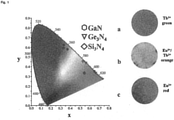
- Fig. 1 shows the CIE diagram and colors of GaN, Ge 3 N 4 and Si 3 N 4 doped with Eu 3+ and/or Tb 3+ proving that a color tuning of one host with different activator ions is possible (cf. Fig. 1a, 1c , Fig. 2 , Fig. 3a, 3b , and Fig. 4a, 4b ).
- GaN and Ge 3 N 4 were doped with different dopant metals (Eu 3+ and Tb 3+ ) at the same time resulting in a further color tuning of only one host material (cf. Fig. 1b , Fig. 3c and Fig. 4c ).
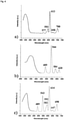
- Fig. 2a shows that in the emission spectrum of Si 3 N 4 doped with Eu 3+ , the transitions 5 D 0 ⁇ 7 F 0 and 7 F 3 are more intense than usually.
- the 5 D 0 ⁇ 7 F 3 transition is even greater than the 5 D 0 ⁇ 7 F 4 transition, which is not common. This means a strong J-mixing and a strong crystal-field perturbation in this matrix.
- the 5 D 0 ⁇ 7 F 0 transition is also broad, by inhomogeneous enlargement, indicating the location of Eu 3+ ions in several sites.
- Fig. 2b illustrates the emission spectra of Si 3 N 4 doped with Tb 3+ .
- the strongest emission peak is at 544 nm corresponding to the 5 D 4 ⁇ 7 F 5 transition, while the peaks at 490 nm, 584 nm and 620 nm, respectively, originate from the 5 D 4 ⁇ 7 F 6 , 5 D 4 ⁇ 7 F 4 and 5 D 4 ⁇ 7 F 3 transitions of the Tb 3+ ions.
- Electrode films were prepared by mixing the active material (i.e. bulk material of doped/ undoped multinary nitrides or nitridosilicates of the formulae (1), (2), (3), (1'), (2') and (3')) with SuperP carbon and polyvinylidene fluoride binder in a weight ratio of 70:20:10.
- a slurry was prepared by addition of N -methylpyrrolidone and then films were cast on Cu foil with a wet thickness of 120 ⁇ m and dried at 80°C for 8h.
- Fig. 6a and 6b The voltage profiles observed during galvanostatic cycling of a bulk material of an undoped GaN with respect to Li
- a long plateau is obtained from 0.5 V to 0.01 V of 600 mAh/g, which corresponds to 2.0Li per formula unit GaN.
- the specific capacity is 150 mAh/g and falls systematically up to the 50 th cycle. From the 60 th cycle, the capacity slowly increases and in the 200 th cycle the specific capacity is 200 mAh/g.
- the first discharge curve shows a specific capacity of 600 mAh/g (0.55Li per formula unit). In the 20 th cycle, the capacity is comparable to the capacity of the undoped material. Also here, in the first 200 cycles a slight increase in capacity can be observed.
- the galvanostatic cycling is shown in Fig. 5e and 5f , which demonstrate the specific capacity is significantly and constantly increased by doping with Ni.
- the first discharge curve shows a specific capacity of 300 mAh/g (0.27Li per formula unit), in the 20 th cycle 200 mAh/g (0.18Li per formula unit) and in the 200 th cycle the capacity corresponds to 525 mAh/g (0.47Li per formula unit).
- the galvanostatic cycling is shown in Fig. 6e and 6f , which demonstrate the specific capacity is significantly increased by doping with Zn and Mg.
- the specific capacitance increases to 850 mAh/g compared to undoped GaN.
- a plateau in the specific capacity vs. cycle number curve can be seen and after that the capacity increases continually.
- the Zn-Mg doping has a favorable influence on the GaN.
- the specific capacity is 450 mAh/g.
Landscapes
- Chemical & Material Sciences (AREA)
- Organic Chemistry (AREA)
- Inorganic Chemistry (AREA)
- Engineering & Computer Science (AREA)
- Materials Engineering (AREA)
- Power Engineering (AREA)
- Chemical Kinetics & Catalysis (AREA)
- Electrochemistry (AREA)
- General Chemical & Material Sciences (AREA)
- Microelectronics & Electronic Packaging (AREA)
- Luminescent Compositions (AREA)
Priority Applications (3)
| Application Number | Priority Date | Filing Date | Title |
|---|---|---|---|
| EP20186968.2A EP3943445A1 (de) | 2020-07-21 | 2020-07-21 | Schüttgüter aus dotierten multinären nitriden und nitridosilikaten, deren herstellungsverfahren und verwendungen |
| PCT/EP2021/070407 WO2022018145A1 (en) | 2020-07-21 | 2021-07-21 | Bulk materials of doped multinary nitrides and nitridosilicates, their production method and uses |
| EP21749555.5A EP4185553A1 (de) | 2020-07-21 | 2021-07-21 | Schüttgüter aus dotierten multinären nitriden und nitridosilikaten, verfahren zu ihrer herstellung und verwendungen |
Applications Claiming Priority (1)
| Application Number | Priority Date | Filing Date | Title |
|---|---|---|---|
| EP20186968.2A EP3943445A1 (de) | 2020-07-21 | 2020-07-21 | Schüttgüter aus dotierten multinären nitriden und nitridosilikaten, deren herstellungsverfahren und verwendungen |
Publications (1)
| Publication Number | Publication Date |
|---|---|
| EP3943445A1 true EP3943445A1 (de) | 2022-01-26 |
Family
ID=71738076
Family Applications (2)
| Application Number | Title | Priority Date | Filing Date |
|---|---|---|---|
| EP20186968.2A Withdrawn EP3943445A1 (de) | 2020-07-21 | 2020-07-21 | Schüttgüter aus dotierten multinären nitriden und nitridosilikaten, deren herstellungsverfahren und verwendungen |
| EP21749555.5A Pending EP4185553A1 (de) | 2020-07-21 | 2021-07-21 | Schüttgüter aus dotierten multinären nitriden und nitridosilikaten, verfahren zu ihrer herstellung und verwendungen |
Family Applications After (1)
| Application Number | Title | Priority Date | Filing Date |
|---|---|---|---|
| EP21749555.5A Pending EP4185553A1 (de) | 2020-07-21 | 2021-07-21 | Schüttgüter aus dotierten multinären nitriden und nitridosilikaten, verfahren zu ihrer herstellung und verwendungen |
Country Status (2)
| Country | Link |
|---|---|
| EP (2) | EP3943445A1 (de) |
| WO (1) | WO2022018145A1 (de) |
Cited By (1)
| Publication number | Priority date | Publication date | Assignee | Title |
|---|---|---|---|---|
| CN118479889A (zh) * | 2024-01-05 | 2024-08-13 | 西北工业大学 | 一种纳米竹节-纳米线双组元复合薄膜及其制备方法 |
Families Citing this family (3)
| Publication number | Priority date | Publication date | Assignee | Title |
|---|---|---|---|---|
| CN114678502B (zh) * | 2022-03-25 | 2024-10-18 | 广东邦普循环科技有限公司 | 一种石墨烯基氮化物负极材料及其制备方法 |
| CN119481351B (zh) * | 2023-08-09 | 2025-10-28 | 中国科学院大连化学物理研究所 | 一种水系锌离子电池电解液及应用 |
| CN116835673A (zh) * | 2023-08-18 | 2023-10-03 | 佛山市德方纳米科技有限公司 | 正极材料及其制备方法和锂离子电池 |
Citations (3)
| Publication number | Priority date | Publication date | Assignee | Title |
|---|---|---|---|---|
| EP1104799A1 (de) * | 1999-11-30 | 2001-06-06 | Patent-Treuhand-Gesellschaft für elektrische Glühlampen mbH | Rotstrahlendes lumineszentes Material |
| WO2007060944A1 (ja) * | 2005-11-22 | 2007-05-31 | Chubu Chelest Co., Ltd. | 金属窒化物の製法 |
| DE102009010705A1 (de) * | 2009-02-27 | 2010-09-02 | Merck Patent Gmbh | Co-dotierte 2-5-8 Nitride |
-
2020
- 2020-07-21 EP EP20186968.2A patent/EP3943445A1/de not_active Withdrawn
-
2021
- 2021-07-21 EP EP21749555.5A patent/EP4185553A1/de active Pending
- 2021-07-21 WO PCT/EP2021/070407 patent/WO2022018145A1/en not_active Ceased
Patent Citations (3)
| Publication number | Priority date | Publication date | Assignee | Title |
|---|---|---|---|---|
| EP1104799A1 (de) * | 1999-11-30 | 2001-06-06 | Patent-Treuhand-Gesellschaft für elektrische Glühlampen mbH | Rotstrahlendes lumineszentes Material |
| WO2007060944A1 (ja) * | 2005-11-22 | 2007-05-31 | Chubu Chelest Co., Ltd. | 金属窒化物の製法 |
| DE102009010705A1 (de) * | 2009-02-27 | 2010-09-02 | Merck Patent Gmbh | Co-dotierte 2-5-8 Nitride |
Non-Patent Citations (9)
| Title |
|---|
| A. ULVESTAD ET AL., SCI. REP., 2018, pages 8 |
| HUANG ZHIFENG ET AL: "Synthesis and photoluminescence of doped Si3N4nanowires with various valence electron configurations", JOURNAL OF MATERIAL SCIENCE, KLUWER ACADEMIC PUBLISHERS, DORDRECHT, vol. 53, no. 19, 19 April 2018 (2018-04-19), pages 13573 - 13583, XP036554740, ISSN: 0022-2461, [retrieved on 20180419], DOI: 10.1007/S10853-018-2330-4 * |
| M. MARTIN-GIL ET AL., MATER. LETT., vol. 57, 2003, pages 3063 - 3069 |
| M. ZEUNER, ANGEW. CHEM., vol. 123, 2011, pages 7898 - 7920 |
| MOREOVER, J. HEIKENFELD ET AL., APPL. PHYS. LETT., vol. 75, no. 1, 1999, pages 1189 - 1191 |
| PAMPILI PIETRO ET AL: "Doping of III-nitride materials", MATERIALS SCIENCE IN SEMICONDUCTOR PROCESSING, ELSEVIER SCIENCE PUBLISHERS B.V., BARKING, UK, vol. 62, 4 December 2016 (2016-12-04), pages 180 - 191, XP029937408, ISSN: 1369-8001, DOI: 10.1016/J.MSSP.2016.11.006 * |
| S.R. ROMER ET AL., CHEM. EUR. J., vol. 14, 2008, pages 7892 - 7902 |
| X.W. ZHANG: "Doping and electrical properties of cubic boron nitride thin films: A critical review", THIN SOLID FILMS, vol. 544, 1 October 2013 (2013-10-01), AMSTERDAM, NL, pages 2 - 12, XP055738285, ISSN: 0040-6090, DOI: 10.1016/j.tsf.2013.07.001 * |
| XIAOMING ZHANG ET AL: "Two-Dimensional GaN: An Excellent Electrode Material Providing Fast Ion Diffusion and High Storage Capacity for Li-Ion and Na-Ion Batteries", ACS APPLIED MATERIALS & INTERFACES, vol. 10, no. 45, 25 October 2018 (2018-10-25), US, pages 38978 - 38984, XP055738272, ISSN: 1944-8244, DOI: 10.1021/acsami.8b15139 * |
Cited By (1)
| Publication number | Priority date | Publication date | Assignee | Title |
|---|---|---|---|---|
| CN118479889A (zh) * | 2024-01-05 | 2024-08-13 | 西北工业大学 | 一种纳米竹节-纳米线双组元复合薄膜及其制备方法 |
Also Published As
| Publication number | Publication date |
|---|---|
| EP4185553A1 (de) | 2023-05-31 |
| WO2022018145A1 (en) | 2022-01-27 |
Similar Documents
| Publication | Publication Date | Title |
|---|---|---|
| EP3943445A1 (de) | Schüttgüter aus dotierten multinären nitriden und nitridosilikaten, deren herstellungsverfahren und verwendungen | |
| Armstrong et al. | The layered intercalation compounds Li (Mn1− yCoy) O2: positive electrode materials for lithium–ion batteries | |
| KR100701532B1 (ko) | 불소화합물이 첨가된 리튬이차전지 양극 활물질 및 그제조방법 | |
| JP6957078B2 (ja) | 正極、それを含むリチウム空気電池、及び該正極の製造方法 | |
| CN115745018A (zh) | 高熵MXene材料、高熵MAX相材料及其制备方法、电极和电池 | |
| Oi et al. | Hexagonal tungsten trioxide obtained from peroxo-polytungstate and reversible lithium electro-intercalation into its framework | |
| Mathieson et al. | Ruddlesden Popper 2D perovskites as Li-ion battery electrodes | |
| CN108461736A (zh) | 一种掺杂包覆的镍钴铝三元锂离子电池正极材料、制备方法及用途 | |
| CN105680009B (zh) | 含m的多功能金属氧化物修饰的高电压钴酸锂正极粉末材料及其制备方法 | |
| US20240283010A1 (en) | Solid electrolyte material and solid-state battery made therewith | |
| JP2018514908A (ja) | ナトリウムイオン電池用の正極活性物質 | |
| Allen et al. | Synthesis, structure and electrochemistry of lithium vanadium phosphate cathode materials | |
| US6998069B1 (en) | Electrode material for positive electrodes of rechargeable lithium batteries | |
| An et al. | Ultralong H 2 V 3 O 8 nanowire bundles as a promising cathode for lithium batteries | |
| US11955597B2 (en) | Solid electrolyte, preparation method thereof, metal air battery including the same, and electrochemical device including the same | |
| Arayamparambil et al. | Electrochemical evaluation of Pb, Ag, and Zn cyanamides/carbodiimides | |
| Yang et al. | High-rate cathode CrSSe based on anion reactions for lithium-ion batteries | |
| Juhi et al. | Exploring metal halide perovskites as active architectures in energy storage systems | |
| WO2019182920A1 (en) | Sodium ion battery cathodes | |
| KR20220098177A (ko) | 리튬 전이금속 할라이드 | |
| Braun et al. | SnCN2: a carbodiimide with an innovative approach for energy storage systems and phosphors in modern LED technology | |
| CN101918317B (zh) | 用于锂离子电池的负极材料 | |
| KR20090100196A (ko) | 리튬-망간-주석 화합물 양극 박막을 포함하는 리튬이차전지, 리튬-망간-주석 화합물 타겟 제조 방법 및 이를이용한 양극 박막 형성 방법 | |
| KR20250043589A (ko) | Lmo 캐소드 조성물 | |
| US20180205078A1 (en) | Tin-containing compounds |
Legal Events
| Date | Code | Title | Description |
|---|---|---|---|
| PUAI | Public reference made under article 153(3) epc to a published international application that has entered the european phase |
Free format text: ORIGINAL CODE: 0009012 |
|
| STAA | Information on the status of an ep patent application or granted ep patent |
Free format text: STATUS: THE APPLICATION HAS BEEN PUBLISHED |
|
| AK | Designated contracting states |
Kind code of ref document: A1 Designated state(s): AL AT BE BG CH CY CZ DE DK EE ES FI FR GB GR HR HU IE IS IT LI LT LU LV MC MK MT NL NO PL PT RO RS SE SI SK SM TR |
|
| STAA | Information on the status of an ep patent application or granted ep patent |
Free format text: STATUS: THE APPLICATION IS DEEMED TO BE WITHDRAWN |
|
| 18D | Application deemed to be withdrawn |
Effective date: 20220727 |