EP3945078A1 - Matériau vitrocéramique, procédé de formation d'un matériau vitrocéramique et utilisation d'un matériau vitrocéramique - Google Patents
Matériau vitrocéramique, procédé de formation d'un matériau vitrocéramique et utilisation d'un matériau vitrocéramique Download PDFInfo
- Publication number
- EP3945078A1 EP3945078A1 EP20188557.1A EP20188557A EP3945078A1 EP 3945078 A1 EP3945078 A1 EP 3945078A1 EP 20188557 A EP20188557 A EP 20188557A EP 3945078 A1 EP3945078 A1 EP 3945078A1
- Authority
- EP
- European Patent Office
- Prior art keywords
- glass
- weight
- ceramic material
- optionally
- cristobalite
- Prior art date
- Legal status (The legal status is an assumption and is not a legal conclusion. Google has not performed a legal analysis and makes no representation as to the accuracy of the status listed.)
- Withdrawn
Links
- 239000006112 glass ceramic composition Substances 0.000 title claims abstract description 150
- 238000000034 method Methods 0.000 title claims abstract description 29
- VYPSYNLAJGMNEJ-UHFFFAOYSA-N silicon dioxide Inorganic materials O=[Si]=O VYPSYNLAJGMNEJ-UHFFFAOYSA-N 0.000 claims description 172
- 229910052906 cristobalite Inorganic materials 0.000 claims description 79
- 239000010453 quartz Substances 0.000 claims description 67
- 239000000203 mixture Substances 0.000 claims description 60
- 239000002245 particle Substances 0.000 claims description 54
- 239000007858 starting material Substances 0.000 claims description 45
- 239000010433 feldspar Substances 0.000 claims description 33
- 239000011521 glass Substances 0.000 claims description 29
- DGAQECJNVWCQMB-PUAWFVPOSA-M Ilexoside XXIX Chemical compound C[C@@H]1CC[C@@]2(CC[C@@]3(C(=CC[C@H]4[C@]3(CC[C@@H]5[C@@]4(CC[C@@H](C5(C)C)OS(=O)(=O)[O-])C)C)[C@@H]2[C@]1(C)O)C)C(=O)O[C@H]6[C@@H]([C@H]([C@@H]([C@H](O6)CO)O)O)O.[Na+] DGAQECJNVWCQMB-PUAWFVPOSA-M 0.000 claims description 28
- 229910000514 dolomite Inorganic materials 0.000 claims description 28
- 229910052708 sodium Inorganic materials 0.000 claims description 28
- 239000011734 sodium Substances 0.000 claims description 28
- 239000010459 dolomite Substances 0.000 claims description 27
- NWXHSRDXUJENGJ-UHFFFAOYSA-N calcium;magnesium;dioxido(oxo)silane Chemical compound [Mg+2].[Ca+2].[O-][Si]([O-])=O.[O-][Si]([O-])=O NWXHSRDXUJENGJ-UHFFFAOYSA-N 0.000 claims description 24
- 229910052637 diopside Inorganic materials 0.000 claims description 24
- 229920005989 resin Polymers 0.000 claims description 24
- 239000011347 resin Substances 0.000 claims description 24
- 239000002969 artificial stone Substances 0.000 claims description 20
- 239000003822 epoxy resin Substances 0.000 claims description 13
- 229920000647 polyepoxide Polymers 0.000 claims description 13
- 238000009826 distribution Methods 0.000 claims description 12
- 239000012535 impurity Substances 0.000 claims description 12
- 239000003973 paint Substances 0.000 claims description 12
- 239000004115 Sodium Silicate Substances 0.000 claims description 11
- 238000010438 heat treatment Methods 0.000 claims description 11
- KKCBUQHMOMHUOY-UHFFFAOYSA-N sodium oxide Chemical compound [O-2].[Na+].[Na+] KKCBUQHMOMHUOY-UHFFFAOYSA-N 0.000 claims description 11
- NTHWMYGWWRZVTN-UHFFFAOYSA-N sodium silicate Chemical compound [Na+].[Na+].[O-][Si]([O-])=O NTHWMYGWWRZVTN-UHFFFAOYSA-N 0.000 claims description 11
- 229910052911 sodium silicate Inorganic materials 0.000 claims description 11
- 235000013312 flour Nutrition 0.000 claims description 9
- CHWRSCGUEQEHOH-UHFFFAOYSA-N potassium oxide Chemical compound [O-2].[K+].[K+] CHWRSCGUEQEHOH-UHFFFAOYSA-N 0.000 claims description 8
- 239000000919 ceramic Substances 0.000 claims description 6
- 239000013078 crystal Substances 0.000 claims description 6
- 239000000463 material Substances 0.000 claims description 6
- 229920001225 polyester resin Polymers 0.000 claims description 6
- 239000004645 polyester resin Substances 0.000 claims description 6
- 229910001948 sodium oxide Inorganic materials 0.000 claims description 5
- 229920005749 polyurethane resin Polymers 0.000 claims description 4
- 238000001914 filtration Methods 0.000 claims description 2
- 239000000446 fuel Substances 0.000 claims description 2
- 239000007943 implant Substances 0.000 claims description 2
- 229910001950 potassium oxide Inorganic materials 0.000 claims description 2
- 239000002699 waste material Substances 0.000 claims description 2
- 235000012239 silicon dioxide Nutrition 0.000 description 60
- 238000001354 calcination Methods 0.000 description 29
- 229910052500 inorganic mineral Inorganic materials 0.000 description 24
- 239000011707 mineral Substances 0.000 description 24
- 235000010755 mineral Nutrition 0.000 description 24
- PNEYBMLMFCGWSK-UHFFFAOYSA-N aluminium oxide Inorganic materials [O-2].[O-2].[O-2].[Al+3].[Al+3] PNEYBMLMFCGWSK-UHFFFAOYSA-N 0.000 description 21
- 239000000126 substance Substances 0.000 description 21
- 102220346623 c.215T>C Human genes 0.000 description 18
- CPLXHLVBOLITMK-UHFFFAOYSA-N Magnesium oxide Chemical compound [Mg]=O CPLXHLVBOLITMK-UHFFFAOYSA-N 0.000 description 16
- GWEVSGVZZGPLCZ-UHFFFAOYSA-N Titan oxide Chemical compound O=[Ti]=O GWEVSGVZZGPLCZ-UHFFFAOYSA-N 0.000 description 12
- 239000000843 powder Substances 0.000 description 12
- 239000012764 mineral filler Substances 0.000 description 11
- 239000003826 tablet Substances 0.000 description 9
- XLYOFNOQVPJJNP-UHFFFAOYSA-N water Substances O XLYOFNOQVPJJNP-UHFFFAOYSA-N 0.000 description 9
- 239000000395 magnesium oxide Substances 0.000 description 8
- 235000012245 magnesium oxide Nutrition 0.000 description 8
- 230000008859 change Effects 0.000 description 7
- JEIPFZHSYJVQDO-UHFFFAOYSA-N iron(III) oxide Inorganic materials O=[Fe]O[Fe]=O JEIPFZHSYJVQDO-UHFFFAOYSA-N 0.000 description 7
- 238000004458 analytical method Methods 0.000 description 6
- NOTVAPJNGZMVSD-UHFFFAOYSA-N potassium monoxide Inorganic materials [K]O[K] NOTVAPJNGZMVSD-UHFFFAOYSA-N 0.000 description 6
- 239000004576 sand Substances 0.000 description 6
- 239000000377 silicon dioxide Substances 0.000 description 6
- 229910052656 albite Inorganic materials 0.000 description 5
- 238000010304 firing Methods 0.000 description 5
- 230000015572 biosynthetic process Effects 0.000 description 4
- QSHDDOUJBYECFT-UHFFFAOYSA-N mercury Chemical compound [Hg] QSHDDOUJBYECFT-UHFFFAOYSA-N 0.000 description 4
- 229910052753 mercury Inorganic materials 0.000 description 4
- 238000010298 pulverizing process Methods 0.000 description 4
- 239000000243 solution Substances 0.000 description 4
- 239000004575 stone Substances 0.000 description 4
- 229910021489 α-quartz Inorganic materials 0.000 description 4
- 239000004593 Epoxy Substances 0.000 description 3
- 238000002441 X-ray diffraction Methods 0.000 description 3
- 238000000137 annealing Methods 0.000 description 3
- 230000000711 cancerogenic effect Effects 0.000 description 3
- 238000005520 cutting process Methods 0.000 description 3
- 238000000227 grinding Methods 0.000 description 3
- 238000004519 manufacturing process Methods 0.000 description 3
- 238000005259 measurement Methods 0.000 description 3
- 238000003801 milling Methods 0.000 description 3
- 239000004570 mortar (masonry) Substances 0.000 description 3
- 238000002360 preparation method Methods 0.000 description 3
- 230000008569 process Effects 0.000 description 3
- 239000011435 rock Substances 0.000 description 3
- 230000000007 visual effect Effects 0.000 description 3
- 239000010456 wollastonite Substances 0.000 description 3
- 229910052882 wollastonite Inorganic materials 0.000 description 3
- 201000010001 Silicosis Diseases 0.000 description 2
- 229910052661 anorthite Inorganic materials 0.000 description 2
- 239000011449 brick Substances 0.000 description 2
- 235000013339 cereals Nutrition 0.000 description 2
- 238000012512 characterization method Methods 0.000 description 2
- 239000000470 constituent Substances 0.000 description 2
- 229910052878 cordierite Inorganic materials 0.000 description 2
- JSKIRARMQDRGJZ-UHFFFAOYSA-N dimagnesium dioxido-bis[(1-oxido-3-oxo-2,4,6,8,9-pentaoxa-1,3-disila-5,7-dialuminabicyclo[3.3.1]nonan-7-yl)oxy]silane Chemical compound [Mg++].[Mg++].[O-][Si]([O-])(O[Al]1O[Al]2O[Si](=O)O[Si]([O-])(O1)O2)O[Al]1O[Al]2O[Si](=O)O[Si]([O-])(O1)O2 JSKIRARMQDRGJZ-UHFFFAOYSA-N 0.000 description 2
- 239000000428 dust Substances 0.000 description 2
- 238000011067 equilibration Methods 0.000 description 2
- LNEPOXFFQSENCJ-UHFFFAOYSA-N haloperidol Chemical compound C1CC(O)(C=2C=CC(Cl)=CC=2)CCN1CCCC(=O)C1=CC=C(F)C=C1 LNEPOXFFQSENCJ-UHFFFAOYSA-N 0.000 description 2
- 229910052638 hedenbergite Inorganic materials 0.000 description 2
- 238000009533 lab test Methods 0.000 description 2
- 238000002844 melting Methods 0.000 description 2
- 230000008018 melting Effects 0.000 description 2
- 238000002156 mixing Methods 0.000 description 2
- 238000010587 phase diagram Methods 0.000 description 2
- 238000012545 processing Methods 0.000 description 2
- 230000003068 static effect Effects 0.000 description 2
- 238000012360 testing method Methods 0.000 description 2
- 238000004876 x-ray fluorescence Methods 0.000 description 2
- 229910000500 β-quartz Inorganic materials 0.000 description 2
- HECLRDQVFMWTQS-RGOKHQFPSA-N 1755-01-7 Chemical compound C1[C@H]2[C@@H]3CC=C[C@@H]3[C@@H]1C=C2 HECLRDQVFMWTQS-RGOKHQFPSA-N 0.000 description 1
- JHQVCQDWGSXTFE-UHFFFAOYSA-N 2-(2-prop-2-enoxycarbonyloxyethoxy)ethyl prop-2-enyl carbonate Chemical compound C=CCOC(=O)OCCOCCOC(=O)OCC=C JHQVCQDWGSXTFE-UHFFFAOYSA-N 0.000 description 1
- JOYRKODLDBILNP-UHFFFAOYSA-N Ethyl urethane Chemical compound CCOC(N)=O JOYRKODLDBILNP-UHFFFAOYSA-N 0.000 description 1
- 206010058467 Lung neoplasm malignant Diseases 0.000 description 1
- 238000005299 abrasion Methods 0.000 description 1
- QVGXLLKOCUKJST-UHFFFAOYSA-N atomic oxygen Chemical compound [O] QVGXLLKOCUKJST-UHFFFAOYSA-N 0.000 description 1
- 230000009286 beneficial effect Effects 0.000 description 1
- HHSPVTKDOHQBKF-UHFFFAOYSA-J calcium;magnesium;dicarbonate Chemical compound [Mg+2].[Ca+2].[O-]C([O-])=O.[O-]C([O-])=O HHSPVTKDOHQBKF-UHFFFAOYSA-J 0.000 description 1
- 238000004364 calculation method Methods 0.000 description 1
- 229910001748 carbonate mineral Inorganic materials 0.000 description 1
- 238000000576 coating method Methods 0.000 description 1
- 150000001875 compounds Chemical class 0.000 description 1
- 238000007906 compression Methods 0.000 description 1
- 230000006835 compression Effects 0.000 description 1
- 238000001816 cooling Methods 0.000 description 1
- 238000012937 correction Methods 0.000 description 1
- 239000007822 coupling agent Substances 0.000 description 1
- 238000005336 cracking Methods 0.000 description 1
- 238000002425 crystallisation Methods 0.000 description 1
- 238000011161 development Methods 0.000 description 1
- GWWPLLOVYSCJIO-UHFFFAOYSA-N dialuminum;calcium;disilicate Chemical compound [Al+3].[Al+3].[Ca+2].[O-][Si]([O-])([O-])[O-].[O-][Si]([O-])([O-])[O-] GWWPLLOVYSCJIO-UHFFFAOYSA-N 0.000 description 1
- KZHJGOXRZJKJNY-UHFFFAOYSA-N dioxosilane;oxo(oxoalumanyloxy)alumane Chemical compound O=[Si]=O.O=[Si]=O.O=[Al]O[Al]=O.O=[Al]O[Al]=O.O=[Al]O[Al]=O KZHJGOXRZJKJNY-UHFFFAOYSA-N 0.000 description 1
- 238000005516 engineering process Methods 0.000 description 1
- 238000002474 experimental method Methods 0.000 description 1
- 238000011049 filling Methods 0.000 description 1
- 238000005188 flotation Methods 0.000 description 1
- 238000009472 formulation Methods 0.000 description 1
- 239000003292 glue Substances 0.000 description 1
- 238000005286 illumination Methods 0.000 description 1
- 238000009434 installation Methods 0.000 description 1
- 201000005202 lung cancer Diseases 0.000 description 1
- 208000020816 lung neoplasm Diseases 0.000 description 1
- 239000011777 magnesium Substances 0.000 description 1
- 229910001719 melilite Inorganic materials 0.000 description 1
- 229910052651 microcline Inorganic materials 0.000 description 1
- 229910052863 mullite Inorganic materials 0.000 description 1
- 238000010899 nucleation Methods 0.000 description 1
- 230000006911 nucleation Effects 0.000 description 1
- 229910052652 orthoclase Inorganic materials 0.000 description 1
- 229910052760 oxygen Inorganic materials 0.000 description 1
- 239000001301 oxygen Substances 0.000 description 1
- 230000000704 physical effect Effects 0.000 description 1
- 229910052655 plagioclase feldspar Inorganic materials 0.000 description 1
- -1 plasters Substances 0.000 description 1
- 238000002459 porosimetry Methods 0.000 description 1
- 239000011148 porous material Substances 0.000 description 1
- 239000011369 resultant mixture Substances 0.000 description 1
- 229910052654 sanidine Inorganic materials 0.000 description 1
- 238000001878 scanning electron micrograph Methods 0.000 description 1
- 238000007873 sieving Methods 0.000 description 1
- 229910052710 silicon Inorganic materials 0.000 description 1
- 239000010703 silicon Substances 0.000 description 1
- 239000002002 slurry Substances 0.000 description 1
- 239000005361 soda-lime glass Substances 0.000 description 1
- 239000007787 solid Substances 0.000 description 1
- 239000006104 solid solution Substances 0.000 description 1
- 229910052596 spinel Inorganic materials 0.000 description 1
- 239000011029 spinel Substances 0.000 description 1
- 238000005507 spraying Methods 0.000 description 1
- 230000007704 transition Effects 0.000 description 1
- 229910052905 tridymite Inorganic materials 0.000 description 1
- 210000003462 vein Anatomy 0.000 description 1
Images


Classifications
-
- C—CHEMISTRY; METALLURGY
- C03—GLASS; MINERAL OR SLAG WOOL
- C03C—CHEMICAL COMPOSITION OF GLASSES, GLAZES OR VITREOUS ENAMELS; SURFACE TREATMENT OF GLASS; SURFACE TREATMENT OF FIBRES OR FILAMENTS MADE FROM GLASS, MINERALS OR SLAGS; JOINING GLASS TO GLASS OR OTHER MATERIALS
- C03C10/00—Devitrified glass ceramics, i.e. glass ceramics having a crystalline phase dispersed in a glassy phase and constituting at least 50% by weight of the total composition
- C03C10/0018—Devitrified glass ceramics, i.e. glass ceramics having a crystalline phase dispersed in a glassy phase and constituting at least 50% by weight of the total composition containing SiO2, Al2O3 and monovalent metal oxide as main constituents
-
- C—CHEMISTRY; METALLURGY
- C03—GLASS; MINERAL OR SLAG WOOL
- C03C—CHEMICAL COMPOSITION OF GLASSES, GLAZES OR VITREOUS ENAMELS; SURFACE TREATMENT OF GLASS; SURFACE TREATMENT OF FIBRES OR FILAMENTS MADE FROM GLASS, MINERALS OR SLAGS; JOINING GLASS TO GLASS OR OTHER MATERIALS
- C03C1/00—Ingredients generally applicable to manufacture of glasses, glazes, or vitreous enamels
-
- C—CHEMISTRY; METALLURGY
- C03—GLASS; MINERAL OR SLAG WOOL
- C03C—CHEMICAL COMPOSITION OF GLASSES, GLAZES OR VITREOUS ENAMELS; SURFACE TREATMENT OF GLASS; SURFACE TREATMENT OF FIBRES OR FILAMENTS MADE FROM GLASS, MINERALS OR SLAGS; JOINING GLASS TO GLASS OR OTHER MATERIALS
- C03C10/00—Devitrified glass ceramics, i.e. glass ceramics having a crystalline phase dispersed in a glassy phase and constituting at least 50% by weight of the total composition
- C03C10/0036—Devitrified glass ceramics, i.e. glass ceramics having a crystalline phase dispersed in a glassy phase and constituting at least 50% by weight of the total composition containing SiO2, Al2O3 and a divalent metal oxide as main constituents
- C03C10/0045—Devitrified glass ceramics, i.e. glass ceramics having a crystalline phase dispersed in a glassy phase and constituting at least 50% by weight of the total composition containing SiO2, Al2O3 and a divalent metal oxide as main constituents containing SiO2, Al2O3 and MgO as main constituents
-
- C—CHEMISTRY; METALLURGY
- C03—GLASS; MINERAL OR SLAG WOOL
- C03C—CHEMICAL COMPOSITION OF GLASSES, GLAZES OR VITREOUS ENAMELS; SURFACE TREATMENT OF GLASS; SURFACE TREATMENT OF FIBRES OR FILAMENTS MADE FROM GLASS, MINERALS OR SLAGS; JOINING GLASS TO GLASS OR OTHER MATERIALS
- C03C12/00—Powdered glass; Bead compositions
-
- C—CHEMISTRY; METALLURGY
- C03—GLASS; MINERAL OR SLAG WOOL
- C03C—CHEMICAL COMPOSITION OF GLASSES, GLAZES OR VITREOUS ENAMELS; SURFACE TREATMENT OF GLASS; SURFACE TREATMENT OF FIBRES OR FILAMENTS MADE FROM GLASS, MINERALS OR SLAGS; JOINING GLASS TO GLASS OR OTHER MATERIALS
- C03C3/00—Glass compositions
- C03C3/04—Glass compositions containing silica
- C03C3/076—Glass compositions containing silica with 40% to 90% silica, by weight
- C03C3/083—Glass compositions containing silica with 40% to 90% silica, by weight containing aluminium oxide or an iron compound
- C03C3/085—Glass compositions containing silica with 40% to 90% silica, by weight containing aluminium oxide or an iron compound containing an oxide of a divalent metal
- C03C3/087—Glass compositions containing silica with 40% to 90% silica, by weight containing aluminium oxide or an iron compound containing an oxide of a divalent metal containing calcium oxide, e.g. common sheet or container glass
-
- C—CHEMISTRY; METALLURGY
- C03—GLASS; MINERAL OR SLAG WOOL
- C03C—CHEMICAL COMPOSITION OF GLASSES, GLAZES OR VITREOUS ENAMELS; SURFACE TREATMENT OF GLASS; SURFACE TREATMENT OF FIBRES OR FILAMENTS MADE FROM GLASS, MINERALS OR SLAGS; JOINING GLASS TO GLASS OR OTHER MATERIALS
- C03C4/00—Compositions for glass with special properties
- C03C4/02—Compositions for glass with special properties for coloured glass
-
- C—CHEMISTRY; METALLURGY
- C04—CEMENTS; CONCRETE; ARTIFICIAL STONE; CERAMICS; REFRACTORIES
- C04B—LIME, MAGNESIA; SLAG; CEMENTS; COMPOSITIONS THEREOF, e.g. MORTARS, CONCRETE OR LIKE BUILDING MATERIALS; ARTIFICIAL STONE; CERAMICS; REFRACTORIES; TREATMENT OF NATURAL STONE
- C04B18/00—Use of agglomerated or waste materials or refuse as fillers for mortars, concrete or artificial stone; Treatment of agglomerated or waste materials or refuse, specially adapted to enhance their filling properties in mortars, concrete or artificial stone
- C04B18/02—Agglomerated materials, e.g. artificial aggregates
- C04B18/021—Agglomerated materials, e.g. artificial aggregates agglomerated by a mineral binder, e.g. cement
-
- C—CHEMISTRY; METALLURGY
- C04—CEMENTS; CONCRETE; ARTIFICIAL STONE; CERAMICS; REFRACTORIES
- C04B—LIME, MAGNESIA; SLAG; CEMENTS; COMPOSITIONS THEREOF, e.g. MORTARS, CONCRETE OR LIKE BUILDING MATERIALS; ARTIFICIAL STONE; CERAMICS; REFRACTORIES; TREATMENT OF NATURAL STONE
- C04B26/00—Compositions of mortars, concrete or artificial stone, containing only organic binders, e.g. polymer or resin concrete
- C04B26/02—Macromolecular compounds
- C04B26/10—Macromolecular compounds obtained otherwise than by reactions only involving carbon-to-carbon unsaturated bonds
- C04B26/14—Polyepoxides
-
- C—CHEMISTRY; METALLURGY
- C04—CEMENTS; CONCRETE; ARTIFICIAL STONE; CERAMICS; REFRACTORIES
- C04B—LIME, MAGNESIA; SLAG; CEMENTS; COMPOSITIONS THEREOF, e.g. MORTARS, CONCRETE OR LIKE BUILDING MATERIALS; ARTIFICIAL STONE; CERAMICS; REFRACTORIES; TREATMENT OF NATURAL STONE
- C04B26/00—Compositions of mortars, concrete or artificial stone, containing only organic binders, e.g. polymer or resin concrete
- C04B26/02—Macromolecular compounds
- C04B26/10—Macromolecular compounds obtained otherwise than by reactions only involving carbon-to-carbon unsaturated bonds
- C04B26/16—Polyurethanes
-
- C—CHEMISTRY; METALLURGY
- C04—CEMENTS; CONCRETE; ARTIFICIAL STONE; CERAMICS; REFRACTORIES
- C04B—LIME, MAGNESIA; SLAG; CEMENTS; COMPOSITIONS THEREOF, e.g. MORTARS, CONCRETE OR LIKE BUILDING MATERIALS; ARTIFICIAL STONE; CERAMICS; REFRACTORIES; TREATMENT OF NATURAL STONE
- C04B26/00—Compositions of mortars, concrete or artificial stone, containing only organic binders, e.g. polymer or resin concrete
- C04B26/02—Macromolecular compounds
- C04B26/10—Macromolecular compounds obtained otherwise than by reactions only involving carbon-to-carbon unsaturated bonds
- C04B26/18—Polyesters; Polycarbonates
-
- C—CHEMISTRY; METALLURGY
- C04—CEMENTS; CONCRETE; ARTIFICIAL STONE; CERAMICS; REFRACTORIES
- C04B—LIME, MAGNESIA; SLAG; CEMENTS; COMPOSITIONS THEREOF, e.g. MORTARS, CONCRETE OR LIKE BUILDING MATERIALS; ARTIFICIAL STONE; CERAMICS; REFRACTORIES; TREATMENT OF NATURAL STONE
- C04B28/00—Compositions of mortars, concrete or artificial stone, containing inorganic binders or the reaction product of an inorganic and an organic binder, e.g. polycarboxylate cements
- C04B28/24—Compositions of mortars, concrete or artificial stone, containing inorganic binders or the reaction product of an inorganic and an organic binder, e.g. polycarboxylate cements containing alkyl, ammonium or metal silicates; containing silica sols
- C04B28/26—Silicates of the alkali metals
-
- C—CHEMISTRY; METALLURGY
- C03—GLASS; MINERAL OR SLAG WOOL
- C03C—CHEMICAL COMPOSITION OF GLASSES, GLAZES OR VITREOUS ENAMELS; SURFACE TREATMENT OF GLASS; SURFACE TREATMENT OF FIBRES OR FILAMENTS MADE FROM GLASS, MINERALS OR SLAGS; JOINING GLASS TO GLASS OR OTHER MATERIALS
- C03C2214/00—Nature of the non-vitreous component
- C03C2214/20—Glass-ceramics matrix
-
- C—CHEMISTRY; METALLURGY
- C03—GLASS; MINERAL OR SLAG WOOL
- C03C—CHEMICAL COMPOSITION OF GLASSES, GLAZES OR VITREOUS ENAMELS; SURFACE TREATMENT OF GLASS; SURFACE TREATMENT OF FIBRES OR FILAMENTS MADE FROM GLASS, MINERALS OR SLAGS; JOINING GLASS TO GLASS OR OTHER MATERIALS
- C03C2214/00—Nature of the non-vitreous component
- C03C2214/30—Methods of making the composites
-
- C—CHEMISTRY; METALLURGY
- C04—CEMENTS; CONCRETE; ARTIFICIAL STONE; CERAMICS; REFRACTORIES
- C04B—LIME, MAGNESIA; SLAG; CEMENTS; COMPOSITIONS THEREOF, e.g. MORTARS, CONCRETE OR LIKE BUILDING MATERIALS; ARTIFICIAL STONE; CERAMICS; REFRACTORIES; TREATMENT OF NATURAL STONE
- C04B2111/00—Mortars, concrete or artificial stone or mixtures to prepare them, characterised by specific function, property or use
- C04B2111/00474—Uses not provided for elsewhere in C04B2111/00
- C04B2111/00767—Uses not provided for elsewhere in C04B2111/00 for waste stabilisation purposes
- C04B2111/00775—Uses not provided for elsewhere in C04B2111/00 for waste stabilisation purposes the composition being used as waste barriers or the like, e.g. compositions used for waste disposal purposes only, but not containing the waste itself
-
- C—CHEMISTRY; METALLURGY
- C04—CEMENTS; CONCRETE; ARTIFICIAL STONE; CERAMICS; REFRACTORIES
- C04B—LIME, MAGNESIA; SLAG; CEMENTS; COMPOSITIONS THEREOF, e.g. MORTARS, CONCRETE OR LIKE BUILDING MATERIALS; ARTIFICIAL STONE; CERAMICS; REFRACTORIES; TREATMENT OF NATURAL STONE
- C04B2111/00—Mortars, concrete or artificial stone or mixtures to prepare them, characterised by specific function, property or use
- C04B2111/00474—Uses not provided for elsewhere in C04B2111/00
- C04B2111/00793—Uses not provided for elsewhere in C04B2111/00 as filters or diaphragms
-
- C—CHEMISTRY; METALLURGY
- C04—CEMENTS; CONCRETE; ARTIFICIAL STONE; CERAMICS; REFRACTORIES
- C04B—LIME, MAGNESIA; SLAG; CEMENTS; COMPOSITIONS THEREOF, e.g. MORTARS, CONCRETE OR LIKE BUILDING MATERIALS; ARTIFICIAL STONE; CERAMICS; REFRACTORIES; TREATMENT OF NATURAL STONE
- C04B2111/00—Mortars, concrete or artificial stone or mixtures to prepare them, characterised by specific function, property or use
- C04B2111/00474—Uses not provided for elsewhere in C04B2111/00
- C04B2111/00836—Uses not provided for elsewhere in C04B2111/00 for medical or dental applications
-
- C—CHEMISTRY; METALLURGY
- C04—CEMENTS; CONCRETE; ARTIFICIAL STONE; CERAMICS; REFRACTORIES
- C04B—LIME, MAGNESIA; SLAG; CEMENTS; COMPOSITIONS THEREOF, e.g. MORTARS, CONCRETE OR LIKE BUILDING MATERIALS; ARTIFICIAL STONE; CERAMICS; REFRACTORIES; TREATMENT OF NATURAL STONE
- C04B2111/00—Mortars, concrete or artificial stone or mixtures to prepare them, characterised by specific function, property or use
- C04B2111/00474—Uses not provided for elsewhere in C04B2111/00
- C04B2111/00853—Uses not provided for elsewhere in C04B2111/00 in electrochemical cells or batteries, e.g. fuel cells
-
- C—CHEMISTRY; METALLURGY
- C04—CEMENTS; CONCRETE; ARTIFICIAL STONE; CERAMICS; REFRACTORIES
- C04B—LIME, MAGNESIA; SLAG; CEMENTS; COMPOSITIONS THEREOF, e.g. MORTARS, CONCRETE OR LIKE BUILDING MATERIALS; ARTIFICIAL STONE; CERAMICS; REFRACTORIES; TREATMENT OF NATURAL STONE
- C04B2111/00—Mortars, concrete or artificial stone or mixtures to prepare them, characterised by specific function, property or use
- C04B2111/54—Substitutes for natural stone, artistic materials or the like
- C04B2111/542—Artificial natural stone
-
- C—CHEMISTRY; METALLURGY
- C04—CEMENTS; CONCRETE; ARTIFICIAL STONE; CERAMICS; REFRACTORIES
- C04B—LIME, MAGNESIA; SLAG; CEMENTS; COMPOSITIONS THEREOF, e.g. MORTARS, CONCRETE OR LIKE BUILDING MATERIALS; ARTIFICIAL STONE; CERAMICS; REFRACTORIES; TREATMENT OF NATURAL STONE
- C04B2111/00—Mortars, concrete or artificial stone or mixtures to prepare them, characterised by specific function, property or use
- C04B2111/80—Optical properties, e.g. transparency or reflexibility
Definitions
- the present invention relates to a glass-ceramic material.
- the present invention also relates to a method of forming a glass-ceramic material.
- Glass-ceramic materials are used in multiple fields, for example bricks, pipes and roof tiles; ceramic bodies; craft pottery; frits, glazes and engobes; sanitary-ware; tiles; and, tableware. Glass-ceramic materials used in these fields typically comprise an amorphous phase, comprising glass, and a crystalline phase.
- Glass-ceramic materials typically have zero or almost zero porosity, due to the way in which they are produced. Often, glass-ceramic materials are produced by a melting and annealing process. The first step (melting) reduces to zero or almost zero the porosity; the second step (annealing) provides conditions for crystal nucleation and growth.
- the zero or almost zero porosity of glass-ceramic materials might be a problem for applications in which a resin embedded glass-ceramic material needs to be produced.
- a porosity of higher than almost zero is beneficial in a glass-ceramic material (to be embedded in resin when forming an artificial stone) because the resin should preferably wet or contact as much of the surface of the glass-ceramic material as possible.
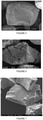
- FIGs 5, 6 and 7 show the surface of particles of quartz ( Figure 5 ) with less porosity and cracks (than cristobalite), particles of cristobalite ( Figure 6 ) and particles of glass with almost zero porosity ( Figure 7 ).
- the intraparticle porosity of cristobalite grit particles is 12% ⁇ 2%.
- Grit particles which could be used as an alternative to cristobalite grit particles (in at least the formation of synthetic stone products, with resin) preferably have an intraparticle porosity of from 2%, or from 3%, or from 4% to 15%.
- Cristobalite is a mineral obtained by calcination of pure silica sand at a temperature of approximately 1550°C; for example, at a temperature of from 1300°C to 1700°C.
- silica sand is mainly composed of a mineralogical phase called ⁇ -quartz.
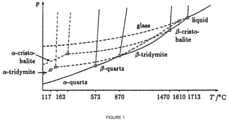
- ⁇ -quartz When the ⁇ -quartz is heated to approximately 1550°C, the crystalline lattice of the ⁇ -quartz undergoes a phase change. Upon heating, ⁇ -quartz initially undergoes a phase change to form ⁇ -quartz. Upon further heating, ⁇ -quartz then forms tridymite and then, at higher temperatures (typically from 1300°C to 1700°C, at atmospheric pressure), cristobalite is formed.
- Cristobalite is chemically stable and mechanically strong. Commercial forms of cristobalite also have a high whiteness. Owing to its ease of manufacture, cristobalite is used in many applications. For example, cristobalite is used in engineering stone (e.g. work surfaces) and in paint.
- the countertops are composed of a mineral filler and resin.
- the countertops typically comprise the mineral filler at a high percentage (up to 92 weight %), whilst one or more resins (optionally: 2K epoxy resins, for example Fugante TM Epoxy 2k; or, polyester resins, for example POLARIS polyester resin (produced by Ashland TM )) are present in lower percentages (up to 8 weight %).
- 2K epoxy resins for example Fugante TM Epoxy 2k
- polyester resins for example POLARIS polyester resin (produced by Ashland TM )
- Cristobalite, quartz, or, cristobalite and quartz are often incorporated in the countertops as the mineral filler.
- a countertop (composed of a mineral filler and resin) will require cutting prior to installation.
- a countertop is typically cut in a dry way with simple abrasion tools. This method of cutting the countertop generates dust that is composed of a mixture of the resin and mineral filler.
- the mineral dust may contain cristobalite, quartz, or, cristobalite and quartz. Cristobalite and quartz dust can lead to work related cell silicosis through inhalation.
- Cristobalite, quartz, or cristobalite and quartz are also used in paint compositions. Paint compositions typically comprise these minerals at from 10 to 20 weight %. Paint can be a source of airborne particles, for example these particles can be generated through spraying paint or dry sanding paint.
- the airborne particles may contain cristobalite, quartz, or, cristobalite and quartz. As discussed above, cristobalite and quartz airborne particles can lead to cell silicosis and lung cancer through inhalation.
- Cristobalite and quartz have been investigated for carcinogenic properties when the minerals are dispersed in the air and therefore inhaled.
- the most dangerous particles are particles with a diameter below 10 ⁇ m and particles freshly generated from a high energy cutting process.
- the glass-ceramic material can replace cristobalite, quartz, or, cristobalite and quartz; or, reduce cristobalite, quartz, or, cristobalite and quartz to below 1% in the final products.
- the present invention discloses a glass-ceramic material which can be used to replace, in whole or in part, cristobalite, quartz, or, cristobalite and quartz.
- the present invention relates to a glass-ceramic material that has the same or similar physical properties as cristobalite.
- Glass-ceramic material refers to a material which has an amorphous phase comprising glass and a crystalline phase. Glass-ceramic materials have the fabrication advantages of glass and include some of the properties of ceramics.
- Cristobalite refers to a mineral that is a high-temperature polymorph of quartz.
- cristobalite is cristobalite grit SIBELITE ® M72T (from Sibelco ® ).
- Cristobalite grit M72T is industrially produced.
- Cristobalite grit M72T is commonly used as a starting material for engineering stone and paint applications.
- Cristobalite grit M72T is referred to as a grit because it has a particle size distribution with a minimum particle size of 100 ⁇ m and a maximum particle size of 500 ⁇ m.
- Another example of cristobalite is cristobalite flour SIBELITE ® M3000 (from Sibelco ® ).
- Cristobalite flour M3000 is referred to as a flour because it has a particle size distribution with a maximum particle size of 45 ⁇ m.
- Quartz M32 refers to a silica sand which is industrially processed. Quartz M32 is referred to as a sand because it has a particle size distribution with a minimum particle size of 63 ⁇ m and a maximum particle size of 1000 ⁇ m.
- the mineral is commonly used as a starting material for the glass, crystal or ceramic industries as a source of silica in foundries, tile glues, plasters, mortars or coatings.
- Dolomite refers to a mineral with the formula CaMg(CO 3 ) 2 .
- Dolomite D-120 (from Sibelco ® ) refers to an anhydrous carbonate mineral composed of calcium magnesium carbonate. Dolomite D-120 is industrially produced.
- Diopside refers to a mineral with the formula MgCaSi 2 O 6 .
- Naturally occurring diopside typically forms a solid solution series with hedenbergite (CaFeSi 2 O 6 ). Therefore, naturally occurring diopside can incorporate Fe in its structure (Fe replacing Mg) and still be considered diopside until a threshold of approximately 14 weight % Fe 2 O 3 .
- Naturally occurring diopside is a rare mineral that occurs in two distinct geological settings: (1) in types of ultrabasic rocks, such as kimberlite; and, (2) in a setting of contact metamorphism often associated with wollastonite. In these geological settings, limited to a few percent of the continental earth crust, diopside crystals can commonly be found in micro or macro crystal shape.
- Calcined alumina refers to a commercial form of alumina (Al 2 O 3 ). Calcined alumina SO-143 supply by DADCO Alumina & Chemicals Ltd is formed by firing alumina at temperatures around 1,000°C, for example at temperatures from 900°C to 1,100°C.
- feldspar refers to a group of minerals with the formulae KAlSi 3 O 8 , NaAlSi 3 O 8 and CaAl 2 Si 2 O 8 .
- feldspar is sodium feldspar; sodium feldspar includes Albite and has the formula NaAlSi 3 O 8 .
- MAXUM ® 1005-K sodium feldspar is a sodium feldspar produced by Sibelco ® .
- CIELAB colour space refers to colour space defined by the International Commission on Illumination. It expresses colour as three numerical values: L (lightness); a (green-red colour components); and, b (blue-yellow components).
- White refers to a colour expressed using CIELAB colour space coordinates. White has the parameters: 100 (L), 0 (a), 0 (b).
- Near white refers to a colour expressed using CIELAB colour space coordinates. Near white has the CIELAB colour space coordinates from 90 to below 100 (L), from -0,5 to +0,5 (a), from 0 to 4 (b).
- LOI refers to loss on ignition. This measurement is conducted by strongly heating a sample of the mineral at a specified temperature and allowing any volatile substances to escape. This will continue until the mass of the mineral stops changing. The value of LOI represents the mass of moisture and volatile material present in a sample.
- Weight % refers to the percentage weight in grams of a component of a composition in every 100 grams of a composition. For example, if a mineral composition contains diopside at 25 weight %, then there is 25 g of diopside for every 100 g of the mineral composition.
- Interparticle porosity refers to the porosity between particles within a composition.
- Intraarticle porosity refers to the porosity within individual particles or grains, of particles or grains within a composition.
- Unavoidable impurities refers to components present in a composition which do not affect the properties of the composition. Unavoidable impurities are present in a composition at: less than 5 weight %; or, less than 4 weight %; or, less than 3 weight %; or, less than 2 weight %; or, less than 1 weight %; or less than 0.5 weight %; or less than 0.1 weight %.
- a glass-ceramic material is formed from quartz, dolomite and sodium feldspar.
- the quartz is provided at 19 weight %. In other examples, the quartz is provided at from 10 to 30 weight %. In this example of the present invention, the quartz is provided at 98 % pure. In other examples, the quartz is provided at from 96 to 100 % pure.
- the dolomite is provided at 40 weight %. In other examples, the dolomite is provided at from 25 to 60 weight %. In this example of the present invention, the dolomite is provided at 96 % pure. In other examples, the dolomite is provided at from 92 to 100 % pure.
- the sodium feldspar is provided at 41 weight %. In other examples, the sodium feldspar is provided at from 25 to 55 weight %. In this example of the present invention, the sodium feldspar is provided at 88 % pure. In other examples, the sodium feldspar is provided at from 85 to 91 % pure.
- the starting materials for GCM1 include quartz (as described above), dolomite (as described above), sodium feldspar (as described above), and, optionally water and/or alumina balls.
- the starting materials for the glass-ceramic material were provided as follows: 85.5 g quartz (quartz M32), 180 g dolomite (dolomite D-120) and 184.5 g sodium feldspar (MAXUM ® 1005-K; NaAlSi 3 O 8 ).
- the starting materials for the glass-ceramic material may be present at from 65 to 125 g quartz, 160 to 200 g dolomite and 164 to 204 g sodium feldspar.
- the starting materials were milled together in a wet way within an alumina jar containing 400g of water and 450g of alumina balls (the alumina balls each having a diameter of from 20 to 25mm) for 60 minutes.
- the alumina balls are used as grinding media.
- the time of milling the starting materials of the glass-ceramic material may be: from 20 to 180 minutes; or, from 40 minutes to 90 minutes; or 60 minutes plus or minus 10%.
- the starting materials were dried after milling.
- the temperature at which the starting materials were dried is 110 °C.
- the temperature at which the starting materials were dried may be less than 110 °C, for example from 90 to 100 °C, or for example from 100 to 110 °C.
- the temperature at which the starting materials are dried may be greater than 110 °C, for example from 110 to 120 °C, or for example from 120 to 130 °C.
- the starting materials were dried for 12 hours.
- the starting materials may be dried for less than 12 hours, for example for from 6 to 8 hours, or for from 8 to 10 hours, or for from 10 to 12 hours.
- the starting materials may be dried for longer than 12 hours, for example for from 12 to 14 hours, or for from 14 to 16 hours, or for from 16 to 18 hours.
- the starting materials were pulverised. Typically, pulverisation occurs after the starting materials have been dried.
- Pulverisation can occur in a pestle and mortar. Pulverisation may require a sieve.
- the sieve may have a mesh size of 1 mm.
- the sieve may have a mesh size less than 1 mm, for example, from 0.1 mm to 1 mm, or from 0.01 mm to 0.1 mm, or from 0.001 mm to 0.01 mm.
- GCM1 is formed by calcination.
- GCM1 may be calcined in a kiln.
- the starting materials are calcined after pulverisation.
- the calcination can be performed using a kiln, optionally a static kiln or a roller kiln, optionally in a Nannetti Static or Roller Kiln.
- the starting materials can be placed in an alumina crucible, which in turn is placed in the kiln.
- the calcination can be performed using an alumina crucible.
- the crucible can have a diameter of 12 cm, height of 9 cm and a thickness of 1 cm.
- 50 g of the starting materials are placed in the alumina crucible prior to calcination.
- the starting materials can be formed into tiles, which are then placed in the kiln.
- water and sodium silicate in the ratio of 90:10 by weight, water:sodium silicate
- water:sodium silicate may be added to the tiles and then mixed, optionally in a Speed Mixer by HausChild.
- the ratio of water:sodium silicate may be 80:20 by weight respectively, or 70:30 by weight respectively.
- the mixture may be mixed for 5 seconds.
- the mixture may be mixed for less than 5 seconds, for example for from 2 to 3 seconds, or for from 3 to 4 seconds, or for from 4 to 5 seconds.
- the mixture may be mixed for more than 5 seconds, for example for from 5 to 6 seconds, or for from 6 to 7 seconds, or for from 7 to 8 seconds.
- the mixture may then be pressed to form a tablet, optionally with a Nannetti Laboratory Press.
- the mixture may be pressed at 250 Kg cm -2 .
- the mixture may be pressed for less than 250 Kg cm -2 , for example at from 150 to 200 Kg cm -2 , or at from 200 to 250 Kg cm -2 .
- the mixture may be pressed at more than 250 Kg cm -2 , for example at from 250 to 550 Kg cm -2 , or at from 300 to 350 Kg cm -2 .
- the tablet may be dried inside an oven, optionally a Nannetti oven.
- the temperature at which the tablet was dried is 110 °C.
- the temperature at which the tablet was dried may be less than 110 °C, for example from 90 to 100 °C, or for example from 100 to 110 °C.
- the temperature at which the tablet was dried may be greater than 110 °C, for example from 110 to 120 °C, or for example from 120 to 130 °C.
- the tablet was dried for 12 hours.
- the tablet may be dried for less than 12 hours, for example for 6 to 8 hours, or for 8 to 10 hours, or for 10 to 12 hours.
- the tablet may be dried for longer than 12 hours, for example for 12 to 14 hours, or 14 to 16 hours, or for 16 to 18 hours.
- the calcination is performed at a high temperature.
- the temperature required to produce the glass-ceramic material was from 1100 °C to 1300°C, or from 1190°C to 1250°C.
- the temperature required to produce the glass-ceramic material may be 1200°C or higher.
- the time of calcination at from 1100°C to 1300°C is 60 minutes.
- the time of calcination at from 1100°C to 1300°C may be shorter than 60 minutes, for example from 20 minutes to 60 minutes, or from 40 minutes to 60 minutes.
- the time of calcination at from 1100°C to 1300°C may be longer than 60 minutes, for example from 60 minutes to 180 minutes, or 60 minutes to 150 minutes, or 60 minutes to 130 minutes, or 60 minutes to 90 minutes.
- the sodium feldspar promotes the development of a glass phase during calcination, which embeds the other starting minerals.
- the sodium feldspar can therefore melt the other starting materials within its own mass.
- the glass-ceramic material formed following calcination is composed of a mixture of minerals.
- the calcined glass-ceramic material comprises diopside.
- Diopside is the main component of the glass-ceramic material; for example, at 55.8 weight %. In other examples diopside may be present at from 50 to 60 weight %, or from 52 to 58 weight %.
- the calcined glass-ceramic material also comprises an amorphous phase comprising glass.
- the amorphous phase comprising glass may be present at 42.9 weight %. In other examples the amorphous phase comprising glass may be present at from 40 to 50 weight %, or from 41 to 44 weight %.
- the amorphous phase comprising glass contains a relatively high content of sodium oxide.
- the amorphous phase comprising glass contains 10% by weight or higher sodium oxide.
- the relatively high content of sodium oxide advantageously creates a glass-ceramic material quickly (60 minutes ⁇ 5 minutes, at a temperature of 1200°C ⁇ 20°C). To produce the same glass-ceramic material on an industrial scale a heating time of 240 minutes ⁇ 20 minutes is needed, followed by an annealing step for crystallisation of 60 minutes ⁇ 10 minutes.
- the calcined glass-ceramic material also comprises quartz and cristobalite. Quartz and cristobalite may be present, for example, at a total of 1.3 weight %. In other examples quartz and cristobalite may be present at a total of 10 weight % or less, or a total of 5 weight % or less, or a total of 3 weight % or less.
- quartz may be present at 1.2 weight % and cristobalite may be present at 0.1 weight %.
- the calcined glass-ceramic material formed following calcination comprises a mixture of chemical constituents.
- the calcined glass-ceramic material comprises SiO 2 .
- SiO 2 is the main chemical constituent of the calcined glass-ceramic material, for example at 58.19 weight %. In other examples, SiO 2 may be present at from 45 to 75 weight %, or from 50 to 65 weight %, or from 55 to 60 weight %.
- the calcined glass-ceramic material also comprises Al 2 O 3 .
- Al 2 O 3 may be present at 9.93 weight %. In other examples Al 2 O 3 may be present at from 2 to 18 weight %, or from 5 to 15 weight %, or from 7 to 12 weight %.
- the calcined glass-ceramic material also comprises CaO.
- CaO may be present at 15.61 weight %. In other examples CaO may be present at from 5 to 25 weight %, or from 10 to 15 weight %, or from 13 to 17 weight %.
- the calcined glass-ceramic material also comprises MgO.
- MgO may be present at 10.82 weight %. In other examples MgO may be present at from 2 to 18 weight %, or from 5 to 75 weight %, or from 7 to 12 weight %.
- the calcined glass-ceramic material also comprises Na 2 O.
- Na 2 O may be present at 10.82 weight %. In other examples Na 2 O may be present at from 2 to 18 weight %, or from 5 to 15 weight %, or from 7 to 12 weight %.
- the calcined glass-ceramic material may also comprise TiO 2 , Fe 2 O 3 and K 2 O.
- TiO 2 , Fe 2 O 3 and K 2 O may be present at a total of 1 weight %, or less. In other examples, TiO 2 , Fe 2 O 3 and K 2 O may be present at a total of 0.5 weight %, or less.
- the calcined glass-ceramic material has an intraparticle porosity higher than 1 %.
- the intraparticle porosity may be 6.33 %. In other examples, the intraparticle porosity may be from 2 to 10 %, or from 3 to 9 %, or from 4 to 8 %, or from 5 to 7 %.
- the glass-ceramic material mitigates carcinogenic effects when compared to other minerals, for examples quartz and cristobalite.
- the glass-ceramic material is white or near white in colour.
- the glass-ceramic material is crystallised in one single calcination step.
- the glass-ceramic material may be used in applications including bricks pipes and roof tiles; ceramic bodes; craft pottery; frits, glazes and engobes; sanitary-ware; tiles; tableware; engineering stone; and, paint.
- Example 1 Formation of a glass-ceramic material (GCM1) according to the present invention
- the glass-ceramic material was formed from three starting materials, namely, quartz M32 or cristobalite M72T, dolomite D-120 and sodium feldspar (MAXUM ® 1005-K).
- the starting materials were all obtained from Sibelco ® .
- the glass-ceramic material was formed according to a method comprising the steps of:
- the chemical composition of the starting materials used to make the glass-ceramic material was analysed by applying x-ray fluorescence (XRF) techniques.
- the LOI of each starting material was analysed on a laboratory muffle furnace. The furnace was heated by 10 °C every minute until 1000 °C was reached. The end environment was maintained for 30 minutes.
- Table 1 outlines the results for the chemical composition and LOI analysis of the starting materials used to form the glass-ceramic material.
- Table 1 The chemical composition and LOI of the starting materials used to form the glass-ceramic material.
- Chemical Composition (Weight %) Starting material SiO 2 Al 2 O 3 TiO 2 Fe 2 O 3 CaO MgO Na 2 O K 2 O LOI Quartz M32 or M72T 98.50 0.80 0.04 0.06 0.06 0.06 0.01 0.20 0.00 Dolomite D-120 0.50 0.02 0.00 0.03 30.41 21.90 0.00 0.00 47.14 Sodium feldspar MAXUM ® 1005-K 68.82 19.25 0.03 0.03 1.16 0.00 10.30 0.24 0.17
- the most common chemical in the quartz M32 or M72T is SiO 2 (98.5 weight %).
- the most common chemical in the dolomite D-120 is CaO (30.41 weight %), and then MgO (21.90 weight %); with 47.14 LOI.
- the most common chemical in the sodium feldspar is SiO 2 (68.82 weight %).
- the mineralogy of the starting materials used to make the glass-ceramic material was analysed by applying X-ray diffraction techniques. Table 2 shows the purity of the minerals as a percentage of total weight. Table 2: The mineralogy of the minerals used to form the glass-ceramic material. Mineral present XRD Analysis (Weight %) Dolomite (D-120) Dolomite 96 Other 4 Quartz (M32) Quartz 98 Other 2 Sodium feldspar (MAXUM ® 1005-K) Albite 88 Other 12
- quartz M32 has a purity of 98 weight %.
- dolomite D-120 has a purity of 96 weight %.
- sodium feldspar has a purity of 88 weight %. All starting materials have a purity of 88 weight % or greater.
- Step 3 Weight composition of the glass-ceramic material before firing
- Table 3 shows the composition of the glass-ceramic material before firing.
- composition changes due to the processing conditions, i.e. chemical and structural changes occur during heating.
- Table 3 Composition of the glass-ceramic material before firing.
- Starting material Weight % Quartz (M32) 19 Dolomite (D-120) 40 Sodium feldspar (MAXUM ® 1005-K) 41
- the glass-ceramic material requires dolomite D-120 and sodium feldspar (MAXUM ® 1005-K) to be the main starting material components of the glass-ceramic material at 40 weight % and 41 weight % respectively.
- the composition also includes quartz at 19 weight %.
- the starting materials (described in step 3) were weighed on an ORMA Technology Balance. Quartz M32 (85.5 g), dolomite D-120 (180 g) and sodium feldspar (184.5 g) were weighed and put inside an alumina jar. The capacity of the alumina jar was 1 litre.
- Alumina balls with a diameter of 20 to 25 mm (450 g) and water (400 g) were added to the alumina jar in addition to the starting materials respectively as a grinding corpse and grinding vehicle.
- the alumina jar and its contents were placed inside a Nannetti S.r.l. Laboratory SPEEDY discontinuous fast mill for 60 minutes.
- the density of the slurry formed in the alumina jar was determined on a pycnometer (known volume of 100ml and weight of 200g). The density of the particles was determined to be approximately 1550 g dm -3 .
- the milling product was then dried in a Nannetti Fast Dryer at 110 °C for 12 hours. A powder was formed.
- the powder was subsequently pulverised using an alumina mortar and pestle.
- the powder was then sieved using a sieve with a 1 mm mesh.
- the particles were sieved because not all of the powder will be ground completely in the mill. Sieving is important to avoid big pieces of material forming the final glass-ceramic material.
- the conditions required to form the powder were set for a laboratory experiment. In other examples, the conditions may change for an industrial scale method.
- the powder (of step 4) was formed into tiles.
- a solution of water and sodium silicate were added to the powder.
- the solution of water and sodium silicate was prepared starting from Reoflux (supplied by Lamberty TM ).
- a ratio of 90 weight % water: 10 weight % Reoflux 20 was prepared.
- This solution was then mixed in combination 90:10 (where 90 is the solid content and 10 is the solution content in weight) with the powder using a laboratory speed mixer (Macinacafè by Moulinex) for 5 seconds.
- the resultant mixture was poured into a press mould and then pressed at 250 Kg cm -2 using a Nannetti laboratory press.
- the tablet obtained was then dried in a Nannetti Fast Dryer at 110 °C for 24 hours.
- calcination was conducted at a maximum temperature of 1200°C in the Nannetti Kiln.
- the tiles were placed in the kiln on a cordierite refractory plate.
- the cordierite refractory plate's dimensions were 30cm by 30 cm and 0.5 cm in thickness.
- the refractory plate and the tile contents were placed inside the chamber of the Nannetti Kiln.
- the temperature was increased 10°C every minute until a maximum temperature of 1200°C was reached. This maximum temperature of the kiln was maintained for a period of 60 minutes.
- the plate was removed from the kiln and permitted to cool to room temperature.
- the powder (of step 4) was directly poured into a mullite crucible. Calcination of the glass-ceramic material was conducted on a Nannetti Kiln. This kiln was able to reach temperatures of up to 1400°C, if required.
- calcination was conducted at a maximum temperature of 1200°C in the Nannetti Kiln.
- the crucible and its contents were placed inside the chamber of the Nannetti Kiln.
- the temperature was increased 10°C every minute until a maximum temperature of 1200°C was reached. This maximum temperature of the kiln was maintained for a period of 60 minutes
- the crucible was removed from the kiln and permitted to cool to room temperature.
- the conditions required to form the glass-ceramic material in the kiln were set for a laboratory experiment.
- the calcination conditions and cooling method may change for an industrial scale method.
- the glass-ceramic material formed from Step 5 was characterised. Additionally, the colorimetric properties of the glass-ceramic material were determined.
- the chemical composition of the glass-ceramic material before and after calcination was determined by XRF analysis. The results are shown in Table 4. Table 4: The chemical composition of the glass-ceramic material before and after calcination. Chemical composition before calcination Chemical composition after calcination Chemical Weight % Chemical Weight % SiO 2 47.18 SiO 2 58.18 Al 2 O 3 8.05 Al 2 O 3 9.93 TiO 2 0.02 TiO 2 0.03 Fe 2 O 3 0.04 Fe 2 O 3 0.04 CaO 12.65 CaO 15.61 MgO 8.77 MgO 10.82 Na 2 O 4.23 Na 2 O 5.22 K 2 O 0.14 K 2 O 0.17 LOI 18.92 LOI 0.00
- the most common chemical in the glass-ceramic material before and after calcination is SiO 2 .
- the mineral composition of the glass-ceramic material after calcination was determined by XRD analysis and is shown in Table 5.
- Table 5 The mineralogy of the glass-ceramic material after calcination.
- the most common mineral in the glass-ceramic material is diopside, and then the amorphous phase comprising glass.
- Colorimetric properties of the glass-ceramic material were measured.
- the colorimetric parameters are defined by CIELAB.
- the parameter "b” is important when assessing colour. The higher the parameter "b” is, the more yellow the material is. This is important because the human eye is more sensitive to this colorimetric parameters compared to the others (blue, red, green, white, black).
- colour-colorimetric and spherical coordinates were used with a set light of D65/10°. The measurement was done using a colorimeter, the model being a HunterLab TM Miniscan XE Plus.
- the colorimetric properties of the glass-ceramic material were compared with the colorimetric parameters of cristobalite grit M72T (a grit which is used commercially as a mineral filler to form countertops composed of a mineral filler and resin).
- GCM1 in grit form
- cristobalite grit when formulate in epoxy resin
- Table 7 Colorimetric parameters of GCM1 (in grit and flour forms) compared to cristobalite (in grit and flour forms) (when both formulated in the same amount (10.6 weight %) of a Fugante TM epoxy 2k resin).
- FIG. 3 and Figure 4 are photographs showing the visual comparison of the two samples on white ( Figure 3 ) and black ( Figure 4 ) background.
- A is the sample formed from Cristobalite M72T and epoxy resin whilst B is the sample formed from GCM1 and epoxy resin.
- GCM1 Quartz and cristobalite are present at minimal weight % in GCM1 (see Table 5). Therefore, GCM1 minimises carcinogenic activity (by minimising the presence of quartz and cristobalite) whilst at the same time giving similar or better colorimetric properties to cristobalite powder or grit, in a synthetic stone.
- the resin combined with the mineral filler is Fugante TM Epoxy 2k, which is an epoxy resin.
- the resin can be other epoxy resins, or a polyester resin, or a polyurethane resin.
- polyester resins include AROPOL TM LP 67400 (produced by INEOS TM ), orthophthalic (produced by Ashland TM ), dicyclopentadiene (produced by Ashland TM ), isophthalic (produced by Ashland TM ) and POLARIS (produced by Ashland TM ).
- Non-limiting examples of polyurethane resins include URETAN NR (produced by Cores TM ) or PUCORE NG (produced by Cores TM ).
- the amount of mineral filler is from 80 to 92 weight % and the amount of resin (optionally of the types listed previously) is from 8 to 20 weight %.
- the porosity of the glass-ceramic material was measured. The results are shown in Table 8.
- the sample of GCM1 from which the porosity measurements were obtained had a particle size distribution with a minimum particle size of 100 ⁇ m and a maximum particle size of 500 ⁇ m (i.e. it was GCM1 grit), and therefore the interparticle and intraparticle porosity were determined.
- FIG. 2 shows intrusion volume (mL / g) as a function of porosity.
- the volume of the intraparticles and the intraparticle porosity were calculated when the slope of the curve suddenly changes: this sudden change indicates the transition from interparticle porosity to intraparticle porosity.
- Figure 2 was obtained on an Autopore IV 9500 (V1.09, serial 867).
- the parameters set on the Autopore IV 9500 to obtain Figure 2 were:
- This calculation of porosity values is a semi-quantitative assessment of two different types of porosity (interparticle porosity and intraparticle porosity).
- a report of the total porosity for each sample was obtained; the volume of mercury intruded in the sample and the graph of the pore size vs mercury volume intruded.
- the change of slope was identified.
- GCM1 the change in slope was identified at a volume of 0.0575 mL/g.
- This value is the interparticle porosity of the GCM1 sample.
- the difference in volume between total porosity and interparticle porosity gives the value of the intraparticle porosity.
- the intraparticle porosity was assessed to be 6.33%.
- Table 8 The porosity of the glass-ceramic material (GCM1) compared with cristobalite M72T, both with a grit particle size distribution (i.e. a particle size distribution with a minimum particle size of 100 ⁇ m and a maximum particle size of 500 ⁇ m).
- Mercury Porosimetry (%) Tot Volume Intruded (ml Hg) Volume Inter Particle (ml Hg/g) Volume Intra Particle (ml Hg/g) Interparticle Porosity (%) Intraparticle Porosity (%) GCM1 19 0.0858 0.0575 0.0283 12.85 6.33 Cristobalite (M72T) 30 0.1899 0.11 0.0799 17.38 12.62
- GCM1 has an intraparticle porosity higher than 1%.
- the intraparticle porosity of GCM1 is approximately 6%.
- GCM1 in grit form has lower porosity compared to Cristobalite M72T.
- the intraparticle porosity for GCM1 is not close to zero, as expected for most known glass-ceramic materials.
- the relatively high intraparticle porosity for GCM1 makes it a suitable replacement for Cristobalite M72T in at least EGS and paint applications.
Landscapes
- Chemical & Material Sciences (AREA)
- Engineering & Computer Science (AREA)
- Ceramic Engineering (AREA)
- Organic Chemistry (AREA)
- Materials Engineering (AREA)
- Chemical Kinetics & Catalysis (AREA)
- Life Sciences & Earth Sciences (AREA)
- General Chemical & Material Sciences (AREA)
- Geochemistry & Mineralogy (AREA)
- Structural Engineering (AREA)
- Crystallography & Structural Chemistry (AREA)
- Dispersion Chemistry (AREA)
- Civil Engineering (AREA)
- Inorganic Chemistry (AREA)
- Compositions Of Oxide Ceramics (AREA)
- Glass Compositions (AREA)
Priority Applications (6)
| Application Number | Priority Date | Filing Date | Title |
|---|---|---|---|
| EP20188557.1A EP3945078A1 (fr) | 2020-07-30 | 2020-07-30 | Matériau vitrocéramique, procédé de formation d'un matériau vitrocéramique et utilisation d'un matériau vitrocéramique |
| CN202180058800.7A CN116157368A (zh) | 2020-07-30 | 2021-07-23 | 玻璃陶瓷材料、形成玻璃陶瓷材料的方法和玻璃陶瓷材料的用途 |
| EP21749573.8A EP4188886A1 (fr) | 2020-07-30 | 2021-07-23 | Matériau vitrocéramique, procédé de formation d'un matériau vitrocéramique et utilisations d'un matériau vitrocéramique |
| US18/018,192 US20230265008A1 (en) | 2020-07-30 | 2021-07-23 | A glass-ceramic material, a method of forming a glass-ceramic material and uses of a glass-ceramic material |
| PCT/EP2021/070675 WO2022023205A1 (fr) | 2020-07-30 | 2021-07-23 | Matériau vitrocéramique, procédé de formation d'un matériau vitrocéramique et utilisations d'un matériau vitrocéramique |
| CA3187193A CA3187193A1 (fr) | 2020-07-30 | 2021-07-23 | Materiau vitroceramique, procede de formation d'un materiau vitroceramique et utilisations d'un materiau vitroceramique |
Applications Claiming Priority (1)
| Application Number | Priority Date | Filing Date | Title |
|---|---|---|---|
| EP20188557.1A EP3945078A1 (fr) | 2020-07-30 | 2020-07-30 | Matériau vitrocéramique, procédé de formation d'un matériau vitrocéramique et utilisation d'un matériau vitrocéramique |
Publications (1)
| Publication Number | Publication Date |
|---|---|
| EP3945078A1 true EP3945078A1 (fr) | 2022-02-02 |
Family
ID=71894646
Family Applications (2)
| Application Number | Title | Priority Date | Filing Date |
|---|---|---|---|
| EP20188557.1A Withdrawn EP3945078A1 (fr) | 2020-07-30 | 2020-07-30 | Matériau vitrocéramique, procédé de formation d'un matériau vitrocéramique et utilisation d'un matériau vitrocéramique |
| EP21749573.8A Pending EP4188886A1 (fr) | 2020-07-30 | 2021-07-23 | Matériau vitrocéramique, procédé de formation d'un matériau vitrocéramique et utilisations d'un matériau vitrocéramique |
Family Applications After (1)
| Application Number | Title | Priority Date | Filing Date |
|---|---|---|---|
| EP21749573.8A Pending EP4188886A1 (fr) | 2020-07-30 | 2021-07-23 | Matériau vitrocéramique, procédé de formation d'un matériau vitrocéramique et utilisations d'un matériau vitrocéramique |
Country Status (5)
| Country | Link |
|---|---|
| US (1) | US20230265008A1 (fr) |
| EP (2) | EP3945078A1 (fr) |
| CN (1) | CN116157368A (fr) |
| CA (1) | CA3187193A1 (fr) |
| WO (1) | WO2022023205A1 (fr) |
Cited By (3)
| Publication number | Priority date | Publication date | Assignee | Title |
|---|---|---|---|---|
| CN115231865A (zh) * | 2022-08-18 | 2022-10-25 | 中国水利水电第四工程局有限公司 | 一种环保pc砖及其制造方法 |
| WO2024079455A1 (fr) * | 2022-10-10 | 2024-04-18 | Liverpool John Moores University | Matériau vitrocéramique |
| EP4389717A1 (fr) | 2022-12-22 | 2024-06-26 | Cosentino Research & Development, S.L. | Article en pierre artificielle agglomérée comprenant du materiau vitreux blanc opaque granule et procede de fabrication dudit article |
Citations (4)
| Publication number | Priority date | Publication date | Assignee | Title |
|---|---|---|---|---|
| US3819387A (en) * | 1965-06-25 | 1974-06-25 | Glaverbel | Heat devitrifiable glass |
| BG50879A1 (en) * | 1990-07-13 | 1992-12-15 | Aleksandar Zh Karamanov | Diopside marble-like glass ceramics |
| US6232251B1 (en) * | 1998-09-29 | 2001-05-15 | Kyocera Corporation | Dielectric ceramics |
| WO2006135049A1 (fr) * | 2005-06-16 | 2006-12-21 | Nippon Electric Glass Co., Ltd | Marbre naturel comme du verre cristallisé et processus de fabrication idoine |
Family Cites Families (11)
| Publication number | Priority date | Publication date | Assignee | Title |
|---|---|---|---|---|
| JPS61256940A (ja) * | 1985-05-07 | 1986-11-14 | Asahi Glass Co Ltd | 輝石系結晶化ガラスの製造法 |
| JPH03199136A (ja) * | 1989-12-28 | 1991-08-30 | Asahi Glass Co Ltd | 輝石系結晶化ガラスの製造法 |
| CN1275967A (zh) * | 1997-09-29 | 2000-12-06 | 沃特克有限公司 | 用工业废物生产陶瓷砖瓦 |
| DE102006027307B4 (de) * | 2006-06-06 | 2014-08-07 | Schott Ag | Verfahren zur Herstellung einer Sinterglaskeramik und deren Verwendung |
| CN102746031B (zh) * | 2012-06-15 | 2013-09-11 | 广东博德精工建材有限公司 | 高逼真度仿玉微晶玻璃陶瓷复合板制备方法 |
| GB201505097D0 (en) * | 2015-03-26 | 2015-05-06 | Pilkington Group Ltd | Glass |
| EP3075714B1 (fr) * | 2015-03-31 | 2017-08-09 | Consejo Superior De Investigaciones Cientificas | Matériau vitrocéramique de albite et/ou anorthite exposant de la chaleur |
| CN106007802B (zh) * | 2016-05-24 | 2019-09-17 | 清华大学 | 一种树脂渗透陶瓷复合材料及其制备方法 |
| DE102016111390A1 (de) * | 2016-06-21 | 2017-12-21 | Schott Ag | Zumindest teilweise kristallisiertes Glas, eine mit diesem Glas hergestellte Verbindung, beispielsweise eine Metall-Glas-Verbindung, insbesondere eine Metall-Glasverbindung bei einem Durchführungselement sowie ein Verfahren zur Herstellung einer solchen Verbindung, insbesondere bei einem Durchführungselement |
| CN107903557B (zh) * | 2017-11-15 | 2020-10-20 | 北京欧亚铂瑞科技有限公司 | 齿科修复用可切削树脂渗透玻璃陶瓷材料及其制备方法 |
| CN111170641A (zh) * | 2019-11-27 | 2020-05-19 | 海南中航特玻科技有限公司 | 一种用高炉渣制备超白色微晶玻璃石材的制备方法 |
-
2020
- 2020-07-30 EP EP20188557.1A patent/EP3945078A1/fr not_active Withdrawn
-
2021
- 2021-07-23 US US18/018,192 patent/US20230265008A1/en active Pending
- 2021-07-23 CN CN202180058800.7A patent/CN116157368A/zh active Pending
- 2021-07-23 EP EP21749573.8A patent/EP4188886A1/fr active Pending
- 2021-07-23 WO PCT/EP2021/070675 patent/WO2022023205A1/fr not_active Ceased
- 2021-07-23 CA CA3187193A patent/CA3187193A1/fr active Pending
Patent Citations (4)
| Publication number | Priority date | Publication date | Assignee | Title |
|---|---|---|---|---|
| US3819387A (en) * | 1965-06-25 | 1974-06-25 | Glaverbel | Heat devitrifiable glass |
| BG50879A1 (en) * | 1990-07-13 | 1992-12-15 | Aleksandar Zh Karamanov | Diopside marble-like glass ceramics |
| US6232251B1 (en) * | 1998-09-29 | 2001-05-15 | Kyocera Corporation | Dielectric ceramics |
| WO2006135049A1 (fr) * | 2005-06-16 | 2006-12-21 | Nippon Electric Glass Co., Ltd | Marbre naturel comme du verre cristallisé et processus de fabrication idoine |
Cited By (4)
| Publication number | Priority date | Publication date | Assignee | Title |
|---|---|---|---|---|
| CN115231865A (zh) * | 2022-08-18 | 2022-10-25 | 中国水利水电第四工程局有限公司 | 一种环保pc砖及其制造方法 |
| WO2024079455A1 (fr) * | 2022-10-10 | 2024-04-18 | Liverpool John Moores University | Matériau vitrocéramique |
| EP4389717A1 (fr) | 2022-12-22 | 2024-06-26 | Cosentino Research & Development, S.L. | Article en pierre artificielle agglomérée comprenant du materiau vitreux blanc opaque granule et procede de fabrication dudit article |
| WO2024133689A1 (fr) | 2022-12-22 | 2024-06-27 | Cosentino Research & Development, S.L. | Article en pierre agglomérée artificielle comprenant un matériau vitreux granulé blanc opaque et procédé de fabrication dudit article |
Also Published As
| Publication number | Publication date |
|---|---|
| CN116157368A (zh) | 2023-05-23 |
| EP4188886A1 (fr) | 2023-06-07 |
| US20230265008A1 (en) | 2023-08-24 |
| CA3187193A1 (fr) | 2022-02-03 |
| WO2022023205A1 (fr) | 2022-02-03 |
Similar Documents
| Publication | Publication Date | Title |
|---|---|---|
| ES2899180T3 (es) | Artículo de piedra aglomerada artificial que comprende granulado de silicato sintético | |
| ES2963999T3 (es) | Artículo de piedra aglomerada artificial que comprende granulado de silicato sintético | |
| US20230265008A1 (en) | A glass-ceramic material, a method of forming a glass-ceramic material and uses of a glass-ceramic material | |
| EP2877436B1 (fr) | Compositions de céramique | |
| KR20070095767A (ko) | 비산회와 고로슬래그에서 자가-유약처리 지오폴리머 타일의제조를 위한 과정 | |
| CN110483024B (zh) | 一种高平整度瓷砖坯料及其制备方法 | |
| CN105967523B (zh) | 一种釉用熔块及其制造方法 | |
| CN115611620A (zh) | 一种瓷砖坯体及其制备工艺、快烧陶瓷砖及其制备工艺 | |
| CN114735999A (zh) | 一种超白透光玉石瓷砖及其加工方法 | |
| EP4188887B1 (fr) | Composition de verre, procédé de formation d'une composition de verre et utilisations d'une composition de verre | |
| EP4361118A1 (fr) | Céramiques légères | |
| KR101343808B1 (ko) | 저온소성용 자기 조성물 및 이를 이용한 저온소성 자기의 제조방법 | |
| RU2843418C1 (ru) | Способ изготовления декоративно-облицовочной плитки из отходов стекла | |
| EP4431479A1 (fr) | Pierre synthétique et procédés de formation de pierre synthétique | |
| EP4565544B1 (fr) | Carreaux ou dalles en matériau céramique compacté | |
| US20230265017A1 (en) | A synthetic mineral composition, a method of forming a synthetic mineral composition and uses of a synthetic mineral composition | |
| Patcharawit et al. | Foam Glass Fabrication from End-of-Life Blended LCD Screen, Photovoltaic Glass Cullet and Flat Glass |
Legal Events
| Date | Code | Title | Description |
|---|---|---|---|
| PUAI | Public reference made under article 153(3) epc to a published international application that has entered the european phase |
Free format text: ORIGINAL CODE: 0009012 |
|
| STAA | Information on the status of an ep patent application or granted ep patent |
Free format text: STATUS: THE APPLICATION HAS BEEN PUBLISHED |
|
| AK | Designated contracting states |
Kind code of ref document: A1 Designated state(s): AL AT BE BG CH CY CZ DE DK EE ES FI FR GB GR HR HU IE IS IT LI LT LU LV MC MK MT NL NO PL PT RO RS SE SI SK SM TR |
|
| STAA | Information on the status of an ep patent application or granted ep patent |
Free format text: STATUS: THE APPLICATION IS DEEMED TO BE WITHDRAWN |
|
| 18D | Application deemed to be withdrawn |
Effective date: 20220803 |