EP3945498B1 - Erzeugung eines von durch audiosprache gesteuerten, animierten, sprechenden gesichts unter verwendung eines kaskadierten generativen kontradiktorischen netzwerks - Google Patents
Erzeugung eines von durch audiosprache gesteuerten, animierten, sprechenden gesichts unter verwendung eines kaskadierten generativen kontradiktorischen netzwerks Download PDFInfo
- Publication number
- EP3945498B1 EP3945498B1 EP21161395.5A EP21161395A EP3945498B1 EP 3945498 B1 EP3945498 B1 EP 3945498B1 EP 21161395 A EP21161395 A EP 21161395A EP 3945498 B1 EP3945498 B1 EP 3945498B1
- Authority
- EP
- European Patent Office
- Prior art keywords
- landmark points
- eye
- speech
- meta
- facial
- Prior art date
- Legal status (The legal status is an assumption and is not a legal conclusion. Google has not performed a legal analysis and makes no representation as to the accuracy of the status listed.)
- Active
Links
Images



Classifications
-
- G—PHYSICS
- G06—COMPUTING OR CALCULATING; COUNTING
- G06T—IMAGE DATA PROCESSING OR GENERATION, IN GENERAL
- G06T13/00—Animation
- G06T13/20—Three-dimensional [3D] animation
- G06T13/40—Three-dimensional [3D] animation of characters, e.g. humans, animals or virtual beings
-
- G—PHYSICS
- G06—COMPUTING OR CALCULATING; COUNTING
- G06F—ELECTRIC DIGITAL DATA PROCESSING
- G06F18/00—Pattern recognition
- G06F18/20—Analysing
- G06F18/21—Design or setup of recognition systems or techniques; Extraction of features in feature space; Blind source separation
- G06F18/214—Generating training patterns; Bootstrap methods, e.g. bagging or boosting
-
- G—PHYSICS
- G06—COMPUTING OR CALCULATING; COUNTING
- G06N—COMPUTING ARRANGEMENTS BASED ON SPECIFIC COMPUTATIONAL MODELS
- G06N3/00—Computing arrangements based on biological models
- G06N3/02—Neural networks
- G06N3/04—Architecture, e.g. interconnection topology
- G06N3/044—Recurrent networks, e.g. Hopfield networks
- G06N3/0442—Recurrent networks, e.g. Hopfield networks characterised by memory or gating, e.g. long short-term memory [LSTM] or gated recurrent units [GRU]
-
- G—PHYSICS
- G06—COMPUTING OR CALCULATING; COUNTING
- G06N—COMPUTING ARRANGEMENTS BASED ON SPECIFIC COMPUTATIONAL MODELS
- G06N3/00—Computing arrangements based on biological models
- G06N3/02—Neural networks
- G06N3/04—Architecture, e.g. interconnection topology
- G06N3/045—Combinations of networks
-
- G—PHYSICS
- G06—COMPUTING OR CALCULATING; COUNTING
- G06N—COMPUTING ARRANGEMENTS BASED ON SPECIFIC COMPUTATIONAL MODELS
- G06N3/00—Computing arrangements based on biological models
- G06N3/02—Neural networks
- G06N3/04—Architecture, e.g. interconnection topology
- G06N3/045—Combinations of networks
- G06N3/0455—Auto-encoder networks; Encoder-decoder networks
-
- G—PHYSICS
- G06—COMPUTING OR CALCULATING; COUNTING
- G06N—COMPUTING ARRANGEMENTS BASED ON SPECIFIC COMPUTATIONAL MODELS
- G06N3/00—Computing arrangements based on biological models
- G06N3/02—Neural networks
- G06N3/04—Architecture, e.g. interconnection topology
- G06N3/0464—Convolutional networks [CNN, ConvNet]
-
- G—PHYSICS
- G06—COMPUTING OR CALCULATING; COUNTING
- G06N—COMPUTING ARRANGEMENTS BASED ON SPECIFIC COMPUTATIONAL MODELS
- G06N3/00—Computing arrangements based on biological models
- G06N3/02—Neural networks
- G06N3/04—Architecture, e.g. interconnection topology
- G06N3/0475—Generative networks
-
- G—PHYSICS
- G06—COMPUTING OR CALCULATING; COUNTING
- G06N—COMPUTING ARRANGEMENTS BASED ON SPECIFIC COMPUTATIONAL MODELS
- G06N3/00—Computing arrangements based on biological models
- G06N3/02—Neural networks
- G06N3/08—Learning methods
- G06N3/088—Non-supervised learning, e.g. competitive learning
-
- G—PHYSICS
- G06—COMPUTING OR CALCULATING; COUNTING
- G06N—COMPUTING ARRANGEMENTS BASED ON SPECIFIC COMPUTATIONAL MODELS
- G06N3/00—Computing arrangements based on biological models
- G06N3/02—Neural networks
- G06N3/08—Learning methods
- G06N3/09—Supervised learning
-
- G—PHYSICS
- G06—COMPUTING OR CALCULATING; COUNTING
- G06N—COMPUTING ARRANGEMENTS BASED ON SPECIFIC COMPUTATIONAL MODELS
- G06N3/00—Computing arrangements based on biological models
- G06N3/02—Neural networks
- G06N3/08—Learning methods
- G06N3/094—Adversarial learning
-
- G—PHYSICS
- G06—COMPUTING OR CALCULATING; COUNTING
- G06N—COMPUTING ARRANGEMENTS BASED ON SPECIFIC COMPUTATIONAL MODELS
- G06N3/00—Computing arrangements based on biological models
- G06N3/02—Neural networks
- G06N3/08—Learning methods
- G06N3/0985—Hyperparameter optimisation; Meta-learning; Learning-to-learn
-
- G—PHYSICS
- G06—COMPUTING OR CALCULATING; COUNTING
- G06T—IMAGE DATA PROCESSING OR GENERATION, IN GENERAL
- G06T13/00—Animation
- G06T13/20—Three-dimensional [3D] animation
- G06T13/205—Three-dimensional [3D] animation driven by audio data
-
- G—PHYSICS
- G06—COMPUTING OR CALCULATING; COUNTING
- G06V—IMAGE OR VIDEO RECOGNITION OR UNDERSTANDING
- G06V40/00—Recognition of biometric, human-related or animal-related patterns in image or video data
- G06V40/10—Human or animal bodies, e.g. vehicle occupants or pedestrians; Body parts, e.g. hands
- G06V40/16—Human faces, e.g. facial parts, sketches or expressions
- G06V40/168—Feature extraction; Face representation
- G06V40/171—Local features and components; Facial parts ; Occluding parts, e.g. glasses; Geometrical relationships
-
- G—PHYSICS
- G10—MUSICAL INSTRUMENTS; ACOUSTICS
- G10L—SPEECH ANALYSIS TECHNIQUES OR SPEECH SYNTHESIS; SPEECH RECOGNITION; SPEECH OR VOICE PROCESSING TECHNIQUES; SPEECH OR AUDIO CODING OR DECODING
- G10L15/00—Speech recognition
- G10L15/02—Feature extraction for speech recognition; Selection of recognition unit
-
- G—PHYSICS
- G10—MUSICAL INSTRUMENTS; ACOUSTICS
- G10L—SPEECH ANALYSIS TECHNIQUES OR SPEECH SYNTHESIS; SPEECH RECOGNITION; SPEECH OR VOICE PROCESSING TECHNIQUES; SPEECH OR AUDIO CODING OR DECODING
- G10L21/00—Speech or voice signal processing techniques to produce another audible or non-audible signal, e.g. visual or tactile, in order to modify its quality or its intelligibility
- G10L21/06—Transformation of speech into a non-audible representation, e.g. speech visualisation or speech processing for tactile aids
- G10L21/10—Transforming into visible information
-
- G—PHYSICS
- G10—MUSICAL INSTRUMENTS; ACOUSTICS
- G10L—SPEECH ANALYSIS TECHNIQUES OR SPEECH SYNTHESIS; SPEECH RECOGNITION; SPEECH OR VOICE PROCESSING TECHNIQUES; SPEECH OR AUDIO CODING OR DECODING
- G10L25/00—Speech or voice analysis techniques not restricted to a single one of groups G10L15/00 - G10L21/00
- G10L25/27—Speech or voice analysis techniques not restricted to a single one of groups G10L15/00 - G10L21/00 characterised by the analysis technique
- G10L25/30—Speech or voice analysis techniques not restricted to a single one of groups G10L15/00 - G10L21/00 characterised by the analysis technique using neural networks
Definitions
- the disclosure herein generally relates to animated talking face generation techniques, and, more particularly, to audio-speech driven animated talking face generation using a cascaded generative adversarial network.
- Speech-driven facial animation is the process of synthesizing talking faces from the speech input. Such an animation should not only demonstrate accurate lip synchronization, but also contain realistic motion, natural expressions, and realistic texture portraying target-specific facial characteristics. The animation process should also be able to quickly adapt to any unknown faces and speech. Current state-of-the-art methods are limited in their ability to generate realistic animation from audio on unknown faces, and the methods cannot be easily generalized to different facial characteristics and voice accent. Some of the failures can be attributed to the end-to-end learning of the complex relationship between the multiple modalities of speech and the video.
- Speech-driven facial animation is useful for a variety of applications such as telepresence, chatbots, etc.
- the necessary attributes of having a realistic face animation are 1) audiovisual synchronization (2) identity preservation of the target individual (3) plausible mouth movements (4) presence of natural eye blinks.
- the existing methods mostly address the audiovisual lip synchronization, and few recent works have addressed synthesis of natural eye blinks for overall video realism.
- a method for identity-preserving realistic facial animation from speech is proposed. First person-independent facial landmarks from audio using Deep Speech features for invariance to different voices, accents, etc. are generated.
- Speech-driven facial animation is the process of synthesizing talking faces from the speech input. Such an animation should not only demonstrate accurate lip synchronization, but also contain realistic motion, natural expressions, and realistic texture portraying target-specific facial characteristics. The animation process should also be able to quickly adapt to any unknown faces and speech. Current state-of-the-art methods are limited in their ability to generate realistic animation from audio on unknown faces, and the methods cannot be easily generalized to different facial characteristics and voice accent. Some of the failures can be attributed to the end-to-end learning of the complex relationship between the multiple modalities of speech and the video. In the present disclosure, embodiments herein provided a system and methods wherein the problem is partitioned into four steps.
- a Generative Adversarial Network is trained to learn the lip motion in a canonical landmark using DeepSpeech features.
- the use of DeepSpeech features makes the method of the present disclosure invariant to different voices, accent, etc. and the use of canonical face makes the learning invariant to different facial structures.
- the learned facial motion from the canonical face are transferred to the person-specific face.
- the present disclosure implements another GAN based texture generator network conditioned on the person-specific landmark to generate high-fidelity face (also referred as high-fidelity image and interchangeably used herein) corresponding to the motion.
- the present disclosure uses meta learning to make the texture generator GAN more flexible to adapt to the unknown subject's traits and orientation of the face during inference.
- embodiments provide system and method to solve the above-mentioned challenges.
- the method of the present disclosure partitions the problem into four stages.
- a GAN network is designed to learn a canonical (person-independent) landmark motion from DeepSpeech features obtained from audio.
- GAN is powerful to learn the subtle deformations in lips due to speech and learning motion in a canonical face makes the method invariant to the person-specific face geometry.
- DeepSpeech features alleviates the problems due to different accent and noises.
- the method of the present disclosure is able to learn motion from speech robustly and also is adaptable to the unknown speech.
- this learned canonical facial landmark motion is transferred to person-specific landmark motion using Procrustes alignment (e.g., for Procrustes alignment refer ⁇ Srivastava, A., Joshi, S.H., Mio, W., Liu, X.: Statistical shape analysis: Clustering, learning, and testing. IEEE Transactions on pattern analysis and machine intelligence 27(4), 590-602 (2005 )' - also referred as Srivastava et al.).
- another GAN network is trained for texture generation conditioning with the person-specific landmark.
- this GAN network is meta-learned using Model-Agnostic-Meta-Learning (MAML) algorithm (e.g., refer ⁇ Finn, C., Abbeel, P., Levine, S.: Model-agnostic meta-learning for fast adaptation of deep networks. In: Proceedings of the 34th International Conference on Machine Learning-Volume 70. pp. 1126-1135. JMI,R. org (2017 )' - also referred as Finn et al.).
- the meta-learned model is fine-tuned with few samples to adapt quickly (approx. 100 secs) to the unseen subject. Eye blinks are imposed using a separate network that learns to generate plausible eye blink motion on facial landmarks.
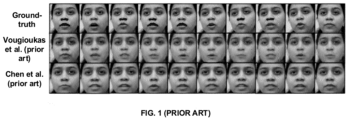
- FIG. 1 illustrate state-of-the-art-methods for speech-driven facial animation which fail to capture accurately the mouth shapes and detailed facial texture on an unknown test subject whose facial characteristics differ from the training data.
- the state-of-the-art methods of Chen et al. e.g., ⁇ Chen, L., Maddox, R.K., Duan, Z., Xu, C.: Hierarchical cross-modal talking face generation with dynamic pixel-wise loss.
- Chen et al. e.g., ⁇ Chen, L., Maddox, R.K., Duan, Z., Xu, C.: Hierarchical cross-modal talking face generation with dynamic pixel-wise loss.
- 7832-7841 e.g., ⁇ Chen, L., Maddox, R.K., Duan, Z., Xu, C.: Hierarchical cross-modal talking face generation with dynamic pixel-wise loss.
- These methods animate an entire face from speech.
- these methods and other additional approaches e.g., Fan, B., Wang, L., Soong, F.K., Xie, L.: Photo-real talking head with deep bidirectional lstm.
- IMSSP International Conference on Acoustics, Speech and Signal Processing
- the first subject-independent learning method achieves lip synchronization but images generated in Chung et al., require additional de-blurring.
- GAN-based methods were proposed by above existing approaches for generating sharp facial texture in speech-driven 2D facial animation. Although these methods animate the entire face, they mainly target lip synchronization with audio, by learning disentangled audio representations (e.g., refer ⁇ Mittal, G., Wang, B.: Animating face using disentangled audio representations. In: The IEEE Winter Conference on Applications of Computer Vision. pp.
- the generated videos with natural expressions may still imperfectly resemble the target identity, which can also be perceived as being fake.
- image attention has been learnt with the help of facial landmarks in a hierarchical approach (e.g., refer Chen et al.).
- the audio is used to generate motion on 2D facial landmarks, and the image texture is generated by conditioning on the landmarks.
- the generated texture in static facial regions can retain the texture from the identity image, the generated texture in regions of motion, especially the eyes and mouth, can differ from the target identity.
- identity-specific texture generation is needed for realistic rendering of a target's talking face.
- embodiments of the present disclosure provide systems and methods for generating audio-speech driven animated talking face using a cascaded generative adversarial network.
- the objective of the method and system of the present disclosure is to synthesize speech synchronized realistic animation of the target face.
- the systems and methods of the present disclosure capture facial motion in a lower dimension space represented by 68 facial landmark points and synthesize texture conditioned on motion of predicted landmarks.
- the system and method implement a GAN based cascaded learning approach consisting of the following: (1) Learning speech-driven motion on 2D facial landmarks independent of identity, (2) Learning eye blink motion on landmarks, (3) Landmark retargeting to generate target specific facial shape along with motion, (4) Generating facial texture from motion of landmarks.
- FIGS. 2 through 13 where similar reference characters denote corresponding features consistently throughout the figures, there are shown preferred embodiments and these embodiments are described in the context of the following exemplary system and/or method.
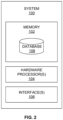
- FIG. 2 depicts a system 100 for generating audio-speech driven animated talking face of a target individual using a cascaded generative adversarial network, in accordance with an embodiment of the present disclosure.
- the system 100 includes one or more hardware processors 104, communication interface device(s) or input/output (I/O) interface(s) 106 (also referred as interface(s)), and one or more data storage devices or memory 102 operatively coupled to the one or more hardware processors 104.
- the one or more processors 104 may be one or more software processing components and/or hardware processors.
- the hardware processors can be implemented as one or more microprocessors, microcomputers, microcontrollers, digital signal processors, central processing units, state machines, logic circuitries, and/or any devices that manipulate signals based on operational instructions.
- the processor(s) is/are configured to fetch and execute computer-readable instructions stored in the memory.
- the system 100 can be implemented in a variety of computing systems, such as laptop computers, notebooks, hand-held devices, workstations, mainframe computers, servers, a network cloud and the like.
- the I/O interface device(s) 106 can include a variety of software and hardware interfaces, for example, a web interface, a graphical user interface, and the like and can facilitate multiple communications within a wide variety of networks N/W and protocol types, including wired networks, for example, LAN, cable, etc., and wireless networks, such as WLAN, cellular, or satellite.
- the I/O interface device(s) can include one or more ports for connecting a number of devices to one another or to another server.
- the memory 102 may include any computer-readable medium known in the art including, for example, volatile memory, such as static random access memory (SRAM) and dynamic random access memory (DRAM), and/or non-volatile memory, such as read only memory (ROM), erasable programmable ROM, flash memories, hard disks, optical disks, and magnetic tapes.
- volatile memory such as static random access memory (SRAM) and dynamic random access memory (DRAM)
- non-volatile memory such as read only memory (ROM), erasable programmable ROM, flash memories, hard disks, optical disks, and magnetic tapes.
- ROM read only memory
- the information stored in the database 108 may further comprise (i) DeepSpeech features of the target individual being extracted from the audio speech of the target individual (also referred as a user and interchangeably used herein), wherein the DeepSpeech features are extracted using a DeepSpeech features technique (or DeepSpeech features extraction technique and may be interchangeably used herein) comprised in the memory 102.
- the information stored in the database 108 (or memory 102) may further comprise a cascaded generative adversarial network comprising a first GAN (/-GAN) and a second GAN (t-GAN).
- the first GAN of the cascaded GAN wherein the first GAN is trained for generating speech-induced motion on a sparse representation of a neutral mean face, wherein the sparse representation of the speech-induced motion comprises a plurality of facial landmark points.
- the database 108 further comprises a plurality of eye blink movements generated from random noise input using one or more video datasets. Further, the database 108 comprises one or more target-specific landmark points generated for each user.
- the database 108 further comprises meta-learning-based texture (e.g., talking face) generated for each target individual using the cascaded GAN (or the second GAN of the cascaded GAN).
- one or more techniques, neural networks, and the like, as known in the art are comprised in the memory 102 and invoked as per the requirement to perform the methodologies described herein.
- the system 100 stores a DeepSpeech features technique, the first GAN, OpenFace, face segmentation technique, a blink generation network, the second GAN in the memory 102 that are invoked for execution of the method of the present disclosure.
- the memory 102 further comprises (or may further comprise) information pertaining to input(s)/output(s) of each step performed by the systems and methods of the present disclosure.
- input(s) fed at each step and output(s) generated at each step are comprised in the memory 102 and can be utilized in further processing and analysis.
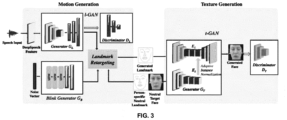
- FIG. 3 depicts a block diagram of an architecture as implemented by the system 100 of FIG. 2 for generating audio-speech driven animated talking face of a target individual using a cascaded generative adversarial network, in accordance with an embodiment of the present disclosure.
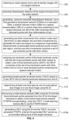
- FIG. 4 depicts an exemplary flow chart illustrating a method for generating audio-speech driven animated talking face of a target individual using a cascaded generative adversarial network comprised in the system 100 of FIG. 2 , in accordance with an embodiment of the present disclosure.
- the system(s) 100 comprises one or more data storage devices or the memory 102 operatively coupled to the one or more hardware processors 104 and is configured to store instructions for execution of steps of the method by the one or more processors 104.
- the steps of the method of the present disclosure will now be explained with reference to components of the system 100 of FIG. 2 , the block diagram of FIG. 3 , the flow diagram as depicted in FIG. 4 and diagrams of FIGS.
- the one or more hardware processors 104 obtain an audio speech and a set of identity images (SI) of a target individual as depicted in FIG. 3 .
- FIG. 3 does not depict the set of identity images (SI), it is to be understood by a person having ordinary skill in the art or person skilled in the art that the system 100 receives audio speech and the set of identity images as input, and shall input shall not be construed as limiting the scope of the present disclosure.
- the set of identity images comprises two or more images, each image containing a neutral facial expression, in one example embodiment of the present disclosure.
- Each of the identity image is a Red Green Blue (RGB) image, in another embodiment of the present disclosure.
- RGB Red Green Blue
- the system and method extract audio features (e.g., DeepSpeech features) from the final layer of the DeepSpeech network (e.g., refer ⁇ Hannun, A., Case, C., Casper, J., Catanzaro, B., Diamos, G., Elsen, E., Prenger, R., Satheesh, S., Sengupta, S., Coates, A., et al.: Deep speech: Scaling up end-to-end speech recognition. arXiv preprint arXiv: 1412.5567 (2014 )' - also referred as Hannun et al.) before the softmax functions.
- audio features e.g., DeepSpeech features
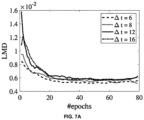
- the system and method of the present disclosure consider sliding windows of ⁇ t features for providing a temporal context to each video frame.
- different existing state-of-the-art methods e.g., refer (a) ⁇ Baltrusaitis, T., Zadeh, A., Lim, Y.C., Morency, L.P.: Openface 2.0: Facial behavior analysis toolkit.
- FG 2018 13th IEEE International Conference on Automatic Face & Gesture Recognition
- Speech-driven motion generation network as implemented by the system of the present disclosure was trained on the TCD-TIMIT dataset.
- the canonical landmarks used for training l -GAN were generated by an inverse process of the landmark retargeting method as described in later section.
- the l -GAN network was trained with a batch size of 6.
- the one or more finer deformations of lips are predicted by the first generative adversarial network (FGAN), the one or more finer deformations of lips are indicative of a difference between pronunciation of two or more letters in one or more words comprised in the audio speech.
- FGAN generative adversarial network
- Adversarial Learning of Landmark Motion Systems and methods use an adversarial network l -GAN to learn the speech-induced landmark displacement .
- the generator network G L generates displacements ⁇ l p m of a canonical landmark from a neutral pose l p m .
- Loss functions The loss functions training l -GAN are as follows:
- L 2 loss is used between consecutive frames for temporal smoothness.
- L reg ⁇ l t m ⁇ l t ⁇ 1 m ⁇ 2 2
- GAN loss An adversarial loss is used for generation of distinct mouth shapes.
- L gan E l t m ⁇ log ( D L l t m ⁇ + E F t log 1 ⁇ D L ( G L l p m F t
- L motion ⁇ dist L dist + ⁇ reg L reg + ⁇ dir L dir + ⁇ gan L gan ⁇ dist , ⁇ reg , ⁇ dir , and ⁇ gan are loss parameters defining contribution of each loss term, and are experimentally set to 1, 0.5, 0.5 and 1 as presented in the ablation study in the later sections.
- the one or more hardware processors 104 generate a plurality of eye blink movements from random noise input using a video dataset, wherein the plurality of eye blink movements are generated for each eye based on a sequence of generated displacements of associated facial landmark points of each eye region, and wherein the plurality of eye blink movements comprise a set of eye landmark points with blink motion.
- the step of generating, via a video dataset, a plurality of eye blink movements from random noise input comprises: performing a comparison of the sequence of generated displacements of the associated facial landmark points of each eye region with one or more ground truth displacements, wherein one or more higher order moments of distribution of the sequence of generated displacements are compared with the one or more ground truth displacements; and generating the plurality of eye blink movements based on the comparison.
- the one or more higher order moments of the sequence of generated displacements comprise one or more statistics of the distribution of the sequence of generated displacements.
- the one or more statistics of the distribution of the sequence of generated displacements comprise at least one of a mean, a variance, and a skewness, wherein a Maximum Mean Discrepancy (MMD) loss is computed using the one or more statistics, and wherein the MMD loss is a measure of similarity or a dissimilarity between a distribution of (i) the plurality of eye blink movements and (ii) one or more ground truth eye blink movements.
- MMD Maximum Mean Discrepancy
- the one or more hardware processors 104 replace one or more eye landmark points of the plurality of facial landmark points with the set of eye landmark points with blink motion to obtain a set of final landmark points
- the set of final landmark points comprises (i) the set of eye landmark points with blink motion and (ii) one or more landmark points containing the speech-induced motion.
- Eye blinks are essential for realism of synthesized face animation, but not dependent on speech. Therefore, the system of the present disclosure implements an unsupervised method for generation of realistic eye blinks through learning a mapping from a random noise Z t ⁇ ( ⁇ , ⁇ 2 )
- Blink generator network G B of the system 100 learns the blink pattern and duration through the mapping and generates a sequence l t e on canonical landmarks by minimizing the MMD loss as follows:
- L MMD E X , X ′ ⁇ p K X , X ′ + E Y , Y ′ ⁇ p K Y , Y ′ ⁇ E X ⁇ p , Y ⁇ q K X Y
- ( X, Y ) is defined as exp ⁇ x ⁇ y 2 2 ⁇
- p and q represent distributions of the GT ⁇ l t e ⁇ and generated eye landmark motion ⁇ l t e respectively.
- the system also uses a min-max regularization to ensure that the range of the generated landmarks matches with the average range of average displacements present in the training data.
- the one or more hardware processors 108 determine at least one face type as one of a pre-stored face image or a new face image using the set of identity images.
- the at least one face type may be obtained as an input (e.g., input from a user). User may provide this input face type based on the set of identity images comprised in the system 100.
- the one or more hardware processors 108 perform, via a second generative adversarial network (SGAN) of the cascaded GAN executed by the one or more hardware processors, at step 216a, fine-tune a meta-trained network (MN) using the set of identity images (SI) and the plurality of facial landmark points extracted from the SI for the target individual to obtain a fine-tuned meta-trained network (FTMTN) and then generate a meta-learning texture (MLT) (also referred as meta-learning-based texture and interchangeably used herein) via the FTMTN using the one or more target-specific landmark points (TSLP); or at step 216b generate the meta-learning texture (MLT) using the SI and the one or more target-specific landmark points (TSLP), via a pre-generated fine-tuned meta-trained network (FTMTN).
- MN meta-trained network
- SI identity images
- FTMTN fine-tuned meta-trained network
- FTMTN fine-tuned meta-t
- the generated MLT serves as an animated talking face of the target individual.
- the system and method of the present disclosure perform step 216a, in one example embodiment.
- the at least one determined face type is a pre-stored face image comprised in the system 100, then the system and method of the present disclosure perform step 216b, in another example embodiment.
- the steps 214 till 216a and 216b are better understood by way of following description and examples, which shall not be construed as limiting the scope of the present disclosure.
- Systems and methods of the present disclosure use the person-specific landmarks ⁇ l t ⁇ containing motion due to the speech and the eye blink to synthesize animated face images ⁇ I t ⁇ by learning a mapping : ( l t , ⁇ I n ⁇ ) ⁇ I t using given target images ⁇ I n
- Systems and methods of the present disclosure use an adversarial network t-GAN (e.g., also referred as the second GAN, deep tensor generative adversarial network and interchangeably used herein) to learn the mapping .
- Generator network G T as depicted in FIG. 3 consists of a texture encoder E I and landmark encoder-decoder E L influenced by E I .
- the system 100 of the present disclosure uses Adaptive Instance Normalization (e.g., refer ⁇ Huang, X., Belongie, S.: Arbitrary style transfer in real-time with adaptive instance normalization. In: Proceedings of the IEEE International Conference on Computer Vision. pp.
- a discriminator network D T is implemented by the system as depicted in FIG. 3 to discriminate the real images from fake.
- Perceptual loss We minimize a perceptual loss (e.g., refer ⁇ Johnson, J., Alahi, A., Fei-Fei, L.: Perceptual losses for real-time style transfer and super-resolution. In: European conference on computer vision. pp. 694 ⁇ 711. Springer (2016 )' - also referred as Johnson et al.) which is the different in feature representations of generated images and ground truth images.
- L feat ⁇ 1 ⁇ vgg 1 I t ⁇ vgg 1 I t ⁇ ⁇ 2 2 + ⁇ 2 ⁇ vgg 2 I t ⁇ vgg 2 I t ⁇ ⁇ 2 2
- vgg 1 and vgg 2 are features obtained using pre-trained VGG19 and VGGFace (e.g., refer ⁇ Parkhi, O.M., Vedaldi, A., Zisserman, A., et al.: Deep face recognition. In: bmvc. vol. 1, p. 6 (2015 ) - also referred as Parkhi et al.) respectively.
- L texture ⁇ pix L pix + ⁇ adv L adv + ⁇ feat L feat ⁇ pix , ⁇ adv, and ⁇ feat are the loss parameters defining contribution of each loss term in L texture .
- the system 100 uses a model-agnostic meta-learning (MAML) (e.g., refer Finn et al.,) to train the second GAN (e.g., t - GAN ) for quick adaptation to the unknown face at inference time using few images.
- MAML trains on a set of tasks T called episodes. For each of the tasks, the number of samples for training and validation is d trn and d qry respectively.
- the resultant direction of the global weights encodes a global information of the t-GAN network for all the tasks which is used as an initialization for fine-tuning during inference.
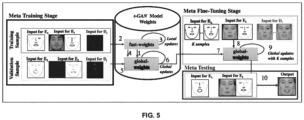
- FIG. 5 depicts state transitions of weights of t -GAN during meta-training, in accordance with an example embodiment of the present disclosure.
- Fast-weights (FW) and global-weights (GW) are two states of t-GAN's weights.
- the sequence of training schedule include: (1) copying FW to GW to keep global state unchanged during the training, (2)-(3) update the FW in iterations, (4)-(5) compute validation loss using FW, (6) update GW using total validation loss (7) copy GW for the fine-tuning, (8)-(9) updating the GW using K sample images, (10) using the updated GW to produce target subject's face.
- Fine-tuning step During fine-tuning, the t -GAN is initialized from the global-weights and the weights are updated by minimizing the loss as described in Equation (13) (e.g., refer above equation 13).
- Embodiments of the present disclosure present the detail experiment results for the method of the present disclosure on different datasets.
- the present disclosure shows the efficacy of motion generation and texture generation of the system and method of the present disclosure in detail along with the network ablation study.
- Embodiments of the present disclosure also show that the accuracy of the cascaded GAN based approach is quite higher than an alternate regression-based strategy.
- the meta-learning-based texture generation strategy enables the method of the present disclosure to be more adaptable to the unknown faces.
- the combined result is a significantly better facial animation from speech than the state-of-the-art methods in terms of both quantitatively and qualitatively.
- detailed results for each of the building blocks of the system and method are described/shown.
- TCD-TIMIT e.g., refer 'Harte, N., Gillen, E.: TCD-TIMIT: An audio-visual corpus of continuous speech. IEEE Transactions on Multimedia 17(5), 603 ⁇ 615 (2015) - also referred as Harte et al.'
- GRID e.g., refer ⁇ Cooke, M., Barker, J., Cunningham, S., Shao, X.: An audio-visual corpus for speech perception and automatic speech recognition.
- the present disclosure has also recorded a dataset to show the efficacy of present disclosure's model for completely unknown faces.
- the present disclosure's model was trained only on TCD-TIMIT and the model was tested on GRID and the recorded data showed the ability of the method of the present disclosure for cross dataset testing.
- the training split contained 3378 videos from 49 subjects with around 6913 sentences uttered in a limited variety of accents.
- Test split (same as Vougioukas, K., Petridis, S., Pantic, M.: Realistic speech-driven facial animation with gans.
- arXiv preprint arXiv:1906.06337 (2019) of TCD-TIMIT and GRID datasets contained 1631 and 9957 videos respectively.
- the motion generation part of the method of the present disclosure consisted of two separate networks for i) speech-induced motion prediction, and ii) realistic generation of eye blinks. Below are the networks described in detail:
- Network Architecture of Blink Generator G B uses recurrent neural network (RNN) as known in the art to predict a sequence of displacements R n ⁇ 75 ⁇ 44 , i.e., x, y coordinates of eye landmarks l t e ⁇ R 22 ⁇ 2 over 75 timestamps from given noise vector z ⁇ ( ⁇ , ⁇ 2 ) with z ⁇ R n ⁇ 75 ⁇ 10 .
- RNN recurrent neural network
- the system and method of the present disclosure consider sliding windows of ⁇ t features for providing a temporal context to each video frame.
- different existing state-of-the-art methods e.g., refer (a) ⁇ Baltrusaitis, T., Zadeh, A., Lim, Y.C., Morency, L.P.: Openface 2.0: Facial behavior analysis toolkit.
- FG 2018 13th IEEE International Conference on Automatic Face & Gesture Recognition
- Speech-driven motion generation network as implemented by the system of the present disclosure was trained on the TCD-TIMIT dataset.
- the canonical landmarks used for training l -GAN were generated by an inverse process of the landmark retargeting method as described in later section.
- the l -GAN network was trained with a batch size of 6.
- LMD Landmark Distance
- AV Offset and AV confidence produced by Syncnet [?] Audio-Visual synchronization metrices
- AV Offset and AV confidence produced by Syncnet [?]
- LMD was computed using lip landmarks extracted from the final generated frames. Lower value of LMD and AV offset with higher AV confidence indicates better lip synchronization.
- the method of the present disclosure showed better accuracy compared to state-of-the-art methods.
- the present disclosure's models trained on TCD-TIMIT also showed good generalization capability in cross-dataset evaluation on GRID dataset (Table 2).
- Chen et al. also generates facial landmarks from audio features (MFCC), unlike their regression-based approach, the use of DeepSpeech features, landmark retargeting, and adversarial learning as implemented in the system and method of the present disclosure results in improved accuracy of landmark generation.
- the facial landmarks as predicted/generated by the present disclosure contained natural eye blink motion for added realism.
- Eye blinks were detected by the system 100 using sharp drop in EAR (Eye Aspect Ratio) signal (e.g., refer ⁇ Chen et al.') calculated using landmarks of eye corners and eyelids.
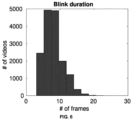
- Blink duration was calculated as the number of consecutive frames between start and end of the sharp drop in EAR.
- the average blink duration and blink frequencies generated from the method of the present disclosure is similar to that of natural human blinks.
- FIG. 7B depicts lip synchronization (LMD) with different losses used for training speech-driven motion generation network, in accordance with an example embodiment of the present disclosure.
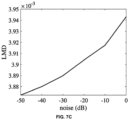
- FIG. 7C with reference to FIGS.
- Using direction loss helps to achieve faster convergence of the landmark prediction network of the present disclosure.
- Use of DeepSpeech features helps the method of the present disclosure to achieve robustness in lip synchronization even for audios with noise, different accents, and different languages.
- Robustness of the l -GAN with different levels of noise was evaluated by adding synthetic noise in audio input.
- FIG. 7C shows up to -30dB, the lip motion does not get affected by the noise and starts degrading afterwards.
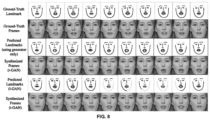
- FIG. 8 qualitative result of landmark generation network on TCD-TIMIT dataset are presented. More specifically, FIG. 8 , with reference to FIGS. 2 through 7C , depicts performance comparison of l -GAN using only generator (third row) and the complete GAN (fifth row), in accordance with an example embodiment of the present disclosure. It shows the effectiveness of using discriminator in l -GAN. As can be observed in FIG. 8 , the regression-based approach cannot capture the finer details like "a” and "o" of lip motion without the help of the discriminator.
- the one or more finer deformations of lips are predicted by the first generative adversarial network (FGAN)
- the one or more finer deformations of lips are indicative of a difference between pronunciation of two or more letters in one or more words comprised in the audio speech as described in step 206 of FIG. 2 .
- a method similar to a self-attention method as known in the art e.g., refer ⁇ Zhang, H., Goodfellow, I., Metaxas, D., Odena, A.: Self-attention generative adversarial networks.
- arXiv preprint arXiv:1805.08318 (2018 )' - also referred as Zhang et al. at the 32 ⁇ 32 layer activation of downsampling and upsampling layers.
- the discriminator network D T as depicted in FIG. 3 consisted of 6 residual blocks similar to E I , followed by a max pooling and a fully connected layer.
- the meta-learning texture comprises a plurality of high-fidelity images (sharper images).
- a plurality of individual pixels of the plurality of high-fidelity images are generated using a neighborhood feature of an output of an intermediary layer of the SGAN, in one example embodiment.
- spectral normalization as known in the art (e.g., refer ⁇ Miyato, T., Kataoka, T., Koyama, M., Yoshida, Y.: Spectral normalization for generative adversarial networks.
- the second GAN was meta-trained using ground-truth landmarks following the teacher forcing strategy.
- Fixed step size as known in the art (refer Finn et al.) of 1e-3 and Adam as the meta-optimizer (refer Finn et al.) with learning rate 1e-4 were used.
- 5 images of the target identity were used, and the person-specific landmark generated by the l -GAN were used to produce the output images.
- Voxceleb dataset e.g., refer ⁇ Nagrani, A., Chung, J.S., Zisserman, A.: Voxceleb: a large-scale speaker identification dataset.
- arXiv preprint arXiv:1706.08612 (2017 )' - also referred as Nagrani et al. which gives average PSNR, SSIM and CPBD of 25.2, 0.63, and 0.11, respectively.
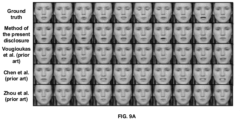
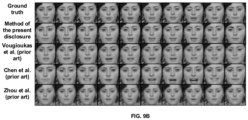
- FIGS. 9A through 9C shows qualitative comparison against Chen et al, Zhou et al. and Vougioukas et al. More specifically, FIGS. 9A-9C , with reference to FIGS. 2 through 8 , depict qualitative comparison of the method of the present disclosure with the recent state-of-the-art methods on TCD-TIMIT dataset (upper 10 rows) and GRID dataset (lower 5 rows), in accordance with an example embodiment of the present disclosure.
- the results of the present disclosure indicate improved identity preservation of the subject, good lip synchronization, detailed texture (such as teeth), lesser blur, and presence of randomly introduced eye blinks. It can be seen that Vougioukas et al., and Zhou et al.
- FIG. 10 shows the qualitative comparison of the GAN based texture generation against a regression based (without discriminator) network output where it is evident that our GAN based network gives more accurate lip deformation with similar motion as ground-truth. More specifically, FIG. 10 , with reference to FIGS. 2 through 9 , depicts qualitative comparison between the t -GAN based method (Row 2) against the regression-based generator G L (Row 3) method, in accordance with an example embodiment of the present disclosure.
- the present disclosure further shows a detail ablation study on the TCD-TIMIT dataset to find out the effect of different losses.
- CC Channel-wise concatenation
- ADIN adaptive instance normalization
- FIG. 10 shows that GAN based method produces more accurate lip deformation than the regression-based method which always produces overly smooth outcome. It is also supported by the quantitative result shown in Table 4.
- FIG. 11 shows the ablation study for the number of images required for fine-tuning on GRID dataset. More specifically, FIG. 11 , with reference to FIGS.
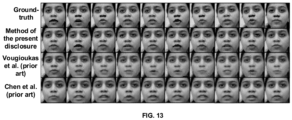
- FIG. 13 depicts a comparison of the generated facial texture and mouth shapes generated by the method of the present disclosure with that speech-driven facial animation of state-of-the-art-methods, in accordance with an embodiment of the present disclosure. More specifically, it can be observed from FIG. 13 that for speech-driven facial animation the state-of-the-art-methods (e.g., Chen et al., and Vougioukas et al.) fail to capture accurately the mouth shapes and detailed facial texture on an unknown test subject whose facial characteristics differ from the training data.
- the state-of-the-art methods of Chen et al. and Vougioukas et al. were evaluated using their publicly available pre-trained models trained on LRW and TCD-TIMIT datasets respectively.
- the generated face can appear to be very different from the target identity (e.g., refer output of Vougioukas et al.) and there can be significant blur in the mouth region (e.g., refer output of Chen et al.), leading to unrealistic face animation.
- the generated facial texture and mouth shapes can accurately resemble the ground-truth animation sequence.
- Embodiments of the present disclosure provide systems and methods for speech driven facial animation using the cascaded GAN comprised in the system 100 of FIG. 2 .
- the method produces realistic facial animation for unknown subjects with different languages and accent in speech showing generalization capability.
- This advantage of the present disclosure is attributed due to the separate learning of motion and texture generator GANs with meta-learning capability.
- the method and system of the present disclosure outperform state-of-the-art methods/systems significantly.
- the hardware device can be any kind of device which can be programmed including e.g. any kind of computer like a server or a personal computer, or the like, or any combination thereof.
- the device may also include means which could be e.g. hardware means like e.g. an application-specific integrated circuit (ASIC), a field-programmable gate array (FPGA), or a combination of hardware and software means, e.g.
- ASIC application-specific integrated circuit
- FPGA field-programmable gate array
- the means can include both hardware means and software means.
- the method embodiments described herein could be implemented in hardware and software.
- the device may also include software means.
- the embodiments may be implemented on different hardware devices, e.g. using a plurality of CPUs.
- the embodiments herein can comprise hardware and software elements.
- the embodiments that are implemented in software include but are not limited to, firmware, resident software, microcode, etc.
- the functions performed by various components described herein may be implemented in other components or combinations of other components.
- a computer-usable or computer readable medium can be any apparatus that can comprise, store, communicate, propagate, or transport the program for use by or in connection with the instruction execution system, apparatus, or device.
- a computer-readable storage medium refers to any type of physical memory on which information or data readable by a processor may be stored.
- a computer-readable storage medium may store instructions for execution by one or more processors, including instructions for causing the processor(s) to perform steps or stages consistent with the embodiments described herein.
- the term "computer-readable medium” should be understood to include tangible items and exclude carrier waves and transient signals, i.e., be non-transitory. Examples include random access memory (RAM), read-only memory (ROM), volatile memory, nonvolatile memory, hard drives, CD ROMs, DVDs, flash drives, disks, and any other known physical storage media.
Landscapes
- Engineering & Computer Science (AREA)
- Physics & Mathematics (AREA)
- Theoretical Computer Science (AREA)
- Health & Medical Sciences (AREA)
- General Physics & Mathematics (AREA)
- Data Mining & Analysis (AREA)
- Computational Linguistics (AREA)
- General Health & Medical Sciences (AREA)
- Evolutionary Computation (AREA)
- General Engineering & Computer Science (AREA)
- Artificial Intelligence (AREA)
- Life Sciences & Earth Sciences (AREA)
- Biophysics (AREA)
- Biomedical Technology (AREA)
- Molecular Biology (AREA)
- Computing Systems (AREA)
- Mathematical Physics (AREA)
- Software Systems (AREA)
- Multimedia (AREA)
- Computer Vision & Pattern Recognition (AREA)
- Human Computer Interaction (AREA)
- Oral & Maxillofacial Surgery (AREA)
- Audiology, Speech & Language Pathology (AREA)
- Acoustics & Sound (AREA)
- Bioinformatics & Computational Biology (AREA)
- Evolutionary Biology (AREA)
- Bioinformatics & Cheminformatics (AREA)
- Quality & Reliability (AREA)
- Signal Processing (AREA)
- Image Analysis (AREA)
- Processing Or Creating Images (AREA)
Claims (9)
- Prozessorimplementiertes Verfahren zum Erzeugen eines audiosprachgesteuerten animierten Sprechgesichts unter Verwendung eines kaskadierten generativen gegnerischen Netzwerks, wobei das Verfahren Folgendes umfasst:Erhalten, über einen oder mehrere Hardwareprozessoren, einer Audiosprache und eines Satzes von Identitätsbildern (SI) eines Zielindividuums (202);Extrahieren, über den einen oder die mehreren Hardwareprozessoren, eines oder mehrerer DeepSpeech-Merkmale des Zielindividuums aus der Audiosprache (204);Erzeugen, unter Verwendung der extrahierten DeepSpeech-Merkmale, über ein erstes generatives gegnerisches Netzwerk (FGAN) eines kaskadierten GAN, das von dem einen oder den mehreren Hardwareprozessoren ausgeführt wird, einer sprachinduzierten Bewegung (SIM) auf einer spärlichen Darstellung (SR) eines neutralen mittleren Gesichts, wobei die SR der SIM eine Mehrzahl von Gesichtsorientierungspunkten mit einer oder mehreren feineren Verformungen der Lippen (206) umfasst;Erzeugen, über den einen oder die mehreren Hardwareprozessoren, einer Mehrzahl von Augenblinzelbewegungen aus einer Zufallsrauscheingabe, die aus einem Videodatensatz gelernt wird, wobei die Mehrzahl von Augenblinzelbewegungen für jedes Auge basierend auf einer Sequenz von erzeugten Verschiebungen von assoziierten Gesichtsorientierungspunkten jeder Augenregion erzeugt wird, und wobei die Mehrzahl von Augenblinzelbewegungen einen Satz von Augenorientierungspunkten mit Blinzelbewegung (208) umfasst;Ersetzen eines oder mehrerer Augenorientierungspunkte der Mehrzahl von Gesichtsorientierungspunkten durch den Satz von Augenorientierungspunkten mit Blinzelbewegung, um einen Satz von endgültigen Orientierungspunkten zu erhalten, wobei der Satz von endgültigen Orientierungspunkten (i) den Satz von Augenorientierungspunkten mit Blinzelbewegung und (ii) einen oder mehrere Orientierungspunkte, die die sprachinduzierte Bewegung (210) enthalten, umfasst, wobei die sprachinduzierte Bewegung basierend auf (i) einer Bewegungsrichtung der Mehrzahl von Gesichtsorientierungspunkten, (ii) einem gegnerischen Verlust, der zum Trainieren des FGAN verwendet wird, (iii) einem zeitlichen Glättungsverlust in der Mehrzahl von Gesichtsorientierungspunkten und (iv) einem Abstandsverlust zwischen einem oder mehreren vorhergesagten Gesichtsorientierungspunkten und einem oder mehreren Ground-Truth-Gesichtsorientierungspunkten gelernt wird;Erzeugen, über den einen oder die mehreren Hardwareprozessoren, eines oder mehrerer zielspezifischer Orientierungspunkte (TSLP) basierend auf (i) dem Satz von endgültigen Orientierungspunkten (FLP) und (ii) einer Identitätsorientierung, die aus dem Satz von Identitätsbildern (212) erhalten wird;Bestimmen mindestens eines Gesichtstyps als eines von einem vorgespeicherten Gesichtsbild oder einem neuen Gesichtsbild unter Verwendung des Satzes von Identitätsbildern (214); undDurchführen, über ein zweites generatives gegnerisches Netzwerk (SGAN) des kaskadierten GAN, das durch den einen oder die mehreren Hardwareprozessoren ausgeführt wird, basierend auf dem mindestens einen bestimmten Gesichtstyp, eines von Folgendem:Feinabstimmen eines metatrainierten Netzwerks (MN) unter Verwendung des Satzes von Identitätsbildern (SI) und der Mehrzahl von Gesichtsorientierungspunkten, die aus dem Satz von Identitätsbildern (SI) extrahiert wurden, für das Zielindividuum, um ein feinabgestimmtes metatrainiertes Netzwerk (FTMTN) zu erhalten, und Erzeugen, unter Verwendung des einen oder der mehreren zielspezifischen Orientierungspunkte (TSLP), einer metalernbasierten Textur (MLT) über das FTMTN davon (216a); oderErzeugen einer metalernbasierten Textur (MLT) unter Verwendung des Satzes von Identitätsbildern (SI) und des einen oder der mehreren zielspezifischen Orientierungspunkte (TSLP) über ein vorerzeugtes feinabgestimmtes metatrainiertes Netzwerk (FTMTN), wobei die erzeugte MLT als ein animiertes Sprechgesicht des Zielindividuums (216b) dient.
- Prozessorimplementiertes Verfahren nach Anspruch 1, wobei die eine oder die mehreren feineren Verformungen der Lippen durch das erste generative gegnerische Netzwerk (FGAN) vorhergesagt werden und wobei die eine oder die mehreren feineren Verformungen der Lippen einen Unterschied zwischen der Aussprache von zwei oder mehr Buchstaben in einem oder mehreren Wörtern, die in der Audiosprache enthalten sind, anzeigen.
- Prozessorimplementiertes Verfahren nach Anspruch 1, wobei die metalernbasierte Textur eine Mehrzahl von hochgetreuen Bildern umfasst und wobei eine Mehrzahl von einzelnen Pixeln der Mehrzahl von hochgetreuen Bildern unter Verwendung eines Nachbarschaftsmerkmals einer Ausgabe einer Zwischenschicht des SGAN erzeugt wird.
- System (100), das Folgendes umfasst:einen Speicher (102), der Anweisungen speichert;eine oder mehrere Kommunikationsschnittstellen (106); undeinen oder mehrere Hardwareprozessoren (104), die mit dem Speicher (102) über die eine oder die mehreren Kommunikationsschnittstellen (106) gekoppelt sind, wobei der eine oder die mehreren Hardwareprozessoren (104) durch die Anweisungen konfiguriert sind zum:Erhalten einer Audiosprache und eines Satzes von Identitätsbildern (SI) eines Zielindividuums;Extrahieren eines oder mehrerer DeepSpeech-Merkmale des Zielindividuums aus der Audiosprache;Erzeugen, unter Verwendung der extrahierten DeepSpeech-Merkmale, über ein erstes generatives gegnerisches Netzwerk (FGAN) eines kaskadierten GAN, das in dem Speicher (102) enthalten ist, einer sprachinduzierten Bewegung (SIM) auf einer spärlichen Darstellung (SR) eines neutralen mittleren Gesichts, wobei die SR der SIM eine Mehrzahl von Gesichtsorientierungspunkten mit einer oder mehreren feineren Verformungen der Lippen umfasst;Erzeugen einer Mehrzahl von Augenblinzelbewegungen aus einer Zufallsrauscheingabe, die aus einem Videodatensatz gelernt wird, wobei die Mehrzahl von Augenblinzelbewegungen für jedes Auge basierend auf einer Sequenz von erzeugten Verschiebungen von assoziierten Gesichtsorientierungspunkten jeder Augenregion erzeugt wird, und wobei die Mehrzahl von Augenblinzelbewegungen einen Satz von Augenorientierungspunkten mit Blinzelbewegung umfasst;Ersetzen eines oder mehrerer Augenorientierungspunkte der Mehrzahl von Gesichtsorientierungspunkten durch den Satz von Augenorientierungspunkten mit Blinzelbewegung, um einen Satz von endgültigen Orientierungspunkten zu erhalten, wobei der Satz von endgültigen Orientierungspunkten (i) den Satz von Augenorientierungspunkten mit Blinzelbewegung und (ii) einen oder mehrere Orientierungspunkte, die die sprachinduzierte Bewegung enthalten, umfasst, wobei die sprachinduzierte Bewegung basierend auf (i) einer Bewegungsrichtung der Mehrzahl von Gesichtsorientierungspunkten, (ii) einem gegnerischen Verlust, der zum Trainieren des FGAN verwendet wird, (iii) einem zeitlichen Glättungsverlust in der Mehrzahl von Gesichtsorientierungspunkten und (iv) einem Abstandsverlust zwischen einem oder mehreren vorhergesagten Gesichtsorientierungspunkten und einem oder mehreren Ground-Truth-Gesichtsorientierungspunkten gelernt wird;Erzeugen eines oder mehrerer zielspezifischer Orientierungspunkte (TSLP) basierend auf (i) dem Satz von endgültigen Orientierungspunkten (FLP) und (ii) einer Identitätsorientierung, die aus dem Satz von Identitätsbildern erhalten wird;Bestimmen mindestens eines Gesichtstyps als eines von einem vorgespeicherten Gesichtsbild oder einem neuen Gesichtsbild unter Verwendung des Satzes von Identitätsbildern; undDurchführen, über ein zweites generatives gegnerisches Netzwerk (SGAN) des kaskadierten GAN, das durch den einen oder die mehreren Hardwareprozessoren ausgeführt wird, basierend auf dem mindestens einen bestimmten Gesichtstyp, eines von Folgendem:Feinabstimmen eines metatrainierten Netzwerks (MN) unter Verwendung des Satzes von Identitätsbildern (SI) und der Mehrzahl von Gesichtsorientierungspunkten, die aus dem Satz von Identitätsbildern (SI) extrahiert wurden, für das Zielindividuum, um ein feinabgestimmtes metatrainiertes Netzwerk (FTMTN) zu erhalten, und Erzeugen, unter Verwendung des einen oder der mehreren zielspezifischen Orientierungspunkte (TSLP), einer metalernbasierten Textur (MLT) über das FTMTN davon; oderErzeugen einer metalernbasierten Textur (MLT) unter Verwendung des Satzes von Identitätsbildern (SI) und des einen oder der mehreren zielspezifischen Orientierungspunkte (TSLP) über ein vorerzeugtes feinabgestimmtes metatrainiertes Netzwerk (FTMTN), wobei die erzeugte MLT als ein animiertes Sprechgesicht des Zielindividuums dient.
- System nach Anspruch 4, wobei die eine oder die mehreren feineren Verformungen der Lippen durch das erste generative gegnerische Netzwerk (FGAN) vorhergesagt werden und wobei die eine oder die mehreren feineren Verformungen der Lippen einen Unterschied zwischen der Aussprache von zwei oder mehr Buchstaben in einem oder mehreren Wörtern, die in der Audiosprache enthalten sind, anzeigen.
- System nach Anspruch 4, wobei die metalernbasierte Textur eine Mehrzahl von hochgetreuen Bildern umfasst und wobei eine Mehrzahl von einzelnen Pixeln der Mehrzahl von hochgetreuen Bildern unter Verwendung eines Nachbarschaftsmerkmals einer Ausgabe einer Zwischenschicht des SGAN erzeugt wird.
- Computerprogrammprodukt, umfassend ein nichttransitorisches computerlesbares Medium mit einem darin verkörperten computerlesbaren Programm, wobei das computerlesbare Programm, wenn es auf einer Rechenvorrichtung ausgeführt wird, die Rechenvorrichtung veranlasst, ein audiosprachgesteuertes animiertes Sprechgesicht unter Verwendung eines kaskadierten generativen gegnerischen Netzwerks zu erzeugen durchErhalten, über einen oder mehrere Hardwareprozessoren, einer Audiosprache und eines Satzes von Identitätsbildern eines Zielindividuums;Extrahieren, über den einen oder die mehreren Hardwareprozessoren, eines oder mehrerer DeepSpeech-Merkmale des Zielindividuums aus der Audiosprache;Erzeugen, unter Verwendung der extrahierten DeepSpeech-Merkmale, über ein erstes generatives gegnerisches Netzwerk (FGAN) des kaskadierten GAN, das durch den einen oder die mehreren Hardwareprozessoren ausgeführt wird, einer sprachinduzierten Bewegung (SIM) auf einer spärlichen Darstellung (SR) eines neutralen mittleren Gesichts, wobei die SR der SIM eine Mehrzahl von Gesichtsorientierungspunkten mit einer oder mehreren feineren Verformungen der Lippen umfasst;Erzeugen, über den einen oder die mehreren Hardwareprozessoren, einer Mehrzahl von Augenblinzelbewegungen aus einer Zufallsrauscheingabe, die aus einem Videodatensatz gelernt wird, wobei die Mehrzahl von Augenblinzelbewegungen für jedes Auge basierend auf einer Sequenz von erzeugten Verschiebungen von assoziierten Gesichtsorientierungspunkten jeder Augenregion erzeugt wird, und wobei die Mehrzahl von Augenblinzelbewegungen einen Satz von Augenorientierungspunkten mit Blinzelbewegung umfasst;Ersetzen eines oder mehrerer Augenorientierungspunkte der Mehrzahl von Gesichtsorientierungspunkten durch den Satz von Augenorientierungspunkten mit Blinzelbewegung, um einen Satz von endgültigen Orientierungspunkten zu erhalten, wobei der Satz von endgültigen Orientierungspunkten (i) den Satz von Augenorientierungspunkten mit Blinzelbewegung und (ii) einen oder mehrere Orientierungspunkte, die die sprachinduzierte Bewegung enthalten, umfasst, wobei die sprachinduzierte Bewegung basierend auf (i) einer Bewegungsrichtung der Mehrzahl von Gesichtsorientierungspunkten, (ii) einem gegnerischen Verlust, der zum Trainieren des FGAN verwendet wird, (iii) einem zeitlichen Glättungsverlust in der Mehrzahl von Gesichtsorientierungspunkten und (iv) einem Abstandsverlust zwischen einem oder mehreren vorhergesagten Gesichtsorientierungspunkten und einem oder mehreren Ground-Truth-Gesichtsorientierungspunkten gelernt wird;Erzeugen, über den einen oder die mehreren Hardwareprozessoren, eines oder mehrerer zielspezifischer Orientierungspunkte (TSLP) basierend auf (i) dem Satz von endgültigen Orientierungspunkten (FLP) und (ii) einer Identitätsorientierung, die aus dem Satz von Identitätsbildern erhalten wird;Bestimmen mindestens eines Gesichtstyps als eines von einem vorgespeicherten Gesichtsbild oder einem neuen Gesichtsbild unter Verwendung des Satzes von Identitätsbildern; undDurchführen, über ein zweites generatives gegnerisches Netzwerk (SGAN) des kaskadierten GAN, das durch den einen oder die mehreren Hardwareprozessoren ausgeführt wird, basierend auf dem mindestens einen bestimmten Gesichtstyp, eines von Folgendem:Feinabstimmen eines metatrainierten Netzwerks (MN) unter Verwendung des Satzes von Identitätsbildern (SI) und der Mehrzahl von Gesichtsorientierungspunkten, die aus den SI extrahiert wurden, für das Zielindividuum, um ein feinabgestimmtes metatrainiertes Netzwerk (FTMTN) zu erhalten, und Erzeugen, unter Verwendung des einen oder der mehreren zielspezifischen Orientierungspunkte (TSLP), einer metalernenden Textur (MLT) über das FTMTN davon; oderErzeugen einer metalernenden Textur (MLT) unter Verwendung der SI und des einen oder der mehreren zielspezifischen Orientierungspunkte (TSLP) über ein vorerzeugtes feinabgestimmtes metatrainiertes Netzwerk (FTMTN), wobei die erzeugte MLT als ein animiertes Sprechgesicht des Zielindividuums dient.
- Computerprogrammprodukt nach Anspruch 7, wobei die eine oder die mehreren feineren Verformungen der Lippen durch das erste generative gegnerische Netzwerk (FGAN) vorhergesagt werden und wobei die eine oder die mehreren feineren Verformungen der Lippen einen Unterschied zwischen der Aussprache von zwei oder mehr Buchstaben in einem oder mehreren Wörtern, die in der Audiosprache enthalten sind, anzeigen.
- Computerprogrammprodukt nach Anspruch 7, wobei die metalernbasierte Textur eine Mehrzahl von hochgetreuen Bildern umfasst und wobei eine Mehrzahl von einzelnen Pixeln der Mehrzahl von hochgetreuen Bildern unter Verwendung eines Nachbarschaftsmerkmals einer Ausgabe einer Zwischenschicht des SGAN erzeugt wird.
Applications Claiming Priority (1)
| Application Number | Priority Date | Filing Date | Title |
|---|---|---|---|
| IN202021032794 | 2020-07-30 |
Publications (3)
| Publication Number | Publication Date |
|---|---|
| EP3945498A1 EP3945498A1 (de) | 2022-02-02 |
| EP3945498C0 EP3945498C0 (de) | 2024-11-27 |
| EP3945498B1 true EP3945498B1 (de) | 2024-11-27 |
Family
ID=74871158
Family Applications (1)
| Application Number | Title | Priority Date | Filing Date |
|---|---|---|---|
| EP21161395.5A Active EP3945498B1 (de) | 2020-07-30 | 2021-03-09 | Erzeugung eines von durch audiosprache gesteuerten, animierten, sprechenden gesichts unter verwendung eines kaskadierten generativen kontradiktorischen netzwerks |
Country Status (2)
| Country | Link |
|---|---|
| US (1) | US11551394B2 (de) |
| EP (1) | EP3945498B1 (de) |
Families Citing this family (28)
| Publication number | Priority date | Publication date | Assignee | Title |
|---|---|---|---|---|
| CN111738230B (zh) * | 2020-08-05 | 2020-12-15 | 深圳市优必选科技股份有限公司 | 一种人脸识别方法、人脸识别装置及电子设备 |
| KR102766918B1 (ko) * | 2020-12-10 | 2025-02-14 | 주식회사 딥브레인에이아이 | 립싱크 영상 생성 장치 및 방법 |
| US12118779B1 (en) * | 2021-09-30 | 2024-10-15 | United Services Automobile Association (Usaa) | System and method for assessing structural damage in occluded aerial images |
| CN113971828B (zh) * | 2021-10-28 | 2023-10-31 | 北京百度网讯科技有限公司 | 虚拟对象唇形驱动方法、模型训练方法、相关装置及电子设备 |
| CN114581980B (zh) * | 2022-03-03 | 2025-05-23 | 北京京东尚科信息技术有限公司 | 用于生成说话人像视频和训练人脸渲染模型的方法、装置 |
| US12393794B2 (en) * | 2022-04-08 | 2025-08-19 | Accenture Global Solutions Limited | Video translation platform |
| CN114663962B (zh) * | 2022-05-19 | 2022-09-16 | 浙江大学 | 一种基于图像补全的唇形同步人脸伪造生成方法及系统 |
| US12505863B1 (en) * | 2022-05-27 | 2025-12-23 | Amazon Technologies, Inc. | Audio-lip movement correlation measurement for dubbed content |
| CN114841328B (zh) * | 2022-05-31 | 2025-04-11 | 北京达佳互联信息技术有限公司 | 模型训练和图像处理的方法、装置、电子设备及存储介质 |
| CN115860054B (zh) * | 2022-07-21 | 2023-09-26 | 广州工商学院 | 基于生成对抗网络的稀疏码本多址编解码系统 |
| CN115457169B (zh) * | 2022-08-22 | 2025-10-21 | 武汉大学 | 一种语音驱动的人脸动画生成方法及系统 |
| CN115691544B (zh) * | 2022-10-31 | 2026-03-24 | 广州方硅信息技术有限公司 | 虚拟形象口型驱动模型的训练及其驱动方法、装置和设备 |
| US12347135B2 (en) * | 2022-11-14 | 2025-07-01 | Adobe Inc. | Generating gesture reenactment video from video motion graphs using machine learning |
| US12456180B2 (en) * | 2022-11-28 | 2025-10-28 | Constructor Technology Ag | System and method for an audio-visual avatar evaluation |
| US20240193839A1 (en) * | 2022-12-12 | 2024-06-13 | Arif Ali Khan | Automatically generating a custom artificially intelligent (ai) character based on a user-provided description of the ai character |
| CN116074577B (zh) * | 2022-12-23 | 2023-09-26 | 北京生数科技有限公司 | 视频处理方法、相关装置及存储介质 |
| KR102703016B1 (ko) * | 2023-03-24 | 2024-09-05 | 유지은 | 약 조제 보조 장치, 그 동작 방법, 및 애플리케이션 |
| US20240346735A1 (en) * | 2023-04-13 | 2024-10-17 | University Of Rochester | System and method for generating videos depicting virtual characters |
| CN116112762A (zh) * | 2023-04-17 | 2023-05-12 | 武汉理工大学三亚科教创新园 | 一种基于元学习的补充数据下的说话视频生成方法 |
| CN116342760B (zh) * | 2023-05-25 | 2023-08-04 | 南昌航空大学 | 三维面部动画合成方法、系统、电子设备及存储介质 |
| CN117520615A (zh) * | 2023-11-15 | 2024-02-06 | 浙江大学 | 一种基于元学习和领域自适应的多场景推荐方法 |
| CN118828107B (zh) * | 2024-01-05 | 2025-10-03 | 中国移动通信有限公司研究院 | 视频处理方法、装置、设备及计算机可读存储介质 |
| US20250252641A1 (en) * | 2024-02-07 | 2025-08-07 | Nvidia Corporation | Digital model generation using neural networks |
| US12542160B2 (en) * | 2024-04-08 | 2026-02-03 | Google Llc | Syncing video with audio |
| CN119028359A (zh) * | 2024-07-19 | 2024-11-26 | 平安科技(深圳)有限公司 | 视频语音生成模型的训练方法、视频合成方法及相关设备 |
| CN119851656A (zh) * | 2025-01-07 | 2025-04-18 | 广州航海学院 | 一种基于语音生成人脸图像的方法及装置 |
| CN120510260B (zh) * | 2025-07-22 | 2025-11-25 | 浙江大学 | 一种跨模态学习的偏好优化增强三维面部生成方法和系统 |
| CN120808809B (zh) * | 2025-09-09 | 2025-11-11 | 陕西欧迪亚实业有限公司 | 智能降噪设备的宽频带自适应滤波与反向声波合成方法 |
Family Cites Families (6)
| Publication number | Priority date | Publication date | Assignee | Title |
|---|---|---|---|---|
| US6735566B1 (en) * | 1998-10-09 | 2004-05-11 | Mitsubishi Electric Research Laboratories, Inc. | Generating realistic facial animation from speech |
| US9911218B2 (en) * | 2015-12-01 | 2018-03-06 | Disney Enterprises, Inc. | Systems and methods for speech animation using visemes with phonetic boundary context |
| JP6913164B2 (ja) * | 2016-11-11 | 2021-08-04 | マジック リープ, インコーポレイテッドMagic Leap,Inc. | 完全な顔画像の眼球周囲およびオーディオ合成 |
| US10521946B1 (en) * | 2017-11-21 | 2019-12-31 | Amazon Technologies, Inc. | Processing speech to drive animations on avatars |
| CN111316203B (zh) * | 2018-07-10 | 2022-05-31 | 微软技术许可有限责任公司 | 自动生成形象的动作 |
| RU2720361C1 (ru) | 2019-08-16 | 2020-04-29 | Самсунг Электроникс Ко., Лтд. | Обучение по нескольким кадрам реалистичных нейронных моделей голов говорящих персон |
-
2021
- 2021-03-09 EP EP21161395.5A patent/EP3945498B1/de active Active
- 2021-03-11 US US17/199,149 patent/US11551394B2/en active Active
Also Published As
| Publication number | Publication date |
|---|---|
| US20220036617A1 (en) | 2022-02-03 |
| US11551394B2 (en) | 2023-01-10 |
| EP3945498C0 (de) | 2024-11-27 |
| EP3945498A1 (de) | 2022-02-02 |
Similar Documents
| Publication | Publication Date | Title |
|---|---|---|
| EP3945498B1 (de) | Erzeugung eines von durch audiosprache gesteuerten, animierten, sprechenden gesichts unter verwendung eines kaskadierten generativen kontradiktorischen netzwerks | |
| US11176724B1 (en) | Identity preserving realistic talking face generation using audio speech of a user | |
| Das et al. | Speech-driven facial animation using cascaded gans for learning of motion and texture | |
| Vougioukas et al. | Realistic speech-driven facial animation with gans | |
| Lahiri et al. | Lipsync3d: Data-efficient learning of personalized 3d talking faces from video using pose and lighting normalization | |
| Zhang et al. | Facial: Synthesizing dynamic talking face with implicit attribute learning | |
| Lu et al. | Live speech portraits: real-time photorealistic talking-head animation | |
| Fan et al. | Faceformer: Speech-driven 3d facial animation with transformers | |
| Vougioukas et al. | End-to-end speech-driven facial animation with temporal gans | |
| Sinha et al. | Emotion-controllable generalized talking face generation | |
| US12159339B2 (en) | Three-dimensional face animation from speech | |
| Hussen Abdelaziz et al. | Modality dropout for improved performance-driven talking faces | |
| Tian et al. | Audio2face: Generating speech/face animation from single audio with attention-based bidirectional lstm networks | |
| KR102509666B1 (ko) | 텍스트 및 오디오 기반 실시간 얼굴 재연 | |
| EP4270391B1 (de) | Verfahren und systeme zur emotionssteuerbaren verallgemeinerten sprechenden gesichtserzeugung | |
| US11295501B1 (en) | Method and system for generating face animations from speech signal input | |
| CN117237521A (zh) | 语音驱动人脸生成模型构建方法、目标人说话视频生成方法 | |
| EP4238073B1 (de) | Klassifizierung einer humanen charakteristischen datenprobe nach normalisierung mit einem autoencoder | |
| Wang et al. | 3d-talkemo: Learning to synthesize 3d emotional talking head | |
| US20240346735A1 (en) | System and method for generating videos depicting virtual characters | |
| Biswas et al. | Realistic talking face animation with speech-induced head motion | |
| Gowda et al. | From pixels to portraits: A comprehensive survey of talking head generation techniques and applications | |
| Dehghani et al. | Generating and detecting various types of fake image and audio content: A review of modern deep learning technologies and tools | |
| Berman et al. | Towards general modality translation with contrastive and predictive latent diffusion bridge | |
| Wang et al. | OT-Talk: Animating 3D Talking Head with Optimal Transportation |
Legal Events
| Date | Code | Title | Description |
|---|---|---|---|
| PUAI | Public reference made under article 153(3) epc to a published international application that has entered the european phase |
Free format text: ORIGINAL CODE: 0009012 |
|
| STAA | Information on the status of an ep patent application or granted ep patent |
Free format text: STATUS: THE APPLICATION HAS BEEN PUBLISHED |
|
| AK | Designated contracting states |
Kind code of ref document: A1 Designated state(s): AL AT BE BG CH CY CZ DE DK EE ES FI FR GB GR HR HU IE IS IT LI LT LU LV MC MK MT NL NO PL PT RO RS SE SI SK SM TR |
|
| STAA | Information on the status of an ep patent application or granted ep patent |
Free format text: STATUS: REQUEST FOR EXAMINATION WAS MADE |
|
| 17P | Request for examination filed |
Effective date: 20220801 |
|
| RBV | Designated contracting states (corrected) |
Designated state(s): AL AT BE BG CH CY CZ DE DK EE ES FI FR GB GR HR HU IE IS IT LI LT LU LV MC MK MT NL NO PL PT RO RS SE SI SK SM TR |
|
| GRAP | Despatch of communication of intention to grant a patent |
Free format text: ORIGINAL CODE: EPIDOSNIGR1 |
|
| STAA | Information on the status of an ep patent application or granted ep patent |
Free format text: STATUS: GRANT OF PATENT IS INTENDED |
|
| RIC1 | Information provided on ipc code assigned before grant |
Ipc: G10L 25/30 20130101ALN20240724BHEP Ipc: G10L 21/10 20130101ALI20240724BHEP Ipc: G06T 13/20 20110101ALI20240724BHEP Ipc: G06T 13/40 20110101AFI20240724BHEP |
|
| INTG | Intention to grant announced |
Effective date: 20240801 |
|
| GRAS | Grant fee paid |
Free format text: ORIGINAL CODE: EPIDOSNIGR3 |
|
| GRAA | (expected) grant |
Free format text: ORIGINAL CODE: 0009210 |
|
| STAA | Information on the status of an ep patent application or granted ep patent |
Free format text: STATUS: THE PATENT HAS BEEN GRANTED |
|
| AK | Designated contracting states |
Kind code of ref document: B1 Designated state(s): AL AT BE BG CH CY CZ DE DK EE ES FI FR GB GR HR HU IE IS IT LI LT LU LV MC MK MT NL NO PL PT RO RS SE SI SK SM TR |
|
| REG | Reference to a national code |
Ref country code: GB Ref legal event code: FG4D |
|
| REG | Reference to a national code |
Ref country code: CH Ref legal event code: EP |
|
| REG | Reference to a national code |
Ref country code: IE Ref legal event code: FG4D |
|
| REG | Reference to a national code |
Ref country code: DE Ref legal event code: R096 Ref document number: 602021022273 Country of ref document: DE |
|
| U01 | Request for unitary effect filed |
Effective date: 20241127 |
|
| U07 | Unitary effect registered |
Designated state(s): AT BE BG DE DK EE FI FR IT LT LU LV MT NL PT RO SE SI Effective date: 20241203 |
|
| PG25 | Lapsed in a contracting state [announced via postgrant information from national office to epo] |
Ref country code: IS Free format text: LAPSE BECAUSE OF FAILURE TO SUBMIT A TRANSLATION OF THE DESCRIPTION OR TO PAY THE FEE WITHIN THE PRESCRIBED TIME-LIMIT Effective date: 20250327 Ref country code: HR Free format text: LAPSE BECAUSE OF FAILURE TO SUBMIT A TRANSLATION OF THE DESCRIPTION OR TO PAY THE FEE WITHIN THE PRESCRIBED TIME-LIMIT Effective date: 20241127 |
|
| PG25 | Lapsed in a contracting state [announced via postgrant information from national office to epo] |
Ref country code: ES Free format text: LAPSE BECAUSE OF FAILURE TO SUBMIT A TRANSLATION OF THE DESCRIPTION OR TO PAY THE FEE WITHIN THE PRESCRIBED TIME-LIMIT Effective date: 20241127 |
|
| PG25 | Lapsed in a contracting state [announced via postgrant information from national office to epo] |
Ref country code: NO Free format text: LAPSE BECAUSE OF FAILURE TO SUBMIT A TRANSLATION OF THE DESCRIPTION OR TO PAY THE FEE WITHIN THE PRESCRIBED TIME-LIMIT Effective date: 20250227 |
|
| PG25 | Lapsed in a contracting state [announced via postgrant information from national office to epo] |
Ref country code: GR Free format text: LAPSE BECAUSE OF FAILURE TO SUBMIT A TRANSLATION OF THE DESCRIPTION OR TO PAY THE FEE WITHIN THE PRESCRIBED TIME-LIMIT Effective date: 20250228 |
|
| PG25 | Lapsed in a contracting state [announced via postgrant information from national office to epo] |
Ref country code: PL Free format text: LAPSE BECAUSE OF FAILURE TO SUBMIT A TRANSLATION OF THE DESCRIPTION OR TO PAY THE FEE WITHIN THE PRESCRIBED TIME-LIMIT Effective date: 20241127 |
|
| PG25 | Lapsed in a contracting state [announced via postgrant information from national office to epo] |
Ref country code: RS Free format text: LAPSE BECAUSE OF FAILURE TO SUBMIT A TRANSLATION OF THE DESCRIPTION OR TO PAY THE FEE WITHIN THE PRESCRIBED TIME-LIMIT Effective date: 20250227 |
|
| U20 | Renewal fee for the european patent with unitary effect paid |
Year of fee payment: 5 Effective date: 20250325 |
|
| PG25 | Lapsed in a contracting state [announced via postgrant information from national office to epo] |
Ref country code: SM Free format text: LAPSE BECAUSE OF FAILURE TO SUBMIT A TRANSLATION OF THE DESCRIPTION OR TO PAY THE FEE WITHIN THE PRESCRIBED TIME-LIMIT Effective date: 20241127 |
|
| PGFP | Annual fee paid to national office [announced via postgrant information from national office to epo] |
Ref country code: CH Payment date: 20250401 Year of fee payment: 5 |
|
| PG25 | Lapsed in a contracting state [announced via postgrant information from national office to epo] |
Ref country code: SK Free format text: LAPSE BECAUSE OF FAILURE TO SUBMIT A TRANSLATION OF THE DESCRIPTION OR TO PAY THE FEE WITHIN THE PRESCRIBED TIME-LIMIT Effective date: 20241127 |
|
| PG25 | Lapsed in a contracting state [announced via postgrant information from national office to epo] |
Ref country code: CZ Free format text: LAPSE BECAUSE OF FAILURE TO SUBMIT A TRANSLATION OF THE DESCRIPTION OR TO PAY THE FEE WITHIN THE PRESCRIBED TIME-LIMIT Effective date: 20241127 |
|
| PLBE | No opposition filed within time limit |
Free format text: ORIGINAL CODE: 0009261 |
|
| STAA | Information on the status of an ep patent application or granted ep patent |
Free format text: STATUS: NO OPPOSITION FILED WITHIN TIME LIMIT |
|
| REG | Reference to a national code |
Ref country code: CH Ref legal event code: L10 Free format text: ST27 STATUS EVENT CODE: U-0-0-L10-L00 (AS PROVIDED BY THE NATIONAL OFFICE) Effective date: 20251008 |
|
| PG25 | Lapsed in a contracting state [announced via postgrant information from national office to epo] |
Ref country code: MC Free format text: LAPSE BECAUSE OF FAILURE TO SUBMIT A TRANSLATION OF THE DESCRIPTION OR TO PAY THE FEE WITHIN THE PRESCRIBED TIME-LIMIT Effective date: 20241127 |
|
| 26N | No opposition filed |
Effective date: 20250828 |
|
| PG25 | Lapsed in a contracting state [announced via postgrant information from national office to epo] |
Ref country code: IE Free format text: LAPSE BECAUSE OF NON-PAYMENT OF DUE FEES Effective date: 20250309 |
|
| REG | Reference to a national code |
Ref country code: CH Ref legal event code: U11 Free format text: ST27 STATUS EVENT CODE: U-0-0-U10-U11 (AS PROVIDED BY THE NATIONAL OFFICE) Effective date: 20260401 |
|
| PGFP | Annual fee paid to national office [announced via postgrant information from national office to epo] |
Ref country code: GB Payment date: 20260304 Year of fee payment: 6 |
|
| U20 | Renewal fee for the european patent with unitary effect paid |
Year of fee payment: 6 Effective date: 20260323 |