EP3945507A1 - Optimierung des bargeldniveaus mit autokalibrierung - Google Patents
Optimierung des bargeldniveaus mit autokalibrierung Download PDFInfo
- Publication number
- EP3945507A1 EP3945507A1 EP20188070.5A EP20188070A EP3945507A1 EP 3945507 A1 EP3945507 A1 EP 3945507A1 EP 20188070 A EP20188070 A EP 20188070A EP 3945507 A1 EP3945507 A1 EP 3945507A1
- Authority
- EP
- European Patent Office
- Prior art keywords
- cash
- calibration
- parameters
- level
- plan
- Prior art date
- Legal status (The legal status is an assumption and is not a legal conclusion. Google has not performed a legal analysis and makes no representation as to the accuracy of the status listed.)
- Withdrawn
Links
Images




Classifications
-
- G—PHYSICS
- G07—CHECKING-DEVICES
- G07F—COIN-FREED OR LIKE APPARATUS
- G07F19/00—Complete banking systems; Coded card-freed arrangements adapted for dispensing or receiving monies or the like and posting such transactions to existing accounts, e.g. automatic teller machines
- G07F19/20—Automatic teller machines [ATMs]
- G07F19/206—Software aspects at ATMs
-
- G—PHYSICS
- G06—COMPUTING OR CALCULATING; COUNTING
- G06Q—INFORMATION AND COMMUNICATION TECHNOLOGY [ICT] SPECIALLY ADAPTED FOR ADMINISTRATIVE, COMMERCIAL, FINANCIAL, MANAGERIAL OR SUPERVISORY PURPOSES; SYSTEMS OR METHODS SPECIALLY ADAPTED FOR ADMINISTRATIVE, COMMERCIAL, FINANCIAL, MANAGERIAL OR SUPERVISORY PURPOSES, NOT OTHERWISE PROVIDED FOR
- G06Q10/00—Administration; Management
- G06Q10/08—Logistics, e.g. warehousing, loading or distribution; Inventory or stock management
- G06Q10/087—Inventory or stock management, e.g. order filling, procurement or balancing against orders
-
- G—PHYSICS
- G06—COMPUTING OR CALCULATING; COUNTING
- G06N—COMPUTING ARRANGEMENTS BASED ON SPECIFIC COMPUTATIONAL MODELS
- G06N3/00—Computing arrangements based on biological models
- G06N3/02—Neural networks
- G06N3/08—Learning methods
- G06N3/086—Learning methods using evolutionary algorithms, e.g. genetic algorithms or genetic programming
-
- G—PHYSICS
- G06—COMPUTING OR CALCULATING; COUNTING
- G06N—COMPUTING ARRANGEMENTS BASED ON SPECIFIC COMPUTATIONAL MODELS
- G06N3/00—Computing arrangements based on biological models
- G06N3/12—Computing arrangements based on biological models using genetic models
- G06N3/126—Evolutionary algorithms, e.g. genetic algorithms or genetic programming
-
- G—PHYSICS
- G06—COMPUTING OR CALCULATING; COUNTING
- G06N—COMPUTING ARRANGEMENTS BASED ON SPECIFIC COMPUTATIONAL MODELS
- G06N5/00—Computing arrangements using knowledge-based models
- G06N5/01—Dynamic search techniques; Heuristics; Dynamic trees; Branch-and-bound
-
- G—PHYSICS
- G06—COMPUTING OR CALCULATING; COUNTING
- G06Q—INFORMATION AND COMMUNICATION TECHNOLOGY [ICT] SPECIALLY ADAPTED FOR ADMINISTRATIVE, COMMERCIAL, FINANCIAL, MANAGERIAL OR SUPERVISORY PURPOSES; SYSTEMS OR METHODS SPECIALLY ADAPTED FOR ADMINISTRATIVE, COMMERCIAL, FINANCIAL, MANAGERIAL OR SUPERVISORY PURPOSES, NOT OTHERWISE PROVIDED FOR
- G06Q10/00—Administration; Management
- G06Q10/06—Resources, workflows, human or project management; Enterprise or organisation planning; Enterprise or organisation modelling
- G06Q10/063—Operations research, analysis or management
- G06Q10/0631—Resource planning, allocation, distributing or scheduling for enterprises or organisations
- G06Q10/06315—Needs-based resource requirements planning or analysis
-
- G—PHYSICS
- G06—COMPUTING OR CALCULATING; COUNTING
- G06Q—INFORMATION AND COMMUNICATION TECHNOLOGY [ICT] SPECIALLY ADAPTED FOR ADMINISTRATIVE, COMMERCIAL, FINANCIAL, MANAGERIAL OR SUPERVISORY PURPOSES; SYSTEMS OR METHODS SPECIALLY ADAPTED FOR ADMINISTRATIVE, COMMERCIAL, FINANCIAL, MANAGERIAL OR SUPERVISORY PURPOSES, NOT OTHERWISE PROVIDED FOR
- G06Q20/00—Payment architectures, schemes or protocols
- G06Q20/08—Payment architectures
- G06Q20/10—Payment architectures specially adapted for electronic funds transfer [EFT] systems; specially adapted for home banking systems
- G06Q20/108—Remote banking, e.g. home banking
- G06Q20/1085—Remote banking, e.g. home banking involving automatic teller machines [ATMs]
-
- G—PHYSICS
- G07—CHECKING-DEVICES
- G07F—COIN-FREED OR LIKE APPARATUS
- G07F19/00—Complete banking systems; Coded card-freed arrangements adapted for dispensing or receiving monies or the like and posting such transactions to existing accounts, e.g. automatic teller machines
- G07F19/20—Automatic teller machines [ATMs]
- G07F19/209—Monitoring, auditing or diagnose of functioning of ATMs
Definitions
- the present invention generally relates to the optimization of the amount of cash money maintained in cash devices, in particular cash-dispensing and cash-recycling devices such as ATMs, and more specifically to methods for auto-calibrating such optimizations. Aspects of the invention are also applicable more broadly to the field of meta-optimization of parameters, i.e. the tuning of parameter values used in an optimization process.
- Cashpoints such as Automatic-Teller-Machines ("ATMs") or other devices that can dispense and / or accept cash money (broadly referred to as “cash devices” herein), need to be stocked with a sufficient amount of cash, typically in the form of banknotes or coins, to operate properly.
- ATMs Automatic-Teller-Machines
- coin devices cash devices
- equipping a cashpoint with more cash than needed not only bears a severe security risk, but is also not optimal from an economic perspective. Therefore, it is important to optimize the cash level of a cashpoint, i.e. the amount of cash present in the cashpoint, and the exact time points when cash replenishment services (“services”) take place, ideally for the entire network of supply and demand that forms the cash supply chain, or cash cycle.
- services cash replenishment services
- a constrained system includes a large number of variables and an objective function, e.g. taking account of the overall cost within the optimization problem. The goal is to find solutions minimizing the value of this function, by a suitable search method.
- the constraints that one has to take into account are typically subdivided into so-called hard constraints and soft constraints.
- the hard constraints are required to be fulfilled in order to obtain a feasible solution.
- Violation of the soft constraints incur penalty costs, thereby increasing the value of the objective function.
- the document " Reactive Search and Intelligent Optimization” by R. Battiti, M. Brunato, F. Mascia addresses the problem of parameter tuning for stochastic optimization problems.
- the Reactive Search paradigm described in this article aims at integrating subsymbolic machine learning techniques into stochastic search heuristics, in order to automate the parameter tuning phase and make it an integral part of the algorithm execution, rather than a pre-processing phase.
- the self-regulation property envisioned by the Reactive Search concept is motivated by the observation that in nature, and in particular in biological systems, feedback loops tend to be adaptive, i.e., they possess a learning component.
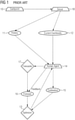
- FIG. 1 is a data transmission diagram that provides an illustration of a typical process according to the prior art, which includes the following:
- the procedure according to the prior art is based to a large extent on the individual decisions of the human agent 14 and is thus highly subjective and inefficient.
- human intervention is required at least in the following steps: import of the historical information from the cashpoint 10 in a suitable database and the optimizer 13 with concurrent calibration of parameters. Very many optimization runs are necessary in order for the human agent to find the best parameter values. The maintenance of the component systems involved, ensuring their proper operation is also part of human intervention. Therefore, the entire mechanism of the cash level adjustments depends on a human agent who acts as an intelligent and self-aware feedback channel, who modifies the parameter values according to his observations about the behavior of the optimizer 13.
- the known approaches do not enable an automated adjustment of the parameter search space, a so-called automated calibration. Furthermore, it is desirable to have fully automated cash level adjustments, without any need for human intervention. It is therefore the technical problem of the present invention to provide an automated approach for the cash level optimization of a cashpoint, thereby at least partly overcoming the above explained disadvantages of the prior art.
- the cash level may indicate an amount of currency, such as banknotes, in at least one cash box of the cash device.
- the method comprises the steps of iteratively optimizing, in an automated manner, a calibration of the cash device, wherein the calibration comprises a plurality of parameters, and generating a plan based at least in part on the calibration.
- the plan may indicate when and/or how the cash device is to be serviced.
- the method provides an optimized calibration for the cash device in an automated manner. Unlike in the prior art, the method does not involve a calibration by a human agent, which is error-prone, slow and may lead to suboptimal calibrations. This way, when the cash device is serviced according to the optimized plan, proper operation and technical functioning of the cash device is ensured. In particular, downtimes of the cash device are effectively avoided, i.e. times when the cash device is out of cash, due to the optimized equipping of the device with cash according to the optimized plan.
- the step of iteratively optimizing a calibration may comprise generating the calibration of the cash device based at least in part on a forecast of expected transactions, a cash level history and/or a current cash level of the cash device.
- the forecast may be generated using a mathematical model based at least in part on the cash level history of the cash device.
- the cash level history may be based on one or more current cash level measurements (current at the time of measurement) received either directly from the cash-dispensing device or via a server. This way, the method takes into account the actual real-life status of the cash-dispensing device and can generate a particularly suitable calibration.
- the plurality of parameters comprises one or more of the following parameters: a parameter defining one or more denominations; a parameter defining a stock level threshold, preferably for each of the one or more denominations; a parameter defining a buffer factor; a parameter defining a minimum balance for at least one denomination; a parameter defining a maximum service interval for the cash device.
- the step of iteratively optimizing a calibration may comprise grouping the parameters into one or more categories, preferably such that functional relationships between the parameters in a given category are preserved. This aspect considerably improves the performance of the optimization process, as will be further explained in the detailed description further below.
- the step of iteratively optimizing a calibration may comprise calculating values of the parameters using a genetic algorithm and/or an evolutionary metaheuristic.
- the step of iteratively optimizing a calibration may comprise storing one or more values of the parameters in a neural network, preferably a feedforward neural network.
- a neural network may serve as a memory for optimal calibrations, which can later be reused to save resources.
- the method may also comprise the further step of evaluating the quality of the calibration.
- the evaluating may comprise generating a plan based on the calibration and a time period in the past, and comparing the plan to a cash level history of the cash device during the time period.
- the plan may be transmitted over a network to an automated cash center, the automated cash center comprising means for automatically equipping one or more cash boxes, i.e. bank note containers, for the cash device with bank notes in accordance with the plan.
- the automated cash center comprising means for automatically equipping one or more cash boxes, i.e. bank note containers, for the cash device with bank notes in accordance with the plan.
- the step of iteratively optimizing a calibration may comprise randomly generating one or more sets of values for the parameters, the sets of values meeting one or more constraints, and repeatedly processing the sets of values by a genetic algorithm until a termination criterion is met.
- the genetic algorithm may perform mutation, combination and selection operations.
- the selection operation preferably comprises a ranking of the sets of values, wherein the ranking may take into account factors including service costs, processing costs, interest costs, stock costs and/or penalty costs.
- Any of the above-described methods may be performed by a server remote from the cash device or by a distributed computing system. This way, a given cash device (and in fact many cash devices) can be managed remotely in an efficient manner.
- the methods may be performed locally on the cash device itself. This way, the cash device measures its current cash levels and autonomously optimizes its cash levels based on the measurements. The optimized plan can then be transmitted to an automated cash center, as already explained above.
- the invention also concerns a computer program comprising instructions for implementing any of the methods disclosed herein.
- a system for optimizing the cash level of a cash device is provided, wherein the system is configured for performing any of the methods disclosed herein.
- machines / apparatuses, information, programmable routines, data structures and other components maybe shown as components in the form of a flowchart diagram, an information transmission diagram, a call diagram or a mixture of these in order not to obscure the embodiments in unnecessary detail.
- well known machines, routines, algorithms, structures, and techniques may be shown without unnecessary detail in order to avoid obscuring the embodiments.
- Systems depicted in some of the figures maybe provided in various configurations.
- One aspect of the present invention relates to methods and systems for an optimized management of the cash level of a machine interchangeably referred to as a "cashpoint", “cash-dispensing device” or “cash device”, which is a device that operates in order to meet the cash demands of customers.
- a cashpoint include, without limitation, an automated teller machine (ATM) for withdrawal of cash, a recycle machine capable to provide the functionality for withdrawal as well as deposit of cash by authorized customers, and/or a cash center within the branch of a bank.
- ATM automated teller machine
- recycle machine capable to provide the functionality for withdrawal as well as deposit of cash by authorized customers
- a cash center within the branch of a bank a cash center within the branch of a bank.
- aspects of the invention may employ software tools or systems that are executed on specific hardware components.
- Certain aspects of the invention may rely on measured physical entities such as the recorded cash level of the cashpoint, and/or the invention may in certain aspects actively perform corresponding measurements of physical entities, e.g. on a regular basis. Aspects of the invention may then forecast a future cash demand and/or supply, on the basis of which an adjustment of the cash levels via services, i.e. replacement of cash, maybe recommended by the system. In certain aspects, the invention may also actively and/or directly calibrate the cashpoint in accordance with the optimized cash level recommendation, preferably with as little as possible or even without human intervention. The underlying procedures to forecast and/or optimize the cash levels may depend on a large number of parameters. It is a very difficult and time-consuming process to adjust these parameters that need to be correctly adjusted.
- aspects of the present invention provide for an automated parameter calibration in order to fully automate the cash level optimization of a cashpoint, multiple cashpoints, bank or retail branches or even entire cash centers.
- aspects of the invention provide for an adapted metaheuristic search mechanism, by which the large space of possible parameters is traversed in an intelligent manner.
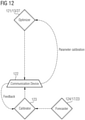
- the invention may involve the communication of two (or more) devices as illustrated in Fig. 12 .
- a calibrator 123 may be adapted for calibrating one or more parameters, preferably reactively and/or continuously, in response to current information provided by a cash optimizer 121, communicated via some communication device 122.
- the resulting network of interacting components preferably with a feedback loop, furnishes a solution to the problem outlined, as will be explained in more detail further below.
- automated parameter adjustments may use techniques of artificial intelligence.
- aspects of the invention may provide an adapted metaheuristic search, possibly taking into account the functional properties of specific parameters.
- the metaheuristic may be coupled to a neural network, which provides a mechanism to store previous possibly useful parameter adjustments.
- the system may comprise a memory, thereby reducing the computational burden of having to recompute cost-minimal parameter adjustments that have been obtained in an earlier run of the metaheuristic search.
- a neural network may provide the possibility to improve the evaluation of the overall costs of a particular parameter adjustment, known as the problem of fitness evaluation of metaheuristic search methods.
- the automated cash level optimizer system may be realized as a distributed system.
- This has the advantages that the computational burden is distributed among many systems, that no mutual interference occurs and the minimization of costs to a company by being able to offer solutions as a service (SaaS model).
- SaaS model solutions as a service
- the disadvantages of a distributed systems solution comprise a higher network load, the risk of data loss both physically as well as legally.
- the components of the system including in particular the calibrator device and the optimizer device (possibly subdivided by further components according to each particular embodiment), could communicate via a network, as part of a reactive feedback loop.
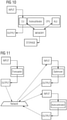
- An example of a distributed systems approach is illustrated in Fig. 11 .
- the calibration device is subdivided into separate components which communicate via a communications network.
- One such component may be the neural network, separate from the metaheuristic search which may in turn be separated from a system responsible for the subdivision of the parameter search space and so on.
- the other components illustrated in Fig. 2 may be further separated into sub-components making up an even larger distributed system.
- Fig. 12 illustrates a feedback loop which enables a reactive and continuous calibration of parameters in accordance with an embodiment of the invention.
- the process illustrated in Fig. 12 is performed by a calibrator 123 in response to current information repeatedly provided by a cash optimizer 121 and in addition the information provided by the forecaster 124, communicated via a communication device 122.
- a calibrator 123 in response to current information repeatedly provided by a cash optimizer 121 and in addition the information provided by the forecaster 124, communicated via a communication device 122.
- Fig. 2 is a data transmission diagram that illustrates a closed loop cashpoint optimization scheme in accordance with an embodiment of the invention.
- the network 28 is a network that may be used for processing large amounts of data and that admits the secure transmission of cash level data.
- This may be a wireless network, a wired network, or a combination of a wired and wireless network, relying on a protocol for encryption and secure transmission of data, such as secure sockets layer (SSL) or transport layer security (TLS).
- SSL secure sockets layer
- TLS transport layer security
- suitable networks include the Internet, a personal area network, a local area network (LAN), a wide area network (WAN), or a wireless local area network (WLAN).
- a wireless network may include a wireless interface or combination of wireless interfaces.
- a wired network may include a wired interface.
- the wired and / or wireless networks may be implemented using routers, access points, bridges, gateways, or the like, to connect devices in Fig. 2 .
- the cashpoint 20 comprises, in one particular embodiment, a system endowed with an integrated radio chip, for secure transmission of cash level data.
- a memory chip provides information at all times on the level of cash inside 22 and/or where and/or when the device was opened. This means that banknotes that are deposited and stored in the device can be made available again for dispensing.
- the optimizer 27 stores the relevant historic data 21 and, based on a mathematical optimization technique, creates a plan 29 for optimal cash level adjustments.
- the forecaster 23 and optimizer 27 could be computer implemented systems which are integrated into one computing system, or they could be part of a distributed network of computer systems, sharing information via a secure network protocol.
- the data obtained from the cashpoint 20 is imported into a database which is then accessed by the forecaster 23. This is facilitated by the CCO system 30 which obtains the data from the cashpoint 20 and facilitates the communication with the other components displayed in Fig. 2 .
- the calibration 15 needed to be executed by a person who would adjust the parameters by hand within the system.
- this step is automized, cf. Fig. 2 .
- the auto calibrator system 25 interacts with the optimizer 27 and reactively generates a cost-optimal calibration.
- this reactive adaptation is illustrated in Fig. 3 .
- the behavior of the optimizer 27 is influenced and reactively adjusted by the auto calibrator 25. What results is a self-regulating system comprised of an autonomic network of interacting components with adaptive feedback channels, i.e. depending on its memory the auto calibrator 25 responds variously to the computations of the optimizer 27.
- the auto-calibration requires a means to repeatedly evaluate the quality of a calibration.
- this evaluation is based on the plan 29, generated by the optimizer 27.
- the optimizer 27 computes a plan 29, set over a specific time period in the past.
- the obtained plan is then compared with the actual behavior of the cash levels and services, based on the information given by the history of the cashpoint. This is what we mean by an evaluation of a calibration in the presently preferred embodiment.
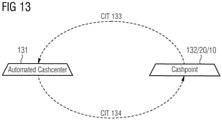
- the instructions computed by the optimizer 27, based on the calibration obtained by the auto calibrator 25, are sent directly to the Server 210 and then passed on to the automated cash center 131, depicted in Fig. 13 .
- these instructions are passed on to the fully automized machines responsible for the further processing of cash.
- the cashpoint is serviced (cf. Fig. 13 )
- CIT cash in transit
- the cash is stored securely and handled efficiently by the use of designated bank notes containers.
- the bank notes containers are uniquely identified and tracked via barcode or RFID tracking.
- the first set of containers resides at the automated cash center 131, does not contain any cash at the outset and is filled with cash according to the instructions. Then it is taken by the CIT 134 to the cashpoint 132.
- the cashpoint 132 contains the second set of containers with the residual cash inside. At the point of a service the first set of containers is exchanged with the second set of containers.
- the CIT 133 transports the second set of containers to the automated cash center 131.
- the second set of bank notes containers is further processed in a fully automized fashion at the cash center 131.
- the processing at the cash center 131 consists of the following steps:
- the second set of bank notes containers are opened by a loading module via a gripping robot that takes staples of cash and inserts them into high speed sorting machines.
- the machines are capable of banding, welding, unzipping and disposing of packaging.
- the loading module fills sorted bank notes into the first set of bank notes containers. Exactly the right amount of cash is inserted, as per the instructions sent to the cash center 131. This also includes the instructions at exactly which points in time, in the future, services should take place, based on the plan generated by the optimizer system and on the operation of the auto-calibrator device.
- the particular embodiment enclosed can be implemented and tested by a person having ordinary skills in the art.
- the closed loop scenario of embodiments of the invention comprises the following steps:
- the system requires a large number of free parameters to be adjusted, i.e. it relies on the calibration. This adjustment is executed by an autocalibration mechanism.
- an autocalibration mechanism We give a detailed description of one particular possible embodiment for such a mechanism, based on an evolutionary metaheuristic coupled to a feedforward neural network. This is meant as an illustrative description and does not exclude other embodiments using other methods of artificial intelligence.
- search strategies such as: a) stochastic gradient descent, b) a feedforward neural network using backpropagation, c) a recurrent neural network (RNN) with a directed acyclic graph, d) a RNN with a directed cyclic graph, e) a continuous time RNN, f) a multiple timescales RNN, g) a heuristic or metaheuristic search or heuristic optimization technique, h) techniques mentioned in g) combined with a), b), c), d), e) or f), as well as i) any suitable combination of the previously mentioned or other search techniques.
- RNN recurrent neural network
- the parameter search space is subdivided into functional categories.
- a datastructure which furnishes a lamination of the search space, is employed.
- the parameters within a category are encoded as so-called gene vectors.
- An initial population is obtained by a randomized breeding of potential solutions.
- Each solution is constrained, by a so-called constraint system 43.
- the constraint system 43 encodes the semantic interrelationships between the parameters, within a given category. Hence any potential solution remains within the bounds imposed by the constraint system.
- the laminated parameter structure is passed on to a genetic algorithm 32.
- the genetic algorithm 32 performs the operations of mutation, combination and selection (using tournament and rank selection), within the bounds imposed by the constraint system. These operations are repeated until, after a predetermined number of trials, no new optimal solution can be reached.
- the solution, consisting of parameters, is then passed on to the optimizer system 33. The system creates in turn a plan for optimal cashlevel adjustments.
- the cash level data 31 is transmitted to the optimizer system, it is first passed on to the genetic algorithm routines 32.
- the candidate solutions obtained within the genetic algorithm are then passed on to the optimizer 33, in order to obtain the necessary information to calculate the fitness 34 of the candidate solutions.
- the genetic algorithm interacts with the constraint system 43, which determines the bounds, within which any candidate solution (i.e. vectors of parameters, subdivided into functional categories), has to remain.
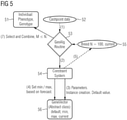
- An initial set of individuals, i.e. candidate solutions is generated in a random fashion 55, after the constraint system has determined the semantic bounds of the functional categories of parameters.
- the genetic algorithm routines 53 execute the selection and crossover combination operations, resulting in 0 ⁇ M ⁇ N candidate solutions 51, cf. figure 5 .
- the genetic algorithm routines themselves, comprise various components. Mutation, crossover and selection are classes that facilitate the generation and combination of new solution candidates.
- the operation of selection comprises a rank selection and/or a tournament selection. Rank selection is based on a probability ranking of individuals, the most fit solution being assigned the highest probability for selection, then the second highest probability for the second most fit solution and so on.
- the tournament selector routine contains in addition a distance measure for parameters. This determines the diversity of prospective solutions. The diversity measure and the rank measure are then aligned to select solutions.
- the fitness function determines the overall cost of the cashlevel adjustments, obtained from the parameters in the optimizer system. Costs consist of service costs, stock costs, interest costs, processing costs and penalty costs for stockouts.
- a genotype therefore fulfills the role of an internal representation of the parameter search space.
- the phenotype is simply a calibration.
- G the set of all possible genotypes.
- the genotypes are converted into phenotypes in the following way.
- d 3 lamina.
- Each lamina corresponds to a category of parameters in the sense that:
- Fig. 7 is a call diagram illustrating the interaction of the routines / data structures comprising a genetic metaheuristic according to one embodiment of the invention:
- the data structure facilitating this functionality is given by a list of GeneVectors.
- the constraint system modifies the gene vectors with their minimum and maximum values.
- the functional data structures determining the operation of the genetic algorithm consist of classes encoding an Individual with its genotype and phenotype and various classes ensuring the correct operation and performance of the algorithm.
- a genotype is encoded via the class GeneVector, consisting of a list vector of Genes.
- the genes encode parameters in terms of key / value pairs.
- the value 0 is mapped to the default state of the parameter, 1/2 are mapped respectively to the minimum / maximum value (determined by the constraint system) and 3 to the current value.
- the phenotype consists of all the parameter keys and values that are translated from the genotype.
- the parameters are therefore identified by their parameter keys which are stored and used uniformly in the genotype, as well as the phenotype data structures.
- An individual is determined by a functional data structure encoding both the genotype and phenotype, as well as a means for translating the former into the latter.
- the operations of the genetic algorithm are given as follows.
- the mutation generates a random value ⁇ in the interval (0,1). If ⁇ ⁇ P c , then a parameter from the population of N individuals is selected at random.
- the recombination operation combines different gene vectors, i.e. categories of parameters, selected according to a probability threshold ⁇ ⁇ P c from the population of N individuals.
- the constraint system (CS) 54 encodes the semantic interdependencies of the parameters within their respective functional categories using various heuristics. This is specific to the concrete types and categories of parameters under consideration. In our case the CS 54 determines the upper and lower bounds for parameters, corresponding to the states MIN and MAX in the definition of the genotype. The CS ensures that the candidate solutions determined by the evolutionary algorithm stay within these bounds. After the constrained mutation and recombination operations have been executed on the population of individuals, the selection operations are executed. These are as described before. The algorithm repeats this process until the termination criterion is reached. The latter is defined as convergence, i.e. the offspring remain in the same fitness class of solutions.
- Fig. 8 shows an example embodiment of a neural network
- Fig. 9 is a call diagram which illustrates a possible interaction between the evolutionary metaheuristic routines and the functional data structures underlying a neural network.
- an autocalibration mechanism comprising a combination of evolutionary metaheuristic and feedforward neural network.
- the auto calibrator with an underlying evolutionary metaheuristic performs well in obtaining a cost-minimal calibration, it can be relevant for some use-cases to couple it to a feedforward neural network.
- the neural network architecture is in principle independent of the evolutionary algorithm and could be realized in a separate computer system, based on a distributed systems approach, i.e. similar to the arrangement in Fig. 11 with the addition of the neural network, interacting with the auto calibrator system.
- the supervised neural network comprises the following components.
- a feedforward neural network cf. Fig. 8
- a neuron is a node, endowed with input and connection weights. By a weight we mean a normalized number in [-1,1].
- a layer of the neural network is a group of neurons, each layer being endowed with an activation function, to be specified.
- Each neuron in layer i is connected to all neurons of layer i + 1 for each 1 ⁇ i ⁇ d .
- the learning rule of the network consists of the genetic algorithm, such that the genotype of a candidate solution corresponds to the network of hidden layers.
- the overall error the network produces corresponds to the negative of the fitness function of the genetic algorithm, i.e. the neural network with the lowest training error corresponds to the solution with the best fitness.
- weights of connections to the next layer correspond to parameter values. Denote by L i for 1 ⁇ i ⁇ d the hidden layers of the network. We denote by x i,j the j -th neuron in layer i and by w i,j thej-th weight of layer i .
- n ( i ) neurons / weights in / of layer i - 1 for 1 ⁇ i ⁇ d There are n ( i ) neurons / weights in / of layer i - 1 for 1 ⁇ i ⁇ d .
- n (0) to be the overall number of parameters in the system.
- the output layer contains n (0) neurons, i.e. the number of parameters of the entire calibration of the device.
- the input of layer i + 1 is given by the weights of layer i as well as the activation levels of the previous layer and the output by the activation function applied to the input with an added bias :
- the function on the right hand side is a suitable nonlinear function.
- we could use the sigmoid function in the form of the logistic function ⁇ x e x e x + 1 .
- Various other choices of nonlinear functions for activation are possible. Note that in alternate embodiments of the search mechanism, by means of other types of neural network, the learning rule changes accordingly.
- cf. Fig. 8 The supervised neural network, cf. Fig. 8 , is combined with the genetic algorithm in the following way in one embodiment, cf. Fig. 9 :
- certain aspects of the present invention provides a method to optimize, using a so-called optimizer, the cash levels of a cashpoint (i.e. a cash device), by automating the calibration of parameters that are needed by the optimizer.
- the optimizer may rely on certain components of data: a forecast, the current cash levels of the device and/or a calibration.
- the cash device may store the historical turnover data and/or the current cash levels.
- the forecast may rely on the historical turnover data to generate, e.g. via a standard statistical procedure, the likely future turnover data of the machine.
- the calibration may comprise a set of parameters needed to fine tune the optimizer.
- the optimizer may execute methods of mathematical optimization in order to produce a plan for future cash level adjustments of the machine.
- aspects of the innovation provide for the automation of the calibration, i.e. the automated determination of parameters, best suitable for ideal performance of the optimizer.
- aspects of the invention may provide a closed loop scheme for automated cash level adjustments of a cash point, without the need for human intervention.
- the methods disclosed herein comprise one or more steps or actions for achieving the described method.
- the method steps and/or actions may be interchanged with one another without departing from the scope of the claims.
- the order and/or use of specific steps and/or actions may be modified without departing from the scope of the claims.
- the various operations of methods described above may be performed by any suitable means capable of performing the corresponding functions.
- the means may include various hardware and/or software/firmware component(s) and/or module(s), including, but not limited to a circuit, an application specific integrated circuit (ASIC), or processor.
- ASIC application specific integrated circuit
- those operations may be performed by any suitable corresponding counterpart means-plus-function components.
- means for determining, means for performing, means for transmitting, means for receiving, means for sending, means for signaling, means for selecting, means for correlating, means for evaluating, means for assigning, means for allocating, means for removing, means for summing, means for scaling, means calculating, means for averaging, and/or means for taking action may include one or more processors, transmitters, receivers, and/or other elements of the components illustrated in the figures.
- DSP digital signal processor
- ASIC application specific integrated circuit
- FPGA field programmable gate array
- a general-purpose processor may be a microprocessor, but in the alternative, the processor maybe any conventional processor, controller, microcontroller, or state machine.
- a processor may also be implemented as a combination of computing devices, e.g., a combination of a DSP and a microprocessor, a plurality of microprocessors, one or more microprocessors in conjunction with a DSP core, or any other such configuration.
- a software/firmware module may reside in RAM memory, flash memory, ROM memory, EPROM memory, EEPROM memory, phase change memory, registers, hard disk, a removable disk, a CD-ROM, or any other form of storage medium known in the art.
- An exemplary storage medium is coupled to the processor such that the processor can read information from, and write information to, the storage medium.
- the storage medium may be integral to the processor.
- the processor and the storage medium may reside in an ASIC.
- the ASIC may reside in a user terminal.
- the processor and the storage medium may reside as discrete components in a user terminal.
- the functions described may be implemented in hardware, software/firmware, or combinations thereof. If implemented in software/firmware, the functions may be stored on or transmitted over as one or more instructions or code on a computer-readable medium.
- Computer-readable media includes both computer storage media and communication media including any medium that facilitates transfer of a computer program from one place to another.
- a storage media may be any available media that can be accessed by a general purpose or special purpose computer.
- such computer-readable media can comprise RAM, ROM, EEPROM, CD/DVD or other optical disk storage, magnetic disk storage or other magnetic storage devices, or any other medium that can be used to carry or store desired program code means in the form of instructions or data structures and that can be accessed by a general-purpose or special-purpose computer, or a general-purpose or special-purpose processor. Also, any connection is properly termed a computer-readable medium.
- Disk and disc includes compact disc (CD), laser disc, optical disc, digital versatile disc (DVD), floppy disk and Blu-ray disc where disks usually reproduce data magnetically, while discs reproduce data optically with lasers. Combinations of the above should also be included within the scope of computer-readable media.
Landscapes
- Engineering & Computer Science (AREA)
- Business, Economics & Management (AREA)
- Physics & Mathematics (AREA)
- Theoretical Computer Science (AREA)
- General Physics & Mathematics (AREA)
- Accounting & Taxation (AREA)
- Finance (AREA)
- Human Resources & Organizations (AREA)
- Health & Medical Sciences (AREA)
- Life Sciences & Earth Sciences (AREA)
- Economics (AREA)
- Biophysics (AREA)
- Strategic Management (AREA)
- Evolutionary Biology (AREA)
- Bioinformatics & Cheminformatics (AREA)
- Bioinformatics & Computational Biology (AREA)
- Mathematical Physics (AREA)
- Software Systems (AREA)
- General Engineering & Computer Science (AREA)
- Computing Systems (AREA)
- Evolutionary Computation (AREA)
- Data Mining & Analysis (AREA)
- Computational Linguistics (AREA)
- Artificial Intelligence (AREA)
- General Business, Economics & Management (AREA)
- Entrepreneurship & Innovation (AREA)
- Development Economics (AREA)
- General Health & Medical Sciences (AREA)
- Physiology (AREA)
- Marketing (AREA)
- Operations Research (AREA)
- Quality & Reliability (AREA)
- Biomedical Technology (AREA)
- Tourism & Hospitality (AREA)
- Molecular Biology (AREA)
- Genetics & Genomics (AREA)
- Educational Administration (AREA)
- Game Theory and Decision Science (AREA)
- Financial Or Insurance-Related Operations Such As Payment And Settlement (AREA)
- Management, Administration, Business Operations System, And Electronic Commerce (AREA)
Priority Applications (3)
| Application Number | Priority Date | Filing Date | Title |
|---|---|---|---|
| EP20188070.5A EP3945507A1 (de) | 2020-07-28 | 2020-07-28 | Optimierung des bargeldniveaus mit autokalibrierung |
| US17/300,514 US12561641B2 (en) | 2020-07-28 | 2021-07-27 | Cash level optimization with autocalibration |
| CA3168104A CA3168104C (en) | 2020-07-28 | 2022-07-15 | CASHIER OPTIMIZATION WITH AUTOMATIC BACKGROUND CALIBRATION |
Applications Claiming Priority (1)
| Application Number | Priority Date | Filing Date | Title |
|---|---|---|---|
| EP20188070.5A EP3945507A1 (de) | 2020-07-28 | 2020-07-28 | Optimierung des bargeldniveaus mit autokalibrierung |
Publications (1)
| Publication Number | Publication Date |
|---|---|
| EP3945507A1 true EP3945507A1 (de) | 2022-02-02 |
Family
ID=71842549
Family Applications (1)
| Application Number | Title | Priority Date | Filing Date |
|---|---|---|---|
| EP20188070.5A Withdrawn EP3945507A1 (de) | 2020-07-28 | 2020-07-28 | Optimierung des bargeldniveaus mit autokalibrierung |
Country Status (3)
| Country | Link |
|---|---|
| US (1) | US12561641B2 (de) |
| EP (1) | EP3945507A1 (de) |
| CA (1) | CA3168104C (de) |
Families Citing this family (1)
| Publication number | Priority date | Publication date | Assignee | Title |
|---|---|---|---|---|
| US20230245234A1 (en) * | 2022-06-12 | 2023-08-03 | Sachin Sumant | Integrated cash network decision optimization platform |
Citations (5)
| Publication number | Priority date | Publication date | Assignee | Title |
|---|---|---|---|---|
| US6272483B1 (en) | 1997-10-31 | 2001-08-07 | The State Of Oregon Acting By And Through The State Board Of Higher Education On Behalf Of The University Of Oregon | Cost-optimizing allocation system and method |
| US6456996B1 (en) | 1998-06-05 | 2002-09-24 | I2 Technologies Us, Inc. | Computer implemented scheduling system and process using abstract local search technique |
| US20150178670A1 (en) * | 2013-12-19 | 2015-06-25 | NCR Organization | Media replenishment management |
| US20170308835A1 (en) * | 2016-04-22 | 2017-10-26 | International Business Machines Corporation | Automated teller machine flow network and control system |
| CN110415462A (zh) * | 2019-07-31 | 2019-11-05 | 中国工商银行股份有限公司 | Atm设备加钞优化方法及装置 |
Family Cites Families (1)
| Publication number | Priority date | Publication date | Assignee | Title |
|---|---|---|---|---|
| WO2019118290A1 (en) * | 2017-12-13 | 2019-06-20 | Sentient Technologies (Barbados) Limited | Evolutionary architectures for evolution of deep neural networks |
-
2020
- 2020-07-28 EP EP20188070.5A patent/EP3945507A1/de not_active Withdrawn
-
2021
- 2021-07-27 US US17/300,514 patent/US12561641B2/en active Active
-
2022
- 2022-07-15 CA CA3168104A patent/CA3168104C/en active Active
Patent Citations (5)
| Publication number | Priority date | Publication date | Assignee | Title |
|---|---|---|---|---|
| US6272483B1 (en) | 1997-10-31 | 2001-08-07 | The State Of Oregon Acting By And Through The State Board Of Higher Education On Behalf Of The University Of Oregon | Cost-optimizing allocation system and method |
| US6456996B1 (en) | 1998-06-05 | 2002-09-24 | I2 Technologies Us, Inc. | Computer implemented scheduling system and process using abstract local search technique |
| US20150178670A1 (en) * | 2013-12-19 | 2015-06-25 | NCR Organization | Media replenishment management |
| US20170308835A1 (en) * | 2016-04-22 | 2017-10-26 | International Business Machines Corporation | Automated teller machine flow network and control system |
| CN110415462A (zh) * | 2019-07-31 | 2019-11-05 | 中国工商银行股份有限公司 | Atm设备加钞优化方法及装置 |
Non-Patent Citations (3)
| Title |
|---|
| J. P. WALSER: "Lecture Notes in Artificial Intelligence, LNAI-1637", vol. 1637, August 1999, SPRINGER VERLAG |
| R. BATTITIM. BRUNATOF. MASCIA: "Operations Research/Computer Science Interfaces Series", vol. 45, November 2008, SPRINGER, article "Reactive Search and Intelligent Optimization" |
| S. K. SMITA. E. EIBEN, PROCEEDINGS OF THE IEEE CONGRESS ON EVOLUTIONARY COMPUTATION (CEC, pages 399 - 406 |
Also Published As
| Publication number | Publication date |
|---|---|
| US20220036293A1 (en) | 2022-02-03 |
| CA3168104A1 (en) | 2023-01-27 |
| CA3168104C (en) | 2025-08-05 |
| US12561641B2 (en) | 2026-02-24 |
Similar Documents
| Publication | Publication Date | Title |
|---|---|---|
| CN118229420A (zh) | 基于可监管区块链隐私交易的供应链金融应用方法 | |
| Gilli et al. | Heuristic optimisation in financial modelling | |
| US20050091146A1 (en) | System and method for predicting stock prices | |
| CN118037457A (zh) | 一种仓单与发票模式的互信供应链金融流程控制方法 | |
| Listiani | Support vector regression analysis for price prediction in a car leasing application | |
| Yeh et al. | End-to-end conformal calibration for optimization under uncertainty | |
| Sindhuraj et al. | Loan eligibility prediction using adaptive hybrid optimization driven-deep neuro fuzzy network | |
| CA3168104C (en) | CASHIER OPTIMIZATION WITH AUTOMATIC BACKGROUND CALIBRATION | |
| Taveeapiradeecharoen et al. | Dynamic model averaging for daily forex prediction: A comparative study | |
| Arora et al. | Approximating methodology: Managing cash in automated teller machines using fuzzy ARTMAP network | |
| Light | A course in dynamic optimization | |
| Dlamini | Machine Learning Techniques for Optimizing Recurring Billing and Revenue Collection in SaaS Payment Platforms | |
| Oroojlooyjadid et al. | Stock-out prediction in multi-echelon networks | |
| San Juan et al. | A data-driven target-oriented robust optimization framework: bridging machine learning and optimization under uncertainty | |
| Silva et al. | A simulated imo-drsa approach for cognitive reduction in multiobjective financial portfolio interactive optimization | |
| Chymshyr et al. | Models and methods for forming service packages for solving of the problem of designing services in information systems of providers | |
| Alvo et al. | Deep Reinforcement Learning for Inventory Networks: Toward Reliable Policy Optimization | |
| Zhang et al. | Optimization of Virtual Network Mapping Based on Improved Ant Colony Algorithm in Complex Network Environments | |
| Tunç et al. | Optimization of Cash Management at ATMs Using Fuzzy AHP Weighted Arithmetic Optimization Algorithm. | |
| Kryzhanyvskyi et al. | Decision-making method in interdependent computing systems | |
| Kunkler et al. | Probabilistic suffix prediction of business processes | |
| US20250307729A1 (en) | System and method for variational annealing to solve financial optimization problems | |
| Saha et al. | Design and Development of Cryptocurrency Price Prediction (CPP) Using ARIMA-LSTM | |
| Gupta et al. | Multi-Preference Optimization: Generalizing DPO via Set-Level Contrasts | |
| US20260120180A1 (en) | Managing income streams using a distributed ledger and soulbound tokens |
Legal Events
| Date | Code | Title | Description |
|---|---|---|---|
| PUAI | Public reference made under article 153(3) epc to a published international application that has entered the european phase |
Free format text: ORIGINAL CODE: 0009012 |
|
| STAA | Information on the status of an ep patent application or granted ep patent |
Free format text: STATUS: THE APPLICATION HAS BEEN PUBLISHED |
|
| AK | Designated contracting states |
Kind code of ref document: A1 Designated state(s): AL AT BE BG CH CY CZ DE DK EE ES FI FR GB GR HR HU IE IS IT LI LT LU LV MC MK MT NL NO PL PT RO RS SE SI SK SM TR |
|
| STAA | Information on the status of an ep patent application or granted ep patent |
Free format text: STATUS: REQUEST FOR EXAMINATION WAS MADE |
|
| 17P | Request for examination filed |
Effective date: 20220727 |
|
| RBV | Designated contracting states (corrected) |
Designated state(s): AL AT BE BG CH CY CZ DE DK EE ES FI FR GB GR HR HU IE IS IT LI LT LU LV MC MK MT NL NO PL PT RO RS SE SI SK SM TR |
|
| STAA | Information on the status of an ep patent application or granted ep patent |
Free format text: STATUS: EXAMINATION IS IN PROGRESS |
|
| RAP3 | Party data changed (applicant data changed or rights of an application transferred) |
Owner name: SESAMI CASH MANAGEMENT SOFTWARE GMBH |
|
| 17Q | First examination report despatched |
Effective date: 20240313 |
|
| STAA | Information on the status of an ep patent application or granted ep patent |
Free format text: STATUS: THE APPLICATION IS DEEMED TO BE WITHDRAWN |
|
| 18D | Application deemed to be withdrawn |
Effective date: 20240716 |