EP3950657A1 - Carbonsäureherstellungsverfahren - Google Patents
Carbonsäureherstellungsverfahren Download PDFInfo
- Publication number
- EP3950657A1 EP3950657A1 EP20778573.4A EP20778573A EP3950657A1 EP 3950657 A1 EP3950657 A1 EP 3950657A1 EP 20778573 A EP20778573 A EP 20778573A EP 3950657 A1 EP3950657 A1 EP 3950657A1
- Authority
- EP
- European Patent Office
- Prior art keywords
- carboxylic acid
- acid
- membrane
- fermentation broth
- extraction
- Prior art date
- Legal status (The legal status is an assumption and is not a legal conclusion. Google has not performed a legal analysis and makes no representation as to the accuracy of the status listed.)
- Granted
Links
Images

Classifications
-
- C—CHEMISTRY; METALLURGY
- C07—ORGANIC CHEMISTRY
- C07B—GENERAL METHODS OF ORGANIC CHEMISTRY; APPARATUS THEREFOR
- C07B63/00—Purification; Separation; Stabilisation; Use of additives
-
- C—CHEMISTRY; METALLURGY
- C12—BIOCHEMISTRY; BEER; SPIRITS; WINE; VINEGAR; MICROBIOLOGY; ENZYMOLOGY; MUTATION OR GENETIC ENGINEERING
- C12P—FERMENTATION OR ENZYME-USING PROCESSES TO SYNTHESISE A DESIRED CHEMICAL COMPOUND OR COMPOSITION OR TO SEPARATE OPTICAL ISOMERS FROM A RACEMIC MIXTURE
- C12P7/00—Preparation of oxygen-containing organic compounds
- C12P7/40—Preparation of oxygen-containing organic compounds containing a carboxyl group including Peroxycarboxylic acids
-
- B—PERFORMING OPERATIONS; TRANSPORTING
- B01—PHYSICAL OR CHEMICAL PROCESSES OR APPARATUS IN GENERAL
- B01D—SEPARATION
- B01D11/00—Solvent extraction
- B01D11/04—Solvent extraction of solutions which are liquid
- B01D11/0415—Solvent extraction of solutions which are liquid in combination with membranes
-
- B—PERFORMING OPERATIONS; TRANSPORTING
- B01—PHYSICAL OR CHEMICAL PROCESSES OR APPARATUS IN GENERAL
- B01D—SEPARATION
- B01D61/00—Processes of separation using semi-permeable membranes, e.g. dialysis, osmosis or ultrafiltration; Apparatus, accessories or auxiliary operations specially adapted therefor
- B01D61/02—Reverse osmosis; Hyperfiltration ; Nanofiltration
- B01D61/027—Nanofiltration
-
- C—CHEMISTRY; METALLURGY
- C07—ORGANIC CHEMISTRY
- C07C—ACYCLIC OR CARBOCYCLIC COMPOUNDS
- C07C227/00—Preparation of compounds containing amino and carboxyl groups bound to the same carbon skeleton
- C07C227/38—Separation; Purification; Stabilisation; Use of additives
- C07C227/40—Separation; Purification
-
- C—CHEMISTRY; METALLURGY
- C07—ORGANIC CHEMISTRY
- C07C—ACYCLIC OR CARBOCYCLIC COMPOUNDS
- C07C51/00—Preparation of carboxylic acids or their salts, halides or anhydrides
- C07C51/42—Separation; Purification; Stabilisation; Use of additives
- C07C51/47—Separation; Purification; Stabilisation; Use of additives by solid-liquid treatment; by chemisorption
-
- C—CHEMISTRY; METALLURGY
- C07—ORGANIC CHEMISTRY
- C07C—ACYCLIC OR CARBOCYCLIC COMPOUNDS
- C07C51/00—Preparation of carboxylic acids or their salts, halides or anhydrides
- C07C51/42—Separation; Purification; Stabilisation; Use of additives
- C07C51/48—Separation; Purification; Stabilisation; Use of additives by liquid-liquid treatment
-
- C—CHEMISTRY; METALLURGY
- C12—BIOCHEMISTRY; BEER; SPIRITS; WINE; VINEGAR; MICROBIOLOGY; ENZYMOLOGY; MUTATION OR GENETIC ENGINEERING
- C12N—MICROORGANISMS OR ENZYMES; COMPOSITIONS THEREOF; PROPAGATING, PRESERVING, OR MAINTAINING MICROORGANISMS; MUTATION OR GENETIC ENGINEERING; CULTURE MEDIA
- C12N1/00—Microorganisms; Compositions thereof; Processes of propagating, maintaining or preserving microorganisms or compositions thereof; Processes of preparing or isolating a composition containing a microorganism; Culture media therefor
- C12N1/02—Separating microorganisms from their culture media
-
- C—CHEMISTRY; METALLURGY
- C12—BIOCHEMISTRY; BEER; SPIRITS; WINE; VINEGAR; MICROBIOLOGY; ENZYMOLOGY; MUTATION OR GENETIC ENGINEERING
- C12P—FERMENTATION OR ENZYME-USING PROCESSES TO SYNTHESISE A DESIRED CHEMICAL COMPOUND OR COMPOSITION OR TO SEPARATE OPTICAL ISOMERS FROM A RACEMIC MIXTURE
- C12P13/00—Preparation of nitrogen-containing organic compounds
- C12P13/04—Alpha- or beta- amino acids
- C12P13/22—Tryptophan; Tyrosine; Phenylalanine; 3,4-Dihydroxyphenylalanine
- C12P13/222—Phenylalanine
-
- C—CHEMISTRY; METALLURGY
- C12—BIOCHEMISTRY; BEER; SPIRITS; WINE; VINEGAR; MICROBIOLOGY; ENZYMOLOGY; MUTATION OR GENETIC ENGINEERING
- C12P—FERMENTATION OR ENZYME-USING PROCESSES TO SYNTHESISE A DESIRED CHEMICAL COMPOUND OR COMPOSITION OR TO SEPARATE OPTICAL ISOMERS FROM A RACEMIC MIXTURE
- C12P7/00—Preparation of oxygen-containing organic compounds
- C12P7/40—Preparation of oxygen-containing organic compounds containing a carboxyl group including Peroxycarboxylic acids
- C12P7/42—Hydroxy-carboxylic acids
-
- C—CHEMISTRY; METALLURGY
- C12—BIOCHEMISTRY; BEER; SPIRITS; WINE; VINEGAR; MICROBIOLOGY; ENZYMOLOGY; MUTATION OR GENETIC ENGINEERING
- C12P—FERMENTATION OR ENZYME-USING PROCESSES TO SYNTHESISE A DESIRED CHEMICAL COMPOUND OR COMPOSITION OR TO SEPARATE OPTICAL ISOMERS FROM A RACEMIC MIXTURE
- C12P7/00—Preparation of oxygen-containing organic compounds
- C12P7/40—Preparation of oxygen-containing organic compounds containing a carboxyl group including Peroxycarboxylic acids
- C12P7/44—Polycarboxylic acids
-
- C—CHEMISTRY; METALLURGY
- C12—BIOCHEMISTRY; BEER; SPIRITS; WINE; VINEGAR; MICROBIOLOGY; ENZYMOLOGY; MUTATION OR GENETIC ENGINEERING
- C12P—FERMENTATION OR ENZYME-USING PROCESSES TO SYNTHESISE A DESIRED CHEMICAL COMPOUND OR COMPOSITION OR TO SEPARATE OPTICAL ISOMERS FROM A RACEMIC MIXTURE
- C12P7/00—Preparation of oxygen-containing organic compounds
- C12P7/40—Preparation of oxygen-containing organic compounds containing a carboxyl group including Peroxycarboxylic acids
- C12P7/44—Polycarboxylic acids
- C12P7/46—Dicarboxylic acids having four or less carbon atoms, e.g. fumaric acid, maleic acid
-
- C—CHEMISTRY; METALLURGY
- C12—BIOCHEMISTRY; BEER; SPIRITS; WINE; VINEGAR; MICROBIOLOGY; ENZYMOLOGY; MUTATION OR GENETIC ENGINEERING
- C12P—FERMENTATION OR ENZYME-USING PROCESSES TO SYNTHESISE A DESIRED CHEMICAL COMPOUND OR COMPOSITION OR TO SEPARATE OPTICAL ISOMERS FROM A RACEMIC MIXTURE
- C12P7/00—Preparation of oxygen-containing organic compounds
- C12P7/40—Preparation of oxygen-containing organic compounds containing a carboxyl group including Peroxycarboxylic acids
- C12P7/54—Acetic acid
-
- C—CHEMISTRY; METALLURGY
- C12—BIOCHEMISTRY; BEER; SPIRITS; WINE; VINEGAR; MICROBIOLOGY; ENZYMOLOGY; MUTATION OR GENETIC ENGINEERING
- C12R—INDEXING SCHEME ASSOCIATED WITH SUBCLASSES C12C - C12Q, RELATING TO MICROORGANISMS
- C12R2001/00—Microorganisms ; Processes using microorganisms
- C12R2001/01—Bacteria or Actinomycetales ; using bacteria or Actinomycetales
- C12R2001/185—Escherichia
- C12R2001/19—Escherichia coli
Definitions
- the present invention relates to a method of producing a carboxylic acid from a carboxylic acid-containing fermentation broth.
- extraction separation is often used as a means for recovering carboxylic acids from fermentation broths containing carboxylic acids, along with adsorption separation with anion exchange resins, electrodialysis, crystallization and the like.
- a carboxylic acid from a fermentation broth containing the carboxylic acid
- organic phase an extraction solvent
- Patent Literature 1 discloses that, in the case of recovering an amino acid from an amino acid fermentation broth by extraction, it is possible to remove cytoplasm and other solids and to speed up the phase separation of the amino acid fermentation broth and an extraction solvent, by passing the amino acid fermentation broth through an ultrafiltration membrane (UF membrane) through which molecules having a molecular weight of 1,000 or less permeate, in the prestage of the extraction of the amino acid.
- UF membrane ultrafiltration membrane
- Patent Literature 2 discloses that, in the case of recovering an aliphatic dicarboxylic acid from an aliphatic dicarboxylic acid fermentation broth by extraction, it is possible to remove microorganisms and to speed up the phase separation of the aliphatic dicarboxylic acid fermentation broth and an extraction solvent, by passing the aliphatic dicarboxylic acid fermentation broth through a microfiltration membrane (MF membrane), and that a microfiltration membrane is more suitable than an ultrafiltration membrane as a filtration membrane.
- Patent Literature 3 discloses that passing a monocarboxylic acid fermentation broth through a nanofiltration membrane enables to remove impurities and to increase the purity of the monocarboxylic acid to be recovered.
- Patent Literatures 1 and 2 disclose that the phase separation during the extraction is sped up by passing the fermentation liquids through an ultrafiltration membrane and a microfiltration membrane, respectively. According to the investigation by the present inventors, however, it has been found out that the phase separation between the aqueous phase and the organic phase during the extraction cannot be sufficiently achieved, even in cases where a carboxylic acid-containing fermentation broth is passed through both a microfiltration membrane and an ultrafiltration membrane (corresponds to Comparative Example 1 of the present application).
- an object of the present invention is to find out a method of enhancing the phase separability between the aqueous phase and the organic phase during the extraction of a carboxylic acid from a carboxylic acid-containing fermentation broth.
- the present inventors have found out that the phase separation between the aqueous phase and the organic phase after the extraction is accelerated, by passing a carboxylic acid fermentation broth through a nanofiltration membrane, before subjecting the fermentation broth to the extraction process of a carboxylic acid, thereby completing the present invention.
- the present invention includes the following (1) to (5).
- the present invention it is possible, in the case of recovering a carboxylic acid from a carboxylic acid-containing fermentation broth by extraction, to accelerate the phase separation between the aqueous phase and the organic phase after the extraction, and to efficiently produce the carboxylic acid.
- carboxylic acid generally refers to a compound having one or a plurality of carboxyl groups (COOH groups) in the molecule.
- the carboxylic acid in the present invention is not particularly limited, but is preferably a carboxylic acid having a molecular weight of about 200 or less, since such a carboxylic acid is highly permeable through a nanofiltration membrane to be described later.
- carboxylic acids include formic acid, acetic acid, propionic acid, oxalic acid, glycolic acid, gluconic acid, acrylic acid, butyric acid, isobutyric acid, ⁇ -aminobutyric acid, valeric acid, isovaleric acid, pyruvic acid, lactic acid, hydroxybutyric acid, succinic acid, fumaric acid, maleic acid, itaconic acid, malic acid, tartaric acid, oxaloacetic acid, glutaric acid, 2-oxoglutaric acid, adipic acid, adipic semialdehyde, 3-oxoadipic acid, 3-hydroxyadipic acid, 3-hydroxyadipic acid-3,6-lactone, ⁇ -hydromuconic acid, ⁇ -hydromuconic acid, muconic acid, muconolactone, 2-keto-L-gulonic acid, 6-aminocaproic acid, aconitic acid, benzoic acid,
- the definition of the term "carboxylic acid-containing fermentation broth” includes not only a culture liquid in which a carboxylic acid(s) has/have been produced by the action of microorganisms, in a liquid medium containing fermentation raw materials, such as a carbon source(s), a nitrogen source(s), an inorganic salt(s), an amino acid(s), a vitamin(s) and/or the like, but also one obtained by adding a carboxylic acid(s) chemically or biologically synthesized separately, to a culture liquid in which microorganisms have been cultured in a liquid medium containing the fermentation raw materials.
- Examples of the carbon source to be used for culturing microorganisms include: monosaccharides such as glucose, sucrose, fructose, galactose, mannose, xylose and arabinose; disaccharides and polysaccharide, in which any of these monosaccharides are bound; and molasses, sugar beet syrup, cane molasses, black treacle, starch saccharified solution and cellulose-containing biomass saccharified solution, which contain any of the above saccharides.
- Examples of the nitrogen source to be used include ammonia gas, ammonia water, ammonium salts, urea, nitric acid salts, other organic nitrogen sources supplementarily used, such as oil cakes, soybean hydrolyzates, casein degradation products, other amino acids, vitamins, corn steep liquor, yeast and yeast extracts, meat extracts, and peptides such as peptone.
- Examples of the inorganic salt to be used include phosphoric acid salts, magnesium salts, calcium salts, iron salts and manganese salts, any of which can be added as appropriate.
- a waste biomass as a fermentation raw material which contains any of these carbon sources, nitrogen sources, inorganic salts, amino acids, vitamins and the like.
- Examples of the waste biomass include food wastes, livestock manure, sewage sludge, agricultural residues and wood wastes.
- microorganisms to be used in the preparation of the carboxylic acid-containing fermentation broth include: yeasts such as baker's yeast; bacteria such as Escherichia coli and coryneform bacteria; filamentous fungi; and actinomycetes, but not particularly limited thereto.
- yeasts such as baker's yeast
- bacteria such as Escherichia coli and coryneform bacteria
- filamentous fungi and actinomycetes, but not particularly limited thereto.
- the microorganisms to be used may be those isolated from natural environments, or those whose properties are partially modified by mutation or genetic engineering.
- step (A) a carboxylic acid-containing fermentation broth is passed through a nanofiltration membrane, to obtain a carboxylic acid-containing filtrate.
- the expression "to pass (a carboxylic acid-containing fermentation broth) through a nanofiltration membrane” refers to passing a carboxylic acid-containing fermentation broth through a nanofiltration membrane to collect a permeate containing a carboxylic acid from the permeate side of the membrane. Further, in the present specification, the permeate which has been passed through the nanofiltration membrane and which contains the carboxylic acid is referred to as "carboxylic acid-containing filtrate”.
- the carboxylic acid in the carboxylic acid-containing fermentation broth may be dissolved in water as the carboxylic acid or a salt of the carboxylic acid.
- the salt of the carboxylic acid include lithium salts, sodium salts, potassium salts, magnesium salts, calcium salts and ammonium salts.
- the salt of the carboxylic acid may be a mixture of different kinds of such salts.
- the concentration of the carboxylic acid in the carboxylic acid-containing fermentation broth to be filtered by being passed through the nanofiltration membrane is not particularly limited. However, a higher carboxylic acid concentration in the fermentation broth leads to a higher carboxylic acid concentration in the resulting carboxylic acid-containing filtrate, and thus is suitable for reducing the energy required in the case of performing concentration.
- concentration of the carboxylic acid that is, to perform concentration
- the material of the nanofiltration membrane to be used in the present invention it is possible to use a polymeric material, such as a cellulose acetate-based polymer, a polyamide, a polyester, a polyimide or a vinyl polymer.
- the nanofiltration membrane is not limited to a membrane made of one kind of the materials described above, and may be a membrane containing a plurality of membrane materials.
- the nanofiltration membrane may be either of the followings: an asymmetrical membrane having a membrane structure which includes a dense layer on at least one surface of the membrane, and in which the diameter of pores in the membrane gradually increase in the direction from the dense layer toward the interior of the membrane or toward the other surface of the membrane; or a composite membrane having a membrane structure which includes an extremely thin functional layer made of another material, on the dense layer of the asymmetrical membrane.
- a composite membrane which is disclosed in JP 62-201606 A , and in which a nanofiltration membrane composed of a polyamide functional layer is formed on a support membrane whose membrane material is polysulfone, can be used.
- a composite membrane including a polyamide functional layer which has a high pressure resistance, a high water permeability and a high soluteremoval ability, in combination, and which has a high potential, is preferred in the present invention.
- a composite membrane having a structure which includes a polyamide functional layer and in which the polyamide functional layer is supported by a support composed of a porous membrane or a nonwoven fabric is preferred.
- examples of preferred carboxylic acid components of the monomers constituting the polyamide include aromatic carboxylic acids such as trimesic acid, benzophenonetetracarboxylic acid, trimellitic acid, pyromellitic acid, isophthalic acid, terephthalic acid, naphthalenedicarboxylic acid, diphenylcarboxylic acid and pyridinecarboxylic acid.
- aromatic carboxylic acids such as trimesic acid, benzophenonetetracarboxylic acid, trimellitic acid, pyromellitic acid, isophthalic acid, terephthalic acid, naphthalenedicarboxylic acid, diphenylcarboxylic acid and pyridinecarboxylic acid.
- trimesic acid, isophthalic acid, terephthalic acid, or a mixture thereof is more preferred, taking into consideration the solubility in a membrane-forming solvent.
- Examples of preferred amine components of the monomers constituting the polyamide include: primary diamines containing an aromatic ring, such as m-phenylenediamine, p-phenylenediamine, benzidine, methylenebisdianiline, 4,4'-diaminobiphenyl ether, dianisidine, 3,3',4-triaminobiphenyl ether, 3,3',4,4'-tetraaminobiphenyl ether, 3,3'-dioxybenzidine, 1,8-naphthalenediamine, m(p)-monomethylphenylenediamine, 3,3'-monomethylamino-4,4'-diaminobiphenyl ether, 4,N,N'-(4-amino benzoyl)-p(m)-phenylenediamine-2,2'-bis(4-aminophenylbenzimidazole), 2,2'-bis(4-aminophenylbenzoxazole) and 2,2'
- a nanofiltration membrane which includes a functional layer made of a crosslinked polyamide containing piperazine or piperidine as a monomer is preferably used, because such a membrane has heat resistance and chemical resistance, in addition to the pressure resistance and durability. More preferred is a nanofiltration membrane containing the above-described crosslinked piperazine polyamide or a crosslinked piperidine polyamide as a main component.
- the nanofiltration membrane which includes a functional layer made of a polyamide containing piperazine polyamide include those disclosed in JP 62-201606 A . Specific examples thereof include crosslinked piperazine polyamide-based semipermeable membranes, UTC-60 and UTC-63, manufactured by Toray Industries, Inc.
- a spiral nanofiltration membrane element to be used in the present invention it is also possible to use a nanofiltration membrane module, SU-210, SU-220, SU-600 or SU-610, manufactured by Toray Industries, Inc., which includes UTC-60 or UTC-63 including a functional layer made of a crosslinked piperazine polyamide, manufactured by Toray Industries, Inc.
- nanofiltration membrane examples include: NF-45, NF-90, NF-200 and NF-400, which are nanofiltration membranes including a functional layer made of a crosslinked piperazine polyamide and manufactured by FilmTec Corporation; NF99, NF97 and NF99HF, which are nanofiltration membranes including a polyamide functional layer and manufactured by Alfa Laval Inc.; and GEsepa, which is a cellulose acetate-based nanofiltration membrane, manufactured by GE Osmonics Inc.
- NF-45, NF-90, NF-200 and NF-400 which are nanofiltration membranes including a functional layer made of a crosslinked piperazine polyamide and manufactured by FilmTec Corporation
- NF99, NF97 and NF99HF which are nanofiltration membranes including a polyamide functional layer and manufactured by Alfa Laval Inc.
- GEsepa which is a cellulose acetate-based nanofiltration membrane, manufactured by GE Osmonics Inc.
- the filtration of the carboxylic acid-containing fermentation broth by the nanofiltration membrane may be carried out while applying a pressure.
- the filtration pressure to be used in the filtration is not particularly limited. However, a filtration pressure within the range of 0.1 MPa or more and 8 MPa or less is preferably used, because a filtration pressure lower than 0.1 MPa results in a decreased membrane permeation rate, and a filtration pressure higher than 8 MPa has an impact on the damage of the membrane. Further, a filtration pressure of 0.5 MPa or more and 7 MPa or less leads to a high membrane permeation flux, and allows for an efficient permeation of the carboxylic acid, and thus is more preferred.
- the recovery rate of the carboxylic acid can be improved by allowing the non-permeate to return to raw water again, and to perform filtration repeatedly.
- the nanofiltration membrane has a characteristic that a substance which is non-ionized (undissociated) in a solution more easily permeates therethrough compared to a substance which is ionized (dissociated) in the solution
- adjusting the pH of the carboxylic acid-containing fermentation broth to an acidic pH leads to an increase in the amount of carboxylic acid which is in the form of the carboxylic acid, not in the form of a carboxylic acid salt, thereby facilitating the permeation of the carboxylic acid through the nanofiltration membrane.
- too low a pH leads to the risk of corrosion of the apparatus used, making it industrially disadvantageous.
- the pH of the carboxylic acid-containing fermentation broth to be passed through the nanofiltration membrane is preferably adjusted to a pH of 4.5 or less, more preferably a pH of 1.5 or more and 4.5 or less, and still more preferably a pH of 2.0 or more and 4.0 or less.
- An acid to be used for adjusting the pH of the carboxylic acid-containing fermentation broth to be passed through the nanofiltration membrane is not particularly limited, as long as the fermentation broth can be adjusted to an acidic pH, and a mineral acid such as sulfuric acid, hydrochloric acid, nitric acid, phosphoric acid or boric acid can be preferably used.
- the carboxylic acid-containing fermentation broth contains insoluble substances derived from bacterial cells, unutilized fermentation raw materials and the like, and biological substances, such as proteins, secreted from microorganisms. From the viewpoint of reducing the clogging of the nanofiltration membrane, it is preferred to remove the insoluble substances in the carboxylic acid-containing fermentation broth, before performing the nanofiltration membrane treatment described above. Further, it is more preferred to remove the biological substances, such as proteins, in the carboxylic acid-containing fermentation broth, along with the removal of the insoluble substances.
- the insoluble substances in the carboxylic acid-containing fermentation broth can be removed, for example, by a method of passing the carboxylic acid-containing fermentation broth through a microfiltration membrane (MF membrane), and as a result, the carboxylic acid-containing fermentation broth from which the insoluble substances have been removed can be obtained from the permeate side of the membrane.
- the carboxylic acid-containing fermentation broth can be subjected to centrifugation to allow the insoluble substances to settle, and the resulting supernatant can be collected to obtain the carboxylic acid-containing fermentation broth from which the insoluble substances have been removed.
- the step of removing the insoluble substances by a microfiltration membrane is preferably used.
- the microfiltration membrane is not particularly limited, as long as the membrane has a function to remove insoluble substances derived from bacterial cells, unutilized fermentation raw materials and the like.
- As the material of the microfiltration membrane it is possible to use, for example, a porous ceramic membrane, a porous glass membrane, a porous organic polymer membrane, a metal fiber-knitted or woven body, a nonwoven fabric or the like. Among these, a porous organic polymer membrane or a porous ceramic membrane is particularly suitable.
- the microfiltration membrane preferably has, for example, a configuration including a porous resin layer as a functional layer, from the viewpoint of fouling resistance.
- the microfiltration membrane including a porous resin layer preferably has a porous resin layer which functions as a functional layer, on the surface of a porous substrate.
- the material of the porous substrate is composed of an organic material and/or an inorganic material, etc., and an organic fiber is desirably used.
- the porous substrate to be used is preferably a woven fabric or a nonwoven fabric obtained using an organic fiber, such as a cellulose fiber, a cellulose triacetate fiber, a polyester fiber, a polypropylene fiber or a polyethylene fiber, and more preferably a nonwoven fabric whose density can be controlled relatively easily, and which can also be produced easily and is inexpensive.
- An organic polymer membrane can be suitably used as the porous resin layer.
- the material of the organic polymer membrane include polyethylenebased resins, polypropylene-based resins, polyvinyl chloride-based resins, polyvinylidene fluoride-based resins, polysulfone-based resins, polyethersulfonebased resins, polyacrylonitrile-based resins, cellulose-based resins and cellulose triacetate-based resins.
- the organic polymer membrane may be made of a mixture of resins containing any of these resins as a main component.
- the term "main component" as used herein refers to a component which is contained in an amount of 50% by weight or more, preferably 60% by weight or more.
- the material of the organic polymer membrane to be used is preferably a polyvinyl chloride-based resin, a polyvinylidene fluoride-based resin, a polysulfone-based resin, a polyethersulfonebased resin or a polyacrylonitrile-based resin, which can be easily formed into a membrane using a solution and which has an excellent physical durability and chemical resistance, and most preferably a polyvinylidene fluoride-based resin or a resin containing the same as a main component.
- a homopolymer of vinylidene fluoride is preferably used as the polyvinylidene fluoride-based resin. Further, a copolymer of vinylidene fluoride and a vinyl monomer copolymerizable with vinylidene fluoride is also preferably used as the polyvinylidene fluoride-based resin. Examples of the vinyl monomer copolymerizable with vinylidene fluoride include tetrafluoroethylene, hexafluoropropylene and ethylene trichloride fluoride.
- the biological substances such as proteins in the carboxylic acid-containing fermentation broth can be removed, for example, by a method of passing the carboxylic acid-containing fermentation broth through an ultrafiltration membrane (UF membrane), and as a result, the carboxylic acid-containing fermentation broth from which the biological substances such as proteins have been removed can be obtained from the permeate side of the membrane.
- UF membrane ultrafiltration membrane
- the ultrafiltration membrane preferably has a molecular weight cutoff within the range of from 5,000 to 100,000, and more preferably within the range of from 5,000 to 30,000, but not particularly limited thereto, as long as the molecular weight cutoff is within the range of from 2,000 to 100,000.
- polyethersulfone polysulfone, polyacrylonitrile, polyvinylidene fluoride, regenerated cellulose, cellulose, a cellulose ester, a sulfonated polysulfone, a sulfonated polyethersulfone, a polyolefin, polyvinyl alcohol, polymethyl methacrylate, poly(ethylene tetrafluoride) or the like.
- ultrafiltration membrane to be used in the present invention examples include: M series, P series, as well as GH (G-10) type, GK (G-20) type and GM (G-50) type of G series, and HWS UF type and STD UF type of "DURATHERM” (registered trademark) series, of DESAL brand, manufactured by GE W&PT; VT, MT, ST, SM, MK, MW, LY, BN and BY, manufactured by Synder Filtration Inc; UF series of "Microza” (registered trademark), manufactured by Asahi Kasei Corporation; and NTR-7410 and NTR-7450, manufactured by Nitto Denko Corporation.
- the order for removing insoluble substances derived from bacterial cells, fermentation raw materials and the like, and biological substances such as proteins, is not particularly limited. However, it is preferred to first remove the insoluble substances derived from bacterial cells, fermentation raw materials and the like, which have a large size, because it allows for reducing the clogging of the ultrafiltration membrane.
- the carboxylic acid is extracted from the carboxylic acid-containing filtrate obtained in the step (A) using an extraction solvent which undergoes phase separation with the filtrate, and a carboxylic acid extract phase-separated from the aqueous phase is collected.
- the extraction solvent to be used in the step (B) is not particularly limited, as long as the solvent undergoes phase separation with the carboxylic acid-containing filtrate obtained in the step (A) and allows for extracting the carboxylic acid.
- the extraction solvent include: aliphatic hydrocarbon-based extraction solvents such as pentane, hexane and heptane; aromatic hydrocarbon-based extraction solvents such as benzene, toluene and xylene; chlorine-based extraction solvents such as tetrachloride, chloroform, dichloromethane and trichloroethylene; ester-based extraction solvents such as ethyl acetate and butyl acetate; ketone-based extraction solvents such as methyl ethyl ketone, methyl isobutyl ketone, cyclopentanone and cyclohexanone; ether-based extraction solvents such as dimethyl ether, diethyl ether, diisopropyl ether and di
- the percentage of isopropanol to be mixed is preferably 40% by volume or less.
- the percentage of isopropanol to be mixed is too high, the phase separability of the extraction solvent from the carboxylic acid-containing filtrate tends to decrease.
- the extraction temperature in the step (B) is not particularly limited. However, from the viewpoint that the extraction temperature is preferably within the temperature range in which the carboxylic acid-containing filtrate and the extraction solvent do not solidify or boil, the extraction temperature is more preferably 5°C or higher and 100°C or lower, still more preferably 10°C or higher and 90°C or lower, and particularly preferably 20°C or higher and 80°C or lower.
- the pH of the carboxylic acid-containing filtrate is not particularly limited, as long as the pH is less than 7, which is an acidic condition. However, a lower pH is more preferred, because there is a tendency that a carboxylic acid which is not in the form of a carboxylic acid salt is more easily extracted into the extraction solvent. On the other hand, too low a pH leads to the risk of corrosion of the apparatus used, making it industrially disadvantageous. From these points of view, the pH of the carboxylic acid-containing filtrate in the step (B) is preferably adjusted to a pH of 4.5 or less, more preferably a pH of 1.5 or more and 4.5 or less, and still more preferably a pH of 2.0 or more and 4.0 or less.
- An acid to be used for adjusting the pH of the carboxylic acid-containing filtrate in the step (B) is not particularly limited, as long as the filtrate can be adjusted to an acidic pH, and a mineral acid such as sulfuric acid, hydrochloric acid, nitric acid, phosphoric acid or boric acid, which is preferably used for adjusting the pH in the step (A), can be preferably used.
- the carboxylic acid concentration in the carboxylic acid-containing filtrate to be subjected to the step (B) is not particularly limited. However, a higher carboxylic acid concentration tends to facilitate the migration of the carboxylic acid into the extraction solvent.
- the carboxylic acid concentration is preferably 0.01% by weight or more, more preferably 0.1% by weight or more, still more preferably 1% by weight or more, and particularly preferably 20% by weight or more.
- concentration of the carboxylic acid-containing filtrate may be adjusted to a desired concentration, by adjusting the concentration the carboxylic acid-containing fermentation broth to be subjected to the step (A) as appropriate.
- the carboxylic acid remaining in the raffinate can further be recovered, enabling to increase the recovery rate of the carboxylic acid.
- the raffinate in which the carboxylic acid concentration is sufficiently decreased may be used as water, for the adjustment of the carboxylic acid-containing fermentation broth, or may be purged outside the system.
- the extraction can be carried out by batch extraction, simple multiple extraction, countercurrent multi-stage extraction or the like.
- a mixer-settler extractor or a column extractor such as a perforated-plate extraction column, a pulsed column or a mixer-settler column.
- the recovery of the carboxylic acid from the carboxylic acid extract can be carried out by a conventional method, such as, for example, a method of simply removing the extraction solvent by evaporation, a method of recovering the carboxylic acid by distillation, a method of precipitating the carboxylic acid, followed by solid-liquid separation, or a method in which the carboxylic acid is backextracted into water, and then separated from water by distillation, concentration or precipitation.
- a conventional method such as, for example, a method of simply removing the extraction solvent by evaporation, a method of recovering the carboxylic acid by distillation, a method of precipitating the carboxylic acid, followed by solid-liquid separation, or a method in which the carboxylic acid is backextracted into water, and then separated from water by distillation, concentration or precipitation.
- the extraction solvent removed from the extract may be reused as it is, as the extraction solvent in the step (B), or may be purified by distillation and then reused as the extraction solvent in the step (B). In cases where the extraction solvent is purified by distillation, it is possible to increase the amount of the carboxylic acid recovered, by recovering a trace amount of carboxylic acid contained in the extraction solvent.
- the carboxylic acid can be concentrated by passing the carboxylic acid-containing fermentation broth to be subjected to the step (A), the carboxylic acid-containing filtrate to be subjected to the step (B), an aqueous solution containing the carboxylic acid which may be produced in the post-step of the step (B), etc., through a reverse osmosis membrane (RO membrane).
- RO membrane reverse osmosis membrane
- to pass (a liquid) through a reverse osmosis membrane refers to filtering any of the liquids as described above by passing the liquid through a reverse osmosis membrane, to remove water from the permeate side of the membrane, and to collect an aqueous solution containing the carboxylic acid in which the carboxylic acid concentration is increased, from the non-permeate side.
- the membrane material of the reverse osmosis membrane to be used in the present invention it is possible to use a polymeric material such as a cellulose acetate-based polymer, a polyamide, a polyester, a polyimide or a vinyl polymer, which is generally available on the market.
- the reverse osmosis membrane is not limited to a membrane made of one kind of the above-mentioned materials, and may be a membrane containing a plurality of such membrane materials.
- the reverse osmosis membrane to be used can be in any appropriate form, such as a flat membrane, a spiral membrane or a hollow fiber membrane.
- reverse osmosis membrane to be used in the present invention include: (UTC) SU-710, SU-720, SU-720F, SU-710L, SU-720L, SU-720LF, SU-720R, SU-710P, SU-720P, SU-810, SU-820, SU-820L and SU-820FA, which are polyamide-based reverse osmosis membranes, manufactured by Toray Industries, Inc.; SC-L100R, SC-L200R, SC-1100, SC-1200, SC-2100, SC-2200, SC-3100, SC-3200, SC-8100 and SC-8200, which are cellulose acetate-based reverse osmosis membranes, manufactured by Toray Industries, Inc.; NTR-759HR, NTR-729HF, NTR-70SWC, ES10-D, ES20-D, ES20-U, ES15-D, ES15-U and LF10-D, manufactured by Nitto Denko
- the filtration by the reverse osmosis membrane is carried out while applying a pressure, and the filtration pressure to be applied is preferably within the range of 1 MPa or more and 8 MPa or less, because a filtration pressure lower than 1 MPa causes a decrease in the membrane permeation rate, and a filtration pressure higher than 8 MPa has an impact on the damage of the membrane.
- the filtration pressure is more preferably within the range of 1 MPa or more and 7 MPa or less, and still more preferably within the range of 2 MPa or more and 6 MPa or less.
- HPLC analysis was performed under the following analysis conditions.
- a Horiba pH meter F-52 (manufactured by HORIBA, Ltd.) was used. The pH calibration was carried out using a pH 4.01 standard solution (manufactured by FUJIFILM Wako Pure Chemical Corporation), a pH 6.86 standard solution (manufactured by FUJIFILM Wako Pure Chemical Corporation), and a pH 9.18 standard solution (manufactured by FUJIFILM Wako Pure Chemical Corporation).
- a carboxylic acid-containing fermentation broth (model fermentation broth) was prepared by the following procedure.
- Escherichia coli NBRC strain 3301 was inoculated in 5 mL of LB culture medium in a test tube, and cultured with shaking overnight (preculture).
- the preculture liquid was inoculated in 1 L of a culture medium having the composition shown below, and cultured with shaking in a Sakaguchi flask (capacity: 2L) for 24 hours.
- acetic acid manufactured by FUJIFILM Wako Pure Chemical Corporation
- succinic acid manufactured by FUJIFILM Wako Pure Chemical Corporation
- the carboxylic acid-containing fermentation broth prepared in Reference Example 1 was passed through a microfiltration membrane (a porous membrane having a pore size of 0.01 ⁇ m or more and less than 1 ⁇ m, manufactured by Toray Industries, Inc.), and then passed through an ultrafiltration membrane (molecular weight cutoff: 10,000; manufactured by Toray Industries, Inc.).
- a microfiltration membrane a porous membrane having a pore size of 0.01 ⁇ m or more and less than 1 ⁇ m, manufactured by Toray Industries, Inc.
- an ultrafiltration membrane molecular weight cutoff: 10,000; manufactured by Toray Industries, Inc.
- a quantity of 1 L of the carboxylic acid-containing fermentation broth prepared in Reference Example 1 was passed through a microfiltration membrane (a porous membrane having a pore size of 0.01 ⁇ m or more and less than 1 ⁇ m, manufactured by Toray Industries, Inc.), and then passed through an ultrafiltration membrane (molecular weight cutoff: 10,000; manufactured by Toray Industries, Inc.). Thereafter, concentrated sulfuric acid (manufactured by Sigma-Aldrich Co. LLC) was added thereto to adjust the pH to 4.0.
- the resulting carboxylic acid-containing fermentation broth was transferred to a raw water tank, and passed through a nanofiltration membrane under the following nanofiltration membrane treatment conditions 2.
- the resulting carboxylic acid-containing filtrate was concentrated to a final volume of 100 mL, using a rotatory evaporator (manufactured by Tokyo Rikakikai Co., Ltd.).
- the concentrated aqueous solution had a pH of 4.6.
- a quantity of 0.5 mL of the resulting aqueous solution and 0.5 mL of dichloromethane (manufactured by FUJIFILM Wako Pure Chemical Corporation) were added to a 2 mL Eppendorf tube, and the resulting mixture was shaken at room temperature for 1 hour at 1,500 rpm, using a Cute Mixer CM-1000 (manufactured by Tokyo Rikakikai Co., Ltd.).
- a quantity of 1 L of the carboxylic acid-containing fermentation broth prepared in Reference Example 1 was passed through a microfiltration membrane (a porous membrane having a pore size of 0.01 ⁇ m or more and less than 1 ⁇ m, manufactured by Toray Industries, Inc.), and then passed through an ultrafiltration membrane (molecular weight cutoff: 10,000; manufactured by Toray Industries, Inc.). Thereafter, concentrated sulfuric acid (manufactured by Sigma-Aldrich Co. LLC) was added thereto to adjust the pH to 4.0.
- the resulting carboxylic acid-containing fermentation broth was transferred to a raw water tank, and passed through the nanofiltration membrane under the nanofiltration membrane treatment conditions 2 described above.
- the nanofiltration membrane treatment was carried out continuously, by returning the non-permeate to the raw water tank, and adding pure water to the raw water tank if the amount of liquid ran short, to obtain a carboxylic acid-containing filtrate in which the entire amount of the carboxylic acids was recovered, from the permeate side of the membrane.
- the resulting carboxylic acid-containing filtrate was concentrated to a final volume of 100 mL, using a rotatory evaporator (manufactured by Tokyo Rikakikai Co., Ltd.), and concentrated sulfuric acid (manufactured by Sigma-Aldrich Co. LLC) was added thereto to adjust the pH to 4.0.
- a quantity of 10 mL of the resulting aqueous solution was transferred to a separatory funnel made of glass (capacity: 50 mL), and 10 mL of ethyl acetate (manufactured by FUJIFILM Wako Pure Chemical Corporation) was added thereto, followed by shaking 30 times.
- the resulting ethyl acetate phase was collected, 10 mL of ethyl acetate was further added to the raffinate, followed by shaking 30 times, and the resulting ethyl acetate phase was collected.
- Example 2 The same procedure as in Example 1 was carried out, except that the carboxylic acid-containing fermentation broth was not passed through a nanofiltration membrane, to obtain a carboxylic acid extract (acetic acid extraction rate: 70%, succinic acid extraction rate: 55%).
- acetic acid extraction rate: 70%, succinic acid extraction rate: 55%) acetic acid extraction rate: 70%, succinic acid extraction rate: 55%).
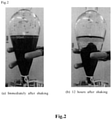
- an intermediate phase containing solids was formed between the aqueous phase and the ethyl acetate phase, and the phase separation did not occur at all immediately after the shaking ( FIG. 2 ).
- the interface between the aqueous phase and the ethyl acetate phase was not clear, although visually observable ( FIG. 2 ). Since it was necessary to collect the ethyl acetate phase such that the intermediate phase was not mixed therein, the amount of the carboxylic acid extract collected decreased as compared to that of Example 1.
- Example 2 The same procedure as in Example 1 was carried out, except that methyl isobutyl ketone was used as an extraction solvent instead of ethyl acetate, to obtain a carboxylic acid extract (acetic acid extraction rate: 85%, succinic acid extraction rate: 60%).
- acetic acid extraction rate: 85%, succinic acid extraction rate: 60% The formation of an intermediate phase containing solids between the aqueous phase and the methyl isobutyl ketone phase was barely observed, in the above extraction, and the phase separation occurred extremely quickly within 10 seconds.
- Example 2 The same procedure as in Example 2 was carried out, except that the carboxylic acid-containing fermentation broth was not passed through a nanofiltration membrane, to obtain a carboxylic acid extract (acetic acid extraction rate: 63%, succinic acid extraction rate: 41%).
- acetic acid extraction rate: 63%, succinic acid extraction rate: 41%) an intermediate phase containing solids was formed between the aqueous phase and the methyl isobutyl ketone phase, and the phase separation did not occur at all immediately after the shaking. Further, even after being left to stand for 12 hours or more, the interface between the aqueous phase and the methyl isobutyl ketone phase was not clear, although visually observable. Since it was necessary to collect the methyl isobutyl ketone phase such that the intermediate phase was not mixed therein, the amount of the carboxylic acid extract collected decreased as compared to that of Example 2.
- a quantity of 1 L of the carboxylic acid-containing fermentation broth prepared in Reference Example 1 was passed through a microfiltration membrane (a porous membrane having a pore size of 0.01 ⁇ m or more and less than 1 ⁇ m, manufactured by Toray Industries, Inc.), and then concentrated sulfuric acid (manufactured by Sigma-Aldrich Co. LLC) was added thereto to adjust the pH to 4.0. Subsequently, the resultant was passed through an ultrafiltration membrane (molecular weight cutoff 10,000; manufactured by Toray Industries, Inc.). Thereafter, the nanofiltration membrane treatment and extraction were carried out in the same manner as in Example 1, to obtain a carboxylic acid extract (acetic acid extraction rate: 99%, succinic acid extraction rate: 90%). The formation of an intermediate phase containing solids between the aqueous phase and the ethyl acetate phase was not observed, in the above extraction, and the phase separation occurred extremely quickly within 10 seconds.
- a microfiltration membrane a porous membrane having a pore size of 0.01 ⁇ m
- Example 3 The same procedure as in Example 3 was carried out, except that the nanofiltration membrane treatment was not performed, to obtain a carboxylic acid extract (acetic acid extraction rate: 90%, succinic acid extraction rate: 65%). In this extraction, an intermediate phase containing solids was formed between the aqueous phase and the ethyl acetate phase. Further, it took 10 minutes until a clear phase separation was observed.
- Example 3 and Comparative Example 3 have shown that the effect of the nanofiltration membrane is clearly observed, even in cases where the pH of the carboxylic acid-containing fermentation broth is adjusted at a timing before passing the fermentation broth through the ultrafiltration membrane.
- Each of the carboxylic acid-containing fermentation broths prepared in Reference Example 20 was passed through a microfiltration membrane (a porous membrane having a pore size of 0.01 ⁇ m or more and less than 1 ⁇ m, manufactured by Toray Industries, Inc.), and then passed through an ultrafiltration membrane (molecular weight cutoff: 10,000; manufactured by Toray Industries, Inc.).
- a microfiltration membrane a porous membrane having a pore size of 0.01 ⁇ m or more and less than 1 ⁇ m, manufactured by Toray Industries, Inc.
- an ultrafiltration membrane molecular weight cutoff: 10,000; manufactured by Toray Industries, Inc.
- Example 2 An experiment was carried out in the same manner as in Example 1, except that the itaconic acid-containing fermentation broth prepared in Reference Example 20 was used, to obtain an itaconic acid extract (extraction rate: 45%). The formation of an intermediate phase containing solids between the aqueous phase and the ethyl acetate phase was barely observed, in the above extraction, and the phase separation occurred extremely quickly within 10 seconds.
- Example 2 An experiment was carried out in the same manner as in Example 1, except that the adipic acid-containing fermentation broth prepared in Reference Example 20 was used, to obtain an adipic acid extract (extraction rate: 90%). The formation of an intermediate phase containing solids between the aqueous phase and the ethyl acetate phase was barely observed, in the above extraction, and the phase separation occurred extremely quickly within 10 seconds.
- Example 2 An experiment was carried out in the same manner as in Example 1, except that the ⁇ -hydromuconic acid-containing fermentation broth prepared in Reference Example 20 was used, to obtain an ⁇ -hydromuconic acid extract (extraction rate: 99%). The formation of an intermediate phase containing solids between the aqueous phase and the ethyl acetate phase was barely observed, in the above extraction, and the phase separation occurred extremely quickly within 10 seconds.
- Example 2 An experiment was carried out in the same manner as in Example 1, except that the cis,cis-muconic acid-containing fermentation broth prepared in Reference Example 20 was used, to obtain a cis,cis-muconic acid extract (extraction rate: 85%). The formation of an intermediate phase containing solids between the aqueous phase and the ethyl acetate phase was barely observed, in the above extraction, and the phase separation occurred extremely quickly within 10 seconds.
- Example 2 An experiment was carried out in the same manner as in Example 1, except that the 4-hydroxybenzoic acid-containing fermentation broth prepared in Reference Example 20 was used, to obtain a 4-hydroxybenzoic acid extract (extraction rate: 99%). The formation of an intermediate phase containing solids between the aqueous phase and the ethyl acetate phase was barely observed, in the above extraction, and the phase separation occurred extremely quickly within 10 seconds.
- Example 2 An experiment was carried out in the same manner as in Example 1, except that the L-phenylalanine-containing fermentation broth prepared in Reference Example 20 was used, to obtain an L-phenylalanine extract (extraction rate: 99%). The formation of an intermediate phase containing solids between the aqueous phase and the ethyl acetate phase was barely observed, in the above extraction, and the phase separation occurred extremely quickly within 10 seconds.
Landscapes
- Chemical & Material Sciences (AREA)
- Organic Chemistry (AREA)
- Engineering & Computer Science (AREA)
- Life Sciences & Earth Sciences (AREA)
- Wood Science & Technology (AREA)
- Zoology (AREA)
- Health & Medical Sciences (AREA)
- Chemical Kinetics & Catalysis (AREA)
- Bioinformatics & Cheminformatics (AREA)
- Biotechnology (AREA)
- Genetics & Genomics (AREA)
- Microbiology (AREA)
- Biochemistry (AREA)
- General Engineering & Computer Science (AREA)
- General Health & Medical Sciences (AREA)
- General Chemical & Material Sciences (AREA)
- Water Supply & Treatment (AREA)
- Nanotechnology (AREA)
- Oil, Petroleum & Natural Gas (AREA)
- Tropical Medicine & Parasitology (AREA)
- Virology (AREA)
- Biomedical Technology (AREA)
- Medicinal Chemistry (AREA)
- Separation Using Semi-Permeable Membranes (AREA)
- Organic Low-Molecular-Weight Compounds And Preparation Thereof (AREA)
Applications Claiming Priority (2)
| Application Number | Priority Date | Filing Date | Title |
|---|---|---|---|
| JP2019056709 | 2019-03-25 | ||
| PCT/JP2020/012856 WO2020196460A1 (ja) | 2019-03-25 | 2020-03-24 | カルボン酸の製造方法 |
Publications (3)
| Publication Number | Publication Date |
|---|---|
| EP3950657A1 true EP3950657A1 (de) | 2022-02-09 |
| EP3950657A4 EP3950657A4 (de) | 2023-01-04 |
| EP3950657B1 EP3950657B1 (de) | 2026-03-25 |
Family
ID=72609827
Family Applications (1)
| Application Number | Title | Priority Date | Filing Date |
|---|---|---|---|
| EP20778573.4A Active EP3950657B1 (de) | 2019-03-25 | 2020-03-24 | Carbonsäureherstellungsverfahren |
Country Status (6)
| Country | Link |
|---|---|
| US (1) | US20220090148A1 (de) |
| EP (1) | EP3950657B1 (de) |
| JP (1) | JP7651861B2 (de) |
| CN (1) | CN113614059B (de) |
| BR (1) | BR112021015097A2 (de) |
| WO (1) | WO2020196460A1 (de) |
Cited By (1)
| Publication number | Priority date | Publication date | Assignee | Title |
|---|---|---|---|---|
| WO2026013077A1 (en) * | 2024-07-10 | 2026-01-15 | Givaudan Sa | Feed purification method |
Families Citing this family (1)
| Publication number | Priority date | Publication date | Assignee | Title |
|---|---|---|---|---|
| CN119019249B (zh) * | 2024-08-16 | 2025-11-21 | 山东金麟科技开发有限公司 | 一种分离提纯乌头酸的原位疏水超分子体系及分离提纯乌头酸的方法 |
Family Cites Families (11)
| Publication number | Priority date | Publication date | Assignee | Title |
|---|---|---|---|---|
| JPS62201606A (ja) | 1985-09-20 | 1987-09-05 | Toray Ind Inc | 複合半透膜及びその製造方法 |
| US4886889A (en) * | 1986-05-16 | 1989-12-12 | Henkel Corporation | Process for recovery of an amino acid from aqueous mixtures thereof |
| US5426219A (en) * | 1993-07-26 | 1995-06-20 | A.E. Staley Manufacturing Co. | Process for recovering organic acids |
| JP2010095450A (ja) * | 2008-10-14 | 2010-04-30 | Toray Ind Inc | モノカルボン酸の製造方法 |
| JP2010126512A (ja) * | 2008-12-01 | 2010-06-10 | Toray Ind Inc | ヒドロキシカルボン酸の製造方法 |
| KR20110105845A (ko) * | 2008-12-26 | 2011-09-27 | 도레이 카부시키가이샤 | 락트산 및 폴리락트산의 제조 방법 |
| WO2011043443A1 (ja) * | 2009-10-07 | 2011-04-14 | 三菱化学株式会社 | 脂肪族ジカルボン酸の製造方法 |
| ES2776439T3 (es) | 2014-10-30 | 2020-07-30 | Toray Industries | Procedimiento para producir épsilon-caprolactama |
| KR102336853B1 (ko) * | 2014-12-02 | 2021-12-09 | 아처 다니엘 미드랜드 캄파니 | 덱스트로오스로부터 아크릴산을 제조하는 방법 |
| CN106117292A (zh) * | 2016-08-26 | 2016-11-16 | 何颖 | 一种从发酵液中分离维生素b12和丙酸的方法 |
| CN106905142A (zh) * | 2017-04-18 | 2017-06-30 | 四川龙蟒福生科技有限责任公司 | 一种s‑诱抗素的分离纯化方法 |
-
2020
- 2020-03-24 JP JP2020546518A patent/JP7651861B2/ja active Active
- 2020-03-24 CN CN202080023442.1A patent/CN113614059B/zh active Active
- 2020-03-24 US US17/439,838 patent/US20220090148A1/en active Pending
- 2020-03-24 BR BR112021015097-8A patent/BR112021015097A2/pt not_active Application Discontinuation
- 2020-03-24 EP EP20778573.4A patent/EP3950657B1/de active Active
- 2020-03-24 WO PCT/JP2020/012856 patent/WO2020196460A1/ja not_active Ceased
Cited By (1)
| Publication number | Priority date | Publication date | Assignee | Title |
|---|---|---|---|---|
| WO2026013077A1 (en) * | 2024-07-10 | 2026-01-15 | Givaudan Sa | Feed purification method |
Also Published As
| Publication number | Publication date |
|---|---|
| JPWO2020196460A1 (de) | 2020-10-01 |
| WO2020196460A1 (ja) | 2020-10-01 |
| CN113614059B (zh) | 2025-09-16 |
| EP3950657A4 (de) | 2023-01-04 |
| JP7651861B2 (ja) | 2025-03-27 |
| CN113614059A (zh) | 2021-11-05 |
| EP3950657B1 (de) | 2026-03-25 |
| US20220090148A1 (en) | 2022-03-24 |
| BR112021015097A2 (pt) | 2021-10-05 |
Similar Documents
| Publication | Publication Date | Title |
|---|---|---|
| CA2706205C (en) | Process for the purification of organic acids | |
| KR101768561B1 (ko) | 당액의 제조방법 | |
| Law et al. | Recovery of succinic acid from fermentation broth by forward osmosis-assisted crystallization process | |
| US20100190222A1 (en) | Lactic acid production method | |
| WO2011162009A1 (ja) | 精製糖水溶液の製造方法 | |
| EP3950657B1 (de) | Carbonsäureherstellungsverfahren | |
| CZ235194A3 (en) | Process for obtaining carboxylic acids from diluted solution thereof and apparatus for making the same | |
| Szczygiełda et al. | Downstream separation and purification of bio-based alpha-ketoglutaric acid from post-fermentation broth using a multi-stage membrane process | |
| AU2013272652B2 (en) | Process for producing sugar solution | |
| JP2009201506A (ja) | 乳酸の製造方法 | |
| US9909119B2 (en) | Method for producing purified soybean oligosaccharide liquid | |
| Bastrzyk et al. | Separation of post-fermentation glycerol solution by nanofiltration membrane distillation system | |
| CN1132741A (zh) | 碱性氨基酸的一种提纯方法 | |
| KR101374080B1 (ko) | 나노여과 및 정삼투를 이용한 발효액에서 유기산의 회수방법 | |
| JP2010095450A (ja) | モノカルボン酸の製造方法 | |
| US8293940B2 (en) | Process for recovery and purification of lactic acid | |
| EP2921471A1 (de) | Extraktionsverfahren von aconitsäure aus produkten der zuckerrohrindustrie | |
| EP2653550A1 (de) | Verfahren zur lactatherstellung | |
| JP7567479B2 (ja) | 3-ヒドロキシアジピン酸-3,6-ラクトンの製造方法 | |
| CN115997027A (zh) | 从包含生物质和至少一种芳香化合物的溶液中分离生物质的方法 | |
| WO2021060334A1 (ja) | アセトインの製造方法 | |
| JP2012193120A (ja) | 有機酸の製造方法 | |
| CN120247690A (zh) | 一种从发酵液中提取丁二酸的方法 | |
| JP2012191878A (ja) | 糖液の製造方法 | |
| CN112774448A (zh) | 一种酸与酯的分离方法 |
Legal Events
| Date | Code | Title | Description |
|---|---|---|---|
| STAA | Information on the status of an ep patent application or granted ep patent |
Free format text: STATUS: THE INTERNATIONAL PUBLICATION HAS BEEN MADE |
|
| PUAI | Public reference made under article 153(3) epc to a published international application that has entered the european phase |
Free format text: ORIGINAL CODE: 0009012 |
|
| STAA | Information on the status of an ep patent application or granted ep patent |
Free format text: STATUS: REQUEST FOR EXAMINATION WAS MADE |
|
| 17P | Request for examination filed |
Effective date: 20210913 |
|
| AK | Designated contracting states |
Kind code of ref document: A1 Designated state(s): AL AT BE BG CH CY CZ DE DK EE ES FI FR GB GR HR HU IE IS IT LI LT LU LV MC MK MT NL NO PL PT RO RS SE SI SK SM TR |
|
| DAV | Request for validation of the european patent (deleted) | ||
| DAX | Request for extension of the european patent (deleted) | ||
| A4 | Supplementary search report drawn up and despatched |
Effective date: 20221205 |
|
| RIC1 | Information provided on ipc code assigned before grant |
Ipc: C12R 1/19 20060101ALI20221129BHEP Ipc: C12P 13/22 20060101ALI20221129BHEP Ipc: C12P 7/54 20060101ALI20221129BHEP Ipc: C12P 7/56 20060101ALI20221129BHEP Ipc: C12P 7/46 20060101ALI20221129BHEP Ipc: C12P 7/44 20060101ALI20221129BHEP Ipc: C12P 7/42 20060101ALI20221129BHEP Ipc: C12N 1/02 20060101ALI20221129BHEP Ipc: C07C 227/40 20060101ALI20221129BHEP Ipc: C07B 63/00 20060101ALI20221129BHEP Ipc: C07C 65/03 20060101ALI20221129BHEP Ipc: C07C 57/16 20060101ALI20221129BHEP Ipc: C07C 55/14 20060101ALI20221129BHEP Ipc: C07C 57/13 20060101ALI20221129BHEP Ipc: C07C 51/47 20060101ALI20221129BHEP Ipc: C07C 55/10 20060101ALI20221129BHEP Ipc: C07C 53/08 20060101ALI20221129BHEP Ipc: C07C 51/48 20060101AFI20221129BHEP |
|
| GRAJ | Information related to disapproval of communication of intention to grant by the applicant or resumption of examination proceedings by the epo deleted |
Free format text: ORIGINAL CODE: EPIDOSDIGR1 |
|
| GRAP | Despatch of communication of intention to grant a patent |
Free format text: ORIGINAL CODE: EPIDOSNIGR1 |
|
| RIC1 | Information provided on ipc code assigned before grant |
Ipc: C07C 51/48 20060101AFI20251031BHEP Ipc: C07C 53/08 20060101ALI20251031BHEP Ipc: C07C 55/10 20060101ALI20251031BHEP Ipc: C07C 51/47 20060101ALI20251031BHEP Ipc: C07C 57/13 20060101ALI20251031BHEP Ipc: C07C 55/14 20060101ALI20251031BHEP Ipc: C07C 57/16 20060101ALI20251031BHEP Ipc: C07C 65/03 20060101ALI20251031BHEP Ipc: C07B 63/00 20060101ALI20251031BHEP Ipc: C07C 227/40 20060101ALI20251031BHEP Ipc: C12N 1/02 20060101ALI20251031BHEP Ipc: C12P 7/42 20060101ALI20251031BHEP Ipc: C12P 7/44 20060101ALI20251031BHEP Ipc: C12P 7/46 20060101ALI20251031BHEP Ipc: C12P 7/56 20060101ALI20251031BHEP Ipc: C12P 7/54 20060101ALI20251031BHEP Ipc: C12P 13/22 20060101ALI20251031BHEP Ipc: C12R 1/19 20060101ALI20251031BHEP |
|
| GRAP | Despatch of communication of intention to grant a patent |
Free format text: ORIGINAL CODE: EPIDOSNIGR1 |
|
| STAA | Information on the status of an ep patent application or granted ep patent |
Free format text: STATUS: GRANT OF PATENT IS INTENDED |
|
| INTG | Intention to grant announced |
Effective date: 20251211 |
|
| GRAS | Grant fee paid |
Free format text: ORIGINAL CODE: EPIDOSNIGR3 |
|
| GRAA | (expected) grant |
Free format text: ORIGINAL CODE: 0009210 |
|
| STAA | Information on the status of an ep patent application or granted ep patent |
Free format text: STATUS: THE PATENT HAS BEEN GRANTED |
|
| P01 | Opt-out of the competence of the unified patent court (upc) registered |
Free format text: CASE NUMBER: UPC_APP_0001699_3950657/2026 Effective date: 20260119 |
|
| AK | Designated contracting states |
Kind code of ref document: B1 Designated state(s): AL AT BE BG CH CY CZ DE DK EE ES FI FR GB GR HR HU IE IS IT LI LT LU LV MC MK MT NL NO PL PT RO RS SE SI SK SM TR |
|
| REG | Reference to a national code |
Ref country code: CH Ref legal event code: F10 Free format text: ST27 STATUS EVENT CODE: U-0-0-F10-F00 (AS PROVIDED BY THE NATIONAL OFFICE) Effective date: 20260325 Ref country code: GB Ref legal event code: FG4D |
|
| REG | Reference to a national code |
Ref country code: DE Ref legal event code: R096 Ref document number: 602020069213 Country of ref document: DE |
|
| REG | Reference to a national code |
Ref country code: IE Ref legal event code: FG4D |