EP3950740B1 - Polymère à base d'oléfine - Google Patents
Polymère à base d'oléfine Download PDFInfo
- Publication number
- EP3950740B1 EP3950740B1 EP20872178.7A EP20872178A EP3950740B1 EP 3950740 B1 EP3950740 B1 EP 3950740B1 EP 20872178 A EP20872178 A EP 20872178A EP 3950740 B1 EP3950740 B1 EP 3950740B1
- Authority
- EP
- European Patent Office
- Prior art keywords
- olefin
- based polymer
- molecular weight
- differential scanning
- temperature
- Prior art date
- Legal status (The legal status is an assumption and is not a legal conclusion. Google has not performed a legal analysis and makes no representation as to the accuracy of the status listed.)
- Active
Links
Images

Classifications
-
- C—CHEMISTRY; METALLURGY
- C08—ORGANIC MACROMOLECULAR COMPOUNDS; THEIR PREPARATION OR CHEMICAL WORKING-UP; COMPOSITIONS BASED THEREON
- C08F—MACROMOLECULAR COMPOUNDS OBTAINED BY REACTIONS ONLY INVOLVING CARBON-TO-CARBON UNSATURATED BONDS
- C08F210/00—Copolymers of unsaturated aliphatic hydrocarbons having only one carbon-to-carbon double bond
- C08F210/16—Copolymers of ethene with alpha-alkenes, e.g. EP rubbers
-
- C—CHEMISTRY; METALLURGY
- C08—ORGANIC MACROMOLECULAR COMPOUNDS; THEIR PREPARATION OR CHEMICAL WORKING-UP; COMPOSITIONS BASED THEREON
- C08F—MACROMOLECULAR COMPOUNDS OBTAINED BY REACTIONS ONLY INVOLVING CARBON-TO-CARBON UNSATURATED BONDS
- C08F2/00—Processes of polymerisation
- C08F2/01—Processes of polymerisation characterised by special features of the polymerisation apparatus used
-
- C—CHEMISTRY; METALLURGY
- C08—ORGANIC MACROMOLECULAR COMPOUNDS; THEIR PREPARATION OR CHEMICAL WORKING-UP; COMPOSITIONS BASED THEREON
- C08F—MACROMOLECULAR COMPOUNDS OBTAINED BY REACTIONS ONLY INVOLVING CARBON-TO-CARBON UNSATURATED BONDS
- C08F2/00—Processes of polymerisation
- C08F2/04—Polymerisation in solution
-
- C—CHEMISTRY; METALLURGY
- C08—ORGANIC MACROMOLECULAR COMPOUNDS; THEIR PREPARATION OR CHEMICAL WORKING-UP; COMPOSITIONS BASED THEREON
- C08F—MACROMOLECULAR COMPOUNDS OBTAINED BY REACTIONS ONLY INVOLVING CARBON-TO-CARBON UNSATURATED BONDS
- C08F210/00—Copolymers of unsaturated aliphatic hydrocarbons having only one carbon-to-carbon double bond
- C08F210/02—Ethene
-
- C—CHEMISTRY; METALLURGY
- C08—ORGANIC MACROMOLECULAR COMPOUNDS; THEIR PREPARATION OR CHEMICAL WORKING-UP; COMPOSITIONS BASED THEREON
- C08F—MACROMOLECULAR COMPOUNDS OBTAINED BY REACTIONS ONLY INVOLVING CARBON-TO-CARBON UNSATURATED BONDS
- C08F210/00—Copolymers of unsaturated aliphatic hydrocarbons having only one carbon-to-carbon double bond
- C08F210/04—Monomers containing three or four carbon atoms
- C08F210/08—Butenes
-
- C—CHEMISTRY; METALLURGY
- C08—ORGANIC MACROMOLECULAR COMPOUNDS; THEIR PREPARATION OR CHEMICAL WORKING-UP; COMPOSITIONS BASED THEREON
- C08F—MACROMOLECULAR COMPOUNDS OBTAINED BY REACTIONS ONLY INVOLVING CARBON-TO-CARBON UNSATURATED BONDS
- C08F4/00—Polymerisation catalysts
- C08F4/42—Metals; Metal hydrides; Metallo-organic compounds; Use thereof as catalyst precursors
- C08F4/44—Metals; Metal hydrides; Metallo-organic compounds; Use thereof as catalyst precursors selected from light metals, zinc, cadmium, mercury, copper, silver, gold, boron, gallium, indium, thallium, rare earths or actinides
- C08F4/60—Metals; Metal hydrides; Metallo-organic compounds; Use thereof as catalyst precursors selected from light metals, zinc, cadmium, mercury, copper, silver, gold, boron, gallium, indium, thallium, rare earths or actinides together with refractory metals, iron group metals, platinum group metals, manganese, rhenium technetium or compounds thereof
- C08F4/62—Refractory metals or compounds thereof
- C08F4/64—Titanium, zirconium, hafnium or compounds thereof
- C08F4/659—Component covered by group C08F4/64 containing a transition metal-carbon bond
- C08F4/6592—Component covered by group C08F4/64 containing a transition metal-carbon bond containing at least one cyclopentadienyl ring, condensed or not, e.g. an indenyl or a fluorenyl ring
-
- C—CHEMISTRY; METALLURGY
- C08—ORGANIC MACROMOLECULAR COMPOUNDS; THEIR PREPARATION OR CHEMICAL WORKING-UP; COMPOSITIONS BASED THEREON
- C08L—COMPOSITIONS OF MACROMOLECULAR COMPOUNDS
- C08L23/00—Compositions of homopolymers or copolymers of unsaturated aliphatic hydrocarbons having only one carbon-to-carbon double bond; Compositions of derivatives of such polymers
- C08L23/02—Compositions of homopolymers or copolymers of unsaturated aliphatic hydrocarbons having only one carbon-to-carbon double bond; Compositions of derivatives of such polymers not modified by chemical after-treatment
- C08L23/10—Homopolymers or copolymers of propene
- C08L23/14—Copolymers of propene
- C08L23/142—Copolymers of propene at least partially crystalline copolymers of propene with other olefins
-
- C—CHEMISTRY; METALLURGY
- C08—ORGANIC MACROMOLECULAR COMPOUNDS; THEIR PREPARATION OR CHEMICAL WORKING-UP; COMPOSITIONS BASED THEREON
- C08F—MACROMOLECULAR COMPOUNDS OBTAINED BY REACTIONS ONLY INVOLVING CARBON-TO-CARBON UNSATURATED BONDS
- C08F2500/00—Characteristics or properties of obtained polyolefins; Use thereof
- C08F2500/12—Melt flow index or melt flow ratio
-
- C—CHEMISTRY; METALLURGY
- C08—ORGANIC MACROMOLECULAR COMPOUNDS; THEIR PREPARATION OR CHEMICAL WORKING-UP; COMPOSITIONS BASED THEREON
- C08F—MACROMOLECULAR COMPOUNDS OBTAINED BY REACTIONS ONLY INVOLVING CARBON-TO-CARBON UNSATURATED BONDS
- C08F2500/00—Characteristics or properties of obtained polyolefins; Use thereof
- C08F2500/18—Bulk density
-
- C—CHEMISTRY; METALLURGY
- C08—ORGANIC MACROMOLECULAR COMPOUNDS; THEIR PREPARATION OR CHEMICAL WORKING-UP; COMPOSITIONS BASED THEREON
- C08F—MACROMOLECULAR COMPOUNDS OBTAINED BY REACTIONS ONLY INVOLVING CARBON-TO-CARBON UNSATURATED BONDS
- C08F4/00—Polymerisation catalysts
- C08F4/42—Metals; Metal hydrides; Metallo-organic compounds; Use thereof as catalyst precursors
- C08F4/44—Metals; Metal hydrides; Metallo-organic compounds; Use thereof as catalyst precursors selected from light metals, zinc, cadmium, mercury, copper, silver, gold, boron, gallium, indium, thallium, rare earths or actinides
- C08F4/60—Metals; Metal hydrides; Metallo-organic compounds; Use thereof as catalyst precursors selected from light metals, zinc, cadmium, mercury, copper, silver, gold, boron, gallium, indium, thallium, rare earths or actinides together with refractory metals, iron group metals, platinum group metals, manganese, rhenium technetium or compounds thereof
- C08F4/62—Refractory metals or compounds thereof
- C08F4/64—Titanium, zirconium, hafnium or compounds thereof
- C08F4/659—Component covered by group C08F4/64 containing a transition metal-carbon bond
- C08F4/65908—Component covered by group C08F4/64 containing a transition metal-carbon bond in combination with an ionising compound other than alumoxane, e.g. (C6F5)4B-X+
Definitions
- the present invention relates to a copolymer of ethylene and any one selected from the group consisting of propylene, 1-butene, 1-pentene, 4-methyl-1-pentene, 1-hexene, 1-heptene, and 1-octene, or mixtures of two or more thereof, and more particularly, to a low-density copolymer of ethylene and any one selected from the group consisting of propylene, 1-butene, 1-pentene, 4-methyl-1-pentene, 1-hexene, 1-heptene, and 1-octene, or mixtures of two or more thereof, introducing a highly crystalline region and showing high mechanical rigidity.
- Polyolefin has excellent moldability, heat resistance, mechanical properties, sanitary quality, permeability of water vapor and appearance characteristics of a molded article, and is widely used as an extrusion molded article, blow molded article and injection molded article.
- polyolefin particularly, polyethylene has no polar group in a molecule, and has low compatibility with a polar resin such as nylon and poor adhesiveness with a polar resin and a metal.
- a polar resin such as nylon and poor adhesiveness with a polar resin and a metal.
- the molded article of polyolefin has defects of low surface hydrophilicity and antistatic properties.
- an olefin polymer such as an ethylene homopolymer, an ethylene/ ⁇ -olefin copolymer, a propylene homopolymer and a propylene/ ⁇ -olefin copolymer
- a method of copolymerizing a polar monomer in the presence of a metal catalyst such as a titanium catalyst and a vanadium catalyst has been used.
- a metal catalyst such as a titanium catalyst and a vanadium catalyst
- a polymerization method in the presence of a metallocene catalyst formed using a transition metal compound such as zircononocene dichloride and an organoaluminum oxy compound (aluminoxane) is known.
- a metallocene catalyst an olefin polymer with a high molecular weight is obtained in high activity, and the olefin polymer thus produced has narrow molecular weight distribution and narrow composition distribution.
- a method of using a metallocene catalyst using a metallocene compound having a ligand of a non-crosslinked cyclopentadienyl group, a crosslinked or non-crosslinked bis indenyl group, or an ethylene crosslinked unsubstituted indenyl group/fluorenyl group as a catalyst is known.
- this method has defects of very low polymerization activity. Accordingly, a method of protecting a polar group by a protecting group is performed, but in case of introducing a protecting group, this protecting group is required to be removed after reaction, resulting in a complicated process.
- An ansa-metallocene compound is an organometal compound including two ligands connected by a bridge group, and due to the bridge group, the rotation of the ligands is prevented, and the activity and structure of a metal center is determined.
- Such an ansa-metallocene compound is used as a catalyst for preparing an olefin-based homopolymer or copolymer.
- an ansa-metallocene compound including a cyclopentadienyl-fluorenyl ligand may produce polyethylene having a high molecular weight, and through this, the microstructure of polypropylene may be controlled.
- an ansa-metallocene compound including an indenyl ligand has excellent activity and may produce polyolefin having improved stereoregularity.
- WO 2008/140205 A1 describes ethylene a-olefin copolymers having a narrow molecular weight distribution and a uniform distribution of comonomer.
- the ethylene a-olefin copolymer exhibits a lower density at the same comonomer content as compared to ethylene copolymers having a random or blocky comonomer distribution.
- KR 2019 0076499 A relates to a polypropylene; and a polypropylene-based composite containing an olefin-based polymer.
- the olefin-based polymer has: (1) 0.850 to 0.865 g/cc of a density; (2) 0.1 to 3.0 g/10 min of a melt index (MI, 190°C, load condition of 2.16 kg); and (3) 8% or more of a soluble fraction (SF) at -20°C on cross-fractionation chromatography (CFC), wherein the average molecular weight (Mw) of the fraction meets the requirements of 50,000 to 500,000 g/mol.
- MI melt index
- CFC cross-fractionation chromatography
- KR 2016 0124788 A describes polymers of ethylene and at least one alpha olefin having from 4 to 20 carbon atoms.
- the polymer has a melt index ratio (MIR) greater than about 40.
- MIR melt index ratio
- the polymer also has a value for Mw1/Mw2 of at least about 2.0, wherein Mw1/Mw2 is a ratio of a weight average molecular weight (Mw) for a first half of a temperature rising elution (TREF) curve from a cross-fractionation (CFC) analysis to an Mw for a second half of the TREF curve.
- Mw1/Mw2 is a ratio of a weight average molecular weight (Mw) for a first half of a temperature rising elution (TREF) curve from a cross-fractionation (CFC) analysis to an Mw for a second half of the TREF curve.
- the polymer also has a value for Tw1 - Tw2 of less than about - 15 °C, wherein Tw1 - Tw2 is a difference of a weight average elution temperature (Tw) for the first half of the TREF curve to a Tw for the second half of the TREF curve.
- Tw weight average elution temperature
- the task to be solved of the present invention is to provide a low-density olefin-based polymer obtained by polymerizing an olefin-based monomer by injecting a hydrogen gas using a transition metal catalyst, thereby introducing a highly crystalline region and showing high mechanical rigidity.
- the present invention provides an olefin-based polymer satisfying the following conditions (1) to (3):
- the olefin-based polymer according to the present invention is a low-density olefin-based polymer, wherein a highly crystalline region is introduced, and high mechanical rigidity is shown, and is a copolymer of ethylene and any one selected from the group consisting of propylene, 1-butene, 1-pentene, 4-methyl-1-pentene, 1-hexene, 1-heptene, and 1-octene, or mixtures of two or more thereof.
- the olefin-based polymer according to the present invention is a copolymer of ethylene and any one selected from the group consisting of propylene, 1-butene, 1-pentene, 4-methyl-1-pentene, 1-hexene, 1-heptene, and 1-octene, or mixtures of two or more thereof and satisfies the conditions (1) to (3) below.
- T(50), T(90) and T(95) are temperatures at which 50%, 90%, and 95% are melted, respectively, when fractionating a temperature-heat capacity curve from measurement results by the differential scanning calorimetry precise measurement method (SSA).
- SSA differential scanning calorimetry precise measurement method
- the olefin-based polymer according to the present invention has a very low density and introduces a highly crystalline region when compared with a common conventional olefin-based polymer, and in case of having the same degrees of density and melt index (MI, 190°C, 2.16 kg load conditions), even higher tensile strength and tearing strength may be shown.
- the olefin-based polymer according to the present invention is prepared by a preparation method including a step of polymerizing an olefin-based monomer by injecting a hydrogen gas in the presence of a catalyst composition for polymerizing olefin, and according to the injection of the hydrogen gas during polymerization, a highly crystalline region is introduced, and excellent mechanical rigidity is shown.
- the melt index (MI) may be controlled by controlling an amount used of the comonomer of a catalyst used in the process of polymerizing an olefin-based polymer and influences the mechanical properties and impact strength of the olefin-based polymer, and its moldability.
- the melt index is measured under low-density conditions of 0.860 g/cc to 0.880 g/cc according to ASTM D1238 at 190°C and 2.16 kg load conditions, and may show 0.1 g/10 min to 10 g/ 10 min, particularly, 0.3 g/10 min to 9 g/10 min, more particularly, 0.4 g/10 min to 7 g/10 min.
- the density may be 0.860 g/cc to 0.875 g/cc.
- the density of an olefin-based polymer is influenced by the type and amount of a monomer used for polymerization, a polymerization degree, etc., and the influence by the amount of a comonomer is significant.
- the olefin-based polymer of the present invention is polymerized using a catalyst composition including a transition metal compound having a characteristic structure, and a large amount of comonomer may be introduced. Accordingly, the olefin-based polymer of the present invention may have a low density as in the above-described range.
- the olefin-based polymer satisfies, when measured by a differential scanning calorimetry precise measurement method (SSA), T(90)-T(50) ⁇ 50 and T(95)-T(90) ⁇ 10, and may particularly satisfy 20 ⁇ T(90)-T(50) ⁇ 45 and 10 ⁇ T(95)-T(90) ⁇ 30, more particularly, 30 ⁇ T(90)-T(50) ⁇ 40 and 10 ⁇ T(95)-T(90) ⁇ 20.
- SSA differential scanning calorimetry precise measurement method
- the T(50), T(90) and T(95) are temperatures at which 50%, 90%, and 95% are melted, respectively, when fractionating a temperature-heat capacity curve from measurement results by the differential scanning calorimetry precise measurement method (SSA).
- SSA differential scanning calorimetry precise measurement method
- the measurement of a melting temperature (Tm) using differential scanning calorimetry is performed by a first cycle including heating to a temperature higher by 30°C than the melting temperature (Tm) at a constant rate, and cooling to a temperature lower by 30°C than a glass transition temperature (Tg) at a constant rate and a second cycle to obtain the peak of a standard melting temperature (Tm).
- the differential scanning calorimetry precise measurement method (SSA) is a method of obtaining more accurate crystal information by undergoing a process of heating immediately before the peak of a melting temperature (Tm) and cooling after the first cycle using differential scanning calorimetry (DSC), and repeatedly performing heating to a temperature reduced by 5°C and cooling ( Eur. Polym. J. 2015, 65, 132 ).
- a high temperature melting peak may not be shown when measured by a melting temperature using general differential scanning calorimetry (DSC) but may be measured through the differential scanning calorimetry precise measurement method (SSA).
- DSC general differential scanning calorimetry
- SSA differential scanning calorimetry precise measurement method
- the olefin-based polymer according to an embodiment of the present invention may additionally satisfy the conditions of (4) a weight average molecular weight (Mw) of 10,000 g/mol to 500,000 g/mol, and particularly, the weight average molecular weight (Mw) may be 30,000 g/mol to 300,000 g/mol, more particularly, 50,000 g/mol to 200,000 g/mol.
- the weight average molecular weight (Mw) is a polystyrene conversion molecular weight analyzed by gel permeation chromatography (GPC).
- the olefin-based polymer according to an embodiment of the present invention may satisfy the conditions of (6) a melting temperature (Tm) of 20°C to 70°C when measured by differential scanning calorimetry (DSC), wherein the melting temperature (Tm) may particularly be 25°C to 60°C, more particularly, 25°C to 50°C.
- Tm melting temperature
- the olefin-based copolymer according to an embodiment of the present invention may be a copolymer of ethylene with propylene, ethylene with 1-butene, ethylene with 1-hexene, ethylene with 4-methyl-1-pentene or ethylene with 1-octene, and more particularly, the olefin copolymer according to an embodiment of the present invention may be a copolymer of ethylene with 1-butene.
- the amount of any one selected from the group consisting of propylene, 1-butene, 1-pentene, 4-methyl-1-pentene, 1-hexene, 1-heptene, and 1-octene, or mixtures of two or more thereof, may be 90 wt% or less, more particularly, 70 wt% or less, further more particularly, 5 wt% to 60 wt%, further more particularly, 20 wt% to 50 wt% based on the total weight of the copolymer. If included in the range, the achievement of the above-described physical properties may be easy.
- the copolymer according to the present invention having the above-described physical properties and configurational characteristics may be prepared through continuous solution polymerization reaction for polymerizing an olefin-based monomer by injecting a hydrogen gas in the presence of a metallocene catalyst composition including one or more types of transition metal compounds in a single reactor. Accordingly, in the copolymer according to an embodiment of the present invention, a block composed by linearly connecting two or more repeating units derived from any one monomer among monomers constituting a polymer is not formed in the polymer.
- the copolymer according to the present invention may not include a block copolymer, but may be selected from the group consisting of a random copolymer, an alternating copolymer and a graft copolymer, more particularly, a random copolymer.
- the hydrogen gas may be injected in an amount of 0.8 to 3 parts by weight, particularly, 0.9 to 2.8 parts by weight, more particularly, 1 to 2.7 parts by weight based on 1 part by weight of ethylene.
- the hydrogen gas in case the copolymer is polymerized by continuous solution polymerization, the hydrogen gas may be injected into a reaction system in an amount of 0.8 to 3 kg/h, particularly, 0.9 to 2.8 kg/h, more particularly, 1 to 2.7 kg/h based on 1 kg/h of ethylene.
- the copolymer of the present invention may satisfy the above-described physical properties.
- the olefin-based copolymer of the present invention may be obtained by a preparation method including a step of polymerizing an olefin-based monomer by injecting a hydrogen gas in the presence of a catalyst composition for polymerizing olefin, including a transition metal compound of Formula 1 below.
- the transition metal compound represented by Formula 2 has characteristics in which a metal site is connected by a cyclopentadienyl ligand introducing tetrahydroquinoline, and a narrow Cp-M-N angle and a wide Q 1 -M-Q 2 (Q 3 -M-Q 4 ) angle to which a monomer goes near, are maintained.
- Cp, tetrahydroquinoline, nitrogen and a metal site are connected in order, and more stable and rigid five-member ring structure is formed.
- the polymerization of an olefin-based polymer having the characteristics of high activity, high molecular weight and high copolymerization properties may be achieved even at a high polymerization temperature.
- hydrocarbyl group used in the present disclosure means a monovalent hydrocarbon group of 1 to 20 carbon atoms, which is composed of only carbon and hydrogen irrespective of its structure, such as alkyl, aryl, alkenyl, alkynyl, cycloalkyl, alkylaryl and arylalkyl, unless otherwise referred to.
- halogen used in the present disclosure means fluorine, chlorine, bromine or iodine, unless otherwise referred to.
- alkyl used in the present disclosure means a hydrocarbon residual group of a linear chain or branched chain, unless otherwise referred to.
- cycloalkyl used in the present disclosure represents cyclic alkyl including cyclopropyl, etc., unless otherwise referred to.
- alkenyl used in the present disclosure means an alkenyl group of a linear chain or branched chain, unless otherwise referred to.
- the branched chain may be alkyl of 1 to 20 carbon atoms; alkenyl of 2 to 20 carbon atoms; aryl of 6 to 20 carbon atoms; alkylaryl of 7 to 20 carbon atoms; or arylalkyl of 7 to 20 carbon atoms.
- aryl used in the present invention represents, unless otherwise referred to, an aromatic group of 6 to 20 carbon atoms, particularly, phenyl, naphthyl, anthryl, phenanthryl, chrysenyl, pyrenyl, anthracenyl, pyridyl, dimethylanilinyl, anisolyl, etc., without limitation.
- the alkylaryl group means an aryl group substituted with the alkyl group.
- the arylalkyl group means an alkyl group substituted with the aryl group.
- the cyclic group means a monovalent aliphatic or aromatic hydrocarbon group having 5 to 20 ring-forming carbon atoms and including one or more heteroatoms, and may be a single ring or a condensed ring of two or more rings.
- the heterocyclic group may be unsubstituted or substituted with an alkyl group. Examples thereof may include indoline, tetrahydroquinoline, etc., but the present invention is not limited thereto.
- the aryl group may preferably have 6 to 20 carbon atoms, and may particularly be phenyl, naphthyl, anthracenyl, pyridyl, dimethylanilinyl, anisolyl, etc., without limitation.
- the silyl may be silyl unsubstituted or substituted with alkyl of 1 to 20 carbo atoms, for example, silyl, trimethylsilyl, triethylsilyl, tripropylsilyl, tributylsilyl, trihexylsilyl, triisopropylsilyl, triisobutylsilyl, triethoxysilyl, triphenylsilyl, tris(trimethylsilyl)silyl, etc., without limitation.
- the compound of Formula 1 may be Formula 1-1 below, without limitation.
- the compound may have various structures within the range defined in Formula 1.
- the transition metal compound of Formula 2 may introduce a large amount of alpha-olefin as well as low-density polyethylene due to the structural characteristics of a catalyst, and a low-density polyolefin copolymer with a density of 0.860 g/cc to 0.880 g/cc may be prepared.
- the transition metal compound of Formula 1 may be prepared by, for example, a method below.
- R 1 to R 3 , M, Q 1 and Q 2 are the same as defined in Formula 1.
- Formula 1 may be prepared by a method disclosed in Patent Laid-open No. 2007-0003071 .
- the transition metal compound of Formula 1 may be used as a catalyst of polymerization reaction as a composition type additionally including one or more among the co-catalyst compounds represented by Formula 2, Formula 3, and Formula 4 below.
- Examples of the compound represented by Formula 2 may include alkylaluminoxane such as methylaluminoxane (MAO), ethylaluminoxane, isobutylaluminoxane and butylalminoxane, and a modified alkylaluminoxane obtained by mixing two or more types of the alkylaluminoxane, particularly, methylaluminoxane, modified methylaluminoxane (MMAO).
- alkylaluminoxane such as methylaluminoxane (MAO), ethylaluminoxane, isobutylaluminoxane and butylalminoxane
- a modified alkylaluminoxane obtained by mixing two or more types of the alkylaluminoxane, particularly, methylaluminoxane, modified methylaluminoxane (MMAO).
- Examples of the compound represented by Formula 3 may include trimethylaluminum, triethylaluminum, triisobutylaluminum, tripropylaluminum, tributylaluminum, dimethylchloroaluminum, triisopropylaluminum, tri-s-butylaluminum, tricyclopentylaluminum, tripentylaluminum, triisopentylaluminum, trihexylaluminum, trioctylaluminum, ethyldimethylaluminum, methyldiethylaluminum, triphenylaluminum, tri-p-tolylaluminum, dimethylaluminummethoxide, dimethylaluminumethoxide, trimethylboron, triethylboron, triisobutylboron, tripropylboron, tributylboron, etc. and particularly, may be selected from trimethylaluminum, triethylalumin
- Examples of the compound represented by Formula 4 may include triethylammoniumtetraphenylboron, tributylammoniumtetraphenylboron, trimethylammoniumtetraphenylboron, tripropylammoniumtetraphenylboron, trimethylammoniumtetra(p-tolyl)boron, trimethylammoniumtetra(o,p-dimethylphenyl)boron, tributylammoniumtetra(p-trifluoromethylphenyl)boron, trimethylammoniumtetra(p-trifluoromethylphenyl)boron, tributylammoniumtetrapentafluorophenylboron, N,N-diethylaniliumtetraphenylboron, N,N-diethylaniliumtetrapentafluorophenylboron, diethylammoniumtetrapentafluorophenylboron, triphenyl
- the catalyst composition may be prepared by, as a first method, a preparation method including a step of obtaining a mixture by contacting the transition metal compound represented by Formula 1 with the compound represented by Formula 2 or Formula 3; and a step of adding the compound represented by Formula 4 to the mixture.
- the catalyst composition may be prepared by, as a second method, a method of making contacting of the transition metal compound represented by Formula 1 with the compound represented by Formula 4.
- the molar ratio of the transition metal compound represented by Formula 1 and the transition metal compound represented by Formula 2/the compound represented by Formula 2 or Formula 3 may be 1/5,000 to 1/2, particularly, 1/1,000 to 1/10, more particularly, 1/500 to 1/20.
- the molar ratio of the transition metal compound represented by Formula 1/the compound represented by Formula 2 or Formula 3 is greater than 1/2, the amount of an alkylating agent is too small, and the alkylation of a metal compound may be incompletely carried out, and if the molar ratio is less than 1/5,000, the alkylation of the metal compound may be achieved, but the activation of the alkylated metal compound may be incompletely carried out due to the side reactions between an excessive amount of the alkylating agent remained and an activating agent which is the compound of Formula 4.
- the molar ratio of the transition metal compound represented by Formula 1/the compound represented by Formula 4 may be 1/25 to 1, particularly, 1/10 to 1, more particularly, 1/5 to 1.
- the molar ratio of the transition metal compound represented by Formula 1/the compound represented by Formula 4 is greater than 1, the amount of an activating agent is relatively small, and the activation of the metal compound may be incompletely carried out, and thus, the activity of the catalyst composition may be deteriorated. If the molar ratio is less than 1/25, the activation of the metal compound may be completely carried out, but due to the excessive amount of the activating agent remained, it would not be economical considering the unit cost of the catalyst composition, or the purity of a polymer produced may be degraded.
- the molar ratio of the transition metal compound represented by Formula 1/the compound represented by Formula 4 may be 1/10,000 to 1/10, particularly, 1/5,000 to 1/100, more particularly, 1/3,000 to 1/500. If the molar ratio is greater than 1/10, the amount of an activating agent is relatively small, and the activation of the metal compound may be incompletely carried out, and the activity of the catalyst composition thus produced may be degraded. If the molar ratio is less than 1/10,000, the activation of the metal compound may be completely carried out, but due to the excessive amount of the activating agent remained, it would not be economical considering the unit cost of the catalyst composition, or the purity of a polymer produced may be degraded.
- a hydrocarbon-based solvent such as pentane, hexane, and heptane, or an aromatic solvent such as benzene and toluene may be used.
- the catalyst composition may include the transition metal compound and the co-catalyst compound in a supported type on a support.
- any supports used in a metallocene-based catalyst may be used as the support without specific limitation.
- the support may be silica, silica-alumina or silica-magnesia, and any one among them or mixtures of two or more thereof may be used.
- the support is silica among them, since a silica support and the functional group of the metallocene compound of Formula 1 may form a chemical bond, there is no catalyst separated from the surface during an olefin polymerization process. As a result, the generation of fouling, by which polymer particles are agglomerated on the wall side of a reactor or from each other during the preparation process of an olefin-based copolymer, may be prevented. In addition, the particle shape and apparent density of a polymer of the olefin-based copolymer prepared in the presence of a catalyst including the silica support are excellent.
- the support may be silica or silica-alumina, including a highly reactive siloxane group and dried at a high temperature through a method of drying at a high temperature, etc.
- the support may further include an oxide, a carbonate, a sulfate, or a nitrate component such as Na 2 O, K 2 CO 3 , BaSO 4 and Mg (NO 3 ) 2 .
- the polymerization reaction for polymerizing the olefin-based monomer may be achieved by a common process applied to the polymerization of an olefin monomer such as continuous solution polymerization, bulk polymerization, suspension polymerization, slurry polymerization and emulsion polymerization.
- the polymerization reaction of the olefin monomer may be performed in an inert solvent, and as the inert solvent, benzene, toluene, xylene, cumene, heptane, cyclohexane, methylcyclohexane, methylcyclopentane, n-hexane, 1-hexene, and 1-octene may be used, without limitation.
- the polymerization of the olefin-based polymer may be performed at a temperature of about 25°C to about 500°C, particularly, at a temperature of 80°C to 250°C, more preferably, 100°C to 200°C.
- the reaction pressure during the polymerization may be 1 kgf/cm 2 to 150 kgf/cm 2 , preferably, 1 kgf/cm 2 to 120 kgf/cm 2 , more preferably, 5 kgf/cm 2 to 100 kgf/cm 2 .
- the olefin-based polymer of the present invention has improved physical properties, and accordingly, may be useful for hollow molding, extrusion molding or injecting molding in various fields and uses for packing, construction, household items, etc. including materials for cars, wires, toys, fibers, and medical, and particularly, useful for cars requiring excellent impact strength.
- the olefin-based polymer of the present invention may be usefully used for the manufacture of a molded article.
- the molded article may be a blow molding molded article, an inflation molded article, a cast molded article, an extrusion laminate molded article, an extrusion molded article, a foam molded article, an injection molded article, a sheet, a film, a fiber, a monofilament, a nonwoven fabric, etc.
- 1,2,3,4-tetrahydroquinoline (13.08 g, 98.24 mmol) and diethyl ether (150 mL) were put in a shlenk flask.
- the shlenk flask was immersed and stirred for 30 minutes.
- n-BuLi 39.9 mL, 2.5 M, 98.24 mmol
- a light yellow slurry was formed.
- the flask was stirred for 2 hours, and the temperature of the flask was elevated to room temperature while removing a butane gas produced.
- the flask was immersed again into the low-temperature bath of -78°C to reduce the temperature, and a CO 2 gas was injected. According to the injection of the carbon dioxide gas, the slurry disappeared into a transparent solution.
- the flask was connected with a bubbler, and the temperature was elevated to room temperature while removing the carbon dioxide gas. After that, remaining CO 2 gas and solvents were removed under vacuum.
- pentane was added thereto, followed by vigorous stirring and filtering to obtain lithium carbamate as a while solid compound. In the while solid compound, diethyl ether made a coordination bond. In this case, the yield was 100%.
- the lithium carbamate compound (8.47 g, 42.60 mmol) prepared in step (i) above was put in a shlenk flask. Then, tetrahydrofuran (4.6 g, 63.9 mmol) and 45 mL of diethyl ether were added thereto in order. Into a low-temperature bath of -20°C obtained by acetone and a small amount of dry ice, the shlenk flask was immersed and stirred for 30 minutes, and n-BuLi (25.1 mL, 1.7 M, 42.60 mmol) was injected. In this case, the color of the reaction mixture was changed into red. While continuously maintaining -20°C, stirring was performed for 6 hours.
- a CeCl 3 ⁇ 2LiCl solution (129 mL, 0.33 M, 42.60 mmol) dissolved in tetrahydrofuran and tetramethylcyclopentanone (5.89 g, 42.60 mmol) were mixed in a syringe and then injected into the flask under a nitrogen atmosphere. In the middle of slowly elevating the temperature of the flask to room temperature, a thermostat was removed after 1 hour, and the temperature was maintained to room temperature. Then, water (15 mL) was added to the flask, and ethyl acetate was put, followed filtering to obtain a filtrate.
- the filtrate was transported to a separating funnel, and hydrochloric acid (2 N, 80 mL) was added thereto, followed by shaking for 12 minutes. Then, a saturated sodium bicarbonate solution (160 mL) was added to neutralize, and an organic layer was extracted. To the organic layer, anhydrous magnesium sulfate was put to remove moisture, and filtering was conducted. The filtrate was taken, and solvents were removed. The filtrate thus obtained was separated by a column chromatography method using a solvent of hexane and ethyl acetate (v/v, 10:1) to obtain a yellow oil. The yield was 40%.
- 2-methyl-7-(2,3,4,5-tetramethyl-1,3-cyclopentadienyl)indoline was prepared through the same method as in (1) in Preparation Example 1 except for using 2-methylindoline instead of 1,2,3,4-tetrahydroquinoline in (1) of Preparation Example 1. The yield was 19%.
- Copolymers were obtained by performing the same copolymerization reaction as in Example 1 except for changing the amount used of a transition metal compound, the amounts used of a catalyst and a co-catalyst, the reaction temperature, the injection amount of hydrogen and the amount of a comonomer as in Table 1 below.
- Copolymers were obtained by performing the same copolymerization reaction as in Example 1 except for changing the type of a transition metal compound, the amount used of a transition metal compound, the amounts used of a catalyst and a co-catalyst, the reaction temperature, the injection amount of hydrogen and the amount of a comonomer as in Table 1 below.
- Mn number average molecular weight
- Mw weight average molecular weight
- the melting temperature was obtained using a differential scanning calorimeter (DSC: differential scanning calorimeter 250) manufactured by TA instrument Co. That is, the temperature was elevated to 150°C, kept for 1 minute, and reduced to -100°C, and then, the temperature was elevated again. The apex of a DSC curve was set to the melting point. In this case, the elevating rate and reducing rate of the temperature were controlled to 10°C/min, and the melting temperature was obtained during the second elevation of the temperature.
- DSC differential scanning calorimeter 250
- the DSC graph of the polymer of Example 1 is shown in FIG. 1
- the DSC graph of the polymer of Comparative Example 1 is shown in FIG. 2 .
- DSC differential scanning calorimeter 250
- SSA successive self-nucleation/annealing
- the temperature was elevated to 150°C, kept for 1 minute, and reduced to -100°C.
- the temperature was elevated to 120°C, kept for 30 minutes, and reduced to -100°C.
- the temperature was elevated to 110°C, kept for 30 minutes, and reduced to -100°C.
- a process of elevating the temperature and decreasing to -100°C by an interval of 10°C was repeated to -60°C so as to crystallize in each temperature section.
- the temperature-heat capacity curve thus obtained was integrated by each section, and the heat capacity of each section with respect to total heat capacity was fractionated.
- T(50) the temperature at which 50% of the total is melted
- T(90) 90% of the total is melted
- T(95) 95% of the total is melted
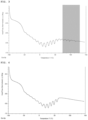
- FIG. 3 shows an SSA graph of the polymer of Example 1
- FIG. 4 shows an SSA graph of the polymer of Comparative Example 1.
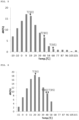
- FIG. 5 shows a fractionated graph of the SSA results of the polymer of Example 1
- FIG. 6 shows a fractionated graph of the SSA results of the polymer of Comparative Example 1.
- Hardness was measured according to the standard of ASTM D2240 using GC610 STAND for durometer of TECLOCK Co. and a shore durometer Type A of Mitutoyo Co.
- Example 1 The olefin-based copolymers of Example 1 and Comparative Examples 1 to 3 were extruded to manufacture pallet shapes, and tensile strength and tearing strength when broken were measured according to ASTM D638 (50 mm/min).
- Example 2 Density (g/mL) MI (g/ 10 min) Mw (g/mol) MWD DSC SSA Tm (°C) T(50) T(90) T(95) T(90)-T(50) T(95)-T(90)
- Example 1 0.862 1.20 106,000 2.01 32.1 16.0 51.1 67.6 35.1 16.5
- Example 2 0.866 4.39 69,070 2.07 33.0 19.8 57.4 83.8 37.6 26.4
- Example 3 0.872 1.
- FIG. 1 and FIG. 2 measured by DSC showed analogical tendency and similar graph types, and no significant difference was confirmed.
- FIG. 3 and FIG. 4 measured by SSA it could be confirmed that there was a significant difference in a high temperature region of 75°C or more.
- Example 1 showed peaks at 75°C or more, but the Comparative Example did not show.
- Comparative Example 2 and Comparative Example 3 showed peaks in the corresponding region, but the sizes were small when compared with the Example.
- Examples 1 to 5 satisfied T(90)-T(50) ⁇ 50, also satisfied T(95)-T(90) ⁇ 10, and had wide values in T(95)-T(90) when compared with Comparative Examples 1 to 7.
- Example 1 introduced a polymer melted at a high temperature and showed increased mechanical rigidity, and thus, attained increased tensile strength and tearing strength when compared with Comparative Examples 1 to 3.
- Examples 1 to 5 correspond to polymers obtained by polymerizing an olefin-based monomer by injecting a hydrogen gas and introducing a highly crystalline region. Accordingly, T(90)-T(50) ⁇ 50 is satisfied, T(95)-T(90) ⁇ 10 is also satisfied, and high mechanical rigidity is shown. It could be confirmed that the satisfaction or not of T(90)-T(50) ⁇ 50 and T(95)-T(90) ⁇ 10 and the mechanical rigidity could be changed according to the injection or not of the hydrogen gas and the injection amount thereof during polymerization, through comparing with Comparative Example 2 and Comparative Example 4.
- a polypropylene-based composite showing markedly improved impact strength properties together with excellent mechanical strength may be provided.
- experiments on applying the olefin-based polymer of the present invention in a polypropylene-based composite are shown.
- CB5230 highly crystalline impact copolymer polypropylene
- the resultant mixture was melted and mulled using a twin screw extruder to prepare a polypropylene-based composite compound in a pellet shape.
- the twin screw extruder has a diameter of 25 ⁇ and a ratio of length to diameter of 40, and conditions were set to a barrel temperature of 200°C to 230°C, a screw rotation velocity of 250 rpm, and an extrusion rate of 25 kr/hr.
- Polypropylene-based composites were prepared by the same method as in Example 1 except for using the olefin copolymers shown in Table 4 below instead of the olefin copolymer prepared in Example 1. In this case, the type of polypropylene, and the ratio of olefin copolymer and polypropylene were changed in Example 5.
- polypropylene represented by CB5290 is highly crystalline impact copolymer polypropylene (CB5290, Korea Petrochemical Industrial Co. Ltd.) having a melt index (230°C, 2.16 kg) of 90 g/10 min.
- Polypropylene-based composites were prepared by the same method as in Example 1 except for using the olefin copolymers shown in Table 4 below instead of the olefin copolymer prepared in Preparation Example 1. In this case, the type of polypropylene, and the ratio of olefin copolymer and polypropylene were changed in Comparative Example 7.
- polypropylene represented by CB5290 is highly crystalline impact copolymer polypropylene (CB5290, Korea Petrochemical Industrial Co. Ltd.) having a melt index (230°C, 2.16 kg) of 90 g/10 min.
- specimens were manufactured by injection molding the polypropylene-based composites using an injection machine at a temperature of 230°C, and the specimens were stood in a constant temperature and humidity room for 1 day, and then, the specific gravity of polymers, the melt index of polymers, tensile strength, flexural strength and flexural modulus, impact strength at low temperature and room temperature, and contraction ratio were measured.
- the physical properties of the specimens thus manufactures are shown in Table 5 below.
- the melt index (MI) of a polymer was measured according to ASTM D-1238 (condition E, 230°C, 2.16 kg load).
- the mechanical rigidity of a polypropylene-based composite may be improved by including an olefin-based copolymer introducing a highly crystalline region and showing high mechanical rigidity of the Example in a polypropylene-based composite.
Landscapes
- Chemical & Material Sciences (AREA)
- Health & Medical Sciences (AREA)
- Chemical Kinetics & Catalysis (AREA)
- Medicinal Chemistry (AREA)
- Polymers & Plastics (AREA)
- Organic Chemistry (AREA)
- Crystallography & Structural Chemistry (AREA)
- Engineering & Computer Science (AREA)
- Materials Engineering (AREA)
- Transition And Organic Metals Composition Catalysts For Addition Polymerization (AREA)
- Addition Polymer Or Copolymer, Post-Treatments, Or Chemical Modifications (AREA)
Claims (11)
- Un polymère à base d'oléfine satisfaisant les conditions (1) à (3) suivantes :(1) un indice de fusion (MI) dans des conditions de 190°C et de charge de 2,16 kg selon ASTM D1238 est de 0,1 g/10 min à 10,0 g/10 min, et (2) une densité (d) est de 0,860 g/cc à 0,880 g/cc, et(3) T(90)-T(50)≤50 et T(95)-T(90)≥10 sont satisfaites lorsque mesurées par une méthode de mesure précise de calorimétrie différentielle à balayage (SSA),dans lequel T(50), T(90) et T(95) sont des températures auxquelles 50 %, 90 % et 95 % sont fondus, respectivement, lors du fractionnement d'une courbe de température-capacité calorifique à partir de résultats de mesure par la méthode de mesure précise de calorimétrie différentielle à balayage (SSA) dans lequel le polymère à base d'oléfine est un copolymère d'éthylène et de l'un quelconque choisi parmi le groupe constitué par le propylène, le 1-butène, le 1-pentène, le 4-méthyl-1-pentène, le 1-hexène, le 1-heptène et le 1-octène, ou des mélanges de deux ou plusieurs d'entre eux,dans lequel la mesure de la température de fusion (Tm) par calorimétrie différentielle à balayage est effectuée par un premier cycle comprenant le chauffage à une température supérieure de 30°C à la température de fusion (Tm) à un taux constant et le refroidissement à une température inférieure de 30°C à une température de transition vitreuse (Tg) à un taux constant, et un deuxième cycle pour obtenir le pic d'une température de fusion standard (Tm),dans lequel la méthode de mesure précise par calorimétrie différentielle à balayage (SSA) est une méthode permettant d'obtenir des informations de cristal par un procédé de chauffage immédiatement avant le pic de la température de fusion (Tm) et de refroidissement après le premier cycle utilisant la calorimétrie différentielle à balayage (DSC), et par un processus répété de chauffage à une température réduite de 5°C et de refroidissement.
- Le polymère à base d'oléfine selon la revendication 1, dans lequel le polymère à base d'oléfine satisfait en outre les conditions suivantes : (4) une masse moléculaire moyenne en poids (Mw) est de 10000 g/mol à 500000 g/mol, dans lequel la masse moléculaire moyenne en poids (Mw) est une masse moléculaire de conversion du polystyrène analysée par chromatographie par perméation de gel (GPC).
- Le polymère à base d'oléfine selon la revendication 1, dans lequel le polymère à base d'oléfine satisfait en outre les conditions suivantes ; (5) la distribution de poids moléculaire (MWD) est de 1,0 à 6,0, la MWD étant déterminée comme indiqué dans la section « 3) Poids moléculaire moyen (Mw, g/mol) et distribution de poids moléculaire (MWD) » de la spécification.
- Le polymère à base d'oléfine selon la revendication 1, dans lequel le polymère à base d'oléfine satisfait en outre les conditions suivantes : (6) une température de fusion est de 20°C à 70°C lorsque mesurée par calorimétrie différentielle à balayage (DSC), dans lequel le point de fusion est déterminé par DSC comme indiqué dans la revendication 1.
- Le polymère à base d'oléfine selon la revendication 1, dans lequel le polymère à base d'oléfine a un indice de fusion (MI) dans des conditions de 190°C et de charge de 2,16 kg de 0,3 g/10 min à 5,5 g/10 min selon ASTM D1238.
- Le polymère à base d'oléfine selon la revendication 1, dans lequel le polymère à base d'oléfine satisfait 30≤T(90)-T(50)≤40 et 10≤T(95)-T(90)≤20 lorsque mesuré par une méthode de mesure précise par calorimétrie différentielle à balayage (SSA) telle que décrite dans la revendication 1.
- Le polymère à base d'oléfine selon la revendication 1, dans lequel le polymère à base d'oléfine est un copolymère d'éthylène et de 1-butène.
- Le polymère à base d'oléfine selon la revendication 1 ayant :un indice de fusion (MI), mesuré selon la norme ASTM D1238 à 190°C et dans des conditions de charge de 2,16 kg, de 0,4 g/10 min à 7,0 g/10 min ;20≤T(90)-T(50)≤45 et 10≤T(95)-T(90)≤30 sont satisfaits lorsqu'ils sont mesurés par une méthode de mesure précise par calorimétrie différentielle à balayage (SSA) telle que décrite dans la revendication 1 ;un poids moléculaire moyen en poids (Mw) est de 10000 à 500000 g/mol, dans lequel le poids moléculaire moyen en poids (Mw) est un poids moléculaire de conversion du polystyrène analysé par chromatographie par perméation de gel (GPC) ;la distribution de la masse moléculaire (MWD) est de 1,0 et 6,0, la MWD étant déterminée comme indiqué dans la section « 3) Masse moléculaire moyenne en poids (Mw, g/mol) et distribution de la masse moléculaire (MWD) » de la spécification ; etune température de fusion mesurée par calorimétrie à balayage différentiel (DSC), telle que décrite dans la revendication 1, est de 20°C à 60°C.
- Le polymère à base d'oléfine selon la revendication 1, dans lequel le polymère à base d'oléfine est un polymère à base d'oléfine obtenu par une méthode de préparation comprenant : la polymérisation d'un monomère à base d'oléfine par l'injection d'un gaz d'hydrogène en présence d'une composition catalytique pour la polymérisation d'oléfine, la composition catalytique comprenant un composé de métal de transition de la Formule 1 suivante :
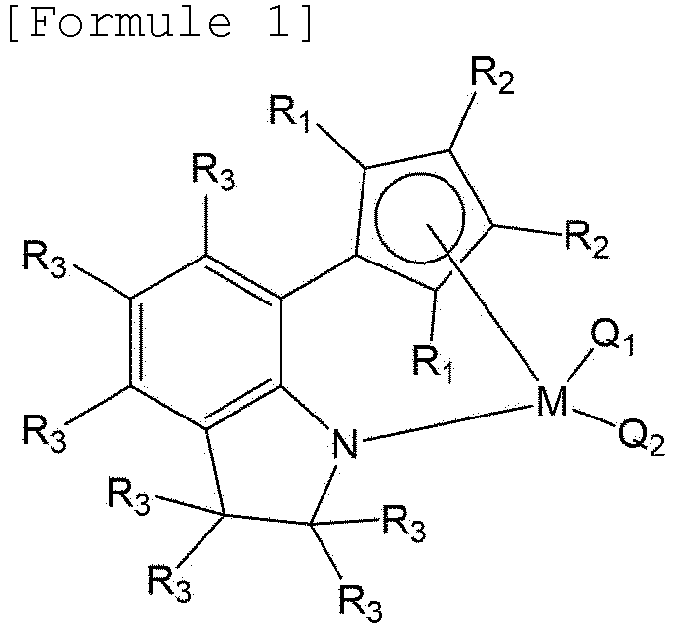 les groupes R1 et R2 sont identiques ou différents et chacun indépendamment d'un hydrogène ou d'un alkyle de 1 à 20 atomes de carbone ;les groupes R3 sont identiques ou différents et chacun indépendamment un hydrogène, un halogène ou un alkyle de 1 à 20 atomes de carbone ;M est Ti ; etQ1 et Q2 sont chacun indépendamment un halogène ou un alkyle de 1 à 20 atomes de carbone.
 - Le polymère à base d'oléfine selon la revendication 9, dans lequel le polymère à base d'oléfine est préparé par une réaction de polymérisation en solution continue à l'aide d'un réacteur à agitation continue en injectant de l'hydrogène en présence d'une composition catalytique pour la polymérisation de l'oléfine.
- Le polymère à base d'oléfine selon la revendication 1 ayant :un indice de fusion (IM) compris de 0,4 g/10 min à 7,0 g/10 min ; et30≤T(90)-T(50)≤40 et 10≤T(95)-T(90)≤20 sont satisfaits lorsqu'ils sont mesurés par une méthode de mesure précise de calorimétrie différentielle à balayage (SSA),dans lequel le polymère à base d'oléfine est un polymère à base d'oléfine obtenu par une méthode de préparation comprenant : la polymérisation d'un monomère à base d'oléfine par injection d'un gaz d'hydrogène en présence d'une composition de catalyseur pour la polymérisation d'oléfine, la composition de catalyseur comprenant un composé de métal de transition de la formule 1 suivante :
 dans la formule 1,les groupes R1 et R2 sont identiques ou différents et chacun indépendamment d'un hydrogène ou d'un alkyle de 1 à 20 atomes de carbone ;les groupes R3 sont identiques ou différents et chacun indépendamment un hydrogène, un halogène ou un alkyle de 1 à 20 atomes de carbone ;M est Ti ; etQ1 et Q2 sont chacun indépendamment un halogène ou un alkyle de 1 à 20 atomes de carbone.
Applications Claiming Priority (2)
| Application Number | Priority Date | Filing Date | Title |
|---|---|---|---|
| KR1020190121152A KR102595112B1 (ko) | 2019-09-30 | 2019-09-30 | 올레핀계 중합체 |
| PCT/KR2020/013275 WO2021066486A1 (fr) | 2019-09-30 | 2020-09-28 | Polymère à base d'oléfine |
Publications (3)
| Publication Number | Publication Date |
|---|---|
| EP3950740A1 EP3950740A1 (fr) | 2022-02-09 |
| EP3950740A4 EP3950740A4 (fr) | 2022-08-17 |
| EP3950740B1 true EP3950740B1 (fr) | 2025-06-04 |
Family
ID=75337360
Family Applications (1)
| Application Number | Title | Priority Date | Filing Date |
|---|---|---|---|
| EP20872178.7A Active EP3950740B1 (fr) | 2019-09-30 | 2020-09-28 | Polymère à base d'oléfine |
Country Status (7)
| Country | Link |
|---|---|
| US (1) | US12134668B2 (fr) |
| EP (1) | EP3950740B1 (fr) |
| JP (1) | JP7412846B2 (fr) |
| KR (1) | KR102595112B1 (fr) |
| CN (1) | CN113795525B (fr) |
| ES (1) | ES3034690T3 (fr) |
| WO (1) | WO2021066486A1 (fr) |
Families Citing this family (2)
| Publication number | Priority date | Publication date | Assignee | Title |
|---|---|---|---|---|
| KR102516747B1 (ko) * | 2019-09-30 | 2023-04-03 | 주식회사 엘지화학 | 폴리프로필렌계 복합재 |
| CN114466873B (zh) * | 2020-07-03 | 2024-02-06 | 株式会社Lg化学 | 烯烃类聚合物 |
Family Cites Families (14)
| Publication number | Priority date | Publication date | Assignee | Title |
|---|---|---|---|---|
| WO1996009166A1 (fr) | 1994-09-20 | 1996-03-28 | Kohjin Co., Ltd. | Pellicule en polyethylene etirable et retrecissable a couches multiples et son procede de production |
| EP0876427B1 (fr) * | 1996-01-22 | 2002-09-25 | The Dow Chemical Company | Melanges d'elastomeres polyoleofiniques presentant des proprietes ameliorees |
| KR100288272B1 (ko) | 1998-10-13 | 2001-05-02 | 유현식 | 올레핀 중합용 신규 메탈로센 촉매 및 제조방법 |
| KR101126487B1 (ko) | 2005-06-30 | 2012-03-30 | 엘지디스플레이 주식회사 | 액정표시장치의 데이터 구동 장치 및 방법 |
| KR100994252B1 (ko) | 2007-05-09 | 2010-11-12 | 주식회사 엘지화학 | 에틸렌 알파-올레핀 공중합체 |
| WO2008140280A2 (fr) * | 2007-05-16 | 2008-11-20 | Lg Chem, Ltd. | Copolymère d'alpha-oléfines d'éthylène, ramifié, à chaîne longue |
| KR101066969B1 (ko) | 2007-05-18 | 2011-09-22 | 주식회사 엘지화학 | 공중합성이 뛰어난 전이금속 촉매를 이용한 올레핀중합체의 제조 방법 |
| RU2734065C9 (ru) | 2014-02-11 | 2020-11-26 | ЮНИВЕЙШН ТЕКНОЛОДЖИЗ, ЭлЭлСи | Получение полиолефиновых продуктов |
| KR102086056B1 (ko) | 2016-09-23 | 2020-03-06 | 주식회사 엘지화학 | 폴리프로필렌계 수지 조성물 |
| KR101958015B1 (ko) | 2016-11-08 | 2019-07-04 | 주식회사 엘지화학 | 에틸렌/알파-올레핀 공중합체 |
| KR102293208B1 (ko) | 2017-09-01 | 2021-08-23 | 주식회사 엘지화학 | 에틸렌/알파-올레핀 공중합체 및 이의 제조방법 |
| CN117430740A (zh) | 2017-12-22 | 2024-01-23 | Lg化学株式会社 | 基于烯烃的聚合物 |
| KR102268080B1 (ko) * | 2017-12-22 | 2021-06-23 | 주식회사 엘지화학 | 폴리프로필렌계 복합재 |
| WO2019132475A1 (fr) | 2017-12-26 | 2019-07-04 | 주식회사 엘지화학 | Polymère à base d'oléfine |
-
2019
- 2019-09-30 KR KR1020190121152A patent/KR102595112B1/ko active Active
-
2020
- 2020-09-28 EP EP20872178.7A patent/EP3950740B1/fr active Active
- 2020-09-28 US US17/608,564 patent/US12134668B2/en active Active
- 2020-09-28 ES ES20872178T patent/ES3034690T3/es active Active
- 2020-09-28 CN CN202080034274.6A patent/CN113795525B/zh active Active
- 2020-09-28 WO PCT/KR2020/013275 patent/WO2021066486A1/fr not_active Ceased
- 2020-09-28 JP JP2022504690A patent/JP7412846B2/ja active Active
Also Published As
| Publication number | Publication date |
|---|---|
| US12134668B2 (en) | 2024-11-05 |
| KR102595112B1 (ko) | 2023-10-30 |
| CN113795525B (zh) | 2024-02-06 |
| EP3950740A4 (fr) | 2022-08-17 |
| JP7412846B2 (ja) | 2024-01-15 |
| EP3950740A1 (fr) | 2022-02-09 |
| KR20210038235A (ko) | 2021-04-07 |
| JP2022541944A (ja) | 2022-09-28 |
| CN113795525A (zh) | 2021-12-14 |
| ES3034690T3 (en) | 2025-08-21 |
| US20220325018A1 (en) | 2022-10-13 |
| WO2021066486A1 (fr) | 2021-04-08 |
Similar Documents
| Publication | Publication Date | Title |
|---|---|---|
| EP3705504A1 (fr) | Polymère à base d'oléfine | |
| EP3699205A1 (fr) | Polymère oléfinique | |
| EP3957660B1 (fr) | Polymère à base d'oléfine | |
| EP3705503A1 (fr) | Polymère à base d'oléfine | |
| US12319761B2 (en) | Olefin-based polymer | |
| EP3950740B1 (fr) | Polymère à base d'oléfine | |
| US12312458B2 (en) | Polypropylene-based composite | |
| JP7662266B2 (ja) | ポリプロピレン系複合材 | |
| KR102752627B1 (ko) | 올레핀계 중합체 | |
| JP7612277B2 (ja) | オレフィン系重合体 | |
| KR20220135028A (ko) | 올레핀계 중합체 |
Legal Events
| Date | Code | Title | Description |
|---|---|---|---|
| STAA | Information on the status of an ep patent application or granted ep patent |
Free format text: STATUS: THE INTERNATIONAL PUBLICATION HAS BEEN MADE |
|
| PUAI | Public reference made under article 153(3) epc to a published international application that has entered the european phase |
Free format text: ORIGINAL CODE: 0009012 |
|
| STAA | Information on the status of an ep patent application or granted ep patent |
Free format text: STATUS: REQUEST FOR EXAMINATION WAS MADE |
|
| 17P | Request for examination filed |
Effective date: 20211104 |
|
| AK | Designated contracting states |
Kind code of ref document: A1 Designated state(s): AL AT BE BG CH CY CZ DE DK EE ES FI FR GB GR HR HU IE IS IT LI LT LU LV MC MK MT NL NO PL PT RO RS SE SI SK SM TR |
|
| A4 | Supplementary search report drawn up and despatched |
Effective date: 20220720 |
|
| RIC1 | Information provided on ipc code assigned before grant |
Ipc: C08L 23/14 20060101ALI20220714BHEP Ipc: C08F 4/659 20060101ALI20220714BHEP Ipc: C08F 2/04 20060101ALI20220714BHEP Ipc: C08F 2/01 20060101ALI20220714BHEP Ipc: C08F 4/6592 20060101ALI20220714BHEP Ipc: C08F 210/08 20060101ALI20220714BHEP Ipc: C08F 210/02 20060101ALI20220714BHEP Ipc: C08F 210/16 20060101AFI20220714BHEP |
|
| DAV | Request for validation of the european patent (deleted) | ||
| DAX | Request for extension of the european patent (deleted) | ||
| STAA | Information on the status of an ep patent application or granted ep patent |
Free format text: STATUS: EXAMINATION IS IN PROGRESS |
|
| 17Q | First examination report despatched |
Effective date: 20231031 |
|
| GRAP | Despatch of communication of intention to grant a patent |
Free format text: ORIGINAL CODE: EPIDOSNIGR1 |
|
| STAA | Information on the status of an ep patent application or granted ep patent |
Free format text: STATUS: GRANT OF PATENT IS INTENDED |
|
| INTG | Intention to grant announced |
Effective date: 20250310 |
|
| GRAS | Grant fee paid |
Free format text: ORIGINAL CODE: EPIDOSNIGR3 |
|
| GRAA | (expected) grant |
Free format text: ORIGINAL CODE: 0009210 |
|
| STAA | Information on the status of an ep patent application or granted ep patent |
Free format text: STATUS: THE PATENT HAS BEEN GRANTED |
|
| AK | Designated contracting states |
Kind code of ref document: B1 Designated state(s): AL AT BE BG CH CY CZ DE DK EE ES FI FR GB GR HR HU IE IS IT LI LT LU LV MC MK MT NL NO PL PT RO RS SE SI SK SM TR |
|
| REG | Reference to a national code |
Ref country code: GB Ref legal event code: FG4D |
|
| REG | Reference to a national code |
Ref country code: CH Ref legal event code: EP |
|
| REG | Reference to a national code |
Ref country code: DE Ref legal event code: R096 Ref document number: 602020052435 Country of ref document: DE |
|
| REG | Reference to a national code |
Ref country code: IE Ref legal event code: FG4D |
|
| REG | Reference to a national code |
Ref country code: NL Ref legal event code: FP |
|
| REG | Reference to a national code |
Ref country code: ES Ref legal event code: FG2A Ref document number: 3034690 Country of ref document: ES Kind code of ref document: T3 Effective date: 20250821 |
|
| PGFP | Annual fee paid to national office [announced via postgrant information from national office to epo] |
Ref country code: NL Payment date: 20250821 Year of fee payment: 6 |
|
| PG25 | Lapsed in a contracting state [announced via postgrant information from national office to epo] |
Ref country code: FI Free format text: LAPSE BECAUSE OF FAILURE TO SUBMIT A TRANSLATION OF THE DESCRIPTION OR TO PAY THE FEE WITHIN THE PRESCRIBED TIME-LIMIT Effective date: 20250604 |
|
| PGFP | Annual fee paid to national office [announced via postgrant information from national office to epo] |
Ref country code: DE Payment date: 20250820 Year of fee payment: 6 |
|
| REG | Reference to a national code |
Ref country code: LT Ref legal event code: MG9D |
|
| PG25 | Lapsed in a contracting state [announced via postgrant information from national office to epo] |
Ref country code: GR Free format text: LAPSE BECAUSE OF FAILURE TO SUBMIT A TRANSLATION OF THE DESCRIPTION OR TO PAY THE FEE WITHIN THE PRESCRIBED TIME-LIMIT Effective date: 20250905 Ref country code: NO Free format text: LAPSE BECAUSE OF FAILURE TO SUBMIT A TRANSLATION OF THE DESCRIPTION OR TO PAY THE FEE WITHIN THE PRESCRIBED TIME-LIMIT Effective date: 20250904 |
|
| PG25 | Lapsed in a contracting state [announced via postgrant information from national office to epo] |
Ref country code: PL Free format text: LAPSE BECAUSE OF FAILURE TO SUBMIT A TRANSLATION OF THE DESCRIPTION OR TO PAY THE FEE WITHIN THE PRESCRIBED TIME-LIMIT Effective date: 20250604 |
|
| PGFP | Annual fee paid to national office [announced via postgrant information from national office to epo] |
Ref country code: IT Payment date: 20250822 Year of fee payment: 6 |
|
| PG25 | Lapsed in a contracting state [announced via postgrant information from national office to epo] |
Ref country code: BG Free format text: LAPSE BECAUSE OF FAILURE TO SUBMIT A TRANSLATION OF THE DESCRIPTION OR TO PAY THE FEE WITHIN THE PRESCRIBED TIME-LIMIT Effective date: 20250604 |
|
| PGFP | Annual fee paid to national office [announced via postgrant information from national office to epo] |
Ref country code: GB Payment date: 20250820 Year of fee payment: 6 |
|
| PG25 | Lapsed in a contracting state [announced via postgrant information from national office to epo] |
Ref country code: HR Free format text: LAPSE BECAUSE OF FAILURE TO SUBMIT A TRANSLATION OF THE DESCRIPTION OR TO PAY THE FEE WITHIN THE PRESCRIBED TIME-LIMIT Effective date: 20250604 |
|
| PGFP | Annual fee paid to national office [announced via postgrant information from national office to epo] |
Ref country code: FR Payment date: 20250821 Year of fee payment: 6 |
|
| PG25 | Lapsed in a contracting state [announced via postgrant information from national office to epo] |
Ref country code: RS Free format text: LAPSE BECAUSE OF FAILURE TO SUBMIT A TRANSLATION OF THE DESCRIPTION OR TO PAY THE FEE WITHIN THE PRESCRIBED TIME-LIMIT Effective date: 20250904 |
|
| PG25 | Lapsed in a contracting state [announced via postgrant information from national office to epo] |
Ref country code: LV Free format text: LAPSE BECAUSE OF FAILURE TO SUBMIT A TRANSLATION OF THE DESCRIPTION OR TO PAY THE FEE WITHIN THE PRESCRIBED TIME-LIMIT Effective date: 20250604 |
|
| PG25 | Lapsed in a contracting state [announced via postgrant information from national office to epo] |
Ref country code: PT Free format text: LAPSE BECAUSE OF FAILURE TO SUBMIT A TRANSLATION OF THE DESCRIPTION OR TO PAY THE FEE WITHIN THE PRESCRIBED TIME-LIMIT Effective date: 20251006 |
|
| REG | Reference to a national code |
Ref country code: AT Ref legal event code: MK05 Ref document number: 1800290 Country of ref document: AT Kind code of ref document: T Effective date: 20250604 |
|
| PG25 | Lapsed in a contracting state [announced via postgrant information from national office to epo] |
Ref country code: IS Free format text: LAPSE BECAUSE OF FAILURE TO SUBMIT A TRANSLATION OF THE DESCRIPTION OR TO PAY THE FEE WITHIN THE PRESCRIBED TIME-LIMIT Effective date: 20251004 |
|
| PG25 | Lapsed in a contracting state [announced via postgrant information from national office to epo] |
Ref country code: SM Free format text: LAPSE BECAUSE OF FAILURE TO SUBMIT A TRANSLATION OF THE DESCRIPTION OR TO PAY THE FEE WITHIN THE PRESCRIBED TIME-LIMIT Effective date: 20250604 Ref country code: AT Free format text: LAPSE BECAUSE OF FAILURE TO SUBMIT A TRANSLATION OF THE DESCRIPTION OR TO PAY THE FEE WITHIN THE PRESCRIBED TIME-LIMIT Effective date: 20250604 |
|
| PG25 | Lapsed in a contracting state [announced via postgrant information from national office to epo] |
Ref country code: CZ Free format text: LAPSE BECAUSE OF FAILURE TO SUBMIT A TRANSLATION OF THE DESCRIPTION OR TO PAY THE FEE WITHIN THE PRESCRIBED TIME-LIMIT Effective date: 20250604 |
|
| PG25 | Lapsed in a contracting state [announced via postgrant information from national office to epo] |
Ref country code: EE Free format text: LAPSE BECAUSE OF FAILURE TO SUBMIT A TRANSLATION OF THE DESCRIPTION OR TO PAY THE FEE WITHIN THE PRESCRIBED TIME-LIMIT Effective date: 20250604 |
|
| PG25 | Lapsed in a contracting state [announced via postgrant information from national office to epo] |
Ref country code: SK Free format text: LAPSE BECAUSE OF FAILURE TO SUBMIT A TRANSLATION OF THE DESCRIPTION OR TO PAY THE FEE WITHIN THE PRESCRIBED TIME-LIMIT Effective date: 20250604 Ref country code: RO Free format text: LAPSE BECAUSE OF FAILURE TO SUBMIT A TRANSLATION OF THE DESCRIPTION OR TO PAY THE FEE WITHIN THE PRESCRIBED TIME-LIMIT Effective date: 20250604 |
|
| PGFP | Annual fee paid to national office [announced via postgrant information from national office to epo] |
Ref country code: ES Payment date: 20251007 Year of fee payment: 6 |
|
| REG | Reference to a national code |
Ref country code: DE Ref legal event code: R097 Ref document number: 602020052435 Country of ref document: DE |
|
| PLBE | No opposition filed within time limit |
Free format text: ORIGINAL CODE: 0009261 |
|
| STAA | Information on the status of an ep patent application or granted ep patent |
Free format text: STATUS: NO OPPOSITION FILED WITHIN TIME LIMIT |
|
| PG25 | Lapsed in a contracting state [announced via postgrant information from national office to epo] |
Ref country code: DK Free format text: LAPSE BECAUSE OF FAILURE TO SUBMIT A TRANSLATION OF THE DESCRIPTION OR TO PAY THE FEE WITHIN THE PRESCRIBED TIME-LIMIT Effective date: 20250604 |
|
| REG | Reference to a national code |
Ref country code: CH Ref legal event code: L10 Free format text: ST27 STATUS EVENT CODE: U-0-0-L10-L00 (AS PROVIDED BY THE NATIONAL OFFICE) Effective date: 20260416 |