EP3954669A1 - Nano-anorganische zusammensetzung und beschichtungsverfahren damit - Google Patents
Nano-anorganische zusammensetzung und beschichtungsverfahren damit Download PDFInfo
- Publication number
- EP3954669A1 EP3954669A1 EP20786921.5A EP20786921A EP3954669A1 EP 3954669 A1 EP3954669 A1 EP 3954669A1 EP 20786921 A EP20786921 A EP 20786921A EP 3954669 A1 EP3954669 A1 EP 3954669A1
- Authority
- EP
- European Patent Office
- Prior art keywords
- nano
- inorganic
- substrate
- inorganic composition
- coating
- Prior art date
- Legal status (The legal status is an assumption and is not a legal conclusion. Google has not performed a legal analysis and makes no representation as to the accuracy of the status listed.)
- Pending
Links
Images




Classifications
-
- C—CHEMISTRY; METALLURGY
- C04—CEMENTS; CONCRETE; ARTIFICIAL STONE; CERAMICS; REFRACTORIES
- C04B—LIME, MAGNESIA; SLAG; CEMENTS; COMPOSITIONS THEREOF, e.g. MORTARS, CONCRETE OR LIKE BUILDING MATERIALS; ARTIFICIAL STONE; CERAMICS; REFRACTORIES; TREATMENT OF NATURAL STONE
- C04B35/00—Shaped ceramic products characterised by their composition; Ceramics compositions; Processing powders of inorganic compounds preparatory to the manufacturing of ceramic products
- C04B35/01—Shaped ceramic products characterised by their composition; Ceramics compositions; Processing powders of inorganic compounds preparatory to the manufacturing of ceramic products based on oxide ceramics
-
- C—CHEMISTRY; METALLURGY
- C04—CEMENTS; CONCRETE; ARTIFICIAL STONE; CERAMICS; REFRACTORIES
- C04B—LIME, MAGNESIA; SLAG; CEMENTS; COMPOSITIONS THEREOF, e.g. MORTARS, CONCRETE OR LIKE BUILDING MATERIALS; ARTIFICIAL STONE; CERAMICS; REFRACTORIES; TREATMENT OF NATURAL STONE
- C04B35/00—Shaped ceramic products characterised by their composition; Ceramics compositions; Processing powders of inorganic compounds preparatory to the manufacturing of ceramic products
- C04B35/622—Forming processes; Processing powders of inorganic compounds preparatory to the manufacturing of ceramic products
- C04B35/62222—Forming processes; Processing powders of inorganic compounds preparatory to the manufacturing of ceramic products obtaining ceramic coatings
-
- B—PERFORMING OPERATIONS; TRANSPORTING
- B05—SPRAYING OR ATOMISING IN GENERAL; APPLYING FLUENT MATERIALS TO SURFACES, IN GENERAL
- B05D—PROCESSES FOR APPLYING FLUENT MATERIALS TO SURFACES, IN GENERAL
- B05D1/00—Processes for applying liquids or other fluent materials
- B05D1/02—Processes for applying liquids or other fluent materials performed by spraying
-
- B—PERFORMING OPERATIONS; TRANSPORTING
- B05—SPRAYING OR ATOMISING IN GENERAL; APPLYING FLUENT MATERIALS TO SURFACES, IN GENERAL
- B05D—PROCESSES FOR APPLYING FLUENT MATERIALS TO SURFACES, IN GENERAL
- B05D3/00—Pretreatment of surfaces to which liquids or other fluent materials are to be applied; After-treatment of applied coatings, e.g. intermediate treating of an applied coating preparatory to subsequent applications of liquids or other fluent materials
- B05D3/002—Pretreatement
-
- C—CHEMISTRY; METALLURGY
- C03—GLASS; MINERAL OR SLAG WOOL
- C03C—CHEMICAL COMPOSITION OF GLASSES, GLAZES OR VITREOUS ENAMELS; SURFACE TREATMENT OF GLASS; SURFACE TREATMENT OF FIBRES OR FILAMENTS MADE FROM GLASS, MINERALS OR SLAGS; JOINING GLASS TO GLASS OR OTHER MATERIALS
- C03C17/00—Surface treatment of glass, not in the form of fibres or filaments, by coating
- C03C17/22—Surface treatment of glass, not in the form of fibres or filaments, by coating with other inorganic material
- C03C17/23—Oxides
- C03C17/25—Oxides by deposition from the liquid phase
-
- C—CHEMISTRY; METALLURGY
- C04—CEMENTS; CONCRETE; ARTIFICIAL STONE; CERAMICS; REFRACTORIES
- C04B—LIME, MAGNESIA; SLAG; CEMENTS; COMPOSITIONS THEREOF, e.g. MORTARS, CONCRETE OR LIKE BUILDING MATERIALS; ARTIFICIAL STONE; CERAMICS; REFRACTORIES; TREATMENT OF NATURAL STONE
- C04B35/00—Shaped ceramic products characterised by their composition; Ceramics compositions; Processing powders of inorganic compounds preparatory to the manufacturing of ceramic products
- C04B35/01—Shaped ceramic products characterised by their composition; Ceramics compositions; Processing powders of inorganic compounds preparatory to the manufacturing of ceramic products based on oxide ceramics
- C04B35/16—Shaped ceramic products characterised by their composition; Ceramics compositions; Processing powders of inorganic compounds preparatory to the manufacturing of ceramic products based on oxide ceramics based on silicates other than clay
-
- C—CHEMISTRY; METALLURGY
- C04—CEMENTS; CONCRETE; ARTIFICIAL STONE; CERAMICS; REFRACTORIES
- C04B—LIME, MAGNESIA; SLAG; CEMENTS; COMPOSITIONS THEREOF, e.g. MORTARS, CONCRETE OR LIKE BUILDING MATERIALS; ARTIFICIAL STONE; CERAMICS; REFRACTORIES; TREATMENT OF NATURAL STONE
- C04B35/00—Shaped ceramic products characterised by their composition; Ceramics compositions; Processing powders of inorganic compounds preparatory to the manufacturing of ceramic products
- C04B35/622—Forming processes; Processing powders of inorganic compounds preparatory to the manufacturing of ceramic products
- C04B35/626—Preparing or treating the powders individually or as batches ; preparing or treating macroscopic reinforcing agents for ceramic products, e.g. fibres; mechanical aspects section B
-
- C—CHEMISTRY; METALLURGY
- C09—DYES; PAINTS; POLISHES; NATURAL RESINS; ADHESIVES; COMPOSITIONS NOT OTHERWISE PROVIDED FOR; APPLICATIONS OF MATERIALS NOT OTHERWISE PROVIDED FOR
- C09D—COATING COMPOSITIONS, e.g. PAINTS, VARNISHES OR LACQUERS; FILLING PASTES; CHEMICAL PAINT OR INK REMOVERS; INKS; CORRECTING FLUIDS; WOODSTAINS; PASTES OR SOLIDS FOR COLOURING OR PRINTING; USE OF MATERIALS THEREFOR
- C09D1/00—Coating compositions, e.g. paints, varnishes or lacquers, based on inorganic substances
-
- C—CHEMISTRY; METALLURGY
- C09—DYES; PAINTS; POLISHES; NATURAL RESINS; ADHESIVES; COMPOSITIONS NOT OTHERWISE PROVIDED FOR; APPLICATIONS OF MATERIALS NOT OTHERWISE PROVIDED FOR
- C09D—COATING COMPOSITIONS, e.g. PAINTS, VARNISHES OR LACQUERS; FILLING PASTES; CHEMICAL PAINT OR INK REMOVERS; INKS; CORRECTING FLUIDS; WOODSTAINS; PASTES OR SOLIDS FOR COLOURING OR PRINTING; USE OF MATERIALS THEREFOR
- C09D1/00—Coating compositions, e.g. paints, varnishes or lacquers, based on inorganic substances
- C09D1/02—Coating compositions, e.g. paints, varnishes or lacquers, based on inorganic substances alkali metal silicates
- C09D1/04—Coating compositions, e.g. paints, varnishes or lacquers, based on inorganic substances alkali metal silicates with organic additives
-
- C—CHEMISTRY; METALLURGY
- C09—DYES; PAINTS; POLISHES; NATURAL RESINS; ADHESIVES; COMPOSITIONS NOT OTHERWISE PROVIDED FOR; APPLICATIONS OF MATERIALS NOT OTHERWISE PROVIDED FOR
- C09D—COATING COMPOSITIONS, e.g. PAINTS, VARNISHES OR LACQUERS; FILLING PASTES; CHEMICAL PAINT OR INK REMOVERS; INKS; CORRECTING FLUIDS; WOODSTAINS; PASTES OR SOLIDS FOR COLOURING OR PRINTING; USE OF MATERIALS THEREFOR
- C09D1/00—Coating compositions, e.g. paints, varnishes or lacquers, based on inorganic substances
- C09D1/06—Coating compositions, e.g. paints, varnishes or lacquers, based on inorganic substances cement
-
- B—PERFORMING OPERATIONS; TRANSPORTING
- B82—NANOTECHNOLOGY
- B82Y—SPECIFIC USES OR APPLICATIONS OF NANOSTRUCTURES; MEASUREMENT OR ANALYSIS OF NANOSTRUCTURES; MANUFACTURE OR TREATMENT OF NANOSTRUCTURES
- B82Y30/00—Nanotechnology for materials or surface science, e.g. nanocomposites
-
- B—PERFORMING OPERATIONS; TRANSPORTING
- B82—NANOTECHNOLOGY
- B82Y—SPECIFIC USES OR APPLICATIONS OF NANOSTRUCTURES; MEASUREMENT OR ANALYSIS OF NANOSTRUCTURES; MANUFACTURE OR TREATMENT OF NANOSTRUCTURES
- B82Y40/00—Manufacture or treatment of nanostructures
-
- C—CHEMISTRY; METALLURGY
- C03—GLASS; MINERAL OR SLAG WOOL
- C03C—CHEMICAL COMPOSITION OF GLASSES, GLAZES OR VITREOUS ENAMELS; SURFACE TREATMENT OF GLASS; SURFACE TREATMENT OF FIBRES OR FILAMENTS MADE FROM GLASS, MINERALS OR SLAGS; JOINING GLASS TO GLASS OR OTHER MATERIALS
- C03C2217/00—Coatings on glass
- C03C2217/20—Materials for coating a single layer on glass
- C03C2217/21—Oxides
- C03C2217/23—Mixtures
-
- C—CHEMISTRY; METALLURGY
- C03—GLASS; MINERAL OR SLAG WOOL
- C03C—CHEMICAL COMPOSITION OF GLASSES, GLAZES OR VITREOUS ENAMELS; SURFACE TREATMENT OF GLASS; SURFACE TREATMENT OF FIBRES OR FILAMENTS MADE FROM GLASS, MINERALS OR SLAGS; JOINING GLASS TO GLASS OR OTHER MATERIALS
- C03C2217/00—Coatings on glass
- C03C2217/70—Properties of coatings
- C03C2217/75—Hydrophilic and oleophilic coatings
-
- C—CHEMISTRY; METALLURGY
- C03—GLASS; MINERAL OR SLAG WOOL
- C03C—CHEMICAL COMPOSITION OF GLASSES, GLAZES OR VITREOUS ENAMELS; SURFACE TREATMENT OF GLASS; SURFACE TREATMENT OF FIBRES OR FILAMENTS MADE FROM GLASS, MINERALS OR SLAGS; JOINING GLASS TO GLASS OR OTHER MATERIALS
- C03C2217/00—Coatings on glass
- C03C2217/70—Properties of coatings
- C03C2217/78—Coatings specially designed to be durable, e.g. scratch-resistant
-
- C—CHEMISTRY; METALLURGY
- C03—GLASS; MINERAL OR SLAG WOOL
- C03C—CHEMICAL COMPOSITION OF GLASSES, GLAZES OR VITREOUS ENAMELS; SURFACE TREATMENT OF GLASS; SURFACE TREATMENT OF FIBRES OR FILAMENTS MADE FROM GLASS, MINERALS OR SLAGS; JOINING GLASS TO GLASS OR OTHER MATERIALS
- C03C2218/00—Methods for coating glass
- C03C2218/30—Aspects of methods for coating glass not covered above
- C03C2218/31—Pre-treatment
-
- C—CHEMISTRY; METALLURGY
- C03—GLASS; MINERAL OR SLAG WOOL
- C03C—CHEMICAL COMPOSITION OF GLASSES, GLAZES OR VITREOUS ENAMELS; SURFACE TREATMENT OF GLASS; SURFACE TREATMENT OF FIBRES OR FILAMENTS MADE FROM GLASS, MINERALS OR SLAGS; JOINING GLASS TO GLASS OR OTHER MATERIALS
- C03C2218/00—Methods for coating glass
- C03C2218/30—Aspects of methods for coating glass not covered above
- C03C2218/32—After-treatment
-
- C—CHEMISTRY; METALLURGY
- C04—CEMENTS; CONCRETE; ARTIFICIAL STONE; CERAMICS; REFRACTORIES
- C04B—LIME, MAGNESIA; SLAG; CEMENTS; COMPOSITIONS THEREOF, e.g. MORTARS, CONCRETE OR LIKE BUILDING MATERIALS; ARTIFICIAL STONE; CERAMICS; REFRACTORIES; TREATMENT OF NATURAL STONE
- C04B2235/00—Aspects relating to ceramic starting mixtures or sintered ceramic products
- C04B2235/02—Composition of constituents of the starting material or of secondary phases of the final product
- C04B2235/30—Constituents and secondary phases not being of a fibrous nature
- C04B2235/32—Metal oxides, mixed metal oxides, or oxide-forming salts thereof, e.g. carbonates, nitrates, (oxy)hydroxides, chlorides
- C04B2235/3201—Alkali metal oxides or oxide-forming salts thereof
-
- C—CHEMISTRY; METALLURGY
- C04—CEMENTS; CONCRETE; ARTIFICIAL STONE; CERAMICS; REFRACTORIES
- C04B—LIME, MAGNESIA; SLAG; CEMENTS; COMPOSITIONS THEREOF, e.g. MORTARS, CONCRETE OR LIKE BUILDING MATERIALS; ARTIFICIAL STONE; CERAMICS; REFRACTORIES; TREATMENT OF NATURAL STONE
- C04B2235/00—Aspects relating to ceramic starting mixtures or sintered ceramic products
- C04B2235/02—Composition of constituents of the starting material or of secondary phases of the final product
- C04B2235/30—Constituents and secondary phases not being of a fibrous nature
- C04B2235/32—Metal oxides, mixed metal oxides, or oxide-forming salts thereof, e.g. carbonates, nitrates, (oxy)hydroxides, chlorides
- C04B2235/3201—Alkali metal oxides or oxide-forming salts thereof
- C04B2235/3203—Lithium oxide or oxide-forming salts thereof
-
- C—CHEMISTRY; METALLURGY
- C04—CEMENTS; CONCRETE; ARTIFICIAL STONE; CERAMICS; REFRACTORIES
- C04B—LIME, MAGNESIA; SLAG; CEMENTS; COMPOSITIONS THEREOF, e.g. MORTARS, CONCRETE OR LIKE BUILDING MATERIALS; ARTIFICIAL STONE; CERAMICS; REFRACTORIES; TREATMENT OF NATURAL STONE
- C04B2235/00—Aspects relating to ceramic starting mixtures or sintered ceramic products
- C04B2235/02—Composition of constituents of the starting material or of secondary phases of the final product
- C04B2235/30—Constituents and secondary phases not being of a fibrous nature
- C04B2235/44—Metal salt constituents or additives chosen for the nature of the anions, e.g. hydrides or acetylacetonate
- C04B2235/447—Phosphates or phosphites, e.g. orthophosphate or hypophosphite
-
- C—CHEMISTRY; METALLURGY
- C04—CEMENTS; CONCRETE; ARTIFICIAL STONE; CERAMICS; REFRACTORIES
- C04B—LIME, MAGNESIA; SLAG; CEMENTS; COMPOSITIONS THEREOF, e.g. MORTARS, CONCRETE OR LIKE BUILDING MATERIALS; ARTIFICIAL STONE; CERAMICS; REFRACTORIES; TREATMENT OF NATURAL STONE
- C04B2235/00—Aspects relating to ceramic starting mixtures or sintered ceramic products
- C04B2235/02—Composition of constituents of the starting material or of secondary phases of the final product
- C04B2235/30—Constituents and secondary phases not being of a fibrous nature
- C04B2235/48—Organic compounds becoming part of a ceramic after heat treatment, e.g. carbonising phenol resins
- C04B2235/486—Boron containing organic compounds, e.g. borazine, borane or boranyl
-
- C—CHEMISTRY; METALLURGY
- C04—CEMENTS; CONCRETE; ARTIFICIAL STONE; CERAMICS; REFRACTORIES
- C04B—LIME, MAGNESIA; SLAG; CEMENTS; COMPOSITIONS THEREOF, e.g. MORTARS, CONCRETE OR LIKE BUILDING MATERIALS; ARTIFICIAL STONE; CERAMICS; REFRACTORIES; TREATMENT OF NATURAL STONE
- C04B2235/00—Aspects relating to ceramic starting mixtures or sintered ceramic products
- C04B2235/70—Aspects relating to sintered or melt-casted ceramic products
- C04B2235/96—Properties of ceramic products, e.g. mechanical properties such as strength, toughness, wear resistance
-
- C—CHEMISTRY; METALLURGY
- C04—CEMENTS; CONCRETE; ARTIFICIAL STONE; CERAMICS; REFRACTORIES
- C04B—LIME, MAGNESIA; SLAG; CEMENTS; COMPOSITIONS THEREOF, e.g. MORTARS, CONCRETE OR LIKE BUILDING MATERIALS; ARTIFICIAL STONE; CERAMICS; REFRACTORIES; TREATMENT OF NATURAL STONE
- C04B2235/00—Aspects relating to ceramic starting mixtures or sintered ceramic products
- C04B2235/70—Aspects relating to sintered or melt-casted ceramic products
- C04B2235/96—Properties of ceramic products, e.g. mechanical properties such as strength, toughness, wear resistance
- C04B2235/963—Surface properties, e.g. surface roughness
Definitions
- the present application relates to a method of manufacturing a highly functional nano-inorganic composition and forming a fine-sized thin film using the nano-inorganic composition.
- the high functionality of the nano-inorganic composition includes, and is not limited to excellent mechanical characteristics such as surface hardness and wear characteristics, chemical stability such as water resistance, acid resistance, and alkali resistance, and excellent thermal stability, as the composition is comprised of inorganic materials.
- the nano-inorganic composition may be controlled to have super-hydrophilic, hydrophilic, or hydrophobic properties, depending on the desired characteristics of the manufactured composition.
- the nano-inorganic composition also has excellent surface contamination resistance and easy-clean properties depending on the characteristics of the thin film coating.
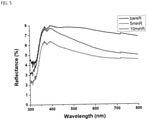
- the nano-inorganic composition has excellent optical properties such as light transmittance and light reflectance.
- the present application relates to a nano-inorganic coating composition with excellent properties such as high strength, smooth surface, surface with a gloss or matte finish, sophisticated exterior, surface polish, adhesion, weather resistance, durability, contamination resistance, chemical resistance, self-purification characteristics, and super-hydrophilicity and a method of coating a surface using the nanoparticulated coating composition for various purposes (e.g., merchandising).
- an inorganic paint and an inorganic ceramic coating composition compared to an organic paint or an organic coating composition, have excellent physical properties such as heat resistance, weather resistance, stain resistance, chemical resistance, and durability.
- Nano-coating technology using an inorganic composition has been used to form a thin film of nano-scale thickness using expensive equipment such as CVD or sputtering equipment, in the fields of high-precision technology such as semiconductors and displays.
- CVD chemical vapor deposition
- sputtering equipment in the fields of high-precision technology
- a coating of nanometer-scale thickness may be formed using more generally available coating methods.
- Fine-Coat (FC) coating agent developed by Wellture FineTech Co., Ltd., employs a material comprised of nanoparticles (with a size from several nanometers to several tens of nanometers) and enables a coating of nanometer-scale thickness through a variety of coating methods such as a typical spray coating method, a spin coating method, a bar coating method, a slot die coating method, and a coating method using a sponge and/or a brush.
- Korea Registered Patent No. 10-1735383 discloses an inorganic paint composition and a method for forming inorganic paint film by using the inorganic paint composition.
- nano-inorganic materials disclosed in prior art have a solid content around tens of wt% or greater and form a coating with a thickness of hundreds to thousands of nanometers.
- typical coating methods using such nano-inorganic materials may cause problems including, and not limited to, 1) efflorescence during coating and 2) microcracks created during thermal treatment.
- problems including, and not limited to, 1) efflorescence during coating and 2) microcracks created during thermal treatment.
- the present application reduced the amount of solid content in the composition to 10 wt% or less and increased the amount of water (or solvent) accordingly. This enabled a formation of a uniform coating film with a thickness of tens of nanometers even by a typical coating (or coating film formation) method. In addition, the present application reduced efflorescence that occurs during coating formation and increased the durability of the coating film.
- the coating thickness is lowered to tens of nanometers, the formation of an air layer in the coating film is suppressed.
- the primary heat treatment (drying) temperature is lowered from 110°C to 90°C, and as a result, the formation of an air layer due to vaporization of water from temperature rise is minimized, reducing defects and improving durability.
- optical properties of the coating film such as light transmittance and light reflectance improved more than twice as high, and efflorescence caused by leaching of metal oxides can be solved.
- a coating film formed using the nano-inorganic composition disclosed in the present application has 1) excellent mechanical characteristics such as surface hardness, wear characteristics, and adhesion, 2) significant chemical stability including strong acid resistance and strong base resistance, 3) excellent heat and flame resistance due to the inorganic nature of the coating, 4) (available depending on the intended use) fogging prevention due to super-hydrophilicity and stain resistance due to easy-clean characteristics, 5) excellent optical and acoustic properties, 6) human suitability (i.e., harmless to the human body) and antibacterial characteristics, and 7) environmentally friendly characteristics as water is used as a solvent, and coated surfaces do not use organic synthetic materials such as detergent.
- nano-inorganic composition having various characteristics as described above,
- the nano-inorganic composition represented by Formula 1 is manufactured such that the composition comprises 0.1-10 parts by weight of (M 2 O+ySiO 2 ), 0.01-2 parts by weight of the inorganic acid compound, and water for the remainders.
- various coating methods may be used to solve the above-mentioned problems.
- the present application shows through experiments that 1) for a transparent substrate such as glass, slot die and bar coating methods may be used to form a uniform coating with a thickness of tens of nanometers with ease, and 2) for a substrate that needs either a matte or glossy surface or a translucent or opaque surface through haze, the spray coating method is shown to be one of the most effective means.
- the inorganic film formed from the nano-inorganic composition disclosed in the present application shows strong adhesion and bonding to the substrate, as the inorganic film has a strong binding force to both metal and nonmetal surfaces.
- Such an inorganic coating film does not detach from the substrate even after a long time.
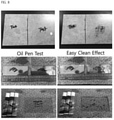
- the inorganic coating film is a film with strong hydrophilic properties, and is not easily contaminated by organic pollutants thanks to the film's weak binding force to organic materials. Furthermore, organic pollutants as well as other pollutants can be readily removed using only water. In other words, one can easily remove pollutants from the inorganic film merely by washing the surface of the coating film with water, without any other additional works.
- the nano-inorganic composition has excellent weather resistance, durability, chemical resistance, abrasion resistance, high hardness of the surface, far infrared (FIR) radiation, nonflammability, and corrosion resistance.
- FIR far infrared
- the nano-inorganic composition is environment-friendly, and its life is semi-permanent.
- nano-inorganic composition and the coating method using the same according to embodiments of the present application are described in detail below.
- the nano-inorganic composition of the present application comprises at least one of sodium oxide (Na 2 O), potassium oxide (K 2 O), and lithium oxide (Li 2 O), all of which are alkali metal oxide (M 2 O); an inorganic acid compound; and water (H 2 O), as represented by Formula 1,
- the nano-inorganic composition according to Formula 1 is manufactured such that the composition comprises 0.1-10 parts by weight of (M 2 O+ySiO 2 ), 0.01-2 parts by weight of the inorganic acid compound, and water for the remainders.
- the nano-inorganic composition according to Formula 1 ((x 1 Na 2 O+x 2 K 2 O+x 3 Li 2 O).ySiO 2 .nH 2 O) comprises 0.1-10 parts by weight of alkali metal silicate (M 2 O+ySiO 2 ), 0.01-2 parts by weight of the inorganic acid compound, and the remaining parts by weight of water as a solvent.
- alkali metal silicate M 2 O+ySiO 2
- boric acid and/or phosphoric acid is selected for the inorganic acid compound.
- composition as represented by Formula 1 may further comprise a dispersant, a catalyst, and/or a surfactant, depending on desired functions, coating methods, and/or coating apparatus.
- the nano-inorganic composition may further comprise 1) a surfactant, depending on the hydrophilicity/hydrophobicity of the substrate surface, to improve adhesion properties, 2) a dispersant to improve dispersion of colored pigments and achieve high color intensity, and/or 3) a catalyst to shorten the production time of the composition and catalyze chemical reactions.
- a surfactant depending on the hydrophilicity/hydrophobicity of the substrate surface, to improve adhesion properties
- a dispersant to improve dispersion of colored pigments and achieve high color intensity
- 3) a catalyst to shorten the production time of the composition and catalyze chemical reactions.
- the amount of the solvent (water + inorganic acid compound) added is greater than what is required to dissolve the entire amount of the alkali metal oxide added (i.e., the solubility of the alkali metal oxide for the solvent), and in an embodiment of the present application, the inorganic acid compound may be phosphoric acid and/or boric acid.
- the nano-inorganic compound of the present application may be manufactured to comprise one, two, or all of three of x 1 Na 2 O, x 2 K 2 O, and x 3 Li 2 O, as represented by Formula 1.
- the compound comprises at least one of the alkali metal oxides represented by Formula 1 so that the nano-inorganic compound has an improved adhesive force or bonding force to the substrate and high functionality including easy-clean properties (self-purification), anti-pollution, water resistance, and improved mechanical and chemical properties of the coating thin film.
- X is the number of moles of alkali metal oxide (M 2 O) included in the nano-inorganic composition
- y is the number of moles of silica (SiO 2 ).
- x 1 is the number of moles number of sodium oxide (Na 2 O)
- x 2 is the number of moles of potassium oxide (K 2 O)
- the nano-inorganic compound shows satisfactory results with respect to optical characteristics, hydrophilic characteristics, water resistance, and durability.
- nano-inorganic compound with a molar ratio (y/X) of alkali metal oxide and silica in the range of 3 to 4 is the most stable, resistant to efflorescence, and water & heat resistant.
- the examples of the present application show that the ratio of the solid content (M 2 O+ySiO 2 ) and the solvent (water+inorganic acid compound) of the nano-inorganic composition is significantly improved in terms of optical characteristics and durability when the solid content is 10 wt% or less.
- phosphoric acid and/or boric acid may be included in the nano-inorganic compound in accordance with the required properties.
- 2% or more of phosphoric acid and boric acid is added, a gel is formed, which does not meet the required properties of the nano-inorganic composition.
- a nonmetallic element replaces a central metal atom so that a single bond between silicon (Si) and another atom becomes a double bond, forming a network structure. Then, a hydroxide ion (-OH) attached to silicate is substituted by another ion and dissociated from the silicate through a condensation reaction with the silicate, thereby preventing water penetration and improving water resistance. This is the mechanism through which the nano-inorganic composition has excellent water resistance.
- functionality of the nano-inorganic composition is optimized by controlling the content of metal oxides added, based on properties of each different metal oxide (e.g., volume change of the metal oxide) and/or required functionality.
- a preferred pH range of the nano-inorganic composition is from 11 to 13.
- the pH of the nano-inorganic composition is 11 or less, solidification occurs, causing difficulties in manufacturing; when the pH of the composition is 13 or more, various functionalities of the composition are reduced.
- the contact angle of the thin film surface of the nano-inorganic composition is 20° or less, showing hydrophilic properties and thus, Easy-Clean properties.
- the haze (turbidity) of the nano-inorganic composition may be controlled to make the surface glossy or matte, and in the case of a transparent substrate, various haze (turbidity) (e.g., translucent or opaque surfaces) may be implemented, thereby satisfying consumer needs.
- the scattering degree, haze, and turbidity represent a degree of transparency (or opacity) depending on the transparency of a transparent substrate, and may be used to indicate the degree of gloss of the coating surface (i.e., glossy or matte surface).
- the coating film when the nano-inorganic composition forms a coating film on a transparent substrate such as glass, the coating film may have 9 different levels of haze as follows: Haze Level 1 (transparent without haze, having a light transmittance of 80% or more), Haze Level 2 (light transmittance of about 70%), Haze Level 3 (light transmittance of about 60%), Haze Level 4 (light transmittance of about 50%), Haze Level 5 (light transmittance of about 40%), Haze Level 6 (light transmittance of about 30%), Haze Level 7 (light transmittance of about 20%), Haze Level 8 (light transmittance of about 10%), and Haze Level 9 (opaque).
- the nano-inorganic composition of the present application may form a coating film of various haze levels, from Haze Level 1 to Haze Level 9.
- the nano-inorganic composition according to the present application was manufactured with a following composition ratio.
- the first composition solid content; SiO 2 , Na 2 O, K 2 O, and Li 2 O
- the second composition H 2 O and inorganic acid compound such as boric acid or phosphoric acid
- the first composition is made such that the molar ratio of the solid content (y/x) is 3.885, and the solid content is 4.04 wt%.
- the second composition is made from 190.72g of water (H 2 O) and 1.2g of the inorganic acid compound (phosphoric acid or boric acid).
- the first composition with the solid content of 4.04 wt% and the second composition (191.92g) are mixed to make 200g of the nano-inorganic composition according to the present application.
- the above-mentioned manufacturing procedure of the nano-inorganic composition involves making each of the first and second compositions separately and mixing the two compositions together (i.e., bicomposition type).
- the nano-inorganic composition may be manufactured in a following manner: when components of the first composition are mixed together to form the first composition, the second composition may be added (i.e., monocomposition type).
- Substrates used in the present application may be one or more of various materials, such as metal, non-ferrous metal materials, other plastics (polymer materials), films, ceramics, tiles, stone materials, wood, and other substrates requiring paint coatings.
- the step of pretreating (or cleaning) the substrate needed to be coated (S200) is as important as the step of preparing the composition of Formula 1 (S100).
- the cleaning step is a very important process because during the coating process using the nano-inorganic composition, any foreign substance on the substrate surface may cause defects.
- the surface of the substrate may be cleaned with a typical alkali or neutral detergent, and if necessary, materials such as alcohol or acetone, or acid may be used for cleaning.
- a method such as polishing may be used for cleaning as a pre-treatment before coating.
- the cleaning process is especially important for transparent substrates, as defects caused by foreign substances remaining on a transparent substrate may greatly affect the quality of the coating film after the film formation.
- a drying step (S300) is conducted to remove water or moisture formed on the surface.
- an attachment (of the coating composition) step (S400) is conducted to attach the nano-inorganic composition using various coating methods.
- Foreign materials may be in water or other media used for cleaning, and such foreign materials may remain on the substrate surface during the drying step.
- the surface needs to be cleanly dried using various methods such as air (wind) or heat to remove the foreign materials.
- air (wind) or heat to remove the foreign materials.
- heat or high temperature is used, distilled water or other high-purity materials may be used such that foreign materials do not remain on the coating surface.
- the first drying step (S300) and the attachment step (S400) are completed as described above, it is necessary to dry or sinter the coated surface again.
- Heating with a high temperature of 100°C or higher for sintering immediately after attaching the coating composition can cause problems such as air bubbles, as most of the water contained in the composition evaporates. Therefore, natural drying at room temperature or drying for a certain period of time at a temperature lower than 100°C (S500) is required immediately after attaching the coating composition.
- a sintering step (S600) for heat treatment at 100 to 1000°C is needed to ensure the durability of the coating.
- the sintering step (S600) is connected to the second drying step (S500) and is continuously controlled using a temperature controller.
- the heat treatment process (S600) is performed at a temperature less than 300°C, but in the case of a substrate with high operation temperature or a substrate used in a tough environment, heat treatment may be performed at 500°C or higher.
- S600 may be replaced by a heat treatment process for glass tempering, immediately after the second drying step (S500).
- the nano-inorganic composition of the present application is composed entirely of inorganic materials, and thus in general, heat treatment at a high temperature increases durability.
- the composition may be used right after the second drying step (S500), without the heat treatment process (S600).
- the sintering step for heat treatment uses heat (temperature) energy to attach the coating composition to the substrate, and EM waves such as ultraviolet rays, infrared rays, or microwaves may be used.
- the coating composition may be cured and attached to the substrate at room temperature (i.e., natural curing).
- room temperature i.e., natural curing
- functionalities e.g., durability
- the heat treatment process requires at least 10 minutes of heat treatment (sintering), excluding the heat-up time.
- sintering heat treatment
- a cooling step (S700) that controls the cooling time may be needed.
- the pre-treatment (cleaning) step S200 is conducted for the substrate needed to be coated.
- a large amount of foreign materials e.g., organic materials and oil
- water cleaning one of wet cleaning processes, is typically used.
- a dry cleaning process such as plasma cleaning, is used.
- the dry cleaning is a relatively simple process and has some benefits, such as hydrophilization of the substrate surface to form a coating film.
- the plasma cleaning process is beneficial when the substrate surface needs to be treated in order to improve the attachment of the nano-inorganic composition to the substrate.
- foreign materials may eventually remain on the substrate surface, so a cleaning process that can completely remove foreign materials from the substrate surface may need to be selected according to the substrate.
- a cleaning agent may be used to remove foreign substances from the surface, and after using the cleaning agent, the cleaning agent should be completely removed (e.g., using air) so that surfactants in the cleaning agent and/or foreign substances do not remain on the surface.
- polishing of the substrate surface may be performed according to the roughness of the substrate surface or the status of the foreign materials attached to the substrate.
- the surface polishing may be employed for the purpose of 1) improving the smoothness of the substrate to be coated and/or 2) when the substrate surface is severely contaminated or when foreign substances have permeated the substrate and are hard to remove, removing the contamination and/or the foreign substances.
- the coating process of the substrate may further comprise, before forming an inorganic coating film using the nano-inorganic composition, an additional pre-treatment step such as plasma, anodizing, sanding, and etching so that the substrate surface may become more hydrophilic, thereby improving the attachment of the coating film to the substrate and rendering the formation of the inorganic coating film more efficient.
- an additional pre-treatment step such as plasma, anodizing, sanding, and etching so that the substrate surface may become more hydrophilic, thereby improving the attachment of the coating film to the substrate and rendering the formation of the inorganic coating film more efficient.
- Ultrasonic cleaning may be used as one of the cleaning processes to clean the substrate surface.
- the substrate is immersed in an ultrasonic tank, and ultrasonic waves are generated from the tank to clean even fine details of the substrate surface.
- the preferred frequency range of the ultrasonic waves is 28 to 48 kHz.
- a water-soluble cleaning agent including an inorganic salt may be used during the ultrasonic cleaning process.
- Such water-soluble cleaning agent including an inorganic salt has some benefits in that the cleaning agent may improve adhesion of the inorganic coating film, formed on the surface of the substrate, to the substrate surface.
- the process of forming the coating film using the nano-inorganic composition may further comprise, prior to the ultrasonic cleaning process described above, a deposition and steam-cleaning step of removing oil and impurities. This step may not be needed when the substrate surface is clean, but may be particularly preferred when it is difficult to remove impurities from the surface (e.g., wood or stone).
- the deposition and steam-cleaning step is performed to remove various types of oil (e.g., mineral synthetic oil) attached to the substrate surface.
- oil e.g., mineral synthetic oil
- the substrate is placed into a tank, immersed in the solvent, and cleaned, or 2) the solvent is evaporated, the solvent vapor is condensed, and the condensed solvent flows on the substrate surface and cleans oil and impurities on the surface. Since the condensed solvent dries immediately after the substrate is taken out of the tank, the substrate may proceed to the next step without going through a separate drying step, hence shortening the manufacturing time.
- a drying step (S300) for removing water or moisture formed on the surface may be conducted, and when drying the substrate surface using air or heat, the drying step may be conducted using preheated air, heated to a predetermined temperature.
- the drying step (S300) is a process of removing water or moisture from the substrate surface.
- dried air may be used after removing moisture from the air (e.g., during summer).
- the air when the ambient temperature is low and the humidity is low (e.g., during winter), the air can be preheated to a temperature of about 50 ⁇ 20°C for the drying step.
- the warm temperature above room temperature transferred from the preheated air to the substrate surface may be used in the coating process to either 1) produce haze for a transparent substrate or 2) selectively control the degree of gloss (e.g., a glossy or matte surface) for an opaque substrate, thereby efficiently forming a coating using the nano-inorganic composition.
- the preheated air may be not utilized to implement haze and/or a glossy or matte surface.
- the coating step (S400) is performed to attach the nano-inorganic composition to the substrate surface.
- the coating method of the nano-inorganic composition may include, and not be limited to, one or more of known methods such as dipping coating, spray coating, roll coating, spin coating, bar coating, flow coating, curtain coating, knife coating, vacuum deposition, ion plating, plasma deposition, sputtering, screen printing, application using a brush or a sponge, and application using a brush or a soft cloth. Any one of the above methods may be used, or more than one of the above methods may be used simultaneously, to form a coating film on the substrate surface using the nano-inorganic composition.
- the coating film of the nano-inorganic composition configured to be coated on the substrate surface, preferably has a thickness in the range of 10 nm to 5 ⁇ m. Any one or more of the above-mentioned coating methods may be controlled to produce a coating film with a thickness within the preferred range, depending on the use of the coating.
- the steps from S200 or S300 to S600 may be conducted more than once to increase the thickness of the coating film, thereby improving chemical stability (e.g., corrosion resistance) and mechanical properties.
- the sintering step (S600) is conducted at a predetermined temperature for a predetermined duration to completely cure the nano-inorganic composition.
- a preferable sintering condition may vary depending on the substrate type
- a preferred sintering temperature and a preferred sintering duration which may improve the hardness and the surface roughness of the coating film without significantly affecting the substrate itself, may be in the range of 100°C to 1000°C and in the range of 10 minutes to 3 hours, respectively.
- a typical sintering temperature is less than 300°C (i.e., in an embodiment of the present application, the coating film is heat-treated at a temperature less than 300°C).
- the coating film may be sintered at a temperature of 500°C or higher and/or heat-treated for 3 hours or more to increase water resistance and durability.
- the above sintering step may be divided into substages of a primary sintering step (S500), a secondary sintering step (S600), and a cooling step (S700).
- the substrate on which the coating film is formed is placed into a furnace, and the temperature inside the furnace is gradually increased at a rate of about 3 to 5°C/min.
- the temperature inside the furnace reaches the first sintering temperature (100 ⁇ 20°C)
- the temperature is not increased any more, and the primary sintering process (S500) is conducted for a predetermined duration while maintaining the temperature inside the furnace at the first sintering temperature.
- a preferable range of the first sintering temperature is 100 ⁇ 20°C.
- the purpose of the primary sintering step as described above is to prevent water vapor from damaging the coating film.
- Water is used as a solvent for the nano-inorganic composition of this application. If the temperature is suddenly increased from a high temperature, of 100°C or higher or if water (i.e., solvent) is exposed to an environment with temperature of 100°C or higher, the water constituting the nano-inorganic composition may vaporize to form an air layer in the coating film, as shown in FIG. 1 , or cause a defect during the heat treatment.
- the rate of temperature increase may be slowed down, or a primary sintering process may be conducted at a temperature of about 100 ⁇ 20°C for a duration of about several minutes to tens of minutes, so that the water present in the nano-inorganic composition is released to the outside during the heat treatment.
- the temperature inside the furnace may be slowly raised again.
- the secondary sintering process is performed for a predetermined period of time while maintaining the temperature inside the furnace at the second sintering temperature without increasing the temperature any more.
- a preferable range of the second sintering temperature is 100°C to 1000°C.
- a temperature increase to 1,000 °C or higher is not problematic for the nano-inorganic composition, as the temperature of 1,000 °C or higher typically does not cause physical or chemical problems to the composition.
- most substrates may be degraded by heat (temperature), depending on the substrate type, so it is necessary to carefully examine the temperature characteristics of the substrate before sintering at a temperature of 1,000 °C or higher.
- a cooling process (S700), during which the sintered substrate is cooled down to to room temperature, is conducted.
- the substrate is not subject to a special treatment, but the temperature of the substrate is lowered to room temperature.
- the cooling process may be controlled such that the temperature may be lowered at a fixed rate, or the substrate may be naturally cooled.
- the sintering temperature may be selected differently depending on the material of the substrate, as different substrates have different thermal expansion characteristics between the substrate and the coating film. Thus, the sintering temperature may be selected based on the substrate to reduce the thermal shock caused by cooling.
- Examples of forming coating films using the nano-inorganic composition of the present application are described as follows, using different coating methods depending on the substrates.
- a spray coating method or a bar coating method is a typical coating method and may be suitable for automation for mass production.
- one or more of parameters may be controlled to form a coating film with an optimal thickness.
- the amount of the composition attached to the substrate surface per unit area decreases, reducing the thickness of the coating film.
- the amount of the composition attached to the substrate surface per unit area increases, increasing the thickness of the coating film.
- the amount of the composition attached decreases, and as the moving speed decreases, the amount of the composition attached increases.
- the coating thickness decreases, and when the solid content is high, the coating thickness increases.
- Surface turbidity may also be adjusted by controlling the air pressure of the nozzle (i.e., the composition ejected to the substrate surface).
- the flow rate of the composition may be adjusted to control the state and thickness of the coating film.
- the formation of a coating film may be performed for a substrate surface area of 100*100mm, with the height of the nozzle of 100mm, the flow rate of 1,000ul/min, the moving speed of the substrate of 0.25m/min, and the moving speed of the nozzle of 20m/min.
- a coating film with a thickness of 200-500 nm may be formed.
- coating may be done more than once under the same conditions described above.
- the unit area means an area of 100*100mm.
- One or more of the above-mentioned parameters may be adjusted depending on environmental conditions. For example, if the humidity is 40% or lower, the flow rate may be increased, and if the humidity is 60% or higher, the flow rate may be decreased, to ensure that the thickness and the surface condition of the coating film is constant and uniform. If the substrate has a surface that absorbs water (e.g., stone or wood), the flow rate may be increased accordingly, to form a coating film with an optimal thickness.
- the humidity is 40% or lower, the flow rate may be increased, and if the humidity is 60% or higher, the flow rate may be decreased, to ensure that the thickness and the surface condition of the coating film is constant and uniform.
- the substrate has a surface that absorbs water (e.g., stone or wood)
- the flow rate may be increased accordingly, to form a coating film with an optimal thickness.
- the spray coating method is used to produce a coating film on the substrate surface, and the following formula may be used to calculate the thickness of the coating film.
- the relationship between the parameters of the spray coating method and the thickness of the coating film is as follows.
- a coating film with a wide range of thickness may be formed by adjusting one or more parameters such as the flow rate (100 ul/min-10,000 ul/min), viscosity (1-10cp), the moving speed of the substrate (0.1-5m/min), the moving speed of the nozzle (10-50m/min), the height of the nozzle (0.05-1m), and the number of coatings.
- coating is done with the air pressure (for controlling the flow rate) set to a predetermined value (i.e., static pressure).
- haze turbidity
- transmittance may be lowered, and the substrate may become translucent or opaque.
- the coating film when the nano-inorganic composition forms a coating film on a transparent substrate such as glass, the coating film may have 9 different levels of haze as follows: Haze Level 1 (transparent without haze (e.g., a typical, transparent, clean glass); having a light transmittance of 80% or more), Haze Level 2 (light transmittance of about 70%), Haze Level 3 (light transmittance of about 60%), Haze Level 4 (light transmittance of about 50%), Haze Level 5 (light transmittance of about 40%), Haze Level 6 (light transmittance of about 30%), Haze Level 7 (light transmittance of about 20%), Haze Level 8 (light transmittance of about 10%), and Haze Level 9 (opaque).
- the nano-inorganic composition of the present application may form a coating film with a wide range of haze (i.e., from Haze Level 1 to Haze Level 9).
- the following equation is a proportional equation related to the degree of scattering (haze).
- a coating film with a wide range of haze may be formed by adjusting one or more parameters such as the air pressure (0.1Mpa-1Mpa), viscosity (1-10cp), the moving speed of the substrate (0.1-5m/min), the moving speed of the nozzle (10-50m/min), and the height of the nozzle (0.1-0.5m), assuming an ambient temperature of 25 ⁇ 5°C, humidity of 40-60%, and the surface temperature of substrate equal to room temperature.
- a certain value e.g., 3,000ul/min or greater
- the spray coating method is suitable for producing a coating film with haze.
- the slot die coating method or the bar coating method is advantageous in that constant surface roughness may be maintained, as compared to the spray coating method.
- the temperature of the substrate surface and/or the environmental conditions may be adjusted to control the haze.
- the degree of scattering may increase given that other conditions are the same.
- the degree of scattering may be increased by increasing the ambient temperature.
- the slot die coating method or the bar coating method may be used instead of the spray coating method, which is difficult to control.
- the slot die coating method or the bar coating method places a slot or a bar, respectively, apart from the coating surface by tens to hundreds of micrometers, thereby forming a meniscus and attaching the composition to the surface to be coated.
- the bar or the slot die in order to coat the substrate surface with a coating film having a thickness of 100 nm on a glass sample with a size of 100 mm x 100 mm, the bar or the slot die may be vertically spaced apart from the substrate surface by about 100 ⁇ 50 ⁇ m, and the flow rate (i.e., injection rate) into the bar or the slot die may be set to about 50-500ul/min, and the moving speed of the substrate may be about 1-10 mm/sec.
- the thickness of the coating film may be adjusted by controlling one or more parameters such as the height of the bar or the slot die, the flow rate, the moving speed, and the solid content of the composition.
- Twet an actual coating thickness at the end of the maniscus, is proportional to the number of the needles and the flow rate and is inversely proportional to the bar length and the injection rate of the composition, and C1 is a constant related to the dynamic meniscus coverage.
- the bar coating or the slot die coating which can implement a thin film thickness and a relatively uniform surface, may prove useful as a coating method for improving light transmittance, among various optical properties.
- sintering is conducted through two steps: primary and secondary sintering processes.
- sintering may be conducted without multiple steps, and in an embodiment of the present application, the sintering temperature may also be adjusted.
- substrates e.g., temperature-sensitive substrates such as film, stone, and wood
- substrates e.g., temperature-sensitive substrates such as film, stone, and wood
- MIR infrared
- the substrate may be coated on one side or on both sides.
- the coating materials may be attached to the polymer materials, and then the substrate may be immediately sintered using microwaves to form a coating on the polymer materials with a wide range of thickness. In this way, various characteristics of inorganic materials can be utilized for substrates of various shapes. By attaching the coating films to industrial materials that have been already installed, the scope of use may be diversified.
- the pencil hardness was measured according to the standard of ASTM D3363.
- Adhesion was measured according to the standard of ASTM D3359.
- the coating film is determined to be hydrophilic when the contact angle is about 20 ⁇ 5 degrees, and superhydrophilic when the contact angle is about 10 ⁇ 2 degrees.
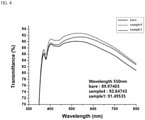
- the transmittance of the coating film coated on a glass plate was measured from the visible light region to the ultraviolet region.
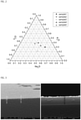
- Example 1 2, 3, and 5 were made using the same methods as Example 4 described above, but with 1) different molar ratios of alkali oxide metal (M 2 O) to silica (SiO 2 ) and 2) different molar fractions of the alkali oxide metals (x 1 , x 2 , x 3 ), as shown in [TABLE 1] below.
- Table 2 shows high functionalities of the coating film, after coating the substrate using the coating composition manufactured according to this application.
- the present application describes an industrially applicable invention related to the production of novel nanomaterials and coating methods using such materials.
Landscapes
- Chemical & Material Sciences (AREA)
- Engineering & Computer Science (AREA)
- Organic Chemistry (AREA)
- Materials Engineering (AREA)
- Ceramic Engineering (AREA)
- Manufacturing & Machinery (AREA)
- Inorganic Chemistry (AREA)
- Life Sciences & Earth Sciences (AREA)
- Structural Engineering (AREA)
- Wood Science & Technology (AREA)
- Chemical Kinetics & Catalysis (AREA)
- General Chemical & Material Sciences (AREA)
- Geochemistry & Mineralogy (AREA)
- Paints Or Removers (AREA)
- Surface Treatment Of Glass (AREA)
Applications Claiming Priority (3)
| Application Number | Priority Date | Filing Date | Title |
|---|---|---|---|
| KR1020190042723A KR102281843B1 (ko) | 2019-04-11 | 2019-04-11 | 나노 무기조성물 및 이의 제조방법 |
| KR1020190042720A KR102281837B1 (ko) | 2019-04-11 | 2019-04-11 | 나노 무기 도막형성 방법 |
| PCT/KR2020/004508 WO2020209544A1 (ko) | 2019-04-11 | 2020-04-02 | 나노 무기조성물 및 이를 이용한 코팅방법 |
Publications (2)
| Publication Number | Publication Date |
|---|---|
| EP3954669A1 true EP3954669A1 (de) | 2022-02-16 |
| EP3954669A4 EP3954669A4 (de) | 2023-01-18 |
Family
ID=72751715
Family Applications (1)
| Application Number | Title | Priority Date | Filing Date |
|---|---|---|---|
| EP20786921.5A Pending EP3954669A4 (de) | 2019-04-11 | 2020-04-02 | Nano-anorganische zusammensetzung und beschichtungsverfahren damit |
Country Status (4)
| Country | Link |
|---|---|
| US (1) | US12378162B2 (de) |
| EP (1) | EP3954669A4 (de) |
| CN (1) | CN113950463B (de) |
| WO (1) | WO2020209544A1 (de) |
Family Cites Families (13)
| Publication number | Priority date | Publication date | Assignee | Title |
|---|---|---|---|---|
| JP2000070796A (ja) * | 1998-08-31 | 2000-03-07 | Nkk Corp | 塗布膜厚制御方法及び装置 |
| JP4404275B2 (ja) * | 1999-01-18 | 2010-01-27 | 地方独立行政法人 大阪市立工業研究所 | 防曇ガラスおよびその製造方法 |
| CN1206302C (zh) * | 1999-03-09 | 2005-06-15 | 东陶机器株式会社 | 亲水性材料、制备它的方法以及用于制备它的涂料和装置 |
| KR100876529B1 (ko) * | 2004-09-15 | 2008-12-31 | 주식회사 엘지화학 | 자기세정성을 갖는 코팅용 조성물을 이용한 필름 또는 건축외장재 및 이의 제조 방법 |
| JP4668954B2 (ja) * | 2007-06-21 | 2011-04-13 | 株式会社トレードサービス | 水性完全無機アルカリ金属珪酸塩組成物,水性完全無機アルカリ金属珪酸塩組成物水溶液,水性コート剤,水性コート剤の水溶液,完全無機有色塗料,高温耐熱塗料用バインダー,水性完全無機アルカリ金属珪酸塩化合物の使用方法 |
| KR101414019B1 (ko) * | 2011-05-31 | 2014-07-03 | 김희곤 | 무기 도막 형성 방법 |
| WO2013001975A1 (ja) * | 2011-06-29 | 2013-01-03 | 信越化学工業株式会社 | 無機親水性コート液、それから得られる親水性被膜及びこれを用いた部材 |
| JP6027809B2 (ja) * | 2012-08-02 | 2016-11-16 | 大倉工業株式会社 | スロットダイによる塗膜の塗工方法および機能性フィルムの製造方法 |
| KR101735383B1 (ko) * | 2012-11-16 | 2017-05-29 | 김효원 | 무기 도료 조성물 및 이를 이용한 무기 도막의 형성방법 |
| KR101839779B1 (ko) * | 2016-05-16 | 2018-03-19 | 한밭대학교 산학협력단 | 내오염성 애자 코팅용 조성물 및 애자 코팅 방법 |
| KR20180107823A (ko) * | 2017-03-23 | 2018-10-04 | 주식회사 웰쳐화인텍 | 유리 코팅방법 |
| CN108069608B (zh) * | 2017-12-28 | 2020-11-27 | 淄博推进化工机械有限公司 | 一种耐碱瓷釉 |
| CN108276812B (zh) * | 2018-01-22 | 2019-11-15 | 华南理工大学 | 用于木材、金属和塑料表面的高硬度透明易清洁疏水涂料 |
-
2020
- 2020-04-02 CN CN202080039669.5A patent/CN113950463B/zh active Active
- 2020-04-02 WO PCT/KR2020/004508 patent/WO2020209544A1/ko not_active Ceased
- 2020-04-02 US US17/603,154 patent/US12378162B2/en active Active
- 2020-04-02 EP EP20786921.5A patent/EP3954669A4/de active Pending
Also Published As
| Publication number | Publication date |
|---|---|
| CN113950463A (zh) | 2022-01-18 |
| US12378162B2 (en) | 2025-08-05 |
| EP3954669A4 (de) | 2023-01-18 |
| US20220194857A1 (en) | 2022-06-23 |
| WO2020209544A1 (ko) | 2020-10-15 |
| CN113950463B (zh) | 2023-06-20 |
Similar Documents
| Publication | Publication Date | Title |
|---|---|---|
| Zheng et al. | Fabrication of transparent wear-resistant superhydrophobic SiO2 film via phase separation and chemical vapor deposition methods | |
| KR100787255B1 (ko) | 친수성 부재, 그의 제조방법, 그의 제조를 위한 코팅제 및 장치 | |
| EP1997565B1 (de) | Artikel mit plasmapolymerer Beschichtung und Verfahren zu dessen Herstellung | |
| US6673433B1 (en) | Stainproof material and method for manufacturing the same, and coating composition and apparatus thereof | |
| DE112016003678B4 (de) | Glasplatte mit Antiverschmutzungsschicht | |
| JPWO2000053689A1 (ja) | 親水性部材、その製造方法、その製造のためのコーティング剤および装置 | |
| DE10019355A1 (de) | Glaskörper mit erhöhter Festigkeit | |
| Wang et al. | Feasible fabrication of durable superhydrophobic SiO2 coatings with translucency and self-cleaning performance | |
| JP3935674B2 (ja) | ガラス上への有機塗料の供給 | |
| US20180105457A1 (en) | Functional glass article and method for producing same | |
| KR101847786B1 (ko) | 친수 및 오염방지 기능을 갖는 투명방음벽용 나노세라믹 코팅 접합유리 제조방법 | |
| KR101078946B1 (ko) | 광촉매 박막, 광촉매 박막의 형성방법 및 광촉매 박막 피복제품 | |
| KR102174294B1 (ko) | 3차원 형상물의 나노 무기 도막 형성방법 | |
| WO2013135637A1 (en) | Glass sheet with an enamel-based coating | |
| Ke et al. | Robust transparent superhydrophobic coatings on glass substrates prepared by a facile rapid thermal process | |
| JP2002080829A (ja) | 親水性部材、その製造方法、およびその製造のためのコーティング剤 | |
| US12378162B2 (en) | Nano inorganic composition and coating method using same | |
| KR101940924B1 (ko) | 친수 및 오염방지 기능을 갖는 나노세라믹 코팅유리 제조방법 | |
| KR102174307B1 (ko) | 투명기판의 나노 무기 도막형성 방법 | |
| JPH09309745A (ja) | 撥水撥油性物品及びその製法 | |
| KR101847785B1 (ko) | 가시광선이 투과하는 투명방음벽용 나노컬러 접합유리 제조 방법 | |
| KR102207259B1 (ko) | 칼라 구현이 가능한 투명기판의 나노 무기도막 형성방법 | |
| KR102281843B1 (ko) | 나노 무기조성물 및 이의 제조방법 | |
| KR102281837B1 (ko) | 나노 무기 도막형성 방법 | |
| KR102174275B1 (ko) | 건축 내외장재의 방수용 무기도막 형성방법 |
Legal Events
| Date | Code | Title | Description |
|---|---|---|---|
| STAA | Information on the status of an ep patent application or granted ep patent |
Free format text: STATUS: THE INTERNATIONAL PUBLICATION HAS BEEN MADE |
|
| PUAI | Public reference made under article 153(3) epc to a published international application that has entered the european phase |
Free format text: ORIGINAL CODE: 0009012 |
|
| STAA | Information on the status of an ep patent application or granted ep patent |
Free format text: STATUS: REQUEST FOR EXAMINATION WAS MADE |
|
| 17P | Request for examination filed |
Effective date: 20211109 |
|
| AK | Designated contracting states |
Kind code of ref document: A1 Designated state(s): AL AT BE BG CH CY CZ DE DK EE ES FI FR GB GR HR HU IE IS IT LI LT LU LV MC MK MT NL NO PL PT RO RS SE SI SK SM TR |
|
| DAV | Request for validation of the european patent (deleted) | ||
| DAX | Request for extension of the european patent (deleted) | ||
| A4 | Supplementary search report drawn up and despatched |
Effective date: 20221215 |
|
| RIC1 | Information provided on ipc code assigned before grant |
Ipc: C04B 35/16 20060101ALI20221209BHEP Ipc: C03C 17/25 20060101ALI20221209BHEP Ipc: C09D 1/04 20060101ALI20221209BHEP Ipc: C09D 1/00 20060101ALI20221209BHEP Ipc: C04B 35/626 20060101ALI20221209BHEP Ipc: C04B 35/622 20060101ALI20221209BHEP Ipc: C04B 35/01 20060101AFI20221209BHEP |
|
| STAA | Information on the status of an ep patent application or granted ep patent |
Free format text: STATUS: EXAMINATION IS IN PROGRESS |
|
| 17Q | First examination report despatched |
Effective date: 20250725 |