EP3954671A2 - Revêtements formant une barrière environnementale en hafnon et zircon pour composants à base de silicium - Google Patents
Revêtements formant une barrière environnementale en hafnon et zircon pour composants à base de silicium Download PDFInfo
- Publication number
- EP3954671A2 EP3954671A2 EP21191490.8A EP21191490A EP3954671A2 EP 3954671 A2 EP3954671 A2 EP 3954671A2 EP 21191490 A EP21191490 A EP 21191490A EP 3954671 A2 EP3954671 A2 EP 3954671A2
- Authority
- EP
- European Patent Office
- Prior art keywords
- phase
- layer
- hfo
- porosity
- volume
- Prior art date
- Legal status (The legal status is an assumption and is not a legal conclusion. Google has not performed a legal analysis and makes no representation as to the accuracy of the status listed.)
- Granted
Links
Images

Classifications
-
- C—CHEMISTRY; METALLURGY
- C04—CEMENTS; CONCRETE; ARTIFICIAL STONE; CERAMICS; REFRACTORIES
- C04B—LIME, MAGNESIA; SLAG; CEMENTS; COMPOSITIONS THEREOF, e.g. MORTARS, CONCRETE OR LIKE BUILDING MATERIALS; ARTIFICIAL STONE; CERAMICS; REFRACTORIES; TREATMENT OF NATURAL STONE
- C04B41/00—After-treatment of mortars, concrete, artificial stone or ceramics; Treatment of natural stone
- C04B41/45—Coating or impregnating, e.g. injection in masonry, partial coating of green or fired ceramics, organic coating compositions for adhering together two concrete elements
- C04B41/4505—Coating or impregnating, e.g. injection in masonry, partial coating of green or fired ceramics, organic coating compositions for adhering together two concrete elements characterised by the method of application
- C04B41/4545—Coating or impregnating, e.g. injection in masonry, partial coating of green or fired ceramics, organic coating compositions for adhering together two concrete elements characterised by the method of application applied as a powdery material
-
- C—CHEMISTRY; METALLURGY
- C04—CEMENTS; CONCRETE; ARTIFICIAL STONE; CERAMICS; REFRACTORIES
- C04B—LIME, MAGNESIA; SLAG; CEMENTS; COMPOSITIONS THEREOF, e.g. MORTARS, CONCRETE OR LIKE BUILDING MATERIALS; ARTIFICIAL STONE; CERAMICS; REFRACTORIES; TREATMENT OF NATURAL STONE
- C04B41/00—After-treatment of mortars, concrete, artificial stone or ceramics; Treatment of natural stone
- C04B41/80—After-treatment of mortars, concrete, artificial stone or ceramics; Treatment of natural stone of only ceramics
- C04B41/81—Coating or impregnation
- C04B41/85—Coating or impregnation with inorganic materials
- C04B41/87—Ceramics
-
- C—CHEMISTRY; METALLURGY
- C04—CEMENTS; CONCRETE; ARTIFICIAL STONE; CERAMICS; REFRACTORIES
- C04B—LIME, MAGNESIA; SLAG; CEMENTS; COMPOSITIONS THEREOF, e.g. MORTARS, CONCRETE OR LIKE BUILDING MATERIALS; ARTIFICIAL STONE; CERAMICS; REFRACTORIES; TREATMENT OF NATURAL STONE
- C04B35/00—Shaped ceramic products characterised by their composition; Ceramics compositions; Processing powders of inorganic compounds preparatory to the manufacturing of ceramic products
- C04B35/71—Ceramic products containing macroscopic reinforcing agents
- C04B35/78—Ceramic products containing macroscopic reinforcing agents containing non-metallic materials
-
- C—CHEMISTRY; METALLURGY
- C04—CEMENTS; CONCRETE; ARTIFICIAL STONE; CERAMICS; REFRACTORIES
- C04B—LIME, MAGNESIA; SLAG; CEMENTS; COMPOSITIONS THEREOF, e.g. MORTARS, CONCRETE OR LIKE BUILDING MATERIALS; ARTIFICIAL STONE; CERAMICS; REFRACTORIES; TREATMENT OF NATURAL STONE
- C04B41/00—After-treatment of mortars, concrete, artificial stone or ceramics; Treatment of natural stone
- C04B41/009—After-treatment of mortars, concrete, artificial stone or ceramics; Treatment of natural stone characterised by the material treated
-
- C—CHEMISTRY; METALLURGY
- C04—CEMENTS; CONCRETE; ARTIFICIAL STONE; CERAMICS; REFRACTORIES
- C04B—LIME, MAGNESIA; SLAG; CEMENTS; COMPOSITIONS THEREOF, e.g. MORTARS, CONCRETE OR LIKE BUILDING MATERIALS; ARTIFICIAL STONE; CERAMICS; REFRACTORIES; TREATMENT OF NATURAL STONE
- C04B41/00—After-treatment of mortars, concrete, artificial stone or ceramics; Treatment of natural stone
- C04B41/45—Coating or impregnating, e.g. injection in masonry, partial coating of green or fired ceramics, organic coating compositions for adhering together two concrete elements
- C04B41/4505—Coating or impregnating, e.g. injection in masonry, partial coating of green or fired ceramics, organic coating compositions for adhering together two concrete elements characterised by the method of application
- C04B41/4523—Coating or impregnating, e.g. injection in masonry, partial coating of green or fired ceramics, organic coating compositions for adhering together two concrete elements characterised by the method of application applied from the molten state ; Thermal spraying, e.g. plasma spraying
- C04B41/4527—Plasma spraying
-
- C—CHEMISTRY; METALLURGY
- C04—CEMENTS; CONCRETE; ARTIFICIAL STONE; CERAMICS; REFRACTORIES
- C04B—LIME, MAGNESIA; SLAG; CEMENTS; COMPOSITIONS THEREOF, e.g. MORTARS, CONCRETE OR LIKE BUILDING MATERIALS; ARTIFICIAL STONE; CERAMICS; REFRACTORIES; TREATMENT OF NATURAL STONE
- C04B41/00—After-treatment of mortars, concrete, artificial stone or ceramics; Treatment of natural stone
- C04B41/45—Coating or impregnating, e.g. injection in masonry, partial coating of green or fired ceramics, organic coating compositions for adhering together two concrete elements
- C04B41/4582—Porous coatings, e.g. coating containing porous fillers
-
- C—CHEMISTRY; METALLURGY
- C04—CEMENTS; CONCRETE; ARTIFICIAL STONE; CERAMICS; REFRACTORIES
- C04B—LIME, MAGNESIA; SLAG; CEMENTS; COMPOSITIONS THEREOF, e.g. MORTARS, CONCRETE OR LIKE BUILDING MATERIALS; ARTIFICIAL STONE; CERAMICS; REFRACTORIES; TREATMENT OF NATURAL STONE
- C04B41/00—After-treatment of mortars, concrete, artificial stone or ceramics; Treatment of natural stone
- C04B41/45—Coating or impregnating, e.g. injection in masonry, partial coating of green or fired ceramics, organic coating compositions for adhering together two concrete elements
- C04B41/50—Coating or impregnating, e.g. injection in masonry, partial coating of green or fired ceramics, organic coating compositions for adhering together two concrete elements with inorganic materials
- C04B41/5024—Silicates
-
- C—CHEMISTRY; METALLURGY
- C04—CEMENTS; CONCRETE; ARTIFICIAL STONE; CERAMICS; REFRACTORIES
- C04B—LIME, MAGNESIA; SLAG; CEMENTS; COMPOSITIONS THEREOF, e.g. MORTARS, CONCRETE OR LIKE BUILDING MATERIALS; ARTIFICIAL STONE; CERAMICS; REFRACTORIES; TREATMENT OF NATURAL STONE
- C04B41/00—After-treatment of mortars, concrete, artificial stone or ceramics; Treatment of natural stone
- C04B41/45—Coating or impregnating, e.g. injection in masonry, partial coating of green or fired ceramics, organic coating compositions for adhering together two concrete elements
- C04B41/50—Coating or impregnating, e.g. injection in masonry, partial coating of green or fired ceramics, organic coating compositions for adhering together two concrete elements with inorganic materials
- C04B41/5025—Coating or impregnating, e.g. injection in masonry, partial coating of green or fired ceramics, organic coating compositions for adhering together two concrete elements with inorganic materials with ceramic materials
- C04B41/5042—Zirconium oxides or zirconates; Hafnium oxides or hafnates
-
- C—CHEMISTRY; METALLURGY
- C04—CEMENTS; CONCRETE; ARTIFICIAL STONE; CERAMICS; REFRACTORIES
- C04B—LIME, MAGNESIA; SLAG; CEMENTS; COMPOSITIONS THEREOF, e.g. MORTARS, CONCRETE OR LIKE BUILDING MATERIALS; ARTIFICIAL STONE; CERAMICS; REFRACTORIES; TREATMENT OF NATURAL STONE
- C04B41/00—After-treatment of mortars, concrete, artificial stone or ceramics; Treatment of natural stone
- C04B41/45—Coating or impregnating, e.g. injection in masonry, partial coating of green or fired ceramics, organic coating compositions for adhering together two concrete elements
- C04B41/50—Coating or impregnating, e.g. injection in masonry, partial coating of green or fired ceramics, organic coating compositions for adhering together two concrete elements with inorganic materials
- C04B41/51—Metallising, e.g. infiltration of sintered ceramic preforms with molten metal
- C04B41/5144—Metallising, e.g. infiltration of sintered ceramic preforms with molten metal with a composition mainly composed of one or more of the metals of the iron group
-
- C—CHEMISTRY; METALLURGY
- C04—CEMENTS; CONCRETE; ARTIFICIAL STONE; CERAMICS; REFRACTORIES
- C04B—LIME, MAGNESIA; SLAG; CEMENTS; COMPOSITIONS THEREOF, e.g. MORTARS, CONCRETE OR LIKE BUILDING MATERIALS; ARTIFICIAL STONE; CERAMICS; REFRACTORIES; TREATMENT OF NATURAL STONE
- C04B41/00—After-treatment of mortars, concrete, artificial stone or ceramics; Treatment of natural stone
- C04B41/45—Coating or impregnating, e.g. injection in masonry, partial coating of green or fired ceramics, organic coating compositions for adhering together two concrete elements
- C04B41/52—Multiple coating or impregnating multiple coating or impregnating with the same composition or with compositions only differing in the concentration of the constituents, is classified as single coating or impregnation
-
- C—CHEMISTRY; METALLURGY
- C04—CEMENTS; CONCRETE; ARTIFICIAL STONE; CERAMICS; REFRACTORIES
- C04B—LIME, MAGNESIA; SLAG; CEMENTS; COMPOSITIONS THEREOF, e.g. MORTARS, CONCRETE OR LIKE BUILDING MATERIALS; ARTIFICIAL STONE; CERAMICS; REFRACTORIES; TREATMENT OF NATURAL STONE
- C04B41/00—After-treatment of mortars, concrete, artificial stone or ceramics; Treatment of natural stone
- C04B41/45—Coating or impregnating, e.g. injection in masonry, partial coating of green or fired ceramics, organic coating compositions for adhering together two concrete elements
- C04B41/52—Multiple coating or impregnating multiple coating or impregnating with the same composition or with compositions only differing in the concentration of the constituents, is classified as single coating or impregnation
- C04B41/526—Multiple coating or impregnation with materials having the same composition but different characteristics
-
- C—CHEMISTRY; METALLURGY
- C04—CEMENTS; CONCRETE; ARTIFICIAL STONE; CERAMICS; REFRACTORIES
- C04B—LIME, MAGNESIA; SLAG; CEMENTS; COMPOSITIONS THEREOF, e.g. MORTARS, CONCRETE OR LIKE BUILDING MATERIALS; ARTIFICIAL STONE; CERAMICS; REFRACTORIES; TREATMENT OF NATURAL STONE
- C04B41/00—After-treatment of mortars, concrete, artificial stone or ceramics; Treatment of natural stone
- C04B41/80—After-treatment of mortars, concrete, artificial stone or ceramics; Treatment of natural stone of only ceramics
- C04B41/81—Coating or impregnation
- C04B41/89—Coating or impregnation for obtaining at least two superposed coatings having different compositions
-
- C—CHEMISTRY; METALLURGY
- C04—CEMENTS; CONCRETE; ARTIFICIAL STONE; CERAMICS; REFRACTORIES
- C04B—LIME, MAGNESIA; SLAG; CEMENTS; COMPOSITIONS THEREOF, e.g. MORTARS, CONCRETE OR LIKE BUILDING MATERIALS; ARTIFICIAL STONE; CERAMICS; REFRACTORIES; TREATMENT OF NATURAL STONE
- C04B41/00—After-treatment of mortars, concrete, artificial stone or ceramics; Treatment of natural stone
- C04B41/80—After-treatment of mortars, concrete, artificial stone or ceramics; Treatment of natural stone of only ceramics
- C04B41/81—Coating or impregnation
- C04B41/89—Coating or impregnation for obtaining at least two superposed coatings having different compositions
- C04B41/90—Coating or impregnation for obtaining at least two superposed coatings having different compositions at least one coating being a metal
-
- F—MECHANICAL ENGINEERING; LIGHTING; HEATING; WEAPONS; BLASTING
- F01—MACHINES OR ENGINES IN GENERAL; ENGINE PLANTS IN GENERAL; STEAM ENGINES
- F01D—NON-POSITIVE DISPLACEMENT MACHINES OR ENGINES, e.g. STEAM TURBINES
- F01D25/00—Component parts, details, or accessories, not provided for in, or of interest apart from, other groups
- F01D25/005—Selecting particular materials
-
- F—MECHANICAL ENGINEERING; LIGHTING; HEATING; WEAPONS; BLASTING
- F01—MACHINES OR ENGINES IN GENERAL; ENGINE PLANTS IN GENERAL; STEAM ENGINES
- F01D—NON-POSITIVE DISPLACEMENT MACHINES OR ENGINES, e.g. STEAM TURBINES
- F01D5/00—Blades; Blade-carrying members; Heating, heat-insulating, cooling or antivibration means on the blades or the members
- F01D5/12—Blades
- F01D5/28—Selecting particular materials; Particular measures relating thereto; Measures against erosion or corrosion
- F01D5/284—Selection of ceramic materials
-
- F—MECHANICAL ENGINEERING; LIGHTING; HEATING; WEAPONS; BLASTING
- F01—MACHINES OR ENGINES IN GENERAL; ENGINE PLANTS IN GENERAL; STEAM ENGINES
- F01D—NON-POSITIVE DISPLACEMENT MACHINES OR ENGINES, e.g. STEAM TURBINES
- F01D5/00—Blades; Blade-carrying members; Heating, heat-insulating, cooling or antivibration means on the blades or the members
- F01D5/12—Blades
- F01D5/28—Selecting particular materials; Particular measures relating thereto; Measures against erosion or corrosion
- F01D5/286—Particular treatment of blades, e.g. to increase durability or resistance against corrosion or erosion
-
- F—MECHANICAL ENGINEERING; LIGHTING; HEATING; WEAPONS; BLASTING
- F01—MACHINES OR ENGINES IN GENERAL; ENGINE PLANTS IN GENERAL; STEAM ENGINES
- F01D—NON-POSITIVE DISPLACEMENT MACHINES OR ENGINES, e.g. STEAM TURBINES
- F01D5/00—Blades; Blade-carrying members; Heating, heat-insulating, cooling or antivibration means on the blades or the members
- F01D5/12—Blades
- F01D5/28—Selecting particular materials; Particular measures relating thereto; Measures against erosion or corrosion
- F01D5/288—Protective coatings for blades
-
- F—MECHANICAL ENGINEERING; LIGHTING; HEATING; WEAPONS; BLASTING
- F05—INDEXING SCHEMES RELATING TO ENGINES OR PUMPS IN VARIOUS SUBCLASSES OF CLASSES F01-F04
- F05D—INDEXING SCHEME FOR ASPECTS RELATING TO NON-POSITIVE-DISPLACEMENT MACHINES OR ENGINES, GAS-TURBINES OR JET-PROPULSION PLANTS
- F05D2230/00—Manufacture
- F05D2230/90—Coating; Surface treatment
-
- F—MECHANICAL ENGINEERING; LIGHTING; HEATING; WEAPONS; BLASTING
- F05—INDEXING SCHEMES RELATING TO ENGINES OR PUMPS IN VARIOUS SUBCLASSES OF CLASSES F01-F04
- F05D—INDEXING SCHEME FOR ASPECTS RELATING TO NON-POSITIVE-DISPLACEMENT MACHINES OR ENGINES, GAS-TURBINES OR JET-PROPULSION PLANTS
- F05D2300/00—Materials; Properties thereof
- F05D2300/20—Oxide or non-oxide ceramics
Definitions
- the disclosure relates to gas turbine engines. More particularly, the disclosure relates to barrier coatings for silicon-based (e.g., ceramic matrix composite (CMC)) substrates.
- silicon-based e.g., ceramic matrix composite (CMC)
- Gas turbine engines (used in propulsion and power applications and broadly inclusive of turbojets, turboprops, turbofans, turboshafts, industrial gas turbines, and the like) are beginning to include components made of CMC.
- CMC ceramic matrix composite
- YSZ stabilized zirconia
- CTE coefficient of thermal expansion
- Zr, Hf, and rare earth silicate abradable coatings have been proposed to better match CTE. These may involve coatings that have porosity greater than 10 vol.% to enable wear.
- One aspect of the disclosure involves a method for coating a substrate.
- the method comprises spraying a combination of powders.
- the combination of powders comprises: Hf 0.5 Si 0.5 O 2 ; Zr 0.5 Si 0.5 O 2 ; HfO 2 and, optionally, ZrO 2 .
- a molar ratio of said Hf 0.5 Si 0.5 O 2 and HfO 2 combined to said Zr 0.5 Si 0.5 O 2 and ZrO 2 (if present) combined is from 2:1 to 4:1 (i.e., including 2:1 and 4:1 exactly).
- a molar ratio of said Hf 0.5 Si 0.5 O 2 to said HfO 2 is at least 1:3 (i.e., including 1:3 exactly).
- the combination of powders comprises: Hf 0.5 Si 0.5 O 2 ; Zr 0.5 Si 0.5 O 2 ; HfO 2 ; and ZrO 2 , and a molar ratio of said Hf 0.5 Si 0.5 O 2 and HfO 2 combined to said Zr 0.5 Si 0.5 O 2 and ZrO 2 combined is from 2:1 to 4:1 (i.e., including 2:1 and 4:1 exactly).
- the combination of powders comprises: Hf 0.5 Si 0.5 O 2 ; Zr 0.5 Si 0.5 O 2 ; HfO 2 ; and substantially no ZrO 2 , and a molar ratio of said Hf 0.5 Si 0.5 O 2 and HfO 2 combined to said Zr 0.5 Si 0.5 O 2 alone is from 2:1 to 4:1 (i.e., including 2:1 and 4:1 exactly).
- said molar ratio of said Hf 0.5 Si 0.5 O 2 and HfO 2 combined to said Zr 0.5 Si 0.5 O 2 and ZrO 2 (if present) combined is from 7:3 to 3:1 (i.e., including 7:3 and 3:1 exactly).
- the combination of powders comprises: Hf 0.5 Si 0.5 O 2 ; Zr 0.5 Si 0.5 O 2 ; HfO 2 ; and ZrO 2
- the molar ratio of said Hf 0.5 Si 0.5 O 2 and HfO 2 combined to said Zr 0.5 Si 0.5 O 2 and ZrO 2 combined is from 7:3 to 3:1 (i.e., including 7:3 and 3:1 exactly).
- the combination of powders comprises: Hf 0.5 Si 0.5 O 2 ; Zr 0.5 Si 0.5 O 2 ; HfO 2 ; and substantially no ZrO 2
- the molar ratio of said Hf 0.5 Si 0.5 O 2 and HfO 2 combined to said Zr 0.5 Si 0.5 O 2 alone is from 7:3 to 3:1 (i.e., including 7:3 and 3:1 exactly).
- the combination of powders comprises said HfO 2 at a single cation molarity of 0.10 to 0.45.
- the combination of powders comprises: Hf 0.5 Si 0.5 O 2 ; Zr 0.5 Si 0.5 O 2 ; HfO 2 ; and ZrO 2
- the combination of powders further comprises said ZrO 2 at a single cation molarity of 0.050 to 0.150.
- a molar ratio of said HfO 2 to said ZrO 2 is at least 2:1. It should be understood that such a ratio can be provided in either alternative, where the combination of powders comprises: Hf 0.5 Si 0.5 O 2 ; Zr 0.5 Si 0.5 O 2 ; HfO 2 ; and ZrO 2 or the combination of powders comprises: Hf 0.5 Si 0.5 O 2 ; Zr 0.5 Si 0.5 O 2 ; HfO 2 ; and substantially no ZrO 2 .
- the combination of powders comprises: Hf 0.5 Si 0.5 O 2 ; Zr 0.5 Si 0.5 O 2 ; HfO 2 ; and ZrO 2
- said molar ratio of said HfO 2 to said ZrO 2 is from 2:1 to 5:1 (i.e., including 2:1 and 5:1 exactly).
- said molar ratio of said HfO 2 to said ZrO 2 is higher than a molar ratio of said Hf 0.5 Si 0.5 O 2 to said Zr 0.5 Si 0.5 O 2 .
- the combination of powders comprises in single cation mol percent at least 95.0% combined said Hf 0.5 Si 0.5 O 2 , said Zr 0.5 Si 0.5 O 2 , and said HfO 2 and ZrO 2 (if present).
- the combination of powders further comprises CaO, AlO 1.5 , and SiO 2 .
- the spraying is of layer and the method further comprises at least one of: applying a bond coat before the spraying; and applying a further layer after the spraying.
- the method includes applying the further layer wherein the further layer is an abradable layer applied by air plasma spray.
- the method includes applying the further layer wherein the further layer has greater porosity than a layer formed by said spraying said combination of powders.
- a further aspect of the disclosure involves, a coated substrate comprising: a substrate; and a coating layer atop the substrate.
- the coating and comprises: at least 25.0 volume %, exclusive of porosity, a first phase being a solid solution of Hf 1-x Zr x SiO 4 ; and at least 25.0 volume %, exclusive of porosity, a second phase being a solid solution of Hf 1-y Zr y O 2 .
- the substrate is a CMC; the substrate is silicon-based; a bond coat is between the substrate and the layer; and the layer is between the substrate and a second layer.
- the coating layer comprises: at least 50.0 volume %, exclusive of porosity, said first phase; and at least 25.0 volume %, exclusive of porosity, said second phase.
- the x in the Hf 1-x Zr x SiO 4 is between 0.20 and 0.40 inclusive; and the y in the Hf 1 - y Zr y O 2 is less than the x.
- the coated substrate further comprises an additional coating layer atop the coating layer.
- the additional coating layer comprises: at least 25.0 volume %, exclusive of porosity, a first phase being a solid solution of Hf 1-x Zr x SiO 4 ; and at least 5.0 volume %, exclusive of porosity, a second phase being a solid solution of Hf 1-y Zr y O 2 , wherein the additional coating layer has a lower volume ratio of the Hf 1-y Zr y O 2 to the Hf 1-x Zr x SiO 4
- the coated substrate further comprises: an additional coating layer atop the coating layer and comprising: at least 25.0 volume %, exclusive of porosity, a first phase being a solid solution of Hf 1-x Zr x SiO 4 ; and at least 5.0 volume %, exclusive of porosity, a second phase being a solid solution of Hf 1-y Zr y O 2 , wherein the additional coating layer further comprises a dislocator phase as a third phase.
- the dislocator phase is present at 2.0% to 40.0% total volume in the additional layer.
- the dislocator phase comprises alkaline earth or transition metal (M) tungstates (MWO 4 ), alkaline earth molybdates (MMoO 4 ), rare earth (RE) phosphates (REPO 4 ) and combinations thereof at said 2.0% to 40.0% total volume in the additional layer.
- MWO 4 alkaline earth or transition metal (M) tungstates
- MMO 4 alkaline earth molybdates
- REPO 4 rare earth
- Zircon is much less expensive than hafnon and initially may provide similar protection to silicon-based substrates as hafnon.
- residual zirconia in zircon-based coatings can bring with it undesirable phase transformations during cyclic operations of a gas turbine.
- hafnia HfO 2
- zirconia transforms from the monoclinic phase to the tetragonal phase at temperatures above 1000°C.
- zirconia would be expected to transform from monoclinic to tetragonal upon heating and then back to monoclinic upon cooling.
- the tetragonal to monoclinic phase transformation results in a 3% volume increase that induces cracking, which would result in loss of mechanical integrity.
- hafnon When zircon is added to hafnon, the hafnon may help suppress the residual zirconia from transforming between its low and high temperature polymorphs.
- a spray of mixed hafnon and zircon feedstock suffers silicon depletion Therefore, a coating produced using raw materials of zircon and hafnon will produce a coating consisting of a zircon-hafnon (hafnon-zircon -order not indicating relative content) solid solution with residual hafnia-zirconia (zirconia-hafnia) solid solution.
- the silicon With a mixture, the silicon will deplete from the hafnon at a similar rate to zircon, producing a hafnia-zirconia phase within the hafnon-zircon phase.
- An approximate rule of mixtures applies to the stability temperature of the hafnia-zirconia relative to the respective values of about 1600°C and 1000°C. Wang, Chong & Zinkevich, Matvei & Aldinger, Fritz. "The Zirconia-Hafnia System: DTA Measurements and Thermodynamic Calculations". Journal of the American Ceramic Society, October, 2006, pp. 3751 - 3758, vol. 89 - no. 12, John Wiley & Sons, Inc., Hoboken, New Jersey .
- An exemplary target operating temperature is 2700°F (1482°C). At that temperature, a moderate amount of zirconia in the hafnia-zirconia system will be acceptable while still avoiding the polymorph transition.
- Hafnon-zircon compositions with up to 40% zircon in the hafnon-zircon silicate phase (single cation molarity) will form residual zirconia that is in solid solution with hafnia (HfO 2 ) and which should not transform if the coating surface temperature is kept below approximately 2700°F (1482°C). Thus, such coating should be stable thermally up to 2700°F (1482°C).
- zirconia-hafnia and zircon-hafnon mixtures are reported to form single-phase solid-solutions across the binary (binary of zirconia and hafnia or binary of zircon and hafnon, respectively).
- the monoclinic to tetragonal transformation of Zr x Hf 1-x O 2 mixtures increases continuously with x.
- x ⁇ 0.30 the monoclinic to tetragonal transformation temperature is above 2700°F (1482°C). This suggests that a Zr x Hf 1-x SiO 4 coating with x ⁇ 0.30 would have enhanced durability relative to mixtures with x>0.30.
- Si loss would result in Zr x Hf 1-x O 2 mixtures that are not susceptible to phase transformation-induced degradation.
- Compositions 0.25 ⁇ x ⁇ 0.30 would have the best cost/property balance, more broadly 0.20 ⁇ x ⁇ 0.33 (2:1 to 4:1 Hf to Zr).
- Exemplary application techniques are thermal spray of source powders.
- the powders(e.g., hafnon and zircon) may be pre blended or they may have separate feeds, mixing in the plasma.
- An exemplary thermal spray is air plasma spray of dry (distinguished from suspension plasma spray) powders (e.g., pre-blended or not).
- the hafnon and zircon phases When deposited, the hafnon and zircon phases will mix into a single first phase, as will the hafnia and zirconia phases into a second single phase. Even if a pure hafnon-zircon mixture is used (no hafnia and/or zirconia), there typically will be one or more stages of silicon depletion/attrition. For example, during deposition, about 10% of hafnon and zircon is transformed to zirconia or hafnia due to Si vaporization in the plasma.
- Zr y Hf 1-y O 2 - Zr x Hf 1-x SiO 4 mixtures sprayed using added zirconia and hafnia feedstock will have enhanced recession resistance relative to Zr x Hf 1-x SiO 4 .
- Zr y Hf 1-y O 2 is not susceptible to recession because the vapor pressure of Zr(OH) 4 and Hf(OH) 4 , in equilibrium with Zr y Hf 1-y O 2 and the combustion environment, is very low.
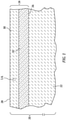
- FIG. 1 shows a coated article 20 comprising a substrate 22 and a coating system 24 atop a surface 26 of the substrate and extending to an outer surface 28.
- the exemplary substrate is a ceramic matrix composite (CMC) such as a SiC-SiC composite (see the '789 publication) or a monolithic ceramic.
- the coating system 24 includes a barrier layer (barrier coating) 30.
- the exemplary FIG. 1 coating system includes a bond coat 32 directly atop the substrate surface. The bond coat is optional. However, further variations may include additional layers.
- Exemplary bond coat thickness is 50 micrometers to 250 micrometers, more particularly 100 micrometers to 200 micrometers.
- Exemplary barrier coat thickness is 25 micrometers to 200 micrometers, more particularly 75 micrometers to 150 micrometers.
- FIG. 2 shows an additional abradable layer 64 (in a coating system 62 of a coated article 60 otherwise similar to coated article 20) in addition to the bond coat 32 and the barrier layer 30.
- Exemplary abradable layer thickness is 200 micrometers to 1000 micrometers, more particularly 300 micrometers to 800 micrometers (e.g., and thicker than all remaining layers individually and, optionally, combined).
- the article 60 interfaces with a second article 36 comprising a substrate 38 and a coating system 40 atop a surface 42 of the substrate and extending to an outer surface 44.
- the exemplary substrate 38 is a metallic substrate such as a nickel-based superalloy.
- the coating system 40 includes an abrasive layer (abrasive coating) 46.
- the exemplary coating system 40 includes a bond coat 48 directly atop the substrate surface.
- An exemplary abrasive layer comprises a cubic boron nitride (cBN) abrasive in a metallic (e.g., MCrAlY) matrix.
- An exemplary abrasive layer application is via electrolytic deposition (plating) of the metal (M - Ni and/or Co and/or Fe) with the addition of the abrasive (e.g., cBN) particles and with or without the addition of metal particles (e.g., the CrAlY) required in order to achieve an alloyed matrix.
- An exemplary bond coat 48 is Ni (e.g., essentially pure such as at least 95.0% or at least 99.0% Ni by weight).
- An exemplary Ni bond coat application is via electrolytic deposition.
- the article 20 is a blade or vane with the coating system 24 being along a gaspath-facing portion of the article (e.g., airfoil pressure and/or suction side, inner diameter platform outer diameter surface, outer diameter shroud inner diameter surface and the like.
- a gaspath-facing portion of the article e.g., airfoil pressure and/or suction side, inner diameter platform outer diameter surface, outer diameter shroud inner diameter surface and the like.
- the first article 60 is a blade outer airseal (BOAS) or segment thereof with the surfaces 26 and 28 at least locally being inner diameter (ID) surfaces.
- the second article 36 is a blade of a blade stage with the surfaces 42 and 44 being tip/outer diameter (OD) surfaces.
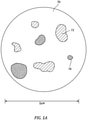
- the barrier layer 30 ( FIG. 1A ) comprises two distinct phases 70 and 72 in addition to porosity (pores) 74.
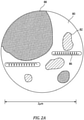
- the abradable layer 64 ( FIG. 2A ) comprises two phases 80 and 82 which may be otherwise respectively similar to 70 and 72 and, optionally, a filler 86 (one or more fillers) in addition to porosity (pores) 88.
- Table I shows examples of various feedstock mixtures used to apply various barrier layers 30 to various substrates. As is seen in the table, single cation molarity concentration is used.
- Table IIbelow shows estimated in-service phases in select such barrier layers 30 layers of the Table I coating systems.
- Example 1 is a relatively high hafnon barrier coating.
- the high hafnon renders the coating less prone to monoclinical tetragonal Zr-Hf oxide formation.
- silicon bond coats may serve to provide oxidation protection at temperatures below 2400°F (1316°C). Typically, this will be Si plus impurities.
- an SiOC-BMAS bond coat may provide protection at temperatures up to about 2700°F (1482°C).
- An exemplary SiOC-BMAS bond coat is 75 vol% SiOC, 20 vol % SiO 2 and 5 vol.% BMAS plus impurities (e.g., up to 5.0% or up to 2.0% by volume total impurities as applied.
- BMAS may be 2.0-10.0 vol.%;and SiO 2 10.0-50.0 vol.%.
- SiO 2 In service, the SiO 2 content will progressively increase.
- SiOC may be at least 50.0 vol.% or at least 60.0 vol.% but may end up less than 50.0 vol.% in service.
- molybdenum disilicide with glass ceramic additive e.g., United States Patent 7951459B2 (the '459 patent), of Tang et al, May 31, 2011 "Oxidation resistant coatings, processes for coating articles, and their coated articles”; United States Patent Application Publication US2019/0119803A1 (the '803 publication), of Tang et al., April 25, 2019, “OXIDATION RESISTANT BOND COAT LAYERS, PROCESSES FOR COATING ARTICLES, AND THEIR COATED ARTICLES”).
- Example 2 The slight reduction in hafnon content of Example 2 relative to Example 1 may slightly lower cost. However, particularly if compositional tolerances are off, it is more susceptible to degradation.
- Examples 3 and 4 involve use of the SiOC-BMAS bond coat that is capable of higher temperature operation.
- Examples 7, 5, and 9 are each silicon-lean overall compositions less prone to tetragonal transformation due to the effect of a substantial initial feedstock surplus of hafnia relative to zirconia with the content of HfO 2 going from 0% in Example 1 to 10% in Example 7, to 25% in Example 5 to 37.5% in Example 9.
- Examples 5-8 involve added hafnia and optionally zirconia in addition to the hafnon and zircon. Comparing Example 5 to Example 1, Example 5 provides a silicon-lean overall composition less prone to tetragonal transformation due to the effect of a substantial initial feedstock surplus of hafnia relative to zirconia.
- Example 6 provides a similar silicon-leanness to Example 5 while reducing the cost by substituting a small amount of zirconia for hafnia.
- Example 8 provides a similar silicon leanness to Example 9 while reducing the cost by substituting a small amount of zirconia for hafnia
- Examples 8, 9, 10, and 11 involve relatively low total silicon contents.
- the low silicon content makes the material less susceptible to vaporization but increases the coefficient of thermal expansion (CTE). This trade-off may be favored in some applications.
- Example 9 has a relatively high x value
- Example 10 has a relatively high x value in the feedstock.
- the feedstock y value is much lower and the as-deposited and in-service y values remain less than the x value.
- Example 11 represents a high end on feedstock zirconia (limited by monoclinic to tetragonal phase transformation temperature of the Hf 1-y Zr y O 2 compound).
- Example 11 has a relatively high initial oxide content. This would have a relatively high resistance to volatilization. This may be particularly relevant to thin coatings due to the lower CTE mismatch of the zircon-hafnon system to the substrate compared with the relative CTE of the zirconia-hafnia system and substrate.
- material of Tables I and/or II may be used as a barrier layer serving as an under layer for an abradable layer 64 in an abradable coating system.
- the abradable layers may be silicates or have silicate matrices.
- such silicates may be hafnon-zircon mixtures as outlined for the barrier layer.
- Table III provides examples of such abradable layers.
- first phase 70 ( FIG. 1A ) that is a solid solution of Hf 1-x Zr x SiO 4 .
- the first phase is a tetragonal orthosilicate, space group I4 1 /amd that consists of (SiO 4 ) -4 tetrahedra that share edges with pseudohexagonal MO 8 bipyramids along the tetragonal c-axis and share vertices with MO 8 bipyramids along the a and b axes, where M can be either Hf of Zr.
- a second phase 72 is a solid solution of Hf 1-y Zr y O 2 .
- this is a metal oxide phase with a monoclinic structure, space group P2 1 /c , in which M ions are 7-fold coordinated with O ions, and M can be either Hf or Zr.
- 0.1 ⁇ x,y ⁇ 0.5 and preferably 0.2 ⁇ x,y ⁇ 0.40 or 0.2 ⁇ x,y ⁇ 0.3 because when x ⁇ 0.3, Hf 1-y Zr y O 2 transforms into a tetragonal crystal structure at turbine operating temperatures, and subsequently converts to monoclinic Hf 1-y Zr y O 2 at colder temperatures.
- the durability of the coating decreases with the volume of Hf 1-y Zr y O 2 that undergoes the tetragonal to monoclinic phase transformation.
- the tetragonal to monoclinic phase transformation results in a 4.7% volume contraction that can cause the material to crack extensively.
- y in particular may be zero.
- x,y may be limited to no more than 0.30 to prevent the formation of phase transformable material because the durability of the coating decreases with the volume of Hf 1-y Zr y O 2 that under goes the tetragonal to monoclinic phase transformation.
- the Zr concentration may be fixed to avoid the deleterious phase transformation.
- a molar ratio of Hf 0.5 Si 0.5 O 2 and HfO 2 combined to said Zr 0.5 Si 0.5 O 2 and ZrO 2 is from 2:1 to 3:1 (more narrowly 7:3 to 3:1) and a molar ratio of said Hf 0.5 Si 0.5 O 2 to said HfO 2 is at least 1:2 (more narrowly 2:1 to 5:1).
- Exemplary content of source powder HfO 2 may be at a single cation molarity of 0.10 to 0.45 (more narrowly 0.20 to 0.33).
- a molar ratio of said HfO 2 to said ZrO 2 is at least 2:1 but may be much higher.
- An x value greater than a y value may offer a useful dynamic.
- x is 0.30 and there is no hafnia or zirconia in the source material, a y value of 0.30 will arise in the as-applied material due to silicon depletion in the spray and in service.
- the y value of the hafnia-zirconia from depleted hafnon-zircon will be diluted by the feedstock hafnia-zirconia, and will thus be less than 0.30 in the as-applied and in-service coating.
- the resulting coating may thus include hafnon-zircon and hafnia-zirconia.
- the hafnon-zircon may represent at least 25.0% by volume (exclusive of porosity) or at least 30.0%, 40.0%, 50.0%, 60.0%, 70.0%, 80.0%, or 90.0%.
- the hafnia-zirconia may represent at least 5.0% by volume (exclusive of porosity) or at least 10.0%, 15.0%, 20.0%, or 25.0%.
- the coating or layer may consist of or consist essentially of (subject to impurities as-applied or in-service accumulated) said hafnon-zircon and hafnia-zirconia or may have intentional additions such as dislocators.
- An exemplary non-fugitive is a three-phase glass (e.g., a CaO-AlO 1-5 -SiO 2 system formed from CaO, AlO 1.5 , and SiO 2 in the source powders). This may still make up a small fraction of the non-fugitive (e.g., about 5% or at least 2.0% and up to 8.0% or 10.0%, leaving the aforementioned hafnon, zircon, hafnia, and zirconia at least 90% as-applied ignoring porosity).
- An exemplary CaO-AlO 1.5 -SiO 2 system is by molarity 24% CaO, 17% AlO 1.5 , and 59% SiO 2 .
- Example 1 would offer a cost reduction with respect to a pure hafnon coating.
- the slight reduction in hafnon content of Example 2 relative to Example 1 may slightly further lower cost.
- Example 2 is more susceptible to degradation.
- Example 5 offers more volatization resistance due to the addition of HfO 2 .
- the effective CTE of the coating will be higher due to the HfO 2 addition, which makes the coating more prone to thermal stress generation.
- Example 6 offers additional volatization resistance due to the reduction in silicate content, while further reducing cost through the addition of ZrO 2 .
- Example 7 offers even greater volatization resistance due to the greater reduction in silicate content, while further reducing cost through the larger addition of ZrO 2 with respect to Example 6.
- the barrier layer and abradable layer in situations wherein both comprise zircon-hafnon, there may be a number of differences.
- One basic difference is greater porosity on the abradable layer than in the barrier layer (e.g., a difference of at least 4.0% or an exemplary 4.0% to 25%). Such may be achieved by the addition of a polymer fugitive powder.
- one difference may be in the relative amount of the two phases (hafnon-zircon relative to hafnia-zirconia) or absolute amount of hafnia-zirconia.
- the abradable layer may have a lower oxide phase content because it is thicker.
- the thickness raises susceptibility to spallation stresses from CTE mismatch between the substrate and the oxide phase (hafnia-zirconia).
- An exemplary difference is at least 10.0 volume percent less of the oxide phase.
- the hafnia-zirconia to hafnon-zircon ratio of the abradable may be an exemplary at least 10% greater for the barrier layer or at least 20% or at least 50%.
- one difference between the barrier layer and the abradable layer may be the presence of hard or soft dislocator phases (e.g., see, U.S. Patent Application No. 63/048,023, filed July 3, 2020 , and entitled “Dislocator Chemistries for Turbine Abradable or Machinable Coating Systems", disclosing fillers of alkaline earth or transition metal (M) tungstates (MWO 4 ), alkaline earth molybdates (MMoO 4 ), rare earth (RE) phosphates (REPO 4 ) and combinations thereof; also see United States Patent Application Publication 20190093497A1 (the '497 publication), of Ndamka et al., published March 28, 2019 and entitled "LOW POROSITY ABRADABLE COATING” discloses an abradable coating having a rare earth silicate matrix and dislocator phases of hafnium diboride (HfB 2 ), zirconium diboride (ZrB 2 ), tantalum carbide (Ta 2 C
- Exemplary dislocator phases represent 2.0% to 40.0% total volume (inclusive of porosity) of the abradable layer, more particularly 5.0% to 30.0% or 5.0% to 20.0%.
- Table I Barrier Coating Application Parameters Example Substrate Bond coat Barrier Coat Material Method Thickness, mils Feedstock -1 Feedstock-2 Feedstock-3 Feedstock-4 Porosity Thickness mils Method Material mol frac Material mol frac Material mol frac Material mol frac Material mol frac 1 SiC-SiC Si APS 2 Hf 0.5 Si 0.5 O 2 0.75 Zr 0.5 Si 0.5 O 2 0.25 3% 5 APS 2 SiC-SiC Si APS 2 Hf 0.5 Si 0.5 O 2 0.70 Zr 0.5 Si 0.5 O 2 0.30 3% 5 APS 3 SiC-SiC SiOC-BMAS Slurry 5 Hf 0.5 Si 0.5 O 2 0.75 Zr 0.5 Si 0.5 O 2 0.25 3% 5 APS 4 SiC-SiC SiOC-
- SiC-SiC ceramic matrix composites include monolithic SiC or SiN, Si-SiC composites, and the like.
- bond coats include metallic silicon, SiOC/BMAS/SiO 2 , metal silicide glass-ceramic, and the like.
- barrier layers include hafnia, hafnon, zircon, ytterbium disilicate, yttrium disilicate), mullite (Al 6 Si 2 O 13 ), BSAS (Ba 0.75 Sr 0.25 Al 2 Si 2 O 8 ), and combinations thereof, with porosity 1.0-10%, more narrowly 1%-5%.
- abradable layers include hafnon, zircon, ytterbium disilicate, yttrium disilicate, BSAS, and combinations thereof, with porosity ranging from 2.0%-25%, more narrowly 12%-25%.
- first, second, and the like in the following claims is for differentiation within the claim only and does not necessarily indicate relative or absolute importance or temporal order. Similarly, the identification in a claim of one element as “first” (or the like) does not preclude such "first” element from identifying an element that is referred to as “second” (or the like) in another claim or in the description.
Landscapes
- Chemical & Material Sciences (AREA)
- Engineering & Computer Science (AREA)
- Ceramic Engineering (AREA)
- Materials Engineering (AREA)
- Structural Engineering (AREA)
- Organic Chemistry (AREA)
- Inorganic Chemistry (AREA)
- General Engineering & Computer Science (AREA)
- Mechanical Engineering (AREA)
- Physics & Mathematics (AREA)
- Plasma & Fusion (AREA)
- Manufacturing & Machinery (AREA)
- Chemical Kinetics & Catalysis (AREA)
- Coating By Spraying Or Casting (AREA)
- Turbine Rotor Nozzle Sealing (AREA)
- Inorganic Compounds Of Heavy Metals (AREA)
Priority Applications (1)
| Application Number | Priority Date | Filing Date | Title |
|---|---|---|---|
| EP24157077.9A EP4345250A3 (fr) | 2020-08-14 | 2021-08-16 | Revêtements de barrière environnementale à base de hafnon et de zircon pour composants à base de silicium |
Applications Claiming Priority (2)
| Application Number | Priority Date | Filing Date | Title |
|---|---|---|---|
| US202063065718P | 2020-08-14 | 2020-08-14 | |
| US17/401,545 US11866379B2 (en) | 2020-08-14 | 2021-08-13 | Hafnon and zircon environmental barrier coatings for silicon-based components |
Related Child Applications (1)
| Application Number | Title | Priority Date | Filing Date |
|---|---|---|---|
| EP24157077.9A Division EP4345250A3 (fr) | 2020-08-14 | 2021-08-16 | Revêtements de barrière environnementale à base de hafnon et de zircon pour composants à base de silicium |
Publications (3)
| Publication Number | Publication Date |
|---|---|
| EP3954671A2 true EP3954671A2 (fr) | 2022-02-16 |
| EP3954671A3 EP3954671A3 (fr) | 2022-03-02 |
| EP3954671B1 EP3954671B1 (fr) | 2024-02-14 |
Family
ID=77358164
Family Applications (2)
| Application Number | Title | Priority Date | Filing Date |
|---|---|---|---|
| EP24157077.9A Pending EP4345250A3 (fr) | 2020-08-14 | 2021-08-16 | Revêtements de barrière environnementale à base de hafnon et de zircon pour composants à base de silicium |
| EP21191490.8A Active EP3954671B1 (fr) | 2020-08-14 | 2021-08-16 | Revêtements formant une barrière environnementale en hafnon et zircon pour composants à base de silicium |
Family Applications Before (1)
| Application Number | Title | Priority Date | Filing Date |
|---|---|---|---|
| EP24157077.9A Pending EP4345250A3 (fr) | 2020-08-14 | 2021-08-16 | Revêtements de barrière environnementale à base de hafnon et de zircon pour composants à base de silicium |
Country Status (2)
| Country | Link |
|---|---|
| US (2) | US11866379B2 (fr) |
| EP (2) | EP4345250A3 (fr) |
Families Citing this family (7)
| Publication number | Priority date | Publication date | Assignee | Title |
|---|---|---|---|---|
| US11668198B2 (en) | 2018-08-03 | 2023-06-06 | Raytheon Technologies Corporation | Fiber-reinforced self-healing environmental barrier coating |
| US11505506B2 (en) | 2018-08-16 | 2022-11-22 | Raytheon Technologies Corporation | Self-healing environmental barrier coating |
| US11535571B2 (en) * | 2018-08-16 | 2022-12-27 | Raytheon Technologies Corporation | Environmental barrier coating for enhanced resistance to attack by molten silicate deposits |
| US20250368793A1 (en) * | 2022-06-24 | 2025-12-04 | Battelle Memorial Institute | Thermal protection systems having ceramic coatings optionally with metal carbide coatings |
| US12281575B2 (en) * | 2023-01-20 | 2025-04-22 | Rtx Corporation | Ceramic component having silicon layer and barrier layer |
| US12503953B2 (en) * | 2024-02-13 | 2025-12-23 | Rtx Corporation | Ceramic matrix composite component with coating |
| US20260103993A1 (en) * | 2024-10-16 | 2026-04-16 | Rtx Corporation | Abradable coating |
Citations (6)
| Publication number | Priority date | Publication date | Assignee | Title |
|---|---|---|---|---|
| US20070065672A1 (en) | 2005-09-19 | 2007-03-22 | United Technologies Corporation | Silicon based substrate with hafnium containing barrier layer |
| US7951459B2 (en) | 2006-11-21 | 2011-05-31 | United Technologies Corporation | Oxidation resistant coatings, processes for coating articles, and their coated articles |
| US20190093497A1 (en) | 2017-09-27 | 2019-03-28 | Rolls-Royce Corporation | Low porosity abradable coating |
| US20190119803A1 (en) | 2017-10-20 | 2019-04-25 | United Technologies Corporation | Oxidation resistant bond coat layers, processes for coating articles, and their coated articles |
| US20200024974A1 (en) | 2018-07-18 | 2020-01-23 | United Technologies Corporation | Environmental barrier multi-phase abradable coating |
| US20200055789A1 (en) | 2018-08-16 | 2020-02-20 | United Technologies Corporation | Protective Coating for Ceramic Matrix Composites |
Family Cites Families (19)
| Publication number | Priority date | Publication date | Assignee | Title |
|---|---|---|---|---|
| EP0262844A3 (fr) | 1986-09-24 | 1989-07-12 | The Commonwealth Of Australia | Dispositif de signalisation |
| US7985493B2 (en) * | 2003-09-22 | 2011-07-26 | Siemens Energy, Inc. | High temperature insulation and insulated article |
| US20060280954A1 (en) | 2005-06-13 | 2006-12-14 | Irene Spitsberg | Corrosion resistant sealant for outer EBL of silicon-containing substrate and processes for preparing same |
| US7354651B2 (en) | 2005-06-13 | 2008-04-08 | General Electric Company | Bond coat for corrosion resistant EBC for silicon-containing substrate and processes for preparing same |
| ES2313599T3 (es) | 2005-06-16 | 2009-03-01 | Sulzer Metco (Us) Inc. | Material ceramico desgastable por abrasion bonificado con alumina. |
| US8603930B2 (en) | 2005-10-07 | 2013-12-10 | Sulzer Metco (Us), Inc. | High-purity fused and crushed zirconia alloy powder and method of producing same |
| CA2585992C (fr) | 2006-06-08 | 2014-06-17 | Sulzer Metco (Us) Inc. | Materiaux possedant une aptitude a l'abrasion, contenant de la zircone stabilisee a l'oxyde de dysprosium (dysprosie) |
| US8153204B2 (en) | 2007-09-19 | 2012-04-10 | Siemens Energy, Inc. | Imparting functional characteristics to engine portions |
| US20090324930A1 (en) | 2008-06-25 | 2009-12-31 | United Technologies Corporation | Protective coatings for silicon based substrates with improved adhesion |
| EP2344590B1 (fr) * | 2008-09-30 | 2016-11-30 | Rolls-Royce Corporation | Revêtement incluant une couche à base de silicate de terre rare comprenant une seconde phase |
| WO2012129431A1 (fr) * | 2011-03-23 | 2012-09-27 | Rolls-Royce Corporation | Couches de liaison pour des substrats céramiques ou en composite à matrice céramique |
| WO2014126961A1 (fr) | 2013-02-18 | 2014-08-21 | United Technologies Corporation | Collecteur de refroidissement pour section de turbine |
| US10107137B2 (en) * | 2013-09-10 | 2018-10-23 | Honeywell International Inc. | Turbine engine, engine structure, and method of forming an engine structure with thermal barrier coating protection |
| US20150354392A1 (en) | 2014-06-10 | 2015-12-10 | General Electric Company | Abradable coatings |
| US20160265367A1 (en) | 2014-12-22 | 2016-09-15 | General Electric Company | Environmental barrier coating with abradable coating for ceramic matrix composites |
| EP3337773B1 (fr) * | 2015-08-18 | 2024-09-25 | General Electric Company | Compositions de revêtement formant une barrière dense isolant de l'environnement |
| CA2990915A1 (fr) | 2017-01-18 | 2018-07-18 | Rolls-Royce Corporation | Couche de liaison destinee a la ceramique ou un composite a matrice ceramique |
| EP3611146B1 (fr) | 2018-08-16 | 2021-03-24 | Raytheon Technologies Corporation | Revêtements usinables fabriqués à l'aide de procédés de suspension à utiliser sur des composites à matrice céramique |
| WO2022026115A1 (fr) | 2020-07-03 | 2022-02-03 | Raytheon Technologies Corporation | Produits chimiques de dislocateur pour systèmes de revêtement abradable ou usinable de turbine |
-
2021
- 2021-08-13 US US17/401,545 patent/US11866379B2/en active Active
- 2021-08-16 EP EP24157077.9A patent/EP4345250A3/fr active Pending
- 2021-08-16 EP EP21191490.8A patent/EP3954671B1/fr active Active
-
2023
- 2023-12-08 US US18/533,791 patent/US20240182372A1/en active Pending
Patent Citations (6)
| Publication number | Priority date | Publication date | Assignee | Title |
|---|---|---|---|---|
| US20070065672A1 (en) | 2005-09-19 | 2007-03-22 | United Technologies Corporation | Silicon based substrate with hafnium containing barrier layer |
| US7951459B2 (en) | 2006-11-21 | 2011-05-31 | United Technologies Corporation | Oxidation resistant coatings, processes for coating articles, and their coated articles |
| US20190093497A1 (en) | 2017-09-27 | 2019-03-28 | Rolls-Royce Corporation | Low porosity abradable coating |
| US20190119803A1 (en) | 2017-10-20 | 2019-04-25 | United Technologies Corporation | Oxidation resistant bond coat layers, processes for coating articles, and their coated articles |
| US20200024974A1 (en) | 2018-07-18 | 2020-01-23 | United Technologies Corporation | Environmental barrier multi-phase abradable coating |
| US20200055789A1 (en) | 2018-08-16 | 2020-02-20 | United Technologies Corporation | Protective Coating for Ceramic Matrix Composites |
Non-Patent Citations (1)
| Title |
|---|
| WANG, CHONGZINKEVICH, MATVEIALDINGER, FRITZ: "Journal of the American Ceramic Society", vol. 89, October 2006, JOHN WILEY & SONS, INC., article "The Zirconia-Hafnia System: DTA Measurements and Thermodynamic Calculations", pages: 3751 - 3758 |
Also Published As
| Publication number | Publication date |
|---|---|
| EP3954671B1 (fr) | 2024-02-14 |
| EP4345250A2 (fr) | 2024-04-03 |
| US20220048828A1 (en) | 2022-02-17 |
| US20240182372A1 (en) | 2024-06-06 |
| US11866379B2 (en) | 2024-01-09 |
| EP3954671A3 (fr) | 2022-03-02 |
| EP4345250A3 (fr) | 2024-06-26 |
Similar Documents
| Publication | Publication Date | Title |
|---|---|---|
| EP3954671B1 (fr) | Revêtements formant une barrière environnementale en hafnon et zircon pour composants à base de silicium | |
| US7449254B2 (en) | Environmental barrier coating with physical barrier layer for silicon-comprising materials | |
| US10717678B2 (en) | Coating including a rare earth silicate-based layer including a second phase | |
| EP1666438B1 (fr) | Système de couches barrière thermique/environnementale pour un substrat contenant du silicium pour améliorer la résistance à haute température | |
| US7429424B2 (en) | Sintering resistant, low conductivity, high stability thermal barrier coating/environmental barrier coating system for a ceramic-matrix composite (CMC) article to improve high temperature capability | |
| EP1953267B1 (fr) | Revêtements de barrière thermique avec une faible conductivité thermique | |
| EP1683775B1 (fr) | Couche barrière thermique/environnementale pour un substrat contenant du silicium | |
| US12359586B2 (en) | Dislocator chemistries for turbine abradable or machinable coating systems | |
| US20160130188A1 (en) | Environmental barrier for a refractory substrate containing silicon | |
| JP2006347871A (ja) | シリコン含有基材用の耐食密封剤および同物を製造するプロセス | |
| US10851656B2 (en) | Multilayer environmental barrier coating | |
| GB2427201A (en) | Thermal/environmental barrier coating system for silicon containing substrate | |
| US10364701B2 (en) | CMAS barrier coating for a gas turbine engine having a reactive material that reacts with a layer of environmental contaminant compositions and method of applying the same | |
| US7115327B2 (en) | Thermal/environmental barrier coating with transition layer for silicon-comprising materials | |
| US7326468B2 (en) | Thermal/environmental barrier coating for silicon-comprising materials | |
| US20060166019A1 (en) | Thermal/environmental barrier coating for silicon-comprising materials | |
| US11958787B2 (en) | Tape casting coating for ceramic matrix composite | |
| EP3378966B1 (fr) | Articles pour service à haute température | |
| US20160177746A1 (en) | Articles for high temperature service and method for making |
Legal Events
| Date | Code | Title | Description |
|---|---|---|---|
| PUAI | Public reference made under article 153(3) epc to a published international application that has entered the european phase |
Free format text: ORIGINAL CODE: 0009012 |
|
| STAA | Information on the status of an ep patent application or granted ep patent |
Free format text: STATUS: THE APPLICATION HAS BEEN PUBLISHED |
|
| PUAL | Search report despatched |
Free format text: ORIGINAL CODE: 0009013 |
|
| AK | Designated contracting states |
Kind code of ref document: A2 Designated state(s): AL AT BE BG CH CY CZ DE DK EE ES FI FR GB GR HR HU IE IS IT LI LT LU LV MC MK MT NL NO PL PT RO RS SE SI SK SM TR |
|
| AK | Designated contracting states |
Kind code of ref document: A3 Designated state(s): AL AT BE BG CH CY CZ DE DK EE ES FI FR GB GR HR HU IE IS IT LI LT LU LV MC MK MT NL NO PL PT RO RS SE SI SK SM TR |
|
| RIC1 | Information provided on ipc code assigned before grant |
Ipc: F01D 5/28 20060101ALI20220121BHEP Ipc: C04B 41/89 20060101ALI20220121BHEP Ipc: C04B 41/87 20060101AFI20220121BHEP |
|
| STAA | Information on the status of an ep patent application or granted ep patent |
Free format text: STATUS: REQUEST FOR EXAMINATION WAS MADE |
|
| 17P | Request for examination filed |
Effective date: 20220830 |
|
| RBV | Designated contracting states (corrected) |
Designated state(s): AL AT BE BG CH CY CZ DE DK EE ES FI FR GB GR HR HU IE IS IT LI LT LU LV MC MK MT NL NO PL PT RO RS SE SI SK SM TR |
|
| GRAP | Despatch of communication of intention to grant a patent |
Free format text: ORIGINAL CODE: EPIDOSNIGR1 |
|
| STAA | Information on the status of an ep patent application or granted ep patent |
Free format text: STATUS: GRANT OF PATENT IS INTENDED |
|
| INTG | Intention to grant announced |
Effective date: 20230320 |
|
| GRAJ | Information related to disapproval of communication of intention to grant by the applicant or resumption of examination proceedings by the epo deleted |
Free format text: ORIGINAL CODE: EPIDOSDIGR1 |
|
| STAA | Information on the status of an ep patent application or granted ep patent |
Free format text: STATUS: REQUEST FOR EXAMINATION WAS MADE |
|
| GRAP | Despatch of communication of intention to grant a patent |
Free format text: ORIGINAL CODE: EPIDOSNIGR1 |
|
| STAA | Information on the status of an ep patent application or granted ep patent |
Free format text: STATUS: GRANT OF PATENT IS INTENDED |
|
| INTC | Intention to grant announced (deleted) | ||
| INTG | Intention to grant announced |
Effective date: 20230828 |
|
| RAP3 | Party data changed (applicant data changed or rights of an application transferred) |
Owner name: RTX CORPORATION |
|
| GRAS | Grant fee paid |
Free format text: ORIGINAL CODE: EPIDOSNIGR3 |
|
| GRAA | (expected) grant |
Free format text: ORIGINAL CODE: 0009210 |
|
| STAA | Information on the status of an ep patent application or granted ep patent |
Free format text: STATUS: THE PATENT HAS BEEN GRANTED |
|
| AK | Designated contracting states |
Kind code of ref document: B1 Designated state(s): AL AT BE BG CH CY CZ DE DK EE ES FI FR GB GR HR HU IE IS IT LI LT LU LV MC MK MT NL NO PL PT RO RS SE SI SK SM TR |
|
| REG | Reference to a national code |
Ref country code: GB Ref legal event code: FG4D |
|
| REG | Reference to a national code |
Ref country code: CH Ref legal event code: EP |
|
| REG | Reference to a national code |
Ref country code: DE Ref legal event code: R096 Ref document number: 602021009338 Country of ref document: DE |
|
| REG | Reference to a national code |
Ref country code: IE Ref legal event code: FG4D |
|
| REG | Reference to a national code |
Ref country code: LT Ref legal event code: MG9D |
|
| REG | Reference to a national code |
Ref country code: NL Ref legal event code: MP Effective date: 20240214 |
|
| PG25 | Lapsed in a contracting state [announced via postgrant information from national office to epo] |
Ref country code: IS Free format text: LAPSE BECAUSE OF FAILURE TO SUBMIT A TRANSLATION OF THE DESCRIPTION OR TO PAY THE FEE WITHIN THE PRESCRIBED TIME-LIMIT Effective date: 20240614 |
|
| PG25 | Lapsed in a contracting state [announced via postgrant information from national office to epo] |
Ref country code: LT Free format text: LAPSE BECAUSE OF FAILURE TO SUBMIT A TRANSLATION OF THE DESCRIPTION OR TO PAY THE FEE WITHIN THE PRESCRIBED TIME-LIMIT Effective date: 20240214 |
|
| PG25 | Lapsed in a contracting state [announced via postgrant information from national office to epo] |
Ref country code: GR Free format text: LAPSE BECAUSE OF FAILURE TO SUBMIT A TRANSLATION OF THE DESCRIPTION OR TO PAY THE FEE WITHIN THE PRESCRIBED TIME-LIMIT Effective date: 20240515 |
|
| REG | Reference to a national code |
Ref country code: AT Ref legal event code: MK05 Ref document number: 1656935 Country of ref document: AT Kind code of ref document: T Effective date: 20240214 |
|
| PG25 | Lapsed in a contracting state [announced via postgrant information from national office to epo] |
Ref country code: HR Free format text: LAPSE BECAUSE OF FAILURE TO SUBMIT A TRANSLATION OF THE DESCRIPTION OR TO PAY THE FEE WITHIN THE PRESCRIBED TIME-LIMIT Effective date: 20240214 Ref country code: NL Free format text: LAPSE BECAUSE OF FAILURE TO SUBMIT A TRANSLATION OF THE DESCRIPTION OR TO PAY THE FEE WITHIN THE PRESCRIBED TIME-LIMIT Effective date: 20240214 Ref country code: RS Free format text: LAPSE BECAUSE OF FAILURE TO SUBMIT A TRANSLATION OF THE DESCRIPTION OR TO PAY THE FEE WITHIN THE PRESCRIBED TIME-LIMIT Effective date: 20240514 |
|
| PG25 | Lapsed in a contracting state [announced via postgrant information from national office to epo] |
Ref country code: ES Free format text: LAPSE BECAUSE OF FAILURE TO SUBMIT A TRANSLATION OF THE DESCRIPTION OR TO PAY THE FEE WITHIN THE PRESCRIBED TIME-LIMIT Effective date: 20240214 |
|
| PG25 | Lapsed in a contracting state [announced via postgrant information from national office to epo] |
Ref country code: AT Free format text: LAPSE BECAUSE OF FAILURE TO SUBMIT A TRANSLATION OF THE DESCRIPTION OR TO PAY THE FEE WITHIN THE PRESCRIBED TIME-LIMIT Effective date: 20240214 |
|
| PG25 | Lapsed in a contracting state [announced via postgrant information from national office to epo] |
Ref country code: RS Free format text: LAPSE BECAUSE OF FAILURE TO SUBMIT A TRANSLATION OF THE DESCRIPTION OR TO PAY THE FEE WITHIN THE PRESCRIBED TIME-LIMIT Effective date: 20240514 Ref country code: NO Free format text: LAPSE BECAUSE OF FAILURE TO SUBMIT A TRANSLATION OF THE DESCRIPTION OR TO PAY THE FEE WITHIN THE PRESCRIBED TIME-LIMIT Effective date: 20240514 Ref country code: NL Free format text: LAPSE BECAUSE OF FAILURE TO SUBMIT A TRANSLATION OF THE DESCRIPTION OR TO PAY THE FEE WITHIN THE PRESCRIBED TIME-LIMIT Effective date: 20240214 Ref country code: LT Free format text: LAPSE BECAUSE OF FAILURE TO SUBMIT A TRANSLATION OF THE DESCRIPTION OR TO PAY THE FEE WITHIN THE PRESCRIBED TIME-LIMIT Effective date: 20240214 Ref country code: IS Free format text: LAPSE BECAUSE OF FAILURE TO SUBMIT A TRANSLATION OF THE DESCRIPTION OR TO PAY THE FEE WITHIN THE PRESCRIBED TIME-LIMIT Effective date: 20240614 Ref country code: HR Free format text: LAPSE BECAUSE OF FAILURE TO SUBMIT A TRANSLATION OF THE DESCRIPTION OR TO PAY THE FEE WITHIN THE PRESCRIBED TIME-LIMIT Effective date: 20240214 Ref country code: GR Free format text: LAPSE BECAUSE OF FAILURE TO SUBMIT A TRANSLATION OF THE DESCRIPTION OR TO PAY THE FEE WITHIN THE PRESCRIBED TIME-LIMIT Effective date: 20240515 Ref country code: FI Free format text: LAPSE BECAUSE OF FAILURE TO SUBMIT A TRANSLATION OF THE DESCRIPTION OR TO PAY THE FEE WITHIN THE PRESCRIBED TIME-LIMIT Effective date: 20240214 Ref country code: ES Free format text: LAPSE BECAUSE OF FAILURE TO SUBMIT A TRANSLATION OF THE DESCRIPTION OR TO PAY THE FEE WITHIN THE PRESCRIBED TIME-LIMIT Effective date: 20240214 Ref country code: BG Free format text: LAPSE BECAUSE OF FAILURE TO SUBMIT A TRANSLATION OF THE DESCRIPTION OR TO PAY THE FEE WITHIN THE PRESCRIBED TIME-LIMIT Effective date: 20240214 Ref country code: AT Free format text: LAPSE BECAUSE OF FAILURE TO SUBMIT A TRANSLATION OF THE DESCRIPTION OR TO PAY THE FEE WITHIN THE PRESCRIBED TIME-LIMIT Effective date: 20240214 |
|
| PG25 | Lapsed in a contracting state [announced via postgrant information from national office to epo] |
Ref country code: PL Free format text: LAPSE BECAUSE OF FAILURE TO SUBMIT A TRANSLATION OF THE DESCRIPTION OR TO PAY THE FEE WITHIN THE PRESCRIBED TIME-LIMIT Effective date: 20240214 Ref country code: PT Free format text: LAPSE BECAUSE OF FAILURE TO SUBMIT A TRANSLATION OF THE DESCRIPTION OR TO PAY THE FEE WITHIN THE PRESCRIBED TIME-LIMIT Effective date: 20240614 |
|
| PG25 | Lapsed in a contracting state [announced via postgrant information from national office to epo] |
Ref country code: SE Free format text: LAPSE BECAUSE OF FAILURE TO SUBMIT A TRANSLATION OF THE DESCRIPTION OR TO PAY THE FEE WITHIN THE PRESCRIBED TIME-LIMIT Effective date: 20240214 Ref country code: PT Free format text: LAPSE BECAUSE OF FAILURE TO SUBMIT A TRANSLATION OF THE DESCRIPTION OR TO PAY THE FEE WITHIN THE PRESCRIBED TIME-LIMIT Effective date: 20240614 Ref country code: PL Free format text: LAPSE BECAUSE OF FAILURE TO SUBMIT A TRANSLATION OF THE DESCRIPTION OR TO PAY THE FEE WITHIN THE PRESCRIBED TIME-LIMIT Effective date: 20240214 Ref country code: LV Free format text: LAPSE BECAUSE OF FAILURE TO SUBMIT A TRANSLATION OF THE DESCRIPTION OR TO PAY THE FEE WITHIN THE PRESCRIBED TIME-LIMIT Effective date: 20240214 |
|
| PG25 | Lapsed in a contracting state [announced via postgrant information from national office to epo] |
Ref country code: DK Free format text: LAPSE BECAUSE OF FAILURE TO SUBMIT A TRANSLATION OF THE DESCRIPTION OR TO PAY THE FEE WITHIN THE PRESCRIBED TIME-LIMIT Effective date: 20240214 |
|
| PG25 | Lapsed in a contracting state [announced via postgrant information from national office to epo] |
Ref country code: SM Free format text: LAPSE BECAUSE OF FAILURE TO SUBMIT A TRANSLATION OF THE DESCRIPTION OR TO PAY THE FEE WITHIN THE PRESCRIBED TIME-LIMIT Effective date: 20240214 |
|
| PG25 | Lapsed in a contracting state [announced via postgrant information from national office to epo] |
Ref country code: CZ Free format text: LAPSE BECAUSE OF FAILURE TO SUBMIT A TRANSLATION OF THE DESCRIPTION OR TO PAY THE FEE WITHIN THE PRESCRIBED TIME-LIMIT Effective date: 20240214 Ref country code: EE Free format text: LAPSE BECAUSE OF FAILURE TO SUBMIT A TRANSLATION OF THE DESCRIPTION OR TO PAY THE FEE WITHIN THE PRESCRIBED TIME-LIMIT Effective date: 20240214 |
|
| PG25 | Lapsed in a contracting state [announced via postgrant information from national office to epo] |
Ref country code: SK Free format text: LAPSE BECAUSE OF FAILURE TO SUBMIT A TRANSLATION OF THE DESCRIPTION OR TO PAY THE FEE WITHIN THE PRESCRIBED TIME-LIMIT Effective date: 20240214 |
|
| PG25 | Lapsed in a contracting state [announced via postgrant information from national office to epo] |
Ref country code: SM Free format text: LAPSE BECAUSE OF FAILURE TO SUBMIT A TRANSLATION OF THE DESCRIPTION OR TO PAY THE FEE WITHIN THE PRESCRIBED TIME-LIMIT Effective date: 20240214 Ref country code: SK Free format text: LAPSE BECAUSE OF FAILURE TO SUBMIT A TRANSLATION OF THE DESCRIPTION OR TO PAY THE FEE WITHIN THE PRESCRIBED TIME-LIMIT Effective date: 20240214 Ref country code: RO Free format text: LAPSE BECAUSE OF FAILURE TO SUBMIT A TRANSLATION OF THE DESCRIPTION OR TO PAY THE FEE WITHIN THE PRESCRIBED TIME-LIMIT Effective date: 20240214 Ref country code: EE Free format text: LAPSE BECAUSE OF FAILURE TO SUBMIT A TRANSLATION OF THE DESCRIPTION OR TO PAY THE FEE WITHIN THE PRESCRIBED TIME-LIMIT Effective date: 20240214 Ref country code: DK Free format text: LAPSE BECAUSE OF FAILURE TO SUBMIT A TRANSLATION OF THE DESCRIPTION OR TO PAY THE FEE WITHIN THE PRESCRIBED TIME-LIMIT Effective date: 20240214 Ref country code: CZ Free format text: LAPSE BECAUSE OF FAILURE TO SUBMIT A TRANSLATION OF THE DESCRIPTION OR TO PAY THE FEE WITHIN THE PRESCRIBED TIME-LIMIT Effective date: 20240214 |
|
| REG | Reference to a national code |
Ref country code: DE Ref legal event code: R097 Ref document number: 602021009338 Country of ref document: DE |
|
| PG25 | Lapsed in a contracting state [announced via postgrant information from national office to epo] |
Ref country code: IT Free format text: LAPSE BECAUSE OF FAILURE TO SUBMIT A TRANSLATION OF THE DESCRIPTION OR TO PAY THE FEE WITHIN THE PRESCRIBED TIME-LIMIT Effective date: 20240214 |
|
| PLBE | No opposition filed within time limit |
Free format text: ORIGINAL CODE: 0009261 |
|
| STAA | Information on the status of an ep patent application or granted ep patent |
Free format text: STATUS: NO OPPOSITION FILED WITHIN TIME LIMIT |
|
| PG25 | Lapsed in a contracting state [announced via postgrant information from national office to epo] |
Ref country code: IT Free format text: LAPSE BECAUSE OF FAILURE TO SUBMIT A TRANSLATION OF THE DESCRIPTION OR TO PAY THE FEE WITHIN THE PRESCRIBED TIME-LIMIT Effective date: 20240214 |
|
| 26N | No opposition filed |
Effective date: 20241115 |
|
| REG | Reference to a national code |
Ref country code: CH Ref legal event code: PL |
|
| PG25 | Lapsed in a contracting state [announced via postgrant information from national office to epo] |
Ref country code: LU Free format text: LAPSE BECAUSE OF NON-PAYMENT OF DUE FEES Effective date: 20240816 |
|
| PG25 | Lapsed in a contracting state [announced via postgrant information from national office to epo] |
Ref country code: SI Free format text: LAPSE BECAUSE OF FAILURE TO SUBMIT A TRANSLATION OF THE DESCRIPTION OR TO PAY THE FEE WITHIN THE PRESCRIBED TIME-LIMIT Effective date: 20240214 Ref country code: CH Free format text: LAPSE BECAUSE OF NON-PAYMENT OF DUE FEES Effective date: 20240831 Ref country code: MC Free format text: LAPSE BECAUSE OF FAILURE TO SUBMIT A TRANSLATION OF THE DESCRIPTION OR TO PAY THE FEE WITHIN THE PRESCRIBED TIME-LIMIT Effective date: 20240214 |
|
| REG | Reference to a national code |
Ref country code: BE Ref legal event code: MM Effective date: 20240831 |
|
| PG25 | Lapsed in a contracting state [announced via postgrant information from national office to epo] |
Ref country code: BE Free format text: LAPSE BECAUSE OF NON-PAYMENT OF DUE FEES Effective date: 20240831 |
|
| PG25 | Lapsed in a contracting state [announced via postgrant information from national office to epo] |
Ref country code: IE Free format text: LAPSE BECAUSE OF NON-PAYMENT OF DUE FEES Effective date: 20240816 |
|
| PGFP | Annual fee paid to national office [announced via postgrant information from national office to epo] |
Ref country code: DE Payment date: 20250724 Year of fee payment: 5 |
|
| PGFP | Annual fee paid to national office [announced via postgrant information from national office to epo] |
Ref country code: GB Payment date: 20250725 Year of fee payment: 5 |
|
| PGFP | Annual fee paid to national office [announced via postgrant information from national office to epo] |
Ref country code: FR Payment date: 20250725 Year of fee payment: 5 |
|
| PG25 | Lapsed in a contracting state [announced via postgrant information from national office to epo] |
Ref country code: CY Free format text: LAPSE BECAUSE OF FAILURE TO SUBMIT A TRANSLATION OF THE DESCRIPTION OR TO PAY THE FEE WITHIN THE PRESCRIBED TIME-LIMIT; INVALID AB INITIO Effective date: 20210816 |
|
| PG25 | Lapsed in a contracting state [announced via postgrant information from national office to epo] |
Ref country code: HU Free format text: LAPSE BECAUSE OF FAILURE TO SUBMIT A TRANSLATION OF THE DESCRIPTION OR TO PAY THE FEE WITHIN THE PRESCRIBED TIME-LIMIT; INVALID AB INITIO Effective date: 20210816 |