EP3955233A1 - Matériel d'enseignement du braille et son procédé de fabrication - Google Patents
Matériel d'enseignement du braille et son procédé de fabrication Download PDFInfo
- Publication number
- EP3955233A1 EP3955233A1 EP20203333.8A EP20203333A EP3955233A1 EP 3955233 A1 EP3955233 A1 EP 3955233A1 EP 20203333 A EP20203333 A EP 20203333A EP 3955233 A1 EP3955233 A1 EP 3955233A1
- Authority
- EP
- European Patent Office
- Prior art keywords
- braille
- dots
- teaching material
- information
- section
- Prior art date
- Legal status (The legal status is an assumption and is not a legal conclusion. Google has not performed a legal analysis and makes no representation as to the accuracy of the status listed.)
- Pending
Links
Images





Classifications
-
- G—PHYSICS
- G09—EDUCATION; CRYPTOGRAPHY; DISPLAY; ADVERTISING; SEALS
- G09B—EDUCATIONAL OR DEMONSTRATION APPLIANCES; APPLIANCES FOR TEACHING, OR COMMUNICATING WITH, THE BLIND, DEAF OR MUTE; MODELS; PLANETARIA; GLOBES; MAPS; DIAGRAMS
- G09B11/00—Teaching hand-writing, shorthand, drawing, or painting
- G09B11/04—Guide sheets or plates; Tracing charts
-
- G—PHYSICS
- G09—EDUCATION; CRYPTOGRAPHY; DISPLAY; ADVERTISING; SEALS
- G09B—EDUCATIONAL OR DEMONSTRATION APPLIANCES; APPLIANCES FOR TEACHING, OR COMMUNICATING WITH, THE BLIND, DEAF OR MUTE; MODELS; PLANETARIA; GLOBES; MAPS; DIAGRAMS
- G09B21/00—Teaching, or communicating with, the blind, deaf or mute
- G09B21/001—Teaching or communicating with blind persons
- G09B21/003—Teaching or communicating with blind persons using tactile presentation of the information, e.g. Braille displays
- G09B21/004—Details of particular tactile cells, e.g. electro-mechanical or mechanical layout
-
- G—PHYSICS
- G09—EDUCATION; CRYPTOGRAPHY; DISPLAY; ADVERTISING; SEALS
- G09B—EDUCATIONAL OR DEMONSTRATION APPLIANCES; APPLIANCES FOR TEACHING, OR COMMUNICATING WITH, THE BLIND, DEAF OR MUTE; MODELS; PLANETARIA; GLOBES; MAPS; DIAGRAMS
- G09B21/00—Teaching, or communicating with, the blind, deaf or mute
- G09B21/001—Teaching or communicating with blind persons
- G09B21/003—Teaching or communicating with blind persons using tactile presentation of the information, e.g. Braille displays
-
- G—PHYSICS
- G09—EDUCATION; CRYPTOGRAPHY; DISPLAY; ADVERTISING; SEALS
- G09B—EDUCATIONAL OR DEMONSTRATION APPLIANCES; APPLIANCES FOR TEACHING, OR COMMUNICATING WITH, THE BLIND, DEAF OR MUTE; MODELS; PLANETARIA; GLOBES; MAPS; DIAGRAMS
- G09B1/00—Manually or mechanically operated educational appliances using elements forming, or bearing, symbols, signs, pictures, or the like which are arranged or adapted to be arranged in one or more particular ways
- G09B1/02—Manually or mechanically operated educational appliances using elements forming, or bearing, symbols, signs, pictures, or the like which are arranged or adapted to be arranged in one or more particular ways and having a support carrying or adapted to carry the elements
- G09B1/04—Manually or mechanically operated educational appliances using elements forming, or bearing, symbols, signs, pictures, or the like which are arranged or adapted to be arranged in one or more particular ways and having a support carrying or adapted to carry the elements the elements each bearing a single symbol or a single combination of symbols
- G09B1/06—Manually or mechanically operated educational appliances using elements forming, or bearing, symbols, signs, pictures, or the like which are arranged or adapted to be arranged in one or more particular ways and having a support carrying or adapted to carry the elements the elements each bearing a single symbol or a single combination of symbols and being attachable to, or mounted on, the support
- G09B1/10—Manually or mechanically operated educational appliances using elements forming, or bearing, symbols, signs, pictures, or the like which are arranged or adapted to be arranged in one or more particular ways and having a support carrying or adapted to carry the elements the elements each bearing a single symbol or a single combination of symbols and being attachable to, or mounted on, the support by means of pins and holes
-
- G—PHYSICS
- G09—EDUCATION; CRYPTOGRAPHY; DISPLAY; ADVERTISING; SEALS
- G09B—EDUCATIONAL OR DEMONSTRATION APPLIANCES; APPLIANCES FOR TEACHING, OR COMMUNICATING WITH, THE BLIND, DEAF OR MUTE; MODELS; PLANETARIA; GLOBES; MAPS; DIAGRAMS
- G09B19/00—Teaching not covered by other main groups of this subclass
- G09B19/06—Foreign languages
-
- G—PHYSICS
- G09—EDUCATION; CRYPTOGRAPHY; DISPLAY; ADVERTISING; SEALS
- G09B—EDUCATIONAL OR DEMONSTRATION APPLIANCES; APPLIANCES FOR TEACHING, OR COMMUNICATING WITH, THE BLIND, DEAF OR MUTE; MODELS; PLANETARIA; GLOBES; MAPS; DIAGRAMS
- G09B21/00—Teaching, or communicating with, the blind, deaf or mute
- G09B21/001—Teaching or communicating with blind persons
- G09B21/008—Teaching or communicating with blind persons using visual presentation of the information for the partially sighted
-
- G—PHYSICS
- G09—EDUCATION; CRYPTOGRAPHY; DISPLAY; ADVERTISING; SEALS
- G09B—EDUCATIONAL OR DEMONSTRATION APPLIANCES; APPLIANCES FOR TEACHING, OR COMMUNICATING WITH, THE BLIND, DEAF OR MUTE; MODELS; PLANETARIA; GLOBES; MAPS; DIAGRAMS
- G09B5/00—Electrically-operated educational appliances
- G09B5/04—Electrically-operated educational appliances with audible presentation of the material to be studied
Definitions
- the present disclosure relates to a braille teaching material, and a method of manufacturing the same. More particularly, the present disclosure relates to a braille teaching material, and a method of manufacturing the same, wherein a teaching tool is detachably attached to a dot corresponding to a raised dot of braille among vertical dots and horizontal dots of braille, so that even braille beginners with undeveloped fingertip sensitivity are able to learn braille.
- Braille is a character symbol system that gives meaning to various dot patterns so that people can read and write through the sense of touch.
- 3*2 or 4*2 dot patterns are widely used for such braille, and the character system is constructed by varying the number and arrangement of dots.
- braille is not just a simple means of accessing information access, but a key means of providing opportunities to live much better.
- Braille education provides more educational opportunities, communication with the world, and even more various occupations and economical opportunities.
- a picture book in braille, and a teaching material set including the same are disclosed in Korean Patent No. 10-0849449 .
- Patent Document 1 Korean Patent No. 10-0849449 (registration date: July 24, 2008 )
- the present disclosure has been made keeping in mind the above problems occurring in the related art, and the present disclosure is directed to providing a braille teaching material, and a method of manufacturing the same, wherein a teaching tool is detachably attached to a dot corresponding to a raised dot of braille among vertical dots and horizontal dots of braille, so that even braille beginners with undeveloped fingertip sensitivity are able to learn braille.
- a braille teaching material including: an information section (100) showing learning information, not braille, to be used for learning, in a preset learning area; a braille section (200) showing dots (210) corresponding to vertical dots and horizontal dots of braille in a preset braille area; and a teaching tool (300) seated or detachably attached to the dot (210) .
- the information section (100) shows the information provided in an uneven shape.
- the information section (100) includes a stroke part (110) indicating a direction in which each stroke of the letter is written.
- the information section (100) includes a start part (120) indicating a point at which each stroke of the letter starts.
- the braille teaching material further includes a stroke order guidance section (400) in a preset area of opened pages of the braille teaching material, the stroke order guidance section (400) showing symbols that correspond to the start parts (120) and are arranged in the same order as the strokes of the letter are written.
- a stroke order guidance section (400) in a preset area of opened pages of the braille teaching material, the stroke order guidance section (400) showing symbols that correspond to the start parts (120) and are arranged in the same order as the strokes of the letter are written.
- the braille section (200) shows which dot (210) corresponds to a raised dot of braille, in a visual manner, in a tactile manner, or in a visual and tactile manner.
- the braille section (200) includes a velcro provided at a position of the dot (210).
- the braille teaching material further including: an NFC tag (not shown) provided in a preset tag area, and storing information required for voice guiding the learning information; and an NFC reader (not shown) outputting the learning information in a voice when recognizing the NFC tag.
- a sheet provided with the dots (210) is formed by stacking, in order, an outer layer (1100) in which the dots (210) are formed in a hole shape, and an inner layer (1200) with a meaning part (220) configured to be distinguishable by the sense of the hand at a position of the dot (210).
- a method of manufacturing a braille teaching material including: punching, at an outer layer punching step (S10), the dots (210) or the dots (210) and the learning information of the information section (100) in the outer layer (1100); and manufacturing, at a sheet manufacturing step (S20), the sheet provided with the dots (210) by stacking the outer layer (1100) and the inner layer (1200) or by stacking the outer layer (1100), the inner layer (1200), and the outer layer (1100) in order and bonding the layers.
- the sheet provided with the dots (210) is manufactured by using an adhesive sheet.
- a teaching tool is detachably attached to a dot corresponding to a raised dot of braille among vertical dots and horizontal dots of braille, so that even braille beginners with undeveloped fingertip sensitivity are able to learn braille.
- the visually impaired person is able to identify the learning information alone and is thus able to learn braille alone.
- the visually impaired person since the direction in which each stroke of a letter is written is provided, the visually impaired person is able to identify in which direction the visually impaired person needs to touch and follow the letter, so that the visually impaired person is able to easily identify the letter.
- the stroke order guidance section in which symbols are arranged in the same order as strokes of a letter are written is provided, so that the visually impaired person is able to learn the stroke order of the letter.
- which dot corresponds to the raised dot of braille is provided in a visual manner, in a tactile manner, or in a visual and tactile manner, so that even people who do not know braille are able to help the visually impaired person to learn braille.
- a braille section are formed, where any powder is mixed with an adhesive and is attached to the position of the dot corresponding to the raised dot of braille, so that it is easy for unimpaired people and the visually impaired people to identify which dot corresponds to the raised dot of braille, without any indications.
- a sheet provided with dots is formed by stacking the outer layer and the inner layer, the outer layer and the inner layer are separately manufactured and are bonded, whereby manufacturing a sheet provided with dots is facilitated.
- the braille teaching material is manufactured through the outer layer punching step and the sheet manufacturing step, whereby the braille teaching material can be made more easily.
- FIG. 1 is a diagram illustrating a braille teaching material according to an embodiment of the present disclosure, specifically, an example in which an information section and a braille section are provided on one page.
- FIG. 2 is a diagram illustrating a braille teaching material according to an embodiment of the present disclosure, specifically, an example in which among opened pages of the braille teaching material, one page is provided with an information section and the other page is provided with a braille section, and in which a stroke part is provided.
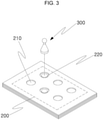
- FIG. 3 is a diagram illustrating a braille teaching material according to an embodiment of the present disclosure, specifically, an example in which a teaching tool is attached to a dot provided with a magnetic part in a page where a braille section is provided.
- FIG. 1 is a diagram illustrating a braille teaching material according to an embodiment of the present disclosure, specifically, an example in which an information section and a braille section are provided on one page.
- FIG. 2 is a diagram illustrating a braille teaching material according to an embodiment of the present disclosure, specifically
- FIG. 4 is a diagram illustrating an example in which a start part and an end part are added to the example of FIG. 2 .
- FIG. 5 is a diagram illustrating an example in which a stroke order guidance section is added to the example of FIG. 4 .
- FIG. 6 is a diagram illustrating an example in which raised dots of braille of FIG. 5 are provided in a visual manner, in a tactile manner, or in a visual and tactile manner.
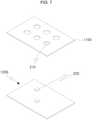
- FIG. 7 is a diagram illustrating an example in which a sheet where a braille section of a braille teaching material is provided is manufactured by stacking an outer layer and an inner layer, according to an embodiment of the present disclosure.
- FIG. 8 is a flowchart illustrating a method of manufacturing a braille teaching material according to an embodiment of the present disclosure.
- an braille teaching material includes an information section 100, a braille section 200, and a teaching tool 300.
- the information section 100 shows learning information, not braille, to be used for learning in a preset learning area.
- the learning information refers to information, such as a character (a letter, a number, a sign, or the like), an image, or the like, for braille learning.
- the information section 100 is provided on the left side of a page and is sections where the Korean letters " " and " " are shown.
- the information section 100 is provided on the left page among the opened pages of the braille teaching material and is a section where the Korean letter " " is shown.
- FIGS. 1 and 2 show that the information section 100 is provided on the left side with respect to the braille section 200 which will be described later, but the present disclosure is not limited thereto.
- the information section 100 may be embodied in various ways as being provided on the right side, the upper side, the lower side, and the like with respect to the braille section 200.
- the braille section 200 shows dots 210 corresponding to vertical dots and horizontal dots of braille in a preset braille area.
- the showing of the dots 210 corresponding to the vertical dots and horizontal dots of braille means that the dots 210 are shown in such a manner as to be distinguished from other parts, and also means that the dots 210 are distinguished in a visual and tactile manner. This is because the braille teaching material is for the visually impaired.
- the dots 210 in an engraved shape so as to be distinguished from other parts.
- a meaning part 220 may be formed to be distinguishable by the sense of the hand at a position of the dot 210.
- the meaning part 220 may be provided in various ways, for example, the meaning part 220 may form all dots 210 identical, or the may part 220 may form the dots 210 corresponding to the raised dots of braille showing information of the information section 100 to be distinguished from the other dots 210.
- the teaching tool 300 is seated or detachably attached to the dots 210 (see FIG. 3 ).
- the teaching tool 300 may be seated in the stepped concave inward of the dot 210 by gravity.
- the 'the teaching tool 300 is seated' means that the teaching tool 300 takes place, and once the teaching tool 300 is seated, it means that the seat can be moved only when an external force above a certain level is applied.
- the teaching tool 300 is formed in such a manner that the lower part of the teaching tool 300 formed in a structure (such as velcro) that is detachable to the dot 210, and the upper part of the teaching tool 300 is gripped by hand.
- a structure such as velcro
- the teaching tool 300 When the user holds the teaching tool 300 in the user's hand and moves the teaching tool 300 to pass between the dots 210, the teaching tool 300 may be attached to the dot 210 due to the detachable structure.
- the teaching tool 300 may be detachable only at a dot 210 corresponding to a raised dot of braille representing information shown in the information section 100.
- the teaching tool 300 is seated or detachably attached to the position of the dot 210 corresponding to the raised dot of braille, so that even those who have undeveloped fingertip sensitivity are able to learn the shape of braille.
- braille can be learned more quickly by learning the shape of braille using a teaching material with a large braille size and then learning while reducing the size.
- the information section 100 of the braille teaching material may be characterized in the information is provided in an uneven shape.
- the learning information shown in the information section 100 may be provided in an uneven shape.
- the learning information shown in the information section 100 may be provided in an uneven shape, such as an engraved shape, a raised shape, an embossed shape, or the like, which is distinguished by the touch of hand.
- the information section 100 is provided in an uneven shape, as an example, the present disclosure is not limited thereto.
- the information section 100 may be embodied in various ways as being provided only as a general image, as a combination of a general image and an uneven shape, and the like.
- the information section 100 of the braille teaching material may include an engraved part (not shown) in which the information is formed in an engraved shape, and a raised part (not shown) that corresponds to the shape of the engraved part (not shown) and is formed in such a manner as to be interlocked to the engraved part (not shown).
- the user is able to learn by touching the engraved part (not shown) and identifying the learning information in the engraved shape, and learn by touching the raised part (not shown) and identifying the learning information in the raised shape.
- the raised part (not shown) may be formed in such a manner as to be interlocked to the engraved part (not shown), but the forcible interlocking form is likely to be damaged due to the material characteristics of the teaching tool. Therefore, it is preferable that the raised part (not shown) is attached to the engraved part (not shown) using magnetic force.
- the raised part (not shown) is provided with a magnet
- the raised part(not shown) is made of a magnet, and so on.
- the information section 100 of the braille teaching material includes a stroke part 110 indicating a direction in which each stroke of the letter is written.
- the stroke part 110 is for informing how to write the strokes of the letter, and the direction of proceeding.
- the teacher who helps with learning may refer to the stroke part 110 to guide the learner.
- the stroke part 110 may be provided in an uneven shape.
- the stroke part 110 may serve as a guide so that the visually impaired person is able to identify in which direction the visually impaired person needs to touch and follow the letter.
- the stroke part 110 is formed in a raised shape
- the stroke part 110 may be formed in a raised shape, but the " "-shaped border surrounding the stroke part 110 or the entire learning information may be formed in a raised shape.
- FIG. 2 shows the stroke part 110 in a shape of broken line, but the present disclosure is not limited thereto.
- the stroke part 110 may be embodied in various ways, such as angle brackets (>), triangles ( ⁇ ), arrows ( ⁇ ), or the like.
- the information section 100 of the braille teaching material includes start parts 120 each indicating a point at which each stroke of the letter starts.
- the start part 120 is for informing where the stroke of the letter needs to start, and the point of the start.
- the teacher who helps with learning may refer to the start part 120 to guide the learner.
- the start part 120 may be provided in various ways, for example, numbers, letters, figures, images, or the like.
- the visually impaired person needs to pay attention around the letter with the fingers so as to identify the start and the end of the letter, and thus it takes time to identify the letter.
- the start part 120 may be provided in an uneven shape.
- the start part 120 enables the point at which the stroke of the letter starts to be identified quickly, and thus the time required to identify the letter is shortened.
- the information section 100 of the braille teaching material includes end parts 130 each indicating a point at which each stroke of the letter ends.
- the end part 130 is for information where the stroke of the letter needs to end, and the point of the end.
- the teacher who helps with learning may refer to the end part 130 to guide the learner.
- the end part 130 may be provided in various ways, for example, numbers, letters, figures, images, or the like.
- the visually impaired person needs to pay attention around the letter with the fingers so as to identify the start and the end of the letter, and thus it takes time to identify the letter.
- the end part 130 may be provided in an uneven shape.
- the end part 130 enables the point at which the stroke of the letter ends to be identified quickly, and thus the time required to identify the letter is shortened.
- both of the start part 120 and the end part 130 are provided.
- the braille teaching material may further include a stroke order guidance section 400 in a preset area of the opened pages of the braille teaching material.
- the stroke order guidance section 400 shows symbols that correspond to the start parts 120 and are arranged in the same order as the strokes of the letter are written.
- the stroke order guidance section 400 is for informing the stroke order of the letter.
- the teacher who helps with learning may refer to the stroke order guidance section 400 to guide the learner.
- the stroke order guidance section 400 is for the visually impaired person to learn the stroke order of the letter.
- the number of strokes of the letter is identified using the number of start parts 120 provided in the stroke order guidance section 400.
- the order in which the strokes need to be written is identified from the stroke order guidance section 400.
- the stroke order guidance section 400 may be provided in an uneven shape.
- the stroke order guidance section 400 is provided at the upper left position, but the stroke order guidance section 400 may be positioned anywhere without being limited thereto.
- the braille section 200 of the braille teaching material shows which dots 210 correspond to the raised dots of braille, in a visual manner, in a tactile manner, or in a visual and tactile manner.
- the dots 210 correspond to the raised dots may be embodied in various ways.
- the dots 210 may be provided in outline, an ambient portion of the dots 210 may be provided in color, or the dots 210 may be provided in color.
- the outline may be provided in an uneven shape, or the inside of the outline may be provided in an uneven shape.
- the braille section 200 of the braille teaching material may include a velcro at the positions of the dots 210.
- the velcro has a hook on one side and a velvet on the other, so that it can be attached and detached from each other.
- a hook is formed at the positions of the dots 210
- a velvet is formed to the teaching tool 300
- a hook is formed to the teaching tool 300.
- the velcro may be provided only at the positions of the dots 210 corresponding to the raised dots of braille that represent the information shown in the information section 100.
- the meaning part 220 may be formed of the velcro.
- the learner himself can also check by tactile sense what the dots 210 corresponds to the raised dots of braille.
- the raised dot of braille representing the Korean letter " " corresponds to only one dot 210 at the top right position
- the raised dots of braille representing the Korean letter " " correspond to only two dots 210 at the top left position and the top right position.
- the raised dots of braille representing the Korean letter " " correspond to only two dots 210 at the top right position and the middle left position.
- the braille section 200 is provided on the right side of one page, and is a section where the braille letter corresponding to the Korean letter " " and the braille letter corresponding to the Korean letter " " are shown.
- the braille section 200 is provided on the right page among the opened pages of the braille teaching material, and is a section where the braille letter corresponding to the Korean letter " " is shown.
- FIGS. 1 and 2 show that the braille section 200 is provided on the right side with respect to the information section 100, but the present disclosure is not limited thereto.
- the braille section 200 may be embodied in various ways as being provided on the left side, the upper side, the lower side, and the like with respect to the information section 100.
- the braille teaching material may be embodied in various ways.
- the information section 100 and the braille section 200 in a pair may be provided on one opened side (one page) (see FIG. 1 ), may be provided on both opened sides (two pages) (see FIG. 2 ), or may be provided on one sheet (the front page and the back page).
- the information section 100 and the braille section 200 in one pair refer to a pair configured to facilitate learning the braille letter corresponding to the learning information of the information section 100 (see FIGS. 1 and 2 ).
- the information section 100 and the braille section 200 in one pair are provided in a preset learning area and a preset braille area, respectively, of the opened pages of the braille teaching material.
- the braille teaching material may include an NFC tag (not shown) and an NFC reader (not shown).
- the NFC tag (not shown) is provided at a preset tag area, and stores information required for voice guiding the learning information.
- the NFC reader When the NFC reader (not shown) recognizes the NFC tag (not shown), the NFC reader outputs the learning information in a voice.
- NFC Near Field Communication
- the tag area is set to an edge portion of the teaching material (book).
- the NFC tag (not shown) is inserted into a page of the book.
- the NFC tag may be provided with a shielding film at a side that is opposite to a designated direction in which the NFC reader (not shown) recognizes the NFC tag, so that the NFC tag is not recognized by the NFC reader (not shown) in an undesired direction.
- the braille teaching material according to an embodiment of the present disclosure is composed of multiple sheets of paper and an NFC tag (not shown) is provided at each sheet, wrong information is prevented from being output due to the NFC tag (not shown) other than information required for the sheet.
- NFC reader (not shown) when the NFC reader (not shown) is placed close to a tag area at page 1, a NFC tag (not shown) at another page is not recognized by the NFC reader (not shown).
- a sheet provided with the dots 210 of the braille teaching material is formed by successively stacking an outer layer 1100 provided with the dots 210 in the form of holes, and an inner layer 1200 with a meaning part 220 formed to be distinguishable by the sense of the hand at a position of the dot 210.
- the meaning part 220 may be formed in the inner layer 1200 some or all of the meaning part 220 to be exposed to the outside.
- the sheet provided with the dots 210 of the braille teaching material according to an embodiment of the present disclosure may be bonded so that the outer layer 1100 and the inner layer 1200 are sequentially stacked.
- the dots 210 of the braille teaching material when the outer layer 1100 and the inner layer 1200 are sequentially stacked, it is preferable that the dots 210 are formed to be exposed to the outside.
- being exposed to the outside means that you can touch it with your hand. That is, it may be recessed or protruded.
- a method of manufacturing a braille teaching material includes an outer layer punching step S10, and a sheet manufacturing step S20.
- the dots 210 in the outer layer 1100 are punched.
- the dots 210 in the outer layer 1100 are punched as shown in FIG. 7 .
- six dots 210 per braille letter are punched.
- a punch processing may be used.
- the punch processing is processing for acquiring a product by performing punch processing on the basic material, and refers to processing in which after a hole in the basic material is made using a punch, the remaining basic material is a product.
- the punch processing is the opposite concept of blank processing.
- the outer layer 1100 and the inner layer 1200, or the outer layer 1100, the inner layer 1200, and the outer layer 1100 are stacked in order and bonded, so that a sheep provided with the dots 210 is manufactured.
- the sheet manufacturing step S20 is performed as follows.
- the sheet provided the dots 210 is manufactured by bonding the outer layer 1100 and the inner layer 1200, or by bonding the inner layer 1200 and the outer layer 1100 in that order.
- the sheet provided with the dots 210 is manufactured by stacking the outer layer 1100, the inner layer 1200, and the outer layer 1100 in order and bonding the layers.
- the method of manufacturing a braille teaching material according to an embodiment of the present disclosure may be characterized in that the sheet provided with the dots 210 is formed using an adhesive sheet.
- the adhesive sheet may be first adhered to the outer layer 1100, the inner layer 1200, or the outer layer 1100 and the inner layer 1200, and then laminated and bonded.
- the adhesive sheet only to the outer layer 1100. If the adhesive sheet is attached to the outer layer 1100 and then punch processing is performed, the adhesive sheet can be neatly adhered without being exposed to the outside.
Landscapes
- Engineering & Computer Science (AREA)
- Business, Economics & Management (AREA)
- Educational Administration (AREA)
- Physics & Mathematics (AREA)
- Educational Technology (AREA)
- General Physics & Mathematics (AREA)
- Theoretical Computer Science (AREA)
- General Health & Medical Sciences (AREA)
- Audiology, Speech & Language Pathology (AREA)
- Health & Medical Sciences (AREA)
- Entrepreneurship & Innovation (AREA)
- Printing Methods (AREA)
- Electrically Operated Instructional Devices (AREA)
Applications Claiming Priority (1)
| Application Number | Priority Date | Filing Date | Title |
|---|---|---|---|
| KR1020200100072A KR102237587B1 (ko) | 2020-08-10 | 2020-08-10 | 점자교육교재 및 그 제조 방법 |
Publications (1)
| Publication Number | Publication Date |
|---|---|
| EP3955233A1 true EP3955233A1 (fr) | 2022-02-16 |
Family
ID=73013242
Family Applications (1)
| Application Number | Title | Priority Date | Filing Date |
|---|---|---|---|
| EP20203333.8A Pending EP3955233A1 (fr) | 2020-08-10 | 2020-10-22 | Matériel d'enseignement du braille et son procédé de fabrication |
Country Status (4)
| Country | Link |
|---|---|
| US (1) | US11727825B2 (fr) |
| EP (1) | EP3955233A1 (fr) |
| KR (1) | KR102237587B1 (fr) |
| WO (1) | WO2022034962A1 (fr) |
Cited By (1)
| Publication number | Priority date | Publication date | Assignee | Title |
|---|---|---|---|---|
| RU222770U1 (ru) * | 2023-11-09 | 2024-01-17 | Айтал Афанасьевич Винокуров | Устройство обучения азбуке по системе Брайля |
Families Citing this family (2)
| Publication number | Priority date | Publication date | Assignee | Title |
|---|---|---|---|---|
| US11640769B2 (en) * | 2020-05-29 | 2023-05-02 | Abenezer Ayana | Modular refreshable braille display system |
| KR102541023B1 (ko) * | 2021-10-22 | 2023-06-05 | 유가희 | 시각장애인을 위한 한글 카드 |
Citations (5)
| Publication number | Priority date | Publication date | Assignee | Title |
|---|---|---|---|---|
| US2456155A (en) * | 1944-11-15 | 1948-12-14 | Emily C Seaman | Device for teaching the blind |
| US3869813A (en) * | 1973-10-10 | 1975-03-11 | Raymond E Hancy | Teaching device for forming intelligence characters |
| US20030099920A1 (en) * | 2001-11-26 | 2003-05-29 | Ann Edwards | Method and device for multi-sensory learning book |
| KR100849449B1 (ko) | 2007-03-05 | 2008-07-30 | 배화여자대학 산학협력단 | 점자 그림책 및 이를 포함하는 유아용 학습자료 세트 |
| WO2009086308A1 (fr) * | 2007-12-21 | 2009-07-09 | Booksync, Llc | Procédé et appareil pour intégrer de l'audio et/ou de la vidéo avec un livre |
Family Cites Families (18)
| Publication number | Priority date | Publication date | Assignee | Title |
|---|---|---|---|---|
| US2371325A (en) * | 1941-03-31 | 1945-03-13 | Eric S Wessborg | Braille teaching device |
| US3895804A (en) * | 1973-03-12 | 1975-07-22 | Elizabeth Anna Lee | Game apparatus |
| GB1540799A (en) | 1977-06-10 | 1979-02-14 | Hsing Ching Liu | Educational toy |
| US4425095A (en) * | 1981-12-07 | 1984-01-10 | Henry Morris | Tactile writing aid |
| US5161975A (en) * | 1991-08-28 | 1992-11-10 | Andrews Mark D | Braille teaching apparatus |
| US5558520A (en) * | 1994-08-23 | 1996-09-24 | Werzberger; Bernice F. | Interactive book assembly |
| US5720616A (en) * | 1996-12-23 | 1998-02-24 | Schuler, Iii; George | Braille sign and method of manufacture |
| JPH11157201A (ja) * | 1997-11-29 | 1999-06-15 | Miyaki Choukokusho:Kk | 点字印刷版 |
| KR100491108B1 (ko) * | 2004-04-27 | 2005-05-24 | 이금경 | 입체형 글씨체가 각인된 글씨 쓰기 연습용 교재 |
| KR20090000338U (ko) | 2007-07-09 | 2009-01-14 | 정진복 | 문자의 형태를 표시한 점자스티커 |
| JP4147494B1 (ja) | 2007-09-20 | 2008-09-10 | 有限会社小堀加工所 | 立体合成樹脂容器 |
| JP3143306U (ja) * | 2008-05-07 | 2008-07-17 | 小栗 睦津世 | 点字学習ブロック |
| KR20160113760A (ko) | 2015-03-23 | 2016-10-04 | 강다건 | 시각장애 아동용 그림책 제조 방법 및 시스템과 이를 이용한 촉각교구 |
| KR101650099B1 (ko) * | 2015-07-23 | 2016-08-23 | 린츠 주식회사 | 시각장애인용 착용형 햅틱 패턴 디스플레이 장치 |
| KR20170051831A (ko) | 2015-11-02 | 2017-05-12 | 한국미래과학기술 주식회사 | 스토리텔링과 촉감을 활용한 학습교구 세트 |
| KR101894006B1 (ko) * | 2016-04-20 | 2018-08-31 | 주식회사 오파테크 | 스마트 점자 학습장치 및 이를 이용한 점자 학습방법 |
| US10861347B2 (en) * | 2017-01-06 | 2020-12-08 | Alex B. Tavares | Device and method for teaching phonics using a touch detecting interface |
| US20210142694A1 (en) * | 2019-11-11 | 2021-05-13 | ObjectiveEd, Inc. | System and method for teaching braille literacy |
-
2020
- 2020-08-10 KR KR1020200100072A patent/KR102237587B1/ko active Active
- 2020-09-17 WO PCT/KR2020/012573 patent/WO2022034962A1/fr not_active Ceased
- 2020-10-02 US US17/062,013 patent/US11727825B2/en active Active
- 2020-10-22 EP EP20203333.8A patent/EP3955233A1/fr active Pending
Patent Citations (5)
| Publication number | Priority date | Publication date | Assignee | Title |
|---|---|---|---|---|
| US2456155A (en) * | 1944-11-15 | 1948-12-14 | Emily C Seaman | Device for teaching the blind |
| US3869813A (en) * | 1973-10-10 | 1975-03-11 | Raymond E Hancy | Teaching device for forming intelligence characters |
| US20030099920A1 (en) * | 2001-11-26 | 2003-05-29 | Ann Edwards | Method and device for multi-sensory learning book |
| KR100849449B1 (ko) | 2007-03-05 | 2008-07-30 | 배화여자대학 산학협력단 | 점자 그림책 및 이를 포함하는 유아용 학습자료 세트 |
| WO2009086308A1 (fr) * | 2007-12-21 | 2009-07-09 | Booksync, Llc | Procédé et appareil pour intégrer de l'audio et/ou de la vidéo avec un livre |
Cited By (1)
| Publication number | Priority date | Publication date | Assignee | Title |
|---|---|---|---|---|
| RU222770U1 (ru) * | 2023-11-09 | 2024-01-17 | Айтал Афанасьевич Винокуров | Устройство обучения азбуке по системе Брайля |
Also Published As
| Publication number | Publication date |
|---|---|
| WO2022034962A1 (fr) | 2022-02-17 |
| US20220044591A1 (en) | 2022-02-10 |
| US11727825B2 (en) | 2023-08-15 |
| KR102237587B1 (ko) | 2021-04-07 |
Similar Documents
| Publication | Publication Date | Title |
|---|---|---|
| US7993139B2 (en) | Teaching aid and method of teaching a learner writing skills | |
| US4770635A (en) | Portable viewer | |
| US8562024B2 (en) | Number writing development guide | |
| US11727825B2 (en) | Braille teaching material and method of manufacturing same | |
| EP3955232B1 (fr) | Matériel d'enseignement du braille et son procédé de fabrication | |
| US5782640A (en) | Language translation note pad | |
| AU2020463301B2 (en) | Braille educational material and manufacturing method therefor | |
| KR20170051831A (ko) | 스토리텔링과 촉감을 활용한 학습교구 세트 | |
| CN104916169A (zh) | 卡片式德语学习工具 | |
| EP0556530A1 (fr) | Technique de fabrication de feuilles sur lesquelles sont imprimés et entaillés des lettres, mots, chiffres ou dessins, et méthode d'apprentissage d'écrire et de dessiner | |
| Roux | Multireligious Education‐An Option for South Africa in the New Education System | |
| CN108268914A (zh) | 基于纸质手写时个人信息与作业本信息的收集方法及装置 | |
| JP4562924B2 (ja) | 解答付き問題用紙 | |
| JP6570163B1 (ja) | 国語学習用カード | |
| Wells-Jensen | The Braille International Phonetic Alphabet and other options: The blind student in the phonetics classroom | |
| Clark | The Math Guidebook For Educators: Exploring Multiple Ways Students Interact With Math | |
| JP2024091971A (ja) | 申請用シート | |
| Kway et al. | THE USAGE OF A-J+ 3+ 6 METHOD IN BRAILLE WRITING WITH SLATE AND STYLUS | |
| JP2003034093A (ja) | 複数方向印刷物。 | |
| Paplinska | How to teach blind children reading of tactile drawings–needs of students and teacher approaches | |
| GG | Exchange film, record), abilty level needed to use the materlals, special characterlstics (brallle, color-keyed, programed material). Thus you can organize your files uslng those terms which best meet your particular needs and cross index under the remalnlng terms. | |
| JP2000330465A (ja) | 点字シート | |
| TWM381859U (en) | Teaching aids for teaching phonetic symbols | |
| WO2006135257A1 (fr) | Aide à l’apprentissage de la reconnaissance de caractères alphanumériques | |
| JPH03168791A (ja) | 課題教習装置 |
Legal Events
| Date | Code | Title | Description |
|---|---|---|---|
| PUAI | Public reference made under article 153(3) epc to a published international application that has entered the european phase |
Free format text: ORIGINAL CODE: 0009012 |
|
| STAA | Information on the status of an ep patent application or granted ep patent |
Free format text: STATUS: REQUEST FOR EXAMINATION WAS MADE |
|
| 17P | Request for examination filed |
Effective date: 20201022 |
|
| AK | Designated contracting states |
Kind code of ref document: A1 Designated state(s): AL AT BE BG CH CY CZ DE DK EE ES FI FR GB GR HR HU IE IS IT LI LT LU LV MC MK MT NL NO PL PT RO RS SE SI SK SM TR |
|
| STAA | Information on the status of an ep patent application or granted ep patent |
Free format text: STATUS: EXAMINATION IS IN PROGRESS |
|
| 17Q | First examination report despatched |
Effective date: 20240221 |
|
| GRAP | Despatch of communication of intention to grant a patent |
Free format text: ORIGINAL CODE: EPIDOSNIGR1 |
|
| STAA | Information on the status of an ep patent application or granted ep patent |
Free format text: STATUS: GRANT OF PATENT IS INTENDED |
|
| INTG | Intention to grant announced |
Effective date: 20251118 |