EP3955584B1 - Système de média numérique - Google Patents
Système de média numérique Download PDFInfo
- Publication number
- EP3955584B1 EP3955584B1 EP21198834.0A EP21198834A EP3955584B1 EP 3955584 B1 EP3955584 B1 EP 3955584B1 EP 21198834 A EP21198834 A EP 21198834A EP 3955584 B1 EP3955584 B1 EP 3955584B1
- Authority
- EP
- European Patent Office
- Prior art keywords
- scene
- machine
- viewing direction
- video files
- digital media
- Prior art date
- Legal status (The legal status is an assumption and is not a legal conclusion. Google has not performed a legal analysis and makes no representation as to the accuracy of the status listed.)
- Active
Links
Images







Classifications
-
- H—ELECTRICITY
- H04—ELECTRIC COMMUNICATION TECHNIQUE
- H04N—PICTORIAL COMMUNICATION, e.g. TELEVISION
- H04N21/00—Selective content distribution, e.g. interactive television or video on demand [VOD]
- H04N21/40—Client devices specifically adapted for the reception of or interaction with content, e.g. set-top-box [STB]; Operations thereof
- H04N21/45—Management operations performed by the client for facilitating the reception of or the interaction with the content or administrating data related to the end-user or to the client device itself, e.g. learning user preferences for recommending movies, resolving scheduling conflicts
- H04N21/466—Learning process for intelligent management, e.g. learning user preferences for recommending movies
- H04N21/4668—Learning process for intelligent management, e.g. learning user preferences for recommending movies for recommending content, e.g. movies
-
- G—PHYSICS
- G02—OPTICS
- G02B—OPTICAL ELEMENTS, SYSTEMS OR APPARATUS
- G02B27/00—Optical systems or apparatus not provided for by any of the groups G02B1/00 - G02B26/00, G02B30/00
- G02B27/01—Head-up displays
- G02B27/017—Head mounted
-
- G—PHYSICS
- G06—COMPUTING OR CALCULATING; COUNTING
- G06F—ELECTRIC DIGITAL DATA PROCESSING
- G06F3/00—Input arrangements for transferring data to be processed into a form capable of being handled by the computer; Output arrangements for transferring data from processing unit to output unit, e.g. interface arrangements
- G06F3/01—Input arrangements or combined input and output arrangements for interaction between user and computer
- G06F3/011—Arrangements for interaction with the human body, e.g. for user immersion in virtual reality
-
- H—ELECTRICITY
- H04—ELECTRIC COMMUNICATION TECHNIQUE
- H04N—PICTORIAL COMMUNICATION, e.g. TELEVISION
- H04N21/00—Selective content distribution, e.g. interactive television or video on demand [VOD]
- H04N21/20—Servers specifically adapted for the distribution of content, e.g. VOD servers; Operations thereof
- H04N21/21—Server components or server architectures
- H04N21/218—Source of audio or video content, e.g. local disk arrays
- H04N21/21805—Source of audio or video content, e.g. local disk arrays enabling multiple viewpoints, e.g. using a plurality of cameras
-
- H—ELECTRICITY
- H04—ELECTRIC COMMUNICATION TECHNIQUE
- H04N—PICTORIAL COMMUNICATION, e.g. TELEVISION
- H04N21/00—Selective content distribution, e.g. interactive television or video on demand [VOD]
- H04N21/20—Servers specifically adapted for the distribution of content, e.g. VOD servers; Operations thereof
- H04N21/23—Processing of content or additional data; Elementary server operations; Server middleware
- H04N21/24—Monitoring of processes or resources, e.g. monitoring of server load, available bandwidth, upstream requests
- H04N21/2408—Monitoring of the upstream path of the transmission network, e.g. client requests
-
- H—ELECTRICITY
- H04—ELECTRIC COMMUNICATION TECHNIQUE
- H04N—PICTORIAL COMMUNICATION, e.g. TELEVISION
- H04N21/00—Selective content distribution, e.g. interactive television or video on demand [VOD]
- H04N21/20—Servers specifically adapted for the distribution of content, e.g. VOD servers; Operations thereof
- H04N21/25—Management operations performed by the server for facilitating the content distribution or administrating data related to end-users or client devices, e.g. end-user or client device authentication, learning user preferences for recommending movies
- H04N21/262—Content or additional data distribution scheduling, e.g. sending additional data at off-peak times, updating software modules, calculating the carousel transmission frequency, delaying a video stream transmission, generating play-lists
- H04N21/26208—Content or additional data distribution scheduling, e.g. sending additional data at off-peak times, updating software modules, calculating the carousel transmission frequency, delaying a video stream transmission, generating play-lists the scheduling operation being performed under constraints
- H04N21/26241—Content or additional data distribution scheduling, e.g. sending additional data at off-peak times, updating software modules, calculating the carousel transmission frequency, delaying a video stream transmission, generating play-lists the scheduling operation being performed under constraints involving the time of distribution, e.g. the best time of the day for inserting an advertisement or airing a children programme
-
- H—ELECTRICITY
- H04—ELECTRIC COMMUNICATION TECHNIQUE
- H04N—PICTORIAL COMMUNICATION, e.g. TELEVISION
- H04N21/00—Selective content distribution, e.g. interactive television or video on demand [VOD]
- H04N21/20—Servers specifically adapted for the distribution of content, e.g. VOD servers; Operations thereof
- H04N21/25—Management operations performed by the server for facilitating the content distribution or administrating data related to end-users or client devices, e.g. end-user or client device authentication, learning user preferences for recommending movies
- H04N21/266—Channel or content management, e.g. generation and management of keys and entitlement messages in a conditional access system, merging a VOD unicast channel into a multicast channel
- H04N21/2662—Controlling the complexity of the video stream, e.g. by scaling the resolution or bitrate of the video stream based on the client capabilities
-
- H—ELECTRICITY
- H04—ELECTRIC COMMUNICATION TECHNIQUE
- H04N—PICTORIAL COMMUNICATION, e.g. TELEVISION
- H04N21/00—Selective content distribution, e.g. interactive television or video on demand [VOD]
- H04N21/20—Servers specifically adapted for the distribution of content, e.g. VOD servers; Operations thereof
- H04N21/27—Server based end-user applications
- H04N21/274—Storing end-user multimedia data in response to end-user request, e.g. network recorder
-
- H—ELECTRICITY
- H04—ELECTRIC COMMUNICATION TECHNIQUE
- H04N—PICTORIAL COMMUNICATION, e.g. TELEVISION
- H04N21/00—Selective content distribution, e.g. interactive television or video on demand [VOD]
- H04N21/40—Client devices specifically adapted for the reception of or interaction with content, e.g. set-top-box [STB]; Operations thereof
- H04N21/43—Processing of content or additional data, e.g. demultiplexing additional data from a digital video stream; Elementary client operations, e.g. monitoring of home network or synchronising decoder's clock; Client middleware
- H04N21/431—Generation of visual interfaces for content selection or interaction; Content or additional data rendering
- H04N21/4312—Generation of visual interfaces for content selection or interaction; Content or additional data rendering involving specific graphical features, e.g. screen layout, special fonts or colors, blinking icons, highlights or animations
- H04N21/4316—Generation of visual interfaces for content selection or interaction; Content or additional data rendering involving specific graphical features, e.g. screen layout, special fonts or colors, blinking icons, highlights or animations for displaying supplemental content in a region of the screen, e.g. an advertisement in a separate window
-
- H—ELECTRICITY
- H04—ELECTRIC COMMUNICATION TECHNIQUE
- H04N—PICTORIAL COMMUNICATION, e.g. TELEVISION
- H04N21/00—Selective content distribution, e.g. interactive television or video on demand [VOD]
- H04N21/40—Client devices specifically adapted for the reception of or interaction with content, e.g. set-top-box [STB]; Operations thereof
- H04N21/43—Processing of content or additional data, e.g. demultiplexing additional data from a digital video stream; Elementary client operations, e.g. monitoring of home network or synchronising decoder's clock; Client middleware
- H04N21/44—Processing of video elementary streams, e.g. splicing a video clip retrieved from local storage with an incoming video stream or rendering scenes according to encoded video stream scene graphs
- H04N21/4402—Processing of video elementary streams, e.g. splicing a video clip retrieved from local storage with an incoming video stream or rendering scenes according to encoded video stream scene graphs involving reformatting operations of video signals for household redistribution, storage or real-time display
- H04N21/440245—Processing of video elementary streams, e.g. splicing a video clip retrieved from local storage with an incoming video stream or rendering scenes according to encoded video stream scene graphs involving reformatting operations of video signals for household redistribution, storage or real-time display the reformatting operation being performed only on part of the stream, e.g. a region of the image or a time segment
-
- H—ELECTRICITY
- H04—ELECTRIC COMMUNICATION TECHNIQUE
- H04N—PICTORIAL COMMUNICATION, e.g. TELEVISION
- H04N21/00—Selective content distribution, e.g. interactive television or video on demand [VOD]
- H04N21/40—Client devices specifically adapted for the reception of or interaction with content, e.g. set-top-box [STB]; Operations thereof
- H04N21/43—Processing of content or additional data, e.g. demultiplexing additional data from a digital video stream; Elementary client operations, e.g. monitoring of home network or synchronising decoder's clock; Client middleware
- H04N21/44—Processing of video elementary streams, e.g. splicing a video clip retrieved from local storage with an incoming video stream or rendering scenes according to encoded video stream scene graphs
- H04N21/4402—Processing of video elementary streams, e.g. splicing a video clip retrieved from local storage with an incoming video stream or rendering scenes according to encoded video stream scene graphs involving reformatting operations of video signals for household redistribution, storage or real-time display
- H04N21/440263—Processing of video elementary streams, e.g. splicing a video clip retrieved from local storage with an incoming video stream or rendering scenes according to encoded video stream scene graphs involving reformatting operations of video signals for household redistribution, storage or real-time display by altering the spatial resolution, e.g. for displaying on a connected PDA
-
- H—ELECTRICITY
- H04—ELECTRIC COMMUNICATION TECHNIQUE
- H04N—PICTORIAL COMMUNICATION, e.g. TELEVISION
- H04N21/00—Selective content distribution, e.g. interactive television or video on demand [VOD]
- H04N21/40—Client devices specifically adapted for the reception of or interaction with content, e.g. set-top-box [STB]; Operations thereof
- H04N21/45—Management operations performed by the client for facilitating the reception of or the interaction with the content or administrating data related to the end-user or to the client device itself, e.g. learning user preferences for recommending movies, resolving scheduling conflicts
- H04N21/4508—Management of client data or end-user data
- H04N21/4532—Management of client data or end-user data involving end-user characteristics, e.g. viewer profile, preferences
-
- H—ELECTRICITY
- H04—ELECTRIC COMMUNICATION TECHNIQUE
- H04N—PICTORIAL COMMUNICATION, e.g. TELEVISION
- H04N21/00—Selective content distribution, e.g. interactive television or video on demand [VOD]
- H04N21/40—Client devices specifically adapted for the reception of or interaction with content, e.g. set-top-box [STB]; Operations thereof
- H04N21/45—Management operations performed by the client for facilitating the reception of or the interaction with the content or administrating data related to the end-user or to the client device itself, e.g. learning user preferences for recommending movies, resolving scheduling conflicts
- H04N21/466—Learning process for intelligent management, e.g. learning user preferences for recommending movies
- H04N21/4662—Learning process for intelligent management, e.g. learning user preferences for recommending movies characterized by learning algorithms
-
- H—ELECTRICITY
- H04—ELECTRIC COMMUNICATION TECHNIQUE
- H04N—PICTORIAL COMMUNICATION, e.g. TELEVISION
- H04N21/00—Selective content distribution, e.g. interactive television or video on demand [VOD]
- H04N21/40—Client devices specifically adapted for the reception of or interaction with content, e.g. set-top-box [STB]; Operations thereof
- H04N21/47—End-user applications
- H04N21/472—End-user interface for requesting content, additional data or services; End-user interface for interacting with content, e.g. for content reservation or setting reminders, for requesting event notification, for manipulating displayed content
- H04N21/4728—End-user interface for requesting content, additional data or services; End-user interface for interacting with content, e.g. for content reservation or setting reminders, for requesting event notification, for manipulating displayed content for selecting a Region Of Interest [ROI], e.g. for requesting a higher resolution version of a selected region
-
- H—ELECTRICITY
- H04—ELECTRIC COMMUNICATION TECHNIQUE
- H04N—PICTORIAL COMMUNICATION, e.g. TELEVISION
- H04N21/00—Selective content distribution, e.g. interactive television or video on demand [VOD]
- H04N21/40—Client devices specifically adapted for the reception of or interaction with content, e.g. set-top-box [STB]; Operations thereof
- H04N21/47—End-user applications
- H04N21/485—End-user interface for client configuration
- H04N21/4858—End-user interface for client configuration for modifying screen layout parameters, e.g. fonts, size of the windows
-
- H—ELECTRICITY
- H04—ELECTRIC COMMUNICATION TECHNIQUE
- H04N—PICTORIAL COMMUNICATION, e.g. TELEVISION
- H04N21/00—Selective content distribution, e.g. interactive television or video on demand [VOD]
- H04N21/80—Generation or processing of content or additional data by content creator independently of the distribution process; Content per se
- H04N21/81—Monomedia components thereof
- H04N21/816—Monomedia components thereof involving special video data, e.g 3D video
-
- H—ELECTRICITY
- H04—ELECTRIC COMMUNICATION TECHNIQUE
- H04N—PICTORIAL COMMUNICATION, e.g. TELEVISION
- H04N5/00—Details of television systems
- H04N5/44—Receiver circuitry for the reception of television signals according to analogue transmission standards
- H04N5/445—Receiver circuitry for the reception of television signals according to analogue transmission standards for displaying additional information
- H04N5/45—Picture in picture, e.g. displaying simultaneously another television channel in a region of the screen
-
- G—PHYSICS
- G02—OPTICS
- G02B—OPTICAL ELEMENTS, SYSTEMS OR APPARATUS
- G02B27/00—Optical systems or apparatus not provided for by any of the groups G02B1/00 - G02B26/00, G02B30/00
- G02B27/01—Head-up displays
- G02B27/0101—Head-up displays characterised by optical features
- G02B2027/014—Head-up displays characterised by optical features comprising information/image processing systems
-
- H—ELECTRICITY
- H04—ELECTRIC COMMUNICATION TECHNIQUE
- H04N—PICTORIAL COMMUNICATION, e.g. TELEVISION
- H04N19/00—Methods or arrangements for coding, decoding, compressing or decompressing digital video signals
- H04N19/10—Methods or arrangements for coding, decoding, compressing or decompressing digital video signals using adaptive coding
- H04N19/134—Methods or arrangements for coding, decoding, compressing or decompressing digital video signals using adaptive coding characterised by the element, parameter or criterion affecting or controlling the adaptive coding
- H04N19/167—Position within a video image, e.g. region of interest [ROI]
-
- H—ELECTRICITY
- H04—ELECTRIC COMMUNICATION TECHNIQUE
- H04N—PICTORIAL COMMUNICATION, e.g. TELEVISION
- H04N19/00—Methods or arrangements for coding, decoding, compressing or decompressing digital video signals
- H04N19/10—Methods or arrangements for coding, decoding, compressing or decompressing digital video signals using adaptive coding
- H04N19/169—Methods or arrangements for coding, decoding, compressing or decompressing digital video signals using adaptive coding characterised by the coding unit, i.e. the structural portion or semantic portion of the video signal being the object or the subject of the adaptive coding
- H04N19/17—Methods or arrangements for coding, decoding, compressing or decompressing digital video signals using adaptive coding characterised by the coding unit, i.e. the structural portion or semantic portion of the video signal being the object or the subject of the adaptive coding the unit being an image region, e.g. an object
-
- H—ELECTRICITY
- H04—ELECTRIC COMMUNICATION TECHNIQUE
- H04N—PICTORIAL COMMUNICATION, e.g. TELEVISION
- H04N19/00—Methods or arrangements for coding, decoding, compressing or decompressing digital video signals
- H04N19/46—Embedding additional information in the video signal during the compression process
-
- H—ELECTRICITY
- H04—ELECTRIC COMMUNICATION TECHNIQUE
- H04N—PICTORIAL COMMUNICATION, e.g. TELEVISION
- H04N19/00—Methods or arrangements for coding, decoding, compressing or decompressing digital video signals
- H04N19/50—Methods or arrangements for coding, decoding, compressing or decompressing digital video signals using predictive coding
- H04N19/597—Methods or arrangements for coding, decoding, compressing or decompressing digital video signals using predictive coding specially adapted for multi-view video sequence encoding
Definitions
- the subject matter disclosed herein generally relates to the technical field of special-purpose machines that process digital media, including software-configured computerized variants of such special-purpose machines and improvements to such variants, and to the technologies by which such special-purpose machines become improved compared to other special-purpose machines that process digital media.
- a machine may be configured to interact with one or more users by streaming digital media content (e.g., a video file, an audio file, an image, text, or any suitable combination thereof) to one or more devices that correspond to the one or more users. For example, if a user causes his or her device to request the streaming of a particular piece of digital media content (e.g., a video file of a movie, a sports event, or a concert), the machine causes that piece of digital media content to be streamed to that user's device. This may be performed by the machine sending sequential portions (e.g., video frames) of the piece of digital media content to the device via a network, or otherwise causing a data repository to send sequential portions of the piece of digital media content to the device via a network.
- the machine may also interact with the user by receiving and responding to one or more playback commands (e.g., stop, pause, skip ahead, or skip back) communicated from the user's device while the piece of digital media content is being presented by that device.
- Document US 2012/0092348 A1 relates to an immersive movie viewing system for delivering an immersive movie to and playing on an observer's computer as a stream from a server.
- the system includes one or more View Tracks for guiding a user to a specific region of interest (ROI) within the movie.
- View tracks may also be used to control the mixing of the sound channels so as to emphasize or simulate the sound coming from a particular direction. If during a playback a sound is to come from a particular direction, a viewer facing this direction may hear more of the sound, whereas a viewer facing another direction would hear less.
- ROI region of interest
- an interactive multimedia transmission system for allowing a user to interact with transmitted digital content is described, in which audio channels are mixed according to a user view selection. If a user selects a view centered in the direction of a sound source, the audio signal from this sound source is more heavily weighted than audio signals from sound sources that are not centered in the direction of view.
- the volume of channels varies according to the view selection instructions, while maintaining a minimum volume based on a predetermined ambient constant.
- Document US 2018/0024724 A1 describes a social media platform for immersive media with databases for storing immersive videos and embedded affordances for the immersive videos. Audio information may be overlaid to the video in correspondence to what is displayed to the user.
- a digital media system is configured to support any one or more of multiple features with respect to virtual-reality content.
- features include directional picture-in-picture (PIP) windows based on viewing direction, directional audio based on viewing direction, user recommendations based on anomalous viewing times of certain visual features in video content, dynamic adjustment of time-to-live (TTL) durations prior to requesting deletion of video files uploaded to a content distribution network, dynamic adjustment of durations of video files to upload based on network capacity, dynamic adjustment of quantities of video files per set to upload based on network capacity, dynamic resizing of top-depicting or bottom-depicting regions within the picture areas of sets of video files, dynamic resizing of the picture areas themselves within sets of video files, or any suitable combination thereof.
- PIP picture-in-picture
- TTL time-to-live
- FIG. 1 is a network diagram illustrating a network environment 100 suitable for provision of the processing digital media, according to some example embodiments.
- the network environment 100 includes a digital media machine 110, a database 115, a content distribution network 120, and devices 130 and 150, all communicatively coupled to each other via a network 190.
- the digital media machine 110 with or without the database 115, may form all or part of a cloud 118 (e.g., a geographically distributed set of multiple machines configured to function as a single server), which may form all or part of a network-based system 105 (e.g., a cloud-based server system configured to provide one or more network-based services to the devices 130 and 150).
- a cloud 118 e.g., a geographically distributed set of multiple machines configured to function as a single server
- a network-based system 105 e.g., a cloud-based server system configured to provide one or more network-based services to the devices 130 and 150.
- the content distribution network 120 is part of the cloud 118, while in other example embodiments, the content distribution network 120 forms all or part of a third-party cloud distinct from the cloud 118 (e.g., within a third-party network-based system distinct from the network-based system 105).
- the digital media machine 110, the database 115, the content distribution network 120, and the devices 130 and 150 may each be implemented in one or more special-purpose (e.g., specialized) computer systems, in whole or in part, as described below with respect to FIG. 12 .
- users 132 and 152 are also shown in FIG. 1 .
- One or both of the users 132 and 152 may be a human user (e.g., a human being), a machine user (e.g., a computer configured by a software program to interact with the device 130 or 150), or any suitable combination thereof (e.g., a human assisted by a machine or a machine supervised by a human).
- the user 132 is associated with the device 130 and may be a user of the device 130 (e.g., a client device configured to present digital media, including virtual-reality content).
- the device 130 may be a desktop computer, a vehicle computer, a tablet computer, a navigational device, a portable media device, a smart phone, or a wearable device (e.g., a smart watch, smart glasses, smart clothing, or smart jewelry) belonging to the user 132.
- the user 152 is associated with the device 150 and may be a user of the device 150 (e.g., a client device configured to present digital media, including virtual-reality content).
- the device 150 may be a desktop computer, a vehicle computer, a tablet computer, a navigational device, a portable media device, a smart phone, or a wearable device (e.g., a smart watch, smart glasses, smart clothing, or smart jewelry) belonging to the user 152.
- a wearable device e.g., a smart watch, smart glasses, smart clothing, or smart jewelry
- any of the systems or machines (e.g., databases and devices) shown in FIG. 1 may be, include, or otherwise be implemented in a special-purpose (e.g., specialized or otherwise non-conventional and non-generic) computer that has been modified to perform one or more of the functions described herein for that system or machine (e.g., configured or programmed by special-purpose software, such as one or more software modules of a special-purpose application, operating system, firmware, middleware, or other software program).
- special-purpose software such as one or more software modules of a special-purpose application, operating system, firmware, middleware, or other software program.
- a special-purpose computer system able to implement any one or more of the methodologies described herein is discussed below with respect to FIG. 12 , and such a special-purpose computer may accordingly be a means for performing any one or more of the methodologies discussed herein.
- a special-purpose computer that has been specially modified (e.g., configured by special-purpose software) by the structures discussed herein to perform the functions discussed herein is technically improved compared to other special-purpose computers that lack the structures discussed herein or are otherwise unable to perform the functions discussed herein. Accordingly, a special-purpose machine configured according to the systems and methods discussed herein provides an improvement to the technology of similar special-purpose machines.
- a “database” is a data storage resource and may store data structured as a text file, a table, a spreadsheet, a relational database (e.g., an object-relational database), a triple store, a hierarchical data store, or any suitable combination thereof.
- a relational database e.g., an object-relational database
- a triple store e.g., a hierarchical data store, or any suitable combination thereof.
- any two or more of the systems or machines illustrated in FIG. 1 may be combined into a single system or machine, and the functions described herein for any single system or machine may be subdivided among multiple systems or machines.
- the network 190 may be any network that enables communication between or among systems, machines, databases, and devices (e.g., between the machine 110 and the device 130). Accordingly, the network 190 may be a wired network, a wireless network (e.g., a mobile or cellular network), or any suitable combination thereof. The network 190 may include one or more portions that constitute a private network, a public network (e.g., the Internet), or any suitable combination thereof.
- the network 190 may include one or more portions that incorporate a local area network (LAN), a wide area network (WAN), the Internet, a mobile telephone network (e.g., a cellular network), a wired telephone network (e.g., a plain old telephone service (POTS) network), a wireless data network (e.g., a WiFi network or WiMax network), or any suitable combination thereof. Any one or more portions of the network 190 may communicate information via a transmission medium.
- LAN local area network
- WAN wide area network
- the Internet a mobile telephone network
- POTS plain old telephone service
- POTS plain old telephone service
- WiFi Wireless Fidelity
- the digital media machine 110 provides data streaming services and manages streaming of virtual-reality content.
- the digital media machine 110 may find useful applications in entertainment (e.g., sports, concerts, or documentaries), education (e.g., academic, corporate, or professional training), industry (e.g., tourism or medicine), or any suitable combination thereof, including live or otherwise low-latency applications (e.g., news reporting or gaming).
- the digital media machine 110 may accordingly provide one or more data streams of virtual-reality content itself, cause one or more of such data streams to be provided by the content distribution network 120, or any suitable combination thereof.
- the virtual-reality content may be provided to one or more client devices, such as one or more of the devices 130 and 150 (e.g., a virtual-reality headset, a mobile device, or other device capable of displaying virtual-reality content).
- the digital media machine 110 is configured to support PIP, which may include supporting multiple instances of PIP (e.g., multiple PIP windows occurring within a single scene). Moreover, such multiple instances of PIP may each be displayed in a different video file among the set of concurrent video files (e.g., concurrent video files 200) representing a given scene. In this context, it is helpful to call the concurrent video files "scene video files.” Accordingly, the digital media machine 110 may access (e.g., receive, retrieve, obtain, or read) one or more supplemental video files to be inserted as one or more PIP windows 316, 326, and 336 into one or more of the scene video files. The accessing may be performed via download, via streaming video, or via any suitable combination thereof (e.g., from the content distribution network 120 or from a video server).
- PIP may include supporting multiple instances of PIP (e.g., multiple PIP windows occurring within a single scene). Moreover, such multiple instances of PIP may each be displayed in a different video file among the set of concurrent video files
- the same scene can be shown to, for example, three players assigned to scene video files corresponding to 0, 120, and 240 degrees respectively, relative to the front or forward direction of the scene, and their respective PIP windows can be inserted into all of the scene video files (e.g., all 9 of 9 scene video files).
- the PIP window for the player assigned to one direction e.g., 0 degrees
- all other scene video files also depict that player's PIP window but only in non-foveated regions with lower resolution.
- FIG. 5 is a flowchart illustrating operations of the digital media machine 110 or other suitably configured machine in performing the method 500 of providing a recommendation, according to some example embodiments. Operations in the method 500 may be performed using one or more processors (e.g., microprocessors or other hardware processors). As shown in FIG. 5 , the method 500 includes operations 510, 520, 530, 540, and 550.
- processors e.g., microprocessors or other hardware processors.
- the digital media machine 110 may also analyze a viewing preference profile of one user and determine a likelihood that the viewing preference profile actually combines the viewing preferences of multiple users.
- a single user account has a viewing preference profile that, within a threshold level of similarity, mathematically resembles a combination (e.g., summation, concatenation, or aggregation) of two or more viewing preference profiles (e.g., as determined by clustering the viewing preference profiles of many users)
- the digital media machine 110 and may determine that multiple users (e.g., users 132 and 152) are sharing the same user account (e.g., using the same user account to view their respectively preferred imagery at different times).
- the digital media machine 110 manages the streaming of an immersive scene to one or more client devices (e.g., the devices 130 and 150) and may respond to changes in view direction at each individual device (e.g., the device 130) by causing that device to receive the scene video file for that view direction from among the set of scene video files for the immersive scene.
- the digital media machine 110 may upload the set of scene video files to the content distribution network 120 to facilitate distribution of various individual scene video files, while still responding to requests from client devices by controlling which individual client device (e.g., the device 130) receives which individual scene video file from the content distribution network 120.
- the digital media machine 110 may dynamically adjust the duration of the scene video files, or sets thereof, and thus dynamically adjust the duration of the sequential segments of the immersive scene. This may be done based on (e.g., in response to) the detected network capacity (e.g., upload data rate or upload bandwidth) between the digital media machine 110 and the content distribution network 120.
- the detected network capacity e.g., upload data rate or upload bandwidth
- the digital media machine 110 may switch to uploading scene video files of dynamically adjusted shorter durations (e.g., 2-4 seconds each) in response to detecting that the network 190 is experiencing congestion (e.g., congestion worse than a threshold level, which may be represented by a measured upload data rate falling below a minimum upload data rate), and later switch back to uploading scene video files of dynamically adjusted longer durations (e.g., 4-6 seconds each) in response to detecting that the network 190 is no longer experiencing the previously detected congestion (e.g., congestion better than the threshold level, which may be represented by a measured upload data rate meeting or exceeding the minimum upload data rate).
- congestion e.g., congestion worse than a threshold level, which may be represented by a measured upload data rate falling below a minimum upload data rate
- dynamically adjusted longer durations e.g., 4-6 seconds each
- the digital media machine 110 prior to uploading the fourth of the segments 610, the digital media machine 110 detects that network congestion has reduced the upload data rate beyond a threshold level. In response, the digital media machine 110 subdivides the fourth and fifth segments among the segments 610 into sub-segments of non-default duration (e.g., 3 seconds long) and non-default file size (e.g., 0.35 megabytes), and the digital media machine 110 uploads the resulting sub-segments to the content distribution network 120, while the upload data rate is below the threshold level.
- non-default duration e.g., 3 seconds long
- non-default file size e.g. 0.35 megabytes
- the sixth, seventh, and eighth segments among the segments 610 have their default durations (e.g., 6 seconds long) and default file sizes (e.g., 0.7 megabytes), like the first, second, and third segments among the segments 610 of the immersive scene.
- the digital media machine 110 dynamically adjusts the size of each set of scene video files by dynamically adjusting the number of scene video files to be uploaded as part of each set. That is, the quantity of scene video files included in a given set can be dynamically adjusted in response to changes in upload data rate. This is another way that the digital media machine 110 can respond to fluctuations in network capacity (e.g., within the network 190) between the digital media machine 110 and the content distribution network 120.
- network capacity e.g., within the network 190
- the digital media machine 110 may switch to uploading fewer scene video files in each set of scene video files (e.g., 1-5 files per set) in response to detecting that the network 190s experiencing congestion (e.g., congestion worse the threshold level, which may be represented by a measured upload data rate falling below a minimum upload data rate), and later switch back to uploading more scene video files in each set of scene video files (e.g., a full set of 9-12 files) in response to detecting that the network 190 is no longer experiencing the previously detected congestion (e.g., congestion better than the threshold level, which may be represented by a measured upload data rate meeting or exceeding the minimum upload data rate).
- congestion e.g., congestion worse the threshold level, which may be represented by a measured upload data rate falling below a minimum upload data rate
- the network 190 may switch to uploading fewer scene video files in each set of scene video files (e.g., 1-5 files per set) in response to detecting that the network 190s experiencing congestion (e.g., congestion worse the
- the digital media machine 110 uploads fewer scene video files per set (e.g., 3 files per set), such that the uploading of each of these smaller sets is likely to be completed in such congested congestions prior to any of their scene video files becoming requested for streaming.
- the digital media machine 110 uploads more scene video files (e.g., 9 files per set, or 12 files per set), such that the uploading of each of these larger sets is likely to be completed prior to any of their scene video files becoming requested for streaming.
- FIG. 7 is a diagram illustrating how the digital media machine 110 dynamically adjusts numbers of video files per set to upload based on network capacity, according to some example embodiments.
- the immersive scene previously discussed with respect to FIG. 6 is subdivided into at least 8 segments 610.
- these segments 610 may all have a default duration (e.g., 6 seconds long), and a default file size (e.g., 0.7 megabytes), and the segments 610 may be stored by the digital media machine 110, the database 115, or any suitable combination thereof, in preparation to being uploaded to the content distribution network 120.
- the first, second, and third segments among the segments 610 are uploaded to the content distribution network 120. Accordingly, the first, second, and third segments among the segments 610 are uploaded as full-size sets of scene video files (e.g., 9 files per set, or 12 files per set).
- the digital media machine 110 prior to uploading the fourth segment among the segments 610, the digital media machine 110 detects that network congestion has reduced the upload data rate beyond a threshold level. In response, the digital media machine 110 reduces the number of scene video files to be uploaded in each of the fourth and fifth segments among the segments 610 (e.g., down to 1 file per set, or 3 files percent), and the digital media machine 110 that uploads the resulting reduced sets of scene video files while the upload data rate is below the threshold level.
- a user e.g., the user 132 who selects a viewing direction for which the corresponding scene video file has not been uploaded will be presented with only non-foveated content from a non-foveated region of one of the scene video files that have been uploaded to the content distribution network 120.
- the situation may be deemed by the user to be more desirable than viewing no content at all (e.g., as a result of pausing the presentation of content until the scene video file with the foveated content that corresponds to the selected viewing direction has been uploaded and becomes available for streaming.
- the digital media machine 110 may prioritize the inclusion of one or more scene video files in each set for each segment among the segments 610 of the immersive scene. Priority can be given to one or more selected scene video files that correspond to one or more special viewing directions (e.g., top priority for a zero degree (front) camera feed or a viewing direction whose foveated content depicts the main action in the immersive scene).
- a prioritized viewing direction which may shift with certain content. For example, in horseracing, the viewing direction with the scene video file whose foveated region depicts the lead horse in a race may change as the horse passes in front of the viewing position. Accordingly, during this period of network congestion, the digital media machine 110 may dynamically adjust which viewing directions are represented by the reduced number of scene video files included in each set for each segment among the segments 610 of the immersive scene.
- the network congestion becomes alleviated and no longer detectable by the digital media machine 110 during the uploading of the reduced sets of scene video files (e.g., during the uploading of the reduced set of scene video files for the fifth segment among the segments 610).
- the digital media machine 110 may detect that the upload data rate has risen above a threshold level (e.g., the previously used threshold level or an alternative threshold level for detecting an absence of network congestion).
- the digital media machine 110 ceases the reducing of the number of scene video files per set and resumes normal uploading.
- the sixth through eighth segments among the segments 610 are uploaded as full-size sets of scene video files (e.g., 9 files per set, or 12 files percent), like the first, second, and third segments among the segments 610 of the immersive scene.
- the digital media machine 110 performs dynamic management and control of the content distribution network 120, which may have the effect of optimizing or otherwise improving the usage of the content distribution network 120 by the digital media machine 110.
- the digital media machine 110 may delete previously uploaded segments of an immersive scene (e.g., uploaded scene video files) that are older than a dynamically adjustable threshold time since being uploaded to the content distribution network 120.
- the digital media machine 110 may adjust an internally stored time-to-live (TTL) value and cause uploaded scene video files to be deleted from the content distribution network 120 after expiration of a time span equal to or otherwise defined based on the TTL value. For example, if the digital media machine 110 has uploaded a six-second segment of the immersive scene to the content distribution network 120, the digital media machine 110 may set the TTL value to five seconds, and request deletion of all scene video files uploaded longer than five seconds ago. This process may be repeated for each segment of the immersive scene.
- TTL time-to-live
- the digital media machine 110 can manage the content distribution network 120 such that the content distribution network 120 only stores scene video files with a significant likelihood of being requested by a client device (e.g., the client device 130). This may provide cost savings in situations where the content distribution network 120 is managed by a third-party that charges fees for the hosting of files by the content distribution network 120.
- the digital media machine 110 can dynamically adjust the TTL value based on the dynamically adjusted length of the scene video files, which is discussed above.
- the TTL may be increased during periods of network congestion (e.g., in conjunction with the uploading of scene video files of shorter duration), since it may be preferable to provide a recently obsoleted scene video file (e.g., for a short duration) if its replacement subsequent scene video file is not yet fully uploaded due to the network congestion.
- the TTL may be decreased when the network congestion is no longer present (e.g., in conjunction with the uploading of scene video files of longer duration), to optimize the usage of storage capacity at the content distribution network 120. Accordingly, these two features operate together to efficiently manage network resources (e.g., the network 190 and the content distribution network 120) as network capacity may fluctuate.
- the digital media machine 110 may be configured to omit or implement (e.g., suspend or resume) such dynamic adjustment of the TTL value based on whether an immersive scene is to be repeated or otherwise made available for later viewing.
- one or more immersive scenes may be spooled for cyclically repeating playback (e.g., as online help, training materials, or a carousel of looping content), and these immersive scenes may be marked (e.g., within metadata of their constituent scene video files) such that the digital media machine 110 maintains a constant TTL value after uploading their constituents scene video files.
- each scene video file has its own corresponding TTL value
- the digital media machine 110 dynamically adjusts the TTL values of all scene video files that have not been marked or otherwise indicated as being spooled for cyclically repeating playback.
- one or more immersive scenes may be designated for on-demand playback (e.g., in a video-on-demand context), and such immersive scenes may be marked (e.g., within metadata of their scene video files) such that the digital media machine 110 sets a maximum TTL value or a null TTL value for each scene video file in these immersive scenes, which may have the effect of causing the content distribution network 122 never delete these scene video files and instead keep them ready for distribution at all times on an ongoing basis (e.g., indefinitely).
- FIG. 8 is a diagram illustrating how the digital media machine 110 dynamically adjusts a top-depicting region 810, a bottom-depicting region 820, or both, of a picture area, such as the picture area 312 (e.g., of the scene video file 310, as discussed above with respect to FIG. 3 ), according to some example embodiments.
- the top-depicting region 810, the bottom-depicting region 820, or both may be dynamically sized while maintaining the size of the picture area 312 constant or while also dynamically sizing the picture area 312 (e.g., as discussed below with respect to FIG. 9 ).
- the picture area 312 includes the top-depicting region 810, the bottom-depicting region 820, and a number of regions that each respectively correspond to a different azimuth angle (e.g., 9 regions centered or otherwise aimed at 0, 40, 80, 120, 160, 200, 240, 280, 320 degrees respectively) relative to the front or forward direction of the immersive scene.
- Each one of these regions may contain image data captured by a different camera (e.g., an upward-facing camera, a downward-facing camera, and cameras aimed at 0, 40, 80, 120, 160, 200, 240, 280, 320 degrees respectively, relative to the front or forward direction of the scene).
- the top-depicting region 810 may depict image information captured by an upward-facing camera (e.g., aimed at the sky or at a ceiling), and the bottom-depicting region 820 may depict image information captured by a downward-facing camera (e.g., aimed at the ground or at a floor).
- an upward-facing camera e.g., aimed at the sky or at a ceiling
- a downward-facing camera e.g., aimed at the ground or at a floor
- the picture area 312 is shown with default proportions for the top-depicting region 810 and the bottom-depicting region 820.
- the top-depicting region 810 and the bottom-depicting region 820 are balanced with respect to each other and have equal areas (e.g., an area ratio of 1:1) within the picture area 312.
- VR content be less interesting in the top-depicting region 810, the bottom-depicting region 820, or both, and these regions may be treated similarly to other non-foveated portions of the picture area 312 or even have lower resolution (e.g., using "2K" resolution at or near 2048 x 1080 pixels) than the other non-foveated portions (e.g., using "4K" resolution at or near 3840 x 2160 pixels) of the picture area 312.
- the digital media machine 110 are configured to dynamically adjust the sizes of the top-depicting region 810 and the bottom-depicting region 820 in response to video complexity, video importance, or both. Accordingly, as shown in the middle and bottom portions of FIG.
- the digital media machine 110 may allocate a larger percentage of the picture area 312 to the bottom-depicting region 820 (e.g., at the expense of the top-depicting region 810). This may result in the top-depicting region 810 and the bottom-depicting region 820 to have a top-to-bottom area ratio of, for example, 1:2, 1:3, or 2:5.
- the digital media machine 110 may allocate a larger percentage of the picture area 312 to the top-depicting region 810 (e.g., at the expense of the bottom-depicting region 820). This may result in the top-depicting region 810 and the bottom-depicting region 822 have a top-to-bottom area ratio of, for example, 2:1, 3:1, or 5:2.
- the digital media machine 110 may restore the top-depicting region 810 and the bottom-depicting region 820 to their default settings.
- FIG. 9 is a diagram illustrating how the digital media machine 110 dynamically adjusts the picture area 312 (e.g., of the scene video file 310), according to some example embodiments.
- the picture area 312 may be dynamically sized, with or without the above-described dynamic sizing of the top-depicting region 810, the bottom-depicting region 820, or any suitable combination thereof (e.g., as discussed above with respect to FIG. 8 ), and such dynamic sizing of the picture area 312 may be performed based on video complexity, network capacity, or both.
- the picture area 312 includes the top-depicting region 810, the bottom-depicting region 820, and a number of regions that each respectively correspond to a different azimuth angle (e.g., 9 regions centered or otherwise aimed at 0, 40, 80, 120, 160, 200, 240, 280, 320 degrees respectively) relative to the front or forward direction of the immersive scene.
- each one of these regions may contain image data captured by a different camera (e.g., an upward-facing camera, a downward-facing camera, and cameras aimed at 0, 40, 80, 120, 160, 200, 240, 280, 320 degrees respectively, relative to the front or forward direction of the scene).
- the top-depicting region 810 may depict image information captured by an upward-facing camera (e.g., aimed at the sky or at a ceiling), and the bottom-depicting region 820 may depict image information captured by a downward-facing camera (e.g., aimed at the ground or at a floor).
- an upward-facing camera e.g., aimed at the sky or at a ceiling
- a downward-facing camera e.g., aimed at the ground or at a floor
- the picture area 312 is again shown with default proportions for the top-depicting region 810 and the bottom-depicting region 820.
- the top-depicting region 810 and the bottom-depicting region 820 are balanced with respect to each other and have equal areas (e.g., an area ratio of 1:1) within the picture area 312.
- these regions may be treated similarly to other non-foveated portions of the picture area 312 or even have lower resolution (e.g., using "2K” resolution at or near 2048 x 1080 pixels) than the other non-foveated portions (e.g., using "4K” resolution at or near 3840 x 2160 pixels) of the picture area 312.
- the digital media machine 110 are configured to dynamically adjust the size of the picture area 312, such that the sizes of the top-depicting region 810 and the bottom-depicting region 820 have a wider range for their dynamic adjustment (e.g., as described above with respect to FIG. 8 or as described presently with respect to FIG. 9 ). Accordingly, as shown in the middle and bottom portions of FIG.
- the digital media machine 110 may expand the picture area 312 (e.g., vertically), while also expanding one or both of the top-depicting region 810 and the bottom-depicting region 820.
- the middle portion of FIG. 9 illustrates vertical resizing of the picture area 312 to accommodate vertical resizing of one or both of the top-depicting region 810 and the bottom-depicting region 820.
- the bottom portion of FIG. 9 illustrates vertical resizing of the picture area 312 to accommodate horizontal resizing of one or both of the top-depicting region 810 and the bottom-depicting region 820.
- such vertical expansion of the picture area 312 has the effect of doubling the vertical size of one or both of the top-depicting region 810 and the bottom-depicting region 820.
- the digital media machine 110 may shrink the picture area 312 (e.g., vertically), also shrinking one or both of the top-depicting region 810 and the bottom-depicting region 820. This may result in the picture area 312 being restored to the state shown in the top portion of FIG. 9 .
- such vertical shrinking of the picture area 312 has the effect of having the vertical size of one or both of the top-depicting region 810 and the bottom-depicting region 820.
- one or more of the methodologies described herein may facilitate provision of any one or more of multiple features described herein with respect to virtual-reality content.
- such features include directional PIP windows based on viewing direction, directional audio based on viewing direction, user recommendations based on anomalous viewing times of certain visual features in video content, dynamic adjustment of TTL durations prior to requesting deletion of video files uploaded to a content distribution network, dynamic adjustment of durations of video files to upload based on network capacity, dynamic adjustment of quantities of video files per set to upload based on network capacity, dynamic resizing of top-depicting or bottom-depicting regions within the picture areas of sets of video files, dynamic resizing of the picture areas themselves within sets of video files, or any suitable combination thereof.
- one or more of the methodologies described herein may facilitate improved user experiences with the virtual-reality content, as well as improved use of hardware resources that deliver such improved user experiences, compared to capabilities of pre-existing systems and methods.
- FIG. 10 is a diagram illustrating concurrent PIP windows from a single immersive scene, including a selected primary PIP window and multiple available secondary PIP windows, being displayed together on a client device (e.g., a display screen, as illustrated, a smartphone, or a smart television) configured to concurrently present the primary and secondary PIP windows, according to some example embodiments.
- a single immersive scene is represented by at least four scene video files 1010, 1020, 1030, and 1040 that all depict the same time span of content, collectively similar to the concurrent video files 200 discussed above.
- Each individual scene video file (e.g., scene video file 1010, 1020, 1030, or 1040) contains a different foveated region that is aligned with a different corresponding angle of azimuth relative to the viewer's position (e.g., relative to the front or forward direction of the scene).
- the scene video file 1010 has a picture area 1012 that includes a foveated region 1014;
- the scene video file 1020 has a picture area 1022 that includes a foveated region 1024;
- the scene video file 1030 has a picture area 1032 that includes a foveated region 1034;
- the scene video file 1040 has a picture area 1042 that includes a foveated region 1044.
- each scene video file's foveated region contains a different PIP window.
- the foveated region 1014 of the picture area 1012 includes a PIP window 1016;
- the foveated region 1024 of the picture area 1022 includes a PIP window 1026;
- the foveated region 1034 of the picture area 132 includes a PIP window 1036;
- the foveated region 1044 of the picture area 1042 includes a PIP window 1046.
- These PIP windows 1016, 1026, 1036, and 1046 are respectively assigned to different regions of the display screen and concurrently (e.g., simultaneously) displayed together on the display screen. As shown in FIG.
- the PIP window 1016 has been selected (e.g., manually by a viewer or automatically by machine) as a primary PIP window for prominent display in the largest region of the display screen, while the other PIP windows 1026, 1036, and 1046 are secondary PIP windows allocated to the three smaller regions of the display screen for less prominent display to indicate their availability for selection as the primary PIP window.
- the primary PIP window is selected automatically by a machine (e.g., by the digital media machine 110, the display screen, or both).
- the machine may execute or otherwise operate an artificial intelligence engine configured to perform recognition of one or more visual patterns in the supplemental video files of the PIP windows 1016, 1026, 1036, and 1046, and then select the primary PIP window based on such visual pattern recognition.
- the artificial intelligence engine may recognize when a scoring event (e.g., a touchdown or a field goal) has a heightened likelihood of occurrence.
- This may include detecting that a scrimmage line marker or a first-down marker depicted in one of the supplemental video files has moved inside a team's own 20-yard line (e.g., by using optical character recognition to detect the n-gram "20" and using visual pattern recognition to detect a triangular disambiguation symbol and the relevant marker). Based on this detection, the machine may automatically select the corresponding PIP window displaying the corresponding supplemental video file as the primary PIP window. This may have the effect of dynamically choosing which one of the four supplemental video files will be presented in the largest region of the display screen.
- the artificial intelligence engine may be configured to predict when the football will reach either team's 20-yard line.
- the artificial intelligence engine may be configured to predict when a specific basketball player is likely to score. For example, such a detection may be based on the player's detected position on the basketball court (e.g., outside the 3-point line) in comparison to the player's shooting statistics accessed from a sports database via the network 190).
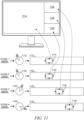
- FIG. 11 is a diagram illustrating concurrent immersive scenes, including a selected region from a selected primary immersive scene and multiple available regions from available secondary immersive scenes, being displayed together on a client device (e.g., a display screen, as illustrated, a smartphone, or a smart television), according to some example embodiments.
- a client device e.g., a display screen, as illustrated, a smartphone, or a smart television
- four separate immersive scenes e.g., Scene 1, Scene 2, Scene 3, and Scene 4
- Each of the immersive scenes (e.g., Scene 1, 2, 3, or 4) is represented by a set of scene video files, similar to the concurrent video files 200 discussed above.
- FIG. 11 illustrates the scene video file 1110 from Scene 1 coincidently having the same alignment as the scene video file 1120 from Scene 2.
- each scene video file's foveated region may be assigned to and displayed in a corresponding region of the display screen
- a portion of the foveated region e.g., a subregion, which may be selected by the viewer via a controller, such as a headset, a joystick, or a suitable graphical user interface generated by the digital media machine 110 or the display screen and presented on the display screen.
- a controller such as a headset, a joystick, or a suitable graphical user interface generated by the digital media machine 110 or the display screen and presented on the display screen.
- These portions (e.g., subregions) of foveated regions are respectively assigned to different regions of the display screen and concurrently (e.g., simultaneously) displayed together on the display screen.
- a portion of the foveated region 1114 has been selected as a primary subregion (e.g., representative of a primary scene) for prominent display in the largest region of the display screen, while other portions of the foveated regions 1124, 1134, and 1144 are secondary subregions (e.g., representative of secondary scenes) allocated to the three smaller regions of the display screen for less prominent display to indicate their availability for selection as the primary subregion.
- a primary subregion e.g., representative of a primary scene
- selection of a primary scene (e.g., Scene 1) whose foveated region will provide the primary subregion is performed in a manner similar to that described above with respect to FIG. 10 regarding selection of a primary PIP window. That is, instead of selecting a primary PIP window from among multiple available PIP windows in the picture areas of multiple scene video files within a single set of scene video files for a single immersive scene, a viewer or a machine (e.g., the digital media machine 110, the display screen, or both) may select a primary immersive scene from among multiple available immersive scenes that each has its own corresponding set of scene video files. Accordingly, the selected primary immersive scene becomes the source for a foveated region whose entirety or subregion is assigned to and displayed in the largest region of the display screen or displayed full-screen.
- a primary immersive scene e.g., Scene 1
- selection of one of its constituent scene video files may be performed in a manner similar to that described above with respect to FIG. 2 (e.g., based on a selected or otherwise determined viewing direction, which may be specified by azimuth angle and elevation angle, or by azimuth angle only.
- the viewer may specify the viewing direction by using a controller device, such as a headset, a mouse, a touchscreen, a joystick, or a suitable graphical user interface presented by the display screen or a smartphone.
- the scene video file e.g., scene video file 1010
- its foveated region e.g., foveated region 1114
- a selected portion thereof is assigned to the largest region of the display screen and displayed therein.
- representative scene video files are selected from the secondary scenes (e.g., Scenes 2, 3, and 4).
- a representative scene video file may be selected by the viewer or by a machine (e.g., the digital media machine 110, the display screen, or both).
- the machine may perform the selection randomly, based on a default (e.g., front or forward) direction, based on output from an artificial intelligence engine (e.g., configured to analyze a set of scene video files and make a selection therefrom), or any suitable combination thereof.
- a representative portion (e.g., subregion) of the foveated region may be selected by the viewer or by the machine.
- the machine may perform such a selection randomly, based on a default (e.g., centered) portion, based on output from an artificial intelligence engine, or any suitable combination thereof.
- the viewer simultaneously selects both the representative scene video file (e.g., scene video file 1120, 1130, or 1140) and the portion of its foveated region (e.g., foveated region 1124, 1134, or 1144) by using a controller device (e.g., headset, a mouse, a touchscreen, joystick, or suitable graphical user interface presented by the display screen or a smartphone).
- a controller device e.g., headset, a mouse, a touchscreen, joystick, or suitable graphical user interface presented by the display screen or a smartphone.
- one or more of the methodologies described herein may obviate a need for certain efforts or resources that otherwise would be involved in providing improved user experiences with virtual-reality content. Efforts expended by a user in perceiving or otherwise obtaining such improved user experiences, or by an administrator in hosting or otherwise providing such improved user experiences, may be reduced by use of (e.g., reliance upon) a special-purpose machine that implements one or more of the methodologies described herein. Computing resources used by one or more systems or machines (e.g., within the network environment 100) may similarly be reduced (e.g., compared to systems or machines that lack the structures discussed herein or are otherwise unable to perform the functions discussed herein). Examples of such computing resources include processor cycles, network traffic, computational capacity, main memory usage, graphics rendering capacity, graphics memory usage, data storage capacity, power consumption, and cooling capacity.
- FIG. 12 is a block diagram illustrating components of a machine 1200, according to some example embodiments, able to read instructions 1224 from a machine-readable medium 1222 (e.g., a non-transitory machine-readable medium, a machine-readable storage medium, a computer-readable storage medium, or any suitable combination thereof) and perform any one or more of the methodologies discussed herein, in whole or in part.
- a machine-readable medium 1222 e.g., a non-transitory machine-readable medium, a machine-readable storage medium, a computer-readable storage medium, or any suitable combination thereof
- FIG. 1222 e.g., a non-transitory machine-readable medium, a machine-readable storage medium, a computer-readable storage medium, or any suitable combination thereof
- FIG. 12 shows the machine 1200 in the example form of a computer system (e.g., a computer, which may be a supercomputer) within which the instructions 1224 (e.g., software, a program, an application, an applet, an app, or other executable code) for causing the machine 1200 to perform any one or more of the methodologies discussed herein may be executed, in whole or in part.
- a computer system e.g., a computer, which may be a supercomputer
- the instructions 1224 e.g., software, a program, an application, an applet, an app, or other executable code
- the machine 1200 operates as a standalone device or may be communicatively coupled (e.g., networked) to other machines.
- the machine 1200 may operate in the capacity of a server machine or a client machine in a server-client network environment, or as a peer machine in a distributed (e.g., peer-to-peer) network environment.
- the machine 1200 may be a server computer (e.g., a supercomputing server), a client computer, a personal computer (PC), a tablet computer, a laptop computer, a netbook, a cellular telephone, a smart phone, a set-top box (STB), a personal digital assistant (PDA), a web appliance, a network router, a network switch, a network bridge, or any machine capable of executing the instructions 1224, sequentially or otherwise, that specify actions to be taken by that machine.
- a server computer e.g., a supercomputing server
- client computer e.g., a client computer
- PC personal computer
- PDA personal digital assistant
- STB set-top box
- STB set-top box
- web appliance e.g., a web appliance, a network router, a network switch, a network bridge, or any machine capable of executing the instructions 1224, sequentially or otherwise, that specify actions to be taken by that machine.
- STB set-top box
- the machine 1200 includes a processor 1202 (e.g., one or more central processing units (CPUs), one or more graphics processing units (GPUs), one or more quantum processing units, one or more digital signal processors (DSPs), one or more application specific integrated circuits (ASICs), one or more radio-frequency integrated circuits (RFICs), or any suitable combination thereof), a main memory 1204, and a static memory 1206, which are configured to communicate with each other via a bus 1208.
- the processor 1202 contains solid-state digital microcircuits (e.g., electronic, optical, or both) that are configurable, temporarily or permanently, by some or all of the instructions 1224 such that the processor 1202 is configurable to perform any one or more of the methodologies described herein, in whole or in part.
- a set of one or more microcircuits of the processor 1202 may be configurable to execute one or more modules (e.g., software modules) described herein.
- the processor 1202 is a multicore CPU (e.g., a dual-core CPU, a quad-core CPU, an 8-core CPU, or a 128-core CPU) within which each of multiple cores behaves as a separate processor that is able to perform any one or more of the methodologies discussed herein, in whole or in part.
- the machine 1200 may further include a graphics display 1210 (e.g., a plasma display panel (PDP), a light emitting diode (LED) display, a liquid crystal display (LCD), a projector, a cathode ray tube (CRT), or any other display capable of displaying graphics or video).
- a graphics display 1210 e.g., a plasma display panel (PDP), a light emitting diode (LED) display, a liquid crystal display (LCD), a projector, a cathode ray tube (CRT), or any other display capable of displaying graphics or video).
- PDP plasma display panel
- LED light emitting diode
- LCD liquid crystal display
- CRT cathode ray tube
- the machine 1200 may also include an alphanumeric input device 1212 (e.g., a keyboard or keypad), a pointer input device 1214 (e.g., a mouse, a touchpad, a touchscreen, a trackball, a joystick, a stylus, a motion sensor, an eye tracking device, a data glove, or other pointing instrument), a data storage 1216, an audio generation device 1218 (e.g., a sound card, an amplifier, a speaker, a headphone jack, or any suitable combination thereof), and a network interface device 1220.
- an alphanumeric input device 1212 e.g., a keyboard or keypad
- a pointer input device 1214 e.g., a mouse, a touchpad, a touchscreen, a trackball, a joystick, a stylus, a motion sensor, an eye tracking device, a data glove, or other pointing instrument
- a data storage 1216 e.g., an audio generation device 1218 (e
- the data storage 1216 (e.g., a data storage device) includes the machine-readable medium 1222 (e.g., a tangible and non-transitory machine-readable storage medium) on which are stored the instructions 1224 embodying any one or more of the methodologies or functions described herein.
- the instructions 1224 may also reside, completely or at least partially, within the main memory 1204, within the static memory 1206, within the processor 1202 (e.g., within the processor's cache memory), or any suitable combination thereof, before or during execution thereof by the machine 1200. Accordingly, the main memory 1204, the static memory 1206, and the processor 1202 may be considered machine-readable media (e.g., tangible and non-transitory machine-readable media).
- the instructions 1224 may be transmitted or received over the network 190 via the network interface device 1220.
- the network interface device 1220 may communicate the instructions 1224 using any one or more transfer protocols (e.g., hypertext transfer protocol (HTTP)).
- HTTP hypertext transfer protocol
- Input data gathered by any one or more of these input components 1230 may be accessible and available for use by any of the modules described herein (e.g., with suitable privacy notifications and protections, such as opt-in consent or opt-out consent, implemented in accordance with user preference, applicable regulations, or any suitable combination thereof).
- machine-readable medium shall also be taken to include any medium, or combination of multiple media, that is capable of carrying (e.g., storing or communicating) the instructions 1224 for execution by the machine 1200, such that the instructions 1224, when executed by one or more processors of the machine 1200 (e.g., processor 1202), cause the machine 1200 to perform any one or more of the methodologies described herein, in whole or in part.
- a “machine-readable medium” refers to a single storage apparatus or device, as well as cloud-based storage systems or storage networks that include multiple storage apparatus or devices.
- machine-readable medium shall accordingly be taken to include, but not be limited to, one or more tangible and non-transitory data repositories (e.g., data volumes) in the example form of a solid-state memory chip, an optical disc, a magnetic disc, or any suitable combination thereof.
- tangible and non-transitory data repositories e.g., data volumes
- a "non-transitory" machine-readable medium specifically excludes propagating signals per se.
- the instructions 1224 for execution by the machine 1200 can be communicated via a carrier medium (e.g., a machine-readable carrier medium).
- a carrier medium include a non-transient carrier medium (e.g., a non-transitory machine-readable storage medium, such as a solid-state memory that is physically movable from one place to another place) and a transient carrier medium (e.g., a carrier wave or other propagating signal that communicates the instructions 1224).
- Modules may constitute software modules (e.g., code stored or otherwise embodied in a machine-readable medium or in a transmission medium), hardware modules, or any suitable combination thereof.
- a "hardware module” is a tangible (e.g., non-transitory) physical component (e.g., a set of one or more processors) capable of performing certain operations and may be configured or arranged in a certain physical manner.
- one or more computer systems or one or more hardware modules thereof may be configured by software (e.g., an application or portion thereof) as a hardware module that operates to perform operations described herein for that module.
- a hardware module may be implemented mechanically, electronically, hydraulically, or any suitable combination thereof.
- a hardware module may include dedicated circuitry or logic that is permanently configured to perform certain operations.
- a hardware module may be or include a special-purpose processor, such as a field programmable gate array (FPGA) or an ASIC.
- FPGA field programmable gate array
- a hardware module may also include programmable logic or circuitry that is temporarily configured by software to perform certain operations.
- a hardware module may include software encompassed within a CPU or other programmable processor. It will be appreciated that the decision to implement a hardware module mechanically, hydraulically, in dedicated and permanently configured circuitry, or in temporarily configured circuitry (e.g., configured by software) may be driven by cost and time considerations.
- the phrase "hardware module” should be understood to encompass a tangible entity that may be physically constructed, permanently configured (e.g., hardwired), or temporarily configured (e.g., programmed) to operate in a certain manner or to perform certain operations described herein.
- the phrase "hardware-implemented module” refers to a hardware module. Considering example embodiments in which hardware modules are temporarily configured (e.g., programmed), each of the hardware modules need not be configured or instantiated at any one instance in time. For example, where a hardware module includes a CPU configured by software to become a special-purpose processor, the CPU may be configured as respectively different special-purpose processors (e.g., each included in a different hardware module) at different times.
- Software e.g., a software module
- Hardware modules can provide information to, and receive information from, other hardware modules. Accordingly, the described hardware modules may be regarded as being communicatively coupled. Where multiple hardware modules exist contemporaneously, communications may be achieved through signal transmission (e.g., over circuits and buses) between or among two or more of the hardware modules. In embodiments in which multiple hardware modules are configured or instantiated at different times, communications between such hardware modules may be achieved, for example, through the storage and retrieval of information in memory structures to which the multiple hardware modules have access. For example, one hardware module may perform an operation and store the output of that operation in a memory (e.g., a memory device) to which it is communicatively coupled. A further hardware module may then, at a later time, access the memory to retrieve and process the stored output. Hardware modules may also initiate communications with input or output devices, and can operate on a resource (e.g., a collection of information from a computing resource).
- a resource e.g., a collection of information from a computing resource
- processors may be temporarily configured (e.g., by software) or permanently configured to perform the relevant operations. Whether temporarily or permanently configured, such processors may constitute processor-implemented modules that operate to perform one or more operations or functions described herein.
- processor-implemented module refers to a hardware module in which the hardware includes one or more processors. Accordingly, the operations described herein may be at least partially processor-implemented, hardware-implemented, or both, since a processor is an example of hardware, and at least some operations within any one or more of the methods discussed herein may be performed by one or more processor-implemented modules, hardware-implemented modules, or any suitable combination thereof.
- processors may perform operations in a "cloud computing" environment or as a service (e.g., within a "software as a service” (SaaS) implementation). For example, at least some operations within any one or more of the methods discussed herein may be performed by a group of computers (e.g., as examples of machines that include processors), with these operations being accessible via a network (e.g., the Internet) and via one or more appropriate interfaces (e.g., an application program interface (API)). The performance of certain operations may be distributed among the one or more processors, whether residing only within a single machine or deployed across a number of machines.
- SaaS software as a service
- the one or more processors or hardware modules may be located in a single geographic location (e.g., within a home environment, an office environment, or a server farm). In other example embodiments, the one or more processors or hardware modules may be distributed across a number of geographic locations.
Landscapes
- Engineering & Computer Science (AREA)
- Multimedia (AREA)
- Signal Processing (AREA)
- Databases & Information Systems (AREA)
- Physics & Mathematics (AREA)
- Human Computer Interaction (AREA)
- Business, Economics & Management (AREA)
- Marketing (AREA)
- General Physics & Mathematics (AREA)
- Theoretical Computer Science (AREA)
- General Engineering & Computer Science (AREA)
- Optics & Photonics (AREA)
- Two-Way Televisions, Distribution Of Moving Picture Or The Like (AREA)
- User Interface Of Digital Computer (AREA)
- Health & Medical Sciences (AREA)
- General Health & Medical Sciences (AREA)
- Social Psychology (AREA)
- Computer Networks & Wireless Communication (AREA)
- Artificial Intelligence (AREA)
- Evolutionary Computation (AREA)
- Information Transfer Between Computers (AREA)
Claims (7)
- Procédé comprenant les étapes consistant à :accéder, par un ou plusieurs processeurs d'une machine, à une pluralité de fichiers vidéo simultanés qui décrivent tous une scène immersive commune dans une zone d'images commune, mais qui correspondent chacun à une direction de visualisation différente ;accéder, par un ou plusieurs processeurs d'une machine, à un ensemble de pistes audio qui correspondent chacune à une direction de visualisation différente parmi l'ensemble de directions de visualisation dans une scène immersive commune ;le procédé étant caractérisé par les étapes consistant à :compléter, par le ou les processeurs de la machine, chaque fichier vidéo simultané d'au moins un ensemble des fichiers vidéo simultanés qui décrivent la scène immersive commune, mais qui correspondent chacun à une direction de visualisation différente parmi l'ensemble de directions de visualisation, avec un mélange audio individuel qui est aligné sur la direction de visualisation correspondante, dans chaque mixage audio toutes les pistes audio, à l'exception de la piste audio qui correspond à la direction de visualisation du fichier vidéo respectif, étant atténuées ; eten réponse à une demande d'un dispositif client pour restituer la scène immersive commune dans une première direction de visualisation, fournir, par le ou les processeurs de la machine, le fichier vidéo simultané correspondant à ladite première direction de visualisation au dispositif client, ledit fichier vidéo simultané comprenant le mélange audio correspondant dans lequel toutes les pistes audio, à l'exception de la piste audio correspondant à la première direction de visualisation, sont atténuées.
- Procédé selon la revendication 1, dans lequel la première piste audio correspond à une première fenêtre d'incrustation d'images (PIP), la première fenêtre PIP étant intégrée dans une première vidéo simultanée correspondant à une direction de visualisation.
- Procédé selon la revendication 1,dans lequel l'ensemble de fichiers vidéo simultanés comprend un autre fichier vidéo simultané correspondant à une seconde direction de visualisation différente de la première direction de visualisation, etdans lequel la piste audio correspondant à la première direction de visualisation n'est pas comprise dans le mélange audio de l'autre fichier vidéo simultané.
- Procédé selon la revendication 1,dans lequel l'ensemble de fichiers vidéo simultanés comprend un autre fichier vidéo simultané correspondant à une seconde direction de visualisation différente de la première direction de visualisation,dans lequel la piste audio correspondant à la première direction de visualisation est comprise dans le mélange audio compris dans l'autre fichier vidéo simultané, etdans lequel le volume de la piste audio correspondant à la première direction de visualisation dans le mélange audio compris dans l'autre fichier vidéo simultané est inférieur au volume de la piste audio correspondant à la première direction de visualisation dans le mélange audio compris dans le fichier vidéo simultané correspondant à la première direction de visualisation.
- Procédé selon la revendication 4, comprenant en outre les étapes consistant à :
en réponse à une demande du dispositif client pour restituer la scène immersive commune dans la seconde direction de visualisation, fournir, par le ou les processeurs de la machine, l'autre fichier vidéo simultané correspondant à ladite seconde direction de visualisation au dispositif client pour restituer la scène immersive commune dans la seconde direction de visualisation, l'autre fichier vidéo simultané amenant le dispositif client à mettre en sourdine la première piste audio dans le mélange audio compris dans le fichier vidéo simultané correspondant à la seconde direction de visualisation. - Support de stockage non transitoire lisible par machine, comprenant des instructions qui, lorsqu'elles sont exécutées par un ou plusieurs processeurs d'une machine, amènent la machine à réaliser des opérations pour mettre en oeuvre le procédé selon l'une quelconque des revendications 1 à 5.
- Système comprenant :un ou plusieurs processeurs ; etune mémoire stockant des instructions qui, lorsqu'elles sont exécutées par au moins un processeur parmi le ou les processeurs, amènent le système à réaliser des opérations pour mettre en oeuvre le procédé selon l'une quelconque des revendications 1 à 5.
Priority Applications (1)
| Application Number | Priority Date | Filing Date | Title |
|---|---|---|---|
| EP24187321.5A EP4440107A3 (fr) | 2018-04-11 | 2019-04-08 | Système multimédia numérique |
Applications Claiming Priority (4)
| Application Number | Priority Date | Filing Date | Title |
|---|---|---|---|
| US201862656149P | 2018-04-11 | 2018-04-11 | |
| US201862743083P | 2018-10-09 | 2018-10-09 | |
| EP19718563.0A EP3777208B1 (fr) | 2018-04-11 | 2019-04-08 | Système de média numérique |
| PCT/US2019/026264 WO2019199637A1 (fr) | 2018-04-11 | 2019-04-08 | Système multimédia numérique |
Related Parent Applications (1)
| Application Number | Title | Priority Date | Filing Date |
|---|---|---|---|
| EP19718563.0A Division EP3777208B1 (fr) | 2018-04-11 | 2019-04-08 | Système de média numérique |
Related Child Applications (1)
| Application Number | Title | Priority Date | Filing Date |
|---|---|---|---|
| EP24187321.5A Division EP4440107A3 (fr) | 2018-04-11 | 2019-04-08 | Système multimédia numérique |
Publications (2)
| Publication Number | Publication Date |
|---|---|
| EP3955584A1 EP3955584A1 (fr) | 2022-02-16 |
| EP3955584B1 true EP3955584B1 (fr) | 2024-07-10 |
Family
ID=66223878
Family Applications (3)
| Application Number | Title | Priority Date | Filing Date |
|---|---|---|---|
| EP21198834.0A Active EP3955584B1 (fr) | 2018-04-11 | 2019-04-08 | Système de média numérique |
| EP24187321.5A Withdrawn EP4440107A3 (fr) | 2018-04-11 | 2019-04-08 | Système multimédia numérique |
| EP19718563.0A Active EP3777208B1 (fr) | 2018-04-11 | 2019-04-08 | Système de média numérique |
Family Applications After (2)
| Application Number | Title | Priority Date | Filing Date |
|---|---|---|---|
| EP24187321.5A Withdrawn EP4440107A3 (fr) | 2018-04-11 | 2019-04-08 | Système multimédia numérique |
| EP19718563.0A Active EP3777208B1 (fr) | 2018-04-11 | 2019-04-08 | Système de média numérique |
Country Status (6)
| Country | Link |
|---|---|
| US (3) | US11343568B2 (fr) |
| EP (3) | EP3955584B1 (fr) |
| JP (2) | JP7174941B2 (fr) |
| KR (3) | KR102518869B1 (fr) |
| CN (1) | CN112567759B (fr) |
| WO (1) | WO2019199637A1 (fr) |
Families Citing this family (17)
| Publication number | Priority date | Publication date | Assignee | Title |
|---|---|---|---|---|
| EP3955584B1 (fr) | 2018-04-11 | 2024-07-10 | Alcacruz Inc. | Système de média numérique |
| JP7392105B2 (ja) * | 2019-07-28 | 2023-12-05 | グーグル エルエルシー | 没入型ビデオコンテンツをフォービエイテッドメッシュを用いてレンダリングするための方法、システム、および媒体 |
| US11979633B2 (en) * | 2019-12-12 | 2024-05-07 | Kovue Systems Llc | Hybrid data collection system to create an integrated database of connected and detailed consumer video viewing data in real-time |
| EP4169020A1 (fr) * | 2020-06-22 | 2023-04-26 | Dolby International AB | Système de mélange automatisé multipiste |
| US11956482B2 (en) * | 2020-07-16 | 2024-04-09 | Comcast Cable Communications, Llc | Systems and methods for storing and delivering content assets |
| US11800179B2 (en) * | 2020-12-03 | 2023-10-24 | Alcacruz Inc. | Multiview video with one window based on another |
| US11736748B2 (en) * | 2020-12-16 | 2023-08-22 | Tencent America LLC | Reference of neural network model for adaptation of 2D video for streaming to heterogeneous client end-points |
| US11943271B2 (en) | 2020-12-17 | 2024-03-26 | Tencent America LLC | Reference of neural network model by immersive media for adaptation of media for streaming to heterogenous client end-points |
| CN112738610A (zh) * | 2020-12-25 | 2021-04-30 | 北京达佳互联信息技术有限公司 | 多媒体数据的显示控制方法、装置、电子设备及存储介质 |
| CN115361649A (zh) * | 2021-04-30 | 2022-11-18 | 中国电信股份有限公司 | 虚拟现实音视频分发方法、装置以及存储介质 |
| US11983214B2 (en) * | 2021-11-05 | 2024-05-14 | Tencent America LLC | Reuse of redundant assets with client query |
| US12132966B2 (en) * | 2021-11-05 | 2024-10-29 | Tencent America LLC | Immersive media analyzer for reuse of scene assets |
| WO2023203423A1 (fr) * | 2022-04-20 | 2023-10-26 | Nokia Technologies Oy | Procédé et appareil de codage, de décodage, ou d'affichage d'incrustation d'image |
| US12056126B2 (en) * | 2022-08-25 | 2024-08-06 | Databricks, Inc. | Efficient merging of tabular data with post-processing compaction |
| CN116112744B (zh) * | 2023-02-15 | 2025-08-19 | 北京字跳网络技术有限公司 | 视频处理方法、装置、电子设备及存储介质 |
| US20240357202A1 (en) * | 2023-04-21 | 2024-10-24 | Google Llc | Determining a time point to skip to within a media item using user interaction events |
| US12591301B2 (en) * | 2024-03-25 | 2026-03-31 | Google Llc | Bilateral exchange of user attention stream for foveated 3D communication streaming |
Family Cites Families (36)
| Publication number | Priority date | Publication date | Assignee | Title |
|---|---|---|---|---|
| WO2001069911A2 (fr) * | 2000-03-07 | 2001-09-20 | Relative Motion Technologies, Inc. | Systeme de transmission multimedia interactif |
| JP2003284196A (ja) * | 2002-03-20 | 2003-10-03 | Sony Corp | 音像定位信号処理装置および音像定位信号処理方法 |
| US7084904B2 (en) | 2002-09-30 | 2006-08-01 | Microsoft Corporation | Foveated wide-angle imaging system and method for capturing and viewing wide-angle images in real time |
| US6968973B2 (en) | 2003-05-31 | 2005-11-29 | Microsoft Corporation | System and process for viewing and navigating through an interactive video tour |
| US8665374B2 (en) | 2008-08-22 | 2014-03-04 | Disney Enterprises, Inc. | Interactive video insertions, and applications thereof |
| US20100188579A1 (en) | 2009-01-29 | 2010-07-29 | At&T Intellectual Property I, L.P. | System and Method to Control and Present a Picture-In-Picture (PIP) Window Based on Movement Data |
| US8964013B2 (en) * | 2009-12-31 | 2015-02-24 | Broadcom Corporation | Display with elastic light manipulator |
| US20120092348A1 (en) | 2010-10-14 | 2012-04-19 | Immersive Media Company | Semi-automatic navigation with an immersive image |
| CN102164273A (zh) * | 2011-04-20 | 2011-08-24 | 上海交通大学 | 手术室医学信息重构与交互系统 |
| US20130155325A1 (en) | 2011-12-16 | 2013-06-20 | General Instrument Corporation | Region of interest selection, decoding and rendering of picture-in-picture window |
| WO2014053875A1 (fr) | 2012-10-01 | 2014-04-10 | Nokia Corporation | Appareil et procédé pour reproduire des données audio enregistrées avec une orientation spatiale correcte |
| EP3162074A1 (fr) * | 2014-06-27 | 2017-05-03 | Koninklijke KPN N.V. | Détermination d'une région d'intérêt sur la base d'un flux vidéo à pavé hevc |
| US9570113B2 (en) * | 2014-07-03 | 2017-02-14 | Gopro, Inc. | Automatic generation of video and directional audio from spherical content |
| US10038887B2 (en) * | 2015-05-27 | 2018-07-31 | Google Llc | Capture and render of panoramic virtual reality content |
| US9877016B2 (en) * | 2015-05-27 | 2018-01-23 | Google Llc | Omnistereo capture and render of panoramic virtual reality content |
| US10313745B2 (en) * | 2016-01-17 | 2019-06-04 | Bitmovin Gmbh | Adaptive streaming of an immersive video scene |
| JP6084728B1 (ja) | 2016-04-08 | 2017-02-22 | 株式会社コロプラ | 表示制御方法及び当該表示制御方法をコンピュータに実行させるためのプログラム |
| CN105933726A (zh) * | 2016-05-13 | 2016-09-07 | 乐视控股(北京)有限公司 | 虚拟现实终端及其视频分辨率的适应方法及装置 |
| US20170347219A1 (en) * | 2016-05-27 | 2017-11-30 | VideoStitch Inc. | Selective audio reproduction |
| US20170374364A1 (en) * | 2016-06-23 | 2017-12-28 | Mediatek Inc. | Method and Apparatus of Face Independent Coding Structure for VR Video |
| US9881647B2 (en) * | 2016-06-28 | 2018-01-30 | VideoStitch Inc. | Method to align an immersive video and an immersive sound field |
| KR102882879B1 (ko) * | 2016-07-08 | 2025-11-06 | 인터디지털 브이씨 홀딩스 인코포레이티드 | 지오메트리 투영을 이용한 360도 비디오 코딩 |
| CN205844637U (zh) * | 2016-07-13 | 2016-12-28 | 肖敦金 | 一种vr全景声头戴影院 |
| US10020025B2 (en) * | 2016-07-22 | 2018-07-10 | Zeality Inc. | Methods and systems for customizing immersive media content |
| US10222958B2 (en) * | 2016-07-22 | 2019-03-05 | Zeality Inc. | Customizing immersive media content with embedded discoverable elements |
| WO2018042658A1 (fr) * | 2016-09-05 | 2018-03-08 | マクセル株式会社 | Terminal d'informations portable, système de visiocasque et procédé de commande de sortie sonore correspondant |
| CN106331645B (zh) * | 2016-09-08 | 2019-02-22 | 北京美吉克科技发展有限公司 | 利用虚拟镜头实现vr全景视频后期编辑的方法和系统 |
| US11172005B2 (en) * | 2016-09-09 | 2021-11-09 | Nokia Technologies Oy | Method and apparatus for controlled observation point and orientation selection audiovisual content |
| US20180098131A1 (en) | 2016-09-30 | 2018-04-05 | Avago Technologies General Ip (Singapore) Pte. Ltd. | Apparatus and methods for adaptive bit-rate streaming of 360 video |
| CN106790996A (zh) * | 2016-11-25 | 2017-05-31 | 杭州当虹科技有限公司 | 手机虚拟现实交互系统及方法 |
| CN106658212A (zh) * | 2017-01-20 | 2017-05-10 | 北京红马传媒文化发展有限公司 | 一种基于html5的vr在线播放方法、系统及播放器 |
| JP2017208808A (ja) | 2017-04-04 | 2017-11-24 | 株式会社コロプラ | 仮想空間を提供する方法、プログラム及び記録媒体 |
| US10515466B2 (en) * | 2017-06-09 | 2019-12-24 | Sony Interactive Entertainment Inc. | Optimized deferred lighting in a foveated rendering system |
| CN107396086A (zh) * | 2017-07-28 | 2017-11-24 | 歌尔科技有限公司 | 基于vr头戴设备播放视频的方法及vr头戴设备 |
| CN107396077B (zh) * | 2017-08-23 | 2022-04-08 | 深圳看到科技有限公司 | 虚拟现实全景视频流投影方法和设备 |
| EP3955584B1 (fr) | 2018-04-11 | 2024-07-10 | Alcacruz Inc. | Système de média numérique |
-
2019
- 2019-04-08 EP EP21198834.0A patent/EP3955584B1/fr active Active
- 2019-04-08 JP JP2021505181A patent/JP7174941B2/ja active Active
- 2019-04-08 KR KR1020227018643A patent/KR102518869B1/ko active Active
- 2019-04-08 CN CN201980039551.XA patent/CN112567759B/zh active Active
- 2019-04-08 KR KR1020207032551A patent/KR102406219B1/ko active Active
- 2019-04-08 EP EP24187321.5A patent/EP4440107A3/fr not_active Withdrawn
- 2019-04-08 EP EP19718563.0A patent/EP3777208B1/fr active Active
- 2019-04-08 WO PCT/US2019/026264 patent/WO2019199637A1/fr not_active Ceased
- 2019-04-08 KR KR1020237011314A patent/KR20230051309A/ko not_active Ceased
- 2019-04-08 US US17/046,121 patent/US11343568B2/en active Active
-
2022
- 2022-04-19 US US17/723,840 patent/US11589110B2/en active Active
- 2022-10-27 JP JP2022172267A patent/JP2023021982A/ja active Pending
-
2023
- 2023-01-17 US US18/097,633 patent/US20230283840A1/en not_active Abandoned
Also Published As
| Publication number | Publication date |
|---|---|
| EP3955584A1 (fr) | 2022-02-16 |
| US20220248088A1 (en) | 2022-08-04 |
| US11343568B2 (en) | 2022-05-24 |
| EP3777208A1 (fr) | 2021-02-17 |
| CN112567759A (zh) | 2021-03-26 |
| KR20220081386A (ko) | 2022-06-15 |
| CN112567759B (zh) | 2023-09-29 |
| JP2021521747A (ja) | 2021-08-26 |
| EP4440107A2 (fr) | 2024-10-02 |
| JP7174941B2 (ja) | 2022-11-18 |
| KR20230051309A (ko) | 2023-04-17 |
| EP4440107A3 (fr) | 2025-01-08 |
| KR102406219B1 (ko) | 2022-06-08 |
| EP3777208B1 (fr) | 2021-09-29 |
| US20230283840A1 (en) | 2023-09-07 |
| KR102518869B1 (ko) | 2023-04-06 |
| US20210037287A1 (en) | 2021-02-04 |
| KR20200143719A (ko) | 2020-12-24 |
| US11589110B2 (en) | 2023-02-21 |
| JP2023021982A (ja) | 2023-02-14 |
| WO2019199637A1 (fr) | 2019-10-17 |
Similar Documents
| Publication | Publication Date | Title |
|---|---|---|
| US11589110B2 (en) | Digital media system | |
| US11601699B2 (en) | Predictive content delivery for video streaming services | |
| CN108885639B (zh) | 内容集合导航和自动转发 | |
| CN112383568B (zh) | 流媒体呈现系统 | |
| US9473548B1 (en) | Latency reduction in streamed content consumption | |
| US20170171274A1 (en) | Method and electronic device for synchronously playing multiple-cameras video | |
| JP2018077851A (ja) | ユーザ介入なくレイアウトに従った画像識別及び編成 | |
| US20220303735A1 (en) | Providing a summary of media content to a communication device | |
| US20200366973A1 (en) | Automatic Video Preview Creation System | |
| US11334310B2 (en) | Synchronization of digital content consumption | |
| WO2018120519A1 (fr) | Procédé et dispositif de traitement d'image | |
| KR102372181B1 (ko) | 전자 장치 및 그의 제어 방법 | |
| CN111246234B (zh) | 用于实时播放的方法、装置、电子设备和介质 | |
| US12231736B2 (en) | Bullet-screen comment display | |
| JP2017182706A (ja) | サーバ装置、情報処理方法およびプログラム | |
| CN117392244A (zh) | 图像处理方法、装置、电子设备和存储介质 |
Legal Events
| Date | Code | Title | Description |
|---|---|---|---|
| PUAI | Public reference made under article 153(3) epc to a published international application that has entered the european phase |
Free format text: ORIGINAL CODE: 0009012 |
|
| STAA | Information on the status of an ep patent application or granted ep patent |
Free format text: STATUS: THE APPLICATION HAS BEEN PUBLISHED |
|
| AC | Divisional application: reference to earlier application |
Ref document number: 3777208 Country of ref document: EP Kind code of ref document: P |
|
| AK | Designated contracting states |
Kind code of ref document: A1 Designated state(s): AL AT BE BG CH CY CZ DE DK EE ES FI FR GB GR HR HU IE IS IT LI LT LU LV MC MK MT NL NO PL PT RO RS SE SI SK SM TR |
|
| STAA | Information on the status of an ep patent application or granted ep patent |
Free format text: STATUS: REQUEST FOR EXAMINATION WAS MADE |
|
| 17P | Request for examination filed |
Effective date: 20220816 |
|
| RBV | Designated contracting states (corrected) |
Designated state(s): AL AT BE BG CH CY CZ DE DK EE ES FI FR GB GR HR HU IE IS IT LI LT LU LV MC MK MT NL NO PL PT RO RS SE SI SK SM TR |
|
| RIC1 | Information provided on ipc code assigned before grant |
Ipc: G02B 27/01 20060101ALN20231213BHEP Ipc: H04N 19/167 20140101ALI20231213BHEP Ipc: H04N 19/597 20140101ALI20231213BHEP Ipc: H04N 21/81 20110101ALI20231213BHEP Ipc: H04N 5/45 20110101ALI20231213BHEP Ipc: H04N 21/431 20110101ALI20231213BHEP Ipc: H04N 21/4728 20110101ALI20231213BHEP Ipc: H04N 21/4402 20110101AFI20231213BHEP |
|
| GRAP | Despatch of communication of intention to grant a patent |
Free format text: ORIGINAL CODE: EPIDOSNIGR1 |
|
| STAA | Information on the status of an ep patent application or granted ep patent |
Free format text: STATUS: GRANT OF PATENT IS INTENDED |
|
| RIC1 | Information provided on ipc code assigned before grant |
Ipc: G02B 27/01 20060101ALN20240117BHEP Ipc: H04N 19/167 20140101ALI20240117BHEP Ipc: H04N 19/597 20140101ALI20240117BHEP Ipc: H04N 21/81 20110101ALI20240117BHEP Ipc: H04N 5/45 20110101ALI20240117BHEP Ipc: H04N 21/431 20110101ALI20240117BHEP Ipc: H04N 21/4728 20110101ALI20240117BHEP Ipc: H04N 21/4402 20110101AFI20240117BHEP |
|
| INTG | Intention to grant announced |
Effective date: 20240206 |
|
| GRAS | Grant fee paid |
Free format text: ORIGINAL CODE: EPIDOSNIGR3 |
|
| GRAA | (expected) grant |
Free format text: ORIGINAL CODE: 0009210 |
|
| STAA | Information on the status of an ep patent application or granted ep patent |
Free format text: STATUS: THE PATENT HAS BEEN GRANTED |
|
| AC | Divisional application: reference to earlier application |
Ref document number: 3777208 Country of ref document: EP Kind code of ref document: P |
|
| AK | Designated contracting states |
Kind code of ref document: B1 Designated state(s): AL AT BE BG CH CY CZ DE DK EE ES FI FR GB GR HR HU IE IS IT LI LT LU LV MC MK MT NL NO PL PT RO RS SE SI SK SM TR |
|
| REG | Reference to a national code |
Ref country code: CH Ref legal event code: EP |
|
| REG | Reference to a national code |
Ref country code: DE Ref legal event code: R096 Ref document number: 602019055227 Country of ref document: DE |
|
| REG | Reference to a national code |
Ref country code: NL Ref legal event code: FP |
|
| REG | Reference to a national code |
Ref country code: LT Ref legal event code: MG9D |
|
| PG25 | Lapsed in a contracting state [announced via postgrant information from national office to epo] |
Ref country code: PT Free format text: LAPSE BECAUSE OF FAILURE TO SUBMIT A TRANSLATION OF THE DESCRIPTION OR TO PAY THE FEE WITHIN THE PRESCRIBED TIME-LIMIT Effective date: 20241111 |
|
| REG | Reference to a national code |
Ref country code: AT Ref legal event code: MK05 Ref document number: 1703073 Country of ref document: AT Kind code of ref document: T Effective date: 20240710 |
|
| PG25 | Lapsed in a contracting state [announced via postgrant information from national office to epo] |
Ref country code: PT Free format text: LAPSE BECAUSE OF FAILURE TO SUBMIT A TRANSLATION OF THE DESCRIPTION OR TO PAY THE FEE WITHIN THE PRESCRIBED TIME-LIMIT Effective date: 20241111 |
|
| RAP4 | Party data changed (patent owner data changed or rights of a patent transferred) |
Owner name: ALCACRUZ INC. |
|
| PG25 | Lapsed in a contracting state [announced via postgrant information from national office to epo] |
Ref country code: NO Free format text: LAPSE BECAUSE OF FAILURE TO SUBMIT A TRANSLATION OF THE DESCRIPTION OR TO PAY THE FEE WITHIN THE PRESCRIBED TIME-LIMIT Effective date: 20241010 |
|
| PG25 | Lapsed in a contracting state [announced via postgrant information from national office to epo] |
Ref country code: GR Free format text: LAPSE BECAUSE OF FAILURE TO SUBMIT A TRANSLATION OF THE DESCRIPTION OR TO PAY THE FEE WITHIN THE PRESCRIBED TIME-LIMIT Effective date: 20241011 Ref country code: FI Free format text: LAPSE BECAUSE OF FAILURE TO SUBMIT A TRANSLATION OF THE DESCRIPTION OR TO PAY THE FEE WITHIN THE PRESCRIBED TIME-LIMIT Effective date: 20240710 Ref country code: PL Free format text: LAPSE BECAUSE OF FAILURE TO SUBMIT A TRANSLATION OF THE DESCRIPTION OR TO PAY THE FEE WITHIN THE PRESCRIBED TIME-LIMIT Effective date: 20240710 |
|
| PG25 | Lapsed in a contracting state [announced via postgrant information from national office to epo] |
Ref country code: BG Free format text: LAPSE BECAUSE OF FAILURE TO SUBMIT A TRANSLATION OF THE DESCRIPTION OR TO PAY THE FEE WITHIN THE PRESCRIBED TIME-LIMIT Effective date: 20240710 |
|
| PG25 | Lapsed in a contracting state [announced via postgrant information from national office to epo] |
Ref country code: LV Free format text: LAPSE BECAUSE OF FAILURE TO SUBMIT A TRANSLATION OF THE DESCRIPTION OR TO PAY THE FEE WITHIN THE PRESCRIBED TIME-LIMIT Effective date: 20240710 |
|
| PG25 | Lapsed in a contracting state [announced via postgrant information from national office to epo] |
Ref country code: AT Free format text: LAPSE BECAUSE OF FAILURE TO SUBMIT A TRANSLATION OF THE DESCRIPTION OR TO PAY THE FEE WITHIN THE PRESCRIBED TIME-LIMIT Effective date: 20240710 Ref country code: IS Free format text: LAPSE BECAUSE OF FAILURE TO SUBMIT A TRANSLATION OF THE DESCRIPTION OR TO PAY THE FEE WITHIN THE PRESCRIBED TIME-LIMIT Effective date: 20241110 |
|
| PG25 | Lapsed in a contracting state [announced via postgrant information from national office to epo] |
Ref country code: HR Free format text: LAPSE BECAUSE OF FAILURE TO SUBMIT A TRANSLATION OF THE DESCRIPTION OR TO PAY THE FEE WITHIN THE PRESCRIBED TIME-LIMIT Effective date: 20240710 |
|
| PG25 | Lapsed in a contracting state [announced via postgrant information from national office to epo] |
Ref country code: ES Free format text: LAPSE BECAUSE OF FAILURE TO SUBMIT A TRANSLATION OF THE DESCRIPTION OR TO PAY THE FEE WITHIN THE PRESCRIBED TIME-LIMIT Effective date: 20240710 Ref country code: RS Free format text: LAPSE BECAUSE OF FAILURE TO SUBMIT A TRANSLATION OF THE DESCRIPTION OR TO PAY THE FEE WITHIN THE PRESCRIBED TIME-LIMIT Effective date: 20241010 |
|
| PG25 | Lapsed in a contracting state [announced via postgrant information from national office to epo] |
Ref country code: RS Free format text: LAPSE BECAUSE OF FAILURE TO SUBMIT A TRANSLATION OF THE DESCRIPTION OR TO PAY THE FEE WITHIN THE PRESCRIBED TIME-LIMIT Effective date: 20241010 Ref country code: PL Free format text: LAPSE BECAUSE OF FAILURE TO SUBMIT A TRANSLATION OF THE DESCRIPTION OR TO PAY THE FEE WITHIN THE PRESCRIBED TIME-LIMIT Effective date: 20240710 Ref country code: NO Free format text: LAPSE BECAUSE OF FAILURE TO SUBMIT A TRANSLATION OF THE DESCRIPTION OR TO PAY THE FEE WITHIN THE PRESCRIBED TIME-LIMIT Effective date: 20241010 Ref country code: LV Free format text: LAPSE BECAUSE OF FAILURE TO SUBMIT A TRANSLATION OF THE DESCRIPTION OR TO PAY THE FEE WITHIN THE PRESCRIBED TIME-LIMIT Effective date: 20240710 Ref country code: IS Free format text: LAPSE BECAUSE OF FAILURE TO SUBMIT A TRANSLATION OF THE DESCRIPTION OR TO PAY THE FEE WITHIN THE PRESCRIBED TIME-LIMIT Effective date: 20241110 Ref country code: HR Free format text: LAPSE BECAUSE OF FAILURE TO SUBMIT A TRANSLATION OF THE DESCRIPTION OR TO PAY THE FEE WITHIN THE PRESCRIBED TIME-LIMIT Effective date: 20240710 Ref country code: GR Free format text: LAPSE BECAUSE OF FAILURE TO SUBMIT A TRANSLATION OF THE DESCRIPTION OR TO PAY THE FEE WITHIN THE PRESCRIBED TIME-LIMIT Effective date: 20241011 Ref country code: FI Free format text: LAPSE BECAUSE OF FAILURE TO SUBMIT A TRANSLATION OF THE DESCRIPTION OR TO PAY THE FEE WITHIN THE PRESCRIBED TIME-LIMIT Effective date: 20240710 Ref country code: ES Free format text: LAPSE BECAUSE OF FAILURE TO SUBMIT A TRANSLATION OF THE DESCRIPTION OR TO PAY THE FEE WITHIN THE PRESCRIBED TIME-LIMIT Effective date: 20240710 Ref country code: BG Free format text: LAPSE BECAUSE OF FAILURE TO SUBMIT A TRANSLATION OF THE DESCRIPTION OR TO PAY THE FEE WITHIN THE PRESCRIBED TIME-LIMIT Effective date: 20240710 Ref country code: AT Free format text: LAPSE BECAUSE OF FAILURE TO SUBMIT A TRANSLATION OF THE DESCRIPTION OR TO PAY THE FEE WITHIN THE PRESCRIBED TIME-LIMIT Effective date: 20240710 |
|
| REG | Reference to a national code |
Ref country code: DE Ref legal event code: R097 Ref document number: 602019055227 Country of ref document: DE |
|
| PG25 | Lapsed in a contracting state [announced via postgrant information from national office to epo] |
Ref country code: SM Free format text: LAPSE BECAUSE OF FAILURE TO SUBMIT A TRANSLATION OF THE DESCRIPTION OR TO PAY THE FEE WITHIN THE PRESCRIBED TIME-LIMIT Effective date: 20240710 Ref country code: DK Free format text: LAPSE BECAUSE OF FAILURE TO SUBMIT A TRANSLATION OF THE DESCRIPTION OR TO PAY THE FEE WITHIN THE PRESCRIBED TIME-LIMIT Effective date: 20240710 Ref country code: RO Free format text: LAPSE BECAUSE OF FAILURE TO SUBMIT A TRANSLATION OF THE DESCRIPTION OR TO PAY THE FEE WITHIN THE PRESCRIBED TIME-LIMIT Effective date: 20240710 |
|
| PG25 | Lapsed in a contracting state [announced via postgrant information from national office to epo] |
Ref country code: EE Free format text: LAPSE BECAUSE OF FAILURE TO SUBMIT A TRANSLATION OF THE DESCRIPTION OR TO PAY THE FEE WITHIN THE PRESCRIBED TIME-LIMIT Effective date: 20240710 |
|
| PG25 | Lapsed in a contracting state [announced via postgrant information from national office to epo] |
Ref country code: CZ Free format text: LAPSE BECAUSE OF FAILURE TO SUBMIT A TRANSLATION OF THE DESCRIPTION OR TO PAY THE FEE WITHIN THE PRESCRIBED TIME-LIMIT Effective date: 20240710 |
|
| PG25 | Lapsed in a contracting state [announced via postgrant information from national office to epo] |
Ref country code: SK Free format text: LAPSE BECAUSE OF FAILURE TO SUBMIT A TRANSLATION OF THE DESCRIPTION OR TO PAY THE FEE WITHIN THE PRESCRIBED TIME-LIMIT Effective date: 20240710 Ref country code: IT Free format text: LAPSE BECAUSE OF FAILURE TO SUBMIT A TRANSLATION OF THE DESCRIPTION OR TO PAY THE FEE WITHIN THE PRESCRIBED TIME-LIMIT Effective date: 20240710 |
|
| PGFP | Annual fee paid to national office [announced via postgrant information from national office to epo] |
Ref country code: NL Payment date: 20250418 Year of fee payment: 7 |
|
| PLBE | No opposition filed within time limit |
Free format text: ORIGINAL CODE: 0009261 |
|
| STAA | Information on the status of an ep patent application or granted ep patent |
Free format text: STATUS: NO OPPOSITION FILED WITHIN TIME LIMIT |
|
| PGFP | Annual fee paid to national office [announced via postgrant information from national office to epo] |
Ref country code: LU Payment date: 20250418 Year of fee payment: 7 |
|
| 26N | No opposition filed |
Effective date: 20250411 |
|
| PGFP | Annual fee paid to national office [announced via postgrant information from national office to epo] |
Ref country code: DE Payment date: 20250422 Year of fee payment: 7 |
|
| PGFP | Annual fee paid to national office [announced via postgrant information from national office to epo] |
Ref country code: GB Payment date: 20250423 Year of fee payment: 7 |
|
| PGFP | Annual fee paid to national office [announced via postgrant information from national office to epo] |
Ref country code: FR Payment date: 20250425 Year of fee payment: 7 |
|
| PGFP | Annual fee paid to national office [announced via postgrant information from national office to epo] |
Ref country code: CH Payment date: 20250501 Year of fee payment: 7 |
|
| PG25 | Lapsed in a contracting state [announced via postgrant information from national office to epo] |
Ref country code: SE Free format text: LAPSE BECAUSE OF FAILURE TO SUBMIT A TRANSLATION OF THE DESCRIPTION OR TO PAY THE FEE WITHIN THE PRESCRIBED TIME-LIMIT Effective date: 20240710 |
|
| PG25 | Lapsed in a contracting state [announced via postgrant information from national office to epo] |
Ref country code: MC Free format text: LAPSE BECAUSE OF FAILURE TO SUBMIT A TRANSLATION OF THE DESCRIPTION OR TO PAY THE FEE WITHIN THE PRESCRIBED TIME-LIMIT Effective date: 20240710 |
|
| REG | Reference to a national code |
Ref country code: BE Ref legal event code: MM Effective date: 20250430 |
|
| PG25 | Lapsed in a contracting state [announced via postgrant information from national office to epo] |
Ref country code: BE Free format text: LAPSE BECAUSE OF NON-PAYMENT OF DUE FEES Effective date: 20250430 |
|
| PG25 | Lapsed in a contracting state [announced via postgrant information from national office to epo] |
Ref country code: IE Free format text: LAPSE BECAUSE OF NON-PAYMENT OF DUE FEES Effective date: 20250408 |