EP3961767A1 - Sekundärbatterie und sekundärbatteriesystem - Google Patents
Sekundärbatterie und sekundärbatteriesystem Download PDFInfo
- Publication number
- EP3961767A1 EP3961767A1 EP20794149.3A EP20794149A EP3961767A1 EP 3961767 A1 EP3961767 A1 EP 3961767A1 EP 20794149 A EP20794149 A EP 20794149A EP 3961767 A1 EP3961767 A1 EP 3961767A1
- Authority
- EP
- European Patent Office
- Prior art keywords
- secondary battery
- aqueous solution
- nickel
- alkaline aqueous
- active material
- Prior art date
- Legal status (The legal status is an assumption and is not a legal conclusion. Google has not performed a legal analysis and makes no representation as to the accuracy of the status listed.)
- Withdrawn
Links
- 239000007864 aqueous solution Substances 0.000 claims abstract description 101
- 239000011149 active material Substances 0.000 claims abstract description 37
- 150000002500 ions Chemical class 0.000 claims abstract description 21
- 150000002816 nickel compounds Chemical class 0.000 claims abstract description 13
- 239000011701 zinc Substances 0.000 claims description 49
- 229910052725 zinc Inorganic materials 0.000 claims description 26
- HCHKCACWOHOZIP-UHFFFAOYSA-N Zinc Chemical compound [Zn] HCHKCACWOHOZIP-UHFFFAOYSA-N 0.000 claims description 24
- 229910052751 metal Inorganic materials 0.000 claims description 24
- PXHVJJICTQNCMI-UHFFFAOYSA-N Nickel Chemical compound [Ni] PXHVJJICTQNCMI-UHFFFAOYSA-N 0.000 claims description 22
- 229910000483 nickel oxide hydroxide Inorganic materials 0.000 claims description 22
- 230000014509 gene expression Effects 0.000 claims description 13
- 239000002184 metal Substances 0.000 claims description 13
- 229910052759 nickel Inorganic materials 0.000 claims description 12
- 239000000203 mixture Substances 0.000 claims description 8
- XLYOFNOQVPJJNP-UHFFFAOYSA-M hydroxide Chemical compound [OH-] XLYOFNOQVPJJNP-UHFFFAOYSA-M 0.000 claims description 4
- 229910052718 tin Inorganic materials 0.000 claims description 4
- ZLMJMSJWJFRBEC-UHFFFAOYSA-N Potassium Chemical compound [K] ZLMJMSJWJFRBEC-UHFFFAOYSA-N 0.000 claims description 3
- 229910052782 aluminium Inorganic materials 0.000 claims description 3
- 229910052797 bismuth Inorganic materials 0.000 claims description 3
- 229910052738 indium Inorganic materials 0.000 claims description 3
- 229910052700 potassium Inorganic materials 0.000 claims description 3
- 239000011591 potassium Substances 0.000 claims description 3
- FYYHWMGAXLPEAU-UHFFFAOYSA-N Magnesium Chemical compound [Mg] FYYHWMGAXLPEAU-UHFFFAOYSA-N 0.000 claims description 2
- 229910052793 cadmium Inorganic materials 0.000 claims description 2
- BDOSMKKIYDKNTQ-UHFFFAOYSA-N cadmium atom Chemical compound [Cd] BDOSMKKIYDKNTQ-UHFFFAOYSA-N 0.000 claims description 2
- 229910052732 germanium Inorganic materials 0.000 claims description 2
- 229910052749 magnesium Inorganic materials 0.000 claims description 2
- 239000011777 magnesium Substances 0.000 claims description 2
- 229910001414 potassium ion Inorganic materials 0.000 claims description 2
- 239000007789 gas Substances 0.000 description 38
- 239000006182 cathode active material Substances 0.000 description 34
- 238000006243 chemical reaction Methods 0.000 description 30
- 239000000843 powder Substances 0.000 description 28
- 238000007599 discharging Methods 0.000 description 26
- 229910006279 γ-NiOOH Inorganic materials 0.000 description 17
- 229910006527 α-Ni(OH)2 Inorganic materials 0.000 description 16
- 239000004020 conductor Substances 0.000 description 15
- 238000010586 diagram Methods 0.000 description 12
- 239000000463 material Substances 0.000 description 12
- XLOMVQKBTHCTTD-UHFFFAOYSA-N Zinc monoxide Chemical compound [Zn]=O XLOMVQKBTHCTTD-UHFFFAOYSA-N 0.000 description 10
- 238000004873 anchoring Methods 0.000 description 10
- 229910006650 β-Ni(OH)2 Inorganic materials 0.000 description 10
- 229910006630 β—Ni(OH)2 Inorganic materials 0.000 description 10
- BFDHFSHZJLFAMC-UHFFFAOYSA-L nickel(ii) hydroxide Chemical compound [OH-].[OH-].[Ni+2] BFDHFSHZJLFAMC-UHFFFAOYSA-L 0.000 description 7
- HEMHJVSKTPXQMS-UHFFFAOYSA-M Sodium hydroxide Chemical compound [OH-].[Na+] HEMHJVSKTPXQMS-UHFFFAOYSA-M 0.000 description 6
- 239000011230 binding agent Substances 0.000 description 6
- -1 nickel hydrogen Chemical class 0.000 description 6
- 229910003160 β-NiOOH Inorganic materials 0.000 description 6
- 125000000129 anionic group Chemical group 0.000 description 5
- 230000008859 change Effects 0.000 description 5
- 210000001787 dendrite Anatomy 0.000 description 5
- 239000000047 product Substances 0.000 description 5
- 239000011347 resin Substances 0.000 description 5
- 229920005989 resin Polymers 0.000 description 5
- 229910021511 zinc hydroxide Inorganic materials 0.000 description 5
- 239000011787 zinc oxide Substances 0.000 description 5
- 238000001514 detection method Methods 0.000 description 4
- 239000007788 liquid Substances 0.000 description 4
- 238000003860 storage Methods 0.000 description 4
- 239000011135 tin Substances 0.000 description 4
- OKTJSMMVPCPJKN-UHFFFAOYSA-N Carbon Chemical compound [C] OKTJSMMVPCPJKN-UHFFFAOYSA-N 0.000 description 3
- RYGMFSIKBFXOCR-UHFFFAOYSA-N Copper Chemical compound [Cu] RYGMFSIKBFXOCR-UHFFFAOYSA-N 0.000 description 3
- WMFOQBRAJBCJND-UHFFFAOYSA-M Lithium hydroxide Chemical compound [Li+].[OH-] WMFOQBRAJBCJND-UHFFFAOYSA-M 0.000 description 3
- KWYUFKZDYYNOTN-UHFFFAOYSA-M Potassium hydroxide Chemical compound [OH-].[K+] KWYUFKZDYYNOTN-UHFFFAOYSA-M 0.000 description 3
- OSOVKCSKTAIGGF-UHFFFAOYSA-N [Ni].OOO Chemical compound [Ni].OOO OSOVKCSKTAIGGF-UHFFFAOYSA-N 0.000 description 3
- 229910052783 alkali metal Inorganic materials 0.000 description 3
- 150000001340 alkali metals Chemical class 0.000 description 3
- 239000006183 anode active material Substances 0.000 description 3
- 239000003575 carbonaceous material Substances 0.000 description 3
- 229910052802 copper Inorganic materials 0.000 description 3
- 239000010949 copper Substances 0.000 description 3
- 238000009792 diffusion process Methods 0.000 description 3
- 150000004679 hydroxides Chemical class 0.000 description 3
- 239000007769 metal material Substances 0.000 description 3
- 230000004660 morphological change Effects 0.000 description 3
- QELJHCBNGDEXLD-UHFFFAOYSA-N nickel zinc Chemical compound [Ni].[Zn] QELJHCBNGDEXLD-UHFFFAOYSA-N 0.000 description 3
- 229920001343 polytetrafluoroethylene Polymers 0.000 description 3
- 239000004810 polytetrafluoroethylene Substances 0.000 description 3
- 239000002244 precipitate Substances 0.000 description 3
- 239000010935 stainless steel Substances 0.000 description 3
- 229910001220 stainless steel Inorganic materials 0.000 description 3
- XLYOFNOQVPJJNP-UHFFFAOYSA-N water Chemical compound O XLYOFNOQVPJJNP-UHFFFAOYSA-N 0.000 description 3
- UGZADUVQMDAIAO-UHFFFAOYSA-L zinc hydroxide Chemical compound [OH-].[OH-].[Zn+2] UGZADUVQMDAIAO-UHFFFAOYSA-L 0.000 description 3
- 229940007718 zinc hydroxide Drugs 0.000 description 3
- XKRFYHLGVUSROY-UHFFFAOYSA-N Argon Chemical compound [Ar] XKRFYHLGVUSROY-UHFFFAOYSA-N 0.000 description 2
- WHXSMMKQMYFTQS-UHFFFAOYSA-N Lithium Chemical compound [Li] WHXSMMKQMYFTQS-UHFFFAOYSA-N 0.000 description 2
- HBBGRARXTFLTSG-UHFFFAOYSA-N Lithium ion Chemical compound [Li+] HBBGRARXTFLTSG-UHFFFAOYSA-N 0.000 description 2
- 229910002640 NiOOH Inorganic materials 0.000 description 2
- 239000002033 PVDF binder Substances 0.000 description 2
- 229910017052 cobalt Inorganic materials 0.000 description 2
- 239000010941 cobalt Substances 0.000 description 2
- GUTLYIVDDKVIGB-UHFFFAOYSA-N cobalt atom Chemical compound [Co] GUTLYIVDDKVIGB-UHFFFAOYSA-N 0.000 description 2
- 150000001875 compounds Chemical class 0.000 description 2
- 230000007423 decrease Effects 0.000 description 2
- 230000006866 deterioration Effects 0.000 description 2
- 230000000694 effects Effects 0.000 description 2
- 238000003411 electrode reaction Methods 0.000 description 2
- 238000007667 floating Methods 0.000 description 2
- 229910002804 graphite Inorganic materials 0.000 description 2
- 239000010439 graphite Substances 0.000 description 2
- 230000006872 improvement Effects 0.000 description 2
- 229910052744 lithium Inorganic materials 0.000 description 2
- 229910001416 lithium ion Inorganic materials 0.000 description 2
- 230000004048 modification Effects 0.000 description 2
- 238000012986 modification Methods 0.000 description 2
- 229910021508 nickel(II) hydroxide Inorganic materials 0.000 description 2
- 229920000642 polymer Polymers 0.000 description 2
- 229920000915 polyvinyl chloride Polymers 0.000 description 2
- 239000004800 polyvinyl chloride Substances 0.000 description 2
- 229920002981 polyvinylidene fluoride Polymers 0.000 description 2
- 238000010248 power generation Methods 0.000 description 2
- 230000009467 reduction Effects 0.000 description 2
- 229920006395 saturated elastomer Polymers 0.000 description 2
- 239000007787 solid Substances 0.000 description 2
- JIAARYAFYJHUJI-UHFFFAOYSA-L zinc dichloride Chemical compound [Cl-].[Cl-].[Zn+2] JIAARYAFYJHUJI-UHFFFAOYSA-L 0.000 description 2
- NWONKYPBYAMBJT-UHFFFAOYSA-L zinc sulfate Chemical compound [Zn+2].[O-]S([O-])(=O)=O NWONKYPBYAMBJT-UHFFFAOYSA-L 0.000 description 2
- IJGRMHOSHXDMSA-UHFFFAOYSA-N Atomic nitrogen Chemical compound N#N IJGRMHOSHXDMSA-UHFFFAOYSA-N 0.000 description 1
- OYPRJOBELJOOCE-UHFFFAOYSA-N Calcium Chemical compound [Ca] OYPRJOBELJOOCE-UHFFFAOYSA-N 0.000 description 1
- LFQSCWFLJHTTHZ-UHFFFAOYSA-N Ethanol Chemical compound CCO LFQSCWFLJHTTHZ-UHFFFAOYSA-N 0.000 description 1
- DGAQECJNVWCQMB-PUAWFVPOSA-M Ilexoside XXIX Chemical compound C[C@@H]1CC[C@@]2(CC[C@@]3(C(=CC[C@H]4[C@]3(CC[C@@H]5[C@@]4(CC[C@@H](C5(C)C)OS(=O)(=O)[O-])C)C)[C@@H]2[C@]1(C)O)C)C(=O)O[C@H]6[C@@H]([C@H]([C@@H]([C@H](O6)CO)O)O)O.[Na+] DGAQECJNVWCQMB-PUAWFVPOSA-M 0.000 description 1
- PWHULOQIROXLJO-UHFFFAOYSA-N Manganese Chemical compound [Mn] PWHULOQIROXLJO-UHFFFAOYSA-N 0.000 description 1
- 229910000990 Ni alloy Inorganic materials 0.000 description 1
- 229910018661 Ni(OH) Inorganic materials 0.000 description 1
- 239000004743 Polypropylene Substances 0.000 description 1
- 239000004793 Polystyrene Substances 0.000 description 1
- FKNQFGJONOIPTF-UHFFFAOYSA-N Sodium cation Chemical compound [Na+] FKNQFGJONOIPTF-UHFFFAOYSA-N 0.000 description 1
- ATJFFYVFTNAWJD-UHFFFAOYSA-N Tin Chemical compound [Sn] ATJFFYVFTNAWJD-UHFFFAOYSA-N 0.000 description 1
- FMRLDPWIRHBCCC-UHFFFAOYSA-L Zinc carbonate Chemical compound [Zn+2].[O-]C([O-])=O FMRLDPWIRHBCCC-UHFFFAOYSA-L 0.000 description 1
- BNOODXBBXFZASF-UHFFFAOYSA-N [Na].[S] Chemical compound [Na].[S] BNOODXBBXFZASF-UHFFFAOYSA-N 0.000 description 1
- 230000002730 additional effect Effects 0.000 description 1
- 239000012670 alkaline solution Substances 0.000 description 1
- 229910045601 alloy Inorganic materials 0.000 description 1
- 239000000956 alloy Substances 0.000 description 1
- 230000003466 anti-cipated effect Effects 0.000 description 1
- 229910052786 argon Inorganic materials 0.000 description 1
- QVGXLLKOCUKJST-UHFFFAOYSA-N atomic oxygen Chemical compound [O] QVGXLLKOCUKJST-UHFFFAOYSA-N 0.000 description 1
- 230000015572 biosynthetic process Effects 0.000 description 1
- OJIJEKBXJYRIBZ-UHFFFAOYSA-N cadmium nickel Chemical compound [Ni].[Cd] OJIJEKBXJYRIBZ-UHFFFAOYSA-N 0.000 description 1
- 239000011575 calcium Substances 0.000 description 1
- 229910052791 calcium Inorganic materials 0.000 description 1
- 229910052799 carbon Inorganic materials 0.000 description 1
- 239000006229 carbon black Substances 0.000 description 1
- 230000015556 catabolic process Effects 0.000 description 1
- 239000013078 crystal Substances 0.000 description 1
- 238000006731 degradation reaction Methods 0.000 description 1
- 229910001873 dinitrogen Inorganic materials 0.000 description 1
- 238000009826 distribution Methods 0.000 description 1
- 239000008151 electrolyte solution Substances 0.000 description 1
- 230000006870 function Effects 0.000 description 1
- 239000001307 helium Substances 0.000 description 1
- 229910052734 helium Inorganic materials 0.000 description 1
- SWQJXJOGLNCZEY-UHFFFAOYSA-N helium atom Chemical compound [He] SWQJXJOGLNCZEY-UHFFFAOYSA-N 0.000 description 1
- 239000000017 hydrogel Substances 0.000 description 1
- 239000001257 hydrogen Substances 0.000 description 1
- 229910052739 hydrogen Inorganic materials 0.000 description 1
- 239000011261 inert gas Substances 0.000 description 1
- 230000014759 maintenance of location Effects 0.000 description 1
- 229910000000 metal hydroxide Inorganic materials 0.000 description 1
- 150000004692 metal hydroxides Chemical class 0.000 description 1
- 229910044991 metal oxide Inorganic materials 0.000 description 1
- 150000004706 metal oxides Chemical class 0.000 description 1
- 238000000034 method Methods 0.000 description 1
- 238000000465 moulding Methods 0.000 description 1
- 229910052754 neon Inorganic materials 0.000 description 1
- GKAOGPIIYCISHV-UHFFFAOYSA-N neon atom Chemical compound [Ne] GKAOGPIIYCISHV-UHFFFAOYSA-N 0.000 description 1
- 150000002815 nickel Chemical group 0.000 description 1
- 239000001301 oxygen Substances 0.000 description 1
- 229910052760 oxygen Inorganic materials 0.000 description 1
- 230000000149 penetrating effect Effects 0.000 description 1
- 230000000737 periodic effect Effects 0.000 description 1
- 230000002093 peripheral effect Effects 0.000 description 1
- 125000002467 phosphate group Chemical class [H]OP(=O)(O[H])O[*] 0.000 description 1
- 229920000139 polyethylene terephthalate Polymers 0.000 description 1
- 239000005020 polyethylene terephthalate Substances 0.000 description 1
- 229920001155 polypropylene Polymers 0.000 description 1
- 229920002223 polystyrene Polymers 0.000 description 1
- 238000002360 preparation method Methods 0.000 description 1
- 230000001105 regulatory effect Effects 0.000 description 1
- 229910052708 sodium Inorganic materials 0.000 description 1
- 239000011734 sodium Substances 0.000 description 1
- 229910001415 sodium ion Inorganic materials 0.000 description 1
- 239000006104 solid solution Substances 0.000 description 1
- 150000003467 sulfuric acid derivatives Chemical class 0.000 description 1
- 238000003466 welding Methods 0.000 description 1
- 239000011667 zinc carbonate Substances 0.000 description 1
- 235000004416 zinc carbonate Nutrition 0.000 description 1
- 229910000010 zinc carbonate Inorganic materials 0.000 description 1
- 239000011592 zinc chloride Substances 0.000 description 1
- 235000005074 zinc chloride Nutrition 0.000 description 1
- 229960001763 zinc sulfate Drugs 0.000 description 1
- 229910000368 zinc sulfate Inorganic materials 0.000 description 1
Images




Classifications
-
- H—ELECTRICITY
- H01—ELECTRIC ELEMENTS
- H01M—PROCESSES OR MEANS, e.g. BATTERIES, FOR THE DIRECT CONVERSION OF CHEMICAL ENERGY INTO ELECTRICAL ENERGY
- H01M4/00—Electrodes
- H01M4/02—Electrodes composed of, or comprising, active material
- H01M4/24—Electrodes for alkaline accumulators
-
- H—ELECTRICITY
- H01—ELECTRIC ELEMENTS
- H01M—PROCESSES OR MEANS, e.g. BATTERIES, FOR THE DIRECT CONVERSION OF CHEMICAL ENERGY INTO ELECTRICAL ENERGY
- H01M10/00—Secondary cells; Manufacture thereof
- H01M10/24—Alkaline accumulators
- H01M10/30—Nickel accumulators
-
- H—ELECTRICITY
- H01—ELECTRIC ELEMENTS
- H01M—PROCESSES OR MEANS, e.g. BATTERIES, FOR THE DIRECT CONVERSION OF CHEMICAL ENERGY INTO ELECTRICAL ENERGY
- H01M10/00—Secondary cells; Manufacture thereof
- H01M10/24—Alkaline accumulators
- H01M10/26—Selection of materials as electrolytes
-
- H—ELECTRICITY
- H01—ELECTRIC ELEMENTS
- H01M—PROCESSES OR MEANS, e.g. BATTERIES, FOR THE DIRECT CONVERSION OF CHEMICAL ENERGY INTO ELECTRICAL ENERGY
- H01M10/00—Secondary cells; Manufacture thereof
- H01M10/42—Methods or arrangements for servicing or maintenance of secondary cells or secondary half-cells
- H01M10/48—Accumulators combined with arrangements for measuring, testing or indicating the condition of cells, e.g. the level or density of the electrolyte
-
- H—ELECTRICITY
- H01—ELECTRIC ELEMENTS
- H01M—PROCESSES OR MEANS, e.g. BATTERIES, FOR THE DIRECT CONVERSION OF CHEMICAL ENERGY INTO ELECTRICAL ENERGY
- H01M50/00—Constructional details or processes of manufacture of the non-active parts of electrochemical cells other than fuel cells, e.g. hybrid cells
- H01M50/70—Arrangements for stirring or circulating the electrolyte
- H01M50/77—Arrangements for stirring or circulating the electrolyte with external circulating path
-
- Y—GENERAL TAGGING OF NEW TECHNOLOGICAL DEVELOPMENTS; GENERAL TAGGING OF CROSS-SECTIONAL TECHNOLOGIES SPANNING OVER SEVERAL SECTIONS OF THE IPC; TECHNICAL SUBJECTS COVERED BY FORMER USPC CROSS-REFERENCE ART COLLECTIONS [XRACs] AND DIGESTS
- Y02—TECHNOLOGIES OR APPLICATIONS FOR MITIGATION OR ADAPTATION AGAINST CLIMATE CHANGE
- Y02E—REDUCTION OF GREENHOUSE GAS [GHG] EMISSIONS, RELATED TO ENERGY GENERATION, TRANSMISSION OR DISTRIBUTION
- Y02E60/00—Enabling technologies; Technologies with a potential or indirect contribution to GHG emissions mitigation
- Y02E60/10—Energy storage using batteries
Definitions
- the disclosed embodiments relate to a secondary battery and a secondary battery system.
- a flow battery that circulates an electrolytic solution containing an anode active material between a cathode and an anode is known as an example of a secondary battery.
- some secondary batteries contain nickel hydroxide as a cathode active material.
- the valence and structure of the nickel atom of nickel hydroxide change due to charging and discharging of the secondary battery.
- Patent Document 1 JP 2015-173068 A
- a secondary battery is provided with a cathode, an anode, and an alkaline aqueous solution.
- the cathode has an active material containing a nickel compound.
- the alkaline aqueous solution is in contact with the cathode and the anode.
- the product of a valence and a molar amount per 1 dm 3 of the complex ions is -2.0 or less.
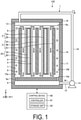
- FIG. 1 is a diagram illustrating an overview of a secondary battery system according to a first embodiment.
- a secondary battery system 100 illustrated in FIG. 1 includes a secondary battery 1 and a control device 90.
- the secondary battery 1 includes a reaction unit 10, a generation unit 9, and a supply unit 14, all housed in a casing 19.
- the reaction unit 10 includes a cathode 2, an anode 3, diaphragms 4, 5, and an alkaline aqueous solution 6.
- the secondary battery 1 is a device that is configured to cause the alkaline aqueous solution 6 housed in the reaction unit 10 to flow by causing gas bubbles 8 generated by the generation unit 9 to float in the alkaline aqueous solution 6. Thus, it is also referred to as a flow battery.
- the generation unit 9 is an example of a flow device.
- FIG. 1 illustrates an embodiment in which the secondary battery 1 is a nickel zinc battery, but the present invention is not limited to a nickel zinc battery.
- the secondary battery 1 may be, for example, a lead storage battery, a lithium ion secondary battery, a lithium ion polymer battery, a nickel hydrogen secondary battery, a nickel cadmium secondary battery, a lithium air secondary battery, a sodium ion secondary battery, a sodium sulfur battery, or a redox flow battery.
- FIG. 1 illustrates a three-dimensional orthogonal coordinate system including a Z-axis for which the vertically upward direction is the positive direction and the vertically downward direction is the negative direction.
- Such orthogonal coordinate systems may also be presented in other drawings used in the description below. Components that are the same as those of the secondary battery system 100 illustrated in FIG. 1 are assigned the same reference signs, and descriptions thereof are omitted or simplified.
- the cathode 2 has one or a plurality of cathode structures 20.
- the cathode structure 20 includes a cathode active material layer 30 and a current collector member 80. Details of the cathode structure 20 will be described later.
- the anode 3 includes an anode active material as a metal.
- an anode active material as a metal.
- a metal plate of a material such as stainless steel or copper, or a stainless steel or copper plate for which the surface has been plated with nickel, tin, or zinc can be used as the anode 3.
- a stainless steel or copper plate for which the surface has been plated and then partially oxidized may also be used as the anode 3.
- the cathode 2 includes cathodes 2A and 2B.
- the anode 3 includes anodes 3A to 3C.
- the anode 3A, the cathode 2A, the anode 3B, the cathode 2B, and the anode 3C are arranged in order along the Y-axis direction at predetermined intervals.
- the diaphragms 4, 5 are disposed so as to sandwich the cathode 2 from both sides in the thickness direction, that is, in the Y-axis direction.
- the diaphragms 4, 5 are constituted of a material that allows the movement of ions in the alkaline aqueous solution 6.
- an example of the material of the diaphragms 4, 5 is an anionic conductive material such that the diaphragms 4, 5 have hydroxide ion conductivity.
- anionic conductive materials include: gel-like anionic conductive materials having a three-dimensional structure such as an organic hydrogel; inorganic layered double hydroxides; or solid polymeric anionic conductive materials.
- the solid polymeric anionic conductive material includes, for example, a polymer and at least one compound selected from the group consisting of oxides, hydroxides, layered double hydroxides, sulfate compounds and phosphate compounds, the compound containing at least one element selected from Groups 1 to 17 of the periodic table.
- the alkaline aqueous solution 6 contains, for example, an alkali metal at an amount of 6 mol ⁇ dm -3 or greater.
- the alkali metal is potassium, for example.
- an aqueous solution from 6 to 13 mol ⁇ dm -3 of potassium hydroxide can be used as the alkaline aqueous solution 6.
- an alkali metal such as lithium or sodium may be added as a hydroxide (lithium hydroxide, sodium hydroxide) for the purpose of suppressing oxygen generation.
- the alkaline aqueous solution 6 also contains a complex ion for which a product of the valence (number of charges) and the molar amount per 1 dm 3 is equal to or less than -2.0.
- the charging capacity can be improved by configuring the alkaline aqueous solution 6 to contain a predetermined amount of the complex ions in this manner. This point will be described later using FIG. 5 .
- the alkaline aqueous solution 6 may also contain a powder 7.
- the powder 7 contains a metal corresponding to the complex ions in the alkaline aqueous solution 6.
- the powder 7 contains zinc.
- the powder 7 is, for example, a metal oxide (for example, zinc oxide) or a metal hydroxide (for example, zinc hydroxide), processed or produced in a powder form.
- the powder 7 is readily dissolved in an alkaline aqueous solution.
- the powder 7 may be dispersed or suspended in the saturated alkaline aqueous solution 6 of the metal species without being dissolved.
- the powder 7 may also be precipitated, for example.
- the powder 7 When the alkaline aqueous solution 6 is left to stand for an extended period of time, most of the powder 7 precipitates in the alkaline aqueous solution 6, for example. However, if convection or the like occurs in the alkaline aqueous solution 6, some of the precipitated powder 7 can be dispersed or suspended in the alkaline aqueous solution 6. That is, the powder 7 is movably present in the alkaline aqueous solution 6.
- movable does not mean that that the powder 7 can move only in a localized space between the other powders 7 present in the surrounding area, but instead, means that the powder 7 moves to another position in the alkaline aqueous solution 6, and thereby the powder 7 is exposed to the alkaline aqueous solution 6 at a position other than the initial position. Furthermore, the term movable also means that the powder 7 can move to the vicinity of both the cathode 2 and the anode 3, or that the powder 7 can move almost anywhere in the alkaline aqueous solution 6 present in the casing 19.
- the powder 7 suspended or precipitated in the alkaline aqueous solution 6 dissolves such that a concentration of the complex ions present in the alkaline aqueous solution 6 approach the saturation concentration, and thereby the powder 7 and the alkaline aqueous solution 6 remain in a mutually equilibrium state.
- the powder 7 can be used to adjust the amount of metal dissolved in the alkaline aqueous solution 6 and maintain high ionic conductivity of the alkaline aqueous solution 6.
- the gas bubbles 8 are constituted by, for example, a gas that is inert to the cathode 2, the anode 3, and the alkaline aqueous solution 6.
- a gas that is inert to the cathode 2, the anode 3, and the alkaline aqueous solution 6.
- examples of such a gas include nitrogen gas, helium gas, neon gas, and argon gas.
- modification of the alkaline aqueous solution 6 can be reduced.
- deterioration of the alkaline aqueous solution 6 containing a zinc species can be reduced, and the ionic conductivity of the alkaline aqueous solution 6 can be maintained at a high value.
- the gas may contain air.
- the generation unit 9 is disposed below the reaction unit 10.
- the generation unit 9 is internally hollow so as to temporarily store a gas supplied from the supply unit 14 described below.
- an inner bottom 10e of the reaction unit 10 is disposed so as to cover the hollow portion of the generation unit 9, and serves as a top plate of the generation unit 9.
- the inner bottom 10e includes a plurality of discharge ports 9a arranged along the X-axis direction and the Y-axis direction.
- the discharge ports 9a are disposed between an inner wall 10a and the anode 3A and between the anode 3C and an inner wall 10b.
- the generation unit 9 generates gas bubbles 8 in the alkaline aqueous solution 6 by discharging, from the discharge ports 9a, the gas supplied from the supply unit 14.
- the diameter of the gas bubbles 8 floating in the alkaline aqueous solution 6 can be, for example, from 0.01 mm to 3 mm. If the diameter of the gas bubbles 8 is smaller than 0.01 mm, the alkaline aqueous solution 6 accommodated in the reaction unit 10 cannot be efficiently flowed, and the possibility of incidents of conduction between the cathode 2 and the anode 3 may not be easily reduced. Furthermore, if the diameter of the gas bubbles 8 exceeds 3 mm, for example, while floating, the gas bubbles 8 may come into contact with the inner wall 10a or the anode 3a and thereby reduce the flow efficiency of the alkaline aqueous solution 6.
- the "diameter of the gas bubbles 8" referred to here is the size in the X-axis direction when the gas bubbles 8 are photographed from above or from the side of the reaction unit 10 using, for example, a high speed camera or the like.
- the discharge ports 9a each have a diameter of, for example, from 5 ⁇ m to 500 ⁇ m. Additionally, for example, each discharge port 9a may have a diameter of from 10 ⁇ m to 500 ⁇ m.
- the diameter of the discharge port 9a may be regulated in this manner, and thus the problem of the alkaline aqueous solution 6 and the powder 7 entering the hollow portion of the interior of the generation unit 9 from the discharge ports 9a can be reduced.
- a pressure loss suitable for formation of the gas bubbles 8 is suitably imparted to the gas discharged from the discharge ports 9a.
- the interval (pitch) along the X-axis direction of the discharge ports 9a may be, for example, from 2.5 mm to 50 mm.
- the interval (pitch) along the X-axis direction of the discharge ports 9a may be, for example, from 2.5 mm to 10 mm.
- the discharge ports 9a are not limited in their size or interval as long as the discharge ports 9a are disposed such that the formed gas bubbles 8 can be appropriately flowed between each mutually facing cathode 2 and anode 3.
- the gas bubbles 8 formed from the gas supplied into the alkaline aqueous solution 6 from the discharge ports 9a of the generation unit 9 float in the alkaline aqueous solution 6 between both ends in the Y-axis direction, and more specifically, between the anode 3A and the inner wall 10a of the casing 17, and between the anode 3C and the inner wall 10b of the casing 17.
- the gas floated upward as gas bubbles 8 in the alkaline aqueous solution 6 disappears at a liquid surface 6a of the alkaline aqueous solution 6, and forms a gas layer 13 positioned between an upper plate 18 and the liquid surface 6a of the alkaline aqueous solution 6.
- an upward liquid flow is generated in the alkaline aqueous solution 6.
- the alkaline aqueous solution 6 flows upward from the lower portion of the reaction unit 10 between the inner wall 10a and the anode 3A, and between the anode 3C and the inner wall 10b.
- the alkaline aqueous solution 6 flows downward from the upper portion between the anode 3A and the cathode 2A, between the cathode 2A and the anode 3B, and between the anode 3B and the cathode 2C.
- the discharge ports 9a may be arranged such that the gas bubbles 8 float upward between the cathode 2 and the anode 3.
- the alkaline aqueous solution 6 flows upward from the lower portion of the reaction unit 10 between the cathode 2 and the anode 3 where the gas bubbles 8 float upward.
- the alkaline aqueous solution 6 also flows downward from the upper portion of the reaction unit 10 between the inner wall 10a and the anode 3A and between the anode 3C and the inner wall 10b.
- the upper plate 18 and the casing 19 are configured from a resin material having alkaline resistance and an insulating property, and examples of the resin material include polystyrene, polypropylene, polyethylene terephthalate, polytetrafluoroethylene, and polyvinyl chloride.
- the upper plate 18 and the casing 19 are preferably configured from a mutually identical material, but may be configured from different materials.
- the generation unit 9 may be disposed inside the reaction unit 10.
- the supply unit 14 supplies a gas collected from the interior of the casing 19 via a piping 16 to the generation unit 9 via a piping 15.
- the supply unit 14 is, for example, a pump (gas pump), a compressor, or a blower, capable of transferring a gas.
- the secondary battery 1 is resistant to reduction in power generation performance, which may be caused by leakage to the outside of water vapor derived from the gas or the alkaline aqueous solution 6.
- an example of an electrode reaction in the secondary battery 1 will be described using, as an example, a nickel zinc battery in which nickel hydroxide is used as the cathode active material and zinc is used as the anode active material.
- the reaction formulas at the cathode 2 and the anode 3 during charging are as follows.
- the zinc species [Zn(OH) 4 ] 2- in the alkaline aqueous solution 6 is maintained at a high concentration by replenishment of the [Zn(OH) 4 ] 2- in the alkaline aqueous solution 6 consumed during charging.
- the growth of dendrites is reduced, and the potential for incidents of conduction between the cathode 2 and the anode 3 is reduced.
- gas is supplied from the discharge ports 9a of the generation unit 9 into the alkaline aqueous solution 6 to generate gas bubbles 8.
- the gas bubbles 8 float upward in the alkaline aqueous solution 6 from the inner bottom 10e of the reaction unit 10. Additionally, as the gas bubbles 8 float upward, the alkaline aqueous solution 6 flows upward from the lower portion of the reaction unit 10, between the cathode 2 and the anode 3.
- the [Zn(OH) 4 ] 2- in the alkaline aqueous solution 6 is consumed by charging, the zinc in the powder 7 is dissolved so as to compensate the consumption thereof, and thereby the alkaline aqueous solution 6 containing a high concentration of the [Zn(OH) 4 ] 2- is replenished in the vicinity of the anode 3. Therefore, the [Zn(OH) 4 ] 2- in the alkaline aqueous solution 6 can be maintained at a high concentration, and the potential for incidents of conduction between the cathode 2 and the anode 3 in association with the growth of dendrites can be reduced.
- examples of the powder 7 containing zinc include, in addition to zinc oxide and zinc hydroxide, metal zinc, calcium zincate, zinc carbonate, zinc sulfate, and zinc chloride, and in particular, zinc oxide and zinc hydroxide can be used.
- the zinc consumed at the anode 3 is zinc that is deposited on the surface of the anode 3 during charging. Therefore, unlike a case in which charging and discharging are repeated using an anode originally containing a zinc species, so-called shape changing in which the surface shape of the anode 3 changes does not occur. As a result, with the secondary battery 1 according to the first embodiment, degradation over time of the anode 3 can be reduced.
- the zinc species that is precipitated from the excess Zn(OH) 4 ] 2- may be Zn(OH) 2 or a mixture of ZnO and Zn(OH) 2 .
- FIG. 2 is a diagram illustrating an example of a cathode structure.
- FIG. 3 is a cross-sectional view taken along the line A-A in FIG. 2
- FIG. 4 is a cross-sectional view taken along the line B-B in FIG. 2 .
- the cathode structure 20 is a member having a box shape or a pocket shape.
- the cathode structure 20 includes a cathode active material layer 30 and a current collector member 80 that houses the cathode active material layer 30.
- the cathode active material layer 30 includes an active material 3 1.
- the active material 31 is, for example, in a granular form containing a nickel compound.
- the nickel compound is one or both of nickel hydroxide and nickel oxyhydroxide, for example.
- the nickel compound includes at least two or more of the following: ⁇ -nickel hydroxide, ⁇ -nickel hydroxide, ⁇ -nickel oxyhydroxide, or ⁇ -nickel oxyhydroxide.
- the relationship in terms of content of the ⁇ -nickel hydroxide, the ⁇ -nickel hydroxide, the ⁇ -nickel oxyhydroxide, and the ⁇ -nickel oxyhydroxide satisfies, for example, any one of the following relational expressions.
- nickel hydroxide and the nickel oxyhydroxide in the active material 31 may be ⁇ -nickel hydroxide and a ⁇ -nickel oxyhydroxide.
- the nickel hydroxide and the nickel oxyhydroxide contained in the active material 31 are further described using FIG. 5 .
- FIG. 5 is a diagram illustrating an example of a change in the form of the nickel compound.
- the ⁇ -nickel hydroxide ( ⁇ -Ni(OH) 2 ) included as the active material 31 in the cathode 2 is converted to ⁇ -nickel oxyhydroxide ( ⁇ -NiOOH) through charging of the secondary battery 1, and ⁇ -NiOOH is converted back to ⁇ -Ni(OH) 2 through discharging of the secondary battery 1.
- the charging/discharging reaction between the ⁇ - ⁇ species is the electrode reaction described above which is commonly used in the secondary battery 1.
- ⁇ -NiOOH is converted to ⁇ -nickel oxyhydroxide ( ⁇ -NiOOH) due to overcharging of the secondary battery 1.
- the ⁇ -NiOOH is converted to ⁇ -nickel hydroxide ( ⁇ -Ni(OH) 2 ) through discharging of the secondary battery 1, and the ⁇ -Ni(OH) 2 is converted back to ⁇ -NiOOH through charging of the secondary battery 1.
- two types of charging/discharging reactions can be used, namely a morphological change between ⁇ -Ni(OH) 2 ⁇ ⁇ -NiOOH and a morphological change between ⁇ -Ni(OH) 2 ⁇ ⁇ -NiOOH.
- the charge/discharge amount per unit molar amount is approximately 1.5 times that of charging and discharging between ⁇ -Ni(OH) 2 ⁇ ⁇ -NiOOH, which is a one-electron reaction.
- ⁇ -Ni(OH) 2 is an unstable material, and when left standing, will convert to the relatively stable ⁇ -Ni(OPH) 2
- ⁇ -Ni(OH) 2 is converted to ⁇ -Ni(OH) 2
- ⁇ -Ni(OH) 2 is not formed unless overcharging to a predetermined voltage value occurs.
- the charging/discharging reaction between ⁇ -Ni(OH) 2 ⁇ ⁇ -NiOOH cannot be used in the normal charging/discharging reaction.
- the alkaline aqueous solution 6 contains complex ions for which the product of the valence and the molar amount per 1 dm 3 is -2.0 or less, and in particular from -5.0 to -2.5. Since the valence of the complex ions is negative, the product of the valence and the molar amount is negative. Furthermore, as the molar amount of the complex ions increases, the product of the valence and the molar amount becomes smaller.
- the complex ions are dissolved, for example, as hydroxide complex ions in the alkaline aqueous solution 6, which is an alkaline solution.
- the complex ions include one or more of, for example, Zn, Al, Sn, Ga, Pb, In, Bi, or Ge.
- Zn can be dissolved in the alkaline aqueous solution 6 as [Zn(OH) 4 ] 2- .
- Al, Sn, Ga, Pb, In, Bi, and Ge are each amphoteric elements, and can be dissolved in the alkaline aqueous solution 6 as, for example, [Al(OH) 4 ] - , [Sn(OH) 6 ] 2- , [Ga(OH) 4 ] - , [Pb(OH) 4 ] 2- , [In(OH) 4 ] - , and [Ge(OH) 4 ] 2- .
- the alkaline aqueous solution 6 contains a prescribed amount of the complex ions in this manner, a morphological change of ⁇ -Ni(OH) 2 , which is the active material 31 in the cathode 2 immersed in the alkaline aqueous solution 6, into ⁇ -Ni(OH) 2 is suppressed, and the charging/discharging reaction between ⁇ -Ni(OH) 2 ⁇ ⁇ -NiOOH can be repeated.
- the charging capacity can be improved over a long period of time.
- the content of the ⁇ -Ni(OH) 2 and ⁇ -NiOOH may be from 45 mol% to 90 mol%.
- the content of the ⁇ -Ni(OH) 2 and ⁇ -NiOOH is less than 45 mol%, for example, the effect of the charging capacity improvement through ⁇ -Ni(OH) 2 and ⁇ -NiOOH is reduced, and the voltage control of the secondary battery 1 may be difficult.
- the content of the ⁇ -Ni(OH)2 and ⁇ -NiOOH exceeds 90 mol%, the volume change rate of the cathode active material layer 30 containing the active material 31 increases in association with charging and discharging. This may result in, for example, deterioration in battery performance with repeated charging and discharging.
- the cathode active material layer 30 may contain ⁇ -NiOOH as the active material 31, or may contain only ⁇ -Ni(OH) 2 as the active material 31 in the preparation of the cathode structure 20.
- the cathode active material layer 30 contains only ⁇ -Ni(OH) 2 as the active material 31 when the full charge in a normal charging/discharging reaction is defined as 100% for example, overcharging to approximately 160% to 200% is preliminarily implemented in advance and some of the ⁇ -Ni(OH) 2 has been converted to ⁇ -NiOOH, and then charging and discharging may be implemented.
- the cathode structure 20 is further described with reference again to FIGS. 2 to 4 .
- the active material 31 may contain a metal element besides nickel.
- the content of the metal elements other than nickel can be 10 mol% or less, and further 6 mol% or less.
- metal elements other than nickel include magnesium, cadmium, and zinc.
- the active material 31 may also contain other metal elements, such as cobalt, for example. These metal elements are those that are substituted in the active material 31 and form a solid solution. In other words, metal elements covering the surface of the active material 31 are not included. An example is a case in which the metal elements are present as a second layer other than in the active material 31.
- the composition of the active material 31 can be measured using, for example, ICP composition analysis.
- the content of the metal elements other than nickel in the active material 31 may also be less than or equal to the detection limit.
- the cathode active material layer 30 may contain a conductor.
- the conductor increases the conductivity between the active material 31 and the current collector member 80, and reduces energy loss that occurs during charging and discharging at the cathode 2.
- the conductor may be, for example, a conductive material such as a carbon material or a metal material. From the perspective of versatility, the conductor is, for example, a carbon material. Examples of the carbon material include graphite, carbon black, graphite, and carbon felt. In addition, a nickel metal for example can be used as the metal material.
- the conductor may be, for example, cobalt metal, manganese metal, or an alloy thereof.
- the cathode active material layer 30 may also contain a binder.
- the binder binds the active materials included in the cathode active material layer 30 to each other, binds the conductors to each other, binds the active materials and the conductors, and contributes to shape retention of the cathode active material layer 30.
- the binder also increases the adhesiveness between the cathode active material layer 30 and the current collector member 80.
- a resin material can be used as the binder.
- the resin material may have alkaline resistance and an insulating property. Examples of resin materials that can be used include polytetrafluoroethylene (PTFE), polyvinyl chloride (PVA), and polyvinylidene fluoride (PVDF).
- a mixture of the active material 31, the conductor, and the binder as described above is kneaded, pressurized, and molded to form the cathode active material layer 30.
- a liquid such as water or alcohol may be added to the mixture of the active material, the conductor, and the binder, and after molding, the mixture may be dried to produce the cathode active material layer 30.
- the current collector member 80 is configured by a plate-shaped member made of nickel metal or a nickel alloy, for example. A metal material, the surface of which has been plated, may also be used as the current collector member 80.
- the current collector member 80 includes a first member 40 and a second member 60 facing each other in the thickness direction of the cathode active material layer 30. The cathode active material layer 30 is housed between the first member 40 and the second member 60.
- the first member 40 includes a communicating portion 42 and an anchoring portion 41.
- the communicating portion 42 is a portion that communicates the inside and outside of the cathode structure 20 in which the cathode active material layer 30 is housed, and allows the movement of the alkaline aqueous solution 6 into and out of the cathode structure 20.
- a plurality of through-holes 43 that go through the inner surface and the outer surface of the first member 40 are provided in the communicating portion 42.
- the anchoring portion 41 is a region that is provided for anchoring the first member 40 and the second member 60 at the peripheral edge of the first member 40.
- the first member 40 includes a bent section 47 that is bent at both ends 46 in the X-axis direction, that is, in the width direction.
- the second member 60 has side edges 61 at both end portions in the X-axis direction, that is, in the width direction.
- a width W2 in the X-axis direction of a housing section 50 between the first member 40 and the second member 60 can be, for example, 1 mm greater than a width W1 in the X-axis direction of the cathode active material layer 30.
- the width W2 of the housing section 50 is defined in this manner, the alkaline aqueous solution 6 can enter between the housing section 50 and an inner surface 60a of the second member 60, and thereby the proportion of the cathode active material layer 30 in direct contact with the alkaline aqueous solution 6 is increased, and diffusion of the alkaline aqueous solution 6 into the cathode active material layer 30 is further enhanced.
- first member 40 and the second member 60 can also be anchored in the longitudinal direction of the cathode structure 20 by the same technique used for anchoring in the lateral direction.
- Anchoring of the first member 40 and the second member 60 is not limited to the illustrated example, and may be implemented by welding, for example.
- the communicating portion 42 and the anchoring portion 41 are each formed as a continuous portion, but other forms may be used.
- through-holes 63 may also be provided in the anchoring portion 41 such that a portion or all of the anchoring portion becomes a communicating portion 42 allowing the movement of the alkaline aqueous solution 6.
- the first member 40 and the second member 60 have gaps 52, 53 at end portions in the width direction of the cathode active material layer 30, specifically, outside of the housing section 50.
- the alkaline aqueous solution 6 enters the gaps 52, 53, and thereby the proportion of the cathode active material layer 30 in direct contact with the alkaline aqueous solution 6 is further increased, and the diffusion starting points are increased.
- diffusion of the alkaline aqueous solution 6 into the cathode active material layer 30 is further enhanced.
- a configuration may also be adopted in which only one of the gaps 52, 53 is present, or in which none of the gaps 52, 53 are present.
- a plurality of through-holes 63 that go through the inner surface and the outer surface are provided in the second member 60.
- the plurality of through-holes 63 can be disposed, for example, so as to face the plurality of through-holes 43 with the cathode active material layer 30 interposed therebetween.
- diameters d1, d2 of the through-holes 43, 63 can be, for example, from 30 ⁇ m to 300 ⁇ m, and also from 100 ⁇ m to 200 ⁇ m. If the diameters d1, d2 are less than 30 ⁇ m, for example, the alkaline aqueous solution 6 is less likely to enter the inside of the through-holes 43, 63. On the other hand, when the diameters d1 and d2 exceed 300 ⁇ m, for example, the active material 31 and other components constituting the cathode active material layer 30 tend to easily leak to the outside.
- the first member 40 and the second member 60 are illustrated as being spaced apart from the cathode active material layer 30, but the present embodiment is not limited to such a configuration, and for example, the through-holes 43, 63 may each protrude toward the cathode active material layer 30 side such that the first member 40 and the second member 60 are in contact with the cathode active material layer 30.
- the first member 40 and the second member 60 are in contact with the cathode active material layer 30, it facilitates electric charge transport between the cathode active material layer 30 and the current collector member 80 through the alkaline aqueous solution 6 (see FIG. 1 ).
- the control device 90 controls the charging of the secondary battery 1.
- the control device 90 includes a controller 91 and a storage unit 92.
- the controller 91 includes a computer or various circuits including, for example, a central processing unit (CPU), a read only memory (ROM), a random access memory (RAM), a hard disk drive (HDD), and an input/output port.
- the CPU of such a computer functions as the controller 91 by, for example, reading and executing the program stored in the ROM.
- the controller 91 may also be configured of hardware such as an application specific integrated circuit (ASIC) or a field programmable gate array (FPGA).
- ASIC application specific integrated circuit
- FPGA field programmable gate array
- the storage unit 92 corresponds to, for example, the ROM and HDD.
- the ROM and the HDD can store various configuration information in the control device 90.
- the controller 91 may also acquire various information via another computer or portable recording medium connected by a wired or wireless network.
- the control device 90 controls the charging of the secondary battery 1 in accordance with the concentrations of potassium and zinc dissolved in the alkaline aqueous solution 6 and the composition of the active material 31 and thus improves the charging capacity. This point will be further described with reference to FIG. 6 .
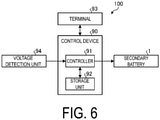
- FIG. 6 is a block diagram illustrating a functional configuration of a secondary battery system according to a first embodiment.
- the secondary battery system 100 includes a voltage detection unit 94 in addition to the secondary battery 1 and the control device 90 described above.
- the voltage detection unit 94 detects a voltage value measured during charging of the secondary battery 1, and transmits information on the voltage value to the controller 91.
- the controller 91 controls the charging of the secondary battery 1 on the basis of the information sent from the voltage detection unit 94 and the configuration information stored in the storage unit 92.
- the controller 91 controls charging such that an upper limit of a charge amount [Ah] expressed by a total molar amount of the nickel compound in the active material 31 multiplied by a coefficient A ((total molar amount of nickel compound) x (coefficient A)) is within a range in which the charge amount [Ah] satisfies the following relational expression (1) and equations (2) and (3).
- C K is the molar concentration (mol ⁇ dm -3 ) of potassium ions dissolved in the alkaline aqueous solution 6
- Czn is the molar concentration (mol ⁇ dm -3 ) of the zinc component dissolved in the alkaline aqueous solution 6
- Mzn is the content (mol%) of the zinc component of the metal elements contained in the active material 31.
- the controller 91 can control the charging of the secondary battery 1 on the basis of an instruction from a terminal 93.
- the controller 91 controls charging in accordance with C K , Czn, and Mzn, and thereby the charging/discharging reaction between ⁇ -Ni(OH) 2 ⁇ ⁇ -NiOOH can be repeated at the cathode 2.
- the charging capacity can be improved over a long period of time.
- FIG. 7 is a diagram illustrating an example of a connection between electrodes of the secondary battery or the secondary battery system according to the first embodiment.
- the anodes 3A to 3C are connected in parallel through tabs 3A1 to 3C1.
- the cathodes 2A and 2B are connected in parallel through tabs 2A1, 2B1.
- a total of five electrodes are arranged with the anodes 3 and the cathodes 2 being alternately arranged, but the present embodiment is not limited thereto, and three or seven or more electrodes may be alternately arranged.
- the electrodes are arranged such that anodes 3 are present at both ends, but the present embodiment is not limited thereto, and the electrodes may be arranged such that cathodes 2 are present at both ends.
- the same number of anodes 3 and cathodes 2 may be alternately disposed so that one end is a cathode 2 and the other end is an anode 3. Additionally, one cathode 2 and one anode 3 may be disposed.
- FIG. 8 is a diagram illustrating an overview of a secondary battery system according to a second embodiment.
- the secondary battery 1 included in the secondary battery system 100A illustrated in FIG. 8 has the same configuration as that of the secondary battery 1 according to the first embodiment with the exception that a supply unit 14a and piping 15a, 16a are provided instead of the generation unit 9, the supply unit 14, and the piping 15, 16 illustrated in FIG. 1 .
- the supply unit 14a supplies an alkaline aqueous solution 6, in which a powder 7 is mixed, to a lower portion of the casing 17 through the piping 15a, the alkaline aqueous solution 6 being collected from the interior of the casing 17 through the piping 16a.
- the supply unit 14a is an example of a flow device.
- the supply unit 14a is, for example, a pump capable of transferring the alkaline aqueous solution 6.
- the secondary battery 1A is resistant to reduction in the power generation performance, which may be caused by leakage to the outside of the powder 7 and the alkaline aqueous solution 6.
- the alkaline aqueous solution 6 sent to the inside of the casing 17 is supplied to a charging/discharging reaction while flowing between the electrodes.
- an opening connected to the piping 16a is provided at an inner wall 10b facing the main surface of each electrode, that is, an opening is provided at an end portion in the Y-axis direction of the reaction unit 10.
- the present embodiment is not limited thereto, and the opening may be provided at the end portion in the X-axis direction.
- the supply unit 14a supplies, to the casing 17, the alkaline aqueous solution 6 in which the powder 7 is mixed.
- the present embodiment is not limited thereto, and the supply unit 14a supplies the alkaline aqueous solution 6 alone.
- a tank for temporarily storing the alkaline aqueous solution 6 in which the powder 7 is mixed may be provided midway along the piping 16a, for example, and the concentration of the complex ions dissolved in the alkaline aqueous solution 6 may be adjusted inside the tank.
- the present invention is not limited to the embodiments described above, and various modifications can be made without departing from the essential spirit of the present invention.
- the supply unit 14 or the supply unit 14a indicated as one example of a flow device was described as a mode for causing the alkaline aqueous solution 6 to flow.
- the present invention is not limited thereto, and may be configured without a flow device.
- the diaphragms 4, 5 were described as being arranged so as to sandwich the cathode 2 from both sides in the thickness direction.
- the diaphragms 4, 5 are not limited thereto, and may cover the cathode 2.
- the diaphragms 4, 5 do not necessarily have to be arranged therein.
Landscapes
- Chemical & Material Sciences (AREA)
- Chemical Kinetics & Catalysis (AREA)
- Electrochemistry (AREA)
- General Chemical & Material Sciences (AREA)
- Engineering & Computer Science (AREA)
- Manufacturing & Machinery (AREA)
- Battery Electrode And Active Subsutance (AREA)
- Secondary Cells (AREA)
- Filling, Topping-Up Batteries (AREA)
Applications Claiming Priority (2)
| Application Number | Priority Date | Filing Date | Title |
|---|---|---|---|
| JP2019086629 | 2019-04-26 | ||
| PCT/JP2020/017866 WO2020218594A1 (ja) | 2019-04-26 | 2020-04-24 | 二次電池および二次電池システム |
Publications (2)
| Publication Number | Publication Date |
|---|---|
| EP3961767A1 true EP3961767A1 (de) | 2022-03-02 |
| EP3961767A4 EP3961767A4 (de) | 2024-02-21 |
Family
ID=72942637
Family Applications (1)
| Application Number | Title | Priority Date | Filing Date |
|---|---|---|---|
| EP20794149.3A Withdrawn EP3961767A4 (de) | 2019-04-26 | 2020-04-24 | Sekundärbatterie und sekundärbatteriesystem |
Country Status (5)
| Country | Link |
|---|---|
| US (1) | US20220352557A1 (de) |
| EP (1) | EP3961767A4 (de) |
| JP (1) | JP7208366B2 (de) |
| CN (1) | CN113728468B (de) |
| WO (1) | WO2020218594A1 (de) |
Family Cites Families (13)
| Publication number | Priority date | Publication date | Assignee | Title |
|---|---|---|---|---|
| JP3239076B2 (ja) * | 1997-01-30 | 2001-12-17 | 三洋電機株式会社 | 密閉型アルカリ蓄電池 |
| US6228535B1 (en) * | 1998-08-17 | 2001-05-08 | Ovonic Battery Company, Inc. | Nickel hydroxide positive electrode material exhibiting improved conductivity and engineered activation energy |
| JP2003151569A (ja) * | 2001-11-08 | 2003-05-23 | Sony Corp | アルカリ亜鉛一次電池およびアルカリ亜鉛二次電池 |
| JP4321997B2 (ja) * | 2002-08-05 | 2009-08-26 | パナソニック株式会社 | アルカリ蓄電池用正極活物質ならびにそれを用いた正極およびアルカリ蓄電池 |
| CN1283022C (zh) * | 2003-03-10 | 2006-11-01 | 华南理工大学 | 锌镍二次电池及其制备方法 |
| JP5405167B2 (ja) * | 2009-03-26 | 2014-02-05 | 三洋電機株式会社 | アルカリ蓄電池システム |
| WO2011047105A1 (en) * | 2009-10-14 | 2011-04-21 | Research Foundation Of The City University Of New York | Nickel-zinc flow battery |
| JP6090673B2 (ja) * | 2012-09-28 | 2017-03-08 | 株式会社Gsユアサ | アルカリ蓄電池とアルカリ蓄電池用の正極材 |
| JP6213316B2 (ja) | 2014-03-12 | 2017-10-18 | 株式会社Gsユアサ | アルカリ蓄電池用の水酸化ニッケル水酸化ニッケルおよびアルカリ蓄電池 |
| WO2017183238A1 (ja) * | 2016-04-22 | 2017-10-26 | ソニー株式会社 | 充放電制御装置、充放電制御方法、電池パック、電子機器、電動車両、電動工具および電力貯蔵システム |
| US20200321661A1 (en) * | 2016-05-31 | 2020-10-08 | Kyocera Corporation | Zinc battery and zinc flow battery |
| JPWO2018117192A1 (ja) * | 2016-12-21 | 2019-10-31 | 京セラ株式会社 | フロー電池 |
| JP2018170231A (ja) * | 2017-03-30 | 2018-11-01 | 京セラ株式会社 | フロー電池 |
-
2020
- 2020-04-24 EP EP20794149.3A patent/EP3961767A4/de not_active Withdrawn
- 2020-04-24 WO PCT/JP2020/017866 patent/WO2020218594A1/ja not_active Ceased
- 2020-04-24 CN CN202080030152.XA patent/CN113728468B/zh active Active
- 2020-04-24 US US17/605,193 patent/US20220352557A1/en not_active Abandoned
- 2020-04-24 JP JP2021516315A patent/JP7208366B2/ja active Active
Also Published As
| Publication number | Publication date |
|---|---|
| WO2020218594A1 (ja) | 2020-10-29 |
| EP3961767A4 (de) | 2024-02-21 |
| CN113728468B (zh) | 2024-10-11 |
| CN113728468A (zh) | 2021-11-30 |
| JP7208366B2 (ja) | 2023-01-18 |
| JPWO2020218594A1 (de) | 2020-10-29 |
| US20220352557A1 (en) | 2022-11-03 |
Similar Documents
| Publication | Publication Date | Title |
|---|---|---|
| JP7109315B2 (ja) | フロー電池 | |
| EP3961767A1 (de) | Sekundärbatterie und sekundärbatteriesystem | |
| JP2019067637A (ja) | フロー電池 | |
| JP7248776B2 (ja) | 二次電池 | |
| US11228058B2 (en) | Flow battery, flow battery system, and control method | |
| JP2019102181A (ja) | フロー電池 | |
| JP7025243B2 (ja) | フロー電池 | |
| JP7590356B2 (ja) | 二次電池 | |
| JP2020004654A (ja) | 正極成形体、電池およびフロー電池 | |
| EP4024542A1 (de) | Sekundärbatterie, sekundärbatteriesystem und steuerungsverfahren | |
| WO2019151454A1 (ja) | フロー電池 | |
| JP2019121491A (ja) | フロー電池システムおよび制御方法 | |
| JP7000591B2 (ja) | 二次電池 | |
| JP2020057475A (ja) | 正極構造体およびフロー電池 | |
| JP6925937B2 (ja) | フロー電池 | |
| WO2021039998A1 (ja) | 二次電池 | |
| JP2020140913A (ja) | 正極構造体およびフロー電池 | |
| JP2019102179A (ja) | フロー電池 | |
| JP2020021565A (ja) | フロー電池 | |
| WO2021132690A1 (ja) | 二次電池 | |
| JP2021125305A (ja) | 二次電池 | |
| JP2019067636A (ja) | フロー電池 | |
| JP2020038754A (ja) | フロー電池 | |
| JP2019133860A (ja) | フロー電池 | |
| JP2019067632A (ja) | フロー電池 |
Legal Events
| Date | Code | Title | Description |
|---|---|---|---|
| STAA | Information on the status of an ep patent application or granted ep patent |
Free format text: STATUS: THE INTERNATIONAL PUBLICATION HAS BEEN MADE |
|
| PUAI | Public reference made under article 153(3) epc to a published international application that has entered the european phase |
Free format text: ORIGINAL CODE: 0009012 |
|
| STAA | Information on the status of an ep patent application or granted ep patent |
Free format text: STATUS: REQUEST FOR EXAMINATION WAS MADE |
|
| 17P | Request for examination filed |
Effective date: 20211021 |
|
| AK | Designated contracting states |
Kind code of ref document: A1 Designated state(s): AL AT BE BG CH CY CZ DE DK EE ES FI FR GB GR HR HU IE IS IT LI LT LU LV MC MK MT NL NO PL PT RO RS SE SI SK SM TR |
|
| DAV | Request for validation of the european patent (deleted) | ||
| DAX | Request for extension of the european patent (deleted) | ||
| P01 | Opt-out of the competence of the unified patent court (upc) registered |
Effective date: 20230505 |
|
| A4 | Supplementary search report drawn up and despatched |
Effective date: 20240117 |
|
| RIC1 | Information provided on ipc code assigned before grant |
Ipc: H01M 50/77 20210101ALI20240112BHEP Ipc: H01M 10/26 20060101ALI20240112BHEP Ipc: H01M 4/24 20060101ALI20240112BHEP Ipc: H01M 10/48 20060101ALI20240112BHEP Ipc: H01M 10/44 20060101ALI20240112BHEP Ipc: H01M 10/30 20060101ALI20240112BHEP Ipc: H01M 4/52 20100101AFI20240112BHEP |
|
| STAA | Information on the status of an ep patent application or granted ep patent |
Free format text: STATUS: EXAMINATION IS IN PROGRESS |
|
| 17Q | First examination report despatched |
Effective date: 20241202 |
|
| STAA | Information on the status of an ep patent application or granted ep patent |
Free format text: STATUS: THE APPLICATION HAS BEEN WITHDRAWN |
|
| 18W | Application withdrawn |
Effective date: 20250321 |