EP3961776A1 - Procédé de production de membrane électrolytique solide, procédé de production de batterie entièrement solide, appareil de production de membrane électrolytique solide et appareil de production de batterie entièrement solide - Google Patents
Procédé de production de membrane électrolytique solide, procédé de production de batterie entièrement solide, appareil de production de membrane électrolytique solide et appareil de production de batterie entièrement solide Download PDFInfo
- Publication number
- EP3961776A1 EP3961776A1 EP20794341.6A EP20794341A EP3961776A1 EP 3961776 A1 EP3961776 A1 EP 3961776A1 EP 20794341 A EP20794341 A EP 20794341A EP 3961776 A1 EP3961776 A1 EP 3961776A1
- Authority
- EP
- European Patent Office
- Prior art keywords
- solid electrolyte
- woven fabric
- solid
- electrolyte membrane
- state battery
- Prior art date
- Legal status (The legal status is an assumption and is not a legal conclusion. Google has not performed a legal analysis and makes no representation as to the accuracy of the status listed.)
- Pending
Links
Images







Classifications
-
- H—ELECTRICITY
- H01—ELECTRIC ELEMENTS
- H01M—PROCESSES OR MEANS, e.g. BATTERIES, FOR THE DIRECT CONVERSION OF CHEMICAL ENERGY INTO ELECTRICAL ENERGY
- H01M10/00—Secondary cells; Manufacture thereof
- H01M10/05—Accumulators with non-aqueous electrolyte
- H01M10/058—Construction or manufacture
- H01M10/0585—Construction or manufacture of accumulators having only flat construction elements, i.e. flat positive electrodes, flat negative electrodes and flat separators
-
- B—PERFORMING OPERATIONS; TRANSPORTING
- B29—WORKING OF PLASTICS; WORKING OF SUBSTANCES IN A PLASTIC STATE IN GENERAL
- B29C—SHAPING OR JOINING OF PLASTICS; SHAPING OF MATERIAL IN A PLASTIC STATE, NOT OTHERWISE PROVIDED FOR; AFTER-TREATMENT OF THE SHAPED PRODUCTS, e.g. REPAIRING
- B29C48/00—Extrusion moulding, i.e. expressing the moulding material through a die or nozzle which imparts the desired form; Apparatus therefor
- B29C48/25—Component parts, details or accessories; Auxiliary operations
- B29C48/36—Means for plasticising or homogenising the moulding material or forcing it through the nozzle or die
-
- D—TEXTILES; PAPER
- D01—NATURAL OR MAN-MADE THREADS OR FIBRES; SPINNING
- D01D—MECHANICAL METHODS OR APPARATUS IN THE MANUFACTURE OF ARTIFICIAL FILAMENTS, THREADS, FIBRES, BRISTLES OR RIBBONS
- D01D5/00—Formation of filaments, threads, or the like
- D01D5/0007—Electro-spinning
- D01D5/0015—Electro-spinning characterised by the initial state of the material
- D01D5/0023—Electro-spinning characterised by the initial state of the material the material being a polymer melt
-
- D—TEXTILES; PAPER
- D01—NATURAL OR MAN-MADE THREADS OR FIBRES; SPINNING
- D01D—MECHANICAL METHODS OR APPARATUS IN THE MANUFACTURE OF ARTIFICIAL FILAMENTS, THREADS, FIBRES, BRISTLES OR RIBBONS
- D01D5/00—Formation of filaments, threads, or the like
- D01D5/0007—Electro-spinning
- D01D5/0015—Electro-spinning characterised by the initial state of the material
- D01D5/003—Electro-spinning characterised by the initial state of the material the material being a polymer solution or dispersion
- D01D5/0038—Electro-spinning characterised by the initial state of the material the material being a polymer solution or dispersion the fibre formed by solvent evaporation, i.e. dry electro-spinning
-
- D—TEXTILES; PAPER
- D01—NATURAL OR MAN-MADE THREADS OR FIBRES; SPINNING
- D01D—MECHANICAL METHODS OR APPARATUS IN THE MANUFACTURE OF ARTIFICIAL FILAMENTS, THREADS, FIBRES, BRISTLES OR RIBBONS
- D01D5/00—Formation of filaments, threads, or the like
- D01D5/0007—Electro-spinning
- D01D5/0061—Electro-spinning characterised by the electro-spinning apparatus
-
- D—TEXTILES; PAPER
- D01—NATURAL OR MAN-MADE THREADS OR FIBRES; SPINNING
- D01D—MECHANICAL METHODS OR APPARATUS IN THE MANUFACTURE OF ARTIFICIAL FILAMENTS, THREADS, FIBRES, BRISTLES OR RIBBONS
- D01D5/00—Formation of filaments, threads, or the like
- D01D5/0007—Electro-spinning
- D01D5/0061—Electro-spinning characterised by the electro-spinning apparatus
- D01D5/0076—Electro-spinning characterised by the electro-spinning apparatus characterised by the collecting device, e.g. drum, wheel, endless belt, plate or grid
- D01D5/0084—Coating by electro-spinning, i.e. the electro-spun fibres are not removed from the collecting device but remain integral with it, e.g. coating of prostheses
-
- D—TEXTILES; PAPER
- D01—NATURAL OR MAN-MADE THREADS OR FIBRES; SPINNING
- D01D—MECHANICAL METHODS OR APPARATUS IN THE MANUFACTURE OF ARTIFICIAL FILAMENTS, THREADS, FIBRES, BRISTLES OR RIBBONS
- D01D5/00—Formation of filaments, threads, or the like
- D01D5/0007—Electro-spinning
- D01D5/0061—Electro-spinning characterised by the electro-spinning apparatus
- D01D5/0092—Electro-spinning characterised by the electro-spinning apparatus characterised by the electrical field, e.g. combined with a magnetic fields, using biased or alternating fields
-
- D—TEXTILES; PAPER
- D04—BRAIDING; LACE-MAKING; KNITTING; TRIMMINGS; NON-WOVEN FABRICS
- D04H—MAKING TEXTILE FABRICS, e.g. FROM FIBRES OR FILAMENTARY MATERIAL; FABRICS MADE BY SUCH PROCESSES OR APPARATUS, e.g. FELTS, NON-WOVEN FABRICS; COTTON-WOOL; WADDING ; NON-WOVEN FABRICS FROM STAPLE FIBRES, FILAMENTS OR YARNS, BONDED WITH AT LEAST ONE WEB-LIKE MATERIAL DURING THEIR CONSOLIDATION
- D04H1/00—Non-woven fabrics formed wholly or mainly of staple fibres or like relatively short fibres
- D04H1/70—Non-woven fabrics formed wholly or mainly of staple fibres or like relatively short fibres characterised by the method of forming fleeces or layers, e.g. reorientation of fibres
- D04H1/72—Non-woven fabrics formed wholly or mainly of staple fibres or like relatively short fibres characterised by the method of forming fleeces or layers, e.g. reorientation of fibres the fibres being randomly arranged
- D04H1/728—Non-woven fabrics formed wholly or mainly of staple fibres or like relatively short fibres characterised by the method of forming fleeces or layers, e.g. reorientation of fibres the fibres being randomly arranged by electro-spinning
-
- D—TEXTILES; PAPER
- D06—TREATMENT OF TEXTILES OR THE LIKE; LAUNDERING; FLEXIBLE MATERIALS NOT OTHERWISE PROVIDED FOR
- D06M—TREATMENT, NOT PROVIDED FOR ELSEWHERE IN CLASS D06, OF FIBRES, THREADS, YARNS, FABRICS, FEATHERS OR FIBROUS GOODS MADE FROM SUCH MATERIALS
- D06M10/00—Physical treatment of fibres, threads, yarns, fabrics or fibrous goods made from such materials, e.g. by ultrasonic waves, corona discharge, irradiation, electric currents or magnetic fields; Physical treatment combined with treatment with chemical compounds or elements
- D06M10/005—Laser beam treatment
-
- H—ELECTRICITY
- H01—ELECTRIC ELEMENTS
- H01M—PROCESSES OR MEANS, e.g. BATTERIES, FOR THE DIRECT CONVERSION OF CHEMICAL ENERGY INTO ELECTRICAL ENERGY
- H01M10/00—Secondary cells; Manufacture thereof
- H01M10/05—Accumulators with non-aqueous electrolyte
- H01M10/052—Li-accumulators
- H01M10/0525—Rocking-chair batteries, i.e. batteries with lithium insertion or intercalation in both electrodes; Lithium-ion batteries
-
- H—ELECTRICITY
- H01—ELECTRIC ELEMENTS
- H01M—PROCESSES OR MEANS, e.g. BATTERIES, FOR THE DIRECT CONVERSION OF CHEMICAL ENERGY INTO ELECTRICAL ENERGY
- H01M10/00—Secondary cells; Manufacture thereof
- H01M10/05—Accumulators with non-aqueous electrolyte
- H01M10/056—Accumulators with non-aqueous electrolyte characterised by the materials used as electrolytes, e.g. mixed inorganic/organic electrolytes
- H01M10/0561—Accumulators with non-aqueous electrolyte characterised by the materials used as electrolytes, e.g. mixed inorganic/organic electrolytes the electrolyte being constituted of inorganic materials only
- H01M10/0562—Solid materials
-
- H—ELECTRICITY
- H01—ELECTRIC ELEMENTS
- H01M—PROCESSES OR MEANS, e.g. BATTERIES, FOR THE DIRECT CONVERSION OF CHEMICAL ENERGY INTO ELECTRICAL ENERGY
- H01M6/00—Primary cells; Manufacture thereof
- H01M6/14—Cells with non-aqueous electrolyte
- H01M6/18—Cells with non-aqueous electrolyte with solid electrolyte
- H01M6/187—Solid electrolyte characterised by the form
-
- H—ELECTRICITY
- H01—ELECTRIC ELEMENTS
- H01M—PROCESSES OR MEANS, e.g. BATTERIES, FOR THE DIRECT CONVERSION OF CHEMICAL ENERGY INTO ELECTRICAL ENERGY
- H01M6/00—Primary cells; Manufacture thereof
- H01M6/14—Cells with non-aqueous electrolyte
- H01M6/18—Cells with non-aqueous electrolyte with solid electrolyte
- H01M6/188—Processes of manufacture
-
- B—PERFORMING OPERATIONS; TRANSPORTING
- B29—WORKING OF PLASTICS; WORKING OF SUBSTANCES IN A PLASTIC STATE IN GENERAL
- B29D—PRODUCING PARTICULAR ARTICLES FROM PLASTICS OR FROM SUBSTANCES IN A PLASTIC STATE
- B29D99/00—Subject matter not provided for in other groups of this subclass
- B29D99/005—Producing membranes
-
- B—PERFORMING OPERATIONS; TRANSPORTING
- B29—WORKING OF PLASTICS; WORKING OF SUBSTANCES IN A PLASTIC STATE IN GENERAL
- B29K—INDEXING SCHEME ASSOCIATED WITH SUBCLASSES B29B, B29C OR B29D, RELATING TO MOULDING MATERIALS OR TO MATERIALS FOR MOULDS, REINFORCEMENTS, FILLERS OR PREFORMED PARTS, e.g. INSERTS
- B29K2023/00—Use of polyalkenes or derivatives thereof as moulding material
- B29K2023/04—Polymers of ethylene
- B29K2023/06—PE, i.e. polyethylene
-
- B—PERFORMING OPERATIONS; TRANSPORTING
- B29—WORKING OF PLASTICS; WORKING OF SUBSTANCES IN A PLASTIC STATE IN GENERAL
- B29K—INDEXING SCHEME ASSOCIATED WITH SUBCLASSES B29B, B29C OR B29D, RELATING TO MOULDING MATERIALS OR TO MATERIALS FOR MOULDS, REINFORCEMENTS, FILLERS OR PREFORMED PARTS, e.g. INSERTS
- B29K2023/00—Use of polyalkenes or derivatives thereof as moulding material
- B29K2023/10—Polymers of propylene
- B29K2023/12—PP, i.e. polypropylene
-
- B—PERFORMING OPERATIONS; TRANSPORTING
- B29—WORKING OF PLASTICS; WORKING OF SUBSTANCES IN A PLASTIC STATE IN GENERAL
- B29K—INDEXING SCHEME ASSOCIATED WITH SUBCLASSES B29B, B29C OR B29D, RELATING TO MOULDING MATERIALS OR TO MATERIALS FOR MOULDS, REINFORCEMENTS, FILLERS OR PREFORMED PARTS, e.g. INSERTS
- B29K2401/00—Use of cellulose, modified cellulose or cellulose derivatives, e.g. viscose, as filler
-
- B—PERFORMING OPERATIONS; TRANSPORTING
- B29—WORKING OF PLASTICS; WORKING OF SUBSTANCES IN A PLASTIC STATE IN GENERAL
- B29L—INDEXING SCHEME ASSOCIATED WITH SUBCLASS B29C, RELATING TO PARTICULAR ARTICLES
- B29L2031/00—Other particular articles
- B29L2031/755—Membranes, diaphragms
-
- D—TEXTILES; PAPER
- D10—INDEXING SCHEME ASSOCIATED WITH SUBLASSES OF SECTION D, RELATING TO TEXTILES
- D10B—INDEXING SCHEME ASSOCIATED WITH SUBLASSES OF SECTION D, RELATING TO TEXTILES
- D10B2321/00—Fibres made from polymers obtained by reactions only involving carbon-to-carbon unsaturated bonds
- D10B2321/02—Fibres made from polymers obtained by reactions only involving carbon-to-carbon unsaturated bonds polyolefins
- D10B2321/021—Fibres made from polymers obtained by reactions only involving carbon-to-carbon unsaturated bonds polyolefins polyethylene
-
- D—TEXTILES; PAPER
- D10—INDEXING SCHEME ASSOCIATED WITH SUBLASSES OF SECTION D, RELATING TO TEXTILES
- D10B—INDEXING SCHEME ASSOCIATED WITH SUBLASSES OF SECTION D, RELATING TO TEXTILES
- D10B2321/00—Fibres made from polymers obtained by reactions only involving carbon-to-carbon unsaturated bonds
- D10B2321/02—Fibres made from polymers obtained by reactions only involving carbon-to-carbon unsaturated bonds polyolefins
- D10B2321/022—Fibres made from polymers obtained by reactions only involving carbon-to-carbon unsaturated bonds polyolefins polypropylene
-
- H—ELECTRICITY
- H01—ELECTRIC ELEMENTS
- H01M—PROCESSES OR MEANS, e.g. BATTERIES, FOR THE DIRECT CONVERSION OF CHEMICAL ENERGY INTO ELECTRICAL ENERGY
- H01M2300/00—Electrolytes
- H01M2300/0017—Non-aqueous electrolytes
- H01M2300/0065—Solid electrolytes
- H01M2300/0068—Solid electrolytes inorganic
-
- H—ELECTRICITY
- H01—ELECTRIC ELEMENTS
- H01M—PROCESSES OR MEANS, e.g. BATTERIES, FOR THE DIRECT CONVERSION OF CHEMICAL ENERGY INTO ELECTRICAL ENERGY
- H01M2300/00—Electrolytes
- H01M2300/0088—Composites
-
- Y—GENERAL TAGGING OF NEW TECHNOLOGICAL DEVELOPMENTS; GENERAL TAGGING OF CROSS-SECTIONAL TECHNOLOGIES SPANNING OVER SEVERAL SECTIONS OF THE IPC; TECHNICAL SUBJECTS COVERED BY FORMER USPC CROSS-REFERENCE ART COLLECTIONS [XRACs] AND DIGESTS
- Y02—TECHNOLOGIES OR APPLICATIONS FOR MITIGATION OR ADAPTATION AGAINST CLIMATE CHANGE
- Y02E—REDUCTION OF GREENHOUSE GAS [GHG] EMISSIONS, RELATED TO ENERGY GENERATION, TRANSMISSION OR DISTRIBUTION
- Y02E60/00—Enabling technologies; Technologies with a potential or indirect contribution to GHG emissions mitigation
- Y02E60/10—Energy storage using batteries
-
- Y—GENERAL TAGGING OF NEW TECHNOLOGICAL DEVELOPMENTS; GENERAL TAGGING OF CROSS-SECTIONAL TECHNOLOGIES SPANNING OVER SEVERAL SECTIONS OF THE IPC; TECHNICAL SUBJECTS COVERED BY FORMER USPC CROSS-REFERENCE ART COLLECTIONS [XRACs] AND DIGESTS
- Y02—TECHNOLOGIES OR APPLICATIONS FOR MITIGATION OR ADAPTATION AGAINST CLIMATE CHANGE
- Y02P—CLIMATE CHANGE MITIGATION TECHNOLOGIES IN THE PRODUCTION OR PROCESSING OF GOODS
- Y02P70/00—Climate change mitigation technologies in the production process for final industrial or consumer products
- Y02P70/50—Manufacturing or production processes characterised by the final manufactured product
Definitions
- Patent Document 2 Japanese Unexamined Patent Application Publication No. 2017-103146 discloses a technology related to a solid electrolyte sheet and a method of manufacturing the same that can give excellent energy density and output characteristics to an all-solid-state battery and make it possible to produce a large number of all-solid-state batteries by the continuous process.
- the solid electrolyte sheet includes a solid electrolyte and a support, the support has a plurality of through holes, and the solid electrolyte is filled in the through holes.
- the method of manufacturing the solid electrolyte sheet includes a step of filling a plurality of through holes formed on the support with the solid electrolyte, and a step of pressing the support in which the through holes are filled with the solid electrolyte.
- the solid electrolyte glass particle powder containing elements such as Li and others is molded to form a sheet, and this sheet is applied to a solid electrolyte.
- the electrical conduction in the solid electrolyte formed only of the powder material is made by the contact between powders, the contact area becomes small and the output characteristics tend to be inferior to those of the lithium battery using the electrolytic solution.
- a powder material it is difficult to form a thin film sheet composed of a layer made of a single material, and the manufacturing process tends to be complicated.
- the solid electrolyte sheet (thickness: 37 to 138 ⁇ m) is manufactured by filling a plurality of through holes having a square shape with a side of 200 to 800 ⁇ m, which is formed by a photo-etching method in a polyimide sheet-like support, with a solid electrolyte, and then performing the heating and pressurizing process with a press machine.
- a wet etching method using a chromium-based solvent is used when penetrating the polyimide sheet serving as a support, a harmful organic solvent is used, which poses serious cost and environmental problems.
- An apparatus for manufacturing a solid electrolyte membrane described in an embodiment disclosed in this application includes: an extruder; a non-woven fabric manufacturing machine; and an all-solid-state battery laminate manufacturing machine, the extruder kneads a resin while melting it, the non-woven fabric manufacturing machine forms a non-woven fabric by making the resin fibrous, and the all-solid-state battery laminate manufacturing machine forms a solid electrolyte membrane by applying a slurry containing solid electrolyte particles onto the non-woven fabric and drying and pressurizing the slurry.
- An apparatus for manufacturing an all-solid-state battery described in an embodiment disclosed in this application includes: an extruder; a non-woven fabric manufacturing machine; and an all-solid-state battery laminate manufacturing machine, the extruder kneads a resin while melting it, the non-woven fabric manufacturing machine forms a non-woven fabric by making the resin fibrous, and the all-solid-state battery laminate manufacturing machine (a) forms a solid electrolyte membrane by applying a slurry containing solid electrolyte particles onto the non-woven fabric and drying and pressurizing the slurry on the non-woven fabric and (b) forms a positive electrode member on one surface of the solid electrolyte membrane and forms a negative electrode member on the other surface of the solid electrolyte membrane.
- FIG. 1 is a cross-sectional view schematically showing a configuration of an all-solid-state battery according to an embodiment.
- This all-solid-state battery is a lithium ion secondary battery.
- the all-solid-state battery means a battery that does not include at least an electrolytic solution (liquid electrolyte).
- the lithium ion secondary battery according to the present embodiment includes a negative electrode 20, a positive electrode 30, and a solid electrolyte membrane (solid electrolyte layer) 40 arranged therebetween.
- the negative electrode 20 has a negative electrode mixture layer 20A and a negative electrode current collector 20B.
- the negative electrode mixture layer 20A has a negative electrode active material 2AP and a solid electrolyte material (solid electrolyte material for negative electrode). Further, the negative electrode mixture layer 20A may have a negative electrode conductive assistant, a negative electrode binder, and the like.
- the negative electrode current collector 20B is made of, for example, metal foil (for example, copper foil).
- the positive electrode 30 has a positive electrode mixture layer 30A and a positive electrode current collector 30B.
- the positive electrode mixture layer 30A has a positive electrode active material 3AP and a solid electrolyte material (solid electrolyte material for positive electrode). Further, the positive electrode mixture layer 30A may have a positive electrode conductive assistant, a positive electrode binder, and the like.
- the positive electrode current collector 30B is made of, for example, metal foil (for example, aluminum foil).
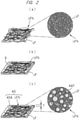
- the characteristics of the solid electrolyte membrane 40 can be improved by using the configuration in which the solid electrolyte material (particles) is incorporated in the ultrafine fiber non-woven fabric UFN used as a support as described above. Specifically, by supporting (fixing) the solid electrolyte material, which is fine particles, with the ultrafine fiber UF, the ratio of the solid electrolyte material in the solid electrolyte membrane 40 can be increased, and the occupied area (exposed area) of the solid electrolyte material on the surface of the membrane can be increased.
- the solid electrolyte material which is fine particles
- the ultrafine fiber UF the solid electrolyte material
- the solid electrolyte material can be firmly fixed, and the solid electrolyte material can be prevented from falling off or collapsing. Further, it is also possible to increase the strength of the solid electrolyte membrane.
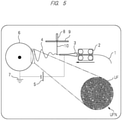
- the raw material resin 1 extruded from the nozzle 3 is irradiated with the laser 10 in the state of applying a high voltage between the nozzle 3 and the collector 6 by the high voltage generation source 5, the raw material resin 1 is instantaneously and uniformly heated and melted, stretched by electrostatic force to become the ultrafine fiber UF, and collected on the collector 6.
- the non-woven fabric (fiber web) UFN can be obtained by laminating the ultrafine fibers UF while being entwined with each other.
- the raw material resin include polyolefins such as polyethylene, high-density polyethylene, polypropylene, and polymethylpentene, polyesters such as polyethylene terephthalate (PET) and polybutylene terephthalate (PBT), polyvinylidene fluoride (PVDF), polyamide, and polyphenylene sulfide. It is preferable to use polyethylene, high-density polyethylene, or polypropylene as the raw material resin. In particular, by using high-density polyethylene (HDPE), the ultrafine fiber non-woven fabric having high strength and high heat resistance can be formed.
- HDPE high-density polyethylene
- CeNF is fine powdered cellulose.
- Cellulose (Cell-OH) is a carbohydrate represented by (C 6 H 10 O 5 ) n .
- CeNF is made from pulp or the like as a raw material and is obtained by micronizing the cellulose fibers contained in the pulp or the like to a nanometer size.
- the product obtained by hydrolyzing pulp can be used as cellulose nanofiber.
- the portion where the molecular chains of cellulose are densely and regularly present is sometimes referred to as crystalline cellulose.
- the shape of the powdered cellulose fiber constituting the cellulose nanofiber is not limited, and for example, the powdered cellulose fiber having an elongated particle shape or a substantially spherical shape can be used.
- Cellulose nanofiber is lightweight, has high strength, and has heat resistance. Therefore, by adding it to the raw material resin, the strength and heat resistance of the ultrafine fiber and the ultrafine fiber non-woven fabric can be improved.
- Cellulose may be nano-sized by a defibering treatment (micronizing treatment).
- the defibering treatment includes a chemical treatment method and a mechanical treatment method. These methods may be used in combination. By such a defibering treatment (micronizing treatment), the fiber length and the fiber diameter can be reduced.
- the cellulose nanofiber (CeNF) to be added to the raw material resin preferably has a fiber length (L) of 0.5 ⁇ m or more and 10 ⁇ m or less and a fiber diameter (R) of 0.001 ⁇ m or more and 10 ⁇ m or less. Also, it is preferable that the fiber length (L) and the fiber diameter (R) are smaller than at least the ultrafine fiber diameter R.
- the ultrafine fiber to be formed becomes finer and more uniform. It is conceivable that this is because the hydroxyl group (-OH) of cellulose is a polar group, so that the fiber is easily attracted by the electrostatic force of the collector 6 and becomes finer and more uniform, that is, the stretching effect is increased.
- the fiber diameter of the ultrafine fiber obtained by the LES method can be made finer and more uniform. Further, the pore diameter of the ultrafine fiber non-woven fabric obtained by the LES method can be made finer and more uniform.
- the solid electrolyte membrane 40 in which the solid electrolyte material (solid electrolyte particles 4AP) is incorporated in the fine pores of the ultrafine fiber non-woven fabric UFN in which the ultrafine fibers UF are mutually entwined to be laminated ( FIG. 2(c) ).
- the solid electrolyte membrane 40 can be formed by a simple process and at low cost.
- the characteristics (thickness, fiber diameter, pore diameter, etc.) of the ultrafine fiber non-woven fabric can be easily adjusted by adjusting the processing conditions (applied voltage, distance between the nozzle and the laser irradiation unit, processing time, etc.).
- the volume ratio of the non-woven fabric serving as the support to the solid electrolyte membrane can be suppressed, and can be set to, for example, 10 vol% or more and 30 vol% or less.
- the characteristics of the solid electrolyte membrane can be improved.
- a fiber web (also referred to as non-woven fabric, fiber bundle, or fiber sheet) of HDPE was fabricated by the laser electrospinning (LES) method.
- LES apparatus an electrospinning (ES) apparatus manufactured by Kato Tech Co., Ltd. and a carbon dioxide laser generator (PIN-30R) manufactured by Onizuka Glass Co., Ltd were used in combination.
- ES electrospinning
- PIN-30R carbon dioxide laser generator
- the LES apparatus was covered with an enclosure box made of acrylic resin, and the atmosphere inside the enclosure box was maintained at a humidity of 10 to 30% RH by supplying dry air. In this way, it was possible to eliminate the influence of humidity during fiber formation.
- the wavelength of the CO 2 laser beam was 10.6 ⁇ m, and the laser beam horizontally emitted from the apparatus was reflected by a mirror and the raw material resin directly below the mirror was irradiated with the laser beam.
- the cross-section of the laser beam at the time of emission was circular with a fiber diameter of 6 mm, and it was converted by a beam shape conversion element (expander) so as to have 2.1 mm in a fiber axis direction and 13 mm in a direction horizontal to the fiber axis at the irradiation portion.
- the irradiation diameter of the laser beam was set to about 1.1 mm in the fiber axis direction and about 8.0 mm in the vertical direction by using a slit.
- a fiber web of CeNF-added HDPE was fabricated by the laser electrospinning (LES) method.
- LES laser electrospinning
- CeNF CeNF-added HDPE
- the amount of CeNF added to HDPE was 1 vol% (CeNF: 1 vol%, HDPE: 99 vol%), and CEOLUS FD101 (manufactured by Asahi Kasei Chemicals Co., Ltd.) was used as CeNF.
- FIG. 8 is a diagram (photograph) showing a state of a nozzle tip at the time of forming the fiber web of CeNF-added HDPE.
- FIG. 9 is a SEM photograph of the fiber web of CeNF-added HDPE. The fiber diameter of the fiber web of CeNF-added HDPE was 5 ⁇ m or less (about 4 ⁇ m).
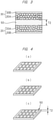
- FIG. 10 is a cross-sectional view showing a manufacturing process of an all-solid-state battery.
- the all-solid-state battery can be formed by inserting the electrode group into the battery case and sealing the battery case.
- the pressurizing process may be performed at once after the positive electrode active material 3AP and the like, the solid electrolyte membrane 40, the negative electrode active material 2AP and the like, and the negative electrode current collector 20B are sequentially stacked on the positive electrode current collector 30B.
- lithium ions are desorbed from the positive electrode active material 3AP of the positive electrode mixture layer 30A during the charging process, and lithium ions desorbed from the negative electrode active material 2AP of the negative electrode mixture layer 20A are inserted during the discharging process. In this way, charging and discharging can be performed by inserting and desorbing lithium ions.
- the solid electrolyte membrane 40 in which the solid electrolyte material (particles) is incorporated in the ultrafine fiber non-woven fabric UFN used as a support, it is possible to manufacture an all-solid-state battery having favorable characteristics. Specifically, as described above, by supporting (fixing) the solid electrolyte material, which is fine particles, with the ultrafine fiber UF, the ratio of the solid electrolyte material in the solid electrolyte membrane 40 can be increased, and the occupied area (exposed area) of the solid electrolyte material on the surface of the membrane can be increased.
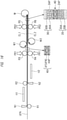
- FIG. 11 is a schematic diagram showing a configuration of a manufacturing apparatus (system) according to the present embodiment.
- FIG. 12 is a diagram showing a configuration of a twin-screw kneading extruder
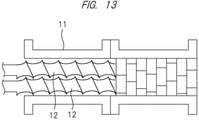
- FIG. 13 is a diagram showing a configuration of a part of the extruder
- FIG. 14 is a diagram showing a configuration of a screw.
- FIG. 15 is a diagram showing a configuration of a non-woven fabric manufacturing machine
- FIG. 16 is a diagram showing a configuration of an all-solid-state battery laminate manufacturing machine.
- CeNF can be added as a CeNF dispersion liquid.
- the CeNF the one described in the first embodiment can be used.
- the CeNF subjected to surface treatment may also be used. By performing the surface treatment in this way, the defibration properties of CeNF are improved and the affinity with the resin is also improved.
- the dispersion medium a material which is liquid at room temperature, for example, water, an organic solvent such as ethanol or toluene, and oil such as liquid paraffin or process oil is preferable.
- These dispersion media may be used alone or as a mixture of a plurality of these media.
- the concentration of the filler dispersion liquid is preferably 5 to 80 wt%, more preferably 10 to 60 wt%.
- an injection nozzle 160 for injecting the filler dispersion liquid is provided in a portion of the cylinder 11 corresponding to the kneading zone B, and a forced exhaust port 111 connected to a vacuum pump (deaeration device) 112 is provided in a portion of the cylinder 11 corresponding to the devolatilization zone C.
- a plunger pump (liquid addition pump) 17 is connected to the injection nozzle 160.
- thermoplastic resin supplied from the hopper 13 is melted in the plasticization zone A in the extruder EM and transferred to the kneading zone B. Then, after the filler dispersion liquid is injected into the molten resin from the injection nozzle 160, the molten resin and the filler dispersion liquid are mixed and kneaded, and then transferred to the devolatilization zone C. In the devolatilization zone C, the gasified dispersion medium is removed (exhausted) from the forced exhaust port 111, and the resin is extruded as a strand from the die 14.
- the ultrafine fiber to be formed becomes finer and more uniform. It is conceivable that this is because the hydroxyl group (-OH) of cellulose is a polar group, so that the fiber is easily attracted by the electrostatic force of the collector 6 and becomes finer and more uniform, that is, the stretching effect is increased.
- FIG. 16 is a schematic diagram showing a configuration of an all-solid-state battery laminate manufacturing machine.
- the all-solid-state battery laminate manufacturing machine includes rollers R1 and R2 that convey the non-woven fabric (fiber web) UFN manufactured by the laser electrospinning apparatus, nozzles N1 and N2 that apply the slurry onto the non-woven fabric (fiber web) UFN, and heaters H1 and H2 for drying the applied film (coated film) .
- a press PR1 (rollers R3 and R4) that pressurizes the applied film, a feeder W1 that sends out the positive electrode member onto one surface of the applied film, a feeder W2 that sends out the negative electrode member onto the other surface of the applied film, a press PR2 that pressurizes a laminated body of the applied film, the positive electrode member EL1, and the negative electrode member EL2, and a winding machine W that winds the laminated body after pressurization.
- a press PR1 rollerers R3 and R4 that pressurizes the applied film
- a feeder W1 that sends out the positive electrode member onto one surface of the applied film
- a feeder W2 that sends out the negative electrode member onto the other surface of the applied film
- a press PR2 that pressurizes a laminated body of the applied film, the positive electrode member EL1, and the negative electrode member EL2, and a winding machine W that winds the laminated body after pressurization.
- the applied films on both surfaces of the non-woven fabric (fiber web) UFN are pressurized by the press PR1 composed of the rollers R3 and R4.
- the liquid component of the slurry is vaporized and the solid electrolyte material (solid electrolyte particles 4AP) is embedded (filled) in the fine pores of the ultrafine fiber non-woven fabric UFN, so that the solid electrolyte membrane 40 in which the solid electrolyte material (solid electrolyte particles 4AP) is incorporated in the fine pores of the ultrafine fiber non-woven fabric UFN in which the ultrafine fibers UF are entwined to be laminated can be formed (see also FIG. 2(c) ).
- the laminated body of the positive electrode member EL1, the solid electrolyte membrane 40, and the negative electrode member EL2 is pressurized by the press PR2, and the pressurized laminated body is wound around the winding machine W.
- the solid electrolyte membrane 40 and the laminated body of the positive electrode member EL1, the solid electrolyte membrane 40, and the negative electrode member EL2 can be efficiently manufactured.
- the slurry containing the solid electrolyte material is applied to one surface of the ultrafine fiber non-woven fabric UFN, but the slurry containing the solid electrolyte material may be applied to both surfaces of the ultrafine fiber non-woven fabric UFN. Further, in the second embodiment ( FIG. 17 ), the slurry containing the solid electrolyte material may be applied to one surface of the ultrafine fiber non-woven fabric UFN by omitting the nozzle N2 and the heater H2.
- the positive electrode member and the negative electrode member are laminated with the solid electrolyte membrane 40 by a feeder.
- the laminated body of the positive electrode member EL1, the solid electrolyte membrane 40, and the negative electrode member EL2 may be formed by forming the mixture layer by applying and drying the slurry containing the active material and the solid electrolyte material on the solid electrolyte membrane 40, and further laminating the current collector on the mixture layer.
- filler for example, natural materials such as ramie, jute, kenaf, bamboo, and bagasse, carbon materials such as carbon fiber, carbon nanofiber, carbon nanotube, fullerene, and carbon black, and mineral materials such as glass, calcium carbonate, titanium dioxide, and talc can be used in addition to cellulose containing CeNF.
- a filler subjected to surface treatment may also be used.
- the strand may be cooled by a strand bath and sequentially cut into pellets by a strand cutter (cutting device). Then, after the pellets are melted to form strands having a desired diameter, the strand may be processed by the non-woven fabric manufacturing machine (S2).
- FIG. 18 is a diagram showing a configuration of an all-solid-state battery laminate manufacturing machine according to the application example 6. For example, after applying the slurry onto the front surface of the non-woven fabric (UFN) by the nozzle N1a and applying the slurry onto the back surface of the non-woven fabric (UFN) by the nozzle N1b, the slurry is heated by the heater H1 and is pressurized by the rollers R3 and R4.
- FIG. 19 is a diagram showing a configuration of an all-solid-state battery laminate manufacturing machine according to the application example 7. For example, after applying the slurry onto the front surface of the non-woven fabric (UFN) by the nozzle N1a and applying the slurry onto the back surface of the non-woven fabric (UFN) by the nozzle N1b, the slurry is heated by the heater H1 and is pressurized by the rollers R3 and R4.
- a secondary battery has been described as an example of a lithium battery, but the present invention can be applied also to a primary battery.
- a lithium battery has been described as an example, but the present invention can be applied also to other all-solid-state batteries.
- CeNF having hydroxyl group (-OH) has been described as an example of a polar filler, but other fillers having a polar group may be used. Both an organic filler and an inorganic filler may be used as the filler.
Landscapes
- Engineering & Computer Science (AREA)
- Chemical & Material Sciences (AREA)
- Manufacturing & Machinery (AREA)
- Chemical Kinetics & Catalysis (AREA)
- General Chemical & Material Sciences (AREA)
- Electrochemistry (AREA)
- Textile Engineering (AREA)
- Mechanical Engineering (AREA)
- Physics & Mathematics (AREA)
- Condensed Matter Physics & Semiconductors (AREA)
- Inorganic Chemistry (AREA)
- General Physics & Mathematics (AREA)
- Dispersion Chemistry (AREA)
- Materials Engineering (AREA)
- Optics & Photonics (AREA)
- Secondary Cells (AREA)
- Primary Cells (AREA)
- Cell Separators (AREA)
- Battery Electrode And Active Subsutance (AREA)
Applications Claiming Priority (2)
| Application Number | Priority Date | Filing Date | Title |
|---|---|---|---|
| JP2019085279A JP7390635B2 (ja) | 2019-04-26 | 2019-04-26 | 固体電解質膜の製造方法、全固体電池の製造方法、固体電解質膜の製造装置および全固体電池の製造装置 |
| PCT/JP2020/017501 WO2020218422A1 (fr) | 2019-04-26 | 2020-04-23 | Procédé de production de membrane électrolytique solide, procédé de production de batterie entièrement solide, appareil de production de membrane électrolytique solide et appareil de production de batterie entièrement solide |
Publications (2)
| Publication Number | Publication Date |
|---|---|
| EP3961776A1 true EP3961776A1 (fr) | 2022-03-02 |
| EP3961776A4 EP3961776A4 (fr) | 2024-12-25 |
Family
ID=72942792
Family Applications (1)
| Application Number | Title | Priority Date | Filing Date |
|---|---|---|---|
| EP20794341.6A Pending EP3961776A4 (fr) | 2019-04-26 | 2020-04-23 | Procédé de production de membrane électrolytique solide, procédé de production de batterie entièrement solide, appareil de production de membrane électrolytique solide et appareil de production de batterie entièrement solide |
Country Status (7)
| Country | Link |
|---|---|
| US (2) | US12087911B2 (fr) |
| EP (1) | EP3961776A4 (fr) |
| JP (1) | JP7390635B2 (fr) |
| KR (1) | KR102861903B1 (fr) |
| CN (1) | CN114207887B (fr) |
| TW (1) | TWI878288B (fr) |
| WO (1) | WO2020218422A1 (fr) |
Families Citing this family (11)
| Publication number | Priority date | Publication date | Assignee | Title |
|---|---|---|---|---|
| US11807957B2 (en) * | 2020-05-22 | 2023-11-07 | University Of Dayton Research Institute | Creating defined electrospun fiber geometries |
| JPWO2022168409A1 (fr) * | 2021-02-08 | 2022-08-11 | ||
| CN113675480A (zh) * | 2021-07-19 | 2021-11-19 | 华南理工大学 | 一种具有“三明治”结构的锂离子电池电芯、电堆及其制备方法 |
| JP7155360B1 (ja) | 2021-08-02 | 2022-10-18 | 株式会社日本製鋼所 | 反応装置、反応システム、材料製造システム、電池用材料製造システム、電池製造システム、反応生成物製造方法、電池用材料製造方法および電池製造方法 |
| JP7524873B2 (ja) | 2021-09-27 | 2024-07-30 | トヨタ自動車株式会社 | 全固体電池 |
| JP7524872B2 (ja) | 2021-09-27 | 2024-07-30 | トヨタ自動車株式会社 | 全固体電池 |
| JP7524874B2 (ja) | 2021-09-27 | 2024-07-30 | トヨタ自動車株式会社 | 全固体電池 |
| US12492506B2 (en) * | 2023-06-13 | 2025-12-09 | The Boeing Company | Fabricating methods and apparatuses for a multilayered, nanoparticle-coated fiber material |
| CN117059914B (zh) * | 2023-07-12 | 2024-06-14 | 苏州大学 | 一种耐高低温的整体化锌离子纤维电池及其制备方法 |
| KR20250081514A (ko) * | 2023-11-29 | 2025-06-05 | 삼성에스디아이 주식회사 | 전고체 전지 |
| WO2025144916A1 (fr) * | 2023-12-29 | 2025-07-03 | Saint-Gobain Ceramics & Plastics, Inc. | Structure comprenant un matériau d'électrolyte solide et un matériau organique et procédés de formation |
Family Cites Families (30)
| Publication number | Priority date | Publication date | Assignee | Title |
|---|---|---|---|---|
| JPH07335217A (ja) * | 1994-06-07 | 1995-12-22 | Fuji Elelctrochem Co Ltd | 非水電解質二次電池 |
| JPH07335218A (ja) * | 1994-06-07 | 1995-12-22 | Fuji Elelctrochem Co Ltd | 非水電解質二次電池 |
| JPH07335216A (ja) * | 1994-06-07 | 1995-12-22 | Fuji Elelctrochem Co Ltd | 非水電解質二次電池 |
| US6288144B1 (en) * | 1999-04-20 | 2001-09-11 | Uniroyal Chemical Company, Inc. | Processing of coupled, filled polyolefins |
| JP4876252B2 (ja) * | 2006-02-28 | 2012-02-15 | 国立大学法人信州大学 | 極細繊維の製造方法 |
| JP5311455B2 (ja) | 2008-06-11 | 2013-10-09 | 国立大学法人福井大学 | 紡糸方法並びにそれを用いた繊維製造方法及び装置 |
| WO2010039865A2 (fr) | 2008-10-01 | 2010-04-08 | Cornell University | Système biodégradable d'administration d'agent chimique |
| JP5433285B2 (ja) | 2009-04-10 | 2014-03-05 | 出光興産株式会社 | 固体電解質シート及びリチウム二次電池 |
| ES2369811B1 (es) | 2010-05-04 | 2012-10-15 | Consejo Superior De Investigaciones Científicas (Csic) | Procedimiento de obtención de materiales nanocompuestos. |
| JP5462227B2 (ja) * | 2011-09-07 | 2014-04-02 | 株式会社日本製鋼所 | セルロースナノファイバー入りポリオレフィン微多孔延伸フィルムの製造方法及びセルロースナノファイバー入りポリオレフィン微多孔延伸フィルム及び非水二次電池用セパレータ |
| US20140121307A1 (en) * | 2012-10-30 | 2014-05-01 | Cyclewood Solutions, Inc. | Blending lignin with thermoplastics and a coupling agent or compatibilizer |
| JP2014143006A (ja) | 2013-01-22 | 2014-08-07 | Daicel Corp | セルロース含有複合シート並びに固体電解質膜 |
| JP5785574B2 (ja) | 2013-02-22 | 2015-09-30 | 出光興産株式会社 | リチウム電池用固体電解質シート、その製造方法、及びそれを用いた全固体二次電池 |
| JP2015161051A (ja) * | 2014-02-28 | 2015-09-07 | 東レ株式会社 | ナノファイバーの製造方法およびナノファイバー |
| JP6496120B2 (ja) * | 2014-10-20 | 2019-04-03 | 株式会社ダイセル | 高融点樹脂ファイバー及び不織布 |
| JP7127235B2 (ja) | 2015-12-03 | 2022-08-31 | 地方独立行政法人大阪産業技術研究所 | 固体電解質シート及びその製造方法、全固体電池、並びに全固体電池の製造方法 |
| JP6647113B2 (ja) * | 2016-03-31 | 2020-02-14 | 日立造船株式会社 | 全固体二次電池の製造方法 |
| KR101804222B1 (ko) | 2016-03-03 | 2018-01-10 | (주)태림기연 | 원격제어가 가능한 폐 pet병 압착기 |
| JP2017183111A (ja) | 2016-03-30 | 2017-10-05 | 旭化成株式会社 | セパレータおよびその製造方法 |
| WO2017179494A1 (fr) | 2016-04-11 | 2017-10-19 | 花王株式会社 | Procédé de production de fibre ultrafine |
| EP3553868B1 (fr) | 2017-05-15 | 2022-09-14 | LG Energy Solution, Ltd. | Procédé de fabrication d'une membrane électrolytique solide pour batterie à électrolyte tout solide et membrane électrolytique solide fabriquée par ce procédé |
| JP6928345B2 (ja) | 2017-06-02 | 2021-09-01 | 国立大学法人京都工芸繊維大学 | 繊維シートの製造方法 |
| US10734673B2 (en) | 2017-06-23 | 2020-08-04 | GM Global Technology Operations LLC | Ionically-conductive reinforced glass ceramic separators/solid electrolytes |
| WO2019065066A1 (fr) | 2017-09-28 | 2019-04-04 | 富士フイルム株式会社 | Composition d'électrolyte solide, feuille contenant un électrolyte solide, pile rechargeable tout solide, procédé de production de feuille contenant un électrolyte solide, et procédé de production de pile rechargeable tout solide |
| KR102598712B1 (ko) | 2018-02-01 | 2023-11-06 | 삼성전자주식회사 | 다공성막, 이를 포함하는 세퍼레이터, 이를 포함하는 전기화학 소자, 및 다공성막 제조방법 |
| JP6889125B2 (ja) | 2018-03-16 | 2021-06-18 | 株式会社東芝 | セパレータ、電極群、二次電池、電池パック、車両、及び定置用電源 |
| JP6498335B2 (ja) | 2018-03-19 | 2019-04-10 | 古河機械金属株式会社 | 固体電解質シート、全固体型リチウムイオン電池、および固体電解質シートの製造方法 |
| JP7014900B2 (ja) | 2018-04-27 | 2022-02-01 | 富士フイルム株式会社 | 固体電解質含有シート、全固体二次電池用電極シート、全固体二次電池、電子機器及び電気自動車、並びに、これらの製造方法 |
| CN109244327A (zh) | 2018-09-25 | 2019-01-18 | 合肥先杰新能源科技有限公司 | 锂离子电池复合隔膜的制备方法 |
| CN109494390A (zh) * | 2018-10-30 | 2019-03-19 | 溧阳天目先导电池材料科技有限公司 | 一种改性固态电解质膜及其制备方法和锂电池 |
-
2019
- 2019-04-26 JP JP2019085279A patent/JP7390635B2/ja active Active
-
2020
- 2020-04-23 KR KR1020217036943A patent/KR102861903B1/ko active Active
- 2020-04-23 TW TW109113635A patent/TWI878288B/zh active
- 2020-04-23 US US17/594,650 patent/US12087911B2/en active Active
- 2020-04-23 EP EP20794341.6A patent/EP3961776A4/fr active Pending
- 2020-04-23 WO PCT/JP2020/017501 patent/WO2020218422A1/fr not_active Ceased
- 2020-04-23 CN CN202080030604.4A patent/CN114207887B/zh active Active
-
2024
- 2024-08-02 US US18/792,996 patent/US20240396092A1/en active Pending
Also Published As
| Publication number | Publication date |
|---|---|
| TWI878288B (zh) | 2025-04-01 |
| EP3961776A4 (fr) | 2024-12-25 |
| US20220181703A1 (en) | 2022-06-09 |
| KR20220002371A (ko) | 2022-01-06 |
| US20240396092A1 (en) | 2024-11-28 |
| CN114207887B (zh) | 2024-02-13 |
| TW202111989A (zh) | 2021-03-16 |
| CN114207887A (zh) | 2022-03-18 |
| WO2020218422A1 (fr) | 2020-10-29 |
| JP7390635B2 (ja) | 2023-12-04 |
| KR102861903B1 (ko) | 2025-09-19 |
| US12087911B2 (en) | 2024-09-10 |
| JP2020181758A (ja) | 2020-11-05 |
Similar Documents
| Publication | Publication Date | Title |
|---|---|---|
| US20240396092A1 (en) | Method of manufacturing solid electrolyte membrane, method of manufacturing all-solid-state battery, apparatus for manufacturing solid electrolyte membrane, and apparatus for manufacturing all-solid-state battery | |
| Yu et al. | Advances in nonwoven-based separators for lithium-ion batteries | |
| CN102498592B (zh) | 非水类电池用隔板及使用其的非水类电池以及非水类电池用隔板的制造方法 | |
| EP2527504B1 (fr) | Tissu non tissé en fibre de carbone, fibres de carbone, procédé de fabrication du tissu non tissé en fibre de carbone, procédé de fabrication de fibres de carbone, électrode, batterie, et filtre | |
| US20260081304A1 (en) | Non-woven fabric, method of manufacturing non-woven fabric, solid electrolyte membrane, method of manufacturing solid electrolyte membrane, all-solid-state battery, and method of manufacturing all-solid-state battery | |
| CN103562447A (zh) | 碳纤维材料、碳纤维材料制造方法、具有所述碳纤维材料的材料 | |
| EP2557213B1 (fr) | Séparateur de batterie comprenant une feuille de nanofilaments de polyoléfine poreuse | |
| JP2013510389A5 (fr) | ||
| CN103493258A (zh) | 锂离子单元设计的设备与方法 | |
| JP2012178320A (ja) | 多孔質シート | |
| JP4034569B2 (ja) | 電気二重層コンデンサ用電極材の製造方法 | |
| Peng et al. | Electrospinning technology | |
| CN117661191B (zh) | 一种无纺布复合膜材料、制备方法及其应用 | |
| TW202332112A (zh) | 電化學裝置用合劑片之製造裝置及合劑片之製造方法 | |
| Luiso | Separators and Electrolytes for Next Generation Li-Ion Batteries | |
| WO2025086014A1 (fr) | Film autoportant et procédé de fabrication de particules discrètes dans un film autoportant | |
| WO2025111698A1 (fr) | Film d'électrode sèche fabriqué à l'aide d'électricité statique | |
| CN121625505A (zh) | 一种电池功能复合膜的挤出复合成型方法及产品 |
Legal Events
| Date | Code | Title | Description |
|---|---|---|---|
| STAA | Information on the status of an ep patent application or granted ep patent |
Free format text: STATUS: THE INTERNATIONAL PUBLICATION HAS BEEN MADE |
|
| PUAI | Public reference made under article 153(3) epc to a published international application that has entered the european phase |
Free format text: ORIGINAL CODE: 0009012 |
|
| STAA | Information on the status of an ep patent application or granted ep patent |
Free format text: STATUS: REQUEST FOR EXAMINATION WAS MADE |
|
| 17P | Request for examination filed |
Effective date: 20211025 |
|
| AK | Designated contracting states |
Kind code of ref document: A1 Designated state(s): AL AT BE BG CH CY CZ DE DK EE ES FI FR GB GR HR HU IE IS IT LI LT LU LV MC MK MT NL NO PL PT RO RS SE SI SK SM TR |
|
| DAV | Request for validation of the european patent (deleted) | ||
| DAX | Request for extension of the european patent (deleted) | ||
| REG | Reference to a national code |
Ref country code: DE Ref legal event code: R079 Free format text: PREVIOUS MAIN CLASS: H01M0006180000 Ipc: H01M0010056200 |
|
| A4 | Supplementary search report drawn up and despatched |
Effective date: 20241121 |
|
| RIC1 | Information provided on ipc code assigned before grant |
Ipc: H01M 10/0585 20100101ALI20241115BHEP Ipc: H01M 10/0562 20100101AFI20241115BHEP |