EP3961787A1 - Accumulateur à électrolyte liquide, en particulier une batterie au plomb - Google Patents
Accumulateur à électrolyte liquide, en particulier une batterie au plomb Download PDFInfo
- Publication number
- EP3961787A1 EP3961787A1 EP21178091.1A EP21178091A EP3961787A1 EP 3961787 A1 EP3961787 A1 EP 3961787A1 EP 21178091 A EP21178091 A EP 21178091A EP 3961787 A1 EP3961787 A1 EP 3961787A1
- Authority
- EP
- European Patent Office
- Prior art keywords
- electrode
- electrolyte
- reservoir
- lead
- counter
- Prior art date
- Legal status (The legal status is an assumption and is not a legal conclusion. Google has not performed a legal analysis and makes no representation as to the accuracy of the status listed.)
- Pending
Links
- 239000011244 liquid electrolyte Substances 0.000 title abstract description 3
- 239000003792 electrolyte Substances 0.000 claims abstract description 179
- 239000002253 acid Substances 0.000 claims abstract description 80
- 239000012530 fluid Substances 0.000 claims abstract description 68
- 238000009792 diffusion process Methods 0.000 claims abstract description 33
- 239000012528 membrane Substances 0.000 claims abstract description 31
- 238000013517 stratification Methods 0.000 claims abstract description 13
- 230000005484 gravity Effects 0.000 claims abstract description 12
- 230000004888 barrier function Effects 0.000 claims abstract description 11
- 239000007788 liquid Substances 0.000 claims description 89
- XLYOFNOQVPJJNP-UHFFFAOYSA-N water Substances O XLYOFNOQVPJJNP-UHFFFAOYSA-N 0.000 claims description 24
- 230000005764 inhibitory process Effects 0.000 claims description 13
- 238000000926 separation method Methods 0.000 claims description 11
- 238000000034 method Methods 0.000 claims description 7
- 238000003487 electrochemical reaction Methods 0.000 claims description 2
- 230000002829 reductive effect Effects 0.000 abstract description 7
- 230000032683 aging Effects 0.000 abstract description 5
- 230000036961 partial effect Effects 0.000 abstract description 3
- 239000007789 gas Substances 0.000 description 39
- 210000004379 membrane Anatomy 0.000 description 28
- NLXLAEXVIDQMFP-UHFFFAOYSA-N Ammonia chloride Chemical compound [NH4+].[Cl-] NLXLAEXVIDQMFP-UHFFFAOYSA-N 0.000 description 7
- 238000013461 design Methods 0.000 description 7
- QAOWNCQODCNURD-UHFFFAOYSA-N Sulfuric acid Chemical compound OS(O)(=O)=O QAOWNCQODCNURD-UHFFFAOYSA-N 0.000 description 5
- 230000008901 benefit Effects 0.000 description 5
- 230000000694 effects Effects 0.000 description 3
- 230000007246 mechanism Effects 0.000 description 3
- QAOWNCQODCNURD-UHFFFAOYSA-L Sulfate Chemical compound [O-]S([O-])(=O)=O QAOWNCQODCNURD-UHFFFAOYSA-L 0.000 description 2
- 239000011149 active material Substances 0.000 description 2
- 239000013543 active substance Substances 0.000 description 2
- TZCXTZWJZNENPQ-UHFFFAOYSA-L barium sulfate Chemical compound [Ba+2].[O-]S([O-])(=O)=O TZCXTZWJZNENPQ-UHFFFAOYSA-L 0.000 description 2
- 238000004891 communication Methods 0.000 description 2
- 125000004122 cyclic group Chemical group 0.000 description 2
- YADSGOSSYOOKMP-UHFFFAOYSA-N dioxolead Chemical compound O=[Pb]=O YADSGOSSYOOKMP-UHFFFAOYSA-N 0.000 description 2
- 238000012423 maintenance Methods 0.000 description 2
- 230000008092 positive effect Effects 0.000 description 2
- 230000001105 regulatory effect Effects 0.000 description 2
- KEQXNNJHMWSZHK-UHFFFAOYSA-L 1,3,2,4$l^{2}-dioxathiaplumbetane 2,2-dioxide Chemical compound [Pb+2].[O-]S([O-])(=O)=O KEQXNNJHMWSZHK-UHFFFAOYSA-L 0.000 description 1
- XUIMIQQOPSSXEZ-UHFFFAOYSA-N Silicon Chemical compound [Si] XUIMIQQOPSSXEZ-UHFFFAOYSA-N 0.000 description 1
- 238000006243 chemical reaction Methods 0.000 description 1
- 238000010276 construction Methods 0.000 description 1
- 238000005260 corrosion Methods 0.000 description 1
- 230000007797 corrosion Effects 0.000 description 1
- 230000001419 dependent effect Effects 0.000 description 1
- 238000003745 diagnosis Methods 0.000 description 1
- 238000007599 discharging Methods 0.000 description 1
- 238000005516 engineering process Methods 0.000 description 1
- 238000000605 extraction Methods 0.000 description 1
- 230000009969 flowable effect Effects 0.000 description 1
- 239000003349 gelling agent Substances 0.000 description 1
- 239000003365 glass fiber Substances 0.000 description 1
- 230000002401 inhibitory effect Effects 0.000 description 1
- 150000002500 ions Chemical class 0.000 description 1
- 230000000670 limiting effect Effects 0.000 description 1
- 230000007774 longterm Effects 0.000 description 1
- 238000005259 measurement Methods 0.000 description 1
- 238000003825 pressing Methods 0.000 description 1
- 230000002035 prolonged effect Effects 0.000 description 1
- 238000005204 segregation Methods 0.000 description 1
- RMAQACBXLXPBSY-UHFFFAOYSA-N silicic acid Chemical compound O[Si](O)(O)O RMAQACBXLXPBSY-UHFFFAOYSA-N 0.000 description 1
- 229910052710 silicon Inorganic materials 0.000 description 1
- 239000010703 silicon Substances 0.000 description 1
- 235000012239 silicon dioxide Nutrition 0.000 description 1
- 229910021653 sulphate ion Inorganic materials 0.000 description 1
- -1 sulphate ions Chemical class 0.000 description 1
- 239000001117 sulphuric acid Substances 0.000 description 1
- 239000006228 supernatant Substances 0.000 description 1
Images

Classifications
-
- H—ELECTRICITY
- H01—ELECTRIC ELEMENTS
- H01M—PROCESSES OR MEANS, e.g. BATTERIES, FOR THE DIRECT CONVERSION OF CHEMICAL ENERGY INTO ELECTRICAL ENERGY
- H01M10/00—Secondary cells; Manufacture thereof
- H01M10/06—Lead-acid accumulators
-
- H—ELECTRICITY
- H01—ELECTRIC ELEMENTS
- H01M—PROCESSES OR MEANS, e.g. BATTERIES, FOR THE DIRECT CONVERSION OF CHEMICAL ENERGY INTO ELECTRICAL ENERGY
- H01M10/00—Secondary cells; Manufacture thereof
- H01M10/20—Semi-lead accumulators, i.e. accumulators in which only one electrode contains lead
-
- H—ELECTRICITY
- H01—ELECTRIC ELEMENTS
- H01M—PROCESSES OR MEANS, e.g. BATTERIES, FOR THE DIRECT CONVERSION OF CHEMICAL ENERGY INTO ELECTRICAL ENERGY
- H01M10/00—Secondary cells; Manufacture thereof
- H01M10/42—Methods or arrangements for servicing or maintenance of secondary cells or secondary half-cells
- H01M10/4214—Arrangements for moving electrodes or electrolyte
-
- H—ELECTRICITY
- H01—ELECTRIC ELEMENTS
- H01M—PROCESSES OR MEANS, e.g. BATTERIES, FOR THE DIRECT CONVERSION OF CHEMICAL ENERGY INTO ELECTRICAL ENERGY
- H01M50/00—Constructional details or processes of manufacture of the non-active parts of electrochemical cells other than fuel cells, e.g. hybrid cells
- H01M50/60—Arrangements or processes for filling or topping-up with liquids; Arrangements or processes for draining liquids from casings
- H01M50/609—Arrangements or processes for filling with liquid, e.g. electrolytes
-
- H—ELECTRICITY
- H01—ELECTRIC ELEMENTS
- H01M—PROCESSES OR MEANS, e.g. BATTERIES, FOR THE DIRECT CONVERSION OF CHEMICAL ENERGY INTO ELECTRICAL ENERGY
- H01M50/00—Constructional details or processes of manufacture of the non-active parts of electrochemical cells other than fuel cells, e.g. hybrid cells
- H01M50/60—Arrangements or processes for filling or topping-up with liquids; Arrangements or processes for draining liquids from casings
- H01M50/673—Containers for storing liquids; Delivery conduits therefor
-
- H—ELECTRICITY
- H01—ELECTRIC ELEMENTS
- H01M—PROCESSES OR MEANS, e.g. BATTERIES, FOR THE DIRECT CONVERSION OF CHEMICAL ENERGY INTO ELECTRICAL ENERGY
- H01M50/00—Constructional details or processes of manufacture of the non-active parts of electrochemical cells other than fuel cells, e.g. hybrid cells
- H01M50/60—Arrangements or processes for filling or topping-up with liquids; Arrangements or processes for draining liquids from casings
- H01M50/673—Containers for storing liquids; Delivery conduits therefor
- H01M50/682—Containers for storing liquids; Delivery conduits therefor accommodated in battery or cell casings
-
- H—ELECTRICITY
- H01—ELECTRIC ELEMENTS
- H01M—PROCESSES OR MEANS, e.g. BATTERIES, FOR THE DIRECT CONVERSION OF CHEMICAL ENERGY INTO ELECTRICAL ENERGY
- H01M50/00—Constructional details or processes of manufacture of the non-active parts of electrochemical cells other than fuel cells, e.g. hybrid cells
- H01M50/70—Arrangements for stirring or circulating the electrolyte
-
- Y—GENERAL TAGGING OF NEW TECHNOLOGICAL DEVELOPMENTS; GENERAL TAGGING OF CROSS-SECTIONAL TECHNOLOGIES SPANNING OVER SEVERAL SECTIONS OF THE IPC; TECHNICAL SUBJECTS COVERED BY FORMER USPC CROSS-REFERENCE ART COLLECTIONS [XRACs] AND DIGESTS
- Y02—TECHNOLOGIES OR APPLICATIONS FOR MITIGATION OR ADAPTATION AGAINST CLIMATE CHANGE
- Y02E—REDUCTION OF GREENHOUSE GAS [GHG] EMISSIONS, RELATED TO ENERGY GENERATION, TRANSMISSION OR DISTRIBUTION
- Y02E60/00—Enabling technologies; Technologies with a potential or indirect contribution to GHG emissions mitigation
- Y02E60/10—Energy storage using batteries
Definitions
- the invention relates to a lead-acid battery with a liquid electrolyte, in particular a lead-acid battery.
- lead-acid batteries for example, lead is used as a negative active substance and lead dioxide as a positive active substance on the electrodes.
- the electrolyte dilute sulfuric acid, also serves to transport the ions between these two electrodes within the cell. In contrast to most other battery technologies, for example in a lead battery, the electrolyte also takes part in the reaction.
- the sulphate ions of the electrolyte are bound as lead sulphate in the active material during discharging (thus reducing the acid density) or released into the electrolyte during charging (the acid density increases).
- the electrodes are arranged with a vertical extension, so that in one direction in the horizontal one, in particular a repeated arrangement of electrode, electrolyte, counter-electrode is created.
- Electrolyte reservoirs with automatic refilling or constructions for balancing the amount of electrolyte or its level in different parts of the battery can also be provided, as known, for example, from US Pat DE 1 571 989 A1 , DE 2 402 920 A1 , DE 3 002 288 A1 , EP 1 665 415 B1 or CN 2011 12 471 Y .
- Another type of electrolyte tracking is for example from the DE 19 50 72 37 A1 famous.
- electrolyte replenishment is realized by using gravity and a mechanism that limits the replenishment of the electrolyte, and there is usually a non-liquid-filled space above the electrolyte above the electrodes, which would also be filled with electrolyte without the limiting mechanism and in which the electrolyte can usually spread freely, for example waves can hit the electrolyte, but the electrolyte cannot displace the remaining volume of air.
- the inventor has now surprisingly recognized that the electrolyte volume above the electrodes is disadvantageous, in particular for the aging behavior, and should be reduced.
- Acid stratification is a concentration gradient of electrolyte and/or acid concentration in the vertical direction. Due to gravity, this gradient is always directed in such a way that there is denser acid in the lower area because it has a higher density.
- the acid layering is caused, among other things, by an inhomogeneous current distribution in the electrodes and thus also on the surface of the active material. This is done for closed and sealed batteries. As practice shows, however, acid stratification occurs only to a very small extent. Measurements in the inventor's sealed batteries also showed that the presence of the electrolyte volume above the plates has significant effects on the structure of the acid stratification. During charging, for example, the acid density between the electrodes is increased.
- Acid stratification is much more pronounced in vented batteries and leads here, among other things, to accelerated aging. This is further promoted by the binding of the electrolyte.
- the object of the invention is therefore to specify a method or a battery in order to reduce acid stratification.
- the task is solved in particular by reducing the electrolyte volume directly above the electrodes. Nevertheless, automatic refilling, if possible by or solely by gravity, should remain possible.
- the electrolyte volume is in particular divided and these partial volumes are connected to one another with a strong diffusion barrier, for example by an only thin and/or long fluid connection path and/or an omni- or semi-permeable membrane.
- the quantity held available for automatic refilling can also be significantly increased, for example doubled, without any disadvantage. It is also possible in this case not to store the partial volume separated from the electrodes with electrolyte but also with another liquid which exclusively or predominantly contains the dissociating component of the electrolyte, for example only water.
- the structural design is similar to some known battery designs with an electrolyte refill supply.
- One difference is that not (only) a refilling of the used electrolyte should be made possible, but the extensive separation of the electrolyte between the electrodes and almost completely the amount of electrolyte standing above the electrodes and the amount of electrolyte standing directly above the electrodes is effected or the amount of liquid connected to it without inhibiting diffusion is reduced.
- the object is achieved in particular by a lead-acid battery according to claim 1, a use according to claim 13 and a method according to claim 14.
- the lead accumulator according to the invention is in particular a closed lead accumulator and/or lead-acid accumulator, in particular a battery. It has at least one electrode and at least one counter-electrode, which are arranged in an electrode space that also extends above the at least one electrode and the at least one counter-electrode.
- the lead-acid battery also has a flowable, in particular liquid, electrolyte which is arranged between and above the at least one electrode and at least one counter-electrode in the electrode chamber and which takes part in the electrochemical reaction of the lead-acid battery in particular.
- the lead-acid battery also has at least one reservoir, in particular exactly one reservoir, which is separate from the electrolyte in the electrode chamber and has a liquid supply, in particular an electrolyte or water supply.
- the reservoir and electrode space are arranged and have such a fluid connection that the liquid level in the reservoir is higher than the liquid level of the electrolyte in the electrode space.
- Underneath is to be understood in particular as being in a state in which the accumulator is oriented in the intended orientation and/or with gas discharge at the top and/or with vertically oriented electrodes and/or counter-electrodes and/or to be understood as being on the side facing away from the gas discharge of the electrolyte level.
- the fluid connection can, for example, be in the form of a line, for example a pipe and/or hose, and/or can be provided by a membrane.
- the minimum free cross-sectional area of the fluid connection represents the smallest cross-sectional area over its length and/or can represent a constriction in the fluid connection, for example if the cross-sectional area varies over the length of the fluid connection.
- the fluid connection can also have a constant cross-sectional area over its length.
- the fluid connection between the reservoir and the electrode chamber thus creates in particular a fluid connection that allows liquid to be refilled into the electrode chamber, in particular only by gravity, but inhibits the diffusion, at least of sulfate ions, especially compared to the case in which the liquid volume of the reservoir would be arranged directly and without separation on the electrolyte in the electrolyte space, namely with the imaginary continuation of the electrolyte space upwards, starting from the height of the electrolyte level in the electrode space with the cross section of the electrolyte space prevailing at this height.
- the object is also achieved by using a diffusion barrier in a lead-acid battery, the lead-acid battery having at least one electrode and at least one counter-electrode and at least one between and/or directly above the at least one electrode and/or the at least one counter-electrode, in particular in an electrode space arranged electrode electrolyte volume and at least one liquid supply, in particular in a reservoir, for replacing dissociated electrolyte portion of the electrode electrolyte volume, in particular by or exclusively by gravity, for reducing the build-up of acid stratification in the at least one electrode-electrolyte volume of the lead-acid battery, the diffusion inhibition impeding diffusion between the electrode-electrolyte volume and the liquid supply.
- the lead-acid battery having at least one electrode and at least one counter-electrode and at least one between and/or has an electrode electrolyte volume arranged directly above the at least one electrode and/or the at least one counter-electrode, in particular in an electrode chamber, and at least one liquid reservoir for replacing the dissociated electrolyte portion of the electrode electrolyte volume, in particular by or exclusively by gravity, to reduce the build-up of acid stratification in the at least one electrode-electrolyte volume of the lead-acid battery, diffusion between the electrode-electrolyte volume and the liquid supply being impeded.
- the liquid supply, in particular in the reservoir is formed by electrolyte, it is in particular the same electrolyte, with the same or different concentration, as the electrolyte in the electrode space between at least one electrode and the at least one counter-electrode or above the at least one electrode and at least a counter electrode. It is preferred if the electrolyte in the reservoir has a lower acid concentration than the electrolyte in the electrode space between at least one electrode and the at least one counter-electrode or above the at least one electrode and at least one counter-electrode, or if there is only water in the reservoir.
- the diffusion inhibition reduces the diffusion between the liquid supply, in particular in the reservoir, and the electrode space or electrode electrolyte volume, in particular compared to a situation in which the liquid supply and/or the reservoir is arranged directly above the electrode space or electrode electrolyte volume and there is no separation between them, in particular the liquid supply directly on the electrolyte of the electrode compartment or electrode electrolyte volume.
- a diffusion inhibition can be realized in different ways.
- between the liquid supply or reservoir and the electrode space or electrode electrolyte volume there can be an elongated, thin fluid connection, for example through a hose or tube, which lengthens the path between the reservoir and electrode space and/or reduces the extraction cross-section of the fluid connection.
- the liquid supply or the reservoir directly above the electrode space or electrode electrolyte volume and to provide a dividing wall between the liquid supply or reservoir and the electrode space or electrode electrolyte volume, which has only one or more openings and/or passages that together lead to one surface, in particular to the surface of the Electrolyte in the electrode space or the electrode electrolyte volume have a smaller opening area.
- the Opening area in particular by at least a factor of five, in particular by a factor of at least 20, smaller than the surface of the electrolyte in the electrode space or the electrode electrolyte volume.
- the cross-sectional area of the electrode space at the upper end of the electrodes and/or counter-electrodes can also be used for comparison, particularly if the electrode space is designed to taper.
- diffusion can also be inhibited by an omni- or semi-permeable membrane between the liquid supply or reservoir and the electrode space or electrode electrolyte volume, which inhibits diffusion.
- the omni- or semi-permeable membrane is permeable at least for water.
- the fluid connection between the liquid supply or reservoir and the electrode space or electrode electrolyte volume is designed in such a way that decoating is slower by at least a factor of five, in particular at least a factor of 20, than without a separation of the reservoir or liquid supply and the electrode space or electrode electrolyte volume and/or compared to a situation in which the reservoir would be located directly above the electrode compartment and there would be no separation between them, in particular the liquid of the reservoir would stand directly on the electrolyte of the electrode compartment.
- the liquid supply and/or the volume of the reservoir is at least twice as large, in particular at least three times, preferably at least five times, particularly preferably at least nine times larger than the electrolyte in the electrode space above the at least one electrode and/or above the at least one counter-electrode and /or as the volume in the electrode space above the at least one electrode and/or the at least one counter-electrode.
- the volume and/or the weight can be used as a basis.
- a lead-acid battery according to the invention can also ensure that sufficient electrolyte or water is available even during prolonged operation. nevertheless segregation is significantly reduced, which leads to a reduction in signs of aging.
- the electrolyte above the at least one electrode and/or above the at least one counter-electrode is at most 40% of the electrode height and/or the electrolyte volume in the electrode space directly above the at least one electrode and/or above the at least one counter-electrode is at most 40% of the volume of the electrolyte standing between the at least one electrode and at least one counter-electrode in the electrode chamber.
- the amount of electrolyte above the electrodes and counter-electrodes in the electrode chamber is also particularly advantageously reduced even further, in particular instead of 40%, in particular 20%, particularly preferably 10%, being set as the upper limit.
- the electrode chamber prefferably has at least one gas outlet, in particular one that is impermeable to liquid. It can thereby be ensured that the gas produced is reliably discharged.
- a liquid-impermeable barrier is present here, which prevents water from being pressed further into the gas discharge as a result of the pressure exerted by the liquid supply in the reservoir.
- the gas discharge is designed such that the water level in the gas discharge is formed below the water level within the reservoir.
- the membrane is arranged below the upper limit of the reservoir in the gas discharge. With particular advantage, it is arranged below or at the level of the lower quarter of the reservoir.
- the gas discharge leads through the reservoir, with the gas discharge being separated in particular from the liquid volume in the reservoir.
- a tube can lead through the reservoir as a gas discharge.
- the electrode chamber is particularly advantageously designed to be liquid-tight, but in particular not gas-tight.
- the unit made up of reservoir, electrode chamber and fluid connection is designed to be liquid-tight, but in particular not gas-tight, so that no liquid can escape. It is conceivable, particularly in the case of a gas connection provided in addition to the fluid connection between the reservoir and the electrode chamber or gas discharge, but which in particular no liquids can pass, and a gas-tight design of the unit made up of reservoir, electrode chamber and fluid connection.
- the electrolyte above the at least one electrode and the at least one counter-electrode is preferably in, in particular communicating, fluid connection with the liquid supply, in particular electrolyte or water supply, in particular in the reservoir.
- a communicating fluid connection is understood to mean, in particular, a fluid connection such as is present in communicating tubes.
- a fluid connection ensures that when the reservoir is at a higher level, liquid can flow into the electrode space, driven by gravity.
- the reservoir has an opening or means for replenishing fluid, in particular air, and/or preventing and/or reducing negative pressure in the reservoir so as not to (significantly) impede replenishment.
- the liquid supply preferably exerts pressure on the electrolyte arranged in the electrode space and the fluid connection is and/or causes a diffusion inhibition, with the liquid supply or reservoir and the electrode space or electrode electrolyte volume preferably being arranged and the fluid connection being designed in such a way that the liquid level of the liquid supply is higher than the liquid level in the electrode chamber or the electrode electrolyte volume and/or the upper edge of the reservoir is higher than the upper edge of the electrode chamber and/or the reservoir extends further upwards than the electrode chamber.
- the reservoir and electrode chamber are arranged and the fluid connection is designed in such a way or the use is carried out in such a way that the method is carried out in such a way that the fluid connection between the electrolyte in the electrode chamber or between the electrode electrolyte volume and the liquid supply, in particular in the reservoir, has no gas layer and/or is given only by electrolyte, liquid of the liquid supply and a liquid- and/or electrolyte-permeable membrane or only by electrolyte and liquid of the liquid supply.
- the reservoir and electrode chamber are arranged and the fluid connection is designed in such a way or the method is carried out or the use is carried out in such a way that a concentration difference between the reservoir and the electrode chamber is de-coated by a factor of at least five, in particular by a factor of at least 20, in particular with a time constant that is at least five times, in particular at least 20 times, greater than when the Liquid supply of the reservoir directly and without separation on the electrolyte in the electrode space, in particular without a barrier and without constriction between the liquid supply that is present in the reservoir according to the invention and the electrolyte in the electrode space.
- the comparison takes place in a situation in which the contact area of the liquid with the electrolyte corresponds to the cross-sectional area of the electrolyte space at the level of the upper end of the at least one electrode or counter-electrode.
- the fluid connection is designed in such a way or the method is carried out in such a way or the use is carried out in such a way that diffusion between and above the at least one electrode and at least one counter-electrode in the electrode chamber arranged electrolyte and liquid supply is possible, in particular independently of the operating state of the lead-acid battery.
- the lead-acid battery preferably has a plurality of lead-acid battery cells, and in particular one reservoir is provided for each lead-acid battery cell and is connected to it.
- Each lead-acid battery cell therefore preferably has an electrode space which is separate from the other electrode spaces, and each lead-acid battery cell has a reservoir which is separate from the other reservoirs.
- the gas discharge is advantageously designed in such a way that gas produced in the electrode space is safely discharged from the electrode space and at the same time no liquid gets into the gas discharge, in particular the gas discharge has a gas-permeable electrolyte barrier and in particular the electrolyte barrier defines the maximum height of the electrolyte in the electrode space.
- the electrolyte barrier is arranged in particular between the electrolyte space and the gas discharge.
- the electrolyte barrier is in particular a membrane.
- the fluid connection between the reservoir and the electrode space is part of the gas discharge and/or the gas discharge is routed through the fluid connection and/or the reservoir.
- the gas produced in the electrode space can first be conducted through the fluid connection into the reservoir and from there can be discharged further via a further part of the gas discharge.
- the reservoir and the fluid connection are part of the gas discharge.
- the gas discharge is only routed through the fluid connection and/or the reservoir, but in particular it has a separation between gas discharge and reservoir and fluid connection.
- the gas discharge can be formed by a tube that runs through the fluid connection and/or the reservoir.
- the reservoir is advantageously located above and/or to the side of the electrode space, in particular the reservoir and in particular the liquid supply also extends at least above the electrode space and/or above the electrolyte in the electrode space.
- the electrode chamber is or will be completely filled with electrolyte. It can thereby be ensured that the pressure which the liquid in the reservoir exerts on the electrolyte in the electrolyte space does not result in an (unintentional) increase in the electrolyte level in the electrolyte space.
- the fluid connection has an elongate fluid connection volume and/or a liquid and/or electrolyte permeable membrane.
- the fluid connection to the electrode space advantageously ends in the upper third of the electrode space and/or in the electrolyte and/or above the at least one electrode and at least one counter-electrode.
- the fluid connection to the reservoir preferably ends at the lower boundary of the reservoir, in particular at one of the points or areas of the reservoir that are furthest down.
- the electrode space and/or the gas outlet particularly advantageously has at least one dome for collecting gas, the dome particularly opening into the gas outlet and/or a gas outlet channel and/or the dome being part of the gas outlet.
- the dome extends over the entire electrolyte surface in the electrode space and/or over the entire cross-sectional area of the electrolyte space.
- FIG 1 shows a section through a lead-acid battery according to the invention.
- An outer housing in which an electrode space 8 and a reservoir 1 are located is shown.
- Reservoir 1 and electrode space 8 are separated from one another by dome 10 .
- Electrolyte 2 is arranged between them.
- An excess electrolyte 4 can also be seen, which is formed by the electrolyte standing above the electrodes and counter-electrodes.
- water is arranged.
- the electrode space 8 is completely filled with electrolyte, while the reservoir 1 is only partially filled with water 9 .
- the dome 10 has a further opening for a membrane 6 .
- the membrane 6 is gas-permeable, but prevents the passage of electrolyte and water.
- the membrane 6 opens into a gas outlet 7, which is designed as a tube and leads out of the housing of the lead-acid battery.
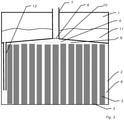
- figure 2 also shows a section of a lead-acid battery according to the invention. It is in accordance with the lead-acid battery figure 1 executed similarly. However, the fluid connection between the reservoir and the electrode space and their diffusion inhibition is designed differently. In figure 2 no membrane is provided for diffusion inhibition, but a long, thin channel 12 is installed as a diffusion inhibition. Here the fluid connection does not end in the upper area of the electrode space. There is also no water in the reservoir 1 here, but the same electrolyte 11 as in the electrode space 8 . But it is possible without any problems, the diffusion inhibition of figures 1 and 2 to combine with each other and at the beginning, end or within the channel 12 a membrane as in figure 1 to arrange. Water can also be provided in the reservoir 1, in particular if a membrane 5 is also used.
Landscapes
- Chemical & Material Sciences (AREA)
- Chemical Kinetics & Catalysis (AREA)
- Electrochemistry (AREA)
- General Chemical & Material Sciences (AREA)
- Engineering & Computer Science (AREA)
- Manufacturing & Machinery (AREA)
- Filling, Topping-Up Batteries (AREA)
Applications Claiming Priority (1)
| Application Number | Priority Date | Filing Date | Title |
|---|---|---|---|
| EP20193255 | 2020-08-28 |
Publications (1)
| Publication Number | Publication Date |
|---|---|
| EP3961787A1 true EP3961787A1 (fr) | 2022-03-02 |
Family
ID=72290841
Family Applications (1)
| Application Number | Title | Priority Date | Filing Date |
|---|---|---|---|
| EP21178091.1A Pending EP3961787A1 (fr) | 2020-08-28 | 2021-06-07 | Accumulateur à électrolyte liquide, en particulier une batterie au plomb |
Country Status (1)
| Country | Link |
|---|---|
| EP (1) | EP3961787A1 (fr) |
Cited By (1)
| Publication number | Priority date | Publication date | Assignee | Title |
|---|---|---|---|---|
| CN114400421A (zh) * | 2022-03-24 | 2022-04-26 | 小洋电源股份有限公司 | 铅酸蓄电池抽真空加酸装置 |
Citations (5)
| Publication number | Priority date | Publication date | Assignee | Title |
|---|---|---|---|---|
| DE3002288A1 (de) * | 1979-01-26 | 1980-08-07 | Magneti Marelli Spa | Vorrichtung zur selbsteinstellung des fluessigkeitsspiegels von elektrolyten in elektrischen akkumulatoren |
| DE19507237A1 (de) * | 1995-03-02 | 1996-09-05 | Varta Batterie | Akkumulatorenbatterie |
| WO2011029035A2 (fr) * | 2009-09-04 | 2011-03-10 | Johnson Controls Technology Company | Batterie secondaire avec déstratification améliorée de l'acide |
| EP2745339B1 (fr) * | 2011-08-17 | 2018-03-14 | Johnson Controls Autobatterie GmbH & Co. KGaA | Procédé de fabrication d'un accumulateur rempli d'un électrolyte liquide et accumulateur |
| CN109148970A (zh) * | 2018-07-26 | 2019-01-04 | 天能电池集团有限公司 | 一种具有液体自循环装置的富液式铅蓄电池 |
-
2021
- 2021-06-07 EP EP21178091.1A patent/EP3961787A1/fr active Pending
Patent Citations (5)
| Publication number | Priority date | Publication date | Assignee | Title |
|---|---|---|---|---|
| DE3002288A1 (de) * | 1979-01-26 | 1980-08-07 | Magneti Marelli Spa | Vorrichtung zur selbsteinstellung des fluessigkeitsspiegels von elektrolyten in elektrischen akkumulatoren |
| DE19507237A1 (de) * | 1995-03-02 | 1996-09-05 | Varta Batterie | Akkumulatorenbatterie |
| WO2011029035A2 (fr) * | 2009-09-04 | 2011-03-10 | Johnson Controls Technology Company | Batterie secondaire avec déstratification améliorée de l'acide |
| EP2745339B1 (fr) * | 2011-08-17 | 2018-03-14 | Johnson Controls Autobatterie GmbH & Co. KGaA | Procédé de fabrication d'un accumulateur rempli d'un électrolyte liquide et accumulateur |
| CN109148970A (zh) * | 2018-07-26 | 2019-01-04 | 天能电池集团有限公司 | 一种具有液体自循环装置的富液式铅蓄电池 |
Cited By (2)
| Publication number | Priority date | Publication date | Assignee | Title |
|---|---|---|---|---|
| CN114400421A (zh) * | 2022-03-24 | 2022-04-26 | 小洋电源股份有限公司 | 铅酸蓄电池抽真空加酸装置 |
| CN114400421B (zh) * | 2022-03-24 | 2022-06-03 | 小洋电源股份有限公司 | 铅酸蓄电池抽真空加酸装置 |
Similar Documents
| Publication | Publication Date | Title |
|---|---|---|
| DE3543574C2 (de) | Metall-Halogen-Sammlerbatterie aus aneinandergeschichteten Elementen mit Elektrolytumwälzung | |
| EP3489394B1 (fr) | Électrolyseur pour électrolyse pem à basse pression | |
| DE102017221946B4 (de) | Lithium-luft-batterie | |
| DE2621081C3 (de) | Galvanische Batterie | |
| WO2015180746A1 (fr) | Système de piles à combustible | |
| WO2013092898A1 (fr) | Batterie à circulation d'oxydo-réduction avec ligne d'alimentation et/ou ligne d'évacuation externes | |
| DE9102838U1 (de) | Akkumulatoren-Batterie | |
| EP0602578B1 (fr) | Accumulateur au plomb sans entretien à capacité élevée | |
| DE3436115C2 (de) | Gasdichte Blei-Akkumulatorzelle | |
| DE1163413B (de) | Verfahren zum Formieren, Laden und Entladen von Akkumulatoren mit saurem Elektrolyten mit hohen Stromdichten | |
| DE3727763C1 (de) | Gasdichter wartungsfreier Blei-Akkumulator | |
| DE3924011C2 (fr) | ||
| DE102009047057A1 (de) | Vorrichtung für Elektrolyt-Austausch bei Energiespeichern | |
| WO2020216539A1 (fr) | Module d'humidification, humidificateur, système de pile à combustible pourvu d'un tel humidificateur, et procédé d'humidification d'un gaz | |
| EP2912709A1 (fr) | Batterie pourvue d'un dispositif de mélangeage de l'électrolyte | |
| DE112009002459T5 (de) | Brennstoffzelle und Brennstoffzellensystem | |
| DE102022109043A1 (de) | Vorrichtung zur Aufbereitung einer Elektrolytflüssigkeit | |
| DE1471747A1 (de) | Alkalische Nickel-Cadmium-Akkumulatorzelle | |
| DE2502369A1 (de) | Vorrichtung zum gleichzeitigen einfuellen der nachfuellfluessigkeit in eine elektrische akkumulatorenbatterie | |
| DE2303244C3 (de) | Vorrichtung zum Nachfüllen einer Zelle einer Batterie | |
| DE3018372A1 (de) | Verschlussstopfen fuer akkumulatoren | |
| DE102018119303A1 (de) | Prozessmediumleitvorrichtung für ein Rekombinationssystem | |
| DE102021204659A1 (de) | Hochvolt-Batteriesystem | |
| DE3300466C2 (de) | Akkumulator mit flüssigem Elektrolyten, insbes. Bleiakkumulator | |
| DE102022103025A1 (de) | Batteriezelle sowie Verfahren zur Befüllung einer solchen Batteriezelle |
Legal Events
| Date | Code | Title | Description |
|---|---|---|---|
| PUAI | Public reference made under article 153(3) epc to a published international application that has entered the european phase |
Free format text: ORIGINAL CODE: 0009012 |
|
| STAA | Information on the status of an ep patent application or granted ep patent |
Free format text: STATUS: THE APPLICATION HAS BEEN PUBLISHED |
|
| AK | Designated contracting states |
Kind code of ref document: A1 Designated state(s): AL AT BE BG CH CY CZ DE DK EE ES FI FR GB GR HR HU IE IS IT LI LT LU LV MC MK MT NL NO PL PT RO RS SE SI SK SM TR |
|
| STAA | Information on the status of an ep patent application or granted ep patent |
Free format text: STATUS: REQUEST FOR EXAMINATION WAS MADE |
|
| 17P | Request for examination filed |
Effective date: 20220330 |
|
| RBV | Designated contracting states (corrected) |
Designated state(s): AL AT BE BG CH CY CZ DE DK EE ES FI FR GB GR HR HU IE IS IT LI LT LU LV MC MK MT NL NO PL PT RO RS SE SI SK SM TR |
|
| STAA | Information on the status of an ep patent application or granted ep patent |
Free format text: STATUS: EXAMINATION IS IN PROGRESS |
|
| 17Q | First examination report despatched |
Effective date: 20240923 |