EP3962016B1 - Informationsverarbeitungsvorrichtung, informationsverarbeitungsverfahren und programm - Google Patents
Informationsverarbeitungsvorrichtung, informationsverarbeitungsverfahren und programm Download PDFInfo
- Publication number
- EP3962016B1 EP3962016B1 EP20793958.8A EP20793958A EP3962016B1 EP 3962016 B1 EP3962016 B1 EP 3962016B1 EP 20793958 A EP20793958 A EP 20793958A EP 3962016 B1 EP3962016 B1 EP 3962016B1
- Authority
- EP
- European Patent Office
- Prior art keywords
- information
- identification information
- processing device
- information processing
- software
- Prior art date
- Legal status (The legal status is an assumption and is not a legal conclusion. Google has not performed a legal analysis and makes no representation as to the accuracy of the status listed.)
- Active
Links
Images




Classifications
-
- G—PHYSICS
- G06—COMPUTING OR CALCULATING; COUNTING
- G06F—ELECTRIC DIGITAL DATA PROCESSING
- G06F8/00—Arrangements for software engineering
- G06F8/60—Software deployment
- G06F8/65—Updates
-
- G—PHYSICS
- G06—COMPUTING OR CALCULATING; COUNTING
- G06F—ELECTRIC DIGITAL DATA PROCESSING
- G06F21/00—Security arrangements for protecting computers, components thereof, programs or data against unauthorised activity
- G06F21/70—Protecting specific internal or peripheral components, in which the protection of a component leads to protection of the entire computer
- G06F21/71—Protecting specific internal or peripheral components, in which the protection of a component leads to protection of the entire computer to assure secure computing or processing of information
-
- G—PHYSICS
- G06—COMPUTING OR CALCULATING; COUNTING
- G06F—ELECTRIC DIGITAL DATA PROCESSING
- G06F9/00—Arrangements for program control, e.g. control units
- G06F9/06—Arrangements for program control, e.g. control units using stored programs, i.e. using an internal store of processing equipment to receive or retain programs
- G06F9/44—Arrangements for executing specific programs
- G06F9/4401—Bootstrapping
- G06F9/4406—Loading of operating system
-
- G—PHYSICS
- G06—COMPUTING OR CALCULATING; COUNTING
- G06F—ELECTRIC DIGITAL DATA PROCESSING
- G06F21/00—Security arrangements for protecting computers, components thereof, programs or data against unauthorised activity
- G06F21/70—Protecting specific internal or peripheral components, in which the protection of a component leads to protection of the entire computer
- G06F21/71—Protecting specific internal or peripheral components, in which the protection of a component leads to protection of the entire computer to assure secure computing or processing of information
- G06F21/77—Protecting specific internal or peripheral components, in which the protection of a component leads to protection of the entire computer to assure secure computing or processing of information in smart cards
-
- H—ELECTRICITY
- H04—ELECTRIC COMMUNICATION TECHNIQUE
- H04L—TRANSMISSION OF DIGITAL INFORMATION, e.g. TELEGRAPHIC COMMUNICATION
- H04L67/00—Network arrangements or protocols for supporting network services or applications
- H04L67/01—Protocols
- H04L67/02—Protocols based on web technology, e.g. hypertext transfer protocol [HTTP]
-
- H—ELECTRICITY
- H04—ELECTRIC COMMUNICATION TECHNIQUE
- H04L—TRANSMISSION OF DIGITAL INFORMATION, e.g. TELEGRAPHIC COMMUNICATION
- H04L67/00—Network arrangements or protocols for supporting network services or applications
- H04L67/34—Network arrangements or protocols for supporting network services or applications involving the movement of software or configuration parameters
Definitions
- the present disclosure relates to an information processing device, an information processing method, and a program.
- Patent Document 1 discloses a method of reusing identification data from an identification module in user equipment by a peripheral device.
- Patent Document 1 Japanese Unexamined Patent Publication No. 2008-504759
- an identifier for uniquely identifying a secure element is required for quality control and defect analysis in a market.
- labor and cost are required.
- the secure element performs contactless communication prescribed in ISO 14443, ISO 18092 and the like with the outside, if a unique identifier regarding the communication is separately provided, labor and cost for generating the identifier are problematically doubled.
- the secure element employs a plurality of communication systems and uses a unique identifier for each system, it takes labor and cost for each system.
- the present disclosure is preferably applied to, for example, a secure element (SE: hereinafter referred to as SE) that holds a parameter required for contactless communication.
- SE secure element
- an identifier for uniquely identifying the SE is required.
- labor and cost for generating a unique identifier are reduced.
- a part of a UID prescribed in ISO 14443 is reused as a part of an IDm prescribed in ISO 18092.
- the secure element is included in an information processing device that communicates with a reader/writer in a contactless manner.
- a mobile terminal a card, a wearable device, a television, and a personal computer are assumed.
- the card for example, a card having a contactless function such as a transportation card or an electronic money card is assumed.
- a wearable device a device having a clock function or a device used for a locker key and the like are assumed.
- the unique identifier (UID) prescribed in ISO 14443 is identification information unique to the information processing device.
- a length of the UID a single UID (specifically has a length of four bytes), a double UID (specifically has a length of seven bytes), and a triple UID (specifically has a length of ten bytes) are prescribed, and there is a room for extension if a numerical range becomes insufficient due to future extendability.
- the UID is prescribed as any one of a unique value set in advance, a random number dynamically generated by the information processing device (allowed only for the single UID), and a non-unique fixed number (allowed only for the single UID).
- a case of the double UID in the example of the unique value set in advance is described as an example.
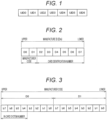
- Fig. 1 is a schematic diagram illustrating a byte sequence of the UID.
- the UID includes seven bytes from UID0 to UID6.
- a first byte UID0 is assigned for each manufacturer, and is prescribed as ensuring uniqueness of the manufacturer.
- each manufacturer sets a unique value by taking uniqueness of other byte values (UID1 to UID6). By configuring the UID in this manner, each UID has uniqueness.
- Fig. 2 is a schematic diagram illustrating a byte sequence of the IDm.
- the IDm being an ID for the reader/writer to identify the information processing device with which this communicates is a byte sequence including eight bytes continuous from a next byte of a response code of the polling response returned by the information processing device that receives the polling command, and is a number numbered by a business operator that manufactures the secure element included in the information processing device.
- the reader/writer may specify the information processing device of the same IDm and perform communication.
- the IDm has a function of an identifier for identifying the information processing device in a communication protocol.
- Values of upper two bytes of the IDm are referred to as a manufacturer code being an identification number for identifying the manufacturer, and following six bytes are referred to as a card identification number being an identification number for uniquely identifying the card. Furthermore, in a case where there is a plurality of systems (in a case of emulating a specific service by each applet to be described later, corresponding to the number of applets) in the card, the IDm is set for each system. In this case, upper four bits of the manufacturer code indicate an in-card system number. Note that, although a case where the information processing device is the card is herein described as an example, the same applies to a case of the portable terminal and a case of the wearable device.
- Fig. 3 is a schematic diagram illustrating a configuration of the manufacturer code.
- a system of the card identification number is prescribed.
- a system vendor numbers other values for a card manufacturer (that assigns the IDm), and the card manufacturer assigns the card identification number to each card according to the system prescribed by the card manufacturer. Therefore, each IDm has uniqueness.
- a system code is a two-byte value included in the polling command for specifying the system, and is assigned for each business operator and each purpose of use.
- the system code specifies services such as a fare prepaid service in a transportation business and electronic money used in a usage fee prepaid service in a convenience store or a supermarket.
- the present invention is also applicable to a wide variety of services such as a service such as a credit card to be settled later, and a payment service using a point or electronic information usable as consideration immediately managed by a server via a network, and is not limited to a specific service.
- the reader/writer specifies the system code in the parameter of the polling command, and a card with the same system code returns the polling response. In other words, when the reader/writer sends the polling command, this sends the system code in order to determine whether or not the card has a specific system. Only the card having the specific system defined by the system code returns the IDm. As is described later, the polling response includes the IDm, SC, and PMm.
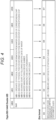
- Fig. 4 is a schematic diagram illustrating an example of conversion from the UID to the IDm according to this embodiment.
- chip vendors pay a lot of effort for uniquely numbering the UID.
- a method for uniquely numbering six bytes of the UID (UID1 to UID6) is illustrated.
- Fig. 4 illustrates an example of preventing the overlapping with physical position information from the center of the secure element in the wafer device (bytes 1 and 2), the wafer number (byte 3), a wafer manufacturing device number (byte 4), and values indicating a wafer manufacture date as numerical values (bytes 5 and 6). Chips numbered in this manner have different UIDs. Note that, the method herein illustrated is an example, and six bytes of the UID ensure the uniqueness by various methods.
- the IDm similarly, since uniqueness is basically required for the chip vendor, if the uniqueness is required for both the UID and the IDm by a similar method, twice the man-hour is required.
- IDm values may ensure the uniqueness without change.
- UID0 is the ID indicating a specific manufacturer, and ensure identity of the manufacturer. Furthermore, the IDm values D0 and D1 serve as the manufacturer code, and ensure the identity of the manufacturer. Therefore, by switching UID0 to D0 and D1, identity of a product may be ensured in a number system assigned by the same manufacturer.
- UID0 that is the ID of the manufacturer is removed from the UID, and the manufacturer code D0 and D1 of the IDm values is newly added.
- the information of UID1 to UID6 is applied to D2 to D7 in the IDm format, respectively, without change. Therefore, it becomes possible to convert from the UID to the IDm by simple processing.
- each manufacturer ensures the uniqueness of other byte values (UID1 to UID6) except UID0. Therefore, by applying UID1 to UID6 to D2 to D7 in the IDm format, respectively, the uniqueness of the IDm may be ensured.
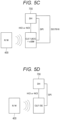
- Figs. 5A to 5D are schematic diagrams illustrating variations of a connection configuration of the secure element.
- Figs. 5A to 5D illustrate the secure element wirelessly connected to a reader/writer 400. More specifically, in Figs. 5A to 5D , the configurations other than the reader/writer 400 is formed in the information processing device.
- a contactless frontend (CLF) 410 is a chip having a wireless function.
- the contactless frontend (CLF) 410 collectively performs RF side processing such as A/D conversion.
- a UICC 500 being the secure element is configured by a SIM card. The UICC 500 ensures a communication function with a base station and performs authentication.
- Fig. 5B illustrates a configuration example obtained by removing the communication function from the UICC 500 in Fig. 5A .
- a configuration of a secure element (SE) 600 is obtained by removing the communication function from the UICC 500.
- SE secure element
- Other configurations in Fig. 5B are similar to those in Fig. 5A .
- Fig. 5C is a configuration example in which the CLF 410 and the UICC 500 in Fig. 5A are integrated.
- Fig. 5D is a schematic diagram illustrating an example in which the CLF 410 and the SE 600 in Fig. 5B are integrated.
- Fig. 5E is a schematic diagram illustrating an example in which the CLF 410 is configured alone without the SE 600 in Fig. 5B provided.
- the method according to this embodiment is also applicable to firmware or a kernel deployed on the CLF in addition to the SE.
- a program corresponding to an applet 108 does not need to be separated from an operating system (JavaCard OS 104 to be described later) such as a program on the firmware and kernel, and may be included as the program in the operating system.
- an operating system JavaCard OS 104 to be described later
- the IDm for ISO 18092 may be generated from the UID held by the CLF.
- a DH 700 is a device host and has a function of a mobile terminal.
- the DH 700 is connected to the SE by ISO 7816 or SPI.
- Fig. 6 is a schematic diagram illustrating a software configuration (configuration of the secure element) of an information processing device 1000 according to this embodiment.
- hardware (H/W) 100, kernel 102, the JavaCard OS 104, a JavaCard API 106, and the applet 108 are layered in this order from a lower layer.
- the hardware 100 includes a CPU, a memory and the like, and has a configuration in which they are connected to each other via a bus.
- the applet 108 is an application (program) downloadable as appropriate, the program that operates in an intermediate language of a JavaCard.
- the JavaCard OS 104 serves as software, that is, an operating system (OS), and the applet 108 is layered thereon via the JavaCard API 106.
- OS operating system
- the operating system is an example of software, and the software may be the firmware or kernel.
- Downloadable in Fig. 6 indicates that other applets are downloadable.
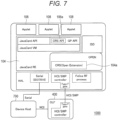
- Fig. 7 is a schematic diagram illustrating the configuration of the information processing device 1000 according to this embodiment in further detail.
- the JavaCard OS 104 includes a JavaCard runtime environment (RE) and a JavaCard vitual machine (VM), and the JavaCard RE is provided with a contactless registry service (CRS (open extension)) 104a as a configuration that ensures a management function.
- the JavaCard API 106 is provided with a CRS API 106a.
- the CRS 104a manages information of the applet 108, and extends the management function indicated as "OPEN" in Fig. 7 while specializing the same in a parameter management function used for the contactless communication with the reader/writer.
- the management function (OPEN) of the JavaCard OS 104 is prescribed by an organization called as GlobalPlatform.
- the management function (OPEN) mainly manages information regarding the applet 108, and the information managed by the management function (OPEN) includes an application identifier (ID), presence or absence of the contactless function, key information, an occupied memory size, package information and the like.
- the CRS API 106a is the API for the applet 108 to make contact with the CRS 104a.
- the applet 108 may set data in the CRS 104a for communicating with the outside through the contactless frontend (CLF) 410 via the API 106a.
- CLF contactless frontend
- the CLF 410 for wirelessly connecting to the outside is connected to the DH 700 having a function of a mobile terminal.
- the UICC (not illustrated in Fig. 7 ) is responsible for a call function.
- the CLF 410 interprets the same and transfers data to the UICC 500 or the SE 600.
- the SE 600 is connected to the DH 700 by another communication protocol (ISO 7816, SPI, or UART).
- Fig. 8 is a schematic diagram illustrating a procedure for generating the IDm from the UID.
- a serial number 10 including the UID is stored in the JavaCard OS 104 being the operating system.
- the serial number 10 is obtained by the applet 108 via the API 106. Therefore, the applet 108 obtains the UID included in the serial number 10. As described above, the UID is set as the unique value in the information processing device.
- the applet 108 generates the IDm by removing the first byte UID0 from the UID, and adding the manufacturer code. As described above, by applying the information of UID1 to UID6 to D2 to D7 in the IDm format, respectively, the IDm value may ensure the uniqueness.
- the applet 108 adds the system code (SC) and PMm to the IDm and sends the same to the CRS 104a of the JavaCard OS 104 via the API 106.
- PMm is data for setting a standby time at the time of the polling response.
- the CRS 104a may generate response data to be returned when the polling command is sent via the CLF 410.
- the CRS 104a returns the IDm, SC, and PMm as the polling response.
- CPLC card production life cycle
- identifiers include Card Serial Number (CSN), Card Image Number (CIN), Integrated Circuit Card Identification (ICCID) and the like. These pieces of information include individually delivered information, information written at once at shipment time and data writing time, vendor identification information, information for identifying the chip and OS and the like. Furthermore, depending on companies, a part of the data serves as the UID. This embodiment is widely applicable to these identifiers.
- serial number in a case of the secure element illustrated in Fig. 6 , there are a case where the serial number is incorporated in an IC chip which is the hardware 100, a case where the serial number is managed by the kernel 102, and a case where the serial number is managed by the JavaCard OS 104. In a case of requiring the uniqueness, it is more convenient to incorporate the serial number in the IC chip because the serial number is fixed. Alternatively, in a case where the serial number is dynamically changed for each phase, there is a case where the serial number may be more flexibly changed by managing the same in an upper layer. In Fig. 6 , a layer for managing the serial number is denoted by "SN".
- Fig. 9 is a schematic diagram illustrating a configuration of the CLF 410 and corresponds to the example illustrated in Fig. 5E .
- hardware (H/W) 200, an interface protocol 210, and CLF firmware 220 are layered in this order from a lower layer.
- the hardware 200 includes a CPU, a memory and the like, and has a configuration in which they are connected to each other via a bus.
- the serial number is incorporated in an IC chip which is the hardware 200 and a case where the interface protocol 210 holds the serial number as information required for RF protocol.
- the serial number in a case of the SE, in a case of requiring the uniqueness, it is more convenient to incorporate the serial number in the IC chip because the serial number is fixed.
- the serial number in a case where the serial number is dynamically changed for each phase, there is a case where the serial number may be more flexibly changed by managing the same in a protocol layer.
- the layer for managing the serial number is denoted by "SN".
- the information set in the secure element in the form of the serial number is applicable to the UID used in a communication protocol referred to as Type A, and when the applet 108 may obtain the serial number, the applet 108 converts the serial number and sets the same in the CRS 104a as a contactless parameter for Type F. Therefore, the polling command from the CLF 410 may be included in the polling response to be returned.
- KDF key derivation function
- PRF Pseudorandom Function
- the IDm may be changed as appropriate.
- Pseudo-Unique PICC Identifier PUPI
- ISO 14443 is described above, it is also possible to divert to an identifier that requires uniqueness at the time of communication such as ISO 15693 Type V (wireless RF), ultra wideband (UWB), Bluetooth (registered trademark) Low Energy (BLE), and Transfer Jet.
- ISO 15693 Type V wireless RF
- ubiquitous ID 128-bit (16-byte) fixed value http://www.mlit.go.jp/seisakutokatsu/jiritsu/siyousho/07 0323/990_J003.pdf
Landscapes
- Engineering & Computer Science (AREA)
- Theoretical Computer Science (AREA)
- Software Systems (AREA)
- Physics & Mathematics (AREA)
- General Engineering & Computer Science (AREA)
- Computer Security & Cryptography (AREA)
- General Physics & Mathematics (AREA)
- Computer Hardware Design (AREA)
- Mathematical Physics (AREA)
- Stored Programmes (AREA)
- Storage Device Security (AREA)
Claims (11)
- Informationsverarbeitungsvorrichtung (1000), umfassend:Software, die konfiguriert ist, um erste Identifikationsinformationen darin zu registrieren; undeine Anwendung, die konfiguriert ist zum:Erhalten der ersten Identifikationsinformationen von der Software,Umwandeln der ersten Identifikationsinformationen in zweite Identifikationsinformationen für die Kommunikation, indem ein Informationsteil aus den ersten Identifikationsinformationen entfernt und ein anderer, in einem Format der zweiten Identifikationsinformationen vorgeschriebener Code neu zugewiesen wird; wobei die nach dem Entfernen des Informationsteils verbleibenden Informationen Informationen zum Sicherstellen der Eindeutigkeit in einer spezifischen Umgebung sind und Identifikationsinformationen sind, die nummeriert sind, um die Eindeutigkeit zu implementieren, indem mindestens eines von einem spezifischen Gesetz, einem physikalischen Gesetz, einem physikalischen Phänomen, einer Positionsinformation und einer Zeitinformation einbezogen wird, undRegistrieren der zweiten Identifikationsinformationen in der Software;wobei die ersten Identifikationsinformationen und die zweiten Identifikationsinformationen der eindeutigen Identifizierung eines sicheren Elements der Informationsverarbeitungsvorrichtung dienen.
- Informationsverarbeitungsvorrichtung nach Anspruch 1, wobei
die Anwendung die ersten Identifikationsinformationen in die zweiten Identifikationsinformationen umwandelt, indem sie andere Informationen als den Informationsteil aus den ersten Identifikationsinformationen unverändert in die zweiten Identifikationsinformationen überträgt. - Informationsverarbeitungsvorrichtung nach Anspruch 1, wobei
es sich bei dem Informationsteil um Identifikationsinformationen handelt, die durch Hinzufügen des Informationsteils Eindeutigkeit in einer spezifischen Umgebung zuweisen. - Informationsverarbeitungsvorrichtung nach Anspruch 3, wobei
der Informationsteil einschließt: Identifikationsinformationen, die zur Identifizierung eines Chipherstellers nummeriert sind, Identifikationsinformationen, die zur Identifizierung eines Unternehmens nummeriert sind, das ein Betriebssystem entwickelt, Identifikationsinformationen, die zur Identifizierung eines Unternehmens nummeriert sind, das einen Dienst betreibt, Identifikationsinformationen, die zur Identifizierung eines Unternehmens nummeriert sind, das mit dem Betrieb betraut ist, Identifikationsinformationen, die zur Identifizierung eines internationalen Kommunikationsstandards zugewiesen sind, oder Identifikationsinformationen, die zur Bereitstellung von Eindeutigkeit in einer Umgebung zugewiesen sind, die ein spezifisches Land, eine spezifische Region oder ein spezifisches Unternehmen einschließt. - Informationsverarbeitungsvorrichtung nach Anspruch 1, wobeidie Software ein JavaCard-Betriebsdienst (JavaCard-OS) ist, unddie Anwendung die zweiten Identifikationsinformationen in einem kontaktlosen Registrierungsdienst registriert, der die im JavaCard-OS enthaltenen kontaktlosen Informationen verwaltet.
- Informationsverarbeitungsvorrichtung nach Anspruch 5, wobei
die Anwendung einen Systemcode zur Identifizierung eines Dienstes oder Identifikationsinformationen zur Angabe einer Bereitschaftszeit zusammen mit den zweiten Identifikationsinformationen in dem kontaktlosen Registrierungsdienst registriert. - Informationsverarbeitungsvorrichtung nach Anspruch 1, wobei
die Anwendung die ersten Identifikationsinformationen als Originaldaten in vorgegebene Informationen umwandelt und die zweiten Identifikationsinformationen aus den vorgegebenen Informationen generiert. - Informationsverarbeitungsvorrichtung nach Anspruch 1, wobei
die Anwendung über die Software heruntergeladen werden kann. - Informationsverarbeitungsvorrichtung nach Anspruch 1, wobei
die Software ein Betriebssystem, Firmware oder ein Kernel ist. - Informationsverarbeitungsverfahren, umfassend:Erhalten der ersten Identifikationsinformationen von Software, in der die ersten Identifikationsinformationen registriert sind;Umwandeln der ersten Identifikationsinformationen in zweite Identifikationsinformationen für die Kommunikation, indem ein Informationsteil aus den ersten Identifikationsinformationen entfernt und ein anderer, in einem Format der zweiten Identifikationsinformationen vorgeschriebener Code neu zugewiesen wird; wobei die nach dem Entfernen des Informationsteils verbleibenden Informationen Informationen zum Sicherstellen der Eindeutigkeit in einer spezifischen Umgebung sind und Identifikationsinformationen sind, die nummeriert sind, um die Eindeutigkeit zu implementieren, indem mindestens eines von einem spezifischen Gesetz, einem physikalischen Gesetz, einem physikalischen Phänomen, einer Positionsinformation und einer Zeitinformation einbezogen wird; undRegistrieren der zweiten Identifikationsinformationen in der Software;wobei die ersten Identifikationsinformationen und die zweiten Identifikationsinformationen der eindeutigen Identifizierung eines sicheren Elements einer Informationsverarbeitungsvorrichtung (1000) dienen.
- Computerprogramm, das, wenn es von einem Computer ausgeführt wird, den Computer veranlasst zum:Erhalten der ersten Identifikationsinformationen von Software, in der die ersten Identifikationsinformationen registriert sind;Umwandeln der ersten Identifikationsinformationen in zweite Identifikationsinformationen für die Kommunikation, indem ein Informationsteil aus den ersten Identifikationsinformationen entfernt und ein anderer, in einem Format der zweiten Identifikationsinformationen vorgeschriebener Code neu zugewiesen wird; wobei die nach dem Entfernen des Informationsteils verbleibenden Informationen Informationen zum Sicherstellen der Eindeutigkeit in einer spezifischen Umgebung sind und Identifikationsinformationen sind, die nummeriert sind, um die Eindeutigkeit zu implementieren, indem mindestens eines von einem spezifischen Gesetz, einem physikalischen Gesetz, einem physikalischen Phänomen, einer Positionsinformation und einer Zeitinformation einbezogen wird; undRegistrieren der zweiten Identifikationsinformationen in der Software;wobei die ersten Identifikationsinformationen und die zweiten Identifikationsinformationen der eindeutigen Identifizierung eines sicheren Elements einer Informationsverarbeitungsvorrichtung (1000) dienen.
Applications Claiming Priority (2)
| Application Number | Priority Date | Filing Date | Title |
|---|---|---|---|
| JP2019085373 | 2019-04-26 | ||
| PCT/JP2020/016250 WO2020218050A1 (ja) | 2019-04-26 | 2020-04-13 | 情報処理装置、情報処理方法及びプログラム |
Publications (3)
| Publication Number | Publication Date |
|---|---|
| EP3962016A1 EP3962016A1 (de) | 2022-03-02 |
| EP3962016A4 EP3962016A4 (de) | 2022-06-08 |
| EP3962016B1 true EP3962016B1 (de) | 2025-05-28 |
Family
ID=72941985
Family Applications (1)
| Application Number | Title | Priority Date | Filing Date |
|---|---|---|---|
| EP20793958.8A Active EP3962016B1 (de) | 2019-04-26 | 2020-04-13 | Informationsverarbeitungsvorrichtung, informationsverarbeitungsverfahren und programm |
Country Status (5)
| Country | Link |
|---|---|
| US (1) | US11954477B2 (de) |
| EP (1) | EP3962016B1 (de) |
| JP (1) | JPWO2020218050A1 (de) |
| CN (1) | CN113692729B (de) |
| WO (1) | WO2020218050A1 (de) |
Family Cites Families (12)
| Publication number | Priority date | Publication date | Assignee | Title |
|---|---|---|---|---|
| US5793970A (en) | 1996-07-11 | 1998-08-11 | Microsoft Corporation | Method and computer program product for converting message identification codes using a conversion map accesible via a data link |
| FR2872366B1 (fr) | 2004-06-28 | 2006-08-18 | Gemplus Sa | Reutilisation de donnees d'identite d'un module d'identite dans un equipement d'usager par un dispositif peripherique |
| JP2009252153A (ja) * | 2008-04-10 | 2009-10-29 | Sony Corp | 情報処理装置、および情報処理方法、並びにコンピュータ・プログラム |
| JP2010039747A (ja) | 2008-08-05 | 2010-02-18 | Sony Corp | 情報処理装置、情報処理方法、情報処理システム、並びにプログラム |
| JP5423280B2 (ja) * | 2009-09-25 | 2014-02-19 | ソニー株式会社 | 通信装置、通信方法、情報処理装置、情報処理方法、プログラム、および通信システム |
| EP2615867B1 (de) * | 2012-01-12 | 2014-01-15 | Alcatel Lucent | Verfahren zur Auswahl eines Übertragungsmodus, Mobilstation, Netzwerkknoten und Kommunikationsnetzwerk dafür |
| CN104335173B (zh) | 2012-05-31 | 2018-07-06 | 索尼公司 | 信息处理设备、信息处理方法和程序 |
| WO2014196969A1 (en) * | 2013-06-05 | 2014-12-11 | American Express Travel Related Services Company, Inc. | System and method for multi-factor mobile user authentication |
| JP6029613B2 (ja) | 2014-04-22 | 2016-11-24 | ソフトバンク株式会社 | 通信端末装置及び決済システム |
| US20150370745A1 (en) * | 2014-06-20 | 2015-12-24 | Key Systems, Inc. | System and method for communication port based asset management |
| US10204654B2 (en) * | 2015-02-05 | 2019-02-12 | Buffalo Inc. | Storage device, information processing system, authentication method, and non-transitory computer readable medium |
| JP6978898B2 (ja) * | 2017-11-01 | 2021-12-08 | シャープ株式会社 | 情報処理装置、情報処理システム、制御プログラムおよび制御方法 |
-
2020
- 2020-04-13 CN CN202080029692.6A patent/CN113692729B/zh active Active
- 2020-04-13 WO PCT/JP2020/016250 patent/WO2020218050A1/ja not_active Ceased
- 2020-04-13 JP JP2021515995A patent/JPWO2020218050A1/ja active Pending
- 2020-04-13 US US17/438,788 patent/US11954477B2/en active Active
- 2020-04-13 EP EP20793958.8A patent/EP3962016B1/de active Active
Also Published As
| Publication number | Publication date |
|---|---|
| US11954477B2 (en) | 2024-04-09 |
| EP3962016A4 (de) | 2022-06-08 |
| WO2020218050A1 (ja) | 2020-10-29 |
| US20220147338A1 (en) | 2022-05-12 |
| CN113692729A (zh) | 2021-11-23 |
| CN113692729B (zh) | 2024-09-10 |
| EP3962016A1 (de) | 2022-03-02 |
| JPWO2020218050A1 (de) | 2020-10-29 |
Similar Documents
| Publication | Publication Date | Title |
|---|---|---|
| EP3895106B1 (de) | Verfahren zum betreiben einer vorrichtung zur auswahl einer virtuellen karte in einer digitalen geldbörse | |
| RU2488888C2 (ru) | Способ доступа к приложениям в защищенной мобильной среде | |
| EP2183728B1 (de) | Verfahren, system und zuverlässiger dienstmanager zur sicheren übertragung einer applikation auf ein mobiltelefon | |
| CN101965597B (zh) | 用于安装和取回已链接的mifare应用的方法和设备 | |
| CN101765846B (zh) | 用于禁用应用程序的移动通信设备和方法 | |
| CN102037499B (zh) | Nfc移动通信设备和rfid读取器 | |
| WO2013101040A1 (en) | Method and system for managing multiple electronic user wallet data cards | |
| WO2005124560A1 (ja) | 情報管理装置及び情報管理方法 | |
| WO2007020519A1 (en) | Method, system, and computer-readable medium for radio frequency identification device | |
| EP2809054A1 (de) | Mobile elektronische Vorrichtung mit Sender-Empfänger für drahtlosen Datenaustausch | |
| CN101334913A (zh) | 自适应sim芯片操作系统接收处理多终端信息的方法 | |
| US9037687B2 (en) | Information processing apparatus, method and program for writing file system metadata of plural operating systems | |
| JP5534186B2 (ja) | 情報処理システム、情報処理サーバ、情報処理方法及び情報処理プログラム等 | |
| WO2021065282A1 (ja) | 情報処理装置、情報処理システム、および情報処理方法、並びにプログラム | |
| US11954477B2 (en) | Information processing device, information processing method, and program | |
| EP2753107B1 (de) | Verfahren und System zur Verarbeitung einer Datenübertragung in Zusammenhang mit einer Datenspeicherkarte | |
| HK40053759A (en) | Information processing device, information processing method, and program | |
| HK40053759B (zh) | 信息处理设备、信息处理方法和程序 | |
| US20040153559A1 (en) | Data processing apparatus | |
| KR101070299B1 (ko) | 정보 처리 방법 | |
| KR20080076869A (ko) | 단말 장치 | |
| KR20050007621A (ko) | 복수의 서비스 카드 정보를 구비하는 결제 수단용 아이씨카드 및 이를 이용한 서비스 카드 적용 방법 및 시스템 | |
| KR20050047310A (ko) | 무선단말기내 선불카드기능 충전 방법 및 시스템 | |
| CN103379492A (zh) | 信号传输方法、交易信息显示方法及行动装置 | |
| KR100974811B1 (ko) | 스마트 카드를 이용한 로열티 교환 방법 |
Legal Events
| Date | Code | Title | Description |
|---|---|---|---|
| STAA | Information on the status of an ep patent application or granted ep patent |
Free format text: STATUS: THE INTERNATIONAL PUBLICATION HAS BEEN MADE |
|
| PUAI | Public reference made under article 153(3) epc to a published international application that has entered the european phase |
Free format text: ORIGINAL CODE: 0009012 |
|
| STAA | Information on the status of an ep patent application or granted ep patent |
Free format text: STATUS: REQUEST FOR EXAMINATION WAS MADE |
|
| 17P | Request for examination filed |
Effective date: 20211019 |
|
| AK | Designated contracting states |
Kind code of ref document: A1 Designated state(s): AL AT BE BG CH CY CZ DE DK EE ES FI FR GB GR HR HU IE IS IT LI LT LU LV MC MK MT NL NO PL PT RO RS SE SI SK SM TR |
|
| A4 | Supplementary search report drawn up and despatched |
Effective date: 20220506 |
|
| RIC1 | Information provided on ipc code assigned before grant |
Ipc: H04L 67/00 20220101ALI20220429BHEP Ipc: H04L 67/02 20220101ALI20220429BHEP Ipc: G06F 9/4401 20180101ALI20220429BHEP Ipc: G06F 8/60 20180101ALI20220429BHEP Ipc: G06K 19/073 20060101AFI20220429BHEP |
|
| DAV | Request for validation of the european patent (deleted) | ||
| DAX | Request for extension of the european patent (deleted) | ||
| REG | Reference to a national code |
Ref country code: DE Ref legal event code: R079 Free format text: PREVIOUS MAIN CLASS: H04L0029060000 Ipc: G06F0021710000 Ref document number: 602020052045 Country of ref document: DE |
|
| GRAP | Despatch of communication of intention to grant a patent |
Free format text: ORIGINAL CODE: EPIDOSNIGR1 |
|
| STAA | Information on the status of an ep patent application or granted ep patent |
Free format text: STATUS: GRANT OF PATENT IS INTENDED |
|
| RIC1 | Information provided on ipc code assigned before grant |
Ipc: H04L 67/00 20220101ALI20241108BHEP Ipc: G06F 21/77 20130101ALI20241108BHEP Ipc: G06F 21/71 20130101AFI20241108BHEP |
|
| INTG | Intention to grant announced |
Effective date: 20241209 |
|
| GRAS | Grant fee paid |
Free format text: ORIGINAL CODE: EPIDOSNIGR3 |
|
| P01 | Opt-out of the competence of the unified patent court (upc) registered |
Free format text: CASE NUMBER: APP_13609/2025 Effective date: 20250319 |
|
| GRAA | (expected) grant |
Free format text: ORIGINAL CODE: 0009210 |
|
| STAA | Information on the status of an ep patent application or granted ep patent |
Free format text: STATUS: THE PATENT HAS BEEN GRANTED |
|
| AK | Designated contracting states |
Kind code of ref document: B1 Designated state(s): AL AT BE BG CH CY CZ DE DK EE ES FI FR GB GR HR HU IE IS IT LI LT LU LV MC MK MT NL NO PL PT RO RS SE SI SK SM TR |
|
| REG | Reference to a national code |
Ref country code: GB Ref legal event code: FG4D |
|
| REG | Reference to a national code |
Ref country code: CH Ref legal event code: EP |
|
| REG | Reference to a national code |
Ref country code: IE Ref legal event code: FG4D Ref country code: DE Ref legal event code: R096 Ref document number: 602020052045 Country of ref document: DE |
|
| REG | Reference to a national code |
Ref country code: NL Ref legal event code: MP Effective date: 20250528 |
|
| PG25 | Lapsed in a contracting state [announced via postgrant information from national office to epo] |
Ref country code: ES Free format text: LAPSE BECAUSE OF FAILURE TO SUBMIT A TRANSLATION OF THE DESCRIPTION OR TO PAY THE FEE WITHIN THE PRESCRIBED TIME-LIMIT Effective date: 20250528 Ref country code: FI Free format text: LAPSE BECAUSE OF FAILURE TO SUBMIT A TRANSLATION OF THE DESCRIPTION OR TO PAY THE FEE WITHIN THE PRESCRIBED TIME-LIMIT Effective date: 20250528 |
|
| REG | Reference to a national code |
Ref country code: LT Ref legal event code: MG9D |
|
| PG25 | Lapsed in a contracting state [announced via postgrant information from national office to epo] |
Ref country code: NO Free format text: LAPSE BECAUSE OF FAILURE TO SUBMIT A TRANSLATION OF THE DESCRIPTION OR TO PAY THE FEE WITHIN THE PRESCRIBED TIME-LIMIT Effective date: 20250828 Ref country code: GR Free format text: LAPSE BECAUSE OF FAILURE TO SUBMIT A TRANSLATION OF THE DESCRIPTION OR TO PAY THE FEE WITHIN THE PRESCRIBED TIME-LIMIT Effective date: 20250829 |
|
| PG25 | Lapsed in a contracting state [announced via postgrant information from national office to epo] |
Ref country code: PL Free format text: LAPSE BECAUSE OF FAILURE TO SUBMIT A TRANSLATION OF THE DESCRIPTION OR TO PAY THE FEE WITHIN THE PRESCRIBED TIME-LIMIT Effective date: 20250528 Ref country code: NL Free format text: LAPSE BECAUSE OF FAILURE TO SUBMIT A TRANSLATION OF THE DESCRIPTION OR TO PAY THE FEE WITHIN THE PRESCRIBED TIME-LIMIT Effective date: 20250528 |
|
| PG25 | Lapsed in a contracting state [announced via postgrant information from national office to epo] |
Ref country code: BG Free format text: LAPSE BECAUSE OF FAILURE TO SUBMIT A TRANSLATION OF THE DESCRIPTION OR TO PAY THE FEE WITHIN THE PRESCRIBED TIME-LIMIT Effective date: 20250528 |
|
| PG25 | Lapsed in a contracting state [announced via postgrant information from national office to epo] |
Ref country code: HR Free format text: LAPSE BECAUSE OF FAILURE TO SUBMIT A TRANSLATION OF THE DESCRIPTION OR TO PAY THE FEE WITHIN THE PRESCRIBED TIME-LIMIT Effective date: 20250528 |
|
| PG25 | Lapsed in a contracting state [announced via postgrant information from national office to epo] |
Ref country code: RS Free format text: LAPSE BECAUSE OF FAILURE TO SUBMIT A TRANSLATION OF THE DESCRIPTION OR TO PAY THE FEE WITHIN THE PRESCRIBED TIME-LIMIT Effective date: 20250828 |
|
| PG25 | Lapsed in a contracting state [announced via postgrant information from national office to epo] |
Ref country code: IS Free format text: LAPSE BECAUSE OF FAILURE TO SUBMIT A TRANSLATION OF THE DESCRIPTION OR TO PAY THE FEE WITHIN THE PRESCRIBED TIME-LIMIT Effective date: 20250928 |
|
| PG25 | Lapsed in a contracting state [announced via postgrant information from national office to epo] |
Ref country code: LV Free format text: LAPSE BECAUSE OF FAILURE TO SUBMIT A TRANSLATION OF THE DESCRIPTION OR TO PAY THE FEE WITHIN THE PRESCRIBED TIME-LIMIT Effective date: 20250528 |
|
| REG | Reference to a national code |
Ref country code: AT Ref legal event code: MK05 Ref document number: 1799030 Country of ref document: AT Kind code of ref document: T Effective date: 20250528 |
|
| PG25 | Lapsed in a contracting state [announced via postgrant information from national office to epo] |
Ref country code: AT Free format text: LAPSE BECAUSE OF FAILURE TO SUBMIT A TRANSLATION OF THE DESCRIPTION OR TO PAY THE FEE WITHIN THE PRESCRIBED TIME-LIMIT Effective date: 20250528 Ref country code: SM Free format text: LAPSE BECAUSE OF FAILURE TO SUBMIT A TRANSLATION OF THE DESCRIPTION OR TO PAY THE FEE WITHIN THE PRESCRIBED TIME-LIMIT Effective date: 20250528 Ref country code: DK Free format text: LAPSE BECAUSE OF FAILURE TO SUBMIT A TRANSLATION OF THE DESCRIPTION OR TO PAY THE FEE WITHIN THE PRESCRIBED TIME-LIMIT Effective date: 20250528 |
|
| PG25 | Lapsed in a contracting state [announced via postgrant information from national office to epo] |
Ref country code: CZ Free format text: LAPSE BECAUSE OF FAILURE TO SUBMIT A TRANSLATION OF THE DESCRIPTION OR TO PAY THE FEE WITHIN THE PRESCRIBED TIME-LIMIT Effective date: 20250528 |
|
| PG25 | Lapsed in a contracting state [announced via postgrant information from national office to epo] |
Ref country code: EE Free format text: LAPSE BECAUSE OF FAILURE TO SUBMIT A TRANSLATION OF THE DESCRIPTION OR TO PAY THE FEE WITHIN THE PRESCRIBED TIME-LIMIT Effective date: 20250528 |
|
| PG25 | Lapsed in a contracting state [announced via postgrant information from national office to epo] |
Ref country code: SK Free format text: LAPSE BECAUSE OF FAILURE TO SUBMIT A TRANSLATION OF THE DESCRIPTION OR TO PAY THE FEE WITHIN THE PRESCRIBED TIME-LIMIT Effective date: 20250528 |
|
| PG25 | Lapsed in a contracting state [announced via postgrant information from national office to epo] |
Ref country code: IT Free format text: LAPSE BECAUSE OF FAILURE TO SUBMIT A TRANSLATION OF THE DESCRIPTION OR TO PAY THE FEE WITHIN THE PRESCRIBED TIME-LIMIT Effective date: 20250528 |
|
| REG | Reference to a national code |
Ref country code: DE Ref legal event code: R097 Ref document number: 602020052045 Country of ref document: DE |
|
| PLBE | No opposition filed within time limit |
Free format text: ORIGINAL CODE: 0009261 |
|
| STAA | Information on the status of an ep patent application or granted ep patent |
Free format text: STATUS: NO OPPOSITION FILED WITHIN TIME LIMIT |
|
| PGFP | Annual fee paid to national office [announced via postgrant information from national office to epo] |
Ref country code: GB Payment date: 20260319 Year of fee payment: 7 |
|
| REG | Reference to a national code |
Ref country code: CH Ref legal event code: L10 Free format text: ST27 STATUS EVENT CODE: U-0-0-L10-L00 (AS PROVIDED BY THE NATIONAL OFFICE) Effective date: 20260409 |
|
| PGFP | Annual fee paid to national office [announced via postgrant information from national office to epo] |
Ref country code: FR Payment date: 20260320 Year of fee payment: 7 |
|
| 26N | No opposition filed |
Effective date: 20260303 |