EP3964460A1 - Dispositif et procédé d'alignement de produits en vrac - Google Patents
Dispositif et procédé d'alignement de produits en vrac Download PDFInfo
- Publication number
- EP3964460A1 EP3964460A1 EP20195086.2A EP20195086A EP3964460A1 EP 3964460 A1 EP3964460 A1 EP 3964460A1 EP 20195086 A EP20195086 A EP 20195086A EP 3964460 A1 EP3964460 A1 EP 3964460A1
- Authority
- EP
- European Patent Office
- Prior art keywords
- piece goods
- conveyor
- alignment
- conveying
- devices
- Prior art date
- Legal status (The legal status is an assumption and is not a legal conclusion. Google has not performed a legal analysis and makes no representation as to the accuracy of the status listed.)
- Withdrawn
Links
- 238000000034 method Methods 0.000 title claims abstract description 16
- 238000005259 measurement Methods 0.000 claims abstract description 14
- 239000013590 bulk material Substances 0.000 claims description 4
- 229920000426 Microplastic Polymers 0.000 claims description 3
- 230000003287 optical effect Effects 0.000 description 5
- 238000011161 development Methods 0.000 description 4
- 238000012546 transfer Methods 0.000 description 4
- 230000007423 decrease Effects 0.000 description 2
- 238000012544 monitoring process Methods 0.000 description 2
- 230000003068 static effect Effects 0.000 description 2
- 238000011144 upstream manufacturing Methods 0.000 description 2
- 238000012937 correction Methods 0.000 description 1
- 238000005265 energy consumption Methods 0.000 description 1
- 230000009969 flowable effect Effects 0.000 description 1
- 238000012423 maintenance Methods 0.000 description 1
- 238000004806 packaging method and process Methods 0.000 description 1
- 238000012536 packaging technology Methods 0.000 description 1
- 238000012545 processing Methods 0.000 description 1
- 238000004904 shortening Methods 0.000 description 1
Images
Classifications
-
- B—PERFORMING OPERATIONS; TRANSPORTING
- B65—CONVEYING; PACKING; STORING; HANDLING THIN OR FILAMENTARY MATERIAL
- B65G—TRANSPORT OR STORAGE DEVICES, e.g. CONVEYORS FOR LOADING OR TIPPING, SHOP CONVEYOR SYSTEMS OR PNEUMATIC TUBE CONVEYORS
- B65G47/00—Article or material-handling devices associated with conveyors; Methods employing such devices
- B65G47/22—Devices influencing the relative position or the attitude of articles during transit by conveyors
- B65G47/24—Devices influencing the relative position or the attitude of articles during transit by conveyors orientating the articles
- B65G47/244—Devices influencing the relative position or the attitude of articles during transit by conveyors orientating the articles by turning them about an axis substantially perpendicular to the conveying plane
- B65G47/2445—Devices influencing the relative position or the attitude of articles during transit by conveyors orientating the articles by turning them about an axis substantially perpendicular to the conveying plane by means of at least two co-operating endless conveying elements
-
- B—PERFORMING OPERATIONS; TRANSPORTING
- B65—CONVEYING; PACKING; STORING; HANDLING THIN OR FILAMENTARY MATERIAL
- B65G—TRANSPORT OR STORAGE DEVICES, e.g. CONVEYORS FOR LOADING OR TIPPING, SHOP CONVEYOR SYSTEMS OR PNEUMATIC TUBE CONVEYORS
- B65G43/00—Control devices, e.g. for safety, warning or fault-correcting
- B65G43/08—Control devices operated by article or material being fed, conveyed or discharged
-
- B—PERFORMING OPERATIONS; TRANSPORTING
- B65—CONVEYING; PACKING; STORING; HANDLING THIN OR FILAMENTARY MATERIAL
- B65G—TRANSPORT OR STORAGE DEVICES, e.g. CONVEYORS FOR LOADING OR TIPPING, SHOP CONVEYOR SYSTEMS OR PNEUMATIC TUBE CONVEYORS
- B65G2203/00—Indexing code relating to control or detection of the articles or the load carriers during conveying
- B65G2203/02—Control or detection
- B65G2203/0208—Control or detection relating to the transported articles
- B65G2203/0225—Orientation of the article
-
- B—PERFORMING OPERATIONS; TRANSPORTING
- B65—CONVEYING; PACKING; STORING; HANDLING THIN OR FILAMENTARY MATERIAL
- B65G—TRANSPORT OR STORAGE DEVICES, e.g. CONVEYORS FOR LOADING OR TIPPING, SHOP CONVEYOR SYSTEMS OR PNEUMATIC TUBE CONVEYORS
- B65G2203/00—Indexing code relating to control or detection of the articles or the load carriers during conveying
- B65G2203/04—Detection means
- B65G2203/042—Sensors
Definitions
- the present invention relates to a device and a method for aligning piece goods, in particular bags filled with bulk goods.
- flap turning devices piece goods are clamped and rotated by flaps that hold the piece goods on opposite sides.
- the flaps exert a mechanical load on the piece goods, which can lead to sack deformation, particularly in the case of sacks filled with plastic granules.
- a local height variance of the individual piece goods leads to undesired stack tilting and instability in palletized stacks.
- the flaps of the flap turning device are highly stressed and therefore cost-intensive components, which also require strongly accelerating drives and the maintenance effort associated therewith.
- a significant energy consumption, vibrations and noise emissions of the flap rotation device are to be mentioned as further technical disadvantages.
- turning devices with two conveyor belts arranged parallel to one another, which carry the piece goods together, are used.
- the speed of one of the two conveyor belts is increased or reduced in comparison to the other conveyor belt, so that the two parallel conveyor belts have a speed difference.
- This results in a rotation of the piece goods since due to the static friction, one side of the piece goods is advanced faster than the other side.
- the conveyor belts are moved again at the same speed.
- a turning device is out DE 20 2011 110 089 U1 famous.
- a light curtain is stretched over the conveyor belts of this device, which extends parallel to the conveying plane and is composed of several light beams running transversely to the conveying direction.
- the light curtain makes it possible to monitor a projected length of the piece goods in the conveying direction during the rotation. Based on the known dimensions of the piece goods, a rotational position or a rotational angle can therefore be inferred.
- a control device of the device is adapted to stop the rotation of the item, ie to eliminate the difference in speed between the two conveyor belts, as soon as the item has reached the desired rotational position.
- the conveyor belts are generally designed to be relatively long, so that continuous monitoring of the rotational position of the piece goods during rotation is possible by means of a light curtain stretched over the conveyor belts. This has an impact on the conveying capacity, since only one unit load is ever transported on the parallel conveyor belts and with the length of the conveyor belt, the dwell time of the piece goods on the same increases. On the other hand, a shortening of the parallel conveyor belts in the above prior art is accompanied by a reduced precision of the rotational position.
- One object of the present invention is to specify a device and a method for aligning piece goods, in particular bags filled with bulk material, which enable piece goods to be rotated precisely with a high conveying capacity.
- the present invention takes into account in particular the alignment of sacks that are filled with free-flowing bulk material, so that subsequent correction of the position within the position of a stack is usually not possible or involves a great deal of effort.
- the present invention proposes a method with the features of claim 1 in order to solve the procedural aspect of this task.
- As generic for such a method is the EP 1 180 484 A2 viewed.
- an item is rotated by a preliminary rotation on two conveyor devices which are arranged parallel to one another and jointly carry the item by switching on a temporary speed difference between the two conveyor devices.
- the preliminary rotation corresponds to a rough alignment of the piece goods by a rotation angle of approx. 0°, ⁇ 90° or 180°.
- the rough alignment is usually done by a parameterized control of the parallel conveyors. Usually, the rotation position is not monitored during the pre-rotation. This enables the rough alignment to be carried out over a short distance in the conveying direction.
- the orientation of the pre-rotated article is measured without rotating the article.
- the measurement is made while the parallel conveyors are driven at the same speed; i.e. without rotation of the piece goods.
- the speed can also be zero (the conveying devices stand still) or negative (the conveying devices move in the opposite direction to the conveying direction).
- the alignment is then finely adjusted on the basis of the measured data by switching on a temporary speed difference again between two conveyor devices which are arranged parallel next to one another and jointly carry the piece goods.
- the angular position of a longitudinal axis of the finely adjusted piece goods is 0°, ⁇ 90° or 180° to the conveying direction.
- the fine adjustment is carried out in a zone which is arranged in the conveying direction behind a zone in which the measurement of the alignment of the piece goods takes place.
- the method steps measuring and fine adjustment are divided into two different areas in the conveying direction. This allows faster clocking, since the respective stations in which an item is rotated or measured can be passed through more quickly and released more quickly for a subsequent item, as well as precise position determination by measuring non-rotating items.
- the measurement of the alignment of the piece goods is carried out in a zone which is arranged in the conveying direction behind the zone in which the piece goods are pre-rotated.
- a separate conveyor can be provided for the coarse rotation, which transfers the previously rotated piece goods to another conveyor, as is fundamentally the case EP 1 180 484 A2 is known.
- a single conveying means with two conveying devices arranged parallel next to one another can also be provided, which is subdivided into several areas in the conveying direction.
- the conveying means is or are preferably designed and controlled in such a way that the alignment of the piece goods is not measured in the same area in which it is previously rotated or the alignment is finely adjusted; ie there is preferably no area or no conveying means provided in which both the piece goods are rotated and the alignment of the piece goods is measured.
- the fine adjustment of the piece goods and the pre-rotation of the piece goods are carried out on different conveyor devices, which can, however, be configured identically.
- a separate conveyor is preferably arranged in each zone.
- the fine adjustment of the piece goods and the preliminary turning of the piece goods can be carried out on the same conveyor devices.
- a single conveying means is generally provided with two conveying devices arranged parallel next to one another, which are subdivided in the conveying direction into an area for rough alignment, an area for measuring the alignment and an area for fine adjustment of the alignment.
- the measured orientation of the item after its pre-rotation is used to control the temporary speed difference during the pre-rotation of a subsequently conveyed item.
- This increases the precision of the rough alignment, since the packaging and transport processes upstream of the device are subject to fluctuations, for example with regard to the degree of sack filling or the sack position on the upstream conveyor lines. These fluctuations can be compensated for with this preferred development.
- the present invention specifies a device for aligning piece goods with the features of claim 7 .
- the device according to this aspect of the invention has a first conveying means with at least two conveying devices arranged parallel next to one another, which can be controlled for the pre-rotation of an item to be conveyed with the conveying devices in such a way that they temporarily have a speed difference.
- a belt, roller or ball track conveyor is to be regarded as a conveyor device within the meaning of the present invention.
- the device also has a second conveying means with at least one conveying device adapted to translate the piece goods, which takes the piece goods from the first conveying means and transfers them to a third conveying means, which in turn has at least two conveying devices arranged parallel next to one another.
- the second conveyor is associated with a sensor for determining an orientation of the piece goods, which is finely adjusted on the third conveyor.
- the conveying devices of the third conveying means can be controlled on the basis of measurement data from the sensor in such a way that they temporarily have a speed difference.
- the rough alignment of the piece goods takes place in a parameterized manner and without monitoring an angular position during the rotation, so that the first conveying means can be designed with a short conveying distance.
- the general cargo is only measured on the second conveyor.
- the first funding is therefore compared to DE 20 2011 110 089 U1 after a short time free again for a following general cargo. In this way, a high cycle rate or high conveying capacity can be achieved.
- the alignment of the piece goods is usually not measured during or after the fine adjustment on the third conveyor.
- the device has a single conveying means with at least two conveying devices arranged parallel to one another and jointly carrying a piece good, which can be controlled in such a way that they temporarily have a speed difference in order to rotate the piece good, a sensor for determining an orientation of the previously rotated piece goods, and a control device controlling the speed difference of the conveyor devices.
- the control device is adapted to control the two conveyors in a rough alignment mode so that they temporarily have a speed difference in order to rotate the piece goods by a pre-rotation, to measure an alignment of the previously rotated piece goods at the same speed of the two conveyors by the sensor, and to finely adjust the alignment in a fine alignment mode based on measurement data from the sensor by switching on a temporary speed difference between the two conveyor devices again.
- the alignment of the piece goods is usually not measured during or after the fine adjustment.
- more than two conveyor devices can be provided, which are arranged parallel to one another and of which at least one can be driven at a controllable speed.
- the parallel conveying devices can be driven at a speed that increases or decreases from conveying device to adjacent conveying device, expediently in such a way that the speeds increase or decrease proportionally to the mutual distances between the conveying devices.
- the sensor for measuring the alignment of the piece goods is usually an optical sensor. He can look like that for example DE 20 2011 110 089 U1 well-known light curtain that measures a projected length of the piece goods in the conveying direction, or something like that EP 1 180 484 A2 known image processing system, which captures at least one portion of the piece goods projected onto the conveying plane.
- the device according to the present invention is intended for use in the field of packaging technology for the layered arrangement of, in particular, rectangular piece goods on pallets.
- sacks filled with bulk material are preferably arranged in a combination of several layers on a pallet.
- the bags are placed in a first orientation or in a second orientation in which the object is rotated 90° with respect to the first orientation, or optionally in a third orientation, in which the object is rotated 180° with respect to the first orientation, arranged next to one another in one plane.
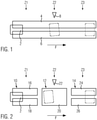
- the figure 1 shows a device for aligning piece goods 2, which are filled with flowable plastic granules and are essentially rectangular in plan view.
- the device comprises two conveyor devices 4, 6 arranged parallel next to one another, which carry the piece goods 2 together and convey them in a conveying direction F.
- the conveyors 4, 6 are presently designed as belt conveyors.
- a control unit is connected in terms of control to the conveyor devices 4, 6 and adapted in such a way that the conveyor devices 4, 6 can be driven at different speeds at times.
- a first zone Z1 in the conveying direction F the static friction between the piece goods 2 and the conveying devices 4, 6 is utilized in order to rotate it by a pre-rotation using different conveying speeds of the conveying devices 4, 6.
- a second zone Z2 which is downstream of the first zone Z1 in the conveying direction F, an optical sensor 8 for detecting the orientation of the piece goods 2, in particular the angular position of a longitudinal axis of the piece goods 2 relative to the conveying direction F, is arranged.
- the alignment of the piece goods 2 is finely adjusted in a third zone Z3 using measurement data from the sensor 8, in that the control unit drives the conveyor devices 4, 6 again at different conveying speeds.
- the third zone Z3 is in turn downstream of the second zone Z2 in the conveying direction.
- the angular position of the longitudinal axis of the piece goods 2 relative to the conveying direction F is generally 0°, ⁇ 90° or 180° after the fine adjustment.
- the figure 2 showed a device for aligning piece goods 2, which are configured as indicated above.
- the device has a first conveyor 10, a second Funding means 12 and a third funding means 14, which are arranged in the conveying direction F one behind the other.
- the first conveyor 10 has two conveyors 16, 18 arranged parallel to one another, which in the present case are designed as belt conveyors and can be driven at different speeds by a control unit, not shown, in order to rotate the piece goods 2 by a pre-rotation.
- the first conveying means 10 arranged in a first zone Z1 in the conveying direction then transfers the previously turned piece goods 2 to the second conveying means 12 which is provided in a second zone Z2 in the conveying direction.
- the second conveying means 12 is adapted to transfer the previously turned piece goods 2 without turning them to the third conveying means 14 arranged in a third zone Z3 in the conveying direction. It has a single belt conveyor 20 for this purpose. According to the second zone Z2, the third zone Z3 is located downstream in the conveying direction.
- An optical sensor 22 for detecting the alignment of the piece goods 2 previously rotated is assigned to the second conveyor 12 .
- conveyor devices 24, 26 of the third conveyor 14 arranged in parallel next to one another and designed as belt conveyors are driven by a control unit at different speeds at times in order to finely adjust the alignment of the piece goods 2.
- the essence of the two exemplary embodiments lies in the fact that the piece goods are rotated and not measured in the first and third zones, and that the piece goods are measured and not rotated in the second zone. In principle, there are no restrictions on the number of funds provided for this purpose.
Landscapes
- Engineering & Computer Science (AREA)
- Mechanical Engineering (AREA)
- Attitude Control For Articles On Conveyors (AREA)
Priority Applications (1)
| Application Number | Priority Date | Filing Date | Title |
|---|---|---|---|
| EP20195086.2A EP3964460A1 (fr) | 2020-09-08 | 2020-09-08 | Dispositif et procédé d'alignement de produits en vrac |
Applications Claiming Priority (1)
| Application Number | Priority Date | Filing Date | Title |
|---|---|---|---|
| EP20195086.2A EP3964460A1 (fr) | 2020-09-08 | 2020-09-08 | Dispositif et procédé d'alignement de produits en vrac |
Publications (1)
| Publication Number | Publication Date |
|---|---|
| EP3964460A1 true EP3964460A1 (fr) | 2022-03-09 |
Family
ID=72432743
Family Applications (1)
| Application Number | Title | Priority Date | Filing Date |
|---|---|---|---|
| EP20195086.2A Withdrawn EP3964460A1 (fr) | 2020-09-08 | 2020-09-08 | Dispositif et procédé d'alignement de produits en vrac |
Country Status (1)
| Country | Link |
|---|---|
| EP (1) | EP3964460A1 (fr) |
Cited By (4)
| Publication number | Priority date | Publication date | Assignee | Title |
|---|---|---|---|---|
| EP4299485A1 (fr) * | 2022-07-01 | 2024-01-03 | Deutsche Post AG | Dispositif d'alignement ou de positionnement. rotation d'objets |
| US12358730B2 (en) | 2022-07-01 | 2025-07-15 | Deutsche Post Ag | Apparatus for orienting or rotating objects |
| US12486119B2 (en) | 2022-07-01 | 2025-12-02 | Deutsche Post Ag | Apparatus for orienting or rotating objects |
| US12552616B2 (en) | 2022-07-01 | 2026-02-17 | Deutsche Post Ag | Apparatus for conveying objects |
Citations (4)
| Publication number | Priority date | Publication date | Assignee | Title |
|---|---|---|---|---|
| EP1180484A2 (fr) | 2000-08-16 | 2002-02-20 | NWU-Benelux B.V. | Station d'alignement fin et sa méthode d'opération |
| DE202011110089U1 (de) | 2011-10-20 | 2012-11-28 | Beumer Gmbh & Co. Kg | Vorrichtung zum Ausrichten eines nicht-kreisrunden oder mehreckigen Gegenstands |
| JP6170969B2 (ja) * | 2015-07-08 | 2017-07-26 | 冨士島工機株式会社 | 食品の向き変更装置 |
| DE102017120730A1 (de) * | 2017-09-08 | 2019-03-14 | Khs Gmbh | Vorrichtung und Verfahren zur Ausrichtung von Gebinden |
-
2020
- 2020-09-08 EP EP20195086.2A patent/EP3964460A1/fr not_active Withdrawn
Patent Citations (4)
| Publication number | Priority date | Publication date | Assignee | Title |
|---|---|---|---|---|
| EP1180484A2 (fr) | 2000-08-16 | 2002-02-20 | NWU-Benelux B.V. | Station d'alignement fin et sa méthode d'opération |
| DE202011110089U1 (de) | 2011-10-20 | 2012-11-28 | Beumer Gmbh & Co. Kg | Vorrichtung zum Ausrichten eines nicht-kreisrunden oder mehreckigen Gegenstands |
| JP6170969B2 (ja) * | 2015-07-08 | 2017-07-26 | 冨士島工機株式会社 | 食品の向き変更装置 |
| DE102017120730A1 (de) * | 2017-09-08 | 2019-03-14 | Khs Gmbh | Vorrichtung und Verfahren zur Ausrichtung von Gebinden |
Cited By (5)
| Publication number | Priority date | Publication date | Assignee | Title |
|---|---|---|---|---|
| EP4299485A1 (fr) * | 2022-07-01 | 2024-01-03 | Deutsche Post AG | Dispositif d'alignement ou de positionnement. rotation d'objets |
| US12358730B2 (en) | 2022-07-01 | 2025-07-15 | Deutsche Post Ag | Apparatus for orienting or rotating objects |
| US12466663B2 (en) | 2022-07-01 | 2025-11-11 | Deutsche Post Ag | Apparatus for orienting or rotating objects |
| US12486119B2 (en) | 2022-07-01 | 2025-12-02 | Deutsche Post Ag | Apparatus for orienting or rotating objects |
| US12552616B2 (en) | 2022-07-01 | 2026-02-17 | Deutsche Post Ag | Apparatus for conveying objects |
Similar Documents
| Publication | Publication Date | Title |
|---|---|---|
| DE69506499T3 (de) | Sortiersystem mit Querband | |
| EP2106376B1 (fr) | Piste intelligente de transport et de retenue | |
| EP3678964B1 (fr) | Dispositif et procédé d'orientation de lots de produits | |
| EP1456101B1 (fr) | Procede et dispositif pour former des rangees d'articles empaquetes | |
| DE202011110089U1 (de) | Vorrichtung zum Ausrichten eines nicht-kreisrunden oder mehreckigen Gegenstands | |
| DE102007036020A1 (de) | Ausrichten von Lebensmittelprodukten | |
| DE102015111098A1 (de) | Verfahren und Vorrichtung zum Depalettieren von Reifen | |
| DE102010044615A1 (de) | Positionierungsförderer, Lagersystem und Verfahren zum Aufnehmen von Stückgütern von einem Förderer | |
| DE4426826A1 (de) | Fördervorrichtung und Verfahren für eine Produktionslinie | |
| EP3357839A1 (fr) | Procédé et système de transport destinés à manipuler un flux de produits initial | |
| EP3786089A1 (fr) | Dispositif et procédé de transport et de tri des marchandises de détail | |
| EP3395728A1 (fr) | Réglage de l'écart entre des marchandises au détail à acheminer | |
| EP0527542B1 (fr) | Système de convoyeurs alimenté par plusieurs couloirs | |
| EP3883868B1 (fr) | Convoyeur télescopique intégrant des moyens convoyeurs cadencés et de mesure | |
| EP4452789A1 (fr) | Dispositif de transport | |
| EP3196154A1 (fr) | Systeme d'alimentation pour marchandises comprenant un dispositif d'alignement | |
| WO2022200392A1 (fr) | Appareil et procédé de création d'espacements entre des groupes individuels de marchandises transportées pendant le transport simultané des groupes de marchandises transportées | |
| AT522417A1 (de) | Verfahren und Fördereinrichtung zur verbesserten Positionsbestimmung eines auf der Fördereinrichtung transportierten Objekts | |
| EP1940711B1 (fr) | Dispositif et procede pour placer des piles d'objets plats sur des palettes | |
| EP4302884A1 (fr) | Dispositif d'alignement d'objets | |
| EP4310032A1 (fr) | Dispositif d'alignement ou de positionnement. rotation d'objets avec une surface glissante | |
| EP4299485A1 (fr) | Dispositif d'alignement ou de positionnement. rotation d'objets | |
| DE60318739T2 (de) | Verfahren und vorrichtung zur handhabung von walzen | |
| EP3841040B1 (fr) | Bande de dépôt destinée à un dispositif de palettisation | |
| DE102021107087A1 (de) | Vorrichtung und Verfahren zur Erzeugung von Abständen zwischen einzelnen Förderguteinheiten bei gleichzeitigem Transport der Förderguteinheiten |
Legal Events
| Date | Code | Title | Description |
|---|---|---|---|
| PUAI | Public reference made under article 153(3) epc to a published international application that has entered the european phase |
Free format text: ORIGINAL CODE: 0009012 |
|
| STAA | Information on the status of an ep patent application or granted ep patent |
Free format text: STATUS: THE APPLICATION HAS BEEN PUBLISHED |
|
| AK | Designated contracting states |
Kind code of ref document: A1 Designated state(s): AL AT BE BG CH CY CZ DE DK EE ES FI FR GB GR HR HU IE IS IT LI LT LU LV MC MK MT NL NO PL PT RO RS SE SI SK SM TR |
|
| STAA | Information on the status of an ep patent application or granted ep patent |
Free format text: STATUS: THE APPLICATION IS DEEMED TO BE WITHDRAWN |
|
| 18D | Application deemed to be withdrawn |
Effective date: 20220910 |