EP3964506A1 - Procédé de fabrication d'un dérivé de diamide d'acide anthranilique substitué par tétrazole - Google Patents
Procédé de fabrication d'un dérivé de diamide d'acide anthranilique substitué par tétrazole Download PDFInfo
- Publication number
- EP3964506A1 EP3964506A1 EP20194636.5A EP20194636A EP3964506A1 EP 3964506 A1 EP3964506 A1 EP 3964506A1 EP 20194636 A EP20194636 A EP 20194636A EP 3964506 A1 EP3964506 A1 EP 3964506A1
- Authority
- EP
- European Patent Office
- Prior art keywords
- formula
- compound
- solvate
- solvent
- crystalline
- Prior art date
- Legal status (The legal status is an assumption and is not a legal conclusion. Google has not performed a legal analysis and makes no representation as to the accuracy of the status listed.)
- Withdrawn
Links
- KNDVJPKNBVIKML-UHFFFAOYSA-N Cc1cc(C#N)cc(C(NC)=O)c1NC(c1cc(C[n]2nnc(C(F)(F)F)n2)n[n]1-c(nccc1)c1Cl)=O Chemical compound Cc1cc(C#N)cc(C(NC)=O)c1NC(c1cc(C[n]2nnc(C(F)(F)F)n2)n[n]1-c(nccc1)c1Cl)=O KNDVJPKNBVIKML-UHFFFAOYSA-N 0.000 description 1
Images


Classifications
-
- C—CHEMISTRY; METALLURGY
- C07—ORGANIC CHEMISTRY
- C07D—HETEROCYCLIC COMPOUNDS
- C07D401/00—Heterocyclic compounds containing two or more hetero rings, having nitrogen atoms as the only ring hetero atoms, at least one ring being a six-membered ring with only one nitrogen atom
- C07D401/14—Heterocyclic compounds containing two or more hetero rings, having nitrogen atoms as the only ring hetero atoms, at least one ring being a six-membered ring with only one nitrogen atom containing three or more hetero rings
-
- C—CHEMISTRY; METALLURGY
- C07—ORGANIC CHEMISTRY
- C07B—GENERAL METHODS OF ORGANIC CHEMISTRY; APPARATUS THEREFOR
- C07B2200/00—Indexing scheme relating to specific properties of organic compounds
- C07B2200/13—Crystalline forms, e.g. polymorphs
Definitions
- the present invention relates to a process for preparing a tetrazole-substituted anthranilic acid diamide derivative of the formula (I) in crystalline form, via solvate crystals, in high purity and yield.
- the present invention also relates to the provision of new solvate crystals which, in crystalline form, are distinguished by improved filtration properties compared to a tetrazole-substituted anthranilic acid diamide derivative of the abovementioned formula (I).
- WO2011/157664 A1 a process for the preparation of tetrazole-substituted anthranilic acid diamide derivatives, inter alia, also according to the abovementioned formula (I) is described. Furthermore, in WO2011/157664 A1 a process for the preparation of a crystalline form of a tetrazole-substituted anthranilic acid diamide derivative according to the above formula (I) is described, which is easy to handle due to its physicochemical properties and enables the production of a stable formulation.
- the object of the present invention is therefore to provide a new process for preparing a tetrazole-substituted anthranilic acid diamide derivative of the abovementioned formula (I) in crystalline form with high purity and yield, which is also advantageous in large-scale production from an economic point of view.
- the object was achieved according to the present invention by a process for preparing a compound of the formula (I) in crystalline form, characterized in that a compound of formula (I) is dissolved in at least one amide solvent and crystallized into a solvate by the presence of at least one anti-solvent and/or by lowering the temperature and is then filtered and dried. It is also particularly surprising that the compound of the formula (I) can be obtained in crystalline form by drying the solvate crystals.
- the crystalline form of the compound of formula (I) obtained according to the process according to the invention is preferably the thermodynamically stable crystalline form.
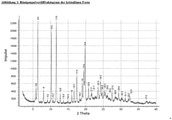
- a compound of the above formula (I) in this crystalline form is characterized in that its X-ray powder diffractogram at a temperature of 25° C. and when using Cu K ⁇ radiation has at least the following reflection positions (2 theta): 5.8°, 6.4°, 11.6 °, 17.5°, 19.8°, 20.8°, 23.5° and 24.2° (each ⁇ 0.2°).
- the X-ray powder diffractogram of the crystalline form at a temperature of 25°C and when using Cu K ⁇ radiation has at least the following additional reflection positions (2 theta): 10.2°, 12.8°, 16.7°, 19.0°, 25.3°, 27.5°, 29.4° (each ⁇ 0.2°).
- the X-ray powder diffractogram of the crystalline form at a temperature of 25° C. and using Cu K ⁇ radiation essentially corresponds to that in illustration 1 reproduced diffractogram.
- the Raman spectrum of the crystalline form particularly preferably has at least the following bands [cm -1 ]: 2927, 1663, 1386, 1334, 1022, 638 (each ⁇ 2° cm -1 ).
- the Raman spectrum of the crystalline form corresponds essentially to that in Figure 2 reproduced spectrum.
- the IR spectrum of the crystalline form particularly preferably has at least the following bands [cm -1 ]: 3286, 1662, 1219, 1181, 1154, 1055 (each ⁇ 2° cm -1 ).
- the IR spectrum of the crystalline form essentially corresponds to that in Figure 3 reproduced spectrum.
- the Raman spectra of the crystalline form were recorded with FT Raman spectrometers from Bruker (eg with the models RFS100 or MultiRam) at 25° C. and with a laser wavelength of 1064 nm and a resolution of 2 cm -1 .
- the starting point for the preparation of a compound of the above formula (I) in a crystalline form according to the present process is the presence of a reactant mixture in which a compound of the above formula (I) in at least one amidic solvent selected from the group of N,N -dimethylformamide, N,N-dimethylacetamide, N-methylformanilide, N-methyl-2-pyrrolidone, N-methylcaprolactam and hexamethylphosphoric triamide and very particularly preferably selected from the group consisting of NN-dimethylacetamide and N-methyl-2-pyrrolidone.
- an amidic solvent is present and not a mixture of the abovementioned amidic solvents.
- N,N-dimethylacetamide When N,N-dimethylacetamide is used, the crystalline N,N-dimethylacetamide solvate of the compound of formula (I) (DMAc solvate) described below is obtained.
- N-methyl-2-pyrrolidone the crystalline N-methyl-2-pyrrolidone solvate described below of the compound of the formula (I) (NMP solvate) is obtained.
- the DMAc solvate and the NMP solvate have significantly improved filtration properties (see Table 5).
- the filtration resistance ⁇ measured in Table 5 was measured by drawing a pressure filtration curve.
- the filtration test was carried out in an apparatus for determining the specific filtration resistance (alpha value) in accordance with VDI guideline 2762 (manufacturer: BHS Sonthofen, model: pocket measuring device KPL TMG 400).
- VDI guideline 2762 manufactured by measuring the suspension to be determined was filled into the apparatus and the amount of filtrate (mother liquor) produced was continuously measured by applying a pressure difference.
- the amount of filtrate V is recorded as a function of time t (filtrate curve).
- the specific filtration resistance (alpha value in m -2 ) can be determined by plotting t/V against V (see also W. Beckmann: Crystallization - Basic Concepts and Industrial Applications, Wiley-VCH, 2013, chap. 14.2.3 ).
- the at least one amide solvent is preferably used in a 2- to 20-fold excess by weight, particularly preferably in a 3- to 10-fold excess by weight, based on the compound of the formula (I) in the starting material mixture.
- a compound of formula (I) in at least one amidic solvent can be crystallized by lowering the temperature to the solvate without adding at least one anti-solvent.
- the temperature reduction preferably takes place slowly, particularly preferably in a range from 1 to 10° C./hour and even more preferably in a range from 1 to 5° C./hour in the temperature range given below.
- the compound of formula (I) in at least one Amidic solvent is preferably present in a homogeneous mixture, which can be achieved, for example, by stirring.
- At least one anti-solvent is used for the method described according to the invention, essentially in order to reduce the solubility and to achieve a higher yield of the solvate.
- the crystallization to form the solvate can then also take place without lowering the temperature or, overall, also at a higher process temperature.
- the presence or addition of at least one anti-solvent and the (preferably subsequent) temperature reduction are combined with one another for the crystallization to form the solvate.
- the at least one anti-solvent is preferably an anti-solvent selected from the group consisting of water, acetonitrile, C 1 -C 6 alcohols, toluene, xylenes, esters of formic acid with C 1 -C 4 alcohols and esters of acetic acid with C 1 -C 4 alcohols used.
- At least one anti-solvent selected from the group consisting of water, acetonitrile, methanol, ethanol, isopropanol, 1-butanol, toluene and ethyl acetate is particularly preferably used.
- the weight ratio between the at least one amide solvent and the at least one anti-solvent is between 10:1 and 1:1, more preferably between 5:1 and 2:1 and most preferably around 4:1.
- the at least one amidic solvent can also already be diluted with the at least one anti-solvent and the compound of the formula (I) in the educt mixture, provided the solvents used are inert under the reaction conditions and a homogeneous state is achieved prior to crystallization of the solvate, for example by increasing the temperature accordingly is reached.
- those inert solvents which, for example, also got into the reaction mixture with the solution of the compound of the formula (II), can be removed by suitable measures, for example by distillation, if necessary under reduced pressure.
- the solvate crystallization according to the process according to the invention described above is preferably carried out at temperatures from -20 to +30° C. and particularly preferably at temperatures from -10 to +20° C., generally under normal pressure.
- the reaction time can be chosen within a range of between one hour and several hours.
- the filtration can be carried out in a filtration apparatus known to those skilled in the art such as a pressure filter or a centrifuge. Drying can be carried out in a drying apparatus known to those skilled in the art, such as, for example, a horizontal or vertical mixer dryer or a suction dryer.
- the drying takes place in a temperature range from 20 to 100.degree. C., preferably in a temperature range from 60 to 80.degree.
- the drying takes place in a pressure range from 1 to 100 mbar, preferably in a pressure range from 5 to 20 mbar.
- the starting material mixture used for the process described above consisting of a compound of the abovementioned formula (I) together with at least one amide solvent, is preferably prepared by a process in which a compound of the formula (II) with a compound of formula (III) be reacted in the presence of an amidic solvent.
- the coupling reaction can optionally be carried out in the presence of a catalyst.
- a catalyst examples which may be mentioned are 4-dimethylaminopyridine and 1-hydroxybenzotriazole. Additional acid-binding agents are not required for this reaction.
- the coupling reaction is more preferably carried out in such a way that the compound of the formula (III) is initially introduced into the amide solvent in equimolar amounts or in a slight excess of 1.0-1.2 molar equivalents, based on the compound of the formula (II).
- the compound of formula (II) is then particularly preferred over a period of preferably 1 to 10 hours, preferably 2 to 5 hours as a solution preferably in an inert organic solvent or as a melt at a temperature of preferably -10 to +50°C 0 to 40.degree. C., very particularly preferably 10 to 30.degree. C., are metered in.
- This reaction is generally carried out under normal pressure. Alternatively it is however, it is also possible to work in a vacuum or under overpressure in an autoclave. After the end of the after-reaction time, the inert solvent is preferably removed as already described above.
- amidic solvents used for this coupling reaction are the same amidic solvents as described above for the starting material mixture.
- the compound of the formula (II) can be used for this coupling reaction as a solid or as a melt. However, preference is given to using the compound of the formula (II) dissolved in an inert organic solvent.
- the compound of formula (II) is dissolved in an inert organic solvent which is preferably selected from the group of aliphatic, alicyclic and aromatic hydrocarbons such as petroleum ether, hexane, heptane, cyclohexane, methylcyclohexane, benzene, toluene, xylene and decalin; halogenated hydrocarbons such as chlorobenzene, dichlorobenzene, dichloromethane, chloroform, carbon tetrachloride, dichloroethane and trichloroethane; ethers such as diethyl ether, diisopropyl ether, methyl t-butyl ether, methyl t-amyl ether, dio
- a compound of formula (II) is prepared by reacting a compound of formula (IV) is reacted with an acid halide former selected from the group consisting of phosgene, phosphorus tribromide, phosphorus trichloride, phosphorus pentachloride, phosphorus oxychloride and thionyl chloride in the presence of an inert organic solvent.
- an acid halide former selected from the group consisting of phosgene, phosphorus tribromide, phosphorus trichloride, phosphorus pentachloride, phosphorus oxychloride and thionyl chloride in the presence of an inert organic solvent.
- the acid halide former is preferably selected from the group consisting of phosgene, mesyl chloride and thionyl chloride.
- Thionyl chloride is particularly preferred.
- inert organic solvents already mentioned above for the preparation of the starting material mixture starting from the compounds of the formulas (II) and (III) are used as inert organic solvents.
- the use of toluene is particularly preferred.
- This process step is preferably carried out at temperatures from +20 to +100° C. and particularly preferably at temperatures from +50 to +75° C., generally under normal pressure.
- the reaction time is in a range between one hour and five hours, preferably between one hour and three hours.
- pyrazole carboxylic acids of the formula (IV) are known or can be obtained by known processes (cf WO2011/157664 A1 ). Because of the tetrazole group, pyrazolecarboxylic acids of the formula (IV) are generally present as mixtures of different regioisomers.
- Another object of the present invention relates to a crystalline NN-dimethylacetamide solvate of a compound of formula (I) which has at least the following reflection layers in the X-ray powder diffractogram at a temperature of 25° C. when using Cu K ⁇ radiation: 8.3, 8.9, 14.6, particularly preferably at least the following reflection layers: 8.3, 8.9, 10.4, 14.6, 15.5, very particularly preferably at least the following reflection layers has: 8.3, 8.9, 10.4, 12.7, 14.6, 15.5, 27.6 (expressed as 2 theta/° value ⁇ 0.2°).
- the crystalline NN-dimethylacetamide solvate according to the invention of a compound of the formula (I) preferably has the reflection positions (2 theta) given in Table 3.
- the X-ray powder diffractogram of the DMAc solvate is also in the Figure 4 played back.
- Another object of the present invention relates to a crystalline N-methyl-2-pyrrolidone solvate of a compound of formula (I) which has at least the following reflection layers in the X-ray powder diffractogram at a temperature of 25° C. when using Cu K ⁇ radiation: 8.3, 8.9, 14.6, particularly preferably at least the following reflection layers: 8.3, 8.9, 10.5, 14.6, 15.4, very particularly preferably at least the following reflection layers has: 8.3, 8.9, 10.5, 12.7, 14.6, 15.4, 27.6 (expressed as 2 theta/° value ⁇ 0.2°).
- the crystalline N-methyl-2-pyrrolidone solvate according to the invention of a compound of the formula (I) preferably has the reflection positions (2 theta) given in Table 3.
- the X-ray powder diffractogram of the NMP solvate is also in the Figure 5 played back.
- the crystalline NN-dimethylacetamide solvate and the crystalline N-methyl-2-pyrrolidone solvate of a compound of formula (I) can also be characterized by IR and Raman spectroscopy.
- the corresponding Raman and IR spectra are in Figure 6 , 7 and 8th pictured.
- IR spectra of the solvates were recorded by FTIR analysis in the spectral range from 400 to 4000 cm -1 with a Bruker Platinum ATR Tensor II and a resolution of 4 cm -1 .
- Bruker's Opus software was used for configuration of the instruments, data recording and data analysis.
- the Raman spectrum of the DMAc solvate preferably has at least the following characteristic bands: 3126, 1685, 1340, particularly preferably the following bands: 3126, 3026, 1685, 1340, 1306, particularly preferably the following bands: 3126, 3026, 2972, 1685, 1340, 1306, 963 (reported as band [cm -1 ]; each ⁇ 2° cm -1 ).
- the IR spectrum of the DMAc solvate preferably has at least the following characteristic bands: 3234, 1525, 926, particularly preferably the following bands: 3234, 3124, 1525, 1496, 926, particularly preferably the following bands: 3234, 3124, 3078, 1525, 1496, 1016, 926 (reported as band [cm -1 ]; each ⁇ 2° cm -1 ).
- the Raman spectrum of the NMP solvate preferably has at least the following characteristic bands: 3125, 1684, 1342, particularly preferably the following bands: 3125, 3024, 1684, 1342, 1305, particularly preferably the following bands: 3125, 3024, 2973, 1684, 1342, 1305, 963 (reported as band [cm -1 ]; each ⁇ 2° cm -1 ).
- the IR spectrum of the NMP solvate preferably has at least the following characteristic bands: 3234, 1525, 926, particularly preferably the following bands: 3234, 3124, 1525, 926, 848, particularly preferably the following bands: 3234, 3124, 3078, 1525, 1016, 926, 848 (reported as band [cm -1 ]; each ⁇ 2° cm -1 ).
- the solid was filtered off using a suction filter and the moist filter cake was dried at 80° C. and 10 mbar. 31.4 g of the product were obtained as a 95:5 mixture of isomers in crystalline form.
- the crystalline form obtained showed the characteristic X-ray powder diffractogram given in Table 1 and Figures 1, as well as the Raman and IR spectra.
Landscapes
- Chemical & Material Sciences (AREA)
- Organic Chemistry (AREA)
- Pharmaceuticals Containing Other Organic And Inorganic Compounds (AREA)
- Plural Heterocyclic Compounds (AREA)
Priority Applications (14)
| Application Number | Priority Date | Filing Date | Title |
|---|---|---|---|
| EP20194636.5A EP3964506A1 (fr) | 2020-09-04 | 2020-09-04 | Procédé de fabrication d'un dérivé de diamide d'acide anthranilique substitué par tétrazole |
| TW110132601A TWI917430B (zh) | 2020-09-04 | 2021-09-02 | 製備經四唑取代之鄰胺苯甲酸二醯胺衍生物之方法 |
| DK21772771.8T DK4208453T3 (da) | 2020-09-04 | 2021-09-02 | Fremgangsmåde til fremstilling af et tetrazol-substitueret anthranilsyrediamid-derivat |
| MX2023002692A MX2023002692A (es) | 2020-09-04 | 2021-09-02 | Procedimiento de preparacion de un derivado de diamida de acido antranilico sustituido con tetrazol. |
| KR1020237010934A KR20230061449A (ko) | 2020-09-04 | 2021-09-02 | 테트라졸-치환된 안트라닐산 디아미드 유도체의 제조 방법 |
| IL300956A IL300956A (en) | 2020-09-04 | 2021-09-02 | A process for the preparation of a diamide derivative of tetrazole-substituted anthranilic acid |
| US18/024,722 US12545661B2 (en) | 2020-09-04 | 2021-09-02 | Process for preparing a tetrazole-substituted anthranilic acid diamide derivative |
| CN202180053957.0A CN116057054A (zh) | 2020-09-04 | 2021-09-02 | 用于制备四唑取代的邻氨基苯甲酸二酰胺衍生物的方法 |
| JP2023514811A JP7834723B2 (ja) | 2020-09-04 | 2021-09-02 | テトラゾール置換アントラニル酸ジアミド誘導体の製造方法 |
| PCT/EP2021/074248 WO2022049186A1 (fr) | 2020-09-04 | 2021-09-02 | Procédé de préparation d'un dérivé diamide d'acide anthranilique substitué par tétrazole |
| ES21772771T ES2991987T3 (es) | 2020-09-04 | 2021-09-02 | Procedimiento de preparación de un derivado de diamida de ácido antranílico sustituido con tetrazol |
| EP21772771.8A EP4208453B1 (fr) | 2020-09-04 | 2021-09-02 | Procédé de fabrication d'un dérivé de diamide d'acide anthranilique substitué par tétrazole |
| FIEP21772771.8T FI4208453T3 (fi) | 2020-09-04 | 2021-09-02 | Menetelmä tetratsolisubstituoidun antraniilihappodiamidijohdannaisen tuottamiseksi |
| JP2025280757A JP2026053590A (ja) | 2020-09-04 | 2025-12-24 | テトラゾール置換アントラニル酸ジアミド誘導体の製造方法 |
Applications Claiming Priority (1)
| Application Number | Priority Date | Filing Date | Title |
|---|---|---|---|
| EP20194636.5A EP3964506A1 (fr) | 2020-09-04 | 2020-09-04 | Procédé de fabrication d'un dérivé de diamide d'acide anthranilique substitué par tétrazole |
Publications (1)
| Publication Number | Publication Date |
|---|---|
| EP3964506A1 true EP3964506A1 (fr) | 2022-03-09 |
Family
ID=72381019
Family Applications (2)
| Application Number | Title | Priority Date | Filing Date |
|---|---|---|---|
| EP20194636.5A Withdrawn EP3964506A1 (fr) | 2020-09-04 | 2020-09-04 | Procédé de fabrication d'un dérivé de diamide d'acide anthranilique substitué par tétrazole |
| EP21772771.8A Active EP4208453B1 (fr) | 2020-09-04 | 2021-09-02 | Procédé de fabrication d'un dérivé de diamide d'acide anthranilique substitué par tétrazole |
Family Applications After (1)
| Application Number | Title | Priority Date | Filing Date |
|---|---|---|---|
| EP21772771.8A Active EP4208453B1 (fr) | 2020-09-04 | 2021-09-02 | Procédé de fabrication d'un dérivé de diamide d'acide anthranilique substitué par tétrazole |
Country Status (11)
| Country | Link |
|---|---|
| US (1) | US12545661B2 (fr) |
| EP (2) | EP3964506A1 (fr) |
| JP (2) | JP7834723B2 (fr) |
| KR (1) | KR20230061449A (fr) |
| CN (1) | CN116057054A (fr) |
| DK (1) | DK4208453T3 (fr) |
| ES (1) | ES2991987T3 (fr) |
| FI (1) | FI4208453T3 (fr) |
| IL (1) | IL300956A (fr) |
| MX (1) | MX2023002692A (fr) |
| WO (1) | WO2022049186A1 (fr) |
Citations (3)
| Publication number | Priority date | Publication date | Assignee | Title |
|---|---|---|---|---|
| WO2006023783A1 (fr) | 2004-08-17 | 2006-03-02 | E.I. Dupont De Nemours And Company | Nouveaux anthranilamides servant a lutter contre des nuisibles invertebres |
| WO2010069502A2 (fr) * | 2008-12-18 | 2010-06-24 | Bayer Cropscience Ag | Amides d'acide anthranilique substitués par tétrazol, utilisés comme pesticides |
| WO2011157664A1 (fr) | 2010-06-15 | 2011-12-22 | Bayer Cropscience Ag | Procédé de production de dérivés de diamide d'acide anthranilique substitués par tétrazole et nouvelle modification cristalline de ces dérivés |
Family Cites Families (5)
| Publication number | Priority date | Publication date | Assignee | Title |
|---|---|---|---|---|
| MX2014000318A (es) * | 2011-07-08 | 2014-02-19 | Bayer Ip Gmbh | Procedimiento de preparacion de derivados de diamida del acido antranilico sustituidos con tetrazol mediante la reaccion de acidos de pirazol con esteres antranilicos. |
| MX349771B (es) * | 2011-08-26 | 2017-08-10 | Bayer Ip Gmbh | Procedimiento para preparar derivados de diamida de acido antranilico sustituida con tetrazol haciendo reaccionar benzoxazinonas con aminas. |
| US20160229820A1 (en) * | 2013-10-17 | 2016-08-11 | Basf Se | Process for preparing substituted isatoic acid anhydride compounds and derivatives thereof |
| WO2019224678A1 (fr) | 2018-05-21 | 2019-11-28 | Pi Industries Ltd. | Nouveau procédé de préparation de diamides anthraniliques |
| MX2021000226A (es) * | 2018-07-20 | 2021-03-31 | Pi Industries Ltd | Nuevo proceso para la preparacion de diamidas antranilicas. |
-
2020
- 2020-09-04 EP EP20194636.5A patent/EP3964506A1/fr not_active Withdrawn
-
2021
- 2021-09-02 FI FIEP21772771.8T patent/FI4208453T3/fi active
- 2021-09-02 DK DK21772771.8T patent/DK4208453T3/da active
- 2021-09-02 EP EP21772771.8A patent/EP4208453B1/fr active Active
- 2021-09-02 JP JP2023514811A patent/JP7834723B2/ja active Active
- 2021-09-02 US US18/024,722 patent/US12545661B2/en active Active
- 2021-09-02 ES ES21772771T patent/ES2991987T3/es active Active
- 2021-09-02 IL IL300956A patent/IL300956A/en unknown
- 2021-09-02 MX MX2023002692A patent/MX2023002692A/es unknown
- 2021-09-02 WO PCT/EP2021/074248 patent/WO2022049186A1/fr not_active Ceased
- 2021-09-02 KR KR1020237010934A patent/KR20230061449A/ko active Pending
- 2021-09-02 CN CN202180053957.0A patent/CN116057054A/zh active Pending
-
2025
- 2025-12-24 JP JP2025280757A patent/JP2026053590A/ja not_active Withdrawn
Patent Citations (3)
| Publication number | Priority date | Publication date | Assignee | Title |
|---|---|---|---|---|
| WO2006023783A1 (fr) | 2004-08-17 | 2006-03-02 | E.I. Dupont De Nemours And Company | Nouveaux anthranilamides servant a lutter contre des nuisibles invertebres |
| WO2010069502A2 (fr) * | 2008-12-18 | 2010-06-24 | Bayer Cropscience Ag | Amides d'acide anthranilique substitués par tétrazol, utilisés comme pesticides |
| WO2011157664A1 (fr) | 2010-06-15 | 2011-12-22 | Bayer Cropscience Ag | Procédé de production de dérivés de diamide d'acide anthranilique substitués par tétrazole et nouvelle modification cristalline de ces dérivés |
Non-Patent Citations (6)
| Title |
|---|
| B. BAKER ET AL., J. ORG. CHEM., 1952, pages 149 - 153 |
| F. E. SHEIBLEY, J. ORG. CHEM., vol. 3, 1938, pages 414 - 423 |
| G. REISSENWEBER ET AL., ANGEW. CHEM, vol. 93, 1981, pages 914 - 915 |
| MINO R CAIRA ED - MONTCHAMP JEAN-LUC: "Crystalline Polymorphism of Organic Compounds", TOPICS IN CURRENT CHEMISTRY; [TOPICS IN CURRENT CHEMISTRY], SPRINGER, BERLIN, DE, vol. 198, 1998, pages 163 - 208, XP008166276, ISSN: 0340-1022, [retrieved on 19990226], DOI: 10.1007/3-540-69178-2_5 * |
| P.J. MONTOYA-PELAEZ, J. ORG. CHEM., vol. 71, 2006, pages 5921 - 5929 |
| W. BECKMANN: "Crystallization - Basic Concepts and Industrial Applications", 2013, WILEY-VCH |
Also Published As
| Publication number | Publication date |
|---|---|
| MX2023002692A (es) | 2023-04-03 |
| ES2991987T3 (es) | 2024-12-05 |
| US20230339899A1 (en) | 2023-10-26 |
| JP7834723B2 (ja) | 2026-03-24 |
| CN116057054A (zh) | 2023-05-02 |
| JP2023540965A (ja) | 2023-09-27 |
| FI4208453T3 (fi) | 2024-09-25 |
| EP4208453B1 (fr) | 2024-08-21 |
| US12545661B2 (en) | 2026-02-10 |
| KR20230061449A (ko) | 2023-05-08 |
| EP4208453A1 (fr) | 2023-07-12 |
| IL300956A (en) | 2023-04-01 |
| WO2022049186A1 (fr) | 2022-03-10 |
| JP2026053590A (ja) | 2026-03-25 |
| TW202229257A (zh) | 2022-08-01 |
| DK4208453T3 (da) | 2024-09-30 |
Similar Documents
| Publication | Publication Date | Title |
|---|---|---|
| EP2582694B1 (fr) | Procédé de fabrication de dérivés de diamide d'acide anthranilique substitués par tétrazole et nouvelle modification cristalline de ces dérivés | |
| DE69716767T2 (de) | Verfahren zur herstellung von tolterodin | |
| DE4236400A1 (de) | N-Phenylacetaminonitrile | |
| DE202010017868U1 (de) | Kristalline Formen von Febuxostat | |
| DD263058A5 (de) | Verfahren zur herstellung von 4-benzyl-1-(2h)-phthalazinon-derivaten | |
| DE69313771T2 (de) | Carbazolon - Derivate und Verfahren zu ihrer Herstellung | |
| EP4208453B1 (fr) | Procédé de fabrication d'un dérivé de diamide d'acide anthranilique substitué par tétrazole | |
| EP0121727B1 (fr) | Agent bactéricide basé en acides quinolinonecarboxyliques | |
| DE60000661T2 (de) | Eine methode zur herstellung eines polymorphes von einem doxazosin-mesylat | |
| AT504621B1 (de) | Neues verfahren zur herstellung von 4,4'-(1-methyl -1,2-ethandiyl)-bis-(2,6-piperazindion) | |
| DE69013726T2 (de) | Verbessertes Verfahren für die Herstellung von o-Carboxypyridyl- und o-Carboxychinolylimidazolinonen. | |
| DE2819873A1 (de) | N-phenyl-n-(4-piperidinyl)-amide, verfahren zu deren herstellung und deren verwendung als analgetika | |
| DE60015496T2 (de) | Verfahren zur herstellung von 3-substituierte 1,5-diarylpyrozole | |
| DE4141187A1 (de) | Verfahren zur herstellung von substituierten pyrazolinen | |
| DE112005003147T5 (de) | Verfahren | |
| DE10332684B3 (de) | Verfahren zur Herstellung von Bifonazol | |
| DE69910691T2 (de) | L-Tartrate von Trans-(-)-4-(4-Fluorphenyl)-3-Hydroxymethyl-Piperidin Verbindungen und Verfahren zu ihrer Herstellung | |
| EP1232151A1 (fr) | Procede de preparation de benzofuranonoximes | |
| DE69305352T2 (de) | Verfahren zur herstellung von 1,3-dioxolanderivaten | |
| DE1543612A1 (de) | Verfahren zur Herstellung von Alkylmercaptoaniliden | |
| EP0092111B1 (fr) | Dérivés du 2,2-dihalogène-3,3-diméthylcyclopropane | |
| EP0008056A1 (fr) | Dérivés de pyrazole N-substitués, procédé pour leur préparation et N-hydroxyalkylpyrazoles obtenus au cours de ce procédé | |
| EP2313377B1 (fr) | Procédé de synthèse stéréosélective d'hétérocycles bicycliques | |
| DE112018001170T5 (de) | Verfahren zur Herstellung einer Triazolverbindung | |
| AT404726B (de) | Kristalline salze von derivaten der 3-vinyl-3-cephem-4-carbonsäure und verfahren zu deren herstellung |
Legal Events
| Date | Code | Title | Description |
|---|---|---|---|
| PUAI | Public reference made under article 153(3) epc to a published international application that has entered the european phase |
Free format text: ORIGINAL CODE: 0009012 |
|
| STAA | Information on the status of an ep patent application or granted ep patent |
Free format text: STATUS: THE APPLICATION HAS BEEN PUBLISHED |
|
| AK | Designated contracting states |
Kind code of ref document: A1 Designated state(s): AL AT BE BG CH CY CZ DE DK EE ES FI FR GB GR HR HU IE IS IT LI LT LU LV MC MK MT NL NO PL PT RO RS SE SI SK SM TR |
|
| STAA | Information on the status of an ep patent application or granted ep patent |
Free format text: STATUS: THE APPLICATION HAS BEEN WITHDRAWN |
|
| 18W | Application withdrawn |
Effective date: 20220314 |