EP3965382A1 - Procédé et dispositif permettant de mettre en oeuvre un traitement de fonction de service - Google Patents
Procédé et dispositif permettant de mettre en oeuvre un traitement de fonction de service Download PDFInfo
- Publication number
- EP3965382A1 EP3965382A1 EP20822610.0A EP20822610A EP3965382A1 EP 3965382 A1 EP3965382 A1 EP 3965382A1 EP 20822610 A EP20822610 A EP 20822610A EP 3965382 A1 EP3965382 A1 EP 3965382A1
- Authority
- EP
- European Patent Office
- Prior art keywords
- packet
- nsh
- network device
- sid
- srv6
- Prior art date
- Legal status (The legal status is an assumption and is not a legal conclusion. Google has not performed a legal analysis and makes no representation as to the accuracy of the status listed.)
- Pending
Links
- 238000000034 method Methods 0.000 title claims abstract description 140
- 230000005540 biological transmission Effects 0.000 claims description 40
- 238000013507 mapping Methods 0.000 claims description 40
- 238000005538 encapsulation Methods 0.000 claims description 38
- 230000006870 function Effects 0.000 description 74
- 238000010586 diagram Methods 0.000 description 11
- 101100309570 Caenorhabditis elegans let-765 gene Proteins 0.000 description 10
- 230000000694 effects Effects 0.000 description 3
- 238000005516 engineering process Methods 0.000 description 1
- 230000003287 optical effect Effects 0.000 description 1
- 230000000750 progressive effect Effects 0.000 description 1
Images




Classifications
-
- H—ELECTRICITY
- H04—ELECTRIC COMMUNICATION TECHNIQUE
- H04L—TRANSMISSION OF DIGITAL INFORMATION, e.g. TELEGRAPHIC COMMUNICATION
- H04L45/00—Routing or path finding of packets in data switching networks
- H04L45/34—Source routing
-
- H—ELECTRICITY
- H04—ELECTRIC COMMUNICATION TECHNIQUE
- H04L—TRANSMISSION OF DIGITAL INFORMATION, e.g. TELEGRAPHIC COMMUNICATION
- H04L41/00—Arrangements for maintenance, administration or management of data switching networks, e.g. of packet switching networks
- H04L41/08—Configuration management of networks or network elements
- H04L41/0803—Configuration setting
- H04L41/0813—Configuration setting characterised by the conditions triggering a change of settings
- H04L41/082—Configuration setting characterised by the conditions triggering a change of settings the condition being updates or upgrades of network functionality
-
- H—ELECTRICITY
- H04—ELECTRIC COMMUNICATION TECHNIQUE
- H04L—TRANSMISSION OF DIGITAL INFORMATION, e.g. TELEGRAPHIC COMMUNICATION
- H04L41/00—Arrangements for maintenance, administration or management of data switching networks, e.g. of packet switching networks
- H04L41/08—Configuration management of networks or network elements
- H04L41/0894—Policy-based network configuration management
-
- H—ELECTRICITY
- H04—ELECTRIC COMMUNICATION TECHNIQUE
- H04L—TRANSMISSION OF DIGITAL INFORMATION, e.g. TELEGRAPHIC COMMUNICATION
- H04L41/00—Arrangements for maintenance, administration or management of data switching networks, e.g. of packet switching networks
- H04L41/08—Configuration management of networks or network elements
- H04L41/0895—Configuration of virtualised networks or elements, e.g. virtualised network function or OpenFlow elements
-
- H—ELECTRICITY
- H04—ELECTRIC COMMUNICATION TECHNIQUE
- H04L—TRANSMISSION OF DIGITAL INFORMATION, e.g. TELEGRAPHIC COMMUNICATION
- H04L41/00—Arrangements for maintenance, administration or management of data switching networks, e.g. of packet switching networks
- H04L41/40—Arrangements for maintenance, administration or management of data switching networks, e.g. of packet switching networks using virtualisation of network functions or resources, e.g. SDN or NFV entities
-
- H—ELECTRICITY
- H04—ELECTRIC COMMUNICATION TECHNIQUE
- H04L—TRANSMISSION OF DIGITAL INFORMATION, e.g. TELEGRAPHIC COMMUNICATION
- H04L41/00—Arrangements for maintenance, administration or management of data switching networks, e.g. of packet switching networks
- H04L41/50—Network service management, e.g. ensuring proper service fulfilment according to agreements
- H04L41/5041—Network service management, e.g. ensuring proper service fulfilment according to agreements characterised by the time relationship between creation and deployment of a service
- H04L41/5054—Automatic deployment of services triggered by the service manager, e.g. service implementation by automatic configuration of network components
-
- H—ELECTRICITY
- H04—ELECTRIC COMMUNICATION TECHNIQUE
- H04L—TRANSMISSION OF DIGITAL INFORMATION, e.g. TELEGRAPHIC COMMUNICATION
- H04L45/00—Routing or path finding of packets in data switching networks
- H04L45/74—Address processing for routing
-
- H—ELECTRICITY
- H04—ELECTRIC COMMUNICATION TECHNIQUE
- H04L—TRANSMISSION OF DIGITAL INFORMATION, e.g. TELEGRAPHIC COMMUNICATION
- H04L45/00—Routing or path finding of packets in data switching networks
- H04L45/74—Address processing for routing
- H04L45/741—Routing in networks with a plurality of addressing schemes, e.g. with both IPv4 and IPv6
-
- H—ELECTRICITY
- H04—ELECTRIC COMMUNICATION TECHNIQUE
- H04L—TRANSMISSION OF DIGITAL INFORMATION, e.g. TELEGRAPHIC COMMUNICATION
- H04L45/00—Routing or path finding of packets in data switching networks
- H04L45/74—Address processing for routing
- H04L45/745—Address table lookup; Address filtering
-
- H—ELECTRICITY
- H04—ELECTRIC COMMUNICATION TECHNIQUE
- H04L—TRANSMISSION OF DIGITAL INFORMATION, e.g. TELEGRAPHIC COMMUNICATION
- H04L69/00—Network arrangements, protocols or services independent of the application payload and not provided for in the other groups of this subclass
- H04L69/22—Parsing or analysis of headers
-
- H—ELECTRICITY
- H04—ELECTRIC COMMUNICATION TECHNIQUE
- H04L—TRANSMISSION OF DIGITAL INFORMATION, e.g. TELEGRAPHIC COMMUNICATION
- H04L2212/00—Encapsulation of packets
-
- H—ELECTRICITY
- H04—ELECTRIC COMMUNICATION TECHNIQUE
- H04L—TRANSMISSION OF DIGITAL INFORMATION, e.g. TELEGRAPHIC COMMUNICATION
- H04L41/00—Arrangements for maintenance, administration or management of data switching networks, e.g. of packet switching networks
- H04L41/08—Configuration management of networks or network elements
- H04L41/0803—Configuration setting
- H04L41/0806—Configuration setting for initial configuration or provisioning, e.g. plug-and-play
Definitions
- This application relates to the field of communications technologies, and in particular, to a method and an apparatus for implementing service function processing.
- SFC service function chaining
- SFF service function forwarder
- a packet transmitted in a network is an SR packet.
- SR segment routing
- SF entities that do not support SR in an existing network, and these SF entities cannot perform SF processing on the SR packet. It is highly costly to enable all SF entities in the existing network to support the SR through technical reconstruction.
- Embodiments of this application provide a method and an apparatus for implementing an SFC, so that SF processing can be implemented for an SRv6 packet when an SF entity does not support SR, and technical reconstruction does not need to be performed on a large quantity of SF entities that do not support SR in an existing network, thereby reducing reconstruction costs.
- an embodiment of this application provides a method for implementing service function processing.
- a network device receives a first internet protocol version 6 segment routing packet, generates a first NSH packet based on the first SRv6 packet, and sends the first NSH packet to a service function SF entity.
- the first SRv6 packet includes a first internet protocol version 6 header (Internet Protocol version 6 Header, IPv6 Header) and a first network service header NSH.
- the first NSH packet includes a part obtained by removing the first IPv6 header from the first SRv6 packet.
- the network device may convert the SRv6 packet into a network service header (English: network service header, NSH for short) packet, and then send the NSH packet to the SF entity, so that the SF entity can perform SF processing on the NSH packet.
- a part that is obtained by removing an IPv6 header and an NSH from the SRv6 packet is a payload of the NSH packet. Therefore, that the SF entity performs SF processing on the NSH packet means that SF processing is performed on the SRv6 packet.
- SF processing can also be performed on the SRv6 packet when the SF entity does not support the SR.
- Technical reconstruction does not need to be performed on a large quantity of SF entities that do not support the SR in the existing network, thereby reducing costs of using an SFC for network upgrade.
- the method further includes: The network device identifies a first segment identifier SID of the network device from a destination address field of the first IPv6 header, and determines that the first SID is used to indicate the network device to send a NSH packet to the SF entity.
- the network device can generate the first NSH packet based on the first SRv6 packet and send the first NSH packet to the SF entity, so that the SF entity performs SF processing on the first NSH packet.
- the first NSH carries a service path identifier SPI.
- the network device After receiving the first SRv6 packet, the network device further records a mapping relationship between the SPI and the first IPv6 header.
- the network device After sending the first NSH packet to the SF entity, the network device further receives a second NSH packet sent by the SF entity; determines the first IPv6 header based on the mapping relationship between the SPI and the first IPv6 header; replaces the first SID carried in the destination address field of the first IPv6 header with a second SID of a next-hop network device of the network device, to obtain a second IPv6 header; and generates a second SRv6 packet based on the second NSH packet, where the second SRv6 packet includes the second IPv6 header, a second NSH, and a payload of the second NSH packet.
- the second NSH packet includes the second NSH, and the second NSH carries the SPI. It can be learned that the network device may determine, by recording the mapping relationship between the first IPv6 header and the SPI, the second IPv6 header for the second NSH packet returned by the SF entity, so that the network device can generate the second SRv6 packet based on the second NSH packet returned by the SF entity, and continue to forward the second SRv6 packet to the next-hop network device.
- the first NSH carries a service path identifier SPI.
- the network device After receiving the first SRv6 packet, the network device replaces the first SID carried in the destination address field of the first IPv6 header with a second SID of a next-hop network device of the network device, to obtain a second IPv6 header, and records a mapping relationship between the SPI and the second IPv6 header.
- the network device After sending the first NSH packet to the SF entity, the network device receives a second NSH packet sent by the SF entity; determines the second IPv6 header based on the mapping relationship between the SPI and the second IPv6 header; and generates a second SRv6 packet based on the second NSH packet, where the second SRv6 packet includes the second IPv6 header, a second NSH, and a payload of the second NSH packet.
- the second NSH packet includes the second NSH, and the second NSH carries the SPI.
- the network device may determine, by recording the mapping relationship between the second IPv6 header and the SPI, the second IPv6 header for the second NSH packet returned by the SF entity, so that the network device can generate the second SRv6 packet based on the second NSH packet returned by the SF entity, and continue to forward the second SRv6 packet to the next-hop network device.
- that the network device determines that the first SID is used to indicate to send the NSH packet to the service function SF entity includes: The network device obtains a function (function) part of the first SID, where the function part is used to indicate to send the NSH packet to the service function SF entity. It can be learned that, based on a function that the function part in the first SID of the network device is used to indicate to send the NSH packet to the SF entity, the first SID of the network device can be used to indicate the function.
- the network device can generate the first NSH packet based on the first SRv6 packet and send the first NSH packet to the SF entity, so that the SF entity performs SF processing on the first NSH packet.
- the network device further advertises the first SID to a controller or a classifier before the network device receives the first SRv6 packet. It can be learned that the first SID that can be used to indicate the network device to send the NSH packet to the SF entity may be advertised by the network device to the controller or the classifier, so that the classifier can encapsulate the first SID into the SRv6 packet.
- the network device further records a mapping relationship between the first SID and the SF entity. It can be learned that the network device can send, to the SF entity based on the mapping relationship, the NSH packet generated based on the SRv6 packet that carries the first SID.
- the first SID is carried in border gateway protocol BGP link state LS type-length-value TLV information for sending. It can be learned that the network device may advertise the first SID to the classifier or the controller by using the BGP LS, so that the first SID can be encapsulated into the SRv6 packet.
- the network device before the network device receives the first SRv6 packet, the network device further advertises, to the controller or the classifier, encapsulation information used to transmit the NSH packet between the network device and the SF. It can be learned that the controller and the classifier may obtain the encapsulation information that is of the NSH packet and that is advertised by the network device, so that the encapsulation information may be carried in the SRv6 packet, and the SRv6 packet can be converted into the NSH packet.
- an embodiment of this application provides a method for implementing service function processing.
- a classifier receives a service packet, obtains a segment routing SR policy and an NSH that correspond to the service packet, encapsulates an IPv6 header and the NSH into the service packet according to the SR policy, to generate an SRv6 packet, and sends the SRv6 packet to a next-hop network device of the classifier by using a segment list.
- the SR policy includes the segment list, and the segment list is used to identify a transmission path of the service packet.
- the segment list includes a SID of a network device, and the SID of the network device is used to indicate the network device to send a network service header NSH packet to a service function SF entity.
- the classifier may encapsulate the NSH and the IPv6 header into the service packet to generate the SRv6 packet, and send the SRv6 packet, where the SID of the network device carried in the IPv6 header may be used to indicate the network device to convert the SRv6 packet into an NSH packet and send the NSH packet to the SF entity. Therefore, the SF entity can perform SF processing on the NSH packet.
- a part that is obtained by removing the IPv6 header and the NSH from the SRv6 packet is a payload of the NSH packet. Therefore, that the SF entity performs SF processing on the NSH packet means that SF processing is performed on the SRv6 packet. It can be learned that SF processing can also be performed on the SRv6 packet when the SF entity does not support SR. Technical reconstruction does not need to be performed on a large quantity of SF entities that do not support the SR in the existing network, thereby reducing costs of using an SFC for network upgrade.
- the classifier obtains the segment routing SR policy corresponding to the service packet includes: The classifier receives the SR policy sent by a controller. It can be learned that the SR policy may be generated by the controller and delivered to the classifier.
- the classifier obtains the segment routing SR policy corresponding to the service packet includes: The classifier receives the SID sent by the network device, and the classifier generates the SR policy based on the SID. It can be learned that the SR policy may be generated by the classifier.
- the SID is carried in border gateway protocol BGP link state LS type-length-value TLV information for sending. It can be learned that the network device may advertise the SID to the classifier or the controller by using the BGP LS, so that the first SID can be encapsulated into the SRv6 packet.
- the classifier further receives encapsulation information used to transmit the NSH packet between the network device and the SF entity. It can be learned that the classifier may obtain the encapsulation information that is of the NSH packet and that is advertised by the network device, so that the encapsulation information may be carried in the SRv6 packet, and the SRv6 packet can be converted into the NSH packet.
- an embodiment of this application provides a method for implementing service function processing.
- a controller receives a SID of a network device, generates an SR policy and an NSH of a service flow, and sends the SR policy and the NSH to a classifier.
- the SID of the network device is used to indicate the network device to send a network service header NSH packet to a service function SF entity.
- the SR policy includes a segment list, the segment list is used to indicate a transmission path of the service flow, and the segment list includes the SID. Because most SF entities in an existing network support SF processing on an NSH packet, the controller may deliver the SR policy and the NSH to the classifier.
- the SID of the network device in the segment list carried in the SR policy may be used to indicate the network device to convert an SRv6 packet into an NSH packet and send the NSH packet to the SF entity. Therefore, the classifier may encapsulate an IPv6 header and the NSH into a service packet according to the SR policy to generate the SRv6 packet, and send the SRv6 packet, where the IPv6 header carries the SID of the network device. In this way, the SF entity can perform SF processing on the NSH packet. Apart that is obtained by removing the IPv6 header and the NSH from the SRv6 packet is a payload of the NSH packet.
- the SF entity performs SF processing on the NSH packet means that SF processing is performed on the SRv6 packet. It can be learned that SF processing can also be performed on the SRv6 packet when the SF entity does not support SR. Technical reconstruction does not need to be performed on a large quantity of SF entities that do not support the SR in the existing network, thereby reducing costs of using an SFC for network upgrade.
- the SID is carried in border gateway protocol BGP link state LS type-length-value TLV information for sending. It can be learned that the network device may advertise the SID to the controller by using the BGP LS, so that the first SID can be encapsulated into the SRv6 packet.
- the controller further receives encapsulation information that is sent by the network device and that is used to transmit the NSH packet between the network device and the SF, and sends the encapsulation information to the classifier. It can be learned that the controller may obtain the encapsulation information that is of the NSH packet and that is advertised by the network device, and provide the encapsulation information to the classifier, so that the encapsulation information may be carried in the SRv6 packet, and the SRv6 packet can be converted into the NSH packet.
- an embodiment of this application provides a network device for implementing service function processing.
- the network device includes a receiving unit, a processing unit, and a sending unit.
- the receiving unit is configured to receive a first internet protocol version 6 segment routing SRv6 packet, where the first SRv6 packet includes a first internet protocol version 6 header IPv6 header and a first network service header NSH.
- the processing unit is configured to generate a first NSH packet based on the first SRv6 packet, where the first NSH packet includes a part obtained by removing the first IPv6 header from the first SRv6 packet.
- the sending unit is configured to send the first NSH packet to a service function SF entity.
- the processing unit is further configured to: before generating the first NSH packet based on the first SRv6 packet, identify a first segment identifier SID of the network device from a destination address field of the first IPv6 header; and determine that the first SID is used to indicate the network device to send the NSH packet to the SF entity.
- the first NSH carries a service path identifier SPI.
- the processing unit is further configured to record a mapping relationship between the SPI and the first IPv6 header.
- the sending unit sends the first NSH packet to the SF entity
- the receiving unit is further configured to receive a second NSH packet sent by the SF entity, where the second NSH packet includes a second NSH, and the second NSH carries the SPI.
- the processing unit is further configured to: determine the first IPv6 header based on the mapping relationship between the SPI and the first IPv6 header; replace the first SID carried in the destination address field of the first IPv6 header with a second SID of a next-hop network device of the network device, to obtain a second IPv6 header; and generate a second SRv6 packet based on the second NSH packet, where the second SRv6 packet includes the second IPv6 header, the second NSH, and a payload of the second NSH packet.
- the first NSH carries a service path identifier SPI.
- the processing unit is further configured to: replace the first SID carried in the destination address field of the first IPv6 header with a second SID of a next-hop network device of the network device, to obtain a second IPv6 header; and record a mapping relationship between the SPI and the second IPv6 header.
- the sending unit sends the first NSH packet to the SF entity
- the receiving unit is further configured to receive a second NSH packet sent by the SF entity, where the second NSH packet includes a second NSH, and the second NSH carries the SPI.
- the processing unit is further configured to: determine the second IPv6 header based on the mapping relationship between the SPI and the second IPv6 header; and generate a second SRv6 packet based on the second NSH packet, where the second SRv6 packet includes the second IPv6 header, the second NSH, and a payload of the second NSH packet.
- the processor is further configured to obtain a function function part of the first SID, where the function part is used to indicate to send the NSH packet to the service function SF entity.
- the sending unit is further configured to advertise the first SID to a controller or a classifier.
- the processing unit is further configured to record a mapping relationship between the first SID and the SF entity.
- the first SID is carried in border gateway protocol BGP link state LS type-length-value TLV information for sending.
- the sending unit is further configured to advertise, to the controller or the classifier, encapsulation information used to transmit the NSH packet between the network device and the SF.
- the network device provided in the fourth aspect corresponds to the method provided in the first aspect. Therefore, for technical effects of the implementations of the fourth aspect, refer to the descriptions of the implementations of the first aspect.
- an embodiment of this application provides a classifier for implementing service function processing.
- the classifier includes a receiving unit, a processing unit, and a sending unit.
- the receiving unit is configured to receive a service packet.
- the processing unit is configured to: obtain a segment routing SR policy corresponding to the service packet, obtain an NSH corresponding to the service packet, and encapsulate an IPv6 header and the NSH into the service packet according to the SR policy, to generate an SRv6 packet, where the SR policy includes a segment list, the segment list is used to identify a transmission path of the service packet, the segment list includes a SID of a network device, and the SID of the network device is used to indicate the network device to send a network service header NSH packet to a service function SF entity.
- the sending unit is configured to send the SRv6 packet to a next-hop network device of the classifier by using the segment list.
- the receiving unit is further configured to receive, by the classifier, the SR policy sent by a controller.
- the receiving unit is further configured to receive the SID sent by the network device; and the processing unit is further configured to generate the SR policy based on the SID.
- the SID is carried in border gateway protocol BGP link state LS type-length-value TLV information for sending.
- the receiving unit is further configured to receive encapsulation information used to transmit the NSH packet between the network device and the SF entity.
- classifier provided in the fifth aspect corresponds to the method provided in the second aspect. Therefore, for technical effects of the implementations of the fifth aspect, refer to the descriptions of the implementations of the second aspect.
- an embodiment of this application provides a controller for implementing service function processing.
- the controller includes a receiving unit, a processing unit, and a sending unit.
- the receiving unit is configured to receive a SID of a network device, where the SID of the network device is used to indicate the network device to send a network service header NSH packet to a service function SF entity.
- the processing unit is configured to generate an SR policy of a service flow and an NSH of the service flow, where the SR policy includes a segment list, the segment list is used to indicate a transmission path of the service flow, and the segment list includes the SID.
- the sending unit is configured to send the SR policy and the NSH to a classifier.
- the SID is carried in border gateway protocol BGP link state LS type-length-value TLV information for sending.
- the receiving unit is further configured to receive encapsulation information that is sent by the network device and that is used to transmit the NSH packet between the network device and the SF; and the sending unit is further configured to send the encapsulation information to the classifier.
- the apparatus provided in the sixth aspect corresponds to the method provided in the first aspect. Therefore, for technical effects of the implementations of the sixth aspect, refer to the descriptions of the implementations of the first aspect.
- an embodiment of this application further provides a network device.
- the network device includes a processor and a memory.
- the memory stores instructions.
- the processor executes the instructions, the network device is enabled to perform the method according to any implementation of the first aspect.
- an embodiment of this application further provides a classifier.
- the classifier includes a processor and a memory.
- the memory stores instructions.
- the processor executes the instructions, the network device is enabled to perform the method according to any implementation of the second aspect.
- an embodiment of this application further provides a controller.
- the controller includes a processor and a memory.
- the memory stores instructions.
- the processor executes the instructions, the network device is enabled to perform the method according to any implementation of the third aspect.
- an embodiment of this application further provides a computer-readable storage medium.
- the computer-readable storage medium stores instructions.
- the instructions When the instructions are run on a computer or a processor, the computer or the processor is enabled to perform the method according to any implementation of the first aspect, the method according to any implementation of the second aspect, or the method according to any implementation of the third aspect.
- a packet transmitted in a network is an SR packet, in other words, a packet transmitted between SFFs is an SR packet.
- the SFF sends the SR packet to an SF entity that does not support SR, the SF entity cannot process the SR packet.
- the SF entity is upgraded, the SF entity can support the SR, and the foregoing problem can be resolved, but upgrading the SF entity is costly.
- a network device may convert the SRv6 packet into an NSH packet, and then send the NSH packet to an SF entity.
- Most SF entities in an existing network support processing on an NSH packet. Therefore, the SF entity can also perform SF processing on the NSH packet when the SF entity is not upgraded.
- a part that is obtained by removing an IPv6 header and an NSH from the SRv6 packet is a payload of the NSH packet. Therefore, that the SF entity performs SF processing on the NSH packet means that SF processing is performed on the SRv6 packet.
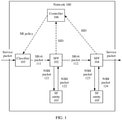
- a scenario in this embodiment of this application may be applied to a network system 100 shown in FIG. 1 .
- An SR policy of a service flow may be set on a classifier (English: classifier) 101, and the SR policy may include a segment list (English: segment list) and an NSH.
- the classifier 101 may encapsulate an internet protocol version 6 header (English: internet protocol version 6 header, IPv6 Header for short) and the NSH into the service packet according to the SR policy of the service flow, to generate an SRv6 packet 111.
- the IPv6 header of the SRv6 packet 111 includes a segment list of the service flow.
- the segment list is used to indicate a transmission path of the service flow in the network system 100, and includes a segment identifier (English: segment identifier, SID for short) of each hop of network device on the transmission path. It is assumed that the transmission path of the service flow is from the classifier 101 to an SFF 102 and then from the SFF 102 to an SFF 104, and the segment list of the service flow includes a SID of the SFF 102 and a SID of the SFF 104.
- a destination address (English: destination address, DA for short) field of the IPv6 header in the SRv6 packet 111 carries a SID of a next-hop network device of the classifier 101, that is, the SID of the SFF 102. Therefore, the classifier 101 may send the SRv6 packet 111 to the SFF 102 based on the SID of the SFF 102 carried in the DA field of the IPv6 header in the SRv6 packet 111.
- the SFF 102 may convert the SRv6 packet 111 into an NSH packet 121, where the NSH packet 121 includes a part obtained by removing the IPv6 header from the SRv6 packet 111, that is, includes the NSH in the SRv6 packet 111 and a payload after the NSH. Then, the SFF 102 may send the NSH packet 121 to an SF entity 103. After performing SF processing on the NSH packet 121, the SF entity 103 sends a processed NSH packet 122 to the SFF 102. The SFF 102 may convert the received NSH packet 122 into an SRv6 packet 112.
- An IPv6 header of the SRv6 packet 112 is obtained by updating a SID of a next-hop network device of the SFF 102 in the segment list of the IPv6 header in the SRv6 packet 111 to the DA field of the IPv6 header in the SRv6 packet 111.
- a DA field of the IPv6 header in the SRv6 packet 112 carries the SID of the SFF 104. Therefore, the SFF 102 may send the SRv6 packet 112 to the SFF 104 based on the SID of the SFF 104 carried in the DA field of the IPv6 header in the SRv6 packet 112.
- the SFF 104 may convert the SRv6 packet 112 into an NSH packet 123, where the NSH packet 123 includes a part obtained by removing the IPv6 header from the SRv6 packet 112, that is, includes the NSH in the SRv6 packet 112 and the payload after the NSH. Then, the SFF 104 may send the NSH packet 123 to an SF entity 105. After performing SF processing on the NSH packet 123, the SF entity 105 sends a processed NSH packet 124 to the SFF 104. Because the SFF 104 is a tail node on the transmission path of the service flow in the network system 100, the SFF 104 may obtain a payload of the received NSH packet 124, to generate the service packet of the service flow.
- the network system 100 may further include a controller (English: controller) 106.
- the controller 106 may receive SIDs reported by the SFF 102 and an SFF 103, and generate the SR policy of the service flow based on the SIDs reported by the SFF 102 and the SFF 103.
- the SR policy of the service flow may be generated by the controller 106 and delivered to the classifier 101.
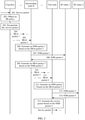
- FIG. 2 is a schematic flowchart of a method 200 for implementing service function processing according to an embodiment of this application. Specifically, the method 200 may include the following steps.
- a classifier receives a service packet.
- the classifier determines a service flow corresponding to the service packet, and obtains an SR policy and an NSH of the service flow.
- the SR policy and an NSH 1 of the service flow are set on the classifier.
- the classifier may determine whether the service packet belongs to the service flow, based on whether a packet feature of the service packet matches a packet feature of the service flow.
- the classifier may obtain the SR policy and the NSH 1 of the service flow.
- the packet feature may be a 5-tuple.
- the NSH 1 of the service flow may be encapsulated into an SRv6 packet of the service flow, so that a network device on a transmission path of the service flow can convert the SRv6 packet into an NSH packet and then send the NSH packet to an SF entity. In this way, the SF entity can perform SF processing on the NSH packet.
- the SR policy may include a segment list of the service flow.
- the segment list of the service flow may be used to indicate the transmission path of the service flow.
- the segment list may include a SID of each hop of network device on the transmission path of the service flow.
- the transmission path of the service flow is from the classifier 101 to the SFF 102, and then from the SFF 102 to the SFF 103.
- the segment list of the service flow may include the SID of the SFF 102 and the SID of the SFF 104.
- the classifier 101 may identify the SID of the next-hop SFF 102 from the segment list carried in the SRv6 packet, and send the SRv6 packet to the SFF 102.
- the SFF 102 may identify the SID of the next-hop SFF 104 from the segment list carried in the SRv6 packet, and send the SRv6 packet to the SFF 104.
- the SR policy may further include a SID corresponding to the SF entity, and the SID is used to indicate the network device on the transmission path of the service flow to convert the SRv6 packet of the service flow into an NSH packet, and send the NSH packet to the SF entity.
- the segment list in the SR policy may further include the SID of the SF entity that the service flow needs to pass through.
- the network device may convert the SRv6 packet into an NSH packet based on the SID of the SF entity carried in the SRv6 packet, and send the NSH packet to the SF entity. For example, in the example scenario shown in FIG.
- the transmission path of the service flow is from the classifier 101 to the SFF 102 and then from the SFF 104 to the SFF 103, the service flow needs to be sent at the SFF 102 to the SF entity 103 for processing, and the service flow needs to be sent at the SFF 104 to the SF entity 105 for processing.
- the segment list of the service flow may include the SID of the SFF 102, a SID of the SF entity 103, the SID of the SFF 104, and a SID of the SF entity 105.
- the SID of the SF entity 103 is used to indicate the SFF 102 to convert the SRv6 packet of the service flow into an NSH packet and send the NSH packet to the SF entity 103.
- the SID of the SF entity 105 is used to indicate the SFF 104 to convert the SRv6 packet of the service flow into an NSH packet and send the NSH packet to the SF entity 105.
- the SID of the network device in the segment list of the service flow may be further used to indicate the network device to send, to the SF entity, an NSH packet including a part obtained by removing the IPv6 header from the SRv6 packet.
- the network device may convert the SRv6 packet into the NSH packet based on the SID of the network device carried in the SRv6 packet, and send the NSH packet to the SF entity. For example, in the example scenario shown in FIG.
- the transmission path of the service flow is from the classifier 101 to the SFF 102 and then from the SFF 104 to the SFF 103, the service flow needs to be sent at the SFF 102 to the SF entity 103 for processing, and the service flow needs to be sent at the SFF 104 to the SF entity 105 for processing.
- the segment list of the service flow may include the SID of the SFF 102 and the SID of the SFF 104.
- the SID of the SFF 102 is further used to indicate the SFF 102 to convert the SRv6 packet of the service flow into an NSH packet and send the NSH packet to the SF entity 103.
- the SID of the SFF 104 is further used to indicate the SFF 104 to convert the SRv6 packet of the service flow into an NSH packet and send the NSH packet to the SF entity 105.
- the format of the SID includes a locator (English: locator) field, a function (English: function) field, and an argument (English: argument) field.
- the locator field carries indication information used to indicate the network device.
- the function field is used to indicate indication information of an operation to be performed by the network device.
- the indication information carried in the function field of the SID corresponds to the SF entity, and the indication information is used to indicate to convert the SRv6 packet into the NSH packet and send the NSH packet to the SF entity.
- the SR policy and the NSH of the service flow may be generated by different network devices based on different network architectures.
- each hop of network device on the transmission path of the service flow may advertise the SID to the classifier, and the classifier may generate the SR policy of the service flow based on the received SID.
- the SFF 102 may advertise the SID of the SFF 102 to the classifier 101
- the SFF 104 may advertise the SID of the SFF 104 to the classifier 101.
- the classifier 101 may generate the SR policy based on the SID of the SFF 102 and the SID of the SFF 104.
- the SID of the SFF 102 is used to indicate the SFF 102 to convert the SRv6 packet of the service flow into an NSH packet and send the NSH packet to the SF entity 103.
- the SID of the SFF 104 is used to indicate the SFF 104 to convert the SRv6 packet of the service flow into an NSH packet and send the NSH packet to the SF entity 105.
- the SFF 102 may advertise the SID of the SFF 102 and the SID of the SF entity 103 to the classifier 101
- the SFF 104 may advertise the SID of the SFF 104 and the SID of the SF entity 105 to the classifier 101.
- the classifier 101 may generate the SR policy based on the SID of the SFF 102, the SID of the SF entity 103, the SID of the SFF 104, and the SID of the SF entity 105.
- the NSH 1 of the service flow may also be generated by the classifier.
- each hop of network device on the transmission path of the service flow may advertise the SID to the controller, and the controller may generate the SR policy of the service flow based on the received SID, and deliver the SR policy to the classifier.
- the SFF 102 may advertise the SID of the SFF 102 to the controller 106
- the SFF 104 may advertise the SID of the SFF 104 to the controller 106.
- the controller 106 may generate the SR policy based on the SID of the SFF 102 and the SID of the SFF 104, and deliver the SR policy to the classifier 101.
- the SID of the SFF 102 is used to indicate the SFF 102 to convert the SRv6 packet of the service flow into an NSH packet and send the NSH packet to the SF entity 103.
- the SID of the SFF 104 is used to indicate the SFF 104 to convert the SRv6 packet of the service flow into an NSH packet and send the NSH packet to the SF entity 105.
- the SFF 102 may advertise the SID of the SFF 102 and the SID of the SF entity 103 to the controller 106
- the SFF 104 may advertise the SID of the SFF 104 and the SID of the SF entity 105 to the controller 106.
- the controller 106 may generate the SR policy based on the SID of the SFF 102, the SID of the SF entity 103, the SID of the SFF 104, and the SID of the SF entity 105, and deliver the SR policy to the classifier 101.
- the NSH 1 of the service flow may also be generated by the controller and delivered to the classifier.
- the network device may record a mapping relationship between the SID and the SF entity.
- the network device may determine the SF entity based on the mapping relationship, so as to send the NSH packet converted from the SRv6 packet to the SF entity.
- the network device may advertise the SID to the controller or the classifier by carrying the SID in border gateway protocol (English: Border Gateway Protocol, BGP for short) link state (English: Link State, LS for short) type-length-value (English: Type Length Value, TLV for short) information.
- Border gateway protocol English: Border Gateway Protocol, BGP for short
- link state English: Link State, LS for short
- type-length-value English: Type Length Value, TLV for short
- TLV Type Length Value
- a function type of the SID may be defined as, for example, END.NSH. If the SID field in the TLV information carries the SID used to indicate the network device to convert the SRv6 packet into the NSH packet and send the NSH packet to the SF entity, the SRv6 endpoint function field in the TLV information may carry END.NSH used as the function type of the SID.
- the network device may further advertise, to the controller or the classifier, encapsulation information used to transmit the NSH packet between the network device and the SF entity.
- the classifier may add the encapsulation information in the SRv6 packet, so that the network device can convert the SRv6 packet into an NSH packet.
- a sub-sub-TLV (English: Sub-sub-TLV) field of the BGP LS TLV may carry the encapsulation information.
- the encapsulation information is specifically packet encapsulation information corresponding to a transmission protocol used between the network device and the SF entity, for example, an Ethernet transmission protocol or an IPv6.
- the classifier encapsulates an IPv6 header 1 and the NSH 1 into the service packet according to the SR policy, to generate an SRv6 packet 1.
- the classifier may obtain the segment list and the NSH 1 of the service flow from the SR policy, generate the IPv6 header 1 carrying the segment list, and encapsulate the IPv6 header 1 and the NSH 1 into the service packet to generate the SRv6 packet 1.
- the SRv6 packet may include the IPv6 header, the NSH, and a payload, where the NSH is encapsulated outside the payload, and the IPv6 header is encapsulated outside the NSH.
- the service packet may be used as the payload, and the NSH 1 is encapsulated outside the service packet, and the IPv6 header 1 is encapsulated outside the NSH 1, so as to form the SRv6 packet 1.
- an SRv6 packet 3 and an SRv6 packet 4 mentioned below refer to the SRv6 packet example shown in FIG. 4 .
- the IPv6 header 1 includes a source address (English: source address, SA for short) field, a DA field, and a segment routing header (English: segment routing header, SRH for short).
- the segment list is carried in the SRH.
- the SA field carries a SID of a head node, namely, the SID of the classifier.
- the DA field carries a SID of a next-hop network device of the classifier, and the SID of the next-hop network device of the classifier may be obtained from the segment list. For example, in the example scenario shown in FIG.
- the SA field of the IPv6 header carries the SID of the classifier 101
- the DA field of the IPv6 header carries the SID of the SFF 102.
- the SFF 102 is the next-hop network device of the classifier 101.
- the classifier sends the SRv6 packet 1 to a network device corresponding to the SID carried in the destination address field of the IPv6 header 1.
- the SID carried in the DA field of the IPv6 header 1 is the SID of the next-hop network device of the classifier. Therefore, the classifier may send the SRv6 packet 1 to the next-hop network device based on the SID. In this way, the SRv6 packet of the service flow can be transmitted along the transmission path of the service flow.
- a DA field of an IPv6 header carries a SID of the intermediate node.
- the intermediate node may identify a SID of a next-hop network device of the intermediate node from the segment list carried in the IPv6 header of the SRv6 packet, update the SID of the intermediate node to the SID of the next-hop network device of the intermediate node in the DA field of the IPv6 header of the SRv6 packet, and then send an updated SRv6 packet to the next-hop network device of the intermediate node.
- the intermediate node N may perform the following steps 205 to 210.
- the intermediate node N receives an SRv6 packet 2.
- the SRv6 packet 2 is the SRv6 packet 1. If there is another intermediate node between the classifier and the intermediate node N on the transmission path of the service flow, the SRv6 packet 2 is a packet sent by a previous-hop intermediate node of the intermediate node N to the intermediate node N.
- the intermediate node N generates an NSH packet 1 based on the SRv6 packet 2.
- the intermediate node N sends the NSH packet 1 to the SF entity 1.
- the intermediate node N may remove an IPv6 header 2 from the SRv6 packet 2, to obtain an NSH 2 and a payload in the SRv6 packet 2; and then encapsulate the NSH 2 and the payload into encapsulation information used to transmit the NSH packet between the intermediate node and the SF entity 1, to obtain the NSH packet 1. Then, the intermediate node N may send the NSH packet 1 to the SF entity 1.
- Each NSH mentioned in this embodiment carries a service path identifier (English: service path identifier, SPI for short) and a service index (English: service index, SI for short).
- SPI and the SI may be used to indicate an SF that the service flow needs to pass through.
- NSH refer to a header format shown in FIG. 5 .
- NSHs in packets of a same service flow carry a same SPI.
- the IPv6 header 2 in the SRv6 packet 2 may carry a SID used to indicate the intermediate node N to convert the SRv6 packet into an NSH packet and send the NSH packet to the SF entity 1.
- the intermediate node N may convert the SRv6 packet 2 into the NSH packet 1, and send the NSH packet 1 to the SF entity 1.
- the SFF 101 may convert the SRv6 111 into the NSH packet 121, and send the NSH packet 121 to the SF entity 103.
- the SFF 101 may convert the SRv6 111 into the NSH packet 121, and send the NSH packet 121 to the SF entity 103.
- the intermediate node N receives an NSH packet 2 obtained by the SF entity 1 by performing SF processing on the NSH packet 1.
- the intermediate node N generates an SRv6 packet 3 based on the NSH packet 2.
- the intermediate node N may identify the SID of the next-hop network device of the intermediate node N from the segment list carried in the IPv6 header 2 of the SRv6 packet 2, and replace the SID of the intermediate node N carried in the DA field of the IPv6 header 2 with the SID of the next-hop network device of the intermediate node N, so as to obtain an IPv6 header 3 of the SRv6 packet 3.
- the intermediate node N may obtain an NSH 3 and a payload from the NSH packet 2, and generate the SRv6 packet 3 based on the IPv6 header 3, the NSH 3, and the payload of the NSH packet 2.
- the intermediate node N may record a mapping relationship between the SPI and the IPv6 header. In this way, the intermediate node N can find the corresponding IPv6 header based on the SPI carried in the NSH packet 2, and convert the NSH packet 2 into the SRv6 packet 3 by using the IPv6 header.
- the intermediate node N may identify the SPI from the NSH 2 of the SRv6 packet 2, and record a mapping relationship between the IPv6 header 2 in the SRv6 packet 2 and the SPI.
- the intermediate node N may identify the SPI from the NSH 3 of the NSH packet 2, and find, based on the recorded mapping relationship, the IPv6 header 2 corresponding to the SPI. Then, the intermediate node N may update the IPv6 header 2 to the IPv6 header 3, and convert the NSH packet 2 into the SRv6 packet 3 based on the IPv6 header 3.
- the intermediate node N may identify the SPI from the NSH 2 of the SRv6 packet 2, update the IPv6 header 2 of the SRv6 packet 2 to the IPv6 header 3, and record a mapping relationship between the IPv6 header 3 and the SPI.
- the intermediate node N may identify the SPI from the NSH 3 of the NSH packet 2, and find, based on the recorded mapping relationship, the IPv6 header 3 corresponding to the SPI. Then, the intermediate node N may convert the NSH packet 2 into the SRv6 packet 3 based on the IPv6 header 3.
- the intermediate node N sends the SRv6 packet 3 to a network device corresponding to the SID carried in the destination address field of the IPv6 header 2 in the SRv6 packet 3.
- the classifier may send the SRv6 packet 3 to the next-hop network device based on the SID. In this way, the SRv6 packet of the service flow can continue to be transmitted along the transmission path of the service flow.
- a DA field of an IPv6 header carries a SID of the tail node, and a segments left (English: segments left, SL for short) value of an SRH is 0.
- the tail node may obtain a payload from the SRv6 packet, and generate a service packet of the service flow based on the payload.
- the tail node may perform the following steps 211 to 215.
- the tail node receives an SRv6 packet 4.
- the SRv6 packet 4 is the SRv6 packet 3. If there is another intermediate node between the intermediate node N and the tail node on the transmission path of the service flow, the SRv6 packet 4 is a packet sent by a previous-hop intermediate node of the tail node to the tail node.
- the tail node generates an NSH packet 3 based on the SRv6 packet 4.
- the tail node sends the NSH packet 3 to the SF entity 2.
- the tail node may remove an IPv6 header 4 from the SRv6 packet 4, to obtain an NSH 4 and a payload in the SRv6 packet 4; and then encapsulate the NSH 4 and the payload into encapsulation information used to transmit the NSH packet between the tail node and the SF entity 2, to obtain the NSH packet 3. Then, the tail node may send the NSH packet 3 to the SF entity 2.
- the IPv6 header 4 in the SRv6 packet 4 may carry a SID used to indicate the tail node to convert the SRv6 packet into an NSH packet and send the NSH packet to the SF entity 2.
- the tail node may convert the SRv6 packet 4 into the NSH packet 3, and send the NSH packet 3 to the SF entity 2.
- the SFF 104 may convert the SRv6 112 into the NSH packet 123, and send the NSH packet 123 to the SF entity 105.
- the SFF 104 may convert the SRv6 112 into the NSH packet 123, and send the NSH packet 123 to the SF entity 105.
- the tail node receives an NSH packet 4 obtained by the SF entity 2 by performing SF processing on the NSH packet 3.
- the tail node generates the service packet based on a payload of the NSH packet 4.
- the tail node identifies, from an SRH of the IPv6 header 4 in the SRv6 packet 4, an SL value is 0.
- the tail node may determine that the NSH packet 4 returned by the SF entity 2 does not need to be converted into an SRv6 packet after the SRv6 packet 4 is converted into the NSH packet 3 and the NSH packet 3 is sent to the SF entity 2. Therefore, the tail node may obtain the payload from the NSH packet 4, and generate the service packet of the service flow based on the payload.
- SF entities such as the SF entity 1 and the SF entity 2, for example, value-added servers (English: value-added server, VAS for short), may be network devices used to carry SFs.
- value-added servers English: value-added server, VAS for short
- the classifier 101 is equivalent to the classifier mentioned in the method 200
- the SFF 102 is equivalent to the intermediate node N mentioned in the method 200
- the SFF 104 is equivalent to the tail node mentioned in the method 200
- the SF entity 103 is equivalent to the SF entity 1 mentioned in the method 200
- the SF entity 105 is equivalent to the SF entity 2 mentioned in the method 200
- the SRv6 packet 111 is equivalent to the SRv6 packet 1 mentioned in the method 200 and is also equivalent to the SRv6 packet 2 mentioned in the method 200
- the SRv6 packet 112 is equivalent to the SRv6 packet 3 mentioned in the method 200 and is also equivalent to the SRv6 packet 4 mentioned in the method 200
- the NSH packet 121 is equivalent to the NSH packet 1 mentioned in the method 200
- the NSH packet 122 is equivalent to the NSH packet 2 mentioned in the method 200
- the NSH packet 123 is equivalent to the NSH packet 3 mentioned in the method 200
- the network device such as the intermediate node or the tail node may convert the SRv6 packet into an NSH packet, and then send the NSH packet to the SF entity such as the SF entity 1 or the SF entity 2, so that the SF entity can perform SF processing on the NSH packet.
- a part that is obtained by removing an IPv6 header and an NSH from the SRv6 packet is a payload of the NSH packet. Therefore, that the SF entity performs SF processing on the NSH packet means that SF processing is performed on the SRv6 packet.
- SF processing can also be performed on the SRv6 packet when the SF entity does not support SR.
- Technical reconstruction does not need to be performed on a large quantity of SF entities that do not support the SR in the existing network, thereby reducing costs of using an SFC for network upgrade.
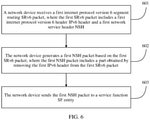
- FIG. 6 is a schematic flowchart of a method 600 for implementing service function processing according to an embodiment of this application.
- the method 600 may include the following steps.
- a network device receives a first internet protocol version 6 segment routing SRv6 packet, where the first SRv6 packet includes a first internet protocol version 6 header IPv6 header and a first network service header NSH.
- the network device generates a first NSH packet based on the first SRv6 packet, where the first NSH packet includes a part obtained by removing the first IPv6 header from the first SRv6 packet.
- the network device sends the first NSH packet to a service function SF entity.
- the method 600 before the network device generates the first NSH packet based on the first SRv6 packet, the method 600 further includes: The network device identifies a first segment identifier SID of the network device from a destination address field of the first IPv6 header; and the network device determines that the first SID is used to indicate the network device to send the NSH packet to the SF entity.
- the first NSH carries a service path identifier SPI
- the method 600 further includes: After receiving the first SRv6 packet, the network device records a mapping relationship between the SPI and the first IPv6 header;
- the first NSH carries the service path identifier SPI
- the method 600 further includes: After receiving the first SRv6 packet, the network device replaces the first SID carried in the destination address field of the first IPv6 header with a second SID of a next-hop network device of the network device, to obtain a second IPv6 header;
- that the network device determines that the first SID is used to indicate to send the NSH packet to the service function SF entity includes: The network device obtains a function function part of the first SID, where the function part is used to indicate to send the NSH packet to the service function SF entity.
- the method 600 further includes: Before the network device receives the first SRv6 packet, the network device advertises the first SID to a controller or a classifier.
- the method 600 further includes: The network device records a mapping relationship between the first SID and the SF entity.
- the first SID is carried in border gateway protocol BGP link state LS type-length-value TLV information for sending.
- the method 600 further includes: before the network device receives the first SRv6 packet, the network device advertises, to the controller or the classifier, encapsulation information used to transmit the NSH packet between the network device and the SF.
- the network device mentioned in the method 600 may be the intermediate node N mentioned in the method 200
- the SF entity mentioned in the method 600 may be the SF entity 1 mentioned in the method 200
- the first SRv6 packet mentioned in the method 600 may be the SRv6 packet 2 mentioned in the method 200
- the first NSH packet mentioned in the method 600 may be the NSH packet 1 mentioned in the method 200
- the second SRv6 packet mentioned in the method 600 may be the SRv6 packet 3 mentioned in the method 200
- the second NSH packet mentioned in the method 600 may be the NSH packet 4 mentioned in the method 200.
- the network device mentioned in the method 600 may be the tail node mentioned in the method 200
- the SF entity mentioned in the method 600 may be the SF entity 2 mentioned in the method 200
- the first SRv6 packet mentioned in the method 600 may be the SRv6 packet 4 mentioned in the method 200
- the first NSH packet mentioned in the method 600 may be the NSH packet 3 mentioned in the method 200
- the second NSH packet mentioned in the method 600 may be the NSH packet 4 mentioned in the method 200.
- the network device may convert the SRv6 packet into an NSH packet, and then send the NSH packet to the SF entity, so that the SF entity can perform SF processing on the NSH packet.
- a part that is obtained by removing an IPv6 header and an NSH from the SRv6 packet is a payload of the NSH packet. Therefore, that the SF entity performs SF processing on the NSH packet means that SF processing is performed on the SRv6 packet. It can be learned that SF processing can also be performed on the SRv6 packet when the SF entity does not support SR. Technical reconstruction does not need to be performed on a large quantity of SF entities that do not support the SR in the existing network, thereby reducing costs of using an SFC for network upgrade.
- FIG. 7 is a schematic flowchart of a method 600 for implementing service function processing according to an embodiment of this application.
- the method 700 may include the following steps.
- a classifier receives a service packet.
- the classifier obtains a segment routing SR policy corresponding to the service packet, where the SR policy includes a segment list, the segment list is used to identify a transmission path of the service packet, the segment list includes a SID of a network device, and the SID of the network device is used to indicate the network device to send a network service header NSH packet to a service function SF entity.
- the classifier obtains an NSH corresponding to the service packet.
- the classifier encapsulates an IPv6 header and the NSH into the service packet according to the SR policy, to generate an SRv6 packet.
- the classifier sends the SRv6 packet to a next-hop network device of the classifier by using the segment list.
- that the classifier obtains the segment routing SR policy corresponding to the service packet includes: The classifier receives the SR policy sent by a controller.
- that the classifier obtains the segment routing SR policy corresponding to the service packet includes: The classifier receives the SID sent by the network device; and the classifier generates the SR policy based on the SID.
- the SID is carried in border gateway protocol BGP link state LS type-length-value TLV information for sending.
- the method 700 further includes:
- the classifier receives encapsulation information used to transmit the NSH packet between the network device and the SF entity.
- the classifier mentioned in the method 700 may be the classifier mentioned in the method 200
- the SR policy mentioned in the method 700 may be the SR policy mentioned in the method 200
- the SRv6 packet mentioned in the method 700 may be the SRv6 packet 1 mentioned in the method 200
- the network device mentioned in the method 700 may include the intermediate node N and/or the tail node mentioned in the method 200
- the SF entity mentioned in the method 700 may include the SF entity 1 and/or the SF entity 2 mentioned in the method 200. Therefore, for various specific implementations of the method 700, refer to related descriptions in the method 200.
- the classifier may encapsulate the NSH and the IPv6 header into the service packet to generate the SRv6 packet, and send the SRv6 packet, where the SID of the network device carried in the IPv6 header may be used to indicate the network device to convert the SRv6 packet into an NSH packet and send the NSH packet to the SF entity. Therefore, the SF entity can perform SF processing on the NSH packet.
- a part that is obtained by removing the IPv6 header and the NSH from the SRv6 packet is a payload of the NSH packet.
- the SF entity performs SF processing on the NSH packet means that SF processing is performed on the SRv6 packet. It can be learned that SF processing can also be performed on the SRv6 packet when the SF entity does not support SR. Technical reconstruction does not need to be performed on a large quantity of SF entities that do not support the SR in the existing network, thereby reducing costs of using an SFC for network upgrade.
- FIG. 8 is a schematic flowchart of a method 800 for implementing service function processing according to an embodiment of this application.
- the method 800 may include the following steps.
- a controller receives a SID of a network device, where the SID of the network device is used to indicate the network device to send a network service header NSH packet to a service function SF entity.
- the controller generates an SR policy of a service flow, where the SR policy includes a segment list, the segment list is used to indicate a transmission path of the service flow, and the segment list includes the SID.
- the controller generates an NSH of the service flow.
- the controller sends the SR policy and the NSH to a classifier.
- the SID is carried in border gateway protocol BGP link state LS type-length-value TLV information for sending.
- the method 800 further includes: The controller receives encapsulation information that is sent by the network device and that is used to transmit the NSH packet between the network device and the SF; and the controller sends the encapsulation information to the classifier.
- the controller mentioned in the method 800 may be the controller mentioned in the method 200
- the classifier mentioned in the method 800 may be the classifier mentioned in the method 200
- the SR policy mentioned in the method 800 may be the SR policy mentioned in the method 200
- the network device mentioned in the method 800 may include the intermediate node N and/or the tail node mentioned in the method 200
- the SF entity mentioned in the method 700 may include the SF entity 1 and/or the SF entity 2 mentioned in the method 200
- the SRv6 packet mentioned in the method 800 may include the SRv6 packet 2 and/or the SRv6 packet 4 mentioned in the method 200. Therefore, for various specific implementations of the method 800, refer to related descriptions in the method 200.
- the controller may deliver the SR policy and the NSH to the classifier.
- the SID of the network device in the segment list carried in the SR policy may be used to indicate the network device to convert an SRv6 packet into an NSH packet and send the NSH packet to the SF entity. Therefore, the classifier may encapsulate an IPv6 header and the NSH into a service packet according to the SR policy to generate the SRv6 packet, and send the SRv6 packet, where the IPv6 header carries the SID of the network device. In this way, the SF entity can perform SF processing on the NSH packet.
- a part that is obtained by removing an IPv6 header and an NSH from the SRv6 packet is a payload of the NSH packet. Therefore, that the SF entity performs SF processing on the NSH packet means that SF processing is performed on the SRv6 packet. It can be learned that SF processing can also be performed on the SRv6 packet when the SF entity does not support SR. Technical reconstruction does not need to be performed on a large quantity of SF entities that do not support the SR in the existing network, thereby reducing costs of using an SFC for network upgrade.
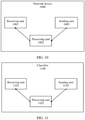
- FIG. 10 is a schematic structural diagram of a network device 1000 for implementing service function processing according to an embodiment of this application.
- the network device 1000 includes a receiving unit 1001, a processing unit 1002, and a sending unit 1003.
- the receiving unit 1001 is configured to receive a first internet protocol version 6 segment routing SRv6 packet, where the first SRv6 packet includes a first internet protocol version 6 header IPv6 header and a first network service header NSH.
- the processing unit 1002 is configured to generate a first NSH packet based on the first SRv6 packet, where the first NSH packet includes a part obtained by removing the first IPv6 header from the first SRv6 packet.
- the sending unit 1003 is configured to send the first NSH packet to a service function SF entity.
- processing unit 1002 is further configured to:
- the first NSH carries a service path identifier SPI
- the first NSH carries a service path identifier SPI
- the processing unit 1002 is further configured to obtain a function function part of the first SID, where the function part is used to indicate to send the NSH packet to the service function SF entity.
- the sending unit 1003 before the receiving unit receives the first SRv6 packet, is further configured to advertise the first SID to a controller or a classifier.
- the processing unit 1002 is further configured to record, by the network device, a mapping relationship between the first SID and the SF entity.
- the sending unit 1003 before the receiving unit receives the first SRv6 packet, is further configured to advertise, to the controller or the classifier, encapsulation information used to transmit the NSH packet between the network device and the SF.
- the network device 1000 is the intermediate node N or the tail node mentioned in the method 200. Therefore, for various specific embodiments of the network device 1000, refer to a description of the intermediate node N or the tail node in the method 200. Details are not described again in this embodiment.
- FIG. 11 is a schematic structural diagram of a classifier 1100 for implementing service function processing according to an embodiment of this application.
- the classifier 1100 includes a receiving unit 1101, a processing unit 1102, and a sending unit 1103.
- the receiving unit 1101 is configured to receive a service packet.
- the processing unit 1102 is configured to: obtain a segment routing SR policy corresponding to the service packet, obtain an NSH corresponding to the service packet, and encapsulate an IPv6 header and the NSH into the service packet according to the SR policy, to generate an SRv6 packet, where the SR policy includes a segment list, the segment list is used to identify a transmission path of the service packet, the segment list includes a SID of a network device, and the SID of the network device is used to indicate the network device to send a network service header NSH packet to a service function SF entity.
- the sending unit 1103 is configured to send the SRv6 packet to a next-hop network device of the classifier by using the segment list.
- the receiving unit 1101 is further configured to receive, by the classifier, the SR policy sent by a controller.
- the receiving unit 1101 is further configured to receive the SID sent by the network device; and the processing unit 1102 is further configured to generate the SR policy based on the SID.
- the receiving unit 1101 is further configured to receive encapsulation information used to transmit the NSH packet between the network device and the SF entity.
- the classifier 1100 is the classifier mentioned in the method 200. Therefore, for various specific embodiments of the classifier 1100, refer to a description of the classifier in the method 200. Details are not described again in this embodiment.
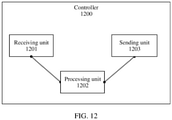
- FIG. 12 is a schematic structural diagram of a controller 1200 for implementing service function processing according to an embodiment of this application.
- the controller 1200 includes a receiving unit 1201, a processing unit 1202, and a sending unit 1203.
- the receiving unit 1201 is configured to receive a SID of a network device, where the SID of the network device is used to indicate the network device to send a network service header NSH packet to a service function SF entity.
- the processing unit 1202 is configured to generate an SR policy of a service flow and an NSH of the service flow, where the SR policy includes a segment list, the segment list is used to indicate a transmission path of the service flow, and the segment list includes the SID.
- the sending unit 1203 is configured to send the SR policy and the NSH to the classifier.
- the receiving unit 1201 is further configured to receive encapsulation information that is sent by the network device and that is to transmit the NSH packet between the network device and the SF; and the sending unit 1203 is further configured to send the encapsulation information to the classifier.
- controller 1200 is the controller mentioned in the method 200. Therefore, for various specific embodiments of the controller 1200, refer to a description of the controller in the method 200. Details are not described again in this embodiment.
- an embodiment of this application further provides a network device.
- the network device includes a processor and a memory.
- the memory stores instructions. When the processor executes the instructions, the network device is enabled to perform the method 600.
- an embodiment of this application further provides a classifier.
- the classifier includes a processor and a memory.
- the memory stores instructions. When the processor executes the instructions, the classifier is enabled to perform the method 700.
- an embodiment of this application further provides a controller.
- the controller includes a processor and a memory.
- the memory stores instructions. When the processor executes the instructions, the controller is enabled to perform the method 800.
- an embodiment of this application further provides a computer-readable storage medium.
- the computer-readable storage medium stores instructions. When the instructions are run on a computer or a processor, the computer or the processor is enabled to perform the method 600, the method 700, or the method 800.
- the computer software product may be stored in a storage medium, for example, a read-only memory (English: read-only memory, ROM) /RAM, a magnetic disk, or an optical disc, and include several instructions for instructing a computer device (which may be a personal computer, a server, or a network communications device such as a router) to perform the methods described in the embodiments or some parts of the embodiments of this application.
- a computer device which may be a personal computer, a server, or a network communications device such as a router
Landscapes
- Engineering & Computer Science (AREA)
- Computer Networks & Wireless Communication (AREA)
- Signal Processing (AREA)
- Computer Security & Cryptography (AREA)
- Data Exchanges In Wide-Area Networks (AREA)
Applications Claiming Priority (2)
| Application Number | Priority Date | Filing Date | Title |
|---|---|---|---|
| CN201910517795.6A CN112087381B (zh) | 2019-06-14 | 2019-06-14 | 一种实现业务功能处理的方法及装置 |
| PCT/CN2020/095518 WO2020249035A1 (fr) | 2019-06-14 | 2020-06-11 | Procédé et dispositif permettant de mettre en œuvre un traitement de fonction de service |
Publications (2)
| Publication Number | Publication Date |
|---|---|
| EP3965382A1 true EP3965382A1 (fr) | 2022-03-09 |
| EP3965382A4 EP3965382A4 (fr) | 2022-06-22 |
Family
ID=73734375
Family Applications (1)
| Application Number | Title | Priority Date | Filing Date |
|---|---|---|---|
| EP20822610.0A Pending EP3965382A4 (fr) | 2019-06-14 | 2020-06-11 | Procédé et dispositif permettant de mettre en oeuvre un traitement de fonction de service |
Country Status (4)
| Country | Link |
|---|---|
| US (1) | US20220109627A1 (fr) |
| EP (1) | EP3965382A4 (fr) |
| CN (2) | CN114448861A (fr) |
| WO (1) | WO2020249035A1 (fr) |
Families Citing this family (9)
| Publication number | Priority date | Publication date | Assignee | Title |
|---|---|---|---|---|
| CN112751826B (zh) * | 2020-12-07 | 2024-04-30 | 中兴通讯股份有限公司 | 算力应用流量转发方法及装置 |
| CN114844817B (zh) * | 2021-02-02 | 2025-05-30 | 华为技术有限公司 | 一种在段路由sr网络中进行保护倒换方法及装置 |
| CN115941576B (zh) * | 2021-08-12 | 2024-11-12 | 中国移动通信有限公司研究院 | SRv6报文的构建方法、装置及终端设备 |
| CN114285907B (zh) * | 2021-12-03 | 2023-05-26 | 中国联合网络通信集团有限公司 | 数据传输方法、装置、电子设备及存储介质 |
| CN114157612B (zh) * | 2021-12-09 | 2024-11-22 | 中国电信股份有限公司 | 流量牵引控制方法和装置、引流装置、流量牵引系统 |
| CN116846862A (zh) * | 2022-03-24 | 2023-10-03 | 中国移动通信有限公司研究院 | 一种SRv6报文处理方法、装置、通信设备和存储介质 |
| CN116405437A (zh) * | 2023-03-28 | 2023-07-07 | 新华三信息安全技术有限公司 | 一种报文处理方法及报文处理系统 |
| CN116389367A (zh) * | 2023-03-30 | 2023-07-04 | 新华三信息安全技术有限公司 | 一种报文处理方法、装置、设备及介质 |
| CN116800287B (zh) * | 2023-07-21 | 2025-10-28 | 苏州泰莱微波技术有限公司 | 一种基于硅基与氮化铝三维异构集成的四通带可调射频微系统及其制造方法 |
Family Cites Families (9)
| Publication number | Priority date | Publication date | Assignee | Title |
|---|---|---|---|---|
| CN105337785B (zh) * | 2014-07-18 | 2018-10-02 | 华为技术有限公司 | 一种路径连通性检测方法及装置 |
| CN109714274B (zh) * | 2014-08-14 | 2022-04-05 | 华为技术有限公司 | 一种获取对应关系的方法和路由设备 |
| CN106330714B (zh) * | 2015-07-02 | 2020-05-29 | 中兴通讯股份有限公司 | 一种实现业务功能链的方法和装置 |
| US10505846B2 (en) * | 2015-07-22 | 2019-12-10 | Cisco Technology, Inc. | Resilient segment routing service hunting with TCP session stickiness |
| US10164875B2 (en) * | 2016-02-22 | 2018-12-25 | Cisco Technology, Inc. | SR app-segment integration with service function chaining (SFC) header metadata |
| US10506083B2 (en) * | 2017-06-27 | 2019-12-10 | Cisco Technology, Inc. | Segment routing gateway storing segment routing encapsulating header used in encapsulating and forwarding of returned native packet |
| US10541893B2 (en) * | 2017-10-25 | 2020-01-21 | Cisco Technology, Inc. | System and method for obtaining micro-service telemetry data |
| US20190140863A1 (en) * | 2017-11-06 | 2019-05-09 | Cisco Technology, Inc. | Dataplane signaled bidirectional/symmetric service chain instantiation for efficient load balancing |
| CN109688057B (zh) * | 2018-12-13 | 2021-08-24 | Ut斯达康通讯有限公司 | 基于ipv6的段路由网络的报文转发方法及装置 |
-
2019
- 2019-06-14 CN CN202111656893.1A patent/CN114448861A/zh active Pending
- 2019-06-14 CN CN201910517795.6A patent/CN112087381B/zh active Active
-
2020
- 2020-06-11 WO PCT/CN2020/095518 patent/WO2020249035A1/fr not_active Ceased
- 2020-06-11 EP EP20822610.0A patent/EP3965382A4/fr active Pending
-
2021
- 2021-12-10 US US17/547,740 patent/US20220109627A1/en active Pending
Also Published As
| Publication number | Publication date |
|---|---|
| EP3965382A4 (fr) | 2022-06-22 |
| US20220109627A1 (en) | 2022-04-07 |
| CN112087381A (zh) | 2020-12-15 |
| CN112087381B (zh) | 2021-12-31 |
| WO2020249035A1 (fr) | 2020-12-17 |
| CN114448861A (zh) | 2022-05-06 |
Similar Documents
| Publication | Publication Date | Title |
|---|---|---|
| EP3965382A1 (fr) | Procédé et dispositif permettant de mettre en oeuvre un traitement de fonction de service | |
| EP3958521B1 (fr) | Procédé et appareil permettant de fournir un service destiné à un flux de services | |
| US12309064B2 (en) | Method for forwarding packet in SRv6 service function chain, SFF, and SF device | |
| KR102555671B1 (ko) | 패킷 처리 방법, 관련 기기 및 컴퓨터 저장 매체 | |
| US10412008B2 (en) | Packet processing method, apparatus, and system | |
| EP4160950B1 (fr) | Procédé et appareil d'envoi de message, ainsi que dispositif de réseau, système et support de stockage | |
| EP4037267B1 (fr) | Procédé, appareil et système d'envoi de message | |
| US12107759B2 (en) | Packet processing method and apparatus, and computer storage medium | |
| US20180198705A1 (en) | Method and apparatus for implementing service function chain | |
| JP2018523404A (ja) | ルーティング規則取得方法、デバイス、およびシステム | |
| CN113489646B (zh) | 基于vxlan的分段路由传输方法、服务器、源节点及存储介质 | |
| WO2017024818A1 (fr) | Procédé et dispositif de traitement de message de données | |
| EP3893435B1 (fr) | Procédé et appareil de traitement d'informations ioam | |
| EP2996303A1 (fr) | Procédé et dispositif de génération de paramètre d'entrée | |
| US20210084125A1 (en) | Managing layer two network extension communications using maximum segment size (mms) modifications | |
| CN118055066A (zh) | 算力资源通告方法、算力流量处理方法、通信设备及介质 | |
| CN107231309B (zh) | 获取sdn全网视图的方法、控制器及目的交换节点 | |
| CN112671646B (zh) | 一种信息处理方法、装置、设备及计算机可读存储介质 | |
| CN104702505A (zh) | 一种报文传输方法和节点 | |
| WO2024074031A1 (fr) | Procédé de traitement de service, dispositif de communication, support de stockage et produit programme |
Legal Events
| Date | Code | Title | Description |
|---|---|---|---|
| STAA | Information on the status of an ep patent application or granted ep patent |
Free format text: STATUS: THE INTERNATIONAL PUBLICATION HAS BEEN MADE |
|
| PUAI | Public reference made under article 153(3) epc to a published international application that has entered the european phase |
Free format text: ORIGINAL CODE: 0009012 |
|
| STAA | Information on the status of an ep patent application or granted ep patent |
Free format text: STATUS: REQUEST FOR EXAMINATION WAS MADE |
|
| 17P | Request for examination filed |
Effective date: 20211129 |
|
| AK | Designated contracting states |
Kind code of ref document: A1 Designated state(s): AL AT BE BG CH CY CZ DE DK EE ES FI FR GB GR HR HU IE IS IT LI LT LU LV MC MK MT NL NO PL PT RO RS SE SI SK SM TR |
|
| REG | Reference to a national code |
Ref country code: DE Ref legal event code: R079 Free format text: PREVIOUS MAIN CLASS: H04L0012721000 Ipc: H04L0041082000 |
|
| A4 | Supplementary search report drawn up and despatched |
Effective date: 20220520 |
|
| RIC1 | Information provided on ipc code assigned before grant |
Ipc: H04L 41/0806 20220101ALN20220516BHEP Ipc: H04L 41/40 20220101ALI20220516BHEP Ipc: H04L 41/0895 20220101ALI20220516BHEP Ipc: H04L 41/0894 20220101ALI20220516BHEP Ipc: H04L 45/745 20220101ALI20220516BHEP Ipc: H04L 45/00 20220101ALI20220516BHEP Ipc: H04L 41/5054 20220101ALI20220516BHEP Ipc: H04L 41/0893 20220101ALI20220516BHEP Ipc: H04L 41/082 20220101AFI20220516BHEP |
|
| DAV | Request for validation of the european patent (deleted) | ||
| DAX | Request for extension of the european patent (deleted) | ||
| STAA | Information on the status of an ep patent application or granted ep patent |
Free format text: STATUS: EXAMINATION IS IN PROGRESS |
|
| 17Q | First examination report despatched |
Effective date: 20230404 |
|
| R17C | First examination report despatched (corrected) |
Effective date: 20230404 |