EP3966204B1 - 1-amino-1h-imidazole-5-carboxamide substitué utilisé en tant qu'inhibiteurs de la tyrosine kinase de bruton - Google Patents
1-amino-1h-imidazole-5-carboxamide substitué utilisé en tant qu'inhibiteurs de la tyrosine kinase de bruton Download PDFInfo
- Publication number
- EP3966204B1 EP3966204B1 EP20805272.0A EP20805272A EP3966204B1 EP 3966204 B1 EP3966204 B1 EP 3966204B1 EP 20805272 A EP20805272 A EP 20805272A EP 3966204 B1 EP3966204 B1 EP 3966204B1
- Authority
- EP
- European Patent Office
- Prior art keywords
- phenyl
- imidazole
- amino
- carboxamide
- carbamoyl
- Prior art date
- Legal status (The legal status is an assumption and is not a legal conclusion. Google has not performed a legal analysis and makes no representation as to the accuracy of the status listed.)
- Active
Links
Classifications
-
- C—CHEMISTRY; METALLURGY
- C07—ORGANIC CHEMISTRY
- C07D—HETEROCYCLIC COMPOUNDS
- C07D417/00—Heterocyclic compounds containing two or more hetero rings, at least one ring having nitrogen and sulfur atoms as the only ring hetero atoms, not provided for by group C07D415/00
- C07D417/14—Heterocyclic compounds containing two or more hetero rings, at least one ring having nitrogen and sulfur atoms as the only ring hetero atoms, not provided for by group C07D415/00 containing three or more hetero rings
-
- A—HUMAN NECESSITIES
- A61—MEDICAL OR VETERINARY SCIENCE; HYGIENE
- A61K—PREPARATIONS FOR MEDICAL, DENTAL OR TOILETRY PURPOSES
- A61K31/00—Medicinal preparations containing organic active ingredients
- A61K31/33—Heterocyclic compounds
- A61K31/395—Heterocyclic compounds having nitrogen as a ring hetero atom, e.g. guanethidine or rifamycins
- A61K31/435—Heterocyclic compounds having nitrogen as a ring hetero atom, e.g. guanethidine or rifamycins having six-membered rings with one nitrogen as the only ring hetero atom
- A61K31/44—Non condensed pyridines; Hydrogenated derivatives thereof
- A61K31/4427—Non condensed pyridines; Hydrogenated derivatives thereof containing further heterocyclic ring systems
- A61K31/4439—Non condensed pyridines; Hydrogenated derivatives thereof containing further heterocyclic ring systems containing a five-membered ring with nitrogen as a ring hetero atom, e.g. omeprazole
-
- A—HUMAN NECESSITIES
- A61—MEDICAL OR VETERINARY SCIENCE; HYGIENE
- A61K—PREPARATIONS FOR MEDICAL, DENTAL OR TOILETRY PURPOSES
- A61K31/00—Medicinal preparations containing organic active ingredients
- A61K31/33—Heterocyclic compounds
- A61K31/395—Heterocyclic compounds having nitrogen as a ring hetero atom, e.g. guanethidine or rifamycins
- A61K31/435—Heterocyclic compounds having nitrogen as a ring hetero atom, e.g. guanethidine or rifamycins having six-membered rings with one nitrogen as the only ring hetero atom
- A61K31/44—Non condensed pyridines; Hydrogenated derivatives thereof
- A61K31/4427—Non condensed pyridines; Hydrogenated derivatives thereof containing further heterocyclic ring systems
- A61K31/444—Non condensed pyridines; Hydrogenated derivatives thereof containing further heterocyclic ring systems containing a six-membered ring with nitrogen as a ring heteroatom, e.g. amrinone
-
- A—HUMAN NECESSITIES
- A61—MEDICAL OR VETERINARY SCIENCE; HYGIENE
- A61P—SPECIFIC THERAPEUTIC ACTIVITY OF CHEMICAL COMPOUNDS OR MEDICINAL PREPARATIONS
- A61P29/00—Non-central analgesic, antipyretic or antiinflammatory agents, e.g. antirheumatic agents; Non-steroidal antiinflammatory drugs [NSAID]
-
- A—HUMAN NECESSITIES
- A61—MEDICAL OR VETERINARY SCIENCE; HYGIENE
- A61P—SPECIFIC THERAPEUTIC ACTIVITY OF CHEMICAL COMPOUNDS OR MEDICINAL PREPARATIONS
- A61P35/00—Antineoplastic agents
-
- A—HUMAN NECESSITIES
- A61—MEDICAL OR VETERINARY SCIENCE; HYGIENE
- A61P—SPECIFIC THERAPEUTIC ACTIVITY OF CHEMICAL COMPOUNDS OR MEDICINAL PREPARATIONS
- A61P35/00—Antineoplastic agents
- A61P35/02—Antineoplastic agents specific for leukemia
-
- A—HUMAN NECESSITIES
- A61—MEDICAL OR VETERINARY SCIENCE; HYGIENE
- A61P—SPECIFIC THERAPEUTIC ACTIVITY OF CHEMICAL COMPOUNDS OR MEDICINAL PREPARATIONS
- A61P37/00—Drugs for immunological or allergic disorders
-
- A—HUMAN NECESSITIES
- A61—MEDICAL OR VETERINARY SCIENCE; HYGIENE
- A61P—SPECIFIC THERAPEUTIC ACTIVITY OF CHEMICAL COMPOUNDS OR MEDICINAL PREPARATIONS
- A61P37/00—Drugs for immunological or allergic disorders
- A61P37/02—Immunomodulators
- A61P37/06—Immunosuppressants, e.g. drugs for graft rejection
-
- A—HUMAN NECESSITIES
- A61—MEDICAL OR VETERINARY SCIENCE; HYGIENE
- A61P—SPECIFIC THERAPEUTIC ACTIVITY OF CHEMICAL COMPOUNDS OR MEDICINAL PREPARATIONS
- A61P37/00—Drugs for immunological or allergic disorders
- A61P37/08—Antiallergic agents
-
- C—CHEMISTRY; METALLURGY
- C07—ORGANIC CHEMISTRY
- C07D—HETEROCYCLIC COMPOUNDS
- C07D401/00—Heterocyclic compounds containing two or more hetero rings, having nitrogen atoms as the only ring hetero atoms, at least one ring being a six-membered ring with only one nitrogen atom
- C07D401/14—Heterocyclic compounds containing two or more hetero rings, having nitrogen atoms as the only ring hetero atoms, at least one ring being a six-membered ring with only one nitrogen atom containing three or more hetero rings
-
- C—CHEMISTRY; METALLURGY
- C07—ORGANIC CHEMISTRY
- C07D—HETEROCYCLIC COMPOUNDS
- C07D409/00—Heterocyclic compounds containing two or more hetero rings, at least one ring having sulfur atoms as the only ring hetero atoms
- C07D409/14—Heterocyclic compounds containing two or more hetero rings, at least one ring having sulfur atoms as the only ring hetero atoms containing three or more hetero rings
Definitions
- the invention relates to a series of 1-amino-1H-imidazole-5-carboxamide compounds of formula I as BTK (Bruton's Tyrosine Kinase) inhibitors, and the methods of making the compounds, and the compounds for use for the treatment of autoimmune disease, inflammatory disease, cancer and potentially allergies.
- BTK Brunauer's Tyrosine Kinase
- BTK Bruton's Tyrosine Kinase
- Tec family a non-receptor tyrosine kinase of the Tec family ( Bradshaw et al, Cell Signal, 2010, 22, 1175-184 ). It plays an important role in the maturation of B cells and the activation of mast cells. It is primarily expressed in hematopoietic cells such as B cell, mast cell and microphages and exists in tissues including bone marrow, lymph nodes and spleens.
- BTK inhibitors such as Ibrutinib ( Structure A. Pan et al, Chem Med Chem 2007, 2:58-61 ; Lee A. Honigberg et al, PNAS July 20, 2010, 107 (29), 13075-13080 ; ) and Acalabrutinib ( Structure B, Barf et al, J Pharmacol Exp Ther 2017, 363:240-252 ; Robert B. Kargbo, ACS Med Chem Lett., 2017 Sep 14; 8(9): 911-913 ) have demonstrated their effectiveness in the treatment of various cancers.
- CN103848810 A relates to a series of polysubstituted five-membered heterocyclic compounds which are used as an irreversible inhibitor of selective Bruton's tyrosine kinase (BTK) alone or in combination with other therapeutic agents to treat inflammation, Autoimmune diseases (such as rheumatoid arthritis) and cancer associated with abnormal B cell proliferation.
- BTK Bruton's tyrosine kinase
- CN 104884458 A relates to substituted pyrazolo[1,5-a]pyrimidine compounds that can be useful for inhibiting protein kinase, including Bruton's tyrosine kinase (BTK), and for treating disorders mediated thereby.
- protein kinase including Bruton's tyrosine kinase (BTK)
- BTK Bruton's tyrosine kinase
- WO 2016/004280 A2 relates to heteroaryl compounds, methods of making such compounds, pharmaceutical compositions and medicaments containing such compounds, and methods of using such compounds and compositions to inhibit the activity of tyrosine kinases such as Bruton's tyrosine kinase (BTK).
- BTK Bruton's tyrosine kinase
- WO 2018/175512 A1 relates to fused heteroaryl compounds as Bruton's tyrosine kinase inhibitors, methods of making such inhibitors, and pharmaceutical compositions containing such inhibitors.
- the invention is defined by the claims. Any subject matter falling outside the scope of the claims is provided for information purposes only.
- the references to methods of treatment in this description are to be interpreted as references to the compounds, pharmaceutical compositions and medicaments of the present invention for use in a method for the treatment of the human (or animal) body by therapy (or for diagnosis).
- the present invention concerns compounds as protein kinase BTK (Bruton's Tyrosine Kinase) inhibitors which may be used for the treatment of autoimmune disease, inflammatory disease, cancer and potentially allergies.
- the invention provides a compound represented by Formula I, or a pharmaceutically acceptable salt, tautomer, or stereoisomer thereof, wherein
- the heterocyclyl or spiral heterocyclyl defined for X has only one nitrogen as a ring atom.
- R 1 is H or C 1-6 alkyl. Particularly, R 1 is H or methyl.
- Ar is selected from the group consisting of: wherein R 8 , R 8a , R 8b , R 8c and R 8d are independently selected from the group consisting of H; C 1-6 alkyl; C 1-6 alkyl substituted with halogen, particularly C 1-6 alkyl substituted with F, more specifically CF 3 ; C 1-6 alkoxy; halogen; C 6 or C 10 aryl; C 6 or C 10 aryl substituted independently, for example p- substituted, with halogen, C 1-6 alkyl, C 1-6 alkoxy, cyano, or trifluloromethyl; heteroaryl, particularly a five-membered or six-membered heteroaryl, or a bicycles where five-membered or six-membered fused with each other, which may have at least one heteroatom selected from O, S, or N.
- Ar is one of the followings:
- Ar is selected from: wherein, R 8 is hydrogen.
- Ar is represented by the following formula: wherein,
- Ar is selected from: wherein, R 8a is H; R 8b is independently selected from H, Cl or CH 3 ; R 8c is independently selected from the group consisting of H, CH 3 , CH 2 CH 3 , OCH 3 , F, Cl, Br, I and CN, CF 3 , isopropyl, phenyl, phenyl substituted, for example p-substituted, independently with halogen or CN; and R 8d is H.
- X is selected from the group consisting of:
- R 9 is independently selected from H, F, C 1-6 alkyl, C 1-6 alkyl substituted with halogen, C 1-6 alkoxy, and NR 6 R 7 ; and R 9 substitute more than one position; or R 9 may form a double bond in the ring, or form a 4-6 member ring fused with the ring R 9 substitute.
- R 2 is selected from the group consisting of H, halogen, cyano, C 1-6 alkyl, and C 1-6 alkyl substituted with F;
- R 3 is selected from hydrogen or C 1-6 alkyl; and
- R 4 is selected from the group consisting of hydrogen, C 6 or C 10 aryl, C 3-6 cycloalkyl, C 1-6 alkyl, and C 1-6 alkyl substituted with F.
- R 2 is independently selected from the group consisting of H, F, cyano, CH 3 and CF 3 ;
- R 3 is selected from hydrogen or methyl;
- R 4 is selected from the group consisting of hydrogen, phenyl, cyclopropyl, C 1-6 alkyl (for example, methyl, ethyl, isopropyl, tert-butyl and trifluoromethyl) and C 1-6 alkyl substituted with F.
- Rx is selected from the group consisting of H, C 3-6 cycloalkyl, C 1-6 alkyl, and C 1-6 alkyl substituted with F. Particularly, Rx is selected from the group consisting of H, methyl, and cyclopropyl.
- heteroaryl may be five-membered or six-membered heteroaryl, or may have bicycles where five-membered or six-membered fused with each other, which may have at least one heteroatom selected from O, S, or N.
- the present invention provides the following specific compounds as follows.
- the invention provides a pharmaceutical composition which includes an effective amount of a compound of the invention, or a pharmaceutically acceptable salt, tautomer, or stereoisomer thereof, and a pharmaceutically acceptable carrier.
- the pharmaceutical composition is in a form suitable for administration including but not limited to oral administration, parenteral administration, topical administration and rectal administration.
- the pharmaceutical composition is in the form of a tablet, capsule, pill, powder, sustained release formulation, solution and suspension, for parenteral injection as a sterile solution, suspension or emulsion, for topical administration as an ointment or cream or for rectal administration as a suppository.
- the pharmaceutical composition is in unit dosage forms suitable for single administration of precise dosages.
- the amount of compound of formula I is in the range of about 0.001 to about 1000 mg/kg body weight/day.
- the amount of compound of formula I is about 0.001 to about 7 g/day. In further or additional embodiments, dosage levels below the lower limit of the aforesaid range may be more than adequate. In further or additional embodiments, dosage levels above the upper limit of the aforesaid range may be required. In further or additional embodiments the compound of formula I is administered in a single dose, once daily. In further or additional embodiments the compound of formula I is administered in multiple doses, more than once per day. In further or additional embodiments, the pharmaceutical composition further comprises at least one therapeutic agent.
- the compounds for use in a method for preventing or treating a subject suffering from or at risk of BTK mediated disease or condition comprising administering to said subject an effective amount of a compound of this invention or a pharmaceutically acceptable salt, active metabolite, tautomer, stereoisomer, or prodrug thereof, or a pharmaceutical composition of this invention.
- the invention provides the compounds for use in a method for preventing or treating a subject suffering from or at risk of a disease or disorder selected from the group consisting of an autoimmune disease, inflammatory disease, cancer, allergy, diffused large B cell lymphoma, follicular lymphoma, chronic lymphocytic leukemia, mantel cell lymphoma, splenic marginal zone lymphoma, large B cell lymphoma, lupus erythematosus, rheumatoid arthritis, Crohn's disease, psoriasis, multiple sclerosis, asthma etc., comprising administering to said subject an effective amount of a compound of this invention or a pharmaceutically acceptable salt, active metabolite, tautomer, stereoisomer, or prodrug thereof, or a pharmaceutical composition of this invention.
- a disease or disorder selected from the group consisting of an autoimmune disease, inflammatory disease, cancer, allergy, diffused large B cell lymphoma, follicular lymphoma, chronic
- the invention provides a use of a compound of the invention, or a pharmaceutically acceptable salt, active metabolite, tautomer, stereoisomer, or prodrug thereof, in the preparation of a medicament for inhibiting the activity of BTK (Bruton's Tyrosine Kinase).
- BTK Brunauer's Tyrosine Kinase
- the invention provides a use of a compound of the invention, or a pharmaceutically acceptable salt, active metabolite, tautomer, stereoisomer, or prodrug thereof, in the preparation of a medicament for treating a disease or disorder that may benefit from the inhibition of BTK.
- the invention provides a use of a compound of the invention, or a pharmaceutically acceptable salt, active metabolite, tautomer, stereoisomer, or prodrug thereof, in the preparation of a medicament for treating a disease or disorder selected from the group consisting of an autoimmune disease, inflammatory disease, cancer, allergy, diffused large B cell lymphoma, follicular lymphoma, chronic lymphocytic leukemia, mantel cell lymphoma, splenic marginal zone lymphoma, large B cell lymphoma, lupus erythematosus, rheumatoid arthritis, Crohn's disease, psoriasis, multiple sclerosis, asthma etc.
- a disease or disorder selected from the group consisting of an autoimmune disease, inflammatory disease, cancer, allergy, diffused large B cell lymphoma, follicular lymphoma, chronic lymphocytic leukemia, mantel cell lymphoma, splenic marginal zone lymphoma, large
- the invention provides a compound of the invention, or a pharmaceutically acceptable salt, tautomer, or stereoisomer thereof, for use in inhibiting BTK.
- the subject is a mammal, such as human.
- the foregoing disease or condition includes but not limit to cancer, autoimmune disease, inflammatory disease and allergy.
- diseases include but not limit to diffused large B cell lymphoma, follicular lymphoma, chronic lymphocytic leukemia, mantel cell lymphoma, splenic marginal zone lymphoma, large B cell lymphoma, lupus erythematosus, rheumatoid arthritis, Crohn's disease, psoriasis, multiple sclerosis, asthma etc.
- Reactions and purification techniques can be performed e.g., using kits of manufacturer's specifications or as commonly accomplished in the art or as described herein.
- the foregoing techniques and procedures can be generally performed of conventional methods well known in the art and as described in various general and more specific references that are cited and discussed throughout the present specification.
- the compounds presented herein may possess one or more stereocenters and each center may exist in the R or S configuration, or combinations thereof. Likewise, the compounds presented herein may possess one or more double bonds and each may exist in the E (trans) or Z (cis) configuration, or combinations thereof. Presentation of one particular stereoisomer should be understood to include all possible stereoisomers, including regioisomers, diastereomers, enantiomers or epimers and mixtures thereof. Thus, the compounds presented herein include all separate configurational stereoisomeric, regioisomeric, diastereomeric, enantiomeric, and epimeric forms as well as the corresponding mixtures thereof.
- a racemate (a mixture of S and R form), diastereomers and single isomers of either S or R can exist. It is the intention of the invention that compounds claimed here could be a mixture of diastereomers, a racemate or a single isomer of either S or R.
- cycle refers to any covalently closed structure, including alicyclic, heterocyclic, aromatic, heteroaromatic and polycyclic fused or non-fused ring systems as described herein. Rings can be optionally substituted. Rings can form part of a fused ring system.
- membered is meant to denote the number of skeletal atoms that constitute the ring. Thus, by way of example only, cyclohexane, pyridine, pyran and pyrimidine are six-membered rings.
- heterocyclyl refers collectively to heteroalicyclyl groups.
- the number of carbon atoms in a heterocycle is indicated (e.g., C 3 -C 6 heterocycle)
- at least one non-carbon atom must be present in the ring.
- Designations such as “C 3 -C 6 heterocycle” refer only to the number of carbon atoms in the ring and do not refer to the total number of atoms in the ring.
- Designations such as "4-8 membered heterocycle” refer to the total number of atoms that are contained in the ring (i.e., a four, five, six, seven, or eight membered ring, in which at least one atom is a carbon atom, at least one atom is a heteroatom and the remaining two to six atoms are either carbon atoms or heteroatoms).
- those two or more heteroatoms can be the same or different from one another.
- Heterocycles can be optionally substituted. Bonding (i.e. attachment to a parent molecule or further substitution) to a heterocycle can be via a heteroatom or a carbon atom.
- the "heterocycle” includes heterocycloalkyl.
- spiral heterocyclyl refers to a polycyclyl wherein two rings share a carbon atom and at least one ring atom is a heteroatom.
- the spiral heterocyclyl may have two or more cycles, each of them may be 4-8 membered cycles.
- Spiral heterocyclyl can be optionally substituted. Bonding (i.e. attachment to a parent molecule or further substitution) to a spiral heterocycle can be via a heteroatom or a carbon atom.
- the "spiral heterocycle” includes heterocycloalkyl.
- cycloalkyl refers to a saturated, hydrocarbon monoradical ring which may include additional, non-ring carbon atoms as substituents (e.g. methylcyclopropyl).
- the cycloalkyl may have three to about ten, or three to about eight, or three to about six, or three to five ring atoms.
- the examples include but not limited to cyclopropyl, cyclobutyl, cyclopentyl, and cyclohexyl.
- the aryl (for example monocyclic aryl) contains, for example, from six to about twelve, or six to about ten, or six to about eight ring carbon atoms.
- a non-limiting example of a single ring aryl group includes phenyl; a fused ring aryl group includes naphthyl, phenanthrenyl, anthracenyl, azulenyl; and a non-fused bi-aryl group includes biphenyl.
- heteroaryl refers to aromatic mono- radicals containing from about five to about twenty skeletal ring atoms, where one or more of the ring atoms is a heteroatom independently selected from among oxygen, nitrogen, sulfur, phosphorous, silicon, selenium and tin but not limited to these atoms and with the proviso that the ring of said group does not contain two adjacent O or S atoms.
- the two or more heteroatoms can be the same as each another, or some or all of the two or more heteroatoms can each be different from the others.
- heteroaryl includes optionally substituted fused and non-fused heteroaryl radicals having at least one heteroatom.
- heteroaryl also includes fused and non-fused heteroaryls having from five to about twelve skeletal ring atoms, as well as those having from five to about ten skeletal ring atoms, which may contain at least one of the above mentioned heteroatoms. It may have one cycle, for example, five-membered or six-membered heteroaryl; or bi-cycle, for example, nine-membered or ten-membered heteroaryl.
- a heteroaryl group may be further substituted via any or all of its carbon atoms, and/or any or all of its heteroatoms.
- alkyl refers to a straight-chain, or optionally substituted branched-chain saturated hydrocarbon monoradical having, for example, from one to about eighteen, or one to about ten carbon atoms, or one to six carbon atoms.
- lower alkyl refers to an alkyl having relatively less carbon atoms, for example having one to about eight carbon atoms, preferably having one to about 6, or one to about four carbon atoms.
- alkyl examples include, but are not limited to methyl, ethyl, n-propyl, isopropyl, 2-methyl-1-propyl, 2-methyl-2-propyl, 2-methyl-1-butyl, 3 -methyl-1-butyl, 2-methyl-3-butyl, 2,2-dimethyl-1-propyl, 2-methyl-1-pentyl, 3-methyl-1-pentyl, 4-methyl-1-pentyl, 2-methyl-2-pentyl, 3-methyl-2-pentyl, 4-methyl-2-pentyl, 2,2-dimethyl-1-butyl, 3,3 -dimethyl-1-butyl, 2 -ethyl-1-butyl, n-butyl, isobutyl, sec-butyl, t-butyl, n-pentyl, isopentyl, neopentyl, tert-amyl and hexyl, and the like.
- alkyl as used in combination includes but not limited to the “alkyl” included in “alkoxy”.
- alkoxy refers to an alkyl ether radical, O-alkyl.
- alkoxy radicals include methoxy, ethoxy, n-propoxy, isopropoxy, n-butoxy, iso-butoxy, sec-butoxy, tertbutoxy and the like.
- alkenyl refers to a straight-chain, or optionally substituted branched-chain hydrocarbon monoradical having one or more carbon-carbon double-bonds and having, for example, from two to about eighteen or two to about ten carbon atoms, or two to about six carbon atoms.
- the group may be in either the cis or trans conformation about the double bond(s), and should be understood to include both isomers.
- alkenyl where no numerical range is designated.
- halogen halo or halide as used herein, alone or in combination refer to fluoro, chloro, bromo and iodo.
- Hydroxy or hydroxyl refers to a group of -OH.
- Cyano refers to a group of -CN.
- Either of a subsitutent or substituents refers to one or more substituents.
- a solid wedge means the bond is pointing to the top of the paper while a dotted wedge means the bond is pointing to the back of the paper.
- a solid bond line usually means all possible isomers.
- subject encompasses mammals and non-mammals.
- mammals include, but are not limited to, any member of the Mammalian class: humans, non-human primates such as chimpanzees, and other apes and monkey species; farm animals such as cattle, horses, sheep, goats, swine; domestic animals such as rabbits, dogs, and cats; laboratory animals including rodents, such as rats, mice and guinea pigs, and the like.
- non- mammals include, but are not limited to, birds, fish and the like.
- the mammal is a human.
- treat include alleviating, abating or ameliorating a disease or condition symptoms, preventing additional symptoms, ameliorating or preventing the underlying metabolic causes of symptoms, inhibiting the disease or condition, e.g., arresting the development of the disease or condition, relieving the disease or condition, causing regression of the disease or condition, relieving a condition caused by the disease or condition, or stopping the symptoms of the disease or condition, and are intended to include prophylaxis.
- the terms further include achieving a therapeutic benefit and/or a prophylactic benefit. By therapeutic benefit is meant eradication or amelioration of the underlying disorder being treated.
- compositions may be administered to a patient at risk of developing a particular disease, or to a patient reporting one or more of the physiological symptoms of a disease, even though a diagnosis of this disease may not have been made.
- an “effective amount”, “therapeutically effective amount” or “pharmaceutically effective amount” as used herein, refer to a sufficient amount of at least one agent or compound being administered which will relieve to some extent one or more of the symptoms of the disease or condition being treated. The result can be reduction and/or alleviation of the signs, symptoms, or causes of a disease, or any other desired alteration of a biological system.
- an “effective amount” for therapeutic uses is the amount of the composition comprising a compound as disclosed herein required to provide a clinically significant decrease in a disease.
- An appropriate “effective” amount in any individual case may be determined using techniques, such as a dose escalation study.
- administer refers to the methods that may be used to enable delivery of compounds or compositions to the desired site of biological action. These methods include, but are not limited to oral routes, intraduodenal routes, parenteral injection (including intravenous, subcutaneous, intraperitoneal, intramuscular, intravascular or infusion), topical and rectal administration. Those of skill in the art are familiar with administration techniques that can be employed with the compounds and methods described herein, e.g., as discussed in Goodman and Gilman, The Pharmacological Basis of Therapeutics, current ed.; Pergam on; and Remington's, Pharmaceutical Sciences (current edition), Mack Publishing Co., Easton, Pa . In preferred embodiments, the compounds and compositions described herein are administered orally.
- tautomer refers to an isomer readily interconverted from a compound of this invention by e.g., migration of a hydrogen atom or proton.
- prodrug refers to any pharmaceutically acceptable salt, ester, salt of an ester or other derivative of a compound of this invention, which, upon administration to a recipient, is capable of providing, either directly or indirectly, a compound of this invention or a pharmaceutically active metabolite or residue thereof.
- Particularly favored derivatives or prodrugs are those that increase the bioavailability of the compounds of this invention when such compounds are administered to a patient (e.g., by allowing orally administered compound to be more readily absorbed into blood) or which enhance delivery of the parent compound to a biological compartment (e.g., the brain or lymphatic system).
- IC 50 means the concentration of a particular compound that inhibits 50% of a specific measured activity.
- the compounds of the invention can generally be synthesized by the chemistry scheme outlined in Scheme-1. All related compounds can be similarly prepared by the general method of Scheme-1 and the synthesis of specific compound is provided in the section of compound examples described in the following text.
- n is a number selected from 0, 1, 2, and 3.
- Step B Preparation of ethyl 4-(3-ethoxy-3-oxopropanoyl)benzoate
- Step C Preparation of ethyl 4-(2-bromo-3-ethoxy-3-oxopropanoyl) benzoate
- Step D Preparation of 1-(tert-butyl) 2-(1-ethoxy-3-(4-(ethoxycarbonyl) phenyl)-1,3-dioxopropan-2-yl)(2S)-pyrrolidine-1,2-dicarboxylate
- Step E Preparation of ethyl (S)-2-(1-(tert-butoxycarbonyl)pyrrolidin-2-yl)-4-(4-(ethoxycarbonyl)phenyl)-1H-imidazole-5-carboxylate
- Step F Preparation of (S)-4-(2-(1-(tert-butoxycarbonyl)pyrrolidin-2-yl)-5-(ethoxycarbonyl)-1H-imidazol-4-yl)benzoic acid
- Step G Preparation of ethyl (S)-2-(1-(tert-butoxycarbonyl)pyrrolidin-2-yl)-4-(4-(pyridin-2-ylcarbamoyl)phenyl)-1H-imidazole-5-carboxylate
- Step H Preparation of ethyl (S)-1-amino-2-(1-(tert-butoxycarbonyl) pyrrolidin-2-yl)-4-(4-(pyridin-2-ylcarbamoyl)phenyl)-1H-imidazole-5- carboxylate
- Step I Preparation of (S)-1-amino-2-(1-(tert-butoxycarbonyl)pyrrolidin-2-yl)-4-(4-(pyridin-2-ylcarbamoyl)phenyl)-1H-imidazole-5-carboxylic acid
- Step J Preparation of tert-butyl (S)-2-(1-amino-5-carbamoyl-4-(4- (pyridin-2-ylcarbamoyl)phenyl)-1H-imidazol-2-yl)pyrrolidine-1-carboxylate
- Step K Preparation of (S)-1-amino-4-(4-(pyridin-2-ylcarbamoyl)phenyl) -2-(pyrrolidin-2-yl)-1H-imidazole-5-carboxamide
- Step L Preparation of (S)-2-(1-acryloylpyrrolidin-2-yl)-1-amino-4-(4-(pyridin-2-ylcarbamoyl)phenyl)-1H-imidazole-5-carboxamide
- Step A Preparation of (S)-1-amino-2-(1-(2-cyanoacetyl)pyrrolidin-2-yl)-4-(4-(pyridin-2-ylcarbamoyl)phenyl)-1H-imidazole-5-carboxamide
- Step B Preparation of (S)-1-amino-2-(1-(2-cyano-3-cyclopropylacryloyl)pyrrolidin-2-yl)-4-(4-(pyridin-2-ylcarbamoyl)phenyl)-1H-imidazole-5- carboxamide
- Step A Preparation of (S)-ethyl 2-(1-(tert-butoxycarbonyl)pyrrolidin-2-yl)-4-(4-((4-methylpyridin-2-yl)carbamoyl)phenyl)-1H-imidazole-5-carboxylate
- Step B Preparation of (S)-ethyl 1-amino-2-(1-(tert-butoxycarbonyl)pyrrolidin-2-yl)-4-(4-((4-methylpyridin-2-yl)carbamoyl)phenyl)-1H-imidazole-5-carboxylate
- Step C Preparation of (S)-1-amino-2-(1-(tert-butoxycarbonyl)pyrrolidin-2-yl)-4-(4-((4-methylpyridin-2-yl)carbamoyl)phenyl)-1H-imidazole-5-carboxylic acid
- Step D Preparation of (S)-tert-butyl 2-(1-amino-5-carbamoyl-4-(4-((4-methylpyridin-2-yl)carbamoyl)phenyl)-1H-imidazol-2-yl)pyrrolidine-1-carboxylate
- Step E Preparation of (S)-1-amino-4-(4-((4-methylpyridin-2-yl)carbamoyl)phenyl)-2-(pyrrolidin-2-yl)-1H-imidazole-5-carboxamide
- Step F Preparation of (S)-2-(1-acryloylpyrrolidin-2-yl)-1-amino-4-(4-((4-methylpyridin-2-yl)carbamoyl)phenyl)-1H-imidazole-5-carboxamide
- Step A Preparation of (S)-1-amino-2-(1-(2-cyanoacetyl)pyrrolidin-2-yl)-4-(4-((4-methyl-pyridin-2-yl)carbamoyl)phenyl)-1H-imidazole-5-carboxamide
- Step B Preparation of (S,E)-1-amino-2-(1-(2-cyano-3-cyclopropylacryloyl)pyrrolidin-2-yl)-4-(4-((4-methylpyridin-2-yl)carbamoyl)phenyl)-1H-imidazole-5-carboxamide
- Step A Preparation of (S)-ethyl 2-(1-(tert-butoxycarbonyl)pyrrolidin-2-yl)-4-(4-((5-methylpyridin-2-yl)carbamoyl)phenyl)-1H-imidazole-5-carboxylate
- N-Dimethylformamide 250 mL was stirred and added HATU (32 g, 84 mmol), diisopropylethylamine (60 mL, 350 mmol) and 5-methylpyridin-2-amine (11.3 g, 105 mmol).
- HATU 32 g, 84 mmol
- diisopropylethylamine 60 mL, 350 mmol
- 5-methylpyridin-2-amine (11.3 g, 105 mmol.
- the reaction mixture was stirred at 80°C. After the completion of the reaction (monitored by TLC), the mixture was quenched with brine and washed with ethyl acetate three times (3 ⁇ 200 mL).
- Step B Preparation of (S)-ethyl 1-amino-2-(1-(tert-butoxycarbonyl)pyrrolidin-2-yl)-4-(4-((5-methylpyridin-2-yl)carbamoyl)phenyl)-1H-imidazole-5-carboxylate
- N-Dimethylformamide 25 mL was stirred and slowly added lithium hexamethyldisilazane (6.1 mL, 1 M solution in tetrahydrofuran) at -10°C. After the mixture was stirred for 10 min, O-(diphenylphosphinyl) hydroxylamine (1.2 g, 5.1 mmol) was added at 0°C and the resulting suspension was stirred 2 h at room temperature (in cases where the reaction mixture became too viscous, additional N, N-dimethylformamide was added). The reaction was quenched with brine and concentrated to dryness in vacuum.
- Step C Preparation of (S)-1-amino-2-(1-(tert-butoxycarbonyl)pyrrolidin-2-yl)-4-(4-((5-methylpyridin-2-yl)carbamoyl)phenyl)-1H-imidazole-5-carboxylic acid
- Step D Preparation of (S)-tert-butyl 2-(1-amino-5-carbamoyl-4-(4-((5-methylpyridin-2-yl)carbamoyl)phenyl)-1H-imidazol-2-yl)pyrrolidine-1-carboxylate
- Step E Preparation of (S)-1-amino-4-(4-((5-methylpyridin-2-yl)carbamoyl)phenyl)-2-(pyrrolidin-2-yl)-1H-imidazole-5-carboxamide
- Step A Preparation of (S)-1-amino-2-(1-(2-cyanoacetyl)pyrrolidin-2-yl)-4-(4-((5-methylpyridin-2-yl)carbamoyl)phenyl)-1H-imidazole-5-carboxamide
- N-Dimethylformamide 5 mL was added triethylamine (212 mg, 2.10 mmol). After 5 min, 2-cyanoacetic acid (27.2 mg, 0.32 mmol) and HATU (200 mg, 0.52 mmol) were added. The reaction mixture was continued to stir at room temperature for 2 h. Ethyl acetate and water were added. The layers were separated, and the aqueous phase was extracted with ethyl acetate. The combined organic phases were washed three times (3 ⁇ 50 mL) with brine solution. The organic phase was dried over anhydrous Na 2 SO 4 , filtered and concentrated.
- Step B Preparation of (S, E)-1-amino-2-(1-(2-cyano-3-cyclopropylacryloyl)pyrrolidin-2-yl)-4-(4-((5-methylpyridin-2-yl)carbamoyl)phenyl)-1H-imidazole-5-carboxamide
- Step A Preparation of (S)-ethyl 2-(1-(tert-butoxycarbonyl)pyrrolidin-2-yl)-4-(4-((4- methoxypyridin-2-yl)carbamoyl)phenyl)-1H-imidazole-5-carboxylate
- N-Dimethylformamide 250 mL was stirred and added HATU (22.5 g, 59 mmol), diisopropylethylamine (43 mL, 246 mmol) and 4-methoxypyridin-2-amine (9.1 g, 73.5 mmol).
- HATU 22.5 g, 59 mmol
- diisopropylethylamine 43 mL, 246 mmol
- 4-methoxypyridin-2-amine 9.1 g, 73.5 mmol
- N-Dimethylformamide 50 mL was stirred and slowly added lithium hexamethyldisilazane (31 mL, 1 M solution in tetrahydrofuran) at -10°C. After the mixture was stirred for 10 min, O-(diphenylphosphinyl) hydroxylamine (6 g, 26 mmol) was added at 0°C and the resulting suspension was stirred 2 h at room temperature (in cases where the reaction mixture became too viscous, additional N, N-Dimethylformamide was added).
- Step C Preparation of (S)-1-amino-2-(1-(tert-butoxycarbonyl)pyrrolidin-2-yl)-4-(4-((4-methoxypyridin-2-yl)carbamoyl)phenyl)-1H-imidazole-5-carboxylic acid
- Step D Preparation of (S)-tert-butyl 2-(1-amino-5-carbamoyl-4-(4-((4-methoxypyridin-2-yl)carbamoyl)phenyl)-1H-imidazol-2-yl)pyrrolidine-1-carboxylate
- N-Dimethylformamide (20 mL) was stirred and added HATU (3.5 g, 9.1 mmol), diisopropylethylamine (3.2 mL, 18.1 mmol) and NH 4 Cl (3.3 g, 60 mmol).
- HATU 3.5 g, 9.1 mmol
- diisopropylethylamine 3.2 mL, 18.1 mmol
- NH 4 Cl 3.3 g, 60 mmol
- Step F Preparation of (S)-2-(1-acryloylpyrrolidin-2-yl)-1-amino-4-(4-((4-methoxypyridin-2-yl)carbamoyl)phenyl)-1H-imidazole-5-carboxamide
- N-Dimethylformamide 5 mL was added triethylamine (210 mg, 2.07 mmol). After 5 min, propiolic acid (21.0 mg, 0.30 mmol) and HATU (194 mg, 0.51 mmol) were added. The reaction mixture was continued to stir at room temperature for 2 h. Ethyl acetate and water were added. The layers were separated, and the aqueous phase was extracted with ethyl acetate. The combined organic phases were washed three times (3 ⁇ 50 mL) with brine solution. The organic phase was dried over anhydrous Na 2 SO 4 , filtered and concentrated.
- N-Dimethylformamide 5 mL was added triethylamine (210 mg, 2.07 mmol). After 5 min, but-2-ynoic acid (26.0 mg, 0.30 mmol) and HATU (194 mg, 0.51 mmol) were added. The reaction mixture was continued to stir at room temperature for 2 h. Ethyl acetate and water were added. The layers were separated, and the aqueous phase was extracted with ethyl acetate. The combined organic phases were washed three times (3 ⁇ 50 mL) with brine solution. The organic phase was dried over anhydrous Na 2 SO 4 , filtered and concentrated.
- Step A Preparation of (S)-ethyl 2-(1-(tert-butoxycarbonyl)pyrrolidin-2-yl)-4-(4-((4-ethylpyridin-2-yl)carbamoyl)phenyl)-1H-imidazole-5-carboxylate
- N-Dimethylformamide 250 mL was stirred and added HATU (30 g, 78 mmol), diisopropylethylamine (60 mL, 327 mmol) and 4-ethylpyridin-2-amine (12 g, 100 mmol).
- HATU 30 g, 78 mmol
- diisopropylethylamine 60 mL, 327 mmol
- 4-ethylpyridin-2-amine 12 g, 100 mmol.
- the reaction mixture was stirred at 80°C. After the completion of the reaction (monitored by TLC), the mixture was quenched with brine and washed with ethyl acetate three times (3 ⁇ 200 mL).
- Step B Preparation of (S)-ethyl 1-amino-2-(1-(tert-butoxycarbonyl)pyrrolidin-2-yl)-4-(4-((4-ethylpyridin-2-yl)carbamoyl)phenyl)-1H-imidazole-5-carboxylate
- Step C Preparation of (S)-1-amino-2-(1-(tert-butoxycarbonyl)pyrrolidin-2-yl)-4-(4-((4-ethylpyridin-2-yl)carbamoyl)phenyl)-1H-imidazole-5-carboxylic acid
- Step D Preparation of (S)-tert-butyl 2-(1-amino-5-carbamoyl-4-(4-((4-ethylpyridin-2-yl)carbamoyl)phenyl)-1H-imidazol-2-yl)pyrrolidine-1-carboxylate
- N-Dimethylformamide (20 mL) was stirred and added HATU (3.5 g, 9.1 mmol), diisopropylethylamine (3.2 mL, 18.1 mmol) and NH 4 Cl (3.3 g, 60 mmol).
- HATU 3.5 g, 9.1 mmol
- diisopropylethylamine 3.2 mL, 18.1 mmol
- NH 4 Cl 3.3 g, 60 mmol
- Step E Preparation of (S)-1-amino-4-(4-((4-ethylpyridin-2-yl)carbamoyl)phenyl)-2-(pyrrolidin-2-yl)-1H-imidazole-5-carboxamide
- Step F Preparation of (S)-2-(1-acryloylpyrrolidin-2-yl)-1-amino-4-(4-((4-ethylpyridin-2-yl)carbamoyl)phenyl)-1H-imidazole-5-carboxamide
- N-Dimethylformamide 5 mL was added triethylamine (230 mg, 2.28 mmol). After 5 min, but-2-ynoic acid (29.0 mg, 0.34 mmol) and HATU (217 mg, 0.57 mmol) were added. The reaction mixture was continued to stir at room temperature for 2 h. Ethyl acetate and water were added. The layers were separated, and the aqueous phase was extracted with ethyl acetate. The combined organic phases were washed three times (3 ⁇ 50 mL) with brine solution. The organic phase was dried over anhydrous Na 2 SO 4 , filtered and concentrated.
- Step A Preparation of (S)-ethyl 2-(1-(tert-butoxycarbonyl)pyrrolidin-2-yl)-4-(4-((4-fluoropyridin-2-yl)carbamoyl)phenyl)-1H-imidazole-5-carboxylate
- N-Dimethylformamide 150 mL was stirred and added HATU (17 g, 45 mmol), diisopropylethylamine (33 mL, 186 mmol) and 4-fluoropyridin-2-amine (6.3 g, 56 mmol).
- HATU 17 g, 45 mmol
- diisopropylethylamine 33 mL, 186 mmol
- 4-fluoropyridin-2-amine 6.3 g, 56 mmol.
- the reaction mixture was stirred at 80°C. After the completion of the reaction (monitored by TLC), the mixture was quenched with brine and washed with ethyl acetate three times (3 ⁇ 200 mL).
- Step B Preparation of (S)-ethyl 1-amino-2-(1-(tert-butoxycarbonyl)pyrrolidin-2-yl)-4-(4-((4-fluoropyridin-2-yl)carbamoyl)phenyl)-1H-imidazole-5-carboxylate
- N-Dimethylformamide (30 mL) was stirred and slowly added lithium hexamethyldisilazane (11 mL, 1 M solution in tetrahydrofuran) at -10°C. After the mixture was stirred for 10 min, O-(diphenylphosphinyl) hydroxylamine (2.2 g, 9.5 mmol) was added at 0°C and the resulting suspension was stirred 2 h at room temperature (in cases where the reaction mixture became too viscous, additional N, N-Dimethylformamide was added).
- Step C Preparation of (S)-1-amino-2-(1-(tert-butoxycarbonyl)pyrrolidin-2-yl)-4-(4-((4-fluoropyridin-2-yl)carbamoyl)phenyl)-1H-imidazole-5-carboxylic acid
- Step D Preparation of (S)-tert-butyl 2-(1-amino-5-carbamoyl-4-(4-((4-fluoropyridin-2-yl)carbamoyl)phenyl)-1H-imidazol-2-yl)pyrrolidine-1-carboxylate
- N-Dimethylformamide (20 mL) was stirred and added HATU (2.0 g, 5.1 mmol), diisopropylethylamine (1.8 mL, 10.3 mmol) and NH 4 Cl (1.9 g, 34 mmol).
- HATU 2.0 g, 5.1 mmol
- diisopropylethylamine 1.8 mL, 10.3 mmol
- NH 4 Cl 1.9 g, 34 mmol
- Step F Preparation of (S)-2-(1-acryloylpyrrolidin-2-yl)-1-amino-4-(4-((4-fluoropyridin-2-yl)carbamoyl)phenyl)-1H-imidazole-5-carboxamide
- N-Dimethylformamide 5 mL was added triethylamine (230 mg, 2.28 mmol). After 5 min, but-2-ynoic acid (29.0 mg, 0.34 mmol) and HATU (217 mg, 0.57 mmol) were added. The reaction mixture was continued to stir at room temperature for 2 h. Ethyl acetate and water were added. The layers were separated, and the aqueous phase was extracted with ethyl acetate. The combined organic phases were washed three times (3 ⁇ 50 mL) with brine solution. The organic phase was dried over anhydrous Na 2 SO 4 , filtered and concentrated.
- Step A Preparation of (S)-ethyl 2-(1-(tert-butoxycarbonyl)pyrrolidin-2-yl)-4-(4-((4-(trifluoromethyl)pyridin-2-yl)carbamoyl)phenyl)-1H-imidazole-5-carboxylate
- Step B Preparation of (S)-ethyl 1-amino-2-(1-(tert-butoxycarbonyl)pyrrolidin-2-yl)-4-(4-((4-(trifluoromethyl)pyridin-2-yl)carbamoyl)phenyl)-1H-imidazole-5-carboxylate
- Step C Preparation of (S)-1-amino-2-(1-(tert-butoxycarbonyl)pyrrolidin-2-yl)-4-(4-((4-(trifluoromethyl)pyridin-2-yl)carbamoyl)phenyl)-1H-imidazole-5-carboxylic acid
- Step D Preparation of (S)-tert-butyl 2-(1-amino-5-carbamoyl-4-(4-((4-(trifluoromethyl)pyridin-2-yl)carbamoyl)phenyl)-1H-imidazol-2-yl) pyrrolidine-1-carboxylate
- N-Dimethylformamide (20 mL) was stirred and added HATU (2.0 g, 5.1 mmol), diisopropylethylamine (1.8 mL, 10.3 mmol) and NH 4 Cl (1.9 g, 34 mmol).
- HATU 2.0 g, 5.1 mmol
- diisopropylethylamine 1.8 mL, 10.3 mmol
- NH 4 Cl 1.9 g, 34 mmol
- Step E Preparation of (S)-1-amino-2-(pyrrolidin-2-yl)-4-(4-((4-(trifluoromethyl)pyridin-2-yl)carbamoyl)phenyl)-1H-imidazole-5-carboxamide
- Step A Preparation of (S)-ethyl 2-(1-(tert-butoxycarbonyl)pyrrolidin-2-yl)-4-(4-((4-isopropylpyridin-2-yl)carbamoyl)phenyl)-1H-imidazole-5-carboxylate
- Step B Preparation of (S)-ethyl 1-amino-2-(1-(tert-butoxycarbonyl)pyrrolidin-2-yl)-4-(4-((4-isopropylpyridin-2-yl)carbamoyl)phenyl)-1H-imidazole-5-carboxylate
- Step C Preparation of (S)-1-amino-2-(1-(tert-butoxycarbonyl)pyrrolidin-2-yl)-4-(4-((4-isopropylpyridin-2-yl)carbamoyl)phenyl)-1H-imidazole-5-carboxylic acid
- Step D Preparation of (S)-tert-butyl 2-(1-amino-5-carbamoyl-4-(4-((4-isopropylpyridin-2-yl)carbamoyl)phenyl)-1H-imidazol-2-yl)pyrrolidine-1-carboxylate
- Step E Preparation of (S)-1-amino-4-(4-((4-isopropylpyridin-2-yl)carbamoyl)phenyl)-2-(pyrrolidin-2-yl)-1H-imidazole-5-carboxamide
- Step F Preparation of (S)-2-(1-acryloylpyrrolidin-2-yl)-1-amino-4-(4-((4-isopropyl-pyridin-2-yl)carbamoyl)phenyl)-1H-imidazole-5-carboxamide
- Step A Preparation of (S)-ethyl 2-(1-(tert-butoxycarbonyl)pyrrolidin-2-yl)-4-(4-((4-methylpyridin-2-yl)carbamoyl)phenyl)-1-(2,2,2-trifluoroacetamido)-1H-imidazole-5-carboxylate
- Step B Preparation of (S)-ethyl 2-(1-(tert-butoxycarbonyl)pyrrolidin-2-yl)-4-(4-((4-methylpyridin-2-yl)carbamoyl)phenyl)-1-(2,2,2-trifluoro-N-methylacetamido)-1H-imidazole-5-carboxylate
- Step C Preparation of (S)-ethyl 2-(1-(tert-butoxycarbonyl)pyrrolidin-2-yl)-1-(methylamino)-4-(4-((4-methylpyridin-2-yl)carbamoyl)phenyl)-1H-imidazole-5-carboxylate
- Step D Preparation of (S)-2-(1-(tert-butoxycarbonyl)pyrrolidin-2-yl)-1-(methylamino)-4-(4-((4-methylpyridin-2-yl)carbamoyl)phenyl)-1H-imidazole-5-carboxylic acid
- Step E Preparation of (S)-tert-butyl 2-(5-carbamoyl-1-(methylamino)-4-(4-((4-methylpyridin-2-yl)carbamoyl)phenyl)-1H-imidazol-2-yl)pyrrolidine-1-carboxylate
- Step F Preparation of (S)-1-(methylamino)-4-(4-((4-methylpyridin-2-yl)carbamoyl)phenyl)-2-(pyrrolidin-2-yl)-1H-imidazole-5-carboxamide
- Step G Preparation of (S)-2-(1-acryloylpyrrolidin-2-yl)-1-(methyl-amino)-4-(4-((4-methylpyridin-2-yl)carbamoyl)phenyl)-1H-imidazole-5-carboxamide
- Step A Preparation of 1-(tert-butyl)-2-(1-ethoxy-3-(4-(ethoxycarbonyl)phenyl)-1,3-dioxopropan-2-yl)(2S)-piperidine- 1,2-dicarboxylate
- Step B Preparation of tert-butyl (S)-2-(5-(ethoxycarbonyl)-4-(4-(ethoxycarbonyl)phenyl)-1H-imidazol-2-yl)piperidine-1-carboxylate
- Step C Preparation of (S)-4-(2-(1-(tert-butoxycarbonyl)piperidin-2-yl)-5-(ethoxycarbonyl)-1H-imidazol-4-yl)benzoic acid
- Step D Preparation of tert-butyl (S)-2-(5-(ethoxycarbonyl)-4-(4-(pyridin-2-ylcarbamoyl)phenyl)-1H-imidazol-2-yl)piperidine-1-carboxylate
- Step E Preparation of tert-butyl (S)-2-(1-amino-5-(ethoxycarbonyl)-4-(4-(pyridin-2-ylcarbamoyl)phenyl)-1H-imidazol-2-yl)piperidine-1-carboxylate
- Step F Preparation of (S)-1-amino-2-(1-(tert-butoxycarbonyl)piperidin-2-yl)-4-(4-(pyridin-2-ylcarbamoyl)phenyl)-1H-imidazole-5-carboxylic acid
- Step G Preparation of tert-butyl (S)-2-(1-amino-5-carbamoyl-4-(4-(pyridin-2-ylcarbamoyl)phenyl)-1H-imidazol-2-yl)piperidine-1-carboxylate
- Step H Preparation of (S)-1-amino-2-(piperidin-2-yl)-4-(4-(pyridin-2-ylcarbamoyl)phenyl)-1H-imidazole-5-carboxamide
- Step I Preparation of (S)-2-(1-acryloyliperidin-2-yl)-1-amino-4-(4-(pyridin-2-ylcarbamoyl)phenyl)-1H-imidazole-5-carboxamide
- Step A Preparation of (S)-1-amino-2-(1-(2-cyanoacetyl)piperidin-2-yl)-4-(4-(pyridin-2-ylcarbamoyl)phenyl)-1H-imidazole-5-carboxamide
- Step B Preparation of (S,E)-1-amino-2-(1-(2-cyano-3-cyclopropyl-acryloyl)piperidin-2-yl)-4-(4-(pyridin-2-ylcarbamoyl)phenyl)-1H-imidazole-5-carboxamide
- Step A Preparation of tert-butyl (S)-2-(5-(ethoxycarbonyl)-4-(4-((4-methylpyridin-2-yl)carbamoyl)phenyl)-1H-imidazol-2-yl)piperidine-1-carboxylate
- Step B Preparation of tert-butyl (S)-2-(1-amino-5-(ethoxycarbonyl)-4-(4-((4-methylpyridin-2-yl)carbamoyl)phenyl)-1H-imidazol-2-yl)piperidine-1-carboxylate
- Step C Preparation of (S)-1-amino-2-(1-(tert-butoxycarbonyl)piperidin-2-yl)-4-(4-((4-methylpyridin-2-yl)carbamoyl)phenyl)-1H-imidazole-5-carboxylic acid
- Step D Preparation of tert-butyl (S)-2-(1-amino-5-carbamoyl-4-(4-((4-methylpyridin-2-yl)carbamoyl)phenyl)-1H-imidazol-2-yl)piperidine-1-carboxylate
- Step E Preparation of (S)-1-amino-4-(4-((4-methylpyridin-2-yl)carbamoyl)phenyl)-2-(piperidin-2-yl)-1H-imidazole-5-carboxamide
- Step F Preparation of (S)-2-(1-acryloylpiperidin-2-yl)-1-amino-4-(4-((4-methylpyridin-2-yl)carbamoyl)phenyl)-1H-imidazole-5-carboxamide
- Step A Preparation of tert-butyl (S)-2-(5-(ethoxycarbonyl)-4-(4-((5-methylpyridin-2-yl)carbamoyl)phenyl)-1H-imidazol-2-yl)piperidine-1-carboxylate
- Step B Preparation of tert-butyl (S)-2-(1-amino-5-(ethoxycarbonyl)-4-(4-((5-methylpyridin-2-yl)carbamoyl)phenyl)-1H-imidazol-2-yl)piperidine-1-carboxylate
- Step C Preparation of (S)-1-amino-2-(1-(tert-butoxycarbonyl) piperidin-2-yl)-4-(4-((5-methylpyridin-2-yl)carbamoyl)phenyl)-1H-imidazole-5-carboxylic acid
- Step D Preparation of tert-butyl (S)-2-(1-amino-5-carbamoyl-4-(4-((5-methylpyridin-2-yl)carbamoyl)phenyl)-1H-imidazol-2-yl)piperidine-1-carboxylate
- Step E Preparation of (S)-1-amino-4-(4-((5-methylpyridin-2-yl)carbamoyl)phenyl)-2-(piperidin-2-yl)-1H-imidazole-5-carboxamide
- Step F Preparation of (S)-2-(1-acryloylpiperidin-2-yl)-1-amino-4-(4-((4-methylpyridin-2-yl)carbamoyl)phenyl)-1H-imidazole-5-carboxamide
- Step A Preparation of tert-butyl (S)-2-(5-(ethoxycarbonyl)-4-(4-((4-phenylpyridin-2-yl)carbamoyl)phenyl)-1H-imidazol-2-yl)piperidine-1-carboxylate
- Step B Preparation of tert-butyl (S)-2-(1-amino-5-(ethoxycarbonyl)-4-(4-((4-phenylpyridin-2-yl)carbamoyl)phenyl)-1H-imidazol-2-yl)piperidine-1-carboxylate
- Step D Preparation of tert-butyl (S)-2-(1-amino-5-carbamoyl-4-(4-((4-phenylpyridin-2-yl)carbamoyl)phenyl)-1H-imidazol-2-yl)piperidine-1-carboxylate
- Step E Preparation of (S)-1-amino-4-(4-((4-phenylpyridin-2-yl)carbamoyl)phenyl)-2-(piperidin-2-yl)-1H-imidazole-5-carboxamide
- Step F Preparation of (S)-2-(1-acryloylpiperidin-2-yl)-1-amino-4-(4-((4-phenylpyridin-2-yl)carbamoyl)phenyl)-1H-imidazole-5-carboxamide
- Step A Preparation of tert-butyl (S)-2-(5-(ethoxycarbonyl)-4-(4-((4-methoxypyridin-2-yl)carbamoyl)phenyl)-1H-imidazol-2-yl)piperidine-1-carboxylate
- Step B Preparation of tert-butyl (S)-2-(1-amino-5-(ethoxycarbonyl)-4-(4-((4-methoxypyridin-2-yl)carbamoyl)phenyl)-1H-imidazol-2-yl)piperidine-1-carboxylate
- Step C Preparation of (S)-1-amino-2-(1-(tert-butoxycarbonyl) piperidin-2-yl)-4-(4-((4-methoxypyridin-2-yl)carbamoyl)phenyl)-1H-imidazole-5-carboxylic acid
- Step D Preparation of tert-butyl (S)-2-(1-amino-5-carbamoyl-4-(4-((4-methoxypyridin-2-yl)carbamoyl)phenyl)-1H-imidazol-2-yl)piperidine-1-carboxylate
- Step E Preparation of (S)-1-amino-4-(4-((4-methoxypyridin-2-yl)carbamoyl)phenyl)-2-(piperidin-2-yl)-1H-imidazole-5-carboxamide
- Step F Preparation of (S)-2-(1-acryloylpiperidin-2-yl)-1-amino-4-(4-((4-methoxypyridin-2-yl)carbamoyl)phenyl)-1H-imidazole-5-carboxamide
- Step A Preparation of tert-butyl (S)-2-(5-(ethoxycarbonyl)-4-(4-((4-isopropylpyridin-2-yl)carbamoyl)phenyl)-1H-imidazol-2-yl)piperidine-1-carboxylate
- Step B Preparation of tert-butyl (S)-2-(1-amino-5-(ethoxycarbonyl)-4-(4-((4-isopropylpyridin-2-yl)carbamoyl)phenyl)-1H-imidazol-2-yl) piperidine-1-carboxylate
- Step C Preparation of (S)1-amino-2-(1-(tert-butoxycarbonyl)piperidin-2-yl)-4-(4-((4-isopropylpyridin-2-yl)carbamoyl)phenyl)-1H-imidazole-5-carboxylic acid
- Step D Preparation of tert-butyl (S)-2-(1-amino-5-carbamoyl-4-(4-((4-isopropylpyridin-2-yl)carbamoyl)phenyl)-1H-imidazol-2-yl)piperidine-1-carboxylate
- Step F Preparation of (S)-2-(1-acryloylpiperidin-2-yl)-1-amino-4-(4-((4-isopropylpyridin-2-yl)carbamoyl)phenyl)-1H-imidazole-5-carboxamide
- Step A Preparation of tert-butyl (S)-2-(4-(4-((4-chloropyridin-2-yl)carbamoyl)phenyl)-5-(ethoxycarbonyl)-1H-imidazol-2-yl)piperidine-1-carboxylate
- Step B Preparation of tert-butyl (S)-2-(1-amino-4-(4-(( 4-chloropyridin-2-yl)carbamoyl)phenyl)-5-(ethoxycarbonyl)-1H-imidazol-2-yl)piperidine-1-carboxylate
Landscapes
- Health & Medical Sciences (AREA)
- Chemical & Material Sciences (AREA)
- Organic Chemistry (AREA)
- Veterinary Medicine (AREA)
- Medicinal Chemistry (AREA)
- Pharmacology & Pharmacy (AREA)
- Life Sciences & Earth Sciences (AREA)
- Animal Behavior & Ethology (AREA)
- General Health & Medical Sciences (AREA)
- Public Health (AREA)
- Nuclear Medicine, Radiotherapy & Molecular Imaging (AREA)
- General Chemical & Material Sciences (AREA)
- Chemical Kinetics & Catalysis (AREA)
- Immunology (AREA)
- Engineering & Computer Science (AREA)
- Bioinformatics & Cheminformatics (AREA)
- Pulmonology (AREA)
- Pain & Pain Management (AREA)
- Rheumatology (AREA)
- Epidemiology (AREA)
- Transplantation (AREA)
- Hematology (AREA)
- Oncology (AREA)
- Pharmaceuticals Containing Other Organic And Inorganic Compounds (AREA)
- Plural Heterocyclic Compounds (AREA)
Claims (14)
- Composé représenté par la formule I, ou sel, tautomère ou stéréoisomère pharmaceutiquement acceptable de celui-ci,
 R1 est choisi dans le groupe constitué par H, un alkyle en C1-6 et R5C(O)-, où R5 est indépendamment choisi dans le groupe constitué par un alkyle en C1-6 et un alcoxy en C1-6 ;Ar est choisi parmi un hétéroaryle ou un hétéroaryle substitué par un substituant choisi dans le groupe constitué par un halogène, un cyano, un alkyle en C1-6, un alkyle en C1-6 substitué par un halogène, un alcoxy en C1-6, un aryle en C6 ou C10, et un aryle en C6 ou C10 substitué par un substituant choisi dans le groupe constitué par un halogène, un cyano, un alkyle en C1-6 éventuellement substitué par un halogène, un hydroxyle ou un alcoxy en C1-6 ;n est un entier choisi parmi 0 et 1 ;X est un hétérocyclyle contenant de l'azote à 4 à 8 chaînons où l'hétérocyclyle est substitué sur l'azote par Y ; ou un hétérocyclyle en spirale contenant de l'azote où ledit azote est substitué par Y ;Y est choisi dans le groupe constitué par -CN, -C(=O)P, -S(=O)P et -S(=O)2P ; dans lequelP est sélectionné parmi
 Rx est choisi dans le groupe constitué par H, un halogène, un cyano, un alkyle en C1-6, un alkyle en C1-6 substitué par un halogène, un alcoxy en C1-6, un cycloalkyle en C3-6, un phényle et -(CH2)mNR6R7 ;R2 est choisi dans le groupe constitué par l'hydrogène, un halogène, un cyano, un alkyle en C1-6, un alkyle en C1-6 substitué par des substituants choisis dans le groupe constitué par F, un hydroxyle et un alcoxy en C1-6 ; un cycloalkyle en C3-6 et un cycloalkyle en C3-6 substitué par F ;R3 et R4 sont indépendamment choisis dans le groupe constitué par l'hydrogène ; un halogène ; un cyano ; un aryle en C6 ou C10 ; un hétéroaryle ; un alkyle en C1-6 ; un alkyle en C1-6 substitué par un substituant choisi dans le groupe constitué par un alcoxy en C1-6, NR6R7, un halogène, un hydroxyle, un aryle en C6 ou C10 et un hétéroaryle ; un cycloalkyle en C3-6 ; un cycloalkyle en C3-6 substitué par un halogène ; un alcényle en C2-6 ; et un alcényle en C2-6 substitué par un substituant choisi dans le groupe constitué par un alcoxy en C1-6, NR6R7, un halogène, un hydroxyle, un aryle en C6 ou C10 et un hétéroaryle ;R6 et R7 sont chacun indépendamment choisis parmi l'hydrogène, un alkyle en C1-6 ou, avec l'azote qu'ils remplacent, forment un hétérocyclyle à 4 à 6 chaînons ;m est un entier choisi parmi 1 à 3.
 - Composé selon la revendication 1, dans lequel R1 est H ou un alkyle en C1-6.
- Composé selon la revendication 2, dans lequel R1 est H ou un méthyle.
- Composé selon l'une quelconque des revendications précédentes, dans lequel Ar est représenté par une formule choisie dans le groupe constitué par :

 R8 sont différents ou identiques et indépendamment choisis dans le groupe constitué par H ; un alkyle en C1-6 ; un alkyle en C1-6 substitué par un halogène ; un alcoxy en C1-6 ; un halogène ; un aryle en C6 ou C10 ; un aryle en C6 ou C10 substitué par un substituant choisi dans un groupe constitué par un halogène, un alkyle en C1-6, un alcoxy en C1-6, un cyano et un trifluorométhyle ; un hétéroaryle ; et un cyano ;R8a, R8b, R8c et R8d sont indépendamment choisis dans le groupe constitué par H ; un alkyle en C1-6 ; un alkyle en C1-6 substitué par un halogène ; un alcoxy en C1-6 ; un halogène ; un aryle en C6 ou C10 ; un aryle en C6 ou C10 substitué par un substituant choisi dans un groupe constitué par un halogène, un alkyle en C1-6, un alcoxy en C1-6, un cyano et un trifluorométhyle ; un hétéroaryle ; et un cyano.
 - Composé selon l'une quelconque des revendications précédentes, dans lequel Ar est choisi parmi ceux représentés par la formule suivante :
 R8a est l'hydrogène ;R8b est l'hydrogène, un alkyle en C1-6 ou un halogène ;R8c est choisi dans le groupe constitué par H ; un alkyle en C1-6 ; un alkyle en C1-6 substitué par un halogène ; un alcoxy en C1-6 ; un halogène ; un aryle en C6 ou C10 ; un aryle en C6 ou C10 substitué par un halogène ou un cyano ; et un cyano ; etR8d est l'hydrogène ; ouAr est représenté par la formule suivante :
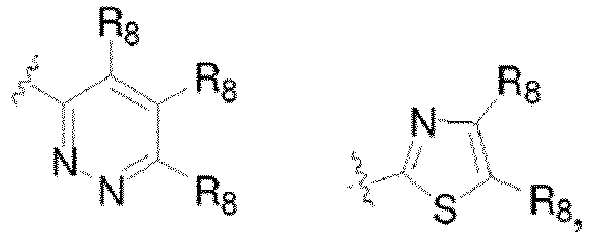 dans lequel R8 est un hydrogène.
 - Composé selon l'une quelconque des revendications précédentes, dans lequel Ar est représenté par la formule suivante :
 R8a est H ;R8b est indépendamment choisi parmi H, Cl ou CH3 ;R8c est indépendamment choisi dans le groupe constitué par H, - CH3, -CH2CH3, -OCH3, F, Cl, Br, I, un cyano, CF3, un isopropyle, un phényle, un phényle substitué par des substituants choisis dans le groupe constitué par un halogène et un cyano ; etR8d est H.
 - Composé selon l'une quelconque des revendications précédentes, dans lequel X est choisi dans le groupe constitué par :

 R9 est choisi parmi H, F, un alkyle en C1-6, un alkyle en C1-6 substitué par un halogène, un alcoxy en C1-6 et NR6R7 ; et un substituant de R9 en une ou plusieurs positions ; ouR9 peut former une double liaison dans le cycle, ou former un cycle de 4 à 6 chaînons fusionné avec le substitut de R9 sur le cycle ;R6 et R7 sont tels que définis dans la revendication 1.
 - Composé selon l'une quelconque des revendications précédentes, dans lequel,R2 est choisi dans le groupe constitué par H, un halogène, un cyano, un alkyle en C1-6 et un alkyle en C1-6 substitué par F ;R3 est choisi parmi l'hydrogène ou un alkyle en C1-6 ;R4 est choisi dans le groupe constitué par l'hydrogène, un aryle en C6 ou C10, un cycloalkyle en C3-6, un alkyle en C1-6 et un alkyle en C1-6 substitué par F ; etRx est choisi dans le groupe constitué de H, un cycloalkyle en C3-6, un alkyle en C1-6 et un alkyle en C1-6 substitué par F.
- Composé selon l'une quelconque des revendications précédentes, dans lequel,R2 est indépendamment choisi dans le groupe constitué de H, F, un cyano, CH3 et CF3 ;R3 est choisi parmi l'hydrogène ou un méthyle ; etR4 est choisi dans le groupe constitué par l'hydrogène, un phényle, un cyclopropyle, un méthyle, un éthyle, un isopropyle, un tert-butyle et un trifluorométhyle ; ouRx est choisi dans le groupe constitué de H, un méthyle et un cyclopropyle.
- Composé selon l'une quelconque des revendications précédentes, dans lequel dans la formule I, X est

 P est
P est R2 est indépendamment choisi dans le groupe constitué par H, F, un cyano et CF3 ;R3 est l'hydrogène ;R4 est indépendamment choisi dans le groupe constitué par H, un cyclopropyle, un méthyle et un trifluorométhyle ;Rx est choisi dans le groupe constitué par H, un méthyle et un cyclopropyle ;n est 0.
 - Composé selon l'une quelconque des revendications précédentes, dans lequel, dans la formule I,Ar est représenté par
 R8a, R8b et R8d sont l'hydrogène ;R8c est indépendamment choisi parmi un méthyle, un éthyle, un isopropyle, un méthoxy, un phényle, CN, Br, Cl, I, CF3 ou un phényle substitué par F ;X est
 Y est -C(=O)P, et P est
 R2 est l'hydrogène ;R3 est l'hydrogène ;R4 est indépendamment choisi dans le groupe constitué par H et un trifluorométhyle ;Rx est choisi dans le groupe constitué par H et un méthyle ;n est 0 ; etR1 est l'hydrogène.
 - Composé selon l'une quelconque des revendications précédentes, qui est choisi parmi les composés suivants ou un sel, un tautomère ou un stéréoisomère pharmaceutiquement acceptable de ceux-ci :(S)-2-(1-acryloylpipéridin-2-yl)-1-amino-4-(4-((4-(4-fluorophényl)pyridin-2-yl)carbamoyl)phényl)-1H-imidazole-5-carboxamide(S)-2-(1-acryloylpipéridin-2-yl)-1-amino-4-(4-((4-(trifluorométhyl)pyridin-2-yl)carbamoyl)phényl)-1H-imidazole-5-carboxamide(S)-1-amino-2-(1-(but-2-yl)pipéridin-2-yl)-4-(4-((4-(trifluorométhyl)pyridin-2-yl)carbamoyl)phényl)-1H-imidazole-5-carboxamide(S)-2-(1-acryloylpipéridin-2-yl)-1-amino-4-(4-((5-chloropyridin-2-yl)carbamoyl)phényl)-1H-imidazole-5-carboxamide(S)-2-(1-acryloylpipéridin-2-yl)-1-amino-4-(4-((4-bromopyridin-2-yl)carbamoyl)phényl)-1H-imidazole-5-carboxamide(S)-1-amino-4-(4-((4-bromopyridin-2-yl)carbamoyl)phényl)-2-(1-(but-2-ynoyl)pipéridin-2-yl)-1H-imidazole-5-carboxamide(S)-2-(1-acryloylpipéridin-2-yl)-1-amino-4-(4-((4-iodopyridin-2-yl)carbamoyl)phényl)-1H-imidazole-5-carboxamide(S)-1-amino-2-(1-(but-2-yl)pipéridin-2-yl)-4-(4-((4-iodopyridin-2-yl)carbamoyl)phényl)-1H-imidazole-5-carboxamide(S)-2-(1-acryloylpyrrolidin-2-yl)-1-amino-4-(4-(pyridin-2-ylcarbamoyl)phényl)-1H-imidazole-5-carboxamide(S)-1-amino-2-(1-méthacryloylpyrrolidin-2-yl)-4-(4-(pyridin-2-ylcarbamoyl)phényl)-1H-imidazole-5-carboxamide(S)-1-amino-2-(1-(3-méthylbut-2-énoyl)pyrrolidin-2-yl)-4-(4-(pyridin-2-ylcarbamoyl)phényl)-1H-imidazole-5-carboxamide(S,E)-1-amino-2-(1-(but-2-énoyl)pyrrolidin-2-yl)-4-(4-(pyridin-2-ylcarbamoyl)phényl)-1H-imidazole-5-carboxamide(S)-1-amino-2-(1-(2-cyano-3-cyclopropylacryloyl)pyrrolidin-2-yl)-4-(4-(pyridin-2-ylcarbamoyl)phényl)-1H-imidazole-5-carboxamide(S,E)-1-amino-2-(1-(pent-2-énoyl)pyrrolidin-2-yl)-4-(4-(pyridin-2-ylcarbamoyl)phényl)-1H-imidazole-5-carboxamide(S)-1-amino-2-(1-propioloylpyrrolidin-2-yl)-4-(4-(pyridin-2-ylcarbamoyl)phényl)-1H-imidazole-5-carboxamide(S)-1-amino-2-(1-(but-2-yl)pyrrolidin-2-yl)-4-(4-(pyridin-2-ylcarbamoyl)phényl)-1H-imidazole-5-carboxamide(S)-1-amino-2-(1-cyanopyrrolidin-2-yl)-4-(4-(pyridin-2-ylcarbamoyl)phényl)-1H-imidazole-5-carboxamide(S)-2-(1-acryloylpyrrolidin-2-yl)-1-amino-4-(4-((4-méthylpyridin-2-yl)carbamoyl)phényl)-1H-imidazole-5-carboxamide(S)-1-amino-2-(1-méthacryloylpyrrolidin-2-yl)-4-(4-((4-méthylpyridin-2-yl)carbamoyl)phényl)-1H-imidazole-5-carboxamide(S)-1-amino-2-(1-(3-méthylbut-2-énoyl)pyrrolidin-2-yl)-4-(4-((4-méthylpyridin-2-yl)carbamoyl)phényl)-1H-imidazole-5-carboxamide(S,E)-1-amino-2-(1-(but-2-énoyl)pyrrolidin-2-yl)-4-(4-((4-méthyll-pyridin-2-yl)carbamoyl)phényl)-1H-imidazole-5-carboxamide(S,E)-1-amino-2-(1-(2-cyano-3-cyclopropylacryloyl)pyrrolidin-2-yl)-4-(4-((4-méthylpyridin-2-yl)carbamoyl)phényl)-1H-imidazole-5-carboxamide(S,E)-1-amino-2-(1-(2-cyano-4-méthylpent-2-énoyl)pyrrolidin-2-yl)-4-(4-((4-méthylpyridin-2-yl)carbamoyl)phényl)-1H-imidazole-5-carboxamide(S,E)-1-amino-4-(4-((4-méthylpyridin-2-yl)carbamoyl)phényl)-2-(1-(pent-2-énoyl)pyrrolidin-2-yl)-1H-imidazole-5-carboxamide(S)-1-amino-4-(4-((4-méthylpyridin-2-yl)carbamoyl)phényl)-2-(1-propioloylpyrrolidin-2-yl)-1H-imidazole-5-carboxamide(S)-1-amino-2-(1-(but-2-yl)pyrrolidin-2-yl)-4-(4-((4-méthylpyridin-2-yl)carbamoyl)phényl)-1H-imidazole-5-carboxamide(S)-2-(1-acryloylpyrrolidin-2-yl)-1-amino-4-(4-((5-méthylpyridin-2-yl)carbamoyl)phényl)-1H-imidazole-5-carboxamide(S)-1-amino-2-(1-méthacryloylpyrrolidin-2-yl)-4-(4-((5-méthylpyridin-2-yl)carbamoyl)phényl)-1H-imidazole-5-carboxamide(S)-1-amino-2-(1-(3-méthylbut-2-énoyl)pyrrolidin-2-yl)-4-(4-((5-méthylpyridin-2-yl)carbamoyl)phényl)-1H-imidazole-5-carboxamide(S,E)-1-amino-2-(1-(but-2-énoyl)pyrrolidin-2-yl)-4-(4-((5-méthylpyridin-2-yl)carbamoyl)phényl)-1H-imidazole-5-carboxamide(S,E)-1-amino-2-(1-(2-cyano-3-cyclopropylacryloyl)pyrrolidin-2-yl)-4-(4-((5-méthylpyridin-2-yl)carbamoyl)phényl)-1H-imidazole-5-carboxamide(S,E)-1-amino-2-(1-(2-cyano-4,4-diméthylpent-2-énoyl)pyrrolidin-2-yl)-4-(4-((5-méthylpyridin-2-yl)carbamoyl)phényl)-1H-imidazole-5-carboxamide(S,E)-1-amino-4-(4-((5-méthylpyridin-2-yl)carbamoyl)phényl)-2-(1-(pent-2-énoyl)pyrrolidin-2-yl)-1H-imidazole-5-carboxamide(S)-1-amino-4-(4-((5-méthylpyridin-2-yl)carbamoyl)phényl)-2-(1-propioloylpyrrolidin-2-yl)-1H-imidazole-5-carboxamide(S)-1-amino-2-(1-(but-2-yl)pyrrolidin-2-yl)-4-(4-((5-méthylpyridin-2-yl)carbamoyl)phényl)-1H-imidazole-5-carboxamide(S)-2-(1-acryloylpyrrolidin-2-yl)-1-amino-4-(4-((4-méthoxypyridin-2-yl)carbamoyl)phényl)-1H-imidazole-5-carboxamide(S)-1-amino-2-(1-méthacryloylpyrrolidin-2-yl)-4-(4-((4-méthoxypyridin-2-yl)carbamoyl)phényl)-1H-imidazole-5-carboxamide(S)-1-amino-4-(4-((4-méthoxypyridin-2-yl)carbamoyl)phényl)-2-(1-(3-méthylbut-2-énoyl)pyrrolidin-2-yl)-1H-imidazole-5-carboxamide(S,E)-1-amino-2-(1-(but-2-énoyl)pyrrolidin-2-yl)-4-(4-((4-méthoxypyridin-2-yl)carbamoyl)phényl)-1H-imidazole-5-carboxamide(S,E)-1-amino-4-(4-((4-méthoxypyridin-2-yl)carbanioyl)phényl)-2-(1-(pent-2-énoyl)pyrrolidin-2-yl)-1H-imidazole-5-carboxamide(S)-1-amino-4-(4-((4-méthoxypyridin-2-yl)carbamoyl)phényl)-2-(1-propioloylpyrrolidin-2-yl)-1H-imidazole-5-carboxamide(S)-1-amino-2-(1-(but-2-yl)pyrrolidin-2-yl)-4-(4-((4-méthoxypyridin-2-yl)carbamoyl)phényl)-1H-imidazole-5-carboxamide(S)-2-(1-acryloylpyrrolidin-2-yl)-1-amino-4-(4-((4-éthylpyridin-2-yl)carbamoyl)phényl)-1H-imidazole-5-carboxamide(S)-1-amino-4-(4-((4-éthylpyridin-2-yl)carbamoyl)phényl)-2-(1-méthacryloylpyrrolidin-2-yl)- 1H-imidazole-5-carboxamide(S)-1-amino-4-(4-((4-éthylpyridin-2-yl)carbamoyl)phényl)-2-(1-(3-méthylbut-2-énoyl)pyrrolidin-2-yl)-1H-imidazole-5-carboxamide(S)-1-amino-2-(1-(but-2-yl)pyrrolidin-2-yl)-4-(4-((4-éthylpyridin-2-yl)carbamoyl)phényl)-1H-imidazole-5-carboxamide(S)-1-amino-2-(1-cyanopyrrolidin-2-yl)-4-(4-((4-éthylpyridin-2-yl)carbamoyl)phényl)-1H-imidazole-5-carboxamide(S)-2-(1-acryloylpyrrolidin-2-yl)-1-amino-4-(4-((4-fluoropyridin-2-yl)carbamoyl)phényl)-1H-imidazole-5-carboxamide(S)-1-amino-2-(1-(but-2-yl)pyrrolidin-2-yl)-4-(4-((4-fluoropyridin-2-yl)carbamoyl)phényl)-1H-imidazole-5-carboxamide(S)-2-(1-acryloylpyrrolidin-2-yl)-1-amino-4-(4-((4-(trifluorométhyl)pyridin-2-yl)carbamoyl)phényl)-1H-imidazole-5-carboxamide(S)-1-amino-2-(1-(but-2-yl)pyrrolidin-2-yl)-4-(4-((4-(trifluorométhyl)pyridin-2-yl)carbamoyl)phényl)-1H-imidazole-5-carboxamide(S)-2-(1-acryloylpyrrolidin-2-yl)-1-amino-4-(4-((4-isopropylpyridin-2-yl)carbamoyl)phényl)-1H-imidazole-5-carboxamide(S)-2-(1-acryloylpyrrolidin-2-yl)-1-(méthylamino)-4-(4-((4-méthylpyridin-2-yl)carbamoyl)phényl)-1H-imidazole-5-carboxamide(S)-2-(1-acryloylpipéridin-2-yl)-1-amino-4-(4-(pyridin-2-ylcarbamoyl)phényl)-1H-imidazole-5-carboxamide(S)-1-amino-2-(1-méthacryloylpipéridin-2-yl)-4-(4-(pyridin-2-ylcarbamoyl)phényl)-1H-imidazole-5-carboxamide(S,E)-1-amino-2-(1-(but-2-énoyl)pipéridin-2-yl)-4-(4-(pyridin-2-ylcarbamoyl)phényl)- 1H-imidazole-5-carboxamide(S)-1-amino-2-(1-(3-méthylbut-2-énoyl)pipéridin-2-yl)-4-(4-(pyridin-2-ylcarbamoyl)phényl)-1H-imidazole-5-carboxamide(S)-1-amino-2-(1-(but-2-yl)pipéridin-2-yl)-4-(4-(pyridin-2-ylcarbamoyl)phényl)-1H-imidazole-5-carboxamide(S,E)-1-amino-2-(1-(pent-2-énoyl)pipéridin-2-yl)-4-(4-(pyridin-2-ylcarbamoyl)phényl)-1H-imidazole-5-carboxamide(S,E)-1-amino-2-(1-(2-cyano-3-cyclopropylacryloyl)pipéridin-2-yl)-4-(4-(pyridin-2-ylcarbamoyl)phényl)-1H-imidazole-5-carboxamide(S)-2-(1-acryloylpipéridin-2-yl)-1-amino-4-(4-((4-méthylpyridin-2-yl)carbamoyl)phényl)-1H-imidazole-5-carboxamide(S)-1-amino-2-(1-méthacryloylpipéridin-2-yl)-4-(4-((4-méthylpyridin-2-yl)carbamoyl)phényl)-1H-imidazole-5-carboxamide(S,E)-1-amino-2-(1-(but-2-énoyl)pipéridin-2-yl)-4-(4-((4-méthylpyridin-2-yl)carbamoyl)phényl)-1H-imidazole-5-carboxamide(S)-1-amino-2-(1-(3-méthylbut-2-énoyl)pipéridin-2-yl)-4-(4-((4-méthylpyridin-2-yl)carbamoyl)phényl)-1H-imidazole-5-carboxamide(S,E)-1-amino-2-(1-cinnamoylpipéridin-2-yl)-4-(4-((4-méthylpyridin-2-yl)carbamoyl)phényl)-1H-imidazole-5-carboxamide(S)-1-amino-2-(1-(but-2-yl)pipéridin-2-yl)-4-(4-((4-méthylpyridin-2-yl)carbamoyl)phényl)-1H-imidazole-5-carboxamide(S)-1-amino-2-(1-(2-fluoroacryloyl)pipéridin-2-yl)-4-(4-((4-méthylpyridin-2-yl)carbamoyl)phényl)-1H-imidazole-5-carboxamide(S,E)-1-amino-4-(4-((4-méthylpyridin-2-yl)carbamoyl)phényl)-2-(1-(4,4,4-trifluorobut-2-énoyl)pipéridin-2-yl)-1H-imidazole-5-carboxamide(S)-2-(1-acryloylpipéridin-2-yl)-1-amino-4-(4-((5-méthylpyridin-2-yl)carbamoyl)phényl)-1H-imidazole-5-carboxamide(S)-1-amino-2-(1-méthacryloylpipéridin-2-yl)-4-(4-((5-méthylpyridin-2-yl)carbamoyl)phényl)-1H-imidazole-5-carboxamide(S)-1-amino-2-(1-(3-méthylbut-2-énoyl)pipéridin-2-yl)-4-(4-((5-méthylpyridin-2-yl)carbamoyl)phényl)-1H-imidazole-5-carboxamide(S)-1-amino-2-(1-(but-2-yl)pipéridin-2-yl)-4-(4-((5-méthylpyridin-2-yl)carbamoyl)phényl)-1H-imidazole-5-carboxamide(S)-2-(1-acryloylpipéridin-2-yl)-1-amino-4-(4-((4-phénylpyridin-2-yl)carbamoyl)phényl)-1H-imidazole-5-carboxamide(S)-1-amino-2-(1-(but-2-yl)pipéridin-2-yl)-4-(4-((4-phénylpyridin-2-yl)carbamoyl)phényl)-1H-imidazole-5-carboxamide(S)-2-(1-acryloylpipéridin-2-yl)-1-amino-4-(4-((4-méthoxypyridin-2-yl)carbanioyl)phényl)-1H-imidazole-5-carboxamide(S)-1-amino-2-(1-(but-2-yl)pipéridin-2-yl)-4-(4-((4-méthoxy-pyridin-2-yl)carbamoyl)phényl)-1H-imidazole-5-carboxamide(S,E)-1-amino-4-(4-((4-méthoxypyridin-2-yl)carbamoyl)phényl)-2-(1-(4,4,4-trifluorobut-2-énoyl)pipéridin-2-yl)-1H-imidazole-5-carboxamide(S)-1-amino-2-(1-(2-fluoroacryloyl)pipéridin-2-yl)-4-(4-((4-méthoxy-pyridin-2-yl)carbamoyl)phényl)-1H-imidazole-5-carboxamide(S)-2-(1-acryloylpipéridin-2-yl)-1-amino-4-(4-((4-isopropylpyridin-2-yl)carbamoyl)phényl)-1H-imidazole-5-carboxamide(S)-2-(1-acryloylpipéridin-2-yl)-1-amino-4-(4-((4-chloropyridin-2-yl)carbamoyl)phényl)-1H-imidazole-5-carboxamide(S)-2-(1-acryloylpipéridin-2-yl)-1-amino-4-(4-((4-éthylpyridin-2-yl)carbamoyl)phényl)-1H-imidazole-5-carboxamide(S)-1-amino-4-(4-((4-éthylpyridin-2-yl)carbamoyl)phényl)-2-(1-méthacryloylpipéridin-2-yl)-1H-imidazole-5-carboxamide(S,E)-1-amino-2-(1-(but-2-énoyl)pipéridin-2-yl)-4-(4-((4-éthylpyridin-2-yl)carbamoyl)phényl)-1H-imidazole-5-carboxamide(S)-1-amino-4-(4-((4-éthylpyridin-2-yl)carbamoyl)phényl)-2-(1-(3-méthylbut-2-énoyl)pipéridin-2-yl)-1H-imidazole-5-carboxamide(S)-1-amino-2-(1-(but-2-yl)pipéridin-2-yl)-4-(4-((4-éthylpyridin-2-yl)carbamoyl)phényl)-1H-imidazole-5-carboxamide(S,E)-1-amino-2-(1-(2-cyano-3-cyclopropylacryloyl)pipéridin-2-yl)-4-(4-((4-éthylpyridin-2-yl)carbamoyl)phényl)-1H-imidazole-5-carboxamide(S,E)-1-amino-2-(1-(2-cyano-4-méthylpent-2-énoyl)pipéridin-2-yl)-4-(4-((4-éthylpyridin-2-yl)carbamoyl)phényl)-1H-imidazole-5-carboxamide(S,E)-1-amino-4-(4-((4-éthylpyridin-2-yl)carbamoyl)phényl)-2-(1-(pent-2-énoyl)pipéridin-2-yl)-1H-imidazole-5-carboxamide(S)-2-(1-acryloylpipéridin-2-yl)-4-(4-((4-éthylpyridin-2-yl)carbamoyl)phényl)-1-(méthylamino)-1H-imidazole-5-carboxamide(S)-1-amino-2-(1-(but-2-yl)pipéridin-2-yl)-4-(4-((4-cyanopyridin-2-yl)carbamoyl)phényl)-1H-imidazole-5-carboxamide(S)-2-(1-acryloylpipéridin-2-yl)-1-amino-4-(4-((4-cyanopyridin-2-yl)carbamoyl)phényl)-1H-imidazole-5-carboxamide(S)-1-amino-2-(1-(but-2-yl)pipéridin-2-yl)-4-(4-((4-(4-fluorophényl)pyridin-2-yl)carbamoyl)phényl)-1H-imidazole-5-carboxamide(R)-2-(1-acryloylpipéridin-3-yl)-1-amino-4-(4-((4-éthylpyridin-2-yl)carbamoyl)phényl)-1H-imidazole-5-carboxamide2-(1-acryloylazépan-2-yl)-1-amino-4-(4-((4-éthylpyridin-2-yl)carbamoyl)phényl)-1H-imidazole-5-carboxamide2-(2-acryloyl-2-azaspiro[3.3]heptan-6-yl)-1-amino-4-(4-((4-éthylpyridin-2-yl)carbamoyl)phényl)-1H-imidazole-5-carboxamide(S)-1-amino-4-(4-((4-méthylpyridin-2-yl)carbanioyl)phényl)-2-(1-propioloylpipéridin-2-yl)-1H-imidazole-5-carboxamide(S)-1-amino-4-(4-((4-méthoxypyridin-2-yl)carbamoyl)phényl)-2-(1-propioloylpipéridin-2-yl)-1H-imidazole-5-carboxamide(S)-1-amino-2-(1-(but-2-yl)pipéridin-2-yl)-4-(4-((4-chloropyridin-2-yl)carbamoyl)phényl)-1H-imidazole-5-carboxamide(S)-1-amino-4-(4-((4-chloropyridin-2-yl)carbamoyl)phényl)-2-(1-propioloylpipéridin-2-yl)-1H-imidazole-5-carboxamide(S)-1-amino-4-(4-((4-éthylpyridin-2-yl)carbamoyl)phényl)-2-(1-propioloylpipéridin-2-yl)-1H-imidazole-5-carboxamide(S)-2-(1-acryloylpipéridin-2-yl)-1-amino-4-(4-(pyridazin-3-ylcarbamoyl)phényl)-1H-imidazole-5-carboxamide(S)-1-amino-2-(1-(but-2-yl)pipéridin-2-yl)-4-(4-(pyridazin-3-ylcarbamoyl)phényl)-1H-imidazole-5-carboxamide2-((1-acryloylpipéridin-4-yl)méthyl)-1-amino-4-(4-(pyridin-2-ylcarbamoyl)phényl)-1H-imidazole-5-carboxamide1-amino-2-((1-(but-2-yl)pipéridin-4-yl)méthyl)-4-(4-(pyridin-2-ylcarbamoyl)phényl)-1H-imidazole-5-carboxamide(S)-2-(1-acryloylpipéridin-2-yl)-1-amino-4-(4-(thiazol-2-ylcarbamoyl)phényl)-1H-imidazole-5-carboxamide(S)-2-(1-acryloylpipéridin-2-yl)-1-amino-4-(4-((4-fluoropyridin-2-yl)carbamoyl)phényl)-1H-imidazole-5-carboxamide(S)-2-(1-acryloylpipéridin-2-yl)-1-amino-4-(4-((5-fluoro-4-méthylpyridin-2-yl)carbamoyl)phényl)-1H-imidazole-5-carboxamide(S)-1-amino-2-(1-(but-2-yl)pipéridin-2-yl)-4-(4-((5-fluoro-4-méthylpyridin-2-yl)carbamoyl)phényl)-1H-imidazole-5-carboxamide(S)-2-(1-acryloylpipéridin-2-yl)-1-amino-4-(4-((4-(4-chlorophényl)pyridin-2-yl)carbamoyl)phényl)-1H-imidazole-5-carboxamide(S)-1-amino-2-(1-(but-2-yl)pipéridin-2-yl)-4-(4-((4-(4-chlorophényl)pyridin-2-yl)carbamoyl)phényl)-1H-imidazole-5-carboxamide(S)-2-(1-acryloylpipéridin-2-yl)-1-amino-4-(4-((4-(4-cyanophényl)pyridin-2-yl)carbamoyl)phényl)-1H-imidazole-5-carboxamide(S)-1-amino-2-(1-(but-2-yl)pipéridin-2-yl)-4-(4-((4-(4-cyanophényl)pyridin-2-yl)carbamoyl)phényl)-1H-imidazole-5-carboxamide.
- Composition pharmaceutique comprenant un composé, un sel, un tautomère ou un stéréoisomère pharmaceutiquement acceptable de celui-ci selon l'une quelconque des revendications précédentes, et un support pharmaceutiquement acceptable.
- Composé selon l'une quelconque des revendications 1 à 12, ou sel, tautomère ou stéréoisomère pharmaceutiquement acceptable de celui-ci, pour traiter ou prévenir une maladie ou une pathologie médiée par BTK, dans lequel la maladie ou la pathologie est choisie dans le groupe constitué par une maladie auto-immune, une maladie inflammatoire, un cancer, une allergie, un lymphome diffus à grandes cellules B, un lymphome folliculaire, une leucémie lymphoïde chronique, un lymphome à cellules du manteau, un lymphome de la zone marginale splénique, un lymphome à grandes cellules B, un lupus érythémateux, un polyarthrite rhumatoïde, une maladie de Crohn, un psoriasis, une sclérose en plaques et un asthme.
Applications Claiming Priority (2)
| Application Number | Priority Date | Filing Date | Title |
|---|---|---|---|
| CN201910388246 | 2019-05-10 | ||
| PCT/CN2020/089407 WO2020228637A1 (fr) | 2019-05-10 | 2020-05-09 | 1-amino-1h-imidazole-5-carboxamide substitué utilisé en tant qu'inhibiteurs de la tyrosine kinase de bruton |
Publications (4)
| Publication Number | Publication Date |
|---|---|
| EP3966204A1 EP3966204A1 (fr) | 2022-03-16 |
| EP3966204A4 EP3966204A4 (fr) | 2023-07-19 |
| EP3966204C0 EP3966204C0 (fr) | 2024-11-27 |
| EP3966204B1 true EP3966204B1 (fr) | 2024-11-27 |
Family
ID=73238102
Family Applications (1)
| Application Number | Title | Priority Date | Filing Date |
|---|---|---|---|
| EP20805272.0A Active EP3966204B1 (fr) | 2019-05-10 | 2020-05-09 | 1-amino-1h-imidazole-5-carboxamide substitué utilisé en tant qu'inhibiteurs de la tyrosine kinase de bruton |
Country Status (7)
| Country | Link |
|---|---|
| US (1) | US12291516B2 (fr) |
| EP (1) | EP3966204B1 (fr) |
| JP (1) | JP7475370B2 (fr) |
| KR (1) | KR102668958B1 (fr) |
| CN (1) | CN111909133B (fr) |
| AU (1) | AU2020276334B2 (fr) |
| WO (1) | WO2020228637A1 (fr) |
Families Citing this family (3)
| Publication number | Priority date | Publication date | Assignee | Title |
|---|---|---|---|---|
| AU2020276334B2 (en) | 2019-05-10 | 2022-12-22 | Henan Zhiwei Biomedicine Co., Ltd. | Substituted 1-amino-1H-imidazole-5-carboxamide as Bruton's Tyrosine Kinase inhibitors |
| IL293558B2 (en) * | 2019-12-11 | 2026-04-01 | Ryvu Therapeutics S A | Heterocyclic compounds functional as modulators of stimulator of interferon genes (STING) |
| CN113200850A (zh) * | 2021-05-08 | 2021-08-03 | 渭南师范学院 | 一种α-酰氧基酮化合物的制备方法 |
Family Cites Families (12)
| Publication number | Priority date | Publication date | Assignee | Title |
|---|---|---|---|---|
| JP2005277602A (ja) * | 2004-03-23 | 2005-10-06 | Kenwood Corp | サービスクラス制御システム、サービスクラス制御装置、端末装置、サービスクラス制御方法及びプログラム |
| SG11201500499TA (en) * | 2012-08-10 | 2015-03-30 | Boehringer Ingelheim Int | Heteroaromatic compounds as bruton's tyrosine kinase (btk) inhibitors |
| CN103848810A (zh) | 2012-11-30 | 2014-06-11 | 北京赛林泰医药技术有限公司 | 鲁顿酪氨酸激酶抑制剂 |
| CA2902686C (fr) | 2013-04-25 | 2017-01-24 | Beigene, Ltd. | Composes heterocycliques fusionnes en tant qu'inhibiteurs de proteine kinase |
| WO2015057992A1 (fr) * | 2013-10-16 | 2015-04-23 | Izumi Raquel | Inhibiteurs btk pour la mobilisation hématopoïétique |
| WO2016004280A2 (fr) | 2014-07-02 | 2016-01-07 | Pharmacyclics Llc | Inhibiteurs de tyrosine kinase de bruton |
| CN106588914B (zh) * | 2015-10-16 | 2018-11-02 | 陈剑 | 具有取代吡啶并咪唑类衍生物,其制备及其在医药上的应用 |
| CN107226805A (zh) | 2016-03-24 | 2017-10-03 | 北京天诚医药科技有限公司 | 芳香族酰胺类衍生物、其制备方法及其在医药上的应用 |
| KR102404759B1 (ko) * | 2016-05-16 | 2022-05-31 | 쑤저우 시노벤트 파마슈티칼즈 씨오., 엘티디. | Btk 억제제로서의 5-아미노피라졸 카르복사미드 유도체 및 그것의 제조 방법 및 제약학적 조성물 |
| WO2018175512A1 (fr) | 2017-03-22 | 2018-09-27 | Suzhou Baijibugong Pharmaceutical Technology Co. Ltd. | Inhibiteurs de tyrosine kinase de bruton |
| CN107056789B (zh) * | 2017-04-21 | 2019-03-29 | 陈剑 | 具有取代吡嗪并咪唑类衍生物,其制备及其在医药上的应用 |
| AU2020276334B2 (en) | 2019-05-10 | 2022-12-22 | Henan Zhiwei Biomedicine Co., Ltd. | Substituted 1-amino-1H-imidazole-5-carboxamide as Bruton's Tyrosine Kinase inhibitors |
-
2020
- 2020-05-09 AU AU2020276334A patent/AU2020276334B2/en active Active
- 2020-05-09 EP EP20805272.0A patent/EP3966204B1/fr active Active
- 2020-05-09 US US17/609,989 patent/US12291516B2/en active Active
- 2020-05-09 JP JP2021567893A patent/JP7475370B2/ja active Active
- 2020-05-09 KR KR1020217040489A patent/KR102668958B1/ko active Active
- 2020-05-09 CN CN202010388187.2A patent/CN111909133B/zh active Active
- 2020-05-09 WO PCT/CN2020/089407 patent/WO2020228637A1/fr not_active Ceased
Also Published As
| Publication number | Publication date |
|---|---|
| EP3966204C0 (fr) | 2024-11-27 |
| KR20220007151A (ko) | 2022-01-18 |
| EP3966204A1 (fr) | 2022-03-16 |
| CA3139795A1 (fr) | 2020-11-19 |
| US12291516B2 (en) | 2025-05-06 |
| AU2020276334B2 (en) | 2022-12-22 |
| EP3966204A4 (fr) | 2023-07-19 |
| AU2020276334A1 (en) | 2021-12-16 |
| US20220259181A1 (en) | 2022-08-18 |
| CN111909133B (zh) | 2023-07-14 |
| KR102668958B1 (ko) | 2024-05-28 |
| JP7475370B2 (ja) | 2024-04-26 |
| CN111909133A (zh) | 2020-11-10 |
| KR102668958B9 (ko) | 2024-08-12 |
| JP2022533818A (ja) | 2022-07-26 |
| WO2020228637A1 (fr) | 2020-11-19 |
Similar Documents
| Publication | Publication Date | Title |
|---|---|---|
| EP3233863B1 (fr) | Composés d'hétéroaryle à cycle condensé et leur utilisation à titre d'inhibiteurs de trk | |
| EP4146348B1 (fr) | Inhibiteurs de la nek7 kinase | |
| EP3889154A1 (fr) | Intermédiaire de composé hétérocyclique, son procédé de préparation et son utilisation | |
| EP3305785B1 (fr) | Dérivé de pyrido[3,4-d]pyrimidine et sel pharmaceutiquement acceptable de celui-ci | |
| EP3068785B1 (fr) | Dérivés de 4,5,6,7-tétrahydropyrazolo[1,5-a]pyrazine substitués en tant qu'inhibiteurs de caséine kinase 1 d/e | |
| EP3728207B1 (fr) | Quinazolinones en tant qu'inhibiteurs de parp14 | |
| RU2674701C2 (ru) | Аминопиридазиноновые соединения в качестве ингибиторов протеинкиназы | |
| EP2858988B1 (fr) | Dérivés de benzamide pour inhiber l'activité d'abl1, d'abl2 et de bcr-abl2 | |
| TW202311260A (zh) | 含有亞磺醯亞胺基的atr抑制劑化合物 | |
| TWI672304B (zh) | 作爲酪胺酸激酶抑制劑之經取代的乙炔基雜雙環化合物 | |
| EP3966204B1 (fr) | 1-amino-1h-imidazole-5-carboxamide substitué utilisé en tant qu'inhibiteurs de la tyrosine kinase de bruton | |
| CN102827170A (zh) | 治疗活性组合物和它们的使用方法 | |
| EP3253754B1 (fr) | Dérivés de 2-phenyl-3h-imidazo[4,5-b]pyridine pouvant être utilisés comme inhibiteurs de l'activité de la tyrosine kinase mammalienne ror1 | |
| EP3197885B1 (fr) | Composés hétérocycliques et utilisation de ces composés | |
| EA028507B1 (ru) | Соединения | |
| EP4389736A1 (fr) | Composé d'urée contenant une substitution du cycle 2-hétéroaromatique, son procédé de préparation et son utilisation | |
| CA3139795C (fr) | 1-amino-1h-imidazole-5-carboxamide substitue utilise en tant qu'inhibiteurs de la tyrosine kinase de bruton | |
| AU2020395741C1 (en) | Substituted imidazolecarboxamide as Bruton's Tyrosine Kinase inhibitors | |
| EP4310084A1 (fr) | Composé à base de pyridopyrimidine et son utilisation | |
| EP4365181A1 (fr) | Dérivé de galactoside en tant qu'inhibiteur de galectine-3 | |
| HK40088615B (en) | Inhibitors of nek7 kinase | |
| HK40088615A (en) | Inhibitors of nek7 kinase | |
| HK40032523A (en) | Substituted 1-amino-1h-imidazole-5-carboxamides as brunauer tyrosine kinase inhibitors | |
| CN121001717A (zh) | 作为cdk2抑制剂的新型大环氨基吡唑化合物 | |
| HK40039341B (en) | Quinazolinones as parp14 inhibitors |
Legal Events
| Date | Code | Title | Description |
|---|---|---|---|
| STAA | Information on the status of an ep patent application or granted ep patent |
Free format text: STATUS: THE INTERNATIONAL PUBLICATION HAS BEEN MADE |
|
| PUAI | Public reference made under article 153(3) epc to a published international application that has entered the european phase |
Free format text: ORIGINAL CODE: 0009012 |
|
| STAA | Information on the status of an ep patent application or granted ep patent |
Free format text: STATUS: REQUEST FOR EXAMINATION WAS MADE |
|
| 17P | Request for examination filed |
Effective date: 20211123 |
|
| AK | Designated contracting states |
Kind code of ref document: A1 Designated state(s): AL AT BE BG CH CY CZ DE DK EE ES FI FR GB GR HR HU IE IS IT LI LT LU LV MC MK MT NL NO PL PT RO RS SE SI SK SM TR |
|
| RAP3 | Party data changed (applicant data changed or rights of an application transferred) |
Owner name: HENAN ZHIWEI BIOMEDICINE CO., LTD. Owner name: HENAN NORMAL UNIVERSITY |
|
| DAV | Request for validation of the european patent (deleted) | ||
| DAX | Request for extension of the european patent (deleted) | ||
| RAP1 | Party data changed (applicant data changed or rights of an application transferred) |
Owner name: HENAN ZHIWEI BIOMEDICINE CO., LTD. |
|
| A4 | Supplementary search report drawn up and despatched |
Effective date: 20230619 |
|
| RIC1 | Information provided on ipc code assigned before grant |
Ipc: A61P 37/08 20060101ALI20230613BHEP Ipc: A61P 37/06 20060101ALI20230613BHEP Ipc: A61P 37/00 20060101ALI20230613BHEP Ipc: A61P 35/02 20060101ALI20230613BHEP Ipc: A61P 35/00 20060101ALI20230613BHEP Ipc: A61P 29/00 20060101ALI20230613BHEP Ipc: A61K 31/4178 20060101ALI20230613BHEP Ipc: C07D 417/14 20060101ALI20230613BHEP Ipc: C07D 401/14 20060101AFI20230613BHEP |
|
| GRAP | Despatch of communication of intention to grant a patent |
Free format text: ORIGINAL CODE: EPIDOSNIGR1 |
|
| STAA | Information on the status of an ep patent application or granted ep patent |
Free format text: STATUS: GRANT OF PATENT IS INTENDED |
|
| INTG | Intention to grant announced |
Effective date: 20240621 |
|
| GRAS | Grant fee paid |
Free format text: ORIGINAL CODE: EPIDOSNIGR3 |
|
| GRAA | (expected) grant |
Free format text: ORIGINAL CODE: 0009210 |
|
| STAA | Information on the status of an ep patent application or granted ep patent |
Free format text: STATUS: THE PATENT HAS BEEN GRANTED |
|
| AK | Designated contracting states |
Kind code of ref document: B1 Designated state(s): AL AT BE BG CH CY CZ DE DK EE ES FI FR GB GR HR HU IE IS IT LI LT LU LV MC MK MT NL NO PL PT RO RS SE SI SK SM TR |
|
| REG | Reference to a national code |
Ref country code: GB Ref legal event code: FG4D |
|
| REG | Reference to a national code |
Ref country code: CH Ref legal event code: EP |
|
| REG | Reference to a national code |
Ref country code: IE Ref legal event code: FG4D |
|
| REG | Reference to a national code |
Ref country code: DE Ref legal event code: R096 Ref document number: 602020042161 Country of ref document: DE |
|
| U01 | Request for unitary effect filed |
Effective date: 20241218 |
|
| U07 | Unitary effect registered |
Designated state(s): AT BE BG DE DK EE FI FR IT LT LU LV MT NL PT RO SE SI Effective date: 20250110 |
|
| PG25 | Lapsed in a contracting state [announced via postgrant information from national office to epo] |
Ref country code: IS Free format text: LAPSE BECAUSE OF FAILURE TO SUBMIT A TRANSLATION OF THE DESCRIPTION OR TO PAY THE FEE WITHIN THE PRESCRIBED TIME-LIMIT Effective date: 20250327 Ref country code: HR Free format text: LAPSE BECAUSE OF FAILURE TO SUBMIT A TRANSLATION OF THE DESCRIPTION OR TO PAY THE FEE WITHIN THE PRESCRIBED TIME-LIMIT Effective date: 20241127 |
|
| PG25 | Lapsed in a contracting state [announced via postgrant information from national office to epo] |
Ref country code: ES Free format text: LAPSE BECAUSE OF FAILURE TO SUBMIT A TRANSLATION OF THE DESCRIPTION OR TO PAY THE FEE WITHIN THE PRESCRIBED TIME-LIMIT Effective date: 20241127 |
|
| PG25 | Lapsed in a contracting state [announced via postgrant information from national office to epo] |
Ref country code: NO Free format text: LAPSE BECAUSE OF FAILURE TO SUBMIT A TRANSLATION OF THE DESCRIPTION OR TO PAY THE FEE WITHIN THE PRESCRIBED TIME-LIMIT Effective date: 20250227 |
|
| PG25 | Lapsed in a contracting state [announced via postgrant information from national office to epo] |
Ref country code: GR Free format text: LAPSE BECAUSE OF FAILURE TO SUBMIT A TRANSLATION OF THE DESCRIPTION OR TO PAY THE FEE WITHIN THE PRESCRIBED TIME-LIMIT Effective date: 20250228 |
|
| PG25 | Lapsed in a contracting state [announced via postgrant information from national office to epo] |
Ref country code: PL Free format text: LAPSE BECAUSE OF FAILURE TO SUBMIT A TRANSLATION OF THE DESCRIPTION OR TO PAY THE FEE WITHIN THE PRESCRIBED TIME-LIMIT Effective date: 20241127 |
|
| PG25 | Lapsed in a contracting state [announced via postgrant information from national office to epo] |
Ref country code: RS Free format text: LAPSE BECAUSE OF FAILURE TO SUBMIT A TRANSLATION OF THE DESCRIPTION OR TO PAY THE FEE WITHIN THE PRESCRIBED TIME-LIMIT Effective date: 20250227 |
|
| U20 | Renewal fee for the european patent with unitary effect paid |
Year of fee payment: 6 Effective date: 20250514 |
|
| PG25 | Lapsed in a contracting state [announced via postgrant information from national office to epo] |
Ref country code: SM Free format text: LAPSE BECAUSE OF FAILURE TO SUBMIT A TRANSLATION OF THE DESCRIPTION OR TO PAY THE FEE WITHIN THE PRESCRIBED TIME-LIMIT Effective date: 20241127 |
|
| PGFP | Annual fee paid to national office [announced via postgrant information from national office to epo] |
Ref country code: CH Payment date: 20250601 Year of fee payment: 6 |
|
| PG25 | Lapsed in a contracting state [announced via postgrant information from national office to epo] |
Ref country code: SK Free format text: LAPSE BECAUSE OF FAILURE TO SUBMIT A TRANSLATION OF THE DESCRIPTION OR TO PAY THE FEE WITHIN THE PRESCRIBED TIME-LIMIT Effective date: 20241127 |
|
| PG25 | Lapsed in a contracting state [announced via postgrant information from national office to epo] |
Ref country code: CZ Free format text: LAPSE BECAUSE OF FAILURE TO SUBMIT A TRANSLATION OF THE DESCRIPTION OR TO PAY THE FEE WITHIN THE PRESCRIBED TIME-LIMIT Effective date: 20241127 |
|
| PLBE | No opposition filed within time limit |
Free format text: ORIGINAL CODE: 0009261 |
|
| STAA | Information on the status of an ep patent application or granted ep patent |
Free format text: STATUS: NO OPPOSITION FILED WITHIN TIME LIMIT |
|
| REG | Reference to a national code |
Ref country code: CH Ref legal event code: L10 Free format text: ST27 STATUS EVENT CODE: U-0-0-L10-L00 (AS PROVIDED BY THE NATIONAL OFFICE) Effective date: 20251008 |
|
| 26N | No opposition filed |
Effective date: 20250828 |
|
| PG25 | Lapsed in a contracting state [announced via postgrant information from national office to epo] |
Ref country code: MC Free format text: LAPSE BECAUSE OF FAILURE TO SUBMIT A TRANSLATION OF THE DESCRIPTION OR TO PAY THE FEE WITHIN THE PRESCRIBED TIME-LIMIT Effective date: 20241127 |
|
| PGFP | Annual fee paid to national office [announced via postgrant information from national office to epo] |
Ref country code: GB Payment date: 20260327 Year of fee payment: 7 |
|
| PG25 | Lapsed in a contracting state [announced via postgrant information from national office to epo] |
Ref country code: IE Free format text: LAPSE BECAUSE OF NON-PAYMENT OF DUE FEES Effective date: 20250509 |