EP3970160B1 - Verfahren zum einstellen eines betriebsparameters in einer medizinischen vorrichtung - Google Patents
Verfahren zum einstellen eines betriebsparameters in einer medizinischen vorrichtung Download PDFInfo
- Publication number
- EP3970160B1 EP3970160B1 EP19817729.7A EP19817729A EP3970160B1 EP 3970160 B1 EP3970160 B1 EP 3970160B1 EP 19817729 A EP19817729 A EP 19817729A EP 3970160 B1 EP3970160 B1 EP 3970160B1
- Authority
- EP
- European Patent Office
- Prior art keywords
- tuning
- state value
- operational parameter
- input device
- change amount
- Prior art date
- Legal status (The legal status is an assumption and is not a legal conclusion. Google has not performed a legal analysis and makes no representation as to the accuracy of the status listed.)
- Active
Links
Images

Classifications
-
- G—PHYSICS
- G16—INFORMATION AND COMMUNICATION TECHNOLOGY [ICT] SPECIALLY ADAPTED FOR SPECIFIC APPLICATION FIELDS
- G16H—HEALTHCARE INFORMATICS, i.e. INFORMATION AND COMMUNICATION TECHNOLOGY [ICT] SPECIALLY ADAPTED FOR THE HANDLING OR PROCESSING OF MEDICAL OR HEALTHCARE DATA
- G16H40/00—ICT specially adapted for the management or administration of healthcare resources or facilities; ICT specially adapted for the management or operation of medical equipment or devices
- G16H40/60—ICT specially adapted for the management or administration of healthcare resources or facilities; ICT specially adapted for the management or operation of medical equipment or devices for the operation of medical equipment or devices
- G16H40/63—ICT specially adapted for the management or administration of healthcare resources or facilities; ICT specially adapted for the management or operation of medical equipment or devices for the operation of medical equipment or devices for local operation
-
- G—PHYSICS
- G16—INFORMATION AND COMMUNICATION TECHNOLOGY [ICT] SPECIALLY ADAPTED FOR SPECIFIC APPLICATION FIELDS
- G16H—HEALTHCARE INFORMATICS, i.e. INFORMATION AND COMMUNICATION TECHNOLOGY [ICT] SPECIALLY ADAPTED FOR THE HANDLING OR PROCESSING OF MEDICAL OR HEALTHCARE DATA
- G16H40/00—ICT specially adapted for the management or administration of healthcare resources or facilities; ICT specially adapted for the management or operation of medical equipment or devices
- G16H40/40—ICT specially adapted for the management or administration of healthcare resources or facilities; ICT specially adapted for the management or operation of medical equipment or devices for the management of medical equipment or devices, e.g. scheduling maintenance or upgrades
-
- A—HUMAN NECESSITIES
- A61—MEDICAL OR VETERINARY SCIENCE; HYGIENE
- A61M—DEVICES FOR INTRODUCING MEDIA INTO, OR ONTO, THE BODY; DEVICES FOR TRANSDUCING BODY MEDIA OR FOR TAKING MEDIA FROM THE BODY; DEVICES FOR PRODUCING OR ENDING SLEEP OR STUPOR
- A61M5/00—Devices for bringing media into the body in a subcutaneous, intra-vascular or intramuscular way; Accessories therefor, e.g. filling or cleaning devices, arm-rests
- A61M5/14—Infusion devices, e.g. infusing by gravity; Blood infusion; Accessories therefor
- A61M5/142—Pressure infusion, e.g. using pumps
-
- G—PHYSICS
- G06—COMPUTING OR CALCULATING; COUNTING
- G06F—ELECTRIC DIGITAL DATA PROCESSING
- G06F3/00—Input arrangements for transferring data to be processed into a form capable of being handled by the computer; Output arrangements for transferring data from processing unit to output unit, e.g. interface arrangements
- G06F3/01—Input arrangements or combined input and output arrangements for interaction between user and computer
- G06F3/03—Arrangements for converting the position or the displacement of a member into a coded form
- G06F3/033—Pointing devices displaced or positioned by the user, e.g. mice, trackballs, pens or joysticks; Accessories therefor
- G06F3/0362—Pointing devices displaced or positioned by the user, e.g. mice, trackballs, pens or joysticks; Accessories therefor with detection of one-dimensional [1D] translations or rotations of an operating part of the device, e.g. scroll wheels, sliders, knobs, rollers or belts
-
- G—PHYSICS
- G06—COMPUTING OR CALCULATING; COUNTING
- G06F—ELECTRIC DIGITAL DATA PROCESSING
- G06F3/00—Input arrangements for transferring data to be processed into a form capable of being handled by the computer; Output arrangements for transferring data from processing unit to output unit, e.g. interface arrangements
- G06F3/01—Input arrangements or combined input and output arrangements for interaction between user and computer
- G06F3/048—Interaction techniques based on graphical user interfaces [GUI]
- G06F3/0484—Interaction techniques based on graphical user interfaces [GUI] for the control of specific functions or operations, e.g. selecting or manipulating an object, an image or a displayed text element, setting a parameter value or selecting a range
- G06F3/04847—Interaction techniques to control parameter settings, e.g. interaction with sliders or dials
-
- A—HUMAN NECESSITIES
- A61—MEDICAL OR VETERINARY SCIENCE; HYGIENE
- A61M—DEVICES FOR INTRODUCING MEDIA INTO, OR ONTO, THE BODY; DEVICES FOR TRANSDUCING BODY MEDIA OR FOR TAKING MEDIA FROM THE BODY; DEVICES FOR PRODUCING OR ENDING SLEEP OR STUPOR
- A61M2205/00—General characteristics of the apparatus
- A61M2205/50—General characteristics of the apparatus with microprocessors or computers
- A61M2205/502—User interfaces, e.g. screens or keyboards
-
- A—HUMAN NECESSITIES
- A61—MEDICAL OR VETERINARY SCIENCE; HYGIENE
- A61M—DEVICES FOR INTRODUCING MEDIA INTO, OR ONTO, THE BODY; DEVICES FOR TRANSDUCING BODY MEDIA OR FOR TAKING MEDIA FROM THE BODY; DEVICES FOR PRODUCING OR ENDING SLEEP OR STUPOR
- A61M2205/00—General characteristics of the apparatus
- A61M2205/58—Means for facilitating use, e.g. by people with impaired vision
- A61M2205/586—Ergonomic details therefor, e.g. specific ergonomics for left or right-handed users
-
- G—PHYSICS
- G16—INFORMATION AND COMMUNICATION TECHNOLOGY [ICT] SPECIALLY ADAPTED FOR SPECIFIC APPLICATION FIELDS
- G16H—HEALTHCARE INFORMATICS, i.e. INFORMATION AND COMMUNICATION TECHNOLOGY [ICT] SPECIALLY ADAPTED FOR THE HANDLING OR PROCESSING OF MEDICAL OR HEALTHCARE DATA
- G16H20/00—ICT specially adapted for therapies or health-improving plans, e.g. for handling prescriptions, for steering therapy or for monitoring patient compliance
- G16H20/10—ICT specially adapted for therapies or health-improving plans, e.g. for handling prescriptions, for steering therapy or for monitoring patient compliance relating to drugs or medications, e.g. for ensuring correct administration to patients
- G16H20/17—ICT specially adapted for therapies or health-improving plans, e.g. for handling prescriptions, for steering therapy or for monitoring patient compliance relating to drugs or medications, e.g. for ensuring correct administration to patients delivered via infusion or injection
Definitions
- the invention relates to a method for setting an operational parameter in a medical device according to claim 1 and to a medical device according to claim 14.
- the scope of the invention is defined by the appended claims 1-14.
- an input device is actuated to set an operational parameter displayed on a display device of the medical device, wherein the input device is advanceable in an actuation direction by movement steps to increase or decrease the operational parameter by a change amount associated with a movement step.
- a medical device such as an infusion device comprises an input device for example in the shape of a rotary knob which can be rotated and hence advanced in a stepwise fashion in order to increase or decrease the operational parameter displayed on a display device for programming.
- an input device for example in the shape of a rotary knob which can be rotated and hence advanced in a stepwise fashion in order to increase or decrease the operational parameter displayed on a display device for programming.
- a range of possible values for an operational parameter may be large and may range for example from 0 to 1 million, due also to the fact that different units may be employed when programming an operational parameter such as the flow rate.
- Such large range of possible values poses a challenge for the handling of an input device, as the input device shall allow for a comfortable, fast setting of an operational parameter, while reducing the risk for errors in the programming of an operational parameter as much as possible.
- the method includes the step of adapting, when advancing the input device, said change amount from a fine-tuning-state value to a tuning-state value larger than the fine-tuning-state value in case a first condition is met.
- an operational parameter for programming a medical device is adjusted by advancing an input device of the medical device.
- the advancing of the input device herein takes place in a stepwise fashion by advancing the input device step by step, wherein movement steps of the input device cause an adjustment of the operational parameter.
- a change amount associated with a movement step is not constant, but depends on the advancing of the input device itself.
- the change amount is adapted when advancing the input device from a fine-tuning-state value to a tuning-state value larger than the fine-tuning-state value such that a further advancement of the input device causes a faster change of the operational parameter.
- the change value associated with a movement step does not remain constant during advancement of the input device, but is adaptively adjusted, a setting of an operational parameter over a large range of possible values is possible at an increased level of comfort and at a higher programming speed.
- a substantial adjustment of the operational parameter is desired, hence causing the change amount to be set from the fine-tuning-state value to the tuning-state value (or an even larger value as described further below) in order to allow for a faster adjustment of the operational parameter.
- the adaption of the change amount from the fine-tuning-state value to the tuning-state value takes place if a first condition is met.
- a first condition For examining whether the first condition is met it in particular may be examined whether a frequency at which movement steps occur exceeds a predefined first frequency and/or a number of movement steps exceeds a predefined first number.
- the frequency of movement steps is indicative of the speed of movement of the input device. If the movement steps occur at a high frequency, this may indicate that a user wishes to substantially change an operational parameter, such that the change amount is set from the fine-tuning-state value to the tuning-state value.
- the increase of the change amount to the tuning-state value may take place only if the input device has been advanced over a predefined number of movement steps counted from the beginning of actuation of the input device after the change amount has been set to the fine-tuning-state value (and the input device hence is in the fine-tuning state).
- the predefined first frequency may for example lie in a range between 10 Hz and 30 Hz, for example at 15 Hz.
- the predefined first number may lie in the range between 15 and 35, for example at 25 movement steps.
- the operational parameter may, for example, be changed by the change amount for every movement step by which the input device is advanced. Hence, every movement step of the input device causes a change of the operational parameter by the change amount being currently set to the fine-tuning-state value or the tuning-state value.
- the method may include a step of adapting said change amount from said tuning-state value to a steady-state value larger than the tuning-state value in case a second condition is met. Over a prolonged, continuous movement of the input device the change amount hence is further increased beyond the tuning-state value, such that an even faster adjustment of the operational parameter becomes possible.
- the second condition For examining whether the second condition is met, it may for example be examined whether a frequency at which the movement steps occur exceeds a predefined second frequency and/or a number of movement steps exceeds a predefined second number.
- a frequency at which the movement steps occur exceeds a predefined second frequency and/or a number of movement steps exceeds a predefined second number.
- the predefined second frequency may for example lie in a range between 10 Hz and 30 Hz, for example at 15 Hz.
- the predefined second number of movement steps may lie in between 15 and 35, for example at 25 movement steps after adapting the change amount to the tuning-state value (i.e., after changing from the fine-tuning state to the tuning state).
- every movement step may cause a change of the operational parameter by the change amount when the change amount is set to the fine-tuning-state value (i.e., in the fine-tuning state) or to the tuning-state value (i.e., in the tuning state)
- the operational parameter is changed, in one embodiment, by the change amount only at every Nth movement step when the change amount is set to the steady-state value (i.e., in the steady state).
- N herein is larger than 1 such that not every movement step causes an adjustment of the operational parameter by the change amount, but only once N steps have passed the operational parameter is changed by the change amount.
- N may for example lie anywhere between 2 and 10, for example at 5.
- the operational parameter is adaptable within a predefined overall range, wherein for adapting said change amount in dependence of the advancing of the input device a first set of values is applied in a first sub-range of the overall range and a second set of values is applied in a second sub-range of the overall range.
- the overall range may for example range from 0 to 1 million.
- the overall range herein may be divided into sub-ranges, for example ranging from 0 to 10,000, from 10,000 to 100,000, and from 100,000 to 1 million.
- Each sub-range herein may be associated with a particular set of values to which the change amount may be set, i.e., to a particular set of a fine tuning-state value, a tuning-state value and a steady-state value.
- the change amount is adapted according to the now actual set of fine-tuning value, tuning-state value and steady-state value.
- the sub-ranges are consecutive. That is, a first sub-range is bound by a first bound and a second bound, and a second sub-range for example following the first sub-range in the increase direction is bound by the second bound and a third bound larger than the second bound.
- a set of fine tuning-state value, tuning-state value and steady-state value is applied which is associated with the current sub-range.
- a user may be notified of leaving one sub-range and of entering another sub-range, the increase or decrease of the operational parameter (depending on the actuation direction of the input device) may be halted and then continues upon further advancement of the input device.
- the predetermined amount of time by which the increase or decrease of the operational parameter may be paused when reaching a bound in between two sub-ranges may for example lie in the range between 200 ms and 1000 ms, for example at 500 ms.
- the change amount may be set to the fine-tuning-state value associated with the sub-range which now has been entered upon passing the bound in between the sub-ranges.
- the change amount is adapted to the tuning-state value for example if the frequency of the movement steps exceeds a predefined first frequency and if in addition a predefined first number of movement steps have occurred after setting the change amount to the fine-tuning-state value of the sub-range.
- the fine-tuning-state value may for example be 1 in a first sub-range, for example between 0 and 10,000.
- the tuning-state value in the first sub-range may for example be 10, and the steady-state value may be 100.
- the values may for example be amplified by 10, such that the fine-tuning-state value becomes 10, the tuning-state value becomes 100, and the steady-state value becomes 1000.
- the second sub-range may lie for example between 10,000 and 100,000.
- the values may be amplified, with respect to the first sub-range, by 100, such that the fine-tuning-state value becomes 100, the tuning-state value becomes 1000, and the steady-state value becomes 10,000.
- a boost mode may be applied.
- an additional boost of the change amount may be applied, for example by a factor ranging between 2 and 20, for example between 5 and 15, for example 10, once a boost value is passed in a sub-range and the frequency of movement steps exceeds a predefined boost frequency.
- Each sub-range herein may be associated with its own boost value, the boost value in the first sub-range being for example 1500, the boost value in the second sub-range being 15,000, and the boost value in the third sub-range being 150,000.
- the predefined boost frequency may for example lie in between 5 Hz and 20 Hz, for example at 10 Hz.
- the change amount is increased from the fine-tuning-state value to the tuning-state value, or from the tuning-state value to the steady-state value.
- the change amount may be decreased from the steady-state value to the tuning-state value, or from the tuning-state value to the fine-tuning-state value, or from the steady-state value directly to the fine-tuning-state value.
- the change amount may be reset to the tuning-state value.
- the change amount may be adapted to the fine-tuning-state value in case the time duration of a movement step exceeds a predefined tuning-state timeout, for example lying in between 100 ms and 1000 ms, for example at 500 ms.
- the change amount may be reset to the fine-tuning-state value if a break condition is met.
- the break condition may for example include an examination whether a movement step occurs within a predefined break time, and if no movement step occurs within the predefined break time the break condition is met such that the change amount is reset to the fine-tuning-state value.
- the change amount is set to the lowest value possible in the current sub-range such that a fine adjustment of the operational parameter is possible.
- the break time may for example be 1000 ms or larger.
- Another break condition may be whether the actuation direction of the input device is reversed, causing the change amount to be reset to a lower state, for example from the steady-state value to the tuning-state value or immediately to the fine-tuning-state value.
- the counter for counting the movement steps for changing the change amount from the tuning-state value to the steady-state value may be cleared, and in addition a memory for computing a frequency of movement steps may be reset.
- the frequency of movement steps is calculated by averaging individual frequencies of single movement steps.
- each individual frequency is computed as the inverse of a time duration of a particular single movement step, i.e., based on the time duration between subsequent ticks of for example a rotary knob which is advanceable tick by tick in a stepwise fashion.
- the frequency of movement steps is hence computed from a running average of the movement of the input device, wherein the average may be taken over a predefined number of movement steps, for example a number in between 10 and 30, for example 20.
- the input device has the shape of a rotary knob
- a user may rotate the input device by turning his wrist.
- a certain angle for example about 180°
- it may be taken into account for computing the frequency of movement steps that a user may naturally have to interrupt the actuation of the input device repeatedly, such interruption not being indicative of a break in the adjustment of the operational parameter.
- a predefined number of individual frequencies smaller than a predefined frequency limit may be disregarded, assuming that such frequencies may be due to a user moving his wrist to start an actuation of the input device anew.
- one individual frequency smaller than a predefined frequency limit for example 10 Hz
- a second and third individual frequency is smaller than set predefined frequency limit, however, such individual frequencies may be taken into account for computing the frequency of movement steps.
- a rounding may be applied.
- the rounding herein may for example be synchronized to the currently used change amount. That is, if the change amount is for example set to 10, the operational parameter may be changed with the second-to-last digit being the smallest significant digit. Hence, a sequence of the operational parameter may be 870-880-890 and so on when applying the change amount. If the change amount instead is set to 100, the third-to-last digit may be the smallest significant digit when increasing or decreasing the operational parameter, such that a sequence may read 12300-12400-12500 and so on.
- a rounding may be applied according to the value of the change amount. If the change amount for example is set to 100 and the operational parameter at the outset is 12448, a rounding may be applied to obtain a sequence such as 12500-12600-12700 and so on, hence using a smallest significant digit when applying the change amount according to the actual value of the change amount.
- the object is also achieved by a medical device according to claim 14.
- the medical device may for example be an infusion device, such as a volumetric (peristaltic) infusion pump or a syringe infusion pump.
- an infusion device such as a volumetric (peristaltic) infusion pump or a syringe infusion pump.
- the input device may for example have the shape of a rotary knob being rotatable about a rotational axis, each movement step being associated with a predefined step angle.
- the input device in the shape of the rotary knob may be rotatable by discrete steps, a full turn being comprised for example of a number between 20 and 40 steps, for example 30 steps. In case a full turn is comprised of 30 steps, the step angle associated with one movement step equals 12°.
- the input device may have any conceivable structure and configuration different than a rotary knob.
- the input device may have the shape of a touchpad allowing an advancement by movement steps for adjusting an operational parameter in discrete steps for example by sliding over the touchpad.
- any input device allowing for an endless actuation may be conceivable and applicable for carrying out an input operation as described herein.
- Fig. 1 shows a schematic drawing of a medical device 1 in the shape of an infusion device which serves to administer a medical fluid to a patient.
- the medical device 1 in the shape of the infusion device herein comprises a receptacle on which an infusion set 2 may be received, the infusion set 2 comprising an infusion line through which a medical fluid may be delivered towards the patient.
- the infusion set 2 is functionally connected to a pumping mechanism 12 of the medical device 1, the pumping mechanism 12 causing a delivery of a medical fluid through the infusion set 2 when the pumping mechanism 12 is operated.
- the medical device 1 comprises a control device 13 and a memory device 14, which together are configured to control operation of the medical device 1, in particular for performing an infusion operation for administering a medical fluid towards a patient.
- the medical device 1 comprises an input device 10 in the shape of a rotary knob which, as illustrated in the schematic drawing of Fig. 2 , is rotatable about a rotational axis 100 and can be activated for setting an operational parameter 110 for programming the operation of the medical device 1, in particular for programming and setting up in infusion operation.
- the medical device 1 furthermore comprises a display device 11 for displaying information, for example for displaying actual values of operational parameters 110 such as the flow rate, a dosage or the dose rate.
- the display device 11 furthermore may output information about an ongoing operation of the medical device 1, for example in the context of an infusion operation, such as information relating to a progress of an infusion operation.
- an operational parameter 110 such as a flow rate may be set by actuating the input device 10.
- an operational parameter 110 to be set may be selected via a menu displayed on the display device 11, wherein a particular operational parameter 110 may be adjusted upon selection by actuating the input device 10 to program the medical device 1 for carrying out an infusion operation.
- the input device 10 may be rotated about the rotational axis 100 in a first, clockwise actuation direction D1 for increasing a selected operational parameter 110, and in a second, counterclockwise actuation direction D2 for decreasing the selected operational parameter 110.
- a first, clockwise actuation direction D1 for increasing a selected operational parameter 110
- a second, counterclockwise actuation direction D2 for decreasing the selected operational parameter 110.
- the rotary knob making up the input device 10 is actuatable in an endless fashion such that the input device 10 may be rotated about the rotational axis 100 in either direction D1, D2 without any bound.
- the input device 10 herein may be rotatable by discrete movement steps, each movement step relating to a particular step angle ⁇ , as illustrated in Fig. 2 .
- the movement steps herein may be discrete in that the movement steps are defined by mechanical notches, the input device 10 being discreetly movable in between defined detent positions separated by the step angle ⁇ , such that the input device 10 is moved step by step, but may not assume an immediate position in between two discrete steps.
- a rotation of the input device 10 about the rotational axis 100 causes an adjustment of the currently selected operational parameter 110 in dependence of the movement direction of the input device 10.
- Each movement step herein has an influence on an increase or decrease of the operational parameter 110, dependent on whether the input device 10 is moved in the first actuation direction D1 or in the second actuation direction D2.
- a movement step by which the input device 10 is moved is associated with a change amount by which the operational parameter 110 is changed when advancing the input device 10 in one direction D1, D2 or the other.
- an adjustment of the operational parameter 110 over a wide range for example in between 0 and 1 million, becomes possible in a fast, comfortable manner, which may be necessary due to the fact that an operational parameter 110 may be set according to different units and hence may assume values within a fairly wide range.
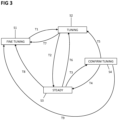
- the input device 10, controlled by the control device 13 together with the memory device 14, may be operated by employing different control states S1, S2, S3, S4, each state being associated with a particular change amount in order to cause an increase or decrease of the currently selected operational parameter 110.
- an adjustment of the operational parameter 110 starts in a fine-tuning state S1, in which a change amount is set to a fine-tuning-state value corresponding for example to a smallest applicable change unit.
- the fine-tuning-state value may for example be set to 1.
- a movement of the input device 10 causes a change of the operational parameter 110 by the fine-tuning-state value, such that each movement step of the input device 10 causes an increase or decrease of the operational parameter 110 by the fine-tuning-state value.
- the operation of the input device 10 may change from the fine-tuning state S1 to a tuning state S2 (transition T1).
- the operation may transition from the fine-tuning state S1 to the tuning state S2, the tuning state S2 being associated with a tuning-state value larger than the fine-tuning-state value.
- the change amount now is set to the tuning-state value, such that a further advancement of the input device 10 causes a faster change of the operational parameter 110.
- the first frequency may for example lie in between 10 Hz and 30 Hz, for example at 15 Hz.
- the first number of movement steps may for example lie in between 15 and 35, for example at 25.
- the tuning-state value may for example be 10.
- the operational parameter 110 in the tuning state is changed by 10, such that the speed of change of the operational parameter 110 is amplified by a factor of 10.
- operation may further transition to a steady state S3 (transition T2) in case a second condition is met.
- a steady state S3 transition T2
- the control may transition from the tuning state S2 to the steady state S3.
- the steady state S3 is associated with a steady-state value, such that in the steady state S3 the change amount is set to the steady-state value associated with the steady state S3.
- the steady-state value may for example be 100.
- each movement step may cause a change of the operational parameter 110 by the change amount (i.e., the fine-tuning-state value in the fine-tuning state S1 or the tuning-state value in the tuning state S2)
- the operational parameter 110 in the steady state S3 is, in one embodiment, adjusted by the steady-state value only after every Nth movement step, wherein N may for example lie between 2 and 10, for example at 5.
- the operational parameter 110 is adjusted by the steady-state value, for example 100.
- the overall range over which the operational parameter 110 may be adjustable may for example be bound by 0 and 1 million. Hence, by actuating the input device 10 the operational parameter 110 may be changed in between 0 and 1 million.
- the overall range herein may be divided into sub-ranges, a first sub-range for example ranging from 0 to 10,000, a second sub-range ranging from 10,000 to 100,000, and a third sub-range ranging from 100,000 to 1 million.
- Each sub-range herein may be associated with its particular set of fine-tuning-state value, tuning-state value and steady-state value, wherein the values may be amplified by an amplification factor of 10 from one sub-range to the other in order to allow for a faster adjustment of the operational parameter 110 over the sub-ranges.
- the fine-tuning-state value may be 1
- the tuning-state value may be 10
- the steady-state value may be 100.
- the fine-tuning-state value may be 10
- the tuning-state value may be 100
- the steady-state value may be 1000.
- the fine-tuning-state value may be 100
- the tuning-state value may be 1000
- the steady-state value may be 10,000.
- the adjustment of the operational parameter 110 first takes place by applying the fine-tuning-state value having the value 1. If a certain number of movement steps, for example 25, has been exceeded and if the speed of movement of the input device 10, as indicated by the frequency of the movement steps, exceeds a predefined first frequency, for example 15 Hz, it is changed to the tuning state S2, and the change amount applied to the operational parameter 110 per movement step is set to the tuning-state value having a value of 10.
- the input device 10 is further advanced by a predefined second number of movement steps, for example 25, and if the frequency of movement steps exceeds a second frequency, for example 15 Hz, it is transitioned to the steady state S3, and the change amount is set to the steady-state value having a value of 100, wherein the steady-state value is applied only at every Nth movement step, for example at every fifth movement step.
- a further boost factor of 10 may be applied, boosting the change amount by the factor of 10 such that a further advancement of the input device 10 beyond the boost value causes in amplified, boosted increase of the operational parameter 110.
- the upper bound of the first sub-range at 10,000 is reached, it is transitioned into the consecutive, second sub-range ranging from 10,000 to 100,000.
- the increase of the operational parameter 110 in one embodiment, is paused for a predefined pause time, for example 500 ms. Hence, the transition from one sub-range to another is cushioned by the pause time.
- the change amount is set to the fine-tuning-state value of the entered sub-range, such that the acceleration of the adjustment of the operational value 110 starts anew at the fine-tuning-state value of the now current sub-range.
- the operation now progresses as in the first sub-range, wherein upon passing a particular boost value associated with the second sub-range, for example 15,000, a boost of the change amount by a boost factor of for example 10 may be applied.
- a boost value associated with the second sub-range for example 15,000
- a boost of the change amount by a boost factor of for example 10 may be applied.
- a pause by a predefined pause time may be applied, and the acceleration starts anew at the fine-tuning-state value associated with the now current, third sub-range.
- An additional boost may be applied after passing a boost value of 150,000.
- operation may transition from the steady state S3 to a confirm-tuning state S4 (transition T3 in Fig. 3 ).
- a confirm-tuning state S4 it may be decided whether to transition to the tuning state S2 (transition T5) or to transition back to the steady state S3 (transition T4), dependent on whether the next movement step takes place within a rather short time duration or exceeds a predefined timeout.
- the steady-state-timeout may for example have a value of 200 ms.
- the tuning-state-timeout may for example have a value of 500 ms.
- the confirm-tuning-timeout may for example have a value of 100 ms.
- any state S2, S3, S4 other than the fine-tuning state S1 if the time duration for a next movement step exceeds a predefined break time, for example 1000 ms, it is directly switched to the fine-tuning state S1 (transitions T7, T8, T9).
- a reversal of the movement direction of the input device 10 causes a transition from the tuning state S2 to the fine-tuning state S1 (transition T7).
- the boost mode may remain activated (such that a boost factor of for example 10 is applied) as long as it is not switched back to the fine-tuning state S1.
- the same concept may be applied in the increase direction (actuation direction D1 of the input device 10 as illustrated in Fig. 2 ) and in the decrease direction (corresponding to the actuation direction D2 of the input device 10).
- the actual, current change amount may be divided by a factor of 10 in order to avoid that the operational parameter 110 is changed abruptly to 0 (in a sequence 2000-1000-0 when in the boost mode), such that below 1000 a change amount divided by a factor of 10 is applied, leading to a sequence 2000-1000-900 and so on.
- a rounding may be applied, such that always only for relevant digits are changed, whereas the others are rounded.
- the frequency of the movement steps is indicative of the movement speed of the input device 10 and may be computed as a running average over a certain number of individual movement steps. Individual frequencies of the individual movement steps herein are computed as the inverse of the time duration of the particular movement step. An average may be taken for example over 20 movement steps.
- one individual frequency below 10 Hz may be disregarded. If the input device 10 is rotatable by discrete steps of 12° such that 30 steps make up on full turn, it can be assumed that a user may have to interrupt a rotational movement roundabout at a half turn due to the user having to return his wrist to continue actuation. This causes a break in the movement, which however is not indicative of a desired break in the actuation. Hence, one delayed movement step in a sequence of movement steps is assumed to be due to a returning movement of a user's wrist and therefore is neglected in the averaging for computing the averaged frequency of the movement steps in the above described scheme of controlling acceleration of an adjustment of the operational value 110.
- the input device is not limited to a rotary knob, but may be implemented by a different device, in particular any device that allows for an endless actuation, such as a touchpad device or the like.
- a scheme as described herein is suitable to adjust an operational parameter in a medical device, wherein all kinds of different operational parameters may be adjusted by actuation of an input device as described herein.
- a scheme as described herein may be applicable to any device that requires an adjustment of an operational parameter over a fairly wide range.
Landscapes
- Engineering & Computer Science (AREA)
- Health & Medical Sciences (AREA)
- Biomedical Technology (AREA)
- Theoretical Computer Science (AREA)
- General Engineering & Computer Science (AREA)
- General Business, Economics & Management (AREA)
- Business, Economics & Management (AREA)
- General Health & Medical Sciences (AREA)
- Public Health (AREA)
- General Physics & Mathematics (AREA)
- Human Computer Interaction (AREA)
- Physics & Mathematics (AREA)
- Epidemiology (AREA)
- Medical Informatics (AREA)
- Primary Health Care (AREA)
- Life Sciences & Earth Sciences (AREA)
- Veterinary Medicine (AREA)
- Hematology (AREA)
- Heart & Thoracic Surgery (AREA)
- Anesthesiology (AREA)
- Vascular Medicine (AREA)
- Animal Behavior & Ethology (AREA)
- Infusion, Injection, And Reservoir Apparatuses (AREA)
Claims (14)
- Verfahren zum Einstellen eines Betriebsparameters in einer medizinischen Vorrichtung (1), umfassend:Betätigen einer Eingabevorrichtung (10) zum Einstellen eines Betriebsparameters (110), der auf einer Anzeigevorrichtung (11) der medizinischen Vorrichtung (1) angezeigt wird, wobei die Eingabevorrichtung (10) in einer Betätigungsrichtung (D1, D2) durch Bewegungsschritte (α) vorschiebbar ist, um den Betriebsparameter (110) um einen mit einem Bewegungsschritt (α) verknüpften Änderungsbetrag zu erhöhen oder zu verringern,Anpassen des Änderungsbetrags von einem Feinabstimmungszustandswert zu einem Abstimmungszustandswert, der größer als der Feinabstimmungszustandswert ist, beim Vorschieben der Eingabevorrichtung (10), falls eine erste Bedingung erfüllt ist,dadurch gekennzeichnet, dass der Betriebsparameter innerhalb eines vordefinierten Gesamtbereichs anpassbar ist, wobei zum Anpassen des Änderungsbetrags in Abhängigkeit von dem Vorschieben der Eingabevorrichtung (10) ein erster Satz von Werten in einem ersten Unterbereich des Gesamtbereichs angewendet wird und ein zweiter Satz von Werten in einem zweiten Unterbereich des Gesamtbereichs angewendet wird.
- Verfahren nach Anspruch 1, dadurch gekennzeichnet, dass zum Prüfen, ob die erste Bedingung erfüllt ist, geprüft wird, ob eine Häufigkeit, mit der Bewegungsschritte (α) auftreten, eine vorgegebene erste Häufigkeit überschreitet und/oder eine Anzahl von Bewegungsschritten (α) eine vorgegebene erste Anzahl überschreitet.
- Verfahren nach Anspruch 1 oder 2, dadurch gekennzeichnet, dass, wenn der Änderungsbetrag auf den Feinabstimmungszustandswert oder den Abstimmungszustandswert eingestellt ist, der Betriebsparameter für jeden Bewegungsschritt (α), um den die Eingabevorrichtung (10) vorgeschoben wird, um den Änderungsbetrag geändert wird.
- Verfahren nach einem der Ansprüche 1 bis 3, gekennzeichnet durch Anpassen des Änderungsbetrags von dem Abstimmzustandswert an einen stationären Wert, der größer als der Abstimmzustandswert ist, falls eine zweite Bedingung erfüllt ist.
- Verfahren nach Anspruch 4, dadurch gekennzeichnet, dass zum Prüfen, ob die zweite Bedingung erfüllt ist, geprüft wird, ob eine Häufigkeit, mit der Bewegungsschritte (α) auftreten, eine vorgegebene zweite Häufigkeit überschreitet und/oder eine Anzahl von Bewegungsschritten (α) eine vorgegebene zweite Anzahl überschreitet.
- Verfahren nach Anspruch 4 oder 5, dadurch gekennzeichnet, dass, wenn der Änderungsbetrag auf den stationären Wert eingestellt ist, der Betriebsparameter bei jedem N-ten Bewegungsschritt (α) beim Vorschieben der Eingabevorrichtung (10) um den Änderungsbetrag geändert wird, wobei N größer als 1 ist.
- Verfahren nach Anspruch 1, dadurch gekennzeichnet, dass der erste Unterbereich durch eine erste Grenze und eine zweite Grenze begrenzt ist und der zweite Unterbereich durch die zweite Grenze und eine dritte Grenze begrenzt ist.
- Verfahren nach Anspruch 7, dadurch gekennzeichnet, dass bei Erreichen der zweiten Grenze beim Vorschieben der Eingabevorrichtung (10) zum Erhöhen oder Verringern des Betriebsparameters (110) die Erhöhung oder Verringerung des Betriebsparameters (110) für eine vorbestimmte Zeitspanne angehalten wird.
- Verfahren nach Anspruch 7 oder 8, dadurch gekennzeichnet, dass bei Erreichen der zweiten Grenze beim Vorschieben der Eingabevorrichtung (10) zum Erhöhen oder Verringern des Betriebsparameters (110) der Änderungsbetrag auf den mit dem Unterbereich verknüpften Feinabstimmungszustandswert eingestellt wird, in den beim Überschreiten der zweiten Grenze eingetreten wird.
- Verfahren nach einem der vorhergehenden Ansprüche, dadurch gekennzeichnet, dass der Änderungsbetrag auf den Feinabstimmungszustandswert zurückgesetzt wird, falls eine Unterbrechungsbedingung erfüllt ist.
- Verfahren nach Anspruch 10, dadurch gekennzeichnet, dass zum Prüfen, ob die Unterbrechungsbedingung erfüllt ist, geprüft wird, ob für eine vorgegebene Unterbrechungszeit kein Bewegungsschritt (α) auftritt.
- Verfahren nach einem der vorhergehenden Ansprüche, dadurch gekennzeichnet, dass eine Frequenz von Bewegungsschritten (α) durch Mittelung von Einzelfrequenzen einzelner Bewegungsschritte (α) berechnet wird, wobei jede Einzelfrequenz als der Kehrwert einer Zeitdauer eines bestimmten einzelnen Bewegungsschritts (α) berechnet wird.
- Verfahren nach Anspruch 12, dadurch gekennzeichnet, dass eine vorgegebene Anzahl von Einzelfrequenzen, die kleiner als eine vorgegebene Frequenzgrenze sind, bei der Berechnung der Häufigkeit von Bewegungsschritten (α) nicht berücksichtigt wird.
- Medizinische Vorrichtung (1), umfassend:eine Anzeigevorrichtung (11),eine Eingabevorrichtung (10), die zum Einstellen eines Betriebsparameters (110) betätigbar ist, der auf der Anzeigevorrichtung (11) der medizinischen Vorrichtung (1) angezeigt wird, wobei die Eingabevorrichtung (10) in einer Betätigungsrichtung (D1, D2) durch Bewegungsschritte (α) vorschiebbar ist, um den Betriebsparameter (110) um einen mit einem Bewegungsschritt (α) verknüpften Änderungsbetrag zu erhöhen oder zu verringern, undeine Steuervorrichtung (13) zur Steuerung des Betriebs der medizinischen Vorrichtung (1),wobei die Steuervorrichtung (13) dazu konfiguriert ist, während des Vorschubs der Eingabevorrichtung (10) den Änderungsbetrag von einem Feinabstimmungszustandswert auf einen Abstimmungszustandswert, der größer als der Feinabstimmungszustandswert ist, anzupassen, falls eine erste Bedingung erfüllt ist,dadurch gekennzeichnet, dass der Betriebsparameter innerhalb eines vordefinierten Gesamtbereichs anpassbar ist, wobei zum Anpassen des Änderungsbetrags in Abhängigkeit von dem Vorschieben der Eingabevorrichtung (10) ein erster Satz von Werten in einem ersten Unterbereich des Gesamtbereichs angewendet wird und ein zweiter Satz von Werten in einem zweiten Unterbereich des Gesamtbereichs angewendet wird.
Applications Claiming Priority (2)
| Application Number | Priority Date | Filing Date | Title |
|---|---|---|---|
| EP19305632 | 2019-05-17 | ||
| PCT/EP2019/085161 WO2020233827A1 (en) | 2019-05-17 | 2019-12-13 | Method for setting an operational parameter in a medical device |
Publications (3)
| Publication Number | Publication Date |
|---|---|
| EP3970160A1 EP3970160A1 (de) | 2022-03-23 |
| EP3970160C0 EP3970160C0 (de) | 2025-05-21 |
| EP3970160B1 true EP3970160B1 (de) | 2025-05-21 |
Family
ID=66685527
Family Applications (1)
| Application Number | Title | Priority Date | Filing Date |
|---|---|---|---|
| EP19817729.7A Active EP3970160B1 (de) | 2019-05-17 | 2019-12-13 | Verfahren zum einstellen eines betriebsparameters in einer medizinischen vorrichtung |
Country Status (5)
| Country | Link |
|---|---|
| US (1) | US12014818B2 (de) |
| EP (1) | EP3970160B1 (de) |
| CN (1) | CN114144838A (de) |
| ES (1) | ES3030735T3 (de) |
| WO (1) | WO2020233827A1 (de) |
Family Cites Families (11)
| Publication number | Priority date | Publication date | Assignee | Title |
|---|---|---|---|---|
| US9201507B2 (en) * | 2005-11-15 | 2015-12-01 | Carefusion 303, Inc. | System and method for rapid input of data |
| US20080184167A1 (en) * | 2007-01-26 | 2008-07-31 | Mapinfo Corporation | Method and apparatus for choosing ranges from a multi-range slider |
| DE102009046645B4 (de) * | 2009-06-05 | 2020-02-13 | Rockwell Automation Technologies, Inc. | Messwert-Visualisierung |
| US8913006B2 (en) * | 2011-02-03 | 2014-12-16 | Olympus Ndt, Inc. | Reciprocal interface panels suitable for multi-purpose actuators |
| CN104508668B (zh) * | 2012-06-03 | 2018-05-22 | 马奎特紧急护理公司 | 呼吸装置和用于与之用户交互的方法 |
| JP6244901B2 (ja) * | 2013-12-27 | 2017-12-13 | カシオ計算機株式会社 | グラフ表示制御装置、電子機器およびプログラム |
| US9984209B2 (en) * | 2015-02-13 | 2018-05-29 | Medtronic, Inc. | Graphical controls for programming medical device operation |
| JP6103487B2 (ja) * | 2015-03-25 | 2017-03-29 | ヤマハ株式会社 | パラメータセットの設定方法および設定装置 |
| AU2015224397A1 (en) * | 2015-09-08 | 2017-03-23 | Canon Kabushiki Kaisha | Methods for adjusting control parameters on an image capture device |
| CN106529141A (zh) * | 2016-10-26 | 2017-03-22 | 天津怡和嘉业医疗科技有限公司 | 一种参数调节方法及其装置 |
| US10352962B2 (en) * | 2016-12-29 | 2019-07-16 | BioMech Sensor LLC | Systems and methods for real-time data quantification, acquisition, analysis and feedback |
-
2019
- 2019-12-13 ES ES19817729T patent/ES3030735T3/es active Active
- 2019-12-13 WO PCT/EP2019/085161 patent/WO2020233827A1/en not_active Ceased
- 2019-12-13 US US17/599,860 patent/US12014818B2/en active Active
- 2019-12-13 EP EP19817729.7A patent/EP3970160B1/de active Active
- 2019-12-13 CN CN201980096475.6A patent/CN114144838A/zh active Pending
Also Published As
| Publication number | Publication date |
|---|---|
| EP3970160C0 (de) | 2025-05-21 |
| EP3970160A1 (de) | 2022-03-23 |
| WO2020233827A1 (en) | 2020-11-26 |
| US20220160963A1 (en) | 2022-05-26 |
| ES3030735T3 (en) | 2025-07-01 |
| US12014818B2 (en) | 2024-06-18 |
| CN114144838A (zh) | 2022-03-04 |
Similar Documents
| Publication | Publication Date | Title |
|---|---|---|
| US6394771B2 (en) | System and method for increased flow uniformity | |
| US5366346A (en) | Electronically controlled intravenous fluid infusion device | |
| JP3589300B2 (ja) | 注入ポンプによる注入制御方法 | |
| EP2736551B1 (de) | System für den nachweis von okklusionen | |
| CA1257673A (en) | Medical infusion controller and user interface | |
| JP5049260B2 (ja) | 有効送出割合の決定方法及び装置又は蠕動ポンプの速度調節方法及び装置 | |
| US5389071A (en) | Infusion method having a plurality of delivery patterns | |
| JPH10502431A (ja) | 流れの均一性を増すシステム | |
| WO2014143599A1 (en) | Gradual transition between basal rates in an ambulatory drug delivery device | |
| EP3970160B1 (de) | Verfahren zum einstellen eines betriebsparameters in einer medizinischen vorrichtung | |
| HK40071822A (en) | Method for setting an operational parameter in a medical device | |
| HK40071822B (en) | Method for setting an operational parameter in a medical device | |
| JPH0474027B2 (de) | ||
| JP7797788B2 (ja) | 流体流量制御装置及び体外循環装置 | |
| JP2001041164A (ja) | 輸液用ポンプの流量制御装置 | |
| JPH0264273A (ja) | 偏心カム式プランジャーポンプの制御方法及び偏心カム式プランジャーポンプを用いる送液装置 | |
| NZ620431B2 (en) | Infusion pump with independently controllable valves for optional gravity infusion and low power operation |
Legal Events
| Date | Code | Title | Description |
|---|---|---|---|
| STAA | Information on the status of an ep patent application or granted ep patent |
Free format text: STATUS: UNKNOWN |
|
| STAA | Information on the status of an ep patent application or granted ep patent |
Free format text: STATUS: THE INTERNATIONAL PUBLICATION HAS BEEN MADE |
|
| PUAI | Public reference made under article 153(3) epc to a published international application that has entered the european phase |
Free format text: ORIGINAL CODE: 0009012 |
|
| STAA | Information on the status of an ep patent application or granted ep patent |
Free format text: STATUS: REQUEST FOR EXAMINATION WAS MADE |
|
| 17P | Request for examination filed |
Effective date: 20211008 |
|
| AK | Designated contracting states |
Kind code of ref document: A1 Designated state(s): AL AT BE BG CH CY CZ DE DK EE ES FI FR GB GR HR HU IE IS IT LI LT LU LV MC MK MT NL NO PL PT RO RS SE SI SK SM TR |
|
| DAV | Request for validation of the european patent (deleted) | ||
| DAX | Request for extension of the european patent (deleted) | ||
| REG | Reference to a national code |
Ref country code: HK Ref legal event code: DE Ref document number: 40071822 Country of ref document: HK |
|
| GRAP | Despatch of communication of intention to grant a patent |
Free format text: ORIGINAL CODE: EPIDOSNIGR1 |
|
| STAA | Information on the status of an ep patent application or granted ep patent |
Free format text: STATUS: GRANT OF PATENT IS INTENDED |
|
| INTG | Intention to grant announced |
Effective date: 20250225 |
|
| GRAS | Grant fee paid |
Free format text: ORIGINAL CODE: EPIDOSNIGR3 |
|
| GRAA | (expected) grant |
Free format text: ORIGINAL CODE: 0009210 |
|
| STAA | Information on the status of an ep patent application or granted ep patent |
Free format text: STATUS: THE PATENT HAS BEEN GRANTED |
|
| AK | Designated contracting states |
Kind code of ref document: B1 Designated state(s): AL AT BE BG CH CY CZ DE DK EE ES FI FR GB GR HR HU IE IS IT LI LT LU LV MC MK MT NL NO PL PT RO RS SE SI SK SM TR |
|
| REG | Reference to a national code |
Ref country code: GB Ref legal event code: FG4D |
|
| REG | Reference to a national code |
Ref country code: CH Ref legal event code: EP |
|
| REG | Reference to a national code |
Ref country code: DE Ref legal event code: R096 Ref document number: 602019070302 Country of ref document: DE |
|
| REG | Reference to a national code |
Ref country code: IE Ref legal event code: FG4D |
|
| U01 | Request for unitary effect filed |
Effective date: 20250522 |
|
| REG | Reference to a national code |
Ref country code: ES Ref legal event code: FG2A Ref document number: 3030735 Country of ref document: ES Kind code of ref document: T3 Effective date: 20250701 |
|
| U07 | Unitary effect registered |
Designated state(s): AT BE BG DE DK EE FI FR IT LT LU LV MT NL PT RO SE SI Effective date: 20250602 |
|
| PG25 | Lapsed in a contracting state [announced via postgrant information from national office to epo] |
Ref country code: GR Free format text: LAPSE BECAUSE OF FAILURE TO SUBMIT A TRANSLATION OF THE DESCRIPTION OR TO PAY THE FEE WITHIN THE PRESCRIBED TIME-LIMIT Effective date: 20250822 Ref country code: NO Free format text: LAPSE BECAUSE OF FAILURE TO SUBMIT A TRANSLATION OF THE DESCRIPTION OR TO PAY THE FEE WITHIN THE PRESCRIBED TIME-LIMIT Effective date: 20250821 |
|
| PG25 | Lapsed in a contracting state [announced via postgrant information from national office to epo] |
Ref country code: PL Free format text: LAPSE BECAUSE OF FAILURE TO SUBMIT A TRANSLATION OF THE DESCRIPTION OR TO PAY THE FEE WITHIN THE PRESCRIBED TIME-LIMIT Effective date: 20250521 |
|
| PG25 | Lapsed in a contracting state [announced via postgrant information from national office to epo] |
Ref country code: HR Free format text: LAPSE BECAUSE OF FAILURE TO SUBMIT A TRANSLATION OF THE DESCRIPTION OR TO PAY THE FEE WITHIN THE PRESCRIBED TIME-LIMIT Effective date: 20250521 |
|
| PG25 | Lapsed in a contracting state [announced via postgrant information from national office to epo] |
Ref country code: RS Free format text: LAPSE BECAUSE OF FAILURE TO SUBMIT A TRANSLATION OF THE DESCRIPTION OR TO PAY THE FEE WITHIN THE PRESCRIBED TIME-LIMIT Effective date: 20250821 |
|
| PG25 | Lapsed in a contracting state [announced via postgrant information from national office to epo] |
Ref country code: IS Free format text: LAPSE BECAUSE OF FAILURE TO SUBMIT A TRANSLATION OF THE DESCRIPTION OR TO PAY THE FEE WITHIN THE PRESCRIBED TIME-LIMIT Effective date: 20250921 |
|
| REG | Reference to a national code |
Ref country code: CH Ref legal event code: U11 Free format text: ST27 STATUS EVENT CODE: U-0-0-U10-U11 (AS PROVIDED BY THE NATIONAL OFFICE) Effective date: 20260101 |
|
| PGFP | Annual fee paid to national office [announced via postgrant information from national office to epo] |
Ref country code: GB Payment date: 20251229 Year of fee payment: 7 |
|
| PG25 | Lapsed in a contracting state [announced via postgrant information from national office to epo] |
Ref country code: SM Free format text: LAPSE BECAUSE OF FAILURE TO SUBMIT A TRANSLATION OF THE DESCRIPTION OR TO PAY THE FEE WITHIN THE PRESCRIBED TIME-LIMIT Effective date: 20250521 |
|
| PG25 | Lapsed in a contracting state [announced via postgrant information from national office to epo] |
Ref country code: CZ Free format text: LAPSE BECAUSE OF FAILURE TO SUBMIT A TRANSLATION OF THE DESCRIPTION OR TO PAY THE FEE WITHIN THE PRESCRIBED TIME-LIMIT Effective date: 20250521 |
|
| PG25 | Lapsed in a contracting state [announced via postgrant information from national office to epo] |
Ref country code: SK Free format text: LAPSE BECAUSE OF FAILURE TO SUBMIT A TRANSLATION OF THE DESCRIPTION OR TO PAY THE FEE WITHIN THE PRESCRIBED TIME-LIMIT Effective date: 20250521 |
|
| U20 | Renewal fee for the european patent with unitary effect paid |
Year of fee payment: 7 Effective date: 20260102 |
|
| PLBE | No opposition filed within time limit |
Free format text: ORIGINAL CODE: 0009261 |
|
| STAA | Information on the status of an ep patent application or granted ep patent |
Free format text: STATUS: NO OPPOSITION FILED WITHIN TIME LIMIT |
|
| REG | Reference to a national code |
Ref country code: CH Ref legal event code: L10 Free format text: ST27 STATUS EVENT CODE: U-0-0-L10-L00 (AS PROVIDED BY THE NATIONAL OFFICE) Effective date: 20260402 |
|
| PGFP | Annual fee paid to national office [announced via postgrant information from national office to epo] |
Ref country code: ES Payment date: 20260102 Year of fee payment: 7 |