EP3971146A1 - Glaselement umfassend emaillebeschichtung und dessen verwendung, beschichtungsmittel zu dessen herstellung und verfahren zur herstellung des beschichtungsmittels - Google Patents
Glaselement umfassend emaillebeschichtung und dessen verwendung, beschichtungsmittel zu dessen herstellung und verfahren zur herstellung des beschichtungsmittels Download PDFInfo
- Publication number
- EP3971146A1 EP3971146A1 EP21194970.6A EP21194970A EP3971146A1 EP 3971146 A1 EP3971146 A1 EP 3971146A1 EP 21194970 A EP21194970 A EP 21194970A EP 3971146 A1 EP3971146 A1 EP 3971146A1
- Authority
- EP
- European Patent Office
- Prior art keywords
- coating
- glass
- filler
- glass element
- component
- Prior art date
- Legal status (The legal status is an assumption and is not a legal conclusion. Google has not performed a legal analysis and makes no representation as to the accuracy of the status listed.)
- Pending
Links
- 239000011521 glass Substances 0.000 title claims abstract description 300
- 239000011248 coating agent Substances 0.000 title claims abstract description 267
- 238000004519 manufacturing process Methods 0.000 title claims abstract description 6
- 239000002320 enamel (paints) Substances 0.000 title claims description 16
- 238000002360 preparation method Methods 0.000 title 1
- 238000000576 coating method Methods 0.000 claims abstract description 236
- 239000000945 filler Substances 0.000 claims description 145
- 239000000758 substrate Substances 0.000 claims description 110
- 239000000049 pigment Substances 0.000 claims description 72
- 239000002245 particle Substances 0.000 claims description 69
- 239000000203 mixture Substances 0.000 claims description 39
- 239000007787 solid Substances 0.000 claims description 26
- 239000008199 coating composition Substances 0.000 claims description 25
- 229910004298 SiO 2 Inorganic materials 0.000 claims description 16
- WMWLMWRWZQELOS-UHFFFAOYSA-N bismuth(iii) oxide Chemical compound O=[Bi]O[Bi]=O WMWLMWRWZQELOS-UHFFFAOYSA-N 0.000 claims description 14
- 239000005361 soda-lime glass Substances 0.000 claims description 13
- 239000011159 matrix material Substances 0.000 claims description 12
- 238000010304 firing Methods 0.000 claims description 11
- PNEYBMLMFCGWSK-UHFFFAOYSA-N aluminium oxide Inorganic materials [O-2].[O-2].[O-2].[Al+3].[Al+3] PNEYBMLMFCGWSK-UHFFFAOYSA-N 0.000 claims description 10
- 238000012360 testing method Methods 0.000 claims description 10
- 229910052593 corundum Inorganic materials 0.000 claims description 9
- 229910001845 yogo sapphire Inorganic materials 0.000 claims description 9
- 229910018072 Al 2 O 3 Inorganic materials 0.000 claims description 7
- FUJCRWPEOMXPAD-UHFFFAOYSA-N Li2O Inorganic materials [Li+].[Li+].[O-2] FUJCRWPEOMXPAD-UHFFFAOYSA-N 0.000 claims description 7
- 229910010413 TiO 2 Inorganic materials 0.000 claims description 7
- XUCJHNOBJLKZNU-UHFFFAOYSA-M dilithium;hydroxide Chemical compound [Li+].[Li+].[OH-] XUCJHNOBJLKZNU-UHFFFAOYSA-M 0.000 claims description 7
- 230000003287 optical effect Effects 0.000 claims description 7
- 239000007788 liquid Substances 0.000 claims description 6
- 229910052700 potassium Inorganic materials 0.000 claims description 4
- 238000005406 washing Methods 0.000 claims description 4
- 238000010411 cooking Methods 0.000 claims description 3
- 238000010998 test method Methods 0.000 claims description 3
- ADCOVFLJGNWWNZ-UHFFFAOYSA-N antimony trioxide Inorganic materials O=[Sb]O[Sb]=O ADCOVFLJGNWWNZ-UHFFFAOYSA-N 0.000 claims description 2
- JEIPFZHSYJVQDO-UHFFFAOYSA-N iron(III) oxide Inorganic materials O=[Fe]O[Fe]=O JEIPFZHSYJVQDO-UHFFFAOYSA-N 0.000 claims description 2
- 239000002904 solvent Substances 0.000 claims description 2
- YEAUATLBSVJFOY-UHFFFAOYSA-N tetraantimony hexaoxide Chemical compound O1[Sb](O2)O[Sb]3O[Sb]1O[Sb]2O3 YEAUATLBSVJFOY-UHFFFAOYSA-N 0.000 claims description 2
- 238000000034 method Methods 0.000 abstract description 16
- 239000000463 material Substances 0.000 description 28
- 239000000843 powder Substances 0.000 description 18
- XLOMVQKBTHCTTD-UHFFFAOYSA-N Zinc monoxide Chemical compound [Zn]=O XLOMVQKBTHCTTD-UHFFFAOYSA-N 0.000 description 16
- 230000008569 process Effects 0.000 description 11
- 210000003298 dental enamel Anatomy 0.000 description 10
- 230000004907 flux Effects 0.000 description 9
- 238000007650 screen-printing Methods 0.000 description 9
- VYPSYNLAJGMNEJ-UHFFFAOYSA-N Silicium dioxide Chemical compound O=[Si]=O VYPSYNLAJGMNEJ-UHFFFAOYSA-N 0.000 description 8
- 239000011787 zinc oxide Substances 0.000 description 8
- 239000011230 binding agent Substances 0.000 description 6
- 239000005388 borosilicate glass Substances 0.000 description 6
- 239000000919 ceramic Substances 0.000 description 6
- 230000000694 effects Effects 0.000 description 6
- 238000002844 melting Methods 0.000 description 6
- 230000008018 melting Effects 0.000 description 6
- 239000003973 paint Substances 0.000 description 6
- 239000000654 additive Substances 0.000 description 5
- 230000008859 change Effects 0.000 description 5
- 238000011161 development Methods 0.000 description 5
- 230000018109 developmental process Effects 0.000 description 5
- 239000000155 melt Substances 0.000 description 5
- 229910052751 metal Inorganic materials 0.000 description 5
- 239000002184 metal Substances 0.000 description 5
- 230000035882 stress Effects 0.000 description 5
- MZZSDCJQCLYLLL-UHFFFAOYSA-N Secalonsaeure A Natural products COC(=O)C12OC3C(CC1=C(O)CC(C)C2O)C(=CC=C3c4ccc(O)c5C(=O)C6=C(O)CC(C)C(O)C6(Oc45)C(=O)OC)O MZZSDCJQCLYLLL-UHFFFAOYSA-N 0.000 description 4
- 229910000272 alkali metal oxide Inorganic materials 0.000 description 4
- 229910052797 bismuth Inorganic materials 0.000 description 4
- JCXGWMGPZLAOME-UHFFFAOYSA-N bismuth atom Chemical compound [Bi] JCXGWMGPZLAOME-UHFFFAOYSA-N 0.000 description 4
- 229910000416 bismuth oxide Inorganic materials 0.000 description 4
- 230000000052 comparative effect Effects 0.000 description 4
- TYIXMATWDRGMPF-UHFFFAOYSA-N dibismuth;oxygen(2-) Chemical compound [O-2].[O-2].[O-2].[Bi+3].[Bi+3] TYIXMATWDRGMPF-UHFFFAOYSA-N 0.000 description 4
- 238000002042 time-of-flight secondary ion mass spectrometry Methods 0.000 description 4
- 229910018068 Li 2 O Inorganic materials 0.000 description 3
- 238000005299 abrasion Methods 0.000 description 3
- 230000000996 additive effect Effects 0.000 description 3
- 230000015572 biosynthetic process Effects 0.000 description 3
- 229910021485 fumed silica Inorganic materials 0.000 description 3
- 230000006872 improvement Effects 0.000 description 3
- 229910052760 oxygen Inorganic materials 0.000 description 3
- 239000000523 sample Substances 0.000 description 3
- 239000000377 silicon dioxide Substances 0.000 description 3
- 239000000126 substance Substances 0.000 description 3
- 238000005011 time of flight secondary ion mass spectroscopy Methods 0.000 description 3
- 239000005341 toughened glass Substances 0.000 description 3
- 239000000853 adhesive Substances 0.000 description 2
- 230000001070 adhesive effect Effects 0.000 description 2
- 239000002585 base Substances 0.000 description 2
- 239000005385 borate glass Substances 0.000 description 2
- 238000006243 chemical reaction Methods 0.000 description 2
- 150000001875 compounds Chemical class 0.000 description 2
- 238000013461 design Methods 0.000 description 2
- 238000009826 distribution Methods 0.000 description 2
- 239000002241 glass-ceramic Substances 0.000 description 2
- 239000012535 impurity Substances 0.000 description 2
- 229910052500 inorganic mineral Inorganic materials 0.000 description 2
- 238000005259 measurement Methods 0.000 description 2
- 238000010309 melting process Methods 0.000 description 2
- 239000011707 mineral Substances 0.000 description 2
- 239000005365 phosphate glass Substances 0.000 description 2
- 238000007639 printing Methods 0.000 description 2
- 238000007493 shaping process Methods 0.000 description 2
- 239000005368 silicate glass Substances 0.000 description 2
- 235000012239 silicon dioxide Nutrition 0.000 description 2
- 229910052708 sodium Inorganic materials 0.000 description 2
- 125000006850 spacer group Chemical group 0.000 description 2
- 229910052596 spinel Inorganic materials 0.000 description 2
- 239000011029 spinel Substances 0.000 description 2
- 230000008646 thermal stress Effects 0.000 description 2
- DEXFNLNNUZKHNO-UHFFFAOYSA-N 6-[3-[4-[2-(2,3-dihydro-1H-inden-2-ylamino)pyrimidin-5-yl]piperidin-1-yl]-3-oxopropyl]-3H-1,3-benzoxazol-2-one Chemical compound C1C(CC2=CC=CC=C12)NC1=NC=C(C=N1)C1CCN(CC1)C(CCC1=CC2=C(NC(O2)=O)C=C1)=O DEXFNLNNUZKHNO-UHFFFAOYSA-N 0.000 description 1
- 229910015902 Bi 2 O 3 Inorganic materials 0.000 description 1
- 239000006018 Li-aluminosilicate Substances 0.000 description 1
- MKYBYDHXWVHEJW-UHFFFAOYSA-N N-[1-oxo-1-(2,4,6,7-tetrahydrotriazolo[4,5-c]pyridin-5-yl)propan-2-yl]-2-[[3-(trifluoromethoxy)phenyl]methylamino]pyrimidine-5-carboxamide Chemical compound O=C(C(C)NC(=O)C=1C=NC(=NC=1)NCC1=CC(=CC=C1)OC(F)(F)F)N1CC2=C(CC1)NN=N2 MKYBYDHXWVHEJW-UHFFFAOYSA-N 0.000 description 1
- AFCARXCZXQIEQB-UHFFFAOYSA-N N-[3-oxo-3-(2,4,6,7-tetrahydrotriazolo[4,5-c]pyridin-5-yl)propyl]-2-[[3-(trifluoromethoxy)phenyl]methylamino]pyrimidine-5-carboxamide Chemical compound O=C(CCNC(=O)C=1C=NC(=NC=1)NCC1=CC(=CC=C1)OC(F)(F)F)N1CC2=C(CC1)NN=N2 AFCARXCZXQIEQB-UHFFFAOYSA-N 0.000 description 1
- KKCBUQHMOMHUOY-UHFFFAOYSA-N Na2O Inorganic materials [O-2].[Na+].[Na+] KKCBUQHMOMHUOY-UHFFFAOYSA-N 0.000 description 1
- 239000004110 Zinc silicate Substances 0.000 description 1
- QCWXUUIWCKQGHC-UHFFFAOYSA-N Zirconium Chemical compound [Zr] QCWXUUIWCKQGHC-UHFFFAOYSA-N 0.000 description 1
- GXDVEXJTVGRLNW-UHFFFAOYSA-N [Cr].[Cu] Chemical compound [Cr].[Cu] GXDVEXJTVGRLNW-UHFFFAOYSA-N 0.000 description 1
- 230000032900 absorption of visible light Effects 0.000 description 1
- 238000010521 absorption reaction Methods 0.000 description 1
- 239000003513 alkali Substances 0.000 description 1
- 239000005354 aluminosilicate glass Substances 0.000 description 1
- -1 amorphous SiO 2 Chemical compound 0.000 description 1
- 229910021486 amorphous silicon dioxide Inorganic materials 0.000 description 1
- 238000000149 argon plasma sintering Methods 0.000 description 1
- 239000011324 bead Substances 0.000 description 1
- 230000008901 benefit Effects 0.000 description 1
- YISOXLVRWFDIKD-UHFFFAOYSA-N bismuth;borate Chemical compound [Bi+3].[O-]B([O-])[O-] YISOXLVRWFDIKD-UHFFFAOYSA-N 0.000 description 1
- 229910052793 cadmium Inorganic materials 0.000 description 1
- BDOSMKKIYDKNTQ-UHFFFAOYSA-N cadmium atom Chemical compound [Cd] BDOSMKKIYDKNTQ-UHFFFAOYSA-N 0.000 description 1
- 150000001844 chromium Chemical class 0.000 description 1
- 238000004040 coloring Methods 0.000 description 1
- 239000006103 coloring component Substances 0.000 description 1
- 239000000470 constituent Substances 0.000 description 1
- 238000007796 conventional method Methods 0.000 description 1
- 238000000354 decomposition reaction Methods 0.000 description 1
- 238000005034 decoration Methods 0.000 description 1
- 230000007423 decrease Effects 0.000 description 1
- 230000006735 deficit Effects 0.000 description 1
- 230000001419 dependent effect Effects 0.000 description 1
- DQUIAMCJEJUUJC-UHFFFAOYSA-N dibismuth;dioxido(oxo)silane Chemical compound [Bi+3].[Bi+3].[O-][Si]([O-])=O.[O-][Si]([O-])=O.[O-][Si]([O-])=O DQUIAMCJEJUUJC-UHFFFAOYSA-N 0.000 description 1
- KZHJGOXRZJKJNY-UHFFFAOYSA-N dioxosilane;oxo(oxoalumanyloxy)alumane Chemical compound O=[Si]=O.O=[Si]=O.O=[Al]O[Al]=O.O=[Al]O[Al]=O.O=[Al]O[Al]=O KZHJGOXRZJKJNY-UHFFFAOYSA-N 0.000 description 1
- 238000001035 drying Methods 0.000 description 1
- 230000003670 easy-to-clean Effects 0.000 description 1
- 238000005538 encapsulation Methods 0.000 description 1
- 238000011156 evaluation Methods 0.000 description 1
- 230000002349 favourable effect Effects 0.000 description 1
- 239000010419 fine particle Substances 0.000 description 1
- 238000007667 floating Methods 0.000 description 1
- 230000036541 health Effects 0.000 description 1
- 239000011256 inorganic filler Substances 0.000 description 1
- 229910003475 inorganic filler Inorganic materials 0.000 description 1
- 229910010272 inorganic material Inorganic materials 0.000 description 1
- 239000011147 inorganic material Substances 0.000 description 1
- 239000001023 inorganic pigment Substances 0.000 description 1
- 229910000464 lead oxide Inorganic materials 0.000 description 1
- HTUMBQDCCIXGCV-UHFFFAOYSA-N lead oxide Chemical compound [O-2].[Pb+2] HTUMBQDCCIXGCV-UHFFFAOYSA-N 0.000 description 1
- QSHDDOUJBYECFT-UHFFFAOYSA-N mercury Chemical compound [Hg] QSHDDOUJBYECFT-UHFFFAOYSA-N 0.000 description 1
- 229910052753 mercury Inorganic materials 0.000 description 1
- 238000012986 modification Methods 0.000 description 1
- 230000004048 modification Effects 0.000 description 1
- 229910052863 mullite Inorganic materials 0.000 description 1
- TWNQGVIAIRXVLR-UHFFFAOYSA-N oxo(oxoalumanyloxy)alumane Chemical compound O=[Al]O[Al]=O TWNQGVIAIRXVLR-UHFFFAOYSA-N 0.000 description 1
- YEXPOXQUZXUXJW-UHFFFAOYSA-N oxolead Chemical compound [Pb]=O YEXPOXQUZXUXJW-UHFFFAOYSA-N 0.000 description 1
- RVTZCBVAJQQJTK-UHFFFAOYSA-N oxygen(2-);zirconium(4+) Chemical compound [O-2].[O-2].[Zr+4] RVTZCBVAJQQJTK-UHFFFAOYSA-N 0.000 description 1
- 238000012856 packing Methods 0.000 description 1
- 235000011837 pasties Nutrition 0.000 description 1
- 229920003217 poly(methylsilsesquioxane) Polymers 0.000 description 1
- 239000010453 quartz Substances 0.000 description 1
- 230000009467 reduction Effects 0.000 description 1
- 238000005096 rolling process Methods 0.000 description 1
- 239000006120 scratch resistant coating Substances 0.000 description 1
- 230000035939 shock Effects 0.000 description 1
- RMAQACBXLXPBSY-UHFFFAOYSA-N silicic acid Chemical compound O[Si](O)(O)O RMAQACBXLXPBSY-UHFFFAOYSA-N 0.000 description 1
- 239000008247 solid mixture Substances 0.000 description 1
- 238000004901 spalling Methods 0.000 description 1
- 230000003068 static effect Effects 0.000 description 1
- 238000005496 tempering Methods 0.000 description 1
- BIKXLKXABVUSMH-UHFFFAOYSA-N trizinc;diborate Chemical compound [Zn+2].[Zn+2].[Zn+2].[O-]B([O-])[O-].[O-]B([O-])[O-] BIKXLKXABVUSMH-UHFFFAOYSA-N 0.000 description 1
- 238000005303 weighing Methods 0.000 description 1
- 238000009736 wetting Methods 0.000 description 1
- LRXTYHSAJDENHV-UHFFFAOYSA-H zinc phosphate Chemical compound [Zn+2].[Zn+2].[Zn+2].[O-]P([O-])([O-])=O.[O-]P([O-])([O-])=O LRXTYHSAJDENHV-UHFFFAOYSA-H 0.000 description 1
- 229910000165 zinc phosphate Inorganic materials 0.000 description 1
- XSMMCTCMFDWXIX-UHFFFAOYSA-N zinc silicate Chemical compound [Zn+2].[O-][Si]([O-])=O XSMMCTCMFDWXIX-UHFFFAOYSA-N 0.000 description 1
- 235000019352 zinc silicate Nutrition 0.000 description 1
- ZFZQOKHLXAVJIF-UHFFFAOYSA-N zinc;boric acid;dihydroxy(dioxido)silane Chemical compound [Zn+2].OB(O)O.O[Si](O)([O-])[O-] ZFZQOKHLXAVJIF-UHFFFAOYSA-N 0.000 description 1
- 229910052726 zirconium Inorganic materials 0.000 description 1
- 229910001928 zirconium oxide Inorganic materials 0.000 description 1
Images


Classifications
-
- C—CHEMISTRY; METALLURGY
- C03—GLASS; MINERAL OR SLAG WOOL
- C03C—CHEMICAL COMPOSITION OF GLASSES, GLAZES OR VITREOUS ENAMELS; SURFACE TREATMENT OF GLASS; SURFACE TREATMENT OF FIBRES OR FILAMENTS MADE FROM GLASS, MINERALS OR SLAGS; JOINING GLASS TO GLASS OR OTHER MATERIALS
- C03C10/00—Devitrified glass ceramics, i.e. glass ceramics having a crystalline phase dispersed in a glassy phase and constituting at least 50% by weight of the total composition
- C03C10/0009—Devitrified glass ceramics, i.e. glass ceramics having a crystalline phase dispersed in a glassy phase and constituting at least 50% by weight of the total composition containing silica as main constituent
-
- C—CHEMISTRY; METALLURGY
- C03—GLASS; MINERAL OR SLAG WOOL
- C03C—CHEMICAL COMPOSITION OF GLASSES, GLAZES OR VITREOUS ENAMELS; SURFACE TREATMENT OF GLASS; SURFACE TREATMENT OF FIBRES OR FILAMENTS MADE FROM GLASS, MINERALS OR SLAGS; JOINING GLASS TO GLASS OR OTHER MATERIALS
- C03C17/00—Surface treatment of glass, not in the form of fibres or filaments, by coating
- C03C17/02—Surface treatment of glass, not in the form of fibres or filaments, by coating with glass
-
- C—CHEMISTRY; METALLURGY
- C03—GLASS; MINERAL OR SLAG WOOL
- C03C—CHEMICAL COMPOSITION OF GLASSES, GLAZES OR VITREOUS ENAMELS; SURFACE TREATMENT OF GLASS; SURFACE TREATMENT OF FIBRES OR FILAMENTS MADE FROM GLASS, MINERALS OR SLAGS; JOINING GLASS TO GLASS OR OTHER MATERIALS
- C03C1/00—Ingredients generally applicable to manufacture of glasses, glazes, or vitreous enamels
- C03C1/04—Opacifiers, e.g. fluorides or phosphates; Pigments
-
- C—CHEMISTRY; METALLURGY
- C03—GLASS; MINERAL OR SLAG WOOL
- C03C—CHEMICAL COMPOSITION OF GLASSES, GLAZES OR VITREOUS ENAMELS; SURFACE TREATMENT OF GLASS; SURFACE TREATMENT OF FIBRES OR FILAMENTS MADE FROM GLASS, MINERALS OR SLAGS; JOINING GLASS TO GLASS OR OTHER MATERIALS
- C03C10/00—Devitrified glass ceramics, i.e. glass ceramics having a crystalline phase dispersed in a glassy phase and constituting at least 50% by weight of the total composition
- C03C10/0054—Devitrified glass ceramics, i.e. glass ceramics having a crystalline phase dispersed in a glassy phase and constituting at least 50% by weight of the total composition containing PbO, SnO2, B2O3
-
- C—CHEMISTRY; METALLURGY
- C03—GLASS; MINERAL OR SLAG WOOL
- C03C—CHEMICAL COMPOSITION OF GLASSES, GLAZES OR VITREOUS ENAMELS; SURFACE TREATMENT OF GLASS; SURFACE TREATMENT OF FIBRES OR FILAMENTS MADE FROM GLASS, MINERALS OR SLAGS; JOINING GLASS TO GLASS OR OTHER MATERIALS
- C03C17/00—Surface treatment of glass, not in the form of fibres or filaments, by coating
- C03C17/006—Surface treatment of glass, not in the form of fibres or filaments, by coating with materials of composite character
- C03C17/007—Surface treatment of glass, not in the form of fibres or filaments, by coating with materials of composite character containing a dispersed phase, e.g. particles, fibres or flakes, in a continuous phase
-
- C—CHEMISTRY; METALLURGY
- C03—GLASS; MINERAL OR SLAG WOOL
- C03C—CHEMICAL COMPOSITION OF GLASSES, GLAZES OR VITREOUS ENAMELS; SURFACE TREATMENT OF GLASS; SURFACE TREATMENT OF FIBRES OR FILAMENTS MADE FROM GLASS, MINERALS OR SLAGS; JOINING GLASS TO GLASS OR OTHER MATERIALS
- C03C17/00—Surface treatment of glass, not in the form of fibres or filaments, by coating
- C03C17/006—Surface treatment of glass, not in the form of fibres or filaments, by coating with materials of composite character
- C03C17/008—Surface treatment of glass, not in the form of fibres or filaments, by coating with materials of composite character comprising a mixture of materials covered by two or more of the groups C03C17/02, C03C17/06, C03C17/22 and C03C17/28
-
- C—CHEMISTRY; METALLURGY
- C03—GLASS; MINERAL OR SLAG WOOL
- C03C—CHEMICAL COMPOSITION OF GLASSES, GLAZES OR VITREOUS ENAMELS; SURFACE TREATMENT OF GLASS; SURFACE TREATMENT OF FIBRES OR FILAMENTS MADE FROM GLASS, MINERALS OR SLAGS; JOINING GLASS TO GLASS OR OTHER MATERIALS
- C03C17/00—Surface treatment of glass, not in the form of fibres or filaments, by coating
- C03C17/02—Surface treatment of glass, not in the form of fibres or filaments, by coating with glass
- C03C17/04—Surface treatment of glass, not in the form of fibres or filaments, by coating with glass by fritting glass powder
-
- C—CHEMISTRY; METALLURGY
- C03—GLASS; MINERAL OR SLAG WOOL
- C03C—CHEMICAL COMPOSITION OF GLASSES, GLAZES OR VITREOUS ENAMELS; SURFACE TREATMENT OF GLASS; SURFACE TREATMENT OF FIBRES OR FILAMENTS MADE FROM GLASS, MINERALS OR SLAGS; JOINING GLASS TO GLASS OR OTHER MATERIALS
- C03C3/00—Glass compositions
- C03C3/04—Glass compositions containing silica
- C03C3/076—Glass compositions containing silica with 40% to 90% silica, by weight
-
- C—CHEMISTRY; METALLURGY
- C03—GLASS; MINERAL OR SLAG WOOL
- C03C—CHEMICAL COMPOSITION OF GLASSES, GLAZES OR VITREOUS ENAMELS; SURFACE TREATMENT OF GLASS; SURFACE TREATMENT OF FIBRES OR FILAMENTS MADE FROM GLASS, MINERALS OR SLAGS; JOINING GLASS TO GLASS OR OTHER MATERIALS
- C03C3/00—Glass compositions
- C03C3/04—Glass compositions containing silica
- C03C3/076—Glass compositions containing silica with 40% to 90% silica, by weight
- C03C3/078—Glass compositions containing silica with 40% to 90% silica, by weight containing an oxide of a divalent metal, e.g. an oxide of zinc
-
- C—CHEMISTRY; METALLURGY
- C03—GLASS; MINERAL OR SLAG WOOL
- C03C—CHEMICAL COMPOSITION OF GLASSES, GLAZES OR VITREOUS ENAMELS; SURFACE TREATMENT OF GLASS; SURFACE TREATMENT OF FIBRES OR FILAMENTS MADE FROM GLASS, MINERALS OR SLAGS; JOINING GLASS TO GLASS OR OTHER MATERIALS
- C03C3/00—Glass compositions
- C03C3/04—Glass compositions containing silica
- C03C3/076—Glass compositions containing silica with 40% to 90% silica, by weight
- C03C3/089—Glass compositions containing silica with 40% to 90% silica, by weight containing boron
- C03C3/091—Glass compositions containing silica with 40% to 90% silica, by weight containing boron containing aluminium
-
- C—CHEMISTRY; METALLURGY
- C03—GLASS; MINERAL OR SLAG WOOL
- C03C—CHEMICAL COMPOSITION OF GLASSES, GLAZES OR VITREOUS ENAMELS; SURFACE TREATMENT OF GLASS; SURFACE TREATMENT OF FIBRES OR FILAMENTS MADE FROM GLASS, MINERALS OR SLAGS; JOINING GLASS TO GLASS OR OTHER MATERIALS
- C03C3/00—Glass compositions
- C03C3/04—Glass compositions containing silica
- C03C3/076—Glass compositions containing silica with 40% to 90% silica, by weight
- C03C3/097—Glass compositions containing silica with 40% to 90% silica, by weight containing phosphorus, niobium or tantalum
-
- C—CHEMISTRY; METALLURGY
- C03—GLASS; MINERAL OR SLAG WOOL
- C03C—CHEMICAL COMPOSITION OF GLASSES, GLAZES OR VITREOUS ENAMELS; SURFACE TREATMENT OF GLASS; SURFACE TREATMENT OF FIBRES OR FILAMENTS MADE FROM GLASS, MINERALS OR SLAGS; JOINING GLASS TO GLASS OR OTHER MATERIALS
- C03C4/00—Compositions for glass with special properties
- C03C4/02—Compositions for glass with special properties for coloured glass
-
- C—CHEMISTRY; METALLURGY
- C03—GLASS; MINERAL OR SLAG WOOL
- C03C—CHEMICAL COMPOSITION OF GLASSES, GLAZES OR VITREOUS ENAMELS; SURFACE TREATMENT OF GLASS; SURFACE TREATMENT OF FIBRES OR FILAMENTS MADE FROM GLASS, MINERALS OR SLAGS; JOINING GLASS TO GLASS OR OTHER MATERIALS
- C03C8/00—Enamels; Glazes; Fusion seal compositions being frit compositions having non-frit additions
-
- C—CHEMISTRY; METALLURGY
- C03—GLASS; MINERAL OR SLAG WOOL
- C03C—CHEMICAL COMPOSITION OF GLASSES, GLAZES OR VITREOUS ENAMELS; SURFACE TREATMENT OF GLASS; SURFACE TREATMENT OF FIBRES OR FILAMENTS MADE FROM GLASS, MINERALS OR SLAGS; JOINING GLASS TO GLASS OR OTHER MATERIALS
- C03C8/00—Enamels; Glazes; Fusion seal compositions being frit compositions having non-frit additions
- C03C8/02—Frit compositions, i.e. in a powdered or comminuted form
-
- C—CHEMISTRY; METALLURGY
- C03—GLASS; MINERAL OR SLAG WOOL
- C03C—CHEMICAL COMPOSITION OF GLASSES, GLAZES OR VITREOUS ENAMELS; SURFACE TREATMENT OF GLASS; SURFACE TREATMENT OF FIBRES OR FILAMENTS MADE FROM GLASS, MINERALS OR SLAGS; JOINING GLASS TO GLASS OR OTHER MATERIALS
- C03C8/00—Enamels; Glazes; Fusion seal compositions being frit compositions having non-frit additions
- C03C8/02—Frit compositions, i.e. in a powdered or comminuted form
- C03C8/04—Frit compositions, i.e. in a powdered or comminuted form containing zinc
-
- C—CHEMISTRY; METALLURGY
- C03—GLASS; MINERAL OR SLAG WOOL
- C03C—CHEMICAL COMPOSITION OF GLASSES, GLAZES OR VITREOUS ENAMELS; SURFACE TREATMENT OF GLASS; SURFACE TREATMENT OF FIBRES OR FILAMENTS MADE FROM GLASS, MINERALS OR SLAGS; JOINING GLASS TO GLASS OR OTHER MATERIALS
- C03C8/00—Enamels; Glazes; Fusion seal compositions being frit compositions having non-frit additions
- C03C8/02—Frit compositions, i.e. in a powdered or comminuted form
- C03C8/06—Frit compositions, i.e. in a powdered or comminuted form containing halogen
-
- C—CHEMISTRY; METALLURGY
- C03—GLASS; MINERAL OR SLAG WOOL
- C03C—CHEMICAL COMPOSITION OF GLASSES, GLAZES OR VITREOUS ENAMELS; SURFACE TREATMENT OF GLASS; SURFACE TREATMENT OF FIBRES OR FILAMENTS MADE FROM GLASS, MINERALS OR SLAGS; JOINING GLASS TO GLASS OR OTHER MATERIALS
- C03C8/00—Enamels; Glazes; Fusion seal compositions being frit compositions having non-frit additions
- C03C8/02—Frit compositions, i.e. in a powdered or comminuted form
- C03C8/08—Frit compositions, i.e. in a powdered or comminuted form containing phosphorus
-
- C—CHEMISTRY; METALLURGY
- C03—GLASS; MINERAL OR SLAG WOOL
- C03C—CHEMICAL COMPOSITION OF GLASSES, GLAZES OR VITREOUS ENAMELS; SURFACE TREATMENT OF GLASS; SURFACE TREATMENT OF FIBRES OR FILAMENTS MADE FROM GLASS, MINERALS OR SLAGS; JOINING GLASS TO GLASS OR OTHER MATERIALS
- C03C8/00—Enamels; Glazes; Fusion seal compositions being frit compositions having non-frit additions
- C03C8/14—Glass frit mixtures having non-frit additions, e.g. opacifiers, colorants, mill-additions
-
- C—CHEMISTRY; METALLURGY
- C03—GLASS; MINERAL OR SLAG WOOL
- C03C—CHEMICAL COMPOSITION OF GLASSES, GLAZES OR VITREOUS ENAMELS; SURFACE TREATMENT OF GLASS; SURFACE TREATMENT OF FIBRES OR FILAMENTS MADE FROM GLASS, MINERALS OR SLAGS; JOINING GLASS TO GLASS OR OTHER MATERIALS
- C03C2207/00—Compositions specially applicable for the manufacture of vitreous enamels
-
- C—CHEMISTRY; METALLURGY
- C03—GLASS; MINERAL OR SLAG WOOL
- C03C—CHEMICAL COMPOSITION OF GLASSES, GLAZES OR VITREOUS ENAMELS; SURFACE TREATMENT OF GLASS; SURFACE TREATMENT OF FIBRES OR FILAMENTS MADE FROM GLASS, MINERALS OR SLAGS; JOINING GLASS TO GLASS OR OTHER MATERIALS
- C03C2217/00—Coatings on glass
- C03C2217/40—Coatings comprising at least one inhomogeneous layer
- C03C2217/43—Coatings comprising at least one inhomogeneous layer consisting of a dispersed phase in a continuous phase
- C03C2217/44—Coatings comprising at least one inhomogeneous layer consisting of a dispersed phase in a continuous phase characterized by the composition of the continuous phase
- C03C2217/45—Inorganic continuous phases
- C03C2217/452—Glass
-
- C—CHEMISTRY; METALLURGY
- C03—GLASS; MINERAL OR SLAG WOOL
- C03C—CHEMICAL COMPOSITION OF GLASSES, GLAZES OR VITREOUS ENAMELS; SURFACE TREATMENT OF GLASS; SURFACE TREATMENT OF FIBRES OR FILAMENTS MADE FROM GLASS, MINERALS OR SLAGS; JOINING GLASS TO GLASS OR OTHER MATERIALS
- C03C2217/00—Coatings on glass
- C03C2217/40—Coatings comprising at least one inhomogeneous layer
- C03C2217/43—Coatings comprising at least one inhomogeneous layer consisting of a dispersed phase in a continuous phase
- C03C2217/46—Coatings comprising at least one inhomogeneous layer consisting of a dispersed phase in a continuous phase characterized by the dispersed phase
- C03C2217/47—Coatings comprising at least one inhomogeneous layer consisting of a dispersed phase in a continuous phase characterized by the dispersed phase consisting of a specific material
- C03C2217/475—Inorganic materials
-
- C—CHEMISTRY; METALLURGY
- C03—GLASS; MINERAL OR SLAG WOOL
- C03C—CHEMICAL COMPOSITION OF GLASSES, GLAZES OR VITREOUS ENAMELS; SURFACE TREATMENT OF GLASS; SURFACE TREATMENT OF FIBRES OR FILAMENTS MADE FROM GLASS, MINERALS OR SLAGS; JOINING GLASS TO GLASS OR OTHER MATERIALS
- C03C2217/00—Coatings on glass
- C03C2217/40—Coatings comprising at least one inhomogeneous layer
- C03C2217/43—Coatings comprising at least one inhomogeneous layer consisting of a dispersed phase in a continuous phase
- C03C2217/46—Coatings comprising at least one inhomogeneous layer consisting of a dispersed phase in a continuous phase characterized by the dispersed phase
- C03C2217/47—Coatings comprising at least one inhomogeneous layer consisting of a dispersed phase in a continuous phase characterized by the dispersed phase consisting of a specific material
- C03C2217/475—Inorganic materials
- C03C2217/478—Silica
-
- C—CHEMISTRY; METALLURGY
- C03—GLASS; MINERAL OR SLAG WOOL
- C03C—CHEMICAL COMPOSITION OF GLASSES, GLAZES OR VITREOUS ENAMELS; SURFACE TREATMENT OF GLASS; SURFACE TREATMENT OF FIBRES OR FILAMENTS MADE FROM GLASS, MINERALS OR SLAGS; JOINING GLASS TO GLASS OR OTHER MATERIALS
- C03C2217/00—Coatings on glass
- C03C2217/40—Coatings comprising at least one inhomogeneous layer
- C03C2217/43—Coatings comprising at least one inhomogeneous layer consisting of a dispersed phase in a continuous phase
- C03C2217/46—Coatings comprising at least one inhomogeneous layer consisting of a dispersed phase in a continuous phase characterized by the dispersed phase
- C03C2217/48—Coatings comprising at least one inhomogeneous layer consisting of a dispersed phase in a continuous phase characterized by the dispersed phase having a specific function
-
- C—CHEMISTRY; METALLURGY
- C03—GLASS; MINERAL OR SLAG WOOL
- C03C—CHEMICAL COMPOSITION OF GLASSES, GLAZES OR VITREOUS ENAMELS; SURFACE TREATMENT OF GLASS; SURFACE TREATMENT OF FIBRES OR FILAMENTS MADE FROM GLASS, MINERALS OR SLAGS; JOINING GLASS TO GLASS OR OTHER MATERIALS
- C03C2217/00—Coatings on glass
- C03C2217/40—Coatings comprising at least one inhomogeneous layer
- C03C2217/43—Coatings comprising at least one inhomogeneous layer consisting of a dispersed phase in a continuous phase
- C03C2217/46—Coatings comprising at least one inhomogeneous layer consisting of a dispersed phase in a continuous phase characterized by the dispersed phase
- C03C2217/48—Coatings comprising at least one inhomogeneous layer consisting of a dispersed phase in a continuous phase characterized by the dispersed phase having a specific function
- C03C2217/485—Pigments
-
- C—CHEMISTRY; METALLURGY
- C03—GLASS; MINERAL OR SLAG WOOL
- C03C—CHEMICAL COMPOSITION OF GLASSES, GLAZES OR VITREOUS ENAMELS; SURFACE TREATMENT OF GLASS; SURFACE TREATMENT OF FIBRES OR FILAMENTS MADE FROM GLASS, MINERALS OR SLAGS; JOINING GLASS TO GLASS OR OTHER MATERIALS
- C03C2217/00—Coatings on glass
- C03C2217/70—Properties of coatings
- C03C2217/72—Decorative coatings
-
- C—CHEMISTRY; METALLURGY
- C03—GLASS; MINERAL OR SLAG WOOL
- C03C—CHEMICAL COMPOSITION OF GLASSES, GLAZES OR VITREOUS ENAMELS; SURFACE TREATMENT OF GLASS; SURFACE TREATMENT OF FIBRES OR FILAMENTS MADE FROM GLASS, MINERALS OR SLAGS; JOINING GLASS TO GLASS OR OTHER MATERIALS
- C03C2218/00—Methods for coating glass
- C03C2218/10—Deposition methods
- C03C2218/11—Deposition methods from solutions or suspensions
- C03C2218/119—Deposition methods from solutions or suspensions by printing
-
- C—CHEMISTRY; METALLURGY
- C23—COATING METALLIC MATERIAL; COATING MATERIAL WITH METALLIC MATERIAL; CHEMICAL SURFACE TREATMENT; DIFFUSION TREATMENT OF METALLIC MATERIAL; COATING BY VACUUM EVAPORATION, BY SPUTTERING, BY ION IMPLANTATION OR BY CHEMICAL VAPOUR DEPOSITION, IN GENERAL; INHIBITING CORROSION OF METALLIC MATERIAL OR INCRUSTATION IN GENERAL
- C23D—ENAMELLING OF, OR APPLYING A VITREOUS LAYER TO, METALS
- C23D5/00—Coating with enamels or vitreous layers
Definitions
- the invention relates generally to glass elements, in particular glass elements comprising at least one coating arranged on at least one side of the glass element. Further aspects of the invention relate to a coating agent, a method for its production and the use of a glass element.
- Glass panes used in household appliances are often coated with so-called decors, i.e. inorganic, glass-based enamel layers, for design and functional purposes.
- decors i.e. inorganic, glass-based enamel layers
- these decorations or enamel layers reduce the breaking strength of the glass panes.
- fillers are generally understood to mean an additive to a composition or a material.
- a filler can change the properties of the composition under consideration, for example its processability. Fillers are also often less expensive than other components of the composition.
- the US patent describes U.S. 5,691,254 describe an enamel composition for coating a low-expansion glass-ceramic, such as is used as a cooking surface.
- the enamel coating can also comprise up to 54% by weight of filler, with the filler being added in order to achieve a particularly abrasion-resistant enamel coating.
- the filler includes after U.S. 5,691,254 in particular zirconium or zirconium oxide. An improvement in the mechanical strength of the coated glass ceramic plate is not addressed.
- US patent specification U.S. 5,412,877 describes a composition of a ceramic paint (or enamel) with a low melting point, which can comprise a filler, whereby the filler can serve, for example, to adjust the firing conditions or the thermal expansion coefficient of the enamel coating.
- the glass frit comprises lead oxide PbO.
- U.S. 2016/0031748 A1 a ceramic paint comprising a filler.
- the ceramic paint is coated onto a metallic substrate.
- the coating of a glass substrate is not addressed.
- the object of the invention is to provide glass elements which include a coating and at the same time have high mechanical strength, in particular high breaking strength.
- the present disclosure thus relates to a glass element, in particular a toughened glass element, preferably a thermally toughened glass element, comprising a disc-shaped glass substrate with a first surface and a second surface opposite the first surface and a coating arranged at least in regions on at least one of the surfaces of the glass substrate.
- the coating is designed as an inorganic, glass-based coating, preferably as an enamel coating, comprising at least one glassy component, at least one pigment comprising pigment particles and a filler.
- the filler is inorganic.
- the filler comprises filler particles with a d 50 value, based on the equivalent diameter, of at least 0.1 ⁇ m, preferably at least 0.3 ⁇ m, and less than 10 ⁇ m, preferably less than 5 ⁇ m.
- the coating can also comprise a further glassy component.
- the composition of the coating preferably results in a thermal expansion coefficient of the coating which is less than or equal to the thermal one Expansion coefficient of the glass substrate is.
- the thermal expansion coefficient of the coating is preferably smaller than that of the glass substrate.
- the thermal expansion coefficient resulting from the composition of the coating can also be referred to as the “resulting thermal expansion coefficient” of the coating. If only the thermal expansion coefficient of the coating is mentioned, this also means the “resulting thermal expansion coefficient” of the coating.
- Such a design of a glass element is advantageous because it is possible in this way, in particular through the addition of the filler, to vary and adjust the composition of the coating in such a way that a glass element can be obtained which, in comparison to glass elements of the prior art , which also includes a glass-based coating, for example an enamel coating (which can also be referred to as "decor” or “decorative layer”), has increased mechanical strength.
- a glass-based coating for example an enamel coating (which can also be referred to as "decor” or “decorative layer”)
- the glass element can in particular be prestressed, for example thermally prestressed. This is advantageous because in this way the strength of the glass against mechanical stress is increased.
- the filler is designed such that it comprises filler particles with a d 50 value, based on the equivalent diameter, of at least 0.1 ⁇ m, preferably at least 0.3 ⁇ m and less than 10 ⁇ m, preferably less than 5 ⁇ m.
- the coating can be designed in such a way that the filler particles do not protrude from the coating, in particular in such a way that the filler particles do not form any elevations on the coating or protrude from the coating.
- the glass element is designed in such a way that the filler particles are completely enveloped by the glassy component.
- Such a configuration can be particularly advantageous for forming a smooth, scratch-resistant coating and/or a coating that is easy to clean. This can advantageously be achieved in particular by a small d 50 value for the equivalent diameter of the filler particles of less than 10 ⁇ m, preferably less than 5 ⁇ m or even less than 1 ⁇ m.
- the filler particles should not be too small either, since otherwise the requirement for glassy components - ie the binder - becomes too high and/or a sufficiently adhesive coating can no longer be achieved.
- the d 50 value of the equivalent diameter of the filler particles is therefore preferably at least 0.1 ⁇ m, preferably at least 0.3 ⁇ m.
- the coating comprises a further vitreous component as an alternative or in addition to the filler
- the coating can generally be designed in such a way that it comprises an inhomogeneous glass material.
- the coating thus comprises a glass material which preferably comprises two glassy phases which, for example, have a different composition.
- the glass substrate is designed in particular in the form of a disk, it being possible for the glass substrate to be either flat or curved, angled or curved.
- a disc-shaped shaped body is understood to mean a body in which the lateral dimension of the shaped body in a first spatial direction of a Cartesian coordinate system is at least one order of magnitude smaller than in the two other spatial directions perpendicular to the first spatial direction.
- This first spatial direction can also be referred to as the thickness of the shaped body.
- a shaped body within the meaning of the present disclosure is disc-shaped if its thickness is at least one order of magnitude less than its length and width.
- the shaped body can also be referred to as a disc; if the length is significantly greater than the width, one can also speak of a band.
- a glass substrate in the form of a pane is therefore also understood here in particular to mean a pane of glass, in which case the pane of glass can be designed both flat and curved or curved or angled, for example as a curved viewing pane.
- the surfaces of the glass substrate are understood to mean the main surfaces or main surfaces of the glass substrate, which can also be referred to, for example, as “sides” of a pane (for example front or rear).
- the surfaces or main surfaces or main surfaces are those areas of the shaped body which together make up more than 50% of the total surface area of the shaped body.
- the edge surfaces of the glass substrate are therefore not referred to as surfaces in the context of the present disclosure.
- the surfaces of the disc-shaped glass substrate can in particular be configured parallel to one another, at least within the framework of normal manufacturing tolerances.
- the equivalent diameter of a particle is understood to mean the volume-equivalent diameter. It indicates the diameter of a particle with a certain volume if the particle were perfectly spherical. This is a standard parameter for characterizing substances that are usually present in particle form, such as pigments and/or fillers. Where a particle size is specified within the scope of the present disclosure, this is understood to mean an indication of the d 50 value, in each case based on the equivalent diameter, unless this is expressly stated otherwise.
- a pigment is a color body which is usually in particulate form. Therefore, if it is stated within the scope of the present disclosure that a coating comprises a pigment, this is understood to mean that the coating comprises pigment particles. This also applies in a corresponding manner to the filler, which is usually also present in particle form in coatings. A single particle of a filler or a pigment is referred to as a filler or pigment particle to avoid misunderstandings.
- the pigments can be in the form of absorption pigments, ie they can impart a color to the coating due to the selective absorption of visible light, or by light scattering as a pigment (this is usually the case with white pigments) or also be designed as so-called effect pigments, which, for example, color change (also referred to as a flop) and / or a so-called "metallic" effect respectively.
- the pigments are in particular inorganic, preferably inorganic and stable at high temperatures, ie in particular stable up to at least 500.degree. Such pigments can also be referred to as ceramic color bodies or ceramic pigments.
- the linear thermal expansion coefficient, ⁇ is understood within the scope of the present disclosure, preferably specified in the range from 20° C. to 300° C.
- the specified value for glasses is the nominal average thermal linear expansion coefficient, which is determined for glasses according to DIN ISO 7991 in static measurements.
- the thermal expansion coefficient is understood to mean the linear thermal expansion coefficient, ⁇ , and this is preferably specified for the range from 20°C to 300°C.
- the designations ⁇ and ⁇ 20-300 are used synonymously in this document.
- the thermal expansion coefficient can also be referred to as CTE (Coefficient of thermal expansion) within the scope of the present document.
- CTE Coefficient of thermal expansion
- ⁇ i designates the linear thermal expansion coefficient of component i and v i its volume fraction.
- the volume of a component can be calculated simply by multiplying it converted to mass with the appropriate density. In other words, the proportion by volume of the individual components is multiplied by the coefficient of thermal expansion of the respective components. The resulting products are then added together to give the resulting coefficient of thermal expansion of the mixture under consideration, ⁇ G .
- these components are in particular at least one glassy component, for example a glass flux, at least one pigment and at least one filler.
- the resulting coefficient of thermal expansion ⁇ G can be calculated from the composition of a coating agent or paste by taking the solid components of the coating agent as a basis for the calculation.
- a coating agent is understood to mean a liquid or pasty material which is intended to be applied to a substrate, so that a material layer preferably firmly connected to the substrate results after a drying and/or baking process.
- a coating agent can also be referred to as a decorative paint or as a paste or enamel paint.
- a configuration of the glass element according to claim 1 is advantageous because high temperature stability of the inorganic coating can be achieved through the use of an inorganic filler and/or a further vitreous component.
- the equivalent diameter of the filler or of the filler particles comprised by the filler can vary within a wide range. This makes it possible to flexibly select the filler depending on the properties to be achieved and/or the filler flexibly depending on the nature of the other components of the coating.
- a low equivalent diameter of the filler particles can be advantageous if, for example, the glassy component of the coating composition also includes particles with a low equivalent diameter.
- the coating or the coating agent comprises larger particles, for example a pigment which comprises larger particles
- the equivalent diameter of the filler particles is larger.
- the coating or the coating agent comprises larger particles, for example a pigment which comprises larger particles
- This can be advantageously supported in particular by that preferably the resulting thermal expansion coefficient of the coating is lower than the thermal expansion coefficient of the glass substrate.
- a type of compressive stress can even be achieved or exerted on the surface of the glass element by the coating, for example similar to thermal prestressing, ie prestressing obtained by a thermal process. This can further promote formation of improved strength of the glass element.
- vitreous component is used as part of the coating as an alternative or in addition to the filler.
- this can be advantageous precisely when large pigment particles are used, so as to provide better encapsulation.
- the adhesion of a coating can also be improved by adding another vitreous component as an alternative or in addition to a filler, since in this way the proportion of the vitreous matrix is increased compared to the particle content of the paint, formed from pigment particles and optionally filler particles.
- the glass element is designed in such a way that the filler particles and/or the other vitreous component have a thermal expansion coefficient of at least 0.5*10 -6 /K and preferably at most 15*10 -6 /K, preferably at most 10*10 - 6 /K, 8*10 -6 /K, more preferably at most 5*10 -6 /K, even more preferably at most 3*10 -6 /K and very particularly preferably at most 0.6*10 -6 /K.
- a filler comprising filler particles and/or another glassy component with a low thermal expansion coefficient of between at least 0.5 * 10 -6 /K and preferably at most 15 * 10 -6 /K, preferably at most 10 *10 -6 /K, 8 *10 -6 /K, more preferably at most 5 * 10 -6 /K, even more preferably at most 3 * 10 -6 /K and very particularly preferably at most 0.6 * 10 -6 / K to adjust the resulting thermal expansion coefficient of the coating.
- the difference in the thermal expansion coefficients of the glass substrate and the coating is between at least 0.5*10 -6 /K and at most 3.1*10 -6 /K.
- the thermal expansion coefficient of the coating is the resulting thermal expansion coefficient of the coating.
- the difference between the thermal expansion coefficient of the glass substrate and the resulting thermal expansion coefficient of the coating results as the difference of the thermal expansion coefficient of the glass substrate and the resulting thermal expansion coefficient of the coating.
- the resulting coefficient of thermal expansion is therefore always smaller than the coefficient of thermal expansion of the glassy substrate material.
- the difference in the thermal expansion coefficients is quite small. It has been shown that it is possible in this way to achieve particularly good mechanical strength of the glass element achieve without further impairment of the properties of the glass element.
- the resulting coefficient of thermal expansion would be further reduced by increasing the proportion of the filler and/or the other glassy component in the coating. This would theoretically make it possible to build up greater compressive stress due to the differences in the coefficients of expansion on the surface of the glass element.
- the coating considered here is made up of several heterogeneous components, each of which has different thermal expansion coefficients. The coefficient of thermal expansion of individual components can be varied, but only within certain limits. The thermal expansion coefficients of customary high-temperature-stable compounds used as pigments are also quite high.
- the proportion of filler in the coating cannot be increased at will at the expense of the pigment and/or glassy component. If the pigment content in the coating is too low, it can happen that the coating loses its opacity and/or that a color point to be set can no longer be obtained. The proportion of the glassy component cannot be increased at will either, since otherwise the coating could no longer have sufficient covering power. Both of these are disadvantageous.
- the opaque effect and/or the setting of the color location is important, for example, for the use of a glass element in applications in which the glass element is exposed to high operational thermal stresses, such as as an oven door pane or as a control panel of a household appliance, so that operating and danger areas of a device are clearly delimited or so that safety lights, for example so-called residual heat indicators or the like, can be clearly assigned to specific areas.
- a reduction in the vitreous component of the coating can lead to the resultant coating not having sufficient adhesive strength or only insufficient mechanical resistance, for example in the case of abrasion loads.
- the vitreous component in the coating acts as a binder, which melts when the temperature rises and binds the other components of the coating to one another and to the glass substrate. Therefore, if this component is reduced too much at the expense of the other components, this can lead to the above-mentioned negative consequences of, for example, insufficient scratch resistance and/or abrasion resistance of the coating.
- the difference in the thermal expansion coefficients of the glass substrate and the coating should preferably be between at least 0.5*10 -6 /K and at most 3.1*10 -6 /K.
- the glass element has a color locus with an L* value of more than 60 and an optical density of more than 1 or a color locus of less than 60 and an optical density of in the area in which the coating is arranged more than 2.
- the glass component of the binder is in the form of glass flux or glass frit and comprises zinc oxide and/or bismuth oxide.
- Glass frits with a zinc oxide content in the range from 0.1 to 70% by weight and in particular a zinc oxide content in the range from 0.1 to 30% by weight have proven particularly advantageous here.
- the glass frit contains 0.1 to 75% by weight and in particular 8 to 75% by weight bismuth oxide.
- the content of zinc oxide or bismuth oxide in the embodiments described above has a particularly advantageous effect on the softening point of the glass.
- the glass frits have softening temperatures in the range from 500 to 950.degree.
- the softening point is preferably less than 800°C, or even less than 750°C and particularly preferably less than 680°C, but more than 450°C. Due to the low softening temperatures, a homogeneous glass matrix can be formed from the glass powder even at low firing temperatures, especially in the event that the Coating or the coating agent include no other vitreous component. Glass substrates with different compositions (and thus different softening points) can thus be coated with the paste without the viscosity of the glass substrate to be coated or of the resulting glass element being reduced during firing.
- the chemical resistance of the corresponding coating i.e. the coating produced with the paste, is increased by the content of bismuth oxide in the glass.
- the information regarding the composition of the glass powder also applies accordingly to the composition of the glass matrix in the coating in some embodiments or developments .
- the glass of the vitreous component contains at least 1% by weight of an alkali metal oxide selected from the group consisting of Na 2 O, Li 2 O and K 2 O or mixtures of these oxides.
- the glass of the vitreous component has the following composition in % by weight: SiO 2 6-65, preferably 10-65, more preferably 15-65 Al2O3 _ 0-20 B2O3 _ 0-40, preferably 1-30, particularly preferably 3-30 Li2O 0-12 Well 2 O 0-18 K2O 0-17 CaO 0-17 MgO 0-12 BaO 0-38 SrO 0-16 ZnO 0-70 TiO 2 0-10, preferably 0-5 ZrO 2 0-5 Bi2O3 _ 0-75, preferably 0-60, preferably 5-60, particularly preferably 10-60 CoO 0-5 Fe2O3 _ 0-5 CeO 2 0-3 f 0-3 class 0-1 H2O 0-3
- the glass of the vitreous component has a minimum SiO 2 content of 10% by weight, preferably at least 15% by weight.
- the glass has a minimum Bi 2 O 3 content of 5% by weight, preferably at least 10% by weight.
- the glass contains at least 1% by weight, preferably at least 3% by weight, of B 2 O 3 .
- the total content of the alkali metal oxides Na 2 O, Li 2 O and K 2 O is preferably at least 1% by weight.
- the glass contained in the paste or the glass matrix in the corresponding coating can in particular be an alkali-free glass, an alkali-containing glass, a silicate glass, a borosilicate glass, a zinc silicate glass, a zinc borate glass, a zinc borosilicate glass, a bismuth borosilicate glass, a bismuth borate glass, a bismuth silicate glass, a phosphate glass, a zinc phosphate glass, an aluminosilicate glass or a lithium aluminosilicate glass.
- the paste contains glass powder with different glass compositions.
- the content of the toxicologically questionable components lead, cadmium, mercury and/or chromium(VII) compounds in the glass is less than 500 ppm.
- the glass substrate comprises a soda-lime glass.
- the glass substrate it is possible for the glass substrate to be in the form of a soda-lime glass pane or to be made of soda-lime glass.
- Soda-lime glass comprises the components CaO, Na 2 O and SiO 2 as the main components in weight percent on an oxide basis and is a widely used glass.
- the main constituents are components which are contained in the vitreous material to an extent of at least 5% by weight.
- Glass substrates made of or comprising soda-lime glass are therefore generally available at low cost and in sufficient quantities.
- soda-lime glass has a fairly high coefficient of thermal expansion, which is disadvantageous, for example, in applications in which a glass substrate or glass element is exposed to high thermal stresses during operation.
- the combination of soda-lime glass as the vitreous material comprised by the glass substrate and the coating according to the embodiments described here surprisingly represents a possibility of achieving a compromise between an inexpensive and highly available substrate material and sufficient thermal shock resistance.
- the coating according to embodiments can build up a certain compressive stress on the surface of the glass element. In this way, it is therefore also possible to further advantageously support a thermal prestressing (that is to say a prestressing achieved by a thermal process) of a glass substrate or glass element by the coating.
- the samples can be prestressed or are prestressed.
- breaking strengths determined in a falling ball test as described above, can be obtained which are up to 30% higher than the values that are achieved for glass elements of the prior art.
- the glass panel according to embodiments of the present disclosure it is possible to address applications where increased strength is required. Alternatively, it is also possible to reduce the substrate thickness of the glass element while maintaining the same mechanical strength of the glass element in comparison to a conventional glass element.
- the filler particles comprise SiO 2 and/or Al 2 O 3 .
- SiO 2 and Al 2 O 3 are each oxides, which have a very high temperature stability and are therefore suitable as fillers for the coating according to embodiments, since they are thermally stable, in particular at burn-in temperatures as are usual for glass-based coatings.
- these are also substances that are harmless from the point of view of the environment and health and which continue to have good availability. Both connections are colorless, so the effect on the color coordinates of the coating is rather small at the preferred weight percentages of the filler in the coating.
- SiO 2 and Al 2 O 3 each occur in different modifications, both crystalline and amorphous, so that it is possible to vary the thermal expansion coefficient of the filler over a wide range with these components. It is also possible that the filler comprises a compound or solid mixture of SiO 2 and Al 2 O 3 , for example in the form of mullite.
- the filler comprises silica, i.e. amorphous SiO 2 , for example in the form of so-called pyrogenic silica (or fumed silica) or consists predominantly, i.e. more than 50% by weight, or essentially, i.e. more than 90% by weight %, or except for unavoidable impurities, or even entirely of silica.
- Silicic acid can be particularly preferred because it has a very low coefficient of thermal expansion of about 0.5*10 -6 /K.
- the filler can preferably be in the form of pyrogenic silica comprising particles with a d 50 value of the particle size distribution, based on the equivalent diameter, of between 0.3 and 0.5 ⁇ m, for example 0.4 ⁇ m.
- the further glassy component can have the following composition in % by weight on an oxide basis: Al2O3 _ 6.0 Bi2O3 _ 9.2 SiO 2 57.4 Well 2 O 0.21 Li2O 4.1 B2O3 _ 22.6.
- the filler can comprise filler particles with a d 50 value of the equivalent diameter of 5 ⁇ m or less.
- the other glassy component of the paste is also initially added as a powder, the above values for the equivalent diameter also apply to the other glassy component.
- the further vitreous component is designed in such a way that it comprises a vitreous material which is obtained in particular in a process which comprises the melting of a mixture and a comminution process of the vitreous material obtained. Very small, fine particles can no longer be produced economically in such a process, so that it is preferable not to aim for particle sizes that are too small for such a glassy material.
- the coating comprises two or even more different fillers, it being possible for the particle size distributions to differ from one another, for example. In this way, a particularly favorable structure can possibly result in the coating, for example a structure with a high packing density.
- the coating it is possible for the coating to include another vitreous component in addition to the filler or fillers.
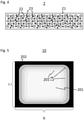
- the coating is arranged in a laterally structured manner, so that an area of the surface of the glass element on which the coating is arranged has no coating and another area has the coating.
- the coating can preferably be applied in the form of a grid, such as a dot grid, and/or a frame.
- a grid is to be understood here as an arrangement of points which are regularly distributed over an area and, for example, as the corner points can be understood from crossing perpendicular lines of a lattice.
- the coating may be applied in the form of a frame to cover an edge region of a surface of the glass substrate and for the surface to be covered with the coating towards the center of the surface and for the frame to be divided into a grid of points with an initially high occupancy level and towards the middle the grid changes in such a way that the occupancy level of the point grid decreases.
- the degree of occupancy refers to the ratio of the area of the coated region or of the coated regions of the surface of the glass substrate or of the glass element to the total area of the surface of the glass substrate.
- the presence of the coating as a frame can be particularly preferred, since in this way, for example, the direct contact of the glass surface with sharp-edged or abrasive objects or components in an installed state of the glass element - for example with a metal frame or metal components as mounting elements - is at least partially reduced or can be reduced.
- the coating can then act as a kind of scratch protection coating. Since scratches in the surface of a glass substrate or glass element reduce its mechanical strength, an embodiment of the glass element in which the coating forms a frame in the edge area is therefore advantageous.
- the coating can also act as a scratch or wear protection coating in the other areas of the glass element. This is because the areas of the surface of the glass element covered with the coating are slightly raised compared to the uncovered areas, so that in this case the coating acts as a kind of spacer to the glass surface. Although scratches on the glass surface cannot be completely prevented in this way, they can at least be reduced somewhat. However, the degree of occupancy in the middle area of the glass element should not be too high since, for example, such coated glass elements can also be used as a viewing pane, for example in an oven door. So here must be one A compromise must be found between sufficient occupancy to reduce surface damage in a targeted manner and sufficient free surface to enable the glass element to be looked through.
- the degree of occupancy is preferably at least 60%, preferably at least 65% and particularly preferably at least 70%.
- the degree of occupancy should preferably not be greater than 90%.
- a full-surface coating is also possible, in particular if the glass element is to be used as an opaque pane or cover.
- the glass element has a thickness of between 3 mm and 10 mm.
- the thickness of the glass element here refers to the lateral dimension of the glass element, which is given by the distance between the two surfaces or main surfaces, without considering the thickness of the coating.
- the thickness of the glass element corresponds to the thickness of the glass substrate.
- the thickness of the glass element should be at least 3 mm. If the glass element or glass substrate is less thick, the mechanical strength of the glass substrate or glass element is too low, so that it is not suitable for many applications, for example as a control panel or as a viewing panel in oven doors. However, the thickness of the glass substrate or element should not be too great either. Although a greater thickness leads to an increase in mechanical strength, it also increases the weight of the glass element/substrate. Furthermore, the material costs increase. The thickness of the glass element or substrate is therefore preferably limited and, according to one embodiment, is no more than 10 mm.
- the coating has a thickness of up to 20 ⁇ m, preferably of up to 10 ⁇ m.
- the wet layer thickness ie the layer thickness before firing, can be up to 20 ⁇ m.
- the coating is preferably at least 1 ⁇ m thick.
- the thickness of the coating should be at least 1 ⁇ m. This ensures that the coating has sufficient opacity.
- the coating can also advantageously fulfill the function of an at least partially wear-reducing coating, i.e. act for example as a kind of "mechanical spacer" and at least partially reduce the direct contact of an abrasive object with the uncoated surface of the glass element or glass substrate.
- the paste is preferably designed in such a way that it can be used in conventional methods for application to a glass substrate, in particular by means of screen printing.
- the firing conditions also preferably do not change compared to those of conventional pastes which do not include any filler.
- the coating it is possible for the coating to be burned in during the thermal prestressing of the glass element.
- the ratio of the sum of the solid components and the sum of the liquid components of the coating agent is between 2 and 3.5 by weight, preferably between 2.2 and 3.1.
- Such a configuration is advantageous because in this way good processability of the coating agent is guaranteed. This can be applied well and flows well, but on the other hand it is not too thin either, so that in particular a layer application by means of a printing process, for example screen printing, is possible.
- the proportion of the glassy component in the solids content of the coating composition is between 58% by volume and 78% by volume, preferably at most 73% by volume.
- the vitreous component which can also be referred to as glass flux, acts as a binder in the coating.
- the vitreous component of the coating agent at least partially melts during firing and connects the other components of the coating agent or the coating to one another and to the glass substrate.
- the glassy component at least partially melts the other components of the solid fraction of the coating agent and/or the glass substrate, at least in one surface area, so that a so-called melting reaction zone is formed at the coating/glass substrate interface.
- the content of the glassy component, for example the glass flux, in the coating composition should therefore be at least 32% by weight so that adequate wetting and coating of the other solid components of the coating composition is possible.
- the glassy component content of the coating composition should not be too high. Because it has been shown that too high a proportion of glass flux in a coating can lead to the mechanical strength of the glass element being reduced. Precisely when a melting reaction zone is formed, cracks can form in the area of the interface, which correspondingly reduce the strength of the glass substrate. The formation of cracks can be reduced if the content of the coating agent - and correspondingly also the coating resulting from the coating agent - is limited. According to one embodiment, therefore, the content of vitreous components in the coating agent or correspondingly in the coating resulting from the coating agent after firing on the glass substrate or glass element is advantageously at most about 45% by weight or at most about 50% by volume.
- the glassy component is present in the coating composition as a powder, preferably comprising glass powder particles with a d 50 value, based on the equivalent diameter, of 1 ⁇ m to 5 ⁇ m.
- a d 50 value based on the equivalent diameter
- Such a particle size range is advantageous because in this way a uniform melting of the glass powder is made possible.
- This also applies in a corresponding manner to the further glassy component if the coating agent should comprise a further glassy component as an alternative or in addition to the at least one filler.
- the proportion of the pigment in the solids content is between 5% by volume and 35% by volume, preferably between 5% by volume and 21% by volume.
- the proportion of pigment can be between 10% by volume and 19% by volume.
- the pigment is the coloring component in the coating on the glass element or glass substrate resulting from the firing of the coating composition.
- the proportion of the pigment in the solids content of the coating should be at least 5% by volume or the coating should correspondingly comprise at least 5% by volume.
- the coloring pigments are generally expensive components, so that the proportion of pigment in the solids content of the coating should not be too high and the coating should correspondingly not contain too much pigment.
- the pigment content of the solids content of the coating composition is therefore preferably limited and, according to one embodiment, is not more than 35% by volume, preferably not more than 21% by volume.
- the coating comprises at most 35% by volume pigment, preferably at most 21% by volume pigment.
- Inorganic pigments which have a high thermal stability, for example pigments with a spinel structure and TiO 2 , are preferred.
- the filler or the other vitreous component makes up at least 0.5% by volume of the solids content of the coating composition.
- the proportion of filler or the proportion of other vitreous components is not too high. Otherwise the adhesion and/or opacity of the coating will no longer be sufficient.
- the filler content or the content of the other vitreous component in the solids content of the coating composition should therefore be a maximum of 60% by volume, preferably a maximum of 35% by volume, particularly preferably a maximum of 19% by volume and very particularly preferably a maximum 15% by volume, for example 10% by volume or even less.
- the coating composition comprises more than one filler or filler and another glassy component, the above information on the solids content relates in each case to the sum of these additional components.
- a particular advantage of the coating composition according to the present disclosure is that it is surprisingly very easy to influence the resulting coefficient of thermal expansion of the coating if the coefficients of thermal expansion of the individual components of the coating composition are known.
- a commercially available enamel or printing ink comprising a To modify glass flux and a pigment by adding a corresponding filler and/or a corresponding further vitreous component, so that a glass element according to embodiments can then be obtained with this resulting coating agent.
- the volume fraction of the individual components of the solid fraction namely pigment or possibly pigments, vitreous component (also referred to as glass flux or glass frit) and filler or possibly fillers or alternatively or in addition to the filler or fillers, the further glassy component multiplied by the respective thermal expansion coefficient.
- the dispersing step can expediently be carried out by means of customary dispersing processes, for example in a three-roll mill or using a dissolver.
- the method described is particularly suitable for components which have coefficients of thermal expansion within the limits listed in the table below.
- the linear thermal expansion coefficient is given in units of 10 -6 /K.
- the lower part of the table shows the limits within which the resulting thermal expansion coefficients of the coating can vary when adding 10% filler with different glassy components.
- component Expansion coefficient [*10 -6 /K) Lower limit Upper limit pigment 9.5 10.9 glass substrate 8.8 9.5
- Glassy component 7 9 further glassy component (wgK) 4.3 4.3 filler, example 0.5 0.6 ⁇ (10% by weight of filler) 6.4, preferably 6.65 8.2, preferably 8.0 ⁇ (10% by weight wgK) 6.8 8.3
- the glass element according to the present disclosure is suitable, for example, for use as a control panel or as a viewing panel, for example as a viewing panel in an oven door, or as a washing machine door or washing machine lid, or as a door or lid of a dryer, or as a cover plate (or so-called cooking surface), for example a gas burner, or as a shelf, for example as a shelf for a refrigerator, or as a viewing panel for a fireplace or stove, or as an opaque cover plate and/or opaque appliance front.
- a control panel or as a viewing panel for example as a viewing panel in an oven door, or as a washing machine door or washing machine lid, or as a door or lid of a dryer, or as a cover plate (or so-called cooking surface), for example a gas burner, or as a shelf, for example as a shelf for a refrigerator, or as a viewing panel for a fireplace or stove, or as an opaque cover plate and/or opaque appliance front.
- the pigment used in each case was CI Pigment Black 28, a copper-chromium spinel, with two different types of Pigment Black 28 being used, which differed in particular with regard to the mean particle size, based on the d 50 value of the equivalent diameter.
- Pigment A had an average size of between 0.6 ⁇ m and 1.5 ⁇ m, and pigment B between 0.4 ⁇ m and 1.2 ⁇ m.
- the glass powder is one that has a composition in the composition ranges mentioned above.
- the glassy component used preferably has a composition comprising the following components in the following composition ranges (all figures in % by weight): component at least Max Li2O 0.1 3 Well 2 O 2.5 12 K2O 0 2.5 CaO 0.015 2.0 SrO 0.0 1 ZnO 5 35 B2O3 _ 1 22.8 Al2O3 _ 0.1 20 SiO 2 15 45 P2O5 _ 0 1.0 TiO 2 1 7 ZrO 2 0 2 Bi2O3 _ 0.07 55 f 0 3 class 0 1
- MnO or NiO in each case preferably below 2% by weight, and optionally other additives and/or impurities.
- the substrate in each case was a floated soda-lime glass.
- the pigment the above pigment A used.
- the percentages relate in each case to the volume fraction of the solids content of the paste.
- the coating was applied in each case by means of screen printing with a 77 screen printing mesh. Also indicated is the pasting ratio of powder to medium, ie the screen printing medium or screen printing oil used, based on weight.
- the color coordinates were measured on the color side against a black tile.
- the coating was baked in in each case in a tempering furnace.
- VB stands for comparative example.
- the glass frit here was a glass frit containing bismuth.
- example 1 2 3 vb composition layer Proportion of glassy component 59.3% 60.1% 54.6% 70% Percentage of pigment A 25.2% 25.5% 23.5% 30% additives 1 5 5 - additive proportion 15.5% 14.4% 21.9% - Medium pasting ratio 10:3,4 10:3,4 10:3,6 10:3–3 Properties of the coated substrate - single print Sclerometer test 10 N OK OK OK OK Optical density 1.7 2.1 2.2 2.6 L*a*b* 29.9/-0.3/-1.4 26.7/-0.1/-0.7 25.7/0/-0.7 26.2/-0.1/-0.8 Ball drop test (average in cm) 89 86 81 64.0
- the substrate was floated soda-lime glass.
- the percentages relate in each case to the volume fraction of the solids content in the paste.
- pigment A was used as the pigment in each case.
- the coating was applied in each case by means of screen printing as a single print. Also indicated is the pasting ratio of powder to medium, ie the screen printing medium or screen printing oil used, also based on weight. The color coordinates were measured on the color side against a black tile.
- the coating was baked in each case in a laboratory oven.
- the information on the fillers refers to the numbers in the table above listing fillers. Different glass frits (1 and 2) were used, which in both cases contained bismuth.
- Glass frit 2 was a glass frit with a high bismuth content.
- the glass frit 1 was also used in all the examples in the previous table.
- N OK OK OK OK OK OK Optical density 2.2 3.3 2.2 1.3
- Gloss (60°) 81 54 4 3 109 L*a*b* (SCE; on color side, black background) 32.3/ -0.2/ -2.0 32.7/-0.1/-1.7 32.3/ -0.2/ -2 30.5/ -0.2/ -2.25 34.1/ -0.4/ -2.1 example 9 10 11 composition layer glass fri
- the following table shows the falling ball values (mean value) as an example, determined on a total of 40 samples with a thickness of 4 mm.
- the glass elements were each thermally prestressed.
- the ceramic paint DV173170 from Prince Minerals was used to produce the samples, to which appropriate fillers were added. It turns out that the use of a filler results in an improvement in breaking strength.
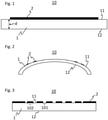
- FIG. 1 shows a first schematic image, which is not true to scale, of a glass element 10 which comprises a glass substrate 1 in the form of a disc.
- the disc-shaped glass substrate 10 is flat here, ie not curved.
- the disc-shaped glass substrate 1 has a first surface 11 and a second surface 12 which is opposite the first surface 11 .
- the surfaces can also be referred to as sides or side surfaces and represent so-called main surfaces of the glass substrate 1 or correspondingly of the glass element 10 because together they make up more than 50% of the surface of the substrate.
- the thickness d of the glass substrate 1 is also the same.
- the thickness of the glass substrate 1 can also be assumed to be approximately the thickness of the glass element 10 because, unlike in the present example, the (not labeled) thickness of the coating 2 is only very small for reasons of better representation compared to the thickness of the glass substrate 1.
- the coating 2 is arranged at least in regions on at least one of the surfaces 11, 12, namely here on the surface 11 of the glass substrate 1. This means that the coating 2 does not have to cover the entire surface 11 but can also be applied only in one section, so that another area of the surface is not covered with the coating 2 .
- the coating is arranged in a central area of the surface 11 so that an edge area remains free. Of course, full-surface occupancy is also possible. It is also possible that the coating is not only arranged on one surface but on both surfaces 11, 12 of the glass substrate.
- the coating 2 is designed as an inorganic, glass-based coating, preferably as an enamel coating. It comprises at least one vitreous component, preferably a vitreous component which melts when heated, so that the vitreous component can also be in the form of glass flux or glass frit, for example.
- a vitreous component which melts when heated
- the vitreous component can also be in the form of glass flux or glass frit, for example.
- the vitreous component can act particularly well as a binder and the other components of the coating, that is to say envelop the pigment and a filler which may be included in the coating and connect them to one another and to the substrate 1 .
- the coating 2 it is also possible for the coating 2 to comprise a further vitreous component in addition or as an alternative to a filler.
- the filler particles comprised by the filler advantageously have a d 50 value, based on the equivalent diameter, of at least 0.1 ⁇ m, preferably at least 0.3 ⁇ m, and less than 10 ⁇ m, preferably less than 5 ⁇ m up.
- the configuration of the coating 2 described above preferably results in a thermal expansion coefficient of the coating 2 which is less than or equal to the thermal expansion coefficient of the glass substrate 1 .
- FIG. 1 shows another illustration of an embodiment of a glass element 10 for a more precise explanation of a laterally structured application of the coating 2.
- the glass element 10 is designed here in such a way that the coating 2 is applied in a laterally structured manner. This means that at least one area 101 of the surface 11, 12, here the surface 11, of the glass substrate 1 has no coating 2, whereas another area 102 has the coating 2. Again, it is generally possible for the coating 2 to be applied on both sides.
- the coating is therefore a mixture of different components, so that a thermal expansion coefficient of the coating results, which results from the volume fraction of the individual components and their respective expansion coefficients and can be calculated as explained above.
- this resulting coefficient of thermal expansion of the coating is preferably less than or equal to the coefficient of thermal expansion of the glass substrate.
- the filler particles 23 have a thermal expansion coefficient of at least 0.5*10 -6 /K and preferably at most 15*10 -6 /K, preferably at most 10*10 -6 /K, 8*10 -6 /K, more preferably at most 5 * 10 -6 /K, even more preferably at most 3 * 10 -6 /K and very particularly preferably at most 0.6 * 10 -6 /K, so that preferably a resulting thermal expansion coefficient of the coating 2 of at most 9 *10 -6 /K, preferably 8.3 *10 -6 /K, with the resulting thermal of the coating preferably being at least 6*10 -6 /K, particularly preferably at least 6.4*10 -6 / K
- FIG. 12 shows a plan view of an exemplary glass element 10 according to one embodiment.
- the glass element 10 or, in a corresponding manner, the glass substrate 1 (not designated here) has a length l and a width b.
- the coating 2 is arranged here in the form of a lateral structure on a surface of the glass substrate that in an edge region of the glass element the coating as a covering coating in the form of a Frame 202 is applied.
- a covering coating is understood here to mean that the degree of coverage of the coating in the area of the frame is almost 100%, since the coating 2 is applied over the entire area in the area of the frame.
- the coating is applied in the form of grids 201 with different degrees of coverage.
- the degree of occupancy calculated for the entire surface of the glass element 10 is preferably between at least 60% and at most 90%.
- the degree of occupancy is preferably at least 65%, particularly preferably at least 70%.
- the coating 2 is constructed here in such a way that it comprises pigment particles 22 and filler particles 23 as well as a first glassy component 21 and a second glassy component 24.
- the coating 2 comprises no filler comprising filler particles, but only a vitreous component 21 and a further vitreous component 24.
- the coating 2 is formed in such a way that it comprises two different glassy phases 21, 24 and thus a glass matrix comprising these two glassy phases 21, 24 is obtained.
- the glass matrix which preferably completely surrounds the particles of the coating 2, encases them and connects them to the glass substrate 1 (not shown), is therefore made according to the example 6 not homogeneous, but comprises two different glass phases. These can differ in particular with regard to their composition, which can be made visible, for example, using ToF-SIMS.
- FIG. 7 shows a representation of ToF-SIMS profiles of example 1 (curve no. 3) and example 2 (designated as curve no. 4) as well as the comparative example (CE), designated as curve 5.
- the signal from Al 3 is shown here + .
- the signal for Al 3+ in curve 4 is significantly stronger because the material added as an additional glassy component contains twice as much Al as the base enamel (the glassy component).
- this increased Al content of the coating is not evenly distributed in the coating, but rather it can be shown in graphic evaluations of ToF-SIMS measurements that the other vitreous component does not completely mix with the vitreous component of a base enamel.
Landscapes
- Chemical & Material Sciences (AREA)
- Engineering & Computer Science (AREA)
- Materials Engineering (AREA)
- Chemical Kinetics & Catalysis (AREA)
- General Chemical & Material Sciences (AREA)
- Geochemistry & Mineralogy (AREA)
- Life Sciences & Earth Sciences (AREA)
- Organic Chemistry (AREA)
- Dispersion Chemistry (AREA)
- Composite Materials (AREA)
- Ceramic Engineering (AREA)
- Crystallography & Structural Chemistry (AREA)
- Glass Compositions (AREA)
- Paints Or Removers (AREA)
- Surface Treatment Of Glass (AREA)
Abstract
Description
- Die Erfindung betrifft allgemein Glaselemente, insbesondere Glaselemente umfassend wenigstens eine auf wenigstens einer Seite des Glaselements angeordnete Beschichtung. Weitere Aspekte der Erfindung betreffen ein Beschichtungsmittel, ein Verfahren zu dessen Herstellung sowie die Verwendung eines Glaselements.
- Glasscheiben mit Anwendung in Haushaltsgeräten werden zu Design- und Funktionszwecken häufig mit sogenannten Dekoren, also anorganischen, glasbasierten Emailleschichten, beschichtet. Es ist allerdings bekannt, dass diese Dekore bzw. Emailleschichten die Bruchfestigkeit der Glasscheiben reduzieren.
- Zur Lösung des Problems der reduzierten Festigkeit von einer mit einer Emailleschicht bedruckten Glasscheiben sowie weiterer Probleme, wie beispielsweise der Bereitstellung einer chemisch besonders beständigen Beschichtung wird in der US-amerikanischen Patentanmeldung
US 2016/0185657 A1 ein Mehrlagen-Emaille vorgeschlagen. Jede Lage dieser Mehrlagen-Emaille wird dabei gedruckt und anschließend eingebrannt, bevor die jeweils nächste Lage aufgebracht wird, wobei jede Lage auf den entsprechenden Verwendungszweck angepasst werden kann. Jedoch ist ein solches Vorgehen aufwendig und kostenintensiv. Weiterhin kann es zum Abplatzen der Beschichtung kommen, wenn die kritische Schichtdicke ― die vom thermischen Ausdehnungskoeffizienten bzw. dem Unterschied der thermischen Ausdehnungskoeffizienten von Beschichtung und Substrat abhängig ist ― überschritten ist. - Es ist weiterhin bekannt, flüssigen Beschichtungsmaterialien Füllstoffe zuzusetzen, insbesondere aus Kostengründen, da Füllstoffe zumeist günstiger sind als weitere Komponenten, wie beispielsweise Pigmente, oder weil Füllstoffe der resultierenden Beschichtung bestimmte vorteilhafte Eigenschaften verleihen können. Unter einem Füllstoff wird allgemein ein Zusatzstoff zu einer Zusammensetzung oder einem Material verstanden. Ein Füllstoff kann die Eigenschaften der betrachteten Zusammensetzung verändern, beispielsweise deren Verarbeitbarkeit. Häufig sind Füllstoffe auch günstiger als andere Komponenten der Zusammensetzung.
- Beispielsweise beschreibt die US-amerikanische Patentschrift
US 5,691,254 eine Emaille-Zusammensetzung für die Beschichtung einer niedrigdehnenden Glaskeramik, wie sie beispielsweise als Kochfläche verwendet wird. Die Emaillebeschichtung kann dabei neben einer Glaskomponente und dem oder den Farbpigmenten auch bis zu 54 Gew.-% Füllstoff umfassen, wobei der Füllstoff zugesetzt wird, um eine besonders abrasionsfeste Emaillebeschichtung zu erzielen. Der Füllstoff umfasst dabei nach derUS 5,691,254 insbesondere Zirkonium oder Zirkoniumoxid. Eine Verbesserung der mechanischen Festigkeit der beschichteten Glaskeramikplatte ist nicht adressiert. - Auch die US-amerikanische Patentschrift
US 5,412,877 beschreibt eine Zusammensetzung einer keramischen Farbe (oder Emaille) mit einem niedrigen Schmelzpunkt, die einen Füllstoff umfassen kann, wobei der Füllstoff beispielsweise zur Einstellung der Einbrandbedingungen oder des thermischen Ausdehnungskoeffizienten der Emaillebeschichtung dienen kann. Die Glasfritte umfasst Bleioxid PbO. Eine Verbesserung der mechanischen Festigkeit der beschichteten Glasplatte ist auch hier nicht angesprochen. - Weiterhin beschreibt auch die US-amerikanische Patentschrift
US 2016/0031748 A1 eine keramische Farbe, welche einen Füllstoff umfasst. Die keramische Farbe wird auf ein metallisches Substrat beschichtet. Die Beschichtung eines Glassubstrats ist nicht angesprochen. - Es besteht somit ein Bedarf an Glaselementen umfassend eine Beschichtung, welches die vorstehend genannten Probleme des Standes der Technik, insbesondere hinsichtlich der Bruchfestigkeit, zumindest mindert. Weiterhin besteht auch ein Bedarf an verbesserten Beschichtungszusammensetzungen.
- Die Aufgabe der Erfindung besteht darin, Glaselemente bereitzustellen, welche eine Beschichtung umfassen und gleichzeitig eine hohe mechanische Festigkeit, insbesondere eine hohe Bruchfestigkeit, aufweisen.
- Die Aufgabe der Erfindung wird gelöst durch den Gegenstand der unabhängigen Ansprüche. Bevorzugte und spezielle Ausführungsformen finden sich in den Unteransprüchen sowie in Beschreibung und Zeichnungen.
- Die vorliegende Offenbarung betrifft damit ein Glaselement, insbesondere ein vorgespanntes Glaselement, bevorzugt ein thermisch vorgespanntes Glaselement, umfassend ein scheibenförmiges Glassubstrat mit einer ersten Oberfläche und einer zweiten, der ersten Oberfläche gegenüberliegenden Oberfläche sowie einer auf wenigstens eine der Oberfläche des Glassubstrats zumindest bereichsweise angeordnete Beschichtung. Die Beschichtung ist als anorganische, glasbasierte Beschichtung, vorzugsweise als Emaillebeschichtung, ausgebildet, umfassend wenigstens eine glasige Komponente, wenigstens ein Pigment umfassend Pigmentpartikel sowie einen Füllstoff. Der Füllstoff ist anorganisch ausgebildet. Der Füllstoff umfasst Füllstoffpartikel mit einem d50-Wert, bezogen auf den Äquivalentdurchmesser, von mindestens 0,1 µm, bevorzugt mindestens 0,3 µm, und weniger als 10 µm, bevorzugt weniger als 5 µm.
- Alternativ oder zusätzlich zum Füllstoff kann die Beschichtung auch eine weitere glasige Komponente umfassen.
- Vorzugsweise resultiert durch die Zusammensetzung der Beschichtung ein thermischer Ausdehnungskoeffizient der Beschichtung, welcher kleiner oder gleich dem thermischen Ausdehnungskoeffizienten des Glassubstrats ist. Bevorzugt ist der thermische Ausdehnungskoeffizient der Beschichtung kleiner als der des Glassubstrats.
- Im Rahmen der vorliegenden Offenbarung kann der durch die Zusammensetzung der Beschichtung resultierende thermische Ausdehnungskoeffizient auch als "resultierender thermischer Ausdehnungskoeffizient" der Beschichtung bezeichnet werden. Sofern lediglich der thermische Ausdehnungskoeffizient der Beschichtung genannt ist, wird darunter ebenfalls der "resultierende thermische Ausdehnungskoeffizient" der Beschichtung verstanden.
- Eine solche Ausgestaltung eines Glaselements ist vorteilhaft, da es auf diese Weise, insbesondere durch den Zusatz des Füllstoffs, möglich ist, die Zusammensetzung der Beschichtung so zu variieren und einzustellen, dass ein Glaselement erhalten werden kann, das im Vergleich zu Glaselementen des Standes der Technik, welche ebenfalls eine glasbasierte Beschichtung, beispielsweise eine Emaillebeschichtung (welche auch als "Dekor" oder "Dekorschicht bezeichnet werden kann) umfassen, eine erhöhte mechanische Festigkeit aufweist. Mit anderen Worten ist es mit einer solchen Ausgestaltung möglich, dass beispielsweise ein dünneres, mit einer glasbasierten Beschichtung umfassend Füllstoffe versehenes, Glaselement gleicher Festigkeit erhalten wird wie ein Glaselement mit herkömmlicher glasbasierter Beschichtung, welches aber eine erhöhte Substratdicke aufweist.
- Das Glaselement kann dabei insbesondere vorgespannt, beispielsweise thermisch vorgespannt, vorliegen. Dies ist vorteilhaft, da auf diese Weise die Festigkeit des Glases gegenüber einer mechanischen Beanspruchung erhöht wird.
- Der Füllstoff ist dabei anorganisch ausgebildet, was vorteilhaft ist, da er auf diese Weise auch bei hohen Einbrandtemperaturen, wie sie beispielsweise bei glasbasierten oder glasflussbasierten Beschichtungen, wie Emaillebeschichtungen, üblich sind, thermisch stabil ist. Unter thermischer Stabilität wird dabei insbesondere verstanden, dass der Füllstoff sich nicht zersetzt. Darunter wird insbesondere verstanden, dass der Füllstoff nicht durch eine Zersetzungsreaktion in neue Phasen aufgespalten wird. Beispielsweise ist es sogar möglich, dass der Füllstoff in dem Sinne thermisch stabil ist, dass die strukturelle Integrität des Füllstoffs auch beim Einbrennvorgang der Beschichtung erhalten bleibt. Vorzugsweise ist der Füllstoff anorganisch oxidisch ausgebildet.
- Der Füllstoff ist so ausgebildet, dass er Füllstoffpartikel mit einem d50-Wert, bezogen auf den Äquivalentdurchmesser, von mindestens 0,1 µm, bevorzugt mindestens 0,3 µm, und weniger als 10 µm, bevorzugt weniger als 5 µm, umfasst.
- Die Beschichtung kann dabei so ausgestaltet sein, dass die Füllstoffpartikel nicht aus der Beschichtung hinausragen, insbesondere also so, dass die Füllstoffpartikel keine Erhebungen auf der Beschichtung ausbilden oder aus der Beschichtung herausragen. Gemäß einer Ausführungsform ist das Glaselement so ausgestaltet, dass die Füllstoffpartikel vollständig von der glasigen Komponente umhüllt sind. Eine solche Ausgestaltung kann insbesondere vorteilhaft sein zur Ausbildung einer glatten, kratzfesten Beschichtung und/oder eine Beschichtung mit einer guten Reinigbarkeit. Vorteilhaft kann dies insbesondere durch einen kleinen d50-Wert des Äquivalentdurchmessers der Füllstoffpartikel von weniger als 10 µm, bevorzugt weniger als 5 µm oder sogar weniger als 1 µm erzielt werden. Allerdings sollten die Füllstoffpartikel auch nicht zu klein sein, da sonst der Bedarf an glasiger Komponente ― also dem Bindemittel ― zu hoch wird und/oder keine ausreichend haftfeste Beschichtung mehr erzielt werden kann. Bevorzugt ist daher der d50-Wert des Äquivalentdurchmessers der Füllstoffpartikel mindestens 0,1 µm, bevorzugt mindestens 0,3 µm.
- Umfasst die Beschichtung alternativ oder zusätzlich zum Füllstoff eine weitere glasige Komponente, so kann die Beschichtung allgemein so ausgebildet sein, dass sie ein inhomogenes Glasmaterial umfasst. Die Beschichtung umfasst also gemäß dieser Ausführungsform ein Glasmaterial, das vorzugsweise zwei glasige Phasen umfasst, welche beispielsweise eine unterschiedliche Zusammensetzung aufweisen.
- Im Rahmen der vorliegenden Offenbarung geltenden die folgenden Definitionen:
- Unter einem Glaselement wird ein veredeltes Glassubstrat verstanden. Insbesondere kann ein Glaselement verstanden werden als umfassend ein Glassubstrat und wenigstens eine auf wenigstens einer Oberfläche des Glassubstrats zumindest bereichsweise angeordnete Beschichtung.
- Unter einem Glassubstrat wird ein Formkörper aus oder umfassend ein glasiges Material verstanden.
- Unter einem glasigen Material (oder: Glas) wird ein anorganisches Material verstanden, welches aus einem Gemenge in einem Schmelzprozess erhalten wird. Das glasige Material kann insbesondere oxidisch ausgebildet sein. An den Schmelzprozess kann sich als weiterer Prozess eine sogenannte Heißformgebung anschließen, in welcher das glasige Material zu einem Formkörper geformt wird. Solche Formgebungsprozesse können beispielsweise Ziehen, Floaten oder Walzen sein.
- Das Glassubstrat ist insbesondere scheibenförmig ausgebildet, wobei das Glassubstrat sowohl eben oder auch gewölbt, gewinkelt oder gebogen vorliegen kann. Unter einem scheibenförmigen Formkörper wird eine Ausbildung eines Körpers verstanden, bei welcher die laterale Abmessung des Formkörpers in einer ersten Raumrichtung eines kartesischen Koordinatensystems wenigstens eine Größenordnung geringer ist als in den beiden anderen, zu ersten Raumrichtung senkrechten Raumrichtungen. Diese erste Raumrichtung kann dabei auch als Dicke des Formkörpers bezeichnet werden. Mit anderen Worten ist ein Formkörper im Sinne der vorliegenden Offenbarung scheibenförmig ausgebildet, wenn seine Dicke wenigstens eine Größenordnung geringer ist als seine Länge und Breite. Weisen Länge und Breite des Formkörpers dieselbe Größenordnung auf, so kann der Formkörper auch als Scheibe bezeichnet werden, ist die Länge deutlich größer als die Breite, kann man auch von einem Band sprechen. Unter einem scheibenförmigen Glassubstrat wird hier daher insbesondere auch eine Glasscheibe verstanden, wobei die Glasscheibe sowohl eben als auch gewölbt oder gekrümmt oder gewinkelt ausgebildet sein kann, beispielsweise als gewölbte Sichtscheibe.
- Da ein Glaselement ein veredeltes Glassubstrat ist, kann eine Oberfläche oder Hauptfläche eines Glassubstrats in entsprechender Weise auch als Oberfläche oder Hauptfläche des Glaselements bezeichnet werden. Die Ausführungen zu Länge, Breite und Dicke des Glassubstrats gelten daher für das Glaselement in entsprechender Weise, wobei hinsichtlich der Dicke beachtlich ist, dass die Dicke des Glaselements für einen beschichteten Bereich die Dicke des Glassubstrats zuzüglich der Dicke der Beschichtung ist. Aufgrund der nur sehr geringen Dicke der Beschichtung im Vergleich zur Dicke des Glassubstrats kann aber hier näherungsweise für praktische Belange die Dicke des Glassubstrats als gleich der Dicke des Glaselements betrachtet werden.
- Unter den Oberflächen des Glassubstrats werden im Rahmen der vorliegenden Offenbarung die Hauptflächen bzw. Hauptoberflächen des Glassubstrats verstanden, welche beispielsweise auch als "Seiten" einer Scheiben (beispielsweise Vorderseite oder Rückseite) bezeichnet werden können. Mit anderen Worten handelt es sich bei den Oberflächen oder Hauptflächen oder Hauptoberflächen um diejenigen Flächen des Formkörpers, welche zusammen mehr als 50 % der Gesamtoberfläche des Formkörpers ausmachen. Nicht als Oberflächen werden im Rahmen der vorliegenden Offenbarung daher die Kantenflächen des Glassubstrats bezeichnet.
- Die Oberflächen des scheibenförmigen Glassubstrats können insbesondere zumindest im Rahmen üblicher Fertigungstoleranzen parallel zueinander ausgebildet sein.
- Unter dem Äquivalentdurchmesser eines Partikels wird im Rahmen der vorliegenden Offenbarung der volumenäquivalente Durchmesser verstanden. Er gibt an, welchen Durchmesser ein Partikel mit einem bestimmten Volumen hätte, wenn der Partikel perfekt kugelförmig ausgebildet wäre. Es handelt sich hierbei um eine übliche Größe zur Charakterisierung von Stoffen, welche üblicherweise in Partikelform vorliegen, wie beispielsweise von Pigmenten und/oder Füllstoffen. Sofern im Rahmen der vorliegenden Offenbarung eine Partikelgröße angegeben ist, wird darunter, sofern dies nicht ausdrücklich anders ausgeführt ist, eine Angabe des d50-Werts, jeweils bezogen auf den Äquivalentdurchmesser, verstanden.
- Im Rahmen der vorliegenden Offenbarung wird verstanden, dass ein Pigment ein Farbkörper ist, welcher üblicherweise in Partikelform vorliegt. Sofern daher im Rahmen der vorliegenden Offenbarung ausgeführt ist, dass eine Beschichtung ein Pigment umfasst, wird dies so verstanden, dass die Beschichtung Pigmentpartikel umfasst. Dies gilt in entsprechender Weise auch für den Füllstoff, welcher in Beschichtungen üblicherweise ebenfalls in Partikelform vorliegt. Ein einzelner Partikel eines Füllstoffs oder eines Pigments wird dabei zur Vermeidung von Missverständnissen als Füllstoff- oder Pigmentpartikel bezeichnet. Die Pigmente können dabei sowohl als Absorptionspigmente ausgebildet sein, also der Beschichtung eine Farbe verleihen aufgrund der selektiven Absorption von sichtbarem Licht, oder durch Lichtstreuung als Pigment wirken (dies ist üblicherweise bei Weißpigmenten der Fall) oder auch als sogenannte Effektpigmente ausgebildet sein, welche beispielsweise Farbwechsel (auch als Flop bezeichnet) und/oder einen sogenannten "metallic"-Effekt erzeugen. Im Rahmen der vorliegenden Offenbarung sind die Pigmente insbesondere anorganisch, vorzugsweise anorganisch und hochtemperaturstabil, also insbesondere stabil bis zu mindestens 500°C, ausgebildet. Solche Pigmente können auch als keramische Farbkörper oder keramische Pigmente bezeichnet werden.
- Sofern im Rahmen der vorliegenden Offenbarung auf den thermischen Ausdehnungskoeffizienten eines Glases oder einer glasigen Komponente abgestellt wird, wird im Rahmen der vorliegenden Offenbarung der lineare thermische Ausdehnungskoeffizient, α, verstanden, vorzugsweise angegeben im Bereich von 20°C bis 300°C. Beim angegebenen Wert für Gläser handelt es sich um den nominalen mittleren thermischen Längenausdehnungskoeffizienten, welcher für Gläser gemäß DIN ISO 7991 in statischer Messung bestimmt ist. Allgemein wird im Rahmen der vorliegenden Offenbarung unter dem thermischen Ausdehnungskoeffizienten der lineare thermische Ausdehnungskoeffizient, α, verstanden und dieser wird vorzugsweise für den Bereich von 20°C bis 300°C angegeben. Die Bezeichnungen α und α20-300 werden im Rahmen dieser Schrift synonym verwendet. Der thermische Ausdehnungskoeffizient kann im Rahmen der vorliegenden Schrift auch als CTE (Coefficient of thermal expansion) bezeichnet werden. Für Pulver wird der thermische Ausdehnungskoeffizient üblicherweise bestimmt, indem das Pulver kompaktiert wird und anhand des so erhaltenen Formkörpers kann der Längenausdehnungskoeffizient in üblicher Weise durch Messung der Längenänderung in Abhängigkeit von der Temperatur bestimmt werden.
- Es ist bekannt, dass der thermische Ausdehnungskoeffizient eines Gemisches, αG, nach der folgenden Formel berechnet werden kann:

- Hierbei bezeichnet αi den linearen thermischen Ausdehnungskoeffizienten der Komponente i und vi deren Volumenanteil. Das Volumen einer Komponente kann einfach durch Multiplikation mit der entsprechenden Dichte in die Masse umgerechnet werden. Mit anderen Worten wird also der Volumenanteil der einzelnen Komponenten mit dem thermischen Ausdehnungskoeffizienten der jeweiligen Komponenten multipliziert. Die daraus entstandenen Produkte werden dann addiert und ergeben so den resultierenden thermischen Ausdehnungskoeffizienten des betrachteten Gemischs, αG. Für die hier betrachtete anorganische glasbasierte Beschichtung sind diese Komponenten insbesondere wenigstens eine glasige Komponente, beispielsweise ein Glasfluss, wenigstens ein Pigment sowie wenigstens ein Füllstoff. In entsprechender Weise wie für die Beschichtung kann der resultierende thermische Ausdehnungskoeffizient αG aus der Zusammensetzung eines Beschichtungsmittels bzw. Paste berechnet werden, indem der Berechnung die festen Komponenten des Beschichtungsmittels zugrunde gelegt werden.
- Unter einem Beschichtungsmittel wird im Rahmen der vorliegenden Offenbarung ein flüssiges oder pastöses Material verstanden, welches dazu bestimmt ist, auf ein Substrat aufgebracht zu werden, sodass nach einem Trocknungs- und/oder Einbrennvorgang eine mit dem Substrat vorzugsweise fest verbundene Materiallage resultiert. Ein Beschichtungsmittel kann dabei auch als Dekorfarbe bezeichnet werden oder als Paste oder Emaillefarbe.
- Eine Ausgestaltung des Glaselements nach Anspruch 1 ist vorteilhaft, weil durch die Verwendung eines anorganischen Füllstoffs und/oder einer weiteren glasigen Komponente eine hohe Temperaturstabilität der anorganischen Beschichtung erzielt werden kann. Wird ein Füllstoff verwendet, kann der Äquivalentdurchmesser des Füllstoffs bzw. der vom Füllstoff umfassten Füllstoffpartikel in einem weiten Bereich variieren. Dies ermöglicht es, den Füllstoff flexibel in Abhängigkeit von den zu erzielenden Eigenschaften und/oder den Füllstoff flexibel in Abhängigkeit von der Beschaffenheit der sonstigen Komponenten der Beschichtung auswählen zu können. So kann beispielsweise ein niedriger Äquivalentdurchmesser der Füllstoffpartikel dann vorteilhaft sein, wenn beispielsweise die glasige Komponente des Beschichtungsmittels auch Partikel mit einem geringen Äquivalentdurchmesser umfasst. Umfasst die Beschichtung bzw. das Beschichtungsmittel hingegen größere Partikel, beispielsweise ein Pigment, welches größere Partikel umfasst, kann es vorteilhaft sein, wenn der Äquivalentdurchmesser der Füllstoffpartikel größer ist. Gleichzeitig ist es mit einer solchen Ausgestaltung möglich, ein Glaselement mit erhöhter mechanischer Festigkeit im Vergleich zu herkömmlichen Glaselementen bereitzustellen. Dies kann insbesondere dadurch vorteilhaft unterstützt werden, dass vorzugsweise der resultierende thermische Ausdehnungskoeffizient der Beschichtung geringer ist als der thermische Ausdehnungskoeffizient des Glassubstrats. Auf diese Weise kann durch die Beschichtung sogar eine Art Druckspannung auf die Oberfläche des Glaselements erzielt bzw. ausgeübt, beispielsweise ähnlich einer thermischen Vorspannung, d.h. einer durch einen thermischen Prozess erhaltenen Vorspannung. Dies kann die Ausbildung einer verbesserten Festigkeit des Glaselements weiter unterstützen.
- Vorteilhaft kann es auch sein, wenn alternativ oder zusätzlich zum Füllstoff eine weitere glasige Komponente als Bestandteil der Beschichtung zum Einsatz kommt. Beispielsweise kann dies gerade dann vorteilhaft sein, wenn große Pigmentpartikel verwendet werden, um so für eine bessere Umhüllung zu sorgen. Auch die Haftfestigkeit einer Beschichtung kann durch die Zugabe von einer weiteren glasigen Komponente alternativ oder zusätzlich zu einem Füllstoff verbessert werden, da auf diese Weise der Anteil der glasigen Matrix im Vergleich zum Partikelgehalt der Farbe, gebildet aus Pigmentpartikel und gegebenenfalls Füllstoffpartikeln, erhöht wird.
- Mit einer Zusammensetzung der Beschichtung wie vorstehend ausgeführt ist es insbesondere möglich, dass eine besonders hohe mechanische Festigkeit des Glaselements erzielt wird.
- Gemäß einer Ausführungsform ist das Glaselement so ausgestaltet, dass die Füllstoffpartikel und/oder die weitere glasige Komponente einen thermischen Ausdehnungskoeffizienten von mindestens 0,5*10-6/K und vorzugsweise höchstens 15*10-6/K, bevorzugt höchstens 10*10-6/K, 8 * 10-6/K, mehr bevorzugt höchstens 5 * 10-6/K, noch mehr bevorzugt höchstens 3 * 10-6/K und ganz besonders bevorzugt höchstens 0,6 *10-6/K aufweisen. Mit anderen Worten weisen die Füllstoffpartikel bzw. weist der Füllstoff bzw. die weitere glasige Komponente also einen relativ geringen linearen thermischen Ausdehnungskoeffizienten auf, insbesondere im Vergleich mit üblichen glasigen Materialien, wie beispielsweise Borosilikatglas oder Kalk-Natron-Gläsern, deren lineare thermische Ausdehnungskoeffizienten mit mehr als 3,0*10-6/K deutlich höher liegen. Insbesondere beträgt der lineare thermische Ausdehnungskoeffizient für Kalk-Natron-Glas etwa 9*10-6/K und ist damit deutlich größer als der thermische Ausdehnungskoeffizient des Füllstoffs.
- Dies kann insbesondere dann besonders vorteilhaft sein, wenn ein besonders niedriger resultierender thermischer Ausdehnungskoeffizient der Beschichtung erhalten werden soll. Denn es hat sich gezeigt, dass ein niedriger resultierender thermischer Ausdehnungskoeffizient einer glasbasierten Beschichtung zu einer verbesserten Festigkeit des Glaselements führen kann.
- Allerdings ist es nicht in allen Fällen erforderlich oder sinnvoll, einen besonders niedrigen thermischen Ausdehnungskoeffizienten der glasbasierten Beschichtung zu erzielen. Vielmehr kann es sinnvoll sein, durch die Zugabe eines Füllstoffs umfassend Füllstoffpartikel und/oder einer weiteren glasigen Komponente mit einem niedrigen thermischen Ausdehnungskoeffizienten zwischen mindestens 0,5 *10-6/K und vorzugsweise höchstens 15*10-6/K, bevorzugt höchstens 10*10-6/K, 8 *10-6/K, mehr bevorzugt höchstens 5 * 10-6/K, noch mehr bevorzugt höchstens 3 * 10-6/K und ganz besonders bevorzugt höchstens 0,6 *10-6/K den resultierenden thermischen Ausdehnungskoeffizienten der Beschichtung einzustellen. Vorzugsweise wird so ein resultierender thermischer Ausdehnungskoeffizient der Beschichtung von höchstens 9*10-6/K, bevorzugt 8,3 *10-6/K erhalten, wobei vorzugsweise der resultierende thermische Ausdehnungskoeffizient der Beschichtung mindestens 6*10-6/K ist, besonders bevorzugt mindestens 6,4*10-6/K ist. Dies kann vorteilhaft sein, denn auf diese Weise wird eine Beschichtung erhalten, deren resultierender thermischer Ausdehnungskoeffizient auf übliche verwendete Substratmaterialien abgestimmt ist.
- Gemäß einer Ausführungsform liegt der Unterschied der thermischen Ausdehnungskoeffizienten des Glassubstrats und der Beschichtung zwischen mindestens 0,5 *10-6/K und höchstens 3,1 *10-6 /K liegt. Der thermische Ausdehnungskoeffizient der Beschichtung ist hierbei der resultierende thermische Ausdehnungskoeffizient der Beschichtung. Der Unterschied zwischen dem thermischen Ausdehnungskoeffizienten des Glassubstrats und dem resultierenden thermischen Ausdehnungskoeffizienten der Beschichtung ergibt sich als die Differenz des thermischen Ausdehnungskoeffizienten des Glassubstrats und des resultierenden thermischen Ausdehnungskoeffizienten der Beschichtung. Der resultierende thermische Ausdehnungskoeffizient ist also gemäß dieser Ausführungsform stets kleiner als der thermische Ausdehnungskoeffizient des glasigen Substratmaterials.
- Mit anderen Worten ist gemäß einer bevorzugten Ausführungsform der Unterschied in den thermischen Ausdehnungskoeffizienten recht gering ausgeprägt. Es hat sich gezeigt, dass es auf diese Weise möglich ist, eine besonders gute mechanische Festigkeit des Glaselements zu erzielen, ohne dass es zu einer weiteren Beeinträchtigung der Eigenschaften des Glaselements kommt.
- Zwar wäre es theoretisch möglich, dass der resultierende thermische Ausdehnungskoeffizient weiter verringert würde, indem der Anteil des Füllstoffs und/oder der weiteren glasigen Komponente in der Beschichtung erhöht würde. Damit wäre es theoretisch möglich, eine größere Druckspannung durch die Unterschiede der Ausdehnungskoeffizienten an der Oberfläche des Glaselements aufzubauen. Allerdings ist hierbei zu beachten, dass anders als eine Druckspannungszone in einem thermisch vorgespannten Glassubstrat die hier betrachtete Beschichtung heterogen aus mehreren Komponenten aufgebaut ist, welche jeweils unterschiedliche thermische Ausdehnungskoeffizienten aufweisen. Zwar kann der thermische Ausdehnungskoeffizient einzelner Bestandteile variiert werden, jedoch nur innerhalb bestimmter Grenzen. Auch sind gerade die thermischen Ausdehnungskoeffizienten von üblichen hochtemperaturstabilen Verbindungen, die als Pigmente verwendet werden, recht hoch.
- Bei einer weiteren Erhöhung des Füllstoffgehalts und/oder des Gehalts der weiteren glasigen Komponente in der Beschichtung in der Form, dass ein nochmals geringer thermischer Ausdehnungskoeffizient der Beschichtung resultieren wurde, könnte es daher zu einer Rissbildung in der Beschichtung kommen. Auch kann der Anteil des Füllstoffs in der Beschichtung auf Kosten des Pigment- und/oder des glasigen Bestandteils nicht beliebig erhöht werden. Bei einem zu geringen Gehalt an Pigment in der Beschichtung kann es dazu kommen, dass die Beschichtung ihre Deckkraft verliert und/oder dass ein einzustellender Farbort nicht mehr erhalten werden kann. Auch der Anteil der glasigen Komponente kann nicht beliebig erhöht werden, da sonst eine nicht mehr ausreichende Deckkraft der Beschichtung resultierenden könnte. Dies ist beides unvorteilhaft. Denn die Deckwirkung und/oder die Einstellung des Farborts ist gerade für den Einsatz eines Glaselements in Anwendungen, in denen das Glaselements betrieblichen hohen thermischen Spannungen ausgesetzt ist, wie als Backofentürscheibe oder als Bedienblende eines Haushaltsgeräts, wichtig, beispielsweise, damit Bedien- und Gefahrenbereiche eines Geräts gut erkennbar abgegrenzt sind oder damit Sicherheitsleuchten, beispielsweise sogenannte Restwärmeanzeigen oder ähnliches, eindeutig bestimmten Bereichen zugeordnet werden können.
- Auf der anderen Seite kann eine Verringerung der glasigen Komponente der Beschichtung dazu führen, dass die resultierende Beschichtung keine ausreichende Haftfestigkeit aufweist oder eine nur unzureichende mechanische Beständigkeit beispielsweise bei Abrasionsbelastungen. Denn die glasige Komponente in der Beschichtung wirkt als Bindemittel, welches bei Temperaturerwärmung aufschmilzt und die übrigen Komponenten der Beschichtung miteinander und mit dem Glassubstrat verbindet. Wird daher diese Komponente auf Kosten der anderen Komponenten zu sehr reduziert, kann dies zu den oben genannten negativen Folgen der beispielsweise nicht ausreichenden Kratzfestigkeit und/oder Abriebfestigkeit der Beschichtung führen.
- Daher sollte der Unterschied in den thermischen Ausdehnungskoeffizienten des Glassubstrats und der Beschichtung wie ausgeführt vorzugsweise zwischen mindestens 0,5 *10-6/K und höchstens 3,1 *10-6/K liegen.
- Gemäß einer Ausführungsform weist das Glaselement in dem Bereich, in welchem die Beschichtung angeordnet ist, einen Farbort mit einem L*-Wert von mehr als 60 und einer optischen Dichte von mehr als 1 auf oder einen Farbort von weniger als 60 und einer optischen Dichte von mehr als 2.
- Gemäß einer Ausführungsform ist der Glasbestandteil des Bindemittels als Glasfluss oder Glasfritte ausgebildet und umfasst Zinkoxid und/oder Bismutoxid. Als besonders vorteilhaft haben sich hierbei Glasfritten mit einem Gehalt an Zinkoxid im Bereich von 0,1 bis 70 Gew.-% und insbesondere einen Zinkoxidgehalt im Bereich von 0,1 bis 30 Gew.-% erwiesen. Alternativ oder zusätzlich enthält die Glasfritte 0,1 bis 75 Gew.-% und insbesondere 8 bis 75 Gew.-% Bismutoxid. Der Gehalt an Zinkoxid bzw. Bismutoxid in den oben beschriebenen Ausführungsformen wirkt sich dabei insbesondere vorteilhaft auf die Erweichungstemperatur des Glases aus. Gemäß einer Weiterbildung dieser Ausführungsformen weisen die Glasfritten Erweichungstemperaturen im Bereich von 500 bis 950 °C. Bevorzugt ist die Erweichungstemperatur kleiner als 800 °C, oder sogar kleiner als 750 °C und besonders bevorzugt kleiner als 680 °C, jedoch mehr als 450°C auf. Durch die niedrigen Erweichungstemperaturen kann bereits bei geringen Einbrandtemperaturen die Ausbildung einer homogenen Glasmatrix aus dem Glaspulver erfolgen, insbesondere für den Fall, dass die Beschichtung bzw. das Beschichtungsmittel keine weitere glasige Komponente umfassen. Somit können Glassubstrate mit unterschiedlichen Zusammensetzungen (und somit unterschiedlichen Erweichungstemperaturen) mit der Paste beschichtet werden, ohne dass beim Einbrand die Viskosität des zu beschichtenden Glassubstrats bzw. des resultierenden Glaselements erniedrigt wird.
- Zudem wird durch den Gehalt an Bismutoxid im Glas die chemische Resistenz der entsprechenden, d.h. der mit der Paste hergestellten, Beschichtung erhöht.
- Da die Glasmatrix in der Beschichtung des beschichteten Substrates (bzw. des Elements) die gleiche Zusammensetzung wie das Glaspulver in der Paste aufweist, gelten die Angaben bezüglich der Zusammensetzung des Glaspulvers entsprechend auch für die Zusammensetzung der Glasmatrix in der Beschichtung in einigen Ausführungsformen bzw. Weiterbildungen. Dies gilt zumindest für den Fall, dass die Beschichtung bzw. das Beschichtungsmittel nur eine glasige Komponente umfassen. Umfasst allgemein das Beschichtungsmittel bzw. die Beschichtung eine weitere glasige Komponente, kann es allgemein sein, dass sich eine inhomogene Glasmatrix ausbildet. In diesem Fall wird auch allgemein ohne Beschränkung auf eine konkret beschriebene Ausführungsform, die Glasmatrix eine andere Zusammensetzung aufweisen als die glasige Komponente.
- Gemäß einer Weiterbildung der Erfindung weist das Glaspulver in der Paste bzw. die Glasmatrix der entsprechenden Beschichtung zumindest für den Fall, dass die Beschichtung bzw. die Paste nicht noch eine weitere glasige Komponente umfasst, folgende Zusammensetzung in Gew.-% auf:
SiO2 30-75, bevorzugt 44-75 Al2O3 0-25, bevorzugt 0,2-25, besonders bevorzugt 2-25 B2O3 0-30, bevorzugt 1-30, besonders bevorzugt 5-30 Li2O 0-12 Na2O 0-25, bevorzugt 0-15 CaO 0-12 MgO 0-9 BaO 0-27 SrO 0-4 ZnO 0-35, bevorzugt 0-20 Bi2O3 0-5 TiO2 0-10, bevorzugt 0-5 ZrO2 0-7 AS2O3 0-1 Sb2O3 0-1,5 F 0-3 Cl 0-1, bevorzugt bis auf unvermeidliche Spuren frei von Cl H2O 0-3. - Bevorzugt weist das Glas der glasigen Komponente einen Mindestgehalt an Al2O3 von 0,2 Gew.-%, bevorzugt von mindestens 2 Gew.-% auf. Alternativ oder zusätzlich weist das Glas einen Gehalt von B2O3 von zumindest 1 Gew.-%, bevorzugt mindestens 5 Gew.-% auf.
- Es hat sich weiterhin als vorteilhaft herausgestellt, wenn das Glas der glasigen Komponente mindestens 1 Gew.-% eines Alkalioxides, ausgewählt aus der Gruppe von Na2O, Li2O und K2O oder Mischungen dieser Oxide enthält.
- Alternativ oder zusätzlich umfasst das Glas der glasigen Komponente mindestens 1 Gew.-% eines weiteren Oxids oder einer Mischung von Oxiden, ausgewählt aus der Gruppe von CaO, MgO, BaO, SrO, ZnO, ZrO2, und TiO2.
- Gemäß einer anderen Weiterbildung weist das Glas der glasigen Komponente folgende Zusammensetzung in Gew.-% auf:
SiO2 6-65, bevorzugt 10-65, besonders bevorzugt 15-65 Al2O3 0-20 B2O3 0-40, bevorzugt 1-30, besonders bevorzugt 3-30 Li2O 0-12 Na2O 0-18 K2O 0-17 CaO 0-17 MgO 0-12 BaO 0-38 SrO 0-16 ZnO 0-70 TiO2 0-10, bevorzugt 0-5 ZrO2 0-5 Bi2O3 0-75, bevorzugt 0-60, bevorzugt 5-60, besonders bevorzugt 10-60 CoO 0-5 Fe2O3 0-5 CeO2 0-3 F 0-3 Cl 0-1 H2O 0-3. - In einer bevorzugten Ausführungsform der Weiterbildung weist das Glas der glasigen Komponente einen Mindestgehalt an SiO2 von 10 Gew.-%, bevorzugt von mindestens 15 Gew.-% auf. Alternativ oder zusätzlich weist das Glas einen Mindestgehalt an Bi2O3 von 5 Gew.-%, bevorzugt von mindestens 10 Gew.-% auf. Alternativ oder zusätzlich enthält das Glas zumindest 1 Gew.-%, bevorzugt zumindest 3 Gew.-% B2O3. Vorzugsweise beträgt der Gesamtgehalt der Alkalioxide Na2O, Li2O und K2O zumindest 1 Gew.-%.
- Das in der Paste enthaltene Glas bzw. die Glasmatrix in der entsprechenden Beschichtung (insbesondere für den Fall, dass die Paste bzw. die resultierende Beschichtung keine weitere glasige Komponente aufweist) kann insbesondere ein alkalifreies Glas, ein alkalihaltiges Glas, ein Silikatglas, ein Borosilikatglas, ein Zinksilikatglas, ein Zinkboratglas, ein Zinkborsilikatglas, ein Bismutborsilikatglas, ein Bismutboratglas, ein Bismutsilikatglas, ein Phosphatglas, ein Zinkphosphatglas, ein Aluminosilikatglas oder ein Lithiumaluminosilikatglas sein. Gemäß einer Ausführungsform der Erfindung weist die Paste Glaspulver mit unterschiedlichen Glaszusammensetzungen auf.
- Gemäß einer Ausführungsform ist der Gehalt der toxikologisch bedenklichen Komponenten Blei, Cadmium, Quecksilber und/oder Chrom(VII)-Verbindungen im Glas kleiner 500 ppm.
- Gemäß einer weiteren Ausführungsform umfasst das Glassubstrat ein Kalk-Natron-Glas. Insbesondere ist es möglich, dass das Glassubstrat als Kalk-Natron-Glasscheibe ausgebildet ist oder aus Kalk-Natron-Glas ausgebildet ist.
- Kalk-Natron-Glas umfasst als Hauptbestandteile in Gewichtsprozent auf Oxidbasis die Komponenten CaO, Na2O und SiO2 und ist ein weitverbreitetes Glas. Als Hauptbestandteile werden dabei Komponenten bezeichnet, welche zu mindestens 5 Gew.-% im glasigen Material enthalten sind. Glassubstrate aus oder umfassend Kalk-Natron-Glas sind daher in der Regel kostengünstig und in ausreichender Menge verfügbar. Allerdings weist Kalk-Natron-Glas einen recht hohen thermischen Ausdehnungskoeffizienten auf, was nachteilig beispielsweise in Anwendungen ist, in denen ein Glassubstrat oder Glaselement betrieblich hohen thermischen Spannungen ausgesetzt ist.
- Gerade die Kombination von Kalk-Natron-Glas als vom Glassubstrat umfasstes glasiges Material und der Beschichtung nach hier beschrieben Ausführungsformen stellt allerdings auf überraschende Weise eine Möglichkeit dar, einen Kompromiss zwischen einem kostengünstigen und hoch verfügbaren Substratmaterial und einer ausreichenden Thermoschockbeständigkeit zu erzielen. Denn wie ausgeführt kann die Beschichtung nach Ausführungsformen eine gewisse Druckspannung an der Oberfläche des Glaselements aufbauen. Auf diese Weise ist es daher auch möglich, eine thermische Vorspannung (also eine durch einen thermischen Prozess erzielte Vorspannung) eines Glassubstrats bzw. Glaselements durch die Beschichtung weiter vorteilhaft zu unterstützen.
- Gemäß einer Ausführungsform ist das Glaselements gekennzeichnet durch eine Bruchfestigkeit, bestimmt in einem Kugelfalltest von mindestens 70 cm oder mindestens 28 Zoll, vorzugsweise von mindestens 80 cm oder von mindestens 31 Zoll, bezogen auf eine Dicke des Glassubstrats von 4 mm. Das Testverfahren wird in Anlehnung an das Testverfahren nach der DIN 52306 durchgeführt, wobei wie folgt vorgegangen wird:
- Der beschichtete Prüfling wird auf einen rechteckigen Rahmen aufgelegt, wobei der Rahmen ein Metallrahmen ist, auf welchen jeweils ein Gummi als Unterlage platziert ist, sodass ein direkter Kontakt zwischen der Glasprobe und dem Metallrahmen vermieden wird. Eine Metallkugel mit einem Gewicht von etwa 535 g und einem Durchmesser von etwa 50,8 mm wird von einer initialen Fallhöhe von 26 Zoll (entsprechend etwa 66 cm) fallen gelassen. Die Fallhöhe wird sodann in Schritten von einem Zoll erhöht, bis Glasbruch eintritt. Die Fallhöhe, bei der Bruch eintritt, wird notiert. Der Test wird für weitere Proben in entsprechender Weise durchgeführt,
- wobei aus statistischen Gründen vorzugsweise mindestens 30 Proben getestet werden. Beim angegebenen Wert der Bruchfestigkeit handelt es sich um den Durchschnittswert der Fallhöhen,
- bei denen Bruch eintritt.
- Insbesondere können die Proben vorgespannt vorliegen bzw. liegen vorgespannt vor.
- Eine solche Ausgestaltung ist ganz besonders vorteilhaft. Denn es hat sich gezeigt, dass mit einem Glaselement nach vorliegenden beschriebenen Ausführungsformen Bruchfestigkeiten, bestimmt in einem Kugelfalltest wie vorstehend beschrieben, erhalten werden können, welche um bis zu 30 % über den Werten liegen, welche für Glaselemente des Standes der Technik erzielt werden.
- Daher ist es mit dem Glaselement nach Ausführungsformen der vorliegenden Offenbarung möglich, Anwendungen zu adressieren, bei denen eine erhöhte Festigkeit erforderlich ist. Alternativ ist es auch möglich, die Substratdicke des Glaselements zu verringern bei gleichbleibender mechanische Festigkeit des Glaselements im Vergleich zu einem herkömmlichen Glaselement.
- Gemäß einer Ausführungsform umfassen die Füllstoffpartikel SiO2 und/oder Al2O3. SiO2 und Al2O3 sind jeweils Oxide, welche eine sehr hohe Temperaturstabilität aufweisen und daher als Füllstoffe für die Beschichtung nach Ausführungsformen geeignet sind, da sie insbesondere bei Einbrandtemperaturen, wie sie für glasbasierte Beschichtungen üblich sind, thermisch beständig sind. Darüber hinaus handelt es sich auch um unter Umwelt- und Gesundheitsgesichtspunkten unbedenkliche Stoffe, die weiterhin auch eine gute Verfügbarkeit aufweisen. Beide Verbindungen sind farblos, sodass die Auswirkungen auf den Farbort der Beschichtung bei den bevorzugten Gewichtsanteilen des Füllstoffs in der Beschichtung eher gering ist.
- SiO2 und Al2O3 kommen jeweils in unterschiedlichen Modifikationen, sowohl kristallin als auch amorph, vor, sodass es möglich ist, mit diesen Komponenten den thermischen Ausdehnungskoeffizienten des Füllstoffs in einem weiten Bereich zu variieren. Es ist auch möglich, dass der Füllstoff eine Verbindung oder eine feste Mischung von SiO2 und Al2O3 umfasst, beispielsweise in Form von Mullit.
- Gemäß einer besonders bevorzugten Variante umfasst der Füllstoff Kieselsäure, also amorphes SiO2, beispielsweise in Form sogenannter pyrogener Kieselsäure (oder fumed silica) oder besteht überwiegend, also zu mehr als 50 Gew.-%, oder im Wesentlichen, also zu mehr als 90 Gew.-%, oder bis auf unvermeidliche Verunreinigungen oder sogar vollständig aus Kieselsäure. Kieselsäure kann besonders bevorzugt sein, weil sie einen sehr geringen thermischen Ausdehnungskoeffizienten von etwa 0,5*10-6/K aufweist. Vorzugsweise kann der Füllstoff in Form von pyrogener Kieselsäure umfassend Partikel mit einem d50-Wert der Partikelgrößenverteilung, bezogen auf den Äquivalentdurchmesser, zwischen 0,3 und 0,5 µm, beispielsweise von 0,4 µm, ausgebildet sein.
- Alternativ oder zusätzlich zum Füllstoff kann beispielsweise die Beschichtung eine weitere glasige Komponente umfassen, beispielsweise ein Borosilikatglas, oder aus eine Glas, wie einem Borosilikatglas, ausgebildet sein. Beispielsweise kann die weitere glasige Komponente ein Glas umfassend die folgenden Komponenten in Mol-% auf Oxidbasis umfassen:
SiO2 55 bis 70 mol%, Al2O3 2,5 bis 8 mol%, Bi2O3 0,5 bis weniger als 4 mol%, B2O3 14 bis 27 mol%, - mit mindestens 2,5 mol% von mindestens einem Oxid der Gruppe Li2O, Na2O und K2O,
- wobei das Verhältnis von Alkalioxiden zu Aluminiumoxid Σ R2O/Al2O3 kleiner als 6 ist.
- Beispielsweise kann die weitere glasige Komponente in diesem Fall die folgende Zusammensetzung in Gew.-% auf Oxidbasis aufweisen:
Al2O3 6,0 Bi2O3 9,2 SiO2 57,4 Na2O 0,21 Li2O 4,1 B2O3 22,6. - Allgemein kann es vorteilhaft sein, dass der Füllstoff Füllstoffpartikel mit einen d50-Wert des Äquivalentdurchmessers von 5 µm oder weniger umfasst. da auch die weitere glasige Komponente der Paste zunächst als Pulver zugesetzt wird, gelten die vorstehend genannten Werte für den Äquivalentdurchmesser auch für die weitere glasige Komponente. Vorteilhaft ist dies dann, wenn die weitere glasige Komponente so ausgebildet ist, dass sie ein glasiges Material umfasst, welches insbesondere in einem Prozess erhalten wird, der die Schmelze eines Gemenges sowie einen Zerkleinerungsprozess des erhaltenen glasigen Materials umfasst. In einem solchen Prozess lassen sich sehr kleine, feine Partikel nicht mehr wirtschaftlich herstellen, sodass es bevorzugt ist, keine zu kleinen Partikelgrößen für ein solches, glasiges Material anzustreben.
- Gemäß einer Ausführungsform kann es vorgesehen sein, dass die Beschichtung zwei oder sogar mehr unterschiedliche Füllstoffe umfasst, wobei beispielsweise die Partikelgrößenverteilungen voneinander abweichen können. Auf diese Weise kann möglicherweise ein besonders günstiges Gefüge in der Beschichtung resultieren, beispielsweise ein Gefüge mit hoher Packungsdichte. Alternativ oder zusätzlich ist es möglich, dass die Beschichtung zusätzlich zu dem Füllstoff oder den Füllstoffen eine weitere glasige Komponente umfasst.
- Gemäß einer weiteren Ausführungsform ist die Beschichtung lateral strukturiert angeordnet, sodass ein Bereich der Oberfläche des Glaselements, auf welcher die Beschichtung angeordnet ist, keine Beschichtung aufweist, und ein anderer Bereich die Beschichtung aufweist. Dabei kann die Beschichtung vorzugsweise in Form eines Rasters, wie eines Punktrasters, und/oder eines Rahmens aufgebracht sein. Unter einem Raster ist hierbei eine Anordnung von Punkten zu verstehen, die regelmäßig über eine Fläche verteilt sind, und beispielsweise als die Eckpunkte von sich kreuzenden rechtwinkligen Linien eines Gitters verstanden werden können. Im Rahmen der vorliegenden Offenbarung ist es dabei möglich, dass sich bei einem Punktraster die Größe der Punkte und/oder die Dichte der Punkte auf der zu beschichtenden Fläche graduell oder abschnittsweise ändert.
- Es ist beispielsweise möglich und kann auch bevorzugt sein, dass die Beschichtung in einem Randbereich einer Oberfläche des Glassubstrats in Form eines Rahmens deckend aufgebracht ist und zur Mitte der Oberfläche hin die Belegung der Oberfläche mit der Beschichtung abnimmt und der Rahmen in ein Punktraster mit einem zunächst hohen Belegungsgrad übergeht und zur Mitte hin das Raster sich dahingehend ändert, dass der Belegungsgrad des Punktrasters abnimmt. Unter dem Belegungsgrad wird hierbei das Verhältnis der Fläche des beschichteten Bereichs bzw. der beschichteten Bereiche der Oberfläche des Glassubstrats bzw. des Glaselements zur Gesamtfläche der Oberfläche des Glassubstrats bezeichnet.
- Das Vorliegen der Beschichtung als Rahmen kann dabei besonders bevorzugt sein, da beispielsweise auf diese Weise der direkte Kontakt der Glasoberfläche mit scharfkantigen oder abrasiven Gegenständen oder Bauteilen in einem Einbauzustand des Glaselements - beispielsweise also mit einem Metallrahmen oder metallischen Bauteilen als Halterungselementen - zumindest teilweise gemindert oder reduziert werden kann. Im Randbereich kann also die Beschichtung dann als eine Art Kratzschutzbeschichtung wirken. Da Kratzer in der Oberfläche eines Glassubstrats oder Glaselements dessen mechanische Festigkeit verringern, ist eine Ausgestaltung des Glaselements, bei der die Beschichtung im Randbereich einen Rahmen bildet, somit vorteilhaft.
- Auch in den übrigen Bereichen des Glaselements kann die Beschichtung noch als Kratz- oder Verschleißschutzbeschichtung wirken. Die mit der Beschichtung belegten Bereiche der Oberfläche des Glaselements sind nämlich im Vergleich zu den unbelegten Bereichen etwas erhöht, sodass die Beschichtung in diesem Fall als eine Art Abstandshalter zur Glasoberfläche wirkt. Kratzer auf der Glasoberfläche können so zwar nicht vollständig verhindert, aber zumindest etwas vermindert werden. Allerdings sollte der Belegungsgrad im mittleren Bereich des Glaselements nicht zu hoch sein, da beispielsweise solche beschichteten Glaselemente auch als Sichtscheibe, beispielsweise in einer Backofentür, verwendet werden können. Hier muss also ein Kompromiss zwischen einer ausreichenden Belegung zur möglichst gezielten Verminderungen von Oberflächenbeschädigungen und ausreichend freier Oberfläche zur Ermöglichung der Durchsicht durch das Glaselement gefunden werden.
- Vorzugsweise beträgt der Belegungsgrad mindestens 60%, vorzugsweise mindestens 65 % und besonders bevorzugt mindestens 70%. Der Belegungsgrad sollte vorzugsweise nicht größer als 90% sein. Allgemein ist aber auch eine vollflächige Beschichtung möglich, insbesondere für den Fall, dass das Glaselement als eine opake Scheibe oder Abdeckung verwendet werden soll.
- Gemäß einer weiteren Ausführungsform weist das Glaselement eine Dicke zwischen 3 mm und 10 mm auf. Die Dicke des Glaselements bezieht sich hier auf die laterale Abmessung des Glaselements, welche durch den Abstand der beiden Oberflächen oder Hauptflächen gegeben ist, ohne Berücksichtigung der Dicke der Beschichtung. Mithin entspricht die Dicke des Glaselements der Dicke des Glassubstrats. In der praktischen Bestimmung der Dicke des Glaselements ist es aber wegen der im Vergleich zur Dicke des Glassubstrats geringen Schichtdicke näherungsweise möglich, die Dicke des Glaselements auch in einem beschichteten Bereich zu bestimmen, beispielsweise also im Randbereich des Glaselements, in welchem die Beschichtung in Form eines Rahmens aufgebracht ist, zu bestimmen.
- Die Dicke des Glaselements sollte mindestens 3 mm betragen. Bei einer geringeren Dicke des Glaselements bzw. -substrats ist die mechanische Festigkeit des Glassubstrats oder Glaselements zu gering, sodass es für viele Anwendungen, beispielsweise als Bedienblende oder als Sichtscheibe in Backofentüren, nicht geeignet ist. Allerdings sollte die Dicke des Glassubstrats bzw. -elements auch nicht zu groß sein. Denn eine höhere Dicke führt zwar zu einer Erhöhung der mechanischen Festigkeit, allerdings erhöht sich auch das Gewicht des Glaselements/-substrats. Weiterhin steigen die Materialkosten. Die Dicke des Glaselements bzw. -substrats ist daher vorzugsweise begrenzt und beträgt gemäß einer Ausführungsform nicht mehr als 10 mm.
- Gemäß einer weiteren Ausführungsform weist die Beschichtung eine Dicke bis zu 20 µm, bevorzugt von bis zu 10 µm, auf. Insbesondere kann die Nassschichtdicke, also die Schichtdicke vor Einbrand, bis zu 20 µm betragen. Die Beschichtung ist vorzugsweise wenigstens 1 µm dick.
- Die Dicke der Beschichtung sollte mindestens 1 µm betragen. Auf diese Weise ist sichergestellt, dass die Beschichtung eine hinreichende Deckkraft aufweist. Auch kann auf diese Weise die Beschichtung vorteilhaft die Funktion einer zumindest teilweise Verschleiß mindernden Beschichtung erfüllen, also beispielsweise als eine Art "mechanischer Abstandshalter" wirken und den direkten Kontakt eines abrasiven Gegenstands mit der unbeschichteten Oberfläche des Glaselements bzw. Glassubstrats zumindest teilweise verringern.
- Die Beschichtung sollte aber keine zu große Dicke aufweisen. So ist bekannt, dass eine zu große Dicke der Beschichtung die mechanische Festigkeit eines Glaselements verringern kann. Hohe Schichtdicken einer Beschichtung können auch dazu führen, dass es zu Abplatzungen kommt. Die Dicke der Beschichtung ist daher vorzugsweise begrenzt und beträgt bevorzugt nicht mehr als 20 µm, insbesondere nicht mehr als 10 µm.
- Die Paste ist dabei vorzugsweise so ausgestaltet, dass sie in üblichen Verfahren zum Auftrag auf ein Glassubstrat verwendet werden kann, insbesondere mittels Siebdruck. Auch die Einbrandbedingungen ändern sich vorzugsweise nicht gegenüber denen herkömmlicher Pasten, welche keinen Füllstoff umfassen. Insbesondere ist es möglich, dass der Einbrand der Beschichtung während des thermischen Vorspannens des Glaselements erfolgt.
- Ein weiterer Aspekt betrifft ein Beschichtungsmittel (oder auch eine Paste oder Emaillefarbe) zur Herstellung einer anorganischen glasbasierten Beschichtung, vorzugsweise einer Emaillebeschichtung, auf einem Glassubstrat. Das Beschichtungsmittel umfasst feste Komponenten, die einen Feststoffanteil des Beschichtungsmittels definieren, sowie wenigstens eine flüssige Komponente, beispielsweise ein Lösungsmittel. Die festen Komponenten umfassen
- wenigstens eine glasige Komponente,
- wenigstens ein Pigment umfassend Pigmentpartikel,
- wenigstens einen Füllstoff umfassend Füllstoffpartikel,
- Gemäß einer Ausführungsform liegt das Verhältnis der Summe der Feststoffbestandteile und der Summe der flüssigen Bestandteile des Beschichtungsmittels zwischen 2 und 3,5, bezogen auf das Gewicht, bevorzugt zwischen 2,2 und 3,1.Eine solche Ausgestaltung ist vorteilhaft, da auf diese Weise eine gute Verarbeitbarkeit des Beschichtungsmittels gewährleistet ist. Dieses lässt sich gut auftragen und fließt gut, ist aber andererseits auch nicht zu dünnflüssig, sodass insbesondere ein Schichtauftrag mittels eines Druckverfahrens, beispielsweise Siebdruck, möglich ist.
- Gemäß einer Ausführungsform beträgt der Anteil der glasigen Komponente am Feststoffanteil des Beschichtungsmittels zwischen 58 Vol.-% und 78 Vol.-%, bevorzugt höchstens 73 Vol.-%.
- Eine solche Ausführungsform ist vorteilhaft, denn die glasige Komponente, die auch als Glasfluss bezeichnet werden kann, wirkt in der Beschichtung als Bindemittel. Mit anderen Worten schmilzt die glasige Komponente des Beschichtungsmittels beim Einbrand zumindest teilweise auf und verbindet die weiteren Komponenten des Beschichtungsmittels bzw. der Beschichtung miteinander und mit dem Glassubstrat. Es ist dabei möglich, dass die glasige Komponente die weiteren Komponenten des Feststoffanteils des Beschichtungsmittels und/oder das Glassubstrat zumindest in einem Oberflächenbereich zumindest teilweise anschmilzt, sodass sich an der Grenzfläche Beschichtung/Glassubstrat eine sogenannte Anschmelz-Reaktionszone ausbildet. Dies kann vorteilhaft sein, da auf diese Weise eine besonders gute Haftung der Beschichtung auf dem Glassubstrat erzielt werden kann. Der Gehalt des Beschichtungsmittels an der glasigen Komponente, beispielsweise dem Glasfluss, sollte daher wenigstens 32 Gew.-% betragen, damit eine ausreichende Benetzung und Umhüllung der weiteren Feststoffkomponenten des Beschichtungsmittels möglich ist.
- Andererseits sollte der Gehalt des Beschichtungsmittels an der glasigen Komponente aber nicht zu hoch sein. Denn es hat sich gezeigt, dass ein zu hoher Anteil an Glasfluss in einer Beschichtung dazu führen kann, dass die mechanische Festigkeit des Glaselements verringert wird. Gerade bei der Ausbildung einer Anschmelz-Reaktionszone kann es dazu kommen, dass sich im Bereich der Grenzfläche Risse bilden, welche die Festigkeit des Glassubstrats entsprechend erniedrigen. Die Ausbildung der Risse kann vermindert werden, wenn der Gehalt des Beschichtungsmittels - und in entsprechender Weise auch der aus dem Beschichtungsmittel resultierenden Beschichtung - begrenzt wird. Vorteilhaft beträgt daher gemäß einer Ausführungsform der Gehalt des Beschichtungsmittels bzw. in entsprechender Weise der aus dem Beschichtungsmittel nach dem Einbrand auf dem Glassubstrat bzw. Glaselement resultierenden Beschichtung an glasiger Komponente höchstens etwa 45 Gew.-% bzw. höchstens etwa 50 Vol.-%.
- Die glasige Komponente liegt im Beschichtungsmittel als Pulver vor, vorzugsweise umfassend Glaspulverpartikel mit einem d50-Wert, bezogen auf den Äquivalentdurchmesser, von 1 µm bis 5 µm. Ein solcher Korngrößenbereich ist vorteilhaft, weil auf diese Weise ein gleichmäßiges Aufschmelzen des Glaspulvers ermöglichst wird. Dies gilt in entsprechender Weise auch für die weitere glasige Komponente, sollte das Beschichtungsmittel eine weitere glasige Komponenten alternativ oder zusätzlich zu dem wenigstens einen Füllstoff umfassen.
- Gemäß einer weiteren Ausführungsform beträgt der Anteil des Pigments am Feststoffanteil zwischen 5 Vol.-% und 35 Vol.-%, bevorzugt zwischen 5 Vol.-% und 21 Vol.-%. Beispielsweise kann der Pigmentanteil zwischen 10 Vol.-% und 19 Vol.-% liegen. Das Pigment ist farbgebende Komponente in der durch Einbrand aus dem Beschichtungsmittel resultierenden Beschichtung auf dem Glaselement bzw. Glassubstrat. Um eine ausreichende Deckkraft der Beschichtung zu erzielen, sollte der Anteil des Pigments am Feststoffanteil der Beschichtung wenigstens 5 Vol.-% betragen bzw. die Beschichtung in entsprechender Weise wenigstens 5 Vol.-% umfassen. Auf der anderen Seite stellen die farbgebenden Pigmente in der Regel kostenintensive Bestandteile dar, sodass der Anteil des Pigments am Feststoffanteil der Beschichtung nicht zu hoch sein bzw. die Beschichtung in entsprechender Weise nicht zu viel Pigment umfassen sollte. Der Pigmentgehalt des Feststoffanteils des Beschichtungsmittels ist daher vorzugsweise begrenzt und beträgt gemäß einer Ausführungsform nicht mehr als 35 Vol.-%, vorzugsweise nicht mehr als 21 Vol.-%. In entsprechender Weise umfasst die Beschichtung höchstens 35 Vol.-% Pigment, vorzugsweise höchstens 21 Vol.-% Pigment. Bevorzugt sind anorganische Pigmente, welche eine hohe Temperaturbeständigkeit aufweisen, beispielsweise Pigmente mit Spinellstruktur und TiO2.
- Gemäß einer weiteren Ausführungsform beträgt der Anteil des Füllstoffs und/oder der weiteren glasigen Komponente am Feststoffanteil des Beschichtungsmittels zwischen insgesamt 0,01 Vol.-% und 60 Vol.-%, vorzugsweise höchstens 35 Vol.-%, besonders bevorzugt höchstens 19 Vol.-% und ganz besonders bevorzugt höchstens 15 Vol.-%. Insbesondere kann der Anteil des Füllstoffs und/oder der weiteren glasigen Komponente auch insgesamt höchstens 10 Vol.-% oder weniger betragen. Bereits mit geringen Füllstoffgehalten und/oder einem geringen Gehalt an der weiteren glasigen Komponente im Beschichtungsmittel bzw. in der resultierenden Beschichtung können vorteilhafte Effekte, beispielsweise hinsichtlich der resultierenden mechanischen Festigkeit des Glaselements, erzielt werden. Es kann jedoch vorteilhaft sein, wenn der Füllstoff bzw. die weitere glasige Komponente wenigstens 0,5 Vol.-% des Feststoffanteils des Beschichtungsmittels ausmacht. Umgekehrt ist es vorteilhaft, wenn der Füllstoffanteil bzw. der Anteil der weiteren glasigen Komponente nicht zu hoch liegt. Denn sonst wird eine nicht mehr ausreichende Haftfestigkeit und/oder Deckkraft der Beschichtung resultieren. Daher sollte der Füllstoffgehalt bzw. der Gehalt der weiteren glasigen Komponente am Feststoffanteil des Beschichtungsmittels insgesamt, also in Summe, höchstens 60 Vol.-% betragen, vorzugsweise höchstens 35 Vol.-% besonders bevorzugt höchstens 19 Vol.-% und ganz besonders bevorzugt höchstens 15 Vol.-%, beispielsweise 10 Vol.-% oder sogar weniger.
- Sofern das Beschichtungsmittel mehr als einen Füllstoff umfasst bzw. Füllstoff und eine weitere glasige Komponente, beziehen sich die vorstehenden Angaben zum Feststoffgehaltjeweils auf die Summe dieser zusätzlichen Komponenten.
- Ein besonderer Vorteil des Beschichtungsmittels nach der vorliegenden Offenbarung ist es, dass es damit überraschend auf sehr einfache Weise möglich ist, unter Kenntnis der thermischen Ausdehnungskoeffizienten der einzelnen Bestandteile des Beschichtungsmittels möglich ist, den resultierenden thermischen Ausdehnungskoeffizienten der Beschichtung zu beeinflussen. Es ist beispielsweise möglich, eine kommerziell erhältliche Emaille- oder Druckfarbe umfassend einen Glasfluss und ein Pigment durch Zusatz eines entsprechenden Füllstoffs und/oder einer entsprechenden weiteren glasigen Komponente zu modifizieren, sodass mit diesem resultierenden Beschichtungsmittel dann ein Glaselement nach Ausführungsformen erhalten werden kann.
- Dies erfolgt über die bereits weiter oben eingeführte Formel zur Berechnung des resultierenden thermischen Ausdehnungskoeffizienten eines Gemischs, αG:

- Zur Berechnung des resultierenden thermischen Ausdehnungskoeffizienten wird der Volumenanteil der einzelnen Komponenten des Feststoffanteils, nämlich Pigment bzw. gegebenenfalls Pigmente, glasige Komponente (auch als Glasfluss oder Glasfritte bezeichnet) und Füllstoff bzw. gegebenenfalls Füllstoffe bzw. alternativ oder zusätzlich zu dem oder den Füllstoffen die weitere glasige Komponente mit dem jeweiligen thermischen Ausdehnungskoeffizienten multipliziert.
- Es hat sich gezeigt, dass es beispielsweise bei Verwendung einer kommerziell erhältlichen Emaillefarbe auf einfache Weise möglich ist, durch die Zugabe eines Füllstoffs oder auch gegebenenfalls mehrerer Füllstoffe oder eines Füllstoffgemischs und/oder einer weiteren glasigen Komponente ein Beschichtungsmittel nach Ausführungsformen der vorliegenden Offenbarung zu erhalten. Dabei ist es unter Heranziehung der oben aufgeführten Formel zur Berechnung des resultierenden thermischen Ausdehnungskoeffizienten der Beschichtung möglich, diesen mit einem Füllstoff oder mehreren Füllstoffen oder alternativ oder zusätzlich einer weiteren glasigen Komponente gezielt einzustellen, wenn Volumenanteile und thermische Ausdehnungskoeffizienten der in der kommerziellen Emaillefarbe enthaltenen Komponenten bekannt sind.
- Die vorliegende Offenbarung betrifft daher auch ein Verfahren zur Herstellung eines Beschichtungsmittels umfassend wenigstens eine Pigment umfassend Pigmentpartikel, wenigstens eine glasige Komponente sowie wenigstens einen Füllstoff umfassend Füllstoffpartikel oder alternativ oder zusätzlich eine weitere glasige Komponente, umfassend die Schritte
- Bereitstellen eines Beschichtungsmittels umfassend eine glasige Komponente und wenigstens ein Pigment umfassend Pigmentpartikel
- Festlegen des resultierenden thermischen Ausdehnungskoeffizienten der aus dem Beschichtungsmittels durch Einbrand auf einem Substrat erhaltenen Beschichtung
- Bereitstellen eines Füllstoffs umfassend Füllstoffpartikel und/oder Bereitstellen einer weiteren glasigen Komponente
- Berechnen des Volumenanteils des Füllstoffs im Beschichtungsmittel
- Zugabe des Füllstoffs entsprechend des berechneten Volumenanteils zum Beschichtungsmittel,
- Dispergieren.
- Der Dispergierschritt kann hierbei zweckmäßig mittels üblicher Dispergierverfahren erfolgen, beispielsweise in einem Dreiwalzenstuhl oder über einen Dissolver.
- Das beschriebene Verfahren eignet sich insbesondere für Komponenten, welche thermische Ausdehnungskoeffizienten in den Grenzen aufweisen, wie sie in der folgenden Tabelle aufgeführt sind. Die Angabe des linearen thermischen Ausdehnungskoeffizienten erfolgt dabei in Einheiten von 10-6/K. Im unteren Bereich der Tabelle ist aufgeführt, in welchen Grenzen auf diese Weise die resultierenden thermischen Ausdehnungskoeffizienten der Beschichtung variieren können bei 10%-tiger Füllstoffzugabe bei unterschiedlichen glasigen Komponenten.
Komponente Ausdehnungskoeffizient [*10-6/K) Untere Grenze Obere Grenze Pigment 9,5 10,9 Glassubstrat 8,8 9,5 Glasige Komponente 7 9 weitere glasige Komponente (wgK) 4,3 4,3 Füllstoff, Beispiel 0,5 0,6 α (10 Gew.-% Füllstoff) 6,4, vorzugsweise 6,65 8,2, vorzugsweise 8,0 α (10 Gew.-% wgK) 6,8 8,3 - Das Glaselement nach der vorliegenden Offenbarung ist beispielsweise geeignet für die Verwendung als Bedienblende oder als Sichtscheibe, beispielsweise als Sichtscheibe in einer Backofentür, oder als Waschmaschinentür oder Waschmaschinendeckel, oder als Tür oder Deckel eines Trockners, oder als Abdeckplatte (oder sogenannte Kochfläche), beispielsweise für einen Gasbrenner, oder als Einlegeboden, beispielsweise als Einlegeboden für einen Kühlschrank, oder als Sichtscheibe für einen Kamin oder einen Ofen, oder als opake Abdeckplatte und/oder opake Gerätefront.
- Im Folgenden sind Beispiele für Beschichtungsmittel nach der vorliegenden Offenbarung aufgeführt. Als Pigment wurde dabei jeweils Cl Pigment Black 28 eingesetzt, ein Kupfer-Chrom-Spinell, wobei zwei unterschiedliche Typen Pigment Black 28 zum Einsatz kamen, die sich insbesondere hinsichtlich der mittleren Teilchengröße, bezogen auf den d50-Wert des Äquivalentdurchmessers, unterschieden. Pigment A wies dabei eine mittlere Größe zwischen 0,6 µm und 1,5 µm auf, Pigment B zwischen 0,4 µm und 1,2 µm.
- In der folgenden Tabelle sind weitere Beispiele für Füllstoffe (Nr. 1 bis 4) sowie zu einem Glaspulver als weitere glasige Komponente (Nr. 5) aufgeführt, welche als Zusatzstoff in der Beschichtung nach der vorliegenden Offenbarung verwendet werden können.
Nr. Material Dichte mittlere Größe (d50) (µm) Sonstiges 1 Sphärisches SiO2-Pulver 2,2 0,4 Amorph 2 Quarz 2,3 6 kristallin 3 Polymethylsilsesquioxane Perlen 1,3 0,8 amorph 4 Sphärisches SiO2-Pulver 2,2 2,48 amorph 5 Glaspulver 2,0 amorph - Bei dem Glaspulver handelt es sich um ein solches, welches eine Zusammensetzung in den weiter vorne genannten Zusammensetzungsbereichen aufweist.
- Die verwendete glasige Komponente weist vorzugsweise eine Zusammensetzung umfassend folgende Komponenten in den folgenden Zusammensetzungsbereichen auf (alle Angaben in Gew.-%):
Komponente min max Li2O 0,1 3 Na2O 2,5 12 K2O 0 2,5 CaO 0,015 2,0 SrO 0,0 1 ZnO 5 35 B2O3 1 22,8 Al2O3 0,1 20 SiO2 15 45 P2O5 0 1,0 TiO2 1 7 ZrO2 0 2 Bi2O3 0,07 55 F 0 3 Cl 0 1 - Weiterhin können noch weitere Komponenten umfasst sein, beispielsweise MnO oder NiO, jeweils vorzugsweise unter 2 Gew.-%, sowie gegebenenfalls weitere Zusätze und/oder Verunreinigungen.
- In der folgenden Tabelle sind einige Beispiele zusammengestellt. Das Substrat war jeweils ein gefloatetes Kalk-Natron-Glas. Als Pigment wurde das vorstehend genannte Pigment A verwendet. Die Prozentangaben beziehen sich jeweils auf den Volumenanteil des Feststoffgehalts der Paste. Der Auftrag der Beschichtung erfolgte jeweils mittels Siebdruck mit einem 77er Siebdruckgewebe. Gleichfalls angegeben ist das Anpastverhältnis von Pulver zu Medium, also dem verwendeten Siebdruckmedium oder Siebdrucköl, bezogen auf das Gewicht. Die Farbortmessung erfolgte auf der Farbseite gegen eine Schwarzkachel. Der Einbrand der Beschichtung erfolgte jeweils in einem Vorspannofen. VB steht für Vergleichsbeispiel. Die Glasfritte war hier eine bismuthaltige Glasfritte.
Beispiel 1 2 3 VB. Zusammensetzung Schicht Anteil glasige Komponente 59,3 % 60,1 % 54,6 % 70% Anteil Pigment A 25,2 % 25,5 % 23,5 % 30% Zusatzstoffe 1 5 5 - Zusatzstoff Anteil 15,5% 14,4% 21,9 % - Medium Anpastverhältnis 10:3,4 10:3,4 10:3,6 10:3,3 Eigenschaften des beschichteten Substrats - Einfachdruck Sklerometertest 10 N ok ok ok ok Optische Dichte 1,7 2,1 2,2 2,6 L*a*b* 29,9/-0,3/- 1,4 26,7/-0,1/- 0,7 25,7/0/- 0,7 26,2/-0,1/- 0,8 Kugelfalltest (Durchschnitt in cm) 89 86 81 64,0 - In der folgenden zweiteiligen Tabelle sind weitere Beispiele zusammengestellt. Das Substrat war auch hier jeweils gefloatetes Kalk-Natron-Glas. Die Prozentangaben beziehen sich jeweils auf den Volumenanteil des Feststoffgehalts in der Paste. Als Pigment wurde auch hier jeweils das Pigment A verwendet. Der Auftrag der Beschichtung erfolgte jeweils mittels Siebdruck als Einfachdruck. Gleichfalls angegeben ist das Anpastverhältnis von Pulver zu Medium, also dem verwendeten Siebdruckmedium oder Siebdrucköl, ebenfalls bezogen auf das Gewicht. Die Farbortmessung erfolgte auf der Farbseite gegen eine Schwarzkachel. Der Einbrand der Beschichtung erfolgte jeweils in einem Laborofen. Die Angabe zu den Füllstoffen beziehen sich auf die Nummern in der vorstehenden Tabelle, in der Füllstoffe gelistet sind. Verwendet wurden unterschiedliche Glasfritte (1 und 2), welche in beiden Fällen Bismut enthielten. Im Falle der Glasfritte 2 handelte es sich um eine hoch-bismuthaltige Glasfritte. Die Glasfritte 1 wurde auch bei allen Beispielen der vorangegangenen Tabelle verwendet.
Teil 1 Beispiel 4 5 6 7 8 Zusammensetzung Schicht Glasfritte Nr. 1 2 2 1 1 Anteil Glas 59,3 60,0 50,0 48,1 60,1 Anteil Pigment 25,2 26,0 22,0 20,6 25,5 Füllstoff 1 1 1 1 5 Anteil Füllstoff 15,5 14,0 28,0 31,3 14,4 Medium Anpastverhältnis 10:3,4 10:3,3 10:4,3 10:4,5 10:3,4 Eigenschaften des beschichteten Substrats Sklerometertest 10 N ok ok ok ok ok Optische Dichte 2,2 3,3 2,2 1,3 1,9 Glanz (60°) 81 54 4 3 109 L*a*b* (SCE; on color side, black background) 32,3/ -0,2/ -2,0 32,7/-0,1/ -1,7 32,3/ -0,2/ -2 30,5/ -0,2/ -2,25 34,1/ -0,4/ -2,1 Teil 2 Beispiel 9 10 11 Zusammensetzung Schicht Glasfritte Nr. 1 1 1 Anteil Glas 54,8 58,6 60 Anteil Pigment 23,2 25,3 26 Füllstoff 5 2 4 Anteil Füllstoff 22,0 16,1 14 Medium Anpastverhältnis 10:3,6 10:3,3 10:3,3 Eigenschaften des beschichteten Substrats Sklerometertest 10 N ok ok ok Optische Dichte 1,6 1,9 1,7 Glanz (60°) 107 50 86 L*a*b* (SCE; on color side, black background) 33,2/ -0,3/ -2 36,0/ -0,5/ -2,9 32,9/ -0,3/ -2,0 - In der folgenden Tabelle sind beispielhaft die Kugelfallwerte (Mittelwert), ermittelt an einer Gesamtheit von 40 Proben der Dicke 4 mm. Die Glaselemente lagen dabei jeweils thermisch vorgespannt vor. Für die Herstellung der Proben wurde dabei die keramische Farbe DV173170 der Firma Prince Minerals verwendet, der entsprechend Füllstoffe zugesetzt wurden. Dabei zeigt sich, dass durch die Verwendung eines Füllstoffs eine Verbesserung der Bruchfestigkeit resultiert.
Beispiel Nummer Referenz 1 2 3 4 Prince Minerals - DV173170 x x x x x Füllstoffgehalt in Vol.-% 0 5 10 15 10 weitere glasige Komponente x x x Füllstoff (Kieselsäure) x Mittelwert Kugelfalltest Höhe (Zoll) 29 32 36 36 36 - Im Folgenden wird die Erfindung anhand von Figuren näher erläutert. Dabei beziehen sich gleiche Bezugszeichen auf dieselben oder einander entsprechende Elemente. Es zeigen
- Fig. 1 bis 3
- schematische und nicht maßstabsgetreue Seitenansichten von Glaselementen
- Fig. 4 und 6
- jeweils eine schematische und nicht maßstabsgetreue Darstellung eines Ausschnitts einer Beschichtung,
- Fig. 5
- eine schematische und nicht maßstabsgetreue Aufsicht auf ein Glaselement, und
- Fig. 7
- ToF-SIMS-Profile von Ausführungsformen sowie einem Vergleichsbeispiel.
-
Fig. 1 zeigt eine erste schematische und nicht maßstabsgetreue Abbildung eines Glaselements 10, das ein scheibenförmiges Glassubstrat 1 umfasst. Das scheibenförmige Glassubstrat 10 ist hier eben ausgebildet, also nicht gekrümmt. Das scheibenförmige Glassubstrat 1 weist eine erste Oberfläche 11 sowie eine zweite Oberfläche 12 auf, welche der ersten Oberfläche 11 gegenüberliegt. Die Oberflächen können auch als Seiten oder Seitenflächen bezeichnet werden und stellen sogenannte Hauptflächen des Glassubstrats 1 bzw. entsprechend des Glaselements 10 dar, denn sie machen zusammen mehr als 50 % der Oberfläche des Substrats aus. Weiterhin ist auch die Dicke d des Glassubstrats 1. Die Dicke des Glassubstrats 1 kann dabei auch näherungsweise als die Dicke des Glaselements 10 angenommen werden, denn anders als vorliegend aus Gründen der besseren Darstellbarkeit ist die (nicht bezeichnete) Dicke der Beschichtung 2 nur sehr gering im Vergleich zur Dicke des Glassubstrats 1. Die Beschichtung 2 ist auf wenigstens einer der Oberflächen 11, 12, nämlich hier auf der Oberfläche 11 des Glassubstrats 1, zumindest bereichsweise angeordnet. Hierunter ist zu verstehen, dass die Beschichtung 2 nicht die gesamte Oberfläche 11 bedecken muss, sondern auch lediglich in einem Abschnitt aufgebracht sein kann, sodass ein anderer Bereich der Oberfläche nicht mit der Beschichtung 2 bedeckt ist. Hier ist die Beschichtung in einem mittleren Bereich der Oberfläche 11 angeordnet, sodass ein Randbereich frei bleibt. Selbstverständlich ist aber auch eine vollflächige Belegung möglich. Es ist weiterhin auch möglich, dass die Beschichtung nicht nur auf einer Oberfläche angeordnet ist, sondern auf beiden Oberflächen 11, 12 des Glassubstrats. Die Beschichtung 2 ist als anorganische, glasbasierte Beschichtung, vorzugsweise als Emaillebeschichtung, ausgebildet. Sie umfasst wenigstens eine glasige Komponente, vorzugsweise eine glasige Komponente, welche bei Erwärmung aufschmilzt, sodass die glasige Komponente beispielsweise auch als Glasfluss oder Glasfritte ausgebildet sein kann. Eine solche Ausgestaltung kann besonders vorteilhaft sein, denn in diesem Fall kann die glasige Komponente ganz besonders gut als Bindemittel wirken und die weiteren Komponenten der Beschichtung, also das Pigment und einen gegebenenfalls von der Beschichtung umfassten Füllstoff umhüllen und miteinander und mit dem Substrat 1 verbinden. Allgemein ist es auch möglich, dass die Beschichtung 2 zusätzlich oder alternativ zu einem Füllstoff eine weitere glasige Komponente umfasst. - Umfasst die Beschichtung 2 einen Füllstoff, weisen vorteilhaft die vom Füllstoff umfassten Füllstoffpartikel mit einem d50-Wert, bezogen auf den Äquivalentdurchmesser, von mindestens 0,1 µm, bevorzugt mindestens 0,3 µm, und weniger als 10 µm, bevorzugt weniger als 5 µm auf. Vorzugsweise resultiert aus der vorstehend beschrieben Ausgestaltung der Beschichtung 2 ein thermischer Ausdehnungskoeffizient der Beschichtung 2, welcher kleiner oder gleich dem thermischen Ausdehnungskoeffizienten des Glassubstrats 1 ist.
-
Fig. 2 zeigt eine weitere schematische und nicht maßstabsgetreue Darstellung einer Ausführungsform eines Glaselements 10 umfassend ein scheibenförmiges Glassubstrat 1. Das scheibenförmiges Glassubstrat 1 weist hier wiederum zwei Oberflächen 11, 12, auf, welche einander gegenüberliegen, und auf einer der Oberflächen 11, 12, nämlich hier der Oberfläche 11, ist bereichsweise die Beschichtung 2 angeordnet. Das scheibenförmige Substrat 1 ist hier als gebogene Scheibe ausgebildet. Allgemein, ohne Beschränkung auf das hier dargestellte Beispiel, ist es möglich, dass beide Oberflächen 11, 12 zumindest bereichsweise eine Beschichtung 2 umfassen. -
Fig. 3 zeigt eine nochmals weitere Darstellung einer Ausführungsform eines Glaselements 10 zur genaueren Erläuterung einer lateral strukturierten Auftragung der Beschichtung 2. Das Glaselement 10 ist hier so ausgestaltet, dass die Beschichtung 2 lateral strukturiert aufgebracht ist. Dies bedeutet, dass wenigstens ein Bereich 101 der Oberfläche 11, 12, hier der Oberfläche 11, des Glassubstrats 1 keine Beschichtung 2 aufweist, wohingegen ein anderer Bereich 102 die Beschichtung 2 aufweist. Auch hier ist es wieder ganz allgemein möglich, dass die Beschichtung 2 beidseitig aufgebracht ist. -
Fig. 4 zeigt eine schematische und nicht maßstabsgetreue Schnittdarstellung einer Beschichtung 2 nach einer Ausführungsform. Die Beschichtung 2 ist als anorganische, glasbasierte Beschichtung ausgebildet, vorzugsweise als Emaillebeschichtung. Sie umfasst eine glasige Komponente 21, welche vorzugsweise in einem Einbrennvorgang zumindest partiell aufschmilzt und insbesondere auch als Glasfluss oder Glasfritte ausgebildet sein kann. Durch das Aufschmelzen kann die glasige Komponente vorteilhaft partikuläre Bestandteile der Beschichtung, wie beispielsweise ein Pigment umfassend Pigmentpartikel 22 sowie einen Füllstoff umfassend Füllstoffpartikel 23 zumindest teilweise umhüllen und miteinander sowie optimalerweise mit dem (nicht dargestellten) Substrat 1 verbinden. Der besseren Übersichtlichkeit halber sind nicht alle Pigment- und Füllstoffpartikel 22, 23 bezeichnet. Die glasige Komponente 21 kann mithin auch als Beschichtungsmatrix oder Bindemittel verstanden werden. Die Beschichtung ist mithin ein Gemisch verschiedener Komponente, sodass ein thermischer Ausdehnungskoeffizient der Beschichtung resultiert, welcher sich aus dem Volumenanteil der einzelnen Komponenten sowie deren jeweiligen Ausdehnungskoeffizienten ergibt und wie weiter oben ausgeführt berechnen lässt. Vorteilhaft ist dieser resultierende thermische Ausdehnungskoeffizient der Beschichtung vorzugsweise kleiner oder gleich dem thermischen Ausdehnungskoeffizienten des Glassubstrats ist. - Gemäß einer Ausführungsform weisen die Füllstoffpartikel 23 einen thermischen Ausdehnungskoeffizienten von mindestens 0,5 *10-6/K und vorzugsweise höchstens 15*10-6/K, bevorzugt höchstens 10*10-6/K, 8 *10-6/K, mehr bevorzugt höchstens 5 * 10-6/K, noch mehr bevorzugt höchstens 3 * 10-6/K und ganz besonders bevorzugt höchstens 0,6 *10-6/K auf, sodass vorzugsweise ein resultierender thermischer Ausdehnungskoeffizient der Beschichtung 2 von höchstens 9*10-6/K, bevorzugt 8,3 *10-6/K erhalten ist oder wird, wobei vorzugsweise der resultierende thermische der Beschichtung mindestens 6*10-6/K ist, besonders bevorzugt mindestens 6,4*10-6/K.
- Bevorzugt liegt der Unterschied der thermischen Ausdehnungskoeffizienten des Glassubstrats 1 und der Beschichtung 2 zwischen mindestens 0,5 *10-6/K und höchstens 3,1 *10-6/K.
-
Fig. 5 zeigt schließlich eine Aufsicht auf eine beispielhaftes Glaselement 10 nach einer Ausführungsform. Das Glaselement 10 bzw. in entsprechender Weise das (hier nicht bezeichnete) Glassubstrat 1 weist eine Länge l und eine Breite b auf. Die Beschichtung 2 ist hier in der Form lateral strukturiert auf einer Oberfläche des Glassubstrats angeordnet, dass in einem Randbereich des Glaselements die Beschichtung als deckende Beschichtung in Form eines Rahmens 202 aufgebracht ist. Unter einer deckenden Beschichtung wird hierbei verstanden, dass im Bereich des Rahmens der Belegungsgrad der Beschichtung nahezu 100% ist, da im Bereich des Rahmens die Beschichtung 2 vollflächig aufgebracht ist. In einem mittleren Bereich des Substrats 1 bzw. des Glaselements 10 ist die Beschichtung in Form von Rastern 201 mit unterschiedlichen Belegungsgraden aufgebracht. Vorzugsweise ist der für die gesamte Oberfläche des Glaselements 10 berechnete Belegungsgrad zwischen mindestens 60% und höchstens 90%. Bevorzugt ist der Belegungsgrad mindestens 65%, besonders bevorzugt mindestens 70%. -
Fig. 6 zeigt eine weitere Variante einer Ausführungsform einer Beschichtung 2. Die Beschichtung 2 ist hier so aufgebaut, dass sie Pigmentpartikel 22 und Füllstoffpartikel 23 umfasst sowie eine erste glasige Komponente 21 und eine zweite glasige Komponente 24. Allgemein, ohne Beschränkung auf das inFig. 6 dargestellte Beispiel einer Beschichtung 2 ist es auch möglich, dass die Beschichtung 2 keinen Füllstoff umfassend Füllstoffpartikel umfasst, sondern lediglich eine glasige Komponente 21 sowie eine weitere glasige Komponente 24. Allgemein ist es gemäß einer Ausführungsform der Beschichtung 2 möglich, wie inFig. 6 beispielhaft dargestellt, dass die Beschichtung 2 so ausgebildet ist, dass sie zwei unterschiedliche glasige Phasen 21, 24 umfasst und damit eine Glasmatrix umfassend diese beiden glasigen Phasen 21, 24, erhalten wird. Die Glasmatrix, welche die Partikel der Beschichtung 2 vorzugsweise vollständig umgibt, umhüllt mit dem Glassubstrat 1 (nicht dargestellt) verbindet, ist also gemäß dem Beispiel ausFig. 6 nicht homogen ausgebildet, sondern umfasst zwei unterschiedliche Glasphasen. Diese können sich insbesondere hinsichtlich ihrer Zusammensetzung unterscheiden, was beispielsweise mittels ToF-SIMS sichtbar gemacht werden kann. -
Fig. 7 zeigt eine Darstellung von ToF-SIMS-Profilen des Beispiels 1 (Kurve Nr. 3) sowie des Beispiels 2 (bezeichnet als Kurve Nr. 4) sowie des Vergleichsbeispiels (VB), benannt als Kurve 5. Dargestellt ist hier das Signal von Al3+. Wie man erkennen kann, ist das Signal für Al3+ in Kurve 4 deutlich stärker, denn das als weitere glasige Komponente zugegebene Material umfasst doppelt soviel Al wie die Grundemaille (die glasige Komponente). Dabei ist dieser erhöhte Al-Gehalt der Beschichtung aber nicht gleichmäßig in der Beschichtung verteilt, sondern es kann vielmehr in graphischen Auswertungen von ToF-SIMS-Messungen auch gezeigt werden, dass sich die weitere glasige Komponente nicht vollkommen mit der glasigen Komponente einer Grundemaille mischt.Bezugszeichenliste 1 Glassubstrat 10 Glaselement 11, 12 Oberflächen 101 Bereich einer Oberfläche ohne Beschichtung 102 Bereich einer Oberfläche mit Beschichtung 2 Beschichtung 201 Raster 202 Rahmen 21 Glasige Komponente 22 Pigmentpartikel 23 Füllstoffpartikel 24 Zweite glasige Komponente 3 ToF-SIMS-Profil von Beispiel 1 4 ToF-SIMS-Profil von Beispiel 2 5 ToF-SIMS des Vergleichsbeispiels d Dicke des Glassubstrats l Länge des Glassubstrats/-elements b Breite des Glassubstrats/-elements
und alternativ oder zusätzlich zu dem wenigstens einen Füllstoff eine weitere glasige Komponente.
Claims (16)
- Glaselement (10), insbesondere vorgespanntes, bevorzugt thermisch vorgespanntes Glaselement, umfassend ein scheibenförmiges Glassubstrat (1) mit einer ersten Oberfläche (11) und einer zweiten, der ersten Oberfläche (11) gegenüberliegenden Oberfläche (12) sowie einer auf wenigstens einer der Oberflächen (11, 12) des Glassubstrats (1) zumindest bereichsweise angeordneten Beschichtung (2), wobei die Beschichtung (2) als anorganische, glasbasierte Beschichtung, vorzugweise als Emaillebeschichtung, ausgebildet ist, umfassend wenigstens eine glasige Komponente (21), wenigstens ein Pigment umfassend Pigmentpartikel (22), sowie
einen Füllstoff, wobei der Füllstoff anorganisch ausgebildet ist und Füllstoffpartikel (23) mit einem d50-Wert, bezogen auf den Äquivalentdurchmesser, von mindestens 0,1 µm, bevorzugt mindestens 0,3 µm, und weniger als 10 µm, bevorzugt weniger als 5 µm, umfasst,
und/oder
eine weitere glasige Komponente (24), wobei die resultierende Glasmatrix der Beschichtung (2) insbesondere inhomogen ausgebildet sein kann,
wobei vorzugsweise aus der Zusammensetzung der Beschichtung (2) ein thermischer Ausdehnungskoeffizient der Beschichtung resultiert, welcher kleiner oder gleich dem thermischen Ausdehnungskoeffizienten des Glassubstrats (1) ist. - Glaselement (10) nach Anspruch 1, wobei die Füllstoffpartikel (23) und/oder die weitere glasige Komponente (24) einen thermischen Ausdehnungskoeffizienten von mindestens 0,5 *10-6/K und vorzugsweise höchstens 15*10-6/K, bevorzugt höchstens 10*10-6/K, besonders bevorzugt höchstens 8 *10-6/K, mehr bevorzugt höchstens 5 * 10-6/K, noch mehr bevorzugt höchstens 3 * 10-6/K und ganz besonders bevorzugt höchstens 0,6 *10-6/K aufweisen, sodass vorzugsweise ein resultierender thermischer Ausdehnungskoeffizient der Beschichtung (2) von höchstens 9*10-6/K, bevorzugt 8,3 *10-6/K erhalten ist oder wird, wobei vorzugsweise der resultierende thermische Ausdehnungskoeffizient der Beschichtung mindestens 6*10-6/K ist, besonders bevorzugt mindestens 6,4*10-6/K.
- Glaselement (10) nach einem der Ansprüche 1 oder 2, wobei der Unterschied der thermischen Ausdehnungskoeffizienten des Glassubstrats (1) und der Beschichtung (2) zwischen mindestens 0,5 *10-6/K und höchstens 3,1 *10-6/K liegt.
- Glaselement (10) nach einem der Ansprüche 1 bis 3, aufweisend einen Farbort mit einem L*-Wert von mehr als 60 und einer optischen Dichte von mehr als 1 oder aufweisend einen Farbort von weniger als 60 und einer optischen Dichte von mehr als 2 in einem Bereich, in welchem die Beschichtung (2) angeordnet ist.
- Glaselement (10) nach einem der Ansprüche 1 bis 4, wobei die glasige Komponente (21) der Beschichtung (2) die folgenden Komponenten in Gew.-% auf Oxidbasis umfasst:
SiO2 30-75, bevorzugt 44-75 Al2O3 0-25, bevorzugt 0,2-25, besonders bevorzugt 2-25 B2O3 0-30, bevorzugt 1-30, besonders bevorzugt 5-30 Li2O 0-12 Na2O 0-25, bevorzugt 0-15 CaO 0-12 MgO 0-9 BaO 0-27 SrO 0-4 ZnO 0-35, bevorzugt 0-20 Bi2O3 0-5 TiO2 0-10, bevorzugt 0-5 ZrO2 0-7 AS2O3 0-1 Sb2O3 0-1,5 F 0-3 Cl 0-1, bevorzugt bis auf unvermeidliche Spuren frei von Cl H2O 0-3 SiO2 6-65, bevorzugt 10-65, besonders bevorzugt 15-65 Al2O3 0-20 B2O3 0-40, bevorzugt 1-30, besonders bevorzugt 3-30 Li2O 0-12 Na2O 0-18 K2O 0-17 CaO 0-17 MgO 0-12 BaO 0-38 SrO 0-16 ZnO 0-70 TiO2 0-10, bevorzugt 0-5 ZrO2 0-5 Bi2O3 0-75, bevorzugt 0-60, bevorzugt 5-60, besonders bevorzugt 10-60 CoO 0-5 Fe2O3 0-5 MnO 0-10 CeO2 0-3 F 0-3 Cl 0-1 H2O 0-3. - Glaselement (10) nach einem der Ansprüche 1 bis 5, wobei das Glassubstrat (1) ein Kalk-Natron-Glas umfasst oder aus Kalk-Natron-Glas ausgebildet ist.
- Glaselement (10) nach einem der Ansprüche 1 bis 6, gekennzeichnet durch eine Bruchfestigkeit, bestimmt in einem Kugelfalltest, vorzugsweise einem in Anlehnung an DIN 52306 durchgeführten Testverfahren, von mindestens 70 cm oder mindestens 28 Zoll, vorzugsweise mindestens 80 cm oder mindestens 31 Zoll, bezogen auf eine Dicke des Glaselements von 4 mm.
- Glaselement (10) nach einem der Ansprüche 1 bis 7, wobei die Füllstoffpartikel SiO2 und/oder Al2O3 umfassen.
- Glaselement (10) nach einem der Ansprüche 1 bis 8, wobei die Beschichtung (2) lateral strukturiert angeordnet ist, sodass ein Bereich (101) der Oberfläche (11, 12) des Glaselements (10), auf welcher die Beschichtung angeordnet ist, keine Beschichtung (2) aufweist, und ein anderer Bereich (102) die Beschichtung (2) aufweist, wobei vorzugsweise die Beschichtung (2) in Form eines Rasters (201), beispielsweise eines Punktrasters, und/oder eines Rahmens (202), aufgebracht ist oder wird.
- Glaselement (10) nach einem der Ansprüche 1 bis 9, wobei der Belegungsgrad der wenigstens einen Oberfläche (11, 12), auf welcher die Beschichtung (2) angeordnet ist, mit der Beschichtung (2) zwischen 60 %, bevorzugt 65%, besonders bevorzugt 70%, und 90 % liegt.
- Glaselement (10) nach einem der Ansprüche 1 bis 10, mit einer Dicke zwischen 3 mm und 10 mm.
- Glaselement (10) nach einem der Ansprüche 1 bis 11, wobei die Beschichtung eine Dicke von bis zu 20 µm, vorzugsweise von höchstens 10 µm, aufweist, wobei die Beschichtung vorzugsweise wenigstens 1 µm dick ist.
- Beschichtungsmittel zur Herstellung einer glasbasierten anorganischen Beschichtung (2), vorzugsweise einer Emaillebeschichtung, auf einem Glassubstrat, wobei das Beschichtungsmittel feste Komponenten, die einen Feststoffanteil des Beschichtungsmittels definieren, sowie wenigstens eine flüssige Komponente, beispielsweise ein Lösungsmittel, umfasst, wobei die festen Komponenten umfassen- wenigstens eine glasige Komponente (21),- wenigstens ein Pigment umfassend Pigmentpartikel (22),- wenigstens einen Füllstoff umfassend Füllstoffpartikel (23) und/oder wenigstens eine weitere glasige Komponente (24),wobei der Füllstoff anorganisch ausgebildet ist und Füllstoffpartikel (23) mit einem d50-Wert, bezogen auf den Äquivalentdurchmesser, zwischen mindestens 0,1 µm, vorzugsweise mindestens 0,3 µm, und weniger als 10 µm umfasst.
- Beschichtungsmittel nach Anspruch 13, aufweisend wenigstens eines der folgenden Merkmale:- das Verhältnis der Summe der Feststoffbestandteile und der Summe der flüssigen Bestandteile des Beschichtungsmittels liegt zwischen 2 und 3,5, bezogen auf das Gewicht, bevorzugt zwischen 2,2 und 3,1,- der Anteil der glasigen Komponente (21) am Feststoffanteil beträgt zwischen 58 Vol.-% und 78 Vol.-%,- der Anteil des Pigments am Feststoffanteil beträgt zwischen 5 Vol.-% und 35 Vol.-%, bevorzugt zwischen 5 Vol.-% und 21 Vol.-%,- der Anteil des Füllstoffs am Feststoffanteil beträgt zwischen 0,01 Vol.-% und 60 Vol.-%, bevorzugt höchstens 35 Vol.-%, besonders bevorzugt höchstens 19 Vol.-% und ganz besonders bevorzugt höchstens 15 Vol.-%.
- Verfahren zur Herstellung eines Beschichtungsmittels, insbesondere eines Beschichtungsmittels nach einem der Ansprüche 13 oder 14, umfassend wenigstens einen Füllstoff umfassend Füllstoffpartikel, wenigstens ein Pigment umfassend Pigmentpartikel sowie wenigstens eine glasige Komponente, umfassend die Schritte- Bereitstellen eines Beschichtungsmittels umfassend eine glasige Komponente und wenigstens ein Pigment umfassend Pigmentpartikel- Festlegen des resultierenden thermischen Ausdehnungskoeffizienten der aus dem Beschichtungsmittels durch Einbrand auf einem Substrat erhaltenen Beschichtung- Bereitstellen eines Füllstoffs umfassend Füllstoffpartikel und/oder einer weiteren glasigen Komponente (24),- Berechnen des Volumenanteils des Füllstoffs und/oder der weiteren glasigen Komponente (24) im Beschichtungsmittel- Zugabe des Füllstoffs und/oder der weiteren glasigen Komponente (24) entsprechend des berechneten Volumenanteils zum Beschichtungsmittel,- Dispergieren.
- Verwendung eines Glaselements nach einem der Ansprüche 1 bis 12 als Bedienblende oder als Sichtscheibe, beispielsweise als Sichtscheibe in einer Backofentür, oder als Waschmaschinentür oder Waschmaschinendeckel, oder als Tür oder Deckel eines Trockners, oder als Abdeckplatte (oder sogenannte Kochfläche), beispielsweise für einen Gasbrenner, oder als Einlegeboden, beispielsweise als Einlegeboden für einen Kühlschrank, oder als Sichtscheibe für einen Kamin oder einen Ofen, oder als opake Abdeckplatte und/oder opake Gerätefront.
Applications Claiming Priority (1)
| Application Number | Priority Date | Filing Date | Title |
|---|---|---|---|
| DE102020123403.1A DE102020123403A1 (de) | 2020-09-08 | 2020-09-08 | Glaselement umfassend Emaillebeschichtung und dessen Verwendung, Beschichtungsmittel zu dessen Herstellung und Verfahren zur Herstellung des Beschichtungsmittels |
Publications (1)
| Publication Number | Publication Date |
|---|---|
| EP3971146A1 true EP3971146A1 (de) | 2022-03-23 |
Family
ID=77640543
Family Applications (1)
| Application Number | Title | Priority Date | Filing Date |
|---|---|---|---|
| EP21194970.6A Pending EP3971146A1 (de) | 2020-09-08 | 2021-09-06 | Glaselement umfassend emaillebeschichtung und dessen verwendung, beschichtungsmittel zu dessen herstellung und verfahren zur herstellung des beschichtungsmittels |
Country Status (6)
| Country | Link |
|---|---|
| US (1) | US11780770B2 (de) |
| EP (1) | EP3971146A1 (de) |
| CN (1) | CN114149183A (de) |
| BR (1) | BR102021017658A2 (de) |
| DE (1) | DE102020123403A1 (de) |
| MX (1) | MX2021010865A (de) |
Families Citing this family (4)
| Publication number | Priority date | Publication date | Assignee | Title |
|---|---|---|---|---|
| DE102020123403A1 (de) * | 2020-09-08 | 2022-03-10 | Schott Ag | Glaselement umfassend Emaillebeschichtung und dessen Verwendung, Beschichtungsmittel zu dessen Herstellung und Verfahren zur Herstellung des Beschichtungsmittels |
| DE102022111945A1 (de) | 2022-05-12 | 2023-11-16 | Schott Ag | Glasscheibe umfassend wenigstens eine in wenigstens einem Bereich wenigstens einer Seite der Glasscheibe aufgetragene Beschichtung, Paste zur Herstellung einer solchen Glasscheibe und Verbund umfassend eine solche Scheibe sowie dessen Verwendung |
| CN117447092B (zh) * | 2023-12-26 | 2024-04-09 | 天合光能股份有限公司 | 镀釉玻璃和光伏组件 |
| DE102024106445A1 (de) * | 2024-03-06 | 2025-09-11 | Schott Ag | Scheibenförmiges Glaselement sowie Paste und Verfahren zu dessen Herstellung sowie dessen Verwendung und Hausgerät umfassend ein solches Glaselement |
Citations (8)
| Publication number | Priority date | Publication date | Assignee | Title |
|---|---|---|---|---|
| US5412877A (en) | 1992-03-27 | 1995-05-09 | Mckendrick Blair T | Fixture gauge and method of manufacturing same |
| US5691254A (en) | 1995-11-30 | 1997-11-25 | Sakamoto; Akihiko | Enamel frit composition for a low-expansion crystallized glass and enamel-coated low-expansion crystallized glass plate using the same |
| US20130287989A1 (en) * | 2010-12-27 | 2013-10-31 | Asahi Glass Company, Limited | Glass member provided with sealing material layer electronic device using it and process for producing the electronic device |
| US20160031748A1 (en) | 2013-03-29 | 2016-02-04 | Nihon Yamamura Glass Co., Ltd. | Insulating layer forming material, insulating layer forming paste |
| US20160185657A1 (en) | 2013-07-17 | 2016-06-30 | Ferro Corporation | Method Of Forming Durable Glass Enamel |
| US20200189967A1 (en) * | 2017-05-31 | 2020-06-18 | Saint-Gobain Glass France | Mechanically strong tinted glass substrate coated with a mineral paint for a motor vehicle roof |
| US20200189968A1 (en) * | 2014-07-16 | 2020-06-18 | Schott Ag | Method for producing a coated substrate, planar substrate, comprising at least two layers applied by means of heating, and the use of the coated substrate |
| FR3090621A1 (fr) * | 2018-12-20 | 2020-06-26 | Eurokera S.N.C. | Article vitroceramique |
Family Cites Families (8)
| Publication number | Priority date | Publication date | Assignee | Title |
|---|---|---|---|---|
| JP3358949B2 (ja) * | 1996-09-03 | 2002-12-24 | セントラル硝子株式会社 | 防眩ガラス |
| JP4014468B2 (ja) * | 2002-08-07 | 2007-11-28 | 株式会社ノリタケカンパニーリミテド | 無鉛ガラスフラックス及び該フラックスを含む絵付け材料 |
| DE102006028763B4 (de) | 2006-06-23 | 2013-02-07 | Schott Ag | Alkali- blei- und cadmiumfreie Glasfritte, Verfahren zu deren Herstellung und deren Verwendung, Verfahren zur Herstellung einer keramischen Farbe und daraus erhältliche keramische Farbe |
| WO2011158805A1 (ja) | 2010-06-14 | 2011-12-22 | 旭硝子株式会社 | 封着材料ペーストとそれを用いた電子デバイスの製造方法 |
| DE102014220457B4 (de) | 2014-10-09 | 2020-07-30 | Schott Ag | Verfahren zur Herstellung eines beschichteten Substrats |
| DE102015110121A1 (de) | 2015-06-24 | 2016-12-29 | Schott Ag | Verfahren zur Herstellung eines Substrates mit einer texturierten Beschichtung auf Glasbasis und beschichtetes Substrat |
| WO2020042738A1 (zh) * | 2018-08-27 | 2020-03-05 | 佛山市顺德区美的电热电器制造有限公司 | 锅具及具有其的烹饪器具 |
| DE102020123403A1 (de) * | 2020-09-08 | 2022-03-10 | Schott Ag | Glaselement umfassend Emaillebeschichtung und dessen Verwendung, Beschichtungsmittel zu dessen Herstellung und Verfahren zur Herstellung des Beschichtungsmittels |
-
2020
- 2020-09-08 DE DE102020123403.1A patent/DE102020123403A1/de active Pending
-
2021
- 2021-09-06 EP EP21194970.6A patent/EP3971146A1/de active Pending
- 2021-09-06 BR BR102021017658-0A patent/BR102021017658A2/pt unknown
- 2021-09-07 CN CN202111044106.8A patent/CN114149183A/zh active Pending
- 2021-09-08 MX MX2021010865A patent/MX2021010865A/es unknown
- 2021-09-08 US US17/468,900 patent/US11780770B2/en active Active
Patent Citations (8)
| Publication number | Priority date | Publication date | Assignee | Title |
|---|---|---|---|---|
| US5412877A (en) | 1992-03-27 | 1995-05-09 | Mckendrick Blair T | Fixture gauge and method of manufacturing same |
| US5691254A (en) | 1995-11-30 | 1997-11-25 | Sakamoto; Akihiko | Enamel frit composition for a low-expansion crystallized glass and enamel-coated low-expansion crystallized glass plate using the same |
| US20130287989A1 (en) * | 2010-12-27 | 2013-10-31 | Asahi Glass Company, Limited | Glass member provided with sealing material layer electronic device using it and process for producing the electronic device |
| US20160031748A1 (en) | 2013-03-29 | 2016-02-04 | Nihon Yamamura Glass Co., Ltd. | Insulating layer forming material, insulating layer forming paste |
| US20160185657A1 (en) | 2013-07-17 | 2016-06-30 | Ferro Corporation | Method Of Forming Durable Glass Enamel |
| US20200189968A1 (en) * | 2014-07-16 | 2020-06-18 | Schott Ag | Method for producing a coated substrate, planar substrate, comprising at least two layers applied by means of heating, and the use of the coated substrate |
| US20200189967A1 (en) * | 2017-05-31 | 2020-06-18 | Saint-Gobain Glass France | Mechanically strong tinted glass substrate coated with a mineral paint for a motor vehicle roof |
| FR3090621A1 (fr) * | 2018-12-20 | 2020-06-26 | Eurokera S.N.C. | Article vitroceramique |
Also Published As
| Publication number | Publication date |
|---|---|
| US20220073420A1 (en) | 2022-03-10 |
| US11780770B2 (en) | 2023-10-10 |
| MX2021010865A (es) | 2022-03-09 |
| BR102021017658A2 (pt) | 2022-03-22 |
| CN114149183A (zh) | 2022-03-08 |
| DE102020123403A1 (de) | 2022-03-10 |
Similar Documents
| Publication | Publication Date | Title |
|---|---|---|
| EP1006088B1 (de) | Bleifreie, alkalimetallfreie Glaszusammensetzungen | |
| DE69806714T2 (de) | Kalknatron-silikatglaszusammensetzungen und deren anwendungen | |
| EP1870383B1 (de) | Alkali- blei- und cadmiumfreie Glasfritte und deren Verwendung zur Herstellung keramischer Farben | |
| EP3971146A1 (de) | Glaselement umfassend emaillebeschichtung und dessen verwendung, beschichtungsmittel zu dessen herstellung und verfahren zur herstellung des beschichtungsmittels | |
| DE4201286C2 (de) | Verwendung von blei- und cadmiumfreien Glaszusammensetzungen zum Glasieren, Emaillieren und Verzieren und deren Zusammensetzung | |
| DE102014226986B4 (de) | Glaskeramisches Substrat aus einer transparenten, eingefärbten LAS-Glaskeramik und Verfahren zu dessen Herstellung | |
| DE19834801C2 (de) | Blei- und cadmiumfreie Glaszusammensetzung zum Glasieren, Emaillieren und Dekorieren von Gläsern oder Glaskeramiken sowie Verfahren zur Herstellung einer damit beschichteten Glaskeramik | |
| EP3067333B1 (de) | Verfahren zur herstellung eines glaskeramikartikels mit einer farbigen glasbasierten beschichtung, sowie einen beschichteten glaskeramikartikel | |
| EP3099641B9 (de) | Mit einer glasflussbasierten beschichtung versehenes substrat, glasflussmaterial sowie verfahren zur beschichtung eines glas- oder glaskeramiksubstrats | |
| DE69905108T2 (de) | Farbige Keramikzusammensetzung und Verfahren zur Herstellung einer gebogenen Glasscheibe | |
| DE69601299T2 (de) | Mit Email beschichtete Kristallisiertes-Glasplatte mit niedriger Ausdehnung | |
| DE202013012151U1 (de) | Ofentür | |
| DE102014220457B4 (de) | Verfahren zur Herstellung eines beschichteten Substrats | |
| EP0723941A2 (de) | Bleifreie Glaszusammensetzung und deren Verwendung | |
| DE19605617A1 (de) | Schwarze Glasfritte, Verfahren zu ihrer Herstellung und deren Verwendung | |
| DE69606606T2 (de) | Emailfrittezusammensetzung für eine Glaskeramik mit niedriger Ausdehnung und damit hergestellte emailbeschichtete Glaskeramikplatte mit niedriger Ausdehnung | |
| EP3196174A1 (de) | Verfahren zur herstellung eines vorzugsweise nicht eingefärbten glaskeramischen materials mit geringem streulichtanteil sowie verfahrensgemäss hergestelltes glaskeramisches material und dessen verwendung | |
| EP3187471A1 (de) | Thermisch vorgespanntes glaselement und seine verwendungen | |
| DE102016211065A1 (de) | Transparenter, vorzugsweise eingefärbter Glaskeramikartikel mit geringem Streulichtanteil und hoher Festigkeit sowie Verfahren zu seiner Herstellung und seine Verwendung | |
| EP3995462A1 (de) | Glas- oder glaskeramikelement umfassend glas- oder glaskeramiksubstrat und beschichtung sowie verfahren zu dessen herstellung und dessen verwendung | |
| EP4166519A1 (de) | Glasscheibe umfassend wenigstens eine in wenigstens einem bereich wenigstens einer seite der glasscheibe aufgetragene beschichtung, paste zur herstellung einer solchen glasscheibe und verbund umfassend eine solche scheibe sowie dessen verwendung | |
| EP4166616A1 (de) | Keramische druckfarbe, insbesondere für einen tintenstrahldruck, zur herstellung einer beschichtung auf einer glaskeramik und beschichtete glaskeramikplatte | |
| EP3372569A1 (de) | Emaille-zusammensetzung und verfahren zur herstellung emaillierter glaskeramikartikel sowie deren verwendung | |
| DE102005040588B9 (de) | Verwendung eines blei- und cadmiumfreien Glases sowie Verfahren zum Glasieren, Emaillieren und Dekorieren von Lithium-Aluminosilikat-Glaskeramiken | |
| DE102021126693A1 (de) | Glasscheibe umfassend wenigstens eine in wenigstens einem Bereich wenigstens einer Seite der Glasscheibe aufgetragene Beschichtung, Paste zur Herstellung einer solchen Glasscheibe und Verbund umfassend eine solche Scheibe sowie dessen Verwendung |
Legal Events
| Date | Code | Title | Description |
|---|---|---|---|
| PUAI | Public reference made under article 153(3) epc to a published international application that has entered the european phase |
Free format text: ORIGINAL CODE: 0009012 |
|
| STAA | Information on the status of an ep patent application or granted ep patent |
Free format text: STATUS: THE APPLICATION HAS BEEN PUBLISHED |
|
| AK | Designated contracting states |
Kind code of ref document: A1 Designated state(s): AL AT BE BG CH CY CZ DE DK EE ES FI FR GB GR HR HU IE IS IT LI LT LU LV MC MK MT NL NO PL PT RO RS SE SI SK SM TR |
|
| STAA | Information on the status of an ep patent application or granted ep patent |
Free format text: STATUS: REQUEST FOR EXAMINATION WAS MADE |
|
| 17P | Request for examination filed |
Effective date: 20220725 |
|
| RBV | Designated contracting states (corrected) |
Designated state(s): AL AT BE BG CH CY CZ DE DK EE ES FI FR GB GR HR HU IE IS IT LI LT LU LV MC MK MT NL NO PL PT RO RS SE SI SK SM TR |
|
| P01 | Opt-out of the competence of the unified patent court (upc) registered |
Effective date: 20230516 |
|
| STAA | Information on the status of an ep patent application or granted ep patent |
Free format text: STATUS: EXAMINATION IS IN PROGRESS |
|
| 17Q | First examination report despatched |
Effective date: 20240123 |