EP3971333A1 - Composites carbone/carbone et procédés de fabrication de composites carbone/carbone présentant une augmentation de volume des fibres - Google Patents
Composites carbone/carbone et procédés de fabrication de composites carbone/carbone présentant une augmentation de volume des fibres Download PDFInfo
- Publication number
- EP3971333A1 EP3971333A1 EP21196374.9A EP21196374A EP3971333A1 EP 3971333 A1 EP3971333 A1 EP 3971333A1 EP 21196374 A EP21196374 A EP 21196374A EP 3971333 A1 EP3971333 A1 EP 3971333A1
- Authority
- EP
- European Patent Office
- Prior art keywords
- textile fabric
- fibrous
- fabric layer
- fabric layers
- typical
- Prior art date
- Legal status (The legal status is an assumption and is not a legal conclusion. Google has not performed a legal analysis and makes no representation as to the accuracy of the status listed.)
- Granted
Links
Images




Classifications
-
- D—TEXTILES; PAPER
- D04—BRAIDING; LACE-MAKING; KNITTING; TRIMMINGS; NON-WOVEN FABRICS
- D04H—MAKING TEXTILE FABRICS, e.g. FROM FIBRES OR FILAMENTARY MATERIAL; FABRICS MADE BY SUCH PROCESSES OR APPARATUS, e.g. FELTS, NON-WOVEN FABRICS; COTTON-WOOL; WADDING ; NON-WOVEN FABRICS FROM STAPLE FIBRES, FILAMENTS OR YARNS, BONDED WITH AT LEAST ONE WEB-LIKE MATERIAL DURING THEIR CONSOLIDATION
- D04H1/00—Non-woven fabrics formed wholly or mainly of staple fibres or like relatively short fibres
- D04H1/40—Non-woven fabrics formed wholly or mainly of staple fibres or like relatively short fibres from fleeces or layers composed of fibres without existing or potential cohesive properties
- D04H1/42—Non-woven fabrics formed wholly or mainly of staple fibres or like relatively short fibres from fleeces or layers composed of fibres without existing or potential cohesive properties characterised by the use of certain kinds of fibres insofar as this use has no preponderant influence on the consolidation of the fleece
- D04H1/4282—Addition polymers
- D04H1/43—Acrylonitrile series
-
- F—MECHANICAL ENGINEERING; LIGHTING; HEATING; WEAPONS; BLASTING
- F16—ENGINEERING ELEMENTS AND UNITS; GENERAL MEASURES FOR PRODUCING AND MAINTAINING EFFECTIVE FUNCTIONING OF MACHINES OR INSTALLATIONS; THERMAL INSULATION IN GENERAL
- F16D—COUPLINGS FOR TRANSMITTING ROTATION; CLUTCHES; BRAKES
- F16D69/00—Friction linings; Attachment thereof; Selection of coacting friction substances or surfaces
- F16D69/02—Composition of linings ; Methods of manufacturing
- F16D69/023—Composite materials containing carbon and carbon fibres or fibres made of carbonizable material
-
- B—PERFORMING OPERATIONS; TRANSPORTING
- B29—WORKING OF PLASTICS; WORKING OF SUBSTANCES IN A PLASTIC STATE IN GENERAL
- B29B—PREPARATION OR PRETREATMENT OF THE MATERIAL TO BE SHAPED; MAKING GRANULES OR PREFORMS; RECOVERY OF PLASTICS OR OTHER CONSTITUENTS OF WASTE MATERIAL CONTAINING PLASTICS
- B29B11/00—Making preforms
- B29B11/14—Making preforms characterised by structure or composition
- B29B11/16—Making preforms characterised by structure or composition comprising fillers or reinforcement
-
- C—CHEMISTRY; METALLURGY
- C04—CEMENTS; CONCRETE; ARTIFICIAL STONE; CERAMICS; REFRACTORIES
- C04B—LIME, MAGNESIA; SLAG; CEMENTS; COMPOSITIONS THEREOF, e.g. MORTARS, CONCRETE OR LIKE BUILDING MATERIALS; ARTIFICIAL STONE; CERAMICS; REFRACTORIES; TREATMENT OF NATURAL STONE
- C04B35/00—Shaped ceramic products characterised by their composition; Ceramics compositions; Processing powders of inorganic compounds preparatory to the manufacturing of ceramic products
- C04B35/71—Ceramic products containing macroscopic reinforcing agents
- C04B35/78—Ceramic products containing macroscopic reinforcing agents containing non-metallic materials
- C04B35/80—Fibres, filaments, whiskers, platelets, or the like
- C04B35/83—Carbon fibres in a carbon matrix
-
- D—TEXTILES; PAPER
- D04—BRAIDING; LACE-MAKING; KNITTING; TRIMMINGS; NON-WOVEN FABRICS
- D04H—MAKING TEXTILE FABRICS, e.g. FROM FIBRES OR FILAMENTARY MATERIAL; FABRICS MADE BY SUCH PROCESSES OR APPARATUS, e.g. FELTS, NON-WOVEN FABRICS; COTTON-WOOL; WADDING ; NON-WOVEN FABRICS FROM STAPLE FIBRES, FILAMENTS OR YARNS, BONDED WITH AT LEAST ONE WEB-LIKE MATERIAL DURING THEIR CONSOLIDATION
- D04H1/00—Non-woven fabrics formed wholly or mainly of staple fibres or like relatively short fibres
- D04H1/40—Non-woven fabrics formed wholly or mainly of staple fibres or like relatively short fibres from fleeces or layers composed of fibres without existing or potential cohesive properties
- D04H1/44—Non-woven fabrics formed wholly or mainly of staple fibres or like relatively short fibres from fleeces or layers composed of fibres without existing or potential cohesive properties the fleeces or layers being consolidated by mechanical means, e.g. by rolling
- D04H1/46—Non-woven fabrics formed wholly or mainly of staple fibres or like relatively short fibres from fleeces or layers composed of fibres without existing or potential cohesive properties the fleeces or layers being consolidated by mechanical means, e.g. by rolling by needling or like operations to cause entanglement of fibres
-
- D—TEXTILES; PAPER
- D04—BRAIDING; LACE-MAKING; KNITTING; TRIMMINGS; NON-WOVEN FABRICS
- D04H—MAKING TEXTILE FABRICS, e.g. FROM FIBRES OR FILAMENTARY MATERIAL; FABRICS MADE BY SUCH PROCESSES OR APPARATUS, e.g. FELTS, NON-WOVEN FABRICS; COTTON-WOOL; WADDING ; NON-WOVEN FABRICS FROM STAPLE FIBRES, FILAMENTS OR YARNS, BONDED WITH AT LEAST ONE WEB-LIKE MATERIAL DURING THEIR CONSOLIDATION
- D04H1/00—Non-woven fabrics formed wholly or mainly of staple fibres or like relatively short fibres
- D04H1/40—Non-woven fabrics formed wholly or mainly of staple fibres or like relatively short fibres from fleeces or layers composed of fibres without existing or potential cohesive properties
- D04H1/44—Non-woven fabrics formed wholly or mainly of staple fibres or like relatively short fibres from fleeces or layers composed of fibres without existing or potential cohesive properties the fleeces or layers being consolidated by mechanical means, e.g. by rolling
- D04H1/46—Non-woven fabrics formed wholly or mainly of staple fibres or like relatively short fibres from fleeces or layers composed of fibres without existing or potential cohesive properties the fleeces or layers being consolidated by mechanical means, e.g. by rolling by needling or like operations to cause entanglement of fibres
- D04H1/498—Non-woven fabrics formed wholly or mainly of staple fibres or like relatively short fibres from fleeces or layers composed of fibres without existing or potential cohesive properties the fleeces or layers being consolidated by mechanical means, e.g. by rolling by needling or like operations to cause entanglement of fibres entanglement of layered webs
-
- D—TEXTILES; PAPER
- D04—BRAIDING; LACE-MAKING; KNITTING; TRIMMINGS; NON-WOVEN FABRICS
- D04H—MAKING TEXTILE FABRICS, e.g. FROM FIBRES OR FILAMENTARY MATERIAL; FABRICS MADE BY SUCH PROCESSES OR APPARATUS, e.g. FELTS, NON-WOVEN FABRICS; COTTON-WOOL; WADDING ; NON-WOVEN FABRICS FROM STAPLE FIBRES, FILAMENTS OR YARNS, BONDED WITH AT LEAST ONE WEB-LIKE MATERIAL DURING THEIR CONSOLIDATION
- D04H1/00—Non-woven fabrics formed wholly or mainly of staple fibres or like relatively short fibres
- D04H1/40—Non-woven fabrics formed wholly or mainly of staple fibres or like relatively short fibres from fleeces or layers composed of fibres without existing or potential cohesive properties
- D04H1/44—Non-woven fabrics formed wholly or mainly of staple fibres or like relatively short fibres from fleeces or layers composed of fibres without existing or potential cohesive properties the fleeces or layers being consolidated by mechanical means, e.g. by rolling
- D04H1/52—Non-woven fabrics formed wholly or mainly of staple fibres or like relatively short fibres from fleeces or layers composed of fibres without existing or potential cohesive properties the fleeces or layers being consolidated by mechanical means, e.g. by rolling by applying or inserting filamentary binding elements
-
- D—TEXTILES; PAPER
- D04—BRAIDING; LACE-MAKING; KNITTING; TRIMMINGS; NON-WOVEN FABRICS
- D04H—MAKING TEXTILE FABRICS, e.g. FROM FIBRES OR FILAMENTARY MATERIAL; FABRICS MADE BY SUCH PROCESSES OR APPARATUS, e.g. FELTS, NON-WOVEN FABRICS; COTTON-WOOL; WADDING ; NON-WOVEN FABRICS FROM STAPLE FIBRES, FILAMENTS OR YARNS, BONDED WITH AT LEAST ONE WEB-LIKE MATERIAL DURING THEIR CONSOLIDATION
- D04H1/00—Non-woven fabrics formed wholly or mainly of staple fibres or like relatively short fibres
- D04H1/70—Non-woven fabrics formed wholly or mainly of staple fibres or like relatively short fibres characterised by the method of forming fleeces or layers, e.g. reorientation of fibres
-
- B—PERFORMING OPERATIONS; TRANSPORTING
- B29—WORKING OF PLASTICS; WORKING OF SUBSTANCES IN A PLASTIC STATE IN GENERAL
- B29K—INDEXING SCHEME ASSOCIATED WITH SUBCLASSES B29B, B29C OR B29D, RELATING TO MOULDING MATERIALS OR TO MATERIALS FOR MOULDS, REINFORCEMENTS, FILLERS OR PREFORMED PARTS, e.g. INSERTS
- B29K2233/00—Use of polymers of unsaturated acids or derivatives thereof, as reinforcement
- B29K2233/18—Polymers of nitriles
- B29K2233/20—PAN, i.e. polyacrylonitrile
-
- B—PERFORMING OPERATIONS; TRANSPORTING
- B29—WORKING OF PLASTICS; WORKING OF SUBSTANCES IN A PLASTIC STATE IN GENERAL
- B29K—INDEXING SCHEME ASSOCIATED WITH SUBCLASSES B29B, B29C OR B29D, RELATING TO MOULDING MATERIALS OR TO MATERIALS FOR MOULDS, REINFORCEMENTS, FILLERS OR PREFORMED PARTS, e.g. INSERTS
- B29K2307/00—Use of elements other than metals as reinforcement
- B29K2307/04—Carbon
-
- C—CHEMISTRY; METALLURGY
- C04—CEMENTS; CONCRETE; ARTIFICIAL STONE; CERAMICS; REFRACTORIES
- C04B—LIME, MAGNESIA; SLAG; CEMENTS; COMPOSITIONS THEREOF, e.g. MORTARS, CONCRETE OR LIKE BUILDING MATERIALS; ARTIFICIAL STONE; CERAMICS; REFRACTORIES; TREATMENT OF NATURAL STONE
- C04B2235/00—Aspects relating to ceramic starting mixtures or sintered ceramic products
- C04B2235/60—Aspects relating to the preparation, properties or mechanical treatment of green bodies or pre-forms
- C04B2235/614—Gas infiltration of green bodies or pre-forms
-
- C—CHEMISTRY; METALLURGY
- C04—CEMENTS; CONCRETE; ARTIFICIAL STONE; CERAMICS; REFRACTORIES
- C04B—LIME, MAGNESIA; SLAG; CEMENTS; COMPOSITIONS THEREOF, e.g. MORTARS, CONCRETE OR LIKE BUILDING MATERIALS; ARTIFICIAL STONE; CERAMICS; REFRACTORIES; TREATMENT OF NATURAL STONE
- C04B2235/00—Aspects relating to ceramic starting mixtures or sintered ceramic products
- C04B2235/70—Aspects relating to sintered or melt-casted ceramic products
- C04B2235/74—Physical characteristics
- C04B2235/77—Density
Definitions
- the present disclosure relates to carbon/carbon composites, and more specifically, to non-woven preform based carbon/carbon composites having increased fiber volume.
- Aircraft brake systems typically employ a series of brake disks that, when forced into contact with each other, help to stop the aircraft.
- the brake disks may comprise a carbon fiber-reinforced/carbon matrix (C/C) composite material.
- C/C carbon fiber-reinforced/carbon matrix
- the rotor friction disks, stator friction disks, pressure plates, friction components, and/or end plates may be comprised of C/C composite materials.
- Rotor friction disks, stator, pressure plate and end plate friction disks comprised of C/C composite materials may exhibit varying wear characteristics, friction coefficients, and vibration profiles resulting in part from the materials used to construct the C/C composite materials and the heat treatments to which the C/C composite materials are exposed.
- a method of making a carbonized preform for a carbon-carbon composite brake disk may comprise: stacking a plurality of textile fabric layers, each textile fabric layer in the plurality of textile fabric layers including oxidized polyacrylonitrile (PAN) fibers, each textile fabric layer in the plurality of textile fabric layers being thinner and more uniform than a typical non-woven fabric layer formed from cross-lapping; needling the plurality of textile fabric layers to form a needled non-woven textile board; cutting a fibrous preform from the needled non-woven textile board; and carbonizing the fibrous preform.
- PAN oxidized polyacrylonitrile
- needling the plurality of textile fabric layers includes needling between 0 and 50 penetrations/cm 2 . Needling the plurality of textile fabric layers may include needling between 0 and 20 penetrations/cm 2 .
- Cutting the fibrous preform may further comprise a plurality of fibrous preforms from the needled non-woven textile board. Carbonizing the fibrous preform may further comprise carbonizing the plurality of fibrous preforms.
- the plurality of fibrous preforms may be more uniform relative to a typical plurality of fibrous preforms formed from a cross-lapping process. Carbonizing the plurality of fibrous preforms may create a plurality of carbonized preforms having a lower standard deviation of local areal weight, relative to a typical non-woven carbonized preform.
- Each textile fabric layer in the plurality of textile fabric layers may have a lower standard deviation of local areal weight, than the typical fabric layer formed from cross-lapping.
- Each textile fabric layer in the plurality of textile fabric layers may be a non-crimp, multi-axial stitch bonded fabric.
- Each textile fabric layer in the plurality of textile fabric layers may have a first average thickness less than a second average thickness of the typical fabric layer.
- a method of making a carbon-carbon composite is disclosed herein.
- the method may comprise: stacking a plurality of textile fabric layers, each textile fabric layer in the plurality of textile fabric layers including oxidized polyacrylonitrile (PAN) fibers, each textile fabric layer in the plurality of textile fabric layers being a non-crimp, multi-axial stitch-bonded fabric; needling the plurality of textile fabric layers to form a needled non-woven textile board; cutting a fibrous preform from the needled non-woven board; carbonizing the fibrous preform; and densifying the fibrous preform with a carbon matrix.
- PAN oxidized polyacrylonitrile
- needling the plurality of textile fabric layers includes needling between 0 and 50 penetrations/cm 2 . Needling the plurality of textile fabric layers may include needling between 0 and 20 penetrations/cm 2 .
- Each textile fabric layer in the plurality of textile fabric layers may have a first average thickness less than a second average thickness of a typical fabric layer formed from cross-lapping.
- Each textile fabric layer in the plurality of textile fabric layers may have a lower standard deviation of local areal weight than a typical fabric layer formed from cross-lapping.
- the method may further comprise forming each textile fabric layer in the plurality of textile fabric layers from a fiber placement process. Cutting the fibrous preform may further comprise a plurality of fibrous preforms from the needled non-woven textile board.
- Carbonizing the fibrous preform may further comprise carbonizing the plurality of fibrous preforms.
- the plurality of fibrous preforms may be more uniform relative to a typical plurality of fibrous preforms formed from a cross-lapping process.
- Carbonizing the plurality of fibrous preforms may create a plurality of carbonized preforms having a lower standard deviation of local areal weight relative to a typical carbonized non-woven preform.
- a method of making a plurality of carbon-carbon composite brake disks is disclosed herein.
- the method may comprise: needling each textile fabric layer in a plurality of textile fabric layers between 0 and 50 penetrations/cm 2 ; stacking a plurality of textile fabric layers, each textile fabric layer in the plurality of textile fabric layers including pre-oxidized polyacrylonitrile (PAN) fibers, each textile fabric layer in the plurality of textile fabric layers being a non-crimp, multi-axial stitch-bonded fabric; cutting a plurality of fibrous preforms from the needled non-woven board; carbonizing the plurality of fibrous preforms without using compression weights; densifying of the plurality of fibrous preforms using chemical vapor infiltration (CVI); and heat treating the plurality of fibrous preforms.
- PAN polyacrylonitrile
- each textile fabric layer in the plurality of textile fabric layers may have a lower standard deviation of local areal weight than a typical fabric layer formed from cross-lapping.
- the method may further comprise forming each textile fabric layer in the plurality of textile fabric layers from a fiber placement process.
- the plurality of fibrous preforms may be more uniform relative to a typical plurality of fibrous preforms formed from the cross-lapping process.
- a first standard deviation of fiber volume ratio for the plurality of fibrous preforms after carbonization may be lower than a typical standard deviation of fiber volume ratio for a typical plurality of fibrous preforms formed from the cross-lapping process.
- a manufacturing system(s) and associated method(s) for fabricating C/C composite materials and/or components in a more ergonomically beneficial and higher furnace capacity manner while maintaining beneficial C/C composite material properties While numerous details are included herein pertaining to aircraft components, such as brake components, the manufacturing system(s) and method(s) disclosed herein can be applied to fabricate other carbon fiber-reinforced ceramic matrix composite components.
- Fibrous preform 10 may comprise a porous structure comprised of a plurality of stacked textile layers 12.
- a porous structure may comprise any structure derived from a fibrous material such as oxidized polyacrylonitrile (PAN), carbon fibers or the like.
- the carbon fibers may be derived from polyacrylonitrile (PAN), rayon (synthetic fiber derived from cellulose), oxidized polyacrylonitrile fiber (OPF), or the like.
- the starting fiber may be oxidized PAN.
- a starting fiber for a manufacturing system and method as described herein includes a oxidized PAN fiber.
- the textile fabric 16 used to manufacture the plurality of stacked textile layers 12 from FIG. 1 is illustrated, in accordance with various embodiments.
- the textile fabric is a non-crimp, multi-axial, stitch-bonded fabric.
- the non-crimp, multi-axial stitch-bonded fabric of the textile fabric 16 may be manufactured from oxidized PAN fiber, as described further herein.
- Non-crimp refers to multiple layers of unidirectional, non-woven fibers, with each ply placed in a different orientation (i.e. multi-axial) or axis.
- Stitch-bonded refers to a process of consolidating fiber webbing (e.g., oxidized PAN fiber webbing), with knitting elements to hold the fibers in alignment.
- each textile layer in the plurality of textile layers 12 of the fibrous preform 10 are more uniform than typical textile preforms.
- "Uniform,” as disclosed herein refers to a lower standard deviation in local areal weight and fiber orientations of the textile layer among the textile preform relative to a typical standard deviation in local area weight of a typical textile layer of a typical fibrous non-woven preform made using a cross-lapped textile fabric.
- area weight as described herein refers to the weight of a fiber per unit area of a textile.
- a typical textile fabric, formed via cross-lapping may include an average local areal weight of approximately 1010 kg/m 2 with a standard deviation of approximately 73 kg/m 2
- an areal weight of the textile fabric 16, as described herein may include an average local areal weight of approximately 1020 kg/m 2 with a standard deviation of approximately 54 kg/m 2 when approximately 72 local areal weights of a textile fabric of the same sizes are measured.
- the textile fabric 16 is more uniform than a typical textile fabric formed via cross-lapping.
- each textile layer in the plurality of textile layers 12 of the fibrous preform 10 from FIG. 1 are more uniform than a typical non-woven textile preform formed with typical textiles.
- the textile layer would be approximately 27% more uniform than a typical textile layer.
- each textile layer from the plurality of textile layers may include a quasi-istropoic 0°, approximately + 60°, approximately -60° architecture.
- Other architectures/fiber orientations are also possible including 0°, +45°, -45°, 90° and the like. Approximately, refers to + / - 2° from the target fiber direction.
- the textile fabric 16 may be thinner than a typical textile layer in a typical non-woven fibrous preform.
- the textile fabric 16 may comprise an average thickness of approximately 0.061 inches (0.155 cm) compared to a typical textile fabric having an average thickness of approximately 0.071 inches (0.180 cm) when formed via cross-lapping.
- a greater fiber volume ratio for a fibrous preform 10 from FIG. 1 may be achieved prior to carbonization.
- a step where weights are placed on a typical fibrous preform during carbonization may be eliminated with the fibrous preform 10 from FIG.
- fiber volume ratio means the ratio of the volume of the fibers of the fibrous preform to the total volume of the fibrous preform. For example, a fiber volume ratio of 25% means the volume of the fibers in the fibrous preform is 25% of the total volume of fibrous preform.
- fibrous preform 10 prior to carbonization, comprises a fiber volume ratio of 40% or greater. In various embodiments, prior to carbonization, fibrous preform 10 comprises a fiber volume ratio between 40% and 60%.
- higher fiber volume ratio may produce a lower carbon wear rate and/or a higher rejected take-off (RTO) friction coefficient.
- Fiber volume ratios may be increased by applying higher needling levels during textile preform fabrication of typical textile layers; however, higher needling may negatively impact mechanical properties and high energy friction coefficients, including RTO friction coefficient.
- the textile fabric 16 may enable a fiber volume ratio equal to or greater than typical C/C brake disks with reduced needling, resulting in greater mechanical properties and/or high energy and RTO friction coefficient relative to typical C/C brake disks.
- the textile fabric 16 may be manufactured from a fiber placement process, as opposed to a typical cross-lapping process.
- the fiber placement process may include an automated composite manufacturing process of heating and compacting the oxidized PAN fiber, as described previously herein.
- the textile fabric 16 may be manufactured from the fiber placement process utilizing an oxidized PAN fiber tow comprising approximately 320,000 filaments (or a 320K tow), in accordance with various embodiments.
- the textile fabric 16 formed from the fiber placement process may be pre-needled prior to stacking (as will be described further herein).
- the textile fabric 16 may be pre-needled between 0 and 50 penetrations/cm 2 , or between 0 and 30 penetrations/cm 2 , or between 0 and 20 penetrations/cm 2 .
- the textile fabric 16 since the textile fabric 16 is more uniform and thinner than typical textile fabrics, the textile fabric 16 may be pre-needled less than typical textile fabrics.
- typical textile fabrics may be pre-needled at greater than 50 penetrations/cm 2 .
- a needled non-woven textile board may be formed by needling a plurality of stacked textile layers, each textile layer including the textile fabric 16 from FIG. 2 . Needling the textile layers of the needle board tends to push fibers from one layer to the next layer, thereby forming z-fibers that extend perpendicularly across the layers. Needling pulls fibers from the in-plane direction and forces them into the z-fiber direction.
- the needles non-woven textile board may comprise fibers extending in three different directions (i.e., in the x and y directions and the z direction).
- stacked textile layers 12 during manufacturing of a fibrous preform 10 from FIG. 1 is illustrated.
- the stacked textile layers 12 comprise at least two textile fabric layers 40a-40i is disposed beneath the multitude of felting needles 14 on support 13.
- the textile fabric layers 40a-40i are in accordance with textile fabric 16 from FIG. 2 .
- the fibrous preform 10 may comprise a multitude of textile layers 12.
- the direction of alignment of the at least one additional textile fabric layer may be at an angle between approximately 45 and 90 degrees to the machine direction.
- the superposing may comprise superposing at least two additional textile fabric layers with the first textile fabric layer at two separate acute angles to the machine direction.
- the first textile fabric layer may be needled prior to the superposing with the at least one additional textile fabric layer.
- top layer 40a is disposed over lower adjacent layers 40b, 40c, 40d, 40e, 40f, 40g, 40h, and 40i with the top layer 40a defining an exposed surface 45.
- top layer 40a is not adhered to layer 40b until it is subjected to a needling pass in which layers 40a-40i are passed beneath the multitude of felting needles 14 while the multitude of felting needles 14 are repeatedly driven through the exposed surface 45 into the fibrous preform 10, as shown in phantom, deep enough to permanently transport fiber from layer 40a into lower adjacent layer 40b.
- the needling pass adheres top layer 40a to layer 40b by permanently transporting fiber from the top layer 40a into layer 40b and other lower adjacent layers.
- Fiber is permanently transported from a chosen set of layers for each needling pass.
- the set of layers may change from one needling pass to the next. Choosing the set of layers is a matter of preform design according to desired final preform properties.
- the set of layers includes at least the top layer 40a.
- the set of layers preferably includes the top layer 40a and at least one adjacent layer 40b.
- the set of layers preferably includes the top layer 40a and at least two adjacent layers 40b and 40c.
- layers could include more than three layers in many applications.
- needling in accordance with FIG. 3 may include needling the stacked textile layers between 50 and 81 penetrations/cm 2 .
- the decrease in needling may positively impact the mechanical properties of the resultant C/C brake disks and high energy friction coefficients, including RTO friction coefficient.
- the use of the textile fabric 16, which includes greater compaction relative to typical textile fabrics formed via cross-lapping, may enable carbonizing a fibrous preform with no needling, resulting in a greater fiber volume ratio.
- the greater uniformity and compaction of the textile fabric 16 may enable a more uniform preform after carbonization, with similar or greater fiber volume ratio relative to typical non-woven carbonized preforms formed with typical textiles and weights or other preform loading methods to facilitate compaction during carbonization.
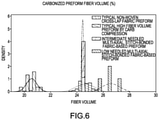
- carbonizing a fibrous preform in accordance with fibrous preform 10 without weights or other external means of compression and the same amount of pre-needling as a typical fibrous preform formed from cross-lapping may result in carbonized preforms with an average fiber volume ratio of 20.6% and a standard deviation of 0.39% (e.g., as shown in FIG. 6 ).
- a fibrous preform produced in accordance with the proposed method may result in a carbonized preform with an average fiber volume of 24.5% or greater without the use of weights or other means of compression during carbonization.
- the typical fibrous preform formed from cross-lapping and carbonized with weights ( FIG. 8 ) may produce an average fiber volume ratio of 24.6% or greater and a standard deviation of 0.7% (e.g., as shown in FIG. 6 ).
- the variation of carbonized preform fiber volume ratio may be approximately 10 times greater (i.e., 0.07% variation vs. 0.7% variation) than the variation of typical non-woven carbonized preforms where textiles formed from cross-lapping are utilized.
- the greater uniformity and compaction of the textile fabric 16 may enable a greater fiber volume ratio after carbonization, with similar variation in fiber volume ratio to typical non-woven carbonized preforms formed with typical textiles and weights or other loading methods to facilitate compaction during carbonization.
- carbonizing a fibrous preform in accordance with fibrous preform 10 without weights and the no needling prior to carbonization, relative to a typical fibrous preform formed from cross-lapping and having typical needling of 51 penetrations/cm 2 prior to carbonization may result in carbonized preforms with an average fiber volume ratio of 24,4% and a standard deviation of 0.07% or fiber volume ratio 26.6% and a standard deviation of 0.62%. Higher fiber volumes and/or lower standard deviations are possible.
- the typical fibrous preform formed from cross-lapping and carbonized with weights may produce an average fiber volume ratio of 24.6%,or higher, and a standard deviation of 0.7%, as outlined above.
- the fiber volume ratio may be increased, but the variation of carbonized preform fiber volume ratio may be similar to the variation of typical non-woven carbonized preforms where textiles formed from cross-lapping are utilized.
- the resulting fibrous preform 10 is substantially composed of oxidized PAN fibers extending in three or more directions through the fibrous preform 10 and pores, or open spaces, extending therethrough. In various embodiments, no other materials are used in forming the fibrous preform 10, such as resins or the like. In addition, the fibrous preform 10 is formed without applying any compressive pressure to the fibrous preform 10 during carbonization, other than the pressure that is applied by the needles 14 during needling and the weight of preforms stacked on top during carbonization.
- fibrous preforms 10 may be placed in a furnace for carbonization.
- the carbonization process may be employed to convert the fibers of the fibrous preforms 10 into pure carbon fibers, as used herein only "pure carbon fibers" means carbon fibers comprised of at least 99% carbon.
- the carbonization process is distinguished from the densification process described below in that the densification process involves infiltrating the pores of the fibrous preform 10 and depositing a carbon matrix within and around the carbon fibers of the fibrous preform, and the carbonization process refer to the process of converting the fibers of the fibrous preform 10 into pure carbon fibers.
- the fibrous preforms 10 may be stacked in the furnace without the additional use of weights as shown in FIG. 7 .
- each fibrous preform 10 may have a fiber volume ratio of greater than 40%, or between 40% and 60% prior to densification.
- fibrous preform 10 comprises a fiber volume of 25% or greater. In various embodiments, after carbonization, fibrous preform 10 comprises a fiber volume of between 23% and 30%. In various embodiments, after carbonization, fibrous preform 10 comprises a fiber volume of between 26% and 28%.
- fibrous preforms 10 may be densified using CVI, as described in further detail below.
- CVI chemical vapor infiltration and deposition
- CVI/CVD chemical vapor infiltration and deposition
- the CVI/CVD process may include a temperature gradient. In various embodiments, the CVI/CVD process may include a pressure gradient. As used herein, CVI/CVD may refer to chemical vapor infiltration or chemical vapor deposition. Accordingly, CVI/CVD may refer to chemical vapor infiltration or deposition.
- CVI/CVD densification may be conducted in a vacuum or partial vacuum (e.g., at pressures of 1-15 torr) or in an inert atmosphere at a temperature in the range from about 900°C to about 1100°C (1,652°F to about 1,832°F), and in various embodiments in the range of up to about 1,000°C (1,832°F) (wherein the term about in this context only means +/- 100°C) for a period of time in the range from about 150 hours to about 550 hours, and in various embodiments, in the range from about 300 hours to about 500 hours (wherein the term about in this context only means +/- 24 hours).
- a vacuum or partial vacuum e.g., at pressures of 1-15 torr
- an inert atmosphere at a temperature in the range from about 900°C to about 1100°C (1,652°F to about 1,832°F)
- up to about 1,000°C (1,832°F) wherein the term about in this context only
- the densification process is continued until the preform reaches a density in the range from 1.6 to 1.9 grams per cubic centimeter (g/cc), and in various embodiments, a density of approximately 1.75 g/cc.
- the resulting C/C part has a carbon fiber structure with a carbon matrix infiltrating the fiber structure, thereby deriving the name "carbon/carbon.”
- the C/C part may undergo a final heat treatment (FHT) process. This may be done using the same furnace used for densification or a different furnace. If done using the same furnace, the flow of hydrocarbon gases would be stopped following the end of the densification process and the temperature increased.
- FHT final heat treatment
- FHT may be conducted in a vacuum or partial vacuum (e.g., at pressures of 1-15 torr) or in an inert atmosphere at a temperature in the range from about 1200°C to about 2600°C (2,192°F to about 4,712°F), and in various embodiments in the range from about 1400°C to about 2200°C (2,552°F to about 3,992°F) (wherein the term about in this context only means +/- 100°C) for a period of time in the range from about 4 hours to about 14 hours, and in various embodiments, in the range from about 8 hours to about 12 hours (wherein the term about in this context only means +/- 2 hours).
- the FHT process may decrease the hardness of the C/C part.
- the FHT process may increase the coefficient of friction of the C/C part.
- the FHT process may decrease the wear life of the C/C part.
- Method 500 may comprise needling each multi-axial, non-crimp, stitch-bonded oxidized PAN fiber fabric layer in a plurality of PAN fiber fabric layers (step 502).
- the plurality of PAN fiber fabric layers may be in accordance with the textile fabric 16 from FIG. 2 .
- each textile fabric layer in the plurality of textile fabric layers may be pre-needled between 0 and 50 penetrations/cm 2 , or between 0 and 30 penetrations/cm 2 , or between 0 and 20 penetrations/cm 2 .
- each textile fabric layer may have greater uniformity and a lower average thickness relative to typical textile fabric layers for use in C/C brake disk fabrication.
- the method 500 may further comprise stacking a plurality of textile fabric layers (Step 504).
- the method 500 further comprises needling the plurality of textile fabric layers (step 506).
- steps 504 and step 506 may be formed simultaneously.
- needling the plurality of textile fabric layers may be between 50 and 81 penetrations/cm 2 .
- a needled non-woven board may be formed after the needling step of the plurality of stacked textile fabric layers (e.g., step 506).
- the method 500 may further comprise cutting a plurality of fibrous preforms from the needle board (step 508) and carbonizing the plurality of fibrous preforms (step 510).
- the carbonizing step may occur without adding weights to the fibrous preforms to compress the preforms.
- C/C brake disk manufacturing process include adding weights to the fibrous preforms prior to carbonization.
- the weights of typical system further compact the fibrous preforms during carbonization. The weights are added to enhance the fiber volume ratio of the typical carbonized fiber preform relative to a process without the weights.
- a fiber volume ratio equal to, or greater than, a fiber volume ratio achieved with weights on typical fibrous preforms from carbonization may be achieved by the method 500 disclosed herein.
- the method 500 provides an ergonomic benefit, reduced time and cost of manufacturing, and an enhanced carbonized preform.
- any of the method or process descriptions may be executed in any order and are not necessarily limited to the order presented.
- any reference to singular includes plural embodiments, and any reference to more than one component or step may include a singular embodiment or step.
- Elements and steps in the figures are illustrated for simplicity and clarity and have not necessarily been rendered according to any particular sequence. For example, steps that may be performed concurrently or in different order are illustrated in the figures to help to improve understanding of embodiments of the present disclosure.
- Any reference to attached, fixed, connected or the like may include permanent, removable, temporary, partial, full and/or any other possible attachment option. Additionally, any reference to without contact (or similar phrases) may also include reduced contact or minimal contact. Surface shading lines may be used throughout the figures to denote different parts or areas but not necessarily to denote the same or different materials. In some cases, reference coordinates may be specific to each figure.
- references to "one embodiment,” “an embodiment,” “various embodiments,” etc. indicate that the embodiment described may include a particular feature, structure, or characteristic, but every embodiment may not necessarily include the particular feature, structure, or characteristic. Moreover, such phrases are not necessarily referring to the same embodiment. Further, when a particular feature, structure, or characteristic is described in connection with an embodiment, it is submitted that it is within the knowledge of one skilled in the art to affect such feature, structure, or characteristic in connection with other embodiments whether or not explicitly described. After reading the description, it will be apparent to one skilled in the relevant art(s) how to implement the disclosure in alternative embodiments.
Landscapes
- Engineering & Computer Science (AREA)
- Chemical & Material Sciences (AREA)
- Mechanical Engineering (AREA)
- Textile Engineering (AREA)
- Composite Materials (AREA)
- General Engineering & Computer Science (AREA)
- Materials Engineering (AREA)
- Ceramic Engineering (AREA)
- Chemical Kinetics & Catalysis (AREA)
- Manufacturing & Machinery (AREA)
- Structural Engineering (AREA)
- Organic Chemistry (AREA)
- Nonwoven Fabrics (AREA)
- Braking Arrangements (AREA)
Priority Applications (1)
| Application Number | Priority Date | Filing Date | Title |
|---|---|---|---|
| EP24163031.8A EP4357319B1 (fr) | 2020-09-14 | 2021-09-13 | Procédé de fabrication de composites carbone/carbone ayant un volume de fibres accru |
Applications Claiming Priority (2)
| Application Number | Priority Date | Filing Date | Title |
|---|---|---|---|
| US202063078074P | 2020-09-14 | 2020-09-14 | |
| US17/392,068 US12117060B2 (en) | 2020-09-14 | 2021-08-02 | Carbon/carbon composites and methods of making carbon/carbon composites having increased fiber volume |
Related Child Applications (1)
| Application Number | Title | Priority Date | Filing Date |
|---|---|---|---|
| EP24163031.8A Division EP4357319B1 (fr) | 2020-09-14 | 2021-09-13 | Procédé de fabrication de composites carbone/carbone ayant un volume de fibres accru |
Publications (2)
| Publication Number | Publication Date |
|---|---|
| EP3971333A1 true EP3971333A1 (fr) | 2022-03-23 |
| EP3971333B1 EP3971333B1 (fr) | 2024-04-03 |
Family
ID=77750055
Family Applications (2)
| Application Number | Title | Priority Date | Filing Date |
|---|---|---|---|
| EP24163031.8A Active EP4357319B1 (fr) | 2020-09-14 | 2021-09-13 | Procédé de fabrication de composites carbone/carbone ayant un volume de fibres accru |
| EP21196374.9A Active EP3971333B1 (fr) | 2020-09-14 | 2021-09-13 | Composites carbone/carbone et procédés de fabrication de composites carbone/carbone présentant une augmentation de volume des fibres |
Family Applications Before (1)
| Application Number | Title | Priority Date | Filing Date |
|---|---|---|---|
| EP24163031.8A Active EP4357319B1 (fr) | 2020-09-14 | 2021-09-13 | Procédé de fabrication de composites carbone/carbone ayant un volume de fibres accru |
Country Status (2)
| Country | Link |
|---|---|
| US (1) | US12117060B2 (fr) |
| EP (2) | EP4357319B1 (fr) |
Cited By (3)
| Publication number | Priority date | Publication date | Assignee | Title |
|---|---|---|---|---|
| EP4321335A3 (fr) * | 2022-08-12 | 2024-05-01 | Goodrich Corporation | Procédé pour limiter le silicium dans des composites cmc à base de particules b4c |
| US12036782B2 (en) | 2020-06-15 | 2024-07-16 | Goodrich Corporation | Composites and methods of forming composites having an increased volume of ceramic particles |
| US12565452B2 (en) | 2022-04-12 | 2026-03-03 | Goodrich Corporation | Z-direction reinforced composites and methods of forming z-direction reinforced composites |
Citations (5)
| Publication number | Priority date | Publication date | Assignee | Title |
|---|---|---|---|---|
| WO2007136962A1 (fr) * | 2006-05-18 | 2007-11-29 | Sulzer Euroflamm Us Inc. | Matériau de friction, système et procédé permettant de fabriquer le matériau de friction |
| GB2462534A (en) * | 2008-08-13 | 2010-02-17 | Goodrich Corp | A method for preparing a needled preform |
| EP2264330A1 (fr) * | 2009-05-20 | 2010-12-22 | Honeywell International Inc. | Composites C-C à faible coût et haute densité densifiés par CVD/CVI pour matériaux de friction d'avion |
| EP2309147A1 (fr) * | 2009-10-09 | 2011-04-13 | Honeywell International Inc. | Matériaux de friction d'avion à faible coût et haute densité utilisant des préformes non tissées à faible volume de fibres avec densification de la nuance |
| EP3085823A1 (fr) * | 2015-04-23 | 2016-10-26 | Goodrich Corporation | Matériaux composites de carbone haute performance à z faible |
Family Cites Families (7)
| Publication number | Priority date | Publication date | Assignee | Title |
|---|---|---|---|---|
| US5392500A (en) * | 1991-12-02 | 1995-02-28 | Societe Europeenne De Propulsion | Process for the manufacture of a fibrous preform formed of refractory fibers for producing a composite material article |
| FR2754031B1 (fr) * | 1996-09-30 | 1998-12-18 | Carbone Ind | Elaboration de preformes fibreuses pour la fabrication de disques de frein en materiau composite |
| FR2757153B1 (fr) * | 1996-12-17 | 1999-03-05 | Carbone Ind | Procede de fabrication de pieces, notamment de disques de freins, en materiau composite carbone-carbone |
| US5952075A (en) * | 1997-09-08 | 1999-09-14 | Fiberite, Inc. | Needled near netshape carbon preforms having polar woven substrates and methods of producing same |
| US8673188B2 (en) | 2006-02-14 | 2014-03-18 | Goodrich Corporation | Carbon-carbon parts and methods for making same |
| US8060997B2 (en) | 2009-03-04 | 2011-11-22 | Goodrich Corporation | Low z preform |
| US10457016B2 (en) | 2016-02-23 | 2019-10-29 | Honeywell International Inc. | Differential needling of a carbon fiber preform |
-
2021
- 2021-08-02 US US17/392,068 patent/US12117060B2/en active Active
- 2021-09-13 EP EP24163031.8A patent/EP4357319B1/fr active Active
- 2021-09-13 EP EP21196374.9A patent/EP3971333B1/fr active Active
Patent Citations (5)
| Publication number | Priority date | Publication date | Assignee | Title |
|---|---|---|---|---|
| WO2007136962A1 (fr) * | 2006-05-18 | 2007-11-29 | Sulzer Euroflamm Us Inc. | Matériau de friction, système et procédé permettant de fabriquer le matériau de friction |
| GB2462534A (en) * | 2008-08-13 | 2010-02-17 | Goodrich Corp | A method for preparing a needled preform |
| EP2264330A1 (fr) * | 2009-05-20 | 2010-12-22 | Honeywell International Inc. | Composites C-C à faible coût et haute densité densifiés par CVD/CVI pour matériaux de friction d'avion |
| EP2309147A1 (fr) * | 2009-10-09 | 2011-04-13 | Honeywell International Inc. | Matériaux de friction d'avion à faible coût et haute densité utilisant des préformes non tissées à faible volume de fibres avec densification de la nuance |
| EP3085823A1 (fr) * | 2015-04-23 | 2016-10-26 | Goodrich Corporation | Matériaux composites de carbone haute performance à z faible |
Cited By (5)
| Publication number | Priority date | Publication date | Assignee | Title |
|---|---|---|---|---|
| US12036782B2 (en) | 2020-06-15 | 2024-07-16 | Goodrich Corporation | Composites and methods of forming composites having an increased volume of ceramic particles |
| US12447715B2 (en) | 2020-06-15 | 2025-10-21 | Goodrich Corporation | Composites and methods of forming composites having an increased volume of ceramic particles |
| US12565452B2 (en) | 2022-04-12 | 2026-03-03 | Goodrich Corporation | Z-direction reinforced composites and methods of forming z-direction reinforced composites |
| EP4321335A3 (fr) * | 2022-08-12 | 2024-05-01 | Goodrich Corporation | Procédé pour limiter le silicium dans des composites cmc à base de particules b4c |
| US12528745B2 (en) | 2022-08-12 | 2026-01-20 | Goodrich Corporation | Method to limit silicon in B4C particulate based CMC composites |
Also Published As
| Publication number | Publication date |
|---|---|
| EP4357319B1 (fr) | 2026-03-04 |
| EP4357319A3 (fr) | 2024-07-03 |
| EP4357319A2 (fr) | 2024-04-24 |
| EP3971333B1 (fr) | 2024-04-03 |
| US20220082144A1 (en) | 2022-03-17 |
| US12117060B2 (en) | 2024-10-15 |
Similar Documents
| Publication | Publication Date | Title |
|---|---|---|
| EP4357319B1 (fr) | Procédé de fabrication de composites carbone/carbone ayant un volume de fibres accru | |
| EP1377759B1 (fr) | Preforme annulaire pour freins en fibres de carbone et methode de fabrication | |
| EP1181260B1 (fr) | Preformes cordales pour articles renforces et procede de production | |
| EP3211262B1 (fr) | Aiguilletage différentielle de preformes de fibres de carbone | |
| US5654059A (en) | Fiber-reinforced carbon and graphite articles and method for the production thereof | |
| JP4468015B2 (ja) | 繊維ブランクの製造方法、および繊維強化複合材料部品の製造方法 | |
| US5895716A (en) | Wet friction materials, methods of making them, and apparatus containing the same | |
| EP1987184B1 (fr) | Procédé pour fabriquer des pièces carbone/carbone | |
| EP3415673B1 (fr) | Matériaux composites de carbone haute performance à z faible | |
| CN111886130A (zh) | 制作纤维预制件的方法以及由此获得的纤维预制件 | |
| MX2007010273A (es) | Metodo para elaborar una parte de material compuesto con una matriz ceramica y parte resultante. | |
| US6660355B2 (en) | Wear resistant articles | |
| US20060016550A1 (en) | Carbon fiber friction material | |
| EP2473752B1 (fr) | Préforme poreuse contenant du carbone et procédé de production de cette préforme | |
| EP1568911A1 (fr) | Matériau de friction en fibres de carbone à résistance à l'usure améliorée |
Legal Events
| Date | Code | Title | Description |
|---|---|---|---|
| PUAI | Public reference made under article 153(3) epc to a published international application that has entered the european phase |
Free format text: ORIGINAL CODE: 0009012 |
|
| STAA | Information on the status of an ep patent application or granted ep patent |
Free format text: STATUS: THE APPLICATION HAS BEEN PUBLISHED |
|
| AK | Designated contracting states |
Kind code of ref document: A1 Designated state(s): AL AT BE BG CH CY CZ DE DK EE ES FI FR GB GR HR HU IE IS IT LI LT LU LV MC MK MT NL NO PL PT RO RS SE SI SK SM TR |
|
| STAA | Information on the status of an ep patent application or granted ep patent |
Free format text: STATUS: REQUEST FOR EXAMINATION WAS MADE |
|
| 17P | Request for examination filed |
Effective date: 20220923 |
|
| RBV | Designated contracting states (corrected) |
Designated state(s): AL AT BE BG CH CY CZ DE DK EE ES FI FR GB GR HR HU IE IS IT LI LT LU LV MC MK MT NL NO PL PT RO RS SE SI SK SM TR |
|
| STAA | Information on the status of an ep patent application or granted ep patent |
Free format text: STATUS: EXAMINATION IS IN PROGRESS |
|
| 17Q | First examination report despatched |
Effective date: 20230123 |
|
| P01 | Opt-out of the competence of the unified patent court (upc) registered |
Effective date: 20230922 |
|
| GRAP | Despatch of communication of intention to grant a patent |
Free format text: ORIGINAL CODE: EPIDOSNIGR1 |
|
| STAA | Information on the status of an ep patent application or granted ep patent |
Free format text: STATUS: GRANT OF PATENT IS INTENDED |
|
| INTG | Intention to grant announced |
Effective date: 20231113 |
|
| GRAS | Grant fee paid |
Free format text: ORIGINAL CODE: EPIDOSNIGR3 |
|
| GRAA | (expected) grant |
Free format text: ORIGINAL CODE: 0009210 |
|
| STAA | Information on the status of an ep patent application or granted ep patent |
Free format text: STATUS: THE PATENT HAS BEEN GRANTED |
|
| AK | Designated contracting states |
Kind code of ref document: B1 Designated state(s): AL AT BE BG CH CY CZ DE DK EE ES FI FR GB GR HR HU IE IS IT LI LT LU LV MC MK MT NL NO PL PT RO RS SE SI SK SM TR |
|
| REG | Reference to a national code |
Ref country code: CH Ref legal event code: EP |
|
| REG | Reference to a national code |
Ref country code: IE Ref legal event code: FG4D |
|
| REG | Reference to a national code |
Ref country code: DE Ref legal event code: R096 Ref document number: 602021011196 Country of ref document: DE |
|
| REG | Reference to a national code |
Ref country code: LT Ref legal event code: MG9D |
|
| REG | Reference to a national code |
Ref country code: NL Ref legal event code: MP Effective date: 20240403 |
|
| REG | Reference to a national code |
Ref country code: AT Ref legal event code: MK05 Ref document number: 1672410 Country of ref document: AT Kind code of ref document: T Effective date: 20240403 |
|
| PG25 | Lapsed in a contracting state [announced via postgrant information from national office to epo] |
Ref country code: NL Free format text: LAPSE BECAUSE OF FAILURE TO SUBMIT A TRANSLATION OF THE DESCRIPTION OR TO PAY THE FEE WITHIN THE PRESCRIBED TIME-LIMIT Effective date: 20240403 |
|
| PG25 | Lapsed in a contracting state [announced via postgrant information from national office to epo] |
Ref country code: NL Free format text: LAPSE BECAUSE OF FAILURE TO SUBMIT A TRANSLATION OF THE DESCRIPTION OR TO PAY THE FEE WITHIN THE PRESCRIBED TIME-LIMIT Effective date: 20240403 |
|
| PG25 | Lapsed in a contracting state [announced via postgrant information from national office to epo] |
Ref country code: IS Free format text: LAPSE BECAUSE OF FAILURE TO SUBMIT A TRANSLATION OF THE DESCRIPTION OR TO PAY THE FEE WITHIN THE PRESCRIBED TIME-LIMIT Effective date: 20240803 |
|
| PG25 | Lapsed in a contracting state [announced via postgrant information from national office to epo] |
Ref country code: BG Free format text: LAPSE BECAUSE OF FAILURE TO SUBMIT A TRANSLATION OF THE DESCRIPTION OR TO PAY THE FEE WITHIN THE PRESCRIBED TIME-LIMIT Effective date: 20240403 |
|
| PG25 | Lapsed in a contracting state [announced via postgrant information from national office to epo] |
Ref country code: HR Free format text: LAPSE BECAUSE OF FAILURE TO SUBMIT A TRANSLATION OF THE DESCRIPTION OR TO PAY THE FEE WITHIN THE PRESCRIBED TIME-LIMIT Effective date: 20240403 Ref country code: FI Free format text: LAPSE BECAUSE OF FAILURE TO SUBMIT A TRANSLATION OF THE DESCRIPTION OR TO PAY THE FEE WITHIN THE PRESCRIBED TIME-LIMIT Effective date: 20240403 |
|
| PG25 | Lapsed in a contracting state [announced via postgrant information from national office to epo] |
Ref country code: GR Free format text: LAPSE BECAUSE OF FAILURE TO SUBMIT A TRANSLATION OF THE DESCRIPTION OR TO PAY THE FEE WITHIN THE PRESCRIBED TIME-LIMIT Effective date: 20240704 |
|
| PG25 | Lapsed in a contracting state [announced via postgrant information from national office to epo] |
Ref country code: PT Free format text: LAPSE BECAUSE OF FAILURE TO SUBMIT A TRANSLATION OF THE DESCRIPTION OR TO PAY THE FEE WITHIN THE PRESCRIBED TIME-LIMIT Effective date: 20240805 |
|
| PG25 | Lapsed in a contracting state [announced via postgrant information from national office to epo] |
Ref country code: ES Free format text: LAPSE BECAUSE OF FAILURE TO SUBMIT A TRANSLATION OF THE DESCRIPTION OR TO PAY THE FEE WITHIN THE PRESCRIBED TIME-LIMIT Effective date: 20240403 |
|
| PG25 | Lapsed in a contracting state [announced via postgrant information from national office to epo] |
Ref country code: CZ Free format text: LAPSE BECAUSE OF FAILURE TO SUBMIT A TRANSLATION OF THE DESCRIPTION OR TO PAY THE FEE WITHIN THE PRESCRIBED TIME-LIMIT Effective date: 20240403 |
|
| PG25 | Lapsed in a contracting state [announced via postgrant information from national office to epo] |
Ref country code: AT Free format text: LAPSE BECAUSE OF FAILURE TO SUBMIT A TRANSLATION OF THE DESCRIPTION OR TO PAY THE FEE WITHIN THE PRESCRIBED TIME-LIMIT Effective date: 20240403 |
|
| PG25 | Lapsed in a contracting state [announced via postgrant information from national office to epo] |
Ref country code: PL Free format text: LAPSE BECAUSE OF FAILURE TO SUBMIT A TRANSLATION OF THE DESCRIPTION OR TO PAY THE FEE WITHIN THE PRESCRIBED TIME-LIMIT Effective date: 20240403 |
|
| PG25 | Lapsed in a contracting state [announced via postgrant information from national office to epo] |
Ref country code: LV Free format text: LAPSE BECAUSE OF FAILURE TO SUBMIT A TRANSLATION OF THE DESCRIPTION OR TO PAY THE FEE WITHIN THE PRESCRIBED TIME-LIMIT Effective date: 20240403 |
|
| PG25 | Lapsed in a contracting state [announced via postgrant information from national office to epo] |
Ref country code: PT Free format text: LAPSE BECAUSE OF FAILURE TO SUBMIT A TRANSLATION OF THE DESCRIPTION OR TO PAY THE FEE WITHIN THE PRESCRIBED TIME-LIMIT Effective date: 20240805 Ref country code: PL Free format text: LAPSE BECAUSE OF FAILURE TO SUBMIT A TRANSLATION OF THE DESCRIPTION OR TO PAY THE FEE WITHIN THE PRESCRIBED TIME-LIMIT Effective date: 20240403 Ref country code: NO Free format text: LAPSE BECAUSE OF FAILURE TO SUBMIT A TRANSLATION OF THE DESCRIPTION OR TO PAY THE FEE WITHIN THE PRESCRIBED TIME-LIMIT Effective date: 20240703 Ref country code: LV Free format text: LAPSE BECAUSE OF FAILURE TO SUBMIT A TRANSLATION OF THE DESCRIPTION OR TO PAY THE FEE WITHIN THE PRESCRIBED TIME-LIMIT Effective date: 20240403 Ref country code: IS Free format text: LAPSE BECAUSE OF FAILURE TO SUBMIT A TRANSLATION OF THE DESCRIPTION OR TO PAY THE FEE WITHIN THE PRESCRIBED TIME-LIMIT Effective date: 20240803 Ref country code: HR Free format text: LAPSE BECAUSE OF FAILURE TO SUBMIT A TRANSLATION OF THE DESCRIPTION OR TO PAY THE FEE WITHIN THE PRESCRIBED TIME-LIMIT Effective date: 20240403 Ref country code: GR Free format text: LAPSE BECAUSE OF FAILURE TO SUBMIT A TRANSLATION OF THE DESCRIPTION OR TO PAY THE FEE WITHIN THE PRESCRIBED TIME-LIMIT Effective date: 20240704 Ref country code: FI Free format text: LAPSE BECAUSE OF FAILURE TO SUBMIT A TRANSLATION OF THE DESCRIPTION OR TO PAY THE FEE WITHIN THE PRESCRIBED TIME-LIMIT Effective date: 20240403 Ref country code: ES Free format text: LAPSE BECAUSE OF FAILURE TO SUBMIT A TRANSLATION OF THE DESCRIPTION OR TO PAY THE FEE WITHIN THE PRESCRIBED TIME-LIMIT Effective date: 20240403 Ref country code: CZ Free format text: LAPSE BECAUSE OF FAILURE TO SUBMIT A TRANSLATION OF THE DESCRIPTION OR TO PAY THE FEE WITHIN THE PRESCRIBED TIME-LIMIT Effective date: 20240403 Ref country code: BG Free format text: LAPSE BECAUSE OF FAILURE TO SUBMIT A TRANSLATION OF THE DESCRIPTION OR TO PAY THE FEE WITHIN THE PRESCRIBED TIME-LIMIT Effective date: 20240403 Ref country code: AT Free format text: LAPSE BECAUSE OF FAILURE TO SUBMIT A TRANSLATION OF THE DESCRIPTION OR TO PAY THE FEE WITHIN THE PRESCRIBED TIME-LIMIT Effective date: 20240403 Ref country code: RS Free format text: LAPSE BECAUSE OF FAILURE TO SUBMIT A TRANSLATION OF THE DESCRIPTION OR TO PAY THE FEE WITHIN THE PRESCRIBED TIME-LIMIT Effective date: 20240703 |
|
| REG | Reference to a national code |
Ref country code: DE Ref legal event code: R097 Ref document number: 602021011196 Country of ref document: DE |
|
| PG25 | Lapsed in a contracting state [announced via postgrant information from national office to epo] |
Ref country code: DK Free format text: LAPSE BECAUSE OF FAILURE TO SUBMIT A TRANSLATION OF THE DESCRIPTION OR TO PAY THE FEE WITHIN THE PRESCRIBED TIME-LIMIT Effective date: 20240403 |
|
| PG25 | Lapsed in a contracting state [announced via postgrant information from national office to epo] |
Ref country code: EE Free format text: LAPSE BECAUSE OF FAILURE TO SUBMIT A TRANSLATION OF THE DESCRIPTION OR TO PAY THE FEE WITHIN THE PRESCRIBED TIME-LIMIT Effective date: 20240403 |
|
| PG25 | Lapsed in a contracting state [announced via postgrant information from national office to epo] |
Ref country code: RO Free format text: LAPSE BECAUSE OF FAILURE TO SUBMIT A TRANSLATION OF THE DESCRIPTION OR TO PAY THE FEE WITHIN THE PRESCRIBED TIME-LIMIT Effective date: 20240403 Ref country code: SK Free format text: LAPSE BECAUSE OF FAILURE TO SUBMIT A TRANSLATION OF THE DESCRIPTION OR TO PAY THE FEE WITHIN THE PRESCRIBED TIME-LIMIT Effective date: 20240403 |
|
| PG25 | Lapsed in a contracting state [announced via postgrant information from national office to epo] |
Ref country code: SM Free format text: LAPSE BECAUSE OF FAILURE TO SUBMIT A TRANSLATION OF THE DESCRIPTION OR TO PAY THE FEE WITHIN THE PRESCRIBED TIME-LIMIT Effective date: 20240403 |
|
| PG25 | Lapsed in a contracting state [announced via postgrant information from national office to epo] |
Ref country code: SM Free format text: LAPSE BECAUSE OF FAILURE TO SUBMIT A TRANSLATION OF THE DESCRIPTION OR TO PAY THE FEE WITHIN THE PRESCRIBED TIME-LIMIT Effective date: 20240403 Ref country code: SK Free format text: LAPSE BECAUSE OF FAILURE TO SUBMIT A TRANSLATION OF THE DESCRIPTION OR TO PAY THE FEE WITHIN THE PRESCRIBED TIME-LIMIT Effective date: 20240403 Ref country code: RO Free format text: LAPSE BECAUSE OF FAILURE TO SUBMIT A TRANSLATION OF THE DESCRIPTION OR TO PAY THE FEE WITHIN THE PRESCRIBED TIME-LIMIT Effective date: 20240403 Ref country code: EE Free format text: LAPSE BECAUSE OF FAILURE TO SUBMIT A TRANSLATION OF THE DESCRIPTION OR TO PAY THE FEE WITHIN THE PRESCRIBED TIME-LIMIT Effective date: 20240403 Ref country code: DK Free format text: LAPSE BECAUSE OF FAILURE TO SUBMIT A TRANSLATION OF THE DESCRIPTION OR TO PAY THE FEE WITHIN THE PRESCRIBED TIME-LIMIT Effective date: 20240403 |
|
| PLBE | No opposition filed within time limit |
Free format text: ORIGINAL CODE: 0009261 |
|
| STAA | Information on the status of an ep patent application or granted ep patent |
Free format text: STATUS: NO OPPOSITION FILED WITHIN TIME LIMIT |
|
| 26N | No opposition filed |
Effective date: 20250106 |
|
| REG | Reference to a national code |
Ref country code: DE Ref legal event code: R119 Ref document number: 602021011196 Country of ref document: DE |
|
| PG25 | Lapsed in a contracting state [announced via postgrant information from national office to epo] |
Ref country code: SI Free format text: LAPSE BECAUSE OF FAILURE TO SUBMIT A TRANSLATION OF THE DESCRIPTION OR TO PAY THE FEE WITHIN THE PRESCRIBED TIME-LIMIT Effective date: 20240403 Ref country code: MC Free format text: LAPSE BECAUSE OF FAILURE TO SUBMIT A TRANSLATION OF THE DESCRIPTION OR TO PAY THE FEE WITHIN THE PRESCRIBED TIME-LIMIT Effective date: 20240403 |
|
| REG | Reference to a national code |
Ref country code: CH Ref legal event code: PL |
|
| PG25 | Lapsed in a contracting state [announced via postgrant information from national office to epo] |
Ref country code: LU Free format text: LAPSE BECAUSE OF NON-PAYMENT OF DUE FEES Effective date: 20240913 |
|
| PG25 | Lapsed in a contracting state [announced via postgrant information from national office to epo] |
Ref country code: DE Free format text: LAPSE BECAUSE OF NON-PAYMENT OF DUE FEES Effective date: 20250401 |
|
| REG | Reference to a national code |
Ref country code: BE Ref legal event code: MM Effective date: 20240930 |
|
| PG25 | Lapsed in a contracting state [announced via postgrant information from national office to epo] |
Ref country code: BE Free format text: LAPSE BECAUSE OF NON-PAYMENT OF DUE FEES Effective date: 20240930 |
|
| PG25 | Lapsed in a contracting state [announced via postgrant information from national office to epo] |
Ref country code: CH Free format text: LAPSE BECAUSE OF NON-PAYMENT OF DUE FEES Effective date: 20240930 |
|
| PG25 | Lapsed in a contracting state [announced via postgrant information from national office to epo] |
Ref country code: IE Free format text: LAPSE BECAUSE OF NON-PAYMENT OF DUE FEES Effective date: 20240913 |
|
| PG25 | Lapsed in a contracting state [announced via postgrant information from national office to epo] |
Ref country code: SE Free format text: LAPSE BECAUSE OF FAILURE TO SUBMIT A TRANSLATION OF THE DESCRIPTION OR TO PAY THE FEE WITHIN THE PRESCRIBED TIME-LIMIT Effective date: 20240403 |
|
| PGFP | Annual fee paid to national office [announced via postgrant information from national office to epo] |
Ref country code: GB Payment date: 20250820 Year of fee payment: 5 |
|
| PGFP | Annual fee paid to national office [announced via postgrant information from national office to epo] |
Ref country code: FR Payment date: 20250820 Year of fee payment: 5 |
|
| PG25 | Lapsed in a contracting state [announced via postgrant information from national office to epo] |
Ref country code: IT Free format text: LAPSE BECAUSE OF FAILURE TO SUBMIT A TRANSLATION OF THE DESCRIPTION OR TO PAY THE FEE WITHIN THE PRESCRIBED TIME-LIMIT Effective date: 20240403 Ref country code: CY Free format text: LAPSE BECAUSE OF FAILURE TO SUBMIT A TRANSLATION OF THE DESCRIPTION OR TO PAY THE FEE WITHIN THE PRESCRIBED TIME-LIMIT; INVALID AB INITIO Effective date: 20210913 |
|
| PG25 | Lapsed in a contracting state [announced via postgrant information from national office to epo] |
Ref country code: HU Free format text: LAPSE BECAUSE OF FAILURE TO SUBMIT A TRANSLATION OF THE DESCRIPTION OR TO PAY THE FEE WITHIN THE PRESCRIBED TIME-LIMIT; INVALID AB INITIO Effective date: 20210913 |