EP3973459B1 - Réseaux antagonistes génératifs avec discriminateurs temporels et spatiaux pour la génération efficace de vidéo - Google Patents
Réseaux antagonistes génératifs avec discriminateurs temporels et spatiaux pour la génération efficace de vidéo Download PDFInfo
- Publication number
- EP3973459B1 EP3973459B1 EP20728455.5A EP20728455A EP3973459B1 EP 3973459 B1 EP3973459 B1 EP 3973459B1 EP 20728455 A EP20728455 A EP 20728455A EP 3973459 B1 EP3973459 B1 EP 3973459B1
- Authority
- EP
- European Patent Office
- Prior art keywords
- discriminator
- neural network
- attention
- images
- network
- Prior art date
- Legal status (The legal status is an assumption and is not a legal conclusion. Google has not performed a legal analysis and makes no representation as to the accuracy of the status listed.)
- Active
Links
Images



Classifications
-
- G—PHYSICS
- G06—COMPUTING OR CALCULATING; COUNTING
- G06T—IMAGE DATA PROCESSING OR GENERATION, IN GENERAL
- G06T3/00—Geometric image transformations in the plane of the image
- G06T3/40—Scaling of whole images or parts thereof, e.g. expanding or contracting
- G06T3/4046—Scaling of whole images or parts thereof, e.g. expanding or contracting using neural networks
-
- G—PHYSICS
- G06—COMPUTING OR CALCULATING; COUNTING
- G06N—COMPUTING ARRANGEMENTS BASED ON SPECIFIC COMPUTATIONAL MODELS
- G06N3/00—Computing arrangements based on biological models
- G06N3/02—Neural networks
- G06N3/04—Architecture, e.g. interconnection topology
- G06N3/044—Recurrent networks, e.g. Hopfield networks
- G06N3/0442—Recurrent networks, e.g. Hopfield networks characterised by memory or gating, e.g. long short-term memory [LSTM] or gated recurrent units [GRU]
-
- G—PHYSICS
- G06—COMPUTING OR CALCULATING; COUNTING
- G06N—COMPUTING ARRANGEMENTS BASED ON SPECIFIC COMPUTATIONAL MODELS
- G06N3/00—Computing arrangements based on biological models
- G06N3/02—Neural networks
- G06N3/04—Architecture, e.g. interconnection topology
- G06N3/045—Combinations of networks
-
- G—PHYSICS
- G06—COMPUTING OR CALCULATING; COUNTING
- G06N—COMPUTING ARRANGEMENTS BASED ON SPECIFIC COMPUTATIONAL MODELS
- G06N3/00—Computing arrangements based on biological models
- G06N3/02—Neural networks
- G06N3/04—Architecture, e.g. interconnection topology
- G06N3/045—Combinations of networks
- G06N3/0455—Auto-encoder networks; Encoder-decoder networks
-
- G—PHYSICS
- G06—COMPUTING OR CALCULATING; COUNTING
- G06N—COMPUTING ARRANGEMENTS BASED ON SPECIFIC COMPUTATIONAL MODELS
- G06N3/00—Computing arrangements based on biological models
- G06N3/02—Neural networks
- G06N3/04—Architecture, e.g. interconnection topology
- G06N3/0464—Convolutional networks [CNN, ConvNet]
-
- G—PHYSICS
- G06—COMPUTING OR CALCULATING; COUNTING
- G06N—COMPUTING ARRANGEMENTS BASED ON SPECIFIC COMPUTATIONAL MODELS
- G06N3/00—Computing arrangements based on biological models
- G06N3/02—Neural networks
- G06N3/04—Architecture, e.g. interconnection topology
- G06N3/0475—Generative networks
-
- G—PHYSICS
- G06—COMPUTING OR CALCULATING; COUNTING
- G06N—COMPUTING ARRANGEMENTS BASED ON SPECIFIC COMPUTATIONAL MODELS
- G06N3/00—Computing arrangements based on biological models
- G06N3/02—Neural networks
- G06N3/08—Learning methods
-
- G—PHYSICS
- G06—COMPUTING OR CALCULATING; COUNTING
- G06N—COMPUTING ARRANGEMENTS BASED ON SPECIFIC COMPUTATIONAL MODELS
- G06N3/00—Computing arrangements based on biological models
- G06N3/02—Neural networks
- G06N3/08—Learning methods
- G06N3/09—Supervised learning
-
- G—PHYSICS
- G06—COMPUTING OR CALCULATING; COUNTING
- G06N—COMPUTING ARRANGEMENTS BASED ON SPECIFIC COMPUTATIONAL MODELS
- G06N3/00—Computing arrangements based on biological models
- G06N3/02—Neural networks
- G06N3/08—Learning methods
- G06N3/094—Adversarial learning
-
- G—PHYSICS
- G06—COMPUTING OR CALCULATING; COUNTING
- G06T—IMAGE DATA PROCESSING OR GENERATION, IN GENERAL
- G06T2207/00—Indexing scheme for image analysis or image enhancement
- G06T2207/20—Special algorithmic details
- G06T2207/20081—Training; Learning
Definitions
- a recurrent neural network is a neural network that receives an input sequence and generates an output sequence from the input sequence.
- a recurrent neural network can use some or all of the internal state of the network from a previous time step in computing an output at a current time step.
- An example of a recurrent neural network is a long short term (LSTM) neural network that includes one or more LSTM memory blocks. Each LSTM memory block can include one or more cells that each include an input gate, a forget gate, and an output gate that allow the cell to store previous states for the cell, e.g., for use in generating a current activation or to be provided to other components of the LSTM neural network.
- LSTM long short term
- This specification generally describes how a system implemented as computer programs in one or more computers in one or more locations can perform a method to train (that is, adjust the parameters of) an adaptive system which is a Generative Adversarial Network (GAN) comprising a generator network and a discriminator network, based on training set of data items selected from a distribution.
- GAN Generative Adversarial Network
- the generator network once trained, may be used to generate samples from the distribution based on latent values (or simply "latents") selected from a latent value distribution (or "latent distribution").
- the implementations described herein produce a generator network for generating a sequence of images that detail a temporal sequence (such as a video comprising a series of frames).
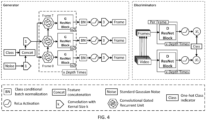
- the disclosure proposes the use of a duel discriminator network that comprises a temporal discriminator network for discriminating based on temporal features of a series of images and a spatial discriminator network for discriminating based on spatial features of individual images.
- the training methods described herein provide improvements in computational efficiency. This is achieved by applying the spatial discriminator network to a set of one or more images that have reduced temporal resolution (relative to the input images) and applying the temporal discriminator network to a set of images that have reduced spatial resolution (relative to the input images).
- This allows each of the discriminator networks to be applied more efficiently (e.g. over a reduced number of processing steps) in order to produce a discriminator score for use in training the generator, whilst maintaining accuracy of the discriminator network.
- this allows a generator network to be trained to more accurately generate sequences of images, through the use of the improved discriminator.
- the use of separate temporal and spatial discriminator networks allows the use of parallel processing to improve the speed and efficiency of the discriminator network.
- the spatial discriminator network may be implemented in parallel to the temporal discriminator network (e.g. through a GPU). This allows the method to leverage parallel processing to speed up the processing of the discriminator network. As the temporal and spatial discriminators act on a reduced feature space and on data of reduced resolution, this results in a quicker and more efficient discriminator network.
- the disclosure proposes a more efficient generator network that makes use a factorized self-attention.
- Self-attention allows the generator to weight the relative influence of embeddings across all time steps when generating each image. In other words, a weighted combination of all embeddings is used when each image is generated.
- the present disclosure proposes a three-layer attention network, with each layer applying attention across a corresponding one of height features, width features and time features. By applying factorization to separate out the attention steps relating to these three feature spaces, the amount of memory storage required to implement self-attention is greatly reduced. This method can drastically reduce the memory footprint (e.g. 3000 fold). Experiments have shown this process to reduce the memory footprint from 150GB to 50 MB (a reduction of 99.97%), thereby allowing the process to be performed in using conventional accelerators.
- each discriminator network can be supplied with a sample from the input images that has reduced resolution in the feature space that is not being directly considered. That is, the spatial discriminator network is supplied with a set of one or more images of reduced temporal resolution and the temporal discriminator network is supplied with a set of images with reduced spatial resolution.
- the input sequence of images may have been generated by the generator or may be provided by another source (e.g. might be real images of a real environment).
- the input sequence of images might be a video (e.g. a sequence of frames of optical images) or might be some other form of temporal progression (e.g. a sequence of LiDAR images).
- Each image may be formed from measurements taken from one or more sensors.
- each image might be a multi-sensory image (e.g. an image formed through a fusion of data from a number of sensors).
- the sensors may sense a variety of types of measurement (for instance, sound, light, vibration, etc.).
- the images form a temporal progression so that there is some temporal relationship between the images.
- Forming the first set might comprise selecting a subset comprising one or more images from the input sequence of images, such that the first set has fewer images than the input sequence. That is, a sample of k images might be chosen from the input sequence of images, where k is less than the total number of images in the input set, L. Each image in the first set may have the same spatial resolution as the images in the input sequence. That is, the selection of the first set might not involve altering spatial resolution of the individual images. For instance, for an input sequence of L images, each having a H ⁇ W pixels, the first set is formed to be a sequence of k images, each having H ⁇ W pixels, where k ⁇ L. In other words, the first set has a lower temporal resolution than the input sequence.
- the subset may be selected at random from the input sequence of images.
- Forming the second set might comprise selecting two or more images from the input sequence and reducing the spatial resolution for each of the selected one or more images. That is, each selected image might be transformed in order to reduce its spatial resolution.
- each image is an H ⁇ W image
- each image might be mapped to a lower resolution, H' ⁇ W' image, according to a downsampling function (mapping) ⁇ ( ⁇ ).
- the downsampling function may be a differentiable function that reduces the spatial resolution of each image.
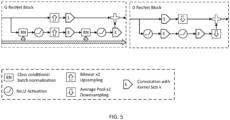
- the downsampling function might be an average pooling function (e.g. a 2 ⁇ 2 average pooling function).
- the temporal resolution of the second set might be the same as the temporal resolution of the input sequence. That is, the second set might comprise a reduced spatial resolution version of each image in the input sequence. Accordingly, the second set might also comprise L images.
- the first set might have a higher temporal resolution but lower spatial resolution than the second set.
- Forming the embedding of the classifications might comprise inputting the classifications into a self-attention block to form a tensor that combines information across the classifications.
- the attention network comprises: a height attention layer configured to determine a height attention map by applying attention to all feature maps across the height dimension; a width attention layer configured to, for each time step, determine a width attention map by applying attention to all feature maps across the width dimension; and a time attention layer configured to, for each time step, determine a time attention map by applying attention to all feature maps across the time dimension.
- the generator network determines, for each time step, an image for the time step by applying the height, width and time attention maps to a decoding of the feature maps.
- the height attention layer may map its input onto the height dimension using the height attention map
- the width attention layer may map its input onto the width dimension using the width attention map
- the time attention layer may map its input onto the time dimension using the time attention map, such that the attention network outputs an image for each time step, each image having values mapped to the height and width dimensions.
- the attention network may be a set of attention layers in each of a set of decoders that are operated in parallel. Accordingly, each set of attention layers may map the input data onto the width, height and time dimensions in order to generate a corresponding image for a corresponding time step.
- An additional attention layer (e.g. a non-causal self-attention block) may be applied to the feature maps prior to input into the attention network and decoder network. This can help to further improve the accuracy of the generated images.
- the additional attention layer may act over a reduced number of features relative to the attention network, thereby avoiding the need to separate out attention on the width, height and time dimensions.
- the sequence of images may be generated according to any of the image generation methods described herein.
- the generator network might comprise the attention layer discussed above.
- Updating the weights for the generator network may comprise forming a combined discriminator score based on the first and second discriminator scores and updating the weights for the generator network based on the combined discriminator score.
- the methods described herein aim to train a discriminator network for use in training a generator network to generate sequences of images based on latent values.
- the discriminator network can be trained more efficiently and accurately and can thereby be used to train a generator network more efficiently and accurately.
- methods are provided for reducing the memory footprint when applying self-attention to the generator network. This is achieved by separating the attention network into separate height, width and temporal attention layers.
- the generator network may generate the data item conditioned upon a conditional vector (target data) input to the generator network, representing a target for generating the data item.
- the target data may represent the same or a different type or modality of data to the generated sequence of images.
- the target data may define a label or class of one of the images for generation and the generated sequence of images may then comprise an example image of that type (e.g. African elephant).
- the target data may comprise an image or an encoding of an image (or sequence of images), and the generated sequence of images may define another, similar sequence of images - for example when trained on images of faces, the target data may comprise an encoding of a person's face and the generator network may then generate a sequence of images representing a similar face with a different pose/lighting condition.
- the target data may show an image of a subject and include data defining a movement/change of a viewpoint, and the generator network could generate a sequence of images of the subject from the new viewpoint.
- the system may also generate video autoregressively, in particular given one or more previous video frames. These previous video frames may be used to condition the generator by applying an encoding of a set of classifications of the frames as an initial state of a recurrent network in the generator network.
- the generator network may be used to generate further sequences of images for training another machine learning system.
- the generator network and discriminator network may be jointly trained on a set of videos and then the generator network may be used to generate new videos similar to those in the training data set.
- the set of latent values may be determined by sampling from the latent distribution of latent values. If the generator network has been trained conditioned on additional data, e.g. labels, new videos may be generated conditioned on additional data e.g. a label provided to the generator network. In this way additional labelled videos may be generated, for example to supplement a dearth of unlabeled training videos.
Landscapes
- Engineering & Computer Science (AREA)
- Physics & Mathematics (AREA)
- Theoretical Computer Science (AREA)
- General Physics & Mathematics (AREA)
- Artificial Intelligence (AREA)
- Evolutionary Computation (AREA)
- Data Mining & Analysis (AREA)
- Computational Linguistics (AREA)
- Biophysics (AREA)
- Biomedical Technology (AREA)
- General Health & Medical Sciences (AREA)
- Molecular Biology (AREA)
- Computing Systems (AREA)
- General Engineering & Computer Science (AREA)
- Life Sciences & Earth Sciences (AREA)
- Mathematical Physics (AREA)
- Software Systems (AREA)
- Health & Medical Sciences (AREA)
- Image Analysis (AREA)
Claims (10)
- Procédé mis en œuvre par ordinateur pour générer, via un réseau neuronal générateur (10) comprenant un réseau neuronal codeur et un réseau neuronal d'attention, une séquence d'images représentant une progression temporelle, le procédé comprenant :le codage, via le réseau neuronal codeur, d'un ensemble de valeurs latentes dans une série de pas de temps pour produire une carte de caractéristiques pour chaque pas de temps, chaque carte de caractéristiques étant relative à une image de sortie correspondante pour le pas de temps et le codage d'informations relatives à une dimension temporelle, une dimension de hauteur et une dimension de largeur ;l'application du réseau neuronal d'attention aux cartes de caractéristiques pour déterminer l'influence de chaque emplacement dans chaque carte de caractéristiques sur chaque position dans chaque image, le réseau neuronal d'attention comprenant :une couche d'attention de hauteur configurée pour déterminer une carte d'attention de hauteur en appliquant une attention à toutes les cartes de caractéristiques dans la dimension de hauteur ;une couche d'attention de largeur configurée pour, pour chaque pas de temps, déterminer une carte d'attention de largeur en appliquant une attention à toutes les cartes de caractéristiques dans la dimension de largeur ; etune couche d'attention temporelle configurée pour, pour chaque pas de temps, déterminer une carte d'attention temporelle en appliquant une attention à toutes les cartes de caractéristiques dans la dimension de temps,dans lequel le réseau neuronal générateur (10) détermine, pour chaque pas de temps, une image pour le pas de temps en appliquant les cartes d'attention de hauteur, de largeur et de temps à un décodage des cartes de caractéristiques.
- Procédé selon la revendication 1, dans lequel la couche d'attention de hauteur, la couche d'attention de largeur et la couche d'attention de temps sont appliquées séquentiellement, avec une sortie d'une première couche parmi les couches étant utilisée comme entrée pour une deuxième couche parmi les couches et une sortie de la deuxième couche parmi les couches étant utilisée comme entrée d'une troisième couche parmi les couches.
- Procédé selon la revendication 2, dans lequel la couche d'attention de hauteur établit une correspondance entre son entrée et la dimension de hauteur à l'aide de la carte d'attention de hauteur, la couche d'attention de largeur établit une correspondance entre son entrée et la dimension de largeur à l'aide de la carte d'attention de largeur et la couche d'attention de temps établit une correspondance entre son entrée et la dimension de temps à l'aide de la carte d'attention temporelle, de sorte que le réseau neuronal d'attention délivre une image pour chaque pas de temps, chaque image ayant des valeurs mises en correspondance avec les dimensions de hauteur et de largeur.
- Procédé selon une quelconque revendication précédente, comprenant également :l'entraînement d'un réseau neuronal discriminateur (20) selon le procédé utilisant la séquence d'images générée comme séquence d'images d'entrée pour le réseau neuronal discriminateur (20) ; etla mise à jour de poids pour le réseau neuronal générateur (10) sur la base du premier score discriminateur et du second score discriminateur.
- Procédé selon la revendication 4, dans lequel le réseau neuronal discriminateur (20) permet de distinguer des séquences d'images générées par le réseau neuronal générateur (10) de séquences d'images non générées par le réseau neuronal générateur (10), le réseau neuronal discriminateur (20) comprend un réseau neuronal discriminateur temporel pour la discrimination sur la base de caractéristiques temporelles et un réseau neuronal discriminateur spatial pour la discrimination sur la base de caractéristiques spatiales, le réseau neuronal discriminateur temporel et le réseau neuronal discriminateur spatial comprennent chacun un réseau de neurones multicouche dans lequel chaque couche réalise une fonction définie par des poids correspondants et l'entraînement du réseau neuronal discriminateur (20) comprend :la formation, à partir de la séquence d'images, d'un premier ensemble d'une ou plusieurs images ayant une résolution temporelle inférieure à celle de la séquence d'images, et l'entrée du premier ensemble dans le réseau neuronal discriminateur spatial pour déterminer, sur la base des caractéristiques spatiales de chaque image du premier ensemble, un premier score discriminant représentant une probabilité que la séquence d'entrée ait été générée par le réseau neuronal générateur (10) ;la formation, à partir de la séquence d'images, d'un second ensemble d'images ayant une résolution spatiale inférieure à celle de la séquence d'images, et l'entrée du second ensemble dans le réseau neuronal discriminateur temporel pour déterminer, sur la base des caractéristiques temporelles des images du second ensemble, un second score discrimateur représentant une probabilité que la séquence d'entrée ait été générée par le réseau neuronal générateur (10), dans lequel le second ensemble d'images a une résolution temporelle supérieure mais une résolution spatiale inférieure à celle du premier ensemble d'images ; etla variation de poids du réseau neuronal discriminateur (20) sur la base du premier score discriminateur et du second score discriminateur.
- Procédé selon la revendication 5, dans lequel la variation de poids du réseau neuronal discriminateur (20) comprend la variation de poids du réseau neuronal discriminateur spatial sur la base du premier score discriminateur et la variation de poids du réseau neuronal discriminateur temporel sur la base du second score discriminateur.
- Procédé selon la revendication 5 ou la revendication 6, dans lequel le premier ensemble comprend plus d'une image et la détermination du premier score discriminateur comprend :la détermination, pour chaque image du premier ensemble, d'une valeur discriminatrice correspondante représentant la probabilité que l'image ait été générée par le réseau neuronal générateur (10), dans lequel chaque valeur discriminatrice est déterminée sur la base d'une seule image correspondante du premier ensemble ; etla combinaison des valeurs discriminatrices des images du premier ensemble pour produire le premier score discriminateur.
- Procédé selon l'une quelconque des revendications 4 à 7, dans lequel la mise à jour des poids pour le réseau neuronal générateur (10) comprend la formation d'un score discriminateur combiné sur la base des premier et second scores discriminateurs et la mise à jour des poids pour le réseau neuronal générateur (10) sur la base du score discriminateur combiné.
- Système comprenant un ou plusieurs ordinateurs et un ou plusieurs dispositifs de stockage stockant des instructions qui, lorsqu'elles sont exécutées par les un ou plusieurs ordinateurs, amènent les un ou plusieurs ordinateurs à réaliser les opérations du procédé respectif selon une quelconque revendication précédente.
- Un ou plusieurs supports de stockage informatique stockant des instructions qui, lorsqu'elles sont exécutées par un ou plusieurs ordinateurs, amènent les un ou plusieurs ordinateurs à réaliser les opérations du procédé selon l'une quelconque des revendications 1 à 8.
Applications Claiming Priority (2)
| Application Number | Priority Date | Filing Date | Title |
|---|---|---|---|
| US201962852176P | 2019-05-23 | 2019-05-23 | |
| PCT/EP2020/064270 WO2020234449A1 (fr) | 2019-05-23 | 2020-05-22 | Réseaux antagonistes génératifs avec discriminateurs temporels et spatiaux pour la génération efficace de vidéo |
Publications (2)
| Publication Number | Publication Date |
|---|---|
| EP3973459A1 EP3973459A1 (fr) | 2022-03-30 |
| EP3973459B1 true EP3973459B1 (fr) | 2025-07-02 |
Family
ID=70857172
Family Applications (1)
| Application Number | Title | Priority Date | Filing Date |
|---|---|---|---|
| EP20728455.5A Active EP3973459B1 (fr) | 2019-05-23 | 2020-05-22 | Réseaux antagonistes génératifs avec discriminateurs temporels et spatiaux pour la génération efficace de vidéo |
Country Status (3)
| Country | Link |
|---|---|
| US (3) | US12277672B2 (fr) |
| EP (1) | EP3973459B1 (fr) |
| WO (1) | WO2020234449A1 (fr) |
Families Citing this family (27)
| Publication number | Priority date | Publication date | Assignee | Title |
|---|---|---|---|---|
| WO2019004350A1 (fr) | 2017-06-29 | 2019-01-03 | 株式会社 Preferred Networks | Procédé d'apprentissage de discriminateur de données, dispositif d'apprentissage de discriminateur de données, programme, et procédé d'apprentissage |
| US11531863B1 (en) * | 2019-08-08 | 2022-12-20 | Meta Platforms Technologies, Llc | Systems and methods for localization and classification of content in a data set |
| US20210350223A1 (en) * | 2020-05-07 | 2021-11-11 | International Business Machines Corporation | Digital content variations via external reaction |
| US20210390410A1 (en) * | 2020-06-12 | 2021-12-16 | Google Llc | Local self-attention computer vision neural networks |
| CN113870431B (zh) * | 2020-06-30 | 2025-02-21 | 复旦大学 | 三维模型动作迁移方法 |
| US20220036239A1 (en) * | 2020-07-29 | 2022-02-03 | Mastercard International Incorporated | Systems and methods to define the card member value from an issuer perspective |
| CN112560981B (zh) * | 2020-12-24 | 2023-07-25 | 北京百度网讯科技有限公司 | 生成对抗模型的训练方法、装置、设备、程序和存储介质 |
| EP4053749A1 (fr) * | 2021-03-05 | 2022-09-07 | Robert Bosch GmbH | Procédé pour déterminer un signal de sortie à l'aide d'un réseau de neurones artificiels |
| CN113239866B (zh) * | 2021-05-31 | 2022-12-13 | 西安电子科技大学 | 一种时空特征融合与样本注意增强的人脸识别方法及系统 |
| CN113409413B (zh) * | 2021-06-03 | 2024-04-19 | 东南数字经济发展研究院 | 一种基于门控卷积-长短记忆网络的时间序列影像重建方法 |
| CN114283108B (zh) * | 2021-08-10 | 2026-02-06 | 腾讯科技(深圳)有限公司 | 图像序列的鉴别方法、装置、设备及可读存储介质 |
| WO2023059699A1 (fr) * | 2021-10-05 | 2023-04-13 | Google Llc | Modélisation d'image à quantification vectorielle |
| CN116368511A (zh) * | 2021-10-28 | 2023-06-30 | 京东方科技集团股份有限公司 | 视频处理方法、装置、电子设备和可读存储介质 |
| CN114118227B (zh) * | 2021-11-03 | 2025-03-14 | 清华大学 | 基于频域感知时空自注意力变换网络的视频编辑检测方法 |
| CN113743110B (zh) * | 2021-11-08 | 2022-02-11 | 京华信息科技股份有限公司 | 一种基于微调生成式对抗网络模型的漏词检测方法及系统 |
| CN114241137B (zh) * | 2021-12-21 | 2024-10-08 | 重庆大学 | 一种基于多角度投射gan的三维模型重建方法 |
| CN114898346B (zh) * | 2022-03-07 | 2025-07-29 | 浙江大华技术股份有限公司 | 一种场景文本检测模型的训练方法、装置和存储介质 |
| KR20230135383A (ko) * | 2022-03-16 | 2023-09-25 | 삼성에스디에스 주식회사 | 가짜 이미지 판별 모델 학습 방법 및 장치 |
| CN114582029B (zh) * | 2022-05-06 | 2022-08-02 | 山东大学 | 一种非专业舞蹈运动序列增强方法及系统 |
| CN115565039B (zh) * | 2022-09-20 | 2026-01-06 | 华中科技大学 | 基于自注意力机制的单目输入动态场景新视图合成方法 |
| US20240290007A1 (en) * | 2023-02-23 | 2024-08-29 | Samsung Electronics Co., Ltd. | Method and device with image generation based on neural scene representation |
| CN116320216A (zh) * | 2023-03-15 | 2023-06-23 | 北京百度网讯科技有限公司 | 视频生成方法、模型的训练方法、装置、设备和介质 |
| CN116563753B (zh) * | 2023-04-23 | 2025-11-18 | 北京石油化工学院 | 动作图像处理方法、装置、设备和存储介质 |
| CN116958468A (zh) * | 2023-07-05 | 2023-10-27 | 中国科学院地理科学与资源研究所 | 基于SCycleGAN的高山积雪环境模拟方法及系统 |
| EP4517774A1 (fr) * | 2023-09-01 | 2025-03-05 | Koninklijke Philips N.V. | Système et procédé de production de données de sortie a l'aide d'un modèle génératif |
| CN118052257B (zh) * | 2024-03-15 | 2025-03-14 | 北京建筑大学 | 一种基于生成对抗网络的声发射信号增强方法及装置 |
| CN118429988B (zh) * | 2024-07-05 | 2024-09-13 | 成都星云智联科技有限公司 | 一种数字标号缺陷检测的方法、装置、设备及存储介质 |
Citations (1)
| Publication number | Priority date | Publication date | Assignee | Title |
|---|---|---|---|---|
| US20180137389A1 (en) * | 2016-11-16 | 2018-05-17 | Facebook, Inc. | Deep Multi-Scale Video Prediction |
Family Cites Families (9)
| Publication number | Priority date | Publication date | Assignee | Title |
|---|---|---|---|---|
| GB2555431A (en) * | 2016-10-27 | 2018-05-02 | Nokia Technologies Oy | A method for analysing media content |
| GB201710877D0 (en) * | 2017-07-06 | 2017-08-23 | Nokia Technologies Oy | A method and an apparatus for evaluating generative machine learning model |
| US11250329B2 (en) * | 2017-10-26 | 2022-02-15 | Nvidia Corporation | Progressive modification of generative adversarial neural networks |
| KR102095097B1 (ko) * | 2018-01-29 | 2020-03-30 | 한국과학기술원 | 생성적 적대 네트워크를 이용한 비디오 시퀀스 생성 시스템 및 그 방법 |
| CN110473147A (zh) * | 2018-05-09 | 2019-11-19 | 腾讯科技(深圳)有限公司 | 一种视频去模糊方法和装置 |
| RU2762144C1 (ru) * | 2018-09-30 | 2021-12-16 | Боэ Текнолоджи Груп Ко., Лтд. | Устройство и способ для обработки изображения и система для обучения нейроной сети |
| US11538143B2 (en) * | 2018-10-26 | 2022-12-27 | Nec Corporation | Fully convolutional transformer based generative adversarial networks |
| CA3076646A1 (fr) * | 2019-03-22 | 2020-09-22 | Royal Bank Of Canada | Systeme et procede de generation d`objets de donnees composites non relevees |
| US11398013B2 (en) * | 2019-10-18 | 2022-07-26 | Retrace Labs | Generative adversarial network for dental image super-resolution, image sharpening, and denoising |
-
2020
- 2020-05-22 EP EP20728455.5A patent/EP3973459B1/fr active Active
- 2020-05-22 US US17/613,694 patent/US12277672B2/en active Active
- 2020-05-22 WO PCT/EP2020/064270 patent/WO2020234449A1/fr not_active Ceased
-
2025
- 2025-03-25 US US19/089,987 patent/US20250225612A1/en active Pending
- 2025-03-26 US US19/091,319 patent/US20250225613A1/en active Pending
Patent Citations (1)
| Publication number | Priority date | Publication date | Assignee | Title |
|---|---|---|---|---|
| US20180137389A1 (en) * | 2016-11-16 | 2018-05-17 | Facebook, Inc. | Deep Multi-Scale Video Prediction |
Non-Patent Citations (2)
| Title |
|---|
| NAL KALCHBRENNER ET AL: "Video Pixel Networks", ARXIV.ORG, 3 October 2016 (2016-10-03), Ithaca, pages 1 - 16, XP093138724, Retrieved from the Internet <URL:https://arxiv.org/pdf/1610.00527.pdf> [retrieved on 20240307], DOI: 10.48550/arxiv.1610.00527 * |
| XIE SAINING ET AL: "Rethinking Spatiotemporal Feature Learning: Speed-Accuracy Trade-offs in Video Classification", 7 October 2018, 20181007, PAGE(S) 318 - 335, XP047635647 * |
Also Published As
| Publication number | Publication date |
|---|---|
| EP3973459A1 (fr) | 2022-03-30 |
| US20250225613A1 (en) | 2025-07-10 |
| US20220230276A1 (en) | 2022-07-21 |
| US20250225612A1 (en) | 2025-07-10 |
| WO2020234449A1 (fr) | 2020-11-26 |
| US12277672B2 (en) | 2025-04-15 |
Similar Documents
| Publication | Publication Date | Title |
|---|---|---|
| EP3973459B1 (fr) | Réseaux antagonistes génératifs avec discriminateurs temporels et spatiaux pour la génération efficace de vidéo | |
| US11361546B2 (en) | Action recognition in videos using 3D spatio-temporal convolutional neural networks | |
| US12190860B2 (en) | End-to-end text-to-speech conversion | |
| US20230377226A1 (en) | Generating images using sequences of generative neural networks | |
| US20240112088A1 (en) | Vector-Quantized Image Modeling | |
| EP3834137B1 (fr) | Autocodeurs variationnels à débit d'informations garanti | |
| CN110706302B (zh) | 一种文本合成图像的系统及方法 | |
| US20230359865A1 (en) | Modeling Dependencies with Global Self-Attention Neural Networks | |
| EP4100884B1 (fr) | Unité récurrente pour générer ou traiter une séquence d'images | |
| CN113826146B (zh) | 自回归视频生成神经网络 | |
| CN120035849A (zh) | 用于图像和视频的全景分割的通用框架 | |
| Aravinda et al. | A novel hybrid architecture for video frame prediction: combining convolutional LSTM and 3D CNN | |
| CN117392284B (zh) | 自适应条件增强的文本图像生成方法、系统、装置及介质 | |
| US12561754B2 (en) | Method and system for processing image based on weighted multiple kernels | |
| US20250336043A1 (en) | Denoising neural networks with shared core sub-networks | |
| US20250200429A1 (en) | Avoiding generative mode collapse using guided image diffusion machine learning models | |
| US20240370706A1 (en) | Contextual convolution blocks | |
| US20260100021A1 (en) | Processing point-cloud data | |
| US20250078809A1 (en) | End-to-end text-to-speech conversion | |
| US20260099957A1 (en) | Fast mode and upscale for text to image | |
| Mathieu | Unsupervised learning under uncertainty | |
| Kwon | Enhancing MRI-Based Alzheimer's Diagnosis: Leveraging Synthetic Data from Generative Models to Improve Image Classification Performance | |
| EP4681169A1 (fr) | Synthèse texte-image de styles arbitraires |
Legal Events
| Date | Code | Title | Description |
|---|---|---|---|
| STAA | Information on the status of an ep patent application or granted ep patent |
Free format text: STATUS: UNKNOWN |
|
| STAA | Information on the status of an ep patent application or granted ep patent |
Free format text: STATUS: THE INTERNATIONAL PUBLICATION HAS BEEN MADE |
|
| PUAI | Public reference made under article 153(3) epc to a published international application that has entered the european phase |
Free format text: ORIGINAL CODE: 0009012 |
|
| STAA | Information on the status of an ep patent application or granted ep patent |
Free format text: STATUS: REQUEST FOR EXAMINATION WAS MADE |
|
| 17P | Request for examination filed |
Effective date: 20211105 |
|
| AK | Designated contracting states |
Kind code of ref document: A1 Designated state(s): AL AT BE BG CH CY CZ DE DK EE ES FI FR GB GR HR HU IE IS IT LI LT LU LV MC MK MT NL NO PL PT RO RS SE SI SK SM TR |
|
| DAV | Request for validation of the european patent (deleted) | ||
| DAX | Request for extension of the european patent (deleted) | ||
| P01 | Opt-out of the competence of the unified patent court (upc) registered |
Effective date: 20230505 |
|
| REG | Reference to a national code |
Ref country code: DE Ref legal event code: R079 Free format text: PREVIOUS MAIN CLASS: G06N0003040000 Ipc: G06N0003047500 Ref document number: 602020053781 Country of ref document: DE |
|
| PUAG | Search results despatched under rule 164(2) epc together with communication from examining division |
Free format text: ORIGINAL CODE: 0009017 |
|
| STAA | Information on the status of an ep patent application or granted ep patent |
Free format text: STATUS: EXAMINATION IS IN PROGRESS |
|
| 17Q | First examination report despatched |
Effective date: 20240315 |
|
| B565 | Issuance of search results under rule 164(2) epc |
Effective date: 20240315 |
|
| RIC1 | Information provided on ipc code assigned before grant |
Ipc: G06N 3/094 20230101ALI20240312BHEP Ipc: G06N 3/045 20230101ALI20240312BHEP Ipc: G06N 3/0475 20230101AFI20240312BHEP |
|
| GRAP | Despatch of communication of intention to grant a patent |
Free format text: ORIGINAL CODE: EPIDOSNIGR1 |
|
| STAA | Information on the status of an ep patent application or granted ep patent |
Free format text: STATUS: GRANT OF PATENT IS INTENDED |
|
| RIC1 | Information provided on ipc code assigned before grant |
Ipc: G06N 3/045 20230101ALI20250129BHEP Ipc: G06N 3/094 20230101ALI20250129BHEP Ipc: G06N 3/0475 20230101AFI20250129BHEP |
|
| INTG | Intention to grant announced |
Effective date: 20250211 |
|
| GRAS | Grant fee paid |
Free format text: ORIGINAL CODE: EPIDOSNIGR3 |
|
| GRAA | (expected) grant |
Free format text: ORIGINAL CODE: 0009210 |
|
| STAA | Information on the status of an ep patent application or granted ep patent |
Free format text: STATUS: THE PATENT HAS BEEN GRANTED |
|
| AK | Designated contracting states |
Kind code of ref document: B1 Designated state(s): AL AT BE BG CH CY CZ DE DK EE ES FI FR GB GR HR HU IE IS IT LI LT LU LV MC MK MT NL NO PL PT RO RS SE SI SK SM TR |
|
| REG | Reference to a national code |
Ref country code: GB Ref legal event code: FG4D |
|
| REG | Reference to a national code |
Ref country code: CH Ref legal event code: EP |
|
| REG | Reference to a national code |
Ref country code: DE Ref legal event code: R096 Ref document number: 602020053781 Country of ref document: DE |
|
| REG | Reference to a national code |
Ref country code: IE Ref legal event code: FG4D |
|
| REG | Reference to a national code |
Ref country code: CH Ref legal event code: W10 Free format text: ST27 STATUS EVENT CODE: U-0-0-W10-W00 (AS PROVIDED BY THE NATIONAL OFFICE) Effective date: 20251105 Ref country code: NL Ref legal event code: MP Effective date: 20250702 |
|
| RAP2 | Party data changed (patent owner data changed or rights of a patent transferred) |
Owner name: GDM HOLDING LLC |
|
| PG25 | Lapsed in a contracting state [announced via postgrant information from national office to epo] |
Ref country code: PT Free format text: LAPSE BECAUSE OF FAILURE TO SUBMIT A TRANSLATION OF THE DESCRIPTION OR TO PAY THE FEE WITHIN THE PRESCRIBED TIME-LIMIT Effective date: 20251103 |
|
| PG25 | Lapsed in a contracting state [announced via postgrant information from national office to epo] |
Ref country code: NL Free format text: LAPSE BECAUSE OF FAILURE TO SUBMIT A TRANSLATION OF THE DESCRIPTION OR TO PAY THE FEE WITHIN THE PRESCRIBED TIME-LIMIT Effective date: 20250702 |
|
| REG | Reference to a national code |
Ref country code: AT Ref legal event code: MK05 Ref document number: 1810079 Country of ref document: AT Kind code of ref document: T Effective date: 20250702 |
|
| PG25 | Lapsed in a contracting state [announced via postgrant information from national office to epo] |
Ref country code: IS Free format text: LAPSE BECAUSE OF FAILURE TO SUBMIT A TRANSLATION OF THE DESCRIPTION OR TO PAY THE FEE WITHIN THE PRESCRIBED TIME-LIMIT Effective date: 20251102 |
|
| PG25 | Lapsed in a contracting state [announced via postgrant information from national office to epo] |
Ref country code: NO Free format text: LAPSE BECAUSE OF FAILURE TO SUBMIT A TRANSLATION OF THE DESCRIPTION OR TO PAY THE FEE WITHIN THE PRESCRIBED TIME-LIMIT Effective date: 20251002 |
|
| REG | Reference to a national code |
Ref country code: LT Ref legal event code: MG9D |
|
| PG25 | Lapsed in a contracting state [announced via postgrant information from national office to epo] |
Ref country code: AT Free format text: LAPSE BECAUSE OF FAILURE TO SUBMIT A TRANSLATION OF THE DESCRIPTION OR TO PAY THE FEE WITHIN THE PRESCRIBED TIME-LIMIT Effective date: 20250702 |
|
| PG25 | Lapsed in a contracting state [announced via postgrant information from national office to epo] |
Ref country code: FI Free format text: LAPSE BECAUSE OF FAILURE TO SUBMIT A TRANSLATION OF THE DESCRIPTION OR TO PAY THE FEE WITHIN THE PRESCRIBED TIME-LIMIT Effective date: 20250702 |
|
| PG25 | Lapsed in a contracting state [announced via postgrant information from national office to epo] |
Ref country code: HR Free format text: LAPSE BECAUSE OF FAILURE TO SUBMIT A TRANSLATION OF THE DESCRIPTION OR TO PAY THE FEE WITHIN THE PRESCRIBED TIME-LIMIT Effective date: 20250702 |
|
| PG25 | Lapsed in a contracting state [announced via postgrant information from national office to epo] |
Ref country code: GR Free format text: LAPSE BECAUSE OF FAILURE TO SUBMIT A TRANSLATION OF THE DESCRIPTION OR TO PAY THE FEE WITHIN THE PRESCRIBED TIME-LIMIT Effective date: 20251003 |
|
| PG25 | Lapsed in a contracting state [announced via postgrant information from national office to epo] |
Ref country code: CZ Free format text: LAPSE BECAUSE OF FAILURE TO SUBMIT A TRANSLATION OF THE DESCRIPTION OR TO PAY THE FEE WITHIN THE PRESCRIBED TIME-LIMIT Effective date: 20250702 Ref country code: SE Free format text: LAPSE BECAUSE OF FAILURE TO SUBMIT A TRANSLATION OF THE DESCRIPTION OR TO PAY THE FEE WITHIN THE PRESCRIBED TIME-LIMIT Effective date: 20250702 |
|
| PG25 | Lapsed in a contracting state [announced via postgrant information from national office to epo] |
Ref country code: LV Free format text: LAPSE BECAUSE OF FAILURE TO SUBMIT A TRANSLATION OF THE DESCRIPTION OR TO PAY THE FEE WITHIN THE PRESCRIBED TIME-LIMIT Effective date: 20250702 |
|
| PG25 | Lapsed in a contracting state [announced via postgrant information from national office to epo] |
Ref country code: BG Free format text: LAPSE BECAUSE OF FAILURE TO SUBMIT A TRANSLATION OF THE DESCRIPTION OR TO PAY THE FEE WITHIN THE PRESCRIBED TIME-LIMIT Effective date: 20250702 Ref country code: PL Free format text: LAPSE BECAUSE OF FAILURE TO SUBMIT A TRANSLATION OF THE DESCRIPTION OR TO PAY THE FEE WITHIN THE PRESCRIBED TIME-LIMIT Effective date: 20250702 |
|
| REG | Reference to a national code |
Ref country code: DE Ref legal event code: R081 Ref document number: 602020053781 Country of ref document: DE Owner name: GDM HOLDING LLC (N.D.GES.D.STAATES DELAWARE), , US Free format text: FORMER OWNER: DEEPMIND TECHNOLOGIES LIMITED, LONDON, GB |
|
| PG25 | Lapsed in a contracting state [announced via postgrant information from national office to epo] |
Ref country code: RS Free format text: LAPSE BECAUSE OF FAILURE TO SUBMIT A TRANSLATION OF THE DESCRIPTION OR TO PAY THE FEE WITHIN THE PRESCRIBED TIME-LIMIT Effective date: 20251002 |
|
| PG25 | Lapsed in a contracting state [announced via postgrant information from national office to epo] |
Ref country code: ES Free format text: LAPSE BECAUSE OF FAILURE TO SUBMIT A TRANSLATION OF THE DESCRIPTION OR TO PAY THE FEE WITHIN THE PRESCRIBED TIME-LIMIT Effective date: 20250702 |
|
| PG25 | Lapsed in a contracting state [announced via postgrant information from national office to epo] |
Ref country code: SM Free format text: LAPSE BECAUSE OF FAILURE TO SUBMIT A TRANSLATION OF THE DESCRIPTION OR TO PAY THE FEE WITHIN THE PRESCRIBED TIME-LIMIT Effective date: 20250702 |
|
| PG25 | Lapsed in a contracting state [announced via postgrant information from national office to epo] |
Ref country code: DK Free format text: LAPSE BECAUSE OF FAILURE TO SUBMIT A TRANSLATION OF THE DESCRIPTION OR TO PAY THE FEE WITHIN THE PRESCRIBED TIME-LIMIT Effective date: 20250702 |
|
| PG25 | Lapsed in a contracting state [announced via postgrant information from national office to epo] |
Ref country code: IT Free format text: LAPSE BECAUSE OF FAILURE TO SUBMIT A TRANSLATION OF THE DESCRIPTION OR TO PAY THE FEE WITHIN THE PRESCRIBED TIME-LIMIT Effective date: 20250702 |