EP3974152A1 - Procédé de codage d'un récipient d'emballage et récipient d'emballage codé pour biens de consommation - Google Patents
Procédé de codage d'un récipient d'emballage et récipient d'emballage codé pour biens de consommation Download PDFInfo
- Publication number
- EP3974152A1 EP3974152A1 EP21192407.1A EP21192407A EP3974152A1 EP 3974152 A1 EP3974152 A1 EP 3974152A1 EP 21192407 A EP21192407 A EP 21192407A EP 3974152 A1 EP3974152 A1 EP 3974152A1
- Authority
- EP
- European Patent Office
- Prior art keywords
- packaging container
- deep
- plastic material
- dimensional
- mold
- Prior art date
- Legal status (The legal status is an assumption and is not a legal conclusion. Google has not performed a legal analysis and makes no representation as to the accuracy of the status listed.)
- Granted
Links
Images



Classifications
-
- B—PERFORMING OPERATIONS; TRANSPORTING
- B42—BOOKBINDING; ALBUMS; FILES; SPECIAL PRINTED MATTER
- B42D—BOOKS; BOOK COVERS; LOOSE LEAVES; PRINTED MATTER CHARACTERISED BY IDENTIFICATION OR SECURITY FEATURES; PRINTED MATTER OF SPECIAL FORMAT OR STYLE NOT OTHERWISE PROVIDED FOR; DEVICES FOR USE THEREWITH AND NOT OTHERWISE PROVIDED FOR; MOVABLE-STRIP WRITING OR READING APPARATUS
- B42D25/00—Information-bearing cards or sheet-like structures characterised by identification or security features; Manufacture thereof
- B42D25/30—Identification or security features, e.g. for preventing forgery
- B42D25/333—Watermarks
-
- B—PERFORMING OPERATIONS; TRANSPORTING
- B29—WORKING OF PLASTICS; WORKING OF SUBSTANCES IN A PLASTIC STATE IN GENERAL
- B29C—SHAPING OR JOINING OF PLASTICS; SHAPING OF MATERIAL IN A PLASTIC STATE, NOT OTHERWISE PROVIDED FOR; AFTER-TREATMENT OF THE SHAPED PRODUCTS, e.g. REPAIRING
- B29C51/00—Shaping by thermoforming, i.e. shaping sheets or sheet like preforms after heating, e.g. shaping sheets in matched moulds or by deep-drawing; Apparatus therefor
- B29C51/08—Deep drawing or matched-mould forming, i.e. using mechanical means only
- B29C51/082—Deep drawing or matched-mould forming, i.e. using mechanical means only by shaping between complementary mould parts
-
- B—PERFORMING OPERATIONS; TRANSPORTING
- B29—WORKING OF PLASTICS; WORKING OF SUBSTANCES IN A PLASTIC STATE IN GENERAL
- B29C—SHAPING OR JOINING OF PLASTICS; SHAPING OF MATERIAL IN A PLASTIC STATE, NOT OTHERWISE PROVIDED FOR; AFTER-TREATMENT OF THE SHAPED PRODUCTS, e.g. REPAIRING
- B29C51/00—Shaping by thermoforming, i.e. shaping sheets or sheet like preforms after heating, e.g. shaping sheets in matched moulds or by deep-drawing; Apparatus therefor
- B29C51/08—Deep drawing or matched-mould forming, i.e. using mechanical means only
-
- B—PERFORMING OPERATIONS; TRANSPORTING
- B29—WORKING OF PLASTICS; WORKING OF SUBSTANCES IN A PLASTIC STATE IN GENERAL
- B29C—SHAPING OR JOINING OF PLASTICS; SHAPING OF MATERIAL IN A PLASTIC STATE, NOT OTHERWISE PROVIDED FOR; AFTER-TREATMENT OF THE SHAPED PRODUCTS, e.g. REPAIRING
- B29C51/00—Shaping by thermoforming, i.e. shaping sheets or sheet like preforms after heating, e.g. shaping sheets in matched moulds or by deep-drawing; Apparatus therefor
- B29C51/10—Forming by pressure difference, e.g. vacuum
-
- B—PERFORMING OPERATIONS; TRANSPORTING
- B29—WORKING OF PLASTICS; WORKING OF SUBSTANCES IN A PLASTIC STATE IN GENERAL
- B29C—SHAPING OR JOINING OF PLASTICS; SHAPING OF MATERIAL IN A PLASTIC STATE, NOT OTHERWISE PROVIDED FOR; AFTER-TREATMENT OF THE SHAPED PRODUCTS, e.g. REPAIRING
- B29C51/00—Shaping by thermoforming, i.e. shaping sheets or sheet like preforms after heating, e.g. shaping sheets in matched moulds or by deep-drawing; Apparatus therefor
- B29C51/26—Component parts, details or accessories; Auxiliary operations
- B29C51/265—Auxiliary operations during the thermoforming operation
-
- B—PERFORMING OPERATIONS; TRANSPORTING
- B42—BOOKBINDING; ALBUMS; FILES; SPECIAL PRINTED MATTER
- B42D—BOOKS; BOOK COVERS; LOOSE LEAVES; PRINTED MATTER CHARACTERISED BY IDENTIFICATION OR SECURITY FEATURES; PRINTED MATTER OF SPECIAL FORMAT OR STYLE NOT OTHERWISE PROVIDED FOR; DEVICES FOR USE THEREWITH AND NOT OTHERWISE PROVIDED FOR; MOVABLE-STRIP WRITING OR READING APPARATUS
- B42D25/00—Information-bearing cards or sheet-like structures characterised by identification or security features; Manufacture thereof
- B42D25/30—Identification or security features, e.g. for preventing forgery
- B42D25/324—Reliefs
-
- B—PERFORMING OPERATIONS; TRANSPORTING
- B42—BOOKBINDING; ALBUMS; FILES; SPECIAL PRINTED MATTER
- B42D—BOOKS; BOOK COVERS; LOOSE LEAVES; PRINTED MATTER CHARACTERISED BY IDENTIFICATION OR SECURITY FEATURES; PRINTED MATTER OF SPECIAL FORMAT OR STYLE NOT OTHERWISE PROVIDED FOR; DEVICES FOR USE THEREWITH AND NOT OTHERWISE PROVIDED FOR; MOVABLE-STRIP WRITING OR READING APPARATUS
- B42D25/00—Information-bearing cards or sheet-like structures characterised by identification or security features; Manufacture thereof
- B42D25/40—Manufacture
- B42D25/405—Marking
- B42D25/43—Marking by removal of material
- B42D25/435—Marking by removal of material using electromagnetic radiation, e.g. laser
-
- G—PHYSICS
- G06—COMPUTING OR CALCULATING; COUNTING
- G06K—GRAPHICAL DATA READING; PRESENTATION OF DATA; RECORD CARRIERS; HANDLING RECORD CARRIERS
- G06K19/00—Record carriers for use with machines and with at least a part designed to carry digital markings
- G06K19/06—Record carriers for use with machines and with at least a part designed to carry digital markings characterised by the kind of the digital marking, e.g. shape, nature, code
- G06K19/06009—Record carriers for use with machines and with at least a part designed to carry digital markings characterised by the kind of the digital marking, e.g. shape, nature, code with optically detectable marking
- G06K19/06037—Record carriers for use with machines and with at least a part designed to carry digital markings characterised by the kind of the digital marking, e.g. shape, nature, code with optically detectable marking multi-dimensional coding
-
- G—PHYSICS
- G06—COMPUTING OR CALCULATING; COUNTING
- G06K—GRAPHICAL DATA READING; PRESENTATION OF DATA; RECORD CARRIERS; HANDLING RECORD CARRIERS
- G06K19/00—Record carriers for use with machines and with at least a part designed to carry digital markings
- G06K19/06—Record carriers for use with machines and with at least a part designed to carry digital markings characterised by the kind of the digital marking, e.g. shape, nature, code
- G06K19/06009—Record carriers for use with machines and with at least a part designed to carry digital markings characterised by the kind of the digital marking, e.g. shape, nature, code with optically detectable marking
- G06K19/06046—Constructional details
- G06K19/06159—Constructional details the marking being relief type, e.g. three-dimensional bar codes engraved in a support
-
- B—PERFORMING OPERATIONS; TRANSPORTING
- B29—WORKING OF PLASTICS; WORKING OF SUBSTANCES IN A PLASTIC STATE IN GENERAL
- B29C—SHAPING OR JOINING OF PLASTICS; SHAPING OF MATERIAL IN A PLASTIC STATE, NOT OTHERWISE PROVIDED FOR; AFTER-TREATMENT OF THE SHAPED PRODUCTS, e.g. REPAIRING
- B29C51/00—Shaping by thermoforming, i.e. shaping sheets or sheet like preforms after heating, e.g. shaping sheets in matched moulds or by deep-drawing; Apparatus therefor
- B29C51/26—Component parts, details or accessories; Auxiliary operations
- B29C51/30—Moulds
-
- B—PERFORMING OPERATIONS; TRANSPORTING
- B29—WORKING OF PLASTICS; WORKING OF SUBSTANCES IN A PLASTIC STATE IN GENERAL
- B29K—INDEXING SCHEME ASSOCIATED WITH SUBCLASSES B29B, B29C OR B29D, RELATING TO MOULDING MATERIALS OR TO MATERIALS FOR MOULDS, REINFORCEMENTS, FILLERS OR PREFORMED PARTS, e.g. INSERTS
- B29K2023/00—Use of polyalkenes or derivatives thereof as moulding material
- B29K2023/04—Polymers of ethylene
- B29K2023/06—PE, i.e. polyethylene
-
- B—PERFORMING OPERATIONS; TRANSPORTING
- B29—WORKING OF PLASTICS; WORKING OF SUBSTANCES IN A PLASTIC STATE IN GENERAL
- B29K—INDEXING SCHEME ASSOCIATED WITH SUBCLASSES B29B, B29C OR B29D, RELATING TO MOULDING MATERIALS OR TO MATERIALS FOR MOULDS, REINFORCEMENTS, FILLERS OR PREFORMED PARTS, e.g. INSERTS
- B29K2023/00—Use of polyalkenes or derivatives thereof as moulding material
- B29K2023/04—Polymers of ethylene
- B29K2023/06—PE, i.e. polyethylene
- B29K2023/0608—PE, i.e. polyethylene characterised by its density
- B29K2023/065—HDPE, i.e. high density polyethylene
-
- B—PERFORMING OPERATIONS; TRANSPORTING
- B29—WORKING OF PLASTICS; WORKING OF SUBSTANCES IN A PLASTIC STATE IN GENERAL
- B29K—INDEXING SCHEME ASSOCIATED WITH SUBCLASSES B29B, B29C OR B29D, RELATING TO MOULDING MATERIALS OR TO MATERIALS FOR MOULDS, REINFORCEMENTS, FILLERS OR PREFORMED PARTS, e.g. INSERTS
- B29K2023/00—Use of polyalkenes or derivatives thereof as moulding material
- B29K2023/10—Polymers of propylene
- B29K2023/12—PP, i.e. polypropylene
-
- B—PERFORMING OPERATIONS; TRANSPORTING
- B29—WORKING OF PLASTICS; WORKING OF SUBSTANCES IN A PLASTIC STATE IN GENERAL
- B29K—INDEXING SCHEME ASSOCIATED WITH SUBCLASSES B29B, B29C OR B29D, RELATING TO MOULDING MATERIALS OR TO MATERIALS FOR MOULDS, REINFORCEMENTS, FILLERS OR PREFORMED PARTS, e.g. INSERTS
- B29K2067/00—Use of polyesters or derivatives thereof, as moulding material
- B29K2067/003—PET, i.e. poylethylene terephthalate
-
- B—PERFORMING OPERATIONS; TRANSPORTING
- B29—WORKING OF PLASTICS; WORKING OF SUBSTANCES IN A PLASTIC STATE IN GENERAL
- B29L—INDEXING SCHEME ASSOCIATED WITH SUBCLASS B29C, RELATING TO PARTICULAR ARTICLES
- B29L2031/00—Other particular articles
- B29L2031/712—Containers; Packaging elements or accessories, Packages
Definitions
- the invention relates to a method for coding a packaging container or an associated component made of dimensionally stable plastic material, which is preferably suitable and intended for storing consumer goods such as food, and a packaging container made of dimensionally stable plastic material, which is intended for storing food.
- Such deep-drawing processes have the disadvantage that when a central section of the sheet-like plastic material is drawn into the mold, a forming process occurs in the edge area, i.e. at the transition from the later bottom surface of the Packaging container to the side wall elements takes place. This forming process often results in a forming of up to 90° in the edge area at the transition from the floor surface to the wall elements, whereby the forming should be wrinkle-free and smooth. Due to the material used in each case and the use of a negative or positive tool mold made of durable material such as metal, there is a risk of a surface change in the area of the later lateral wall element of the packaging container, which is used, for example, for offering ready-made salads, cold ready-made meals, vegetable compositions etc. is used. These can be provided with an inscription or other imprints on their surface.
- plastic materials of this type are not printed or provided with stickers before the actual deep-drawing process - although it would be very easy at this point.
- stickers that have a code Coding in particular, such as barcodes, must therefore be attached to the packaging container subsequently, i.e. after deep-drawing, using a separate sticker or a paper strip surrounding the packaging container, which is usually more complex because the side walls are already in their final alignment and this makes application more difficult.
- codings or barcodes are very desirable in order to enable quick payment by reading the barcodes.
- barcodes can usually only be found in a specific position for the entire packaging container with the dish inside and the associated lid, so that the cashier must first find this position and then hold it under the barcode scanner. This may also require tipping the dish or meal together with the packaging container. This is usually not desired.
- barcodes applied in the form of tags, labels or bands can make identification more difficult and/or impossible due to deformation or tearing off.
- such packaging containers made of plastic materials increasingly pose an environmental problem, since they are often not subject to a targeted recycling cycle.
- waste recycling regulations such containers may therefore still find their way into a practiced waste separation, but not the way to a regulated recycling cycle, in which specifically this material is assigned to a recycling process for the creation of new containers by the respective manufacturer from which the packaging container is made.
- rigid or stiff plastic materials are HDPE, PE, PET and PP.
- An essential point of the invention is that in a method for coding a packaging container or an associated component made of dimensionally stable plastic material, the packaging container being suitable for storing consumer goods such as food, detergents, etc., the film-shaped plastic material undergoes a shape-changing treatment for production undergoes a plurality of codes while being deep drawn with a tool mold.
- the tool mold has correspondingly machined inserts on the inside and on the bottom area of the surface when a negative mold is present, the respective shape-changing treatment on the outside of the plastic material during deep-drawing in the form of an applied Codes, in particular a digital watermark, the existence of which is almost invisible to the viewer, can be effected in any number at many positions on the outside of the packaging container or an associated component.
- a flat plastic material that was previously in the form of a plate or film does not yet have any imprints or stickers before the actual deep-drawing process takes place, since these are deformed by up to 90° during the deep-drawing process due to the downward drawing and a deformation that takes place in the edge area at the transition from the floor surface to the wall elements would experience damage and thus can not remain permanently present on the outside of the packaging container in undamaged form. Rather, the packaging container is not only formed in its final form during the deep-drawing process, but is also provided with the already mentioned plurality of codes by a single deep-drawing process.
- the shape-changing treatment which is not similar to a printing process, is carried out at various positions on the surface of a first side of the previously plate-shaped or film-shaped and flat plastic material, i.e. on first surfaces of outer sides of the three-dimensional packaging container to be formed. This can ensure that there is no risk of damage to the printed surface during the deep-drawing process, as is the case with the printed surfaces.
- the shape-changing treatments can also take place on the surfaces of the insides of a three-dimensional packaging container to be shaped or of associated components, such as a lid. This occurs when a positive mold is used as the tool mold instead of a negative.
- the codes or the plurality of codes are then introduced into the surfaces of the insides of the three-dimensional packaging container or its associated component, such as a lid, by means of a deep-drawing process via a positive mold.
- An essential preceding method step for this includes the conversion of data from at least one previously stored two-dimensional code pattern into data of a three-dimensional code pattern by means of a data conversion device.
- This three-dimensional code pattern is worked into the second surfaces of the tool mold or mold inserts that can be arranged therein by means of a laser device.
- the second surfaces are given surface depressions and/or protuberances in the form of minute dots or other minute cross-sectional areas.
- any other non-contact machining methods can be used, which ultimately achieve a shape-changing treatment on the surfaces of outer surfaces or inner surfaces of the three-dimensional packaging container or its associated components, in turn by machining the tool shape or associated inserts.
- data from, for example, a two-dimensional barcode, a digital watermark and/or a QR code is converted in such a way that it can be represented in three-dimensional space in order to form corresponding depressions and elevations at the points where light and dark areas of the code previously existed were present in the two-dimensional code pattern.
- a dark point in a two-dimensional code pattern within a lateral inner wall or a bottom surface of the tool mold represents a specific depression in point form
- a light point in the two-dimensional code pattern represents an elevation or an area without a depression in the three-dimensional code pattern on the second surfaces the outer sides or the lateral wall surfaces or the bottom surface of the tool mold.
- These laser beams can selectively heat the surfaces and, if necessary, carry out an ablation, in particular a melting process, and generate code patterns, for example in a square shape, as known from QR codes, on the second surfaces in three-dimensional form in a very small space.
- the rigid or dimensionally stable or stiff plastic material is pressed against these areas of the tool mold or its inserts in such a way that the pattern of the three-dimensional code is imprinted in the plastic material on the outside of the packaging container and, due to the multiple use, in a wide variety of positions on the outside of the packaging container is present.
- Such treatment of Surface insides of the tool mold by means of laser beams is not easy to practice and to carry out, since there is a risk of causing unwanted elevations in the edge areas of, for example, hole-like depressions, the shape of which is so desired, with such laser treatments.
- long series of tests by the applicant have shown solutions as to how such elevations and depressions can be processed in order to achieve a constant result in the deep-drawing process and the resulting coding over the long term.
- the deep-drawing process can be supported, for example, by negative pressure or a stamp, or even positive pressure, in order to ensure the fastest possible reshaping of a sheet-like, flat plastic material into a final shape of the actual shell of the packaging container or an associated component.
- the code can be applied in identical form as often as desired to the wall and base sides of the packaging container or an associated component, in order to thereby distribute the code over the subsequent lateral wall elements, or outer wall surfaces, or on the first surfaces of the outer sides of the packaging container and also the outer floor surface. This ensures that the packaging container can be read quickly and easily from any side, as is necessary, for example, when paying at the checkout. This saves time because there is no need to spend a long time searching for a barcode on a sticker on the packaging.
- associated data In order to read out the data of the digital watermark, associated data must be stored, for example in a cloud.
- the code pattern applied to the packaging container can be optimized in terms of its resolution and its extent or expansion with regard to the elevations that arise from the depressions in the tool mold or the tool mold inserts so that it blends into the already existing surface roughness of the surface of the outer surfaces of the packaging container is integrated to a certain extent or disappears therein and thus becomes invisible. It is also advantageous here for the digital watermark to extend over the entire outer surface, for example a lateral wall surface of the packaging container or a base surface, so that no difference can be seen from a non-coded outer surface of the packaging container. The application of a digital watermark is also conceivable in the corner areas of the packaging container.
- the rectangular code pattern can thus be digitally adapted or patched to a packaging container contour.
- the code pattern will be distorted by fitting to the contour. This can be done in terms of data technology by using 3-D data of the packaging container to also use the corresponding distortion of the rectangular code pattern for transfer to parts or the entirety of the packaging container for adaptation to its contour during the data calculation.
- 3-D data of the packaging container to also use the corresponding distortion of the rectangular code pattern for transfer to parts or the entirety of the packaging container for adaptation to its contour during the data calculation.
- data of a two-dimensional code pattern is converted into data of a three-dimensional code pattern, and then during a readout process, if this is desired, for example as part of a recycling process, a three-dimensional code pattern is again converted into data of a two-dimensional code pattern.
- This data can then in turn be used, for example, to bring about a targeted sorting out of these containers with the specific material and the specific manufacturer on a sorting belt, or to separate or sort food packaging materials from non-food packaging materials.
- both the material such as PP, PE, PET, rPET etc., as well as the origin, the place of manufacture, the type of manufacture, the packaging container content information, the GTIN number, the SKU number etc. can be read out in order to target the packaging container For example, subjecting them to a specific recycling cycle and sending them to them so that new containers can then be made from the recycling material with exactly this substance.
- Readable data contained in the watermark can thus be used to identify the material and the packaging container or its components per se in order to be categorized and sorted accordingly in the recycling process.
- the data which can be found in the watermark in the form of a reading process, allows conclusions to be drawn about the company that placed the packaging containers on the market, which waste company was involved, who was involved in the recycling process, which sorting unit was actively involved and which control bodies were involved during the recycling process, the manufacturing process and/or the filling process of the packaging container.
- the use of digital watermarks can give the buyer or user information about the packaging contents and other data about the food manufacturer by simply scanning or reading a section of the wall surface of the packaging container or the base with their smartphone.
- the positions of the plurality of codes are preferably selected in such a way that they are distributed on the outer wall surfaces and/or on an outer bottom surface of the deep-drawn packaging container.
- the digital watermarks are composed of square arrays of small dots, which square arrays can be present in different sizes on the same packaging container.
- such digital watermarks can have any other type of shape, such as the shape of a circle, a triangle, or a rectangle without equal side lengths.
- a packaging container made of dimensionally stable plastic material that is suitable for storing food therefore advantageously has wall surfaces and/or a bottom surface with a plurality of digital watermarks that are almost invisible to the viewer. This takes place at a plurality of positions during a deep-drawing operation without delay in the overall process flow for manufacturing the packaging container by a shape-changing treatment.
- the resolution of the two-dimensional signal data provided for conversion into 3-D data is also decisive for the recognizability of a digital watermark on the surface of the outer surfaces of the packaging container, so that more or less precisely outlined elevations are created on the outer surfaces of the packaging container.
- Fig.1 shows a laterally illustrated ready-made packaging container 10, which is still open at the top and could be covered with a lid. It can be clearly seen from this representation that the almost invisible watermarks 2a, 2b, 2c and 2d are arranged on a lateral front wall surface 12a or on the outside outer surface. Further watermarks, which cannot be shown here, are arranged on the right and left lateral wall surfaces 12b and 12c. This also applies to a rear wall area, which cannot be shown here. Watermarks are also arranged on the outside on a bottom surface 11 of the packaging container 10 . These correspond to the watermarks 3a, 3b, such as those shown in Fig.2 , which reproduces the photograph of a plastic container actually produced, or a packaging container. This square-shaped digital watermark 3a and 3b can be arranged either twice or four times or also in multiple form on the floor area or the outside of the floor area. In this way, reliable, targeted and rapid scanning of information from the container is possible.
- the distribution of the watermarks can be such, for example, that a packaging container with a substantially square base has square digital watermarks on each side wall surface. On its underside, i.e. the bottom surface, there could be two slightly larger digital watermarks or four watermarks, as in Fig.2 reproduced, be.
- the distance from such digital watermarks could be formed, for example, in the lateral wall surface area such that there is only a narrow edge of 2-5 mm between each digital watermark.
- the watermarks could be arranged in a square shape with an edge length of e.g. 10 - 30 mm not only next to each other, but also in two or three rows one above the other on the side wall surfaces.
- the watermarks can also be applied over the entire side wall area or an entire base area or simply over all wall and base areas. Depending on the geometry of the packaging, this should be done in such a way that reading is not impossible, especially in the edge and corner areas.
- the watermark is read out in a recycling system, only a small part of the entire watermark has to be read out or found by the reading system.
- a tool mold insert is shown in a plan view, which has applied or incorporated 3D codes 18a - 18k according to the method according to the invention.
- the tool mold insert is in a fictitious for the sake of better illustration shown in an unfolded form, so that all the insides and the inner bottom area can be seen separately from one another in this plan view.
- a laser device 4 with laser beams 4a can be designed in such a way that many small dots are arranged at different locations, for example in the form of a square, with these points being arranged to provide certain information due to their arrangement position and due to their depth in the material in the area of the surfaces contain.
- Such square-shaped codes can be used as a pattern in the mold shown here, for example along the side wall area, which is formed by the mold insert side surfaces 15, 16, 17 and 18, and are therefore later responsible for the side wall surfaces of the finished packaging container.
- These three-dimensional code patterns can be arranged with equal or different distances and also in different sizes. This is represented by the 3D codes 18a, 18b, 18c, 18d, 18e - k.
- digital watermarks can also be arranged in the area of the later bottom surface of the packaging container.
- the mold insert bottom surface 19 associated with the bottom surface has, for example, incorporated three-dimensional codes 19a and 19b, which in turn can be embodied as a digital watermark.
- These can, for example, have a larger side length of a square than the codes 18a-k in terms of their size.
- These digital watermarks located on the bottom are denoted by reference numerals 19a, 19b.
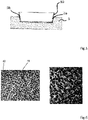
- Fig.4 shows a cross-sectional view of a deep-drawing mold 5 with a negative recess 6, this negative recess 6 reflecting the outer shape of the packaging container that is to be deep-drawn.
- the plate-shaped, flat plastic material is placed on the deep-drawing mold 5 with its first side 1a upside down.
- the actual deep-drawing process takes place.
- the plate-shaped plastic material 1 is pressed into the recess 6 of the mold by negative pressure or by positive pressure or by a stamp acting from above, by pulling the material down along the edges 5a and 5b. It is important to ensure that the outer surface of the packaging container to be produced is not damaged.
- the plastic material 1 is being pulled down or deep-drawn, the resulting side surfaces 12a, 12b, 12c and a bottom surface 11 and, if necessary, other surfaces of the packaging container are simultaneously pressed against the side inner walls of the tool mold, with these walls as well as the bottom surface of the tool mold with mold insert side faces and bottom faces 15, 16, 17, 18 and 19 as shown in Fig.3 were shown.
- these mold insert surfaces are distinguished by targeted, minimal indentations in the plate material, which can be metal, for displaying the 3D code.
- These codes then emboss an outer surface of the later packaging container during the deep-drawing process in such a way that the code is transferred to the outer surface, but remains almost invisible in the third dimension due to the small extension in three dimensions.
- FIG.6 Figure 12 shows, in a microscopic cut-away view, an area of applied three-dimensional codes on the inside of the metal tool mold or on metal inserts that are placed in the tool mold. It can be seen from this illustration that there are minimal point-like depressions 40 with a certain depth, which can be, for example, in the range of 1 ⁇ m-200 ⁇ m, preferably 5-50 ⁇ m. Unchanged areas 41 are present between these punctiform indentations, which in a two-dimensional code would correspondingly be assigned to the white area portion between black dots.
- the first surfaces of the outer surfaces of the packaging container to be produced i.e. the side wall surfaces and the underside of the packaging container, are formed at these points during the subsequent deep-drawing process of a plastic material into the tool mold Bumps obtained to thereby digitally watermark the first surfaces of the exterior surfaces and the bottom surface of the obtain packaging container.
- Such elevations can range from 1 to 30 ⁇ m. In relation to the overall wall thickness of the side wall surfaces and also the bottom surface, these elevations are extremely small and therefore hardly perceptible.
- the wall thicknesses which depend on the geometry of the product, for example the shape of a drinking cup or the shape of a tray, are 250 ⁇ m - 600 ⁇ m, preferably 300 ⁇ m - 500 ⁇ m.
- the wall thicknesses depend on the plastic material used and the position on the outer surface, since during the deep-drawing process the wall thickness in the upper area of the container thus obtained is usually greater than in the middle area of the side walls. The wall thickness then increases again towards the corner radii of the container. In the lower area, which adjoins the base area and in the base area itself, there is a wall thickness that is close to the initial thickness of the film-like material, depending on the deep-drawing ratio, the die geometry, the product contour, etc.
- the type of digital watermark or the digicode can also influence the wall thickness structure with regard to the wall surfaces.
- Fig.6 Another possible embodiment of a code that can be introduced into the metal surfaces by means of a laser device can also be seen. This form of code is commonly seen with QR codes.
- a read-out device 21 accesses this data memory 20 and, after the start of a laser treatment process, reads the data from the data memory and forwards it to a data conversion device 22 .
- This is intended to bring about a conversion of the previously available electronic two-dimensional data for a two-dimensional code pattern into data for a three-dimensional code pattern. This means that dark and light areas in the two-dimensional code pattern are converted into areas of different depths within the surface of a tool mold or associated mold inserts.
- a laser activation device 23 then receives an activation command in order to then introduce the data of the three-dimensional code pattern with the aid of a laser device 24 into the surface tool mold or the tool mold inserts.
Landscapes
- Engineering & Computer Science (AREA)
- Mechanical Engineering (AREA)
- Physics & Mathematics (AREA)
- General Physics & Mathematics (AREA)
- Theoretical Computer Science (AREA)
- Health & Medical Sciences (AREA)
- Optics & Photonics (AREA)
- Toxicology (AREA)
- Manufacturing & Machinery (AREA)
- General Health & Medical Sciences (AREA)
- Electromagnetism (AREA)
- Details Of Rigid Or Semi-Rigid Containers (AREA)
- Containers Having Bodies Formed In One Piece (AREA)
- Packages (AREA)
Applications Claiming Priority (1)
| Application Number | Priority Date | Filing Date | Title |
|---|---|---|---|
| DE102020125214.5A DE102020125214B4 (de) | 2020-09-28 | 2020-09-28 | Verfahren zum Codieren eines Verpackungsbehälters und codierter Verpackungsbehälter für Konsumgüter |
Publications (2)
| Publication Number | Publication Date |
|---|---|
| EP3974152A1 true EP3974152A1 (fr) | 2022-03-30 |
| EP3974152B1 EP3974152B1 (fr) | 2023-06-07 |
Family
ID=77431227
Family Applications (1)
| Application Number | Title | Priority Date | Filing Date |
|---|---|---|---|
| EP21192407.1A Active EP3974152B1 (fr) | 2020-09-28 | 2021-08-20 | Procédé de codage d'un récipient d'emballage et récipient d'emballage codé pour biens de consommation |
Country Status (10)
| Country | Link |
|---|---|
| US (1) | US11772407B2 (fr) |
| EP (1) | EP3974152B1 (fr) |
| CA (1) | CA3128618C (fr) |
| DE (1) | DE102020125214B4 (fr) |
| DK (1) | DK3974152T3 (fr) |
| ES (1) | ES2953338T3 (fr) |
| FI (1) | FI3974152T3 (fr) |
| HU (1) | HUE062641T2 (fr) |
| PL (1) | PL3974152T3 (fr) |
| PT (1) | PT3974152T (fr) |
Cited By (1)
| Publication number | Priority date | Publication date | Assignee | Title |
|---|---|---|---|---|
| WO2025140757A1 (fr) | 2023-12-27 | 2025-07-03 | Andreas Mayr | Ensemble constitué d'une boîte pliante et d'un dispositif électronique |
Families Citing this family (3)
| Publication number | Priority date | Publication date | Assignee | Title |
|---|---|---|---|---|
| DE102021133107A1 (de) | 2021-09-14 | 2023-03-16 | Paccor Packaging Gmbh | Verfahren und System zum Identifizieren eines Verpackungsmaterials für das Recycling |
| EP4148641A1 (fr) | 2021-09-14 | 2023-03-15 | PACCOR Packaging GmbH | Procédé et système d'identification d'une matière d'emballage pour le recyclage |
| DE112022007892T5 (de) * | 2022-12-15 | 2025-08-28 | Robert Bosch Gesellschaft mit beschränkter Haftung | Kunststoffgegenstand sowie vorrichtung und verfahren zur bestimmung einer materialart des kunststoffgegenstands |
Citations (6)
| Publication number | Priority date | Publication date | Assignee | Title |
|---|---|---|---|---|
| US5366791A (en) * | 1990-07-06 | 1994-11-22 | Paramount Packaging Corporation | Thermoformable laminate material with registered print and method of making the same |
| DE19544973A1 (de) | 1995-12-01 | 1997-06-05 | Schmalbach Lubeca | Sandwich-Kunststoffverpackung |
| US20050067727A1 (en) * | 2003-09-25 | 2005-03-31 | Weder Donald E. | Encoded sheet of material and method for controlling an article forming system |
| US20140315153A1 (en) * | 2011-10-12 | 2014-10-23 | Ormco Corporation | Fabrication of an orthodontic aligner from a negative mold designed by a computational device |
| DE202018107348U1 (de) * | 2018-12-20 | 2019-01-18 | Rehau Ag + Co | Kunststoff-Bauteil |
| WO2021167971A1 (fr) * | 2020-02-18 | 2021-08-26 | Berry Global, Inc | Articles polymères ayant un code électronique formé sur eux et leur procédé de fabrication |
Family Cites Families (13)
| Publication number | Priority date | Publication date | Assignee | Title |
|---|---|---|---|---|
| DE102008008749B4 (de) * | 2007-02-14 | 2016-06-23 | Fritz Schäfer GmbH | Verfahren zum Aufbringen von Aufdrucken auf Kunststoffbauteile |
| DE102010023098A1 (de) | 2010-06-09 | 2011-12-15 | Giesecke & Devrient Gmbh | Sicherheitsmerkmal für Formteile |
| DK3521210T3 (da) * | 2010-07-22 | 2020-04-14 | K Fee System Gmbh | Portionskapsel med stregkode |
| DE202011110247U1 (de) | 2011-09-01 | 2013-03-20 | Krones Ag | Behälter mit bedruckter Oberflächenkontur und Druckverfahren |
| EP2983885B1 (fr) * | 2013-04-13 | 2018-05-23 | Rel8 ApS | Procédé et appareil pour la production d'une partie codée par un code-barre 2d par moulage, identifiable en utilisant un smartphone |
| US20190306385A1 (en) | 2014-01-31 | 2019-10-03 | Digimarc Corporation | Concerning digital marking and reading of plastic items, useful in recycling |
| US11962876B2 (en) * | 2014-01-31 | 2024-04-16 | Digimarc Corporation | Recycling methods and systems, and related plastic containers |
| DE102015107744B3 (de) * | 2015-05-18 | 2016-07-28 | Fraunhofer-Gesellschaft zur Förderung der angewandten Forschung e.V. | Verfahren zur Markierung von Werkstücken und ein derart hergestelltes Werkstück |
| EP3305498A1 (fr) | 2016-10-07 | 2018-04-11 | REHAU AG + Co | Composant en matière plastique et procédé de commande de la fabrication réglementaire d'au moins un composant en matière plastique |
| CN110785277B (zh) * | 2017-03-31 | 2026-01-09 | 帝斯克玛股份有限公司 | 模制具有表面标记的容器的方法和容器 |
| EP3446803A1 (fr) * | 2017-08-24 | 2019-02-27 | Presspart Manufacturing Ltd. | Procédé de formation d'articles creux |
| GB2572183A (en) * | 2018-03-21 | 2019-09-25 | Sutton Philip | Recycling method and taggant for a recyclable product |
| CH717886A1 (de) * | 2020-09-21 | 2022-03-31 | Alpla Werke Alwin Lehner Gmbh & Co Kg | Kunststoffbehälter und Verfahren zum Bestimmen einer Eigenschaft eines Kunststoffbehälters. |
-
2020
- 2020-09-28 DE DE102020125214.5A patent/DE102020125214B4/de active Active
-
2021
- 2021-08-18 CA CA3128618A patent/CA3128618C/fr active Active
- 2021-08-20 FI FIEP21192407.1T patent/FI3974152T3/fi active
- 2021-08-20 ES ES21192407T patent/ES2953338T3/es active Active
- 2021-08-20 PT PT211924071T patent/PT3974152T/pt unknown
- 2021-08-20 EP EP21192407.1A patent/EP3974152B1/fr active Active
- 2021-08-20 PL PL21192407.1T patent/PL3974152T3/pl unknown
- 2021-08-20 DK DK21192407.1T patent/DK3974152T3/da active
- 2021-08-20 HU HUE21192407A patent/HUE062641T2/hu unknown
- 2021-09-23 US US17/483,796 patent/US11772407B2/en active Active
Patent Citations (7)
| Publication number | Priority date | Publication date | Assignee | Title |
|---|---|---|---|---|
| US5366791A (en) * | 1990-07-06 | 1994-11-22 | Paramount Packaging Corporation | Thermoformable laminate material with registered print and method of making the same |
| DE19544973A1 (de) | 1995-12-01 | 1997-06-05 | Schmalbach Lubeca | Sandwich-Kunststoffverpackung |
| EP0868357A1 (fr) | 1995-12-01 | 1998-10-07 | Rpc Containers Limited | Emballage plastic multicouche avec support d'informations |
| US20050067727A1 (en) * | 2003-09-25 | 2005-03-31 | Weder Donald E. | Encoded sheet of material and method for controlling an article forming system |
| US20140315153A1 (en) * | 2011-10-12 | 2014-10-23 | Ormco Corporation | Fabrication of an orthodontic aligner from a negative mold designed by a computational device |
| DE202018107348U1 (de) * | 2018-12-20 | 2019-01-18 | Rehau Ag + Co | Kunststoff-Bauteil |
| WO2021167971A1 (fr) * | 2020-02-18 | 2021-08-26 | Berry Global, Inc | Articles polymères ayant un code électronique formé sur eux et leur procédé de fabrication |
Cited By (2)
| Publication number | Priority date | Publication date | Assignee | Title |
|---|---|---|---|---|
| WO2025140757A1 (fr) | 2023-12-27 | 2025-07-03 | Andreas Mayr | Ensemble constitué d'une boîte pliante et d'un dispositif électronique |
| DE102023005344A1 (de) * | 2023-12-27 | 2025-07-03 | Andreas Mayr | Set, bestehend aus einer Faltschachtel und einem elektronischen Gerät |
Also Published As
| Publication number | Publication date |
|---|---|
| CA3128618C (fr) | 2026-03-03 |
| DE102020125214A1 (de) | 2022-03-31 |
| HUE062641T2 (hu) | 2023-11-28 |
| PT3974152T (pt) | 2023-08-17 |
| DE102020125214B4 (de) | 2022-05-25 |
| ES2953338T3 (es) | 2023-11-10 |
| FI3974152T3 (fi) | 2023-08-25 |
| EP3974152B1 (fr) | 2023-06-07 |
| US20220097436A1 (en) | 2022-03-31 |
| DK3974152T3 (da) | 2023-08-28 |
| CA3128618A1 (fr) | 2022-03-28 |
| US11772407B2 (en) | 2023-10-03 |
| PL3974152T3 (pl) | 2023-11-13 |
Similar Documents
| Publication | Publication Date | Title |
|---|---|---|
| EP3974152B1 (fr) | Procédé de codage d'un récipient d'emballage et récipient d'emballage codé pour biens de consommation | |
| EP3974153B1 (fr) | Procédé de codage d'un récipient et récipient codé | |
| DE3314327C1 (de) | Ausweiskarte und Verfahren zur Herstellung derselben | |
| DE69415029T2 (de) | Gegenstände aus zwei materialien, mit oder ohne scharnier | |
| DE69902237T2 (de) | Identifikationskennzeichnung mit einer optisch und elektronisch lesbaren markierung | |
| EP0308904A2 (fr) | Carte d'identité imprimable à plusieurs couches et procédé pour sa réalisation | |
| EP1791765A1 (fr) | Couvercle, notamment pour un emballage alimentaire, ou tiquette, notamment pour un col de bouteille | |
| DE19754860C1 (de) | Echtheitsmerkmal | |
| DE102012209675A1 (de) | Verfahren zum Bedrucken einer zylindrischen Druckoberfläche einer Getränkedose und bedruckte Getränkedose | |
| WO2013127650A1 (fr) | Étiquette de sécurité et son procédé de fabrication | |
| EP1050482B1 (fr) | Feuille avec fonction de sécurité, méthode de fabrication et son utilisation comme matériau d'emballage | |
| EP4245673A1 (fr) | Emballage alimentaire et procédé de fabrication d'un emballage alimentaire | |
| EP3587665A1 (fr) | Procédé et dispositif de fabrication d'un objet tridimensionnel à base de cellulose | |
| DE202011111122U1 (de) | Flaschenkasten mit Prägefolie | |
| DE10251781A1 (de) | Sicherheitselement und Verfahren zu seiner Herstellung | |
| EP1948450B1 (fr) | Procédé pour réaliser un support de données sous forme de carte comportant une zone d'inscription | |
| DE102006019248A1 (de) | Identifizierungskennzeichnung zur unterscheidbaren Identifizierung von Gegenständen | |
| EP2303593B1 (fr) | Corps composite pour un document de valeur et/ou de sécurité présentant une zone de papier inscriptible, et procédé et dispositif permettant la fabrication d un tel corps composite | |
| EP2875963A1 (fr) | Document de sécurité doté d'une caractéristique de sécurité de flexion | |
| EP3509834B1 (fr) | Outil d'estampage destiné à la mise en forme de films lisses et gaufrés | |
| DE102008023653A1 (de) | Prägeetikett und Verfahren zur Herstellung eines Prägeetiketts | |
| WO2002038396A1 (fr) | Marquage masque d'un cote, realise sur des surfaces en tole | |
| EP4607401A1 (fr) | Programme informatique et procédé mis en oeuvre par ordinateur pour adapter un glyphe adapté pour présenter une glyphe personnalisée de petites dimensions futures impression sur un substrat | |
| DE102014200595B4 (de) | Sicherheitsanordnung sowie Verfahren zur Herstellung einer Sicherheitsanordnung | |
| DE102005036269A1 (de) | Behälter, insbesondere Verpackungsbehälter |
Legal Events
| Date | Code | Title | Description |
|---|---|---|---|
| PUAI | Public reference made under article 153(3) epc to a published international application that has entered the european phase |
Free format text: ORIGINAL CODE: 0009012 |
|
| STAA | Information on the status of an ep patent application or granted ep patent |
Free format text: STATUS: THE APPLICATION HAS BEEN PUBLISHED |
|
| AK | Designated contracting states |
Kind code of ref document: A1 Designated state(s): AL AT BE BG CH CY CZ DE DK EE ES FI FR GB GR HR HU IE IS IT LI LT LU LV MC MK MT NL NO PL PT RO RS SE SI SK SM TR |
|
| STAA | Information on the status of an ep patent application or granted ep patent |
Free format text: STATUS: REQUEST FOR EXAMINATION WAS MADE |
|
| 17P | Request for examination filed |
Effective date: 20220927 |
|
| RBV | Designated contracting states (corrected) |
Designated state(s): AL AT BE BG CH CY CZ DE DK EE ES FI FR GB GR HR HU IE IS IT LI LT LU LV MC MK MT NL NO PL PT RO RS SE SI SK SM TR |
|
| GRAP | Despatch of communication of intention to grant a patent |
Free format text: ORIGINAL CODE: EPIDOSNIGR1 |
|
| STAA | Information on the status of an ep patent application or granted ep patent |
Free format text: STATUS: GRANT OF PATENT IS INTENDED |
|
| RIC1 | Information provided on ipc code assigned before grant |
Ipc: B29L 31/00 20060101ALN20230130BHEP Ipc: B29K 23/00 20060101ALN20230130BHEP Ipc: B29K 67/00 20060101ALN20230130BHEP Ipc: B29C 51/30 20060101ALN20230130BHEP Ipc: B29C 51/26 20060101ALI20230130BHEP Ipc: B29C 51/10 20060101ALI20230130BHEP Ipc: B29C 51/08 20060101AFI20230130BHEP |
|
| INTG | Intention to grant announced |
Effective date: 20230213 |
|
| GRAS | Grant fee paid |
Free format text: ORIGINAL CODE: EPIDOSNIGR3 |
|
| GRAA | (expected) grant |
Free format text: ORIGINAL CODE: 0009210 |
|
| STAA | Information on the status of an ep patent application or granted ep patent |
Free format text: STATUS: THE PATENT HAS BEEN GRANTED |
|
| AK | Designated contracting states |
Kind code of ref document: B1 Designated state(s): AL AT BE BG CH CY CZ DE DK EE ES FI FR GB GR HR HU IE IS IT LI LT LU LV MC MK MT NL NO PL PT RO RS SE SI SK SM TR |
|
| REG | Reference to a national code |
Ref country code: GB Ref legal event code: FG4D Free format text: NOT ENGLISH |
|
| REG | Reference to a national code |
Ref country code: CH Ref legal event code: EP Ref country code: AT Ref legal event code: REF Ref document number: 1573737 Country of ref document: AT Kind code of ref document: T Effective date: 20230615 Ref country code: DE Ref legal event code: R096 Ref document number: 502021000797 Country of ref document: DE |
|
| P01 | Opt-out of the competence of the unified patent court (upc) registered |
Effective date: 20230515 |
|
| REG | Reference to a national code |
Ref country code: PT Ref legal event code: SC4A Ref document number: 3974152 Country of ref document: PT Date of ref document: 20230817 Kind code of ref document: T Free format text: AVAILABILITY OF NATIONAL TRANSLATION Effective date: 20230807 |
|
| REG | Reference to a national code |
Ref country code: FI Ref legal event code: FGE |
|
| REG | Reference to a national code |
Ref country code: DK Ref legal event code: T3 Effective date: 20230823 |
|
| REG | Reference to a national code |
Ref country code: SE Ref legal event code: TRGR |
|
| REG | Reference to a national code |
Ref country code: NL Ref legal event code: FP |
|
| REG | Reference to a national code |
Ref country code: LT Ref legal event code: MG9D |
|
| REG | Reference to a national code |
Ref country code: NO Ref legal event code: T2 Effective date: 20230607 |
|
| REG | Reference to a national code |
Ref country code: SK Ref legal event code: T3 Ref document number: E 42122 Country of ref document: SK |
|
| REG | Reference to a national code |
Ref country code: ES Ref legal event code: FG2A Ref document number: 2953338 Country of ref document: ES Kind code of ref document: T3 Effective date: 20231110 |
|
| REG | Reference to a national code |
Ref country code: HU Ref legal event code: AG4A Ref document number: E062641 Country of ref document: HU |
|
| PG25 | Lapsed in a contracting state [announced via postgrant information from national office to epo] |
Ref country code: RS Free format text: LAPSE BECAUSE OF FAILURE TO SUBMIT A TRANSLATION OF THE DESCRIPTION OR TO PAY THE FEE WITHIN THE PRESCRIBED TIME-LIMIT Effective date: 20230607 Ref country code: LV Free format text: LAPSE BECAUSE OF FAILURE TO SUBMIT A TRANSLATION OF THE DESCRIPTION OR TO PAY THE FEE WITHIN THE PRESCRIBED TIME-LIMIT Effective date: 20230607 Ref country code: LT Free format text: LAPSE BECAUSE OF FAILURE TO SUBMIT A TRANSLATION OF THE DESCRIPTION OR TO PAY THE FEE WITHIN THE PRESCRIBED TIME-LIMIT Effective date: 20230607 Ref country code: HR Free format text: LAPSE BECAUSE OF FAILURE TO SUBMIT A TRANSLATION OF THE DESCRIPTION OR TO PAY THE FEE WITHIN THE PRESCRIBED TIME-LIMIT Effective date: 20230607 Ref country code: GR Free format text: LAPSE BECAUSE OF FAILURE TO SUBMIT A TRANSLATION OF THE DESCRIPTION OR TO PAY THE FEE WITHIN THE PRESCRIBED TIME-LIMIT Effective date: 20230908 |
|
| PG25 | Lapsed in a contracting state [announced via postgrant information from national office to epo] |
Ref country code: IS Free format text: LAPSE BECAUSE OF FAILURE TO SUBMIT A TRANSLATION OF THE DESCRIPTION OR TO PAY THE FEE WITHIN THE PRESCRIBED TIME-LIMIT Effective date: 20231007 |
|
| PG25 | Lapsed in a contracting state [announced via postgrant information from national office to epo] |
Ref country code: SM Free format text: LAPSE BECAUSE OF FAILURE TO SUBMIT A TRANSLATION OF THE DESCRIPTION OR TO PAY THE FEE WITHIN THE PRESCRIBED TIME-LIMIT Effective date: 20230607 Ref country code: RO Free format text: LAPSE BECAUSE OF FAILURE TO SUBMIT A TRANSLATION OF THE DESCRIPTION OR TO PAY THE FEE WITHIN THE PRESCRIBED TIME-LIMIT Effective date: 20230607 Ref country code: IS Free format text: LAPSE BECAUSE OF FAILURE TO SUBMIT A TRANSLATION OF THE DESCRIPTION OR TO PAY THE FEE WITHIN THE PRESCRIBED TIME-LIMIT Effective date: 20231007 Ref country code: EE Free format text: LAPSE BECAUSE OF FAILURE TO SUBMIT A TRANSLATION OF THE DESCRIPTION OR TO PAY THE FEE WITHIN THE PRESCRIBED TIME-LIMIT Effective date: 20230607 |
|
| REG | Reference to a national code |
Ref country code: DE Ref legal event code: R097 Ref document number: 502021000797 Country of ref document: DE |
|
| PG25 | Lapsed in a contracting state [announced via postgrant information from national office to epo] |
Ref country code: MC Free format text: LAPSE BECAUSE OF FAILURE TO SUBMIT A TRANSLATION OF THE DESCRIPTION OR TO PAY THE FEE WITHIN THE PRESCRIBED TIME-LIMIT Effective date: 20230607 |
|
| PG25 | Lapsed in a contracting state [announced via postgrant information from national office to epo] |
Ref country code: MC Free format text: LAPSE BECAUSE OF FAILURE TO SUBMIT A TRANSLATION OF THE DESCRIPTION OR TO PAY THE FEE WITHIN THE PRESCRIBED TIME-LIMIT Effective date: 20230607 |
|
| PLBE | No opposition filed within time limit |
Free format text: ORIGINAL CODE: 0009261 |
|
| STAA | Information on the status of an ep patent application or granted ep patent |
Free format text: STATUS: NO OPPOSITION FILED WITHIN TIME LIMIT |
|
| PG25 | Lapsed in a contracting state [announced via postgrant information from national office to epo] |
Ref country code: SI Free format text: LAPSE BECAUSE OF FAILURE TO SUBMIT A TRANSLATION OF THE DESCRIPTION OR TO PAY THE FEE WITHIN THE PRESCRIBED TIME-LIMIT Effective date: 20230607 |
|
| 26N | No opposition filed |
Effective date: 20240308 |
|
| PG25 | Lapsed in a contracting state [announced via postgrant information from national office to epo] |
Ref country code: SI Free format text: LAPSE BECAUSE OF FAILURE TO SUBMIT A TRANSLATION OF THE DESCRIPTION OR TO PAY THE FEE WITHIN THE PRESCRIBED TIME-LIMIT Effective date: 20230607 |
|
| PG25 | Lapsed in a contracting state [announced via postgrant information from national office to epo] |
Ref country code: BG Free format text: LAPSE BECAUSE OF FAILURE TO SUBMIT A TRANSLATION OF THE DESCRIPTION OR TO PAY THE FEE WITHIN THE PRESCRIBED TIME-LIMIT Effective date: 20230607 |
|
| PG25 | Lapsed in a contracting state [announced via postgrant information from national office to epo] |
Ref country code: BG Free format text: LAPSE BECAUSE OF FAILURE TO SUBMIT A TRANSLATION OF THE DESCRIPTION OR TO PAY THE FEE WITHIN THE PRESCRIBED TIME-LIMIT Effective date: 20230607 |
|
| PG25 | Lapsed in a contracting state [announced via postgrant information from national office to epo] |
Ref country code: CY Free format text: LAPSE BECAUSE OF FAILURE TO SUBMIT A TRANSLATION OF THE DESCRIPTION OR TO PAY THE FEE WITHIN THE PRESCRIBED TIME-LIMIT; INVALID AB INITIO Effective date: 20210820 |
|
| PGFP | Annual fee paid to national office [announced via postgrant information from national office to epo] |
Ref country code: LU Payment date: 20250820 Year of fee payment: 5 Ref country code: NL Payment date: 20250821 Year of fee payment: 5 |
|
| PGFP | Annual fee paid to national office [announced via postgrant information from national office to epo] |
Ref country code: HU Payment date: 20250814 Year of fee payment: 5 |
|
| PGFP | Annual fee paid to national office [announced via postgrant information from national office to epo] |
Ref country code: ES Payment date: 20250917 Year of fee payment: 5 Ref country code: PT Payment date: 20250807 Year of fee payment: 5 Ref country code: FI Payment date: 20250820 Year of fee payment: 5 |
|
| PGFP | Annual fee paid to national office [announced via postgrant information from national office to epo] |
Ref country code: DE Payment date: 20250811 Year of fee payment: 5 Ref country code: DK Payment date: 20250821 Year of fee payment: 5 |
|
| PGFP | Annual fee paid to national office [announced via postgrant information from national office to epo] |
Ref country code: NO Payment date: 20250820 Year of fee payment: 5 |
|
| PGFP | Annual fee paid to national office [announced via postgrant information from national office to epo] |
Ref country code: PL Payment date: 20250807 Year of fee payment: 5 Ref country code: IT Payment date: 20250829 Year of fee payment: 5 |
|
| PGFP | Annual fee paid to national office [announced via postgrant information from national office to epo] |
Ref country code: BE Payment date: 20250820 Year of fee payment: 5 Ref country code: GB Payment date: 20250822 Year of fee payment: 5 |
|
| PGFP | Annual fee paid to national office [announced via postgrant information from national office to epo] |
Ref country code: AT Payment date: 20251020 Year of fee payment: 5 Ref country code: FR Payment date: 20250821 Year of fee payment: 5 |
|
| PGFP | Annual fee paid to national office [announced via postgrant information from national office to epo] |
Ref country code: CH Payment date: 20250901 Year of fee payment: 5 Ref country code: SE Payment date: 20250821 Year of fee payment: 5 |
|
| PGFP | Annual fee paid to national office [announced via postgrant information from national office to epo] |
Ref country code: IE Payment date: 20250821 Year of fee payment: 5 Ref country code: CZ Payment date: 20250808 Year of fee payment: 5 |
|
| PGFP | Annual fee paid to national office [announced via postgrant information from national office to epo] |
Ref country code: SK Payment date: 20250808 Year of fee payment: 5 |
|
| PG25 | Lapsed in a contracting state [announced via postgrant information from national office to epo] |
Ref country code: TR Free format text: LAPSE BECAUSE OF FAILURE TO SUBMIT A TRANSLATION OF THE DESCRIPTION OR TO PAY THE FEE WITHIN THE PRESCRIBED TIME-LIMIT Effective date: 20230607 |