EP3974550A9 - Procédé de fourniture de matériau de boîte en aluminium - Google Patents
Procédé de fourniture de matériau de boîte en aluminium Download PDFInfo
- Publication number
- EP3974550A9 EP3974550A9 EP21199212.8A EP21199212A EP3974550A9 EP 3974550 A9 EP3974550 A9 EP 3974550A9 EP 21199212 A EP21199212 A EP 21199212A EP 3974550 A9 EP3974550 A9 EP 3974550A9
- Authority
- EP
- European Patent Office
- Prior art keywords
- aluminium
- scrap
- strip
- tab
- ubc
- Prior art date
- Legal status (The legal status is an assumption and is not a legal conclusion. Google has not performed a legal analysis and makes no representation as to the accuracy of the status listed.)
- Pending
Links
Images
Classifications
-
- C—CHEMISTRY; METALLURGY
- C22—METALLURGY; FERROUS OR NON-FERROUS ALLOYS; TREATMENT OF ALLOYS OR NON-FERROUS METALS
- C22C—ALLOYS
- C22C21/00—Alloys based on aluminium
-
- C—CHEMISTRY; METALLURGY
- C22—METALLURGY; FERROUS OR NON-FERROUS ALLOYS; TREATMENT OF ALLOYS OR NON-FERROUS METALS
- C22C—ALLOYS
- C22C1/00—Making non-ferrous alloys
- C22C1/02—Making non-ferrous alloys by melting
- C22C1/026—Alloys based on aluminium
-
- C—CHEMISTRY; METALLURGY
- C22—METALLURGY; FERROUS OR NON-FERROUS ALLOYS; TREATMENT OF ALLOYS OR NON-FERROUS METALS
- C22C—ALLOYS
- C22C21/00—Alloys based on aluminium
- C22C21/06—Alloys based on aluminium with magnesium as the next major constituent
-
- C—CHEMISTRY; METALLURGY
- C22—METALLURGY; FERROUS OR NON-FERROUS ALLOYS; TREATMENT OF ALLOYS OR NON-FERROUS METALS
- C22F—CHANGING THE PHYSICAL STRUCTURE OF NON-FERROUS METALS AND NON-FERROUS ALLOYS
- C22F1/00—Changing the physical structure of non-ferrous metals or alloys by heat treatment or by hot or cold working
- C22F1/04—Changing the physical structure of non-ferrous metals or alloys by heat treatment or by hot or cold working of aluminium or alloys based thereon
-
- C—CHEMISTRY; METALLURGY
- C22—METALLURGY; FERROUS OR NON-FERROUS ALLOYS; TREATMENT OF ALLOYS OR NON-FERROUS METALS
- C22F—CHANGING THE PHYSICAL STRUCTURE OF NON-FERROUS METALS AND NON-FERROUS ALLOYS
- C22F1/00—Changing the physical structure of non-ferrous metals or alloys by heat treatment or by hot or cold working
- C22F1/04—Changing the physical structure of non-ferrous metals or alloys by heat treatment or by hot or cold working of aluminium or alloys based thereon
- C22F1/047—Changing the physical structure of non-ferrous metals or alloys by heat treatment or by hot or cold working of aluminium or alloys based thereon of alloys with magnesium as the next major constituent
Definitions
- the present invention relates to a method for providing aluminium can material, in particular aluminium can strip.
- different aluminium alloys are used for the can body on the one side and the can end (i.e. the can lid) and the can tab on the other side.
- a 3xxx aluminium alloy, typically 3104, is usually used for the can body and a 5xxx aluminium alloy, typically 5182, is usually used for the can end and can tab.
- can production scrap e.g. trimming scrap of can body strips or can end or tab strips, have been remelted to produce new can body material or can end or tab material, respectively.
- aluminium can material in particular aluminium can end
- can tab and/or aluminium can body material with a better use of scrap material, in particular PCS material.
- this object is achieved by a method for providing aluminium can material, in particular aluminium can strip, in which an aluminium melt is provided and in which the can material is produced from the aluminium melt, wherein the aluminium melt is at least in part provided by melting an amount of non-UBC aluminium scrap.
- Alluminium melt as used in this document is in particular understood to mean “aluminium alloy melt”.
- non-UBC aluminium scrap allows to achieve the target composition for aluminium can body or aluminium can end or tab material with a higher proportion of scrap and less primary material used for providing the aluminium melt.
- the aluminium melt is at least in part provided by melting an amount of non-UBC aluminium scrap.
- at least 40 wt.-%, more preferably at least 50 wt.-%, in particular at least or more than 75 wt.-%, of the melt may be provided by melting non-UBC aluminium scrap.
- the rest of the melt may be provided, for example, by melting primary aluminium or aluminium alloys, other alloying material, e.g. alloying material containing particular alloying elements such as Mg, Mn, Ti etc., and even a certain amount of UBC scrap if desired.
- the selection of materials and their respective amounts melted to provide the melt are in particular selected such that the desired composition of the melt is achieved.
- Aluminium can material is then produced from the aluminium melt.
- the can material is in particular aluminium beverage can material.
- Producing the can material from the aluminium melt may in particular include: casting the melt by means of discontinuous or semi-continuous casting, optionally ingot sawing and/or scalping, optionally ingot homogenizing, hot rolling, cold rolling, optionally intermediate annealing and/or trimming.
- At least 40 wt.-%, preferably at least 50 wt.-%, in particular at least or more than 75 wt.-% of the aluminium melt is provided by melting the amount of non-UBC aluminium scrap. It has been found that the use of non-UBC scrap allows relatively high proportions of scrap use for providing the can material. With a higher scrap proportion, the carbon dioxide footprint and costs may be reduced and recycling rate may be increased.
- the amount of non-UBC aluminium scrap is an amount of non-UBC post consumer scrap.
- non-UBC post consumer scrap may be suitable to achieve higher scrap proportions.
- the use of post consumer scrap is advantageous in order to increase the overall recycling rate.
- the can material is aluminium can end or can tab material.
- the use of large UBC scrap proportions for producing can end or can tab material is particularly difficult since the can end or tab makes up the minor weight share of an aluminium can in comparison to the can body and therefore the minor weight share in UBC scrap. As a consequence of that, using a large proportion of UBC scrap makes it difficult to match the desired alloy specification for can end or tab material. Accordingly, the method described above is particularly useful to provide aluminium can end or tab material with an increased scrap use proportion.
- the amount of non-UBC aluminium scrap comprises or consists of aluminium lithographic scrap, in particular scrap lithographic sheets.
- aluminium lithographic scrap is particularly suitable for producing aluminium can end or tab material.
- aluminium lithographic scrap usually consists to a large proportion of aluminium alloys with contents of particular alloying elements, such as Si, Zn and/or Cu, that allow to comply with upper limits of these elements of typical aluminium can end or tab alloy specifications, in particular 5xxx aluminium alloys such as 5182 aluminium alloy, even when using a high scrap proportion for the melt.
- at least 40 wt.-%, preferably at least 50 wt.-%, more preferably at least or more than 75 wt.-% of the melt are provided by melting the aluminium lithographic scrap.
- the aluminium lithographic scrap may primarily or essentially completely consist of scrap pieces of 1xxx alloys.
- alloying material comprising Mg and/or Mn may be added to provide the melt.
- Aluminium lithographic scrap is scrap from lithographic aluminium material, in particular for offset printing, such as from aluminium strips for lithographic printing plate supports, from lithographic printing plate supports or from lithographic printing plates before or after use, potentially post-treated such as, e.g., washed.
- the amount of non-UBC aluminium scrap comprises or consists of post consumer scrap from lithographic sheets, in particular from blue-washed lithographic sheets.
- Post consumer scrap from lithographic sheets, in particular from blue-washed lithographic sheets are generally available on the scrap market as regular commodity and with high degree of varietal purity. Therefore, the use of such scrap allows a good control of the alloy composition of the aluminium can cap or tab material to be provided as this type of scrap contains little contamination by non-lithographic aluminium scrap.
- the post consumer scrap from lithographic sheets may in particular comprise lithographic scrap from offset printing plants.
- the lithographic scrap may in particular comprise or consist of scrap according to the ISRI code "Tablet” and/or “Tabloid".
- the ISRI codes are specified in the Guidelines for Nonferrous Scrap of the Institute of Scrap Recycling Industries Inc. (ISRI), available from isri.org/specs. For this application, version NF-2020 is used.
- ISRI codes are widely used on the international scrap market to classify different kinds of nonferrous scrap material, in particular aluminium scrap material.
- scrap according to ISRI code "Tablet” is preferred over “Tabloid” since "Tablet” scrap is post consumer scrap, the use of which increases the overall post consumer scrap recycling rate and significantly reduces the waste of resources. Therefore, preferably more scrap according to ISRI code “Tablet” than scrap according to ISRI code “Tabloid” is used to provide the melt. Preferably at least 40 wt.-%, more preferably at least 50 wt.-%, in particular at least or more than 75 wt.-% of the melt are provided by melting scrap according to ISRI code "Tablet".
- the aluminium can end or can tab material has a composition according to a 5xxx aluminium alloy, in particular 5182 aluminium alloy.
- 5xxx aluminium alloy, in particular 5182 aluminium alloy melt has strict upper limits for particular alloying elements such as Si, Zn and/or Cu which are difficult to comply with when using large proportions of UBC scrap for providing the melt.
- the use of aluminium lithographic scrap allows use of a large scrap proportion while complying with the upper limits for these alloying elements.
- the aluminium can end material is provided as aluminium can end strip or sheet.
- the aluminium can end material in particular can end strip, may have a thickness in the range of between 165 ⁇ m and 350 ⁇ m which is a suitable thickness for using the aluminium can end material for producing can ends.
- the aluminium can end material in particular can end strip, may have a yield strength R p0,2 in the range of between 310 MPa and 380 MPa, which is a suitable yield strength for using the aluminium can end material for producing can ends.
- the aluminium can end material in particular can end strip, may have a tensile strength R m in the range of between 360 MPa and 440 MPa, which is a suitable tensile strength for using the aluminium can end material for producing can ends.
- the aluminium can end material in particular can end strip, may have an elongation A 50 of 4% or more, in particular 5% or more, which is a suitable elongation for using the aluminium can end material for producing can ends.
- R p0,2 and R m and the lower limit for A 50 named above are typical requirements for can end material that can be met when producing the can end material from the melt by adjusting the production parameters in a commonly known manner, in particular with a 5xxx composition, more particular 5182 composition, of the can end material.
- R p0,2, R m and A 50 are determined according to DIN EN ISO 6892-1:2019, wherein specimen are taken both in rolling direction and with an angle of 45° to the rolling direction. The given limits and ranges apply to both of these directions.
- the aluminium can end material in particular can end strip, may comprise a coating, in particular a stove-enamelled coating.
- the aluminium end material may further comprise a wax layer on the coating.
- the aluminium can end material in particular can end strip, may be in a strain-hardened state H, in particular in a strain-hardened and stove-enamelled state such as H42, H44, H46, H48 or H49, in particular in state H48 or H49.
- the material states such as H48 or H49, refer to the material states according to DIN EN 515.
- producing the aluminium can end material from the melt comprises: DC casting of the melt into an ingot, optionally sawing and/or scalping the ingot, optionally homogenizing the ingot, hot rolling the ingot to form a hot strip, in particular with a final hot strip thickness in the range of 1.5 to 4 mm, in particular 1.5 to 3 mm, cold rolling the hot strip to form a cold strip, in particular with an end thickness in the range of 165 ⁇ m to 350 ⁇ m, optionally trimming and/or intermediate annealing during cold rolling, optionally stove-enamelling the cold strip at end thickness with a stove-enamelled coating, optionally applying a waxing layer on the stove-enamelled coating.
- the method further comprises: producing an aluminium can end from the aluminium can end strip or sheet.
- the method for providing an aluminium can material is in particular a method for providing a can end.
- the aluminium can tab material is provided as aluminium can tab strip or sheet.
- the aluminium can tab material in particular can tab strip, may have a thickness in the range of between 230 ⁇ m and 350 ⁇ m which is a suitable thickness for using the aluminium can tab material for producing can tabs.
- the aluminium can tab material in particular can tab strip, may have a yield strength R p0,2 in the range of between 290 MPa and 390 MPa, which is a suitable yield strength for using the aluminium can tab material for producing can tabs.
- the aluminium can tab material in particular can tab strip, may have a tensile strength R m in the range of between 330 MPa and 440 MPa, which is a suitable tensile strength for using the aluminium can tab material for producing can tabs.
- the aluminium can tab material in particular can tab strip, may have an elongation A 50 of 3% or more, in particular 4% or more, which is a suitable elongation for using the aluminium can tab material for producing can tabs.
- R p0,2 and R m and the lower limit for A 50 named above are typical requirements for can tab material that can be met when producing the can tab material from the melt by adjusting the production parameters in a commonly known manner, in particular with a 5xxx composition, more particular 5182 composition, of the can tab material.
- the aluminium can tab material in particular can tab strip, may comprise a coating, in particular a stove-enamelled coating.
- the aluminium can tab material in particular can tab strip, may be in a strain-hardened state H, in particular in a strain-hardened and stove-enamelled state such as H42, H44, H46, H48 or H49, in particular in state H48 or H49.
- the aluminium can tab material in particular strip, may have a width in the range of between 20 and 150 mm, in particular between 20 and 100 mm.
- producing the aluminium can tab material from the melt comprises: DC casting of the melt into an ingot, optionally sawing and/or scalping the ingot, optionally homogenizing the ingot, hot rolling the ingot to form a hot strip, in particular with a final hot strip thickness in the range of 1.5 to 4 mm, in particular 1.5 to 3 mm, cold rolling the hot strip to form a cold strip, in particular with an end thickness in the range of 230 ⁇ m to 350 ⁇ m, optionally trimming and/or intermediate annealing during cold rolling, optionally stove-enamelling the cold strip at end thickness with a stove-enamelled coating, optionally slitting the cold strip at end thickness into strips, in particular having a width in the range of between 60 and 100 mm.
- the method further comprises: producing aluminium can tab from the aluminium tab end strip or sheet.
- the method for providing an aluminium can material is in particular a method for providing a can tab.
- the can material is aluminium can body material.
- the can body makes the major weight share of an aluminium can and thus of UBC scrap, the weight proportion of the can end and can tab in UBC scrap results in a combined UBC scrap composition that makes it difficult to comply with the alloying limits of certain elements, in particular Mg, for aluminium can body material. Therefore, the method described is also useful to provide aluminium can body material with an increased scrap use proportion.
- the amount of non-UBC aluminium scrap comprises or consists of lithographic scrap and/or scrap according to ISRI code Taint/Tabor, Twitch or Zorba or a combination thereof.
- at least 40 wt.-%, more preferably at least 50 wt.-%, in particular at least or more than 75 wt.-% of the melt are provided by melting lithographic scrap and/or scrap according to ISRI code Taint/Tabor, Twitch or Zorba or a combination thereof.
- the lithographic scrap may in particular be scrap according to ISRI code Tabloid or Tablet.
- the lithographic scrap may in particular be post consumer lithographic scrap, in particular according to ISRI code Tablet.
- composition of lithography scrap and of scrap with ISRI codes “Taint/Tabor”, “Twitch” and “Zorba” is suitable to comply with typical alloying specifications for aluminium can body material, preferably 3xxx, in particular 3104 aluminium alloy.
- these scrap kinds allow a high proportion of scrap for producing the aluminium can body material while complying with the alloying limits, in particular upper limits, of certain elements, in particular Mg.
- the scrap according to ISRI code Taint/Tabor, Twitch and/or Zorba may be pre-sorted, preferably such that the scrap complies with upper limits of 3xxx alloys, in particular of 3104 aluminium alloy, for alloying elements, in particular of Zn, Cu, Fe and/or Pb, and/or for heavy metals.
- the pre-sorting may include sorting out of heavy metal containing scrap fragments.
- the pre-sorting may include sorting out of heavy metal containing scrap fragments.
- the pre-sorting may include sorting out of strongly alloyed aluminium scrap fragments, e.g.
- scrap fragments with a content for alloying elements such as, in particular, Zn, Cu, Fe and/or Pb, that exceed the respective upper limit of 3xxx alloys, in particular of 3104 aluminium alloy, by a factor of 5 or more, in particular 2 or more.
- the pre-sorting may include sorting out scrap fragments from aluminium casting alloys (in contrast to aluminium wrought alloys).
- the can body material has a composition according to a 3xxx aluminium alloy, in particular 3104 aluminium alloy.
- 3xxx aluminium alloy, in particular 3104 aluminium alloy melt has strict upper limits for particular alloying elements such as Mg which are difficult to comply with when using UBC scrap for providing the melt.
- the use of non-UBC scrap, in particular lithography scrap and/or "Taint/Tabor", “Twitch” and/or “Zorba” allows use of a large scrap proportion while complying with the upper limits for these alloying elements.
- alloying material comprising Cu, Mn and/or Mg may be added to provide the melt.
- the can body material is provided as aluminium can body strip or sheet.
- the aluminium can body material in particular can body strip, may have a thickness in the range of between 180 ⁇ m and 400 ⁇ m which is a suitable thickness for using the aluminium can body material for producing can bodies.
- the aluminium can body material in particular can body strip, may have a yield strength R p0,2 in the range of between 260 MPa and 320 MPa, which is a suitable yield strength for using the aluminium can body material for producing can bodies.
- the aluminium can body material in particular can body strip, may have a tensile strength R m in the range of between 270 MPa and 360 MPa, which is a suitable tensile strength for using the aluminium can body material for producing can bodies.
- the aluminium can body material in particular can body strip, may have an elongation A 50 of 1% or more, in particular of 2% or more, which is a suitable elongation for using the aluminium can body material for producing can bodies.
- the aluminium can body material in particular can body strip, may have a yield strength R p0,2 of at least 255 MPa after an annealing at 200 °C for 7 minutes.
- the annealing of 7 minutes at 200°C simulates the heat-involving process of can body manufacturing.
- With a yield strength of at least 255 MPa after such annealing it can be ensured that the material has sufficient yield strength after being formed into a can body.
- R p0,2 , R m and the lower limits for A 50 and R p0,2 after annealing for 7 min. at 200 °C named above are typical requirements for can body material that can be met when producing the can body material from the melt by adjusting the production parameters in a commonly known manner, in particular with a 3xxx composition, more particular 3104 composition, of the can body material.
- the aluminium can body material in particular can body strip, may comprise a lubricant coating layer, e.g. a lubricant coating layer comprising an ester-based lubricant.
- the lubricant coating layer may have a mass per unit area of 150 - 300 mg/m 2 .
- the aluminium can body material in particular can body strip, may be in a strain-hardened state H, in particular in H19 state.
- producing the aluminium can body material from the melt comprises: DC casting of the melt into an ingot, optionally sawing and/or scalping the ingot, optionally homogenizing the ingot, hot rolling the ingot to form a hot strip, in particular with a final hot strip thickness in the range of 1.5 to 4 mm, in particular 1.5 to 3 mm, cold rolling the hot strip to form a cold strip, in particular with an end thickness in the range of 180 ⁇ m to 400 ⁇ m, optionally trimming and/or intermediate annealing during cold rolling, optionally coating the cold strip at end thickness with a lubricant, e.g. an ester-based lubricant.
- a lubricant e.g. an ester-based lubricant.
- the method further comprises: producing an aluminium can body from the aluminium can body strip or sheet.
- the method for providing an aluminium can material is in particular a method for providing a can body.
- the object from above is further achieved by the use of non-UBC scrap, in particular aluminium lithographic scrap or scrap according to ISRI code Taint/Tabor, Twitch or Zorba, for providing can material, in particular can end material, can tab material or can body material, in particular for producing can ends, can tabs or can bodies of aluminium beverage cans.
- non-UBC scrap in particular aluminium lithographic scrap or scrap according to ISRI code Taint/Tabor, Twitch or Zorba
- can material in particular can end material
- can tab material or can body material in particular for producing can ends, can tabs or can bodies of aluminium beverage cans.
- the embodiments of the method described above also apply, individually as well as in combination, for this use.
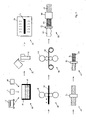
- Fig. 1 schematically shows a first exemplary embodiment of the method for providing can material, namely can end material.
- an aluminium melt 11 is provided by melting aluminium lithography scrap material 12, optionally other aluminium scrap material 13 and further alloying material 14 in a melting furnace 15.
- the aluminium lithography scrap material 12 is preferably post consumer scrap according to ISRI code "Tablet” and preferably makes up at least 40 wt.-%, more preferably at least 50 wt.-%, in particular at least or more than 75 wt.-% of the melt 11.
- the aluminium lithography scrap material 12 may predominantly comprise scrap pieces of 1xxx alloys.
- the further alloying material 14 may in particular comprise primary aluminium or aluminium alloys or other alloying element containing material, e.g. Mg and/or Mn containing alloying material, to match the target specification of the melt 11, which for can end material is preferably a 5xxx aluminium alloy, in particular 5182 aluminium alloy.
- the target specification of the 5182 aluminium alloy is as follows: Si ⁇ 0.20 wt.-%, Fe ⁇ 0.35 wt.-%, Cu ⁇ 0.15 wt.-%, 0.20 wt.-% ⁇ Mn ⁇ 0.50 wt.-%, 4.0 wt.-% ⁇ Mg ⁇ 5.0 wt.-%, Cr ⁇ 0.10 wt.-%, Zn ⁇ 0.25 wt.-%, Ti ⁇ 0.10 wt.-%, other elements: individually ⁇ 0.05 wt.-%, in total ⁇ 0.15 wt.-%, remainder Al.
- an ingot 21 is formed from the melt 11 by DC casting.
- the ingot 21 may be sawn and scalped subsequently (not shown).
- the ingot 21 may be optionally homogenized and/or heated to hot rolling temperature in an oven 31.
- the ingot 21 is hot-rolled in a hot rolling mill 41, e.g. reversing hot rolling mill, to form a hot strip 42.
- Hot strip thickness after hot rolling may be between 1.5 and 4 mm.
- the hot strip 42 is cold-rolled in a cold rolling mill 51 in several passes to form a cold strip 52, optionally with intermediate annealing (not shown).
- End thickness after cold rolling may be between 165 ⁇ m and 350 ⁇ m.
- the cold strip 52 is coated with a pigments containing lacquer coating 61 by means of a coating device 62 and the lacquer coating 61 is then burned in by means of an oven 63 to form a stove-enamelled coating 64.
- the coated cold strip 52 is edge-trimmed by means of an edge-trimming device 71.
- the stove-enamelled and trimmed cold strip 52 is optionally coated with a wax coating 81 by means of a coating device 82.
- the resulting stove-enamelled, trimmed and optionally waxed strip 83 may then be reeled to a coil, packed and shipped as aluminium can end strip to a customer, namely to a producer of aluminium cans.
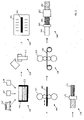
- Fig. 2 schematically shows a second exemplary embodiment of the method for providing can material, namely can tab material.
- an aluminium melt 111 is provided by melting aluminium lithography scrap material 112, optionally other aluminium scrap material 113 and further alloying material 114 in a melting furnace 115.
- the aluminium lithography scrap material 112 is preferably post consumer scrap according to ISRI code "Tablet” and preferably makes up at least 40 wt.-%, more preferably at least 50 wt.-%, in particular at least or more than 75 wt.-% of the melt 111.
- the aluminium lithography scrap material 112 may predominantly comprise scrap pieces of 1xxx alloys.
- the further alloying material 114 may in particular comprise primary aluminium or aluminium alloys or other alloying element containing material, e.g. Mg and/or Mn containing alloying material, to match the target specification of the melt 111, which for can tab material is a 5xxx aluminium alloy, in particular 5182 aluminium alloy.
- the target specification of the 5182 aluminium alloy is as defined above.
- an ingot 121 is formed from the melt 111 by DC casting.
- the ingot 121 may be sawn and scalped subsequently (not shown).
- the ingot 121 may be optionally homogenized and/or heated to hot rolling temperature in an oven 131.
- the ingot 121 is hot-rolled in a hot rolling mill 141, e.g. reversing hot rolling mill, to form a hot strip 142.
- Hot strip thickness after hot rolling may be between 1.5 and 4 mm.
- a next step 150 after cooling of the hot strip 142, the hot strip 142 is cold-rolled in a cold rolling mill 151 in several passes to form a cold strip 152, optionally with intermediate annealing (not shown). End thickness after cold rolling may be between 230 ⁇ m and 350 ⁇ m.
- the cold strip 152 is coated with a pigments containing lacquer coating 161 by means of a coating device 162 and the lacquer coating 161 is then burned in by means of an oven 163 to form a stove-enamelled coating 164.
- the coated cold strip 152 is edge-trimmed and cut longitudinally into a plurality of strips 171 with a width of between 20 and 100 mm by means of a trimming-and-cutting device 172.
- the resulting stove-enamelled, trimmed and longitudinally cut strips 171 may then be reeled to coils, packed and shipped as aluminium can tab strips to a customer, namely to a producer of aluminium cans.
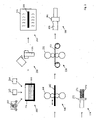
- Fig. 3 schematically shows a third exemplary embodiment of the method for providing can material, namely can body material.
- an aluminium melt 211 is provided by melting non-UBC aluminium post consumer scrap material 212, optionally other aluminium scrap material 213 and further alloying material 214 in a melting furnace 215.
- the non-UBC aluminium scrap material 212 is preferably post consumer scrap according to ISRI code "Tablet” and/or “Taint/Tabor", “Twitch” and/or “Zorba” and preferably makes up at least 40 wt.-%, more preferably at least 50 wt.-%, in particular at least or more than 75 wt.-% of the melt 211.
- Scrap according to ISRI code "Taint/Tabor”, “Twitch” and/or “Zorba” is preferably pre-sorted, in particular essentially freed from scraps containing significant amounts of heavy metals and/or from strongly alloyed scraps.
- the further alloying material 214 may in particular comprise primary aluminium or aluminium alloys or other alloying element containing material, e.g. Cu, Mn and/or Mg containing alloying material, to match the target specification of the melt 211, which for can body material is a 3xxx aluminium alloy, in particular 3104 aluminium alloy.
- the target specification of the 3104 aluminium alloy is as follows: Si ⁇ 0.6 wt.-%, Fe ⁇ 0.8 wt.-%, 0.05 wt.-% ⁇ Cu ⁇ 0.25 wt.-%, 0.8 wt.-% ⁇ Mn ⁇ 1.4 wt.-%, 0.8 wt.-% ⁇ Mg ⁇ 1.3 wt.-%, Zn ⁇ 0.25 wt.-%, Ga ⁇ 0.05 wt.-%, V ⁇ 0.05 wt.-%, Ti ⁇ 0.10 wt.-%, other elements: individually ⁇ 0.05 wt.-%, in total ⁇ 0.15 wt.-%, remainder Al.
- an ingot 221 is formed from the melt 211 by DC casting.
- the ingot 221 may be sawn and scalped subsequently (not shown).
- the ingot 221 may be optionally homogenized and/or heated to hot rolling temperature in an oven 231.
- the ingot 221 is hot-rolled in a hot rolling mill 241, e.g. reversing hot rolling mill, to form a hot strip 242.
- Hot strip thickness after hot rolling may be between 1.5 and 4 mm.
- the hot strip 242 is cold-rolled in a cold rolling mill 251 in several passes to form a cold strip 252, optionally with intermediate annealing (not shown).
- End thickness after cold rolling may be between 180 ⁇ m and 400 ⁇ m.
- the cold strip 252 is edge-trimmed by means of a trimming device 261.
- the trimmed cold strip 252 is coated with a lubricant coating layer 271 (so-called "Post Lube") by means of a coating device 272.
- the lubricant coating layer 271 may have a mass per unit area of 150 - 300 mg/m 3 .
- a suitable lubricant for the lubricant coating layer is, e.g. Bonderite L-FM 8320, available from Henkel AG & Co. KGaA, Duesseldorf, Germany.
- the resulting trimmed and lubricant coated strip 273 may then be reeled to a coil, packed and shipped as aluminium can body strip to a customer, namely to a producer of aluminium cans.
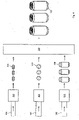
- Fig. 4 shows, very schematically, a method for producing aluminium cans from aluminium can end material 302, aluminium can tab material 304 and aluminium can body material 306.
- aluminium can end strip 83 from Fig. 1 may be used as can end material 302
- an aluminium can tab strip 171 from Fig. 2 may be used as can tab material 304
- aluminium can body strip 273 from Fig. 3 may be used as can end material 306.
- Can end material 302 is fed into a can end manufacturing machine 308 in which can end blanks are punched out of the can end material 302 and formed into can ends 310.
- Can tab material 304 is fed into a can tab manufacturing machine 312 in which can tab blanks are punched out of the can tab material 304 and formed into can tabs 314.
- Can body material 306 is fed into a can body manufacturing machine 316 in which round blanks are punched out of the can body material 306 and formed into can bodies 318.
- the can ends 310, can tabs 314 and can bodies 318 are supplied to a can manufacturing and filling machine 320, in which the can tabs 314 are attached to the can ends 310 and in which the can bodies 318 are painted, cleaned, filled with a beverage and closed with the can ends 310 to form an aluminium beverage can 322.
- the post consumer scrap recycling rate may be considerably increased and the carbon dioxide footprint for producing the aluminium beverage can 322 can be considerably reduced.
- at least 40 wt.-%, more preferably at least 50 wt.-%, in particular at least or more than 75 wt.-% of the aluminium of aluminium beverage can 322 may be produced from post consumer scrap in that way.
Landscapes
- Chemical & Material Sciences (AREA)
- Engineering & Computer Science (AREA)
- Materials Engineering (AREA)
- Mechanical Engineering (AREA)
- Metallurgy (AREA)
- Organic Chemistry (AREA)
- Physics & Mathematics (AREA)
- Thermal Sciences (AREA)
- Crystallography & Structural Chemistry (AREA)
- Containers Opened By Tearing Frangible Portions (AREA)
Applications Claiming Priority (1)
| Application Number | Priority Date | Filing Date | Title |
|---|---|---|---|
| DE102020125252.8A DE102020125252A1 (de) | 2020-09-28 | 2020-09-28 | Verfahren zur Bereitstellung von Aluminiumdosenmaterial |
Publications (2)
| Publication Number | Publication Date |
|---|---|
| EP3974550A1 EP3974550A1 (fr) | 2022-03-30 |
| EP3974550A9 true EP3974550A9 (fr) | 2022-05-18 |
Family
ID=77998772
Family Applications (1)
| Application Number | Title | Priority Date | Filing Date |
|---|---|---|---|
| EP21199212.8A Pending EP3974550A1 (fr) | 2020-09-28 | 2021-09-27 | Procédé de fourniture de matériau de boîte en aluminium |
Country Status (2)
| Country | Link |
|---|---|
| EP (1) | EP3974550A1 (fr) |
| DE (1) | DE102020125252A1 (fr) |
Family Cites Families (4)
| Publication number | Priority date | Publication date | Assignee | Title |
|---|---|---|---|---|
| CA2091184A1 (fr) * | 1990-09-05 | 1992-03-06 | Ivan M. Marsh | Procede de fabrication d'aluminium en feuilles |
| JP2008114439A (ja) * | 2006-11-02 | 2008-05-22 | Fujifilm Corp | 平版印刷版用支持体およびその製造方法 |
| JP2008229853A (ja) * | 2007-03-16 | 2008-10-02 | Fujifilm Corp | 平版印刷版用支持体およびその製造方法 |
| BR112018070957B1 (pt) | 2016-04-20 | 2022-08-30 | Hydro Aluminium Rolled Products Gmbh | Método para produção de uma faixa de alumínio para suportes de placa de impressão litográfica de uma liga de alumínio |
-
2020
- 2020-09-28 DE DE102020125252.8A patent/DE102020125252A1/de active Pending
-
2021
- 2021-09-27 EP EP21199212.8A patent/EP3974550A1/fr active Pending
Also Published As
| Publication number | Publication date |
|---|---|
| DE102020125252A1 (de) | 2022-03-31 |
| DE102020125252A9 (de) | 2022-06-02 |
| EP3974550A1 (fr) | 2022-03-30 |
Similar Documents
| Publication | Publication Date | Title |
|---|---|---|
| US4269632A (en) | Fabrication of aluminum alloy sheet from scrap aluminum for container components | |
| US4235646A (en) | Continuous strip casting of aluminum alloy from scrap aluminum for container components | |
| US4260419A (en) | Aluminum alloy composition for the manufacture of container components from scrap aluminum | |
| US4282044A (en) | Method of recycling aluminum scrap into sheet material for aluminum containers | |
| EP4334486A1 (fr) | Tôles d'aluminium 5xxx pour la fabrication de canettes | |
| US4318755A (en) | Aluminum alloy can stock and method of making same | |
| CA3151478C (fr) | Produits lamines a plat d'aluminium a haute teneur en materiaux recycles pour solutions de conditionnement a faible epaisseur et procedes associes | |
| DE2929724C2 (de) | Verfahren zum Herstellen eines Bandes aus einer Aluminiumlegierung für Dosen und Deckel | |
| US20120064367A1 (en) | Weldable Metal Article | |
| US20230257853A1 (en) | Aluminum Alloys Having a High Amount of Recycled Material | |
| EP3974550A9 (fr) | Procédé de fourniture de matériau de boîte en aluminium | |
| KR20250129001A (ko) | 고-재활용분 함량 음료 뚜껑부 스톡 | |
| EP4306668A1 (fr) | Procédé de production de tôle de canette d'aluminium | |
| KR20260037173A (ko) | 식품 및 음료 포장재용 고강도 알루미늄 합금 및 이의 제조 방법 | |
| JP2023174465A (ja) | 飲料缶用アルミニウム合金板およびその製造方法 |
Legal Events
| Date | Code | Title | Description |
|---|---|---|---|
| PUAI | Public reference made under article 153(3) epc to a published international application that has entered the european phase |
Free format text: ORIGINAL CODE: 0009012 |
|
| STAA | Information on the status of an ep patent application or granted ep patent |
Free format text: STATUS: THE APPLICATION HAS BEEN PUBLISHED |
|
| AK | Designated contracting states |
Kind code of ref document: A1 Designated state(s): AL AT BE BG CH CY CZ DE DK EE ES FI FR GB GR HR HU IE IS IT LI LT LU LV MC MK MT NL NO PL PT RO RS SE SI SK SM TR |
|
| STAA | Information on the status of an ep patent application or granted ep patent |
Free format text: STATUS: REQUEST FOR EXAMINATION WAS MADE |
|
| 17P | Request for examination filed |
Effective date: 20220930 |
|
| RBV | Designated contracting states (corrected) |
Designated state(s): AL AT BE BG CH CY CZ DE DK EE ES FI FR GB GR HR HU IE IS IT LI LT LU LV MC MK MT NL NO PL PT RO RS SE SI SK SM TR |