EP3976706B1 - Thermoplastische zusammensetzungen, verfahren zu deren herstellung und artikel daraus - Google Patents
Thermoplastische zusammensetzungen, verfahren zu deren herstellung und artikel daraus Download PDFInfo
- Publication number
- EP3976706B1 EP3976706B1 EP20737637.7A EP20737637A EP3976706B1 EP 3976706 B1 EP3976706 B1 EP 3976706B1 EP 20737637 A EP20737637 A EP 20737637A EP 3976706 B1 EP3976706 B1 EP 3976706B1
- Authority
- EP
- European Patent Office
- Prior art keywords
- carbonate
- siloxane
- units
- poly
- bisphenol
- Prior art date
- Legal status (The legal status is an assumption and is not a legal conclusion. Google has not performed a legal analysis and makes no representation as to the accuracy of the status listed.)
- Active
Links
Classifications
-
- C—CHEMISTRY; METALLURGY
- C08—ORGANIC MACROMOLECULAR COMPOUNDS; THEIR PREPARATION OR CHEMICAL WORKING-UP; COMPOSITIONS BASED THEREON
- C08L—COMPOSITIONS OF MACROMOLECULAR COMPOUNDS
- C08L83/00—Compositions of macromolecular compounds obtained by reactions forming in the main chain of the macromolecule a linkage containing silicon with or without sulfur, nitrogen, oxygen or carbon only; Compositions of derivatives of such polymers
- C08L83/10—Block- or graft-copolymers containing polysiloxane sequences
-
- B—PERFORMING OPERATIONS; TRANSPORTING
- B33—ADDITIVE MANUFACTURING TECHNOLOGY
- B33Y—ADDITIVE MANUFACTURING, i.e. MANUFACTURING OF THREE-DIMENSIONAL [3D] OBJECTS BY ADDITIVE DEPOSITION, ADDITIVE AGGLOMERATION OR ADDITIVE LAYERING, e.g. BY 3D PRINTING, STEREOLITHOGRAPHY OR SELECTIVE LASER SINTERING
- B33Y70/00—Materials specially adapted for additive manufacturing
-
- C—CHEMISTRY; METALLURGY
- C08—ORGANIC MACROMOLECULAR COMPOUNDS; THEIR PREPARATION OR CHEMICAL WORKING-UP; COMPOSITIONS BASED THEREON
- C08L—COMPOSITIONS OF MACROMOLECULAR COMPOUNDS
- C08L69/00—Compositions of polycarbonates; Compositions of derivatives of polycarbonates
- C08L69/005—Polyester-carbonates
-
- C—CHEMISTRY; METALLURGY
- C09—DYES; PAINTS; POLISHES; NATURAL RESINS; ADHESIVES; COMPOSITIONS NOT OTHERWISE PROVIDED FOR; APPLICATIONS OF MATERIALS NOT OTHERWISE PROVIDED FOR
- C09D—COATING COMPOSITIONS, e.g. PAINTS, VARNISHES OR LACQUERS; FILLING PASTES; CHEMICAL PAINT OR INK REMOVERS; INKS; CORRECTING FLUIDS; WOODSTAINS; PASTES OR SOLIDS FOR COLOURING OR PRINTING; USE OF MATERIALS THEREFOR
- C09D183/00—Coating compositions based on macromolecular compounds obtained by reactions forming in the main chain of the macromolecule a linkage containing silicon, with or without sulfur, nitrogen, oxygen, or carbon only; Coating compositions based on derivatives of such polymers
- C09D183/10—Block or graft copolymers containing polysiloxane sequences
-
- C—CHEMISTRY; METALLURGY
- C08—ORGANIC MACROMOLECULAR COMPOUNDS; THEIR PREPARATION OR CHEMICAL WORKING-UP; COMPOSITIONS BASED THEREON
- C08L—COMPOSITIONS OF MACROMOLECULAR COMPOUNDS
- C08L2205/00—Polymer mixtures characterised by other features
- C08L2205/03—Polymer mixtures characterised by other features containing three or more polymers in a blend
- C08L2205/035—Polymer mixtures characterised by other features containing three or more polymers in a blend containing four or more polymers in a blend
Definitions
- thermoplastic compositions and in particular to thermoplastic compositions that can be used to make interior components for aircrafts, methods of manufacture, and uses thereof.
- WO2016028960 discloses a thermoplastic composition used for manufacturing an article, containing polycarbonatesiloxane-arylate, core-shell impact modifier, flame retardant containing bromine-containing polymer or oligomer, and aromatic organophosphorus compound.
- thermoplastic composition comprises: 40 to 75 wt% of a poly(carbonatesiloxane-arylate); 5 to 45 wt% of a poly(carbonate-siloxane) present in an amount effective to provide 0.75 to 7 wt% of siloxane units; 10 to 40 wt% of a polycarbonate homopolymer; 5 to 15 wt% of an organophosphorus compound in an amount effective to provide 0.1 to 1 wt% of phosphorus; and optionally, 0.1 to 10 wt% of an additive composition, wherein each amount is based on the total weight of the poly(carbonate-siloxane-arylate), poly(carbonate-siloxane), polycarbonate homopolymer, flame retardant, and optional additive composition, which does not exceed 100%; and wherein the thermoplastic composition has a melt volume flow rate of greater than 6 cm 3 /10 min when measured in accordance with the ISO-1133-1:2011 standard at 300°C under a load of 1.2 kg with a residence time of
- thermoplastic composition A powder, filament, or composite comprising the thermoplastic composition is also disclosed.
- thermoplastic composition is selected from a molded article, a thermoformed article, an extruded film, an extruded sheet, a foamed article, a layer of a multi-layer article, a substrate for a coated article, and a substrate for a metallized article, preferably wherein the article is an aircraft interior component.
- a method of manufacture of an article comprises additively manufacturing the article using a powder or filament comprising the thermoplastic composition.
- halogen-free thermoplastic compositions having balanced flow, impact properties, smoke, and heat release can be obtained by combining a poly(carbonate-siloxane-arylate) with a poly(carbonate-siloxane), a linear or branched polycarbonate homopolymer, and certain phosphorus-containing flame retardants.
- a combination of a poly(carbonate-siloxane-arylate) and a phosphorus-containing flame retardant can meet the smoke and heat release requirements for aircraft applications, but can have less than desirable impact properties.
- Adding a linear or branched polycarbonate homopolymer to the combination maintains the heat and smoke properties, but the impact resistance is still low.
- thermoplastic compositions with an unexpected combination of high impact resistance, good ductility, good flow, and excellent flame retardance.
- the thermoplastic compositions can advantageously be used to make aircraft components, in particular, thin wall aircraft components meeting or exceeding governmental and aircraft manufacturer flame safety requirements.
- thermoplastic compositions are described in more detail below.
- the poly(carbonate-siloxane-arylate) comprises repeating aromatic carbonate units, siloxane units, and aromatic ester (arylate) units.
- the aromatic carbonate units are of formula (1): wherein at least 60 percent of the total number of R 1 groups are aromatic, or each R 1 contains at least one C 6-30 aromatic group. A combination of different R 1 groups can be present.
- R a and R b are each independently C 1-3 alkyl or C 1-3 alkoxy, p and q are each independently 0 to 1, and X a is a single bond, -O-, - S(O)-, -S(O) 2 -, -C(O)-, a C 1-11 alkylidene of formula -C(R c )(R d ) - wherein R c and R d are each independently hydrogen or C 1-10 alkyl, each R h is independently a C 1-3 alkyl, and n is 0 to 1.
- dihydroxy compounds (2) that can be used are described, for example, in WO 2013/175448 A1 , US 2014/0295363 , and WO 2014/072923 .
- Specific dihydroxy compounds include 2,2-bis(4-hydroxyphenyl) propane (“bisphenol A” or "BPA”), 3,3-bis(4-hydroxyphenyl) phthalimidine, 2-phenyl-3,3'-bis(4-hydroxyphenyl) phthalimidine (also known as N-phenyl phenolphthalein bisphenol, "PPPBP", or 3,3-bis(4-hydroxyphenyl)-2-phenylisoindolin-1-one), 1,1-bis(4-hydroxy-3-methylphenyl)cyclohexane, and 1,1-bis(4-hydroxyphenyl)-3,3,5-trimethylcyclohexane (isophorone bisphenol).
- diphenol compounds (3) included resorcinol, substituted resorcinol compounds such as 5-methyl resorcinol, 5-ethyl resorcinol, 5-propyl resorcinol, 5-butyl resorcinol, 5-t-butyl resorcinol, 5-phenyl resorcinol, 5-cumyl resorcinol, or the like; catechol; hydroquinone; substituted hydroquinones such as 2-methyl hydroquinone, 2-ethyl hydroquinone, 2-propyl hydroquinone, 2-butyl hydroquinone, 2-t-butyl hydroquinone, 2-phenyl hydroquinone, 2-cumyl hydroquinone, 2,3,5,6-tetramethyl hydroquinone, 2,3,5,6-tetra-t-butyl hydroquinone, or the like.
- a combination of different diphenol compounds can be used.
- the aromatic carbonate units are bisphenol A carbonate units having the formula (2a):
- the poly(carbonate-siloxane-arylate) further comprises aromatic ester (arylate) units, i.e., ester units based on an aromatic dicarboxylic acid repeating ester units of formula (4) wherein D is a divalent group derived from a dihydroxy compound, and can be, for example, a C 6-20 alicyclic group or a C 6-20 aromatic group; and T is a divalent C 6-20 arylene group.
- D is derived from a dihydroxy aromatic compound of formula (2), formula (3) or a combination thereof.
- the D and T groups are desirably minimally substituted with hydrocarbon-containing substituents such as alkyl, alkoxy, or alkylene substituents.
- less than 5 mol%, preferably less than or equal to 2 mol%, and still more preferably less than or equal to 1 mol% of the combined number of moles of D and T groups are substituted with hydrocarbon-containing substituents such as alkyl, alkoxy, or alkylene substituents.
- aromatic dicarboxylic acids from which the T group in the ester unit of formula (4) is derived include isophthalic or terephthalic acid, 1,2-di(p-carboxyphenyl)ethane, 4,4'-dicarboxydiphenyl ether, 4,4'-bisbenzoic acid, and combinations comprising at least one of the foregoing acids. Acids containing fused rings can also be present, such as in 1,4-, 1,5-, or 2,6-naphthalenedicarboxylic acids.
- Specific dicarboxylic acids are terephthalic acid, isophthalic acid, naphthalene dicarboxylic acid, cyclohexane dicarboxylic acid, or combinations thereof.
- a specific dicarboxylic acid comprises a combination of isophthalic acid and terephthalic acid wherein the weight ratio of isophthalic acid to terephthalic acid is 99:1 to 1:99.
- the aromatic ester units are derived from the reaction product of one equivalent of an isophthalic acid derivative and/or terephthalic acid derivative.
- the aromatic ester units are of formula (4a) or (4b): wherein each R f is independently a C 1-10 hydrocarbyl group such as a C 1-10 alkyl, a C 6-10 aryl, u is 0 to 4, preferably 0, and m is greater than or equal to 4.
- m is 4 to 100, 4 to 50, preferably 5 to 30, more preferably 5 to 25, and still more preferably 10 to 20.
- the molar ratio of isophthalate to terephthalate can also be 0.25: 1 to 4.0: 1.
- Preferred aromatic ester units are isophthalate-terephthalate-resorcinol ester units, isophthalate-terephthalate-bisphenol A ester units, or a combination of these, which can be referred to respectively as poly(isophthalate-terephthalate-resorcinol) ester units, poly(isophthalate-terephthalate-bisphenol-A) ester units, and poly[(isophthalate-terephthalate-resorcinol) ester-co-(isophthalate-terephthalate-bisphenol-A)] ester units.
- the aromatic carbonate units and the aromatic ester units are present as blocks of formula (5): wherein R f , u, and m are as defined in formula (4a), each R 1 is independently a C 6-30 arylene group, and n is greater than or equal to one, for example 3 to 50, preferably from 5 to 25, and more preferably from 5 to 20. In an aspect, m is 5 to 75 and n is 3 to 50, or m is 10 to 25 and n is 5 to 20, and the molar ratio of isophthalate units to terephthalate units is 80:20 to 20:80.
- the preferred carbonate units are bisphenol A carbonate units, optionally together with resorcinol carbonate units, and the aromatic ester units are poly(isophthalate-terephthalate-resorcinol) ester units, poly(isophthalate-terephthalate-bisphenol-A) ester units, and poly[(isophthalate-terephthalate-resorcinol) ester-co-(isophthalate-terephthalate-bisphenol-A)] ester units.
- the carbonate and aromatic ester units are present as a poly(isophthalate-terephthalate-resorcinol ester)-co-(resorcinol carbonate)-co-(bisphenol-A carbonate) segment.
- the carbonate and aromatic ester units desirably comprise a minimum amount of saturated hydrocarbon present in the form of substituents or structural groups such as bridging groups or other connective groups.
- substituents or structural groups such as bridging groups or other connective groups.
- less than or equal to 25 mol%, preferably less than or equal to 15 mol%, and still more preferably less than or equal to 10 mol% of the combined aromatic ester units and carbonate units comprise alkyl, alkoxy, or alkylene groups.
- the aromatic ester units and the carbonate units are not substituted with non-aromatic hydrocarbon-containing substituents such as alkyl, alkoxy, or alkylene substituents.
- the siloxane units are of formula (6): wherein each R is independently a C 1-13 monovalent organic group.
- R can be a C 1-13 alkyl, C 1-13 alkoxy, C 2 - 13 alkenyl, C 2 - 13 alkenyloxy, C 3 - 6 cycloalkyl, C 3-6 cycloalkoxy, C 6 - 14 aryl, C 6-1O aryloxy, C 7 - 13 arylalkylene, C 7-13 arylalkylenoxy, C 7-13 alkylarylene, or C 7-13 alkylarylenoxy.
- Combinations of the foregoing R groups can be used in the same copolymer.
- R is a C 1-3 alkyl, C 1-3 alkoxy, C 3-6 cycloalkyl, C 3-6 cycloalkoxy, C 6-14 aryl, C 6-1O aryloxy, C 7 arylalkylene, C 7 arylalkylenoxy, C 7 alkylarylene, or C 7 alkylarylenoxy.
- R is methyl, or phenyl.
- E in formula (6) can vary widely depending on the type and relative amount of each component in the thermoplastic compositions, the desired properties of the composition, and like considerations. Generally, E has an average value of 2 to 125, 5 to 80, or 10 to 100. Preferably, E has an average value of 5 to 20 or 5 to 15, and E can also have an average value of 20 to 80, or 30 to 70, preferably 30 to 50 or 40 to 50. As used herein, the average value of E means number average value of E.
- the siloxane units are of formula (7): wherein E is as defined in formula (6); each R can be the same or different and is as defined above in the context of formula (6); and Ar can be the same or different and is a substituted or unsubstituted C 6-30 arylene, wherein the bonds are directly connected to an aromatic moiety.
- Ar groups in formula (7) can be derived from a C 6-30 dihydroxyarylene compound, for example a dihydroxy compound of formula (2).
- Exemplary dihydroxyarylene compounds are 1,1-bis(4-hydroxyphenyl) methane, 1,1-bis(4-hydroxyphenyl) ethane, 2,2-bis(4-hydroxyphenyl) propane, 2,2-bis(4-hydroxyphenyl) butane, 2,2-bis(4-hydroxyphenyl) octane, 1,1-bis(4-hydroxyphenyl) propane, 1,1-bis(4-hydroxyphenyl) n-butane, 2,2-bis(4-hydroxy-1-methylphenyl) propane, 1,1-bis(4-hydroxyphenyl) cyclohexane, bis(4-hydroxyphenyl sulfide), and 1,1-bis(4-hydroxy-t-butylphenyl) propane. Combinations comprising at least one of the foregoing dihydroxy compounds can also be used.
- siloxane units of formula (7) include those of the formulas (7a) and (7b):
- the siloxane units are of formula (8): wherein R and E are as described in formula (6), and each R 5 is independently a divalent C 1 -C 30 organic group, and wherein the polymerized polysiloxane unit is the reaction residue of its corresponding dihydroxy compound.
- the siloxane units are of formula (9): wherein R and E are as defined above in the context of formula (6).
- R 6 in formula (9) is a divalent C 2 - 8 aliphatic.
- Each M in formula (9) can be the same or different, and can be cyano, nitro, a C 1 - 8 alkylthio, C 1 - 8 alkyl, C 1 - 8 alkoxy, C 2-8 alkenyl, C 2-8 alkenyloxy, C 3-8 cycloalkyl, C 3-8 cycloalkoxy, C 6 - 10 aryl, C 6-10 aryloxy, C 7 - 12 aralkyl, C 7 - 12 arylalkylenoxy, C 7 - 12 alkylarylene, or C 7 - 12 alkylarylenoxy, wherein each n is independently 0, 1, 2, 3, or 4.
- M is an alkyl such as methyl, ethyl, or propyl, an alkoxy such as methoxy, ethoxy, or propoxy, or an aryl such as phenyl, or tolyl;
- R 6 is a dimethylene, trimethylene or tetramethylene; and R is a C 1-8 alkyl, cyanoalkyl, or aryl such as phenyl, or tolyl.
- R is methyl, or a combination of methyl and phenyl.
- R is methyl, M is methoxy, n is one, and R 6 is a divalent C 1-3 aliphatic group.
- Specific siloxane units are of the formula or a combination thereof, wherein E has an average value of 5 to 20 or 5 to 15.
- Blocks of formula (9) can be derived from the corresponding dihydroxy polydiorganosiloxane, which in turn can be prepared effecting a platinum-catalyzed addition between the siloxane hydride and an aliphatically unsaturated monohydric phenol such as eugenol, 2-alkylphenol, 4-allyl-2-methylphenol, 4-allyl-2-phenylphenol, 4-allyl-2-t-butoxyphenol, 4-phenyl-2-phenylphenol, 2-methyl-4-propylphenol, 2-allyl-4,6-dimethylphenol, 2-allyl-6-methoxy-4-methylphenol and 2-allyl-4,6-dimethylphenol.
- an aliphatically unsaturated monohydric phenol such as eugenol, 2-alkylphenol, 4-allyl-2-methylphenol, 4-allyl-2-phenylphenol, 4-allyl-2-t-butoxyphenol, 4-phenyl-2-phenylphenol, 2-methyl-4-propylphenol, 2-allyl-4
- the polysiloxane units can then be endcapped, with resorcinol or bisphenol A, for example, by the synthetic procedures of European Patent Application Publication No. 0 524 731 A1 of Hoover.
- the endcapped polysiloxane can the form an ester-linked structure with a carboxylic acid derivative during formation of the poly(carbonate-siloxane-arylate), or a carbonatelinked structure by copolymerization with a carbonate precursor such as chloroformate, or a combination of such structures.
- the poly(carbonate-siloxane-arylate) can be manufactured by different methods such as solution polymerization, interfacial polymerization, and melt polymerization as is known in the art.
- the poly(carbonate-siloxane-arylate) is provided by the reaction of a diacid derivative, a difunctional polysiloxane, a dihydroxy aromatic compound, and, a carbonyl source, in a biphasic medium comprising an immiscible organic phase and aqueous phase.
- the arylate unit is formed by reacting a dihydroxy aromatic compound and a dicarboxylic acid dichloride in a biphasic medium in the presence of a base.
- the order and timing of addition of these components to the polymerization reaction can be varied to provide a poly(carbonate-siloxane-arylate) having different distributions of the polysiloxane in the polymer backbone.
- All types of end groups are contemplated as being useful, e.g., phenol, cyanophenol, or para-cumyl phenol, provided that such end groups do not significantly affect desired properties of the polycarbonate copolymer compositions.
- the poly(carbonate-siloxane-arylate) comprises 0.2 to 49.8 mol%, 1 to 40 mol%, or 1 to 20 mol% of carbonate units such as bisphenol-A carbonate units, 50 to 99.6 mol% or 50 to 95 mol% of aromatic ester units (4a) or (4b), and an amount of polysiloxane units (7a), (7b), (9a), (9b), (9c), or a combination comprising at least one of the foregoing, specifically (9a), in an amount effective to provide 0.2 to 10 wt%, preferably 0.2 to 6 wt%, more preferably 0.2 to 5 wt%, and still more preferably 0.25 to 2 wt% siloxane units, each based on the total copolymer.
- the poly(carbonate-siloxane-arylate) can comprise 1 to 20 mol% of bisphenol-A carbonate units, 60 to 90 mole% of aromatic ester units (4b), and an amount of polysiloxane units (9a), (9b), (9c) or a combination comprising at least one of the foregoing (specifically of formula 9a) effective to provide 0.2 to 5 wt% of siloxane units, each based on the total copolymer.
- thermoplastic compositions contain 40 to 75 wt% or 60 to 65 wt% of the poly(carbonate-siloxane-arylate), based on the total weight of the thermoplastic compositions.
- thermoplastic compositions further comprise a poly(carbonate-siloxane).
- the poly(carbonate-siloxane) can comprise carbonate units and siloxane units as described herein in the context of poly(carbonate-siloxane-arylate).
- the poly(carbonate-siloxane) can be free of aromatic ester units.
- the poly(carbonatesiloxane) comprises carbonate units derived from bisphenol A, and repeating siloxane units (7a), (7b), (9a), (9b), (9c), or a combination thereof (preferably of formula 9a), wherein E has an average value of 10 to 100, preferably 20 to 80, or 30 to 70, more preferably 30 to 50 or 40 to 50.
- the poly(carbonate-siloxane) can have a siloxane content of 5 to 45 wt%, 5 to 30 wt%, or 10 to 30 wt%, preferably 15 to 25 wt%, more preferably 17 to 23 wt%, each based on the total weight of the poly(carbonate-siloxane).
- siloxane content of a poly(carbonate-siloxane) refers to the content of siloxane units based on the total weight of the poly(carbonate-siloxane).
- the poly(carbonate-siloxane) can have an Mw of 28,000 to 32,000 Dalton (Da), preferably 29,000 to 31,000 Da as measured by gel permeation chromatography using a crosslinked styrene-divinyl benzene column, at a sample concentration of 1 milligram per milliliter, and as calibrated with bisphenol A polycarbonate standards.
- the poly(carbonate-siloxane) can be present in an amount effective to provide 0.75 to 7 wt%, preferably 1 to 5 wt% or 1 to 4 wt%, and more preferably 1 to 3 wt% siloxane units, based on the total weight of the thermoplastic compositions.
- the poly(carbonate-siloxane) is present in the thermoplastic compositions in an amount of 5 to 45 wt%, preferably 5 to 25 wt%, and more preferably 5 to 15 wt%, based on the total weight of the thermoplastic compositions.
- the linear and the branched polycarbonate homopolymers can comprise carbonate units as described herein in formula (1) or are derived from bisphenols of formula (2) or (3).
- Preferably the linear and the branched polycarbonate homopolymers have bisphenol A carbonate units of formula (2a).
- the linear polycarbonate homopolymer can have a weight average molecular weight of 15,000 to 20,000 Da or 16,000 to 19,000 Da as measured by gel permeation chromatography (GPC), using a crosslinked styrene-divinylbenzene column and calibrated to bisphenol A homopolycarbonate references.
- the linear polycarbonate homopolymer can have endgroups derived from an end-capping agent such as phenol, p-cumylphenol, or a combination comprising at least one of the foregoing.
- branched polycarbonate a particular type of branching agent is used. These branched polycarbonate materials have statistically more than two end groups.
- the branching agent is added in an amount (relative to the bisphenol monomer) that is sufficient to achieve the desired branching content, that is, more than two end groups.
- the molecular weight of the polymer may become very high upon addition of the branching agent, and to avoid excess viscosity during polymerization, an increased amount of a chain stopper agent can be used, relative to the amount used when the particular branching agent is not present.
- the amount of chain stopper used is generally above 5 mole percent and less than 20 mole percent compared to the bisphenol monomer.
- Such branching agents include aromatic triacyl halides, for example triacyl chlorides of formula (10) wherein Z is a halogen, C 1-3 alkyl, C 1-3 alkoxy, C 7-12 arylalkylene, C 7-12 alkylarylene, or nitro, and z is 0 to 3; a tri-substituted phenol of formula (11) wherein T is a C 1-20 alkyl, C 1-20 alkoxy, C 7-12 arylalkyl, or C 7-12 alkylaryl, Y is a halogen, C 1-3 alkyl, C 1-3 alkoxy, C 7-12 arylalkyl, C 7-12 alkylaryl, or nitro, s is 0 to 4; or a compound of formula (12) (isatin-bis-phenol)
- TMTC trimellitic trichloride
- THPE tris-p-hydroxyphenylethane
- isatin-bis-phenol examples include trimellitic trichloride (TMTC), tris-p-hydroxyphenylethane (THPE), and isatin-bis-phenol.
- the amount of the branching agents used in the manufacture of the polycarbonate will depend on a number of considerations, for example the type of R 1 groups in the carbonate units (1), the amount of chain stopper, e.g., cyanophenol, and the desired molecular weight of the polycarbonate.
- the amount of branching agent is effective to provide 0.1 to 10 branching units per 100 unbranched carbonate units (1) (R 1 units), specifically 0.5 to 8 branching units per 100 R 1 units, and more specifically 0.75 to 5 branching units per 100 R 1 units.
- R 1 units unbranched carbonate units
- a combination of two or more branching agents can be used.
- the branching agents can be added at a level of 0.05 to 2.0 wt%.
- the branched polycarbonate comprises units (1) or (2a) as described above; greater than or equal to 3 mole%, e.g., 3 to 10 mole%, based on the total moles of the polycarbonate, of moieties derived from a branching agent; and end-capping groups derived from an end-capping agent having a pKa between 8.3 and 11.
- the branching agent can comprise trimellitic trichloride, 1,1,1-tris(4-hydroxyphenyl)ethane (THPE) or a combination of trimellitic trichloride and 1,1,1-tris(4-hydroxyphenyl)ethane, and the endcapping agent is phenol or a phenol containing a substituent of cyano group, aliphatic groups, olefinic groups, aromatic groups, ester groups, ether groups, or a combination comprising at least one of the foregoing.
- THPE 1,1,1-tris(4-hydroxyphenyl)ethane
- the endcapping agent is phenol or a phenol containing a substituent of cyano group, aliphatic groups, olefinic groups, aromatic groups, ester groups, ether groups, or a combination comprising at least one of the foregoing.
- the end-capping agent is phenol, p-t-butylphenol, p-methoxyphenol, p-cyanophenol, p-cumylphenol, or a combination comprising at least one of the foregoing.
- the branched polycarbonate comprises bisphenol A carbonate units, 3 to 10 mol%, based on the total moles of the branched polycarbonate, of a moiety derived from 1,1,1-tris(4-hydroxyphenyl)ethane, and end-capping groups derived from p-cyanophenol.
- the branched polycarbonate has a molecular weight of between 28,000 and 40,000 Da or 30,000 to 35,000 Da as measured by gel permeation chromatography (GPC), using a crosslinked styrene-divinylbenzene column and calibrated to bisphenol A homopolycarbonate references.
- GPC gel permeation chromatography
- thermoplastic compositions can contain 10 to 40 wt%, 10 to 30 wt%, or 15 to 25 wt% of the linear or the branched polycarbonate homopolymer or a combination thereof.
- the organophosphorus flame retardant in the thermoplastic compositions has a structure represented by formula (13): wherein R 16 , R 17 , R 18 , and R 19 are each independently C 1-8 alkyl, C 5-6 cycloalkyl, C 6-20 aryl, or C 7-12 arylalkylene, each optionally substituted by C 1-12 alkyl, specifically by C 1-4 alkyl, and X is a mono- or poly-nuclear aromatic C 6-30 moiety or a linear or branched C 2-30 aliphatic radical, which can be OH-substituted and can contain up to 8 ether bonds, provided that at least one of R 16 , R 17 , R 18 , R 19 , and X is an aromatic group.
- R 16 , R 17 , R 18 , and R 19 are each independently C 1-4 alkyl, naphthyl, phenyl(C 1-4 alkylene), or aryl groups optionally substituted by C 1-4 alkyl. Specific aryl moieties are cresyl, phenyl, xylenyl, propylphenyl, or butylphenyl.
- X in formula (13) is a mono- or poly-nuclear aromatic C 6-30 moiety derived from a diphenol.
- n is each independently 0 or 1; in some embodiments n is equal to 1.
- q is from 0.5 to 30, from 0.8 to 15, from 1 to 5, or from 1 to 2.
- X can be represented by the following divalent groups (14) or a combination thereof,
- each of R 16 , R 17 , R 18 , and R 19 can be aromatic, i.e., phenyl, n is 1, and q is 1-5, specifically 1-2, and X is of formula (14).
- flame retardants include an oligomeric phosphate ester having a phosphorus content of 10.7 wt%, a specific gravity of 1.3, and a melting point of 101-108°C, available as Sol-DP from FYROLFLEX and a phosphate ester of formula (14b) having a phosphorus content 9.5 wt%, available as FP 800 from CEL-SPAN.
- the organophosphorus compound is present in an amount effective to provide 0.1 to 1 wt% of phosphorus, based on the total weight of the thermoplastic compositions. Accordingly, depending on the particular organophosphorus compound used, the thermoplastic compositions can comprise from 2 to 15 wt%, or 2 to 10 wt%, or 5 to 8 wt%, or 6 to 8 wt% of the organophosphorus flame retardant, each based on the total weight of the compositions.
- thermoplastic compositions can be essentially halogen-free.
- Essentially halogen-free is defined as having a chlorine or bromine content of less than or equal to 100 parts per million by weight (ppm), less than or equal to 75 ppm, or less than or equal to 50 ppm, based on the total parts by weight of the composition, excluding any filler or colorants.
- Essentially halogen-free also means that the total amount of chlorine and bromine is less than or equal to 200 ppm, less than or equal to 150 ppm, or less than or equal to 100 ppm, based on the total parts by weight of the composition, excluding any filler.
- the thermoplastic compositions further contain a mineral filler, glass, carbon, or a combination comprising at least one of the foregoing.
- mineral fillers include aluminum silicate, calcium carbonate, calcium sulfate dihydrate, calcium sulfate hemihydrate, calcinated clay, calcium silicate, clay, crushed quartz, diatomaceous earth, fly ash, kaolin, limestone, mica, silicates, talc, titanium dioxide, wollastonite, zirconium oxide, and zirconium silicate.
- the mineral filler, glass, carbon, or a combination comprising at least one of the foregoing can be present in an amount of 5 to 45 wt% based on the total weight of the thermoplastic compositions.
- the thermoplastic compositions can further include various additives ordinarily incorporated into flame retardant compositions having low smoke density and low heat release, with the proviso that the additive(s) are selected so as to not adversely affect the desired properties of the thermoplastic composition significantly, in particular low smoke density and low heat release.
- additives can be mixed at a suitable time during the mixing of the components for forming the composition.
- Exemplary additives include antioxidants, heat stabilizers, light stabilizers, ultraviolet (UV) light stabilizers, plasticizers, lubricants, mold release agents, antistatic agents, colorants such as such as titanium dioxide, carbon black, and organic dyes, surface effect additives, radiation stabilizers, additional flame retardants, and anti-drip agents.
- a combination of additives can be used.
- the additives are used in the amounts generally known to be effective.
- the total amount of additives can be 0.01 to 5 wt% based on the total weight of the thermoplastic compositions.
- the thermoplastic compositions comprise no more than 5 wt% based on the weight of the compositions of a processing aid, a heat stabilizer, anti-drip agent, an antioxidant, a colorant, or a combination comprising at least one of the foregoing.
- thermoplastic compositions can have a combination of desired properties. As discussed herein, the thermoplastic compositions are formulated to meet strict flammability requirements.
- the thermoplastic composition can have an OSU integrated 2-minute heat release test value of less than 65 kW-min/m 2 and a peak heat release rate of less than 65 kW/m 2 as measured using the method of FAR F25.4, in accordance with Federal Aviation Regulation FAR 25.853 (d), on parts with a thickness of 1.5, 2, or 3 mm.
- thermoplastic composition can further have a flame time of less than 15 seconds, a burn length of less than 6 inches, and a drip extinguishing time of less than 5 seconds, each measured using the method of FAR F25.5, in accordance FAR 25.853(a) at a thickness of 1.5, 2, or 3 mm.
- the thermoplastic compositions can further have excellent impact properties, including impact resistance, or ductility, or both.
- the compositions can have a notched Izod impact resistance of greater than 30 kJ/m 2 determined in accordance with ISO 180:2000 on 4 mm ISO bars at 23°C, with a 5.5 J hammer.
- the compositions can also have a notched Izod impact resistance of greater than 700 J/m 2 and a ductility of greater than 80% or 100%, each measured on notched 3.2 mm bars at 23°C, in accordance with the ASTM-D256-10 (2016) standard.
- compositions can have a ductility in multiaxial impact of 100%, performed on notched discs having a thickness of 3.2 mm and a diameter of 100 mm at 23°C, in accordance with the ISO-6603-2:2000 standard at an impact speed of 4.4 m/s.
- the same or similar values can be obtained in articles having a wide range of thicknesses, for example from 0.1 to 10 mm, but particularly at 0.5 to 5 mm.
- the compositions can also have a ductility in multiaxial impact of 100% at lower temperatures, such as +10°C, 0°C, -10°C, -20°C, or -30 °C.
- the compositions can further have good melt viscosities, which aids processing.
- the thermoplastic composition can have a melt volume flow rate (MVFR) of greater than 6 cc/10 min (cubic centimeter per 10 minutes), or 6 to 20 cc/10 min, when measured in accordance with the ISO-1133-1:2011 standard at 300°C under a load of 1.2 kg with a residence time of 300 seconds.
- MVFR melt volume flow rate
- melt viscosity is a measurement of the rheological characteristics of a composition at temperatures and shear conditions common to processing equipment. A lower value for melt viscosity indicates that the composition flows more easily.
- the thermoplastic compositions as disclosed herein can have a melt viscosity of 200 to 350 Pascal-second (Pa-s), measured in accordance with ISO 11443:2014 at a temperature of 280°C under a shear rate of 1500 per second (s -1 ).
- the thermoplastic compositions can also have a melt viscosity of 150 to 300 Pa-s, measured in accordance with ASTM D3835-16 at a temperature of 300°C under a shear rate of 1500 s -1 .
- thermoplastic compositions can vary.
- the polymers are combined with any additives (e.g., a mold release agent) such as in a screw-type extruder.
- the polymers any additives can be combined in any order, and in form, for example, powder, granular, filamentous, as a masterbatch, and the like.
- Transparent compositions can be produced by manipulation of the process used to manufacture the thermoplastic composition. One example of such a process to produce transparent thermoplastic compositions is described in U.S. Patent No. 7,767,738 .
- the thermoplastic compositions can be foamed, extruded into a sheet, or optionally pelletized.
- thermoplastic composition using frothing or physical or chemical blowing agents
- the pellets can be used for molding into articles, foaming, or they can be used in forming a sheet of the flame-retardant thermoplastic composition.
- the composition can be extruded (or co-extruded with a coating or other layer) in the form of a sheet and/or can be processed through calendaring rolls to form the desired sheet.
- thermoplastic compositions can also be used to make powders, filaments, or composites.
- the composites can also include a fibrous material such as glass, carbon, basalt in a format such as woven fibers, non-woven fibers, or uni-directional long fiber tapes.
- the weight ratio of the thermoplastic composition relative to the fibrous material can be 10: 1 to 1:1.
- thermoplastic compositions can be molded into useful shaped articles by a variety of means such as injection molding, extrusion, rotational molding, blow molding, and thermoforming to form articles.
- the thermoplastic compositions can be used to form a foamed article, a molded article, a thermoformed article, an extruded film, an extruded sheet, a layer of a multi-layer article, e.g., a cap-layer, a substrate for a coated article, or a substrate for a metallized article.
- These values can be obtained in articles having a wide range of thicknesses, for example from 0.1 to 10 mm, or 0.5 to 5 mm.
- the articles can also be additively formed using a powder or filament comprising the thermoplastic compositions disclosed herein.
- the articles can be interior components for aircraft, including access panels, access doors, air flow regulators baggage storage doors, display panels, display units, door handles, door pulls, enclosures for electronic devices, food carts, food trays, grilles, handles, magazine racks, seat components, partitions, refrigerator doors, seat backs, side walls, tray tables, trim panels, ceiling paneling, flaps, boxes, hoods, louvers, insulation material and the body shell in interiors, side walls, front walls/end walls, partitions, room dividers, interior doors, interior lining of the front/end-wall doors and external doors, luggage overhead luggage racks, vertical luggage rack, luggage container, luggage compartments, windows, window frames, kitchen interiors, surfaces or a component assembly comprising at least one of the foregoing, and the like.
- thermoplastic compositions can be formed (e.g., molded) into sheets that can be used for any of the above-mentioned components. It is generally noted that the overall size, shape, thickness, optical properties, and the like of the thermoplastic sheet can vary depending upon the desired application.
- thermoplastic compositions having balanced flow, impact resistance, and OSU heat release are further illustrated by the following non-limiting examples.
- FR-1 Oligomeric phosphate ester having a phosphorus content of 10.7 wt%, a specific gravity of 1.3, and a melting point of 101-108°C, available as Sol-DP FYROLFLEX FR-2 Phosphate ester of formula (14b) having a phosphorus content of 9.5 wt%, available as FP 800 CEL-SPAN PEPQ Tetrakis(2,4-di-tert-butylphenyl)[1,1-biphenyl]-4,4'diylbisphosphonite Clariant CB Carbon black, available as MONARCH 800 Cabot Corp.
- Solvent violet 36 available as MACROLEX VIOLET 3R LANXESS SB 104
- Solvent blue 104 available as SANDOPLAST BLUE 2B Clariant PB 15:4 Pigment blue 15:4, available as SUNFAST BLUE 248-3450 Sun Chemical SR 135 MB Solvent red 135 MB, 1% in polycarbonate, available as MACROLEX RED EG LANXESS PB 28 MB Pigment blue 28 MB, 1% in polycarbonate, SICOPAL BLUE K6310 BASF
- Heat distortion temperatures were determined in accordance with the ISO-75-2:2013 standard with a 5.5 J hammer, using the flat side of 10 mm ⁇ 4 mm thick ISO bars and a load of 1.8 MPa (A/f).
- Multi-axial impact (MAI) measurements were performed on notched discs having a thickness of 3.2 mm and a diameter of 100 mm at 23°C, in accordance with the ISO-6603-2:2000 standard at an impact speed of 4.4 m/s. Ductility is expressed as a percentage of the discs showing ductile failure.
- MVFR Melt volume flow rate
- MV Melt viscosity
- Vicat softening temperatures were measured on 4 mm ISO bars in accordance with the ISO-306:2013 standard at a load of 10 N and a speed of 50°/hr (A50) or a load of 50 N and a speed of 120°C/hr (B120), respectively.
- the spiral flow (SF) length was measured under a melt temperature of 330°C, a mold temperature of 100°C, and an injection pressure of 1000, 1600, or 2200 bar.
- the resulting molded parts had a thickness of 3 mm or 1.5 mm.
- Smoke density was performed according to FAR 25.853(d), Appendix F, Part V on plaques of 76 ⁇ 76 mm with a thickness of 2 mm each.
- the test part was placed vertically in a smoke density NBS chamber and exposed to a radiant furnace and pilot flames. The following parameters were measured: Optical smoke density (DS) in 1.5 minutes, DS in 4 minutes and the maximum smoke density (DS-4) that occurs in the first 4 minutes of the test. In order to pass the smoke density test, the three samples must show an average of less than or equal to 200.
- compositions Example5 and Ex6
- comparative compositions CEx1 to CEx4
- the formulations and the results are shown in Table 2.
- Table 2. Component Unit CEx1 CEx2 CEx3 CEx4 Ex5 Ex6
- PC-Si-ITR Wt% 93.44 73.44 63.44 53.44 53.44 63.44 PEPQ Wt% 0.06 0.06 0.06 0.06 0.06 0.06 FR-1 Wt% 6.5 6.5 6.5 6.5 6.5 6.5 PC-Si Wt% 10 10 PC-1 (branched) Wt% 20 30 40 30 20 Property Notched Izod ISO, 23°C kJ/m 2 9 9 9 9 72 58 Notched Izod ASTM, 23°C J/m 95 90 85 89 1030 1010 MVFR at 300°C cm 3 /10 min 10.8 9.3 8.3 7.7 7.2 8.3 MV at 280°C, 1500 1/s Pa-s 389 395 3
- compositions (Ex11 to Ex13) and comparative compositions (CEx7 to CEx10), were tested for impact resistance, flow, and heat properties. The formulations and the results are shown in Table 3. Table 3. Component Unit CEx7 CEx8 CEx9 CEx10 Ex11 Ex12 Ex13 PC-Si-ITR Wt% 92.44 72.44 62.44 52.44 82.44 62.44 52.44 PEPQ Wt% 0.06 0.06 0.06 0.06 0.06 0.06 0.06 0.06 FR-2 Wt% 7.5 7.5 7.5 7.5 7.5 7.5 PC-Si Wt% 10 10 10 PC-1 (branched) Wt% 20 30 40 20 30 Property Notched Izod ISO, 23°C kJ/m 2 10 9 10 9 37 66 69 Notched Izod ASTM, 23°C J/m 109 96 100 100 891 952 983 MVFR cm 3 /10 min 10.6 10.3 8.3 7.1 8.4 7.4 6.9 MV at 280°C, 1500
- compositions (Ex18 to Ex20) and comparative compositions (CEx14 to CEx17), were tested for impact resistance, flow, and heat properties. The formulations and the results are shown in Table 4. Table 4. Component Unit CEx14 CEx15 CEx16 CEx 17 Ex18 Ex19 Ex20 PC-Si-ITR Wt% 93.44 73.44 63.44 53.44 83.44 73.44 63.44 PEPQ Wt% 0.06 0.06 0.06 0.06 0.06 0.06 0.06 0.06 FR-1 Wt% 6.5 6.5 6.5 6.5 6.5 6.5 6.5 6.5 PC-Si Wt% 10 10 10 PC-2 (linear) Wt% 20 30 40 10 20 Property Notched Izod ISO, 23°C kJ/m 2 9 8 8 7 23 30 61 Notched Izod ASTM, 23°C J/m 94 94 84 71 831 825 858 MAI Ductility, 23°C % 100 100 100 75 100 100 100 100 100 100 MAI Duct
- compositions Example and Ex26
- comparative compositions CEx21 to CEx24 were tested for impact, flow, and heat properties. The formulations and the results are shown in Table 5.
- Table 5. Component Unit CEx21 CEx22 CEx23 CEx24 Ex25 Ex26 PC-Si-ITR % 92.44 72.44 62.44 82.44 72.44 62.44 PEPQ % 0.06 0.06 0.06 0.06 0.06 0.06 FR-2 % 7.5 7.5 7.5 7.5 7.5 PC-Si % 10 10 10 PC-2 % 20 30 10 20 Property Notched Izod ISO, 23°C kJ/m 2 9 9 7 58 31 49 Notched Izod ASTM, 23°C J/m 103 94 86 890 777 834 MAI Ductility, 23°C % 100 100 100 100 100 100 100 100 100 100 100 100 MAI Ductility 0°C % 100 40 20 100 100 100 100 MVFR cm 3 /10 min 10.0 14.3 19.1 8.7 10.
- compositions (Ex29 to Ex32) and comparative compositions (CEx27 to CEx28), were tested for impact, flow, heat, and OSU performance. The formulations and the results are shown in Table 6. Table 6. Component Unit CEx27 Ex29 Ex30 CEx28 Ex31 Ex32 PC-Si-ITR % 93.44 63.44 63.44 93.44 63.44 63.44 PEPQ % 0.06 0.06 0.06 0.06 0.06 0.06 0.06 0.06 FR-1 % 6.5 6.5 6.5 6.5 6.5 6.5 PC-Si % 10 10 10 10 PC-1 % 20 20 PC-2 % 20 20 TiO 2 % 1.792 1.792 1.792 1 1 1 1 SR 135 MB % 0.004 0.004 0.004 PB 28 MB % 0.265 0.265 0.265 CB % 0.036 0.036 0.036 SV36 % 0.056 0.056 0.056 SB 104 % 0.062 0.062 0.062 PB
- thermoplastic composition comprising: 40 to 75 wt% of a poly(carbonate-siloxane-arylate); 5 to 45 wt% of a poly(carbonate-siloxane) present in an amount effective to provide 0.75 to 7 wt% of siloxane units; 10 to 40 wt% of a polycarbonate homopolymer; 5 to 15 wt% of an organophosphorus compound in an amount effective to provide 0.1 to 1 wt% of phosphorus; and optionally, 0.1 to 10 wt% of an additive composition, wherein each amount is based on the total weight of the poly(carbonatesiloxane-arylate), poly(carbonate-siloxane), polycarbonate homopolymer, flame retardant, and optional additive composition, which does not exceed 100%; and wherein the thermoplastic composition has a melt volume flow rate of greater than 6 cm 3 /10 min when measured in accordance with the ISO-1133-1:2011 standard at 300°C under a load of 1.2 kg with
- thermoplastic composition of Aspect 1, wherein the poly(carbonate-siloxane-arylate) comprises: 0.2 to 10 wt% of siloxane units based on the total weight of the poly(carbonate-siloxane-arylate); 50 to 99.6 mol% arylate units, and 0.2 to 49.8 mol% carbonate units, each based on the sum of the moles of the siloxane units, the arylate units, and carbonate units in the poly(carbonate-siloxane-arylate); preferably wherein the arylate units are isophthalate-terephthalate-resorcinol ester units; the carbonate units are bisphenol A carbonate units, resorcinol carbonate units, or a combination thereof; and the siloxane units are polydimethylsiloxane units.
- the poly(carbonate-siloxane) has a siloxane content of 5 to 45 wt%, 5 to 30 wt%, or 10 to 30 wt%, preferably 15 to 25 wt%, more preferably 17 to 23 wt%, each based on the total weight of the poly(carbonate-siloxane).
- the poly(carbonate-siloxane) has an Mw of 28,000 to 32,000 Dalton (Da), preferably 29,000 to 31,000 Da as measured by gel permeation chromatography using a crosslinked styrene-divinyl benzene column, at a sample concentration of 1 milligram per milliliter, and as calibrated with bisphenol A polycarbonate standards.
- GPC gel permeation chromatography
- thermoplastic composition of any of the preceding Aspects wherein the polycarbonate homopolymer comprises a branched polycarbonate comprising bisphenol A carbonate units and moieties derived from a branching agent comprising trimellitic acid, trimellitic anhydride, tris-phenol TC (1,3,5-tris((p-hydroxyphenyl)isopropyl)benzene), tris-phenol PA (4(4(1,1-bis(p-hydroxyphenyl)-ethyl) alpha, alpha-dimethyl benzyl)phenol), 4-chloroformyl phthalic anhydride, trimesic acid, benzophenone tetracarboxylic acid, or a combination thereof.
- a branching agent comprising trimellitic acid, trimellitic anhydride, tris-phenol TC (1,3,5-tris((p-hydroxyphenyl)isopropyl)benzene), tris-phenol PA (4(4(1,1-bis(p-hydroxyphenyl)
- thermoplastic composition of Aspect 5 wherein the branched polycarbonate comprises bisphenol A carbonate units and 3 to 10 mol%, based on the total moles of the branched polycarbonate, of a moiety derived from 1,1,1-tris(4-hydroxyphenyl)ethane; and optionally the branched polycarbonate has a weight average molecular weight of 28,000 to 40,000 Dalton, as measured by gel permeation chromatography (GPC) using a crosslinked styrene-divinylbenzene column and calibrated to bisphenol A polycarbonate references.
- GPC gel permeation chromatography
- Aspect 7 The thermoplastic composition of any of the preceding Aspects, wherein the aromatic organophosphorus compound is of the formula wherein R 16 , R 17 , R 18 and R 19 are each independently C 1-8 alkyl, C 5-6 cycloalkyl, C 6-20 aryl, or C 7-12 arylalkylene, each optionally substituted by C 1-12 alkyl, and X is a mono- or poly-nuclear aromatic C 6-30 moiety or a linear or branched C 2-30 aliphatic moiety, each of which can be OH-substituted and can contain up to 8 ether bonds, provided that at least one of R 16 , R 17 , R 18 , R 19 , and X is aromatic, n is each independently 0 or 1, and q is from 0.5 to 30; preferably wherein each of R 16 , R 17 , R 18 , and R 19 is phenyl, X is of the formula each n is 1, and q is 1-5.
- thermoplastic composition of any of preceding Aspects comprising 60 to 65 wt% of the poly(carbonate-siloxane-arylate), wherein the poly(carbonate-siloxane-arylate) comprises, based on the total weight of the poly(carbonatesiloxane-arylate) 0.2 to 10 wt% of siloxane units of the formula wherein E has an average value of 5 to 20, 50 to 99.6 mol% isophthalate-terephthalate-resorcinol ester units, and 0.2 to 49.8 mol% bisphenol A carbonate units; 5 to 15 wt% of the poly(carbonate-siloxane), wherein the poly(carbonate-siloxane) has a siloxane content of 15 to 25 wt% based on the total weight of the poly(carbonate-siloxane), and comprises bisphenol A carbonate units, and siloxane units of the formula wherein E has an average value of 20 to 80; and 15 to 25
- thermoplastic composition of any of preceding Aspects further comprising a mineral filler, glass, carbon, or a combination comprising at least one of the foregoing; and optionally wherein the mineral filler, glass, carbon, or a combination comprising at least one of the foregoing are present in an amount of 5 to 45 wt%, based on the total weight of the thermoplastic composition.
- Aspect 12 A powder, filament, or composite comprising the thermoplastic composition of any of preceding Aspects.
- Aspect 13 A composite comprising the thermoplastic composition of any of Aspects 1 to 11, and a fibrous material comprising glass fiber, carbon fiber, basalt fiber; optionally wherein the fibrous material is a woven fiber, a non-woven fiber, or a uni-directional fiber tape.
- Aspect 14 An article comprising the composition of any of Aspects 1 to 13, selected from a molded article, a thermoformed article, an extruded film, an extruded sheet, a foamed article, a layer of a multi-layer article, a substrate for a coated article, and a substrate for a metallized article, preferably wherein the article is an aircraft interior component.
- Aspect 15 A method of manufacture of an article, the method comprising additively manufacturing the article using a powder or filament comprising the thermoplastic compositions of any one of Aspects 1 to 11.
Landscapes
- Chemical & Material Sciences (AREA)
- Chemical Kinetics & Catalysis (AREA)
- Organic Chemistry (AREA)
- Health & Medical Sciences (AREA)
- Medicinal Chemistry (AREA)
- Polymers & Plastics (AREA)
- Engineering & Computer Science (AREA)
- Materials Engineering (AREA)
- Life Sciences & Earth Sciences (AREA)
- Wood Science & Technology (AREA)
- Manufacturing & Machinery (AREA)
- Compositions Of Macromolecular Compounds (AREA)
Claims (15)
- Thermoplastische Zusammensetzung, umfassend:40 bis 75 Gew.% eines Poly(carbonat-siloxan-arylat)s;5 bis 45 Gew.% eines Poly(carbonat-siloxan)s, das in einer Menge vorhanden ist, die effektiv ist, um 0,75 bis 7 Gew.% Siloxaneinheiten bereitzustellen;10 bis 40 Gew.% eines Polycarbonathomopolymers;5 bis 15 Gew.% einer Organophosphorverbindung in einer Menge, die effektiv ist, um 0,1 bis 1 Gew.% Phosphor bereitzustellen; undgegebenenfalls 0,1 bis 10 Gew.% einer Additivzusammensetzung,wobei jede Menge auf dem Gesamtgewicht von dem Poly-(carbonat-siloxan-arylat), Poly(carbonat-siloxan), Polycarbonathomopolymer, Flammhemmer und gegebenenfalls der Additivzusammensetzung basiert, und 100 % nicht übersteigt; undwobeidie thermoplastische Zusammensetzung eine Schmelzvolumenflussrate von mehr als 6 cm3/10 min aufweist, wenn gemäß dem Standard ISO-1133-1:2011 bei 300 °C unter einer Last von 1,2 kg mit einer Verweilzeit von 300 Sekunden gemessen wird; undein aus der thermoplastischen Zusammensetzung geformter Artikel aufweist:eine über 2 Minuten integrierte Wärmefreisetzungsrate von weniger als oder gleich 65 kW-min/m2 und eine Spitzenwärmefreisetzungsrate von weniger als 65 kW/m2, gemessen unter Verwendung des Verfahrens gemäß Teil IV, OSU Heat Release aus FAR/JAR 25.853, Änderung 25-116; undeine Izod-Kerbschlagzähigkeit von mehr als 30 kJ/m2, bestimmt gemäß ISO 180:2000 an gekerbten 4 Millimeter dicken ISO-Stäben bei 23 °C mit einem 5,5 J-Hammer;eine Izod-Kerbschlagzähigkeit von mehr als 700 J/m2, gemessen an gekerbten 3,2 mm Stäben bei 23 °C gemäß dem Standard ASTM-D256-10 (2018),wobei die Gesamtmenge an Chlor und Brom kleiner als oder gleich 200 ppm ist, basierend auf den Gesamtgewichtsteilen der thermoplastischen Zusammensetzung ohne jeglichen Füllstoff.
- Thermoplastische Zusammensetzung nach Anspruch 1, wobei das Poly(carbonat-siloxan-arylat) umfasst:0,2 bis 10 Gew.% Siloxaneinheiten, basierend auf dem Gesamtgewicht des Poly(carbonat-siloxan-arylat)s;50 bis 99,6 Mol.% Arylateinheiten, und0,2 bis 49,8 Mol.% Carbonateinheiten, jeweils basierend auf die Summe der Mole der Siloxaneinheiten, der Arylateinheiten und Carbonateinheiten in dem Poly(carbonat-siloxan-arylat);wobei vorzugsweise die Arylateinheiten Isophthalat-Terephthalat-Resorcinestereinheiten sind; die Carbonateinheiten Bisphenol A-carbonateinheiten, Resorcincarbonateinheiten oder eine Kombination davon sind; und die Siloxaneinheiten Polydimethylsiloxaneinheiten sind.
- Thermoplastische Zusammensetzung nach einem der vorhergehenden Ansprüche, wobei das Poly(carbonatsiloxan) Bisphenol A-carbonateinheiten und Polydimethylsiloxaneinheiten umfasst.
- Thermoplastische Zusammensetzung nach einem der vorhergehenden Ansprüche, wobei das Polycarbonathomopolymer ein lineares Bisphenol A-polycarbonathomopolymer mit einem durchschnittlichen Molekulargewicht (Gewichtsmittel) von 15.000 bis 20.000 Dalton umfasst, gemessen mittels Gelpermeationschromatographie (GPC) unter Verwendung einer vernetzten Styrol-Divinylbenzol-Säule und kalibriert mit Bisphenol A-polycarbonat-Referenzen.
- Thermoplastische Zusammensetzung nach einem der vorhergehenden Ansprüche, wobei das Polycarbonathomopolymer ein verzweigtes Polycarbonat umfasst, umfassend Bisphenol A-carbonateinheiten und Anteile, die von einem Verzweigungsmittel abgeleitet sind, umfassend Trimellitsäure, Trimellitsäureanhydrid, Tris-phenol-TC (1,3,5-Tris((p-hydroxyphenyl)isopropyl)benzol), Tris-phenol-PA (4(4(1,1-Bis(p-hydroxyphenyl)-ethyl)-alpha,alpha-dimethylbenzyl)phenol), 4-Chlorformylphthalsäureanhydrid, Trimesinsäure, Benzophenontetracarbonsäure oder eine Kombination davon.
- Thermoplastische Zusammensetzung nach Anspruch 5, wobei das verzweigte Polycarbonat Bisphenol A-carbonateinheiten und 3 bis 10 Mol.%, basierend auf den Gesamtmolen des verzweigten Polycarbonats, von einem Anteil abgeleitet von 1,1,1-Tris(4-hydroxyphenyl)ethan umfasst; und das verzweigte Polycarbonat gegebenenfalls ein durchschnittliches Molekulargewicht (Gewichtsmittel) von 28.000 bis 40.000 Dalton aufweist, gemessen mittels Gelpermeationschromatographie (GPC) unter Verwendung einer vernetzten Styrol-Divinylbenzol-Säule und kalibriert mit Bisphenol A-polycarbonat-Referenzen.
- Thermoplastische Zusammensetzung nach einem der vorhergehenden Ansprüche, wobei die aromatische Organophosphorverbindung die folgende Formel hat:
 R16, R17, R18 und R19 jeweils unabhängig C1-8-Alkyl, C5-6-Cycloalkyl, C6-20-Aryl oder C7-12-Arylalkylen sind, wobei jedes gegebenenfalls mit C1-12-Alkyl substituiert ist, undX ein ein- oder mehrkerniger aromatischer C6-30-Anteil oder ein linearer oder verzweigter aliphatischer C2-30-Anteil ist, wobei jeder von diesen mit OH substituiert sein kann und bis zu 8 Etherbindungen enthalten kann, mit der Maßgabe, dass mindestens einer von R16, R17, R18, R19 und X aromatisch ist,n unabhängig 0 oder 1 ist, undq 0,5 bis 30 ist;wobei vorzugsweisejeder von R16, R17, R18 und R19 Phenyl ist,X die folgende Formel hat:
 jedes n 1 ist, undq 1 bis 5 ist.
 - Thermoplastische Zusammensetzung nach einem der vorhergehenden Ansprüche, wobei die aromatische Organophosphorverbindung die folgende Formel hat:

- Thermoplastische Zusammensetzung nach einem der vorhergehenden Ansprüche, umfassend:
60 bis 65 Gew.% des Poly(carbonat-siloxan-arylat)s, wobei das Poly(carbonat-siloxan-arylat) basierend auf dem Gesamtgewicht des Poly(carbonat-siloxan-arylat)s umfasst:0,2 bis 10 Gew.% Siloxaneinheiten mit der folgenden Formel: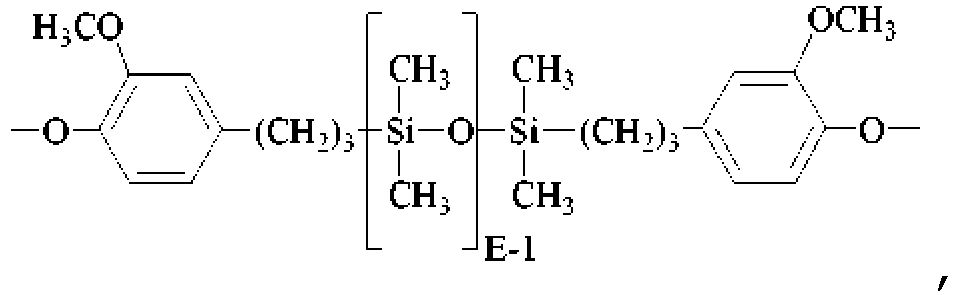 wobei E einen Durchschnittswert von 5 bis 20 hat,50 bis 99,6 Mol.% Isophthalat-Terephthalat-Resorcinestereinheiten, und0,2 bis 49,8 Mol.% Bisphenol A-carbonateinheiten;5 bis 15 Gew.% des Poly(carbonat-siloxan)s, wobei das Poly(carbonat-siloxan) einen Siloxangehalt von 15 bis 25 Gew.% hat, basierend auf dem Gesamtgewicht des Poly(carbonat-siloxan)s, und umfasst:Bisphenol A-carbonateinheiten undSiloxaneinheiten mit der Formel:
 wobei E einen Durchschnittswert von 20 bis 80 hat; und15 bis 25 Gew.% des Polycarbonathomopolymers, wobei das Polycarbonathomopolymer ein verzweigtes Polycarbonat umfasst, umfassend Bisphenol A-carbonateinheiten und 3 bis 10 Mol.%, basierend auf den Gesamtmol des verzweigten Polycarbonats, von einem Anteil abgeleitet von 1,1,1-Tris(4-hydroxyphenyl)ethan und Endverkappungsgruppen, die von p-Cyanophenol abgeleitet sind; und wobei das verzweigte Polycarbonat ein durchschnittliches Molekulargewicht (Gewichtsmittel) von 30.000 bis 35.000 Dalton aufweist, gemessen mittels Gelpermeationschromatographie (GPC) unter Verwendung einer vernetzten Styrol-Divinylbenzol-Säule und kalibriert mit Bisphenol A-polycarbonat-Referenzen;5 bis 8 Gew.% der Organophosphorverbindung, wobei die Organophosphorverbindung die folgende Formel hat:
 wobei q 1 oder 5 ist; und0,1 bis 3 Gew.% der Additivzusammensetzung, wobei die Additivzusammensetzung ein Formtrennmittel und einen Wärmestabilisator umfasst.
 - Thermoplastische Zusammensetzung nach einem der Ansprüche 1 bis 8, umfassend:
60 bis 65 Gew.% des Poly(carbonat-siloxan-arylat)s, wobei das Poly(carbonat-siloxan-arylat), basierend auf dem Gesamtgewicht des Poly(carbonat-siloxan-arylat)s, umfasst:0,2 bis 10 Gew.% Siloxaneinheiten mit der Formel: wobei E einen Durchschnittswert von 5 bis 20 hat,50 bis 99,6 Mol.% Isophthalat-Terephthalat-Resorcinestereinheiten, und0,2 bis 49,8 Mol.% Bisphenol A-carbonateinheiten;5 bis 15 Gew.% des Poly(carbonat-siloxan)s, wobei das Poly(carbonat-siloxan) einen Siloxangehalt von 15 bis 25 Gew.% hat, basierend auf dem Gesamtgewicht des Poly(carbonat-siloxan)s, und umfasst:Bisphenol A-carbonateinheiten undSiloxaneinheiten mit der Formel:
 wobei E einen Durchschnittswert von 20 bis 80 hat;15 bis 25 Gew.% des Polycarbonathomopolymers, wobei das Polycarbonathomopolymer ein lineares Bisphenol A-polycarbonathomopolymer mit einem durchschnittlichen Molekulargewicht (Gewichtsmittel) von 15.000 bis 20.000 Dalton umfasst, gemessen mittels Gelpermeationschromatographie (GPC) unter Verwendung einer vernetzten Styrol-Divinylbenzol-Säule und kalibriert mit Bisphenol A-polycarbonat-Referenzen;5 bis 8 Gew.% der Organophosphorverbindung, basierend auf dem Gesamtgewicht der thermoplastischen Zusammensetzung, wobei die Organophosphorverbindung die folgende Formel hat:
 wobei q 1 oder 5 ist; und0,1 bis 3 Gew.% der Additivzusammensetzung, wobei die Additivzusammensetzung ein Formtrennmittel und einen Wärmestabilisator umfasst.
 - Thermoplastische Zusammensetzung nach einem der vorhergehenden Ansprüche, des Weiteren umfassend einen mineralischen Füllstoff, Glas, Kohle oder eine Kombination, die mindestens einen der zuvor genannten umfasst; und wobei gegebenenfalls der Mineralfüllstoff, das Glas, der Kohlenstoff oder eine Kombination, die mindestens einen der zuvor genannten umfasst, in einer Menge von 5 bis 45 Gew.% vorhanden ist/sind, basierend auf dem Gesamtgewicht der thermoplastischen Zusammensetzung.
- Pulver, Filament oder Verbundstoff, umfassend die thermoplastische Zusammensetzung nach einem der vorhergehenden Ansprüche.
- Verbundstoff, umfassend die thermoplastische Zusammensetzung nach einem der Ansprüche 1 bis 11 und ein faseriges Material, umfassend Glasfaser, Kohlefaser, Basaltfaser; wobei gegebenenfalls das faserige Material eine gewebte Faser, eine Vliesfaser oder ein unidirektionales Faserband ist.
- Artikel, umfassend die Zusammensetzung nach einem der Ansprüche 1 bis 13, ausgewählt aus einem Formartikel, einem thermogeformten Artikel, einem extrudierten Film, einer extrudierten Lage, einem geschäumten Artikel, einer Schicht eines mehrschichtigen Artikels, einem Substrat für einen beschichteten Artikel und einem Substrat für einen metallisierten Artikel, wobei vorzugsweise der Artikel eine Flugzeuginnenkomponente ist.
- Verfahren zur Fertigung eines Artikels, wobei das Verfahren additive Fertigung des Artikels unter Verwendung eines Pulvers oder Filaments umfasst, das die thermoplastischen Zusammensetzungen gemäß einem der Ansprüche 1 bis 11 umfasst.
Applications Claiming Priority (3)
| Application Number | Priority Date | Filing Date | Title |
|---|---|---|---|
| EP19177748 | 2019-05-31 | ||
| US201962857418P | 2019-06-05 | 2019-06-05 | |
| PCT/US2020/035214 WO2020243492A1 (en) | 2019-05-31 | 2020-05-29 | Thermoplastic compositions, methods of their manufacture, and articles thereof |
Publications (2)
| Publication Number | Publication Date |
|---|---|
| EP3976706A1 EP3976706A1 (de) | 2022-04-06 |
| EP3976706B1 true EP3976706B1 (de) | 2024-11-06 |
Family
ID=71527907
Family Applications (1)
| Application Number | Title | Priority Date | Filing Date |
|---|---|---|---|
| EP20737637.7A Active EP3976706B1 (de) | 2019-05-31 | 2020-05-29 | Thermoplastische zusammensetzungen, verfahren zu deren herstellung und artikel daraus |
Country Status (3)
| Country | Link |
|---|---|
| US (1) | US12187893B2 (de) |
| EP (1) | EP3976706B1 (de) |
| WO (1) | WO2020243492A1 (de) |
Families Citing this family (1)
| Publication number | Priority date | Publication date | Assignee | Title |
|---|---|---|---|---|
| WO2023166489A1 (en) * | 2022-03-04 | 2023-09-07 | Shpp Global Technologies B.V. | Thermoplastic compositions, methods of their manufacture, and articles thereof |
Family Cites Families (17)
| Publication number | Priority date | Publication date | Assignee | Title |
|---|---|---|---|---|
| EP0524731B1 (de) | 1991-07-01 | 2002-03-13 | General Electric Company | Mischungen aus Polycarbonat-Polysiloxan-Blockcopolymeren und Polycarbonaten oder Polyestercarbonatcopolymeren |
| US7790292B2 (en) | 1999-05-18 | 2010-09-07 | Sabic Innovative Plastics Ip B.V. | Polysiloxane copolymers, thermoplastic composition, and articles formed therefrom |
| US6989190B2 (en) | 2000-10-17 | 2006-01-24 | General Electric Company | Transparent polycarbonate polyester composition and process |
| US8981015B2 (en) | 2011-03-31 | 2015-03-17 | Sabic Global Technologies B.V. | Flame retardant poly(siloxane) copolymer compositions, methods of manufacture, and articles formed therefrom |
| WO2013049967A1 (en) | 2011-10-08 | 2013-04-11 | Sabic Innovative Plastics Ip B.V. | Plastic flame housing and method of making the same |
| US20130224462A1 (en) | 2012-02-29 | 2013-08-29 | Sabic Innovative Plastics Ip B.V. | Thermoplastic compositions having low smoke, methods of their manufacture, and uses thereof |
| EP2634219B1 (de) * | 2012-02-29 | 2017-01-04 | SABIC Global Technologies B.V. | Thermoplastische Polycarbonatcopolymerzusammensetzungen, Verfahren zu deren Herstellung und Artikel davon |
| US20130317142A1 (en) | 2012-05-24 | 2013-11-28 | Sabic Innovative Plastics Ip B.V. | Flame retardant thermoplastic compositions, methods of manufacture thereof and articles comprising the same |
| EP2730618B1 (de) | 2012-11-07 | 2016-10-12 | SABIC Global Technologies B.V. | Verfahren zur Herstellung von Polycarbonatzusammensetzungen |
| US9328240B2 (en) | 2012-12-21 | 2016-05-03 | Sabic Global Technologies B.V. | Polycarbonate compositions, articles formed therefrom, and methods of manufacture thereof |
| US9352755B2 (en) | 2013-05-01 | 2016-05-31 | Sabic Global Technologies B.V. | Interior train components having low smoke and low heat release, and methods of their manufacture |
| US9266541B2 (en) | 2013-05-01 | 2016-02-23 | Sabic Global Technologies B.V. | Interior train components having low smoke and low heat release, and methods of their manufacture |
| US9650496B2 (en) | 2013-06-12 | 2017-05-16 | Sabic Global Technologies B.V. | Interior aircraft components and methods of manufacture |
| US9718956B2 (en) | 2014-01-14 | 2017-08-01 | Sabic Global Technologies B.V. | Interior aircraft components and methods of manufacture |
| US10329421B2 (en) * | 2014-06-11 | 2019-06-25 | Sabic Global Technologies B.V. | Polycarbonate compositions, method of manufacture thereof, and articles therefrom |
| EP3169730B1 (de) * | 2014-08-20 | 2018-10-03 | SABIC Global Technologies B.V. | Thermoplastische zusammensetzungen, verfahren zu deren herstellung und artikel daraus |
| KR20160067714A (ko) | 2014-12-04 | 2016-06-14 | 주식회사 엘지화학 | 코폴리카보네이트 및 이를 포함하는 물품 |
-
2020
- 2020-05-29 EP EP20737637.7A patent/EP3976706B1/de active Active
- 2020-05-29 WO PCT/US2020/035214 patent/WO2020243492A1/en not_active Ceased
- 2020-05-29 US US17/614,014 patent/US12187893B2/en active Active
Also Published As
| Publication number | Publication date |
|---|---|
| US12187893B2 (en) | 2025-01-07 |
| EP3976706A1 (de) | 2022-04-06 |
| US20220220312A1 (en) | 2022-07-14 |
| WO2020243492A1 (en) | 2020-12-03 |
Similar Documents
| Publication | Publication Date | Title |
|---|---|---|
| CN104136535B (zh) | 热塑性聚碳酸酯共聚物组合物、它们的制造方法及其制品 | |
| EP3094680B1 (de) | Zuginnenkomponenten mit niedriger rauch- und wärmeabgabe und verfahren zu deren herstellung | |
| CN104204088B (zh) | 具有低烟气的热塑性组合物、它们的制备方法及其用途 | |
| EP3169730B1 (de) | Thermoplastische zusammensetzungen, verfahren zu deren herstellung und artikel daraus | |
| US9352755B2 (en) | Interior train components having low smoke and low heat release, and methods of their manufacture | |
| CN104136518B (zh) | 热塑性聚碳酸酯共聚物组合物、其制造方法及其用途 | |
| US20240174801A1 (en) | Polycarbonate copolymer compositions for rail interiors | |
| EP3094679B1 (de) | Innere flugzeugkomponenten und verfahren zur herstellung | |
| EP3224313B1 (de) | Thermoplastische zusammensetzungen, verfahren zur herstellung und artikel daraus | |
| US20160347952A1 (en) | Interior train components having low smoke and low heat release, and methods of their manufacture | |
| EP3976706B1 (de) | Thermoplastische zusammensetzungen, verfahren zu deren herstellung und artikel daraus | |
| EP2334717B1 (de) | Flammhemmende thermoplastische zusammensetzungen und daraus hergestellte artikel | |
| EP4194509B1 (de) | Polycarbonatzusammensetzungen | |
| WO2020084575A1 (en) | Co-polycarbonate resin materials and materials made there-from | |
| EP3990546B1 (de) | Transparente polycarbonat-zusammensetzungen mit ultraniedrigem halogenflammschutz mit v0 bei 0,6 mm |
Legal Events
| Date | Code | Title | Description |
|---|---|---|---|
| STAA | Information on the status of an ep patent application or granted ep patent |
Free format text: STATUS: UNKNOWN |
|
| STAA | Information on the status of an ep patent application or granted ep patent |
Free format text: STATUS: THE INTERNATIONAL PUBLICATION HAS BEEN MADE |
|
| PUAI | Public reference made under article 153(3) epc to a published international application that has entered the european phase |
Free format text: ORIGINAL CODE: 0009012 |
|
| STAA | Information on the status of an ep patent application or granted ep patent |
Free format text: STATUS: REQUEST FOR EXAMINATION WAS MADE |
|
| 17P | Request for examination filed |
Effective date: 20211207 |
|
| AK | Designated contracting states |
Kind code of ref document: A1 Designated state(s): AL AT BE BG CH CY CZ DE DK EE ES FI FR GB GR HR HU IE IS IT LI LT LU LV MC MK MT NL NO PL PT RO RS SE SI SK SM TR |
|
| DAV | Request for validation of the european patent (deleted) | ||
| DAX | Request for extension of the european patent (deleted) | ||
| GRAP | Despatch of communication of intention to grant a patent |
Free format text: ORIGINAL CODE: EPIDOSNIGR1 |
|
| STAA | Information on the status of an ep patent application or granted ep patent |
Free format text: STATUS: GRANT OF PATENT IS INTENDED |
|
| INTG | Intention to grant announced |
Effective date: 20240624 |
|
| GRAS | Grant fee paid |
Free format text: ORIGINAL CODE: EPIDOSNIGR3 |
|
| GRAA | (expected) grant |
Free format text: ORIGINAL CODE: 0009210 |
|
| STAA | Information on the status of an ep patent application or granted ep patent |
Free format text: STATUS: THE PATENT HAS BEEN GRANTED |
|
| P01 | Opt-out of the competence of the unified patent court (upc) registered |
Free format text: CASE NUMBER: APP_49202/2024 Effective date: 20240829 |
|
| AK | Designated contracting states |
Kind code of ref document: B1 Designated state(s): AL AT BE BG CH CY CZ DE DK EE ES FI FR GB GR HR HU IE IS IT LI LT LU LV MC MK MT NL NO PL PT RO RS SE SI SK SM TR |
|
| REG | Reference to a national code |
Ref country code: GB Ref legal event code: FG4D |
|
| REG | Reference to a national code |
Ref country code: CH Ref legal event code: EP |
|
| REG | Reference to a national code |
Ref country code: DE Ref legal event code: R096 Ref document number: 602020040829 Country of ref document: DE |
|
| REG | Reference to a national code |
Ref country code: IE Ref legal event code: FG4D |
|
| REG | Reference to a national code |
Ref country code: LT Ref legal event code: MG9D |
|
| REG | Reference to a national code |
Ref country code: NL Ref legal event code: MP Effective date: 20241106 |
|
| PG25 | Lapsed in a contracting state [announced via postgrant information from national office to epo] |
Ref country code: HR Free format text: LAPSE BECAUSE OF FAILURE TO SUBMIT A TRANSLATION OF THE DESCRIPTION OR TO PAY THE FEE WITHIN THE PRESCRIBED TIME-LIMIT Effective date: 20241106 Ref country code: PT Free format text: LAPSE BECAUSE OF FAILURE TO SUBMIT A TRANSLATION OF THE DESCRIPTION OR TO PAY THE FEE WITHIN THE PRESCRIBED TIME-LIMIT Effective date: 20250306 Ref country code: IS Free format text: LAPSE BECAUSE OF FAILURE TO SUBMIT A TRANSLATION OF THE DESCRIPTION OR TO PAY THE FEE WITHIN THE PRESCRIBED TIME-LIMIT Effective date: 20250306 |
|
| PG25 | Lapsed in a contracting state [announced via postgrant information from national office to epo] |
Ref country code: FI Free format text: LAPSE BECAUSE OF FAILURE TO SUBMIT A TRANSLATION OF THE DESCRIPTION OR TO PAY THE FEE WITHIN THE PRESCRIBED TIME-LIMIT Effective date: 20241106 Ref country code: NL Free format text: LAPSE BECAUSE OF FAILURE TO SUBMIT A TRANSLATION OF THE DESCRIPTION OR TO PAY THE FEE WITHIN THE PRESCRIBED TIME-LIMIT Effective date: 20241106 |
|
| REG | Reference to a national code |
Ref country code: AT Ref legal event code: MK05 Ref document number: 1739321 Country of ref document: AT Kind code of ref document: T Effective date: 20241106 |
|
| PG25 | Lapsed in a contracting state [announced via postgrant information from national office to epo] |
Ref country code: BG Free format text: LAPSE BECAUSE OF FAILURE TO SUBMIT A TRANSLATION OF THE DESCRIPTION OR TO PAY THE FEE WITHIN THE PRESCRIBED TIME-LIMIT Effective date: 20241106 |
|
| PG25 | Lapsed in a contracting state [announced via postgrant information from national office to epo] |
Ref country code: ES Free format text: LAPSE BECAUSE OF FAILURE TO SUBMIT A TRANSLATION OF THE DESCRIPTION OR TO PAY THE FEE WITHIN THE PRESCRIBED TIME-LIMIT Effective date: 20241106 |
|
| PG25 | Lapsed in a contracting state [announced via postgrant information from national office to epo] |
Ref country code: NO Free format text: LAPSE BECAUSE OF FAILURE TO SUBMIT A TRANSLATION OF THE DESCRIPTION OR TO PAY THE FEE WITHIN THE PRESCRIBED TIME-LIMIT Effective date: 20250206 |
|
| PG25 | Lapsed in a contracting state [announced via postgrant information from national office to epo] |
Ref country code: LV Free format text: LAPSE BECAUSE OF FAILURE TO SUBMIT A TRANSLATION OF THE DESCRIPTION OR TO PAY THE FEE WITHIN THE PRESCRIBED TIME-LIMIT Effective date: 20241106 Ref country code: GR Free format text: LAPSE BECAUSE OF FAILURE TO SUBMIT A TRANSLATION OF THE DESCRIPTION OR TO PAY THE FEE WITHIN THE PRESCRIBED TIME-LIMIT Effective date: 20250207 Ref country code: AT Free format text: LAPSE BECAUSE OF FAILURE TO SUBMIT A TRANSLATION OF THE DESCRIPTION OR TO PAY THE FEE WITHIN THE PRESCRIBED TIME-LIMIT Effective date: 20241106 |
|
| PG25 | Lapsed in a contracting state [announced via postgrant information from national office to epo] |
Ref country code: PL Free format text: LAPSE BECAUSE OF FAILURE TO SUBMIT A TRANSLATION OF THE DESCRIPTION OR TO PAY THE FEE WITHIN THE PRESCRIBED TIME-LIMIT Effective date: 20241106 |
|
| PG25 | Lapsed in a contracting state [announced via postgrant information from national office to epo] |
Ref country code: RS Free format text: LAPSE BECAUSE OF FAILURE TO SUBMIT A TRANSLATION OF THE DESCRIPTION OR TO PAY THE FEE WITHIN THE PRESCRIBED TIME-LIMIT Effective date: 20250206 |
|
| PG25 | Lapsed in a contracting state [announced via postgrant information from national office to epo] |
Ref country code: SM Free format text: LAPSE BECAUSE OF FAILURE TO SUBMIT A TRANSLATION OF THE DESCRIPTION OR TO PAY THE FEE WITHIN THE PRESCRIBED TIME-LIMIT Effective date: 20241106 |
|
| PGFP | Annual fee paid to national office [announced via postgrant information from national office to epo] |
Ref country code: DE Payment date: 20250402 Year of fee payment: 6 |
|
| PG25 | Lapsed in a contracting state [announced via postgrant information from national office to epo] |
Ref country code: DK Free format text: LAPSE BECAUSE OF FAILURE TO SUBMIT A TRANSLATION OF THE DESCRIPTION OR TO PAY THE FEE WITHIN THE PRESCRIBED TIME-LIMIT Effective date: 20241106 |
|
| PG25 | Lapsed in a contracting state [announced via postgrant information from national office to epo] |
Ref country code: EE Free format text: LAPSE BECAUSE OF FAILURE TO SUBMIT A TRANSLATION OF THE DESCRIPTION OR TO PAY THE FEE WITHIN THE PRESCRIBED TIME-LIMIT Effective date: 20241106 |
|
| PGFP | Annual fee paid to national office [announced via postgrant information from national office to epo] |
Ref country code: FR Payment date: 20250401 Year of fee payment: 6 |
|
| PG25 | Lapsed in a contracting state [announced via postgrant information from national office to epo] |
Ref country code: RO Free format text: LAPSE BECAUSE OF FAILURE TO SUBMIT A TRANSLATION OF THE DESCRIPTION OR TO PAY THE FEE WITHIN THE PRESCRIBED TIME-LIMIT Effective date: 20241106 |
|
| PG25 | Lapsed in a contracting state [announced via postgrant information from national office to epo] |
Ref country code: SK Free format text: LAPSE BECAUSE OF FAILURE TO SUBMIT A TRANSLATION OF THE DESCRIPTION OR TO PAY THE FEE WITHIN THE PRESCRIBED TIME-LIMIT Effective date: 20241106 |
|
| PG25 | Lapsed in a contracting state [announced via postgrant information from national office to epo] |
Ref country code: CZ Free format text: LAPSE BECAUSE OF FAILURE TO SUBMIT A TRANSLATION OF THE DESCRIPTION OR TO PAY THE FEE WITHIN THE PRESCRIBED TIME-LIMIT Effective date: 20241106 |
|
| PG25 | Lapsed in a contracting state [announced via postgrant information from national office to epo] |
Ref country code: IT Free format text: LAPSE BECAUSE OF FAILURE TO SUBMIT A TRANSLATION OF THE DESCRIPTION OR TO PAY THE FEE WITHIN THE PRESCRIBED TIME-LIMIT Effective date: 20241106 |
|
| REG | Reference to a national code |
Ref country code: DE Ref legal event code: R097 Ref document number: 602020040829 Country of ref document: DE |
|
| PG25 | Lapsed in a contracting state [announced via postgrant information from national office to epo] |
Ref country code: SE Free format text: LAPSE BECAUSE OF FAILURE TO SUBMIT A TRANSLATION OF THE DESCRIPTION OR TO PAY THE FEE WITHIN THE PRESCRIBED TIME-LIMIT Effective date: 20241106 |
|
| PLBE | No opposition filed within time limit |
Free format text: ORIGINAL CODE: 0009261 |
|
| STAA | Information on the status of an ep patent application or granted ep patent |
Free format text: STATUS: NO OPPOSITION FILED WITHIN TIME LIMIT |
|
| 26N | No opposition filed |
Effective date: 20250807 |
|
| REG | Reference to a national code |
Ref country code: CH Ref legal event code: H13 Free format text: ST27 STATUS EVENT CODE: U-0-0-H10-H13 (AS PROVIDED BY THE NATIONAL OFFICE) Effective date: 20251223 |
|
| PG25 | Lapsed in a contracting state [announced via postgrant information from national office to epo] |
Ref country code: LU Free format text: LAPSE BECAUSE OF NON-PAYMENT OF DUE FEES Effective date: 20250529 |
|
| PG25 | Lapsed in a contracting state [announced via postgrant information from national office to epo] |
Ref country code: CH Free format text: LAPSE BECAUSE OF NON-PAYMENT OF DUE FEES Effective date: 20250531 |
|
| GBPC | Gb: european patent ceased through non-payment of renewal fee |
Effective date: 20250529 |
|
| REG | Reference to a national code |
Ref country code: BE Ref legal event code: MM Effective date: 20250531 |
|
| PG25 | Lapsed in a contracting state [announced via postgrant information from national office to epo] |
Ref country code: MC Free format text: LAPSE BECAUSE OF FAILURE TO SUBMIT A TRANSLATION OF THE DESCRIPTION OR TO PAY THE FEE WITHIN THE PRESCRIBED TIME-LIMIT Effective date: 20241106 |
|
| PG25 | Lapsed in a contracting state [announced via postgrant information from national office to epo] |
Ref country code: GB Free format text: LAPSE BECAUSE OF NON-PAYMENT OF DUE FEES Effective date: 20250529 |
|
| PG25 | Lapsed in a contracting state [announced via postgrant information from national office to epo] |
Ref country code: IE Free format text: LAPSE BECAUSE OF NON-PAYMENT OF DUE FEES Effective date: 20250529 |
|
| PG25 | Lapsed in a contracting state [announced via postgrant information from national office to epo] |
Ref country code: BE Free format text: LAPSE BECAUSE OF NON-PAYMENT OF DUE FEES Effective date: 20250531 |