EP3977200B1 - Article optique à étages multiples - Google Patents
Article optique à étages multiples Download PDFInfo
- Publication number
- EP3977200B1 EP3977200B1 EP19728402.9A EP19728402A EP3977200B1 EP 3977200 B1 EP3977200 B1 EP 3977200B1 EP 19728402 A EP19728402 A EP 19728402A EP 3977200 B1 EP3977200 B1 EP 3977200B1
- Authority
- EP
- European Patent Office
- Prior art keywords
- photochromic
- layer
- optical article
- photochromic material
- unactivated state
- Prior art date
- Legal status (The legal status is an assumption and is not a legal conclusion. Google has not performed a legal analysis and makes no representation as to the accuracy of the status listed.)
- Active
Links
Images


Classifications
-
- G—PHYSICS
- G02—OPTICS
- G02B—OPTICAL ELEMENTS, SYSTEMS OR APPARATUS
- G02B5/00—Optical elements other than lenses
- G02B5/20—Filters
- G02B5/22—Absorbing filters
- G02B5/23—Photochromic filters
-
- G—PHYSICS
- G02—OPTICS
- G02C—SPECTACLES; SUNGLASSES OR GOGGLES INSOFAR AS THEY HAVE THE SAME FEATURES AS SPECTACLES; CONTACT LENSES
- G02C7/00—Optical parts
- G02C7/10—Filters, e.g. for facilitating adaptation of the eyes to the dark; Sunglasses
- G02C7/102—Photochromic filters
-
- G—PHYSICS
- G02—OPTICS
- G02C—SPECTACLES; SUNGLASSES OR GOGGLES INSOFAR AS THEY HAVE THE SAME FEATURES AS SPECTACLES; CONTACT LENSES
- G02C7/00—Optical parts
- G02C7/10—Filters, e.g. for facilitating adaptation of the eyes to the dark; Sunglasses
- G02C7/105—Filters, e.g. for facilitating adaptation of the eyes to the dark; Sunglasses having inhomogeneously distributed colouring
Definitions
- the present invention relates to optical articles that exhibit: a uniform first transmittance when directly exposed to actinic radiation; a gradient second percent transmittance when exposed to actinic radiation that has passed through an actinic radiation blocking or attenuating transparency interposed between the source of actinic radiation and the optical article; and a uniform third percent transmittance when free of exposure to actinic radiation, where the uniform first percent transmittance is less than the uniform third percent transmittance.
- photochromic compounds When exposed to actinic radiation, photochromic compounds typically change from a first state (such as a bleached or first colored state providing a first transmittance) to a second state (such as a second colored state providing a second transmittance that is less than the first transmittance). When free of exposure to actinic radiation, photochromic compounds in the second state (such as the second colored state) will typically convert back to the first state (such as the bleached state).
- a first state such as a bleached or first colored state providing a first transmittance
- second state such as a second colored state providing a second transmittance that is less than the first transmittance
- Photochromic compounds, and correspondingly photochromic articles that include such photochromic compounds have been developed that are capable of reversibly transitioning between the above-described first and second states when an actinic radiation blocking or attenuating transparency (such as a vehicle windshield) is interposed between the photochromic article and the source of actinic radiation.
- Photochromic articles, such as photochromic optical lenses, which have been developed for use behind a vehicle windshield typically provide a uniform color or uniform level of darkness over the lens. Such a uniform level of color/darkness can be desirable when a user is looking out through the transparency, but can make viewing difficult when looking below the windshield, such as at the dashboard, instrument cluster, audio control system, multimedia display, and/or other items in the vehicle cabin.
- Photochromic articles When outside a vehicle and exposed directly to actinic radiation, a uniform color having a greater uniform level of darkness over the lens is typically desirable.
- Photochromic articles have been developed, which exhibit a gradient color and gradient level of darkness, advantageously when behind a vehicle windshield, but also less advantageously when outside a vehicle and exposed directly to actinic radiation.
- optical articles such as photochromic optical articles
- optical articles such as photochromic optical articles, also provide a uniform reduced level of darkness (or bleached state) when free of exposure to actinic radiatior
- molecular weight values of polymers such as weight average molecular weights (Mw) and number average molecular weights (Mn) are determined by gel permeation chromatography using appropriate standards, such as polystyrene standards.
- polydispersity index (PDI) values represent a ratio of the weight average molecular weight (Mw) to the number average molecular weight (Mn) of the polymer (i.e., Mw/Mn).
- polymer means homopolymers (e.g., prepared from a single monomer species), copolymers (e.g., prepared from at least two monomer species), graft polymers, core-shell polymers, comb polymers, and star polymers.
- (meth)acrylate and similar terms, such as “(meth)acrylic acid ester", means methacrylates and/or acrylates.
- (meth)acrylic acid means methacrylic acid and/or acrylic acid.
- photochromic and similar terms, such as “photochromic compound”, means having an absorption spectrum for at least visible radiation that varies in response to absorption of at least actinic radiation.
- photochromic material means any substance that is adapted to display photochromic properties (such as, adapted to have an absorption spectrum for at least visible radiation that varies in response to absorption of at least actinic radiation) and which includes at least one photochromic compound.
- actinic radiation means electromagnetic radiation that is capable of causing a response in a material, such as, but not limited to, transforming a photochromic material from one form or state to another as will be discussed in further detail herein.
- photochromic material includes thermally reversible photochromic materials and compounds and non-thermally reversible photochromic materials and compounds.
- thermally reversible photochromic compounds/materials as used herein means compounds/materials capable of converting from a first state, for example a "clear state”, to a second state, for example a "colored state”, in response to actinic radiation, and reverting back to the first state in response to thermal energy.
- non-thermally reversible photochromic compounds/materials means compounds/materials capable of converting from a first state, for example a "clear state", to a second state, for example a "colored state", in response to actinic radiation, and reverting back to the first state in response to actinic radiation of substantially the same wavelength(s) as the absorption(s) of the colored state (e.g., discontinuing exposure to such actinic radiation).
- the terms “first” and “second” are not intended to refer to any particular order or chronology, but instead refer to two different conditions or properties.
- the first state and the second state of a photochromic compound can differ with respect to at least one optical property, such as but not limited to the absorption of visible and/or UV radiation.
- the photochromic compounds of the photochromic articles of the present invention can have a different absorption spectrum in each of the first and second state.
- a photochromic compound of the photochromic articles of the present invention can be clear in the first state and colored in the second state.
- a photochromic compound of the photochromic articles of the present invention can have a first color in the first state and a second color in the second state.
- optical article or element or device means pertaining to or associated with light and/or vision.
- the optical article or element or device can be chosen from ophthalmic articles, elements and devices, display articles, elements and devices, windows, mirrors, and active and passive liquid crystal cell articles, elements and devices.
- ophthalmic means pertaining to or associated with the eye and vision.
- ophthalmic articles or elements include corrective and non-corrective lenses, including single vision or multi-vision lenses, which can be either segmented or non-segmented multi-vision lenses (such as, but not limited to, bifocal lenses, trifocal lenses and progressive lenses), as well as other elements used to correct, protect, or enhance (cosmetically or otherwise) vision, including without limitation, contact lenses, intra-ocular lenses, magnifying lenses, and protective lenses or visors.
- display means the visible or machine-readable representation of information in words, numbers, symbols, designs or drawings.
- Non-limiting examples of display elements include screens, monitors, and security elements, such as security marks.
- window means an aperture adapted to permit the transmission of radiation there-through.
- windows include automotive and aircraft transparencies, windshields, filters, shutters, and optical switches.
- mirror means a surface that specularly reflects a large fraction of incident light.
- liquid crystal cell refers to a structure containing a liquid crystal material that is capable of being ordered.
- a non-limiting example of a liquid crystal cell element is a liquid crystal display.
- the terms “formed over”, “deposited over”, “provided over”, “applied over”, “residing over”, or “positioned over” mean formed, deposited, provided, applied, residing, or positioned on but not necessarily in direct (or abutting) contact with the underlying element, or surface of the underlying element.
- a layer “positioned over” a substrate does not preclude the presence of one or more other layers, coatings, or films of the same or different composition located between the positioned or formed layer and the substrate.
- a first photochromic material means at least one first photochromic material. When two or more first photochromic materials are present, they together have and provide a (e.g., an average) first unactivated state absorbance of greater than 0 over a particular wavelength range, and a (e.g., an average) first unactivated state terminal minimum absorbance wavelength.
- a second photochromic material means at least one second photochromic material. When two or more second photochromic materials are present, they together have and provide a (e.g., an average) second unactivated state absorbance of greater than 0 over a particular wavelength range, and a (e.g., an average) second unactivated state terminal minimum absorbance wavelength.
- the term "unactivated state" with regard to photochromic materials means the photochromic material has: (i) measurable absorbance at wavelengths of greater than or equal to 330 nm and less than or equal to 450 nm, such as less than or equal to 430 nm, or less than or equal to 410 nm; and (ii) minimal or substantially no measurable absorbance at wavelengths of greater than 450 nm.
- the term "activated state" with regard to photochromic materials, such as the first photochromic material, the second photochromic material, and photochromic articles means the photochromic material and/or photochromic article has been exposed to actinic radiation having sufficient energy to result in the photochromic material and/or photochromic article having or producing measurable absorbance: (i) at wavelengths including at least some of the wavelengths of the unactivated state; and (ii) at wavelengths greater than those of the unactivated state.
- a first unactivated state absorbance of greater than 0 over at least a portion of a certain wavelength range, such as “over at least a portion of (or all) wavelengths from 375 nm to 450 nm” means the first photochromic material has an unactivated state absorbance of greater than 0 over at least a portion of a certain wavelength range, such as at least a portion of wavelengths from 375 nm to 450 nm.
- a first unactivated state terminal minimum absorbance wavelength means the wavelength at which the first photochromic material (of the first layer) in an unactivated state, has a terminal (or upper) minimum absorbance.
- a second unactivated state absorbance of greater than 0" over at least a portion of a certain wavelength range means the second photochromic material (of the second layer) has an unactivated state absorbance of greater than 0 over at least a portion of a certain wavelength range, such as over at least a portion of wavelengths from 340 nm to less than 400 nm, such as from 340 nm to 390 nm, such as from 340 nm to 380 nm, such as from 350 nm to 380 nm.
- the term "over at least a portion of wavelengths from x nm to y nm" with regard to an unactivated state absorbance of greater than 0, means over at least a portion of consecutive wavelengths within the recited range, inclusive of the recited upper and lower wavelength values.
- a second unactivated state terminal minimum absorbance wavelength means the wavelength at which the second photochromic material (of the second layer), in an unactivated state, has a terminal (or upper) minimum absorbance.
- percent transmittance was determined using a suitable instrument, such as a Spectrum Detective SD2400 transmission meter, commercially available from EDTM, Inc., in accordance with instructions provided in the spectrometer user manual.
- test specimens that are representative of the photochromic articles of the present invention, are tested for photochromic response: (i) in the absence of exposure to actinic radiation; (ii) with a simulated windshield interposed between the test specimen and the source of actinic radiation, under conditions simulating an eyeglass wearer behind an automotive windshield, in the Behind the Windshield Test (BWS); and (iii) under conditions simulating outdoor exposure in the Outdoor Test (OS).
- BWS Behind the Windshield Test
- OS Outdoor Test
- the test specimens are observed visually with regard to an observed: lack of color; uniform color development; or gradient color development.
- the term "uniform percent transmittance” and related terms, such as “uniform first percent transmittance” and “uniform third percent transmittance” means a uniform (or constant) percent transmittance over (such as relative to the face of) the photochromic article.
- the term “uniform percent transmittance” means that when measured at two or more points over or relative to the face of the lens (such as from the top to the bottom of the face of the lens), the lens has a uniform percent transmittance.
- the term "uniform percent transmittance” means having a variation in percent transmittance, such as measured over a plurality of points over the face of the photochromic article, of less than or equal to 0.5 percent, such as less than or equal to 0.25 percent, such as less than or equal to 0.1 percent, such as less than or equal to 0.05 percent, the percent values each being as between any two measurement points.
- the term “gradient percent transmittance” and related terms, such as “gradient second percent transmittance” means a gradient increase or decrease in percent transmittance along a line over (such as relative to the face of) the optical article.
- the term gradient percent transmittance" and related terms, such as “gradient second percent transmittance” means that when a plurality of measurements are taken along a line extending from an upper portion (or end) to a bottom portion (or end) of the face of the lens, the percent transmittance increases in a gradient (or gradiently) along the line of measurements; and correspondingly, the percent transmittance decreases in a gradient (or gradiently) in the opposite direction along the same line of measurements.
- the gradient change in percent transmittance along the line of measurements (as a function of linear distance along the line of measurements), with some embodiments, can: be linear; be non-linear, such as exponential; include one or more plateaus; or be composed of a combination of two or more thereof.
- actinic radiation blocking and related terms, such as “actinic radiation attenuating”, “actinic radiation blocking transparency”, and “actinic radiation attenuating transparency” means at least some, but less than all, of the incident actinic radiation is blocked or attenuated, such as by a transparency, such as, but not limited to, a vehicle windshield.
- the uniform first transmittance is from 5 percent to 25 percent, such as from 6 percent to 22 percent, such as from 8 percent to 20 percent.
- the uniform third transmittance is from 40 percent to 95 percent, such as from 60 percent to 92 percent, such as from 80 percent to 90 percent.
- the uniform first percent transmittance is less than the uniform third percent transmittance.
- the uniform first percent transmittance is less than the uniform third percent transmittance by an absolute value of from 35 to 70, such as from 54 to 70, where each absolute value is determined by subtracting the uniform first percent transmittance from the uniform third percent transmittance.
- the optical article is an electrochromic optical article that provides the uniform first percent transmittance, gradient second percent transmittance, and uniform third percent transmittance as described previously herein.
- the optical article is a photochromic optical article that provides the uniform first percent transmittance, gradient second percent transmittance, and uniform third percent transmittance as described previously herein.
- the optical article is a photochromic optical article that includes: (a) a substrate; and (b) a first layer positioned over the substrate, where the first layer includes a first photochromic material having a first unactivated state terminal minimum absorbance wavelength.
- the photochromic optical article further includes, with some embodiments, (c) a second layer positioned over the first layer, where the second layer includes a second photochromic material having a second unactivated state terminal minimum absorbance wavelength.
- the second unactivated state terminal minimum absorbance wavelength is less than the first unactivated state terminal minimum absorbance wavelength.
- the first layer provides the gradient second percent transmittance when the photochromic optical article is tested in the Behind the Windshield Test, and the second layer provides the uniform first percent transmittance when the photochromic optical article is tested in the Outdoor Test.
- the first photochromic material has a first unactivated state absorbance of greater than 0 over at least a portion of wavelengths from 375 nm to 450 nm, and the first unactivated state terminal minimum absorbance wavelength is greater than 400 nm; and the second photochromic material has a second unactivated state absorbance of greater than zero over at least a portion of wavelengths from 340 nm to less than 420 nm, and the second unactivated state terminal minimum absorbance wavelength is less than or equal to 415 nm.
- the first unactivated state terminal minimum absorbance wavelength (of the first photochromic material) is greater than 415 nm and less than or equal to 450 nm; and the second unactivated state terminal minimum absorbance wavelength (of the second photochromic material) is greater than 375 nm and less than or equal to 415 nm.
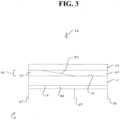
- Photochromic article 4 includes a substrate 11 having a first (or forward) surface 14 and a second (or rear) surface 17, in which the first 14 and second 17 surfaces are opposed to each other.
- First surface 14 of substrate 11 faces incident actinic radiation depicted by arrow 26.
- Photochromic optical article 4 further includes a first layer 72 that is composed of: a first portion 20 that includes the first photochromic material; and a second portion 60 that is free of photochromic material.
- the gradient pattern is represented by line 90.
- the gradient pattern can be, for example, a concentration gradient of the first photochromic material in the first layer 72.
- the concentration of the first photochromic material in the first layer 72 can decrease from a maximum towards a first end 63 of substrate 11 to a minimum towards a second end 66 of substrate 11.
- the concentration of the first photochromic material can decrease from a maximum at or near the first end 63 to a minimum at or about the middle 69 of substrate 11.
- the gradient pattern can be a thickness gradient.
- First portion 20 of first layer 72 can be in abutting relationship with a portion of first surface 14 of substrate 11.
- Second portion 60 of first layer 72 can be positioned over (e.g., in abutting relationship with) with at least a portion of underlying first portion 20 and over at least a portion of first surface 14 of substrate 11.
- at least a portion of second portion 60 of first layer 72 can have a gradient thickness that decreases from a maximum towards the second end 66 to a minimum towards the first end 63 of substrate 11 (e.g., over the first portion 20).
- second portion 60 of first layer 72 is a clear coat (e.g., formed from a coating material including no colorants).
- the first layer 72 can have a substantially uniform thickness.
- Photochromic optical article 4, of FIG. 3 includes a second layer 23 which is positioned over (e.g., in abutting relationship with) underlying first layer 72.
- Second layer 23 includes the second photochromic material.
- Second layer 23, in accordance with some embodiments, and as depicted illustratively in FIG. 3 can have a substantially uniform thickness, e.g., from first end 63 to second end 66 of substrate 11.
- Second layer 23, in accordance with some embodiments, can have a substantially uniform concentration of the second photochromic material e.g., from first end 63 to second end 66 of substrate 11.
- the first photochromic material of first portion 20 of first layer 72 of photochromic optical article 4 of FIG. 3 can have absorbance properties represented by graph 29 of FIG. 1 , which is a plot of absorbance vs. wavelength for a first photochromic material. With reference to representative graph 29, the first photochromic material can have a first unactivated state terminal minimum absorbance wavelength 41 of about 435 nm.
- the second photochromic material of second layer 23 of photochromic article 4 of FIG. 3 can have absorbance properties represented by graph 32 of FIG. 2 , which is a plot of absorbance vs. wavelength for a second photochromic material. With reference to graph 32, the second photochromic material can have a second unactivated state terminal minimum absorbance wavelength 50 of about 410 nm.
- the first layer 72 of the photochromic optical article 4 provides the gradient second percent transmittance when the photochromic optical article 4 is tested in the Behind the Windshield Test.
- the second layer 23 of the photochromic optical article 4 provides the uniform first percent transmittance when the photochromic optical article 4 is tested in the Outdoor Test.
- the uniform third percent transmittance is provided by the photochromic optical article 4 as a whole when the photochromic optical article 4 is free of exposure to actinic radiation.
- the second photochromic material of the second layer 23 when tested in the Outdoor Test, the second photochromic material of the second layer 23 is activated and thereby provides the uniform first percent transmission of the photochromic optical article 4.
- the second photochromic material of the second layer 23 also blocks (or prevents) substantially actinic radiation from reaching the first photochromic material of the underlying first layer 72, thus preventing substantially (or minimizing) activation of the first photochromic material.
- the second photochromic material of the second layer 23 is substantially free of activation, due to the simulation windshield blocking wavelengths of light (actinic radiation) that would otherwise activate the second photochromic material.
- actinic radiation attenuated by passing through the simulation windshield passes through the second layer 23 and activates the first photochromic material of the underlying first layer 72.
- the first layer 72 has a gradient pattern of the first photochromic material.
- the first photochromic material being present in a gradient pattern, when activated by exposure to actinic radiation, provides the gradient pattern of the photochromic article 4.
- the first layer 72 can be provided with a gradient pattern of the first photochromic material in accordance with art-recognized methods, such as, but not limited to: dip (or partial immersion) coating methods; spray methods; micro-jet coating methods (such as ink-jet coating methods, where, with some embodiments, the ink of the ink-jet coating apparatus is replaced with a composition including the first photochromic compound); and combinations of such methods.
- the first layer 72 can be formed using a spray coater.
- a first coating solution comprising the first photochromic material (to form the first portion 20) can be mixed at the spray nozzle with a second coating solution free of the first photochromic material (to form the second portion 60).
- the amounts of the two coating solutions can be varied as the coatings are applied onto the substrate 11 to provide the gradient (e.g., gradient concentration) of the first coating material, i.e. to form the first portion 20 and the second portion 60.
- gradient e.g., gradient concentration
- An example of such a coating method is disclosed in paragraphs [0110] through [0114] of Example 1 of WO 2018/010809 A1 .
- the gradient pattern of the first photochromic compound of the first layer 72 is provided and oriented such that there is higher concentration of first photochromic material at the top of the lens (such as, above the eye of the wearer) and a lower concentration of (including no) first photochromic material at the bottom of the lens (such as, below the eye of the wearer).
- the first photochromic material of the first layer 72 When present in such a gradient pattern and activated, the first photochromic material of the first layer 72 provides a gradient second percent transmittance, in which the percent transmittance at the top of the lens is less, and the percent transmittance at the bottom of the lens is greater (relative to each other).
- the first photochromic material of the first layer 72 is selected from a first photochromic compound, a first photochromic-dichroic compound, and combinations thereof.
- the second photochromic material of the second layer 23 is selected from a second photochromic compound, a second photochromic-dichroic compound, or combinations thereof.
- photochromic-dichroic and similar terms, such as “dichroism”, means the ability to absorb one of two orthogonal plane polarized components of radiation (including transmitted and/or reflected radiation) more strongly than the other orthogonal plane polarized component.
- Photochromic-dichroic materials possess both photochromic properties and dichroic properties.
- a photochromic-dichroic material in some instances, can be described as including a photochromic molecule (or core, or moiety) to which is covalently attached at least one lengthening group that includes at least one mesogen (or mesogenic) segment.
- a mesogen is typically described as the primary or fundamental unit (or segment or group) of a liquid crystal material that induces, and/or is induced into, structural order amongst and between liquid crystals (such as, other liquid crystal materials and/or other mesogen segments that are present). Ordering of the lengthening groups of photochromic-dichroic compounds results, in some embodiments, a molecular structure having optical anisotropy. The dichroic properties of photochromic-dichroic compounds are believed to be due to the optical anisotropy resulting from alignment of the lengthening groups of the photochromic-dichroic compounds.
- a mesogen segment includes two or more divalent cyclic groups selected from divalent cycloaliphatic groups and/or divalent aromatic groups.
- the alignment of the first photochromic-dichroic compound (of the first layer), or first alignment, and the alignment of the second photochromic-dichroic compound (of the second layer), or second alignment can be: parallel relative to each other; non-parallel, such as having a relative angle (as between the first alignment and the second alignment) of greater than 0° and less than or equal to 90°, such as from 10° to 90°, such as from 20° to 80°, such as from 25° to 75°.
- the first and second photochromic-dichroic compounds can each be independently aligned in accordance with art-recognized methods, such as direct methods, such as by the application of shear force, or indirectly, such as by exposure to at least one of a magnetic field, an electric field, and/or linearly polarized radiation.
- the first and second photochromic-dichroic compounds are each independently aligned by abutment with an alignment layer, which is typically an underlying alignment layer.
- the first photochromic-dichroic compound(s) of the first layer can be aligned by a first alignment layer that is interposed between the substrate and the first layer, and in abutting relationship with the first layer.
- the second photochromic-dichroic compound(s) of the second layer can be aligned by a second alignment layer that is interposed between the first layer and the second layer, and in abutting relationship with the second layer.
- the first and second alignment layers can each be independently aligned by exposure to at least one of a magnetic field, an electric field, linearly polarized radiation, shear force, or combinations of two or more thereof. Alignment of the alignment layer results in alignment of the photochromic-dichroic material of the layer associated therewith (such as in abutment therewith).
- Classes and examples of materials that can be used as or to form each alignment layer include, but are not limited to, the orientation facilities, orientation materials, alignment media, and alignment facilities described at: column 5, line 5 through column 6, line 4; column 7, line 56 through column 24, line 36; and the examples of US 8,926,091 B2 , which disclosure is incorporated herein by reference.
- the first photochromic material and the second photochromic material are each independently selected from indeno-fused naphthopyrans, naphtho[1,2-b]pyrans, naphtho[2,1-b]pyrans, spirofluoroeno[1,2-b]pyrans, phenanthropyrans, quinolinopyrans, fluoroanthenopyrans, spiropyrans, benzoxazines, naphthoxazines, spiro(indoline)naphthoxazines, spiro(indoline)pyridobenzoxazines, spiro(indoline)fluoranthenoxazines, spiro(indoline)quinoxazines, fulgides, fulgimides, diarylethenes, diarylalkylethenes, diarylalkenylethenes, and combinations of two or more thereof.
- the photochromic moiety or core of the first photochromic-dichroic compound and the photochromic moiety or core of the second photochromic-dichroic compound are each independently selected from indeno-fused naphthopyrans, naphtho[1,2-b]pyrans, naphtho[2,1-b]pyrans, spirofluoroeno[1,2-b]pyrans, phenanthropyrans, quinolinopyrans, fluoroanthenopyrans, spiropyrans, benzoxazines, naphthoxazines, spiro(indoline)naphthoxazines, spiro(indoline)pyridobenzoxazines, spiro(indoline)fluoranthenoxazines, spiro(indoline)quino
- the optical article 4 of the present invention can, with some embodiments, include one or more additional layers, such as, but not limited to, primer layer(s), topcoat layer(s), antireflective layer(s), hardcoat layer(s), polarizing layer(s), and alignment layer(s).
- additional layers such as, but not limited to, primer layer(s), topcoat layer(s), antireflective layer(s), hardcoat layer(s), polarizing layer(s), and alignment layer(s).
- additional layers are described at column 20, line 30 through column 21, line 38 of US 8,828,284 B2 , which disclosure is incorporated herein by reference.
- the first layer 72 and the second layer 23 of the photochromic optical article can each independently include at least one additive selected from dyes, alignment promoters, kinetic enhancing additives, photoinitiators, thermal initiators, polymerization inhibitors, solvents, light stabilizers, heat stabilizers, mold release agents, rheology control agents, leveling agents, free radical scavengers, adhesion promoters, blue light blockers, or combinations of two or more thereof.
- Classes and examples of blue light blocking (or filtering) agents include, but are not limited to, those described in US 9,683,102 B2 and US 2015/0234208 A1 , the pertinent portions of which are incorporated herein by reference.
- the first layer 72 and the second layer 23 can each independently include a dichroic dye.
- dichroic dyes that can be included in the first and/or second layers of the photochromic optical article of the present invention include, but are not limited to, azomethines, indigoids, thioindigoids, merocyanines, indans, quinophthalonic dyes, perylenes, phthaloperines, triphenodioxazines, indoloquinoxalines, imidazo-triazines, tetrazines, azo and (poly)azo dyes, benzoquinones, naphthoquinones, anthroquinone and (poly)anthroquinones, anthropyrimidinones, iodine, iodates, or combinations of two or more thereof.
- the substrate 11 includes a first surface 14 and a second surface 17, in which the first surface 14 and the second surface 17 are opposed to each other; the first layer 72 is positioned over at least a portion of the first surface 14 of the substrate 11; and, optionally, the photochromic article 4 further includes a back-layer 80 that includes an ultraviolet light absorber, in which the back-layer 80 is positioned over the second surface 17 of the substrate 11.
- the back layer 80 is, with some embodiments, positioned over second surface 17 of substrate 11.
- ultraviolet light absorbers that can be included in the back layer 80 include, but are not limited to, TINUVIN ultraviolet light absorbers, which are commercially available from BASF Corporation.
- the back layer 80 which includes an ultraviolet light absorber(s), prevents or minimizes actinic radiation, such as reflected actinic radiation, from passing through the second (or back) surface 17 of the substrate and activating the first photochromic material of the first layer 72.
- actinic radiation such as sunlight
- actinic radiation can be reflected off the face of the wearer and pass through the second (or back) surface 17 of the substrate 11 of the photochromic ophthalmic lens and into the first layer 72.
- the reflected actinic radiation (such as ultraviolet light) passing through the second (or back) surface 17 of the substrate 11 and into the first layer 72 can undesirably activate the first photochromic material, such as when worn outdoors (without an interposed actinic radiation blocking/absorbing transparency, such as a windshield).
- the first layer 72, the second layer 23, and any additional optional layers (including the back layer 80) provided over the substrate of the photochromic optical articles of the present invention each independently include, with some embodiments, an organic matrix, such as an organic polymer matrix, which can be a cured (or crosslinked) organic matrix, a thermoplastic organic matrix, or a combination of thereof.
- an organic matrix such as an organic polymer matrix, which can be a cured (or crosslinked) organic matrix, a thermoplastic organic matrix, or a combination of thereof.
- each layer (including the first and second layers) of the photochromic optical articles of the present invention can each be independently selected from cured (or crosslinked) layers and thermoplastic layers.
- each layer of the photochromic optical articles of the present invention can each independently include linkages such as, but not limited to: ether linkages; carboxylic acid ester linkages; urethane linkages; amide linkages; urea linkages; carbonate linkages; linkages formed from the radical polymerization of radically polymerizable ethylenically unsaturated groups, such as, but not limited to, vinyl groups, allyl groups, and/or (meth)acrylate groups; and combinations of two or more thereof.
- linkages such as, but not limited to: ether linkages; carboxylic acid ester linkages; urethane linkages; amide linkages; urea linkages; carbonate linkages; linkages formed from the radical polymerization of radically polymerizable ethylenically unsaturated groups, such as, but not limited to, vinyl groups, allyl groups, and/or (meth)acrylate groups; and combinations of two or more thereof.
- Each layer (including the first layer 72 and second layer 23) of the photochromic optical articles of the present invention can be formed by art-recognized methods, such as, but not limited to, lamination methods and coating methods.
- Coating methods include, but are not limited to: spray coating methods; spin coating methods; curtain coating methods; dip coating methods; micro-jet coating methods (such as ink-jet coating methods); in-mold coating methods; and combinations thereof.
- Lamination methods include, but are not limited to: extrusion lamination methods (such as directly over the substrate); in-mold lamination methods (in which a laminate is placed in a mold, and the substrate is formed there-against within the mold); thermal lamination methods (in which a laminate is thermally fused over the substrate); adhesive lamination methods (in which the laminate is adhered over the substrate by an interposed adhesive layer); and combinations thereof.
- the substrate 11 of the photochromic optical article is an optical substrate, which can include organic materials (such as organic polymers), inorganic materials, or combinations thereof (for example, composite materials).
- organic materials such as organic polymers
- inorganic materials such as organic polymers
- combinations thereof for example, composite materials.
- substrates that can be included in the photochromic optical articles of the present invention include, but are not limited to, those described at column 35, line 5 through column 36, line 57 of US 8,628,685 B2 , which disclosure is incorporated herein by reference.
- the photochromic optical article is selected from ophthalmic articles, display articles, windows, mirrors, and active liquid crystal cell articles, and passive liquid crystal cell articles.
- the photochromic optical article is selected from ophthalmic articles, and the ophthalmic articles are selected from corrective lenses, non-corrective lenses, contact lenses, intra-ocular lenses, magnifying lenses, protective lenses, and visors.
- Part 1 of the following examples the preparation of Coating Formulations 1, 2, and 3 is described.
- Part 2 there is described the preparation of test specimens representative of photochromic optical articles according to the present invention, using Coating Formulations 1, 2, and 3.
- Part 3 testing and evaluation of the test specimens of Part 2 is described.
- Part 4 the Behind the Windshield Test and the Outdoor Test as used in Part 3 are described.
- a curable clear polyurethane composition was prepared using the components and relative amounts thereof as recited in Table 1 at column 31 of US 9,690,021 B2 , without the addition of the magenta dye and photochromic dyes.
- Table 1 of US 9,690,021 B2 , without the magenta dye and photochromic dyes, is provided as follows: Table 1 Component Weight % N-Methyl pyrrolidone (NMP) 28.321 Acrylic polyol 1 17.770 DURANOL ® T5652 2 16.040 TRIXENE ® BI7960 3 30.603 K-KAT ® 348 4 0.483 BYK ® 333 5 0.036 SILQUEST ® A-187 6 1.914 TINUVIN ® 144 7 0.966 IRGANOX ® 245 8 0.966 1 Made from free radical polymerization of Hydroxypropyl methacrylate (40.4%), Butyl methacrylate (57.6%) and Acrylic acid (2.0%) with
- a curable photochromic polyurethane composition was prepared according to Coating Formulation 1, but with the addition of a blend of photochromic dyes that provided an unactivated state terminal minimum absorbance wavelength of about 435 nm. See FIG. 1 of the drawings, and in particular, character 41 thereof.
- the blend of photochromic dyes provided a neutral grey color in the activated state.
- a curable photochromic polyurethane composition was prepared according to Coating Formulation 1, but with the addition of a blend of photochromic dyes that provided an unactivated state terminal minimum absorbance wavelength of about 410 nm. See FIG. 2 of the drawings, and in particular, character 50 thereof.
- a photochromic optical article test specimens according to the present invention were prepared, using Coating Formulations 1, 2, and 3, as follows.
- Plano polycarbonate lens substrates were cleaned using isopropyl alcohol and then subjected to corona surface treatment using a Tantec Lab corona system Model HT-XI-28-02.
- a gradient first photochromic coating layer was formed over a surface (one side) of the corona surface treated plano polycarbonate lens substrates using the procedures described in paragraphs [0110] through [0114] of Example 1 of WO 2018/010809 A1 .
- Coating Formulation 2 was used in place of the photochromic T7 Grey Coating solution, and Coating Formulation 1 diluted 2:1 with methylisobutyl ketone was used as the clear coating.
- plano polycarbonate lens substrates having the gradient first photochromic coating layer over a surface thereof, as described in the preceding paragraph, were cured in an electric oven for 90 minutes at a temperature of 125°C.
- a uniform second photochromic coating layer was formed over the cured gradient first photochromic coating layer by applying Coating Formulation 3 thereover at a coating weight of 0.32 grams, followed by curing of the applied Coating Formulation 3 at a temperature of 125°C for 90 minutes in an electric oven, which resulted in test specimens that were representative of photochromic optical articles according to the present invention.
- test specimens of Part 2 were tested and evaluated as follows.
- test specimens were tested using the Behind the Windshield Test and Outdoor Test as described in Part 4 below. After activation the test specimens were evaluated visually with regard to an observed: lack of color; uniform color development; or gradient color development.
- test specimens Prior to testing, the test specimens were observed to be transparent and colorless (being representative of a third percent transmittance when free of exposure to actinic radiation).
- the test specimens were subjected to the exposure conditions of the Behind the Windshield Test, immediately after which the test specimens were removed and visually inspected.
- the test specimens were visually observed to have a gradient color, having a darker color in the area corresponding to Coating Formulation 2, and colorless in the area corresponding to Coating Formulation 1.
- Transmission testing of the gradient test specimens was conducted using a Spectrum Detective SD2400 transmission meter, commercially available from EDTM, Inc..
- test specimens exposed in accordance with the Behind the Windshield Test were found to have a transmittance of 41% in the darkest area, and a transmittance of 73% in the most colorless area (being representative of a gradient second percent transmittance when tested in the Behind the Windshield Test).
- test specimens were next subjected to the exposure conditions of the Outdoor Test. Immediately after the Outdoor Test exposure, the test specimens were removed and visually inspected, and observed to have a substantially uniform dark gray color, which was determined to have a transmittance of 18% (using a Spectrum Detective SD2400 transmission meter model), and being representative of a uniform first percent transmittance when tested in the Outdoor Test.
- the Outdoor Test (also referred to as the Outdoor Simulation (OS) Test) is described as follows.
- test specimens prepared as described in Part 2 were tested for photochromic response in the Outdoor Simulation (OS) Test as described herein on an Advance Bench for Measuring Photochromics (A-BMP) custom made by PPG. Prior to testing on the A-BMP, the test specimens were conditioned by activating and fading as described hereinafter. The test specimens were first exposed to 365 nanometer ultraviolet light for approximately 10 minutes at a distance of 14 centimeters to activate the photochromic compounds. The UVA (315 to 380 nm) irradiance at the test specimen was measured with a Licor Model Li-1800 spectroradiometer and found to be 22.2 watts per square meter.
- OS Outdoor Simulation
- A-BMP Advance Bench for Measuring Photochromics
- the activated test specimens were then placed under a 500 watt, high intensity halogen lamp for approximately 10 minutes at a distance of 36 centimeters to bleach or inactivate the photochromic compounds.
- the illuminance at the test specimens was measured with the Licor spectroradiometer and found to be 21.4 Klux.
- the test specimens were then kept covered for at least 1 hour prior to testing on an A-BMP.
- the A-BMP was fitted with two 150 watt Xenon arc lamps positioned 90° apart (one lamp to provide the amount of UV/VIS light (Lamp 1) and one to provide the additional contribution of visible light (Lamp 2)).
- the collimated output beams from the Xenon arc lamps were combined and directed toward the sample cell through a 50/50 beam splitter. Each lamp was filtered and shuttered individually and also shuttered after blending, prior to entering the temperature controlled sample chamber.
- the light path from Lamp 1 was directed through a 3 mm Schott KG-2 band-pass filter and appropriate neutral density filters that contributed to the required UV and partial VIS light irradiance level.
- the light path from the Lamp 2 was directed through a 3 mm Schott KG-2 band-pass filter, a 400 nm cutoff filter and neutral density filters in order to provide supplemental VIS light illuminance.
- Proprietary software was used on the A-BMP to control timing, irradiance intensity, sample chamber temperature, shuttering, filter selection and response measurement.
- a Zeiss spectrophotometer, Model MCS 601, with fiber optic cables for light delivery through the test specimen was used for response and color measurement.
- the test specimen within the sample chamber was controlled at a temperature of 23+/-0.2°C using an FTS TM Systems AirJet TM XE maintained at 3.5cfm pressure flow through the sample chamber.
- UVA 6.7 Watts/m 2
- test specimens were tested in the Behind the Windshield (BWS) Test using the A-BMP described above (with regard to the Outdoor Test) with conditions simulating photochromic lens response on a wearer inside an automobile. It was determined that the amount of light energy available to activate a photochromic lens on a wearer in an automobile was 0.75 Watts/m 2 integrated between 380 and 420 nm and 1.7 Klux (kilolumens/m 2 ). These conditions were attained using only Lamp 1 with a direct irradiance path to the sample. In this irradiance path, the 3 mm Schott KG-2 band-pass filter and a simulated windshield were used to attain the irradiance spectral profile.
- BWS Behind the Windshield
- the simulated windshield was prepared by laminating a 0.73 mm thick piece of polyvinylbutyrate film from Solutia Inc. between two 2.3 mm thick layers of Solex 97 glass from PPG Industries, Inc.
- the simulated windshield had a total thickness of 5.33 mm.
Landscapes
- Physics & Mathematics (AREA)
- Health & Medical Sciences (AREA)
- Ophthalmology & Optometry (AREA)
- General Physics & Mathematics (AREA)
- Optics & Photonics (AREA)
- General Health & Medical Sciences (AREA)
- Eyeglasses (AREA)
- Optical Filters (AREA)
Claims (14)
- Article optique qui présente :un premier pourcentage de transmittance uniforme quand ledit article optique est testé dans le test en extérieur (Outdoor Test),un deuxième pourcentage de transmittance à gradient quand ledit article optique est testé dans le test derrière un pare-brise (Behind the Windshield Test), les tests étant ceux décrits dans la partie 4 de la section des exemples dans la description, etun troisième pourcentage de transmittance uniforme quand ledit article optique est privé d'exposition à un rayonnement actinique,dans lequel ledit premier pourcentage de transmittance uniforme est inférieur audit troisième pourcentage de transmittance uniforme,l'article optique comprenant :(a) un substrat ;(b) une première couche positionnée sur au moins une partie dudit substrat, ladite première couche comprenant un premier matériau photochrome ayant une première longueur d'onde d'absorbance terminale minimale dans l'état inactivé ; et(c) une deuxième couche positionnée sur au moins une partie de ladite première couche, ladite deuxième couche comprenant un deuxième matériau photochrome ayant une deuxième longueur d'onde d'absorbance terminale minimale dans l'état inactivé,dans lequel ladite deuxième longueur d'onde d'absorbance terminale minimale dans l'état inactivé est inférieure à ladite première longueur d'onde d'absorbance terminale minimale dans l'état inactivé, etdans lequel ladite première couche fournit ledit deuxième pourcentage de transmittance à gradient quand ledit article photochrome est testé dans le test derrière un pare-brise, et ladite deuxième couche fournit ledit premier pourcentage de transmittance uniforme quand ledit article photochrome est testé dans le test en extérieur.
- Article optique selon la revendication 1, ledit article optique étant un article optique photochrome.
- Article optique selon la revendication 1, dans lequelledit premier matériau photochrome a une première absorbance dans l'état inactivé de plus de 0 sur au moins une partie de longueurs d'onde de 375 nm à 450 nm, et ladite première longueur d'onde d'absorbance terminale minimale dans l'état inactivé est supérieure à 400 nm, etledit deuxième matériau photochrome a une deuxième absorbance dans l'état inactivé de plus de zéro sur au moins une partie de longueurs d'onde de 340 nm à 420 nm, et ladite deuxième longueur d'onde d'absorbance terminale minimale dans l'état inactivé est inférieure ou égale à 415 nm.
- Article optique selon la revendication 3, dans lequelladite première absorbance terminale minimale dans l'état inactivé est supérieure à 415 nm et inférieure ou égale à 450 nm, etladite deuxième absorbance terminale minimale dans l'état inactivé est supérieure à 375 nm et inférieure ou égale à 415 nm.
- Article optique selon l'une quelconque des revendications 1 à 4, dans lequel ladite première couche a un motif à gradient dudit premier matériau photochrome.
- Article optique selon l'une quelconque des revendications 1 à 5, dans lequelledit premier matériau photochrome est choisi dans le groupe constitué par un premier composé photochrome, un premier composé photochrome dichroïque et les combinaisons de ceux-ci, etledit deuxième matériau photochrome est choisi dans le groupe constitué par un deuxième composé photochrome, un deuxième composé photochrome dichroïque et les combinaisons de ceux-ci.
- Article optique selon la revendication 6, dans lequel au moins une des situations suivantes prévaut :ledit premier composé photochrome dichroïque est au moins partiellement aligné, ouledit deuxième composé photochrome dichroïque est au moins partiellement aligné, ouledit premier composé photochrome dichroïque et ledit deuxième composé photochrome dichroïque sont chacun indépendamment au moins partiellement alignés.
- Article optique selon l'une quelconque des revendications 1 à 7, dans lequel ladite première couche et ladite deuxième couche comprennent en outre chacune indépendamment au moins un additif choisi parmi les colorants, les promoteurs d'alignement, les additifs améliorant la cinétique, les photoinitiateurs, les initiateurs thermiques, les inhibiteurs de polymérisation, les solvants, les photostabilisants, les stabilisants thermiques, les agents de démoulage, les agents de contrôle de la rhéologie, les agents de nivellement, les pièges à radicaux libres, les promoteurs d'adhérence, les agents bloquant la lumière bleue, et les combinaisons d'au moins deux d'entre eux.
- Article optique selon l'une quelconque des revendications 1 à 8, dans lequel ledit premier matériau photochrome et ledit deuxième matériau photochrome sont chacun indépendamment choisis parmi les naphtopyranes condensés à un indène, les naphto[1,2-b]pyranes, les naphto[2,1-b]pyranes, les spirofluoroéno[1,2-b]pyranes, les phénanthropyranes, les quinolinopyranes, les fluoro-anthénopyranes, les spiropyranes, les benzoxazines, les naphtoxazines, les spiro(indoline)naphtoxazines, les spiro(indoline)pyridobenzoxazines, les spiro(indoline)-fluoranthénoxazines, les spiro(indoline)quinoxazines, les fulgides, les fulgimides, les diaryléthènes, les diarylalkyléthènes, les diarylalcényléthènes, et les combinaisons d'au moins deux d'entre eux.
- Article optique selon l'une quelconque des revendications 1 à 9, comprenant en outre au moins un élément parmi : une couche d'apprêt ; une couche de finition ; une couche dure ; une ou plusieurs couches antireflet ; une ou plusieurs couches d'alignement ; et les combinaisons de celles-ci.
- Article optique selon l'une quelconque des revendications 1 à 10, dans lequelledit substrat comprend une première surface et une deuxième surface, ladite première surface et ladite deuxième surface étant à l'opposé l'une de l'autre,ladite première couche est positionnée sur au moins une partie de ladite première surface dudit substrat, etledit article optique comprend en outre une couche arrière comprenant un absorbeur de rayonnement ultraviolet, ladite couche arrière étant positionnée sur au moins une partie de ladite deuxième surface dudit substrat.
- Article optique selon l'une quelconque des revendications 1 à 11, ledit article optique étant choisi parmi les articles ophtalmiques, les articles d'affichage, les fenêtres, les miroirs, les articles à cellules de cristaux liquides actifs, et les articles à cellules de cristaux liquides passifs.
- Article optique selon la revendication 12, ledit article optique étant choisi parmi les articles ophtalmiques, et lesdits articles ophtalmiques étant choisis parmi les lentilles correctrices, les lentilles non correctrices, les lentilles de contact, les lentilles intraoculaires, les lentilles grossissantes, les lentilles protectrices, et les visières.
- Procédé de fabrication d'un article optique selon l'une quelconque des revendications 1 à 13, comprenant :(a) l'application d'une première couche comprenant un motif à gradient du premier matériau photochrome sur au moins une partie du substrat ; et(b) l'application d'une deuxième couche comprenant le deuxième matériau photochrome sur au moins une partie de la première couche pour former la deuxième couche, dans lequel la deuxième couche a une concentration sensiblement uniforme du deuxième matériau photochrome.
Applications Claiming Priority (1)
| Application Number | Priority Date | Filing Date | Title |
|---|---|---|---|
| PCT/EP2019/064188 WO2020239235A1 (fr) | 2019-05-31 | 2019-05-31 | Article optique à étages multiples |
Publications (2)
| Publication Number | Publication Date |
|---|---|
| EP3977200A1 EP3977200A1 (fr) | 2022-04-06 |
| EP3977200B1 true EP3977200B1 (fr) | 2024-04-10 |
Family
ID=66752098
Family Applications (1)
| Application Number | Title | Priority Date | Filing Date |
|---|---|---|---|
| EP19728402.9A Active EP3977200B1 (fr) | 2019-05-31 | 2019-05-31 | Article optique à étages multiples |
Country Status (4)
| Country | Link |
|---|---|
| US (1) | US12242090B2 (fr) |
| EP (1) | EP3977200B1 (fr) |
| CN (1) | CN113906334B (fr) |
| WO (1) | WO2020239235A1 (fr) |
Families Citing this family (2)
| Publication number | Priority date | Publication date | Assignee | Title |
|---|---|---|---|---|
| US11703685B1 (en) | 2022-01-28 | 2023-07-18 | Toyota Motor Engineering & Manufacturing North America, Inc. | Dynamic adjustment of micromirror for heads-up display using photochromatic material |
| CN119948130A (zh) * | 2023-02-24 | 2025-05-06 | 全视线光学有限公司 | 包括光致变色层和uv吸收层的光致变色制品 |
Family Cites Families (20)
| Publication number | Priority date | Publication date | Assignee | Title |
|---|---|---|---|---|
| DE2712859C2 (de) * | 1976-04-20 | 1987-05-07 | AO Inc., Southbridge, Mass. | Linse oder Linsenrohling für ophtalmische Zwecke mit örtlich variierendem photochromen Verhalten |
| US7166357B2 (en) | 2003-03-20 | 2007-01-23 | Transitions Optical, Inc. | Photochromic articles that activate behind ultraviolet radiation blocking transparencies and methods for preparation |
| US6926405B2 (en) | 2003-06-06 | 2005-08-09 | Younger Mfg. Co. | Eyewear lens having selective spectral response |
| US8582192B2 (en) | 2003-07-01 | 2013-11-12 | Transitions Optical, Inc. | Polarizing photochromic articles |
| US7632540B2 (en) | 2003-07-01 | 2009-12-15 | Transitions Optical, Inc. | Alignment facilities for optical dyes |
| US8545015B2 (en) | 2003-07-01 | 2013-10-01 | Transitions Optical, Inc. | Polarizing photochromic articles |
| US8628685B2 (en) | 2008-06-27 | 2014-01-14 | Transitions Optical, Inc | Mesogen-containing compounds |
| FR2954523B1 (fr) | 2009-12-17 | 2014-08-22 | Essilor Int | Article optique photochrome comportant un revetement photochrome sature et un film absorbant le rayonnement uv |
| ES2984173T3 (es) | 2011-06-06 | 2024-10-29 | Transitions Optical Inc | Artículos fotocromáticos polarizantes |
| US8828284B2 (en) | 2012-01-23 | 2014-09-09 | Transitions Optical, Inc. | Method of producing an optical element having a mark |
| EP4163707B1 (fr) | 2012-05-16 | 2026-04-22 | Essilor International | Lentille ophtalmique |
| US8649081B1 (en) | 2012-09-14 | 2014-02-11 | Transitions Optical, Inc. | Photochromic article having two at least partially crossed photochromic-dichroic layers |
| US9334439B2 (en) | 2013-03-15 | 2016-05-10 | Transitions Optical, Inc. | Photochromic articles that include photochromic-dichroic materials |
| US9310541B2 (en) | 2013-05-13 | 2016-04-12 | Kilolambda Technologies Ltd | Layered photochromic composition and device |
| RU2641123C2 (ru) | 2013-10-11 | 2018-01-16 | Трэнсиженс Оптикал, Инк. | Устройство для нанесения многослойного покрытия на оптическую подложку способом центрифугирования |
| US9683102B2 (en) | 2014-05-05 | 2017-06-20 | Frontier Scientific, Inc. | Photo-stable and thermally-stable dye compounds for selective blue light filtered optic |
| KR102299921B1 (ko) | 2014-10-07 | 2021-09-09 | 삼성전자주식회사 | 광학 장치 |
| EP3248054B1 (fr) | 2015-01-22 | 2018-12-12 | Transitions Optical, Inc. | Article optique à repère photoluminescent |
| CN109476100A (zh) * | 2016-07-15 | 2019-03-15 | 光学转变有限公司 | 用于用光致变色涂料精确涂布眼科透镜的方法和装置 |
| US11543570B1 (en) * | 2020-05-11 | 2023-01-03 | Meta Platforms Technologies, Llc | Gradient photochromic dimming device and optical assembly including the same |
-
2019
- 2019-05-31 US US17/613,712 patent/US12242090B2/en active Active
- 2019-05-31 EP EP19728402.9A patent/EP3977200B1/fr active Active
- 2019-05-31 CN CN201980096950.XA patent/CN113906334B/zh active Active
- 2019-05-31 WO PCT/EP2019/064188 patent/WO2020239235A1/fr not_active Ceased
Also Published As
| Publication number | Publication date |
|---|---|
| US20220229216A1 (en) | 2022-07-21 |
| CN113906334B (zh) | 2024-04-26 |
| WO2020239235A1 (fr) | 2020-12-03 |
| US12242090B2 (en) | 2025-03-04 |
| CN113906334A (zh) | 2022-01-07 |
| EP3977200A1 (fr) | 2022-04-06 |
Similar Documents
| Publication | Publication Date | Title |
|---|---|---|
| US7044599B2 (en) | Polarizing devices and methods of making the same | |
| US20070177100A1 (en) | Photochromic opitcal element | |
| EP4244304B1 (fr) | Procédé de préparation d'un article revêtu | |
| EP3977200B1 (fr) | Article optique à étages multiples | |
| JP7442521B2 (ja) | フォトクロミック物品 | |
| KR20140095087A (ko) | 내마모성 유리-유사 코팅제를 갖는 코팅된 제품 | |
| EP4244305B1 (fr) | Articles photochromiques-dichroïques | |
| WO2025124708A1 (fr) | Article optique photochromique polychromatique | |
| WO2025256717A1 (fr) | Système et procédé de détermination d'un effet d'un article optique sur la perception des couleurs | |
| WO2024175204A1 (fr) | Article photochrome comprenant une couche photochrome et une couche d'absorption des uv |
Legal Events
| Date | Code | Title | Description |
|---|---|---|---|
| STAA | Information on the status of an ep patent application or granted ep patent |
Free format text: STATUS: UNKNOWN |
|
| STAA | Information on the status of an ep patent application or granted ep patent |
Free format text: STATUS: THE INTERNATIONAL PUBLICATION HAS BEEN MADE |
|
| PUAI | Public reference made under article 153(3) epc to a published international application that has entered the european phase |
Free format text: ORIGINAL CODE: 0009012 |
|
| STAA | Information on the status of an ep patent application or granted ep patent |
Free format text: STATUS: REQUEST FOR EXAMINATION WAS MADE |
|
| 17P | Request for examination filed |
Effective date: 20211129 |
|
| AK | Designated contracting states |
Kind code of ref document: A1 Designated state(s): AL AT BE BG CH CY CZ DE DK EE ES FI FR GB GR HR HU IE IS IT LI LT LU LV MC MK MT NL NO PL PT RO RS SE SI SK SM TR |
|
| DAV | Request for validation of the european patent (deleted) | ||
| DAX | Request for extension of the european patent (deleted) | ||
| P01 | Opt-out of the competence of the unified patent court (upc) registered |
Effective date: 20230516 |
|
| GRAP | Despatch of communication of intention to grant a patent |
Free format text: ORIGINAL CODE: EPIDOSNIGR1 |
|
| STAA | Information on the status of an ep patent application or granted ep patent |
Free format text: STATUS: GRANT OF PATENT IS INTENDED |
|
| INTG | Intention to grant announced |
Effective date: 20231218 |
|
| GRAS | Grant fee paid |
Free format text: ORIGINAL CODE: EPIDOSNIGR3 |
|
| GRAA | (expected) grant |
Free format text: ORIGINAL CODE: 0009210 |
|
| STAA | Information on the status of an ep patent application or granted ep patent |
Free format text: STATUS: THE PATENT HAS BEEN GRANTED |
|
| AK | Designated contracting states |
Kind code of ref document: B1 Designated state(s): AL AT BE BG CH CY CZ DE DK EE ES FI FR GB GR HR HU IE IS IT LI LT LU LV MC MK MT NL NO PL PT RO RS SE SI SK SM TR |
|
| REG | Reference to a national code |
Ref country code: GB Ref legal event code: FG4D |
|
| REG | Reference to a national code |
Ref country code: CH Ref legal event code: EP |
|
| REG | Reference to a national code |
Ref country code: DE Ref legal event code: R096 Ref document number: 602019049975 Country of ref document: DE |
|
| REG | Reference to a national code |
Ref country code: IE Ref legal event code: FG4D |
|
| REG | Reference to a national code |
Ref country code: LT Ref legal event code: MG9D |
|
| REG | Reference to a national code |
Ref country code: NL Ref legal event code: MP Effective date: 20240410 |
|
| REG | Reference to a national code |
Ref country code: AT Ref legal event code: MK05 Ref document number: 1675505 Country of ref document: AT Kind code of ref document: T Effective date: 20240410 |
|
| PG25 | Lapsed in a contracting state [announced via postgrant information from national office to epo] |
Ref country code: NL Free format text: LAPSE BECAUSE OF FAILURE TO SUBMIT A TRANSLATION OF THE DESCRIPTION OR TO PAY THE FEE WITHIN THE PRESCRIBED TIME-LIMIT Effective date: 20240410 |
|
| PG25 | Lapsed in a contracting state [announced via postgrant information from national office to epo] |
Ref country code: NL Free format text: LAPSE BECAUSE OF FAILURE TO SUBMIT A TRANSLATION OF THE DESCRIPTION OR TO PAY THE FEE WITHIN THE PRESCRIBED TIME-LIMIT Effective date: 20240410 |
|
| PG25 | Lapsed in a contracting state [announced via postgrant information from national office to epo] |
Ref country code: IS Free format text: LAPSE BECAUSE OF FAILURE TO SUBMIT A TRANSLATION OF THE DESCRIPTION OR TO PAY THE FEE WITHIN THE PRESCRIBED TIME-LIMIT Effective date: 20240810 |
|
| PG25 | Lapsed in a contracting state [announced via postgrant information from national office to epo] |
Ref country code: BG Free format text: LAPSE BECAUSE OF FAILURE TO SUBMIT A TRANSLATION OF THE DESCRIPTION OR TO PAY THE FEE WITHIN THE PRESCRIBED TIME-LIMIT Effective date: 20240410 |
|
| PG25 | Lapsed in a contracting state [announced via postgrant information from national office to epo] |
Ref country code: FI Free format text: LAPSE BECAUSE OF FAILURE TO SUBMIT A TRANSLATION OF THE DESCRIPTION OR TO PAY THE FEE WITHIN THE PRESCRIBED TIME-LIMIT Effective date: 20240410 Ref country code: HR Free format text: LAPSE BECAUSE OF FAILURE TO SUBMIT A TRANSLATION OF THE DESCRIPTION OR TO PAY THE FEE WITHIN THE PRESCRIBED TIME-LIMIT Effective date: 20240410 |
|
| PG25 | Lapsed in a contracting state [announced via postgrant information from national office to epo] |
Ref country code: GR Free format text: LAPSE BECAUSE OF FAILURE TO SUBMIT A TRANSLATION OF THE DESCRIPTION OR TO PAY THE FEE WITHIN THE PRESCRIBED TIME-LIMIT Effective date: 20240711 |
|
| PG25 | Lapsed in a contracting state [announced via postgrant information from national office to epo] |
Ref country code: PT Free format text: LAPSE BECAUSE OF FAILURE TO SUBMIT A TRANSLATION OF THE DESCRIPTION OR TO PAY THE FEE WITHIN THE PRESCRIBED TIME-LIMIT Effective date: 20240812 |
|
| PG25 | Lapsed in a contracting state [announced via postgrant information from national office to epo] |
Ref country code: ES Free format text: LAPSE BECAUSE OF FAILURE TO SUBMIT A TRANSLATION OF THE DESCRIPTION OR TO PAY THE FEE WITHIN THE PRESCRIBED TIME-LIMIT Effective date: 20240410 |
|
| PG25 | Lapsed in a contracting state [announced via postgrant information from national office to epo] |
Ref country code: AT Free format text: LAPSE BECAUSE OF FAILURE TO SUBMIT A TRANSLATION OF THE DESCRIPTION OR TO PAY THE FEE WITHIN THE PRESCRIBED TIME-LIMIT Effective date: 20240410 |
|
| PG25 | Lapsed in a contracting state [announced via postgrant information from national office to epo] |
Ref country code: PL Free format text: LAPSE BECAUSE OF FAILURE TO SUBMIT A TRANSLATION OF THE DESCRIPTION OR TO PAY THE FEE WITHIN THE PRESCRIBED TIME-LIMIT Effective date: 20240410 |
|
| PG25 | Lapsed in a contracting state [announced via postgrant information from national office to epo] |
Ref country code: LV Free format text: LAPSE BECAUSE OF FAILURE TO SUBMIT A TRANSLATION OF THE DESCRIPTION OR TO PAY THE FEE WITHIN THE PRESCRIBED TIME-LIMIT Effective date: 20240410 |
|
| PG25 | Lapsed in a contracting state [announced via postgrant information from national office to epo] |
Ref country code: PT Free format text: LAPSE BECAUSE OF FAILURE TO SUBMIT A TRANSLATION OF THE DESCRIPTION OR TO PAY THE FEE WITHIN THE PRESCRIBED TIME-LIMIT Effective date: 20240812 Ref country code: PL Free format text: LAPSE BECAUSE OF FAILURE TO SUBMIT A TRANSLATION OF THE DESCRIPTION OR TO PAY THE FEE WITHIN THE PRESCRIBED TIME-LIMIT Effective date: 20240410 Ref country code: NO Free format text: LAPSE BECAUSE OF FAILURE TO SUBMIT A TRANSLATION OF THE DESCRIPTION OR TO PAY THE FEE WITHIN THE PRESCRIBED TIME-LIMIT Effective date: 20240710 Ref country code: LV Free format text: LAPSE BECAUSE OF FAILURE TO SUBMIT A TRANSLATION OF THE DESCRIPTION OR TO PAY THE FEE WITHIN THE PRESCRIBED TIME-LIMIT Effective date: 20240410 Ref country code: IS Free format text: LAPSE BECAUSE OF FAILURE TO SUBMIT A TRANSLATION OF THE DESCRIPTION OR TO PAY THE FEE WITHIN THE PRESCRIBED TIME-LIMIT Effective date: 20240810 Ref country code: HR Free format text: LAPSE BECAUSE OF FAILURE TO SUBMIT A TRANSLATION OF THE DESCRIPTION OR TO PAY THE FEE WITHIN THE PRESCRIBED TIME-LIMIT Effective date: 20240410 Ref country code: GR Free format text: LAPSE BECAUSE OF FAILURE TO SUBMIT A TRANSLATION OF THE DESCRIPTION OR TO PAY THE FEE WITHIN THE PRESCRIBED TIME-LIMIT Effective date: 20240711 Ref country code: FI Free format text: LAPSE BECAUSE OF FAILURE TO SUBMIT A TRANSLATION OF THE DESCRIPTION OR TO PAY THE FEE WITHIN THE PRESCRIBED TIME-LIMIT Effective date: 20240410 Ref country code: ES Free format text: LAPSE BECAUSE OF FAILURE TO SUBMIT A TRANSLATION OF THE DESCRIPTION OR TO PAY THE FEE WITHIN THE PRESCRIBED TIME-LIMIT Effective date: 20240410 Ref country code: BG Free format text: LAPSE BECAUSE OF FAILURE TO SUBMIT A TRANSLATION OF THE DESCRIPTION OR TO PAY THE FEE WITHIN THE PRESCRIBED TIME-LIMIT Effective date: 20240410 Ref country code: AT Free format text: LAPSE BECAUSE OF FAILURE TO SUBMIT A TRANSLATION OF THE DESCRIPTION OR TO PAY THE FEE WITHIN THE PRESCRIBED TIME-LIMIT Effective date: 20240410 Ref country code: RS Free format text: LAPSE BECAUSE OF FAILURE TO SUBMIT A TRANSLATION OF THE DESCRIPTION OR TO PAY THE FEE WITHIN THE PRESCRIBED TIME-LIMIT Effective date: 20240710 |
|
| REG | Reference to a national code |
Ref country code: CH Ref legal event code: PL |
|
| REG | Reference to a national code |
Ref country code: DE Ref legal event code: R097 Ref document number: 602019049975 Country of ref document: DE |
|
| PG25 | Lapsed in a contracting state [announced via postgrant information from national office to epo] |
Ref country code: DK Free format text: LAPSE BECAUSE OF FAILURE TO SUBMIT A TRANSLATION OF THE DESCRIPTION OR TO PAY THE FEE WITHIN THE PRESCRIBED TIME-LIMIT Effective date: 20240410 |
|
| PG25 | Lapsed in a contracting state [announced via postgrant information from national office to epo] |
Ref country code: LU Free format text: LAPSE BECAUSE OF NON-PAYMENT OF DUE FEES Effective date: 20240531 |
|
| PG25 | Lapsed in a contracting state [announced via postgrant information from national office to epo] |
Ref country code: EE Free format text: LAPSE BECAUSE OF FAILURE TO SUBMIT A TRANSLATION OF THE DESCRIPTION OR TO PAY THE FEE WITHIN THE PRESCRIBED TIME-LIMIT Effective date: 20240410 |
|
| PG25 | Lapsed in a contracting state [announced via postgrant information from national office to epo] |
Ref country code: CZ Free format text: LAPSE BECAUSE OF FAILURE TO SUBMIT A TRANSLATION OF THE DESCRIPTION OR TO PAY THE FEE WITHIN THE PRESCRIBED TIME-LIMIT Effective date: 20240410 |
|
| PG25 | Lapsed in a contracting state [announced via postgrant information from national office to epo] |
Ref country code: SK Free format text: LAPSE BECAUSE OF FAILURE TO SUBMIT A TRANSLATION OF THE DESCRIPTION OR TO PAY THE FEE WITHIN THE PRESCRIBED TIME-LIMIT Effective date: 20240410 Ref country code: RO Free format text: LAPSE BECAUSE OF FAILURE TO SUBMIT A TRANSLATION OF THE DESCRIPTION OR TO PAY THE FEE WITHIN THE PRESCRIBED TIME-LIMIT Effective date: 20240410 |
|
| PG25 | Lapsed in a contracting state [announced via postgrant information from national office to epo] |
Ref country code: SM Free format text: LAPSE BECAUSE OF FAILURE TO SUBMIT A TRANSLATION OF THE DESCRIPTION OR TO PAY THE FEE WITHIN THE PRESCRIBED TIME-LIMIT Effective date: 20240410 |
|
| PG25 | Lapsed in a contracting state [announced via postgrant information from national office to epo] |
Ref country code: SM Free format text: LAPSE BECAUSE OF FAILURE TO SUBMIT A TRANSLATION OF THE DESCRIPTION OR TO PAY THE FEE WITHIN THE PRESCRIBED TIME-LIMIT Effective date: 20240410 Ref country code: SK Free format text: LAPSE BECAUSE OF FAILURE TO SUBMIT A TRANSLATION OF THE DESCRIPTION OR TO PAY THE FEE WITHIN THE PRESCRIBED TIME-LIMIT Effective date: 20240410 Ref country code: RO Free format text: LAPSE BECAUSE OF FAILURE TO SUBMIT A TRANSLATION OF THE DESCRIPTION OR TO PAY THE FEE WITHIN THE PRESCRIBED TIME-LIMIT Effective date: 20240410 Ref country code: LU Free format text: LAPSE BECAUSE OF NON-PAYMENT OF DUE FEES Effective date: 20240531 Ref country code: EE Free format text: LAPSE BECAUSE OF FAILURE TO SUBMIT A TRANSLATION OF THE DESCRIPTION OR TO PAY THE FEE WITHIN THE PRESCRIBED TIME-LIMIT Effective date: 20240410 Ref country code: DK Free format text: LAPSE BECAUSE OF FAILURE TO SUBMIT A TRANSLATION OF THE DESCRIPTION OR TO PAY THE FEE WITHIN THE PRESCRIBED TIME-LIMIT Effective date: 20240410 Ref country code: CZ Free format text: LAPSE BECAUSE OF FAILURE TO SUBMIT A TRANSLATION OF THE DESCRIPTION OR TO PAY THE FEE WITHIN THE PRESCRIBED TIME-LIMIT Effective date: 20240410 Ref country code: CH Free format text: LAPSE BECAUSE OF NON-PAYMENT OF DUE FEES Effective date: 20240531 Ref country code: MC Free format text: LAPSE BECAUSE OF FAILURE TO SUBMIT A TRANSLATION OF THE DESCRIPTION OR TO PAY THE FEE WITHIN THE PRESCRIBED TIME-LIMIT Effective date: 20240410 |
|
| PG25 | Lapsed in a contracting state [announced via postgrant information from national office to epo] |
Ref country code: IT Free format text: LAPSE BECAUSE OF FAILURE TO SUBMIT A TRANSLATION OF THE DESCRIPTION OR TO PAY THE FEE WITHIN THE PRESCRIBED TIME-LIMIT Effective date: 20240410 |
|
| PLBE | No opposition filed within time limit |
Free format text: ORIGINAL CODE: 0009261 |
|
| STAA | Information on the status of an ep patent application or granted ep patent |
Free format text: STATUS: NO OPPOSITION FILED WITHIN TIME LIMIT |
|
| REG | Reference to a national code |
Ref country code: BE Ref legal event code: MM Effective date: 20240531 |
|
| 26N | No opposition filed |
Effective date: 20250113 |
|
| GBPC | Gb: european patent ceased through non-payment of renewal fee |
Effective date: 20240710 |
|
| PG25 | Lapsed in a contracting state [announced via postgrant information from national office to epo] |
Ref country code: SI Free format text: LAPSE BECAUSE OF FAILURE TO SUBMIT A TRANSLATION OF THE DESCRIPTION OR TO PAY THE FEE WITHIN THE PRESCRIBED TIME-LIMIT Effective date: 20240410 Ref country code: BE Free format text: LAPSE BECAUSE OF NON-PAYMENT OF DUE FEES Effective date: 20240531 |
|
| PG25 | Lapsed in a contracting state [announced via postgrant information from national office to epo] |
Ref country code: GB Free format text: LAPSE BECAUSE OF NON-PAYMENT OF DUE FEES Effective date: 20240710 |
|
| PGFP | Annual fee paid to national office [announced via postgrant information from national office to epo] |
Ref country code: DE Payment date: 20250529 Year of fee payment: 7 |
|
| PGFP | Annual fee paid to national office [announced via postgrant information from national office to epo] |
Ref country code: FR Payment date: 20250526 Year of fee payment: 7 |
|
| PGFP | Annual fee paid to national office [announced via postgrant information from national office to epo] |
Ref country code: IE Payment date: 20250527 Year of fee payment: 7 |
|
| PG25 | Lapsed in a contracting state [announced via postgrant information from national office to epo] |
Ref country code: SE Free format text: LAPSE BECAUSE OF FAILURE TO SUBMIT A TRANSLATION OF THE DESCRIPTION OR TO PAY THE FEE WITHIN THE PRESCRIBED TIME-LIMIT Effective date: 20240410 |
|
| PG25 | Lapsed in a contracting state [announced via postgrant information from national office to epo] |
Ref country code: CY Free format text: LAPSE BECAUSE OF FAILURE TO SUBMIT A TRANSLATION OF THE DESCRIPTION OR TO PAY THE FEE WITHIN THE PRESCRIBED TIME-LIMIT; INVALID AB INITIO Effective date: 20190531 |
|
| PG25 | Lapsed in a contracting state [announced via postgrant information from national office to epo] |
Ref country code: HU Free format text: LAPSE BECAUSE OF FAILURE TO SUBMIT A TRANSLATION OF THE DESCRIPTION OR TO PAY THE FEE WITHIN THE PRESCRIBED TIME-LIMIT; INVALID AB INITIO Effective date: 20190531 |