EP3979963B1 - Timbre transdermique - Google Patents
Timbre transdermique Download PDFInfo
- Publication number
- EP3979963B1 EP3979963B1 EP20727963.9A EP20727963A EP3979963B1 EP 3979963 B1 EP3979963 B1 EP 3979963B1 EP 20727963 A EP20727963 A EP 20727963A EP 3979963 B1 EP3979963 B1 EP 3979963B1
- Authority
- EP
- European Patent Office
- Prior art keywords
- dressing according
- nonwoven fabric
- skin
- adhesive layer
- fibres
- Prior art date
- Legal status (The legal status is an assumption and is not a legal conclusion. Google has not performed a legal analysis and makes no representation as to the accuracy of the status listed.)
- Active
Links
Images
Classifications
-
- A—HUMAN NECESSITIES
- A61—MEDICAL OR VETERINARY SCIENCE; HYGIENE
- A61F—FILTERS IMPLANTABLE INTO BLOOD VESSELS; PROSTHESES; DEVICES PROVIDING PATENCY TO, OR PREVENTING COLLAPSING OF, TUBULAR STRUCTURES OF THE BODY, e.g. STENTS; ORTHOPAEDIC, NURSING OR CONTRACEPTIVE DEVICES; FOMENTATION; TREATMENT OR PROTECTION OF EYES OR EARS; BANDAGES, DRESSINGS OR ABSORBENT PADS; FIRST-AID KITS
- A61F13/00—Bandages or dressings; Absorbent pads
- A61F13/02—Adhesive bandages or dressings
- A61F13/0203—Adhesive bandages or dressings with fluid retention members
- A61F13/0206—Adhesive bandages or dressings with fluid retention members with absorbent fibrous layers, e.g. woven or non-woven absorbent pads or island dressings
-
- A—HUMAN NECESSITIES
- A61—MEDICAL OR VETERINARY SCIENCE; HYGIENE
- A61F—FILTERS IMPLANTABLE INTO BLOOD VESSELS; PROSTHESES; DEVICES PROVIDING PATENCY TO, OR PREVENTING COLLAPSING OF, TUBULAR STRUCTURES OF THE BODY, e.g. STENTS; ORTHOPAEDIC, NURSING OR CONTRACEPTIVE DEVICES; FOMENTATION; TREATMENT OR PROTECTION OF EYES OR EARS; BANDAGES, DRESSINGS OR ABSORBENT PADS; FIRST-AID KITS
- A61F13/00—Bandages or dressings; Absorbent pads
- A61F13/02—Adhesive bandages or dressings
- A61F13/0276—Apparatus or processes for manufacturing adhesive dressings or bandages
- A61F13/0289—Apparatus or processes for manufacturing adhesive dressings or bandages manufacturing of adhesive dressings
-
- D—TEXTILES; PAPER
- D04—BRAIDING; LACE-MAKING; KNITTING; TRIMMINGS; NON-WOVEN FABRICS
- D04H—MAKING TEXTILE FABRICS, e.g. FROM FIBRES OR FILAMENTARY MATERIAL; FABRICS MADE BY SUCH PROCESSES OR APPARATUS, e.g. FELTS, NON-WOVEN FABRICS; COTTON-WOOL; WADDING ; NON-WOVEN FABRICS FROM STAPLE FIBRES, FILAMENTS OR YARNS, BONDED WITH AT LEAST ONE WEB-LIKE MATERIAL DURING THEIR CONSOLIDATION
- D04H1/00—Non-woven fabrics formed wholly or mainly of staple fibres or like relatively short fibres
- D04H1/40—Non-woven fabrics formed wholly or mainly of staple fibres or like relatively short fibres from fleeces or layers composed of fibres without existing or potential cohesive properties
- D04H1/42—Non-woven fabrics formed wholly or mainly of staple fibres or like relatively short fibres from fleeces or layers composed of fibres without existing or potential cohesive properties characterised by the use of certain kinds of fibres insofar as this use has no preponderant influence on the consolidation of the fleece
- D04H1/425—Cellulose series
-
- D—TEXTILES; PAPER
- D04—BRAIDING; LACE-MAKING; KNITTING; TRIMMINGS; NON-WOVEN FABRICS
- D04H—MAKING TEXTILE FABRICS, e.g. FROM FIBRES OR FILAMENTARY MATERIAL; FABRICS MADE BY SUCH PROCESSES OR APPARATUS, e.g. FELTS, NON-WOVEN FABRICS; COTTON-WOOL; WADDING ; NON-WOVEN FABRICS FROM STAPLE FIBRES, FILAMENTS OR YARNS, BONDED WITH AT LEAST ONE WEB-LIKE MATERIAL DURING THEIR CONSOLIDATION
- D04H1/00—Non-woven fabrics formed wholly or mainly of staple fibres or like relatively short fibres
- D04H1/40—Non-woven fabrics formed wholly or mainly of staple fibres or like relatively short fibres from fleeces or layers composed of fibres without existing or potential cohesive properties
- D04H1/42—Non-woven fabrics formed wholly or mainly of staple fibres or like relatively short fibres from fleeces or layers composed of fibres without existing or potential cohesive properties characterised by the use of certain kinds of fibres insofar as this use has no preponderant influence on the consolidation of the fleece
- D04H1/4282—Addition polymers
- D04H1/4291—Olefin series
-
- D—TEXTILES; PAPER
- D04—BRAIDING; LACE-MAKING; KNITTING; TRIMMINGS; NON-WOVEN FABRICS
- D04H—MAKING TEXTILE FABRICS, e.g. FROM FIBRES OR FILAMENTARY MATERIAL; FABRICS MADE BY SUCH PROCESSES OR APPARATUS, e.g. FELTS, NON-WOVEN FABRICS; COTTON-WOOL; WADDING ; NON-WOVEN FABRICS FROM STAPLE FIBRES, FILAMENTS OR YARNS, BONDED WITH AT LEAST ONE WEB-LIKE MATERIAL DURING THEIR CONSOLIDATION
- D04H1/00—Non-woven fabrics formed wholly or mainly of staple fibres or like relatively short fibres
- D04H1/40—Non-woven fabrics formed wholly or mainly of staple fibres or like relatively short fibres from fleeces or layers composed of fibres without existing or potential cohesive properties
- D04H1/42—Non-woven fabrics formed wholly or mainly of staple fibres or like relatively short fibres from fleeces or layers composed of fibres without existing or potential cohesive properties characterised by the use of certain kinds of fibres insofar as this use has no preponderant influence on the consolidation of the fleece
- D04H1/4326—Condensation or reaction polymers
- D04H1/4334—Polyamides
-
- D—TEXTILES; PAPER
- D04—BRAIDING; LACE-MAKING; KNITTING; TRIMMINGS; NON-WOVEN FABRICS
- D04H—MAKING TEXTILE FABRICS, e.g. FROM FIBRES OR FILAMENTARY MATERIAL; FABRICS MADE BY SUCH PROCESSES OR APPARATUS, e.g. FELTS, NON-WOVEN FABRICS; COTTON-WOOL; WADDING ; NON-WOVEN FABRICS FROM STAPLE FIBRES, FILAMENTS OR YARNS, BONDED WITH AT LEAST ONE WEB-LIKE MATERIAL DURING THEIR CONSOLIDATION
- D04H1/00—Non-woven fabrics formed wholly or mainly of staple fibres or like relatively short fibres
- D04H1/40—Non-woven fabrics formed wholly or mainly of staple fibres or like relatively short fibres from fleeces or layers composed of fibres without existing or potential cohesive properties
- D04H1/42—Non-woven fabrics formed wholly or mainly of staple fibres or like relatively short fibres from fleeces or layers composed of fibres without existing or potential cohesive properties characterised by the use of certain kinds of fibres insofar as this use has no preponderant influence on the consolidation of the fleece
- D04H1/4326—Condensation or reaction polymers
- D04H1/435—Polyesters
-
- D—TEXTILES; PAPER
- D04—BRAIDING; LACE-MAKING; KNITTING; TRIMMINGS; NON-WOVEN FABRICS
- D04H—MAKING TEXTILE FABRICS, e.g. FROM FIBRES OR FILAMENTARY MATERIAL; FABRICS MADE BY SUCH PROCESSES OR APPARATUS, e.g. FELTS, NON-WOVEN FABRICS; COTTON-WOOL; WADDING ; NON-WOVEN FABRICS FROM STAPLE FIBRES, FILAMENTS OR YARNS, BONDED WITH AT LEAST ONE WEB-LIKE MATERIAL DURING THEIR CONSOLIDATION
- D04H1/00—Non-woven fabrics formed wholly or mainly of staple fibres or like relatively short fibres
- D04H1/40—Non-woven fabrics formed wholly or mainly of staple fibres or like relatively short fibres from fleeces or layers composed of fibres without existing or potential cohesive properties
- D04H1/42—Non-woven fabrics formed wholly or mainly of staple fibres or like relatively short fibres from fleeces or layers composed of fibres without existing or potential cohesive properties characterised by the use of certain kinds of fibres insofar as this use has no preponderant influence on the consolidation of the fleece
- D04H1/4382—Stretched reticular film fibres; Composite fibres; Mixed fibres; Ultrafine fibres; Fibres for artificial leather
- D04H1/43825—Composite fibres
-
- D—TEXTILES; PAPER
- D04—BRAIDING; LACE-MAKING; KNITTING; TRIMMINGS; NON-WOVEN FABRICS
- D04H—MAKING TEXTILE FABRICS, e.g. FROM FIBRES OR FILAMENTARY MATERIAL; FABRICS MADE BY SUCH PROCESSES OR APPARATUS, e.g. FELTS, NON-WOVEN FABRICS; COTTON-WOOL; WADDING ; NON-WOVEN FABRICS FROM STAPLE FIBRES, FILAMENTS OR YARNS, BONDED WITH AT LEAST ONE WEB-LIKE MATERIAL DURING THEIR CONSOLIDATION
- D04H1/00—Non-woven fabrics formed wholly or mainly of staple fibres or like relatively short fibres
- D04H1/40—Non-woven fabrics formed wholly or mainly of staple fibres or like relatively short fibres from fleeces or layers composed of fibres without existing or potential cohesive properties
- D04H1/42—Non-woven fabrics formed wholly or mainly of staple fibres or like relatively short fibres from fleeces or layers composed of fibres without existing or potential cohesive properties characterised by the use of certain kinds of fibres insofar as this use has no preponderant influence on the consolidation of the fleece
- D04H1/4391—Non-woven fabrics formed wholly or mainly of staple fibres or like relatively short fibres from fleeces or layers composed of fibres without existing or potential cohesive properties characterised by the use of certain kinds of fibres insofar as this use has no preponderant influence on the consolidation of the fleece characterised by the shape of the fibres
- D04H1/43918—Non-woven fabrics formed wholly or mainly of staple fibres or like relatively short fibres from fleeces or layers composed of fibres without existing or potential cohesive properties characterised by the use of certain kinds of fibres insofar as this use has no preponderant influence on the consolidation of the fleece characterised by the shape of the fibres nonlinear fibres, e.g. crimped or coiled fibres
-
- D—TEXTILES; PAPER
- D04—BRAIDING; LACE-MAKING; KNITTING; TRIMMINGS; NON-WOVEN FABRICS
- D04H—MAKING TEXTILE FABRICS, e.g. FROM FIBRES OR FILAMENTARY MATERIAL; FABRICS MADE BY SUCH PROCESSES OR APPARATUS, e.g. FELTS, NON-WOVEN FABRICS; COTTON-WOOL; WADDING ; NON-WOVEN FABRICS FROM STAPLE FIBRES, FILAMENTS OR YARNS, BONDED WITH AT LEAST ONE WEB-LIKE MATERIAL DURING THEIR CONSOLIDATION
- D04H1/00—Non-woven fabrics formed wholly or mainly of staple fibres or like relatively short fibres
- D04H1/40—Non-woven fabrics formed wholly or mainly of staple fibres or like relatively short fibres from fleeces or layers composed of fibres without existing or potential cohesive properties
- D04H1/54—Non-woven fabrics formed wholly or mainly of staple fibres or like relatively short fibres from fleeces or layers composed of fibres without existing or potential cohesive properties by welding together the fibres, e.g. by partially melting or dissolving
- D04H1/542—Adhesive fibres
-
- D—TEXTILES; PAPER
- D04—BRAIDING; LACE-MAKING; KNITTING; TRIMMINGS; NON-WOVEN FABRICS
- D04H—MAKING TEXTILE FABRICS, e.g. FROM FIBRES OR FILAMENTARY MATERIAL; FABRICS MADE BY SUCH PROCESSES OR APPARATUS, e.g. FELTS, NON-WOVEN FABRICS; COTTON-WOOL; WADDING ; NON-WOVEN FABRICS FROM STAPLE FIBRES, FILAMENTS OR YARNS, BONDED WITH AT LEAST ONE WEB-LIKE MATERIAL DURING THEIR CONSOLIDATION
- D04H1/00—Non-woven fabrics formed wholly or mainly of staple fibres or like relatively short fibres
- D04H1/40—Non-woven fabrics formed wholly or mainly of staple fibres or like relatively short fibres from fleeces or layers composed of fibres without existing or potential cohesive properties
- D04H1/54—Non-woven fabrics formed wholly or mainly of staple fibres or like relatively short fibres from fleeces or layers composed of fibres without existing or potential cohesive properties by welding together the fibres, e.g. by partially melting or dissolving
- D04H1/542—Adhesive fibres
- D04H1/544—Olefin series
-
- D—TEXTILES; PAPER
- D04—BRAIDING; LACE-MAKING; KNITTING; TRIMMINGS; NON-WOVEN FABRICS
- D04H—MAKING TEXTILE FABRICS, e.g. FROM FIBRES OR FILAMENTARY MATERIAL; FABRICS MADE BY SUCH PROCESSES OR APPARATUS, e.g. FELTS, NON-WOVEN FABRICS; COTTON-WOOL; WADDING ; NON-WOVEN FABRICS FROM STAPLE FIBRES, FILAMENTS OR YARNS, BONDED WITH AT LEAST ONE WEB-LIKE MATERIAL DURING THEIR CONSOLIDATION
- D04H1/00—Non-woven fabrics formed wholly or mainly of staple fibres or like relatively short fibres
- D04H1/40—Non-woven fabrics formed wholly or mainly of staple fibres or like relatively short fibres from fleeces or layers composed of fibres without existing or potential cohesive properties
- D04H1/54—Non-woven fabrics formed wholly or mainly of staple fibres or like relatively short fibres from fleeces or layers composed of fibres without existing or potential cohesive properties by welding together the fibres, e.g. by partially melting or dissolving
- D04H1/542—Adhesive fibres
- D04H1/549—Polyamides
-
- D—TEXTILES; PAPER
- D04—BRAIDING; LACE-MAKING; KNITTING; TRIMMINGS; NON-WOVEN FABRICS
- D04H—MAKING TEXTILE FABRICS, e.g. FROM FIBRES OR FILAMENTARY MATERIAL; FABRICS MADE BY SUCH PROCESSES OR APPARATUS, e.g. FELTS, NON-WOVEN FABRICS; COTTON-WOOL; WADDING ; NON-WOVEN FABRICS FROM STAPLE FIBRES, FILAMENTS OR YARNS, BONDED WITH AT LEAST ONE WEB-LIKE MATERIAL DURING THEIR CONSOLIDATION
- D04H1/00—Non-woven fabrics formed wholly or mainly of staple fibres or like relatively short fibres
- D04H1/40—Non-woven fabrics formed wholly or mainly of staple fibres or like relatively short fibres from fleeces or layers composed of fibres without existing or potential cohesive properties
- D04H1/54—Non-woven fabrics formed wholly or mainly of staple fibres or like relatively short fibres from fleeces or layers composed of fibres without existing or potential cohesive properties by welding together the fibres, e.g. by partially melting or dissolving
- D04H1/542—Adhesive fibres
- D04H1/55—Polyesters
-
- A—HUMAN NECESSITIES
- A61—MEDICAL OR VETERINARY SCIENCE; HYGIENE
- A61F—FILTERS IMPLANTABLE INTO BLOOD VESSELS; PROSTHESES; DEVICES PROVIDING PATENCY TO, OR PREVENTING COLLAPSING OF, TUBULAR STRUCTURES OF THE BODY, e.g. STENTS; ORTHOPAEDIC, NURSING OR CONTRACEPTIVE DEVICES; FOMENTATION; TREATMENT OR PROTECTION OF EYES OR EARS; BANDAGES, DRESSINGS OR ABSORBENT PADS; FIRST-AID KITS
- A61F13/00—Bandages or dressings; Absorbent pads
- A61F13/15—Absorbent pads, e.g. sanitary towels, swabs or tampons for external or internal application to the body; Supporting or fastening means therefor; Tampon applicators
- A61F2013/15008—Absorbent pads, e.g. sanitary towels, swabs or tampons for external or internal application to the body; Supporting or fastening means therefor; Tampon applicators characterized by the use
- A61F2013/15024—Absorbent pads, e.g. sanitary towels, swabs or tampons for external or internal application to the body; Supporting or fastening means therefor; Tampon applicators characterized by the use for protecting the body against ulcers
Definitions
- Pressure ulcers have long been a significant problem in both clinical and inpatient care settings.
- wounds are associated with severe pain, reduced quality of life and increased morbidity.
- treatment costs are high, particularly due to prolonged hospital stays and intensive care requirements.
- pressure ulcers occurring in hospitals and care facilities are already used as a quality indicator, i.e. a high incidence rate indicates low quality of care.
- Pressure ulcers are caused by a combination of high or uneven pressure, shear forces and friction in temporarily or permanently immobilized patients.
- the origin of these ulcers is usually in the deeper tissue, especially over sharp bone protrusions such as the heel or sacral region. If the tissue is deformed by pressure and shear forces, an inflammatory reaction of the body sets in, which ultimately leads to the death of cells and damage to the deeper tissue. This damage spreads in a Chain reaction on higher layers of tissue. Often they are only visible on the surface of the skin after several days. The microclimate on the skin also contributes to the formation of pressure ulcers. Excessive moisture on the skin (e.g. sweat or urine) can lead to increased friction and degradation of the skin. Excessive dryness of the skin can also lead to brittle skin that is easily injured.
- a wound dressing that is primarily used for healing, but also for prevention describes the EP1156838B1
- the wound dressing consists of a hydrophilic foam layer, which is equipped with an adhesive layer on the side facing the skin and an absorbent layer on the opposite side.
- the disadvantage of using this dressing is that the dressing is primarily configured for healing, ie for the absorption and retention of wound exudate, and thus the function is not optimized for prevention. This means that there is no layer that is optimized for pressure distribution.
- a wound dressing consisting of an absorbent and a non-absorbent pressure-distributing part, which specifically absorbs wound exudate and at the same time ensures pressure distribution of static and dynamic pressure effects.
- the disadvantage of the wound dressing is that it has a very complicated structure, since it must meet both absorption and pressure distribution requirements. In addition, it cannot be cut to size.
- US9877872 B2 also describes a wound dressing for healing, which, in addition to an absorption layer, is equipped with a designated pressure distribution layer in the form of a spacer fabric/knitted fabric or fabric for decubitus prevention.
- the disadvantage here is the design in the form of a so-called island dressing, which on the one hand does not allow the dressing to be reused after a skin inspection because the film edges easily stick together and on the other hand is not optimized for all body regions.
- the film side that is impermeable to microorganisms and is not needed when used on intact skin limits the removal of moisture.
- a wound dressing with properties optimized for decubitus prevention in the sacral region describes US20180008476 A1 .
- the wound dressing also has tabs on the pad which make it easy to remove and reattach to the skin, allowing skin inspection.
- the pad is also characterized by different tensile strengths in the x and y directions. There is a higher tensile strength in the y direction to protect cells from deformation when the patient slides down in bed. In the x direction, the pad is characterized by greater elasticity to compensate for forces that arise when the patient turns.
- the disadvantage here is that the shape is only optimized for the sacral region and cannot be used efficiently in other parts of the body, for example by cutting, as the tensile and stretching behavior is tailored to the region. The shape and size cannot be customized for individual patients.
- An adhesive wound dressing for the sacral region that is partially adaptable in shape is used, for example, in the EP1320343B1 described. Due to the "Island dressing" shape, cutting is not possible here either.
- WO 2017095460 A1 describes a hydrophilic polymer matrix with closed cells for direct skin contact to distribute pressure and regulate moisture.
- the dressing consists of one layer and can therefore be cut to size, ie individualized for the patient.
- the wound dressing aims to ensure healing, ie absorption and prevention combined in one layer. This inevitably leads to a compromise of the pressure-distributing properties in favor of an increased absorption capacity, which is not necessary for purely prophylactic use.
- EP3162330A1 describes an anatomically shaped pad for protecting the sacral region, consisting of a moisture barrier layer and a connecting layer facing the skin. Although targeted moisture management on the skin can reduce the formation of pressure ulcers, it is not sufficient on its own, as there is no directed pressure distribution.
- the shape of the pad is also only suitable for the sacral region. Cutting it to size or adapting it for other parts of the body is not possible.
- US20170087002 A1 describes a pressure distribution pad consisting of a pressure distribution layer, preferably a cellular foam structure, a thin film and a release layer for the prevention of pressure ulcers, particularly on the face, in applications of medical equipment.
- a polyurethane foam with a defined density is used as the pressure distribution layer, which is applied to a thin hydrophilic film with a release liner. is applied.
- the pad can be cut to size and adjusted to the patient.
- the disadvantage here is that the pressure distribution only occurs through the foam. It can be assumed that the cells in the foam collapse under high pressure, especially in areas subject to high stress such as the sacral region, and do not offer sufficient protection. This is particularly true when the foam is wet. It is also questionable whether a thin hydrophilic film has enough capacity to quickly transport sweat away from the skin, for example.
- the WO 2017039668 A1 describes a product for preventing pressure ulcers comprising a substrate with an inner substrate surface having a substrate region and an opposite outer substrate surface; wherein the opposite outer substrate surface has a dynamic friction coefficient in the range of 0.1 to 0.6; a connecting layer arranged on the inner substrate surface; a cushioning layer with a surface facing the body, which has a cushioning layer region and an opposite surface facing the substrate; and an adhesive layer arranged on the surface facing the body; wherein the cushioning layer is arranged between the adhesive layer and the adhesive layer and wherein the product for preventing pressure ulcers has a water vapor permeability in the range of 2,400 g / m 2 * day to 10,000 g / m 2 * day.
- a foam or nonwoven fabric for example a corrugated nonwoven fabric, can be used as the cushioning layer.
- a disadvantage of the product is that the cushioning layer is only separated from the skin by the adhesive layer. If a nonwoven fabric is used with a thin adhesive layer, skin irritation can be caused by fibers penetrating the adhesive layer. If the adhesive layer is thick, the water vapor permeability is reduced.
- a skin dressing comprising an open-cell foam layer and an adhesive layer arranged thereon for skin contact, wherein at least the side of the foam layer facing the adhesive layer has macropores, the cavities of which are at least partially covered by a barrier layer formed from the foam layer.
- the skin dressing is ideally suited for regulating moisture in existing (chronic) wounds, in particular for creating a moist wound climate and thus for moist wound treatment, in particular of chronic wounds.
- the skin dressing is not optimized for use in preventing pressure ulcers.
- the WO 2015/096230 A1 describes a foaming composite wound dressing comprising a water absorption layer and a water retention layer covering the water absorption layer; a transition layer disposed between the water absorption layer and the water retention layer; a waterproof layer covering the water retention layer; a polyurethane film layer disposed beneath the water absorption layer.
- US 2013/116645 A1 describes a foam tape having an adhesive layer for positioning on a tissue surface, a porous layer having a plurality of pores adapted to absorb fluid, a breathable layer configured to allow the passage of vapor, and an optional release layer.
- the foam tape can be used as a wound dressing or in a compression dressing system.
- US 2014/249495 A1 describes a wound dressing comprising: a wound contact layer; an absorbent layer for absorbing wound exudate, the absorbent layer disposed above the wound contact layer; a darkening element for at least partially obscuring a view of wound exudate absorbed by the absorbent layer in use, the darkening element disposed above the absorbent layer; and a cover layer disposed above the darkening element.
- the object of the present invention is to provide a skin pad that has optimal properties for use in preventing pressure ulcers.
- the skin pad should be able to effectively reduce pressure stresses occurring in the tissue and be suitable for regulating moisture near the skin.
- the disadvantages mentioned above should be at least partially eliminated.
- a skin covering comprising a foam layer and an adhesive layer arranged directly thereon for skin contact, wherein a textile fabric is arranged on the side of the foam layer facing away from the adhesive layer, wherein the textile fabric is a vertical nonwoven fabric.
- the skin pad according to the invention is excellently suited to preventing pressure ulcers, as it can efficiently reduce compressive stresses occurring in the tissue. Without committing to a mechanism in accordance with the invention, it is assumed that these advantageous properties of the skin pad are due to the fact that the vertical nonwoven fabric has fibers with a component that is vertical to the surface of the skin pad - in contrast to nonwoven fabrics that were produced using conventional nonwoven fabric forming processes (e.g. carding with and without cross-laying, laying from the air stream (airlay and airlaid) or wet-laying processes) and which have predominantly horizontally laid fibers.
- conventional nonwoven fabric forming processes e.g. carding with and without cross-laying, laying from the air stream (airlay and airlaid) or wet-laying processes
- the skin pad can absorb and distribute pressure loads that occur particularly well due to the vertically aligned fibers, as the vertically aligned fibers counteract compression of the skin pad and thus increase the load surface of the body part to be protected. This can reduce the loads that occur in the tissue. This is especially true for peak loads and means that the cells in the tissue are effectively protected from excessive loads, thus weakening the mechanisms that lead to pressure ulcers.
- the foam layer forms a barrier layer to the skin and can thereby prevent fibers from coming into contact with the skin and causing skin irritation.
- foam layers can be easily manufactured with a flat surface. which - compared to nonwoven layers, for example - enables the application of an adhesive layer in clearly defined patterns.
- Another advantage of the skin pad according to the invention is that it has a high water vapor permeability (MVTR), presumably due to the capillary effect of its vertically aligned fibers. This is advantageous because it can prevent excessive accumulation of moisture on the skin.
- MVTR water vapor permeability
- the skin pad can be manufactured as a roll and can therefore be cut to size, i.e. the shape can be ideally adapted to the patient.
- the vertical component results from its specific manufacturing process.
- a classic needling process in which generally only a local vertical alignment of a horizontal fiber pile is achieved in the needle penetration channels, in the manufacture of a vertical nonwoven fabric, generally the entire fiber pile formed is folded in a vertical direction and thus aligned vertically to the fiber pile plane.
- the angle of the folded fiber pile to the plane of the not yet folded pile is preferably at least 20°, more preferably at least 60°, more preferably about 90° and/or at least 90°.
- the fibers or pile do not have to follow a single straight line or plane, but can, for example, be curved or follow a zigzag course.
- the vertical nonwoven fabric can contain a wide variety of matrix fibers.
- matrix fibers are fibers that are not thermally fused or are only thermally fused to a small extent in the vertical nonwoven fabric.
- the matrix fibers are preferably thermoplastic matrix fibers, which preferably have a melting point of the lowest melting fiber component of over 100°C, for example from 100 to 200°C, even more preferably over 200°C.
- the matrix fibers consist of one fiber component.
- the matrix fibers consist of several fiber components.
- Full-profile fibers, multilobal full-profile fibers, hollow fibers, full-profile bicomponent fibers are particularly preferred.
- the melting point of the fiber component with the lowest melting point contained in the matrix fiber is above the melting point of the fiber component with the highest melting point contained in the binding fiber.
- the melting point of the fiber component with the lowest melting point in the matrix fiber is at least 10 °C, particularly preferably at least 30 °C, above the melting point of the fiber component with the highest melting point in the binding fiber.
- Suitable polymer classes for producing the matrix fibers can include polyesters, polyamides, polyolefins, polyacrylonitrile, cellulose or polyvinyl alcohols.
- Particularly suitable matrix fibers are hydrophobic fibers, ie fibers made from polymers whose surface energy is less than 50 mJ/m 2 .
- Particularly suitable hydrophobic fibers are polyester and/or polyolefin fibers. The advantage of hydrophobic fibers is that they do not absorb moisture, but can transport it away from the body along the z-oriented structure. This can prevent moisture from having a negative effect on the structural properties of the nonwoven fabric, in particular the compression properties.
- the proportion of matrix fibers in the vertical nonwoven fabric is preferably at least 20% by weight, for example from 20 to 100% by weight, more preferably at least 25% by weight, for example from 25 to 80% by weight, more preferably at least 30% by weight, for example from 30 to 70% by weight, in each case based on the total weight of the vertical nonwoven fabric.
- the vertical nonwoven fabric has binding fibers.
- Binding fibers are fibers that are at least partially fused in the vertical nonwoven fabric and thereby create binding points between the fibers.
- at least one fusible fiber component of the binding fiber in particular a fusible fiber component arranged on the outside, has a melting point that is lower than the melting point of other fiber components contained in the nonwoven fabric, in particular lower than the melting point of the lowest melting fiber component of the matrix fibers.
- the melting point of the highest melting fiber component of the binding fiber is preferably more than 10 °C, particularly preferably more than 30 °C below the melting point of the lowest melting fiber component of the matrix fibers.
- Suitable binding fibers have a melting point of the highest melting fiber component of less than 250 °C, for example from 100 to 200 °C, even more preferably below 180 °C, for example from 100 to 180 °C, in particular below 175 °C, for example from 100 to 175 °C.
- Preferred fusible fiber components in binding fibers are polyolefin, polyester, polyamide and/or mixtures thereof and copolymers such as ethylene-vinyl acetate copolymers.
- Also preferred binding fibers are bicomponent fibers, in particular bicomponent fibers containing polyolefin, Polyester, ethylene-vinyl acetate copolymers, polybutylene terephthalate, and/or mixtures thereof as externally arranged fiber components.
- the binding fibers can have different cross-sectional geometries such as full-profile fiber, multilobal full-profile fiber, hollow fiber, full-profile bicomponent fiber (e.g. core/sheath, side-by-side) geometries. Melt binding fibers in the form of full-profile fibers are preferred.
- the matrix fibers and/or the binding fibers are crimped fibers.
- crimped fibers are 2-dimensionally crimped fibers such as the "Grisuten" polyester fibers from Märkische Faser GmbH in Premnitz.
- 3-dimensionally crimped fibers are particularly suitable, in particular 3-dimensionally crimped binding fibers (e.g. spirally crimped fibers), because they have an increased recovery capacity compared to 2-dimensionally crimped fibers.
- the 3-dimensional crimp can be created during the spinning process, for example like the "Softflex HY” from Indorama, or is created by thermally treating a bicomponent fiber, for example with a side-by-side or eccentric core-sheath cross-sectional geometry, for example like the "EMF" fiber from Huvis.
- the proportion of the crimped fibers, in particular the 3-dimensionally crimped binding fibers, in the vertical nonwoven fabric is preferably at least 20% by weight, for example from 20 to 100% by weight, more preferably at least 25% by weight, for example from 25 to 80% by weight, more preferably at least 30 wt.%, for example from 30 to 70 wt.%, each based on the total weight of the vertical nonwoven fabric.
- the crimped fibers have a crimp arc number of 4 to 25 arcs/cm, preferably between 6 and 18 arcs/cm, particularly preferably between 8 and 14 arcs/1 cm.
- the vertical nonwoven fabric is thermally bonded. It is also preferably not needled.
- the disadvantage of needling is that it can disrupt the vertical alignment of the fibers in the vertical nonwoven fabric.
- the vertical nonwoven fabric can contain further non-crimped fibers, for example non-crimped fibers containing polyester, polyolefin, polyamide and/or mixtures thereof.
- the further fibers are preferably present as staple fibers.
- the fibers contained in the vertical nonwoven fabric are staple fibers, preferably with a staple length between 20 and 150 mm, more preferably between 30 and 90 mm and in particular between 40 and 70 mm.
- the fiber titer of the fibers contained in the vertical nonwoven fabric is preferably in the range from 0.9 to 100 dtex (g/10,000 m), more preferably it is between 1.5 and 30 dtex, in particular between 3 and 11 dtex.
- the vertical nonwoven fabric has an average thickness, measured according to DIN EN ISO 9073-2:1997-02, of at least 1.5 mm, for example 1.5 mm to 15 mm, more preferably of at least 2 mm, for example from 2 mm to 10 mm, and/or from 4 mm to 10 mm, and/or from 2 mm to 5 mm and/or from 5 mm to 8 mm.
- foams in particular polymer foams
- the foam layer is preferably based on polyurethane foam, for example polyether polyurethane or polyester polyurethane foam, polyetherester polyurethane foam, polyvinyl acetate foam, polyvinyl alcohol foam or mixtures of these foams.
- the term "based on” means more than 50% by weight, more preferably more than 70% by weight, in particular more than 90% by weight, based on the total weight of the foam layer.
- the foam layer is particularly preferably based on a hydrophilic polymer foam, i.e. a foam with a sinking time of a water drop of less than 1 minute, preferably less than 40 seconds, even more preferably less than 10 seconds, even more preferably less than 1 second.
- a polymer foam made of hydrophilic polymers, preferably hydrophilic polyurethanes, in particular hydrophilic polyurethanes as in the WO2018/007093 described.
- Hydrophilic polymer foams have the ability to absorb and store liquids. Compared to hydrophobic polymer foams, hydrophilic polymer foams have the advantage that they quickly absorb liquid from the surface of the skin and thus contribute positively to the microclimate on the skin. This is particularly advantageous in the system according to the invention, since the foam layer is only separated from the skin by the adhesive layer.
- a polyurethane foam is particularly preferred, since this combines high hydrophilicity with good elasticity and retention.
- the foam layer is connected to the textile fabric by means of a binding agent.
- Preferred binding agents are adhesive nonwovens, adhesive grids and/or hot melt adhesives.
- the binding agents can contain co-polyamide, co-polyester, polyolefin, polyvinyl alcohol (PVA), ethylene-vinyl acetate (EVA), thermoplastic polyurethane (TPU), polycaprolactone, terpolymers and/or mixtures thereof.
- the binding agent preferably contains the aforementioned polymers in an amount of more than 50% by weight, particularly preferably more than 70% by weight, in particular more than 90% by weight, in each case based on the total weight of the binding agent.
- thermoplastic hot melt adhesives in particular hot melt adhesives based on polycaprolactone.
- the advantage of this is that good adhesion can be achieved without compromising the flexibility of the skin pad and thus its adaptability to body contours.
- the hot melt adhesive can be applied using a variety of methods known to those skilled in the art, for example by sprinkling, spraying, jet application or slotted nozzle application. Sprinkling is particularly preferred because this creates point connections that enable a flexible and water vapor-permeable connection.
- the binding agent is applied at specific points between the foam layer and the textile fabric. This is advantageous because it allows good water vapor permeability and flexibility to be maintained.
- the foam layer has an average thickness, measured using a calibrated thickness gauge, of at least 0.3 mm, for example 0.3 mm to 12 mm, more preferably of at least 0.4 mm, for example from 0.4 mm to 12 mm, more preferably from 0.5 mm to 10 mm, even more preferably from 1 mm to 8 mm and in particular from 1 mm to 7 mm.
- the skin pad has an adhesive layer.
- adhesive layer This can contain a wide variety of materials known to those skilled in the art, provided that they are both skin-compatible and achieve sufficient adhesion to prevent the skin pad from slipping or coming off.
- Suitable adhesives include, for example, silicone, acrylic and/or acrylate-based adhesives, whereby "based" means more than 50% by weight, more preferably more than 70% by weight, in particular more than 90% by weight, based on the total weight of the adhesive layer.
- Hydrogels, hydrocolloids, polyurethane gels and/or rubber-based adhesives are also suitable.
- the adhesive layer is preferably a layer containing silicone, preferably a layer that contains more than 50% by weight, more preferably more than 70% by weight, in particular more than 90% by weight of silicone, based on the total amount of the adhesive layer.
- a silicone-containing adhesive layer is particularly preferred, as described, for example, in the WO2018/007093 A1
- the advantage of silicone is that it is a very soft adhesive that can adapt well to the contours of the body. Its softness and elasticity also allow it to absorb shear forces that arise. Furthermore, silicone is a very skin-friendly adhesive that can be easily and gently removed from the skin without destroying skin cells or causing pain.
- the adhesive layer can cover the entire surface of the foam layer. This has the advantage that a high level of adhesion to the skin is achieved, thus preventing the skin pad from slipping or coming off, e.g. when positioning patients.
- the adhesive layer can only cover part of the foam layer and be in the form of a pattern, for example waves. Dots, stripes and/or a grid-like pattern.
- the advantage of this is that the adhesion to the skin can be selectively controlled. This is advantageous for particularly sensitive skin, such as that found in older patients (so-called parchment skin).
- the degree of coverage of the foam layer with the adhesive layer is preferably less than 90%, for example between 50% and 90%, even more preferably between 60% and 80%. The degree of coverage can be determined by means of optical evaluation.
- the adhesive layer has a thickness of less than 200 ⁇ m and/or is applied in an amount of less than 200 g/m 2. This can be achieved, for example, with the WO 2018/007093 The advantage of this is that, due to the low thickness and possible partial coverage of the adhesive layer, a higher water vapor permeability and lower peeling forces can be achieved, the latter enabling the layer to be removed without damaging the skin.
- the skin pad has a sinking time for water drops of less than 60 seconds, more preferably less than 30 seconds, even more preferably less than 15 seconds. This has the advantage that any liquid that forms is quickly removed from the skin, thus preventing the accumulation of liquid.
- the skin pad has a thickness, measured according to DIN EN ISO 9073-2:1997-02, of 3 to 20 mm, more preferably 5 to 13 mm, even more preferably 8 to 10 mm. It has been found that with these thicknesses, a good pressure distribution occurs and at the same time the skin pad is thin enough so that it for example, it does not hinder the patient when turning and does not come off easily.
- the skin pad is designed as a roll. This allows the user to freely select the desired shape and size as required.
- the skin pad can already be available in the form prepared for the application, for example as a heel, back of the head and/or sacral protection pad.
- the skin pad has a barrier layer, for example a barrier film.
- a barrier layer preferably consists of polyurethane or polyester or mixtures thereof.
- the barrier layer can protect the skin from liquids and aggressive body excretions.
- the barrier layer is expediently permeable to water vapor, in particular it preferably has a water vapor permeability (MVTR value) measured according to DIN EN 13726-2:2002-06 of at least 1000 g/(24 hm 2 ), preferably of at least 5000 g/(24 hm 2 ), even more preferably of at least 8000 g/(24 hm 2 ).
- MVTR value water vapor permeability
- the barrier layer is arranged on the side of the textile fabric facing away from the foam layer.
- the barrier layer more preferably has a thickness, measured according to DIN ISO 23529:2010, of 10 to 70 ⁇ m, particularly preferably of 20 - 40 ⁇ m.
- the skin dressing according to the invention is ideally suited for preventing and/or preventing the development of pressure ulcers in temporarily or permanently immobilized patients. Uses include protecting bony areas of the body such as the heel, back of the head and sacral area from pressure ulcers.
- the foam layer and textile fabric are bonded using a binding agent. This bonding is preferably achieved using temperature and pressure.
- Measuring methods For the purposes of the present invention, the following measuring methods were used: Basically, for all measuring methods in which mean values are calculated, the expert selects the number of values to be averaged depending on their dispersion. The greater the deviations found, the more values he will include in the determination.
- Number of curling arcs The number of curling arcs is the number of half sinus arcs per cm. Every pronounced change in direction is referred to as a bow. Only bows that add volume are counted. Individual fibers are laid out parallel on a velvet board. The fibers must not be compressed or distorted. A millimeter strip is placed on both sides of the fiber, with a horizontal, linear marking at 20 mm intervals. Place 1 brass sheet on each of the marking lines (measurement length precisely defined). Count the number of half sinus bows on a curled fiber length of 20 mm under the stereo microscope at 12x magnification and note down the number of curl bows in bows/cm. Every pronounced change in direction is referred to as a bow. Spirally curled fibers are read in the clamped state during the curling process.
- Sinking time for water drops The time it takes for a water drop to completely sink into the skin pad is measured as follows. The skin pad is laid out flat with the silicone-coated wound contact layer. A drop of water is applied using a pipette and the time it takes for the water drop to completely sink into the skin pad is recorded. If the water drop has not completely sunk in within 3 minutes, the sinking time is assumed to be 180 seconds.
- the thickness of the adhesive layer is determined using scanning electron microscopy with an accelerating voltage of 20 kV. To avoid charging effects and resulting measurement errors, the samples are sputtered with gold before the SEM examination. This is done at an argon gas pressure of 0.1 mbar at 30 mA sputter current at a distance of 10 cm. The sputtering time is 300 seconds.
- a fictitious reference surface is generated by placing a double-sided polyethylene-coated paper with a basis weight of 120 g/m 2 on the adhesive layer. The thickness is measured as a distance between the underside of the paper and the deepest point containing adhesive at the respective measuring point. The evaluation is carried out using SEM in cross-section.
- a backscatter detector is used. The thickness is measured at at least 10 points evenly distributed over an area of at least 2 mm and the average value is determined. In order to avoid falsification due to subsequent penetration of adhesive into the foam layer when forming the cross-sectional area, the cut is made perpendicularly from the side of the foam layer facing away from the adhesive.
- Thickness of the foam layer The foam thickness is measured at all four corners of a 10 x 10 cm sample using a calibrated thickness gauge. When measuring, care must be taken to ensure that the foam is not compressed. The measurement results must be recorded to two decimal places. The average foam thickness is the mean of the four measurements.
- Thickness of textile fabric The thickness of the textile fabric is measured according to DIN EN ISO 9073 Part 2.
- Example 1 Production of a skin pad according to the invention with a vertical nonwoven fabric as a textile fabric
- a polyurethane foam layer (thickness 3 mm) is used according to the WO 2018/007093 A1 described process with a very thin silicone layer (20 g/m 2 50% coverage). Then a vertical nonwoven fabric with a density of 20 kg/m 3 consisting of 60% polyester matrix fibers 40% spiral crimped binding fiber ("EMF" Huvis) is produced according to the process described in the CN104805597 manufactured in 8 mm thickness, on The foam layer is applied and thermally bonded (140°C, 6 m/min) in a laminating system using hot melt adhesive powder.
- EMF spiral crimped binding fiber
- the resulting skin dressing has the properties shown in the table below.
- Example 2 Determination of force-strain behavior of the skin pad from Example 1
- the force-strain behavior of the skin pad from example 1 is measured using a Zwick tensile testing machine as follows. A sample with a diameter of 25 mm is punched out of the skin pad. The samples are placed in the tensile testing machine and approached with a metal plate (also 25 mm in diameter) with a preload of 0.5 N to ensure a defined starting point. The sample is then loaded with a force of 15 N (speed 5 mm/s) for 15 minutes. After the load is removed, the sample is again briefly loaded with 25 N.
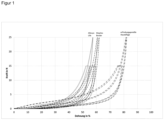
- FIG. 1 The force-strain behavior of the skin pad from Example 1 is illustrated (dashed line) and compared with two commercially available Skin pads Mepilex ® Border (dotted line), Allevyn Life ® (dot-dash line) were compared. It can be seen that the skin pad according to the invention has a higher stretch than the two commercial skin pads. The decisive point is the point on the curve at which the linear increase in force with stretch changes to an exponential increase. From this point on, the pad is compressed to such an extent that sinking is only possible to a limited extent, and the existing compression greatly increases the stiffness. It can be clearly seen that the skin pad according to the invention achieves a higher stretch and thus a greater penetration depth for the same weight.
- the stretch for a weight of 13 N is 54% and 51% respectively, whereas for the skin pad according to the invention the stretch is around 76%. This is advantageous for use in pressure ulcer prevention, as this behavior increases the contact surface for the body part to be protected and thus distributes the pressure over a larger area, thereby reducing load peaks.
- Example 3 Analysis of the forces occurring in the tissue when using the skin pad according to the invention
- Finite element modelling was used to evaluate the skin dressing according to the invention. Decubitus wounds mostly occur in the deeper tissue and not on the surface of the skin. Therefore, simply looking at the pressure distribution on the surface is not enough to assess the effectiveness of skin dressings. Finite element modelling was therefore used to evaluate the compressive stresses that occur in the tissue. Finite element modelling is based on the use of numerical methods. A solid body is divided into a finite number of parts, the physical behaviour of which can then be used to calculate the behaviour of the entire body.
- the method chosen to evaluate the skin patch according to the invention was adapted from A. Levy, M. BO. Frank and Amid Gefen, The biomechanical efficacy of dressings in preventing heel ulcers, in Journal of Tissue Viability (2015) 24, 1-11 .
- the biomechanical properties of the foot tissue were taken from Sara Behforootan, Panagiotis E. Chatzistergos, Nachiappan Chockalingam, Roozbeh Naemi, Journal of the mechanical behavior of biomedical materials 68 (2017) 287-295 .
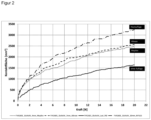
- Figure 2 shows the change in the contact area for the body part to be protected (a foot in the selected simulation) with increasing weight for a skin pad according to the invention (dashed line) compared to the commercial products Mepilex ® Border (dotted line) and Allevyn Life ® (dot-dash line).
- the skin pad according to the invention increases the contact area by 100%, especially at high forces, compared to using no pad, whereas the commercial products Mepilex ® Border and Allevyn Life ® only increase the contact area by around 50%.
- the pressure that occurs can be distributed over a larger area and local load peaks can be reduced.
Landscapes
- Engineering & Computer Science (AREA)
- Textile Engineering (AREA)
- Health & Medical Sciences (AREA)
- Life Sciences & Earth Sciences (AREA)
- Heart & Thoracic Surgery (AREA)
- Vascular Medicine (AREA)
- Biomedical Technology (AREA)
- Animal Behavior & Ethology (AREA)
- General Health & Medical Sciences (AREA)
- Public Health (AREA)
- Veterinary Medicine (AREA)
- Chemical & Material Sciences (AREA)
- Chemical Kinetics & Catalysis (AREA)
- Manufacturing & Machinery (AREA)
- Materials For Medical Uses (AREA)
Claims (14)
- Timbre transdermique comprenant une couche de mousse et une couche adhésive, prévue pour contact avec la peau, disposée immédiatement par-dessus, une étoffe textile étant disposée sur la face de la couche de mousse opposée à la couche adhésive, caractérisé en ce que l'étoffe textile est un non-tissé vertical.
- Timbre transdermique selon la revendication 1, caractérisé en ce que le non-tissé vertical contient des fibres de matrice, de préférence choisies parmi les fibres de polyester, de polyoléfine, de polyamide, de cellulose et/ou les mélanges de celles-ci.
- Timbre transdermique selon l'une quelconque des revendications 1 ou 2, caractérisé en ce que la proportion des fibres de matrice dans le non-tissé vertical, rapportée au poids total du non-tissé vertical, est d'au moins 20 % en poids.
- Timbre transdermique selon l'une ou plusieurs quelconques des revendications précédentes, caractérisé en ce que le non-tissé vertical contient des fibres de liaison, de préférence des fibres de liaison qui contiennent des fibres de polyoléfine, de polyester, de polyamide et/ou des mélanges de celles-ci et/ou contient des fibres bicomposants, en particulier des fibres bicomposants qui contiennent une polyoléfine, un polyester, un polyamide, un éthylène-acétate de vinyle, un éthylène-acrylate de méthyle, un poly(téréphtalate de butylène), un acrylate d'éthylène, un copolymère éthylène-acétate de vinyle, un acrylonitrile et/ou des mélanges de ceux-ci, en tant que composant fibre extérieur.
- Timbre transdermique selon l'une ou plusieurs quelconques des revendications précédentes, caractérisé en ce que le non-tissé vertical contient des fibres frisées, en particulier des fibres de liaison frisées.
- Timbre transdermique selon l'une ou plusieurs quelconques des revendications précédentes, caractérisé en ce que le non-tissé vertical est lié par voie thermique et de préférence n'est pas aiguilleté.
- Timbre transdermique selon l'une ou plusieurs quelconques des revendications précédentes, caractérisé en ce que le non-tissé vertical présente une épaisseur moyenne, mesurée selon DIN EN ISO 9073-2:1997-02 d'au moins 1,5 mm.
- Timbre transdermique selon l'une ou plusieurs quelconques des revendications précédentes, caractérisé en ce que la couche de mousse est à base de mousses polymères hydrophiles, en particulier de mousses de polyuréthane.
- Timbre transdermique selon l'une ou plusieurs quelconques des revendications précédentes, caractérisé en ce que la couche de mousse se présente assemblée à l'étoffe textile à l'aide d'un liant, en particulier des non-tissés adhésifs, des grilles adhésives et/ou des adhésifs fusibles.
- Timbre transdermique selon l'une ou plusieurs quelconques des revendications précédentes, caractérisé en ce que la couche adhésive est une couche adhésive contenant une silicone, en particulier constituée pour l'essentiel de silicone.
- Timbre transdermique selon l'une ou plusieurs quelconques des revendications précédentes, caractérisé en ce que la couche adhésive présente une épaisseur inférieure à 200 µm et/ou est présente selon une masse surfacique inférieure à 200 g/m2.
- Timbre transdermique selon l'une ou plusieurs quelconques des revendications précédentes, caractérisé par une épaisseur, mesurée selon DIN EN ISO 9073-2:1997-02, de 3 à 15 mm.
- Timbre transdermique selon l'une ou plusieurs quelconques des revendications précédentes, caractérisé en ce qu'il se présente en rouleau.
- Procédé de fabrication d'un timbre transdermique selon l'une ou plusieurs quelconques des revendications 1 à 13, comprenant les étapes suivantes- fourniture d'une couche de mousse ;- application d'une couche adhésive, prévue pour contact avec la peau, sur la couche de mousse ;- application d'une étoffe textile sur la face de la couche de mousse opposée à la couche adhésive, l'étoffe textile étant un non-tissé vertical ;- assemblage de la couche de mousse et de l'étoffe textile.
Applications Claiming Priority (2)
| Application Number | Priority Date | Filing Date | Title |
|---|---|---|---|
| DE102019115005.1A DE102019115005A1 (de) | 2019-06-04 | 2019-06-04 | Hautauflage |
| PCT/EP2020/063959 WO2020244924A1 (fr) | 2019-06-04 | 2020-05-19 | Timbre transdermique |
Publications (3)
| Publication Number | Publication Date |
|---|---|
| EP3979963A1 EP3979963A1 (fr) | 2022-04-13 |
| EP3979963B1 true EP3979963B1 (fr) | 2024-05-08 |
| EP3979963C0 EP3979963C0 (fr) | 2024-05-08 |
Family
ID=70847352
Family Applications (1)
| Application Number | Title | Priority Date | Filing Date |
|---|---|---|---|
| EP20727963.9A Active EP3979963B1 (fr) | 2019-06-04 | 2020-05-19 | Timbre transdermique |
Country Status (5)
| Country | Link |
|---|---|
| US (1) | US20220241115A1 (fr) |
| EP (1) | EP3979963B1 (fr) |
| CN (1) | CN114007561B (fr) |
| DE (1) | DE102019115005A1 (fr) |
| WO (1) | WO2020244924A1 (fr) |
Families Citing this family (1)
| Publication number | Priority date | Publication date | Assignee | Title |
|---|---|---|---|---|
| WO2023149903A1 (fr) * | 2022-02-07 | 2023-08-10 | Purewick Corporation | Ensemble de collecte de fluide comprenant un matériau poreux avec des couches internes et externes |
Family Cites Families (28)
| Publication number | Priority date | Publication date | Assignee | Title |
|---|---|---|---|---|
| US4690683A (en) * | 1985-07-02 | 1987-09-01 | Rutgers, The State University Of New Jersey | Transdermal varapamil delivery device |
| US4793337A (en) * | 1986-11-17 | 1988-12-27 | E. R. Squibb & Sons, Inc. | Adhesive structure and products including same |
| DE3839625A1 (de) * | 1988-11-24 | 1990-05-31 | Ralf Latzke | Vorrichtung zur applikation von transdermal resorbierbaren wirkstoffen |
| SE513964C2 (sv) | 1999-03-01 | 2000-12-04 | Moelnlycke Health Care Ab | Sårförband innefattande ett skikt av ett hydrofilt skum |
| US7182085B1 (en) | 1999-04-07 | 2007-02-27 | Coloplast A/S | Pressure relieving dressing |
| EP1149882A1 (fr) * | 2000-04-27 | 2001-10-31 | Peter Dr.-Ing. Böttcher | Support textile pour rubans adhésifs |
| GB2367245B (en) | 2000-09-29 | 2004-11-17 | Johnson & Johnson Medical Ltd | Adaptable dressings |
| DE10063378A1 (de) * | 2000-12-19 | 2002-06-20 | Labtec Gmbh | Aufkleber mit Verflüssigungsmittel für natürliche Atemwegssekrete |
| FR2900419B1 (fr) | 2006-04-26 | 2009-02-13 | Schlumberger Sa N | Procede de fabrication de non-tisse en trois dimensions, ligne de fabrication pour la mise en oeuvre de ce procede et produit non-tisse en trois dimensions obtenu |
| JP4804337B2 (ja) * | 2006-12-27 | 2011-11-02 | 花王株式会社 | 吸収性物品用の表面シート及びその製造方法 |
| DE202009010867U1 (de) * | 2009-03-11 | 2010-01-21 | Abel, Bernd M. | Fersen-Schutzpolster |
| FR2973223B1 (fr) * | 2011-03-31 | 2013-04-19 | Urgo Lab | Pansement absorbant cicatrisant, ses utilisations pour les plaies chroniques |
| AU2012282287B2 (en) * | 2011-07-14 | 2017-06-01 | Smith & Nephew Plc | Wound dressing and method of treatment |
| US20130116645A1 (en) * | 2011-11-07 | 2013-05-09 | Tyco Healthcare Group Lp | Absorbent Foam Tape And Related Methods Thereof |
| EP2698135B1 (fr) * | 2012-08-16 | 2016-07-20 | Lohmann & Rauscher GmbH | Bandage élastique |
| CN103637877B (zh) * | 2013-12-25 | 2016-08-17 | 浙江隆泰医疗科技股份有限公司 | 一种泡沫复合伤口敷料 |
| DE102014202578A1 (de) * | 2014-02-12 | 2015-08-13 | Aesculap Ag | Medizinisches Produkt und Verfahren zu seiner Herstellung |
| DE14814724T1 (de) | 2014-05-21 | 2017-08-24 | V-Lap Pty. Ltd. | Wickelmaschine |
| CN104805597B (zh) * | 2015-04-13 | 2017-04-12 | 太仓安佑无纺科技有限公司 | 一种直立棉疏密可调的立式铺网装置 |
| WO2017039668A1 (fr) | 2015-09-03 | 2017-03-09 | Kimberly-Clark Worldwide, Inc. | Dispositif de prévention d'escarre de décubitus |
| TWI586345B (zh) | 2015-09-30 | 2017-06-11 | 泰陞國際科技股份有限公司 | 預防壓瘡之減壓墊 |
| US20190336347A9 (en) | 2015-10-27 | 2019-11-07 | Hill-Rom Services, Inc. | Dressing and Dressing Assembly for Preventing Pressure Ulcers |
| WO2017095460A1 (fr) | 2015-12-04 | 2017-06-08 | Avent, Inc. | Dispositif de prévention et de traitement de plaie par répartition de pression |
| EP3260098A1 (fr) * | 2016-06-23 | 2017-12-27 | Mölnlycke Health Care AB | Pansement médical |
| DE102016008257A1 (de) | 2016-07-08 | 2018-01-11 | Carl Freudenberg Kg | Hautauflage |
| EP3348245A1 (fr) * | 2017-01-11 | 2018-07-18 | Mölnlycke Health Care AB | Pansement médical pour une partie de corps convexe |
| US11186063B2 (en) * | 2018-01-16 | 2021-11-30 | Piana Nonwovens | Lapped nonwoven with attachable backing and applications thereof |
| EP3517666A1 (fr) * | 2018-01-30 | 2019-07-31 | Low & Bonar B.V. | Matériau multicouche pour des fonctionnalités intelligentes comprenant un matériau textile |
-
2019
- 2019-06-04 DE DE102019115005.1A patent/DE102019115005A1/de not_active Ceased
-
2020
- 2020-05-19 CN CN202080034671.3A patent/CN114007561B/zh active Active
- 2020-05-19 WO PCT/EP2020/063959 patent/WO2020244924A1/fr not_active Ceased
- 2020-05-19 EP EP20727963.9A patent/EP3979963B1/fr active Active
- 2020-05-19 US US17/616,210 patent/US20220241115A1/en not_active Abandoned
Also Published As
| Publication number | Publication date |
|---|---|
| US20220241115A1 (en) | 2022-08-04 |
| EP3979963A1 (fr) | 2022-04-13 |
| DE102019115005A1 (de) | 2020-12-10 |
| CN114007561A (zh) | 2022-02-01 |
| CN114007561B (zh) | 2023-01-06 |
| EP3979963C0 (fr) | 2024-05-08 |
| WO2020244924A1 (fr) | 2020-12-10 |
Similar Documents
| Publication | Publication Date | Title |
|---|---|---|
| DE602004004337T3 (de) | Absorbierender Artikel | |
| DE69812917T2 (de) | Verbände | |
| EP3033116B1 (fr) | Article pour le soin de plaies, présentant des fibres super-absorbantes et des particules super-absorbantes | |
| CN101862237B (zh) | 创伤覆盖材料和创伤覆盖材料成套器具 | |
| DE112014002457B4 (de) | Wasserstrahlverfestigte Faserstrukturen | |
| CN104287891B (zh) | 创伤敷料用表面片和创伤敷料 | |
| EP2470133B1 (fr) | Article pour le soin des plaies comprenant un élément actif en plastique pouvant être déformé ou modelé | |
| DE69222914T2 (de) | Textilverbundstoffe | |
| EP2635244B1 (fr) | Pansement pour plaie comprenant une couche de biocellulose et équipé pour adsorber des bactéries | |
| EP2701904B1 (fr) | Article hygiénique absorbant élastique pour l'absorption de fluides corporels | |
| EP2320844A1 (fr) | Article pour le soin des plaies contenant une proportion de fibres naturelles modifiées ou de fibres synthétiques | |
| DE60020337T2 (de) | Wundauflage | |
| DE102008062824A1 (de) | Wundauflage | |
| EP2701646A1 (fr) | Article pour le soin des plaies comportant un motif d'incisions et/ou de gaufrages | |
| DE19634196A1 (de) | Laminat, Verfahren zu seiner Herstellung und seine Verwendung | |
| EP3177252B1 (fr) | Couche d'absorption et de répartition pour un liquide à absorber et produits fabriqués à partir de cette couche | |
| WO2020244924A1 (fr) | Timbre transdermique | |
| DE69806842T2 (de) | Absorbierende Wundverbände | |
| DE10342123A1 (de) | Mehrlagige Vliesanordnung | |
| EP4205711B1 (fr) | Pansement respirant auto-adhésif pour plaies à exsudat fort | |
| EP3943055B1 (fr) | Enveloppe du noyau absorbant pour noyaux super-absorbants des articles d'hygiène | |
| WO2001008880A1 (fr) | Materiau composite stratifie absorbant, plan, flexible | |
| EP4017305B1 (fr) | Timbre hygienique pour absorber la sueur | |
| EP4076311B1 (fr) | Bandage compressif | |
| EP2401992A1 (fr) | Pansement |
Legal Events
| Date | Code | Title | Description |
|---|---|---|---|
| STAA | Information on the status of an ep patent application or granted ep patent |
Free format text: STATUS: UNKNOWN |
|
| STAA | Information on the status of an ep patent application or granted ep patent |
Free format text: STATUS: THE INTERNATIONAL PUBLICATION HAS BEEN MADE |
|
| PUAI | Public reference made under article 153(3) epc to a published international application that has entered the european phase |
Free format text: ORIGINAL CODE: 0009012 |
|
| STAA | Information on the status of an ep patent application or granted ep patent |
Free format text: STATUS: REQUEST FOR EXAMINATION WAS MADE |
|
| 17P | Request for examination filed |
Effective date: 20211116 |
|
| AK | Designated contracting states |
Kind code of ref document: A1 Designated state(s): AL AT BE BG CH CY CZ DE DK EE ES FI FR GB GR HR HU IE IS IT LI LT LU LV MC MK MT NL NO PL PT RO RS SE SI SK SM TR |
|
| DAV | Request for validation of the european patent (deleted) | ||
| DAX | Request for extension of the european patent (deleted) | ||
| GRAP | Despatch of communication of intention to grant a patent |
Free format text: ORIGINAL CODE: EPIDOSNIGR1 |
|
| STAA | Information on the status of an ep patent application or granted ep patent |
Free format text: STATUS: GRANT OF PATENT IS INTENDED |
|
| INTG | Intention to grant announced |
Effective date: 20240111 |
|
| GRAS | Grant fee paid |
Free format text: ORIGINAL CODE: EPIDOSNIGR3 |
|
| GRAA | (expected) grant |
Free format text: ORIGINAL CODE: 0009210 |
|
| STAA | Information on the status of an ep patent application or granted ep patent |
Free format text: STATUS: THE PATENT HAS BEEN GRANTED |
|
| AK | Designated contracting states |
Kind code of ref document: B1 Designated state(s): AL AT BE BG CH CY CZ DE DK EE ES FI FR GB GR HR HU IE IS IT LI LT LU LV MC MK MT NL NO PL PT RO RS SE SI SK SM TR |
|
| REG | Reference to a national code |
Ref country code: GB Ref legal event code: FG4D Free format text: NOT ENGLISH |
|
| REG | Reference to a national code |
Ref country code: CH Ref legal event code: EP |
|
| REG | Reference to a national code |
Ref country code: DE Ref legal event code: R096 Ref document number: 502020007942 Country of ref document: DE |
|
| REG | Reference to a national code |
Ref country code: IE Ref legal event code: FG4D Free format text: LANGUAGE OF EP DOCUMENT: GERMAN |
|
| U01 | Request for unitary effect filed |
Effective date: 20240515 |
|
| U07 | Unitary effect registered |
Designated state(s): AT BE BG DE DK EE FI FR IT LT LU LV MT NL PT SE SI Effective date: 20240528 |
|
| U20 | Renewal fee for the european patent with unitary effect paid |
Year of fee payment: 5 Effective date: 20240523 |
|
| PG25 | Lapsed in a contracting state [announced via postgrant information from national office to epo] |
Ref country code: IS Free format text: LAPSE BECAUSE OF FAILURE TO SUBMIT A TRANSLATION OF THE DESCRIPTION OR TO PAY THE FEE WITHIN THE PRESCRIBED TIME-LIMIT Effective date: 20240908 |
|
| PG25 | Lapsed in a contracting state [announced via postgrant information from national office to epo] |
Ref country code: HR Free format text: LAPSE BECAUSE OF FAILURE TO SUBMIT A TRANSLATION OF THE DESCRIPTION OR TO PAY THE FEE WITHIN THE PRESCRIBED TIME-LIMIT Effective date: 20240508 |
|
| PG25 | Lapsed in a contracting state [announced via postgrant information from national office to epo] |
Ref country code: GR Free format text: LAPSE BECAUSE OF FAILURE TO SUBMIT A TRANSLATION OF THE DESCRIPTION OR TO PAY THE FEE WITHIN THE PRESCRIBED TIME-LIMIT Effective date: 20240809 |
|
| PG25 | Lapsed in a contracting state [announced via postgrant information from national office to epo] |
Ref country code: ES Free format text: LAPSE BECAUSE OF FAILURE TO SUBMIT A TRANSLATION OF THE DESCRIPTION OR TO PAY THE FEE WITHIN THE PRESCRIBED TIME-LIMIT Effective date: 20240508 |
|
| PG25 | Lapsed in a contracting state [announced via postgrant information from national office to epo] |
Ref country code: PL Free format text: LAPSE BECAUSE OF FAILURE TO SUBMIT A TRANSLATION OF THE DESCRIPTION OR TO PAY THE FEE WITHIN THE PRESCRIBED TIME-LIMIT Effective date: 20240508 |
|
| PG25 | Lapsed in a contracting state [announced via postgrant information from national office to epo] |
Ref country code: PL Free format text: LAPSE BECAUSE OF FAILURE TO SUBMIT A TRANSLATION OF THE DESCRIPTION OR TO PAY THE FEE WITHIN THE PRESCRIBED TIME-LIMIT Effective date: 20240508 Ref country code: NO Free format text: LAPSE BECAUSE OF FAILURE TO SUBMIT A TRANSLATION OF THE DESCRIPTION OR TO PAY THE FEE WITHIN THE PRESCRIBED TIME-LIMIT Effective date: 20240808 Ref country code: IS Free format text: LAPSE BECAUSE OF FAILURE TO SUBMIT A TRANSLATION OF THE DESCRIPTION OR TO PAY THE FEE WITHIN THE PRESCRIBED TIME-LIMIT Effective date: 20240908 Ref country code: HR Free format text: LAPSE BECAUSE OF FAILURE TO SUBMIT A TRANSLATION OF THE DESCRIPTION OR TO PAY THE FEE WITHIN THE PRESCRIBED TIME-LIMIT Effective date: 20240508 Ref country code: GR Free format text: LAPSE BECAUSE OF FAILURE TO SUBMIT A TRANSLATION OF THE DESCRIPTION OR TO PAY THE FEE WITHIN THE PRESCRIBED TIME-LIMIT Effective date: 20240809 Ref country code: ES Free format text: LAPSE BECAUSE OF FAILURE TO SUBMIT A TRANSLATION OF THE DESCRIPTION OR TO PAY THE FEE WITHIN THE PRESCRIBED TIME-LIMIT Effective date: 20240508 Ref country code: RS Free format text: LAPSE BECAUSE OF FAILURE TO SUBMIT A TRANSLATION OF THE DESCRIPTION OR TO PAY THE FEE WITHIN THE PRESCRIBED TIME-LIMIT Effective date: 20240808 |
|
| REG | Reference to a national code |
Ref country code: CH Ref legal event code: PL |
|
| PG25 | Lapsed in a contracting state [announced via postgrant information from national office to epo] |
Ref country code: CZ Free format text: LAPSE BECAUSE OF FAILURE TO SUBMIT A TRANSLATION OF THE DESCRIPTION OR TO PAY THE FEE WITHIN THE PRESCRIBED TIME-LIMIT Effective date: 20240508 |
|
| PG25 | Lapsed in a contracting state [announced via postgrant information from national office to epo] |
Ref country code: SK Free format text: LAPSE BECAUSE OF FAILURE TO SUBMIT A TRANSLATION OF THE DESCRIPTION OR TO PAY THE FEE WITHIN THE PRESCRIBED TIME-LIMIT Effective date: 20240508 Ref country code: RO Free format text: LAPSE BECAUSE OF FAILURE TO SUBMIT A TRANSLATION OF THE DESCRIPTION OR TO PAY THE FEE WITHIN THE PRESCRIBED TIME-LIMIT Effective date: 20240508 |
|
| PG25 | Lapsed in a contracting state [announced via postgrant information from national office to epo] |
Ref country code: SM Free format text: LAPSE BECAUSE OF FAILURE TO SUBMIT A TRANSLATION OF THE DESCRIPTION OR TO PAY THE FEE WITHIN THE PRESCRIBED TIME-LIMIT Effective date: 20240508 |
|
| PG25 | Lapsed in a contracting state [announced via postgrant information from national office to epo] |
Ref country code: SM Free format text: LAPSE BECAUSE OF FAILURE TO SUBMIT A TRANSLATION OF THE DESCRIPTION OR TO PAY THE FEE WITHIN THE PRESCRIBED TIME-LIMIT Effective date: 20240508 Ref country code: SK Free format text: LAPSE BECAUSE OF FAILURE TO SUBMIT A TRANSLATION OF THE DESCRIPTION OR TO PAY THE FEE WITHIN THE PRESCRIBED TIME-LIMIT Effective date: 20240508 Ref country code: RO Free format text: LAPSE BECAUSE OF FAILURE TO SUBMIT A TRANSLATION OF THE DESCRIPTION OR TO PAY THE FEE WITHIN THE PRESCRIBED TIME-LIMIT Effective date: 20240508 Ref country code: CZ Free format text: LAPSE BECAUSE OF FAILURE TO SUBMIT A TRANSLATION OF THE DESCRIPTION OR TO PAY THE FEE WITHIN THE PRESCRIBED TIME-LIMIT Effective date: 20240508 Ref country code: CH Free format text: LAPSE BECAUSE OF NON-PAYMENT OF DUE FEES Effective date: 20240531 |
|
| PG25 | Lapsed in a contracting state [announced via postgrant information from national office to epo] |
Ref country code: MC Free format text: LAPSE BECAUSE OF FAILURE TO SUBMIT A TRANSLATION OF THE DESCRIPTION OR TO PAY THE FEE WITHIN THE PRESCRIBED TIME-LIMIT Effective date: 20240508 |
|
| REG | Reference to a national code |
Ref country code: DE Ref legal event code: R097 Ref document number: 502020007942 Country of ref document: DE |
|
| PLBE | No opposition filed within time limit |
Free format text: ORIGINAL CODE: 0009261 |
|
| STAA | Information on the status of an ep patent application or granted ep patent |
Free format text: STATUS: NO OPPOSITION FILED WITHIN TIME LIMIT |
|
| 26N | No opposition filed |
Effective date: 20250211 |
|
| PG25 | Lapsed in a contracting state [announced via postgrant information from national office to epo] |
Ref country code: IE Free format text: LAPSE BECAUSE OF NON-PAYMENT OF DUE FEES Effective date: 20240519 |
|
| GBPC | Gb: european patent ceased through non-payment of renewal fee |
Effective date: 20240808 |
|
| U20 | Renewal fee for the european patent with unitary effect paid |
Year of fee payment: 6 Effective date: 20250526 |
|
| PG25 | Lapsed in a contracting state [announced via postgrant information from national office to epo] |
Ref country code: GB Free format text: LAPSE BECAUSE OF NON-PAYMENT OF DUE FEES Effective date: 20240808 |
|
| PG25 | Lapsed in a contracting state [announced via postgrant information from national office to epo] |
Ref country code: CY Free format text: LAPSE BECAUSE OF FAILURE TO SUBMIT A TRANSLATION OF THE DESCRIPTION OR TO PAY THE FEE WITHIN THE PRESCRIBED TIME-LIMIT; INVALID AB INITIO Effective date: 20200519 |
|
| PG25 | Lapsed in a contracting state [announced via postgrant information from national office to epo] |
Ref country code: HU Free format text: LAPSE BECAUSE OF FAILURE TO SUBMIT A TRANSLATION OF THE DESCRIPTION OR TO PAY THE FEE WITHIN THE PRESCRIBED TIME-LIMIT; INVALID AB INITIO Effective date: 20200519 |
|
| PG25 | Lapsed in a contracting state [announced via postgrant information from national office to epo] |
Ref country code: TR Free format text: LAPSE BECAUSE OF FAILURE TO SUBMIT A TRANSLATION OF THE DESCRIPTION OR TO PAY THE FEE WITHIN THE PRESCRIBED TIME-LIMIT Effective date: 20240508 |
|
| U20 | Renewal fee for the european patent with unitary effect paid |
Year of fee payment: 7 Effective date: 20260521 |