EP3980302B1 - Raddrehzahlsensor für ein nutzfahrzeug - Google Patents
Raddrehzahlsensor für ein nutzfahrzeug Download PDFInfo
- Publication number
- EP3980302B1 EP3980302B1 EP20732146.4A EP20732146A EP3980302B1 EP 3980302 B1 EP3980302 B1 EP 3980302B1 EP 20732146 A EP20732146 A EP 20732146A EP 3980302 B1 EP3980302 B1 EP 3980302B1
- Authority
- EP
- European Patent Office
- Prior art keywords
- component
- wheel speed
- sensor
- speed sensor
- axis
- Prior art date
- Legal status (The legal status is an assumption and is not a legal conclusion. Google has not performed a legal analysis and makes no representation as to the accuracy of the status listed.)
- Active
Links
Images



Classifications
-
- G—PHYSICS
- G01—MEASURING; TESTING
- G01P—MEASURING LINEAR OR ANGULAR SPEED, ACCELERATION, DECELERATION, OR SHOCK; INDICATING PRESENCE, ABSENCE, OR DIRECTION, OF MOVEMENT
- G01P3/00—Measuring linear or angular speed; Measuring differences of linear or angular speeds
- G01P3/42—Devices characterised by the use of electric or magnetic means
- G01P3/44—Devices characterised by the use of electric or magnetic means for measuring angular speed
- G01P3/48—Devices characterised by the use of electric or magnetic means for measuring angular speed by measuring frequency of generated current or voltage
- G01P3/481—Devices characterised by the use of electric or magnetic means for measuring angular speed by measuring frequency of generated current or voltage of pulse signals
- G01P3/487—Devices characterised by the use of electric or magnetic means for measuring angular speed by measuring frequency of generated current or voltage of pulse signals delivered by rotating magnets
-
- B—PERFORMING OPERATIONS; TRANSPORTING
- B60—VEHICLES IN GENERAL
- B60T—VEHICLE BRAKE CONTROL SYSTEMS OR PARTS THEREOF; BRAKE CONTROL SYSTEMS OR PARTS THEREOF, IN GENERAL; ARRANGEMENT OF BRAKING ELEMENTS ON VEHICLES IN GENERAL; PORTABLE DEVICES FOR PREVENTING UNWANTED MOVEMENT OF VEHICLES; VEHICLE MODIFICATIONS TO FACILITATE COOLING OF BRAKES
- B60T8/00—Arrangements for adjusting wheel-braking force to meet varying vehicular or ground-surface conditions, e.g. limiting or varying distribution of braking force
- B60T8/32—Arrangements for adjusting wheel-braking force to meet varying vehicular or ground-surface conditions, e.g. limiting or varying distribution of braking force responsive to a speed condition, e.g. acceleration or deceleration
- B60T8/72—Arrangements for adjusting wheel-braking force to meet varying vehicular or ground-surface conditions, e.g. limiting or varying distribution of braking force responsive to a speed condition, e.g. acceleration or deceleration responsive to a difference between a speed condition, e.g. deceleration, and a fixed reference
- B60T8/76—Arrangements for adjusting wheel-braking force to meet varying vehicular or ground-surface conditions, e.g. limiting or varying distribution of braking force responsive to a speed condition, e.g. acceleration or deceleration responsive to a difference between a speed condition, e.g. deceleration, and a fixed reference two or more sensing means from different wheels indicative of the same type of speed condition
-
- B—PERFORMING OPERATIONS; TRANSPORTING
- B60—VEHICLES IN GENERAL
- B60T—VEHICLE BRAKE CONTROL SYSTEMS OR PARTS THEREOF; BRAKE CONTROL SYSTEMS OR PARTS THEREOF, IN GENERAL; ARRANGEMENT OF BRAKING ELEMENTS ON VEHICLES IN GENERAL; PORTABLE DEVICES FOR PREVENTING UNWANTED MOVEMENT OF VEHICLES; VEHICLE MODIFICATIONS TO FACILITATE COOLING OF BRAKES
- B60T8/00—Arrangements for adjusting wheel-braking force to meet varying vehicular or ground-surface conditions, e.g. limiting or varying distribution of braking force
- B60T8/17—Using electrical or electronic regulation means to control braking
- B60T8/171—Detecting parameters used in the regulation; Measuring values used in the regulation
-
- G—PHYSICS
- G01—MEASURING; TESTING
- G01D—MEASURING NOT SPECIALLY ADAPTED FOR A SPECIFIC VARIABLE; ARRANGEMENTS FOR MEASURING TWO OR MORE VARIABLES NOT COVERED IN A SINGLE OTHER SUBCLASS; TARIFF METERING APPARATUS; MEASURING OR TESTING NOT OTHERWISE PROVIDED FOR
- G01D5/00—Mechanical means for transferring the output of a sensing member; Means for converting the output of a sensing member to another variable where the form or nature of the sensing member does not constrain the means for converting; Transducers not specially adapted for a specific variable
- G01D5/12—Mechanical means for transferring the output of a sensing member; Means for converting the output of a sensing member to another variable where the form or nature of the sensing member does not constrain the means for converting; Transducers not specially adapted for a specific variable using electric or magnetic means
- G01D5/14—Mechanical means for transferring the output of a sensing member; Means for converting the output of a sensing member to another variable where the form or nature of the sensing member does not constrain the means for converting; Transducers not specially adapted for a specific variable using electric or magnetic means influencing the magnitude of a current or voltage
- G01D5/142—Mechanical means for transferring the output of a sensing member; Means for converting the output of a sensing member to another variable where the form or nature of the sensing member does not constrain the means for converting; Transducers not specially adapted for a specific variable using electric or magnetic means influencing the magnitude of a current or voltage using Hall-effect devices
-
- G—PHYSICS
- G01—MEASURING; TESTING
- G01P—MEASURING LINEAR OR ANGULAR SPEED, ACCELERATION, DECELERATION, OR SHOCK; INDICATING PRESENCE, ABSENCE, OR DIRECTION, OF MOVEMENT
- G01P1/00—Details of instruments
- G01P1/02—Housings
- G01P1/026—Housings for speed measuring devices, e.g. pulse generator
-
- G—PHYSICS
- G01—MEASURING; TESTING
- G01R—MEASURING ELECTRIC VARIABLES; MEASURING MAGNETIC VARIABLES
- G01R33/00—Arrangements or instruments for measuring magnetic variables
- G01R33/02—Measuring direction or magnitude of magnetic fields or magnetic flux
- G01R33/06—Measuring direction or magnitude of magnetic fields or magnetic flux using galvano-magnetic devices
- G01R33/07—Hall effect devices
- G01R33/072—Constructional adaptation of the sensor to specific applications
Definitions
- the invention relates to a wheel speed sensor for a commercial vehicle, in particular a wheel speed sensor for a commercial vehicle, which is arranged in the area of a brake of a wheel on a chassis of the commercial vehicle.
- wheel speed sensors are known, which are arranged in the area of a wheel of the vehicle in order to record the speed as directly as possible, without deviations due to a mechanical transmission.
- active wheel speed sensors are increasingly being used, which generate signals in the wheel speed sensor that, for example, have a constant amplitude that is independent of the speed.
- a data protocol is therefore already generated in the wheel speed sensor, which, for example transmitted via a bus system, can be evaluated in a control unit. It is also possible to implement diagnostic functions.
- active wheel speed sensors in the commercial vehicle sector, since the thermal load on the sensor in the wheel area is greater than in the car sector and, in particular, Hall sensor chips cannot withstand the thermal load.
- AMR sensors that have a chip with an “Anisotropic MagnetoResistive” effect are used for active wheel speed sensors.
- the AMR sensors have the disadvantage compared to the Hall sensors that they only have a specific detection direction in which a movement of a pulse generator can be detected, whereas conventional Hall sensors are not limited to a specific detection direction, but a movement in any direction can capture. Therefore it is with the Using AMR sensors requires mounting the wheel speed sensors in the vehicle in a predetermined orientation.
- the invention is therefore based on the object of eliminating the above disadvantage and of providing a wheel speed sensor which can also be used in an area with a higher thermal load in a limited installation space.
- a wheel speed sensor for a commercial vehicle has an active pulse sensor with a predetermined detection direction and a housing that is designed to at least partially enclose the pulse sensor.
- the pulse sensor can detect a movement of a pulse generator in the predetermined detection direction, and the wheel speed sensor has an axis, with a direction of the axis being defined so that it is perpendicular to the Detection direction of the pulse sensor is aligned.
- the housing has a first component and a second component, by which the first component can be at least partially enclosed and with which the first component can be at least partially connected in a form-fitting manner.
- the pulse sensor is attached to the first component and the wheel speed sensor has a radial cable outlet which is radial to the axis of the Wheel speed sensor is aligned and which leads a cable out of the wheel speed sensor, the radial cable outlet being formed integrally with the second component so that the cable is led out in a direction other than in the direction of the axis of the wheel speed sensor.
- the first component has, in the direction of the axis, a first region which has a contour other than a rotationally symmetrical contour on its circumference, and the second component has a second region whose inner contour is at least partially complementary to the contour on the circumference of the first region is formed, and the contour on the circumference of the first region each has a shape feature in predetermined angular steps around the axis of the wheel speed sensor, so that the first component is designed such that when connected, an orientation of the first component to the second component in the predetermined Angle steps around the axis can be defined in order to provide a predetermined angle around the axis between the detection direction of the pulse sensor and the radial cable outlet.
- the active pulse sensor is a sensor that detects pulses that are generated by a change in a magnetic field in a detection area of the sensor.
- the change in the magnetic field in the area of the sensor occurs either by introducing a magnetic body, for example a rotating magnet wheel with permanent magnets attached to it, into the detection area or by changing a stationary magnetic field in the area of the sensor.
- the stationary magnetic field is changed by introducing a ferromagnetic body into the detection area.
- a pulse wheel which has teeth and gaps on the circumference, is moved in the detection area of the sensor and the change in the magnetic field is detected by the teeth and gaps moving through the detection area. Both a transition from a tooth to a gap and a transition from a gap to a tooth can be recorded.
- Such a wheel speed sensor makes it possible to variably produce wheel speed sensors with different angular assignments between the detection direction of the pulse sensor and the radial cable outlet, for example in a second component casting tool for the second component.
- the pulse sensor has an AMR sensor.
- the AMR sensor offers high resolution and great accuracy. In addition, compared to other sensors, it is relatively insensitive to oil, dirt and ambient temperatures.
- the first component is designed as a plastic molded part
- the second component is formed by casting a plastic around the first component
- the housing of the wheel speed sensor is formed by molding the first component with the plastic, which forms the second component, such a wheel speed sensor can be produced inexpensively.
- the first component and the second component have the same material.
- Such a wheel speed sensor has the advantage that a thermal expansion coefficient of the materials of the first and second components is the same, so that the occurrence of internal stresses in the housing of the wheel speed sensor is minimized under thermal load.
- the predetermined angular steps are in a range of 80° to 100°, particularly preferably 90°.
- a possibility of producing the wheel speed sensor with such a grid always offers a suitable angular assignment between the detection direction of the pulse sensor and the radial cable outlet for common applications.
- the predetermined angular steps are in a range from 40° to 50°, particularly preferably 45°.
- a possibility of producing the wheel speed sensor with such a grid offers a suitable angular assignment between the detection direction of the pulse sensor and the radial cable outlet for applications with particularly limited installation space.
- a method has the following steps: providing a pre-assembly assembly, which has the first component, the pulse sensor and the cable pre-assembled, in a second-component casting tool for producing the second component including the radial cable outlet; Orienting the first component in the casting tool by introducing one of the mold features into a corresponding counter-mold feature of the second component casting tool such that a desired predetermined angle between the pulse sensor and the radial cable outlet about the axis of the wheel speed sensor is established; Casting around the first component and the cable so that the second component is produced with the radial cable outlet around the first component.
- Such a method makes it possible to variably produce wheel speed sensors with different angular assignments between the detection direction of the pulse sensor and the radial cable outlet in a single casting tool for the second component.
- the method contains additional steps for producing the pre-assembly assembly: casting around busbars in a first component casting tool; Connecting the cable to the busbars; Connecting the pulse sensor to the power rails.
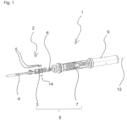
- Fig. 1 shows an exploded view of a wheel speed sensor 1 according to the invention.
- the wheel speed sensor 1 has a pre-assembly assembly 2.
- the pre-assembly assembly 2 has a first component 3, a cable 4, busbars 5 and an active pulse sensor 6, which is attached to the first component 3.
- the pulse sensor 6 has a predetermined detection direction in which a movement of a pulse generator can be detected. This is based on the effect that an electrical resistance of the pulse sensor depends on the presence of a magnetic field and in particular on a direction of the magnetic field.
- the pulse sensor 6 has an AMR sensor.
- the pulse sensor 6 is provided with another sensor with a predetermined detection direction, for example an active Hall sensor.
- the first component 3 is produced by a casting process in which the busbars 5 are cast into the first component 3, so that the first component 3 is designed as a plastic molding.
- the first component 3 points in the direction of one below in connection with Fig. 4 and Fig. 5 defined axis 12 has a first area 14.
- the cable 4 and the pulse sensor 6 are mechanically and electrically connected to the busbars 5 cast in the first component 3.
- the pre-assembly assembly 2 In order to produce the second component 5 around the pre-assembly assembly 2, the pre-assembly assembly 2, and thus the first component 3, is cast with a plastic.
- the second component 7 partially encloses the pulse sensor 6, completely encloses the first component 3 and is connected to the first component 3 in a form-fitting manner.
- the first component 3 and the second component 7 have the same material and form a housing 8 of the wheel speed sensor 1.
- the housing 8 is constructed from other components, with the housing 8 completely or partially enclosing the pulse sensor 6.
- the first component 3 is not completely enclosed by the second component 7 or does not have the same material.
- the wheel speed sensor 1 has a protective cap 9 which partially covers the housing 8.
- Fig. 2 shows a representation of the first component 3 of the wheel speed sensor 1 cast with the second component 7 with a radial cable outlet 10, the cable outlet 10 being designed to lead the cable 4 out of the wheel speed sensor 1.
- Fig. 3 shows an overall representation of the wheel speed sensor 1 from Fig. 2 with installed protective cap 9.
- Fig. 4 shows a schematic sketch of a top view of the wheel speed sensor Fig. 3
- Fig. 5 shows a schematic sketch of a side view of the wheel speed sensor from Fig. 3 to explain a position of an axle 12 of the wheel speed sensor 1.
- the radial cable outlet 10 is formed integrally with the second component 7 so that the cable 4 is led out in a direction other than in the direction of the axle 12.
- the cable outlet 10 is led out radially at a right angle to the axis 12.
- the cable 4 is not led out at a right angle.
- a direction of the axis 12 is defined so that it is aligned perpendicular to a detection direction 11 of the pulse sensor 6.
- the axis 12 corresponds to a central axis of the axisymmetric elongated wheel speed sensor 1.
- a plane 13, which is arranged perpendicular to the axis 12, represents a plane in which the cable 4 extends at different predetermined angles Housing of the wheel speed sensor 1 exits.
- Fig. 6 shows an enlarged view of the first component 3 with a sectional plane indicated by the arrows A, A.
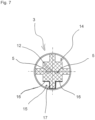
- Fig. 7 shows an enlarged view of a cross section of the first component 3 in FIG Fig. 6 specified cutting plane AA, i.e. in the first area 14.
- the first area 14 has a contour other than a rotationally symmetrical contour on its circumference.
- the circumference is step-shaped all around and has a shape feature 15 shown with a thick line.
- the shape feature 15 is formed from a shape feature plane 16 and a shape feature web 17, which protrudes from the shape feature plane 16.
- the contour has the shape feature 15 in predetermined angular steps around the axis 12.
- the shape feature 15 is provided here periodically four times in predetermined angular steps of 90°.
- the shape feature 15 can also be provided in 45° increments, or alternatively in angular increments of any size, in particular in a range of 80° to 100° or a range of 40° to 50°.
- Fig. 8 shows an enlarged view of a cross section of a wheel speed sensor 1 from Fig. 3 at the location of the cutting plane AA in Fig. 6 .
- Fig. 8 a cross section of the first region 14 of the first component 3 and a cross section of a second region of the second component 7, the inner contour of which is complementary to the contour on the circumference of the first region 14 of the first component 3, are shown.
- the contours partially match in a complementary manner, with the shape feature 15 matching a complementary part of the contour of the second region of the second component 7.
- an orientation of the first component 3 to the second component 7 can be variably defined in the predetermined angular steps around the axis 12 in order to provide a predetermined angle around the axis 12 between the detection direction 11 of the pulse sensor 6 and the radial cable outlet 10.
- the predetermined angle is provided when the housing 8 is manufactured by recasting, by orienting the pre-assembly assembly 2 in a casting tool.
- the second component 7 consists of two parts which, by clipping together, form the second component 7, which then encloses the first component 3
- a corresponding counter-shape feature of the second component can correspond to the shape feature 15 in the second component 7 be provided in such a way that the predetermined angle is provided by introducing the shape feature 15 into the counter-shape feature of the second component 7.
- busbars are 5 in Fig. 7 and Fig. 8 shown in a state cast in the first component 3.
- the busbars are not cast in the first component 3 but are attached to the first component 3 in a different way.
- the busbars are not absolutely necessary if the cable 4 is connected directly to the pulse sensor 6.
- the pre-assembly assembly 2 is manufactured.
- the busbars 5 are inserted into a first assembly casting tool and then cast in such a way that the first component 3 is formed with the busbars 5 cast therein (see also Figures 7 and 8th ).
- the cable 4 and the pulse sensor 6 are then connected to the busbars 5. This is done via welding, or alternatively via soldering or another suitable connection method, such as crimping.
- the pre-assembly assembly is suitable for being used both for the wheel speed sensor 1 with the radial cable outlet 10 and for the wheel speed sensor 1 with an axial cable outlet.
- the pre-assembly assembly 2 is manufactured in a different way, for example without the busbars 5.
- the pre-assembly assembly 2 which has the first component 3, the pulse sensor 6 and the cable 4, is provided in a second component casting tool for producing the second component 3 including the radial cable outlet 10 by placing it in the second component casting tool is inserted.
- the first component 3 is oriented to the second-component casting tool by introducing one of the shape features 15 into a corresponding counter-shape feature of the second-component casting tool in such a way that the desired predetermined angle between the pulse sensor 6 and the radial cable outlet 10 about the axis 12 is set.
- the shape feature web 17 ( Fig. 7 ) is introduced into a corresponding recess in the second component casting tool.
- This alignment determines the orientation of the pulse sensor 6 in the second component casting tool.
- the pulse sensor 6 can be oriented in a 90° grid. Since the second component casting tool has a mold section for the radial cable outlet 10 at a fixed position, the predetermined angle between the pulse sensor 6 and the radial cable outlet 10 about the axis 12 is thus made possible.
- the cable 4 is then inserted into a receptacle of the second component casting tool, so that the cable 4 is provided in a suitable position so that casting material can be cast around it, the radial cable outlet 10 then being formed.
- the casting material is then filled into the second component casting tool, the first component 3 with the pulse sensor 6 is thereby cast, and the second assembly 7 with the radial cable outlet 10 integrally produced thereon is thereby produced.
Landscapes
- Physics & Mathematics (AREA)
- General Physics & Mathematics (AREA)
- Engineering & Computer Science (AREA)
- Transportation (AREA)
- Mechanical Engineering (AREA)
- Condensed Matter Physics & Semiconductors (AREA)
- Transmission And Conversion Of Sensor Element Output (AREA)
- Injection Moulding Of Plastics Or The Like (AREA)
Description
- Die Erfindung betrifft einen Raddrehzahlsensor für ein Nutzfahrzeug, insbesondere einen Raddrehzahlsensor für ein Nutzfahrzeug, der im Bereich einer Bremse eines Rads an einem Fahrwerk des Nutzfahrzeugs angeordnet ist.
- Eine Erfassung von Raddrehzahlen von einzelnen Rädern von Fahrzeugen ist heutzutage erforderlich, um eine Funktion von Assistenzsystemen, beispielsweise ABS, ASR, ESP, zu ermöglichen. Dabei ist eine genaue Erfassung erforderlich, um in Grenzsituationen entsprechende Algorithmen anzusteuern. Um die Raddrehzahlen genau zu erfassen, sind Raddrehzahlsensoren bekannt, die im Bereich eines Rads des Fahrzeugs angeordnet sind, um die Drehzahl möglichst unmittelbar, ohne Abweichungen durch eine mechanische Übertragung, zu erfassen.
- Im PKW-Bereich werden vermehrt aktive Raddrehzahlsensoren eingesetzt, die bereits im Raddrehzahlsensor Signale, die beispielsweise eine drehzahlunabhängige konstante Amplitude aufweisen, erzeugen. Somit wird bereits im Raddrehzahlsensor ein Datenprotokoll erzeugt, das, beispielsweise über ein Bus-System übertragen, in einem Steuergerät ausgewertet werden kann. Außerdem besteht die Möglichkeit, Diagnosefunktionen zu implementieren. Jedoch war im Nutzfahrzeugbereich ein Einsatz der aktiven Raddrehzahlsensoren bislang nicht möglich, da hier im Bereich des Rades eine thermische Belastung des Sensors größer als im PKW-Bereich ist und insbesondere Chips von Hall-Gebern der thermischen Belastung nicht standhalten.
- Unter Anderem aus diesem Grund werden AMR-Sensoren, die einen Chip mit einem "Anisotropen MagnetoResistiven"-Effekt aufweisen, für die aktiven Raddrehzahlsensoren eingesetzt. Die AMR-Sensoren haben jedoch gegenüber den Hall-Gebern den Nachteil, dass sie nur eine bestimmte Erfassungsrichtung haben, in der eine Bewegung eines Impulsgebers erfasst werden kann, wohingegen konventionelle Hall-Geber auf keine bestimmte Erfassungsrichtung beschränkt sind, sondern eine Bewegung in jeglicher Richtung erfassen können. Daher ist es bei der Verwendung von AMR-Sensoren notwendig, die Raddrehzahlsensoren in einer vorbestimmten Orientierung in das Fahrzeug zu montieren.
- Aufgrund von Beschränkungen des Bauraums ist es jedoch erforderlich, im Falle von Raddrehzahlsensoren mit einer langgestreckten Form, einen Kabelabgang nicht axial an einem Ende des Raddrehzahlsensors vorzusehen, sondern einen radialen Kabelabgang vorzusehen. Dabei besteht jedoch das Problem, dass die Kabelabgänge der Raddrehzahlsensoren in Abhängigkeit des vorhandenen Bauraums bezüglich einer Orientierung des AMR-Sensors in unterschiedlichen Winkelpositionen vorgesehen sein müssen. Dies verteuert die Fertigung, da, beispielsweise im Falle von Raddrehzahlsensoren, deren Gehäuse in einem Gießverfahren hergestellt wird, unterschiedliche Werkzeuge für die Raddrehzahlsensoren mit den Kabelabgängen in unterschiedlichen Winkelpositionen erforderlich sind.
- Die Dokumente
KR 100931126 B1 KR 20100062613 A - In Dokument
WO 2017/178215 A1 und in DokumentDE 20 2013 011 157 U1 ist jeweils ein aktiver Raddrehzahlsensor mit einem AMR-Sensor offenbart. - Der Erfindung liegt also die Aufgabe zugrunde, den obigen Nachteil zu beseitigen und einen Raddrehzahlsensor bereitzustellen, der auch in einem Bereich mit einer höheren thermischen Belastung in einem eingeschränkten Bauraum eingesetzt werden kann.
- Die Aufgabe wird durch einen Raddrehzahlsensor gemäß Anspruch 1 und ein Verfahren gemäß Anspruch 6 gelöst. Vorteilhafte Weiterentwicklungen sind in den abhängigen Ansprüchen enthalten.
- Gemäß einem Aspekt der Erfindung weist ein Raddrehzahlsensor für ein Nutzfahrzeug einen aktiven Impulssensor mit einer vorbestimmten Erfassungsrichtung und ein Gehäuse, das ausgebildet ist, den Impulssensor zumindest teilweise zu umschließen, auf. Durch den Impulssensor ist eine Bewegung eines Impulsgebers in der vorbestimmten Erfassungsrichtung erfassbar, und der Raddrehzahlsensor weist eine Achse auf, wobei eine Richtung der Achse so definiert ist, dass sie senkrecht zu der Erfassungsrichtung des Impulssensors ausgerichtet ist. Das Gehäuse weist ein erstes Bauteil und ein zweites Bauteil, von dem das erste Bauteil zumindest teilweise umschließbar ist und mit dem das erste Bauteil zumindest teilweise formschlüssig verbindbar ist, auf. Der Impulssensor ist an dem ersten Bauteil befestigt und der Raddrehzahlsensor weist einen radialen Kabelabgang auf, der radial zu der Achse des Raddrehzahlsensors ausgerichtet ist und der ein Kabel aus dem Raddrehzahlsensor herausführt, wobei der radiale Kabelabgang integral mit dem zweiten Bauteil so ausgebildet ist, dass das Kabel in einer anderen Richtung als in Richtung der Achse des Raddrehzahlsensors herausgeführt wird. Das erste Bauteil weist in der Richtung der Achse einen ersten Bereich auf, der eine andere als eine rotationssymmetrische Kontur an seinem Umfang aufweist, und das zweite Bauteil weist einen zweiten Bereich auf, dessen innere Kontur zumindest teilweise komplementär zu der Kontur am Umfang des ersten Bereichs ausgebildet ist, und die Kontur am Umfang des ersten Bereichs weist jeweils ein Formmerkmal in vorbestimmten Winkelschritten um die Achse des Raddrehzahlsensors auf, so dass das erste Bauteil so ausgebildet ist, dass bei einem Verbinden eine Orientierung des ersten Bauteils zu dem zweiten Bauteil in den vorbestimmten Winkelschritten um die Achse definierbar ist, um einen vorbestimmten Winkel um die Achse zwischen der Erfassungsrichtung des Impulssensors und dem radialen Kabelabgang bereitzustellen.
- Der aktive Impulssensor ist ein Sensor, der Impulse erfasst, die durch eine Veränderung eines Magnetfelds in einem Erfassungsbereich des Sensors erzeugt werden. Die Veränderung des Magnetfelds im Bereich des Sensors erfolgt entweder durch Einbringen eines magnetischen Körpers, beispielsweise eines sich drehenden Polrads mit daran angebrachten Permanentmagneten, in den Erfassungsbereich oder durch Veränderung eines stationären Magnetfelds im Bereich des Sensors. Das stationäre Magnetfeld wird durch Einbringen eines ferromagnetischen Körpers in den Erfassungsbereich verändert. Hierbei wird ein Impulsrad, das am Umfang Zähne und Lücken aufweist, im Erfassungsbereich des Sensors bewegt und die Veränderung des Magnetfelds durch die sich durch den Erfassungsbereich bewegenden Zähne und Lücken erfasst. Dabei kann sowohl ein Übergang von einem Zahn zu einer Lücke als auch ein Übergang von einer Lücke zu einem Zahn erfasst werden.
- Durch einen solchen Raddrehzahlsensor ist es möglich, variabel, beispielsweise in einem zweites-Bauteil-Gießwerkzeug für das zweite Bauteil, Raddrehzahlsensoren mit unterschiedlichen Winkelzuordnungen zwischen der Erfassungsrichtung des Impulssensors und dem radialen Kabelabgang herzustellen.
- Bei einer vorteilhaften Weiterbildung des Raddrehzahlsensors weist der Impulssensor einen AMR-Sensor auf.
- Der AMR-Sensor bietet eine hohe Auflösung und eine große Genauigkeit. Darüber hinaus ist er, im Vergleich zu anderen Sensoren gegenüber Öl, Schmutz und Umgebungstemperaturen relativ unempfindlich.
- Erfindungsgemäß ist das erste Bauteil als ein Kunststoff-Formteil ausgebildet, und zweite Bauteil ist durch Umgießen des ersten Bauteils mit einem Kunststoff ausgebildet.
- Da durch das Umgießen des ersten Bauteils mit dem Kunststoff, der das zweite Bauteil bildet, das Gehäuse des Raddrehzahlsensors gebildet wird, ist ein solcher Raddrehzahlsensor ist kostengünstig herstellbar.
- In einer weiteren vorteilhaften Weiterbildung des Raddrehzahlsensors weisen das erste Bauteil und das zweite Bauteil ein gleiches Material auf.
- Ein solcher Raddrehzahlsensor weist den Vorteil auf, dass ein Wärmeausdehnungskoeffizient der Materialien des ersten und zweiten Bauteils gleich ist, so dass bei thermischer Belastung ein Auftreten von inneren Spannungen in dem Gehäuse des Raddrehzahlsensors minimiert wird.
- Gemäß einer weiteren vorteilhaften Weiterbildung des Raddrehzahlsensors liegen die vorbestimmten Winkelschritte in einem Bereich 80° bis 100°, besonders bevorzugt bei 90°.
- Eine Herstellmöglichkeit des Raddrehzahlsensors mit einem solchen Raster bietet für übliche Anwendungsfälle immer eine geeignete Winkelzuordnung zwischen der Erfassungsrichtung des Impulssensors und dem radialen Kabelabgang.
- Bei einer weiteren vorteilhaften Weiterbildung des Raddrehzahlsensors liegen die vorbestimmten Winkelschritte in einem Bereich von 40° bis 50°, besonders bevorzugt bei 45°.
- Eine Herstellmöglichkeit des Raddrehzahlsensors mit einem solchen Raster bietet für Anwendungsfälle mit besonders eingeschränkten Bauraum eine geeignete Winkelzuordnung zwischen der Erfassungsrichtung des Impulssensors und dem radialen Kabelabgang.
- Gemäß einem weiteren Aspekt der Erfindung weist ein Verfahren die folgenden Schritte auf: Bereitstellen einer Vormontagebaugruppe, die das ersten Bauteil, den Impulssensor und das Kabel vormontiert aufweist, in einem zweites-Bauteil-Gießwerkzeug zur Herstellung des zweiten Bauteils einschließlich des radialen Kabelabgangs; Orientieren des ersten Bauteils in dem Gießwerkzeug durch Einbringen von einem der Formmerkmale in ein entsprechendes Gegenformmerkmal des zweites-Bauteil-Gießwerkzeugs so, dass ein gewünschter vorbestimmter Winkel zwischen dem Impulssensor und dem radialen Kabelabgang um die Achse des Raddrehzahlsensors festgelegt wird; Umgießen des ersten Bauteils und des Kabels, so dass das zweite Bauteil mit dem radialen Kabelabgang um das erste Bauteil herum hergestellt wird.
- Durch ein solches Verfahren ist es möglich, in einem einzigen Gießwerkzeug für das zweite Bauteil, Raddrehzahlsensoren mit unterschiedlichen Winkelzuordnungen zwischen der Erfassungsrichtung des Impulssensors und dem radialen Kabelabgang variabel herzustellen.
- Gemäß einer weiteren vorteilhaften Weiterbildung des Verfahrens enthält es zusätzliche Schritte zur Herstellung der Vormontagebaugruppe: Umgießen von Stromschienen in einem erstes-Bauteil-Gießwerkzeug; Verbinden des Kabels mit den Stromschienen; Verbinden des Impulssensors mit den Stromschienen.
- Mit diesen Schritten ist es möglich Funktionsteile des Raddrehzahlsensors in einer Vormontagebaugruppe kostengünstig zu fixieren und zu verbinden, wobei die Vormontagebaugruppe dann zum Schutz der Funktionsteile nochmals kostengünstig umgossen werden kann.
- Nachstehend wird die Erfindung anhand eines Ausführungsbeispiels unter Bezugnahme auf die beigefügten Zeichnungen erläutert.
- Insbesondere zeigt:
- Fig. 1
- eine Explosionsdarstellung einer bevorzugten Ausführungsform eines erfindungsgemäßen Raddrehzahlsensors;
- Fig. 2
- eine Darstellung eines mit dem zweiten Bauteil mit radialem Kabelabgang umgossenen ersten Bauteils des Raddrehzahlsensors;
- Fig. 3
- eine Darstellung des Raddrehzahlsensors von
Fig. 2 mit montierter Schutzkappe; - Fig. 4
- eine Prinzipskizze einer Draufsicht auf den Raddrehzahlsensor von
Fig. 3 zum Erläutern einer Lage einer Achse des Raddrehzahlsensors; - Fig. 5
- eine Prinzipskizze einer Seitenansicht des Raddrehzahlsensors von
Fig. 3 zum Erläutern einer Lage einer Achse des Raddrehzahlsensors; - Fig. 6
- eine vergrößerte Darstellung des ersten Bauteils;
- Fig. 7
- eine vergrößerte Darstellung eines Querschnitts des ersten Bauteils an einer Stelle eines Schnitts A-A in
Fig. 6 ; und - Fig. 8
- eine vergrößerte Darstellung eines Querschnitts des Raddrehzahlsensors von
Fig. 3 an einer Stelle eines Schnitts A-A inFig. 6 . -
Fig. 1 zeigt eine Explosionsdarstellung eines erfindungsgemäßen Raddrehzahlsensors 1. Der Raddrehzahlsensor 1 weist eine Vormontagebaugruppe 2 auf. - Die Vormontagebaugruppe 2 weist ein erstes Bauteil 3, ein Kabel 4, Stromschienen 5 und einen aktiven Impulssensor 6, der an dem ersten Bauteil 3 befestigt ist, auf.
- Der Impulssensor 6 weist eine vorbestimmte Erfassungsrichtung auf, in der eine Bewegung eines Impulsgebers erfassbar ist. Dies beruht auf dem Effekt, dass ein elektrischer Widerstand des Impulssensors von der Anwesenheit eines Magnetfelds und insbesondere von einer Richtung des Magnetfelds abhängig ist. Der Impulssensor 6 weist einen AMR-Sensor auf. In einer alternativen Ausführungsform ist der Impulssensor 6 mit einem anderen Sensor mit einer vorbestimmten Erfassungsrichtung, beispielsweise einem aktiven Hall-Sensor, versehen.
- Das erste Bauteil 3 wird durch einen Gießvorgang herstellt, in dem die Stromschienen 5 in das erste Bauteil 3 eingegossen werden, so dass das erste Bauteil 3 als ein Kunststoff-Formteil ausgebildet ist. Das erste Bauteil 3 weist in Richtung einer nachstehend in Verbindung mit
Fig. 4 undFig. 5 definierten Achse 12 einen ersten Bereich 14 auf. - Das Kabel 4 und der Impulssensor 6 werden mit den im ersten Bauteil 3 eingegossenen Stromschienen 5 mechanisch und elektrisch verbunden.
- Um das zweite Bauteil 5 um die Vormontagebaugruppe 2 herum herzustellen, wird die Vormontagebaugruppe 2, und somit das erste Bauteil 3, mit einem Kunststoff umgossen. Das zweite Bauteil 7 umschließt den Impulssensor 6 teilweise, umschließt das erste Bauteil 3 vollständig und ist mit dem ersten Bauteil 3 formschlüssig verbunden. Das erste Bauteil 3 und das zweite Bauteil 7 weisen ein gleiches Material auf und bilden ein Gehäuse 8 des Raddrehzahlsensors 1.
- In einer alternativen Ausführungsform ist das Gehäuse 8 aus anderen Komponenten aufgebaut, wobei das Gehäuse 8 den Impulssensor 6 vollständig oder teilweise umschließt. In einer weiteren Alternative ist das erste Bauteil 3 nicht vollständig von dem zweiten Bauteil 7 umschlossen oder weist nicht dasselbe Material auf.
- Ferner weist der Raddrehzahlsensor 1 eine Schutzkappe 9 auf, die das Gehäuse 8 teilweise abdeckt.
-
Fig. 2 zeigt eine Darstellung des mit dem zweiten Bauteil 7 mit radialem Kabelabgang 10 umgossenen ersten Bauteils 3 des Raddrehzahlsensors 1, wobei der Kabelabgang 10 ausgebildet ist, das Kabel 4 aus dem Raddrehzahlsensor 1 herauszuführen. -
Fig. 3 zeigt eine Gesamtdarstellung des Raddrehzahlsensors 1 vonFig. 2 mit montierter Schutzkappe 9. -
Fig. 4 zeigt eine Prinzipskizze einer Draufsicht auf den Raddrehzahlsensor vonFig. 3 undFig. 5 zeigt eine Prinzipskizze einer Seitenansicht des Raddrehzahlsensors vonFig. 3 zum Erläutern einer Lage einer Achse 12 des Raddrehzahlsensors 1. Der radiale Kabelabgang 10 ist integral mit dem zweiten Bauteil 7 so ausgebildet, dass das Kabel 4 in einer anderen Richtung als in Richtung der Achse 12 herausgeführt wird. In dem gezeigten Ausführungsbeispiel ist der Kabelabgang 10 radial in einem rechten Winkel zur Achse 12 herausgeführt. In einer alternativen Ausführungsform ist das Kabel 4 nicht in einem rechten Winkel herausgeführt. - Eine Richtung der Achse 12 ist so definiert, dass sie senkrecht zu einer Erfassungsrichtung 11 des Impulssensors 6 ausgerichtet ist. Im Falle eines im Wesentlichen achsensymmetrischen länglichen Raddrehzahlsensors 1 entspricht die Achse 12 einer Mittelachse des achsensymmetrischen länglichen Raddrehzahlsensors 1. Eine Ebene 13, die senkrecht zu der Achse 12 angeordnet ist, stellt eine Ebene dar, in der das Kabel 4 in unterschiedlichen vorbestimmten Winkeln aus dem Gehäuse des Raddrehzahlsensors 1 austritt.
-
Fig. 6 zeigt eine vergrößerte Darstellung des ersten Bauteils 3 mit einer Schnittebene, die durch die Pfeile A, A angegeben ist. -
Fig. 7 zeigt eine vergrößerte Darstellung eines Querschnitts des ersten Bauteils 3 in der inFig. 6 angegebenen Schnittebene A-A, also in dem ersten Bereich 14. Der erste Bereich 14 hat eine andere als eine rotationssymmetrische Kontur an seinem Umfang. - Der Umfang ist umlaufend stufenförmig und hat ein mit einer dicken Linie dargestelltes Formmerkmal 15. Das Formmerkmal 15 wird aus einer Formmerkmalsebene 16 und einem Formmerkmalssteg 17, der von der Formmerkmalsebene 16 vorsteht, gebildet. Die Kontur weist das Formmerkmal 15 in vorbestimmten Winkelschritten um die Achse 12 auf. Das Formmerkmal 15 ist hier periodisch in vorbestimmten Winkelschritten von 90° vier Mal vorgesehen. Alternativ kann das Formmerkmal 15 auch in 45° Schritten, oder weiterhin alternativ in beliebig großen Winkelschritten, insbesondere in einem Bereich von 80° bis 100° oder einem Bereich von 40° bis 50°, vorgesehen sein.
-
Fig. 8 zeigt eine vergrößerte Darstellung eines Querschnitts eines Raddrehzahlsensors 1 vonFig. 3 an der Stelle der Schnittebene A-A inFig. 6 . - In
Fig. 8 ist ein Querschnitt des ersten Bereichs 14 des ersten Bauteils 3 und ein Querschnitt eines zweiten Bereichs des zweiten Bauteils 7, dessen innere Kontur komplementär zu der Kontur am Umfang des ersten Bereichs 14 des ersten Bauteils 3 ausgebildet ist, gezeigt. In alternativen Ausführungsformen stimmen die Konturen teilweise komplementär überein, wobei das Formmerkmal 15 mit einem komplementären Teil der Kontur des zweiten Bereichs des zweiten Bauteils 7 übereinstimmt. Dadurch ist beim Zusammenbau eine Orientierung des ersten Bauteils 3 zu dem zweiten Bauteil 7 in den vorbestimmten Winkelschritten um die Achse 12 variabel definierbar, um einen vorbestimmten Winkel um die Achse 12 zwischen der Erfassungsrichtung 11 des Impulssensors 6 und dem radialen Kabelabgang 10 bereitzustellen. - Der vorbestimmte Winkel wird, wie nachstehend erläutert, bei einer Herstellung des Gehäuses 8 durch Umgießen, durch eine Orientierung der Vormontagebaugruppe 2 in einem Gießwerkzeug bereitgestellt. Bei einem alternativen Herstellungsverfahren, in dem beispielsweise das zweite Bauteil 7 aus zwei Teilen besteht, die durch Zusammenklipsen das zweite Bauteil 7 bilden, das dann das erste Bauteil 3 umschließt, kann ein entsprechendes Gegenformmerkmal des zweiten Bauteils zu dem Formmerkmal 15 in dem zweiten Bauteil 7 so vorgesehen sein, dass der vorbestimmte Winkel durch ein Einbringen des Formmerkmals 15 in das Gegenformmerkmal des zweiten Bauteils 7 bereitgestellt wird.
- Ferner sind die Stromschienen 5 in
Fig. 7 undFig. 8 in einem in dem ersten Bauteil 3 eingegossenen Zustand dargestellt. In alternativen Ausführungsformen sind die Stromschienen nicht in dem ersten Bauteil 3 eingegossen sondern in einer anderen Weise an dem ersten Bauteil 3 befestigt. Weiterhin sind alternativ die Stromschienen nicht zwingend erforderlich, sofern das Kabel 4 direkt mit dem Impulssensor 6 verbunden ist. - Eine Herstellung des Raddrehzahlsensors 1 wird nachstehend erläutert.
- Zunächst wird die Vormontagebaugruppe 2 hergestellt. Dazu werden die Stromschienen 5 in ein erste-Baugruppe-Gießwerkzeug eingelegt und dann so umgossen, dass das erste Bauteil 3 mit den darin eingegossenen Stromschienen 5 gebildet wird (siehe auch
Figuren 7 und8 ). - Anschließend werden das Kabel 4 und der Impulssensor 6 mit den Stromschienen 5 verbunden. Dies erfolgt über Schweißen, oder alternativ über Löten oder ein anderes geeignetes Verbindungsverfahren, wie beispielsweise Crimpen. Die Vormontagebaugruppe ist in diesem Zustand geeignet, sowohl für den Raddrehzahlsensor 1 mit dem radialen Kabelabgang 10 als auch für den Raddrehzahlsensor 1 mit einem axialen Kabelabgang verwendet zu werden.
- In einem alternativen Verfahren wird die Vormontagebaugruppe 2, beispielsweise ohne die Stromschienen 5, in einer anderen Weise hergestellt.
- Anschließend wird die Vormontagebaugruppe 2, die das erste Bauteil 3, den Impulssensor 6 und das Kabel 4 aufweist, in einem zweites-Bauteil-Gießwerkzeug zur Herstellung des zweiten Bauteils 3 einschließlich des radialen Kabelabgangs 10 bereitgestellt, indem es in das zweites-Bauteil-Gießwerkzeug eingelegt wird. Dabei wird das erste Bauteil 3 zu dem zweites-Bauteil-Gießwerkzeug durch Einbringen von einem der Formmerkmale 15 in ein entsprechendes Gegenformmerkmal des zweites-Bauteil-Gießwerkzeugs so orientiert, dass der gewünschte vorbestimmte Winkel zwischen dem Impulssensor 6 und dem radialen Kabelabgang 10 um die Achse 12 festgelegt wird. In der gezeigten Ausführungsform wird der Formmerkmalssteg 17 (
Fig. 7 ) in eine entsprechende Vertiefung in dem zweites-Bauteil-Gießwerkzeug eingebracht. - Durch diese Ausrichtung wird die Orientierung des Impulssensors 6 in dem zweites-Bauteil-Gießwerkzeug festgelegt. In der gezeigten Ausführungsform ist eine die Orientierung des Impulssensors 6 in einem 90°-Raster möglich. Da das zweites-Bauteil-Gießwerkzeug einen Formabschnitt für den radialen Kabelabgang 10 an einer festen Position aufweist, wird somit der vorbestimmte Winkel zwischen dem Impulssensor 6 und dem radialen Kabelabgang 10 um die Achse 12 ermöglicht.
- Das Kabel 4 wird anschließend in eine Aufnahme des zweites-Bauteil-Gießwerkzeugs eingelegt, so dass das Kabel 4 in einer geeigneten Lage bereitgestellt wird, um von Gießmaterial umgießbar zu sein, wobei dann der radiale Kabelabgang 10 gebildet wird. Anschließend wird das Gießmaterial in das zweites-Bauteil-Gießwerkzeug eingefüllt, das erste Bauteil 3 mit dem Impulssensor 6 dadurch umgossen, und die zweite Baugruppe 7 mit dem daran integral hergestellten radialen Kabelabgang 10 wird dadurch hergestellt.
-
- 1
- Raddrehzahlsensor
- 2
- Vormontagebaugruppe
- 3
- erstes Bauteil
- 4
- Kabel
- 5
- Stromschiene
- 6
- Impulssensor
- 7
- zweites Bauteil
- 8
- Gehäuse
- 9
- Schutzkappe
- 10
- radialer Kabelabgang
- 11
- Erfassungsrichtung
- 12
- Achse
- 13
- Ebene
- 14
- erster Bereich
- 15
- Formmerkmal
- 16
- Formmerkmalsebene
- 17
- Formmerkmalssteg
Claims (7)
- Raddrehzahlsensor (1) für ein Nutzfahrzeug, aufweisendeinen Impulssensor (6) mit einer vorbestimmten Erfassungsrichtung, undein Gehäuse (8), das ausgebildet ist, den Impulssensor (6) zumindest teilweise zu umschließen,wobeidurch den Impulssensor (6) eine Bewegung eines Impulsgebers in der vorbestimmten Erfassungsrichtung (11), erfassbar ist,der Raddrehzahlsensor (1) eine Achse (12) aufweist, wobei eine Richtung der Achse (12) so definiert ist, dass sie senkrecht zu der Erfassungsrichtung (11) des Impulssensors (6) ausgerichtet ist,das Gehäuse (8) ein erstes Bauteil (3) und ein zweites Bauteil (7), von dem das erste Bauteil (3) zumindest teilweise umschließbar ist und mit dem das erste Bauteil (3) zumindest teilweise formschlüssig verbindbar ist, aufweist,der Impulssensor (6) an dem ersten Bauteil (3) befestigt ist,der Raddrehzahlsensor (1) einen radialen Kabelabgang (10) aufweist, der radial zu der Achse (12) ausgerichtet ist, und der ausgebildet ist, ein Kabel (4) aus dem Raddrehzahlsensor (1) herauszuführen,der radiale Kabelabgang (10) integral mit dem zweiten Bauteil (7) so ausgebildet ist, dass das Kabel (4) in einer anderen Richtung als in Richtung der Achse (12) geführt wird,das erste Bauteil (3) in der Richtung der Achse (12) einen ersten Bereich (14) aufweist, der eine andere als eine rotationssymmetrische Kontur an seinem Umfang hat, und das zweite Bauteil (7) einen zweiten Bereich aufweist, dessen innere Kontur zumindest teilweise komplementär zu der Kontur am Umfang des ersten Bereichs (14) ausgebildet ist, unddie Kontur am Umfang des ersten Bereichs (14) jeweils ein Formmerkmal (15) in vorbestimmten Winkelschritten um die Achse (12) aufweist, so dass das erste Bauteil (3) so ausgebildet ist, dass eine Orientierung des ersten Bauteils (3) zu dem zweiten Bauteil (7) in den vorbestimmten Winkelschritten um die Achse (12) definierbar ist, um einen vorbestimmten Winkel um die Achse (12) zwischen der Erfassungsrichtung (11) des Impulssensors (6) und dem radialen Kabelabgang (10) bereitzustellen,dadurch gekennzeichnet, dassder Impulssensor (6) ein aktiver Impulssensor ist,das erste Bauteil (3) als ein Kunststoff-Formteil ausgebildet ist, und das zweite Bauteil (7) durch Umgießen des ersten Bauteils (3) mit einem Kunststoff ausgebildet ist.
- Raddrehzahlsensor (1) gemäß Anspruch 1, wobei
der Impulssensor (6) einen AMR-Sensor aufweist. - Raddrehzahlsensor (1) gemäß einem der Ansprüche 1 oder 2, wobei
das erste Bauteil (3) und das zweite Bauteil (7) ein gleiches Material aufweisen. - Raddrehzahlsensor (1) gemäß einem der vorangehenden Ansprüche, wobei
die vorbestimmten Winkelschritte in einem Bereich von 80°bis 100° liegen. - Raddrehzahlsensor (1) gemäß einem der vorangehenden Ansprüche 1 bis 4, wobei
die vorbestimmten Winkelschritte in einem Bereich von 40° bis 50° liegen. - Verfahren zum Herstellen eines Raddrehzahlsensors (1) gemäß einem der vorangehenden Ansprüche mit den Schritten:Bereitstellen einer Vormontagebaugruppe (2), die das erste Bauteil (3), den Impulssensor (6), und das Kabel (4) vormontiert aufweist, in einem zweites-Bauteil-Gießwerkzeug zur Herstellung des zweiten Bauteils (7) einschließlich des radialen Kabelabgangs (10);Orientieren des ersten Bauteils (3) in dem zweites-Bauteil-Gießwerkzeug durch Einbringen von einem der Formmerkmale (15) in ein entsprechendes Gegenformmerkmal des zweites-Bauteil-Gießwerkzeugs so, dass ein gewünschter vorbestimmter Winkel zwischen dem Impulssensor (6) und dem radialen Kabelabgang (10) um die Achse (12) festgelegt wird;Umgießen des ersten Bauteils (3) und des Kabels (4), so dass das zweite Bauteil (7) mit dem radialen Kabelabgang (10) um das erste Bauteil (3) herum hergestellt wird.
- Verfahren gemäß Anspruch 6 mit den zusätzlichen Schritten zur Herstellung der Vormontagebaugruppe (2):Umgießen von Stromschienen (5) in einem erste-Baugruppe-Gießwerkzeug zum Herstellen des ersten Bauteils;Verbinden des Kabels (4) mit den Stromschienen (5);Verbinden des Impulssensors (6) mit den Stromschienen (5).
Applications Claiming Priority (2)
| Application Number | Priority Date | Filing Date | Title |
|---|---|---|---|
| DE102019115397.2A DE102019115397A1 (de) | 2019-06-06 | 2019-06-06 | Raddrehzahlsensor für ein Nutzfahrzeug |
| PCT/EP2020/065452 WO2020245254A1 (de) | 2019-06-06 | 2020-06-04 | Raddrehzahlsensor für ein nutzfahrzeug |
Publications (2)
| Publication Number | Publication Date |
|---|---|
| EP3980302A1 EP3980302A1 (de) | 2022-04-13 |
| EP3980302B1 true EP3980302B1 (de) | 2024-01-10 |
Family
ID=71083604
Family Applications (1)
| Application Number | Title | Priority Date | Filing Date |
|---|---|---|---|
| EP20732146.4A Active EP3980302B1 (de) | 2019-06-06 | 2020-06-04 | Raddrehzahlsensor für ein nutzfahrzeug |
Country Status (6)
| Country | Link |
|---|---|
| US (1) | US12061210B2 (de) |
| EP (1) | EP3980302B1 (de) |
| JP (1) | JP7326489B2 (de) |
| CN (1) | CN113924232B (de) |
| DE (1) | DE102019115397A1 (de) |
| WO (1) | WO2020245254A1 (de) |
Family Cites Families (24)
| Publication number | Priority date | Publication date | Assignee | Title |
|---|---|---|---|---|
| FR2659450B1 (fr) * | 1990-03-09 | 1994-05-20 | Skf France | Dispositif de moyeu a roulement muni d'un capteur a double detection de la vitesse de rotation. |
| DE19612765A1 (de) * | 1996-03-29 | 1997-11-13 | Teves Gmbh Alfred | Kunststoffsensor und Verfahren zu dessen Herstellung |
| DE19617680A1 (de) * | 1996-05-03 | 1997-11-06 | Teves Gmbh Alfred | Schaltungsanordnung und Vorrichtung zur Erfassung des Drehverhaltens eines Rades |
| DE19625489A1 (de) * | 1996-06-26 | 1998-01-02 | Bosch Gmbh Robert | Drehzahlmeßsystem mit einem umlaufenden bereichsweise magnetisierten Rotor |
| DE19857880B4 (de) * | 1997-12-18 | 2008-07-31 | Honda Lock Mfg. Co., Ltd. | Sensor |
| DE10137294A1 (de) * | 2000-08-02 | 2002-03-14 | Continental Teves Ag & Co Ohg | Kraftfahrzeugmagnetfeldsensoranordnung, Aktivsensor, dessen Verwendung, Verfahren und Vorrichtung |
| US6911817B2 (en) * | 2002-12-23 | 2005-06-28 | American Electronics Components, Inc. | Wheel-speed sensor |
| JP2004351802A (ja) * | 2003-05-29 | 2004-12-16 | Aisin Seiki Co Ltd | インサート成形方法、インサート成形装置、および、インサート成形品 |
| JP4232771B2 (ja) * | 2005-09-30 | 2009-03-04 | 株式会社デンソー | 回転検出装置 |
| US7655319B2 (en) * | 2007-02-02 | 2010-02-02 | Continental Automotive Systems Us, Inc. | Plastic positioning pin for overmolded product |
| US7592803B1 (en) * | 2008-06-23 | 2009-09-22 | Magic Technologies, Inc. | Highly sensitive AMR bridge for gear tooth sensor |
| KR100931126B1 (ko) * | 2008-06-23 | 2009-12-10 | 현대자동차주식회사 | 휠스피드센서 조립체 |
| KR101033325B1 (ko) * | 2008-12-02 | 2011-05-09 | 현대자동차주식회사 | 휠 스피드 센서 장치 |
| US20110061810A1 (en) * | 2009-09-11 | 2011-03-17 | Applied Materials, Inc. | Apparatus and Methods for Cyclical Oxidation and Etching |
| DE102013112813A1 (de) * | 2013-11-20 | 2015-05-21 | Knorr-Bremse Systeme für Nutzfahrzeuge GmbH | Sensoreinrichtung und Scheibenbremse mit einer Sensoreinrichtung |
| DE202013011157U1 (de) * | 2013-12-17 | 2014-02-19 | Continental Teves Ag & Co. Ohg | Sensor mit integrierter Identifikationseinrichtung |
| US10222234B2 (en) * | 2014-06-17 | 2019-03-05 | Infineon Technologies Ag | Rotation sensor |
| DE102014223356A1 (de) * | 2014-11-17 | 2016-05-19 | Robert Bosch Gmbh | Anordnung mit einem Sensor und mit einem elektrischen Kabel |
| DE102015205390A1 (de) * | 2015-03-25 | 2016-09-29 | Robert Bosch Gmbh | Sensoranordnung zur Drehzahlerfassung eines rotierenden Bauteils |
| GB201520343D0 (en) * | 2015-11-18 | 2015-12-30 | Trw Ltd | A position sensor assembly |
| JP2017111002A (ja) * | 2015-12-16 | 2017-06-22 | 株式会社デンソー | 回転検出装置 |
| DE102016206389A1 (de) * | 2016-04-15 | 2017-10-19 | Continental Teves Ag & Co. Ohg | Raddrehzahlsensor und Befestigungssystem zur Montage eines Raddrehzahlsensors |
| JP2018128322A (ja) * | 2017-02-07 | 2018-08-16 | 株式会社デンソー | 回転検出装置及びその製造方法 |
| CN207208030U (zh) * | 2017-05-22 | 2018-04-10 | 华晨汽车集团控股有限公司 | 一种带有转角传感器的制动踏板总成 |
-
2019
- 2019-06-06 DE DE102019115397.2A patent/DE102019115397A1/de active Pending
-
2020
- 2020-06-04 WO PCT/EP2020/065452 patent/WO2020245254A1/de not_active Ceased
- 2020-06-04 JP JP2021572263A patent/JP7326489B2/ja active Active
- 2020-06-04 EP EP20732146.4A patent/EP3980302B1/de active Active
- 2020-06-04 CN CN202080041666.5A patent/CN113924232B/zh active Active
- 2020-06-04 US US17/596,042 patent/US12061210B2/en active Active
Also Published As
| Publication number | Publication date |
|---|---|
| WO2020245254A1 (de) | 2020-12-10 |
| EP3980302A1 (de) | 2022-04-13 |
| CN113924232A (zh) | 2022-01-11 |
| US12061210B2 (en) | 2024-08-13 |
| JP7326489B2 (ja) | 2023-08-15 |
| CN113924232B (zh) | 2023-04-14 |
| US20220317143A1 (en) | 2022-10-06 |
| JP2022536102A (ja) | 2022-08-12 |
| DE102019115397A1 (de) | 2020-12-10 |
Similar Documents
| Publication | Publication Date | Title |
|---|---|---|
| EP2235551B1 (de) | Magnetfeldsensor | |
| EP3074730B1 (de) | Sensorherstellung durch halten des zwischenspritzlings | |
| EP2223125B1 (de) | Magnetfeld-sensorelement | |
| EP1040321B1 (de) | Messwertaufnehmer und ein verfahren zu dessen herstellung | |
| DE4405438A1 (de) | Drehzahlgeber | |
| EP0984121A2 (de) | Antriebseinrichtung mit einem Stellantrieb | |
| DE102016124370A1 (de) | Sensorvorrichtung sowie Verfahren zum Zusammenbau einer Sensorvorrichtung | |
| EP1608994B1 (de) | Sensoranordnung einer einparkhilfe | |
| DE102006046984A1 (de) | Verfahren zur Herstellung eines Trägerelements mit einem Winkelsensor | |
| DE19848081A1 (de) | Antriebseinrichtung mit einem Stellantrieb | |
| EP3980302B1 (de) | Raddrehzahlsensor für ein nutzfahrzeug | |
| DE102008014985A1 (de) | Magnetbaugruppe für eine Drehmoment- und/oder Drehwinkelsensoranordnung und Herstellungsverfahren | |
| DE10129222B4 (de) | Magnetfeldsensor und Verfahren zur Herstellung eines solchen | |
| DE102007032500A1 (de) | Sensormodul zur berührungslosen Signalerfassung, Geberelementanordnung und Pedalhebelwerk sowie Verfahren zur Herstellung eines Sensormoduls sowie eines mit einem solchen ausgestatteten Pedalhebelwerks | |
| DE19744673C2 (de) | Vorrichtung zur Erfassung der Drehzahl eines umlaufenden Bauteiles, insbesondere für ein Kraftfahrzeug | |
| WO2009053207A2 (de) | Sensor, insbesondere zur drehzahlerfassung, und verfahren zur herstellung desselben | |
| WO2018224376A1 (de) | Elektronisches bauteil und verfahren zu dessen herstellung | |
| EP1391351B1 (de) | Lenkstockmodul und Montageverfahren | |
| EP3074729A1 (de) | Werkzeug zum urformen eines gehäuses für einen sensor | |
| EP3980306B1 (de) | Raddrehzahlsensor für ein nutzfahrzeug | |
| DE102014213590A1 (de) | Kundenspezifischer Adapter für Standardsensor | |
| WO2018068921A1 (de) | Sensorvorrichtung für ein fahrzeug, kraftfahrzeug | |
| DE102022213403A1 (de) | Sensoranordnung für ein Fahrzeug | |
| DE102017210979B4 (de) | Verfahren zur Herstellung eines elektrischen Bauteils und elektrisches Bauteil | |
| EP1391350B1 (de) | Lenkstockmodul und Montageverfahren |
Legal Events
| Date | Code | Title | Description |
|---|---|---|---|
| STAA | Information on the status of an ep patent application or granted ep patent |
Free format text: STATUS: UNKNOWN |
|
| STAA | Information on the status of an ep patent application or granted ep patent |
Free format text: STATUS: THE INTERNATIONAL PUBLICATION HAS BEEN MADE |
|
| PUAI | Public reference made under article 153(3) epc to a published international application that has entered the european phase |
Free format text: ORIGINAL CODE: 0009012 |
|
| STAA | Information on the status of an ep patent application or granted ep patent |
Free format text: STATUS: REQUEST FOR EXAMINATION WAS MADE |
|
| 17P | Request for examination filed |
Effective date: 20220107 |
|
| AK | Designated contracting states |
Kind code of ref document: A1 Designated state(s): AL AT BE BG CH CY CZ DE DK EE ES FI FR GB GR HR HU IE IS IT LI LT LU LV MC MK MT NL NO PL PT RO RS SE SI SK SM TR |
|
| DAV | Request for validation of the european patent (deleted) | ||
| DAX | Request for extension of the european patent (deleted) | ||
| GRAP | Despatch of communication of intention to grant a patent |
Free format text: ORIGINAL CODE: EPIDOSNIGR1 |
|
| STAA | Information on the status of an ep patent application or granted ep patent |
Free format text: STATUS: GRANT OF PATENT IS INTENDED |
|
| INTG | Intention to grant announced |
Effective date: 20230822 |
|
| GRAS | Grant fee paid |
Free format text: ORIGINAL CODE: EPIDOSNIGR3 |
|
| GRAA | (expected) grant |
Free format text: ORIGINAL CODE: 0009210 |
|
| STAA | Information on the status of an ep patent application or granted ep patent |
Free format text: STATUS: THE PATENT HAS BEEN GRANTED |
|
| RAP3 | Party data changed (applicant data changed or rights of an application transferred) |
Owner name: KNORR-BREMSE SYSTEME FUER NUTZFAHRZEUGE GMBH |
|
| AK | Designated contracting states |
Kind code of ref document: B1 Designated state(s): AL AT BE BG CH CY CZ DE DK EE ES FI FR GB GR HR HU IE IS IT LI LT LU LV MC MK MT NL NO PL PT RO RS SE SI SK SM TR |
|
| REG | Reference to a national code |
Ref country code: GB Ref legal event code: FG4D Free format text: NOT ENGLISH |
|
| REG | Reference to a national code |
Ref country code: CH Ref legal event code: EP |
|
| REG | Reference to a national code |
Ref country code: DE Ref legal event code: R096 Ref document number: 502020006698 Country of ref document: DE |
|
| REG | Reference to a national code |
Ref country code: IE Ref legal event code: FG4D Free format text: LANGUAGE OF EP DOCUMENT: GERMAN |
|
| REG | Reference to a national code |
Ref country code: SE Ref legal event code: TRGR |
|
| P01 | Opt-out of the competence of the unified patent court (upc) registered |
Effective date: 20240118 |
|
| REG | Reference to a national code |
Ref country code: LT Ref legal event code: MG9D |
|
| REG | Reference to a national code |
Ref country code: NL Ref legal event code: MP Effective date: 20240110 |
|
| PG25 | Lapsed in a contracting state [announced via postgrant information from national office to epo] |
Ref country code: NL Free format text: LAPSE BECAUSE OF FAILURE TO SUBMIT A TRANSLATION OF THE DESCRIPTION OR TO PAY THE FEE WITHIN THE PRESCRIBED TIME-LIMIT Effective date: 20240110 |
|
| PG25 | Lapsed in a contracting state [announced via postgrant information from national office to epo] |
Ref country code: NL Free format text: LAPSE BECAUSE OF FAILURE TO SUBMIT A TRANSLATION OF THE DESCRIPTION OR TO PAY THE FEE WITHIN THE PRESCRIBED TIME-LIMIT Effective date: 20240110 |
|
| PG25 | Lapsed in a contracting state [announced via postgrant information from national office to epo] |
Ref country code: IS Free format text: LAPSE BECAUSE OF FAILURE TO SUBMIT A TRANSLATION OF THE DESCRIPTION OR TO PAY THE FEE WITHIN THE PRESCRIBED TIME-LIMIT Effective date: 20240510 |
|
| PG25 | Lapsed in a contracting state [announced via postgrant information from national office to epo] |
Ref country code: LT Free format text: LAPSE BECAUSE OF FAILURE TO SUBMIT A TRANSLATION OF THE DESCRIPTION OR TO PAY THE FEE WITHIN THE PRESCRIBED TIME-LIMIT Effective date: 20240110 |
|
| PG25 | Lapsed in a contracting state [announced via postgrant information from national office to epo] |
Ref country code: GR Free format text: LAPSE BECAUSE OF FAILURE TO SUBMIT A TRANSLATION OF THE DESCRIPTION OR TO PAY THE FEE WITHIN THE PRESCRIBED TIME-LIMIT Effective date: 20240411 |
|
| PG25 | Lapsed in a contracting state [announced via postgrant information from national office to epo] |
Ref country code: HR Free format text: LAPSE BECAUSE OF FAILURE TO SUBMIT A TRANSLATION OF THE DESCRIPTION OR TO PAY THE FEE WITHIN THE PRESCRIBED TIME-LIMIT Effective date: 20240110 Ref country code: RS Free format text: LAPSE BECAUSE OF FAILURE TO SUBMIT A TRANSLATION OF THE DESCRIPTION OR TO PAY THE FEE WITHIN THE PRESCRIBED TIME-LIMIT Effective date: 20240410 |
|
| PG25 | Lapsed in a contracting state [announced via postgrant information from national office to epo] |
Ref country code: ES Free format text: LAPSE BECAUSE OF FAILURE TO SUBMIT A TRANSLATION OF THE DESCRIPTION OR TO PAY THE FEE WITHIN THE PRESCRIBED TIME-LIMIT Effective date: 20240110 |
|
| PG25 | Lapsed in a contracting state [announced via postgrant information from national office to epo] |
Ref country code: RS Free format text: LAPSE BECAUSE OF FAILURE TO SUBMIT A TRANSLATION OF THE DESCRIPTION OR TO PAY THE FEE WITHIN THE PRESCRIBED TIME-LIMIT Effective date: 20240410 Ref country code: NO Free format text: LAPSE BECAUSE OF FAILURE TO SUBMIT A TRANSLATION OF THE DESCRIPTION OR TO PAY THE FEE WITHIN THE PRESCRIBED TIME-LIMIT Effective date: 20240410 Ref country code: LT Free format text: LAPSE BECAUSE OF FAILURE TO SUBMIT A TRANSLATION OF THE DESCRIPTION OR TO PAY THE FEE WITHIN THE PRESCRIBED TIME-LIMIT Effective date: 20240110 Ref country code: IS Free format text: LAPSE BECAUSE OF FAILURE TO SUBMIT A TRANSLATION OF THE DESCRIPTION OR TO PAY THE FEE WITHIN THE PRESCRIBED TIME-LIMIT Effective date: 20240510 Ref country code: HR Free format text: LAPSE BECAUSE OF FAILURE TO SUBMIT A TRANSLATION OF THE DESCRIPTION OR TO PAY THE FEE WITHIN THE PRESCRIBED TIME-LIMIT Effective date: 20240110 Ref country code: GR Free format text: LAPSE BECAUSE OF FAILURE TO SUBMIT A TRANSLATION OF THE DESCRIPTION OR TO PAY THE FEE WITHIN THE PRESCRIBED TIME-LIMIT Effective date: 20240411 Ref country code: ES Free format text: LAPSE BECAUSE OF FAILURE TO SUBMIT A TRANSLATION OF THE DESCRIPTION OR TO PAY THE FEE WITHIN THE PRESCRIBED TIME-LIMIT Effective date: 20240110 Ref country code: BG Free format text: LAPSE BECAUSE OF FAILURE TO SUBMIT A TRANSLATION OF THE DESCRIPTION OR TO PAY THE FEE WITHIN THE PRESCRIBED TIME-LIMIT Effective date: 20240110 |
|
| PG25 | Lapsed in a contracting state [announced via postgrant information from national office to epo] |
Ref country code: PT Free format text: LAPSE BECAUSE OF FAILURE TO SUBMIT A TRANSLATION OF THE DESCRIPTION OR TO PAY THE FEE WITHIN THE PRESCRIBED TIME-LIMIT Effective date: 20240510 Ref country code: PL Free format text: LAPSE BECAUSE OF FAILURE TO SUBMIT A TRANSLATION OF THE DESCRIPTION OR TO PAY THE FEE WITHIN THE PRESCRIBED TIME-LIMIT Effective date: 20240110 |
|
| PG25 | Lapsed in a contracting state [announced via postgrant information from national office to epo] |
Ref country code: PT Free format text: LAPSE BECAUSE OF FAILURE TO SUBMIT A TRANSLATION OF THE DESCRIPTION OR TO PAY THE FEE WITHIN THE PRESCRIBED TIME-LIMIT Effective date: 20240510 Ref country code: PL Free format text: LAPSE BECAUSE OF FAILURE TO SUBMIT A TRANSLATION OF THE DESCRIPTION OR TO PAY THE FEE WITHIN THE PRESCRIBED TIME-LIMIT Effective date: 20240110 Ref country code: LV Free format text: LAPSE BECAUSE OF FAILURE TO SUBMIT A TRANSLATION OF THE DESCRIPTION OR TO PAY THE FEE WITHIN THE PRESCRIBED TIME-LIMIT Effective date: 20240110 |
|
| PG25 | Lapsed in a contracting state [announced via postgrant information from national office to epo] |
Ref country code: DK Free format text: LAPSE BECAUSE OF FAILURE TO SUBMIT A TRANSLATION OF THE DESCRIPTION OR TO PAY THE FEE WITHIN THE PRESCRIBED TIME-LIMIT Effective date: 20240110 |
|
| REG | Reference to a national code |
Ref country code: DE Ref legal event code: R097 Ref document number: 502020006698 Country of ref document: DE |
|
| PG25 | Lapsed in a contracting state [announced via postgrant information from national office to epo] |
Ref country code: SM Free format text: LAPSE BECAUSE OF FAILURE TO SUBMIT A TRANSLATION OF THE DESCRIPTION OR TO PAY THE FEE WITHIN THE PRESCRIBED TIME-LIMIT Effective date: 20240110 |
|
| PG25 | Lapsed in a contracting state [announced via postgrant information from national office to epo] |
Ref country code: EE Free format text: LAPSE BECAUSE OF FAILURE TO SUBMIT A TRANSLATION OF THE DESCRIPTION OR TO PAY THE FEE WITHIN THE PRESCRIBED TIME-LIMIT Effective date: 20240110 Ref country code: CZ Free format text: LAPSE BECAUSE OF FAILURE TO SUBMIT A TRANSLATION OF THE DESCRIPTION OR TO PAY THE FEE WITHIN THE PRESCRIBED TIME-LIMIT Effective date: 20240110 |
|
| PG25 | Lapsed in a contracting state [announced via postgrant information from national office to epo] |
Ref country code: SK Free format text: LAPSE BECAUSE OF FAILURE TO SUBMIT A TRANSLATION OF THE DESCRIPTION OR TO PAY THE FEE WITHIN THE PRESCRIBED TIME-LIMIT Effective date: 20240110 |
|
| PG25 | Lapsed in a contracting state [announced via postgrant information from national office to epo] |
Ref country code: SM Free format text: LAPSE BECAUSE OF FAILURE TO SUBMIT A TRANSLATION OF THE DESCRIPTION OR TO PAY THE FEE WITHIN THE PRESCRIBED TIME-LIMIT Effective date: 20240110 Ref country code: SK Free format text: LAPSE BECAUSE OF FAILURE TO SUBMIT A TRANSLATION OF THE DESCRIPTION OR TO PAY THE FEE WITHIN THE PRESCRIBED TIME-LIMIT Effective date: 20240110 Ref country code: RO Free format text: LAPSE BECAUSE OF FAILURE TO SUBMIT A TRANSLATION OF THE DESCRIPTION OR TO PAY THE FEE WITHIN THE PRESCRIBED TIME-LIMIT Effective date: 20240110 Ref country code: EE Free format text: LAPSE BECAUSE OF FAILURE TO SUBMIT A TRANSLATION OF THE DESCRIPTION OR TO PAY THE FEE WITHIN THE PRESCRIBED TIME-LIMIT Effective date: 20240110 Ref country code: DK Free format text: LAPSE BECAUSE OF FAILURE TO SUBMIT A TRANSLATION OF THE DESCRIPTION OR TO PAY THE FEE WITHIN THE PRESCRIBED TIME-LIMIT Effective date: 20240110 Ref country code: CZ Free format text: LAPSE BECAUSE OF FAILURE TO SUBMIT A TRANSLATION OF THE DESCRIPTION OR TO PAY THE FEE WITHIN THE PRESCRIBED TIME-LIMIT Effective date: 20240110 |
|
| PLBE | No opposition filed within time limit |
Free format text: ORIGINAL CODE: 0009261 |
|
| STAA | Information on the status of an ep patent application or granted ep patent |
Free format text: STATUS: NO OPPOSITION FILED WITHIN TIME LIMIT |
|
| 26N | No opposition filed |
Effective date: 20241011 |
|
| PG25 | Lapsed in a contracting state [announced via postgrant information from national office to epo] |
Ref country code: MC Free format text: LAPSE BECAUSE OF FAILURE TO SUBMIT A TRANSLATION OF THE DESCRIPTION OR TO PAY THE FEE WITHIN THE PRESCRIBED TIME-LIMIT Effective date: 20240110 |
|
| REG | Reference to a national code |
Ref country code: CH Ref legal event code: PL |
|
| PG25 | Lapsed in a contracting state [announced via postgrant information from national office to epo] |
Ref country code: LU Free format text: LAPSE BECAUSE OF NON-PAYMENT OF DUE FEES Effective date: 20240604 |
|
| PG25 | Lapsed in a contracting state [announced via postgrant information from national office to epo] |
Ref country code: IE Free format text: LAPSE BECAUSE OF NON-PAYMENT OF DUE FEES Effective date: 20240604 |
|
| PG25 | Lapsed in a contracting state [announced via postgrant information from national office to epo] |
Ref country code: SI Free format text: LAPSE BECAUSE OF FAILURE TO SUBMIT A TRANSLATION OF THE DESCRIPTION OR TO PAY THE FEE WITHIN THE PRESCRIBED TIME-LIMIT Effective date: 20240110 Ref country code: BE Free format text: LAPSE BECAUSE OF NON-PAYMENT OF DUE FEES Effective date: 20240630 Ref country code: CH Free format text: LAPSE BECAUSE OF NON-PAYMENT OF DUE FEES Effective date: 20240630 |
|
| REG | Reference to a national code |
Ref country code: BE Ref legal event code: MM Effective date: 20240630 |
|
| PGFP | Annual fee paid to national office [announced via postgrant information from national office to epo] |
Ref country code: DE Payment date: 20250626 Year of fee payment: 6 |
|
| PGFP | Annual fee paid to national office [announced via postgrant information from national office to epo] |
Ref country code: GB Payment date: 20250617 Year of fee payment: 6 |
|
| PGFP | Annual fee paid to national office [announced via postgrant information from national office to epo] |
Ref country code: FR Payment date: 20250624 Year of fee payment: 6 |
|
| PGFP | Annual fee paid to national office [announced via postgrant information from national office to epo] |
Ref country code: AT Payment date: 20250721 Year of fee payment: 5 |
|
| PGFP | Annual fee paid to national office [announced via postgrant information from national office to epo] |
Ref country code: SE Payment date: 20250619 Year of fee payment: 6 |
|
| PG25 | Lapsed in a contracting state [announced via postgrant information from national office to epo] |
Ref country code: FI Free format text: LAPSE BECAUSE OF FAILURE TO SUBMIT A TRANSLATION OF THE DESCRIPTION OR TO PAY THE FEE WITHIN THE PRESCRIBED TIME-LIMIT Effective date: 20240110 |
|
| PGFP | Annual fee paid to national office [announced via postgrant information from national office to epo] |
Ref country code: IT Payment date: 20250623 Year of fee payment: 6 |
|
| PG25 | Lapsed in a contracting state [announced via postgrant information from national office to epo] |
Ref country code: CY Free format text: LAPSE BECAUSE OF FAILURE TO SUBMIT A TRANSLATION OF THE DESCRIPTION OR TO PAY THE FEE WITHIN THE PRESCRIBED TIME-LIMIT; INVALID AB INITIO Effective date: 20200604 |
|
| PG25 | Lapsed in a contracting state [announced via postgrant information from national office to epo] |
Ref country code: HU Free format text: LAPSE BECAUSE OF FAILURE TO SUBMIT A TRANSLATION OF THE DESCRIPTION OR TO PAY THE FEE WITHIN THE PRESCRIBED TIME-LIMIT; INVALID AB INITIO Effective date: 20200604 |