EP3983393B1 - Neuartige spirobicyclische zwischenprodukte - Google Patents
Neuartige spirobicyclische zwischenprodukte Download PDFInfo
- Publication number
- EP3983393B1 EP3983393B1 EP20734118.1A EP20734118A EP3983393B1 EP 3983393 B1 EP3983393 B1 EP 3983393B1 EP 20734118 A EP20734118 A EP 20734118A EP 3983393 B1 EP3983393 B1 EP 3983393B1
- Authority
- EP
- European Patent Office
- Prior art keywords
- alkyl
- compound
- hydrogen
- silyl group
- mmol
- Prior art date
- Legal status (The legal status is an assumption and is not a legal conclusion. Google has not performed a legal analysis and makes no representation as to the accuracy of the status listed.)
- Active
Links
Classifications
-
- A—HUMAN NECESSITIES
- A61—MEDICAL OR VETERINARY SCIENCE; HYGIENE
- A61P—SPECIFIC THERAPEUTIC ACTIVITY OF CHEMICAL COMPOUNDS OR MEDICINAL PREPARATIONS
- A61P35/00—Antineoplastic agents
-
- C—CHEMISTRY; METALLURGY
- C07—ORGANIC CHEMISTRY
- C07H—SUGARS; DERIVATIVES THEREOF; NUCLEOSIDES; NUCLEOTIDES; NUCLEIC ACIDS
- C07H15/00—Compounds containing hydrocarbon or substituted hydrocarbon radicals directly attached to hetero atoms of saccharide radicals
- C07H15/02—Acyclic radicals, not substituted by cyclic structures
- C07H15/04—Acyclic radicals, not substituted by cyclic structures attached to an oxygen atom of the saccharide radical
-
- C—CHEMISTRY; METALLURGY
- C07—ORGANIC CHEMISTRY
- C07H—SUGARS; DERIVATIVES THEREOF; NUCLEOSIDES; NUCLEOTIDES; NUCLEIC ACIDS
- C07H15/00—Compounds containing hydrocarbon or substituted hydrocarbon radicals directly attached to hetero atoms of saccharide radicals
- C07H15/18—Acyclic radicals, substituted by carbocyclic rings
-
- C—CHEMISTRY; METALLURGY
- C07—ORGANIC CHEMISTRY
- C07H—SUGARS; DERIVATIVES THEREOF; NUCLEOSIDES; NUCLEOTIDES; NUCLEIC ACIDS
- C07H19/00—Compounds containing a hetero ring sharing one ring hetero atom with a saccharide radical; Nucleosides; Mononucleotides; Anhydro-derivatives thereof
- C07H19/02—Compounds containing a hetero ring sharing one ring hetero atom with a saccharide radical; Nucleosides; Mononucleotides; Anhydro-derivatives thereof sharing nitrogen
- C07H19/04—Heterocyclic radicals containing only nitrogen atoms as ring hetero atom
- C07H19/16—Purine radicals
-
- C—CHEMISTRY; METALLURGY
- C07—ORGANIC CHEMISTRY
- C07H—SUGARS; DERIVATIVES THEREOF; NUCLEOSIDES; NUCLEOTIDES; NUCLEIC ACIDS
- C07H23/00—Compounds containing boron, silicon or a metal, e.g. chelates or vitamin B12
-
- C—CHEMISTRY; METALLURGY
- C07—ORGANIC CHEMISTRY
- C07H—SUGARS; DERIVATIVES THEREOF; NUCLEOSIDES; NUCLEOTIDES; NUCLEIC ACIDS
- C07H7/00—Compounds containing non-saccharide radicals linked to saccharide radicals by a carbon-to-carbon bond
- C07H7/04—Carbocyclic radicals
-
- C—CHEMISTRY; METALLURGY
- C07—ORGANIC CHEMISTRY
- C07H—SUGARS; DERIVATIVES THEREOF; NUCLEOSIDES; NUCLEOTIDES; NUCLEIC ACIDS
- C07H9/00—Compounds containing a hetero ring sharing at least two hetero atoms with a saccharide radical
- C07H9/02—Compounds containing a hetero ring sharing at least two hetero atoms with a saccharide radical the hetero ring containing only oxygen as ring hetero atoms
- C07H9/04—Cyclic acetals
Definitions
- the present invention relates to novel spirobicyclic intermediates useful in the synthesis of spirobicyclic nucleoside analogues.
- PRMT5 also described as Hsl7, Jbp1, Skb1, Capsuleen or DartS, is one of the major methyltransferases responsible for mono- and symmetric dimethylation of arginines.
- Post-translational arginine methylation on histones and non-histone proteins seems to be crucial for a variety of biological processes, like genome organisation, transcription, differentiation, spliceosome function, signal transduction and regulation of cell-cycle progression, stem cells and T-cell fate [ Stopa, N. et al., Cell Mol Life Sci, 2015. 72(11): p. 2041-59 ] [ Geoghegan, V. et al., Nat Commun, 2015. 6: p. 6758 ].
- Metazoan PRMTS forms a functional complex with the methylosome protein 50 (MEP50) also named as Wdr77, androgen receptor coactivator p44 and Valois. Both, elevated PRMTS-MEP50 protein level and cytoplasmic accumulation are implicated in cancer tumorigenesis and have recently been correlated with poor clinical outcome [ Shilo, K. et al., Diagn Pathol, 2013. 8: p. 201 ]. Cellular rescue experiments that addressed both the catalytic and scaffold function of the PRMT5-MEP50 complex, beside comprehensive enzymological studies have substantiate the oncogenic link between protein level, localisation and enzymatic function [ Gu, Z. et al., Biochem J, 2012. 446(2): p.
- PRMTS is a member of the type II PRMT subfamily that utilises S-adenosylmethionine (SAM) to generate symmetric dimethylated arginine on histones and non-histone protein substrates and S-adenosylhomocysteine (SAH).
- SAM S-adenosylmethionine
- SAH S-adenosylhomocysteine
- PRMT5 human hetereo-octameric complex
- MEP50 histone H4 peptide substrate illustrated the mechanism of methylation and substrate recognition [ Antonysamy, S. et al., Proc Natl Acad Sci U S A, 2012. 109(44): p. 17960-5 ].
- the regulation of PRMTS activity occurs through a vast number of different binding partners, post-translational modification cross talk, miRNAs and subcellular localisation.
- Non-histone methylation can occur either in the cytoplasm or nucleus dependent on the cellular localisation of PRMT5.
- Further evidence for PRMTS involved in splicing has been provided by the conditional PRMTS knockout in mouse neural stem cells. Cells that lack PRMTS showed a selective retention of introns and skipping of exons with weak 5' donor sites [ Bezzi, M. et al., Genes Dev, 2013. 27(17): p. 1903-16 ].
- PRMTS influences key pathways involved in cell fate and homeostasis by direct methylation of key signalling nodules like p53 [ Jansson, M. et al., Nat Cell Biol, 2008. 10(12): p. 1431-9 ], EGFR [ Hsu, J.M. et al., Nat Cell Biol, 2011. 13(2): p. 174-81 ], CRAF [ Andreu-Perez, P. et al., Sci Signal, 2011. 4(190): p. ra58 ], PI3K/AKT [ Wei, T.Y. et al., Cell Signal, 2014. 26(12): p. 2940-50 ], NFkB [ Wei, H. et al., Proc Natl Acad Sci U S A, 2013. 110(33): p. 13516-21 ].
- PRMTS is one of the major sym-Arg methyltransferases and involved in a multitude of cellular processes, an increased protein expression appears to be an important factor in its tumourigenicity.
- MCL mantle cell lymphoma
- miRNAs the translation of PRMTS in mantle cell lymphoma (MCL) seems to be regulated by miRNAs.
- MCL cells show less mRNA and a slower transcription rate of PRMTS than normal B lymphocytes, the PRMTS level and the methylation of H3R8 and H4R3 are significantly increased [ Pal, S. et al., EMBO J, 2007. 26(15): p. 3558-69 ].
- WO2003070739 discloses partial and full agonists of A1 adenosine receptors, their preparation, and their therapeutic use.
- WO2012082436 discloses compounds and compositions as modulators of histone methyltransferases, and for treating diseases influenced by modulation of histone methyltransferase activity.
- WO03074083 discloses combination therapies that selectively kill methylthioadenosine phosphorylase deficient cells. Analogs of MTA are described herein as anti-toxicity agents. Kung, P.-P.
- MTAP 5'-deoxy-5'-methylthioadenosine phosphorylase
- WO2016135582 and US20160244475 describe substituted nucleoside derivatives useful as anticancer agents.
- Boyer et al described diaryl-erythro-furanosyltubercidin analogies as adenosine kinase inhibitors.
- Nucleoside analogues are a class of compounds that have interesting therapeutic activities. They are used clinically for the treatment of wide-ranging diseases and disorders such as viral infections and proliferative disorders.
- WO2019/110734 , WO2017/032840 , WO2017/153186 and WO2018/065365 disclose nucleoside analogues useful for inhibiting Protein Arginine Methyltransferase 5 (PRMT5) activity and for treating PRMT5-mediated disorders.
- PRMT5 Protein Arginine Methyltransferase 5
- spirobicyclic nucleosides show interesting activity, for example against PRMT5.
- Novel intermediates that may be used to synthesise spirobicyclic nucleoside analogues have been developed.
- these intermediates contain functional groups that can be diversified to give access to a variety of spirobicyclic nucleoside analogues, including cyclopentane containing nucleoside analogues.
- compounds which are useful as intermediates for the preparation of spirobicyclic nucleoside analogues that may, for example, possess activity against PRMT5.
- spirocyclic nucleoside compounds which may serve as intermediates for further functionalisation to provide spirobicyclic nucleoside analogues with interesting activity.
- the present invention concerns a compound of Formula (A) or a salt or solvate thereof, wherein:
- the present invention concerns a compound of formula (D): or a salt or solvate thereof, wherein:
- the present invention concerns a compound of formula (E): or a salt or solvate thereof, wherein:
- the present invention concerns a compound of formula (H): or a salt or solvate thereof, wherein:
- any variable occurs more than one time in any constituent or in any formula, its definition in each occurrence is independent of its definition at every other occurrence.
- substituted it is meant, unless otherwise is indicated or is clear from the context, to indicate that one or more hydrogens, in particular from 1 to 3 hydrogens, preferably 1 or 2 hydrogens, more preferably 1 hydrogen, on the atom or radical indicated in the expression using "substituted” are replaced with a selection from the indicated group, provided that the normal valency is not exceeded, and that the substitution results in a chemically stable compound, i.e. a compound that is sufficiently robust to survive isolation to a useful degree of purity from a reaction mixture, and formulation into a therapeutic agent.
- substituents When two or more substituents are present on a moiety they may, unless otherwise is indicated or is clear from the context, replace hydrogens on the same atom or they may replace hydrogen atoms on different atoms in the moiety.
- C x-y (where x and y are integers) as used herein refers to the number of carbon atoms in a given group.
- a C 1-4 alkyl group contains from 1 to 4 carbon atoms
- a C 1-3 alkyl group contains from 1 to 3 carbon atoms and so on.
- halo as a group or part of a group is generic for fluoro, chloro, bromo, iodo unless otherwise is indicated or is clear from the context.
- C 1-6 alkyl refers to a hydrocarbyl radical of Formula C n H 2n+1 wherein n is a number ranging from 1 to 6.
- C 1-6 alkyl groups comprise from 1 to 6 carbon atoms, preferably from 1 to 4 carbon atoms, preferably from 1 to 3 carbon atoms, more preferably 1 to 2 carbon atoms.
- C 1-6 alkyl, C 1-4 alkyl, and C 1-3 alkyl groups may be linear or branched and may be substituted as indicated herein.
- the subscript refers to the number of carbon atoms that the named group may contain.
- C 1-6 alkyl includes all linear, or branched alkyl groups with between 1 and 6 carbon atoms, and thus includes methyl, ethyl, n-propyl, i-propyl, 2-methyl-ethyl, butyl and its isomers (e.g. n- butyl, isobutyl and tert-butyl), pentyl and its isomers, hexyl and its isomers and the like.
- suitable -O-C 1-4 alkyl include methyloxy (also methoxy), ethyloxy (also ethoxy), propyloxy, isopropyloxy, butyloxy, isobutyloxy, sec-butyloxy and tert-butyloxy.
- C 2-4 alkenyl as used herein as a group or part of a group represents a straight or branched chain hydrocarbon group containing from 2 to 4 carbon atoms and containing a carbon carbon double bond such as, but not limited to, ethenyl, propenyl, butenyl, 1-propen-2-yl, and the like.
- 'C 3-6 cycloalkyl' as used herein as a group or part of a group represents cyclic saturated hydrocarbon radicals having from 3 to 6 carbon atoms such as cyclopropyl, cyclobutyl, cyclopentyl or cyclohexyl.
- aryl as used herein as a group or part of a group represents a monocyclic or bicyclic aromatic ring system having from six to fourteen carbon atoms (i.e., C 6-14 aryl).
- Non-limiting exemplary aryl groups include phenyl, naphthyl, phenanthryl, anthracyl, indenyl, azulenyl, biphenyl, biphenylenyl, and fluorenyl groups.
- Aryl is preferably chosen from phenyl or naphthyl, more preferably phenyl.
- tautomer or “tautomeric form” refers to structural isomers of different energies which are interconvertible via a low energy barrier.
- proton tautomers also known as prototropic tautomers
- Valence tautomers include interconversions by reorganisation of some of the bonding electrons.
- R, S a particular configuration
- any particular chiral atom is not specified in the structures shown herein, then all stereoisomers are contemplated and included as the compounds of the invention, either as a pure stereoisomer or as a mixture of two or more stereoisomers.
- stereoisomers thereof and the tautomeric forms thereof.
- stereochemistry as mentioned in the previous paragraph, is specified by bonds which are shown as solid wedged or hashed wedged bonds, or are otherwise indicated as having a particular configuration (e.g. R , S ), then that stereoisomer is so specified and defined.
- bonds which are shown as solid wedged or hashed wedged bonds, or are otherwise indicated as having a particular configuration (e.g. R , S )
- R , S particular configuration
- stereoisomer is so specified and defined.
- a bond is shown as a wavy bond, unless otherwise defined, this means the stereochemical configuration at the stereocenter is a mixture of stereoisomers. It will be clear this also applies to subgroups of formulae herein.
- Atropisomers are stereoisomers which have a particular spatial configuration, resulting from a restricted rotation about a single bond, due to large steric hindrance. All atropisomeric forms of the compounds described herein are intended to be included within the scope of the present invention.
- Diastereomers are stereoisomers that are not enantiomers, i.e. they are not related as mirror images. If a compound contains a double bond, the substituents may be in the E or the Z configuration. Substituents on bivalent cyclic (partially) saturated radicals may have either the cis- or trans-configuration; for example if a compound contains a disubstituted cycloalkyl group, the substituents may be in the cis or trans configuration. Therefore, the invention includes enantiomers, atropisomers, diastereomers, racemates, E isomers, Z isomers, cis isomers, trans isomers and mixtures thereof, whenever chemically possible.
- the absolute configuration is specified according to the Cahn-Ingold-Prelog system.
- the configuration at an asymmetric atom is specified by either R or S.
- Resolved stereoisomers whose absolute configuration is not known can be designated by (+) or (-) depending on the direction in which they rotate plane polarized light.
- resolved enantiomers whose absolute configuration is not known can be designated by (+) or (-) depending on the direction in which they rotate plane polarized light.
- any compound described herein containing the structure may have any of the following stereochemistries: or may be a mixture of any one or more of these stereochemistries. This also applies when OR 4 is replaced by a nucleobase or nucleobase derivative.
- stereoisomer is substantially free, i.e. associated with less than 50%, preferably less than 20%, more preferably less than 10%, even more preferably less than 5%, in particular less than 2% and most preferably less than 1%, of the other stereoisomers.
- R this means that the compound is substantially free of the (S) isomer
- E this means that the compound is substantially free of the Z isomer
- cis this means that the compound is substantially free of the trans isomer.
- Stereoisomers may be separated using techniques known in the art, for example chromatographic methods.
- Functionalisation for example installation of a suitable protecting group such as a benzoate (conditions eg BzCl, pyridine, dichloromethane) may aid separation of stereoisomers using silica gel chromatography, or reversed phase chromatography, or supercritical fluid (SFC) chromatography.
- a suitable protecting group such as a benzoate (conditions eg BzCl, pyridine, dichloromethane)
- a suitable protecting group such as a benzoate
- SFC supercritical fluid
- Salts of the compounds described herein and solvates thereof may be those wherein the counterion is pharmaceutically acceptable. Salts of acids and bases which are nonpharmaceutically acceptable may also find use, for example, in the preparation or purification of a pharmaceutically acceptable compound. All salts, whether pharmaceutically acceptable or not are included within the ambit of the present invention.
- salts include acid addition salts and base addition salts.
- Such salts may be formed by conventional means, for example by reaction of a free acid or a free base form with one or more equivalents of an appropriate acid or base, optionally in a solvent, or in a medium in which the salt is insoluble, followed by removal of said solvent, or said medium, using standard techniques (e.g. in vacuo, by freeze-drying or by filtration).
- Salts may also be prepared by exchanging a counter-ion of a compound of the invention in the form of a salt with another counter-ion, for example using a suitable ion exchange resin.
- compositions as mentioned hereinabove or hereinafter are meant to comprise the therapeutically active non-toxic acid and base addition salt forms which the compounds and solvates thereof, are able to form.
- Appropriate acids comprise, for example, inorganic acids such as hydrohalic acids, e.g. hydrochloric or hydrobromic acid, sulfuric, nitric, phosphoric and the like acids; or organic acids such as, for example, acetic, propanoic, hydroxyacetic, lactic, pyruvic, oxalic (i.e. ethanedioic), malonic, succinic (i.e.
- salt forms can be converted by treatment with an appropriate base into the free base form.
- the compounds and solvates thereof containing an acidic proton may also be converted into their non-toxic metal or amine addition salt forms by treatment with appropriate organic and inorganic bases.
- Appropriate base salt forms comprise, for example, the ammonium salts, the alkali and earth alkaline metal salts, e.g. the lithium, sodium, potassium, magnesium, calcium salts and the like, salts with organic bases, e.g.
- primary, secondary and tertiary aliphatic and aromatic amines such as methylamine, ethylamine, propylamine, isopropylamine, the four butylamine isomers, dimethylamine, diethylamine, diethanolamine, dipropylamine, diisopropylamine, di-n-butylamine, pyrrolidine, piperidine, morpholine, trimethylamine, triethylamine, tripropylamine, quinuclidine, pyridine, quinoline and isoquinoline; the benzathine, N-methyl-D-glucamine, hydrabamine salts, and salts with amino acids such as, for example, arginine, lysine and the like.
- the salt form can be converted by treatment with acid into the free acid form.
- solvate comprises the hydrates and solvent addition forms which the compounds of the invention are able to form, as well as salts thereof. Examples of such forms are e.g. hydrates, alcoholates and the like.
- the compounds of the invention as prepared in the processes described below may be synthesized in the form of mixtures of enantiomers, in particular racemic mixtures of enantiomers, that can be separated from one another following art-known resolution procedures.
- a manner of separating the enantiomeric forms of the compounds, and salts, and solvates thereof, involves liquid chromatography using a chiral stationary phase.
- Said pure stereochemically isomeric forms may also be derived from the corresponding pure stereochemically isomeric forms of the appropriate starting materials, provided that the reaction occurs stereospecifically.
- the present invention also embraces isotopically-labeled compounds of the present invention which are identical to those recited herein, but for the fact that one or more atoms are replaced by an atom having an atomic mass or mass number different from the atomic mass or mass number usually found in nature (or the most abundant one found in nature).
- isotopes and isotopic mixtures of any particular atom or element as specified herein are contemplated within the scope of the compounds of the invention, either naturally occurring or synthetically produced, either with natural abundance or in an isotopically enriched form.
- Exemplary isotopes that can be incorporated into compounds of the invention include isotopes of hydrogen, carbon, nitrogen, oxygen, phosphorus, sulfur, fluorine, chlorine and iodine, such as 2 H, 3 H, 11 C, 13 C, 14 C, 13 N, 15 O, 17 O, 18 O, 32 P, 33 P, 35 S, 18 F, 36 Cl, 122 I, 123 I, 125 I, 131 I, 75 Br, 76 Br, 77 Br and 82 Br.
- the radioactive isotope is selected from the group of 2 H, 3 H, 11 C and 18 F. More preferably, the radioactive isotope is 2 H.
- deuterated compounds are intended to be included within the scope of the present invention.
- Certain isotopically-labeled compounds of the present invention are useful for substrate tissue distribution assays.
- Tritiated ( 3 H) and carbon-14 ( 14 C) isotopes are useful for their ease of preparation and detectability. Further, substitution with heavier isotopes such as deuterium (i.e., 2 H may afford certain therapeutic advantages resulting from greater metabolic stability (e.g., increased in vivo half-life or reduced dosage requirements) and hence may be preferred in some circumstances.
- Positron emitting isotopes such as 15 O, 13 N, 11 C and 18 F are useful for positron emission tomography (PET) studies to examine substrate receptor occupancy.
- a protecting group as referenced herein may be any suitable hydroxyl protection group. Suitable protecting groups are known in the art, for example from Wuts, P.G.M. and Greene, T.W.: Protective Groups in Organic Synthesis, Fourth Edition, Wiley, New York, 2006 .
- a silyl group as referenced herein may, for example, be t-butyldimethylsilyl, t-butyldiphenylsilyl, triisopropylsilyl, trimethylsilyl, or triethylsilyl.
- a diol protecting group may, for example, be -C(C 1-4 alkyl) 2 - (such as (-C(CH 3 ) 2 )-. It will be appreciated to a person of skill in the art that R 4 and R 5 may be taken together to form a diol protecting group when the stereochemistry of the compound is such that -OR 4 and -OR 5 are in a cis configuration. Likewise, it will be appreciated to a person of skill in the art that R 5 and R 6 may be taken together to form a diol protecting group when the stereochemistry of the compound is such that -OR 5 and -OR 6 are in a cis configuration.
- a boronic acid protecting group may, for example, be catechol borane, pinacol borane, N-methyliminodiacetic acid (MIDA) boronate, neopentylglycol borane, pinanediol borane, biscyclohexyldiol borane, or 1-(4-methoxyphenyl)-2-methylpropane-1,2-diol (MPMP-diol) borane.
- MIDA N-methyliminodiacetic acid
- nucleobase or nucleobase derivative as referenced herein encompasses both pyrimidine and purine nitrogenous bases, including modified and protected forms thereof.
- nucleobases as referenced herein include, but are not limited to, adenine, cytosine, guanine, thymine, 6-chloro purine, uracil, adenine, 7-methyl guanine, xanthine, hypoxanthine, purine, 2,6-diaminopurine,5,6-dihydrouracil, 6,8-diaminopurine inosine, 5-methylcytosine, and 5-hydroxymethylcyctosine.
- an amino protecting group e.g. Benzoyl (Bz), tert-butyloxycarbonyl (Boc), benzyl (Bn), acetyl (Ac), diphenylcarbamoyl, benzyloxycarbonyl (cbz), fluor
- nucleobase precursor Such a modified or protected nucleobase may also be referred to as a nucleobase precursor).
- a nucleobase or nucleobase derivative as referenced herein may include any purine or pyrimidine nitrogenous base, such as any of the nucleobases referenced above, wherein one or more substituents R is present on the heteroaryl core of the nitrogenous base, in place of a hydrogen or another substituent moiety, wherein R is selected from, but not limited, to halo, -NR*R**, C 1-4 alkyl, C 2-4 alkenyl, C 3-6 cycloalkyl, -OH, -O-C 1-4 alkyl, C 1-4 alkyl substituted with one, two or three halo atom, wherein R* is hydrogen, C 1-4 alkyl or -C(O)O-C 1-4 alkyl and R** is hydrogen, C 3-6 cycloalkyl, C 1-4 alkyl, or -C(O)
- TDPS means tert-butyl diphenyl silyl
- Piv means pivaloyl
- Bn means benzyl
- Et means ethyl
- Me means methyl
- PMB means p-methoxybenzyl
- TMS means trimethylsilyl
- tBu-O means tert-butoxy
- 'Pr means n-propyl.
- the invention relates to a compound of Formula (I) or a salt or solvate thereof, wherein:
- the present invention relates to those compounds of Formula (A) and salts, and solvates thereof, or any subgroup thereof as mentioned in any of the other embodiments herein, wherein the compound is a compound of formula: or a salt or solvate thereof.
- the present invention relates to those compounds of Formula (A) and salts, and solvates thereof, or any subgroup thereof as mentioned in any of the other embodiments herein, wherein the compound is a compound of formula: or a salt or solvate thereof.
- the present invention relates to those compounds of Formula (A) and salts, and solvates thereof, or any subgroup thereof as mentioned in any of the other embodiments herein, wherein the compound is a compound of formula (A-1), (A-2), (A-3), (A-4), (A-5) or (A-6): or a salt or solvate thereof.
- the present invention relates to those compounds of Formula (A) and salts, and solvates thereof, or any subgroup thereof as mentioned in any of the other embodiments herein, wherein the compound is a compound of formula (A-1a), (A-2a), (A-3a), (A-4a), (A-5a) or (A-6a): or a salt or solvate thereof.
- the present invention relates to those compounds of Formula (A) and salts, and solvates thereof, or any subgroup thereof as mentioned in any of the other embodiments herein, wherein the compound is a compound of formula (A-1b), (A-2b), (A-3b), (A-4b), (A-5b) or (A-6b): or a salt or solvate thereof.
- the present invention relates to those compounds of Formula (I) and salts, and solvates thereof, wherein the compound has a stereochemistry as depicted for those compounds of any of Formula (A-1), (A-2), (A-3), (A-4), (A-5), (A-6), (A-1a), (A-2a), (A-3a), (A-4a), (A-5a), (A-6a), (A-1b), (A-2b), (A-3b), (A-4b), (A-5b) or (A-6b).
- the present invention relates to those compounds of any of (A-1a), (A-3a), (A-1b), or (A-3b), and salts, and solvates thereof, or any subgroup thereof as mentioned in any of the other embodiments herein.
- the present invention relates to those compounds of any of (A-1a), (A-3a), (A-5a), (A-1b), (A-3b), or (A-5b), and salts, and solvates thereof, or any subgroup thereof as mentioned in any of the other embodiments herein.
- the present invention relates to those compounds of any of Formula (A), (A-a), (A-b), (A-1), (A-2), (A-3), (A-4), (A-5), (A-6), (A-1a), (A-2a), (A-3a), (A-4a), (A-5a), (A-6a), (A-1b), (A-2b), (A-3b), (A-4b), (A-5b) or (A-6b), and salts, and solvates thereof, or any subgroup thereof as mentioned in any of the other embodiments herein, wherein:
- the present invention relates to those compounds of any of Formula (A), (A-a), (A-b), (A-1), (A-2), (A-3), (A-4), (A-5), (A-6), (A-1a), (A-2a), (A-3a), (A-4a), (A-5a), (A-6a), (A-1b), (A-2b), (A-3b), (A-4b), (A-5b) or (A-6b), and salts, and solvates thereof, or any subgroup thereof as mentioned in any of the other embodiments herein, wherein:
- the present invention relates to those compounds of any of Formula (A), (A-a), (A-b), (A-1), (A-2), (A-3), (A-4), (A-5), (A-6), (A-1a), (A-2a), (A-3a), (A-4a), (A-5a), (A-6a), (A-1b), (A-2b), (A-3b), (A-4b), (A-5b) or (A-6b), and salts, and solvates thereof, wherein:
- the present invention relates to those compounds of any of Formula (A-a), (A-b), (A-1), (A-2), (A-3), (A-4), (A-5), (A-6), (A-1a), (A-2a), (A-3a), (A-4a), (A-5a), (A-6a), (A-1b), (A-2b), (A-3b), (A-4b), (A-5b) or (A-6b), and salts, and solvates thereof, or any subgroup thereof as mentioned in any of the other embodiments herein.
- the present invention relates to those compounds of any of Formula (I), (A), (A-a), (A-b), (A-1), (A-2), (A-3), (A-4), (A-5), (A-6), (A-1a), (A-2a), (A-3a), (A-4a), (A-5a), (A-6a), (A-1b), (A-2b), (A-3b), (A-4b), (A-5b) or (A-6b), and salts, and solvates thereof, or any subgroup thereof as mentioned in any of the other embodiments herein, wherein n is 1.
- the present invention relates to those compounds of any of Formula (I), (A), (A-a), (A-b), (A-1), (A-2), (A-3), (A-4), (A-5), (A-6), (A-1a), (A-2a), (A-3a), (A-4a), (A-5a), (A-6a), (A-1b), (A-2b), (A-3b), (A-4b), (A-5b) or (A-6b), and salts, and solvates thereof, or any subgroup thereof as mentioned in any of the other embodiments herein, wherein n is 1, R 1 is hydrogen and R 2 -(CH 2 ) m NR a 2 , -(CH 2 ) m OR a , -(CH 2 ) m C(O)OR a , -(CH 2 ) m C(O)NR a 2 , - (CH 2 ) m C(O)R a , -(CH 2 ) m S(O)
- the present invention relates to those compounds of any of Formula (I), (A), (A-a), (A-b), (A-1), (A-2), (A-3), (A-4), (A-5), (A-6), (A-1a), (A-2a), (A-3a), (A-4a), (A-5a), (A-6a), (A-1b), (A-2b), (A-3b), (A-4b), (A-5b) or (A-6b), and salts, and solvates thereof, or any subgroup thereof as mentioned in any of the other embodiments herein, wherein n is 1, R 1 is hydrogen and R 2 -(CH 2 ) m NR a 2 , -(CH 2 ) m OR a , -C(O)OR a , -C(O)NR a 2 , -C(O)R a , - (CH 2 ) m S(O) x R c , a silyl group, C 1 - 6 alky
- the present invention relates to those compounds of any of Formula (I), (A), (A-a), (A-b), (A-1), (A-2), (A-3), (A-4), (A-5), (A-6), (A-1a), (A-2a), (A-3a), (A-4a), (A-5a), (A-6a), (A-1b), (A-2b), (A-3b), (A-4b), (A-5b) or (A-6b), and salts, and solvates thereof, or any subgroup thereof as mentioned in any of the other embodiments herein, wherein n is 1, R 1 is hydrogen; and R 2 is -(CH 2 ) m NR a 2 or -C(O)NR a 2 .
- the present invention relates to those compounds of any of Formula (I), (A), (A-a), (A-b), (A-1), (A-2), (A-3), (A-4), (A-5), (A-6), (A-1a), (A-2a), (A-3a), (A-4a), (A-5a), (A-6a), (A-1b), (A-2b), (A-3b), (A-4b), (A-5b) or (A-6b), and salts, and solvates thereof, or any subgroup thereof as mentioned in any of the other embodiments herein, wherein n is 1, R 2 is -NH 2 or -CH 2 NH 2 ; and R 1 is hydrogen.
- the present invention relates to those compounds of any of Formula (I), (A), (A-a), (A-b), (A-1), (A-2), (A-3), (A-4), (A-5), (A-6), (A-1a), (A-2a), (A-3a), (A-4a), (A-5a), (A-6a), (A-1b), (A-2b), (A-3b), (A-4b), (A-5b) or (A-6b), and salts, and solvates thereof, or any subgroup thereof as mentioned in any of the other embodiments herein, wherein n is 0.
- the present invention relates to those compounds of any of Formula (I), (A), (A-a), (A-b), (A-1), (A-2), (A-3), (A-4), (A-5), (A-6), (A-1a), (A-2a), (A-3a), (A-4a), (A-5a), (A-6a), (A-1b), (A-2b), (A-3b), (A-4b), (A-5b) or (A-6b), and salts, and solvates thereof, or any subgroup thereof as mentioned in any of the other embodiments herein, wherein n is 0, one of R 1 and R 2 is hydrogen and the other is -(CH 2 ) m NR a 2 , -(CH 2 ) m OR a , -(CH 2 ) m OPG, - (CH 2 ) m C(O)OR a , -(CH 2 ) m C(O)NR a 2 , -(CH 2 ) m C(O)
- the present invention relates to those compounds of any of Formula (I), (A), (A-a), (A-b), (A-1), (A-2), (A-3), (A-4), (A-5), (A-6), (A-1a), (A-2a), (A-3a), (A-4a), (A-5a), (A-6a), (A-1b), (A-2b), (A-3b), (A-4b), (A-5b) or (A-6b), and salts, and solvates thereof, or any subgroup thereof as mentioned in any of the other embodiments herein, wherein n is 0, one of R 1 and R 2 is hydrogen and the other is - -(CH 2 ) m NR a 2 , -(CH 2 ) m OR a , -(CH 2 ) m OPG, - C(O)OR a , -C(O)NR a 2 or -B(OR b ) 2 .
- the present invention relates to those compounds of any of Formula (I), (A), (A-a), (A-b), (A-1), (A-2), (A-3), (A-4), (A-5), (A-6), (A-1a), (A-2a), (A-3a), (A-4a), (A-5a), (A-6a), (A-1b), (A-2b), (A-3b), (A-4b), (A-5b) or (A-6b), and salts, and solvates thereof, or any subgroup thereof as mentioned in any of the other embodiments herein, wherein n is 0, one of R 1 and R 2 is hydrogen and the other is -CH 2 NR a 2 , -OR a , -CH 2 OR a , -C(O)OR a or - B(OR b ) 2 .
- the present invention relates to those compounds of any of Formula (I), (A), (A-a), (A-b), (A-1), (A-2), (A-3), (A-4), (A-5), (A-6), (A-1a), (A-2a), (A-3a), (A-4a), (A-5a), (A-6a), (A-1b), (A-2b), (A-3b), (A-4b), (A-5b) or (A-6b), and salts, and solvates thereof, or any subgroup thereof as mentioned in any of the other embodiments herein, wherein n is 0, one of R 1 and R 2 is hydrogen and the other is -OH, -CH 2 OH, -CH 2 NH 2 , -C(O)OH or C(O)OEt.
- the present invention relates to those compounds of any of Formula (I), (A), (A-a), (A-b), (A-1), (A-2), (A-3), (A-4), (A-5), (A-6), (A-1a), (A-2a), (A-3a), (A-4a), (A-5a), (A-6a), (A-1b), (A-2b), (A-3b), (A-4b), (A-5b) or (A-6b), and salts, and solvates thereof, or any subgroup thereof as mentioned in any of the other embodiments herein, wherein n is 0, one of R 1 and R 2 is hydrogen and the other is -OH, or -CH 2 NH 2 .
- the present invention relates to those compounds of any of Formula (I), (A), (A-a), (A-b), (A-1), (A-2), (A-3), (A-4), (A-5), (A-6), (A-1a), (A-2a), (A-3a), (A-4a), (A-5a), (A-6a), (A-1b), (A-2b), (A-3b), (A-4b), (A-5b) or (A-6b), and salts, and solvates thereof, or any subgroup thereof as mentioned in any of the other embodiments herein, wherein - (CH 2 ) m NR a 2 , when present, is -(CH 2 ) m NHC 1 - 6 alkyl or -(CH 2 ) m NH 2 .
- the present invention relates to those compounds of any of Formula (I), (A), (A-a), (A-b), (A-1), (A-2), (A-3), (A-4), (A-5), (A-6), (A-1a), (A-2a), (A-3a), (A-4a), (A-5a), (A-6a), (A-1b), (A-2b), (A-3b), (A-4b), (A-5b) or (A-6b), and salts, and solvates thereof, or any subgroup thereof as mentioned in any of the other embodiments herein, wherein R a is H, methyl, ethyl or propyl.
- the present invention relates to those compounds of any of Formula (I), (A), (A-a), (A-b), (A-1), (A-2), (A-3), (A-4), (A-5), (A-6), (A-1a), (A-2a), (A-3a), (A-4a), (A-5a), (A-6a), (A-1b), (A-2b), (A-3b), (A-4b), (A-5b) or (A-6b), and salts, and solvates thereof, or any subgroup thereof as mentioned in any of the other embodiments herein, wherein -NR a 2 , when present, is -NHR a .
- the present invention relates to those compounds of any of Formula (I), (A), (A-a), (A-b), (A-1), (A-2), (A-3), (A-4), (A-5), (A-6), (A-1a), (A-2a), (A-3a), (A-4a), (A-5a), (A-6a), (A-1b), (A-2b), (A-3b), (A-4b), (A-5b) or (A-6b), and salts, and solvates thereof, or any subgroup thereof as mentioned in any of the other embodiments herein, wherein Y is O.
- the present invention relates to those compounds of any of Formula (I), (A), (A-a), (A-b), (A-1), (A-2), (A-3), (A-4), (A-5), (A-6), (A-1a), (A-2a), (A-3a), (A-4a), (A-5a), (A-6a), (A-1b), (A-2b), (A-3b), (A-4b), (A-5b) or (A-6b), and salts, and solvates thereof, or any subgroup thereof as mentioned in any of the other embodiments herein, wherein Y is CH 2 .
- the present invention relates to those compounds of any of Formula (I), (A), (A-a), (A-b), (A-1), (A-2), (A-3), (A-4), (A-5), (A-6), (A-1a), (A-2a), (A-3a), (A-4a), (A-5a), (A-6a), (A-1b), (A-2b), (A-3b), (A-4b), (A-5b) or (A-6b), and salts, and solvates thereof, or any subgroup thereof as mentioned in any of the other embodiments herein, wherein R 4 , R 5 and R 6 are each, independently, a hydroxyl protecting group, or, if R 5 and R 6 are in a cis orientation they may optionally be taken together to form a diol protecting group , or if R 4 and R 5 are in a cis orientation they may optionally taken together to form a diol protecting group.
- the present invention relates to those compounds of any of Formula (I), (A), (A-a), (A-b), (A-1), (A-1a) or (A-1b), and salts, and solvates thereof, for example a compound of any of Formula (A-1), (A-1a) or (A-1b), or a salt or solvate thereof, or any subgroup thereof as mentioned in any of the other embodiments herein, wherein R 4 is C 1-4 alkyl, such as methyl, and R 5 and R 6 taken together are -C(C 1-4 alkyl) 2 -, such as -C(CH 3 ) 2 -.
- the present invention relates to a compound selected from: or a salt or solvate thereof.
- the present invention relates to those compounds of Formula (C) and salts, and solvates thereof, or any subgroup thereof as mentioned in any of the other embodiments herein, wherein the compound is a compound of formula: or a salt or solvate thereof.
- the present invention relates to those compounds of Formula (C) and salts, and solvates thereof, wherein the compound is selected from: or a salt or solvate thereof.
- the invention relates to a compound of Formula (D): or a salt or solvate thereof, wherein:
- the invention relates to those compounds of Formula (D) and salts, and solvates thereof, or any subgroup thereof as mentioned in any of the other embodiments herein, wherein:
- the present invention relates to those compounds of Formula (D) and salts, and solvates thereof, or any subgroup thereof as mentioned in any of the other embodiments herein, wherein R 3 is OR 4 .
- the present invention relates to those compounds of Formula (D) and salts, and solvates thereof, or any subgroup thereof as mentioned in any of the other embodiments herein, wherein a silyl group, when present, is trimethylsilyl, triethylsilyl, tert- butyldiphenylsilyl, triisopropylsilyl or dimethylphenylsilyl.
- the present invention relates to those compounds of Formula (D) and salts, and solvates thereof, or any subgroup thereof as mentioned in any of the other embodiments herein, wherein - - is a single bond.
- the present invention relates to those compounds of Formula (D) and salts, and solvates thereof, or any subgroup thereof as mentioned in any of the other embodiments herein, wherein - - is a double bond.
- the present invention relates to those compounds of Formula (D) and salts, and solvates thereof, or any subgroup thereof as mentioned in any of the other embodiments herein, wherein - - is a single bond, one of R 1 ' and R 2 ' is hydrogen and the other is a silyl group, C 1 alkyl substituted with a silyl group, -O-C 1 - 6 alkyl or -S-aryl.
- the present invention relates to those compounds of Formula (D) and salts, and solvates thereof, or any subgroup thereof as mentioned in any of the other embodiments herein, wherein - - is a double bond, one of R 1 ' and R 2 ' is hydrogen or methyl, and the other is a silyl group, C 1 alkyl substituted with a silyl group, -O-C 1 - 6 alkyl or -S-aryl.
- the present invention relates to those compounds of Formula (D) and salts, and solvates thereof, or any subgroup thereof as mentioned in any of the other embodiments herein, wherein one of R 1 ' and R 2 ' is hydrogen and the other of R 1 ' and R 2 ' is not C 1 - 6 alkyl or hydrogen.
- the present invention relates to those compounds of Formula (D) and salts, and solvates thereof, wherein the compound has a stereochemistry as depicted for those compounds of any of Formula (A-1), (A-2), (A-3), (A-4), (A-5), (A-6), (A-1a), (A-2a), (A-3a), (A-4a), (A-5a), (A-6a), (A-1b), (A-2b), (A-3b), (A-4b), (A-5b) or (A-6b).
- the present invention relates to those compounds of Formula (D) and salts, and solvates thereof, wherein the compound is selected from: or a salt or solvate thereof.
- the invention relates to a compound of Formula (E): or a salt or solvate thereof, wherein:
- the present invention relates to those compounds of Formula (E) and salts, and solvates thereof, or any subgroup thereof as mentioned in any of the other embodiments herein, wherein:
- the present invention relates to those compounds of Formula (E) and salts, and solvates thereof, or any subgroup thereof as mentioned in any of the other embodiments herein, wherein n is 1.
- the present invention relates to those compounds of Formula (E) and salts, and solvates thereof, or any subgroup thereof as mentioned in any of the other embodiments herein, wherein n is 0.
- the present invention relates to those compounds of Formula (E) and salts, and solvates thereof, or any subgroup thereof as mentioned in any of the other embodiments herein, wherein Y is O. and salts, and solvates thereof, or any subgroup thereof as mentioned in any of the other embodiments herein, wherein Y is CH 2 .
- the present invention relates to those compounds of Formula (E) and salts, and solvates thereof, wherein R 1 and R 2 are as defined for those compounds of any of Formula (A), (A-a), (A-b), (A-1), (A-2), (A-3), (A-4), (A-5), (A-6), (A-1a), (A-2a), (A-3a), (A-4a), (A-5a), (A-6a), (A-1b), (A-2b), (A-3b), (A-4b), (A-5b) or (A-6b), or any subgroup thereof as mentioned in any of the other embodiments herein.
- R 1 and R 2 are as defined for those compounds of any of Formula (A), (A-a), (A-b), (A-1), (A-2), (A-3), (A-4), (A-5), (A-6), (A-1a), (A-2a), (A-3b), (A-4b), (A-5b) or (A-6b), or any subgroup thereof as mentioned in any of the other embodiments
- the present invention relates to those compounds of Formula (E) and salts, and solvates thereof, wherein R 4 , R 5 and R 6 are as defined for those compounds of any of Formula (A), (A-a), (A-b), (A-1), (A-2), (A-3), (A-4), (A-5), (A-6), (A-1a), (A-2a), (A-3a), (A-4a), (A-5a), (A-6a), (A-1b), (A-2b), (A-3b), (A-4b), (A-5b) or (A-6b), or any subgroup thereof as mentioned in any of the other embodiments herein.
- the present invention relates to those compounds of Formula (E) and salts, and solvates thereof, wherein the compound has a stereochemistry as depicted for those compounds of any of Formula (A-1), (A-2), (A-3), (A-4), (A-5), (A-6), (A-1a), (A-2a), (A-3a), (A-4a), (A-5a), (A-6a), (A-1b), (A-2b), (A-3b), (A-4b), (A-5b) or (A-6b), for example as depicted in any of the structures below;
- the present invention relates to those compounds of Formula (E) and salts, and solvates thereof, wherein any one or more of Y, n, R 1 , R 2 , R 5 and R 6 as defined for those compounds of any of Formula (I), (A), (A-a), (A-b), (A-1), (A-2), (A-3), (A-4), (A-5), (A-6), (A-1a), (A-2a), (A-3a), (A-4a), (A-5a), (A-6a), (A-1b), (A-2b), (A-3b), (A-4b), (A-5b) or (A-6b), or any subgroup thereof as mentioned in any of the other embodiments herein.
- the present invention relates to those compounds of Formula (E) and salts, and solvates thereof, wherein the compound is selected from: or a salt or solvate thereof.
- the present invention relates to those compounds of Formula (E) and salts, and solvates thereof, wherein the compound is selected from: or a salt or solvate thereof.
- the present invention relates to those compounds of Formula (E) and salts, and solvates thereof, wherein the compound is selected from: or a salt or solvate thereof.
- the invention relates to a compound of Formula (F): or a salt or solvate thereof, wherein:
- the present invention relates to those compounds of Formula (F) and salts, and solvates thereof, wherein R 4 , R 5 and R 6 are as defined for those compounds of any of Formula (A), (A-a), (A-b), (A-1), (A-2), (A-3), (A-4), (A-5), (A-6), (A-1a), (A-2a), (A-3a), (A-4a), (A-5a), (A-6a), (A-1b), (A-2b), (A-3b), (A-4b), (A-5b) or (A-6b), or any subgroup thereof as mentioned in any of the other embodiments herein.
- the present invention relates to those compounds of Formula (F) and salts, and solvates thereof, wherein the compound has a stereochemistry as depicted for those compounds of any of Formula (A-1), (A-2), (A-3), (A-4), (A-5), (A-6), (A-1a), (A-2a), (A-3a), (A-4a), (A-5a), (A-6a), (A-1b), (A-2b), (A-3b), (A-4b), (A-5b) or (A-6b).
- the present invention relates to any of those compounds of any of Formula (A), (A-a), (A-b), (A-1), (A-2), (A-3), (A-4), (A-5), (A-6), (A-1a), (A-2a), (A-3a), (A-4a), (A-5a), (A-6a), (A-1b), (A-2b), (A-3b), (A-4b), (A-5b), (A-6b), (B), (C), (D), (E) and (F) and salts, and solvates thereof, or any subgroup thereof as mentioned in any of the other embodiments herein, wherein a silyl group, if present, is t-butyldimethylsilyl, t-butyldiphenylsilyl, triisopropylsilyl, trimethylsilyl, or triethylsilyl.
- a silyl group if present, is t-butyldimethylsilyl, t-butyldip
- the present invention relates to those compounds of any of Formula (A), (A-a), (A-b), (A-1), (A-2), (A-3), (A-4), (A-5), (A-6), (A-1a), (A-2a), (A-3a), (A-4a), (A-5a), (A-6a), (A-1b), (A-2b), (A-3b), (A-4b), (A-5b), (A-6b), (B), (C), (D), (E) and (F) and salts, and solvates thereof, or any subgroup thereof as mentioned in any of the other embodiments herein, wherein -B(OR b ) 2 , if present, is catechol borane, pinacol borane, N-methyliminodiacetic acid (MIDA) boronate, neopentylglycol borane, pinanediol borane, biscyclohexyldiol borane, or 1-(4-methoxyphen
- the present invention relates to those compounds of any of Formula (D), (E) and (F) wherein R 10 , when present, is cytosine, thymine, uracil, or a modified or protected form thereof, or a bicyclic aromatic heterocyclic ring system selected from the group consisting of (a-1), (a-2), (a-3), (a-4) and (a-5):
- the present invention relates to those compounds of any of Formula (D), (E) and (F) wherein R 10 , when present, is cytosine, thymine, uracil, or a modified or protected form thereof, or a bicyclic aromatic heterocyclic ring system selected from the group consisting of (a-1), (a-2), (a-3), (a-4) and (a-5):
- the present invention relates to those compounds of any of Formula (D), (E) and (F) wherein R 10 , when present, is cytosine, thymine, uracil, or a modified or protected form thereof, or a bicyclic aromatic heterocyclic ring system selected from the group consisting of (a-1), (a-2), (a-3), (a-4) and (a-5):
- the present invention relates to those compounds of any of Formula (D), (E) and (F) wherein R 10 , when present, is cytosine, thymine, uracil, or a modified or protected form thereof, or a bicyclic aromatic heterocyclic ring system selected from the group consisting of (a-1), (a-2) and (a-3):
- the present invention relates to those compounds of any of Formula (D), (E) and (F) wherein R 10 , when present, is a bicyclic aromatic heterocyclic ring system (a-1), wherein R 3a represents -NH 2 or chloro.
- spirobicyclic nucleoside analogues may inhibit PRMT5 activity.
- the inhibition of PRMT5 may be useful in treating or preventing, in particular treating, the following non-limiting list of cancers: breast cancer, lung cancer, esophageal cancer, bladder cancer, hematopoietic cancer, lymphoma, medulloblastoma, rectum adenocarcinoma, colon adenocarcinoma, gastric cancer, pancreatic cancer, liver cancer, adenoid cystic carcinoma, lung adenocarcinoma, head and neck squamous cell carcinoma, brain tumors, hepatocellular carcinoma, renal cell carcinoma, melanoma, oligodendroglioma, ovarian clear cell carcinoma, and ovarian serous cystadenoma.
- cancers breast cancer, lung cancer, esophageal cancer, bladder cancer, hematopoietic cancer, lymphoma, medulloblastoma, rectum adenocarcinoma, colon adenocarcinoma, gastric cancer, pan
- metabolic disorders which may be treated or prevented, in particular treated, include, but are not limited to, diabetes or obesity.
- Examples of blood disorders which may be treated or prevented, in particular treated include, but are not limited to, hemoglobinopathy, such as sickle cell disease or ⁇ -thalassemia.
- Examples of cancers which may be treated or prevented, in particular treated include, but are not limited to, acoustic neuroma, adenocarcinoma, adrenal gland cancer, anal cancer, angiosarcoma (e.g., lymphangio sarcoma, lymphangioendothelio sarcoma, hemangio sarcoma), appendix cancer, benign monoclonal gammopathy, biliary cancer (e.g., cholangiocarcinoma), bladder cancer, breast cancer (e.g., adenocarcinoma of the breast, papillary carcinoma of the breast, mammary cancer, medullary carcinoma of the breast), brain cancer (e.g., meningioma; glioma, e.g., astrocytoma, oligo
- uterine cancer uterine sarcoma
- esophageal cancer e.g., adenocarcinoma of the esophagus, Barrett' s adenocarinoma
- eye cancer e.g., intraocular melanoma, retinoblastoma
- familiar hypereosinophilia gall bladder cancer
- gastric cancer e.g., stomach adenocarcinoma
- gastrointestinal stromal tumor GIST
- head and neck cancer e.g., head and neck squamous cell carcinoma
- oral cancer e.g., oral squamous cell carcinoma (OSCC)
- throat cancer e.g., pharyngeal cancer, laryngeal cancer, nasopharyngeal cancer, oropharyngeal cancer
- hematopoietic cancers e.g., leukemia such as acute lymphocytic leukemia (ALL)
- ALL acute lymphoc
- alpha chain disease e.g., alpha chain disease, gamma chain disease, mu chain disease
- hemangioblastoma e.g., hemangioblastoma a.k.a.
- MMD myeloproliferative disorder
- MPD
- myelofibrosis MF
- chronic idiopathic myelofibrosis chronic myelocytic leukemia (CML), chronic neutrophilic leukemia (CNL), hypereosinophilic syndrome (HES)
- neuroblastoma e.g., neurofibromatosis (NF) type 1 or type 2, schwannomatosis
- neuroendocrine cancer e.g., gastroenteropancreatic neuroendoctrine tumor (GEP-NET), carcinoid tumor
- osteosarcoma ovarian cancer (e.g., cystadenocarcinoma, ovarian embryonal carcinoma, ovarian adenocarcinoma), papillary adenocarcinoma, pancreatic cancer (e.g., pancreatic andenocarcinoma, intraductal papillary mucinous neoplasm (IPMN), Islet cell tumors), penile cancer (e.g., Paget' s disease of the
- neurodegenerative diseases which may be treated or prevented, in particular treated, include, but are not limited to, motor neurone disease, progressive supranuclear palsy, corticobasal degeneration, Pick's disease, Alzheimer's disease, AIDS-related dementia, Parkinson's disease, amyotropic lateral sclerosis, retinitis pigmentosa, spinal muscular atropy, and cerebellar degeneration.
- cardiovascular diseases which may be treated or prevented, in particular treated, include, but are not limited to, cardiac hypertrophy, restenosis, atherosclerosis, and glomerulonephritis.
- inflammatory diseases which may be treated or prevented, in particular treated, include, but are not limited to, inflammation associated with acne, anemia (e.g., aplastic anemia, haemolytic autoimmune anaemia), rhinitis, asthma, arteritis (e.g., polyarteritis, temporal arteritis, periarteritis nodosa, Takayasu's arteritis), arthritis (e.g., crystalline arthritis, osteoarthritis, psoriatic arthritis, gouty arthritis, reactive arthritis, rheumatoid arthritis and Reiter's arthritis), upper respiratory tract disease, ankylosing spondylitis, amylosis, amyotrophic lateral sclerosis, autoimmune diseases, allergies or allergic reactions, atherosclerosis, bronchitis, bursitis, chronic prostatitis, conjunctivitis, Chagas disease, chronic obstructive pulmonary disease, diverticulitis, cermatomyositis
- prostatitis chronic inflammation associated with cranial radiation injury, pelvic inflammatory disease, reperfusion injury, regional enteritis, rheumatic fever, systemic lupus erythematosus, schleroderma, scierodoma, sarcoidosis, spondyloarthopathies, Sjogren's syndrome, thyroiditis, transplantation rejection, tendonitis, trauma or injury (e.g. , frostbite, chemical irritants, toxins, scarring, burns, physical injury), vasculitis, vitiligo and Wegener's granulomatosis.
- trauma or injury e.g. , frostbite, chemical irritants, toxins, scarring, burns, physical injury
- vasculitis vitiligo and Wegener's granulomatosis.
- the inflammatory disease is an acute inflammatory disease (e.g., for example, inflammation resulting from infection).
- the inflammatory disease is a chronic inflammatory disease (e.g., conditions resulting from asthma, arthritis and inflammatory bowel disease).
- Such compounds may also be useful in treating inflammation associated with trauma and non-inflammatory myalgia.
- Such compounds may also be useful in treating inflammation associated with cancer.
- autoimmune diseases which may be treated or prevented, in particular treated, include, but are not limited to, arthritis (including rheumatoid arthritis, spondyloarthopathies, gouty arthritis, degenerative joint diseases such as osteoarthritis, systemic lupus erythematosus, Sjogren's syndrome, ankylosing spondylitis, undifferentiated spondylitis, Behcet's disease, haemolytic autoimmune anaemias, amyotrophic lateral sclerosis, amylosis, multiple sclerosis, acute painful shoulder, psoriatic, and juvenile arthritis), asthma, atherosclerosis, osteoporosis, bronchitis, tendonitis, bursitis, skin condition (e.g., psoriasis, eczema, eczema hypersensitivity reactions, burns, dermatitis, pruritus (itch)), enuresis, eosinophilic disease, gastrointestinal disorder (
- eosinophilic gastrointestinal disorders e.g., eosinophilic esophagitis, eosinophilic gastritis, eosinophilic gastroenteritis, eosinophilic colitis
- gastritis diarrhea, gastroesophageal reflux disease (GORD, or its synonym GERD
- IBD inflammatory bowel disease
- IBS inflammatory bowel syndrome
- disorders ameliorated by a gastroprokinetic agent e.g.
- GORD gastroesophageal reflux disease
- GERD gastroesophageal reflux disease
- eosinophilic esophagitis gastroparesis such as diabetic gastroparesis
- food intolerances and food allergies and other functional bowel disorders such as non-ulcerative dyspepsia (NUD) and non-cardiac chest pain (NCCP, including costo-chondritis)
- a compound that can be suitable to treat or prevent cancer or cancer-related conditions may be administered alone or in combination with one or more additional therapeutic agents.
- a pharmaceutical composition may comprise a pharmaceutically acceptable carrier and an active ingredient.
- the carrier or diluent must be "acceptable” in the sense of being compatible with the other ingredients of the composition and not deleterious to the recipients thereof.
- references to Formulae also include all other sub-groups and examples thereof as defined herein.
- compounds of the present invention may also be prepared by analogous reaction protocols as described in the general schemes below, combined with standard synthetic processes commonly used by those skilled in the art of organic chemistry.
- microwave heating may be used instead of conventional heating to shorten the overall reaction time.
- the starting materials is available as a salt form
- a base such as for example N,N-diisopropylethylamine (DIPEA).
- DIPEA N,N-diisopropylethylamine
- R 4 , R 5 and R 6 are each independently a hydroxyl protecting group; or R 5 and R 6 taken together are a diol protecting group; or R 4 and R 5 taken together are a diol protecting group, as defined herein.
- protecting groups may be utilised, as necessary, in the following schemes and any protecting group may subsequently be removed to provide de-protected compounds.
- R represents R 10 as defined herein or OR 4 , R 4 , R 5 and R 6 are each independently a hydroxyl protecting group; or R 5 and R 6 taken together are a diol protecting group; or R 4 and R 5 taken together are a diol protecting group, as defined herein.
- one of R 1 ' and R 2 ' is hydrogen or C 1 - 6 alkyl and the other is a silyl group, C 1 - 6 alkyl optionally substituted with a silyl group, -O-C 1 - 6 alkyl, -S-C 1 - 6 alkyl, -S-aryl, -O-aryl, B(OR b ) 2 , or C(O)R a , and R a is hydrogen or C 1 - 6 alkyl.
- R 1 ' and R 2 ' are unprotected if initially a protecting group was present.
- 6-Chloropurine (121.79 mg,0.81 mmol, 1.10 eq) was dissolved in MeCN (25 mL), and N,O-bis(trimethylsilyl)acetamide (150.22 mg, 0.74 mmol, 1.00 eq) was added dropwise. The mixture was heated to 80°C for 16 hours. After the mixture was cooled to room temperature, compound 138a (300 mg, 0.74 mmol, 1.00 eq) in MeCN (2.2 mL) was added, followed by trimethylsilyltrifluoromethanesulfonate (194.94 mg, 0.88 mmol, 1.20 eq) and the mixture was heated to 80°C for 2 hours.
- Zinc powder (25.0 g, 0.38 mol, 1.00 eq) was added to a two-necked round bottomed flask (500 ml) containing demineralized water (100 ml) and the solution was degassed with nitrogen during 15 minutes. Subsequently, copper(II)sulfate (1.85 g, 11.5 mmol, 0.03 eq) was added and the stirring solution was degassed and stirred for 45 minutes. The mixture was filtered and the black solids were washed with degassed water (250 ml) and degassed acetone (250 ml), respectively. The zinc-copper couple was dried in vacuo for 12 hours.
- Methyltriphenylphosphonium bromide (1.45 g, 3.98 mmol, 1.30 eq) was weighed in an oven dried vial and THF (12.0 ml) was added. The heterogeneous solution was cooled to 0°C and potassium tert-butoxide (3.98 ml, 1M in THF, 3.98 mmol, 1.30 eq) was added dropwise. The mixture was stirred at 0°C for 20 minutes. The freshly prepared wittig reagent was added dropwise via syringe to compound 46 (1.00 g, 3.06 mmol, 1.00 eq) dissolved in THF (12.0 ml) at 0°C.
- Potassium 6-chloro-7-deazapurine was prepared as follows. A mixture of 4-chloro-7H-pyrrolo[2,3-D]pyrimidine, CAS 3680-69-1 (100 g, 651 mmol, 1.00 eq) and KOtBu (73.1 g, 651 mmol, 1.00 eq) in THF (1l) was stirred at room temperature for 45 minutes until a clear solution was obtained. The solvents were evaporated. The residue was triturated in DIPE. The white solids were filtered off and dried in vacuo at 30°C yielding potassium 6-chloro-7-deazapurine (113 g, 90% yield).
- Potassium 6-chloro-7-deazapurine (5.90 g, 30.8 mmol, 10.0 eq) was dissolved in anhydrous DMF (35.0 ml) and stirred for 30 minutes at 0°C. This was followed by the dropwise addition of the crude triflate (1.05 g, 3.08 mmol, 1.00 eq) dissolved in anhydrous DMF (8.00 ml) over 15 min at 0°C. The mixture was stirred for 2 hours at 0°C and then warmed to room temperature and stirred for an additional 2 hours. The mixture was poured in NH4Cl (aq. sat. 50 ml) and the product was extracted in EtOAc (3x 100 ml).
- Compounds 55a and 55b were prepared by a process analogous to that used for the preparation of Compounds 54a and 54b.
- Compound 17 (2.00 g, 5.50 mmol, 1.00 eq) was weighed in a three neck 100 ml flask equipped with a reflux condenser, thermometer and a CaCl 2 tube. To the substrate was added a solution (5 wt% in toluene) of bis(cyclopentadienyl)dimethyltitanium (39.4 mL, 7.97 mmol, 1.45 eq, CAS: 1271-66-5 ). The flask was covered from light with aluminium foil and heated to 70°C. [Note: upon heating, the active Petasis reagent is generated and 1 equivalent of methane gas relative to the titanocene is liberated.
- reaction in metal pressurized reactors did show only low conversions, as the titanocene reagent sticks to the reactor walls.
- the reaction was stirred for 17 hours after which full conversion was observed.
- the mixture was concentrated to a minimal volume in vacuo and to the residue was added n -heptane (100 ml).
- the solids were sonicated for 5 minutes and removed via filtration over Celite (rinsed with n-heptane).
- the organic layer was concentrated to a minimal volume in vacuo.
- the residue was purified by column chromatography over silica gel (gradient elution: n-heptane /EtOAc from 1:0 to 3:7 in 15 column volumes). The fractions containing the product were collected and the solvent was evaporated to afford compound 56 (58% yield, 1.14 g; 3.19 mmol, colorless oil).
- reaction mixture was stirred for 16 h at 50 °C then was cooled to room temperature.
- a mixture of hydrogen peroxide (8 mL, 69.83 mmol, 30% in water, 5 eq) and sodium hydroxide (27.9 mL, 69.83 mmol, 2.5 M in water, 5 eq) was added and the reaction mixture was stirred at room temperature for 3 h.
- the reaction was quenched by adding 95 mL of a saturated aqueous solution of Na 2 S 2 O 3 and 65 mL of a saturated aqueous solution of NaHCO 3 .
- the product was extracted with EtOAc (3 x 50 mL).
- the combined organic phases were washed with an aqueous saturated solution of Na 2 S 2 O 3 (50 mL) and brine (50 mL).
- the combined organic phase was washed, dried over Na 2 SO 4 , filtered and concentrated under reduced pressure.
Landscapes
- Chemical & Material Sciences (AREA)
- Organic Chemistry (AREA)
- Health & Medical Sciences (AREA)
- Life Sciences & Earth Sciences (AREA)
- General Health & Medical Sciences (AREA)
- Engineering & Computer Science (AREA)
- Biochemistry (AREA)
- Biotechnology (AREA)
- Genetics & Genomics (AREA)
- Molecular Biology (AREA)
- Medicinal Chemistry (AREA)
- Veterinary Medicine (AREA)
- Chemical Kinetics & Catalysis (AREA)
- Nuclear Medicine, Radiotherapy & Molecular Imaging (AREA)
- Pharmacology & Pharmacy (AREA)
- Animal Behavior & Ethology (AREA)
- Public Health (AREA)
- General Chemical & Material Sciences (AREA)
- Crystallography & Structural Chemistry (AREA)
- Pharmaceuticals Containing Other Organic And Inorganic Compounds (AREA)
- Organic Low-Molecular-Weight Compounds And Preparation Thereof (AREA)
- Saccharide Compounds (AREA)
- Nitrogen Condensed Heterocyclic Rings (AREA)
- Nitrogen And Oxygen Or Sulfur-Condensed Heterocyclic Ring Systems (AREA)
Claims (24)
- Verbindung der Formel (A)
 Y -O- oder -CH2- ist;n 0 oder 1 ist;wenn n 1 ist, ist R1 Wasserstoff und R2 ist -(CH2)mNRa 2, -(CH2)mORa, - (CH2)mC(O)ORa, -(CH2)mC(O)NRa 2, -(CH2)mC(O)Ra, -(CH2)mB(ORb)2, -(CH2)mS(O)xRc, eine Silyl-Gruppe, C1-6-Alkyl substituiert mit einer Silyl-Gruppe, =O oder =CRa 2; oderwenn n 1 ist, ist R2 Wasserstoff und R1 ist -(CH2)mNRa 2, -(CH2)mORa, - (CH2)mOPG, -(CH2)mC(O)ORa, -(CH2)mC(O)NRa 2, -(CH2)mC(O)Ra, - (CH2)mB(ORb)2, -(CH2)mS(O)xRc, eine Silyl-Gruppe, C1-6-Alkyl, substituiert mit einer Silyl-Gruppe, -O-Aryl, =O oder =CRa 2;wenn n 0 ist, dann ist einer von R1 und R2 Wasserstoff und der andere ist - (CH2)mNRa 2,-(CH2)mORa, -(CH2)mOPG, -(CH2)mC(O)ORa, -(CH2)mC(O)NRa 2, - (CH2)mC(O)Ra, -(CH2)mB(ORb)2, -(CH2)mS(O)xRc oder =CH2;wobei die Bindung zu R1 oder R2 - - eine Einfachbindung ist, wenn R1 oder R2 Wasserstoff, -(CH2)mNRa 2, -(CH2)mORa, -(CH2)mOPG, -(CH2)mC(O)ORa, - (CH2)mC(O)NRa 2, -(CH2)mC(O)Ra, -(CH2)mB(ORb)2, -(CH2)mS(O)×Rc, eine Silyl-Gruppe, C1-6-Alkyl, substituiert mit einer Silyl-Gruppe oder -O-Aryl ist, oder eine Doppelbindung, wenn R1 oder R2 =O, =CH2 oder =CRa 2 ist;jeder Ra unabhängig Wasserstoff oder C1-6-Alkyl ist;jeder Rb Wasserstoff ist oder beide Rb zusammen eine Boronsäure-Schutzgruppe bilden, nämlich Catecholboran, Pinakolboran, N-Methyliminodiessigsäureboronat, Neopentylglykolboran, Pinandiolboran, Biscyclohexyldiolboran oder 1-(4-Methoxyphenyl)-2-methylpropan-1,2-diolboran;Rc C1-6-Alkyl oder -Aryl ist;PG eine Hydroxyl-Schutzgruppe ist, die eine Silyl-Gruppe, C1-4-Alkyl, C1-4-Alkyl-O-C1-4-Alkyl, Tetrahydropyranyl, Allyl, Benzyl, -CH2-Naphthyl,
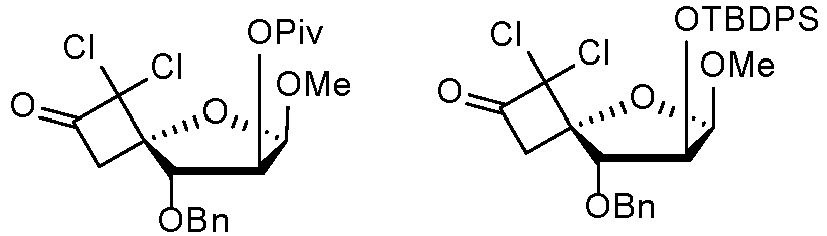
Benzoyl, -C(=O)-C1-4-Alkyl oder -C(=O)-Phenyl ist; wobei Benzyl, -CH2-Naphthyl und Benzoyl optional durch einen oder zwei Substituenten substituiert sind, die jeweils unabhängig aus -CH3 und -OCH3 ausgewählt sind;m 0 oder 1 ist;x 0, 1 oder 2 ist;R4, R5 und R6 jeweils unabhängig Wasserstoff oder eine Hydroxyl-Schutzgruppe sind, die eine Silyl-Gruppe, C1-4-Alkyl, C1-4-Alkyl-O-C1-4-Alkyl, Tetrahydropyranyl, Allyl, Benzyl, -CH2-Naphthyl, Benzoyl, -C(=O)-C1-4-Alkyl oder -C(=O)-Phenyl ist; wobei Benzyl, -CH2-Naphthyl und Benzoyl optional durch einen oder zwei Substituenten substituiert sind, die jeweils unabhängig aus -CH3 und -OCH3 ausgewählt sind;oder R5 und R6 zusammen eine Diol-Schutzgruppe -C(C1-4-Alkyl)2- sind;oder R4 und R5 zusammen eine Diol-Schutzgruppe -C(C1-4-Alkyl)2- sind;unter der Voraussetzung, dass:(a) die Verbindung keine Verbindung der Formel: (b) die Verbindung keine Verbindung der Formel:
 (c) die Verbindung keine Verbindung der Formel:
 (d) die Verbindung keine Verbindung der Formel:
- Verbindung nach Anspruch 1, wobei die Verbindung eine Verbindung der Formel (A-1a), (A-3a), (A-1b) oder (A-3b) ist:

- Verbindung nach einem der Ansprüche 1 bis 2, wobei Y O ist.
- Verbindung nach einem der Ansprüche 1 bis 2, wobei Y CH2 ist.
- Verbindung nach einem der Ansprüche 1 bis 4, wobei n 1 ist.
- Verbindung nach Anspruch 5, wobei:R1 Wasserstoff ist und R2 -(CH2)mNRa 2, -(CH2)mORa, -(CH2)mC(O)ORa, - (CH2)mC(O)NRa 2, -(CH2)mC(O)Ra, -(CH2)mS(O)xRc, eine Silyl-Gruppe, C1-6-Alkyl substituiert mit einer Silyl-Gruppe, =O oder =CRa 2 ist; oderR2 Wasserstoff ist and R1 -(CH2)mNRa 2, -(CH2)mORa, -(CH2)mOPG, - (CH2)mC(O)ORa, -(CH2)mC(O)NRa 2, -(CH2)mC(O)Ra, -(CH2)mS(O)xRc, eine Silyl-Gruppe, C1-6-Alkyl substituiert mit einer Silyl-Gruppe, -O-Aryl, =O oder =CRa 2 ist.
- Verbindung nach einem der Ansprüche 1 bis 4, wobei n 0 ist.
- Verbindung nach Anspruch 7, wobei einer von R1 und R2 Wasserstoff ist und der andere -(CH2)mNRa 2, -(CH2)mORa, -(CH2)mOPG, -C(O)ORa, -C(O)NRa 2 oder -B(ORb)2 ist.
- Verbindung nach Anspruch 1, wobei die Verbindung ausgewählt ist aus:


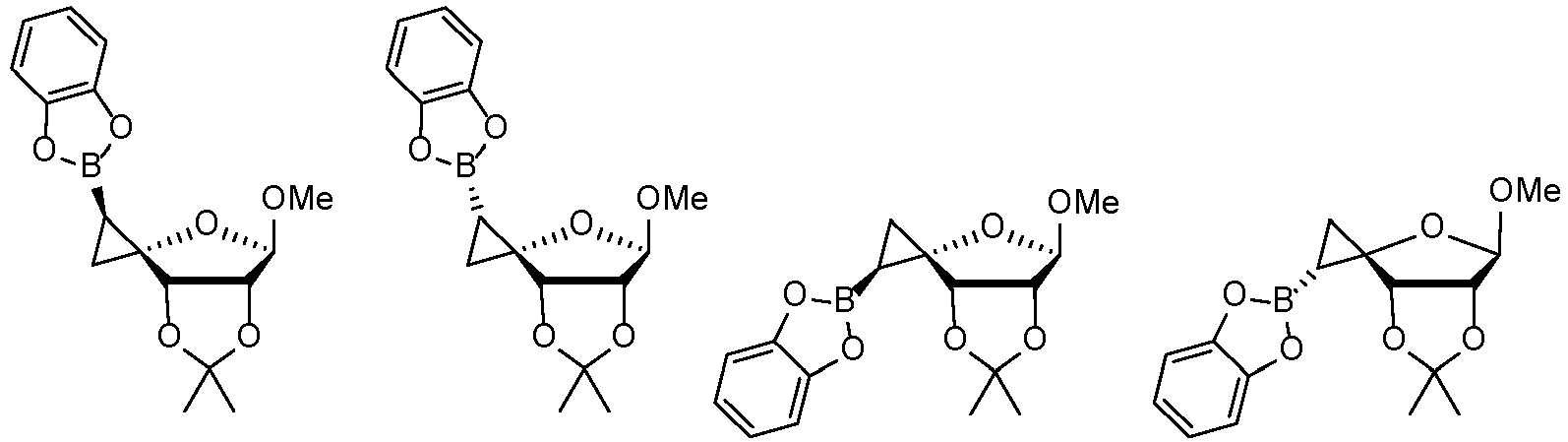




- Verbindung der Formel (B):
 Y -O- oder -CH2- ist;R4, R5 und R6 jeweils unabhängig Wasserstoff oder eine Hydroxyl-Schutzgruppe sind, die eine Silyl-Gruppe, C1-4-Alkyl, C1-4-Alkyl-O-C1-4-Alkyl, Tetrahydropyranyl, Allyl, Benzyl, -CH2 -Naphthyl, Benzoyl, -C(=O)-C1-4-Alkyl oder -C(=O)-Phenyl ist; wobei Benzyl, -CH2-Naphthyl und Benzoyl optional durch einen oder zwei Substituenten substituiert sind, die jeweils unabhängig aus -CH3 und -OCH3 ausgewählt sind;oder R5 und R6 zusammen eine Diol-Schutzgruppe -C(C1-4-Alkyl)2- sind;oder R4 und R5 zusammen eine Diol-Schutzgruppe -C(C1-4-Alkyl)2- sind.
 - Verbindung nach Anspruch 10, wobei die Verbindung ausgewählt ist aus:

- Verbindung der Formel (C):
 Y -O- oder -CH2- ist;R4, R5 und R6 jeweils unabhängig Wasserstoff oder eine Hydroxil-Schutzgruppe sind, die eine Silyl-Gruppe, C1-4-Alkyl, C1-4-Alkyl-O-C1-4-Alkyl, Tetrahydropyranyl, Allyl, Benzyl, -CH2-Naphthyl, Benzoyl, -C(=O)-C1-4-Alkyl, oder -C(=O)-Phenyl ist; wobei Benzyl, -CH2-Naphthyl und Benzoyl optional durch einen oder zwei Substituenten substituiert sind, die jeweils unabhängig aus -CH3 und -OCH3 ausgewählt sind; oderR4 und R5 zusammen eine Diol-Schutzgruppe -C(C1-4-Alkyl)2- sind; oderR5 und R6 zusammen eine Diol-Schutzgruppe -C(C1-4-Alkyl)2- sind;vorausgesetzt, dass die Verbindung nicht ist:
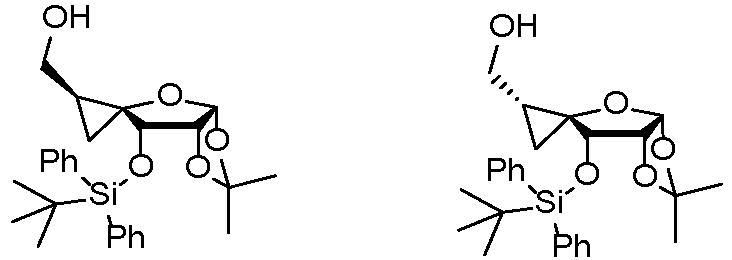
- Verbindung nach Anspruch 12, wobei die Verbindung ausgewählt ist aus:


- Verbindung der Formel (D):
 Y -O- oder -CH2- ist;wobei - - eine Einfachbindung oder eine Doppelbindung ist; undwenn - - eine Einfachbindung ist, ist einer von R1' und R2' Wasserstoff oder C1-6-Alkyl und der andere ist eine Silyl-Gruppe, C1-6-Alkyl optional substituiert mit einer Silyl-Gruppe, -O-C1-6Alkyl, -B(ORb)2-S-C1-6-Alkyl, -S-Aryl, -O-Aryl oder C(O)Ra;wenn - - eine Doppelbindung ist, ist einer von R1' und R2' Wasserstoff oder C1-6-Alkyl und der andere ist eine Silyl-Gruppe, C1-6-Alkyl optional substituiert mit einer Silyl-Gruppe, -O-C1-6-Alkyl, oder C(O)Ra;undRa Wasserstoff oder C1-6-Alkyl ist;jeder Rb Wasserstoff ist oder beide Rb zusammen eine Boronsäure-Schutzgruppe bilden, nämlich Catecholboran, Pinakolboran, N-Methyliminodiessigsäureboronat, Neopentylglykolboran, Pinandiolboran, Biscyclohexyldiolboran oder 1-(4-Methoxyphenyl)-2-methylpropan-1,2-diolboran;R3 OR4 oder R10 ist;R10 eine Nukleobase oder ein Nukleobase-Derivat ist;R4, R5 und R6 jeweils unabhängig Wasserstoff oder eine Hydroxil-Schutzgruppe sind, die eine Silyl-Gruppe, C1-4-Alkyl, C1-4-Alkyl-O-C1-4-Alkyl, Tetrahydropyranyl, Allyl, Benzyl, -CH2-Naphthyl, Benzoyl, -C(=O)-C1-4-Alkyl, oder -C(=O)-Phenyl ist; wobei Benzyl, -CH2-Naphthyl und Benzoyl optional durch einen oder zwei Substituenten substituiert sind, die jeweils unabhängig aus -CH3 und -OCH3 ausgewählt sind; oderR4 und R5 zusammen eine Diol-Schutzgruppe -C(C1-4-Alkyl)2- sind; oderR5 und R6 zusammen eine Diol-Schutzgruppe -C(C1-4-Alkyl)2- sind.
 - Verbindung nach Anspruch 14, wobei die Verbindung ausgewählt ist aus:


- Verbindung der Formel (E):
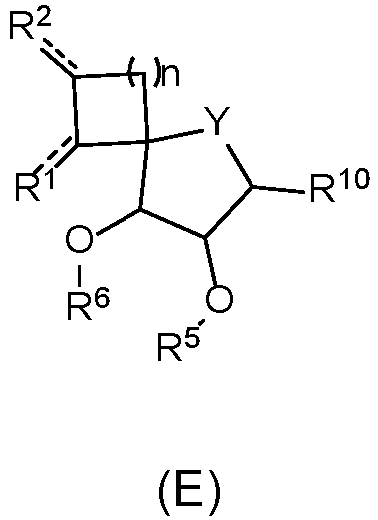 Y -O- oder -CH2- ist;n 0 oder 1 ist;wenn n 1 ist, ist R1 Wasserstoff und R2 ist -(CH2)mNRa 2, -(CH2)mORa, - (CH2)mC(O)ORa, -(CH2)mC(O)NRa 2, -(CH2)mC(O)Ra, -(CH2)mB(ORb)2, -(CH2)mS(O)xRc, eine Silyl-Gruppe, C1-6-Alkyl substituiert mit einer Silyl-Gruppe, =O oder =CRa 2; oderwenn n 1 ist, ist R2 Wasserstoff und R1 ist -(CH2)mNRa 2, -(CH2)mORa, - (CH2)mOPG, -(CH2)mC(O)ORa, -(CH2)mC(O)NRa 2, -(CH2)mC(O)Ra, - (CH2)mB(ORb)2, -(CH2)mS(O)xRc, eine Silyl-Gruppe, C1-6-Alkyl, substituiert mit einer Silyl-Gruppe, -O-Aryl, =O oder =CRa 2;wenn n 0 ist, ist einer von R1 und R2 Wasserstoff und der andere ist - (CH2)mNRa 2, -(CH2)mORa, -(CH2)mOPG, -(CH2)mC(O)ORa, -(CH2)mC(O)NRa 2, - (CH2)mC(O)Ra, -(CH2)mB(ORb)2, -(CH2)mS(O)xRc oder =CH2;wobei die Bindung zu R1 oder R2 - - eine Einfachbindung ist, wenn R1 oder R2 Wasserstoff, -(CH2)mNRa 2, -(CH2)mORa, -(CH2)mOPG, -(CH2)mC(O)ORa, - (CH2)mC(O)NRa 2, -(CH2)mC(O)Ra, -(CH2)mB(ORb)2, -(CH2)mS(O)xRc, eine Silyl-Gruppe, C1-6-Alkyl, substituiert mit einer Silyl-Gruppe oder -O-Aryl ist, oder eine Doppelbindung, wenn R1 oder R2 =O, =CH2 oder =CRa 2 ist;jeder Ra unabhängig Wasserstoff oder C1-6-Alkyl ist;beide Rb Wasserstoff sind oder beide Rb zusammen eine Boronsäure-Schutzgruppe bilden, nämlich Catecholboran, Pinakolboran, N-Methyliminodiessigsäureboronat, Neopentylglykolboran, Pinandiolboran, Biscyclohexyldiolboran oder 1-(4-Methoxyphenyl)-2-methylpropan-1,2-diolboran;Rc C1-6-Alkyl oder -Aryl ist;x 0, 1 oder 2 ist;m 0 oder 1 ist;R5 und R6 jeweils unabhängig Wasserstoff oder eine Hydroxyl-Schutzgruppe sind, die eine Silyl-Gruppe, C1-4-Alkyl, C1-4-Alkyl-O-C1-4-Alkyl, Tetrahydropyranyl, Allyl, Benzyl, -CH2-Naphthyl, Benzoyl, -C(=O)-C1-4-Alkyl oder -C(=O)-Phenyl ist; wobei Benzyl, -CH2-Naphthyl und Benzoyl optional durch einen oder zwei Substituenten substituiert sind, die jeweils unabhängig aus -CH3 und -OCH3 ausgewählt sind; oder R5 und R6 zusammen eine Diol-Schutzgruppe -C(C1-4-Alkyl)2- sind;R10 eine Nukleobase oder ein Nukleobase-Derivat ist;PG eine Hydroxyl-Schutzgruppe ist, die eine Silyl-Gruppe, C1-4-Alkyl, C1-4-Alkyl-O-C1-4-Alkyl, Tetrahydropyranyl, Allyl, Benzyl, -CH2-Naphthyl,
Benzoyl, -C(=O)-C1-4-Alkyl oder -C(=O)-Phenyl ist; wobei Benzyl, -CH2-Naphthyl und Benzoyl optional durch einen oder zwei Substituenten substituiert sind, die jeweils unabhängig aus -CH3 und -OCH3 ausgewählt sind;vorausgesetzt, dass die Verbindung keine der folgenden ist:
 wobeiR5 Wasserstoff oder -C(=O)-C1-4-Alkyl ist;R6 Wasserstoff oder -C(=O)-C1-4-Alkyl ist; oder R5 und R6 zusammen -C(CH3)2- sindY -O- oder -CH2- ist;R10 ist
 Q1 CR6a ist;Q2 N oder CR6b ist;R6a und R6b jeweils unabhängig für Wasserstoff, Halogen, C1-4-Alkyl, - NR9aR9b oder C1-4-Alkyl stehen, das mit einem, zwei oder drei Halogenatomen substituiert ist;R9a und R9b jeweils unabhängig für Wasserstoff oder C1-4-Alkyl stehen;R3a Wasserstoff, Halogen, -NR7aR7b, C1-4-Alkyl, C2-4-Alkenyl, C3-6-Cycloalkyl, -OH oder-O-C1-4-Alkyl ist;R7a Wasserstoff ist;R7b Wasserstoff, C3-6-Cycloalkyl oder C1-4-Alkyl ist;R4a Wasserstoff, Halogen, -NR8aR8b oder C1-4-Alkyl ist; undRx
 oder ein Salz oder Solvat davon.
 - Verbindung nach Anspruch 16, wobei die Verbindung eine Verbindung der Formel (G-1a) oder (G-1b) ist:

- Verbindung nach einem der Ansprüche 16 oder 17, wobei n 1 ist.
- Verbindung nach Anspruch 18, wobei:R1 Wasserstoff ist und R2 -(CH2)mNRa 2, -(CH2)mORa, -(CH2)mC(O)ORa, - (CH2)mC(O)NRa 2, -(CH2)mC(O)Ra, -(CH2)mS(O)xRc, eine Silyl-Gruppe, C1-6-Alkyl substituiert mit einer Silyl-Gruppe, =O oder =CRa 2 ist; oderR2 Wasserstoff ist and R1 -(CH2)mNRa 2, -(CH2)mORa, -(CH2)mOPG, - (CH2)mC(O)ORa, -(CH2)mC(O)NRa 2, -(CH2)mC(O)Ra, -(CH2)mS(O)xRc, eine Silyl-Gruppe, C1-6-Alkyl substituiert mit einer Silyl-Gruppe, -O-Aryl, =O oder =CRa 2 ist.
- Verbindung nach einem der Ansprüche 16 oder 17, wobei n 0 ist.
- Verbindung nach Anspruch 18, wobei einer von R1 und R2 Wasserstoff ist und der andere -(CH2)mNRa 2, -(CH2)mORa, -(CH2)mOPG, -(CH2)mC(O)ORa, - (CH2)mC(O)NRa 2, -(CH2)mC(O)Ra, -(CH2)mB(ORb)2 oder =CH2 ist.
- Verbindung nach Anspruch 16, wobei die Verbindung ausgewählt ist aus:



- Verbindung der Formel (H):
 Y -O- oder -CH2- ist;R5 und R6 jeweils unabhängig Wasserstoff oder eine Hydroxyl-Schutzgruppe sind, die eine Silyl-Gruppe, C1-4-Alkyl, C1-4-Alkyl-O-C1-4-Alkyl, Tetrahydropyranyl, Allyl, Benzyl, -CH2-Naphthyl, Benzoyl, -C(=O)-C1-4-Alkyl oder -C(=O)-Phenyl ist; wobei Benzyl, -CH2-Naphthyl und Benzoyl optional durch einen oder zwei Substituenten substituiert sind, die jeweils unabhängig aus -CH3 und -OCH3 ausgewählt sind; oder R5 und R6 zusammen eine Diol-Schutzgruppe -C(C1-4-Alkyl)2- sind; und R10 eine Nukleobase oder ein Nukleobase-Derivat ist.
 - Verbindung nach einem der Ansprüche 14 bis 23, wobei R10, sofern vorhanden, Cytosin, Thymin, Uracil oder eine modifizierte oder geschützte Form davon oder ein bicyclisches aromatisches heterocyclisches Ringsystem ist, ausgewählt aus der Gruppe bestehend aus (a-1), (a-2), (a-3), (a-4) und (a-5):
 R3a, R3b, R3c, R3d und R3e jeweils unabhängig Wasserstoff, Halogen, -NR7aR7b, C1-4-Alkyl, C2-4-Alkenyl, C3-6-Cycloalkyl, -OH oder -O-C1-4-Alkyl sind;R7a Wasserstoff, -C(O)O-C1-4-Alkyl oder
 R7b Wasserstoff, C3-6-Cycloalkyl, C1-4-Alkyl oder -C(O)O-C1-4-Alkyl ist;R4a, R4b, R4c, R4d, R4e, R4f und R4g jeweils unabhängig Wasserstoff, Halogen, -NR8aR8b oder C1-4-Alkyl sind;R8a und R8b jeweils unabhängig Wasserstoff oder C1-4-Alkyl sind;Q1 N oder CR6a ist;Q2 N oder CR6b ist;Q3 N oder CR6c ist;Q4 N oder CR6d ist;mit der Maßgabe, dass maximal eines von Q3 und Q4 N ist;Q8 N oder CR6g ist;Q9 N oder CR6h ist;Q10 N oder CR6i ist;Q11 N oder CR6j ist;Q5 CR3d ist; Q6 N ist; und Q7 CR4f ist; oderQ5 CR3d ist; Q6 CR4e ist; und Q7 N ist; oderQ5 N ist; Q6 CR4e ist; und Q7 CR4f ist; oderQ5 N ist; Q6 CR4e ist; und Q7 N ist; oderQ5 N ist; Q6 N ist; und Q7 CR4f ist; oderQ5 N ist; Q6 N ist; und Q7 N ist;R6a, R6b, R6c, R6d, R6e, R6f, R6 g, R6h, R6i und R6j jeweils unabhängig Wasserstoff, Halogen, C1-4-Alkyl, -NR9aR9b oder C1-4-Alkyl sind, das durch ein, zwei oder drei Halogenatome substituiert ist;R9a und R9b jeweils unabhängig Wasserstoff oder C1-4-Alkyl sind.
Applications Claiming Priority (3)
| Application Number | Priority Date | Filing Date | Title |
|---|---|---|---|
| IN201911023295 | 2019-06-12 | ||
| EP19193707 | 2019-08-27 | ||
| PCT/EP2020/066182 WO2020249663A1 (en) | 2019-06-12 | 2020-06-11 | Novel spirobicyclic intermediates |
Publications (3)
| Publication Number | Publication Date |
|---|---|
| EP3983393A1 EP3983393A1 (de) | 2022-04-20 |
| EP3983393C0 EP3983393C0 (de) | 2025-04-02 |
| EP3983393B1 true EP3983393B1 (de) | 2025-04-02 |
Family
ID=71120144
Family Applications (1)
| Application Number | Title | Priority Date | Filing Date |
|---|---|---|---|
| EP20734118.1A Active EP3983393B1 (de) | 2019-06-12 | 2020-06-11 | Neuartige spirobicyclische zwischenprodukte |
Country Status (18)
| Country | Link |
|---|---|
| US (1) | US20220275018A1 (de) |
| EP (1) | EP3983393B1 (de) |
| JP (2) | JP7598338B2 (de) |
| KR (1) | KR20220019766A (de) |
| CN (1) | CN113966328B (de) |
| AU (1) | AU2020290672A1 (de) |
| BR (1) | BR112021024457A2 (de) |
| CA (1) | CA3138349A1 (de) |
| CR (1) | CR20220012A (de) |
| EC (1) | ECSP21089373A (de) |
| ES (1) | ES3028534T3 (de) |
| IL (1) | IL288741B2 (de) |
| JO (1) | JOP20210327A1 (de) |
| MA (1) | MA56185A (de) |
| MX (1) | MX2021015363A (de) |
| PE (1) | PE20220433A1 (de) |
| PH (1) | PH12021553075A1 (de) |
| WO (1) | WO2020249663A1 (de) |
Families Citing this family (2)
| Publication number | Priority date | Publication date | Assignee | Title |
|---|---|---|---|---|
| WO2024170488A1 (en) | 2023-02-13 | 2024-08-22 | Astrazeneca Ab | Prmt5 inhibitor for use in cancer therapy |
| WO2026008533A1 (en) | 2024-07-01 | 2026-01-08 | Janssen Pharmaceutica Nv | Prmt5 inhibitors for treating adenomas |
Family Cites Families (15)
| Publication number | Priority date | Publication date | Assignee | Title |
|---|---|---|---|---|
| US6143749A (en) | 1995-06-07 | 2000-11-07 | Abbott Laboratories | Heterocyclic substituted cyclopentane compounds |
| JP2005527502A (ja) | 2002-02-19 | 2005-09-15 | シーブイ・セラピューティクス・インコーポレイテッド | A1アデノシン受容体の部分的および全アゴニスト |
| US20040043959A1 (en) | 2002-03-04 | 2004-03-04 | Bloom Laura A. | Combination therapies for treating methylthioadenosine phosphorylase deficient cells |
| US9145438B2 (en) | 2010-12-03 | 2015-09-29 | Epizyme, Inc. | 7-deazapurine modulators of histone methyltransferase, and methods of use thereof |
| EP2646455A4 (de) | 2010-12-03 | 2014-04-02 | Epizyme Inc | Modulatoren der histonmethyltransferase und verwendungsverfahren dafür |
| WO2014035140A2 (en) | 2012-08-30 | 2014-03-06 | Kainos Medicine, Inc. | Compounds and compositions for modulating histone methyltransferase activity |
| US9745291B2 (en) | 2012-12-21 | 2017-08-29 | Epizyme, Inc. | PRMT5 inhibitors containing a dihydro- or tetrahydroisoquinoline and uses thereof |
| CA2894126A1 (en) | 2012-12-21 | 2014-06-26 | Epizyme, Inc. | Prmt5 inhibitors and uses thereof |
| DK2935222T3 (en) | 2012-12-21 | 2019-01-07 | Epizyme Inc | PRMT5 INHIBITORS AND APPLICATIONS THEREOF |
| US20170198006A1 (en) | 2014-06-25 | 2017-07-13 | Epizyme, Inc. | Prmt5 inhibitors and uses thereof |
| MX2017010844A (es) | 2015-02-24 | 2017-12-07 | Pfizer | Derivados de nucleosidos sustituidos utiles como agentes anticancerosos. |
| TWI870767B (zh) * | 2015-08-26 | 2025-01-21 | 比利時商健生藥品公司 | 使用作為prmt5抑制劑之新穎經6-6雙環芳香環取代之核苷類似物 |
| AU2017230658B2 (en) * | 2016-03-10 | 2021-03-04 | Janssen Pharmaceutica Nv | Substituted nucleoside analogues for use as PRMT5 inhibitors |
| WO2018065365A1 (en) | 2016-10-03 | 2018-04-12 | Janssen Pharmaceutica Nv | Novel monocyclic and bicyclic ring system substituted carbanucleoside analogues for use as prmt5 inhibitors |
| US11059850B2 (en) * | 2017-12-08 | 2021-07-13 | Janssen Pharmaceutica Nv | Spirobicyclic analogues |
-
2020
- 2020-06-11 KR KR1020227000490A patent/KR20220019766A/ko not_active Withdrawn
- 2020-06-11 CA CA3138349A patent/CA3138349A1/en active Pending
- 2020-06-11 CN CN202080042994.7A patent/CN113966328B/zh active Active
- 2020-06-11 BR BR112021024457A patent/BR112021024457A2/pt unknown
- 2020-06-11 MX MX2021015363A patent/MX2021015363A/es unknown
- 2020-06-11 WO PCT/EP2020/066182 patent/WO2020249663A1/en not_active Ceased
- 2020-06-11 ES ES20734118T patent/ES3028534T3/es active Active
- 2020-06-11 MA MA056185A patent/MA56185A/fr unknown
- 2020-06-11 CR CR20220012A patent/CR20220012A/es unknown
- 2020-06-11 PH PH1/2021/553075A patent/PH12021553075A1/en unknown
- 2020-06-11 AU AU2020290672A patent/AU2020290672A1/en not_active Abandoned
- 2020-06-11 PE PE2021002041A patent/PE20220433A1/es unknown
- 2020-06-11 US US17/616,248 patent/US20220275018A1/en active Pending
- 2020-06-11 IL IL288741A patent/IL288741B2/en unknown
- 2020-06-11 JP JP2021573512A patent/JP7598338B2/ja active Active
- 2020-06-11 EP EP20734118.1A patent/EP3983393B1/de active Active
-
2021
- 2021-12-09 JO JOP/2021/0327A patent/JOP20210327A1/ar unknown
- 2021-12-10 EC ECSENADI202189373A patent/ECSP21089373A/es unknown
-
2024
- 2024-08-09 JP JP2024133713A patent/JP2024170421A/ja active Pending
Also Published As
| Publication number | Publication date |
|---|---|
| ECSP21089373A (es) | 2022-01-31 |
| JP2022536712A (ja) | 2022-08-18 |
| CN113966328B (zh) | 2025-01-03 |
| KR20220019766A (ko) | 2022-02-17 |
| AU2020290672A1 (en) | 2022-02-10 |
| US20220275018A1 (en) | 2022-09-01 |
| MX2021015363A (es) | 2022-04-06 |
| JP2024170421A (ja) | 2024-12-10 |
| EP3983393C0 (de) | 2025-04-02 |
| WO2020249663A1 (en) | 2020-12-17 |
| BR112021024457A2 (pt) | 2022-01-18 |
| PH12021553075A1 (en) | 2023-09-11 |
| PE20220433A1 (es) | 2022-03-29 |
| JP7598338B2 (ja) | 2024-12-11 |
| IL288741B1 (en) | 2024-11-01 |
| CA3138349A1 (en) | 2020-12-17 |
| IL288741B2 (en) | 2025-03-01 |
| JOP20210327A1 (ar) | 2021-12-09 |
| ES3028534T3 (en) | 2025-06-19 |
| IL288741A (en) | 2022-02-01 |
| MA56185A (fr) | 2022-04-20 |
| EP3983393A1 (de) | 2022-04-20 |
| CR20220012A (es) | 2022-03-11 |
| CN113966328A (zh) | 2022-01-21 |
Similar Documents
| Publication | Publication Date | Title |
|---|---|---|
| JP7352544B2 (ja) | 新規なスピロ二環式類似体 | |
| EP3386992B1 (de) | Inhibitoren von bruton-tyrosinkinase und verfahren zu deren verwendung | |
| WO1999024449A2 (en) | Adenosine a1 receptor agonists | |
| JP2024170421A (ja) | 新規なスピロ二環式中間体 | |
| JP2022084699A (ja) | Prmt5阻害剤として使用するための新規な単環式および二環式環系置換カルバヌクレオシド類似体 | |
| EP4043461A1 (de) | Verbindung als kleiner molekülinhibitor pd- und pd-l1 und verwendung davon | |
| HK40061140A (en) | Novel spirobicyclic intermediates | |
| RU2789377C2 (ru) | Новые спиробициклические аналоги | |
| HK40033790B (en) | Spirobicyclic analogues | |
| HK40033790A (en) | Spirobicyclic analogues | |
| HK40038903B (en) | Novel spirobicyclic analogues | |
| HK40038903A (en) | Novel spirobicyclic analogues | |
| WO2022194924A1 (en) | Chiral synthons for the synthesis of chiral phosphorothioates | |
| Reddy et al. | Stereoselective synthesis of tetrahydrofuranyl 1, 2, 3-triazolyl C-nucleoside analogues by ‘click’chemistry and investigation of their biological activity | |
| Li | Syntheses of Carbobicyclic Nucleosides |
Legal Events
| Date | Code | Title | Description |
|---|---|---|---|
| STAA | Information on the status of an ep patent application or granted ep patent |
Free format text: STATUS: UNKNOWN |
|
| STAA | Information on the status of an ep patent application or granted ep patent |
Free format text: STATUS: THE INTERNATIONAL PUBLICATION HAS BEEN MADE |
|
| PUAI | Public reference made under article 153(3) epc to a published international application that has entered the european phase |
Free format text: ORIGINAL CODE: 0009012 |
|
| STAA | Information on the status of an ep patent application or granted ep patent |
Free format text: STATUS: REQUEST FOR EXAMINATION WAS MADE |
|
| 17P | Request for examination filed |
Effective date: 20220112 |
|
| AK | Designated contracting states |
Kind code of ref document: A1 Designated state(s): AL AT BE BG CH CY CZ DE DK EE ES FI FR GB GR HR HU IE IS IT LI LT LU LV MC MK MT NL NO PL PT RO RS SE SI SK SM TR |
|
| REG | Reference to a national code |
Ref country code: HK Ref legal event code: DE Ref document number: 40068203 Country of ref document: HK |
|
| STAA | Information on the status of an ep patent application or granted ep patent |
Free format text: STATUS: EXAMINATION IS IN PROGRESS |
|
| 17Q | First examination report despatched |
Effective date: 20230111 |
|
| GRAP | Despatch of communication of intention to grant a patent |
Free format text: ORIGINAL CODE: EPIDOSNIGR1 |
|
| STAA | Information on the status of an ep patent application or granted ep patent |
Free format text: STATUS: GRANT OF PATENT IS INTENDED |
|
| INTG | Intention to grant announced |
Effective date: 20240516 |
|
| GRAJ | Information related to disapproval of communication of intention to grant by the applicant or resumption of examination proceedings by the epo deleted |
Free format text: ORIGINAL CODE: EPIDOSDIGR1 |
|
| STAA | Information on the status of an ep patent application or granted ep patent |
Free format text: STATUS: EXAMINATION IS IN PROGRESS |
|
| INTC | Intention to grant announced (deleted) | ||
| GRAP | Despatch of communication of intention to grant a patent |
Free format text: ORIGINAL CODE: EPIDOSNIGR1 |
|
| STAA | Information on the status of an ep patent application or granted ep patent |
Free format text: STATUS: GRANT OF PATENT IS INTENDED |
|
| INTG | Intention to grant announced |
Effective date: 20241108 |
|
| GRAS | Grant fee paid |
Free format text: ORIGINAL CODE: EPIDOSNIGR3 |
|
| GRAA | (expected) grant |
Free format text: ORIGINAL CODE: 0009210 |
|
| STAA | Information on the status of an ep patent application or granted ep patent |
Free format text: STATUS: THE PATENT HAS BEEN GRANTED |
|
| AK | Designated contracting states |
Kind code of ref document: B1 Designated state(s): AL AT BE BG CH CY CZ DE DK EE ES FI FR GB GR HR HU IE IS IT LI LT LU LV MC MK MT NL NO PL PT RO RS SE SI SK SM TR |
|
| REG | Reference to a national code |
Ref country code: GB Ref legal event code: FG4D |
|
| REG | Reference to a national code |
Ref country code: CH Ref legal event code: EP |
|
| REG | Reference to a national code |
Ref country code: DE Ref legal event code: R096 Ref document number: 602020048710 Country of ref document: DE |
|
| REG | Reference to a national code |
Ref country code: IE Ref legal event code: FG4D |
|
| U01 | Request for unitary effect filed |
Effective date: 20250430 |
|
| U07 | Unitary effect registered |
Designated state(s): AT BE BG DE DK EE FI FR IT LT LU LV MT NL PT RO SE SI Effective date: 20250508 |
|
| REG | Reference to a national code |
Ref country code: ES Ref legal event code: FG2A Ref document number: 3028534 Country of ref document: ES Kind code of ref document: T3 Effective date: 20250619 |
|
| PGFP | Annual fee paid to national office [announced via postgrant information from national office to epo] |
Ref country code: GB Payment date: 20250501 Year of fee payment: 6 |
|
| PGFP | Annual fee paid to national office [announced via postgrant information from national office to epo] |
Ref country code: IE Payment date: 20250509 Year of fee payment: 6 |
|
| U20 | Renewal fee for the european patent with unitary effect paid |
Year of fee payment: 6 Effective date: 20250808 |
|
| PGFP | Annual fee paid to national office [announced via postgrant information from national office to epo] |
Ref country code: ES Payment date: 20250707 Year of fee payment: 6 |
|
| PG25 | Lapsed in a contracting state [announced via postgrant information from national office to epo] |
Ref country code: NO Free format text: LAPSE BECAUSE OF FAILURE TO SUBMIT A TRANSLATION OF THE DESCRIPTION OR TO PAY THE FEE WITHIN THE PRESCRIBED TIME-LIMIT Effective date: 20250702 Ref country code: GR Free format text: LAPSE BECAUSE OF FAILURE TO SUBMIT A TRANSLATION OF THE DESCRIPTION OR TO PAY THE FEE WITHIN THE PRESCRIBED TIME-LIMIT Effective date: 20250703 |
|
| PG25 | Lapsed in a contracting state [announced via postgrant information from national office to epo] |
Ref country code: PL Free format text: LAPSE BECAUSE OF FAILURE TO SUBMIT A TRANSLATION OF THE DESCRIPTION OR TO PAY THE FEE WITHIN THE PRESCRIBED TIME-LIMIT Effective date: 20250402 |
|
| PG25 | Lapsed in a contracting state [announced via postgrant information from national office to epo] |
Ref country code: HR Free format text: LAPSE BECAUSE OF FAILURE TO SUBMIT A TRANSLATION OF THE DESCRIPTION OR TO PAY THE FEE WITHIN THE PRESCRIBED TIME-LIMIT Effective date: 20250402 |
|
| PGFP | Annual fee paid to national office [announced via postgrant information from national office to epo] |
Ref country code: CH Payment date: 20250701 Year of fee payment: 6 |
|
| PG25 | Lapsed in a contracting state [announced via postgrant information from national office to epo] |
Ref country code: RS Free format text: LAPSE BECAUSE OF FAILURE TO SUBMIT A TRANSLATION OF THE DESCRIPTION OR TO PAY THE FEE WITHIN THE PRESCRIBED TIME-LIMIT Effective date: 20250702 |
|
| PG25 | Lapsed in a contracting state [announced via postgrant information from national office to epo] |
Ref country code: IS Free format text: LAPSE BECAUSE OF FAILURE TO SUBMIT A TRANSLATION OF THE DESCRIPTION OR TO PAY THE FEE WITHIN THE PRESCRIBED TIME-LIMIT Effective date: 20250802 |
|
| PG25 | Lapsed in a contracting state [announced via postgrant information from national office to epo] |
Ref country code: SM Free format text: LAPSE BECAUSE OF FAILURE TO SUBMIT A TRANSLATION OF THE DESCRIPTION OR TO PAY THE FEE WITHIN THE PRESCRIBED TIME-LIMIT Effective date: 20250402 |
|
| VS25 | Lapsed in a validation state [announced via postgrant information from nat. office to epo] |
Ref country code: MD Free format text: LAPSE BECAUSE OF FAILURE TO SUBMIT A TRANSLATION OF THE DESCRIPTION OR TO PAY THE FEE WITHIN THE PRESCRIBED TIME-LIMIT Effective date: 20250402 |
|
| PG25 | Lapsed in a contracting state [announced via postgrant information from national office to epo] |
Ref country code: CZ Free format text: LAPSE BECAUSE OF FAILURE TO SUBMIT A TRANSLATION OF THE DESCRIPTION OR TO PAY THE FEE WITHIN THE PRESCRIBED TIME-LIMIT Effective date: 20250402 |
|
| PG25 | Lapsed in a contracting state [announced via postgrant information from national office to epo] |
Ref country code: SK Free format text: LAPSE BECAUSE OF FAILURE TO SUBMIT A TRANSLATION OF THE DESCRIPTION OR TO PAY THE FEE WITHIN THE PRESCRIBED TIME-LIMIT Effective date: 20250402 |
|
| PG25 | Lapsed in a contracting state [announced via postgrant information from national office to epo] |
Ref country code: MC Free format text: LAPSE BECAUSE OF FAILURE TO SUBMIT A TRANSLATION OF THE DESCRIPTION OR TO PAY THE FEE WITHIN THE PRESCRIBED TIME-LIMIT Effective date: 20250402 |
|
| PLBE | No opposition filed within time limit |
Free format text: ORIGINAL CODE: 0009261 |
|
| STAA | Information on the status of an ep patent application or granted ep patent |
Free format text: STATUS: NO OPPOSITION FILED WITHIN TIME LIMIT |
|
| REG | Reference to a national code |
Ref country code: CH Ref legal event code: L10 Free format text: ST27 STATUS EVENT CODE: U-0-0-L10-L00 (AS PROVIDED BY THE NATIONAL OFFICE) Effective date: 20260211 |
|
| VS25 | Lapsed in a validation state [announced via postgrant information from nat. office to epo] |
Ref country code: MA Free format text: FAILURE TO ELECT DOMICILE IN THE NATIONAL COUNTRY Effective date: 20250703 |
|
| 26N | No opposition filed |
Effective date: 20260105 |
|
| VS25 | Lapsed in a validation state [announced via postgrant information from nat. office to epo] |
Ref country code: MA Free format text: LAPSE BECAUSE OF FAILURE TO SUBMIT A TRANSLATION OF THE DESCRIPTION OR TO PAY THE FEE WITHIN THE PRESCRIBED TIME-LIMIT Effective date: 20250402 |