EP3983832B1 - Verfahren zur bestimmung der präsenz von aufgespeicherten kohlenwasserstoffen - Google Patents
Verfahren zur bestimmung der präsenz von aufgespeicherten kohlenwasserstoffen Download PDFInfo
- Publication number
- EP3983832B1 EP3983832B1 EP20751765.7A EP20751765A EP3983832B1 EP 3983832 B1 EP3983832 B1 EP 3983832B1 EP 20751765 A EP20751765 A EP 20751765A EP 3983832 B1 EP3983832 B1 EP 3983832B1
- Authority
- EP
- European Patent Office
- Prior art keywords
- hydrocarbon
- compositions
- seeps
- seep
- hydrocarbons
- Prior art date
- Legal status (The legal status is an assumption and is not a legal conclusion. Google has not performed a legal analysis and makes no representation as to the accuracy of the status listed.)
- Active
Links
Images

Classifications
-
- E—FIXED CONSTRUCTIONS
- E21—EARTH OR ROCK DRILLING; MINING
- E21B—EARTH OR ROCK DRILLING; OBTAINING OIL, GAS, WATER, SOLUBLE OR MELTABLE MATERIALS OR A SLURRY OF MINERALS FROM WELLS
- E21B49/00—Testing the nature of borehole walls; Formation testing; Methods or apparatus for obtaining samples of soil or well fluids, specially adapted to earth drilling or wells
- E21B49/001—Testing the nature of borehole walls; Formation testing; Methods or apparatus for obtaining samples of soil or well fluids, specially adapted to earth drilling or wells specially adapted for underwater installations
-
- E—FIXED CONSTRUCTIONS
- E21—EARTH OR ROCK DRILLING; MINING
- E21B—EARTH OR ROCK DRILLING; OBTAINING OIL, GAS, WATER, SOLUBLE OR MELTABLE MATERIALS OR A SLURRY OF MINERALS FROM WELLS
- E21B43/00—Methods or apparatus for obtaining oil, gas, water, soluble or meltable materials or a slurry of minerals from wells
- E21B43/01—Methods or apparatus for obtaining oil, gas, water, soluble or meltable materials or a slurry of minerals from wells specially adapted for obtaining from underwater installations
- E21B43/0122—Collecting oil or the like from a submerged leakage
-
- E—FIXED CONSTRUCTIONS
- E21—EARTH OR ROCK DRILLING; MINING
- E21B—EARTH OR ROCK DRILLING; OBTAINING OIL, GAS, WATER, SOLUBLE OR MELTABLE MATERIALS OR A SLURRY OF MINERALS FROM WELLS
- E21B49/00—Testing the nature of borehole walls; Formation testing; Methods or apparatus for obtaining samples of soil or well fluids, specially adapted to earth drilling or wells
-
- G—PHYSICS
- G01—MEASURING; TESTING
- G01N—INVESTIGATING OR ANALYSING MATERIALS BY DETERMINING THEIR CHEMICAL OR PHYSICAL PROPERTIES
- G01N33/00—Investigating or analysing materials by specific methods not covered by groups G01N1/00 - G01N31/00
- G01N33/26—Oils; Viscous liquids; Paints; Inks
- G01N33/28—Oils, i.e. hydrocarbon liquids
- G01N33/2823—Raw oil, drilling fluid or polyphasic mixtures
Definitions
- the present invention relates to the field of determining the presence of reservoired hydrocarbons from a hydrocarbon seep.
- a method for detecting hydrocarbon seepages into the sea is described in US9,612,231B2 (Pottorf et al., 4 Apr 2017 ).
- the method starts with performing a remote sensing survey and analysing the remote sensing data from the remote sensing survey to determine the location of hydrocarbon seeps into the sea.
- the remote sensing survey may include performing one or more of ocean acoustic waveguide survey, water column seismic survey, active acoustic sensing survey, imagery and spectrometry of slicks and atmospheric gas plumes, passive acoustic sensing survey, magnetic and gravity surveys, optical sensing survey and thermal anomalies detection survey.
- These surveys include seismic and acoustic imaging of seeps in the water column, performed in ship-based marine vessels, using multibeam echo sounder and/or side-scan sonar.
- US20140250999A1 (Lawson et al., 11 Sept 2014 ) describes a method for reservoir surveillance. Samples of produced fluids are analysed for changes over time in noble gas and clumped isotope signatures. And in yet another member of the same family, US20150127313A1 (Lawson et al., 7 May 2015 ) describes a method for determining the presence and location of a subsurface hydrocarbon accumulation by comparing a clumped isotopic signature with an expected or theoretical concentration of isotopologues of a hydrocarbon species calculated by molecular modelling.
- the "differentiation between direct seepage from a source rock from the leakage of hydrocarbons from a subsurface accumulation requires consideration of the clumped isotopic signatures that may result from the two models of seepage.
- Hydrocarbons that have migrated directly from a source rock may either (i) retain a stochastic clumped isotope signature given insufficient time for a thermal contribution to the "clumping" of multiply substituted isotopologues, or (ii) display an inconsistent clumped isotope signature that arises as a result of the variability in the rate of isotope exchange of individual isotopologues.
- Kennicutt et al (“Leakage of deep, reservoired petroleum to the near surface on the Gulf of Mexico continental slope," Marine Chemistry 24:39-59; 1988 ) discusses the link between natural seepage in a deepwater marine setting and the formation of sea slicks and tar balls. Analysis of the gaseous and liquid hydrocarbons show that gas migrates to shallow sediments with little or no isotopic fractionation. Table 1 illustrates that carbon isotopic compositions are essentially unchanged after migration from reservoirs at depths > 2000 m.
- Kennicutt et al found that near-surface hydrocarbon liquids were depleted in aliphatics, 4-ring or larger aromatics, naphthalene, C1-naphthalenes and C2-naphthalenes as compared to reservoired fluids.
- AbuAli et al. (US2016/0341038A1, 24 Nov 2016 ) describes a sampling technique used to detect hydrocarbon microseeps in a subterranean formation by inserting probes into multiple different sampling depths from the surface.
- Peterson et al. discloses a method for determining a characteristic of a hydrocarbon source by analyzing a hydrocarbon fluid sample to determine a measure clumped isotope signature and comparing to an expected clumped isotope signature.
- Ellis (US2008/0147326A1, 19 Jun 2008 ) relates to a system and method for utilizing acquired compositional and isotopic data for an interpretive method of mud gas isotope logging to determine hydrocarbon charge, source identification, maturity, reservoir hydrocarbon isotopic signature, good hydrocarbon communication, seals, baffles, or other barriers to hydrocarbon communication in oil and gas drilling prospects.
- a method for determining a presence of reservoired hydrocarbons having a hydrocarbon seep comprising the steps of: (a) locating a hydrocarbon seep at a seabed location where hydrocarbon is actively flowing out of the seabed; (b) determining at least two temporally spaced molecular compositions of the hydrocarbon seep; (c) determining a temporal variance between the at least two temporally spaced molecular compositions; (d) when the temporal variance falls within a predetermined temporal tolerance, classifying the hydrocarbon seep as being indicative of the presence of reservoired hydrocarbons; and (e) assigning a unique identifier to the reservoired hydrocarbons.
- a method for determining a unique hydrocarbon reservoir having a hydrocarbon seep comprising the steps of: (a) locating a plurality of hydrocarbon seeps at a seabed location where hydrocarbon is actively flowing out of the seabed; (b) determining at least two temporally spaced molecular compositions for each of the plurality of hydrocarbon seeps; (c) determining a temporal variance between the at least two temporally spaced molecular compositions for each of the plurality of hydrocarbon seeps; (d) when the temporal variance for any one of the plurality of hydrocarbon seeps falls within a predetermined temporal tolerance, classifying the hydrocarbon seep as being indicative of a presence of a reservoired hydrocarbons; (e) selecting a representative molecular composition for each of the plurality of hydrocarbon seeps classified as being indicative of the presence of reservoired hydrocarbons; (f) determining a spatial variance between the representative molecular compositions; (g)
- the present invention provides a method for determining a presence of reservoired hydrocarbons having a hydrocarbon seep. In another embodiment, the method of the present invention provides a method for determining a unique hydrocarbon reservoir having a plurality of hydrocarbon seeps.
- the methods of the present invention involve determining at least two temporally spaced molecular compositions from a hydrocarbon seep. By determining whether a variance between two temporally spaced molecular compositions falls within a temporal tolerance, the method of the present invention determines that a steady state exists, thereby suggesting that the hydrocarbon seep is more likely indicative of reservoired hydrocarbons, as opposed to a seep originating directly from a source rock.
- Reservoired hydrocarbons as used herein means that the hydrocarbons are reservoired in an oil reservoir or a gas reservoir.
- a reservoir is an underground formation containing an individual and separate natural accumulation of producible hydrocarbons.
- An oil reservoir generally contains gas, oil and water, with oil being a major component. When gas accumulates independently of the oil, the reservoir is referred to as a gas reservoir, which may also contain some water and oil.
- a gas reservoir is a naturally occurring storage area of natural gas. In a condensate reservoir, hydrocarbons may exist as a gas, but when brought to the surface, the heavier hydrocarbons condense to a liquid.
- a "seep” or “hydrocarbon seep” is an indicator of hydrocarbons escaping the subsurface to a seabed, often under low pressure or flow.
- the hydrocarbons may escape from a reservoir along geological layers, or through fractures and fissures in the rock.
- Hydrocarbon seeps may result in bubble plumes in a water column, production of gas hydrates on the seabed, and/or production of oil slicks on the surface of the sea. Seeps may also arise from hydrocarbons escaping source rock that are not connected to a reservoir.
- actively flowing means that there is mass transfer of hydrocarbons.
- Indicators of an actively flowing seep include, without limitation, a bubble plume, a distinct phase from surrounding water, intrusion of one fluid into another, non-diffusive transport, and an accumulation of gas hydrates or oil that increases with time.
- bubbles is used for vapour-filled bubbles, as well as liquid droplets.
- the bubbles may or may not be at least partially frozen.
- the bubbles may be at least partially in the form of hydrocarbon hydrates, such as methane hydrates.
- a bubble may have a hydrate shell around a hydrocarbon fluid.
- the bubble plume may be formed of liquid or gas depending on, for example, the depth of the water.
- C 1 - C 4 components which are typically gaseous at STP, are in liquid form at or near the seabed.
- isotopes refers to variants of a chemical element with different numbers of neutrons.
- carbon has 15 known isotopes, from 8 C to 22 C, of which 12 C and 13 C are stable isotopes.
- Hydrogen has three-naturally occurring isotopes - protium 1 H with zero neutrons, deuterium 2 H (or D) with one neutron and tritium 3 H with two neutrons.
- isotopologues are molecules that have the same chemical composition but differ only in their isotopic composition.
- methane has ten stable isotopologues: 12 CH 4 , 13 CH 4 , 12 CH 3 D, 13 CH 3 D, 12 CH 2 D 2 , 12 CH 2 D 2 , 13 CH 2 D 2 , 12 CHD 3 , 13 CHD 3 , 12 CD 4 and 13 CD 4 .
- 12 CH 4 is an unsubstituted isotopologue
- 13 CH 4 and 12 CH 3 D are singly substituted isotopologues
- 13 CH 3 D and 12 CH 2 D 2 are doubly substituted isotopologues.
- Multiple-substituted isotopologues for example 13 CH 3 D and 12 CH 2 D 2 , are termed "clumped isotopologues.”
- isotopic composition we mean the relative amounts or distribution of individual isotopologues measured (in wt. or mol%).
- molecular composition we mean the relative amounts or distribution of individual molecules measured (in wt. or mol%).
- the molecular composition may be limited to hydrocarbons, for example C1-C7 hydrocarbons, or may also include non-hydrocarbons of interest.
- steady state means that the molecular, and, preferably isotopic, composition is stable with respect to time, within a predetermined tolerance.
- Fig. 1 illustrates different types of hydrocarbon seeps from hydrocarbon reservoirs 12, 14, 16.
- Oil slicks 22 at the sea surface 24 or hydrocarbon streams 26, as a bubble plume and/or a distinct phase from surrounding water, at the sea surface 24 or seabed 28 may be indicative of a subsurface reservoir 12, 14, 16.
- Hydrocarbons from a hydrocarbon reservoir 12, 14, 16 migrate to the seabed 28 through fractures 32.
- microbial, especially bacterial, mats 34 and/or other sea life (not shown), such as tube worms and seep mussels, may accumulate around a seep location, S1, S2, S3.
- the microbial mats 34 may not necessarily be visible or present around an active seep S1, S2, S3.
- microbial mats 34 may form at other hydrocarbon sources (not shown) that do not originate from a hydrocarbon reservoir 12, 14, 16.
- Fig.1 depicts gas accumulations 36 at or below the seabed 28.
- the gas accumulations 36 are associated with a reservoir 12, 14, 16.
- the gas accumulations 36 may be in the form of trapped gas and/or gas hydrates.
- the various elements in Fig. 1 are not to scale.
- the gas accumulation 36 may be significantly smaller than the reservoir 12, 14, 16.
- Fig. 1 illustrates one active seep S3 from hydrocarbon reservoir 16.
- Fig. 1 also shows a reservoir 14 that is connected to another reservoir 12.
- the composition from seep S1 and seep S2 will be substantially similar.
- the composition from seep S1 and seep S2 may be different. Isotopic compositions from seep S1 and seep S2 are more likely to be substantially similar.
- the molecular composition from seep S1 may differ from seep S2 due to partitioning effects in reservoir 12 and/or gas accumulation 36.
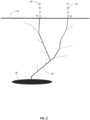
- Fig. 2 illustrates an embodiment where seeps S4 and S5 originate from the same reservoir 18 from fracture 32, which later splits into two main fractures resulting in separate seeps S4 and S5. Isotopic and/or molecular compositions of hydrocarbon streams 26 are expected to be substantially similar for seeps S4 and S5. For ease of discussion, the various elements in Fig. 2 are not to scale.
- a hydrocarbon seep S1, S2, S3, S4, S5 is first found at a seabed location where hydrocarbon is actively flowing out of the seabed 28.
- the hydrocarbon seep S1, S2, S3, S4, S5 may be detected for example, without limitation, by satellite, aircraft or watercraft detection and/or observation of hydrocarbon slicks 22 and/or hydrocarbon streams 26.
- the hydrocarbon seep S1, S2, S3, S4, S5 may also be located by planned or unplanned surveillance by an underwater vehicle.
- At least two temporally spaced molecular compositions of the hydrocarbon seep S1, S2, S3, S4, S5 are determined.
- the molecular compositions are determined for example, without limitation, by gas chromatography-mass spectrometry (GC/MS), GC/GC/MS, and/or liquid chromatography.
- analysis of samples may also be conducted. This may include, for example, without limitation, inductively coupled plasma mass spectrometry (ICP-MS) and ICP-optical emission spectroscopy.
- ICP-MS inductively coupled plasma mass spectrometry
- Gas chemistry analysis may also be conducted and may include isotope ratio-mass spectrometry and GC.
- At least two temporally spaced isotopic compositions of the hydrocarbon seep S1, S2, S3, S4, S5 are determined.
- the isotopic compositions are determined, for example, without limitation, by mass spectroscopy, laser-based spectroscopy, and other methods/apparatus known to those skilled in the art.
- the isotopic compositions are determined, for example, without limitation, by mass spectroscopy, laser-based spectroscopy, and other methods/apparatus known to those skilled in the art.
- the temporally spaced isotopic composition is defined by isotopic compositions of hydrocarbons selected from the group consisting of methane, ethane, propane, butane, and combinations thereof.
- the temporally spaced isotopic composition is defined by isotopic compositions of hydrocarbons, such as, for example, without limitation, methane, ethane, propane, and/or butane, as well as isotopic compositions of non-hydrocarbons, such as, for example, without limitation, carbon dioxide and/or hydrogen sulphide.
- hydrocarbons such as, for example, without limitation, methane, ethane, propane, and/or butane
- non-hydrocarbons such as, for example, without limitation, carbon dioxide and/or hydrogen sulphide.
- the compositions are determined by capturing and/or in-situ probing hydrocarbons from the hydrocarbon streams 26.
- a sample of hydrocarbon stream 26 may be captured isobarically, so that the components of the sample remain unchanged when taken to a testing site, for example at sea level.
- compositions may be determined by underwater mass spectrometers, Raman spectroscopy, isotope probes, and the like.
- Samples may be obtained, for example, by divers, underwater vehicles, including manned and unmanned submersibles, remotely operated underwater vehicles (ROV), autonomous underwater vehicles (AUV), and the like.
- the compositions may be determined without the need for a physical sample, for example, by Raman spectroscopy or isotope probes, known to those skilled in the art.
- Analysis of the samples may be determined in-situ and/or remotely.
- a camera may be used while collecting samples.
- samples of hydrocarbon gas and hydrocarbon oil are taken from the same seep location.
- the gas and oil may be captured in the same sample container or may be independently captured. In the latter case, it may be particularly advantageous to use a camera to determine the volumetric flow rate. In this way, the gas and oil samples may be combined in the correct volumetric ratio for an analysis of the recombined sample.
- the at least two temporally spaced molecular compositions may be determined, for example, by compositions may be determined by samples and/or measurements taken 12 to 24 hours apart. Likewise, the at least two temporally spaced isotopic compositions may be determined, for example, by samples taken 12 to 24 hours apart.
- the objective of temporal spacing is to account for periodicity, especially, for example, tidal forces, to assess whether a composition is at steady state. Accordingly, it is within the scope of the present invention to determine a composition at time to and then determine a composition 1 day or week, for example, later, with or without an offset of 12 hours.
- the at least two temporally spaced molecular, and, preferably isotopic compositions of the hydrocarbon seep are analysed for relative amounts or distribution of certain or all molecular, and, preferably isotopic components.
- more than two temporally spaced molecular, and, preferably isotopic compositions of the hydrocarbon seep are determined and analysed to improve resolution of the compositions.
- Isotopic compositions are particularly useful for identifying the presence of a hydrocarbon accumulation because they are indicative of the thermal maturity of the hydrocarbon accumulation. Furthermore, isotopic compositions are substantially unaffected by diffusivity as the hydrocarbon migrates to the seabed. Accordingly, in a preferred embodiment of the present invention, both molecular and isotopic compositions are determined.
- Oil samples typically will have a strong relationship to the source of reservoired hydrocarbons. Gas samples are more sensitive to how the gas migrated to the seabed from the reservoir.
- a base set of isotopologues and/or compounds are selected for comparing temporal and/or spatial variances between temporally spaced compositions.
- Nonhydrocarbon gases such as hydrogen sulphide and carbon dioxide
- the nonhydrocarbon gases are considered as part of the molecular, and, preferably isotopic composition.
- CO2 is considered as part of the molecular, and, preferably isotopic composition.
- the information about carbon dioxide can provide more insights into the reservoir characteristics.
- the at least two temporally spaced compositions are then compared to determine a temporal variance between the compositions.
- the temporal variance falls within a predetermined temporal tolerance
- the hydrocarbon seep related to the at least two compositions is classified as being indicative of the presence of reservoired hydrocarbons.
- the value of the temporal tolerance will be dependent on a number of factors, including the compound and/or isotope/isotopologue being considered, the time difference between samples, tidal forces, and the like.
- a unique identifier can be assigned to the reservoired hydrocarbons.
- the method involves locating a plurality of hydrocarbon seeps. At least two temporally spaced compositions are determined and when a temporal variance between the at least two temporally spaced compositions falls within a predetermined temporal tolerance, a hydrocarbon seep is classified as being indicative of the presence of reservoired hydrocarbons. A representative composition is then selected for each of the hydrocarbon seeps classified as being indicative of the presence of reservoired hydrocarbons. A spatial variance is determined between the representative compositions. When the spatial variance falls within a predetermined spatial tolerance, the same unique identifier is assigned to the reservoired hydrocarbons. In this way, independent hydrocarbon seeps can be identified as originating from the same or different reservoir.
Landscapes
- Life Sciences & Earth Sciences (AREA)
- Engineering & Computer Science (AREA)
- Chemical & Material Sciences (AREA)
- Geology (AREA)
- Mining & Mineral Resources (AREA)
- Physics & Mathematics (AREA)
- Health & Medical Sciences (AREA)
- Environmental & Geological Engineering (AREA)
- Geochemistry & Mineralogy (AREA)
- General Life Sciences & Earth Sciences (AREA)
- Oil, Petroleum & Natural Gas (AREA)
- Fluid Mechanics (AREA)
- Pathology (AREA)
- General Chemical & Material Sciences (AREA)
- General Physics & Mathematics (AREA)
- Medicinal Chemistry (AREA)
- General Health & Medical Sciences (AREA)
- Biochemistry (AREA)
- Chemical Kinetics & Catalysis (AREA)
- Analytical Chemistry (AREA)
- Immunology (AREA)
- Food Science & Technology (AREA)
- Investigating Or Analysing Materials By Optical Means (AREA)
- Investigating Or Analyzing Non-Biological Materials By The Use Of Chemical Means (AREA)
Claims (11)
- Verfahren zum Bestimmen eines Vorhandenseins von eingelagerten Kohlenwasserstoffen, die eine Kohlenwasserstoffsickerstelle aufweisen, das Verfahren umfassend die Schritte:a) Lokalisieren einer Kohlenwasserstoffsickerstelle (S1, S2, S3, S4, S5) an einer Position eines Meeresbodens (28), wo Kohlenwasserstoff aus dem Meeresboden (28) aktiv ausströmt;dadurch gekennzeichnet, dass das Verfahren ferner umfasst:b) Bestimmen mindestens zweier zeitlich beabstandeter Molekülzusammensetzungen der Kohlenwasserstoffsickerstelle (S1, S2, S3, S4, S5);c) Bestimmen einer zeitlichen Varianz zwischen den mindestens zwei zeitlich beabstandeten Molekülzusammensetzungen;d) wenn die zeitliche Varianz innerhalb einer zuvor bestimmten zeitlichen Toleranz fällt, Klassifizieren des Kohlenwasserstoffsickerstelle (S1, S2, S3, S4, S5) als hinweisend auf das Vorhandensein eines eingelagerten Kohlenwasserstoffs; unde) Zuweisen eines eindeutigen Bezeichners zu den eingelagerten Kohlenwasserstoffen.
- Verfahren nach Anspruch 1, wobei Schritt b) ferner das Bestimmen mindestens zweier zeitlich beabstandeter Isotopenzusammensetzungen der Kohlenwasserstoffsickerstelle (S1, S2, S3, S4, S5) umfasst.
- Verfahren nach Anspruch 2, wobei die mindestens zwei zeitlich beabstandeten Isotopenzusammensetzungen aus der Gruppe ausgewählt sind, bestehend aus Isotopologen von Methan, Ethan, Propan, Butan, Kohlendioxid, Schwefelwasserstoff und Kombinationen davon.
- Verfahren nach Anspruch 1, wobei die mindestens zwei zeitlich beabstandeten Molekülzusammensetzungen Komponenten umfassen, die aus der Gruppe ausgewählt sind, bestehend aus Methan, Ethan, Propan, Butan, Kohlendioxid, Schwefelwasserstoff und Kombinationen davon.
- Verfahren nach Anspruch 1, wobei Schritt b) vor Ort, aus der Ferne oder durch eine Kombination davon bestimmt wird.
- Verfahren nach Anspruch 1, wobei in Schritt a) eine Vielzahl von Kohlenwasserstoffsickerstellen (S1, S2, S3, S4, S5) erkannt werden, und wobei in Schritt b) für jede der Vielzahl von Kohlenwasserstoffsickerstellen (S1, S2, S3, S4, S5) mindestens zwei zeitlich beabstandete Molekülzusammensetzungen bestimmt werden.
- Verfahren nach Anspruch 6, ferner umfassend die Schritte:f) Auswählen einer repräsentativen Molekülzusammensetzung für jede der Vielzahl von Kohlenwasserstoffsickerstellen (S1, S2, S3, S4, S5), die als hinweisend auf das Vorhandensein von eingelagerten Kohlenwasserstoffen klassifiziert sind;g) Bestimmen einer räumlichen Varianz zwischen den repräsentativen Molekülzusammensetzungen; undh) wenn die räumliche Varianz innerhalb einer zuvor bestimmten räumlichen Toleranz fällt, Zuweisen desselben eindeutigen Bezeichners zu den eingelagerten Kohlenwasserstoffen.
- Verfahren zum Bestimmen einer eindeutigen Kohlenwasserstofflagerstätte, die eine Kohlenwasserstoffsickerstelle aufweist, das Verfahren umfassend die Schritte:a) Lokalisieren einer Vielzahl von Kohlenwasserstoffsickerstellen (S1, S2, S3, S4, S5) an der Position eines Meeresbodens (28), wo Kohlenwasserstoff aus dem Meeresboden (28) aktiv ausströmt;dadurch gekennzeichnet, dass das Verfahren ferner umfasst:b) Bestimmen mindestens zweier zeitlich beabstandeter Molekülzusammensetzungen für jede der Vielzahl von Kohlenwasserstoffsickerstellen (S1, S2, S3, S4, S5);c) Bestimmen einer zeitlichen Varianz zwischen den mindestens zwei zeitlich beabstandeten Molekülzusammensetzungen für jede der Vielzahl von Kohlenwasserstoffsickerstellen (S1, S2, S3, S4, S5);d) wenn die zeitliche Varianz für eine beliebige der Vielzahl von Kohlenwasserstoffsickerstellen (S1, S2, S3, S4, S5) innerhalb einer zuvor bestimmten zeitlichen Toleranz fällt, Klassifizieren der Kohlenwasserstoffsickerstelle (S1, S2, S3, S4, S5) als hinweisend auf ein Vorhandensein von eingelagerten Kohlenwasserstoffen;e) Auswählen einer repräsentativen Molekülzusammensetzung für jede der Vielzahl von Kohlenwasserstoffsickerstellen (S1, S2, S3, S4, S5), die als hinweisend auf das Vorhandensein von eingelagerten Kohlenwasserstoffen klassifiziert sind;f) Bestimmen einer räumlichen Varianz zwischen den repräsentativen Molekülzusammensetzungen;g) für die Kohlenwasserstoffsickerstellen (S1, S2, S3, S4, S5), die die räumliche Varianz aufweisen, die innerhalb einer zuvor bestimmten räumlichen Toleranz fällt, Zuweisen eines eindeutigen Bezeichners zu den eingelagerten Kohlenwasserstoffen; undh) für die eine oder die mehreren Kohlenwasserstoffsickerstellen (S1, S2, S3, S4, S5), wobei die räumliche Varianz außerhalb der zuvor bestimmten räumlichen Toleranz fällt, Zuweisen eines oder mehrerer zusätzlicher eindeutiger Bezeichner zu den eingelagerten Kohlenwasserstoffen.
- Verfahren nach Anspruch 8, wobei Schritt b) ferner das Bestimmen mindestens zweier zeitlich beabstandeter Isotopenzusammensetzungen für jede der Vielzahl von Kohlenwasserstoffsickerstellen (S1, S2, S3, S4, S5) umfasst.
- Verfahren nach Anspruch 9, wobei die mindestens zwei zeitlich beabstandeten Isotopenzusammensetzungen aus der Gruppe ausgewählt sind, bestehend aus Isotopologen von Methan, Ethan, Propan, Butan, Kohlendioxid, Schwefelwasserstoff und Kombinationen davon.
- Verfahren nach Anspruch 8, wobei Schritt b) vor Ort, aus der Ferne oder durch eine Kombination davon bestimmt wird.
Applications Claiming Priority (3)
| Application Number | Priority Date | Filing Date | Title |
|---|---|---|---|
| US201962860827P | 2019-06-13 | 2019-06-13 | |
| EP19185139 | 2019-07-09 | ||
| PCT/US2020/037411 WO2020252245A1 (en) | 2019-06-13 | 2020-06-12 | Method for determining presence of reservoired hydrocarbons |
Publications (3)
| Publication Number | Publication Date |
|---|---|
| EP3983832A1 EP3983832A1 (de) | 2022-04-20 |
| EP3983832B1 true EP3983832B1 (de) | 2024-08-14 |
| EP3983832C0 EP3983832C0 (de) | 2024-08-14 |
Family
ID=71950774
Family Applications (1)
| Application Number | Title | Priority Date | Filing Date |
|---|---|---|---|
| EP20751765.7A Active EP3983832B1 (de) | 2019-06-13 | 2020-06-12 | Verfahren zur bestimmung der präsenz von aufgespeicherten kohlenwasserstoffen |
Country Status (7)
| Country | Link |
|---|---|
| US (1) | US20220228481A1 (de) |
| EP (1) | EP3983832B1 (de) |
| BR (1) | BR112021024171A2 (de) |
| CA (1) | CA3142943A1 (de) |
| MX (1) | MX2021015078A (de) |
| MY (1) | MY205780A (de) |
| WO (1) | WO2020252245A1 (de) |
Family Cites Families (12)
| Publication number | Priority date | Publication date | Assignee | Title |
|---|---|---|---|---|
| GB0220798D0 (en) * | 2002-09-06 | 2002-10-16 | Statoil Asa | Identification tool for hydrocarbon zones |
| US20080147326A1 (en) * | 2004-05-14 | 2008-06-19 | Leroy Ellis | Method and system of processing information derived from gas isotope measurements in association with geophysical and other logs from oil and gas drilling operations |
| BR112014007821B1 (pt) | 2011-11-11 | 2021-12-07 | Exxonmobil Upstream Research Company | Método para determinar a localização, tamanho, e composição fluida de um acúmulo de hidrocarboneto abaixo da superfície |
| BR112014007819B1 (pt) | 2011-11-11 | 2021-03-02 | Exxonmobil Upstream Research Company | método para produzir hidrocarbonetos |
| WO2013070304A1 (en) | 2011-11-11 | 2013-05-16 | Exxonmobil Upstream Research Company | Method for determining the presence and location of a subsurface hydrocarbon accumulation and the origin of the associated hydrocarbons |
| WO2016043981A1 (en) * | 2014-09-18 | 2016-03-24 | Exxonmobil Upstream Research Company | Method to enhance exploration, development and production of hydrocarbons using multiply substituted isotopologue geochemistry, basin modeling and molecular kinetics |
| EP3298379A1 (de) * | 2015-05-20 | 2018-03-28 | Saudi Arabian Oil Company | Abtasttechniken zur detektion von kohlenwasserstoffsickerwasser |
| WO2018005522A1 (en) * | 2016-07-01 | 2018-01-04 | Exxonmobil Upstream Research Company | Methods for identifying hydrocarbon reservoirs |
| EP3598875B1 (de) * | 2017-02-28 | 2022-09-07 | ExxonMobil Upstream Research Company | Metallisotopenanwendungen bei der kohlenwasserstoffexploration, -entwicklung und -herstellung |
| JP6853416B2 (ja) * | 2017-05-08 | 2021-03-31 | エクソンモービル アップストリーム リサーチ カンパニー | 同位体痕跡を使用して、炭化水素根源の特徴を決定する方法 |
| US20220205972A1 (en) * | 2019-06-13 | 2022-06-30 | Shell Oil Company | Method for determining presence of reservoired hydrocarbons |
| EP4022306B1 (de) * | 2019-08-29 | 2023-12-27 | ExxonMobil Technology and Engineering Company | Alterungsdifferenzierung von ölen aus der späten kreidezeit und dem tertiär |
-
2020
- 2020-06-12 EP EP20751765.7A patent/EP3983832B1/de active Active
- 2020-06-12 MX MX2021015078A patent/MX2021015078A/es unknown
- 2020-06-12 WO PCT/US2020/037411 patent/WO2020252245A1/en not_active Ceased
- 2020-06-12 MY MYPI2021006738A patent/MY205780A/en unknown
- 2020-06-12 BR BR112021024171A patent/BR112021024171A2/pt unknown
- 2020-06-12 CA CA3142943A patent/CA3142943A1/en active Pending
- 2020-12-06 US US17/611,328 patent/US20220228481A1/en active Pending
Also Published As
| Publication number | Publication date |
|---|---|
| CA3142943A1 (en) | 2020-12-17 |
| MX2021015078A (es) | 2022-01-18 |
| US20220228481A1 (en) | 2022-07-21 |
| WO2020252245A1 (en) | 2020-12-17 |
| MY205780A (en) | 2024-11-12 |
| EP3983832C0 (de) | 2024-08-14 |
| EP3983832A1 (de) | 2022-04-20 |
| BR112021024171A2 (pt) | 2022-01-11 |
Similar Documents
| Publication | Publication Date | Title |
|---|---|---|
| US9612231B2 (en) | Exploration method and system for detection of hydrocarbons | |
| EP3983831B1 (de) | Verfahren zur bestimmung der präsenz von aufgespeicherten kohlenwasserstoffen | |
| EP3983830B1 (de) | Verfahren zum bestimmen der unterirdischen kohlenwasserstofffluideigenschaften von kohlenwasserstoffen in reservoirs | |
| EP3983832B1 (de) | Verfahren zur bestimmung der präsenz von aufgespeicherten kohlenwasserstoffen | |
| Crampin et al. | Application of Advanced Mud Gas Logging for Improved Hydrocarbon Phase Determination in a Highly Depleted Reservoir | |
| Ker et al. | GHASS cruise report | |
| Hardage et al. | Evaluation of deepwater gas-hydrate systems | |
| BR112021024216B1 (pt) | Métodos para determinar uma presença de hidrocarbonetos em reservatório e para determinar um reservatório de hidrocarboneto único | |
| CN102455272A (zh) | 确定流体密度及确定固体骨架密度的方法 | |
| Bernard et al. | Near-surface hydrocarbon seeps as indicators of petroleum charge: The evolution of site selection, sample collection, laboratory analysis, and interpretation | |
| AU2012335022B8 (en) | Exploration method and system for detection of hydrocarbons with an underwater vehicle | |
| Malone et al. | Detection development needs for gas hydrates in sediments | |
| Herringshaw et al. | Stratigraphic reservoir compartmentalization: causes, recognition, and implications for the geological storage of carbon dioxide | |
| Leg | In-Situ Sampling and Characterization of Naturally Occurring Marine Methane Hydrate Using the D/V JOIDES Resolution. | |
| Fleet | Petroleum Geochemistry | |
| Riedel et al. | GAS HYDRATE ON THE CASCADIA MARGIN |
Legal Events
| Date | Code | Title | Description |
|---|---|---|---|
| STAA | Information on the status of an ep patent application or granted ep patent |
Free format text: STATUS: UNKNOWN |
|
| STAA | Information on the status of an ep patent application or granted ep patent |
Free format text: STATUS: THE INTERNATIONAL PUBLICATION HAS BEEN MADE |
|
| PUAI | Public reference made under article 153(3) epc to a published international application that has entered the european phase |
Free format text: ORIGINAL CODE: 0009012 |
|
| STAA | Information on the status of an ep patent application or granted ep patent |
Free format text: STATUS: REQUEST FOR EXAMINATION WAS MADE |
|
| 17P | Request for examination filed |
Effective date: 20211210 |
|
| AK | Designated contracting states |
Kind code of ref document: A1 Designated state(s): AL AT BE BG CH CY CZ DE DK EE ES FI FR GB GR HR HU IE IS IT LI LT LU LV MC MK MT NL NO PL PT RO RS SE SI SK SM TR |
|
| DAV | Request for validation of the european patent (deleted) | ||
| DAX | Request for extension of the european patent (deleted) | ||
| GRAP | Despatch of communication of intention to grant a patent |
Free format text: ORIGINAL CODE: EPIDOSNIGR1 |
|
| STAA | Information on the status of an ep patent application or granted ep patent |
Free format text: STATUS: GRANT OF PATENT IS INTENDED |
|
| INTG | Intention to grant announced |
Effective date: 20240423 |
|
| GRAS | Grant fee paid |
Free format text: ORIGINAL CODE: EPIDOSNIGR3 |
|
| GRAA | (expected) grant |
Free format text: ORIGINAL CODE: 0009210 |
|
| STAA | Information on the status of an ep patent application or granted ep patent |
Free format text: STATUS: THE PATENT HAS BEEN GRANTED |
|
| AK | Designated contracting states |
Kind code of ref document: B1 Designated state(s): AL AT BE BG CH CY CZ DE DK EE ES FI FR GB GR HR HU IE IS IT LI LT LU LV MC MK MT NL NO PL PT RO RS SE SI SK SM TR |
|
| REG | Reference to a national code |
Ref country code: GB Ref legal event code: FG4D |
|
| REG | Reference to a national code |
Ref country code: CH Ref legal event code: EP |
|
| REG | Reference to a national code |
Ref country code: DE Ref legal event code: R096 Ref document number: 602020035800 Country of ref document: DE |
|
| REG | Reference to a national code |
Ref country code: IE Ref legal event code: FG4D |
|
| U01 | Request for unitary effect filed |
Effective date: 20240814 |
|
| U07 | Unitary effect registered |
Designated state(s): AT BE BG DE DK EE FI FR IT LT LU LV MT NL PT SE SI Effective date: 20240821 |
|
| PG25 | Lapsed in a contracting state [announced via postgrant information from national office to epo] |
Ref country code: GR Free format text: LAPSE BECAUSE OF FAILURE TO SUBMIT A TRANSLATION OF THE DESCRIPTION OR TO PAY THE FEE WITHIN THE PRESCRIBED TIME-LIMIT Effective date: 20241115 Ref country code: PL Free format text: LAPSE BECAUSE OF FAILURE TO SUBMIT A TRANSLATION OF THE DESCRIPTION OR TO PAY THE FEE WITHIN THE PRESCRIBED TIME-LIMIT Effective date: 20240814 |
|
| PG25 | Lapsed in a contracting state [announced via postgrant information from national office to epo] |
Ref country code: IS Free format text: LAPSE BECAUSE OF FAILURE TO SUBMIT A TRANSLATION OF THE DESCRIPTION OR TO PAY THE FEE WITHIN THE PRESCRIBED TIME-LIMIT Effective date: 20241214 |
|
| PG25 | Lapsed in a contracting state [announced via postgrant information from national office to epo] |
Ref country code: HR Free format text: LAPSE BECAUSE OF FAILURE TO SUBMIT A TRANSLATION OF THE DESCRIPTION OR TO PAY THE FEE WITHIN THE PRESCRIBED TIME-LIMIT Effective date: 20240814 |
|
| PG25 | Lapsed in a contracting state [announced via postgrant information from national office to epo] |
Ref country code: RS Free format text: LAPSE BECAUSE OF FAILURE TO SUBMIT A TRANSLATION OF THE DESCRIPTION OR TO PAY THE FEE WITHIN THE PRESCRIBED TIME-LIMIT Effective date: 20241114 Ref country code: ES Free format text: LAPSE BECAUSE OF FAILURE TO SUBMIT A TRANSLATION OF THE DESCRIPTION OR TO PAY THE FEE WITHIN THE PRESCRIBED TIME-LIMIT Effective date: 20240814 |
|
| PG25 | Lapsed in a contracting state [announced via postgrant information from national office to epo] |
Ref country code: RS Free format text: LAPSE BECAUSE OF FAILURE TO SUBMIT A TRANSLATION OF THE DESCRIPTION OR TO PAY THE FEE WITHIN THE PRESCRIBED TIME-LIMIT Effective date: 20241114 Ref country code: PL Free format text: LAPSE BECAUSE OF FAILURE TO SUBMIT A TRANSLATION OF THE DESCRIPTION OR TO PAY THE FEE WITHIN THE PRESCRIBED TIME-LIMIT Effective date: 20240814 Ref country code: IS Free format text: LAPSE BECAUSE OF FAILURE TO SUBMIT A TRANSLATION OF THE DESCRIPTION OR TO PAY THE FEE WITHIN THE PRESCRIBED TIME-LIMIT Effective date: 20241214 Ref country code: HR Free format text: LAPSE BECAUSE OF FAILURE TO SUBMIT A TRANSLATION OF THE DESCRIPTION OR TO PAY THE FEE WITHIN THE PRESCRIBED TIME-LIMIT Effective date: 20240814 Ref country code: GR Free format text: LAPSE BECAUSE OF FAILURE TO SUBMIT A TRANSLATION OF THE DESCRIPTION OR TO PAY THE FEE WITHIN THE PRESCRIBED TIME-LIMIT Effective date: 20241115 Ref country code: ES Free format text: LAPSE BECAUSE OF FAILURE TO SUBMIT A TRANSLATION OF THE DESCRIPTION OR TO PAY THE FEE WITHIN THE PRESCRIBED TIME-LIMIT Effective date: 20240814 |
|
| PG25 | Lapsed in a contracting state [announced via postgrant information from national office to epo] |
Ref country code: SM Free format text: LAPSE BECAUSE OF FAILURE TO SUBMIT A TRANSLATION OF THE DESCRIPTION OR TO PAY THE FEE WITHIN THE PRESCRIBED TIME-LIMIT Effective date: 20240814 |
|
| PG25 | Lapsed in a contracting state [announced via postgrant information from national office to epo] |
Ref country code: CZ Free format text: LAPSE BECAUSE OF FAILURE TO SUBMIT A TRANSLATION OF THE DESCRIPTION OR TO PAY THE FEE WITHIN THE PRESCRIBED TIME-LIMIT Effective date: 20240814 |
|
| PG25 | Lapsed in a contracting state [announced via postgrant information from national office to epo] |
Ref country code: SK Free format text: LAPSE BECAUSE OF FAILURE TO SUBMIT A TRANSLATION OF THE DESCRIPTION OR TO PAY THE FEE WITHIN THE PRESCRIBED TIME-LIMIT Effective date: 20240814 |
|
| U20 | Renewal fee for the european patent with unitary effect paid |
Year of fee payment: 6 Effective date: 20250509 |
|
| PLBE | No opposition filed within time limit |
Free format text: ORIGINAL CODE: 0009261 |
|
| STAA | Information on the status of an ep patent application or granted ep patent |
Free format text: STATUS: NO OPPOSITION FILED WITHIN TIME LIMIT |
|
| PGFP | Annual fee paid to national office [announced via postgrant information from national office to epo] |
Ref country code: GB Payment date: 20250401 Year of fee payment: 6 |
|
| PGFP | Annual fee paid to national office [announced via postgrant information from national office to epo] |
Ref country code: NO Payment date: 20250610 Year of fee payment: 6 |
|
| 26N | No opposition filed |
Effective date: 20250515 |
|
| REG | Reference to a national code |
Ref country code: CH Ref legal event code: H13 Free format text: ST27 STATUS EVENT CODE: U-0-0-H10-H13 (AS PROVIDED BY THE NATIONAL OFFICE) Effective date: 20260127 |
|
| PG25 | Lapsed in a contracting state [announced via postgrant information from national office to epo] |
Ref country code: MC Free format text: LAPSE BECAUSE OF FAILURE TO SUBMIT A TRANSLATION OF THE DESCRIPTION OR TO PAY THE FEE WITHIN THE PRESCRIBED TIME-LIMIT Effective date: 20240814 |
|
| PG25 | Lapsed in a contracting state [announced via postgrant information from national office to epo] |
Ref country code: IE Free format text: LAPSE BECAUSE OF NON-PAYMENT OF DUE FEES Effective date: 20250612 |
|
| PG25 | Lapsed in a contracting state [announced via postgrant information from national office to epo] |
Ref country code: RO Free format text: LAPSE BECAUSE OF FAILURE TO SUBMIT A TRANSLATION OF THE DESCRIPTION OR TO PAY THE FEE WITHIN THE PRESCRIBED TIME-LIMIT Effective date: 20240814 |
|
| PG25 | Lapsed in a contracting state [announced via postgrant information from national office to epo] |
Ref country code: CH Free format text: LAPSE BECAUSE OF NON-PAYMENT OF DUE FEES Effective date: 20250630 |