EP3986060B1 - Station de base, procédé, programme et support d'enregistrement - Google Patents
Station de base, procédé, programme et support d'enregistrement Download PDFInfo
- Publication number
- EP3986060B1 EP3986060B1 EP20850269.0A EP20850269A EP3986060B1 EP 3986060 B1 EP3986060 B1 EP 3986060B1 EP 20850269 A EP20850269 A EP 20850269A EP 3986060 B1 EP3986060 B1 EP 3986060B1
- Authority
- EP
- European Patent Office
- Prior art keywords
- terminal apparatus
- base station
- radio resource
- time length
- hopping pattern
- Prior art date
- Legal status (The legal status is an assumption and is not a legal conclusion. Google has not performed a legal analysis and makes no representation as to the accuracy of the status listed.)
- Active
Links
Images




Classifications
-
- H—ELECTRICITY
- H04—ELECTRIC COMMUNICATION TECHNIQUE
- H04L—TRANSMISSION OF DIGITAL INFORMATION, e.g. TELEGRAPHIC COMMUNICATION
- H04L5/00—Arrangements affording multiple use of the transmission path
- H04L5/0001—Arrangements for dividing the transmission path
- H04L5/0003—Two-dimensional division
- H04L5/0005—Time-frequency
- H04L5/0007—Time-frequency the frequencies being orthogonal, e.g. OFDM(A) or DMT
- H04L5/0012—Hopping in multicarrier systems
-
- H—ELECTRICITY
- H04—ELECTRIC COMMUNICATION TECHNIQUE
- H04B—TRANSMISSION
- H04B1/00—Details of transmission systems, not covered by a single one of groups H04B3/00 - H04B13/00; Details of transmission systems not characterised by the medium used for transmission
- H04B1/69—Spread spectrum techniques
- H04B1/713—Spread spectrum techniques using frequency hopping
- H04B1/715—Interference-related aspects
-
- H—ELECTRICITY
- H04—ELECTRIC COMMUNICATION TECHNIQUE
- H04L—TRANSMISSION OF DIGITAL INFORMATION, e.g. TELEGRAPHIC COMMUNICATION
- H04L5/00—Arrangements affording multiple use of the transmission path
- H04L5/003—Arrangements for allocating sub-channels of the transmission path
- H04L5/0037—Inter-user or inter-terminal allocation
-
- H—ELECTRICITY
- H04—ELECTRIC COMMUNICATION TECHNIQUE
- H04B—TRANSMISSION
- H04B1/00—Details of transmission systems, not covered by a single one of groups H04B3/00 - H04B13/00; Details of transmission systems not characterised by the medium used for transmission
- H04B1/69—Spread spectrum techniques
- H04B1/713—Spread spectrum techniques using frequency hopping
- H04B1/715—Interference-related aspects
- H04B2001/7154—Interference-related aspects with means for preventing interference
-
- H—ELECTRICITY
- H04—ELECTRIC COMMUNICATION TECHNIQUE
- H04L—TRANSMISSION OF DIGITAL INFORMATION, e.g. TELEGRAPHIC COMMUNICATION
- H04L5/00—Arrangements affording multiple use of the transmission path
- H04L5/0001—Arrangements for dividing the transmission path
- H04L5/0003—Two-dimensional division
- H04L5/0005—Time-frequency
-
- H—ELECTRICITY
- H04—ELECTRIC COMMUNICATION TECHNIQUE
- H04W—WIRELESS COMMUNICATION NETWORKS
- H04W72/00—Local resource management
- H04W72/04—Wireless resource allocation
- H04W72/044—Wireless resource allocation based on the type of the allocated resource
- H04W72/0453—Resources in frequency domain, e.g. a carrier in FDMA
-
- H—ELECTRICITY
- H04—ELECTRIC COMMUNICATION TECHNIQUE
- H04W—WIRELESS COMMUNICATION NETWORKS
- H04W72/00—Local resource management
- H04W72/20—Control channels or signalling for resource management
- H04W72/27—Control channels or signalling for resource management between access points
-
- H—ELECTRICITY
- H04—ELECTRIC COMMUNICATION TECHNIQUE
- H04W—WIRELESS COMMUNICATION NETWORKS
- H04W92/00—Interfaces specially adapted for wireless communication networks
- H04W92/16—Interfaces between hierarchically similar devices
- H04W92/20—Interfaces between hierarchically similar devices between access points
Definitions
- the present invention relates to a base station, a method, and a program.
- frequency hopping is used in order to achieve frequency diversity.
- Physical Uplink Shared Channel (PUSCH) frequency hopping is performed as frequency hopping of an uplink.
- the PUSCH frequency hopping is inter-slot frequency hopping within a subframe (Intra-subframe).
- UE User Equipment
- NR defines a Configured Grant (CG) for periodically (periodicity) allocating at least a part of radio resources for a specific terminal apparatus (for example, see NPL 1).
- CG Configured Grant
- NPL 1 3GPP TS 38.300 V15.6.0 (2019/06 )
- EP 2 988 561 A1 discusses an information transmission method, a base station, user equipment, and a system, which relate to the field of information transmission.
- the method includes: determining a characteristic parameter of user equipment; determining, according to a correspondence between a characteristic parameter and a resource configuration, a resource configuration corresponding to the characteristic parameter of the user equipment, and using the resource configuration corresponding to the characteristic parameter of the user equipment as a first resource configuration, where the first resource configuration includes one or more types of the following sub-configurations: a spreading resource configuration, a random access preamble format configuration, a narrowband resource configuration, and a frequency hopping pattern configuration; and determining a resource according to the first resource configuration, and performing information transmission with the user equipment by using the resource.
- a first resource configuration corresponding to a characteristic parameter of user equipment is determined according to a correspondence between a characteristic parameter and a resource configuration, and information transmission is performed by using a resource determined by using the first resource configuration.
- NR New Radio
- time lengths of radio resources such as slots are different between terminal apparatuses (for example, UEs).
- terminal apparatuses for example, UEs.
- complicated operation may be required in order to have frequency hopping patterns for each of the terminal apparatuses cooperate with each other.
- the radio resources and the frequency hopping pattern allocated to a first terminal apparatus by a first base station may be the same as the radio resources and the frequency hopping pattern allocated to a second terminal apparatus by a second base station. In such a case, even when frequency hopping is performed, interference from the second terminal apparatus in the first base station may continuously occur for the entire period of the allocated radio resources.
- the present invention provides a first base station, an associated method, and an associated program as defined in the appended independent claims.
- Optional features are defined in the appended dependent claims.
- a first base station includes: a first communication processing unit configured to communicate with a first terminal apparatus; and a second communication processing unit configured to receive, from a second base station communicating with a second terminal apparatus, radio resource time length information for specifying time length of a radio resource for the second terminal apparatus, and hopping pattern information for specifying a frequency hopping pattern for the second terminal apparatus, wherein the first communication processing unit is configured to determine a frequency hopping pattern for the first terminal apparatus based on the radio resource time length information and the hopping pattern information, and communicate with the first terminal apparatus in accordance with the determined frequency hopping pattern.
- a method used in a first base station includes: communicating with a first terminal apparatus; and receiving, from a second base station communicating with a second terminal apparatus, radio resource time length information for specifying a time length of a radio resource for the second terminal apparatus, and hopping pattern information for specifying a frequency hopping pattern for the second terminal apparatus, wherein the communicating with the first terminal apparatus includes determining a frequency hopping pattern for the first terminal apparatus, based on the radio resource time length information and the hopping pattern information, and communicating with the first terminal apparatus in accordance with the determined frequency hopping pattern.
- a program is a program that causes a processor in a first base station to execute: communicating with a first terminal apparatus; and receiving, from a second base station communicating with a second terminal apparatus, radio resource time length information for specifying a time length of a radio resource for the second terminal apparatus, and hopping pattern information for specifying a frequency hopping pattern for the second terminal apparatus, wherein the communicating with the first terminal apparatus includes determining a frequency hopping pattern for the first terminal apparatus, based on the radio resource time length information and the hopping pattern information, and communicating with the first terminal apparatus in accordance with the determined frequency hopping pattern.
- a recording medium is a non-transitory computer readable recording medium storing a program that causes a processor in a first base station to execute: communicating with a first terminal apparatus; and receiving, from a second base station communicating with a second terminal apparatus, radio resource time length information for specifying a time length of a radio resource for the second terminal apparatus, and hopping pattern information for specifying a frequency hopping pattern for the second terminal apparatus, wherein the communicating with the first terminal apparatus includes determining a frequency hopping pattern for the first terminal apparatus, based on the radio resource time length information and the hopping pattern information, and communicating with the first terminal apparatus in accordance with the determined frequency hopping pattern.
- communication of a radio access network can be improved in an environment in which it may be assumed that time lengths of radio resources are different between terminal apparatuses. Note that, according to the present invention, instead of or together with the above effects, other effects may be exerted.
- frequency hopping is used in order to achieve frequency diversity.
- Physical Uplink Shared Channel (PUSCH) frequency hopping is performed as frequency hopping of an uplink.
- the PUSCH frequency hopping is inter-slot frequency hopping within a subframe (Intra-subframe).
- UE User Equipment
- NR defines a Configured Grant (CG) for periodically (periodicity) allocating at least a part of radio resources for a specific terminal apparatus.
- CG Configured Grant
- NR defines a CG of type 1 and a CG of type 2.
- RRC Radio Resource Control
- the base station uses Radio Resource Control (RRC) to directly indicate a period of allocating uplink radio resources for a specific terminal apparatus.
- RRC Radio Resource Control
- the base station uses Radio Resource Control (RRC) to define a period of allocating uplink radio resources for a specific terminal apparatus
- the base station uses an address-designated Physical Downlink Control CHannel (PDCCH) for the terminal apparatus to activate or deactivate permission (Grant) of resource allocation.
- PDCCH Physical Downlink Control CHannel
- NR New Radio
- one subframe is 1 ms, and in principle corresponds to a Transmission Time Interval (TTI) as well.
- TTI Transmission Time Interval
- one slot is 0.5 ms (in other words, two slots correspond to one subframe.)
- the number of Orthogonal Frequency Division Multiplexing (OFDM) symbols in one subframe is 14 in a case of a Normal Cyclic Prefix (CP).
- CP Normal Cyclic Prefix
- SCS subcarrier spacing
- one subframe is 1 ms, and the number of OFDM symbols in one slot is 14.
- a subcarrier spacing (SCS) is 15 kHz, 30 kHz, 60 kHz, or 120 kHz.
- the subcarrier spacing (SCS) varies, and thus the time length of one slot varies according to the subcarrier spacing (SCS).
- (one or more than one) possible value of the subcarrier spacing (SCS) is determined for each Frequency band.
- the time length of one slot may vary for each Frequency band as well.
- terminal apparatuses possibly assumed to have different time lengths of radio resources, such as the time lengths of slot as described above, may coexist, and thus complicated operation may be required in order to have frequency hopping patterns for each of the terminal apparatuses cooperate with each other.
- the radio resources and the frequency hopping pattern allocated to a first terminal apparatus by a first base station may be the same as the radio resources and the frequency hopping pattern allocated to a second terminal apparatus by a second base station. In such a case, even when frequency hopping is performed, interference from the second terminal apparatus in the first base station may continuously occur for the entire period of the allocated radio resources.
- the radio resources and the frequency hopping pattern allocated to the first terminal apparatus by the first base station may be the same as the radio resources and the frequency hopping pattern allocated to the second terminal apparatus by the second base station. In such a case, even when frequency hopping is performed, interference from the second terminal apparatus in the first base station may continuously occur for the entire period of the allocated radio resources.
- One example object of the present example embodiment is to enable improvement of communication of a radio access network in an environment in which it may be assumed that time lengths of radio resources are different between terminal apparatuses.
- a first base station receives, from a second base station communicating with a second terminal apparatus, radio resource time length information for specifying a time length of a radio resource for the second terminal apparatus, and hopping pattern information for specifying a frequency hopping pattern for the second terminal apparatus. Then, the first base station determines a frequency hopping pattern for a first terminal apparatus with which the first base station communicates, based on the radio resource time length information and the hopping pattern information, and communicates with the first terminal apparatus in accordance with the determined frequency hopping pattern.
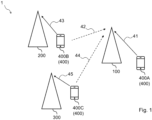
- Fig. 1 is an explanatory diagram illustrating an example of a schematic configuration of the system 1 according to the first example.
- the system 1 includes a base station 100, a base station 200, a base station 300, and a terminal apparatus 400.
- Fig. 1 illustrates three terminal apparatuses 400 (i.e., a terminal apparatus 400A, a terminal apparatus 400B, and a terminal apparatus 400C).
- the system 1 may include four or more terminal apparatuses 400, or may include only one or two terminal apparatuses 400.
- the system 1 is, for example, a system conforming to standards/specifications of Third Generation Partnership Project (3GPP). More specifically, for example, the system 1 may be a system conforming to standards/specifications of LTE/LTE-Advanced. Alternatively, the system 1 may be a system conforming to standards/specifications of the fifth generation (5G)/New Radio (NR). The system 1 is, of course, not limited to these examples.
- 3GPP Third Generation Partnership Project
- the system 1 may be a system conforming to standards/specifications of LTE/LTE-Advanced.
- the system 1 may be a system conforming to standards/specifications of the fifth generation (5G)/New Radio (NR).
- 5G fifth generation
- NR New Radio
- Base Station 100 Base Station 100, Base Station 200, and Base Station 300
- the base station 100 is a node of a radio access network (RAN), and performs radio communication with a terminal apparatus (for example, the terminal apparatus 400) located in a coverage area.
- the RAN may be an E-UTRAN of LTE, or may be a Next Generation RAN (NG-RAN) of 5GNR.
- NG-RAN Next Generation RAN
- the base station 100 may be an evolved Node B (eNB) or a gNB in 5G NR.
- the base station 100 may include a plurality of units (or a plurality of nodes).
- the plurality of units (or the plurality of nodes) may include a first unit (or a first node) configured to perform higher protocol layer processing and a second unit (or a second node) configured to perform lower protocol layer processing.
- the first unit may be referred to as a center/central unit (CU)
- the second unit may be referred to as a distributed unit (DU) or an access unit (AU).
- CU center/central unit
- DU distributed unit
- AU access unit
- the first unit may be referred to as a digital unit (DU), and the second unit may be referred to as a radio unit (RU) or a remote unit (RU).
- the digital unit (DU) may be a base band unit (BBU), and the RU may be a remote radio head (RRH) or a remote radio unit (RRU).
- BBU base band unit
- RRH remote radio head
- RRU remote radio unit
- the terms for the first unit (or the first node) and the second unit (or the second node) are, of course, not limited to these examples.
- the base station 100 may be a single unit (or a single node).
- the base station 100 may be one of the plurality of units (e.g., either one of the first unit and the second unit) or may be connected to another unit of the plurality of units (e.g., the other one of the first unit and the second unit).
- EPC EPC of LTE
- the eNB of LTE (E-UTRA) connected to a 5G core network (5GC) is also referred to as a ng-eNB, and this is included in the NG-RAN.
- 5GC 5G core network
- Description of the base station 200 and the base station 300 is also similar to description of the base station 100. Thus, overlapping description will be omitted herein.
- each of the base station 200 and the base station 300 may be a base station of a type the same as that of the base station 100, or may be a base station of a type different from that of the base station 100.
- the base station 100 may be an eNB and the base station 200 (or the base station 300) may also be an eNB, or the base station 100 may be a gNB and the base station 200 (or the base station 300) may also be a gNB.
- the base station 100 may be one of an eNB and a gNB, and the base station 200 (or the base station 300) may be the other of the eNB and the gNB.
- the base station 300 may be a base station of a type the same as that of the base station 200, or may be a base station of a type different from that of the base station 200.
- Each of the base station 100, the base station 200, and the base station 300 may be the second unit and may be connected to the same first unit.
- the terminal apparatus 400 (wirelessly) communicates with a base station. For example, when the terminal apparatus 400 is located within a coverage area of a base station, the terminal apparatus 400 communicates with the base station.
- the terminal apparatus 400A is connected to the base station 100 and communicates with the base station 100
- the terminal apparatus 400B is connected to the base station 200 and communicates with the base station 200
- the terminal apparatus 400C is connected to the base station 300 and communicates with the base station 300.
- each terminal apparatus 400 is a UE.
- the base station 100, the base station 200, and the base station 300 may allocate the same radio resources (the same time frequency resources) to each of the terminal apparatus 400A, the terminal apparatus 400B, and the terminal apparatus 400C. In this case, interference may occur.
- the terminal apparatus 400A transmits a signal 41 to the base station 100
- the terminal apparatus 400B transmits a signal 43 to the base station 200
- the terminal apparatus 400C transmits a signal 45 to the base station 200.
- These signal 41, signal 43, and signal 45 are desired signals in the base station 100, the base station 200, and the base station 300, respectively.
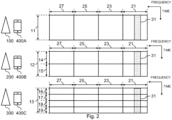
- Fig. 2 is an explanatory diagram for illustrating an example of uplink radio resources (PUSCH resources) being allocated to the terminal apparatuses by the base stations.
- PUSCH resources uplink radio resources
- time frequency resources in subframes 11, 12, and 13 are illustrated.
- the subframe 11 includes one slot.
- the subframe 12 includes a first slot 14 and a second slot 15.
- the subframe 13 includes a first slot 16, a second slot 17, a third slot 18, and a fourth slot 19.
- the reason why a different slot length is configured for each of the base stations 100, 200, and 300 is that the base stations 100, 200, and 300 configure subcarrier spacings (SCS) different from each other.
- the terminal apparatuses 400A, 400B, and 400C having slot lengths different from each other coexist.
- each of the base stations 100, 200, and 300 may configure the subcarrier spacing SCS for each cell.
- the base station 100, the base station 200, and the base station 300 allocate a radio resource 31 to the terminal apparatus 400A, the terminal apparatus 400B, and the terminal apparatus 400C, respectively.
- the radio resource 31 is located for over a part of the subband 21 in the frequency direction and over the subband 21 in the time direction.
- the terminal apparatus 400B is located near a boundary between the coverage of the base station 200 and the coverage of the base station 100, and thus the signal 42 from the terminal apparatus 400B (the same signal as the signal 43) reaches the base station 100.
- the signal 42 may be an interference signal in the base station 100.
- the terminal apparatus 400C is located near a boundary between the coverage of the base station 300 and the coverage of the base station 100, and thus the signal 44 from the terminal apparatus 400C (the same signal as the signal 45) reaches the base station 100.
- the signal 41 may be an interference signal in the base station 100.
- NR defines a CG of type 1 and a CG of type 2.
- the base station uses Radio Resource Control (RRC) to directly indicate a period of allocating uplink radio resources for a specific terminal apparatus.
- RRC Radio Resource Control
- the base station uses Radio Resource Control (RRC) to define a period of allocating uplink radio resources for a specific terminal apparatus, whereas the base station uses an address-designated Physical Downlink Control CHannel (PDCCH) for the terminal apparatus to activate or deactivate permission (Grant) of resource allocation.
- RRC Radio Resource Control
- PDCCH Physical Downlink Control CHannel
- the terminal apparatus 400A, the terminal apparatus 400B, and the terminal apparatus 400C use frequency hopping.
- the pattern of frequency hopping of the terminal apparatus 400A is the same as the patterns of frequency hopping of the terminal apparatus 400B and the terminal apparatus 400C, interference in the base station 100 is not reduced.
- the pattern of frequency hopping of the terminal apparatus 400A is different from the patterns of frequency hopping of the terminal apparatus 400B and the terminal apparatus 400C, interference in the base station 100 may be reduced.
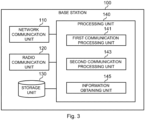
- Fig. 3 is a block diagram illustrating an example of a schematic configuration of the base station 100 according to the first example embodiment.
- the base station 100 includes a network communication unit 110, a radio communication unit 120, a storage unit 130, and a processing unit 140.
- the network communication unit 110 receives a signal from a network, and transmits a signal to a network.
- the radio communication unit 120 wirelessly transmits and receives a signal.
- the radio communication unit 120 receives a signal from the terminal apparatus, and transmits a signal to the terminal apparatus.
- the storage unit 130 temporarily or permanently stores programs (instructions) and parameters for operations of the base station 100 as well as various data.
- the program includes one or more instructions for operations of the base station 100.
- the processing unit 140 provides various functions of the base station 100.
- the processing unit 140 includes a first communication processing unit 141, a second communication processing unit 143, and an information obtaining unit 145.
- the processing unit 140 may further include another constituent element different from these constituent elements. In other words, the processing unit 140 may also perform operations other than the operations of these constituent elements. Specific operations of the first communication processing unit 141, the second communication processing unit 143, and the information obtaining unit 145 will be described later in detail.
- the processing unit 140 (first communication processing unit 141) communicates with another network node (for example, the base station 200 or the base station 300) via the network communication unit 110.
- the processing unit 140 (second communication processing unit 143) communicates with the terminal apparatus (for example, the terminal apparatus 400A) via the radio communication unit 120.
- the network communication unit 110 may be implemented with a network adapter and/or a network interface card, and the like.
- the radio communication unit 120 may be implemented with an antenna, a radio frequency (RF) circuit, and the like, and the antenna may be a directional antenna.
- the storage unit 130 may be implemented with a memory (e.g., a nonvolatile memory and/or a volatile memory) and/or a hard disk, and the like.
- the processing unit 140 may be implemented with one or more processors, such as a baseband (BB) processor and/or a different kind of processor.
- the first communication processing unit 141, the second communication processing unit 143, and the information obtaining unit 145 may be implemented with the same processor or may be implemented with separate processors.
- the memory (storage unit 130) may be included in the one or more processors or may be provided outside the one or more processors.
- the base station 100 may include a memory configured to store a program (instructions) and one or more processors that can execute the program (instructions).
- the one or more processors may execute the program and thereby perform operations of the processing unit 140 (operations of the first communication processing unit 141, the second communication processing unit 143, and/or the information obtaining unit 145).
- the program may be a program for causing the processor(s) to execute the operations of the processing unit 140 (operations of the first communication processing unit 141, the second communication processing unit 143, and/or the information obtaining unit 145).
- the base station 100 may be virtual.
- the base station 100 may be implemented as a virtual machine.
- the base station 100 (the virtual machine) may operate as a physical machine (hardware) including a processor, a memory, and the like, and a virtual machine on a hypervisor.
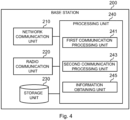
- Fig. 4 is a block diagram illustrating an example of a schematic configuration of the base station 200 according to the first example.
- the base station 200 includes a network communication unit 210, a radio communication unit 220, a storage unit 230, and a processing unit 240.
- the network communication unit 210 receives a signal from a network, and transmits a signal to a network.
- the radio communication unit 220 wirelessly transmits and receives a signal.
- the radio communication unit 220 receives a signal from the terminal apparatus, and transmits a signal to the terminal apparatus.
- the storage unit 230 temporarily or permanently stores programs (instructions) and parameters for operations of the base station 200 as well as various data.
- the program includes one or more instructions for operations of the base station 200.
- the processing unit 240 provides various functions of the base station 200.
- the processing unit 240 includes a first communication processing unit 241, a second communication processing unit 243, and an information obtaining unit 245.
- the processing unit 240 may further include another constituent element different from these constituent elements. In other words, the processing unit 240 may also perform operations other than the operations of these constituent elements. Specific operations of the first communication processing unit 241, the second communication processing unit 243, and the information obtaining unit 245 will be described later in detail.
- the processing unit 240 (first communication processing unit 241) communicates with another network node (for example, the base station 100 or the base station 300) via the network communication unit 210.
- the processing unit 240 (second communication processing unit 243) communicates with the terminal apparatus (for example, the terminal apparatus 400B) via the radio communication unit 220.
- the network communication unit 210 may be implemented with a network adapter and/or a network interface card, and the like.
- the radio communication unit 220 may be implemented with an antenna, a radio frequency (RF) circuit, and the like, and the antenna may be a directional antenna.
- the storage unit 230 may be implemented with a memory (e.g., a nonvolatile memory and/or a volatile memory) and/or a hard disk, and the like.
- the processing unit 240 may be implemented with one or more processors, such as a baseband (BB) processor and/or a different kind of processor.
- the first communication processing unit 241, the second communication processing unit 243, and the information obtaining unit 245 may be implemented with the same processor or may be implemented with separate processors.
- the memory (storage unit 230) may be included in the one or more processors or may be provided outside the one or more processors.
- the base station 200 may include a memory configured to store a program (instructions) and one or more processors that can execute the program (instructions).
- the one or more processors may execute the program and thereby perform operations of the processing unit 240 (operations of the first communication processing unit 241, the second communication processing unit 243, and/or the information obtaining unit 245).
- the program may be a program for causing the processor(s) to execute the operations of the processing unit 240 (operations of the first communication processing unit 241, the second communication processing unit 243, and/or the information obtaining unit 245).
- the base station 200 may be virtual.
- the base station 200 may be implemented as a virtual machine.
- the base station 200 (the virtual machine) may operate as a physical machine (hardware) including a processor, a memory, and the like, and a virtual machine on a hypervisor.
- Fig. 5 is a block diagram illustrating an example of a schematic configuration of the base station 300 according to the first example embodiment.
- the base station 300 includes a network communication unit 310, a radio communication unit 320, a storage unit 330, and a processing unit 340.
- the network communication unit 310 receives a signal from a network, and transmits a signal to a network.
- the radio communication unit 320 wirelessly transmits and receives a signal.
- the radio communication unit 320 receives a signal from the terminal apparatus, and transmits a signal to the terminal apparatus.
- the storage unit 330 temporarily or permanently stores programs (instructions) and parameters for operations of the base station 300 as well as various data.
- the program includes one or more instructions for operations of the base station 300.
- the processing unit 340 provides various functions of the base station 300.
- the processing unit 340 includes a first communication processing unit 341, a second communication processing unit 343, and an information obtaining unit 345.
- the processing unit 340 may further include another constituent element different from these constituent elements. In other words, the processing unit 340 may also perform operations other than the operations of these constituent elements. Specific operations of the first communication processing unit 341, the second communication processing unit 343, and the information obtaining unit 345 will be described later in detail.
- the processing unit 340 (first communication processing unit 341) communicates with another network node (for example, the base station 100 or the base station 200) via the network communication unit 310.
- the processing unit 340 (second communication processing unit 343) communicates with the terminal apparatus (for example, the terminal apparatus 400C) via the radio communication unit 320.
- the network communication unit 310 may be implemented with a network adapter and/or a network interface card, and the like.
- the radio communication unit 320 may be implemented with an antenna, a radio frequency (RF) circuit, and the like, and the antenna may be a directional antenna.
- the storage unit 330 may be implemented with a memory (e.g., a nonvolatile memory and/or a volatile memory) and/or a hard disk, and the like.
- the processing unit 340 may be implemented with one or more processors, such as a baseband (BB) processor and/or a different kind of processor.
- the first communication processing unit 341, the second communication processing unit 343, and the information obtaining unit 345 may be implemented with the same processor or may be implemented with separate processors.
- the memory (storage unit 330) may be included in the one or more processors or may be provided outside the one or more processors.
- the base station 300 may include a memory configured to store a program (instructions) and one or more processors that can execute the program (instructions).
- the one or more processors may execute the program and thereby perform operations of the processing unit 340 (operations of the first communication processing unit 341, the second communication processing unit 343, and/or the information obtaining unit 345).
- the program may be a program for causing the processor(s) to execute the operations of the processing unit 340 (operations of the first communication processing unit 341, the second communication processing unit 343, and/or the information obtaining unit 345).
- the base station 300 may be virtual.
- the base station 300 may be implemented as a virtual machine.
- the base station 300 (the virtual machine) may operate as a physical machine (hardware) including a processor, a memory, and the like, and a virtual machine on a hypervisor.
- the base station 100 (first communication processing unit 141) communicates with a first terminal apparatus (for example, the terminal apparatus 400A).
- the base station 100 (second communication processing unit 143) receives, from a second base station (for example, the base station 200, 300) communicating with a second terminal apparatus (for example, the terminal apparatus 400B, 400C), radio resource time length information for specifying a time length of a radio resource for the second terminal apparatus, and hopping pattern information for specifying a frequency hopping pattern for the second terminal apparatus.
- the base station 100 (first communication processing unit 141) determines the frequency hopping pattern for the first terminal apparatus, based on the radio resource time length information and the hopping pattern information, and communicates with the first terminal apparatus in accordance with the determined frequency hopping pattern.
- the second base station (for example, the base station 200, 300) accommodates a plurality of cells, for example, and configures the radio resources for the second terminal apparatus (for example, the terminal apparatus 400B, 400C) existing in each of the cells. Then, the second base station (for example, the base station 200, 300) individually configures the hopping pattern for each second terminal apparatuses (for example, the terminal apparatus 400B, 400C).
- the first terminal apparatus is a terminal apparatus to which the Configured Grant (CG) for periodically (periodicity) allocating at least a part of radio resources for a specific terminal apparatus is applied.
- the second terminal apparatus and the third terminal apparatus are each a terminal apparatus to which the CG is applied.
- the frequency hopping is frequency hopping of the uplink.
- the frequency hopping is frequency hopping of the PUSCH.
- the frequency hopping is inter-slot frequency hopping within a subframe.
- the hopping pattern control information is information for specifying one out of a list of a plurality of frequency hopping patterns as the pattern of the frequency hopping for the second terminal apparatus (for example, the terminal apparatus 400B, 400C).
- the hopping pattern control information may be information corresponding to a frequency offset of second hopping of the pattern of the frequency hopping.
- the information related to the list of the plurality of hopping patterns may be, for example, information that is notified to the first terminal apparatus using an RRC message.
- the hopping pattern control information may be, for example, included in a Frequency domain resource assignment field in Downlink Control Information.
- the hopping pattern control information may indicate "without frequency hopping" as the pattern of the frequency hopping for the second terminal apparatus.
- the hopping pattern information may be information indicating the pattern of the frequency hopping for the second terminal apparatus.
- the radio resource time length information is information for specifying the time length of the radio resource for the second terminal apparatus (for example, the terminal apparatus 400B, 400C) from a plurality of candidate time lengths.
- the radio resource time length information is information for specifying the time length of a slot for the second terminal apparatus (for example, the terminal apparatus 400B, 400C). Take the example illustrated in Fig. 2 .
- the radio resource time length information is information for specifying that the time length of a slot is a time length corresponding to 1/2 of the subframe 12.
- the radio resource time length information is information for specifying that the time length of a slot is a time length corresponding to 1/4 of the subframe 13.
- the radio resource time length information may be information corresponding to a configuration of the subcarrier spacing (subcarrier spacing configuration).
- the time length of the slot can be specified.
- the radio resource time length information may be information corresponding to a configuration of the subcarrier spacing (subcarrier spacing configuration) within the cell.
- the radio resource time length information may be one set including a combination of pieces of information corresponding to configurations of the subcarrier spacings (subcarrier spacing configurations) of each cell.
- the radio resource time length information is not limited to the examples described above, and may be, for example, information for specifying the time length of a subframe for the second terminal apparatus (for example, the terminal apparatus 400B, 400C).
- the base station 100 obtains information indicating the time length of the radio resource for the first terminal apparatus (for example, the terminal apparatus 400A). Take the example illustrated in Fig. 2 .
- the information indicating the time length of the radio resource for the terminal apparatus 400A is information indicating that it is the time length corresponding to the subframe 11.
- the base station 100 determines the frequency hopping pattern for the first terminal apparatus (for example, the terminal apparatus 400A), based on whether or not the time length of the radio resource for the first terminal apparatus (for example, the terminal apparatus 400A) is equal to the time length of the radio resource for the second terminal apparatus (for example, the terminal apparatus 400B, 400C) specified by the radio resource time length information.
- the base station 100 may determine, as the frequency hopping pattern for the first terminal apparatus (for example, the terminal apparatus 400A), a frequency hopping pattern different from the frequency hopping pattern for the second terminal apparatus (for example, the terminal apparatus 400B, 400C) specified by the hopping pattern information.
- the base station 100 may determine the frequency hopping pattern for the first terminal apparatus (for example, the terminal apparatus 400A) according to one of the following two determination methods, for example.
- the base station 100 may determine the frequency hopping pattern for the first terminal apparatus (for example, the terminal apparatus 400A), based on the time length of the radio resource for the first terminal apparatus (for example, the terminal apparatus 400A). In other words, the base station 100 (first communication processing unit 141) may determine the frequency hopping pattern for the first terminal apparatus (for example, the terminal apparatus 400A), based on the time length of the radio resource for the first terminal apparatus (for example, the terminal apparatus 400A), without taking the frequency hopping pattern for the second terminal apparatus (for example, the terminal apparatus 400B, 400C) into consideration.
- the base station 100 may change the time length of the radio resource for the first terminal apparatus (for example, the terminal apparatus 400A) so as to be equal to the time length of the radio resource for the second terminal apparatus (for example, the terminal apparatus 400B, 400C), and determine, as the frequency hopping pattern for the first terminal apparatus (for example, the terminal apparatus 400A), a frequency hopping pattern different from the frequency hopping pattern for the second terminal apparatus (for example, the terminal apparatus 400B, 400C), based on the hopping pattern information.
- the base station 100 may change the time length of the radio resource for the first terminal apparatus (for example, the terminal apparatus 400A) so as to be equal to the time length of the radio resource for the second terminal apparatus (for example, the terminal apparatus 400B, 400C), and determine, as the frequency hopping pattern for the first terminal apparatus (for example, the terminal apparatus 400A), a frequency hopping pattern different from the frequency hopping pattern for the second terminal apparatus (for example, the terminal apparatus 400B, 400C), based on the hopping pattern information.
- the base station 100 may transmit information for specifying the frequency hopping pattern for the first terminal apparatus (for example, the terminal apparatus 400A) to the second base station (base station 200, 300). Specifically, the base station 100 (second communication processing unit 143) may transmit the information for specifying the frequency hopping pattern for the first terminal apparatus (for example, the terminal apparatus 400A) to the second base station (terminal apparatus 400B, 400C) after determining the frequency hopping pattern for the first terminal apparatus (for example, the terminal apparatus 400A).
- the base station 100 may determine the frequency hopping pattern for the first terminal apparatus, based on information received from another base station, and communicate with the first terminal apparatus in accordance with the determined frequency hopping pattern.
- the base station 200 (first communication processing unit 241) communicates with a first terminal apparatus (for example, the terminal apparatus 400B).
- the base station 200 (second communication processing unit 243) receives, from a second base station (base station 100, 300) communicating with a second terminal apparatus (for example, the terminal apparatus 400A, 400C), radio resource time length information for specifying a time length of a radio resource for the second terminal apparatus, and hopping pattern information for specifying a frequency hopping pattern for the second terminal apparatus. Then, the base station 200 (first communication processing unit 241) determines the frequency hopping pattern for the first terminal apparatus, based on the radio resource time length information and the hopping pattern information, and communicates with the first terminal apparatus in accordance with the determined frequency hopping pattern.
- the base station 300 (first communication processing unit 341) communicates with a first terminal apparatus (for example, the terminal apparatus 400C).
- the base station 300 (second communication processing unit 343) receives, from a second base station (base station 100, 200) communicating with a second terminal apparatus (for example, the terminal apparatus 400A, 400B), radio resource time length information for specifying a time length of a radio resource for the second terminal apparatus, and hopping pattern information for specifying a frequency hopping pattern for the second terminal apparatus. Then, the base station 300 (first communication processing unit 341) determines the frequency hopping pattern for the first terminal apparatus, based on the radio resource time length information and the hopping pattern information, and communicates with the first terminal apparatus in accordance with the determined frequency hopping pattern.
- the frequency hopping patterns to be used (for the terminal apparatus to which the Configured Grant (CG) is applied) can be arranged to be different between the base stations.
- CG Configured Grant
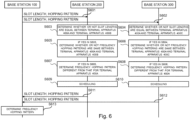
- Fig. 6 is a sequence diagram for illustrating an example of a schematic flow of processing according to a first specific example.
- the base station 100 (second communication processing unit 143) transmits slot time length (slot length) information of the radio resource for the terminal apparatus 400A and frequency hopping pattern information for the terminal apparatus 400A to the base station 200 (Step S601).
- the base station 100 (first communication processing unit 142) transmits slot time length (slot length) information of the radio resource for the terminal apparatus 400A and frequency hopping pattern information for the terminal apparatus 400A to the base station 300 (Step S602).
- the base station 200 determines whether or not the slot length of the radio resource for the terminal apparatus 400B is equal to the slot length of the radio resource for the terminal apparatus 400A, based on the information received from the base station 100 (Step S603).
- the base station 300 determines whether or not the slot length of the radio resource for the terminal apparatus 400C is equal to the slot length of the radio resource for the terminal apparatus 400A, based on the information received from the base station 100 (Step S604).
- Step S603 the base station 200 (first communication processing unit 241) determines whether or not the frequency hopping pattern selected for the terminal apparatus 400B is the same as the frequency hopping pattern for the terminal apparatus 400A (Step S605).
- the base station 300 first communication processing unit 341 determines whether or not the frequency hopping pattern selected for the terminal apparatus 400C is the same as the frequency hopping pattern for the terminal apparatus 400A (Step S606).
- Step S605 the base station 200 (first communication processing unit 241) determines, as the frequency hopping pattern for the terminal apparatus 400B, a frequency hopping pattern different from the frequency hopping pattern for the terminal apparatus 400A (Step S607).
- Step S606 the base station 300 (first communication processing unit 341) determines, as the frequency hopping pattern for the terminal apparatus 400C, a frequency hopping pattern different from the frequency hopping pattern for the terminal apparatus 400A (Step S608).
- the base station 200 (first communication processing unit 241) performs scheduling for the terminal apparatus 400B, based on the frequency hopping pattern determined in Step S607 (Step S609).
- the base station 300 (first communication processing unit 341) performs scheduling for the terminal apparatus 400C, based on the frequency hopping pattern determined in Step S608 (Step S610).
- the base station 200 (second communication processing unit 243) transmits information related to the frequency hopping pattern determined in Step S607 to the base station 100 (Step S611).
- the base station 300 (second communication processing unit 343) transmits information related to the frequency hopping pattern determined in Step S608 to the base station 100 (Step S612).
- the base station 100 (first communication processing unit 141) changes or determines, as the frequency hopping pattern for the terminal apparatus 400A, a frequency hopping pattern different from the frequency hopping pattern for the terminal apparatus 400B, 400C, for example, based on the information transmitted from the base station 200, 300 (Step S613).
- Fig. 7 is a sequence diagram for illustrating an example of a schematic flow of processing according to a second specific example.
- the base station 100 (second communication processing unit 143) transmits slot time length (slot length) information of the radio resource for the terminal apparatus 400A and frequency hopping pattern information for the terminal apparatus 400A to the base station 200 (Step S701).
- the base station 100 (first communication processing unit 142) transmits slot time length (slot length) information of the radio resource for the terminal apparatus 400A and frequency hopping pattern information for the terminal apparatus 400A to the base station 300 (Step S702).
- the base station 200 determines whether or not the slot length of the radio resource for the terminal apparatus 400B is equal to the slot length of the radio resource for the terminal apparatus 400A, based on the information received from the base station 100 (Step S703).
- the base station 300 determines whether or not the slot length of the radio resource for the terminal apparatus 400C is equal to the slot length of the radio resource for the terminal apparatus 400A, based on the information received from the base station 100 (Step S704).
- Step S703 the base station 200 (first communication processing unit 241) determines whether or not the radio resource scheduled for the terminal apparatus 400B by the base station 200 is the same as the radio resource scheduled for the terminal apparatus 400A by the base station 100 (Step S705).
- Step S704 the base station 300 (first communication processing unit 341) determines whether or not the radio resource scheduled for the terminal apparatus 400C by the base station 300 is the same as the radio resource scheduled for the terminal apparatus 400A by the base station 100 (Step S706).
- the base station 200 (first communication processing unit 241) adjusts the slot length of the radio resource for the terminal apparatus 400B so as to be equal to the slot length of the radio resource for the terminal apparatus 400A. Then, the base station 200 (first communication processing unit 241) determines, as the frequency hopping pattern for the terminal apparatus 400B, a frequency hopping pattern different from the frequency hopping pattern for the terminal apparatus 400A (Step S707).
- Step S706 when it is determined that the radio resources are the same in Step S706 (S706: Yes), the base station 300 (first communication processing unit 341) adjusts the slot length of the radio resource for the terminal apparatus 400C so as to be equal to the slot length of the radio resource for the terminal apparatus 400A. Then, the base station 300 (first communication processing unit 341) determines, as the frequency hopping pattern for the terminal apparatus 400C, a frequency hopping pattern different from the frequency hopping pattern for the terminal apparatus 400A (Step S708).
- the base station 200 (first communication processing unit 241) performs scheduling for the terminal apparatus 400B, based on the frequency hopping pattern determined in Step S707 (Step S709).
- the base station 300 (first communication processing unit 341) performs scheduling for the terminal apparatus 400C, based on the frequency hopping pattern determined in Step S708 (Step S710).
- Fig. 8 is a diagram for illustrating a specific example of a case in which the frequency hopping pattern is determined by making an adjustment to be the equal slot length when the slot lengths are different.
- the slot length of a slot 81 is 1 ms
- the slot length of each of slots 82 and 83 is 0.5 ms
- the slot length of each of slots 84, 85, 86, and 87 is 0.25 ms.
- a focus is put on a case of making an adjustment to be the equal slot length of 0.5 ms.
- the slot 81 is divided into two slots.
- the slots 84, 85, 86, and 87 two adjacent slots are combined. In this manner, the slot length can be uniformly arranged to be 0.5 ms when frequency hopping is performed.
- the hopping pattern can be determined so that the radio resources do not collide with each other between the terminal apparatuses.
- frequency and time resources used for the terminal apparatus to which the Configured Grant (CG) is applied can be arranged to be different between the base stations. As a result, interference can be reduced in a radio access network, and communication can be improved.
- the system 1 illustrated in Fig. 1 may include four or more terminal apparatuses 400, or may include only one or two terminal apparatuses 400.
- Information transmitted and received between the base stations 100, 200, and 300 may be an X2 message, or may be an Xn message.
- Scheduling information from the base stations 100, 200, and 300 to the terminal apparatus 400 may be a Radio Resource Control (RRC) message.
- RRC Radio Resource Control
- Fig. 9 is a diagram for illustrating an example alteration according to the first example embodiment.
- the slot lengths are the same between a set of slots 91 to 94 and another set of 95 to 98; however, the time lengths (TTI lengths) of the Transmission Time Interval (TTI) scheduled for the terminal apparatus are different.
- transmission information from the base station 100 to the base station 200 and transmission information from the base station 100 to the base station 300 may be scheduled TTI length information.
- the TTI lengths may be adjusted so that different TTI lengths are uniformly arranged to be the equal TTI length, and the hopping pattern may be determined so that the radio resources do not collide with each other between the terminal apparatuses.
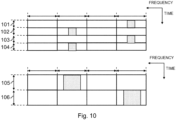
- Fig. 10 is a diagram for illustrating another example alteration according to the first example.
- the slot lengths are different between a set of slots 101 to 104 and another set of 105 and 106, and the time lengths (TTI lengths) of the Transmission Time Interval (TTI) scheduled for the terminal apparatus are different.
- TTI lengths Transmission Time Interval
- transmission information from the base station 100 to the base station 200 and transmission information from the base station 100 to the base station 300 may be a slot length and scheduled TTI length information.
- the TTI lengths may be adjusted so that different slot lengths are uniformly arranged to be the equal slot length and that different TTI lengths are uniformly arranged to be the equal TTI length, and the hopping pattern may be determined so that the radio resources do not collide with each other between the terminal apparatuses.
- the first base station When the first base station is a Center/Central Unit (CU) of a Centralized Radio Access Network (C-RAN), the first base station may notify a Distributed Unit (DU) under the first base station of the radio resource time length information and the hopping pattern information received from the second base station.
- the second base station When the second base station is a center/central unit of a C-RAN, the second base station may transmit, to the first base station, the radio resource time length information and the hopping pattern information generated by a distributed unit under the second base station.
- Fig. 11 is an explanatory diagram illustrating an example of a schematic configuration of the system 2 according to the second example embodiment.
- the system 2 includes a base station 600, a base station 700, and a terminal apparatus 800.
- Fig. 11 illustrates only one terminal apparatus 800. However, the system 2 may include two or more terminal apparatuses 800.
- description of the base station 600 is the same as the description of the base station 100 according to the first example embodiment.
- description of the base station 700 is the same as the description of the base station 200 or the base station 300 according to the first example embodiment.
- description of the terminal apparatus 800 is the same as the description of the terminal apparatus 400 according to the first example embodiment.
- overlapping description will be omitted herein.
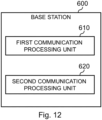
- Fig. 12 is a block diagram illustrating an example of a schematic configuration of the base station 600 according to the second example embodiment.
- the base station 600 includes a first communication processing unit 610 and a second communication processing unit 620. Specific operations of the first communication processing unit 610 and the second communication processing unit 620 will be described later.
- the first communication processing unit 610 and the second communication processing unit 620 may be implemented with one or more processors, such as a baseband (BB) processor and/or a different kind of processor, a memory (e.g., a nonvolatile memory and/or a volatile memory), and/or a hard disk.
- the first communication processing unit 610 and the second communication processing unit 620 may be implemented with the same processor or may be implemented with separate processors.
- the memory may be included in the one or more processors or may be provided outside the one or more processors.
- the base station 600 may include a memory configured to store a program (instructions) and one or more processors that can execute the program (instructions).
- the one or more processors may execute the program and thereby perform operations of the first communication processing unit 610 and the second communication processing unit 620.
- the program may be a program for causing the processor(s) to execute the operations of the first communication processing unit 610 and the second communication processing unit 620.
- the base station 600 may be virtual.
- the base station 600 may be implemented as a virtual machine.
- the base station 600 (the virtual machine) may operate as a physical machine (hardware) including a processor, a memory, and the like, and a virtual machine on a hypervisor.
- the base station 600 (first communication processing unit 610) communicates with a first terminal apparatus (for example, the terminal apparatus 800).
- the base station 600 (second communication processing unit 620) receives, from a second base station (base station 700) communicating with a second terminal apparatus, radio resource time length information for specifying a time length of a radio resource for the second terminal apparatus, and hopping pattern information for specifying a frequency hopping pattern for the second terminal apparatus. Then, the base station 600 (first communication processing unit 610) determines the frequency hopping pattern for the first terminal apparatus, based on the radio resource time length information and the hopping pattern information, and communicates with the first terminal apparatus in accordance with the determined frequency hopping pattern.
- the base station 600, the base station 700, and the terminal apparatus 800 of the second example embodiment are the base station 100, the base station 200 (or the base station 300), and the terminal apparatus 400 (the terminal apparatus 400A or the terminal apparatus 400B) of the first example embodiment, respectively.
- the descriptions of the first example embodiment may be applicable to the second example embodiment as well.
- the second example embodiment has been described above. According to the second example embodiment, communication in a radio access network may be improved.
- the steps in the processing described in the Specification may not necessarily be executed in time series in the order described in the corresponding sequence diagram.
- the steps in the processing may be executed in an order different from that described in the corresponding sequence diagram or may be executed in parallel.
- Some of the steps in the processing may be deleted, or more steps may be added to the processing.
- An apparatus including constituent elements (e.g., the various communication processing units and/or the information obtaining unit) of the base station described in the Specification e.g., one or more apparatuses (or units) among a plurality of apparatuses (or units) constituting the base station or a module for one of the plurality of apparatuses (or units)
- constituent elements e.g., the various communication processing units and/or the information obtaining unit
- methods including processing of the constituent elements may be provided, and programs for causing a processor to execute processing of the constituent elements may be provided.
- non-transitory computer readable recording media non-transitory computer readable media having recorded thereon the programs may be provided. It is apparent that such apparatuses, modules, methods, programs, and non-transitory computer readable recording media are also included in the present invention.
Landscapes
- Engineering & Computer Science (AREA)
- Signal Processing (AREA)
- Computer Networks & Wireless Communication (AREA)
- Mobile Radio Communication Systems (AREA)
Claims (11)
- Première station de base (200) comprenant :un premier moyen de traitement de communication (141) pour communiquer avec un premier appareil terminal (400B) ;un deuxième moyen de traitement de communication (143) pour recevoir, depuis une deuxième station de base (100) communiquant avec un deuxième appareil terminal (400A), des informations de durée de ressource radio pour spécifier une durée d'une ressource radio pour le deuxième appareil terminal (400A), et des informations de motif de saut pour spécifier un motif de saut de fréquence pour le deuxième appareil terminal (400A) ; etun moyen d'obtention d'informations (145) pour obtenir des informations indiquant une durée d'une ressource radio pour le premier appareil terminal (400B), dans laquellele premier moyen de traitement de communication (141) est configuré pour déterminer un motif de saut de fréquence pour le premier appareil terminal (400B), sur la base des informations de durée de ressource radio et des informations de motif de saut, et communiquer avec le premier appareil terminal (400B) en fonction du motif de saut de fréquence déterminé, etle premier moyen de traitement de communication (141) est configuré pour déterminer le motif de saut de fréquence pour le premier appareil terminal (400B), selon que la durée de la ressource radio pour le premier appareil terminal (400B) est ou non égale à la durée de la ressource radio pour le deuxième appareil terminal (400A) spécifiée par les informations de durée de ressource radio.
- Première station de base (200) selon la revendication 1, dans laquelle les informations de durée de ressource radio sont des informations pour spécifier la durée de la ressource radio pour le deuxième appareil terminal (400A) parmi une pluralité de durées candidates.
- Première station de base (200) selon la revendication 1 ou 2, dans laquelle
les informations de durée de ressource radio sont des informations pour spécifier une durée d'un créneau pour le deuxième appareil terminal (400A). - Première station de base (200) selon la revendication 1 ou 2, dans laquelle
les informations de durée de ressource radio sont des informations pour spécifier une durée d'une sous-trame pour le deuxième appareil terminal (400A). - Première station de base (200) selon la revendication 1, dans laquelle lorsque la durée de la ressource radio pour le premier appareil terminal (400B) est égale à la durée de la ressource radio pour le deuxième appareil terminal (400A) spécifiée par les informations de durée de ressource radio, le premier moyen de traitement de communication (141) détermine, en tant que le motif de saut de fréquence pour le premier appareil terminal (400B), un motif de saut de fréquence différent du motif de saut de fréquence pour le deuxième appareil terminal (400A) spécifié par les informations de motif de saut.
- Première station de base (200) selon l'une quelconque des revendications 1 à 5, dans laquelle
lorsque la durée de la ressource radio pour le premier appareil terminal (400B) est différente de la durée de la ressource radio pour le deuxième appareil terminal (400A) sur la base des informations de durée de ressource radio, le premier moyen de traitement de communication (141) détermine le motif de saut de fréquence pour le premier appareil terminal (400B) sur la base de la durée de la ressource radio pour le premier appareil terminal (400B). - Première station de base (200) selon l'une quelconque des revendications 1 à 5, dans laquelle
lorsque la durée de la ressource radio pour le premier appareil terminal (400B) est différente de la durée de la ressource radio pour le deuxième appareil terminal (400A) sur la base des informations de durée de ressource radio, le premier moyen de traitement de communication (141) change la durée de la ressource radio pour le premier appareil terminal (400B) pour qu'elle soit égale à la durée de la ressource radio pour le deuxième appareil terminal (400A), et détermine, en tant que le motif de saut de fréquence pour le premier appareil terminal (400B), un motif de saut de fréquence différent du motif de saut de fréquence pour le deuxième appareil terminal (400A) sur la base des informations de motif de saut. - Première station de base (200) selon l'une quelconque des revendications 1 à 7, dans laquelle
le deuxième moyen de traitement de communication (143) transmet, à la deuxième station de base (100), des informations pour spécifier le motif de saut de fréquence pour le premier appareil terminal (400B). - Première station de base (200) selon l'une quelconque des revendications 1 à 8, dans laquelle
le premier appareil terminal (400B) est un appareil terminal auquel un octroi configuré, CG, est appliqué. - Procédé utilisé dans une première station de base (200) comprenant :la communication avec un premier appareil terminal (400B) ;la réception, depuis une deuxième station de base (100) communiquant avec un deuxième appareil terminal (400A), d'informations de durée de ressource radio pour spécifier une durée d'une ressource radio pour le deuxième appareil terminal (400A), et d'informations de motif de saut pour spécifier un motif de saut de fréquence pour le deuxième appareil terminal (400A) ; etl'obtention d'informations indiquant une durée d'une ressource radio pour le premier appareil terminal (400B), dans lequella communication avec le premier appareil terminal (400B) comporte la détermination d'un motif de saut de fréquence pour le premier appareil terminal (400B), sur la base des informations de durée de ressource radio et des informations de motif de saut, et la communication avec le premier appareil terminal (400B) en fonction du motif de saut de fréquence déterminé, etla communication avec le premier appareil terminal (400B) comporte la détermination du motif de saut de fréquence pour le premier appareil terminal (400B), selon que la durée de la ressource radio pour le premier appareil terminal (400B) est ou non égale à la durée de la ressource radio pour le deuxième appareil terminal (400A) spécifiée par les informations de durée de ressource radio.
- Programme qui amène un processeur dans une première station de base (200) à exécuter :la communication avec un premier appareil terminal (400B) ;la réception, depuis une deuxième station de base (100) communiquant avec un deuxième appareil terminal (400A), d'informations de durée de ressource radio pour spécifier une durée d'une ressource radio pour le deuxième appareil terminal (400A), et d'informations de motif de saut pour spécifier un motif de saut de fréquence pour le deuxième appareil terminal (400A) ; etl'obtention d'informations indiquant une durée d'une ressource radio pour le premier appareil terminal (400B), dans lequella communication avec le premier appareil terminal (400B) comporte la détermination d'un motif de saut de fréquence pour le premier appareil terminal (400B), sur la base des informations de durée de ressource radio et des informations de motif de saut, et la communication avec le premier appareil terminal (400B) en fonction du motif de saut de fréquence déterminé, etla communication avec le premier appareil terminal (400B) comporte la détermination du motif de saut de fréquence pour le premier appareil terminal (400B), selon que la durée de la ressource radio pour le premier appareil terminal (400B) est ou non égale à la durée de la ressource radio pour le deuxième appareil terminal (400A) spécifiée par les informations de durée de ressource radio.
Applications Claiming Priority (2)
| Application Number | Priority Date | Filing Date | Title |
|---|---|---|---|
| JP2019143900 | 2019-08-05 | ||
| PCT/JP2020/029228 WO2021024903A1 (fr) | 2019-08-05 | 2020-07-30 | Station de base, procédé, programme et support d'enregistrement |
Publications (3)
| Publication Number | Publication Date |
|---|---|
| EP3986060A1 EP3986060A1 (fr) | 2022-04-20 |
| EP3986060A4 EP3986060A4 (fr) | 2022-07-13 |
| EP3986060B1 true EP3986060B1 (fr) | 2024-09-04 |
Family
ID=74503590
Family Applications (1)
| Application Number | Title | Priority Date | Filing Date |
|---|---|---|---|
| EP20850269.0A Active EP3986060B1 (fr) | 2019-08-05 | 2020-07-30 | Station de base, procédé, programme et support d'enregistrement |
Country Status (4)
| Country | Link |
|---|---|
| US (1) | US12015568B2 (fr) |
| EP (1) | EP3986060B1 (fr) |
| JP (1) | JP7205632B2 (fr) |
| WO (1) | WO2021024903A1 (fr) |
Family Cites Families (18)
| Publication number | Priority date | Publication date | Assignee | Title |
|---|---|---|---|---|
| JP3244610B2 (ja) * | 1995-01-27 | 2002-01-07 | 株式会社日立製作所 | 周波数ホッピング方式無線lanシステム |
| JP3246718B2 (ja) * | 1996-09-25 | 2002-01-15 | 東芝テック株式会社 | 周波数ホッピングスペクトル拡散通信における周波数ホッピングパターン選択方法 |
| JPH10261980A (ja) * | 1997-03-18 | 1998-09-29 | Fujitsu Ltd | 無線通信ネットワーク用基地局装置,無線通信ネットワークの通信制御方法,無線通信ネットワークシステムおよび無線端末装置 |
| JP4181093B2 (ja) | 2004-07-16 | 2008-11-12 | 株式会社東芝 | 無線通信システム |
| US8494546B2 (en) | 2006-10-16 | 2013-07-23 | Stmicroelectronics, Inc. | Method of inter-system communications dynamic spectrum access network systems-logical control connections |
| CN101183882B (zh) | 2007-12-21 | 2012-10-10 | 中兴通讯股份有限公司 | 组网资源占用方法 |
| GB2486926B (en) | 2011-06-02 | 2013-10-23 | Renesas Mobile Corp | Frequency hopping in license-exempt/shared bands |
| TW202029678A (zh) | 2012-01-24 | 2020-08-01 | 美商內數位專利控股公司 | 無憲傳輸/接收單元、在無線傳輸/接收單元中實施的方法以及網路節點 |
| CN104770009B (zh) | 2012-09-25 | 2018-05-04 | Lg 电子株式会社 | 在无线通信系统中支持控制面和用户面的方法和设备 |
| EP3790339A1 (fr) | 2013-05-31 | 2021-03-10 | Huawei Technologies Co., Ltd. | Procédé de transmission d'informations, dispositif de réseau, et équipement utilisateur |
| KR102309771B1 (ko) * | 2014-08-28 | 2021-10-08 | 소니그룹주식회사 | 통신 제어 장치, 통신 제어 방법 및 프로그램 |
| JP6472463B2 (ja) | 2015-01-29 | 2019-02-20 | 株式会社Nttドコモ | 無線基地局、ユーザ端末及び無線通信方法 |
| US10547427B2 (en) * | 2015-12-24 | 2020-01-28 | Lg Electronics Inc. | Method for transmitting demodulation reference signal in wireless communication system that supports narrow band IoT and apparatus for supporting the same |
| WO2018030098A1 (fr) | 2016-08-10 | 2018-02-15 | 株式会社Nttドコモ | Station de base, et procédé de transmission de signal |
| TWI683561B (zh) * | 2016-08-11 | 2020-01-21 | 弗勞恩霍夫爾協會 | 用於潛時受限及可靠之無線通訊系統之排程增強技術 |
| CN108347289B (zh) * | 2017-01-25 | 2020-04-03 | 华为技术有限公司 | 一种干扰协调方法及装置 |
| WO2019125062A1 (fr) | 2017-12-21 | 2019-06-27 | 엘지전자 주식회사 | Procédé destiné à l'émission et à la réception d'un signal de référence de sondage dans un système de communication sans fil et appareil associé |
| JP2019143900A (ja) | 2018-02-21 | 2019-08-29 | パナソニックIpマネジメント株式会社 | 冷凍装置 |
-
2020
- 2020-07-30 US US17/627,971 patent/US12015568B2/en active Active
- 2020-07-30 JP JP2021537267A patent/JP7205632B2/ja active Active
- 2020-07-30 EP EP20850269.0A patent/EP3986060B1/fr active Active
- 2020-07-30 WO PCT/JP2020/029228 patent/WO2021024903A1/fr not_active Ceased
Also Published As
| Publication number | Publication date |
|---|---|
| WO2021024903A1 (fr) | 2021-02-11 |
| US20220278783A1 (en) | 2022-09-01 |
| US12015568B2 (en) | 2024-06-18 |
| EP3986060A1 (fr) | 2022-04-20 |
| JPWO2021024903A1 (fr) | 2021-02-11 |
| JP7205632B2 (ja) | 2023-01-17 |
| EP3986060A4 (fr) | 2022-07-13 |
Similar Documents
| Publication | Publication Date | Title |
|---|---|---|
| US11115145B2 (en) | Method for operating IoT in cellular system and system therefor | |
| EP3934357B1 (fr) | Procédé et appareil de transmission de données dans des réseaux cellulaires de nouvelle génération | |
| US8780769B2 (en) | Method, apparatus, and system for identifying different frame structures | |
| EP2850863B1 (fr) | Réutilisation d'une technologie d'accès radio existante | |
| US9178680B2 (en) | Control signaling for downlink coordinated multipoint wireless communication | |
| EP3291599B1 (fr) | Dispositif d'utilisateur et station de base | |
| EP3445115A1 (fr) | Terminal utilisateur et procédé de communication sans fil | |
| EP3579469B1 (fr) | Procédé et dispositif de communication sans fil | |
| EP2797372B1 (fr) | Dispositif d'émission et procédé d'émission pour enhanced physical downlink control channel | |
| EP3664536B1 (fr) | Terminal utilisateur et procédé de communications sans fil | |
| EP3968717A1 (fr) | Terminal d'utilisateur et procédé de communication radio | |
| KR20130132767A (ko) | 비주기적 채널 사운딩을 위한 자원 할당 및 시그널링의 방법 | |
| US10009950B2 (en) | Apparatus and method for transmitting D2D data based on resource pattern | |
| EP3697150B1 (fr) | Équipement utilisateur, station de base et procédé de communication sans fil | |
| JP5677224B2 (ja) | 無線基地局及び通信制御方法 | |
| EP3188530B1 (fr) | Dispositif et procédé de système de communication sans fil | |
| CN117616838A (zh) | 用于无线通信的参考信令的系统和方法 | |
| EP3376811A1 (fr) | Station de base, dispositif d'utilisateur, procédé d'émission de signal de référence, et procédé de réception de signal | |
| EP3197219A1 (fr) | Procédé et dispositif d'émission de données d2d d'après un motif de ressources | |
| US12082159B2 (en) | Extended bandwidth allocation | |
| CN107295668B (zh) | 数据的传输方法及装置 | |
| EP3567946A1 (fr) | Dispositif d'utilisateur, station de base et procédé de transmission de signal de référence | |
| EP3986060A1 (fr) | Station de base, procédé, programme et support d'enregistrement | |
| JP7400794B2 (ja) | 無線通信装置、方法、プログラム、コンピュータに読み取り可能な非一時的記録媒体、及びシステム | |
| EP2477438A1 (fr) | Dispositif de station de base et procédé de commande de communication pour dispositif de station de base |
Legal Events
| Date | Code | Title | Description |
|---|---|---|---|
| STAA | Information on the status of an ep patent application or granted ep patent |
Free format text: STATUS: THE INTERNATIONAL PUBLICATION HAS BEEN MADE |
|
| PUAI | Public reference made under article 153(3) epc to a published international application that has entered the european phase |
Free format text: ORIGINAL CODE: 0009012 |
|
| STAA | Information on the status of an ep patent application or granted ep patent |
Free format text: STATUS: REQUEST FOR EXAMINATION WAS MADE |
|
| 17P | Request for examination filed |
Effective date: 20220112 |
|
| AK | Designated contracting states |
Kind code of ref document: A1 Designated state(s): AL AT BE BG CH CY CZ DE DK EE ES FI FR GB GR HR HU IE IS IT LI LT LU LV MC MK MT NL NO PL PT RO RS SE SI SK SM TR |
|
| A4 | Supplementary search report drawn up and despatched |
Effective date: 20220614 |
|
| RIC1 | Information provided on ipc code assigned before grant |
Ipc: H04L 5/00 20060101ALI20220609BHEP Ipc: H04W 92/20 20090101ALI20220609BHEP Ipc: H04W 72/04 20090101AFI20220609BHEP |
|
| DAV | Request for validation of the european patent (deleted) | ||
| DAX | Request for extension of the european patent (deleted) | ||
| REG | Reference to a national code |
Ref country code: DE Ref legal event code: R079 Ref document number: 602020037284 Country of ref document: DE Free format text: PREVIOUS MAIN CLASS: H04W0072040000 Ipc: H04W0072045300 |
|
| GRAP | Despatch of communication of intention to grant a patent |
Free format text: ORIGINAL CODE: EPIDOSNIGR1 |
|
| STAA | Information on the status of an ep patent application or granted ep patent |
Free format text: STATUS: GRANT OF PATENT IS INTENDED |
|
| RIC1 | Information provided on ipc code assigned before grant |
Ipc: H04W 72/27 20230101ALN20240215BHEP Ipc: H04L 5/00 20060101ALI20240215BHEP Ipc: H04W 92/20 20090101ALI20240215BHEP Ipc: H04W 72/0453 20230101AFI20240215BHEP |
|
| RIC1 | Information provided on ipc code assigned before grant |
Ipc: H04W 72/27 20230101ALN20240216BHEP Ipc: H04L 5/00 20060101ALI20240216BHEP Ipc: H04W 92/20 20090101ALI20240216BHEP Ipc: H04W 72/0453 20230101AFI20240216BHEP |
|
| INTG | Intention to grant announced |
Effective date: 20240305 |
|
| GRAS | Grant fee paid |
Free format text: ORIGINAL CODE: EPIDOSNIGR3 |
|
| GRAA | (expected) grant |
Free format text: ORIGINAL CODE: 0009210 |
|
| STAA | Information on the status of an ep patent application or granted ep patent |
Free format text: STATUS: THE PATENT HAS BEEN GRANTED |
|
| AK | Designated contracting states |
Kind code of ref document: B1 Designated state(s): AL AT BE BG CH CY CZ DE DK EE ES FI FR GB GR HR HU IE IS IT LI LT LU LV MC MK MT NL NO PL PT RO RS SE SI SK SM TR |
|
| REG | Reference to a national code |
Ref country code: GB Ref legal event code: FG4D |
|
| REG | Reference to a national code |
Ref country code: CH Ref legal event code: EP |
|
| REG | Reference to a national code |
Ref country code: IE Ref legal event code: FG4D |
|
| REG | Reference to a national code |
Ref country code: DE Ref legal event code: R096 Ref document number: 602020037284 Country of ref document: DE |
|
| REG | Reference to a national code |
Ref country code: LT Ref legal event code: MG9D |
|
| REG | Reference to a national code |
Ref country code: NL Ref legal event code: MP Effective date: 20240904 |
|
| PG25 | Lapsed in a contracting state [announced via postgrant information from national office to epo] |
Ref country code: NO Free format text: LAPSE BECAUSE OF FAILURE TO SUBMIT A TRANSLATION OF THE DESCRIPTION OR TO PAY THE FEE WITHIN THE PRESCRIBED TIME-LIMIT Effective date: 20241204 |
|
| PG25 | Lapsed in a contracting state [announced via postgrant information from national office to epo] |
Ref country code: GR Free format text: LAPSE BECAUSE OF FAILURE TO SUBMIT A TRANSLATION OF THE DESCRIPTION OR TO PAY THE FEE WITHIN THE PRESCRIBED TIME-LIMIT Effective date: 20241205 Ref country code: PL Free format text: LAPSE BECAUSE OF FAILURE TO SUBMIT A TRANSLATION OF THE DESCRIPTION OR TO PAY THE FEE WITHIN THE PRESCRIBED TIME-LIMIT Effective date: 20240904 Ref country code: FI Free format text: LAPSE BECAUSE OF FAILURE TO SUBMIT A TRANSLATION OF THE DESCRIPTION OR TO PAY THE FEE WITHIN THE PRESCRIBED TIME-LIMIT Effective date: 20240904 |
|
| PG25 | Lapsed in a contracting state [announced via postgrant information from national office to epo] |
Ref country code: BG Free format text: LAPSE BECAUSE OF FAILURE TO SUBMIT A TRANSLATION OF THE DESCRIPTION OR TO PAY THE FEE WITHIN THE PRESCRIBED TIME-LIMIT Effective date: 20240904 |
|
| PG25 | Lapsed in a contracting state [announced via postgrant information from national office to epo] |
Ref country code: LV Free format text: LAPSE BECAUSE OF FAILURE TO SUBMIT A TRANSLATION OF THE DESCRIPTION OR TO PAY THE FEE WITHIN THE PRESCRIBED TIME-LIMIT Effective date: 20240904 |
|
| PG25 | Lapsed in a contracting state [announced via postgrant information from national office to epo] |
Ref country code: HR Free format text: LAPSE BECAUSE OF FAILURE TO SUBMIT A TRANSLATION OF THE DESCRIPTION OR TO PAY THE FEE WITHIN THE PRESCRIBED TIME-LIMIT Effective date: 20240904 |
|
| PG25 | Lapsed in a contracting state [announced via postgrant information from national office to epo] |
Ref country code: ES Free format text: LAPSE BECAUSE OF FAILURE TO SUBMIT A TRANSLATION OF THE DESCRIPTION OR TO PAY THE FEE WITHIN THE PRESCRIBED TIME-LIMIT Effective date: 20240904 Ref country code: RS Free format text: LAPSE BECAUSE OF FAILURE TO SUBMIT A TRANSLATION OF THE DESCRIPTION OR TO PAY THE FEE WITHIN THE PRESCRIBED TIME-LIMIT Effective date: 20241204 |
|
| PG25 | Lapsed in a contracting state [announced via postgrant information from national office to epo] |
Ref country code: RS Free format text: LAPSE BECAUSE OF FAILURE TO SUBMIT A TRANSLATION OF THE DESCRIPTION OR TO PAY THE FEE WITHIN THE PRESCRIBED TIME-LIMIT Effective date: 20241204 Ref country code: PL Free format text: LAPSE BECAUSE OF FAILURE TO SUBMIT A TRANSLATION OF THE DESCRIPTION OR TO PAY THE FEE WITHIN THE PRESCRIBED TIME-LIMIT Effective date: 20240904 Ref country code: NO Free format text: LAPSE BECAUSE OF FAILURE TO SUBMIT A TRANSLATION OF THE DESCRIPTION OR TO PAY THE FEE WITHIN THE PRESCRIBED TIME-LIMIT Effective date: 20241204 Ref country code: LV Free format text: LAPSE BECAUSE OF FAILURE TO SUBMIT A TRANSLATION OF THE DESCRIPTION OR TO PAY THE FEE WITHIN THE PRESCRIBED TIME-LIMIT Effective date: 20240904 Ref country code: HR Free format text: LAPSE BECAUSE OF FAILURE TO SUBMIT A TRANSLATION OF THE DESCRIPTION OR TO PAY THE FEE WITHIN THE PRESCRIBED TIME-LIMIT Effective date: 20240904 Ref country code: GR Free format text: LAPSE BECAUSE OF FAILURE TO SUBMIT A TRANSLATION OF THE DESCRIPTION OR TO PAY THE FEE WITHIN THE PRESCRIBED TIME-LIMIT Effective date: 20241205 Ref country code: FI Free format text: LAPSE BECAUSE OF FAILURE TO SUBMIT A TRANSLATION OF THE DESCRIPTION OR TO PAY THE FEE WITHIN THE PRESCRIBED TIME-LIMIT Effective date: 20240904 Ref country code: ES Free format text: LAPSE BECAUSE OF FAILURE TO SUBMIT A TRANSLATION OF THE DESCRIPTION OR TO PAY THE FEE WITHIN THE PRESCRIBED TIME-LIMIT Effective date: 20240904 Ref country code: BG Free format text: LAPSE BECAUSE OF FAILURE TO SUBMIT A TRANSLATION OF THE DESCRIPTION OR TO PAY THE FEE WITHIN THE PRESCRIBED TIME-LIMIT Effective date: 20240904 |
|
| REG | Reference to a national code |
Ref country code: AT Ref legal event code: MK05 Ref document number: 1721722 Country of ref document: AT Kind code of ref document: T Effective date: 20240904 |
|
| PG25 | Lapsed in a contracting state [announced via postgrant information from national office to epo] |
Ref country code: NL Free format text: LAPSE BECAUSE OF FAILURE TO SUBMIT A TRANSLATION OF THE DESCRIPTION OR TO PAY THE FEE WITHIN THE PRESCRIBED TIME-LIMIT Effective date: 20240904 |
|
| PG25 | Lapsed in a contracting state [announced via postgrant information from national office to epo] |
Ref country code: IS Free format text: LAPSE BECAUSE OF FAILURE TO SUBMIT A TRANSLATION OF THE DESCRIPTION OR TO PAY THE FEE WITHIN THE PRESCRIBED TIME-LIMIT Effective date: 20250104 Ref country code: PT Free format text: LAPSE BECAUSE OF FAILURE TO SUBMIT A TRANSLATION OF THE DESCRIPTION OR TO PAY THE FEE WITHIN THE PRESCRIBED TIME-LIMIT Effective date: 20250106 |
|
| PG25 | Lapsed in a contracting state [announced via postgrant information from national office to epo] |
Ref country code: SM Free format text: LAPSE BECAUSE OF FAILURE TO SUBMIT A TRANSLATION OF THE DESCRIPTION OR TO PAY THE FEE WITHIN THE PRESCRIBED TIME-LIMIT Effective date: 20240904 Ref country code: RO Free format text: LAPSE BECAUSE OF FAILURE TO SUBMIT A TRANSLATION OF THE DESCRIPTION OR TO PAY THE FEE WITHIN THE PRESCRIBED TIME-LIMIT Effective date: 20240904 |
|
| PG25 | Lapsed in a contracting state [announced via postgrant information from national office to epo] |
Ref country code: AT Free format text: LAPSE BECAUSE OF FAILURE TO SUBMIT A TRANSLATION OF THE DESCRIPTION OR TO PAY THE FEE WITHIN THE PRESCRIBED TIME-LIMIT Effective date: 20240904 Ref country code: EE Free format text: LAPSE BECAUSE OF FAILURE TO SUBMIT A TRANSLATION OF THE DESCRIPTION OR TO PAY THE FEE WITHIN THE PRESCRIBED TIME-LIMIT Effective date: 20240904 |
|
| PG25 | Lapsed in a contracting state [announced via postgrant information from national office to epo] |
Ref country code: CZ Free format text: LAPSE BECAUSE OF FAILURE TO SUBMIT A TRANSLATION OF THE DESCRIPTION OR TO PAY THE FEE WITHIN THE PRESCRIBED TIME-LIMIT Effective date: 20240904 |
|
| PG25 | Lapsed in a contracting state [announced via postgrant information from national office to epo] |
Ref country code: IT Free format text: LAPSE BECAUSE OF FAILURE TO SUBMIT A TRANSLATION OF THE DESCRIPTION OR TO PAY THE FEE WITHIN THE PRESCRIBED TIME-LIMIT Effective date: 20240904 Ref country code: SK Free format text: LAPSE BECAUSE OF FAILURE TO SUBMIT A TRANSLATION OF THE DESCRIPTION OR TO PAY THE FEE WITHIN THE PRESCRIBED TIME-LIMIT Effective date: 20240904 |
|
| REG | Reference to a national code |
Ref country code: DE Ref legal event code: R097 Ref document number: 602020037284 Country of ref document: DE |
|
| PG25 | Lapsed in a contracting state [announced via postgrant information from national office to epo] |
Ref country code: DK Free format text: LAPSE BECAUSE OF FAILURE TO SUBMIT A TRANSLATION OF THE DESCRIPTION OR TO PAY THE FEE WITHIN THE PRESCRIBED TIME-LIMIT Effective date: 20240904 |
|
| PLBE | No opposition filed within time limit |
Free format text: ORIGINAL CODE: 0009261 |
|
| STAA | Information on the status of an ep patent application or granted ep patent |
Free format text: STATUS: NO OPPOSITION FILED WITHIN TIME LIMIT |
|
| 26N | No opposition filed |
Effective date: 20250605 |
|
| PG25 | Lapsed in a contracting state [announced via postgrant information from national office to epo] |
Ref country code: SE Free format text: LAPSE BECAUSE OF FAILURE TO SUBMIT A TRANSLATION OF THE DESCRIPTION OR TO PAY THE FEE WITHIN THE PRESCRIBED TIME-LIMIT Effective date: 20240904 |
|
| REG | Reference to a national code |
Ref country code: DE Ref legal event code: R119 Ref document number: 602020037284 Country of ref document: DE |
|
| REG | Reference to a national code |
Ref country code: CH Ref legal event code: H13 Free format text: ST27 STATUS EVENT CODE: U-0-0-H10-H13 (AS PROVIDED BY THE NATIONAL OFFICE) Effective date: 20260224 |
|
| PG25 | Lapsed in a contracting state [announced via postgrant information from national office to epo] |
Ref country code: LU Free format text: LAPSE BECAUSE OF NON-PAYMENT OF DUE FEES Effective date: 20250730 |
|
| GBPC | Gb: european patent ceased through non-payment of renewal fee |
Effective date: 20250730 |
|
| REG | Reference to a national code |
Ref country code: BE Ref legal event code: MM Effective date: 20250731 |
|
| PG25 | Lapsed in a contracting state [announced via postgrant information from national office to epo] |
Ref country code: GB Free format text: LAPSE BECAUSE OF NON-PAYMENT OF DUE FEES Effective date: 20250730 |
|
| PG25 | Lapsed in a contracting state [announced via postgrant information from national office to epo] |
Ref country code: DE Free format text: LAPSE BECAUSE OF NON-PAYMENT OF DUE FEES Effective date: 20260203 |
|
| PG25 | Lapsed in a contracting state [announced via postgrant information from national office to epo] |
Ref country code: BE Free format text: LAPSE BECAUSE OF NON-PAYMENT OF DUE FEES Effective date: 20250731 |
|
| PG25 | Lapsed in a contracting state [announced via postgrant information from national office to epo] |
Ref country code: FR Free format text: LAPSE BECAUSE OF NON-PAYMENT OF DUE FEES Effective date: 20250731 |
|
| PG25 | Lapsed in a contracting state [announced via postgrant information from national office to epo] |
Ref country code: CH Free format text: LAPSE BECAUSE OF NON-PAYMENT OF DUE FEES Effective date: 20250731 |