EP3992145B1 - Verfahren zur entfernung von phosphor aus phosphorhaltigen substanzensubstanz, verfahren zur herstellung von rohmaterial, rohmaterial für die metallschmelze oder rohmaterial für die metallraffination und verfahren zur herstellung von metall - Google Patents
Verfahren zur entfernung von phosphor aus phosphorhaltigen substanzensubstanz, verfahren zur herstellung von rohmaterial, rohmaterial für die metallschmelze oder rohmaterial für die metallraffination und verfahren zur herstellung von metall Download PDFInfo
- Publication number
- EP3992145B1 EP3992145B1 EP20831257.9A EP20831257A EP3992145B1 EP 3992145 B1 EP3992145 B1 EP 3992145B1 EP 20831257 A EP20831257 A EP 20831257A EP 3992145 B1 EP3992145 B1 EP 3992145B1
- Authority
- EP
- European Patent Office
- Prior art keywords
- phosphorus
- treatment
- containing substance
- granular
- reduction
- Prior art date
- Legal status (The legal status is an assumption and is not a legal conclusion. Google has not performed a legal analysis and makes no representation as to the accuracy of the status listed.)
- Active
Links
Images




Classifications
-
- C—CHEMISTRY; METALLURGY
- C22—METALLURGY; FERROUS OR NON-FERROUS ALLOYS; TREATMENT OF ALLOYS OR NON-FERROUS METALS
- C22B—PRODUCTION AND REFINING OF METALS; PRETREATMENT OF RAW MATERIALS
- C22B1/00—Preliminary treatment of ores or scrap
- C22B1/11—Removing sulfur, phosphorus or arsenic other than by roasting
-
- C—CHEMISTRY; METALLURGY
- C01—INORGANIC CHEMISTRY
- C01B—NON-METALLIC ELEMENTS; COMPOUNDS THEREOF; METALLOIDS OR COMPOUNDS THEREOF NOT COVERED BY SUBCLASS C01C
- C01B21/00—Nitrogen; Compounds thereof
- C01B21/082—Compounds containing nitrogen and non-metals and optionally metals
- C01B21/097—Compounds containing nitrogen and non-metals and optionally metals containing phosphorus atoms
-
- C—CHEMISTRY; METALLURGY
- C21—METALLURGY OF IRON
- C21C—PROCESSING OF PIG-IRON, e.g. REFINING, MANUFACTURE OF WROUGHT-IRON OR STEEL; TREATMENT IN MOLTEN STATE OF FERROUS ALLOYS
- C21C7/00—Treating molten ferrous alloys, e.g. steel, not covered by groups C21C1/00 - C21C5/00
- C21C7/04—Removing impurities by adding a treating agent
- C21C7/064—Dephosphorising; Desulfurising
- C21C7/0645—Agents used for dephosphorising or desulfurising
-
- C—CHEMISTRY; METALLURGY
- C21—METALLURGY OF IRON
- C21C—PROCESSING OF PIG-IRON, e.g. REFINING, MANUFACTURE OF WROUGHT-IRON OR STEEL; TREATMENT IN MOLTEN STATE OF FERROUS ALLOYS
- C21C7/00—Treating molten ferrous alloys, e.g. steel, not covered by groups C21C1/00 - C21C5/00
- C21C7/04—Removing impurities by adding a treating agent
- C21C7/072—Treatment with gases
-
- C—CHEMISTRY; METALLURGY
- C21—METALLURGY OF IRON
- C21C—PROCESSING OF PIG-IRON, e.g. REFINING, MANUFACTURE OF WROUGHT-IRON OR STEEL; TREATMENT IN MOLTEN STATE OF FERROUS ALLOYS
- C21C7/00—Treating molten ferrous alloys, e.g. steel, not covered by groups C21C1/00 - C21C5/00
- C21C7/10—Handling in a vacuum
-
- C—CHEMISTRY; METALLURGY
- C22—METALLURGY; FERROUS OR NON-FERROUS ALLOYS; TREATMENT OF ALLOYS OR NON-FERROUS METALS
- C22B—PRODUCTION AND REFINING OF METALS; PRETREATMENT OF RAW MATERIALS
- C22B1/00—Preliminary treatment of ores or scrap
- C22B1/02—Roasting processes
Definitions
- iron While phosphorus in molten pig iron or molten steel is oxidized using a gas such as oxygen and removed into the slag, iron is also oxidized at this time, and thus even in a case of not using iron oxide as the oxygen source, the iron in the form of iron oxide is also contained in the slag.
- slag (converter slag) generated during decarburization refining of molten pig iron that has been subjected to a preliminary dephosphorization treatment (a treatment of preliminarily removing phosphorus in molten pig iron before being subjected to decarburization refining in a converter) is recycled, as a CaO source for a slag forming agent or an iron source, to a blast furnace via a sintering process of iron ore or recycled as a CaO source in a molten pig iron preliminary treatment process.
- a preliminary dephosphorization treatment a treatment of preliminarily removing phosphorus in molten pig iron before being subjected to decarburization refining in a converter
- dephosphorized molten pig iron When performing decarburization refining of molten pig iron to which a preliminary dephosphorization treatment has been performed (hereinafter, referred to "dephosphorized molten pig iron"), especially dephosphorized molten pig iron to which a preliminary dephosphorization treatment has been performed to a level of the phosphorus concentration of a steel product in a converter, the molten pig iron generates a converter slag barely containing phosphorus. Accordingly, for example, even when such a converter slag is used for recycling in a blast furnace, there is no need to be concerned about an increase in a phosphorus concentration (pickup) in the molten pig iron.
- manganese (Mn) is conventionally added so as to improve the strength of iron and steel products.
- a manganese source to be added to increase an Mn concentration in molten steel there is used, in addition to manganese ore, ferromanganese having a carbon content of 1.0 to 7.5 mass%, silicon manganese having a carbon content of not more than 2.0 mass%, metallic manganese having a carbon content of not more than 0.01 mass%, or the like. It is known, however, that a raw material price of the manganese source except for manganese ore increases with decreasing carbon content.
- manganese ore which is inexpensive as the manganese source, is used to produce manganese-containing steel.
- a problem is that a particularly inexpensive type of manganese ore contains a large amount of phosphorus, so that using such a manganese as the manganese source causes an increase in phosphorus concentration in a steel material, resulting in deterioration in quality. For this reason, the use of manganese ore is in fact limited.
- a large amount of phosphorus is usually contained in a main raw material or an auxiliary raw material that is used in an ironmaking process, and thus a phosphorus content in final iron and steel products is increased depending on a concentration and a use amount of phosphorus contained in such a phosphorus-containing substance.
- the phosphorus content affects the quality of iron and steel products.
- it is required to use a phosphorus-containing substance such as a main or auxiliary raw material having a low phosphorus content. This, however, leads to a cost increase.
- some methods for preliminarily removing phosphorus from a phosphorus-containing substance that is a main or auxiliary raw material for ironmaking have conventionally been proposed some methods for preliminarily removing phosphorus from a phosphorus-containing substance that is a main or auxiliary raw material for ironmaking.
- Patent Literature 2 proposes the following method. That is, phosphate is separated and dissolved by: crushing iron ore having a high phosphorus content to a size of not more than 0.5 mm; adding water to the resultant to have a pulp concentration of about 35 mass%; and adding H 2 SO 4 or HCl to the solution and reacting therewith at pH: not more than 2.0. Then, nonmagnetic SiO 2 , Al 2 O 3 and so on are precipitated and separated as slime by gathering a magnetically attracted substance such as magnetite and so on by means of a magnetic separation, while P dissolved into the solution is neutralized in a range of pH: 5.0 to 10.0 by adding slaked lime or quicklime so as to separate and collect as calcium phosphate.
- Patent Literature 3 proposes a method for performing dephosphorization of iron ore by use of Microbial Aspergillus SP KSC-1004 strain or Microbial Fusarium SP KSC-1005 strain.
- Non-Patent Literature 1 reports a study on reduction of high-phosphorus iron ore by use of a hydrogen-vapor mixture gas in which a water vapor pressure is controlled, thus proposing a method for performing dephosphorization directly from iron ore.
- a further method for removing phosphorous from a phosphorous containing substance is disclosed EP 3 733 882 A1 .
- Patent Literature 1 presents a problem of a treatment temperature of as high as not lower than 1600°C, resulting in the need for a large amount of energy. Moreover, since ore is treated in a molten state, there are also problems of wear of a vessel and handling difficulty of a high-temperature melt.
- Patent Literature 2 is a wet treatment using acid, presenting a problem of time-consuming and costly drying of a magnetically attractable substance recovered so that the substance can be used as a main raw material. Another problem is that preliminarily pulverizing iron ore to a size of not more than 0.5 mm is time-consuming and costly.
- Patent Literature 3 is also a wet treatment, presenting a problem of time-consuming and costly drying of ore after removal of phosphorus therefrom so that the ore can be used as a main raw material.
- Non-Patent Literature 1 presents a problem of a removal ratio of phosphorus in ore of as low as 13% at the maximum. Another problem is that, while hydrogen is used as a reaction gas, no consideration has been made on equipment and so on for safely treating the hydrogen on an industrial scale.
- An object of the present invention is to propose a method for removing phosphorus from a phosphorus-containing substance, which is applicable on an industrial scale, so as to effectively decrease phosphorus contained in a phosphorus-containing substance, which is a solid oxide that is used as a main raw material or an auxiliary raw material for metal smelting or metal refining, a method for manufacturing a raw material for metal smelting or refining, and a method for manufacturing metal.
- the present invention is developed based on this finding and is set out in the appended claims, and firstly provides a method for removing phosphorus from a phosphorus-containing substance in which the phosphorus-containing substance that is used as a raw material for metal smelting or metal refining is reacted with a nitrogen-containing gas so that phosphorus in the phosphorus-containing substance is removed through nitriding.
- a reduction treatment is performed in which the phosphorus-containing substance is heated to an unmolten state temperature range so as to react with a reducing agent, thereby reducing at least a part of metal oxide in the phosphorus-containing substance.
- the method for removing phosphorus from a phosphorus-containing substance according to the first method of the present invention is also conceived to be a more preferred embodiment when configured as follows:
- the present invention secondly proposes a method for manufacturing a raw material for metal smelting or a raw material for metal refining including, in manufacturing the raw material for metal smelting or the raw material for metal refining, a step of decreasing a phosphorus content in a phosphorus-containing substance by use of the method for removing phosphorus from a phosphorus-containing substance, which is the above-described first method according to the present invention.
- the present invention thirdly proposes a method for manufacturing metal, in which in manufacturing the metal via at least one of a smelting step or a refining step, the raw material for metal smelting obtained by the second method according to the present invention is used to perform smelting in the smelting step or the raw material for metal refining obtained by the second method according to the present invention is used to perform refining in the refining step.
- the unmolten state refers to a state at a temperature lower than the temperature (melting point) T m at which a solid sample is transformed into a liquid, which can be easily determined by any of first to third methods described below and thus is desirable. There is, however, no limitation only to these methods.
- a phosphorus-containing substance that is used as a main raw material or an auxiliary raw material for metal smelting or metal refining is reacted, while being heated to an unmolten state temperature, with a reducing agent so that a reduction treatment of oxide in the phosphorus-containing substance is performed.
- the nitriding dephosphorization treatment of removing phosphorus in the phosphorus-containing substance into a gas phase is, for example, a nitriding dephosphorization treatment in which phosphorus in the phosphorus-containing substance is removed as a mononitride gas (PN) into a gas phase.
- PN mononitride gas
- the by-product since phosphorus can be efficiently removed from a by-product such as steelmaking slag, the by-product can be reused during its generation process, and thus it is possible to reduce the amount of the auxiliary raw material usage in the dephosphorization treatment process in a metal smelting or metal refining process and suppress the generation amount of the by-product.
- phosphorus removed through nitriding is oxidized in an exhaust gas and formed into P 2 O 5 , which leads to recovery of dust having a high phosphorus concentration, and thus there is also an effect that effective utilization leading to recycling of phosphorus is enabled.
- the inventors focused on inexpensive substances having a high phosphorus concentration as main raw material and auxiliary raw material for metal smelting or metal refining and pursued a study on a method for preliminarily removing phosphorus from such phosphorus-containing substances prior to the smelting or refining using the substances.
- the phosphorus-containing substances that are used as raw material (main raw material and auxiliary raw material) for metal smelting or metal refining contain phosphorus mainly as an oxide such as P 2 O 5 and usually contain, in addition thereto, metal oxides such as CaO, SiO 2 , MgO, Al 2 O 3 , MnO, Mn 2 O 3 , FeO, and Fe 2 O 3 .
- Examples of such raw material for metal smelting or metal refining, particularly raw material for ironmaking include iron ore, manganese ore, or steelmaking slag.
- Table 1 shows typical compositions thereof. [Table 1] CaO SiO 2 MgO Al 2 O 3 T. Mn T. Fe P 2 O 5 Iron ore - 3.5 - 1.4 - 63.0 0.2 Manganese ore 0.4 4.1 0.2 8.1 50.1 0.8 0.2 Steelmaking slag 41.0 13.8 6.1 5.6 1.6 18.7 1.6
- the main raw material and the auxiliary raw material for metal smelting and metal refining (hereinafter, an explanation will be made taking "a raw material for iron- and steel-making" as an example) comprises various metal oxides. Since phosphorus has a weak affinity with oxygen compared to calcium (Ca) and silicon (Si), it is known that P 2 O 5 in the phosphorus-containing substance is easily reduced in a reduction of the phosphorus-containing substance by carbon, silicon, aluminum and so on. On the other hand, iron is included in various raw materials for iron- and steel-making as an oxide in the form of FeO or Fe 2 O 3 (hereinafter, abbreviated as "FexO").
- Phosphorus however, has a high solubility into iron or manganese, and especially, phosphorus formed by reduction is quickly dissolved into iron or manganese that are formed through reduction, thus forming a high phosphorus-containing iron or a high phosphorus-containing manganese. Therefore, the method for removing phosphorus formed by reduction presents a problem that a phosphorus removal ratio is low because phosphorus is absorbed and dissolved into iron and manganese which are valuable components.
- the inventors performed an experiment to confirm whether or not phosphorus is removed through nitriding.
- 10 g of iron ore whose particle size was adjusted to 1 to 3 mm was used as a phosphorus-containing substance, and 5 g of reagent carbon (having a particle size of under 0.25 mm) was used as solid carbon. Then, they were put on different boats made of alumina and placed stably in a compact electric resistance furnace.
- the furnace was heated to a predetermined temperature (600 to 1400°C) while an Ar gas was supplied thereinto at 1 liter/min, after which the supply of the Ar gas was stopped and followed by supply of a mixture gas of carbon monoxide (CO) and nitrogen (N 2 ), instead of the Ar gas, at 3 liter/min, and the temperature was maintained constant for 60 minutes.
- a ratio of the mixture gas between carbon monoxide and nitrogen was made to vary so that a nitrogen partial pressure P N2 fell within a range of 0 to 1 atm.
- the supply of the mixture gas of carbon monoxide and nitrogen was stopped and followed by supply of an Ar gas instead at 1 liter/min, and after a temperature decrease to room temperature, the iron ore was collected.
- the gases were supplied from an upstream side on which the reagent carbon was placed stably so that the carbon monoxide gas reacted with the reagent carbon first.
- the nitrogen partial pressure (P N2 ) is in a range of 0.2 to 0.9 atm.
- the reason why the phosphorus removal ratio is low when the nitrogen partial pressure is not more than 0.15 atm is that the nitrogen partial pressure was too low, so that phosphorus removal by the reaction (a) did not progress sufficiently within a predetermined treatment time.
- a high phosphorus removal ratio is obtained at 750 to 1300°C, and thus it can be understood that this temperature range is preferable for nitriding removal of phosphorus.
- the reason why the phosphorus removal ratio ⁇ P is low at a temperature of lower than 750°C is considered partly because, as shown in FIG.
- a small-scale experiment was performed to confirm whether or not phosphorus is removed through nitriding when the nitriding dephosphorization treatment is carried out after a reduction treatment using the reducing gas.
- 20 g or 40 g of iron ore was put on a boat made of alumina and subjected first to the reduction treatment and then to the nitriding dephosphorization treatment.
- a flow rate of a carbon monoxide (CO) gas and a treatment time were adjusted so that a reducing gas unit consumption x ⁇ Q was 0.3 to 9.0 in the iron ore, and the temperature was set to 1000°C.
- CO carbon monoxide
- Q denotes an amount of the reducing gas (Nm 3 /kg) used for the reduction treatment with respect to a total amount of Fe 2 O 3 and Mn 2 O 3 in a phosphorus-containing substance.
- the reason why the phosphorus removal ratio ⁇ P is low when the reduction ratio R Fe of iron oxide is less than 11% is that Fe 2 O 3 remained after the reduction treatment, and thus the reaction (a) was suppressed until the reaction (e) progressed. Furthermore, conceivably, when the reduction ratio R Fe of iron oxide was larger than 33%, a part of the iron oxide was reduced to metallic iron, which then absorbed vaporized phosphorus, resulting in lowering the phosphorus removal ratio.
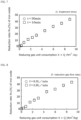
- FIG. 7 shows a relation between the reducing gas unit consumption x ⁇ Q and the reduction ratio R Fe (%) of iron oxide.
- FIG. 7 also shows a result in a case where the reduction treatment is not performed (the reduction ratio of iron oxide is 0%).
- the reduction ratio R Fe of iron oxide is 11 to 33% when the reducing gas unit consumption x ⁇ Q is 1.5 to 6.0. Furthermore, in a case where a nitriding dephosphorization treatment as in the above-described case is performed after the reduction treatment, the phosphorus removal ratio ⁇ P is high when the reduction ratio R Fe of iron oxide is 11 to 33%.
- FIG. 8 shows a relation between the reduction ratio R Fe of iron oxide and the reducing gas unit consumption x ⁇ Q in a case where 20 g of iron ore is subjected to a reduction treatment at a temperature of 1000°C, in which a reducing gas flow rate is set to 0.5 L/min or 2.0 L/min
- FIG. 9 shows the same relationship in a case where 40 g of iron ore is subjected to a reduction treatment at a temperature of 1000°C, in which the reducing gas flow rate is set to 0.5 L/min or 2.0 L/min.
- FIGS. 8 and 9 also show results in a case where the reduction treatment is not performed (the reduction ratio of iron oxide is 0%).
- CO carbon monoxide
- FIGS. 10 and 11 show a relation between the reduction ratio R Fe of iron oxide and the reduction treatment temperature Tr and a relation between the phosphorus removal ratio ⁇ P and the reduction ratio R Fe of iron oxide, respectively, which are obtained from a result of an analysis before and after a nitriding dephosphorization treatment.
- FIG. 10 also shows a result in a case where the reduction treatment is not performed (the reduction ratio of iron oxide is 0%).
- the reduction ratio R Fe of iron oxide is high when the reduction treatment temperature Tr is not lower than 300°C.
- FIG. 10 shows a relation between the reduction ratio R Fe of iron oxide and the reduction treatment temperature Tr and a relation between the phosphorus removal ratio ⁇ P and the reduction ratio R Fe of iron oxide, respectively, which are obtained from a result of an analysis before and after a nitriding dephosphorization treatment.
- FIG. 10 also shows a result in a case where the reduction treatment is not performed (the reduction ratio of iron oxide is 0%).
- the reduction ratio R Fe of iron oxide is
- the phosphorus removal ratio ⁇ P is increased as compared with the case where the reduction treatment is not performed.
- the phosphorus removal ratio is high particularly when the reduction ratio R Fe of iron oxide is 10 to 26%.
- the reason why the reduction ratio R Fe of iron oxide is low when the reduction treatment temperature Tr is lower than 300°C is that Fe 2 O 3 was stable at lower than 300°C, and thus a reduction using carbon monoxide did not progress.
- a small-scale experiment was performed to confirm whether or not phosphorus is removed through nitriding when the nitriding dephosphorization treatment is carried out after a reduction treatment using the solid reducing agent.
- W M , W Fe2O3 , and W Mn2O3 denote masses (kg) of a solid reducing agent M and Fe 2 O 3 and Mn 2 O 3 in a phosphorus-containing substance, respectively
- M M , M Fe2O3 , and M Mn2O3 denote molar masses (kg/mol) of the solid reducing agent M and Fe 2 O 3 and Mn 2 O 3 in the phosphorus-containing substance, respectively
- the reducing agent ratio M/O on an amount-of-substance basis is expressed as (W M /M M )/ ⁇ (W Fe2O3 /M Fe2O3 ) + (W Mn2O3 /M Mn2O3 ) ⁇ .
- FIGS. 12 and 13 show a relation between the reduction ratio R Fe (%) of iron oxide and the reducing agent ratio M/O on an amount-of-substance basis and a relation between the phosphorus removal ratio ⁇ P (%) and the reduction ratio R Fe (%) of iron oxide, respectively, which are obtained from a result of an analysis before and after the treatment.
- the reduction ratio R Fe (%) of iron oxide refers to a ratio of an amount of reduced oxygen to total oxygen in iron oxide.
- the reason why the phosphorus removal ratio is low when the reduction ratio of iron oxide is lower than 11% is that Fe 2 O 3 remained after the reduction treatment, and thus the reaction (a) was suppressed until the reaction (e) finished progressing.
- the reduction ratio of iron oxide was larger than 33%, a part of the iron oxide was reduced to metallic iron, which then absorbed vaporized phosphorus, resulting in lowering the phosphorus removal ratio ⁇ P.
- Inventive Examples 1 to 20 of the present invention shown in Tables 2 to 5 in which the reduction treatment was performed first a phosphorus removal ratio is improved by performing the reduction treatment as compared with Comparative Example 1 of the present invention in which the reduction treatment was not performed, with any value of the reducing gas unit consumption x ⁇ Q. Furthermore, in Inventive Examples 1 to 20 of the present invention in which the reducing gas unit consumption x ⁇ Q is 1.5 to 6.0, as compared with Comparative Examples 2 to 17, the phosphorus removal ratio is as high as about 70%.
- Tables 8 to 9 show, along with results thereof, treatment conditions that an amount of iron ore was 4 t and a flow rate of the reducing gas was 25 L/min or 100 L/min.
- Inventive Examples 21 to 40 of the present invention shown in Tables 6 to 9 for any value of the reduction treatment temperature Tr, as compared with Comparative Example 1 in which the reduction treatment was not performed, a phosphorus removal ratio is improved by performing the reduction treatment.
- the phosphorus removal ratio is as high as about 70%.
- the reason why an increase in phosphorus removal ratio is small when the reducing gas unit consumption x ⁇ Q is less than 1.5 is that Fe 2 O 3 still remained after the reduction treatment, and thus the reaction (a) was suppressed until the reaction (e) progressed.
- Tables 10 to 11 show treatment conditions and results thereof where the reducing gas unit consumption x ⁇ Q was 3.0 or 5.0, an amount of iron ore was 2 t and a reduction treatment time was one hour.
- the phosphorus removal ratio ⁇ P is improved by the reduction treatment under a condition that the reduction treatment temperature Tr is not higher than 1300°C.
- the phosphorus removal ratio ⁇ P is high particularly in Inventive Examples 41 to 52 of the present invention in which the reduction treatment was performed at 300 to 1300°C.
- the reason why the phosphorus removal ratio is low in Comparative Examples 36 to 37 and Comparative Examples 40 to 41 in which the reduction treatment was performed at a temperature higher than 1300°C is that a melting point of iron ore used this time was 1370°C, so that the iron ore was in a semi-molten or molten state at the reduction treatment temperature Tr of 1350 or 1400°C, and as a result of aggregation of a sample, gaps and pores between iron ore particles disappeared to significantly reduce an interfacial area for contacting gas.
- a melting point T m used in this example was measured based on the first method described above in paragraph [0025].
- a temperature measurement and a gas composition analysis were performed at a location of the charged sample after a lapse of 15 minutes in the nitriding dephosphorization treatment.
- the phosphorus removal ratio ⁇ P is as high as about 70% particularly under a condition that the reducing agent ratio M/O on an amount-of-substance basis is 1/3 to 1.0.
- the reason why an increase in phosphorus removal ratio is small when the reducing agent ratio M/O on an amount-of-substance basis is less than 1/3 is as follows. That is, under the conditions of this example, a carbonaceous material is used as a solid reducing agent, and thus an amount of substance y of an oxygen atom that reacts with 1 mol of the solid reducing agent is 1 mol.
- Treatment Conditions Nos. 50 to 88 in Tables 12-5 to 12-7 show results of operations in which the reducing agent ratio M/O on an amount-of-substance basis was set to 0.33, 0.78, and 1.0 and the reduction treatment temperature Tr was made to vary.
- the phosphorus removal ratio ⁇ P based on a nitriding dephosphorization treatment is improved.
- the phosphorus removal ratio ⁇ P based on the nitriding dephosphorization treatment is high particularly when the reduction treatment temperature Tr is 300 to 1300°C.
- the dephosphorization method according to the present invention is not only a method for preferentially removing phosphorus from a phosphorus-containing substance but also a technique for preferentially reducing oxide, and this idea is applicable not only to the field of smelting and refining described merely as an example but also to other technical fields.
Landscapes
- Chemical & Material Sciences (AREA)
- Engineering & Computer Science (AREA)
- Organic Chemistry (AREA)
- Metallurgy (AREA)
- Materials Engineering (AREA)
- Manufacturing & Machinery (AREA)
- Life Sciences & Earth Sciences (AREA)
- Geology (AREA)
- Geochemistry & Mineralogy (AREA)
- Mechanical Engineering (AREA)
- General Life Sciences & Earth Sciences (AREA)
- Environmental & Geological Engineering (AREA)
- Inorganic Chemistry (AREA)
- Manufacture And Refinement Of Metals (AREA)
Claims (8)
- Verfahren zum Entfernen von Phosphor aus einer phosphorhaltigen Substanz, bei welchem die phosphorhaltige Substanz, die als Rohmaterial für das Schmelzen von Metall oder für die Metallraffination verwendet wird, mit einem stickstoffhaltigen Gas umgesetzt wird, so dass Phosphor in der phosphorhaltigen Substanz durch Nitrierung entfernt wird,
dadurch gekennzeichnet, dassvor einer Entfernung von Phosphor durch Nitrierung aus der phosphorhaltigen Substanz eine Reduktionsbehandlung durchgeführt wird, bei welcher die phosphorhaltige Substanz auf einen Temperaturbereich des nicht geschmolzenen Zustands erhitzt wird, um mit einem Reduktionsmittel zu reagieren, wodurch mindestens ein Teil des Metalloxids in der phosphorhaltigen Substanz reduziert wird, wobeiein Reduktionsverhältnis von Eisenoxid und Manganoxid in der phosphorhaltigen Substanz am Ende der Reduktionsbehandlung auf nicht weniger als 11 % und weniger als 33 % eingestellt wird,wobei das Eisenoxid ein Einzelnes oder ein Gemisch von FeO, Fe3O4 und Fe2O3 darstellt,das Manganoxid ein Einzelnes oder ein Gemisch von MnO, Mn3O4, Mn2O3 und MnO2 darstellt unddas Reduktionsverhältnis sich auf ein Verhältnis einer durch Reduktion entfernten Sauerstoffmenge zu dem gesamten Sauerstoff in dem Eisenoxid und dem Manganoxid bezieht, wobeidas Reduktionsmittel ein reduzierendes Gas oder ein festes Reduktionsmittel ist, und wobeidie Reduktionsbehandlung unter Verwendung des reduzierenden Gases in einem Bereich des folgenden Ausdrucks (2) durchgeführt wird:
[Ausdruck 2] wobei x das Zweifache (-) eines Volumenverhältnisses eines Sauerstoffgases im Standardzustand bezeichnet, welches für die vollständige Verbrennung einer Volumeneinheit des Reduktionsgases im Standardzustand erforderlich ist, und Q eine Menge des für die Reduktionsbehandlung verwendeten Reduktionsgases (Nm3/kg) in Bezug auf eine Gesamtmenge des Eisenoxids und des Manganoxids in der phosphorhaltigen Substanz bezeichnet.
 - Verfahren zum Entfernen von Phosphor aus einer phosphorhaltigen Substanz gemäß Anspruch 1, wobei
das Reduktionsmittel einen Gleichgewichtssauerstoffpartialdruck von nicht mehr als 10-1 atm aufweist, welcher durch das Reduktionsmittel und ein Produkt, das aus der vollständigen Verbrennung des Reduktionsmittels bei einer Behandlungstemperatur der Reduktionsbehandlung resultiert, bestimmt wird. - Verfahren zum Entfernen von Phosphor aus einer phosphorhaltigen Substanz gemäß Anspruch 1 oder 2, wobeieine Behandlungstemperatur Tr (°C) der Reduktionsbehandlung eine Bedingung des folgenden Ausdrucks (1) erfüllt:
[Ausdruck 1] wobei Tm einen Schmelzpunkt (°C) der phosphorhaltigen Substanz bezeichnet.
 - Verfahren zum Entfernen von Phosphor aus einer phosphorhaltigen Substanz gemäß Anspruch 1, wobeidie Reduktionsbehandlung unter Verwendung des festen Reduktionsmittels durchgeführt wird, indem eine Masse WM (kg) eines festen Reduktionsmittels M so eingestellt wird, dass eine Bedingung des folgenden Ausdrucks (3) erfüllt ist:
[Ausdruck 3] wobei MM eine molare Masse (kg/mol) des festen Reduktionsmittels M bezeichnet,MFe2O3 eine molare Masse (kg/mol) von Fe2O3 bezeichnet,MMn2O3 eine molare Masse (kg/mol) von Mn2O3 bezeichnet,WM die Masse (kg) des festen Reduktionsmittels M bezeichnet,WFe2O3 eine Masse (kg) von Fe2O3 in der phosphorhaltigen Substanz bezeichnet,WMn2O3 eine Masse (kg) von Mn2O3 in der phosphorhaltigen Substanz bezeichnet undy eine Stoffmenge (mol) eines Sauerstoffatoms bezeichnet, welche mit 1 mol des festen Reduktionsmittels M reagiert.
 - Verfahren zum Entfernen von Phosphor aus einer phosphorhaltigen Substanz gemäß einem der Ansprüche 1 bis 4, wobei
die Entfernung durch Nitrierung aus der phosphorhaltigen Substanz eine Behandlung ist, bei welcher die phosphorhaltige Substanz auf eine Temperatur des nicht geschmolzenen Zustands erhitzt wird, um mit einem stickstoffhaltigen Gas mit einem Stickstoffpartialdruck von mehr als 0,15 atm und weniger als 0,95 atm zu reagieren, wodurch mindestens ein Teil des Phosphors in der phosphorhaltigen Substanz daraus in eine Gasphase entfernt wird. - Verfahren zum Entfernen von Phosphor aus einer phosphorhaltigen Substanz gemäß Anspruch 5, wobei
die Entfernung durch Nitrierung aus der phosphorhaltigen Substanz eine Behandlung ist, bei welcher die phosphorhaltige Substanz auf die Temperatur des nicht geschmolzenen Zustands erhitzt wird, um mit einem stickstoffhaltigen Gas mit einem Stickstoffpartialdruck von mehr als 0,15 atm und weniger als 0,95 atm zu reagieren, wodurch mindestens ein Teil des Phosphors in der phosphorhaltigen Substanz daraus als PN-Gas entfernt wird. - Verfahren zum Herstellen eines Rohmaterials zum Schmelzen von Metall oder eines Rohmaterials für die Metallraffination,
dadurch gekennzeichnet, dass
das Verfahren beim Herstellen des Rohmaterials zum Schmelzen von Metall oder des Rohmaterials für die Metallraffination einen Schritt zum Verringern eines Phosphorgehalts in einer phosphorhaltigen Substanz unter Verwendung des Verfahrens zum Entfernen von Phosphor aus einer phosphorhaltigen Substanz gemäß einem der Ansprüche 1 bis 6 umfasst. - Verfahren zum Herstellen von Metall,
dadurch gekennzeichnet, dass
beim Herstellen des Metalls über mindestens einen von einem Schmelzschritt oder einem Raffinierungsschritt das durch das Verfahren gemäß Anspruch 7 erhaltene Rohmaterial zum Schmelzen von Metall verwendet wird, um das Schmelzen im Schmelzschritt durchzuführen, oder das durch das Verfahren gemäß Anspruch 7 erhaltene Rohmaterial für die Metallraffination verwendet wird, um die Raffinierung im Raffinierungsschritt durchzuführen.
Applications Claiming Priority (3)
| Application Number | Priority Date | Filing Date | Title |
|---|---|---|---|
| JP2019117307 | 2019-06-25 | ||
| JP2019117329 | 2019-06-25 | ||
| PCT/JP2020/018445 WO2020261767A1 (ja) | 2019-06-25 | 2020-05-01 | リン含有物質からのリンの除去方法、金属製錬用原料または金属精錬用原料の製造方法および金属の製造方法 |
Publications (3)
| Publication Number | Publication Date |
|---|---|
| EP3992145A1 EP3992145A1 (de) | 2022-05-04 |
| EP3992145A4 EP3992145A4 (de) | 2022-08-17 |
| EP3992145B1 true EP3992145B1 (de) | 2025-07-02 |
Family
ID=73646815
Family Applications (1)
| Application Number | Title | Priority Date | Filing Date |
|---|---|---|---|
| EP20831257.9A Active EP3992145B1 (de) | 2019-06-25 | 2020-05-01 | Verfahren zur entfernung von phosphor aus phosphorhaltigen substanzensubstanz, verfahren zur herstellung von rohmaterial, rohmaterial für die metallschmelze oder rohmaterial für die metallraffination und verfahren zur herstellung von metall |
Country Status (5)
| Country | Link |
|---|---|
| US (1) | US12584187B2 (de) |
| EP (1) | EP3992145B1 (de) |
| JP (1) | JP6798654B1 (de) |
| KR (1) | KR102597737B1 (de) |
| CN (1) | CN114026041B (de) |
Families Citing this family (3)
| Publication number | Priority date | Publication date | Assignee | Title |
|---|---|---|---|---|
| CN118302544A (zh) * | 2021-11-30 | 2024-07-05 | 杰富意钢铁株式会社 | 金属铁的制造方法 |
| KR102883315B1 (ko) * | 2023-03-08 | 2025-11-07 | 엠케이전자 주식회사 | 솔더 합금, 이를 포함하는 솔더 볼, 및 이를 포함하는 반도체 부품 |
| WO2026037793A1 (de) * | 2024-08-14 | 2026-02-19 | Primetals Technologies Austria GmbH | Denitridierung von eisenschwamm |
Family Cites Families (15)
| Publication number | Priority date | Publication date | Assignee | Title |
|---|---|---|---|---|
| JPS5940209B2 (ja) * | 1977-12-16 | 1984-09-28 | 新日本製鐵株式会社 | 鉱石のリンを除去する方法 |
| JPS5675507A (en) | 1979-11-21 | 1981-06-22 | Sumitomo Metal Ind Ltd | Regenerating method of converter slag |
| JPS60261501A (ja) | 1984-06-08 | 1985-12-24 | Nippon Touseki Kk | 鉄鉱石からの脱燐法 |
| RU2001123C1 (ru) * | 1991-06-28 | 1993-10-15 | Московский институт стали и сплавов | Способ дефосфорации металла |
| JPH08176631A (ja) * | 1994-12-21 | 1996-07-09 | Kawasaki Steel Corp | 竪型溶融金属還元炉の操業方法 |
| JP2000119759A (ja) | 1998-10-13 | 2000-04-25 | Kawasaki Steel Corp | 鉄鉱石の脱りん方法 |
| CN100575512C (zh) * | 2008-07-03 | 2009-12-30 | 太原理工大学 | 一种锰矿粉的微波加热固态还原气化脱磷方法 |
| JP5332651B2 (ja) | 2008-12-26 | 2013-11-06 | Jfeスチール株式会社 | 製鋼スラグからの鉄及び燐の回収方法 |
| CN102126811B (zh) | 2011-01-21 | 2013-04-24 | 北京建工环境发展有限责任公司 | 用于污水强化脱氮的双缺氧脱氮方法及设备 |
| EP3042965A1 (de) | 2015-01-09 | 2016-07-13 | S.A. Lhoist Recherche Et Developpement | Verfahren zur Entphosphorisierung von geschmolzenem Metall während eines Raffinierungsverfahrens |
| JP6597332B2 (ja) * | 2016-01-18 | 2019-10-30 | 日本製鉄株式会社 | リン酸肥料の製造方法及びリン酸肥料の製造装置 |
| CN105907947B (zh) * | 2016-06-03 | 2018-08-28 | 江苏省冶金设计院有限公司 | 制备铁粉的方法和制备铁粉的系统 |
| CN108148942B (zh) | 2017-11-23 | 2019-08-06 | 华北理工大学 | 一种转炉炉渣留渣气化脱磷方法及循环利用冶炼方法 |
| BR112020013037B1 (pt) * | 2017-12-26 | 2023-03-21 | Jfe Steel Corporation | Método para remover fósforo de uma substância que contém fósforo |
| CN109321704B (zh) * | 2018-10-30 | 2021-02-26 | 华北理工大学 | 一种采用溅渣护炉降低冶炼终渣磷含量的冶炼方法 |
-
2020
- 2020-05-01 US US17/619,998 patent/US12584187B2/en active Active
- 2020-05-01 JP JP2020547160A patent/JP6798654B1/ja active Active
- 2020-05-01 CN CN202080046608.1A patent/CN114026041B/zh active Active
- 2020-05-01 EP EP20831257.9A patent/EP3992145B1/de active Active
- 2020-05-01 KR KR1020217038818A patent/KR102597737B1/ko active Active
Also Published As
| Publication number | Publication date |
|---|---|
| CN114026041A (zh) | 2022-02-08 |
| KR102597737B1 (ko) | 2023-11-02 |
| EP3992145A1 (de) | 2022-05-04 |
| JPWO2020261767A1 (ja) | 2021-09-13 |
| US12584187B2 (en) | 2026-03-24 |
| KR20220002544A (ko) | 2022-01-06 |
| BR112021025216A2 (pt) | 2022-02-01 |
| CN114026041B (zh) | 2024-08-13 |
| EP3992145A4 (de) | 2022-08-17 |
| US20220372591A1 (en) | 2022-11-24 |
| JP6798654B1 (ja) | 2020-12-09 |
Similar Documents
| Publication | Publication Date | Title |
|---|---|---|
| EP3733882B1 (de) | Verfahren zur entfernung von phosphor aus phosphorhaltiger substanz | |
| US12584187B2 (en) | Method for removing phosphorus from phosphorus-containing substance, method for manufacturing raw material for metal smelting or raw material for metal refining, and method for manufacturing metal | |
| JP2010189762A (ja) | 粒状鉄の製造方法 | |
| TWI797457B (zh) | 自含磷物質中除去磷的方法、金屬冶煉用原料或金屬精煉用原料之製造方法及金屬之製造方法 | |
| JP7067532B2 (ja) | 酸化マンガン含有物質の脱リン処理方法、低リン含有酸化マンガン含有物質の製造方法および該酸化マンガン含有物質を用いる鋼の製造方法 | |
| JP7476871B2 (ja) | 金属の製造方法 | |
| JP7047817B2 (ja) | 低リン鋼の製造方法 | |
| BR112021025216B1 (pt) | Método para remover fósforo a partir de substância contendo fósforo, método para fabricar matéria-prima para fundição de metal ou matéria-prima para refino de metal e método para fabricar metal | |
| TWI911868B (zh) | 錳碳化物之製造方法及含錳鋼之製造方法 | |
| TWI842235B (zh) | 金屬鐵的製造方法 | |
| JP7040499B2 (ja) | リン含有物質からのリン除去方法、および、鋼の製造方法 | |
| JP2023080996A (ja) | 金属の製造方法 | |
| JP2021004379A (ja) | 低リン鋼の製造方法 | |
| JP2001279338A (ja) | ロータリーキルンを用いた溶鉄製造方法 | |
| JP2021004380A (ja) | 低リン鋼の製造方法 | |
| JPH03271309A (ja) | 溶融還元による低窒素―高炭素鉄合金の製造方法 |
Legal Events
| Date | Code | Title | Description |
|---|---|---|---|
| STAA | Information on the status of an ep patent application or granted ep patent |
Free format text: STATUS: THE INTERNATIONAL PUBLICATION HAS BEEN MADE |
|
| PUAI | Public reference made under article 153(3) epc to a published international application that has entered the european phase |
Free format text: ORIGINAL CODE: 0009012 |
|
| STAA | Information on the status of an ep patent application or granted ep patent |
Free format text: STATUS: REQUEST FOR EXAMINATION WAS MADE |
|
| 17P | Request for examination filed |
Effective date: 20220104 |
|
| AK | Designated contracting states |
Kind code of ref document: A1 Designated state(s): AL AT BE BG CH CY CZ DE DK EE ES FI FR GB GR HR HU IE IS IT LI LT LU LV MC MK MT NL NO PL PT RO RS SE SI SK SM TR |
|
| A4 | Supplementary search report drawn up and despatched |
Effective date: 20220718 |
|
| RIC1 | Information provided on ipc code assigned before grant |
Ipc: C21C 7/04 20060101ALI20220712BHEP Ipc: C22B 1/11 20060101ALI20220712BHEP Ipc: C22B 1/02 20060101ALI20220712BHEP Ipc: C22B 1/00 20060101ALI20220712BHEP Ipc: C01B 21/097 20060101AFI20220712BHEP |
|
| DAV | Request for validation of the european patent (deleted) | ||
| DAX | Request for extension of the european patent (deleted) | ||
| STAA | Information on the status of an ep patent application or granted ep patent |
Free format text: STATUS: EXAMINATION IS IN PROGRESS |
|
| 17Q | First examination report despatched |
Effective date: 20230620 |
|
| GRAP | Despatch of communication of intention to grant a patent |
Free format text: ORIGINAL CODE: EPIDOSNIGR1 |
|
| STAA | Information on the status of an ep patent application or granted ep patent |
Free format text: STATUS: GRANT OF PATENT IS INTENDED |
|
| RIC1 | Information provided on ipc code assigned before grant |
Ipc: C21C 7/10 20060101ALI20250113BHEP Ipc: C21C 7/072 20060101ALI20250113BHEP Ipc: C21C 7/064 20060101ALI20250113BHEP Ipc: C21C 7/04 20060101ALI20250113BHEP Ipc: C22B 1/11 20060101ALI20250113BHEP Ipc: C22B 1/02 20060101ALI20250113BHEP Ipc: C22B 1/00 20060101ALI20250113BHEP Ipc: C01B 21/097 20060101AFI20250113BHEP |
|
| INTG | Intention to grant announced |
Effective date: 20250217 |
|
| RIN1 | Information on inventor provided before grant (corrected) |
Inventor name: KIKUCHI, NAOKI Inventor name: NAKAI, YOSHIE Inventor name: NAKASE, KENJI Inventor name: YAMADA, REI |
|
| GRAS | Grant fee paid |
Free format text: ORIGINAL CODE: EPIDOSNIGR3 |
|
| GRAA | (expected) grant |
Free format text: ORIGINAL CODE: 0009210 |
|
| STAA | Information on the status of an ep patent application or granted ep patent |
Free format text: STATUS: THE PATENT HAS BEEN GRANTED |
|
| AK | Designated contracting states |
Kind code of ref document: B1 Designated state(s): AL AT BE BG CH CY CZ DE DK EE ES FI FR GB GR HR HU IE IS IT LI LT LU LV MC MK MT NL NO PL PT RO RS SE SI SK SM TR |
|
| REG | Reference to a national code |
Ref country code: GB Ref legal event code: FG4D |
|
| REG | Reference to a national code |
Ref country code: CH Ref legal event code: EP |
|
| REG | Reference to a national code |
Ref country code: DE Ref legal event code: R096 Ref document number: 602020053944 Country of ref document: DE |
|
| REG | Reference to a national code |
Ref country code: IE Ref legal event code: FG4D |
|
| REG | Reference to a national code |
Ref country code: NL Ref legal event code: MP Effective date: 20250702 |
|
| PG25 | Lapsed in a contracting state [announced via postgrant information from national office to epo] |
Ref country code: PT Free format text: LAPSE BECAUSE OF FAILURE TO SUBMIT A TRANSLATION OF THE DESCRIPTION OR TO PAY THE FEE WITHIN THE PRESCRIBED TIME-LIMIT Effective date: 20251103 |
|
| PG25 | Lapsed in a contracting state [announced via postgrant information from national office to epo] |
Ref country code: NL Free format text: LAPSE BECAUSE OF FAILURE TO SUBMIT A TRANSLATION OF THE DESCRIPTION OR TO PAY THE FEE WITHIN THE PRESCRIBED TIME-LIMIT Effective date: 20250702 |
|
| REG | Reference to a national code |
Ref country code: AT Ref legal event code: MK05 Ref document number: 1809105 Country of ref document: AT Kind code of ref document: T Effective date: 20250702 |
|
| PG25 | Lapsed in a contracting state [announced via postgrant information from national office to epo] |
Ref country code: IS Free format text: LAPSE BECAUSE OF FAILURE TO SUBMIT A TRANSLATION OF THE DESCRIPTION OR TO PAY THE FEE WITHIN THE PRESCRIBED TIME-LIMIT Effective date: 20251102 |
|
| PG25 | Lapsed in a contracting state [announced via postgrant information from national office to epo] |
Ref country code: NO Free format text: LAPSE BECAUSE OF FAILURE TO SUBMIT A TRANSLATION OF THE DESCRIPTION OR TO PAY THE FEE WITHIN THE PRESCRIBED TIME-LIMIT Effective date: 20251002 |
|
| REG | Reference to a national code |
Ref country code: LT Ref legal event code: MG9D |
|
| PG25 | Lapsed in a contracting state [announced via postgrant information from national office to epo] |
Ref country code: AT Free format text: LAPSE BECAUSE OF FAILURE TO SUBMIT A TRANSLATION OF THE DESCRIPTION OR TO PAY THE FEE WITHIN THE PRESCRIBED TIME-LIMIT Effective date: 20250702 |
|
| PG25 | Lapsed in a contracting state [announced via postgrant information from national office to epo] |
Ref country code: FI Free format text: LAPSE BECAUSE OF FAILURE TO SUBMIT A TRANSLATION OF THE DESCRIPTION OR TO PAY THE FEE WITHIN THE PRESCRIBED TIME-LIMIT Effective date: 20250702 |
|
| PG25 | Lapsed in a contracting state [announced via postgrant information from national office to epo] |
Ref country code: HR Free format text: LAPSE BECAUSE OF FAILURE TO SUBMIT A TRANSLATION OF THE DESCRIPTION OR TO PAY THE FEE WITHIN THE PRESCRIBED TIME-LIMIT Effective date: 20250702 |
|
| PG25 | Lapsed in a contracting state [announced via postgrant information from national office to epo] |
Ref country code: GR Free format text: LAPSE BECAUSE OF FAILURE TO SUBMIT A TRANSLATION OF THE DESCRIPTION OR TO PAY THE FEE WITHIN THE PRESCRIBED TIME-LIMIT Effective date: 20251003 |
|
| PG25 | Lapsed in a contracting state [announced via postgrant information from national office to epo] |
Ref country code: CZ Free format text: LAPSE BECAUSE OF FAILURE TO SUBMIT A TRANSLATION OF THE DESCRIPTION OR TO PAY THE FEE WITHIN THE PRESCRIBED TIME-LIMIT Effective date: 20250702 Ref country code: SE Free format text: LAPSE BECAUSE OF FAILURE TO SUBMIT A TRANSLATION OF THE DESCRIPTION OR TO PAY THE FEE WITHIN THE PRESCRIBED TIME-LIMIT Effective date: 20250702 |
|
| PG25 | Lapsed in a contracting state [announced via postgrant information from national office to epo] |
Ref country code: LV Free format text: LAPSE BECAUSE OF FAILURE TO SUBMIT A TRANSLATION OF THE DESCRIPTION OR TO PAY THE FEE WITHIN THE PRESCRIBED TIME-LIMIT Effective date: 20250702 |
|
| PG25 | Lapsed in a contracting state [announced via postgrant information from national office to epo] |
Ref country code: PL Free format text: LAPSE BECAUSE OF FAILURE TO SUBMIT A TRANSLATION OF THE DESCRIPTION OR TO PAY THE FEE WITHIN THE PRESCRIBED TIME-LIMIT Effective date: 20250702 Ref country code: BG Free format text: LAPSE BECAUSE OF FAILURE TO SUBMIT A TRANSLATION OF THE DESCRIPTION OR TO PAY THE FEE WITHIN THE PRESCRIBED TIME-LIMIT Effective date: 20250702 |
|
| PG25 | Lapsed in a contracting state [announced via postgrant information from national office to epo] |
Ref country code: RS Free format text: LAPSE BECAUSE OF FAILURE TO SUBMIT A TRANSLATION OF THE DESCRIPTION OR TO PAY THE FEE WITHIN THE PRESCRIBED TIME-LIMIT Effective date: 20251002 |
|
| PG25 | Lapsed in a contracting state [announced via postgrant information from national office to epo] |
Ref country code: ES Free format text: LAPSE BECAUSE OF FAILURE TO SUBMIT A TRANSLATION OF THE DESCRIPTION OR TO PAY THE FEE WITHIN THE PRESCRIBED TIME-LIMIT Effective date: 20250702 |
|
| PG25 | Lapsed in a contracting state [announced via postgrant information from national office to epo] |
Ref country code: SM Free format text: LAPSE BECAUSE OF FAILURE TO SUBMIT A TRANSLATION OF THE DESCRIPTION OR TO PAY THE FEE WITHIN THE PRESCRIBED TIME-LIMIT Effective date: 20250702 |
|
| PG25 | Lapsed in a contracting state [announced via postgrant information from national office to epo] |
Ref country code: DK Free format text: LAPSE BECAUSE OF FAILURE TO SUBMIT A TRANSLATION OF THE DESCRIPTION OR TO PAY THE FEE WITHIN THE PRESCRIBED TIME-LIMIT Effective date: 20250702 |
|
| PG25 | Lapsed in a contracting state [announced via postgrant information from national office to epo] |
Ref country code: IT Free format text: LAPSE BECAUSE OF FAILURE TO SUBMIT A TRANSLATION OF THE DESCRIPTION OR TO PAY THE FEE WITHIN THE PRESCRIBED TIME-LIMIT Effective date: 20250702 |
|
| PG25 | Lapsed in a contracting state [announced via postgrant information from national office to epo] |
Ref country code: SK Free format text: LAPSE BECAUSE OF FAILURE TO SUBMIT A TRANSLATION OF THE DESCRIPTION OR TO PAY THE FEE WITHIN THE PRESCRIBED TIME-LIMIT Effective date: 20250702 Ref country code: EE Free format text: LAPSE BECAUSE OF FAILURE TO SUBMIT A TRANSLATION OF THE DESCRIPTION OR TO PAY THE FEE WITHIN THE PRESCRIBED TIME-LIMIT Effective date: 20250702 |
|
| PLBE | No opposition filed within time limit |
Free format text: ORIGINAL CODE: 0009261 |
|
| STAA | Information on the status of an ep patent application or granted ep patent |
Free format text: STATUS: NO OPPOSITION FILED WITHIN TIME LIMIT |