EP3992148A1 - Verfahren zur gewinnung von natriumsilikatpulver aus sandrückständen aus dem verfahren zur konzentrierung von eisenerz - Google Patents
Verfahren zur gewinnung von natriumsilikatpulver aus sandrückständen aus dem verfahren zur konzentrierung von eisenerz Download PDFInfo
- Publication number
- EP3992148A1 EP3992148A1 EP20858337.7A EP20858337A EP3992148A1 EP 3992148 A1 EP3992148 A1 EP 3992148A1 EP 20858337 A EP20858337 A EP 20858337A EP 3992148 A1 EP3992148 A1 EP 3992148A1
- Authority
- EP
- European Patent Office
- Prior art keywords
- sodium silicate
- iron ore
- tailings
- removal
- humidity
- Prior art date
- Legal status (The legal status is an assumption and is not a legal conclusion. Google has not performed a legal analysis and makes no representation as to the accuracy of the status listed.)
- Granted
Links
Images



Classifications
-
- C—CHEMISTRY; METALLURGY
- C01—INORGANIC CHEMISTRY
- C01B—NON-METALLIC ELEMENTS; COMPOUNDS THEREOF; METALLOIDS OR COMPOUNDS THEREOF NOT COVERED BY SUBCLASS C01C
- C01B33/00—Silicon; Compounds thereof
- C01B33/20—Silicates
- C01B33/32—Alkali metal silicates
-
- C—CHEMISTRY; METALLURGY
- C01—INORGANIC CHEMISTRY
- C01B—NON-METALLIC ELEMENTS; COMPOUNDS THEREOF; METALLOIDS OR COMPOUNDS THEREOF NOT COVERED BY SUBCLASS C01C
- C01B33/00—Silicon; Compounds thereof
- C01B33/20—Silicates
- C01B33/32—Alkali metal silicates
- C01B33/325—After-treatment, e.g. purification or stabilisation of solutions, granulation; Dissolution; Obtaining solid silicate, e.g. from a solution by spray-drying, flashing off water or adding a coagulant
-
- B—PERFORMING OPERATIONS; TRANSPORTING
- B09—DISPOSAL OF SOLID WASTE; RECLAMATION OF CONTAMINATED SOIL
- B09B—DISPOSAL OF SOLID WASTE NOT OTHERWISE PROVIDED FOR
- B09B3/00—Destroying solid waste or transforming solid waste into something useful or harmless
- B09B3/80—Destroying solid waste or transforming solid waste into something useful or harmless involving an extraction step
-
- C—CHEMISTRY; METALLURGY
- C01—INORGANIC CHEMISTRY
- C01P—INDEXING SCHEME RELATING TO STRUCTURAL AND PHYSICAL ASPECTS OF SOLID INORGANIC COMPOUNDS
- C01P2004/00—Particle morphology
- C01P2004/60—Particles characterised by their size
- C01P2004/61—Micrometer sized, i.e. from 1-100 micrometer
Definitions
- the present invention refers to a process of producing powdered sodium silicate from sand tailings of mineral production, notably iron ore processing.
- the present invention mainly addresses the production of raw materials used in the manufacturing of geopolymers and alkali activated materials to be employed mainly by the construction industry and in road paving.
- the utilization of this tailing reduces the environmental impact generated by the disposal of tailings in large dams, as well as enabling addition of value to a tailing by obtaining a commercially applicable product.
- Sodium silicate is an inorganic compound with the general formula Na 2 O.xSiO 2 (where x is between 2.06 and 3.87), obtained by the combination of SiO 2 (silicon dioxide or silica) and Na 2 O (sodium oxide). It may be found both in aqueous solution and in solid form, being widely used in several applications, products, and industrial processes, in various industry sectors.
- the sodium silicate family also known as waterglass, features various compounds that contain sodium oxide (Na 2 O) and silica (SiO 2 ), or a mixture of sodium silicates ranging their weighted ratios, solid content, density, and viscosity. These materials include a series of compounds that may be found in the form of sodium orthosilicate (Na 4 SiO 4 ), sodium metasilicate (Na 2 SiO 3 ), sodium polysilicate ([Na 2 SiO 3 ] n ), sodium pyrosilicate (Na 6 Si 2 O 7 ), among others. Such compounds have glassy, colorless, and clear features, and are water-soluble, as well as being commercially available in the form of powder or viscous solutions. Some forms are soluble, and others are almost insoluble, and insoluble forms are easily dissolved by heating with pressurized water.
- Sodium silicate is stable in neutral and alkaline solutions. In acid solutions, the silicate ion reacts with hydrogen ions to form silicic acid, which, when heated, forms silica gel, which is a hard and vitreous material.
- sodium silicate are as adhesive/binding agents, which are very important in several types of industries, such as paper, wood, metallic plates, glass, porcelain, optical applications, insulating materials, refractory cements, acid-proof and acid-resistant cements, briquettes, among others. Soluble silicates may also react with silicon fluoride or silica for producing acid-resistant cements with low contraction and thermal expansion similar to steel.
- sodium silicate is applied due to its capacity of dispersion of clay, sand, quartz, fluorite, kaolin particles, among others, thus acting as an auxiliary component in the grinding phase. It is also widely used in the flotation process, as it acts as a modifying reagent, being employed as a depressant and dispersing reagent. It is emphasized its use in sulphide flotation. There are also references of its application in the remediation of acid drainages in mines, due to its basic characteristic, and as a zeolite synthesizer.
- sodium silicate is used in the manufacturing of waterproof materials for walls, floors, and slabs. It is also used as an additive to accelerate cement curing and in the manufacturing of wall partitions and fire doors, due to its resistance to high temperatures. It is also used in the production of thermal insulators. It may also be applied in cosmetics and detergent industry.
- the standard process for manufacturing sodium silicate consists of mixing silica (SiO 2 ) with sodium carbonate (Na 2 CO 3 ) or, less frequently, with sodium sulphate (Na 2 SO 4 ), with are melted in an oven at high temperature (1200 °C to 1500 °C) and pressure.
- a second process involves dissolution of silicate material (sand, chalcedony, opal, diatomite, etc.) in a sodium hydroxide solution (NaOH), also at high temperature and pressure, this last one being more common in Brazil.
- the vitreous mixture is subjected to high pressure in an autoclave, with injection of vapor and water. A clear, slightly viscous, odorless, and fully soluble in water fluid is then formed.
- the solution which is strongly alkaline, is stable in all usage and storage conditions.
- the solution may be dried to form hydrated sodium silicate crystals.
- the final properties of the produced silicate are dependent on the SiO 2 /Na 2 O relation, which may be altered by the addition of NaOH during the process and may be summarized by the reaction: Na 2 CO 3 + nSiO 2 ⁇ Na 2 O.nSiO 2 + CO 2
- Sodium silicate contains three components: silica, which is the primary constituent; alkali, represented by sodium oxide, and water, which grants the hydration characteristics.
- Soluble sodium silicates are silicate polymers.
- the SiO 2 /Na 2 O ratio of the silicate generally expressed in mass, determines physical and chemical properties of the product and its functional activity. The variation of this ratio allows multiple uses for sodium silicate. As the SiO 2 /Na 2 O ratio increases, the viscosity increases and the pH of the solution decreases. With the increase in concentration, the solution increases in viscosity until it becomes a solid. For this reason, commercial solutions with a higher silica module are provided with lower total solid concentration.
- the melting of carbonate and sand takes place in the oven at a temperature of 1.500 °C Afterwards, the product obtained from this melting (100% sodium silicate) is sent to the autoclave, and water is added. Under pressure, silicate is dissolved, and becomes a sodium silicate solution, which is filtered afterwards.
- caustic soda and sand are mixed and poured into the reactor, at high pressure and temperature, where the following reaction occurs: 2 NaOH + xSiO 2 +(n-1)H 2 O ⁇ Na 2 O.xSiO 2 .nH 2 O
- tailings generate a positive environmental impact, when considering the possible benefits in face of the large amount of tailings produced during ore extraction, thus preventing its storage in dams, or even considerably reducing the size and volume of said facilities.
- Soluble silicates presented silica modules between 2.04 and 2.83. For this resulting silicate, density, viscosity and silica percentage were measured. Thus, experimentally produced sodium silicate was tested as a deflocculant for ceramic raw materials with a 0.40 percentage, compared to a 0.37% of commercial silicate. This process is distinct from the present invention, since it employs a hydrometallurgical (alkaline leaching) for obtaining sodium silicate, instead of a thermal metallurgy process.
- Patent US 7,335,342 filed in 03/14/2006, on behalf of the Council of Scientific and Industrial Research , titled "Process for the preparation of sodium silicate from kimberlite tailing", presents a process for the preparation of sodium silicate from kimberlite tailings generated as solid waste during diamond mining.
- the process comprises the reaction of kimberlite tailings in acidic means to remove soluble impurities, followed by digestion of kimberlite tailings with an alkaline solution in open or closed system, to obtain sodium silicate to be commercially employed.
- the proposed route involves the use of kimberlite tailings as a source of silica to produce sodium silicate.
- the tailings are subjected to a cleaning step, leaching with 18% w/v hydrochloric acid at a 1:4 ratio, at a temperature of 95-100 °C, for 3 to 5 hours.
- the pulp is filtered and washed until it reaches neutral pH levels.
- It is subsequently subjected to digestion by caustic soda, where an 8% to 10% by weight NaOH solution is added to the material, at a solid-liquid ratio of 1:4, at a temperature of 95-190 °C, in closed system, or at boiling temperature in an open system for 3 to 4 hours, obtaining sodium silicate with the required properties.
- sodium silicate is obtained by the reaction of sodium hydroxide with the flotation tailings at temperatures in the order of 450 °C for 2.5 hours. Powdered sodium silicate (Na 2 SiO 3 ) mixed with residual iron oxide of the tailings is obtained.
- geopolymers which are cement binders with similar functions to Portland cement.
- geopolymers are experiencing an increase in interest, since their manufacturing process emits only a fifth of the amount of carbon dioxide gas emitted for manufacturing Portland cement.
- the Portland cement industry within the industrial sector, is the second largest emitter of carbon dioxide gas.
- These binders are obtained by alkaline activation of materials rich in silica and alumina, with highlights to metakaolin and industrial residues. It requires addition of silica in the form of sodium (or potassium) silicates to metakaolin to increase the amount of silica in the obtaining of geopolymers.
- Geopolymers are inorganic polymers with increased resistance, obtained from a solid reactive mineral containing silicon and aluminum oxide which receive a basic activation solution with alkaline hydroxides or silicates.
- Geopolymers are products with numerous applications in construction industry as replacement for cement, as well as promoting reductions in CO 2 emissions. Its use in paving is very positive, as it considerably reduces the frequency of corrective maintenance, due to the lack of cracks and heat melting, which also implies in reducing paving and road maintenance costs.
- the present invention further presents an alternative to geopolymer production, where the sand tailings originated from iron ore concentration process are used as aggregate together with sodium silicate produced from the same tailings. Obtaining geopolymers from said tailings is seen as an alternative for decreasing tailings storage areas and to the elimination of dams.
- the present invention has as its overall objective to provide a process for obtaining sodium silicate from sand tailings from the iron ore concentration process, as a source of silica, for using in manufacturing geopolymers.
- Additional objectives of the present invention are to decrease tailings in iron ore processing units, which adds up to major environmental impact, and the utilization of this tailing, transforming it into a commercial product.
- Another objective of the present invention is, therefore, to reduce the environmental impact generated by the disposal of ore processing tailings in dams, which is possible by harnessing this material as a source of silicate material to produce sodium silicate.
- the present invention in its preferential embodiment, discloses a process for obtaining powdered sodium silicate from sand tailings generated from the iron ore concentration process, comprising the following steps:
- the main approach of this invention is related to a process for production of sodium silicate from materials with high silica (SiO 2 ) contents in their constitution, said materials being flotation tailings, generated by the iron ore concentration process.
- the production process of sodium silicate of the present invention uses sand tailings generated from the iron ore concentration process by flotation as source of silica-containing materials, which has characteristics similar to ordinary sand and may be used in this production process, in replacement of sand as a silica source.
- the production process of sodium silicate of the present invention comprises the following steps:
- the process starts with the removal of ultra-fine material (grain size lower than 40 ⁇ m), also called slurry, present in the sand tailings, which may be carried out by a cyclone system, thickening, or centrifugation or, more adequately, a combination of said unit operations, resulting in a material with suitable grain size to the subsequent processing.
- ultra-fine material grain size lower than 40 ⁇ m
- slurry present in the sand tailings
- the slurry-free material After removal of the ultra-fine fraction, the slurry-free material, with a solid percentage ranging between 20 and 65% (by mass), is sent to a dewatering step, which may be carried out by filtering or centrifugation, preparing the material for the next step of drying.
- the objective of filtering is to minimize material humidity, which leads to less energy consumption.
- the humidity of the obtained cake is also related, in addition to the presence of fine material, to minerals present in the composition. This unit operation preferably yields a cake with up to 15% by mass humidity, and this value is not limiting.
- drying step is important to ensure the removal of excess humidity of the material.
- This process may be carried out in several ways, however, the most common ones for solid materials are based on heat exchanging and, in the case of the present invention, it may preferably be by a direct (convection) or indirect (conduction) method. Drying is carried out in a standard dryer, being a rotation-type or fluid bed dryer, for example.
- the drying temperature used in the industry, particularly when referring to materials with no oxidization issues, is up to 105 °C, but it may be defined according to the equipment type to be used, as well as the time required. Depending on weather conditions and storage availability, drying may also be performed outdoors.
- the dry material After drying, the dry material receives a sodium hydroxide solution at a concentration of 33 to 38 gmol/L, at a mass ration of one part of dry material for two parts of solution, to obtain a paste.
- a blender is used to ensure efficient mixing with material homogeneity. The mixing is performed constantly for about 2 minutes, with no heat loss.
- the mixture obtained is sent to a heat step, in which a rotating furnace may be used at a process temperature of between 400 °C and 500 °C.
- the mixture heating may be carried out at an average heating rate of 10 °C/min, with a non-limiting preferred residence time of 2.5 hours.
- the material is subjected to a cooling phase in a heat exchanger, which may be of shell and tube type.
- a heat exchanger which may be of shell and tube type.
- the temperature of the powdered sodium silicate, i.e., final product of the present invention must be in the range of 60 °C and 75 °C. This product must be stored in a closed location or container, to prevent absorption of humidity due to its high hygroscopicity.
- Test bench scale tests were performed with iron ore processing tailing samples, aiming at the production of powdered sodium silicate. The obtained results show the possibility of obtaining sodium silicate suitable to use in producing geopolymers.
- VGR1 and VGR2 The chemical composition of the samples is presented in Table 1.
- Table 1 Average chemical composition of iron ore flotation tailing samples (Technique: X-ray Fluorescence) (%) Average composition of flotation tailings VGR1 VGR22 Fe 26.68 20.85 SiO 2 59.78 68.36 Al 2 O 3 1.03 0.37 P 0.028 0.013 Mn 0.029 0.015 CaO 0.011 0.010 MgO 0.027 0.023 TiO 2 0.102 0.018
- the tailings pulp was decanted at first, separating the supernatant, which included the ultra-fine fraction smaller than 40 ⁇ m, by siphoning.
- the decanted and thickened material was subjected to stove drying for 24h, at a temperature of 100 °C. After drying, the material was disaggregated and homogenized.
- the dried and homogenized material received a NaOH solution at a concentration of 37 gmol/L, at a 1:2 dried material / solution by mass ratio.
- the mixture was taken to a furnace and heated at a rate of 10 °C/min up to 450 °C, said temperature being maintained for 2.5 hours.
- the product of this heat treatment is sodium silicate, obtained in powder form. After this step, the product was cooled at room temperature and stored in a closed container, to prevent water absorption from the environment due to its hygroscopic behavior.
- Table 2 presents the chemical composition of the obtained powdered sodium silicate. It should be noted that the SiO 2 /Na 2 O ratio is lower than 1, unlike the commercial silicates, whose ratio ranges between 1.60 and 3.75. The excess amount of Na 2 O is a key feature of this product, since water addition to obtain the binding paste provides the alkaline medium required for dissolution of aluminate and silicate ions from metakaolin or other sources of said ions, in order to form the geopolymer.
- Table 2 Chemical composition of samples obtained from sodium silicate from sand tailings (Technique: X-ray Fluorescence) Oxides (%) Samples obtained from Powdered Sodium Silicate SS1 SS2 Na 2 O 47.34 47.80 SiO 2 37.72 37.71 Fe 2 O 3 13.33 13.32 SO 3 0.89 0.66 P 2 O 5 0.31 0.36 CaO 0.10 0.10 Cr 2 O 3 0.08 0.08 Sc 2 O 3 0.06 ND* *ND: not detected
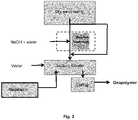
- Powdered sodium silicate (Na 2 SiO 3 ), obtained from the process described by the present invention, generated from sand tailings from the iron ore concentration process, may be used in producing geopolymers, which have application in road paving, for example, in which the obtaining process is shown in the block diagram of Figure 3 .
- Powdered sodium silicate obtained through the presented technique, according to Figure 3 may be mixed with metakaolin or other source of amorphous powdered aluminum-silicate, together with the flotation tailing. Afterwards, water is added to this mixture, producing a paste that is molded to obtain hardened monoliths. This material may be used to replace Portland cement mortar, with the added benefit of including a high fraction of tailings, which is not possible with this kind of cement.
- the geopolymer obtained may be used in construction industry or in sidewalk or road paving works. Obtaining this geopolymer from alternative silica-containing sources has been the subject of research and its use has the added benefit of avoiding handling highly alkaline solutions, in addition to featuring a process that is very similar to producing Portland cement mortar.
Landscapes
- Chemical & Material Sciences (AREA)
- Organic Chemistry (AREA)
- Inorganic Chemistry (AREA)
- Engineering & Computer Science (AREA)
- Environmental & Geological Engineering (AREA)
- Silicates, Zeolites, And Molecular Sieves (AREA)
- Manufacture And Refinement Of Metals (AREA)
- Curing Cements, Concrete, And Artificial Stone (AREA)
- Processing Of Solid Wastes (AREA)
Applications Claiming Priority (2)
| Application Number | Priority Date | Filing Date | Title |
|---|---|---|---|
| BR102019018080-3A BR102019018080B1 (pt) | 2019-08-30 | 2019-08-30 | Processo de obtenção de silicato de sódio em pó a partir de rejeito arenoso oriundo do processo de concentração de minério de ferro |
| PCT/BR2020/050261 WO2021035318A1 (pt) | 2019-08-30 | 2020-07-15 | Processo de obtenção de silicato de sódio em pó a partir de rejeito arenoso oriundo do processo de concentração de minério de ferro |
Publications (4)
| Publication Number | Publication Date |
|---|---|
| EP3992148A1 true EP3992148A1 (de) | 2022-05-04 |
| EP3992148A4 EP3992148A4 (de) | 2023-03-22 |
| EP3992148B1 EP3992148B1 (de) | 2023-11-15 |
| EP3992148C0 EP3992148C0 (de) | 2023-11-15 |
Family
ID=69054085
Family Applications (1)
| Application Number | Title | Priority Date | Filing Date |
|---|---|---|---|
| EP20858337.7A Active EP3992148B1 (de) | 2019-08-30 | 2020-07-15 | Verfahren zur gewinnung von natriumsilikatpulver aus sandrückständen aus dem verfahren zur konzentrierung von eisenerz |
Country Status (13)
| Country | Link |
|---|---|
| US (1) | US12286357B2 (de) |
| EP (1) | EP3992148B1 (de) |
| JP (1) | JP7509862B2 (de) |
| KR (1) | KR20220078555A (de) |
| CN (1) | CN114174227B (de) |
| AR (1) | AR119860A1 (de) |
| AU (1) | AU2020337184B2 (de) |
| BR (1) | BR102019018080B1 (de) |
| CA (1) | CA3144908C (de) |
| ES (1) | ES2969573T3 (de) |
| MX (1) | MX2022000832A (de) |
| TW (1) | TWI760829B (de) |
| WO (1) | WO2021035318A1 (de) |
Families Citing this family (7)
| Publication number | Priority date | Publication date | Assignee | Title |
|---|---|---|---|---|
| BR102020016451B1 (pt) | 2020-08-12 | 2021-11-03 | Pq Silicas Brazil Ltda | Solução estável de silicato de sódio e ferro, processo para preparar a referida solução e seus usos |
| CN112845524B (zh) * | 2021-01-04 | 2023-02-21 | 包头钢铁(集团)有限责任公司 | 一种铁矿固体废物综合利用方法 |
| CN114669585B (zh) * | 2022-03-14 | 2023-11-10 | 昆明理工大学 | 一种硅酸盐物料风化成土及资源化利用的方法 |
| CN114685104B (zh) * | 2022-04-11 | 2023-02-24 | 重庆工商大学 | 一种深海浮岛建设用硅藻土碱激发多孔轻质混凝土及其制备方法和用途 |
| JP7787530B2 (ja) * | 2022-05-13 | 2025-12-17 | 学校法人大阪産業大学 | ジオポリマー組成物、ジオポリマー硬化体及びジオポリマー硬化体の製造方法 |
| CN115572176B (zh) * | 2022-09-30 | 2023-06-20 | 广西欧神诺陶瓷有限公司 | 一种利用金属尾矿制备的轻质陶瓷砖及其制备方法 |
| JP7693161B1 (ja) * | 2025-03-26 | 2025-06-17 | マツモト産業株式会社 | 防草舗装方法 |
Family Cites Families (13)
| Publication number | Priority date | Publication date | Assignee | Title |
|---|---|---|---|---|
| CN101296865B (zh) | 2005-11-10 | 2011-10-12 | 科学与工业研究委员会 | 用于从金伯利岩尾矿制备硅酸钠的方法 |
| CN1982214A (zh) * | 2005-12-12 | 2007-06-20 | 秦才东 | 无水钠或钾的硅酸盐的生产方法 |
| RU2335456C1 (ru) | 2007-04-03 | 2008-10-10 | Государственное образовательное учреждение высшего профессионального образования "Братский государственный университет" | Способ получения жидкого стекла |
| RU2374177C1 (ru) | 2008-06-25 | 2009-11-27 | Государственное образовательное учреждение высшего профессионального образования "Братский государственный университет" | Способ получения жидкого стекла |
| CN102583417A (zh) | 2012-03-26 | 2012-07-18 | 西安科技大学 | 利用煤矸石制取水玻璃的方法 |
| CN103803571B (zh) * | 2014-03-11 | 2015-09-30 | 斯莱登(北京)化工科技有限公司 | 一种由铜镍渣制备水玻璃的方法 |
| CN103910362B (zh) * | 2014-04-29 | 2016-01-13 | 深圳市国大长兴科技有限公司 | 利用含硅尾矿矿粉制备硅酸盐水溶液的方法 |
| US11162158B2 (en) | 2015-09-18 | 2021-11-02 | The Trustees Of Columbia University In The City Of New York | Methods and systems for recovering products from iron and steel slag |
| CN105502426B (zh) * | 2015-12-09 | 2017-10-03 | 西南科技大学 | 用强碱焙烧法提取温石棉尾矿中氧化硅制备水玻璃的方法 |
| CN105692638A (zh) * | 2016-04-27 | 2016-06-22 | 王嘉兴 | 一种水玻璃的制备方法 |
| RU2682635C1 (ru) | 2018-01-18 | 2019-03-19 | Федеральное государственное бюджетное образовательное учреждение высшего образования "Челябинский государственный университет" | Способ получения жидкого стекла |
| CN108726525A (zh) | 2018-05-22 | 2018-11-02 | 广西银亿新材料有限公司 | 一种红土镍矿浸出渣生产水玻璃的方法 |
| CN109012517B (zh) | 2018-08-28 | 2020-09-29 | 浙江工业大学 | 一种以铁尾矿为原料制备复合型硅基气凝胶的方法 |
-
2019
- 2019-08-30 BR BR102019018080-3A patent/BR102019018080B1/pt active IP Right Grant
-
2020
- 2020-07-15 KR KR1020227002961A patent/KR20220078555A/ko active Pending
- 2020-07-15 ES ES20858337T patent/ES2969573T3/es active Active
- 2020-07-15 JP JP2022505358A patent/JP7509862B2/ja active Active
- 2020-07-15 CA CA3144908A patent/CA3144908C/en active Active
- 2020-07-15 EP EP20858337.7A patent/EP3992148B1/de active Active
- 2020-07-15 CN CN202080054025.3A patent/CN114174227B/zh active Active
- 2020-07-15 MX MX2022000832A patent/MX2022000832A/es unknown
- 2020-07-15 US US17/630,436 patent/US12286357B2/en active Active
- 2020-07-15 WO PCT/BR2020/050261 patent/WO2021035318A1/pt not_active Ceased
- 2020-07-15 AU AU2020337184A patent/AU2020337184B2/en active Active
- 2020-08-28 AR ARP200102428A patent/AR119860A1/es active IP Right Grant
- 2020-08-28 TW TW109129577A patent/TWI760829B/zh active
Also Published As
| Publication number | Publication date |
|---|---|
| AU2020337184A1 (en) | 2022-03-03 |
| JP7509862B2 (ja) | 2024-07-02 |
| TW202116680A (zh) | 2021-05-01 |
| US20220250923A1 (en) | 2022-08-11 |
| EP3992148A4 (de) | 2023-03-22 |
| CN114174227A (zh) | 2022-03-11 |
| ES2969573T3 (es) | 2024-05-21 |
| EP3992148B1 (de) | 2023-11-15 |
| TWI760829B (zh) | 2022-04-11 |
| CN114174227B (zh) | 2023-12-19 |
| JP2022545616A (ja) | 2022-10-28 |
| BR102019018080B1 (pt) | 2020-06-16 |
| CA3144908A1 (en) | 2021-03-04 |
| AR119860A1 (es) | 2022-01-19 |
| KR20220078555A (ko) | 2022-06-10 |
| CA3144908C (en) | 2023-05-09 |
| AU2020337184B2 (en) | 2023-12-07 |
| BR102019018080A2 (pt) | 2019-12-17 |
| MX2022000832A (es) | 2022-02-10 |
| WO2021035318A1 (pt) | 2021-03-04 |
| US12286357B2 (en) | 2025-04-29 |
| EP3992148C0 (de) | 2023-11-15 |
Similar Documents
| Publication | Publication Date | Title |
|---|---|---|
| EP3992148B1 (de) | Verfahren zur gewinnung von natriumsilikatpulver aus sandrückständen aus dem verfahren zur konzentrierung von eisenerz | |
| Badanoiu et al. | Preparation and characterization of foamed geopolymers from waste glass and red mud | |
| Pereira et al. | Mechanical and durability properties of alkali-activated mortar based on sugarcane bagasse ash and blast furnace slag | |
| Abi | Effect of borogypsum on brick properties | |
| CA3022523A1 (en) | Synthetic pozzolans | |
| Mahfoud et al. | Mechanical and microstructural properties of just add water geopolymer cement comprised of Thermo-Mechanicalsynthesis Sediments-Fly ash mix | |
| CN106573841A (zh) | 水泥混合料及其生产方法 | |
| RU2085489C1 (ru) | Способ получения жидкого стекла | |
| EP1226097B1 (de) | Synthetische silikatpelletzusammensetzung, verfahren zu dessen herstelung und dessen anwendung | |
| CN107162010A (zh) | 合成水化硅酸钙的方法及由该方法合成的水化硅酸钙 | |
| US8470087B2 (en) | Production method for a lightweight construction material using asbestos waste | |
| CN114620964B (zh) | 一种制备尾渣微骨料同时产出磁铁矿的方法 | |
| Ghanim et al. | Exemplification of efficacy of homebrewed sodium silicate solution processed from eco-processed pozzolan and palm oil clinker powder in geopolymer mortar | |
| CN116655363B (zh) | 一种利用含铍废渣制备陶瓷的方法 | |
| JPWO2021035318A5 (ja) | 鉄鉱石精鉱過程で生じる砂状尾鉱から粉末ケイ酸ナトリウムを得る方法 | |
| AU2022201537B2 (en) | Process of obtaining powdered sodium silicate from sandy tailings originated from the iron ore concentration process, use of the sodium silicate, and sodium silicate | |
| RU2752198C1 (ru) | Способ получения теплоизоляционного материала | |
| CN116143435B (zh) | 一种活性煤矸石早强混合料及流动性调整料及其制备方法 | |
| CN109354422A (zh) | 一种消除mswi底灰遇碱发泡膨胀的方法—高温煅烧熔融法 | |
| CN109437851A (zh) | 一种陶瓷道路砖及其制备工艺 | |
| Elwan et al. | Effect of by-pass cement dust on the properties of clay bricks | |
| Santos et al. | Plastic viscosity, microstructural, and mechanical characteristics of sustainable geopolymers based on metakaolin with the incorporation of long-neck bottles waste glass | |
| CN106278303B (zh) | 基于聚氯化铝废渣的莫来石质耐火材料及其制备方法 | |
| JP2004300005A (ja) | 人工ゼオライトの製造方法 | |
| Huilan¹ et al. | 1 School of Materials Science and Engineering, Hebei University of Science and Technology; Shijiazhuang, 050018, China 2Hebei Key Laboratory of Material Near-net Forming Technology, Hebei University of Science and Technology, Shijiazhuang 050018 |
Legal Events
| Date | Code | Title | Description |
|---|---|---|---|
| STAA | Information on the status of an ep patent application or granted ep patent |
Free format text: STATUS: THE INTERNATIONAL PUBLICATION HAS BEEN MADE |
|
| PUAI | Public reference made under article 153(3) epc to a published international application that has entered the european phase |
Free format text: ORIGINAL CODE: 0009012 |
|
| STAA | Information on the status of an ep patent application or granted ep patent |
Free format text: STATUS: REQUEST FOR EXAMINATION WAS MADE |
|
| 17P | Request for examination filed |
Effective date: 20220126 |
|
| AK | Designated contracting states |
Kind code of ref document: A1 Designated state(s): AL AT BE BG CH CY CZ DE DK EE ES FI FR GB GR HR HU IE IS IT LI LT LU LV MC MK MT NL NO PL PT RO RS SE SI SK SM TR |
|
| DAV | Request for validation of the european patent (deleted) | ||
| DAX | Request for extension of the european patent (deleted) | ||
| A4 | Supplementary search report drawn up and despatched |
Effective date: 20230216 |
|
| RIC1 | Information provided on ipc code assigned before grant |
Ipc: B09B 3/00 20060101ALI20230210BHEP Ipc: C01B 33/32 20060101AFI20230210BHEP |
|
| GRAP | Despatch of communication of intention to grant a patent |
Free format text: ORIGINAL CODE: EPIDOSNIGR1 |
|
| STAA | Information on the status of an ep patent application or granted ep patent |
Free format text: STATUS: GRANT OF PATENT IS INTENDED |
|
| INTG | Intention to grant announced |
Effective date: 20230602 |
|
| GRAS | Grant fee paid |
Free format text: ORIGINAL CODE: EPIDOSNIGR3 |
|
| GRAA | (expected) grant |
Free format text: ORIGINAL CODE: 0009210 |
|
| STAA | Information on the status of an ep patent application or granted ep patent |
Free format text: STATUS: THE PATENT HAS BEEN GRANTED |
|
| RAP3 | Party data changed (applicant data changed or rights of an application transferred) |
Owner name: VALE S.A. |
|
| AK | Designated contracting states |
Kind code of ref document: B1 Designated state(s): AL AT BE BG CH CY CZ DE DK EE ES FI FR GB GR HR HU IE IS IT LI LT LU LV MC MK MT NL NO PL PT RO RS SE SI SK SM TR |
|
| REG | Reference to a national code |
Ref country code: CH Ref legal event code: EP Ref country code: GB Ref legal event code: FG4D |
|
| REG | Reference to a national code |
Ref country code: DE Ref legal event code: R096 Ref document number: 602020021272 Country of ref document: DE |
|
| REG | Reference to a national code |
Ref country code: IE Ref legal event code: FG4D |
|
| U01 | Request for unitary effect filed |
Effective date: 20231213 |
|
| U07 | Unitary effect registered |
Designated state(s): AT BE BG DE DK EE FI FR IT LT LU LV MT NL PT SE SI Effective date: 20231220 |
|
| REG | Reference to a national code |
Ref country code: GR Ref legal event code: EP Ref document number: 20240400411 Country of ref document: GR Effective date: 20240312 |
|
| PG25 | Lapsed in a contracting state [announced via postgrant information from national office to epo] |
Ref country code: IS Free format text: LAPSE BECAUSE OF FAILURE TO SUBMIT A TRANSLATION OF THE DESCRIPTION OR TO PAY THE FEE WITHIN THE PRESCRIBED TIME-LIMIT Effective date: 20240315 |
|
| PG25 | Lapsed in a contracting state [announced via postgrant information from national office to epo] |
Ref country code: IS Free format text: LAPSE BECAUSE OF FAILURE TO SUBMIT A TRANSLATION OF THE DESCRIPTION OR TO PAY THE FEE WITHIN THE PRESCRIBED TIME-LIMIT Effective date: 20240315 |
|
| REG | Reference to a national code |
Ref country code: ES Ref legal event code: FG2A Ref document number: 2969573 Country of ref document: ES Kind code of ref document: T3 Effective date: 20240521 |
|
| PG25 | Lapsed in a contracting state [announced via postgrant information from national office to epo] |
Ref country code: RS Free format text: LAPSE BECAUSE OF FAILURE TO SUBMIT A TRANSLATION OF THE DESCRIPTION OR TO PAY THE FEE WITHIN THE PRESCRIBED TIME-LIMIT Effective date: 20231115 Ref country code: PL Free format text: LAPSE BECAUSE OF FAILURE TO SUBMIT A TRANSLATION OF THE DESCRIPTION OR TO PAY THE FEE WITHIN THE PRESCRIBED TIME-LIMIT Effective date: 20231115 Ref country code: NO Free format text: LAPSE BECAUSE OF FAILURE TO SUBMIT A TRANSLATION OF THE DESCRIPTION OR TO PAY THE FEE WITHIN THE PRESCRIBED TIME-LIMIT Effective date: 20240215 Ref country code: HR Free format text: LAPSE BECAUSE OF FAILURE TO SUBMIT A TRANSLATION OF THE DESCRIPTION OR TO PAY THE FEE WITHIN THE PRESCRIBED TIME-LIMIT Effective date: 20231115 |
|
| PG25 | Lapsed in a contracting state [announced via postgrant information from national office to epo] |
Ref country code: CZ Free format text: LAPSE BECAUSE OF FAILURE TO SUBMIT A TRANSLATION OF THE DESCRIPTION OR TO PAY THE FEE WITHIN THE PRESCRIBED TIME-LIMIT Effective date: 20231115 |
|
| PG25 | Lapsed in a contracting state [announced via postgrant information from national office to epo] |
Ref country code: SK Free format text: LAPSE BECAUSE OF FAILURE TO SUBMIT A TRANSLATION OF THE DESCRIPTION OR TO PAY THE FEE WITHIN THE PRESCRIBED TIME-LIMIT Effective date: 20231115 |
|
| PG25 | Lapsed in a contracting state [announced via postgrant information from national office to epo] |
Ref country code: SM Free format text: LAPSE BECAUSE OF FAILURE TO SUBMIT A TRANSLATION OF THE DESCRIPTION OR TO PAY THE FEE WITHIN THE PRESCRIBED TIME-LIMIT Effective date: 20231115 Ref country code: SK Free format text: LAPSE BECAUSE OF FAILURE TO SUBMIT A TRANSLATION OF THE DESCRIPTION OR TO PAY THE FEE WITHIN THE PRESCRIBED TIME-LIMIT Effective date: 20231115 Ref country code: RO Free format text: LAPSE BECAUSE OF FAILURE TO SUBMIT A TRANSLATION OF THE DESCRIPTION OR TO PAY THE FEE WITHIN THE PRESCRIBED TIME-LIMIT Effective date: 20231115 Ref country code: CZ Free format text: LAPSE BECAUSE OF FAILURE TO SUBMIT A TRANSLATION OF THE DESCRIPTION OR TO PAY THE FEE WITHIN THE PRESCRIBED TIME-LIMIT Effective date: 20231115 |
|
| REG | Reference to a national code |
Ref country code: DE Ref legal event code: R097 Ref document number: 602020021272 Country of ref document: DE |
|
| U20 | Renewal fee for the european patent with unitary effect paid |
Year of fee payment: 5 Effective date: 20240729 |
|
| PLBE | No opposition filed within time limit |
Free format text: ORIGINAL CODE: 0009261 |
|
| STAA | Information on the status of an ep patent application or granted ep patent |
Free format text: STATUS: NO OPPOSITION FILED WITHIN TIME LIMIT |
|
| 26N | No opposition filed |
Effective date: 20240819 |
|
| PG25 | Lapsed in a contracting state [announced via postgrant information from national office to epo] |
Ref country code: MC Free format text: LAPSE BECAUSE OF FAILURE TO SUBMIT A TRANSLATION OF THE DESCRIPTION OR TO PAY THE FEE WITHIN THE PRESCRIBED TIME-LIMIT Effective date: 20231115 |
|
| REG | Reference to a national code |
Ref country code: CH Ref legal event code: PL |
|
| PG25 | Lapsed in a contracting state [announced via postgrant information from national office to epo] |
Ref country code: CH Free format text: LAPSE BECAUSE OF NON-PAYMENT OF DUE FEES Effective date: 20240731 |
|
| U20 | Renewal fee for the european patent with unitary effect paid |
Year of fee payment: 6 Effective date: 20250725 |
|
| PGFP | Annual fee paid to national office [announced via postgrant information from national office to epo] |
Ref country code: ES Payment date: 20250801 Year of fee payment: 6 |
|
| PGFP | Annual fee paid to national office [announced via postgrant information from national office to epo] |
Ref country code: GR Payment date: 20250729 Year of fee payment: 6 |
|
| PGFP | Annual fee paid to national office [announced via postgrant information from national office to epo] |
Ref country code: GB Payment date: 20250725 Year of fee payment: 6 |
|
| PGFP | Annual fee paid to national office [announced via postgrant information from national office to epo] |
Ref country code: IE Payment date: 20250725 Year of fee payment: 6 |
|
| PG25 | Lapsed in a contracting state [announced via postgrant information from national office to epo] |
Ref country code: CY Free format text: LAPSE BECAUSE OF FAILURE TO SUBMIT A TRANSLATION OF THE DESCRIPTION OR TO PAY THE FEE WITHIN THE PRESCRIBED TIME-LIMIT; INVALID AB INITIO Effective date: 20200715 |
|
| PG25 | Lapsed in a contracting state [announced via postgrant information from national office to epo] |
Ref country code: HU Free format text: LAPSE BECAUSE OF FAILURE TO SUBMIT A TRANSLATION OF THE DESCRIPTION OR TO PAY THE FEE WITHIN THE PRESCRIBED TIME-LIMIT; INVALID AB INITIO Effective date: 20200715 |