EP3992327A1 - Stahldrahtnetz mit doppelbeschichtung - Google Patents
Stahldrahtnetz mit doppelbeschichtung Download PDFInfo
- Publication number
- EP3992327A1 EP3992327A1 EP20204411.1A EP20204411A EP3992327A1 EP 3992327 A1 EP3992327 A1 EP 3992327A1 EP 20204411 A EP20204411 A EP 20204411A EP 3992327 A1 EP3992327 A1 EP 3992327A1
- Authority
- EP
- European Patent Office
- Prior art keywords
- wire netting
- steel
- zinc
- coating
- polymer
- Prior art date
- Legal status (The legal status is an assumption and is not a legal conclusion. Google has not performed a legal analysis and makes no representation as to the accuracy of the status listed.)
- Withdrawn
Links
- 229910000831 Steel Inorganic materials 0.000 title claims abstract description 81
- 239000010959 steel Substances 0.000 title claims abstract description 81
- 238000000576 coating method Methods 0.000 title claims abstract description 55
- 239000011248 coating agent Substances 0.000 title claims abstract description 53
- 229920000642 polymer Polymers 0.000 claims abstract description 37
- -1 polyethylene terephthalate Polymers 0.000 claims abstract description 26
- 239000005020 polyethylene terephthalate Substances 0.000 claims abstract description 25
- 229920000139 polyethylene terephthalate Polymers 0.000 claims abstract description 25
- 239000011701 zinc Substances 0.000 claims abstract description 21
- 229910052725 zinc Inorganic materials 0.000 claims abstract description 21
- HCHKCACWOHOZIP-UHFFFAOYSA-N Zinc Chemical compound [Zn] HCHKCACWOHOZIP-UHFFFAOYSA-N 0.000 claims abstract description 20
- 229920001903 high density polyethylene Polymers 0.000 claims abstract description 19
- 239000004700 high-density polyethylene Substances 0.000 claims abstract description 19
- 229910000611 Zinc aluminium Inorganic materials 0.000 claims abstract description 14
- 229910052799 carbon Inorganic materials 0.000 claims abstract description 14
- 230000003628 erosive effect Effects 0.000 claims abstract description 12
- 229910045601 alloy Inorganic materials 0.000 claims abstract description 10
- 239000000956 alloy Substances 0.000 claims abstract description 10
- 229910000861 Mg alloy Inorganic materials 0.000 claims abstract description 5
- GANNOFFDYMSBSZ-UHFFFAOYSA-N [AlH3].[Mg] Chemical compound [AlH3].[Mg] GANNOFFDYMSBSZ-UHFFFAOYSA-N 0.000 claims abstract description 5
- VLKZOEOYAKHREP-UHFFFAOYSA-N n-Hexane Chemical compound CCCCCC VLKZOEOYAKHREP-UHFFFAOYSA-N 0.000 claims description 9
- 239000004411 aluminium Substances 0.000 claims description 8
- 229910052782 aluminium Inorganic materials 0.000 claims description 8
- XAGFODPZIPBFFR-UHFFFAOYSA-N aluminium Chemical compound [Al] XAGFODPZIPBFFR-UHFFFAOYSA-N 0.000 claims description 8
- 239000012535 impurity Substances 0.000 claims description 7
- 239000004609 Impact Modifier Substances 0.000 claims description 6
- 229910000640 Fe alloy Inorganic materials 0.000 claims description 5
- KFZAUHNPPZCSCR-UHFFFAOYSA-N iron zinc Chemical compound [Fe].[Zn] KFZAUHNPPZCSCR-UHFFFAOYSA-N 0.000 claims description 5
- 239000012745 toughening agent Substances 0.000 claims description 5
- 230000002902 bimodal effect Effects 0.000 claims description 3
- 239000001273 butane Substances 0.000 claims description 3
- 229920000092 linear low density polyethylene Polymers 0.000 claims description 3
- 239000004707 linear low-density polyethylene Substances 0.000 claims description 3
- IJDNQMDRQITEOD-UHFFFAOYSA-N n-butane Chemical compound CCCC IJDNQMDRQITEOD-UHFFFAOYSA-N 0.000 claims description 3
- OFBQJSOFQDEBGM-UHFFFAOYSA-N n-pentane Natural products CCCCC OFBQJSOFQDEBGM-UHFFFAOYSA-N 0.000 claims description 3
- TVMXDCGIABBOFY-UHFFFAOYSA-N octane Chemical compound CCCCCCCC TVMXDCGIABBOFY-UHFFFAOYSA-N 0.000 claims description 3
- 229920001296 polysiloxane Polymers 0.000 claims description 3
- 239000000376 reactant Substances 0.000 claims description 3
- 229920001897 terpolymer Polymers 0.000 claims description 3
- VGGSQFUCUMXWEO-UHFFFAOYSA-N Ethene Chemical compound C=C VGGSQFUCUMXWEO-UHFFFAOYSA-N 0.000 claims description 2
- 239000005977 Ethylene Substances 0.000 claims description 2
- FYYHWMGAXLPEAU-UHFFFAOYSA-N Magnesium Chemical compound [Mg] FYYHWMGAXLPEAU-UHFFFAOYSA-N 0.000 claims description 2
- CERQOIWHTDAKMF-UHFFFAOYSA-N Methacrylic acid Chemical compound CC(=C)C(O)=O CERQOIWHTDAKMF-UHFFFAOYSA-N 0.000 claims description 2
- 229920001577 copolymer Polymers 0.000 claims description 2
- 229910052749 magnesium Inorganic materials 0.000 claims description 2
- 239000011777 magnesium Substances 0.000 claims description 2
- 229920000098 polyolefin Polymers 0.000 claims description 2
- 229920000915 polyvinyl chloride Polymers 0.000 description 10
- 239000004800 polyvinyl chloride Substances 0.000 description 10
- 238000000034 method Methods 0.000 description 8
- 239000000203 mixture Substances 0.000 description 8
- OKTJSMMVPCPJKN-UHFFFAOYSA-N Carbon Chemical compound [C] OKTJSMMVPCPJKN-UHFFFAOYSA-N 0.000 description 5
- 229920003020 cross-linked polyethylene Polymers 0.000 description 5
- 238000005299 abrasion Methods 0.000 description 4
- 238000005260 corrosion Methods 0.000 description 4
- 230000007797 corrosion Effects 0.000 description 4
- 239000004703 cross-linked polyethylene Substances 0.000 description 3
- 229910052748 manganese Inorganic materials 0.000 description 3
- 239000011572 manganese Substances 0.000 description 3
- 239000003607 modifier Substances 0.000 description 3
- 229910052710 silicon Inorganic materials 0.000 description 3
- IJGRMHOSHXDMSA-UHFFFAOYSA-N Atomic nitrogen Chemical compound N#N IJGRMHOSHXDMSA-UHFFFAOYSA-N 0.000 description 2
- 229910001209 Low-carbon steel Inorganic materials 0.000 description 2
- PWHULOQIROXLJO-UHFFFAOYSA-N Manganese Chemical compound [Mn] PWHULOQIROXLJO-UHFFFAOYSA-N 0.000 description 2
- PXHVJJICTQNCMI-UHFFFAOYSA-N Nickel Chemical compound [Ni] PXHVJJICTQNCMI-UHFFFAOYSA-N 0.000 description 2
- 239000004698 Polyethylene Substances 0.000 description 2
- XUIMIQQOPSSXEZ-UHFFFAOYSA-N Silicon Chemical compound [Si] XUIMIQQOPSSXEZ-UHFFFAOYSA-N 0.000 description 2
- NINIDFKCEFEMDL-UHFFFAOYSA-N Sulfur Chemical compound [S] NINIDFKCEFEMDL-UHFFFAOYSA-N 0.000 description 2
- 239000005864 Sulphur Substances 0.000 description 2
- 230000002378 acidificating effect Effects 0.000 description 2
- WNROFYMDJYEPJX-UHFFFAOYSA-K aluminium hydroxide Chemical class [OH-].[OH-].[OH-].[Al+3] WNROFYMDJYEPJX-UHFFFAOYSA-K 0.000 description 2
- 229910021502 aluminium hydroxide Inorganic materials 0.000 description 2
- 230000007613 environmental effect Effects 0.000 description 2
- 238000001125 extrusion Methods 0.000 description 2
- 230000001965 increasing effect Effects 0.000 description 2
- 238000004519 manufacturing process Methods 0.000 description 2
- 229910052751 metal Inorganic materials 0.000 description 2
- 239000002184 metal Substances 0.000 description 2
- 229910052698 phosphorus Inorganic materials 0.000 description 2
- 239000004014 plasticizer Substances 0.000 description 2
- 229920000573 polyethylene Polymers 0.000 description 2
- 239000011347 resin Substances 0.000 description 2
- 229920005989 resin Polymers 0.000 description 2
- 239000010703 silicon Substances 0.000 description 2
- 230000007704 transition Effects 0.000 description 2
- VYZAMTAEIAYCRO-UHFFFAOYSA-N Chromium Chemical compound [Cr] VYZAMTAEIAYCRO-UHFFFAOYSA-N 0.000 description 1
- RYGMFSIKBFXOCR-UHFFFAOYSA-N Copper Chemical compound [Cu] RYGMFSIKBFXOCR-UHFFFAOYSA-N 0.000 description 1
- 229910000677 High-carbon steel Inorganic materials 0.000 description 1
- ZOKXTWBITQBERF-UHFFFAOYSA-N Molybdenum Chemical compound [Mo] ZOKXTWBITQBERF-UHFFFAOYSA-N 0.000 description 1
- OAICVXFJPJFONN-UHFFFAOYSA-N Phosphorus Chemical compound [P] OAICVXFJPJFONN-UHFFFAOYSA-N 0.000 description 1
- 238000010521 absorption reaction Methods 0.000 description 1
- 230000004888 barrier function Effects 0.000 description 1
- 230000009286 beneficial effect Effects 0.000 description 1
- 238000009954 braiding Methods 0.000 description 1
- 239000006229 carbon black Substances 0.000 description 1
- 230000015556 catabolic process Effects 0.000 description 1
- 229910052804 chromium Inorganic materials 0.000 description 1
- 239000011651 chromium Substances 0.000 description 1
- 238000001816 cooling Methods 0.000 description 1
- 229910052802 copper Inorganic materials 0.000 description 1
- 239000010949 copper Substances 0.000 description 1
- 239000013078 crystal Substances 0.000 description 1
- 238000002425 crystallisation Methods 0.000 description 1
- 230000008025 crystallization Effects 0.000 description 1
- 238000006731 degradation reaction Methods 0.000 description 1
- 238000009713 electroplating Methods 0.000 description 1
- 238000005246 galvanizing Methods 0.000 description 1
- 239000005556 hormone Substances 0.000 description 1
- 229940088597 hormone Drugs 0.000 description 1
- 229920000554 ionomer Polymers 0.000 description 1
- 238000002386 leaching Methods 0.000 description 1
- 239000000463 material Substances 0.000 description 1
- 229910052750 molybdenum Inorganic materials 0.000 description 1
- 239000011733 molybdenum Substances 0.000 description 1
- 125000000896 monocarboxylic acid group Chemical group 0.000 description 1
- 239000000178 monomer Substances 0.000 description 1
- 229910052759 nickel Inorganic materials 0.000 description 1
- 229910052757 nitrogen Inorganic materials 0.000 description 1
- 150000002978 peroxides Chemical class 0.000 description 1
- 239000011574 phosphorus Substances 0.000 description 1
- 229940098458 powder spray Drugs 0.000 description 1
- 238000002360 preparation method Methods 0.000 description 1
- 238000005507 spraying Methods 0.000 description 1
- 230000003068 static effect Effects 0.000 description 1
- XLYOFNOQVPJJNP-UHFFFAOYSA-N water Substances O XLYOFNOQVPJJNP-UHFFFAOYSA-N 0.000 description 1
- 150000003751 zinc Chemical class 0.000 description 1
Images
Classifications
-
- C—CHEMISTRY; METALLURGY
- C23—COATING METALLIC MATERIAL; COATING MATERIAL WITH METALLIC MATERIAL; CHEMICAL SURFACE TREATMENT; DIFFUSION TREATMENT OF METALLIC MATERIAL; COATING BY VACUUM EVAPORATION, BY SPUTTERING, BY ION IMPLANTATION OR BY CHEMICAL VAPOUR DEPOSITION, IN GENERAL; INHIBITING CORROSION OF METALLIC MATERIAL OR INCRUSTATION IN GENERAL
- C23C—COATING METALLIC MATERIAL; COATING MATERIAL WITH METALLIC MATERIAL; SURFACE TREATMENT OF METALLIC MATERIAL BY DIFFUSION INTO THE SURFACE, BY CHEMICAL CONVERSION OR SUBSTITUTION; COATING BY VACUUM EVAPORATION, BY SPUTTERING, BY ION IMPLANTATION OR BY CHEMICAL VAPOUR DEPOSITION, IN GENERAL
- C23C2/00—Hot-dipping or immersion processes for applying the coating material in the molten state without affecting the shape; Apparatus therefor
- C23C2/04—Hot-dipping or immersion processes for applying the coating material in the molten state without affecting the shape; Apparatus therefor characterised by the coating material
- C23C2/06—Zinc or cadmium or alloys based thereon
-
- B—PERFORMING OPERATIONS; TRANSPORTING
- B21—MECHANICAL METAL-WORKING WITHOUT ESSENTIALLY REMOVING MATERIAL; PUNCHING METAL
- B21F—WORKING OR PROCESSING OF METAL WIRE
- B21F15/00—Connecting wire to wire or other metallic material or objects; Connecting parts by means of wire
- B21F15/02—Connecting wire to wire or other metallic material or objects; Connecting parts by means of wire wire with wire
-
- B—PERFORMING OPERATIONS; TRANSPORTING
- B21—MECHANICAL METAL-WORKING WITHOUT ESSENTIALLY REMOVING MATERIAL; PUNCHING METAL
- B21F—WORKING OR PROCESSING OF METAL WIRE
- B21F27/00—Making wire network, i.e. wire nets
-
- C—CHEMISTRY; METALLURGY
- C22—METALLURGY; FERROUS OR NON-FERROUS ALLOYS; TREATMENT OF ALLOYS OR NON-FERROUS METALS
- C22C—ALLOYS
- C22C18/00—Alloys based on zinc
- C22C18/04—Alloys based on zinc with aluminium as the next major constituent
-
- C—CHEMISTRY; METALLURGY
- C22—METALLURGY; FERROUS OR NON-FERROUS ALLOYS; TREATMENT OF ALLOYS OR NON-FERROUS METALS
- C22C—ALLOYS
- C22C38/00—Ferrous alloys, e.g. steel alloys
- C22C38/001—Ferrous alloys, e.g. steel alloys containing N
-
- C—CHEMISTRY; METALLURGY
- C22—METALLURGY; FERROUS OR NON-FERROUS ALLOYS; TREATMENT OF ALLOYS OR NON-FERROUS METALS
- C22C—ALLOYS
- C22C38/00—Ferrous alloys, e.g. steel alloys
- C22C38/002—Ferrous alloys, e.g. steel alloys containing In, Mg, or other elements not provided for in one single group C22C38/001 - C22C38/60
-
- C—CHEMISTRY; METALLURGY
- C22—METALLURGY; FERROUS OR NON-FERROUS ALLOYS; TREATMENT OF ALLOYS OR NON-FERROUS METALS
- C22C—ALLOYS
- C22C38/00—Ferrous alloys, e.g. steel alloys
- C22C38/02—Ferrous alloys, e.g. steel alloys containing silicon
-
- C—CHEMISTRY; METALLURGY
- C22—METALLURGY; FERROUS OR NON-FERROUS ALLOYS; TREATMENT OF ALLOYS OR NON-FERROUS METALS
- C22C—ALLOYS
- C22C38/00—Ferrous alloys, e.g. steel alloys
- C22C38/04—Ferrous alloys, e.g. steel alloys containing manganese
-
- C—CHEMISTRY; METALLURGY
- C22—METALLURGY; FERROUS OR NON-FERROUS ALLOYS; TREATMENT OF ALLOYS OR NON-FERROUS METALS
- C22C—ALLOYS
- C22C38/00—Ferrous alloys, e.g. steel alloys
- C22C38/18—Ferrous alloys, e.g. steel alloys containing chromium
- C22C38/40—Ferrous alloys, e.g. steel alloys containing chromium with nickel
- C22C38/42—Ferrous alloys, e.g. steel alloys containing chromium with nickel with copper
-
- C—CHEMISTRY; METALLURGY
- C22—METALLURGY; FERROUS OR NON-FERROUS ALLOYS; TREATMENT OF ALLOYS OR NON-FERROUS METALS
- C22C—ALLOYS
- C22C38/00—Ferrous alloys, e.g. steel alloys
- C22C38/18—Ferrous alloys, e.g. steel alloys containing chromium
- C22C38/40—Ferrous alloys, e.g. steel alloys containing chromium with nickel
- C22C38/44—Ferrous alloys, e.g. steel alloys containing chromium with nickel with molybdenum or tungsten
-
- C—CHEMISTRY; METALLURGY
- C23—COATING METALLIC MATERIAL; COATING MATERIAL WITH METALLIC MATERIAL; CHEMICAL SURFACE TREATMENT; DIFFUSION TREATMENT OF METALLIC MATERIAL; COATING BY VACUUM EVAPORATION, BY SPUTTERING, BY ION IMPLANTATION OR BY CHEMICAL VAPOUR DEPOSITION, IN GENERAL; INHIBITING CORROSION OF METALLIC MATERIAL OR INCRUSTATION IN GENERAL
- C23C—COATING METALLIC MATERIAL; COATING MATERIAL WITH METALLIC MATERIAL; SURFACE TREATMENT OF METALLIC MATERIAL BY DIFFUSION INTO THE SURFACE, BY CHEMICAL CONVERSION OR SUBSTITUTION; COATING BY VACUUM EVAPORATION, BY SPUTTERING, BY ION IMPLANTATION OR BY CHEMICAL VAPOUR DEPOSITION, IN GENERAL
- C23C2/00—Hot-dipping or immersion processes for applying the coating material in the molten state without affecting the shape; Apparatus therefor
- C23C2/26—After-treatment
-
- C—CHEMISTRY; METALLURGY
- C23—COATING METALLIC MATERIAL; COATING MATERIAL WITH METALLIC MATERIAL; CHEMICAL SURFACE TREATMENT; DIFFUSION TREATMENT OF METALLIC MATERIAL; COATING BY VACUUM EVAPORATION, BY SPUTTERING, BY ION IMPLANTATION OR BY CHEMICAL VAPOUR DEPOSITION, IN GENERAL; INHIBITING CORROSION OF METALLIC MATERIAL OR INCRUSTATION IN GENERAL
- C23C—COATING METALLIC MATERIAL; COATING MATERIAL WITH METALLIC MATERIAL; SURFACE TREATMENT OF METALLIC MATERIAL BY DIFFUSION INTO THE SURFACE, BY CHEMICAL CONVERSION OR SUBSTITUTION; COATING BY VACUUM EVAPORATION, BY SPUTTERING, BY ION IMPLANTATION OR BY CHEMICAL VAPOUR DEPOSITION, IN GENERAL
- C23C2/00—Hot-dipping or immersion processes for applying the coating material in the molten state without affecting the shape; Apparatus therefor
- C23C2/34—Hot-dipping or immersion processes for applying the coating material in the molten state without affecting the shape; Apparatus therefor characterised by the shape of the material to be treated
- C23C2/36—Elongated material
- C23C2/38—Wires; Tubes
-
- C—CHEMISTRY; METALLURGY
- C23—COATING METALLIC MATERIAL; COATING MATERIAL WITH METALLIC MATERIAL; CHEMICAL SURFACE TREATMENT; DIFFUSION TREATMENT OF METALLIC MATERIAL; COATING BY VACUUM EVAPORATION, BY SPUTTERING, BY ION IMPLANTATION OR BY CHEMICAL VAPOUR DEPOSITION, IN GENERAL; INHIBITING CORROSION OF METALLIC MATERIAL OR INCRUSTATION IN GENERAL
- C23C—COATING METALLIC MATERIAL; COATING MATERIAL WITH METALLIC MATERIAL; SURFACE TREATMENT OF METALLIC MATERIAL BY DIFFUSION INTO THE SURFACE, BY CHEMICAL CONVERSION OR SUBSTITUTION; COATING BY VACUUM EVAPORATION, BY SPUTTERING, BY ION IMPLANTATION OR BY CHEMICAL VAPOUR DEPOSITION, IN GENERAL
- C23C28/00—Coating for obtaining at least two superposed coatings either by methods not provided for in a single one of groups C23C2/00 - C23C26/00 or by combinations of methods provided for in subclasses C23C and C25C or C25D
-
- C—CHEMISTRY; METALLURGY
- C23—COATING METALLIC MATERIAL; COATING MATERIAL WITH METALLIC MATERIAL; CHEMICAL SURFACE TREATMENT; DIFFUSION TREATMENT OF METALLIC MATERIAL; COATING BY VACUUM EVAPORATION, BY SPUTTERING, BY ION IMPLANTATION OR BY CHEMICAL VAPOUR DEPOSITION, IN GENERAL; INHIBITING CORROSION OF METALLIC MATERIAL OR INCRUSTATION IN GENERAL
- C23C—COATING METALLIC MATERIAL; COATING MATERIAL WITH METALLIC MATERIAL; SURFACE TREATMENT OF METALLIC MATERIAL BY DIFFUSION INTO THE SURFACE, BY CHEMICAL CONVERSION OR SUBSTITUTION; COATING BY VACUUM EVAPORATION, BY SPUTTERING, BY ION IMPLANTATION OR BY CHEMICAL VAPOUR DEPOSITION, IN GENERAL
- C23C28/00—Coating for obtaining at least two superposed coatings either by methods not provided for in a single one of groups C23C2/00 - C23C26/00 or by combinations of methods provided for in subclasses C23C and C25C or C25D
- C23C28/02—Coating for obtaining at least two superposed coatings either by methods not provided for in a single one of groups C23C2/00 - C23C26/00 or by combinations of methods provided for in subclasses C23C and C25C or C25D only coatings only including layers of metallic material
- C23C28/023—Coating for obtaining at least two superposed coatings either by methods not provided for in a single one of groups C23C2/00 - C23C26/00 or by combinations of methods provided for in subclasses C23C and C25C or C25D only coatings only including layers of metallic material only coatings of metal elements only
- C23C28/025—Coating for obtaining at least two superposed coatings either by methods not provided for in a single one of groups C23C2/00 - C23C26/00 or by combinations of methods provided for in subclasses C23C and C25C or C25D only coatings only including layers of metallic material only coatings of metal elements only with at least one zinc-based layer
-
- E—FIXED CONSTRUCTIONS
- E01—CONSTRUCTION OF ROADS, RAILWAYS, OR BRIDGES
- E01F—ADDITIONAL WORK, SUCH AS EQUIPPING ROADS OR THE CONSTRUCTION OF PLATFORMS, HELICOPTER LANDING STAGES, SIGNS, SNOW FENCES, OR THE LIKE
- E01F7/00—Devices affording protection against snow, sand drifts, side-wind effects, snowslides, avalanches or falling rocks; Anti-dazzle arrangements ; Sight-screens for roads, e.g. to mask accident site
- E01F7/04—Devices affording protection against snowslides, avalanches or falling rocks, e.g. avalanche preventing structures, galleries
-
- D—TEXTILES; PAPER
- D07—ROPES; CABLES OTHER THAN ELECTRIC
- D07B—ROPES OR CABLES IN GENERAL
- D07B2201/00—Ropes or cables
- D07B2201/20—Rope or cable components
- D07B2201/2001—Wires or filaments
- D07B2201/201—Wires or filaments characterised by a coating
- D07B2201/2011—Wires or filaments characterised by a coating comprising metals
-
- D—TEXTILES; PAPER
- D07—ROPES; CABLES OTHER THAN ELECTRIC
- D07B—ROPES OR CABLES IN GENERAL
- D07B2201/00—Ropes or cables
- D07B2201/20—Rope or cable components
- D07B2201/2001—Wires or filaments
- D07B2201/201—Wires or filaments characterised by a coating
- D07B2201/2012—Wires or filaments characterised by a coating comprising polymers
-
- D—TEXTILES; PAPER
- D07—ROPES; CABLES OTHER THAN ELECTRIC
- D07B—ROPES OR CABLES IN GENERAL
- D07B2201/00—Ropes or cables
- D07B2201/20—Rope or cable components
- D07B2201/2001—Wires or filaments
- D07B2201/201—Wires or filaments characterised by a coating
- D07B2201/2013—Wires or filaments characterised by a coating comprising multiple layers
-
- D—TEXTILES; PAPER
- D07—ROPES; CABLES OTHER THAN ELECTRIC
- D07B—ROPES OR CABLES IN GENERAL
- D07B2205/00—Rope or cable materials
- D07B2205/20—Organic high polymers
- D07B2205/201—Polyolefins
-
- D—TEXTILES; PAPER
- D07—ROPES; CABLES OTHER THAN ELECTRIC
- D07B—ROPES OR CABLES IN GENERAL
- D07B2205/00—Rope or cable materials
- D07B2205/20—Organic high polymers
- D07B2205/2039—Polyesters
-
- D—TEXTILES; PAPER
- D07—ROPES; CABLES OTHER THAN ELECTRIC
- D07B—ROPES OR CABLES IN GENERAL
- D07B2205/00—Rope or cable materials
- D07B2205/30—Inorganic materials
- D07B2205/3021—Metals
- D07B2205/3071—Zinc (Zn)
-
- D—TEXTILES; PAPER
- D07—ROPES; CABLES OTHER THAN ELECTRIC
- D07B—ROPES OR CABLES IN GENERAL
- D07B2205/00—Rope or cable materials
- D07B2205/30—Inorganic materials
- D07B2205/3021—Metals
- D07B2205/3085—Alloys, i.e. non ferrous
- D07B2205/3092—Zinc (Zn) and tin (Sn) alloys
-
- E—FIXED CONSTRUCTIONS
- E01—CONSTRUCTION OF ROADS, RAILWAYS, OR BRIDGES
- E01F—ADDITIONAL WORK, SUCH AS EQUIPPING ROADS OR THE CONSTRUCTION OF PLATFORMS, HELICOPTER LANDING STAGES, SIGNS, SNOW FENCES, OR THE LIKE
- E01F7/00—Devices affording protection against snow, sand drifts, side-wind effects, snowslides, avalanches or falling rocks; Anti-dazzle arrangements ; Sight-screens for roads, e.g. to mask accident site
- E01F7/04—Devices affording protection against snowslides, avalanches or falling rocks, e.g. avalanche preventing structures, galleries
- E01F7/045—Devices specially adapted for protecting against falling rocks, e.g. galleries, nets, rock traps
-
- E—FIXED CONSTRUCTIONS
- E02—HYDRAULIC ENGINEERING; FOUNDATIONS; SOIL SHIFTING
- E02D—FOUNDATIONS; EXCAVATIONS; EMBANKMENTS; UNDERGROUND OR UNDERWATER STRUCTURES
- E02D29/00—Independent underground or underwater structures; Retaining walls
- E02D29/02—Retaining or protecting walls
- E02D29/0208—Gabions
-
- E—FIXED CONSTRUCTIONS
- E02—HYDRAULIC ENGINEERING; FOUNDATIONS; SOIL SHIFTING
- E02D—FOUNDATIONS; EXCAVATIONS; EMBANKMENTS; UNDERGROUND OR UNDERWATER STRUCTURES
- E02D31/00—Protective arrangements for foundations or foundation structures; Ground foundation measures for protecting the soil or the subsoil water, e.g. preventing or counteracting oil pollution
-
- E—FIXED CONSTRUCTIONS
- E04—BUILDING
- E04H—BUILDINGS OR LIKE STRUCTURES FOR PARTICULAR PURPOSES; SWIMMING OR SPLASH BATHS OR POOLS; MASTS; FENCING; TENTS OR CANOPIES, IN GENERAL
- E04H17/00—Fencing, e.g. fences, enclosures, corrals
- E04H17/02—Wire fencing, e.g. made of wire mesh
- E04H17/04—Wire fencing, e.g. made of wire mesh characterised by the use of specially adapted wire, e.g. barbed wire, wire mesh, toothed strip or the like; Coupling means therefor
-
- Y—GENERAL TAGGING OF NEW TECHNOLOGICAL DEVELOPMENTS; GENERAL TAGGING OF CROSS-SECTIONAL TECHNOLOGIES SPANNING OVER SEVERAL SECTIONS OF THE IPC; TECHNICAL SUBJECTS COVERED BY FORMER USPC CROSS-REFERENCE ART COLLECTIONS [XRACs] AND DIGESTS
- Y02—TECHNOLOGIES OR APPLICATIONS FOR MITIGATION OR ADAPTATION AGAINST CLIMATE CHANGE
- Y02A—TECHNOLOGIES FOR ADAPTATION TO CLIMATE CHANGE
- Y02A40/00—Adaptation technologies in agriculture, forestry, livestock or agroalimentary production
- Y02A40/80—Adaptation technologies in agriculture, forestry, livestock or agroalimentary production in fisheries management
- Y02A40/81—Aquaculture, e.g. of fish
Definitions
- the invention relates to a steel wire netting adapted to be used in erosion control, geotechnical solutions or rockfall protection.
- steel wire nettings must meet demands that become more and more severe. These steel nettings are subjected to extreme climate circumstances and are very often installed at remote locations in nature. So the steel wire nettings must exhibit a long lifetime, which means that they must have a more than average resistance against humidity, corrosion, abrasion and impact. In addition, any present coatings on the steel wires of these steel wire nettings must remain undamaged during production.
- PVC polyvinyl chloride
- a PVC coating does not guarantee to meet the above-mentioned demands.
- One of the drawbacks of PVC is its humidity absorption.
- Another drawback is that the PVC may be damaged during production of the steel wire netting, e.g. during twisting or braiding.
- PVC shows embrittlement over time due to plasticizer leaching out. As these plasticizers are known to be hormone disruptive for living organisms, this causes environmental issues. Moreover, embrittlement will lead to lower adhesion, and lower resistance to impact of erosion and, over time, leading to spots of corrosion.
- WO-A1-2004/003302 discloses a wire netting where the steel wires are directly covered with a coating of cross-linked polyethylene on the steel cores of the steel wires.
- Cross-linked polyethylene is known as XPLE.
- the cross-linked polyethylene, particularly in its low-density form, can be filled with carbon black and be supplemented with peroxides.
- a steel wire netting adapted to be used in erosion control, in geotechnical solutions or in rockfall protection.
- the steel wire netting comprises steel wires. These steel wires have a steel core.
- the steel core is of a low-carbon or high-carbon nature (see below).
- the steel wires further have an intermediate metallic coating of zinc or of a zinc aluminium alloy or of a zinc aluminium magnesium alloy on the steel core.
- the steel wires further have a top coating of a polymer.
- This polymer being selected out of a polyethylene terephthalate or a high density polyethylene.
- Polyethylene terephthalate and a high density polyethylene have proven to be advantageous with respect to abrasion and erosion resistance and durability in terms of guaranteed properties over time in hot climates and under water like in rivers or in sea.
- These polymers may be applied on the steel wire preferably by means of extrusion or preferably by means of powder spray coating.
- a primer of modified polyolefin is present between the intermediate metallic coating and the polymer top coating.
- a first preferable embodiment for the intermediate metallic coating is a coating of zinc and unavoidable impurities.
- This zinc coating may be applied to the steel core by means of an electrolytic plating operation or by means of a hot dip process.
- the hot dip process is the preferable way.
- the hot dip process has the advantage of creating a thin zinc iron alloy layer between the steel core and the zinc coating.
- This zinc iron alloy layer has the drawback of being very brittle but the great advantage of being very beneficial for the adhesion between the intermediate metallic coating and the steel core.
- the brittle nature does not form a hurdle and does not weigh against the big advantages of the improved adhesion.
- the intermediate metallic coating may also be a zinc aluminium alloy or a zinc aluminium magnesium alloy.
- An intermediate metallic coating of a zinc aluminium alloy has, as such, a better corrosion resistance than an intermediate metallic coating of 100% zinc.
- This zinc aluminium alloy coating may have an aluminium content ranging from 2 wt % to 12 wt %, e.g. ranging from 3 wt % to 12 wt %, i.e. 4 wt % to 11 wt %.
- An example is a composition close to the eutectoid composition with between 4 wt % and 6 wt % aluminium, the rest being zinc and unavoidable impurities.
- Another example is a zinc aluminium magnesium alloy coating which comprises 2 wt % to 8 wt % aluminium and 0.05 % to 3.0 wt % magnesium, the remainder being zinc and unavoidable impurities.
- a preferable zinc aluminium alloy comprises 8 wt % to 12 wt % aluminium, the rest being zinc and unavoidable impurities.
- This preferable alloy has the advantage of a large presence of aluminium, amongst others at the surface.
- the aluminium at the surface may give rise to aluminium hydroxides that provide an excellent basis for bonds with either the primer or the top polymer coating.
- acidic groups can be introduced in a polyolefinic primer via copolymerisation of a different monomer or via grafting onto a polyolefin-like polymer. The acidic groups can react with the aluminium hydroxides to form a strong bond.
- the polymer used for the top coating is an impact modified polyethylene terephthalate.
- the impact modifier used in polyethylene terephthalate increases the crack resistance during use or during deformation. In other words, it provides ductility to the polyethylene terephthalate coating in the end application. This is done by influencing the crystallization process of the polyethylene terephthalate during cooling. Compared to a standard polyethylene terephthalate polymer, much smaller crystals are formed, providing less brittle material.
- the impact modifier is of a reactive type, which means that it can chemically react with the base resin and is fixed chemically in the polymer preventing it from coming out of the polymer.
- the reactive impact modifier is based on ethylene-ethyl acrylate-glycidyl methacrylate terpolymer.
- the modifier has a structure as shown herebelow.
- the impact modifier is added to the polyethylene therephthalate in amounts ranging between 1% and 4.5%.
- the thus modified polyethylene terephthalate Due to this modifier there is less degradation during the process of extruding the polymer on the metal coated steel wire, since it reacts directly with the COOH ends of the chains of polyethylene therephthalate.
- the binding of the modifier to the polyethylene terephthalate leads to enhanced mechanical properties and to the creation of new OH-functions.
- the thus modified polyethylene terephthalate has a higher viscosity leading to a higher and more stable centricity of the polymer coating around the metal coated steel wire.
- the thus modified polyethylene terephthalate is less moisture-sensitive both in processing and in coating properties.
- a toughening agent in the form of a high molecular weight of polysiloxane modified polyethylene terephthalate is added to the polymer.
- the amount of toughening agent added ranges between 1% and 4% of the total weight of the polymer.
- the addition of a toughening agent increases the resistance to abrasion and the resistance to erosion.
- the polymer is a high-density polyethylene of the bimodal based type with at least one co-reactant selected out of the group of butane, hexane and octane.
- the coating with this type of polymer has a high environmental resistance.
- an ionomer resin a copolymer of ethylene and methacrylic acid is added to the polymer in amounts ranging from 10% to 25%. This addition has the advantage of improving the erosion resistance.
- An alternative preferable embodiment of the polymer is a high-density polyethylene wherein 10% to 30% of a linear low density polyethylene has been mixed. This alternative also has an improved erosion resistance and increased strength.
- the wire netting according to the invention can be any type of wire netting including welded structures, but is preferably a double-twist hexagonal netting or a chain-link fence.
- a gabion made out of a wire netting as described above.
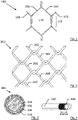
- FIGURE 1 is a schematic representation of part of a double-twist hexagonal wire netting 100.
- the part that is shown on FIGURE 1 has four steel double-coated wires 102, 104, 106 and 108.
- Each of these steel wires 102, 104, 106 and 108 makes alternatingly a connection with a neighboring steel wire at the left side and a neighboring steel wire at the right side.
- Each connection is formed by intertwisting the two neighboring steel wires.
- the intertwisting 110 shows the twisting of steel wire 102 with steel wire 104. As this intertwisting is done in a same process over the whole width of the entire wire netting, hexagonal meshes 112 are formed.
- FIGURE 2 is a schematic representation of part of a chainlink mesh 200.
- the part shown in FIGURE 2 has five undulated or zigzag wires 202, 204, 206, 208 and 210 which are alternatingly woven with a left neighboring steel wire and a right neighboring steel wire.
- FIGURE 3 shows the cross-section of a double coated steel wire 300 used in the wire netting according to the invention.
- a steel core 302 has an intermediate metallic coating of zinc 306.
- a brittle zinc iron alloy forms the transition 304 between the steel and the zinc.
- a primer 308 is present between the zinc layer and the top coating 310.
- the top coating 310 is a polyethylene terephthalate or a high-density polyethylene.
- the steel wires used in the present invention can be of a low-carbon nature or of a high-carbon nature.
- a low-carbon steel composition has a carbon content ranging between 0.04 wt % and 0.20 wt %.
- An example of a complete composition of such a low-carbon steel is as follows: a carbon content of 0.06 wt %, a silicon content of 0.166 wt %, a chromium content of 0.042 wt %, a copper content of 0.173 wt %, a manganese content of 0.382 wt %, a molybdenum content of 0.013 wt %, a nitrogen content of 0.006 wt %, a nickel content of 0.077 wt %, a phosphorus content of 0.007 wt %, a sulphur content of 0.013 wt %.
- a high-carbon steel composition carbon is a steel composition having more than 0.60 wt% carbon, more particularly it is a steel composition along following lines (all percentages being percentages by weight):
- the wire rod is drawn until its desired final steel wire diameter.
- the thus drawn steel wire is then subjected to a hot dip galvanizing process to provide a zinc coating with a zinc-iron alloy transition layer to the core steel wire.
- the zinc coated steel wire is then guided through a bath filled with a suitable primer to enhance the adhesion between the metallic intermediate coating and a top polymer coating.
- a suitable primer can be sprayed on the zinc coated steel wire.
- top polymer coating may be applied to the zinc coated steel wire by means of an extrusion process.
- FIGURE 4 The adhesion of a prior art polymer coating and various invention polymer coatings on a steel wire was tested via the so-called Furukawa adhesion test.
- a steel wire 400 is covered with a polymer coating 402.
- the polymer coating 402 is removed from the steel wire except for a length of 10 mm.
- the steel wire 400 with the remaining coating 402 is then pulled through a calibrated opening to strip the remaining coating 402. The force needed for this stripping is recorded.
Landscapes
- Chemical & Material Sciences (AREA)
- Engineering & Computer Science (AREA)
- Mechanical Engineering (AREA)
- Organic Chemistry (AREA)
- Materials Engineering (AREA)
- Metallurgy (AREA)
- Chemical Kinetics & Catalysis (AREA)
- Architecture (AREA)
- Civil Engineering (AREA)
- Structural Engineering (AREA)
- Laminated Bodies (AREA)
- Revetment (AREA)
- Ropes Or Cables (AREA)
- Farming Of Fish And Shellfish (AREA)
- Devices Affording Protection Of Roads Or Walls For Sound Insulation (AREA)
Priority Applications (7)
| Application Number | Priority Date | Filing Date | Title |
|---|---|---|---|
| EP20204411.1A EP3992327A1 (de) | 2020-10-28 | 2020-10-28 | Stahldrahtnetz mit doppelbeschichtung |
| EP21786980.9A EP4237592A1 (de) | 2020-10-28 | 2021-10-08 | Stahldrahtnetz mit doppelbeschichtung |
| PCT/EP2021/077935 WO2022089919A1 (en) | 2020-10-28 | 2021-10-08 | Steel wire netting with double coating |
| CN202180072761.6A CN116457489A (zh) | 2020-10-28 | 2021-10-08 | 具有双涂层的钢丝网 |
| US18/030,571 US20230372994A1 (en) | 2020-10-28 | 2021-10-08 | Steel wire netting with double coating |
| CONC2023/0004579A CO2023004579A2 (es) | 2020-10-28 | 2023-04-13 | Malla de alambre de acero con doble recubrimiento |
| ECSENADI202328253A ECSP23028253A (es) | 2020-10-28 | 2023-04-18 | Malla de alambre de acero con doble recubrimiento |
Applications Claiming Priority (1)
| Application Number | Priority Date | Filing Date | Title |
|---|---|---|---|
| EP20204411.1A EP3992327A1 (de) | 2020-10-28 | 2020-10-28 | Stahldrahtnetz mit doppelbeschichtung |
Publications (1)
| Publication Number | Publication Date |
|---|---|
| EP3992327A1 true EP3992327A1 (de) | 2022-05-04 |
Family
ID=73037818
Family Applications (2)
| Application Number | Title | Priority Date | Filing Date |
|---|---|---|---|
| EP20204411.1A Withdrawn EP3992327A1 (de) | 2020-10-28 | 2020-10-28 | Stahldrahtnetz mit doppelbeschichtung |
| EP21786980.9A Pending EP4237592A1 (de) | 2020-10-28 | 2021-10-08 | Stahldrahtnetz mit doppelbeschichtung |
Family Applications After (1)
| Application Number | Title | Priority Date | Filing Date |
|---|---|---|---|
| EP21786980.9A Pending EP4237592A1 (de) | 2020-10-28 | 2021-10-08 | Stahldrahtnetz mit doppelbeschichtung |
Country Status (6)
| Country | Link |
|---|---|
| US (1) | US20230372994A1 (de) |
| EP (2) | EP3992327A1 (de) |
| CN (1) | CN116457489A (de) |
| CO (1) | CO2023004579A2 (de) |
| EC (1) | ECSP23028253A (de) |
| WO (1) | WO2022089919A1 (de) |
Cited By (2)
| Publication number | Priority date | Publication date | Assignee | Title |
|---|---|---|---|---|
| CN115036069A (zh) * | 2022-08-11 | 2022-09-09 | 任丘市嘉华电讯器材有限公司 | 一种高强韧加强芯及其制造工艺 |
| US20240052565A1 (en) * | 2020-12-17 | 2024-02-15 | Nv Bekaert Sa | Compacted steel strand with cladded core |
Families Citing this family (1)
| Publication number | Priority date | Publication date | Assignee | Title |
|---|---|---|---|---|
| JP2025168119A (ja) * | 2024-04-27 | 2025-11-07 | 株式会社ミクニ | メッシュフェンス及びメッシュフェンスの製造方法 |
Citations (4)
| Publication number | Priority date | Publication date | Assignee | Title |
|---|---|---|---|---|
| JP3005524B2 (ja) * | 1998-01-30 | 2000-01-31 | タキロン株式会社 | 構造物用合成樹脂被覆線材及びこの線材からなる構造物用網体 |
| WO2000036177A1 (en) * | 1998-12-15 | 2000-06-22 | N.V. Bekaert S.A. | Steel wire with bright looking surface |
| WO2002061201A1 (en) * | 2001-01-16 | 2002-08-08 | N.V. Bekaert S.A. | Steel rope with double corrosion protection on the steel wires |
| WO2004003302A1 (en) | 2002-07-01 | 2004-01-08 | Officine Maccaferri S.P.A. | Cable covered with a xple sheath |
Family Cites Families (5)
| Publication number | Priority date | Publication date | Assignee | Title |
|---|---|---|---|---|
| JPS57117680A (en) | 1981-01-16 | 1982-07-22 | Unitika Ltd | Graing-proof fabric and production thereof |
| CN102276891A (zh) * | 2010-06-11 | 2011-12-14 | 中国石油天然气股份有限公司 | 管材用聚烯烃树脂组合物 |
| CN102261078A (zh) * | 2011-05-10 | 2011-11-30 | 湖南省交通规划勘察设计院 | 钢丝绳网及包含钢丝绳网的主动防护网和落石防护栅栏 |
| EP2572574A1 (de) * | 2011-09-20 | 2013-03-27 | NV Bekaert SA | Aquakulturnetz mit organischer Beschichtung in kritischem Bereich |
| CN210506952U (zh) * | 2019-05-14 | 2020-05-12 | 河北华兴电讯器材有限公司 | 一种绝缘镀锌钢绞线 |
-
2020
- 2020-10-28 EP EP20204411.1A patent/EP3992327A1/de not_active Withdrawn
-
2021
- 2021-10-08 US US18/030,571 patent/US20230372994A1/en active Pending
- 2021-10-08 WO PCT/EP2021/077935 patent/WO2022089919A1/en not_active Ceased
- 2021-10-08 EP EP21786980.9A patent/EP4237592A1/de active Pending
- 2021-10-08 CN CN202180072761.6A patent/CN116457489A/zh active Pending
-
2023
- 2023-04-13 CO CONC2023/0004579A patent/CO2023004579A2/es unknown
- 2023-04-18 EC ECSENADI202328253A patent/ECSP23028253A/es unknown
Patent Citations (4)
| Publication number | Priority date | Publication date | Assignee | Title |
|---|---|---|---|---|
| JP3005524B2 (ja) * | 1998-01-30 | 2000-01-31 | タキロン株式会社 | 構造物用合成樹脂被覆線材及びこの線材からなる構造物用網体 |
| WO2000036177A1 (en) * | 1998-12-15 | 2000-06-22 | N.V. Bekaert S.A. | Steel wire with bright looking surface |
| WO2002061201A1 (en) * | 2001-01-16 | 2002-08-08 | N.V. Bekaert S.A. | Steel rope with double corrosion protection on the steel wires |
| WO2004003302A1 (en) | 2002-07-01 | 2004-01-08 | Officine Maccaferri S.P.A. | Cable covered with a xple sheath |
Cited By (2)
| Publication number | Priority date | Publication date | Assignee | Title |
|---|---|---|---|---|
| US20240052565A1 (en) * | 2020-12-17 | 2024-02-15 | Nv Bekaert Sa | Compacted steel strand with cladded core |
| CN115036069A (zh) * | 2022-08-11 | 2022-09-09 | 任丘市嘉华电讯器材有限公司 | 一种高强韧加强芯及其制造工艺 |
Also Published As
| Publication number | Publication date |
|---|---|
| ECSP23028253A (es) | 2023-05-31 |
| US20230372994A1 (en) | 2023-11-23 |
| CO2023004579A2 (es) | 2023-04-27 |
| EP4237592A1 (de) | 2023-09-06 |
| WO2022089919A1 (en) | 2022-05-05 |
| CN116457489A (zh) | 2023-07-18 |
Similar Documents
| Publication | Publication Date | Title |
|---|---|---|
| US5014760A (en) | Steel wire for reinforcing elastomer articles with improved adhesion promoting layer | |
| US4854032A (en) | Method of manufacturing a steel wire with high tensile strength | |
| US4651513A (en) | Layered steel cord | |
| US20230372994A1 (en) | Steel wire netting with double coating | |
| US6276120B1 (en) | Push-pull steel cable with coating of polyethylene terephthalate | |
| US9951469B2 (en) | Steel cord for rubber reinforcement | |
| JP4610897B2 (ja) | 中間フィラメントがポリマーにより被覆された多層スチールコード | |
| CN101617080B (zh) | 具有铁锌合金涂层的钢索 | |
| US5873961A (en) | Process for producing patented steel wire | |
| CN110799699B (zh) | 橡胶物品增强用钢丝帘线 | |
| CN115210070B (zh) | 具有可延展绳的混凝土3d打印结构 | |
| EP3851575B1 (de) | Stahlseil zur verstärkung eines gummiartikels | |
| CN109604368B (zh) | 一种架空导线用超特高强镀锌钢丝及其制造方法 | |
| WO2002061201A1 (en) | Steel rope with double corrosion protection on the steel wires | |
| JPH0261184A (ja) | スチールコードおよびタイヤ | |
| EP1018574A2 (de) | Radialer Reifen mit einer Stahlseil aufweisenden Karkasse | |
| JPH0261187A (ja) | スチールコードおよびタイヤ | |
| EP4263934B1 (de) | Verdichteter stahlstrang mit plattiertem kern | |
| KR20010003864A (ko) | 스틸코드용 도금 강선의 제조방법 | |
| JPH0718100B2 (ja) | タイヤ用スチールコードおよびタイヤ | |
| JPH0253981A (ja) | スチールコードおよびタイヤ |
Legal Events
| Date | Code | Title | Description |
|---|---|---|---|
| PUAI | Public reference made under article 153(3) epc to a published international application that has entered the european phase |
Free format text: ORIGINAL CODE: 0009012 |
|
| STAA | Information on the status of an ep patent application or granted ep patent |
Free format text: STATUS: THE APPLICATION HAS BEEN PUBLISHED |
|
| AK | Designated contracting states |
Kind code of ref document: A1 Designated state(s): AL AT BE BG CH CY CZ DE DK EE ES FI FR GB GR HR HU IE IS IT LI LT LU LV MC MK MT NL NO PL PT RO RS SE SI SK SM TR |
|
| STAA | Information on the status of an ep patent application or granted ep patent |
Free format text: STATUS: THE APPLICATION HAS BEEN WITHDRAWN |
|
| 18W | Application withdrawn |
Effective date: 20220506 |