EP3992624B1 - Abbildungsprobe für massenspektrometer und verfahren zur herstellung davon - Google Patents
Abbildungsprobe für massenspektrometer und verfahren zur herstellung davon Download PDFInfo
- Publication number
- EP3992624B1 EP3992624B1 EP20833242.9A EP20833242A EP3992624B1 EP 3992624 B1 EP3992624 B1 EP 3992624B1 EP 20833242 A EP20833242 A EP 20833242A EP 3992624 B1 EP3992624 B1 EP 3992624B1
- Authority
- EP
- European Patent Office
- Prior art keywords
- biological tissue
- sample
- adhesive film
- conductive adhesive
- frozen
- Prior art date
- Legal status (The legal status is an assumption and is not a legal conclusion. Google has not performed a legal analysis and makes no representation as to the accuracy of the status listed.)
- Active
Links
Images


Classifications
-
- G—PHYSICS
- G01—MEASURING; TESTING
- G01N—INVESTIGATING OR ANALYSING MATERIALS BY DETERMINING THEIR CHEMICAL OR PHYSICAL PROPERTIES
- G01N1/00—Sampling; Preparing specimens for investigation
- G01N1/28—Preparing specimens for investigation including physical details of (bio-)chemical methods covered elsewhere, e.g. G01N33/50, C12Q
- G01N1/36—Embedding or analogous mounting of samples
-
- G—PHYSICS
- G01—MEASURING; TESTING
- G01N—INVESTIGATING OR ANALYSING MATERIALS BY DETERMINING THEIR CHEMICAL OR PHYSICAL PROPERTIES
- G01N1/00—Sampling; Preparing specimens for investigation
- G01N1/28—Preparing specimens for investigation including physical details of (bio-)chemical methods covered elsewhere, e.g. G01N33/50, C12Q
- G01N1/2813—Producing thin layers of samples on a substrate, e.g. smearing, spinning-on
-
- G—PHYSICS
- G01—MEASURING; TESTING
- G01N—INVESTIGATING OR ANALYSING MATERIALS BY DETERMINING THEIR CHEMICAL OR PHYSICAL PROPERTIES
- G01N1/00—Sampling; Preparing specimens for investigation
- G01N1/02—Devices for withdrawing samples
- G01N1/04—Devices for withdrawing samples in the solid state, e.g. by cutting
- G01N1/06—Devices for withdrawing samples in the solid state, e.g. by cutting providing a thin slice, e.g. microtome
-
- G—PHYSICS
- G01—MEASURING; TESTING
- G01N—INVESTIGATING OR ANALYSING MATERIALS BY DETERMINING THEIR CHEMICAL OR PHYSICAL PROPERTIES
- G01N1/00—Sampling; Preparing specimens for investigation
- G01N1/28—Preparing specimens for investigation including physical details of (bio-)chemical methods covered elsewhere, e.g. G01N33/50, C12Q
- G01N1/42—Low-temperature sample treatment, e.g. cryofixation
-
- G—PHYSICS
- G01—MEASURING; TESTING
- G01N—INVESTIGATING OR ANALYSING MATERIALS BY DETERMINING THEIR CHEMICAL OR PHYSICAL PROPERTIES
- G01N1/00—Sampling; Preparing specimens for investigation
- G01N1/28—Preparing specimens for investigation including physical details of (bio-)chemical methods covered elsewhere, e.g. G01N33/50, C12Q
- G01N1/2813—Producing thin layers of samples on a substrate, e.g. smearing, spinning-on
- G01N2001/2833—Collecting samples on a sticky, tacky, adhesive surface
-
- G—PHYSICS
- G01—MEASURING; TESTING
- G01N—INVESTIGATING OR ANALYSING MATERIALS BY DETERMINING THEIR CHEMICAL OR PHYSICAL PROPERTIES
- G01N1/00—Sampling; Preparing specimens for investigation
- G01N1/28—Preparing specimens for investigation including physical details of (bio-)chemical methods covered elsewhere, e.g. G01N33/50, C12Q
- G01N1/36—Embedding or analogous mounting of samples
- G01N2001/362—Embedding or analogous mounting of samples using continuous plastic film to mount sample
Definitions
- the present invention relates to a sliced biological tissue sample having a biological tissue attached to a conductive adhesive film. More specifically, the present invention relates to a sliced sample of a biological tissue (for example, an unfixed non-decalcified hard tissue, a whole body of a laboratory animal, or a plant sample) which can be used in life science studies (for example, a histological study, a histochemical study, an enzyme histochemical study, an immunohistochemical study, a genetic histochemical study, a biodistribution study of water-soluble substances, a biochemical analysis of microregions, or a pharmacokinetic study) via imaging with a mass spectrometer, and a method for producing the sample.
- life science studies for example, a histological study, a histochemical study, an enzyme histochemical study, an immunohistochemical study, a genetic histochemical study, a biodistribution study of water-soluble substances, a biochemical analysis of microregions, or a pharmacokinetic study
- NPL 1 and 2 disclose a method for obtaining a frozen section from a frozen biological sample to prepare an imaging sample for a mass spectrometer.
- a non-conductive adhesive plastic film is used, or a section is prepared using the non-conductive adhesive film followed by physical or chemical treatment to prepare an imaging sample for a mass spectrometer.
- the freezing and slicing are carried out at a sample temperature of, for example, -20 °C so as not to affect the retention of in vivo substances or the storage state such as tissue shape.
- a sample temperature of, for example, -20 °C
- a non-conductive plastic film is used, as described above. Consequently, there is a problem with imaging using a mass spectrometer, where electric charge accumulates in the sample and sensitivity is thus significantly reduced.
- a thin frozen sectioned sample for example, a thickness of 5 ⁇ m to 30 ⁇ m
- sensitivity can be maintained and the effects on the retention of in vivo substances and the storage state such as tissue shape are eliminated, from an unfixed non-decalcified hard tissue or a large biological sample (for example, a slice surface of 4 cm ⁇ 5 cm in size).
- an object of the present invention is to provide a sliced biological tissue sample for imaging with a mass spectrometer, capable of eliminating physical or chemical effects and adhesively supporting a thin frozen section of hard tissue or large biological tissue even at low temperature, and a method for producing the sample.
- the present inventors have intensively studied and experimented so as to achieve the above object.
- the present inventors have unexpectedly discovered that the above object can be achieved by fixing a frozen biological tissue (for example, an unfixed non-decalcified hard tissue, a whole body of a laboratory animal, or a plant sample) to a freezing-slicing apparatus, attaching a thin film (hereinafter referred to as a conductive adhesive film) coated with a conductive adhesive which has adhesiveness even at low temperature to a predetermined surface of the fixed frozen biological tissue, and slicing the frozen biological tissue attached with the conductive adhesive film to a predetermined thickness with a blade.
- a frozen biological tissue for example, an unfixed non-decalcified hard tissue, a whole body of a laboratory animal, or a plant sample
- a freezing-slicing apparatus attaching a thin film (hereinafter referred to as a conductive adhesive film) coated with a conductive adhesive which has adhesiveness even at low temperature to a predetermined surface of the fixed frozen biological
- the present invention relates to a sliced biological tissue sample having a biological tissue attached to a conductive adhesive film, wherein an electrical resistance between two points separated by 75 mm or more on a surface of the conductive adhesive film to which the biological tissue is attached is 1.0 ⁇ 10 -2 ⁇ to less than 2.0 ⁇ 10 7 ⁇ , and wherein a median value of a temperature range in which an adhesive of the conductive adhesive film exhibits glass transition in DSC measurement is -150 °C to -40 °C.
- the present invention relates to a method for producing the sliced biological tissue sample comprising the following steps:
- a frozen section having a thickness of 5 ⁇ m to 30 ⁇ m in which the effects of reduced sensitivity, retantion of in vivo substances, changes in tissue shape, and another physical destruction or chemical contamination are eliminated, can be easily and reliably prepared from hard tissue or a large biological tissue (for example, a sample having a slice surface of 4 cm ⁇ 5 cm in size) without undergoing decalcification treatment or fixation treatment with chemical agents, and can then be used as an imaging sample for a mass spectrometer.
- the cut surface of the biological tissue can be used as-is for measurement, and the sharpness of an image is increased by the retention of in vivo substances and the prevention of charge accumulation.
- the adhesiveness is maintained even at low temperature between the biological tissue and the conductive adhesive film, physical destruction such as changes in tissue shape is eliminated.
- a series of biological tissue sections for example, 30 or more sections per mouse, can be easily prepared, and sample preparation efficiency is remarkably improved.
- One embodiment of the present invention is a sliced biological tissue sample having a biological tissue attached to a conductive adhesive film, wherein an electrical resistance between two points separated by 75 mm or more on a surface of the conductive adhesive film to which the biological tissue is attached (hereinafter simply referred to as electrical resistance) is 1.0 ⁇ 10 -2 ⁇ to less than 2.0 ⁇ 10 7 ⁇ , and wherein a median value of a temperature range in which an adhesive of the conductive adhesive film exhibits glass transition in DSC measurement (hereinafter, simply referred to as glass transition point) is -150 °C to -40 °C.
- the biological tissue is preferably embedded with a water-soluble embedding agent.
- the adhesive of the conductive adhesive film is preferably an acrylic-based adhesive or a silicone-based adhesive, more preferably a silicone-based adhesive.
- the sliced biological tissue sample may be in a frozen state at -35 °C to -10 °C or in a normal temperature state at 10 °C to 30 °C.
- the sliced biological tissue sample can be in a dry state as well.
- Another embodiment of the present invention is a method for producing the sliced biological tissue sample, comprising the following steps:
- the method for producing the sliced biological tissue sample can include embedding the biological tissue with a water-soluble embedding agent, preferably before freezing.
- the method for producing the sliced biological tissue sample can also include: temperature adjustment of adjusting the obtained sliced biological tissue sample to 10 °C to 30 °C; and/or drying the obtained frozen sliced biological tissue sample.
- the conductive adhesive film has a conductivity with an electrical resistance of 1.0 ⁇ 10 -2 ⁇ to less than 2.0 ⁇ 10 7 ⁇ between two points separated by 75 mm or more at least on a surface of the side in contact with the frozen biological tissue.
- the conductive adhesive film has conductivity as a whole (for example, when the conductive adhesive film comprises an adhesive and a backing, both the adhesive and the backing are conductive).
- the conductive adhesive also has conductivity to the substrate side.
- the slicing of a frozen biological tissue is usually carried out below freezing, specifically at low temperature of -35 °C to -10 °C.
- the conductive adhesive film is preferably arranged with an embedded biological tissue at low temperature, such that it is necessary for the conductive adhesive film to have adhesiveness (adhesion) at low temperature.
- the adhesion between the frozen biological tissue and the conductive adhesive film is often affected by the glass transition point of the conductive adhesive film.
- a rubbery state which exhibits adhesiveness, transitions to a glassy state, and adhesiveness may be reduced significantly.
- at least the glass transition point of the conductive adhesive film in contact with the frozen biological tissue must be -150 °C to -40 °C.
- another embodiment of the present invention is a method for producing the sliced biological tissue sample, comprising the following steps:
- Freezing is a step in which a biological tissue (sample) is frozen to obtain a frozen biological tissue.
- biological tissue is not particularly limited and encompasses hard tissue and a whole body of a laboratory animal, liver, kidney, skin, plant, and fruit.
- a laboratory animal include a mouse, a rat, a guinea pig, a hamster, and a rabbit.
- a frozen biological tissue can be prepared by cooling the biological tissue.
- the freezing temperature is not particularly limited as long as the biological tissue is frozen.
- the freezing treatment time is also not particularly limited.
- the biological tissue can undergo a freezing treatment in acetone inside a container cooled with dry ice, in a temperature of -70 °C or lower for about 30 minutes. The freezing treatment may end when the biological tissue is visually checked and confirmed to be frozen.
- the material of the container is not particularly limited as long as the sliced biological tissue sample or the analysis, such as mass spectrometry, using the sliced biological tissue sample is not affected, or the container does not become damaged or leak through the freezing.
- a known container can be used.
- the container for example, a stainless steel container, a glass container, a container using a polymer material, or a bag using a polymer material can be appropriately selected and used.
- the method for cooling the biological tissue is also not particularly limited as long as the conditions for freezing the biological tissue can be achieved.
- a method for cooling the container containing the biological tissue with a freezer or a method of immersing in a solvent cooled by a circulating freezer or a low temperature body such as dry ice, liquid nitrogen, or liquid propane can be adopted.
- embedding the biological tissue with a water-soluble embedding agent Before freezing, embedding the biological tissue with a water-soluble embedding agent may be included.
- a conventionally known embedding agent can be used, for example, a 3% by mass to 5% by mass carboxymethyl cellulose aqueous solution, an OCT compound, or a gelatin.
- the embedded biological tissue is typically an embedded block, and can be prepared by a conventionally known method (for example, in case of a mouse, a method in which hair is sheared off, embedded in a 4% by mass carboxymethyl cellulose solution, and freeze-treated in dry ice/acetone at a temperature of -70 °C or lower for about 30 minutes).
- a frozen embedded biological tissue can be prepared by placing the biological tissue and the water-soluble embedding agent inside a container and cooling the embedded biological tissue.
- the embedding may be carried out in atmospheric air or in an inert gas atmosphere.
- the embedding temperature is not particularly limited as long as the biological tissue and the water-soluble embedding agent are frozen.
- the freezing treatment time is also not particularly limited. The freezing treatment may end when the biological tissue and the water-soluble embedding agent are visually checked and confirmed to be frozen.
- the amount of the water-soluble embedding agent to be used is not particularly limited as long as the site of the biological tissue for which a frozen sliced biological tissue sample is to be prepared is immersed in the water-soluble embedding agent contained in the container.
- the amount of the water-soluble embedding agent to be used can be determined so as to have a frozen layer of the water-soluble embedding agent having a thickness of about 5 mm to 10 mm around the site of the biological tissue for which the sliced biological tissue sample is to be prepared.
- the capacity and shape of the container to be used can be appropriately selected according to the biological tissue.
- the material of the container is not particularly limited as long as the elution of the water-soluble embedding agent, the sliced biological tissue sample, or the analysis such as mass spectrometry using the sliced biological tissue sample is not affected, or the container does not become damaged or leak through the embedding.
- a container of a known material can be used, similar to those indicated for the freezing.
- the method for cooling the biological tissue and water-soluble embedding agent is not particularly limited as long as the conditions for freezing the biological tissue and water-soluble embedding agent can be achieved. A method similar to those indicated for the freezing can be adopted.
- Attaching is a step in which the conductive adhesive film is attached to a frozen biological tissue.
- the frozen biological tissue becomes a frozen embedded biological tissue.
- an embodiment using a frozen embedded biological tissue as the frozen biological tissue will be described.
- a frozen biological tissue may be read as a frozen embedded biological tissue.
- FIG. 1 shows an example of the conductive adhesive film.
- a conductive adhesive film 10 may comprise or consist only of a first adhesive 1; may comprise or consist only of a backing 2 and the first adhesive 1 having conductivity arranged on a first surface of the backing 2; may comprise or consist only of the first adhesive 1 having conductivity and a second adhesive 3 having or not having conductivity; or may comprise or consist only of the backing 2, the first adhesive 1 having conductivity arranged on the first surface of the backing 2, and the second adhesive 3 having or not having conductivity arranged on a second surface of the backing 2.
- the first adhesive 1 and the second adhesive 3 may be the same or different adhesives.
- the backing may be either a conductive material or a non-conductive material.
- the backing is selected from the group consisting of a metal foil, a plastic (conductive plastic or non-conductive plastic), and a fiber (conductive fiber or non-conductive fiber).
- the metal foil include aluminum foil and copper foil.
- the plastic include a polyolefin (for example, polypropylene), a vinyl resin (for example, polyvinyl chloride), and a polyester (for example, PET).
- the fiber include a nonwoven fabric.
- the thickness of the backing is preferably 0.1 ⁇ m to 200 ⁇ m, more preferably 5 ⁇ m to 150 ⁇ m, or even more preferably 25 ⁇ m to 75 ⁇ m.
- the first adhesive is conductive.
- the electrical resistance between two points separated by 75 mm or more is preferably 1.0 ⁇ 10 -2 ⁇ to less than 2.0 ⁇ 10 7 ⁇ . More preferably, the electrical resistance between two points separated by 75 mm or more is 1.0 ⁇ 10 -2 ⁇ to 1.0 ⁇ 10 3 ⁇ .
- the distance between the two points where the electrical resistance is measured is preferably 75 mm to 100 mm, more preferably 75 mm. When the electrical resistance cannot be measured at a spacing of 75 mm, the measurable electrical resistance (in the unit of ⁇ ) between two points may be divided by the distance (in the unit of mm) between the two points and then multiplied by 75 to calculate the value.
- the measuring device for the electrical resistance of the adhesive film is not particularly limited.
- the electrical resistance can be measured by a known method, for example, an ohmmeter or a tester. Measurement can be carried out, for example, by separating the terminals of the plus and minus test leads connected to the ohmmeter by 75 mm or more and bringing them into contact with a surface of the conductive adhesive film on the side in contact with the embedded biological sample.
- the adhesive film is placed on a glass plate (for example, a glass slide may be used), and then a weight is set on the adhesive film to carry out the measurement.
- the weight is about 100 g, has a bottom surface of about 900 mm 2 , and the surface thereof in contact with the adhesive film is made of a material (plastic, glass) having low conductivity.
- the first adhesive comprises a conductive substance and an adhesive polymer.
- the adhesive polymer of this embodiment may be conductive or non-conductive.
- the conductive substance include a powder of a metal (for example, nickel or copper).
- the adhesive may be blended so as to have a preferred electrical resistivity (in the present embodiment, the electrical resistance between two points separated by 75 mm or more is in a preferred range).
- examples of the conductive adhesive polymer include various conductive rubbers, from the viewpoint of obtaining good adhesive strength and flexibility even at low temperature.
- the conductive adhesive polymer may be a conductive polymer selected from the group consisting of a conductive acrylic, a conductive silicone, and a conductive urethane (these conductive polymers encompass ones having rubber elasticity and ones not having rubber elasticity at room temperature).
- the conductive adhesive polymer is preferably a conductive acrylic or a conductive silicone, more preferably a conductive silicone.
- the non-conductive adhesive polymer may be a rubber or a synthetic polymer, from the viewpoint of obtaining good adhesive strength and flexibility even at low temperature.
- the non-conductive adhesive polymer may be a polymer selected from the group consisting of an acrylic, a silicone, and a urethane (these polymers encompass ones having and not having rubber elasticity at room temperature).
- the non-conductive adhesive polymer is preferably an acrylic or a silicone, more preferably a silicone.
- the first adhesive may be composed of the above adhesive polymer and a conductive substance.
- An acrylic-based adhesive refers to an adhesive in which the polymer of the adhesive is an acrylic (including a conductive acrylic)
- a silicone-based adhesive refers to an adhesive in which the polymer of the adhesive is a silicone (including a conductive silicone).
- the acrylic-based adhesive is an adhesive polymer in which the main component is a polymer of an acrylic monomer.
- the structure and polymer composition thereof are not particularly limited, and any composition having the preferred glass transition point can be used as the adhesive of the present embodiment.
- an acrylic is a polymer of a methacrylic acid ester and/or an acrylic acid ester.
- the glass transition point of the polymer can be adjusted by changing the number of carbon atoms and structure of the ester groups or the composition ratio of the methacrylic acid ester and the acrylic acid ester.
- the degree of polymerization (can be used as, for example, a number average molecular weight and an indicator) of the acrylic can also be appropriately selected.
- the acrylic-based adhesive may be a copolymer with other monomer components.
- the silicone-based adhesive is an adhesive polymer in which the main component is a polysiloxane.
- the structure and composition thereof are not particularly limited, and any composition having the preferred glass transition point can be used as the adhesive.
- a polysiloxane has at least one structure as a repeating unit selected from the group consisting of M(R 1 R 2 R 3 SiO 1/2 ), D(R 4 R 5 SiO), T(R 6 SiO 3/2 ), and Q(SiO 2 ), where the R 1 , R 2 , R 3 , R 4 , R 5 , and R 6 each represent any organic group.
- the physical properties of the polysiloxane can be changed by changing the substituents on the silicon atom or the composition ratio or degree of polymerization of the substituents.
- the glass transition point of the first adhesive is preferably -150 °C to -40 °C, more preferably - 150 °C to -45 °C, or even more preferably -150 °C to -50 °C.
- the conductive adhesive film can remain attached to the biological sample in the series of steps (attaching and slicing) for preparing a sliced biological tissue sample.
- the effect of improving work efficiency and the effect of maintaining the shape of the prepared sliced biological tissue sample in good condition are obtained.
- the measuring lower limit for a DSC measuring device generally used by a person skilled in the art in measuring glass transition point is often -150 °C, and is thus set to -150 °C for convenience. Glass transition points lower than -150 °C are not actively excluded. In other words, an adhesive film having an adhesive with a glass transition point lower than -150 °C can be suitably used.
- the glass transition point of the adhesive can be measured by a known method. For example, using a DSC measuring device (differential scanning calorimetry device), the sample is cooled to the lower limit of the measuring range of the device, and then the temperature is raised at a rate of, for example, 3 °C/min. The calorific value change obtained when the temperature is raised is recorded, and the glass transition point can be read from the inflection point of the calorific value change curve. Generally, for the inflection point of the calorific value change curve associated with the glass transition point, two inflection points, on the low temperature side and the high temperature side, are often observed for one glass transition.
- a DSC measuring device differential scanning calorimetry device
- the temperature (midpoint) between the inflection point on the high temperature side and the inflection point on the low temperature side corresponds to the temperature range described above or not may be determined.
- the peak of the second derivative curve of the calorific value change curve can be set as the temperature of the inflection point of the calorific value change curve associated with the glass transition point. If it is difficult to cool the sample to the lower limit of the measuring range of the device, the measurement may be carried out in a range in which the sample can be easily cooled.
- the glass transition point of the adhesive can be presumed to be below the measuring range of the DSC device used for the measurement.
- the conductive adhesive film itself may be used as a sample to carry out the measurement.
- the backing of the conductive adhesive film has a glass transition point in the above measuring range, the backing from which the adhesive is removed is prepared by a known method such as a method of peeling off the adhesive or a method of wiping the adhesive off with a solvent.
- the glass transition point of the adhesive layer can be found from a comparison between the DSC measurement result of the backing and the DSC measurement result of the adhesive film.
- FIG. 2 is a cross-sectional drawing that shows an embodiment in which the conductive adhesive film is attached to a predetermined surface of a frozen embedded block as a frozen embedded biological tissue.
- the conductive adhesive film 10 is attached to the frozen embedded biological sample 4 by the first adhesive 1.
- the conductive adhesive film is attached to the desired surface of the biological sample embedded with a water-soluble embedding agent.
- the temperature at which the attaching is carried out is not particularly limited as long as the frozen embedded state of the biological sample is maintained, the adhesive of the conductive adhesive film preferably used in the present embodiment has adhesiveness, and the conductive adhesive film is attached to the biological sample.
- the attaching is carried out under the same temperature conditions as the slicing thereafter.
- the temperature is preferably -35 °C or higher, more preferably -30 °C or higher, and even more preferably -25 °C or higher, and is preferably -10 °C or lower, more preferably -15 °C or lower, and even more preferably -20 °C or lower. It is preferable that the biological sample and conductive adhesive tape embedded with the water-soluble embedding agent be adjusted preliminarily to the temperature at which the attaching is carried out.
- the conductive adhesive film is attached to a frozen embedded biological sample such that the frozen embedded biological sample is fixed to a sample stage of the biological tissue slicing apparatus.
- the conductive adhesive film may be pressed against the biological sample using a jig such as a trowel to increase the degree of attachment of the conductive adhesive film to the biological sample.
- a jig such as a trowel
- the surface of the biological sample to be attached to the conductive adhesive film is preliminarily planarized. More preferably, the surface of the biological sample to be attached to the conductive adhesive film is preliminarily pared using a blade, such as a microtome, to be planarized. It is preferable that the blade such as a microtome used in such case be adjusted preliminarily to the temperature at which the process is carried out. As described below, when a plurality of sliced biological tissue samples are prepared by carrying out the attaching and slicing multiple times, the surface of the biological sample after the slicing is planarized, and thus the conduction adhesive film may be attached as-is.
- a blade such as a microtome
- Slicing is a step in which the frozen biological tissue attached to the conductive adhesive film is sliced to a predetermined thickness at -35 °C to -10 °C.
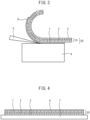
- FIG. 3 is a cross-sectional drawing that shows the relationship between a frozen section and the conductive adhesive film during slicing.
- the embedded biological sample 4 in a frozen state with the conductive adhesive film 10 is cut with a blade 5 (for example, a blade made of tungsten carbide) to a predetermined thickness (for example, 5 ⁇ m to 50 ⁇ m, which is a thickness suitable for life science studies via imaging with a mass spectrometer) to prepare an imaging sample 20 comprising the conductive adhesive film 10 and a sliced sample 6 attached to the conductive adhesive film 10.
- a blade 5 for example, a blade made of tungsten carbide
- a predetermined thickness for example, 5 ⁇ m to 50 ⁇ m, which is a thickness suitable for life science studies via imaging with a mass spectrometer
- the conductive adhesive film When slicing the frozen embedded biological sample, the conductive adhesive film also functions as a support for the obtained sliced sample.
- the second adhesive film 10 has a second adhesive 3 on a second surface of the backing 2
- the second adhesive has a function of fixing the sample to the substrate of a mass spectrometer.
- the sample is usually fixed while being stretched without causing wrinkles. Therefore, the backing 2, the first adhesive 1, and the second adhesive 3 are preferably selected so as to have strong adhesive strength as well as good flexibility and pliability at normal temperature.
- an adhesive is used separately for fixing the substrate and the sample, it is not necessary for the conductive adhesive film to comprise a second adhesive.
- the second adhesive may be a conductive or non-conductive, natural rubber or synthetic rubber, from the viewpoint of obtaining superior adhesive strength and flexibility at normal temperature.
- the second adhesive may be one or more polymers selected from the group consisting of a conductive or a non-conductive acrylic, silicone, and urethane (these polymers having rubber elasticity at room temperature). Suitable examples of various rubbers, acrylics, silicones, and urethanes are the same as the ones included as suitable examples of the adhesive polymer in the first adhesive. Examples of the second adhesive that is conductive include the same ones exemplified as the first adhesive. The first adhesive and the second adhesive may be the same.
- the temperature at which the slicing is carried out is not particularly limited as long as the frozen embedded state of the biological sample is maintained, and the adhesive of the conductive adhesive film preferably used in the present embodiment has adhesiveness and can maintain the state in which the biological sample and the conductive adhesive film are attached.
- the slicing is carried out under the same temperature conditions as the attaching above.
- the temperature is preferably -35 °C to -10 °C, more preferably -30 °C to -15 °C, or even more preferably -25 °C to -20 °C.
- the tools such as the blade (for example, blade 5 in FIG. 3 ) used for the slicing and the sample stage of the biological tissue freezing-slicing apparatus are adjusted preliminarily to the temperature at which the slicing is carried out.
- the thickness of the biological sample to be sliced in the slicing is preferably 5 ⁇ m or greater, more preferably 10 ⁇ m or greater, or even more preferably 15 ⁇ m or greater, and preferably 50 ⁇ m or less, more preferably 30 ⁇ m or less, or even more preferably 20 ⁇ m or less.
- One sliced biological tissue sample can be obtained by carrying the embedding, attaching, and slicing described above once in order.
- the attaching and slicing described above may be carried out multiple times.
- the sliced biological tissue sample of the present embodiment can be used for preparing an imaging sample for a mass spectrometer by further comprising the following steps.
- Drying is a step in which the sliced biological tissue sample is dried.
- the drying can be carried out while freezing the sample obtained in the slicing.
- the freezer to be used is not particularly limited as long as the sample does not melt.
- a cryostat, a deep freezer, or a freeze-dryer can be used.
- the drying may be carried out in atmospheric air or in an inert gas atmosphere, and may be carried out under atmospheric pressure or under reduced pressure.
- a known desiccant, dryer, or blower may be used without exerting changes to the biological sample.
- a known humidifier may be used to slow down the drying rate of the sample.
- the drying may be carried out on the sliced biological tissue sample obtained in the slicing.
- the drying may also be provided before temperature adjustment or after temperature adjustment.
- Temperature adjustment is a step in which the temperature of the sliced biological tissue sample prepared in the slicing is brought to normal temperature (10 °C to 30 °C) to prepare a sliced biological tissue sample.
- the normal temperature in the temperature adjustment is not particularly limited as long as the temperature adjustment is carried out in environmental temperature, which is generally 10 °C to 30 °C.
- the temperature adjustment can be carried out in a drying environment such that condensation does not occur in the dried frozen sliced biological tissue sample due to temperature change.
- the drying environment can be carried out under vacuum or by drying with silica gel.
- the temperature adjustment may be carried out in an inert gas atmosphere.
- the frozen sliced biological tissue sample may also be placed in a container and heated.
- the container is not particularly limited as long as the container has a sufficient size and shape for carrying out the operation.
- a stainless steel container, a glass container, a container using a polymer material, or a bag using a polymer material can be appropriately selected.
- the heating may be carried out with a known heater (a cooler may be added as needed) or by bringing into contact an atmospheric gas (which may be atmospheric air or an inert gas).
- the temperature adjustment may be carried out as-is.
- Another embodiment of the present invention is a method for producing a substrate-mounted imaging sample for a mass spectrometer, comprising the following steps:
- FIG. 4 is a cross-sectional drawing that shows an embodiment in which a section to be attached to the conductive adhesive film is affixed to a substrate.
- an imaging sample 20 having a conductive adhesive film 10 and a sliced sample 6 retained thereon is attached to a substrate 7 via a second adhesive 3.
- any conductive substrate for example, conductive glass, ITO, or metal
- non-conductive substrate for example, ordinary glass, plastic, or film
- the desired antistatic effect can be obtained by the conductive adhesive film having conductivity.
- a non-conductive substrate has an advantage of cost reduction.
- a frozen section in which the effects on the maintenance of sensitivity and the retention of in vivo substances and the effects of changes in tissue shape and another physical destruction or chemical contamination are eliminated can be easily and reliably prepared from a frozen embedded biological sample (for example, an unfixed non-decalcified hard tissue or a whole body of a laboratory animal).
- the thin frozen section can be used for life science studies via imaging with a mass spectrometer.
- Conductive adhesive films were cut to a size of about 4 to 5 mm in diameter, and each thereof was placed in a sample pan. Under the conditions of raising the temperature by 3 °C per minute in the range of -80 °C to 10 °C, a DSC Q2000 (manufactured by TA Instruments Japan Inc.) differential scanning calorimeter (DSC) was used to measure the glass transition point. The glass transition point was evaluated at the midpoint between the inflection point on the low temperature side and the inflection point on the high temperature side.
- DSC Q2000 manufactured by TA Instruments Japan Inc.
- Rat kidneys were placed in a 4% carboxymethyl cellulose solution (manufactured by Leica Microsystems Inc.) and frozen in liquid nitrogen to prepare frozen embedded biological samples.
- the frozen embedded biological samples were set in a CM 1860UV (manufactured by Leica Microsystems Inc.) cryostat and set to a sample temperature of -15 °C, -20 °C, or -25 °C.
- Conductive adhesive films were cut to 10 mm in diameter, and each thereof was attached to an embedded sample surface, which was then sliced three times to slices having a thickness of 20 ⁇ m at a blade speed of 10 mm to 20 mm per second.
- the conductive adhesive film was evaluated as "N”. If a rat kidney was sectioned on the conductive adhesive film without completely peeling in all three times, the conductive adhesive film was evaluated as "S”.
- Each conductive adhesive film was trimmed to the same size as a glass slide (25 mm ⁇ 75 mm) and attached to the glass slide such that the adhesive 1 faced upward.
- the surface of the adhesive 1 was turned to face downward, and the sides of the testers of a CD721 (manufactured by Sanwa Electric Instrument Co., Ltd.) digital multimeter were sufficiently brought into contact with both of the short sides of the conductive adhesive film.
- a 100 g weight was set on the glass slide, and the electrical resistance was measured at normal temperature.
- a glass bottle having a bottom surface of about 900 mm 2 was filled with water to make 100 g and used as the weight.
- Each conductive adhesive film was placed on a glass slide.
- a Parapin manufactured by HAKUAI Co., Ltd.
- medicine wrapping paper having a diameter of about 3 mm was soaked in a solution of acetonitrile containing 500 ⁇ g/mL celecoxib and dried. The medicine wrapping paper was then attached to the surface of adhesive 1.
- the surface of the adhesive 1 to which the medicine wrapping paper was attached was sprayed with an aqueous solution of 50% methanol (Kanto Chemical Co., Inc.) containing 30 mg/mL 2,5-dihydroxybenzoic acid (manufactured by Tokyo Chemical Industry Co., Ltd.) and 0.1% trifluoroacetic acid (Wako Pure Chemical Industries, Ltd.) and dried in a vacuum desiccator for 30 minutes.
- the sample was measured on the medicine wrapping paper using an UltrafleXtreme (Bruker Japan K.K.) time-of-flight mass spectrometer in reflector mode, m/z range of 100 to 1000, and 1000 shots/point.
- the spectral intensities at m/z 382, which are protonated ions of celecoxib measured at six points, were averaged to measure the ion intensity and signal-to-noise ratio.
- a whole-body mouse sample was placed in a freezing mold, embedded in a 4% by mass carboxymethyl cellulose aqueous solution, and frozen with dry ice/acetone to prepare a frozen embedded block.
- the frozen embedded block was fixed to a cryo-microtome (manufactured by Leica Microsystems Inc.) set at -20 °C.
- a tungsten carbide replacement blade was installed on the microtome.
- the surface of the frozen embedded block was pared away.
- a conductive silicone-based double-sided adhesive film (a double-sided adhesive film in which a first adhesive and a second adhesive, consisting of a conductive filler and a silicone-based adhesive polymer, are laminated on both sides of a metal foil backing, ESD EMI Engineering Corporation, 2018 catalog, Cat. No.
- T-9426 as the conductive adhesive film was cooled to -20 °C, and then the release paper on one side (first adhesive side) was peeled.
- the first adhesive of the conductive adhesive film was attached to the pared-away frozen embedded block surface without causing wrinkles.
- the conductive adhesive film was pressed against the frozen embedded block with an adhesion tool such as a cooled trowel.
- the cryo-microtome was set to a slicing thickness of 20 ⁇ m, and from the frozen embedded block with the conductive adhesive film still attached thereto, a whole-body mouse section was sliced off. The whole-body mouse section sample was retained on the conductive adhesive film and dried in a freezer.
- FIG. 5 shows an image of the obtained imaging sample.
- FIG. 6 shows an image of the obtained imaging sample attached to a plastic plate as the substrate.
- the imaging sample was prepared in the same manner as in Example 1.
- the imaging sample was prepared in the same manner as in Example 1.
- the imaging sample was prepared in the same manner as in Example 1.
- the imaging sample was prepared in the same manner as in Example 1.
- the imaging sample was prepared in the same manner as in Example 1.
- the imaging sample was prepared in the same manner as in Example 1.
- Table 1 shows the glass transition temperatures, as well as the sliceability during the preparation of imaging samples, of the conductive adhesive films in the above Examples and Comparative Examples.
- Table 1 Conductive adhesive film Glass transition point (°C) Sliceabilitv -15 °C -20 °C -25 °C Example 1 -80 or lower S S S Comparative Example 1 -22.6 N N N Comparative Example 2 -35.3 S N N Example 2 -42.8 S S S Example 3 -42.3 S S S Comparative Example 3 -35.4 S N N Comparative Example 4 -48.6 S S S S
- the conductive adhesive films having a glass transition point higher than -40 °C had a sliceability of "N", where a section peels from the conductive adhesive film during slicing or the tissue shape is not maintained.
- the glass transition point of the conductive adhesive film is important in slicing in a low-temperature environment. In a -20 °C environment, at the least, it is necessary for the glass transition point to be -40 °C or lower.
- Table 2 shows the electrical resistances, ion intensity s, and signal-to-noise ratios of the conductive adhesive films in the above Examples and Comparative Examples.
- Table 2 Conductive adhesive film Resistance ( ⁇ ) Ion Intensity Signal-to-noise ratio
- Example 1 1.0 3.0 ⁇ 10 4 458 Comparative Example 1 2.5 2.2 ⁇ 10 4 175 Comparative Example 2 0.1 2.9 ⁇ 10 4 161
- Example 2 0.5 3.1 ⁇ 10 4 186
- Example 3 0.5 2.2 ⁇ 10 4 170 Comparative Example 3 2.0 ⁇ 10 7 5.0 ⁇ 10 3 193 Comparative Example 4 3 ⁇ 10 or greater 25 -
- mass spectrometry generally requires a signal-to-noise ratio of 3 or greater, which requires a certain level of ion intensity (signal) to achieve. It was found that the ion intensity and signal-to-noise ratio are good when the electrical resistance of the conductive adhesive film is less than 2.0 ⁇ 10 7 ⁇ . Thus, it is shown that the electrical resistance is important in obtaining a good signal-to-noise ratio. At the least, it is necessary for the electrical resistance to be less than 2.0 ⁇ 10 7 ⁇ .
- a frozen section having a thickness of 5 ⁇ m to 30 ⁇ m in which the effects on the maintenance of sensitivity and the retention of in vivo substances and the effects of changes in tissue shape and another physical destruction or chemical contamination are eliminated, can be easily and reliably prepared from hard tissue or a large biological tissue (for example, a sample having a slice surface of 4 cm ⁇ 5 cm in size) without undergoing decalcification treatment or fixation treatment with chemical agents, and can then be used as an imaging sample for a mass spectrometer.
- a thin frozen section prepared by the method of slicing a biological sample according to the present invention can be used in a number of life science studies (for example, a histological study, a histochemical study, an enzyme histochemical study, an immunohistochemical study, a genetic histochemical study, a biodistribution study of water-soluble substances, a biochemical analysis of microregions, or a pharmacokinetic study).
- life science studies for example, a histological study, a histochemical study, an enzyme histochemical study, an immunohistochemical study, a genetic histochemical study, a biodistribution study of water-soluble substances, a biochemical analysis of microregions, or a pharmacokinetic study.
Landscapes
- Physics & Mathematics (AREA)
- Health & Medical Sciences (AREA)
- Life Sciences & Earth Sciences (AREA)
- Chemical & Material Sciences (AREA)
- Analytical Chemistry (AREA)
- Biochemistry (AREA)
- General Health & Medical Sciences (AREA)
- General Physics & Mathematics (AREA)
- Immunology (AREA)
- Pathology (AREA)
- Sampling And Sample Adjustment (AREA)
- Other Investigation Or Analysis Of Materials By Electrical Means (AREA)
Claims (11)
- Biologische Gewebeschnittprobe mit einem biologischen Gewebe, das an einem leitfähigen Klebstofffilm/einer leitfähigen Klebstofffolie angehaftet ist, wobei ein elektrischer Widerstand zwischen zwei Punkten, die 75 mm oder mehr auf einer Oberfläche des leitfähigen Klebstofffilms/der leitfähigen Klebstofffolie, woran das biologische Gewebe angehaftet ist, voneinander getrennt sind, 1,0 × 10⁻² Ω bis weniger als 2,0 × 10⁷ Ω ist, und wobei ein Mittelwert eines Temperaturbereichs, in dem ein Klebstoff des leitfähigen Klebstofffilms/der leitfähigen Klebstoffolie bei DSC-Messung einen Glasübergang zeigt, -150 °C bis -40 °C beträgt.
- Biologische Gewebeschnittprobe nach Anspruch 1, wobei das biologische Gewebe mit einem wasserlöslichen Einbettungsmittel eingebettet ist.
- Biologische Gewebeschnittprobe nach Anspruch 1 oder 2, wobei der Klebstoff des leitfähigen Klebstofffilms/der leitfähigen Klebstofffolie ein Klebstoff auf Acrylatbasis oder ein Klebstoff auf Siliconbasis ist.
- Biologische Gewebeschnittprobe nach Anspruch 3, wobei der der Klebstoff des leitfähigen Klebstofffilms/der leitfähigen Klebstofffolie ein Klebstoff auf Siliconbasis ist.
- Biologische Gewebeschnittprobe nach einem der Ansprüche 1 bis 4, welche bei -35 °C bis -10 °C vorliegt.
- Biologische Gewebeschnittprobe nach einem der Ansprüche 1 bis 4, welche bei 10 °C bis 30 °C vorliegt.
- Biologische Gewebeschnittprobe nach einem der Ansprüche 1 bis 6, die in einem trockenen Zustand vorliegt.
- Verfahren zur Herstellung der biologischen Gewebeschnittprobe nach einem der Ansprüche 1 und 3 bis 5, mit folgenden Schritten:Einfrieren eines biologischen Gewebes, um ein gefrorenes biologisches Gewebe zu erhalten;Anhaften eines leitfähigen Klebstofffilms/einer leitfähigen Klebstofffolie an dem gefrorenen biologischen Gewebe; undSchneiden des gefrorenen biologischen Gewebes, das an dem leitfähigen Klebstoffilm/der leitfähigen Klebstofffolie angehaftet ist, in eine vorbestimmte Dicke bei -35 °C und -10 °C.
- Verfahren zur Herstellung der biologischen Gewebeschnittprobe nach Anspruch 2, umfassend das Einbetten eines biologischen Gewebes mit einem wasserlöslichen Einbettungsmittel vor dem Einfrieren.
- Verfahren zur Herstellung der biologischen Gewebeschnittprobe nach Anspruch 6, umfassend:
eine Temperatureinstellung, wobei eine durch das Verfahren nach Anspruch 8 oder 9 erhaltene gefrorene biologischen Gewebeschnittprobe auf 10 °C bis 30 °C eingestellt wird. - Verfahren zur Herstellung der biologischen Gewebeschnittprobe nach Anspruch 7, umfassend:
Trocknen der durch das Verfahren nach Anspruch 8 oder 9 erhaltenen gefrorenen biologischen Gewebeschnittprobe.
Applications Claiming Priority (2)
| Application Number | Priority Date | Filing Date | Title |
|---|---|---|---|
| JP2019121981 | 2019-06-28 | ||
| PCT/JP2020/008764 WO2020261651A1 (ja) | 2019-06-28 | 2020-03-02 | 質量分析計のためのイメージング用試料、及びその製法 |
Publications (3)
| Publication Number | Publication Date |
|---|---|
| EP3992624A1 EP3992624A1 (de) | 2022-05-04 |
| EP3992624A4 EP3992624A4 (de) | 2022-08-10 |
| EP3992624B1 true EP3992624B1 (de) | 2023-05-10 |
Family
ID=74061587
Family Applications (1)
| Application Number | Title | Priority Date | Filing Date |
|---|---|---|---|
| EP20833242.9A Active EP3992624B1 (de) | 2019-06-28 | 2020-03-02 | Abbildungsprobe für massenspektrometer und verfahren zur herstellung davon |
Country Status (5)
| Country | Link |
|---|---|
| US (1) | US20220236152A1 (de) |
| EP (1) | EP3992624B1 (de) |
| JP (1) | JP6876881B1 (de) |
| CN (1) | CN114072666B (de) |
| WO (1) | WO2020261651A1 (de) |
Family Cites Families (12)
| Publication number | Priority date | Publication date | Assignee | Title |
|---|---|---|---|---|
| DE10003588C2 (de) * | 2000-01-25 | 2002-10-02 | Sl Microtest Wissenschaftliche | Verfahren zum Isolieren eines Teils einer Schicht biologischen Materials |
| JP3424126B2 (ja) * | 2000-05-06 | 2003-07-07 | 忠文 川本 | 切片保存方法 |
| JP2003240755A (ja) * | 2002-01-31 | 2003-08-27 | Ecole Polytechnique Federale De Lausanne | 透明炭化水素系重合体からなるマイクロチップ |
| JP3769671B2 (ja) * | 2002-07-02 | 2006-04-26 | 忠文 川本 | 生物組織薄切片作製方法及び薄切片支持用粘着性プラスチックフィルム |
| JP4939263B2 (ja) * | 2006-03-10 | 2012-05-23 | キヤノン株式会社 | 高感度質量分析装置および分析方法 |
| WO2008038812A1 (en) * | 2006-09-28 | 2008-04-03 | Shimadzu Corporation | Method of preparing sample for matrix-assisted laser desorption ionization mass spectrometry and matrix-assisted laser desorption ionization mass spectrometry |
| WO2014162557A1 (ja) * | 2013-04-04 | 2014-10-09 | 株式会社島津製作所 | Maldi用試料調製方法及び試料調製装置 |
| BR112017009995B1 (pt) * | 2014-11-19 | 2022-05-03 | Tablemark Co., Ltd | Método para produzir uma composição de levedura, composição para alimento, mistura em pó, massa, alimento frito, amaciador para carne ou frutos do mar, e, método para amaciamento de carne ou frutos do mar |
| CN104597113B (zh) * | 2015-01-21 | 2015-12-09 | 华中师范大学 | 一种高分辨质谱成像系统图像采集半导体薄膜、制备方法及应用 |
| JP6610247B2 (ja) * | 2015-12-25 | 2019-11-27 | 三菱ケミカル株式会社 | 粘着剤組成物、これを架橋させてなる粘着剤、マスキングフィルム用粘着剤、耐熱粘着フィルム用粘着剤、マスキング用耐熱粘着フィルム |
| CN105973973B (zh) * | 2016-07-11 | 2020-10-20 | 华南师范大学 | 一种生物组织质谱成像方法 |
| KR20180097873A (ko) * | 2017-02-24 | 2018-09-03 | 최진호 | 나노 카본 소재를 함유한 투명한 점착성 대전방지 박리 필름 및 테이프 |
-
2020
- 2020-03-02 EP EP20833242.9A patent/EP3992624B1/de active Active
- 2020-03-02 JP JP2020549835A patent/JP6876881B1/ja active Active
- 2020-03-02 CN CN202080047729.8A patent/CN114072666B/zh active Active
- 2020-03-02 US US17/616,427 patent/US20220236152A1/en active Pending
- 2020-03-02 WO PCT/JP2020/008764 patent/WO2020261651A1/ja not_active Ceased
Also Published As
| Publication number | Publication date |
|---|---|
| US20220236152A1 (en) | 2022-07-28 |
| JP6876881B1 (ja) | 2021-05-26 |
| EP3992624A4 (de) | 2022-08-10 |
| JPWO2020261651A1 (ja) | 2021-09-13 |
| EP3992624A1 (de) | 2022-05-04 |
| CN114072666B (zh) | 2024-07-26 |
| CN114072666A (zh) | 2022-02-18 |
| WO2020261651A1 (ja) | 2020-12-30 |
Similar Documents
| Publication | Publication Date | Title |
|---|---|---|
| Fontanella | Pressure and temperature variation of the electrical conductivity of poly (propylene glycol) containing LiCF 3 SO 3 | |
| EP3992624A1 (de) | Abbildungsprobe für massenspektrometer und verfahren zur herstellung davon | |
| CN105264632B (zh) | 离子碾磨装置 | |
| Sevéus | Preparation of biological material for X‐ray microanalysis of diffusible elements | |
| Graebner et al. | Heat capacity of superconducting Ba 0.6 K 0.4 BiO 3 near T c | |
| JP2019109146A (ja) | 質量分析計のためのイメージング用試料を作製する方法 | |
| US5563517A (en) | Dual channel d.c. low noise measurement system and test methodology | |
| Hosier | Morphology and electrical properties of polyethylene blends | |
| Leguenza et al. | Dielectric and viscoelastic properties of cross-linked polyethylene aged under multistressing conditions | |
| Nagata | Techniques of radioautography for medical and biological research | |
| Holboll et al. | Partial discharge patterns and surface deterioration in voids in filled and unfilled epoxy | |
| Ritamäki et al. | Effects of thermal aging on the characteristic breakdown behavior of Nano-SiO 2-BOPP and BOPP films | |
| JP2015141171A (ja) | 電極の耐湿性評価方法およびこれに用いられる評価装置 | |
| Singh et al. | Evaluation of a proposed test method to measure surface and volume resistance of static dissipative packaging materials | |
| Silva et al. | How to fail the measure of DC conductivity or resistivity of polymeric materials | |
| JP3846207B2 (ja) | 四探針抵抗測定装置用管理試料および四探針抵抗測定装置の管理方法 | |
| Boella et al. | The representation of the ohm using the quantum Hall effect at IEN | |
| Domen | Emissivity of aluminized mylar | |
| Zukas et al. | Microdielectric monitoring of prepreg cure | |
| La Mantia et al. | dc conductivity and structure of nylon 6-LiCl mixtures | |
| Squillante et al. | Stabilization of HgI2 X-ray detectors | |
| Hasagawa | Dark resistivity of anthracene measured by potentiometric method | |
| CN109705645A (zh) | 卫星太阳基板表面玻璃型二次表面镜热控涂层及制备方法 | |
| Szczurek et al. | An organic semiconductor as gas detector | |
| Weiss et al. | The Characterization of Water in Treed Crosslinked Polyethylene Films |
Legal Events
| Date | Code | Title | Description |
|---|---|---|---|
| STAA | Information on the status of an ep patent application or granted ep patent |
Free format text: STATUS: THE INTERNATIONAL PUBLICATION HAS BEEN MADE |
|
| PUAI | Public reference made under article 153(3) epc to a published international application that has entered the european phase |
Free format text: ORIGINAL CODE: 0009012 |
|
| STAA | Information on the status of an ep patent application or granted ep patent |
Free format text: STATUS: REQUEST FOR EXAMINATION WAS MADE |
|
| 17P | Request for examination filed |
Effective date: 20211125 |
|
| AK | Designated contracting states |
Kind code of ref document: A1 Designated state(s): AL AT BE BG CH CY CZ DE DK EE ES FI FR GB GR HR HU IE IS IT LI LT LU LV MC MK MT NL NO PL PT RO RS SE SI SK SM TR |
|
| A4 | Supplementary search report drawn up and despatched |
Effective date: 20220708 |
|
| RIC1 | Information provided on ipc code assigned before grant |
Ipc: G01N 1/42 20060101ALI20220704BHEP Ipc: G01N 1/06 20060101ALI20220704BHEP Ipc: G01N 1/28 20060101ALI20220704BHEP Ipc: G01N 27/62 20210101AFI20220704BHEP |
|
| DAV | Request for validation of the european patent (deleted) | ||
| DAX | Request for extension of the european patent (deleted) | ||
| GRAP | Despatch of communication of intention to grant a patent |
Free format text: ORIGINAL CODE: EPIDOSNIGR1 |
|
| STAA | Information on the status of an ep patent application or granted ep patent |
Free format text: STATUS: GRANT OF PATENT IS INTENDED |
|
| INTG | Intention to grant announced |
Effective date: 20221114 |
|
| RAP3 | Party data changed (applicant data changed or rights of an application transferred) |
Owner name: ASAHI KASEI KABUSHIKI KAISHA |
|
| GRAS | Grant fee paid |
Free format text: ORIGINAL CODE: EPIDOSNIGR3 |
|
| GRAA | (expected) grant |
Free format text: ORIGINAL CODE: 0009210 |
|
| STAA | Information on the status of an ep patent application or granted ep patent |
Free format text: STATUS: THE PATENT HAS BEEN GRANTED |
|
| AK | Designated contracting states |
Kind code of ref document: B1 Designated state(s): AL AT BE BG CH CY CZ DE DK EE ES FI FR GB GR HR HU IE IS IT LI LT LU LV MC MK MT NL NO PL PT RO RS SE SI SK SM TR |
|
| REG | Reference to a national code |
Ref country code: GB Ref legal event code: FG4D |
|
| REG | Reference to a national code |
Ref country code: AT Ref legal event code: REF Ref document number: 1567157 Country of ref document: AT Kind code of ref document: T Effective date: 20230515 Ref country code: CH Ref legal event code: EP |
|
| REG | Reference to a national code |
Ref country code: DE Ref legal event code: R096 Ref document number: 602020010842 Country of ref document: DE |
|
| REG | Reference to a national code |
Ref country code: IE Ref legal event code: FG4D |
|
| P01 | Opt-out of the competence of the unified patent court (upc) registered |
Effective date: 20230323 |
|
| P02 | Opt-out of the competence of the unified patent court (upc) changed |
Effective date: 20230530 |
|
| REG | Reference to a national code |
Ref country code: LT Ref legal event code: MG9D |
|
| REG | Reference to a national code |
Ref country code: NL Ref legal event code: MP Effective date: 20230510 |
|
| REG | Reference to a national code |
Ref country code: AT Ref legal event code: MK05 Ref document number: 1567157 Country of ref document: AT Kind code of ref document: T Effective date: 20230510 |
|
| PG25 | Lapsed in a contracting state [announced via postgrant information from national office to epo] |
Ref country code: SE Free format text: LAPSE BECAUSE OF FAILURE TO SUBMIT A TRANSLATION OF THE DESCRIPTION OR TO PAY THE FEE WITHIN THE PRESCRIBED TIME-LIMIT Effective date: 20230510 Ref country code: PT Free format text: LAPSE BECAUSE OF FAILURE TO SUBMIT A TRANSLATION OF THE DESCRIPTION OR TO PAY THE FEE WITHIN THE PRESCRIBED TIME-LIMIT Effective date: 20230911 Ref country code: NO Free format text: LAPSE BECAUSE OF FAILURE TO SUBMIT A TRANSLATION OF THE DESCRIPTION OR TO PAY THE FEE WITHIN THE PRESCRIBED TIME-LIMIT Effective date: 20230810 Ref country code: NL Free format text: LAPSE BECAUSE OF FAILURE TO SUBMIT A TRANSLATION OF THE DESCRIPTION OR TO PAY THE FEE WITHIN THE PRESCRIBED TIME-LIMIT Effective date: 20230510 Ref country code: ES Free format text: LAPSE BECAUSE OF FAILURE TO SUBMIT A TRANSLATION OF THE DESCRIPTION OR TO PAY THE FEE WITHIN THE PRESCRIBED TIME-LIMIT Effective date: 20230510 Ref country code: AT Free format text: LAPSE BECAUSE OF FAILURE TO SUBMIT A TRANSLATION OF THE DESCRIPTION OR TO PAY THE FEE WITHIN THE PRESCRIBED TIME-LIMIT Effective date: 20230510 |
|
| PG25 | Lapsed in a contracting state [announced via postgrant information from national office to epo] |
Ref country code: RS Free format text: LAPSE BECAUSE OF FAILURE TO SUBMIT A TRANSLATION OF THE DESCRIPTION OR TO PAY THE FEE WITHIN THE PRESCRIBED TIME-LIMIT Effective date: 20230510 Ref country code: PL Free format text: LAPSE BECAUSE OF FAILURE TO SUBMIT A TRANSLATION OF THE DESCRIPTION OR TO PAY THE FEE WITHIN THE PRESCRIBED TIME-LIMIT Effective date: 20230510 Ref country code: LV Free format text: LAPSE BECAUSE OF FAILURE TO SUBMIT A TRANSLATION OF THE DESCRIPTION OR TO PAY THE FEE WITHIN THE PRESCRIBED TIME-LIMIT Effective date: 20230510 Ref country code: LT Free format text: LAPSE BECAUSE OF FAILURE TO SUBMIT A TRANSLATION OF THE DESCRIPTION OR TO PAY THE FEE WITHIN THE PRESCRIBED TIME-LIMIT Effective date: 20230510 Ref country code: IS Free format text: LAPSE BECAUSE OF FAILURE TO SUBMIT A TRANSLATION OF THE DESCRIPTION OR TO PAY THE FEE WITHIN THE PRESCRIBED TIME-LIMIT Effective date: 20230910 Ref country code: HR Free format text: LAPSE BECAUSE OF FAILURE TO SUBMIT A TRANSLATION OF THE DESCRIPTION OR TO PAY THE FEE WITHIN THE PRESCRIBED TIME-LIMIT Effective date: 20230510 Ref country code: GR Free format text: LAPSE BECAUSE OF FAILURE TO SUBMIT A TRANSLATION OF THE DESCRIPTION OR TO PAY THE FEE WITHIN THE PRESCRIBED TIME-LIMIT Effective date: 20230811 |
|
| PG25 | Lapsed in a contracting state [announced via postgrant information from national office to epo] |
Ref country code: FI Free format text: LAPSE BECAUSE OF FAILURE TO SUBMIT A TRANSLATION OF THE DESCRIPTION OR TO PAY THE FEE WITHIN THE PRESCRIBED TIME-LIMIT Effective date: 20230510 |
|
| PG25 | Lapsed in a contracting state [announced via postgrant information from national office to epo] |
Ref country code: SK Free format text: LAPSE BECAUSE OF FAILURE TO SUBMIT A TRANSLATION OF THE DESCRIPTION OR TO PAY THE FEE WITHIN THE PRESCRIBED TIME-LIMIT Effective date: 20230510 |
|
| PG25 | Lapsed in a contracting state [announced via postgrant information from national office to epo] |
Ref country code: SM Free format text: LAPSE BECAUSE OF FAILURE TO SUBMIT A TRANSLATION OF THE DESCRIPTION OR TO PAY THE FEE WITHIN THE PRESCRIBED TIME-LIMIT Effective date: 20230510 Ref country code: SK Free format text: LAPSE BECAUSE OF FAILURE TO SUBMIT A TRANSLATION OF THE DESCRIPTION OR TO PAY THE FEE WITHIN THE PRESCRIBED TIME-LIMIT Effective date: 20230510 Ref country code: RO Free format text: LAPSE BECAUSE OF FAILURE TO SUBMIT A TRANSLATION OF THE DESCRIPTION OR TO PAY THE FEE WITHIN THE PRESCRIBED TIME-LIMIT Effective date: 20230510 Ref country code: EE Free format text: LAPSE BECAUSE OF FAILURE TO SUBMIT A TRANSLATION OF THE DESCRIPTION OR TO PAY THE FEE WITHIN THE PRESCRIBED TIME-LIMIT Effective date: 20230510 Ref country code: DK Free format text: LAPSE BECAUSE OF FAILURE TO SUBMIT A TRANSLATION OF THE DESCRIPTION OR TO PAY THE FEE WITHIN THE PRESCRIBED TIME-LIMIT Effective date: 20230510 Ref country code: CZ Free format text: LAPSE BECAUSE OF FAILURE TO SUBMIT A TRANSLATION OF THE DESCRIPTION OR TO PAY THE FEE WITHIN THE PRESCRIBED TIME-LIMIT Effective date: 20230510 |
|
| REG | Reference to a national code |
Ref country code: DE Ref legal event code: R097 Ref document number: 602020010842 Country of ref document: DE |
|
| PLBE | No opposition filed within time limit |
Free format text: ORIGINAL CODE: 0009261 |
|
| STAA | Information on the status of an ep patent application or granted ep patent |
Free format text: STATUS: NO OPPOSITION FILED WITHIN TIME LIMIT |
|
| 26N | No opposition filed |
Effective date: 20240213 |
|
| PG25 | Lapsed in a contracting state [announced via postgrant information from national office to epo] |
Ref country code: SI Free format text: LAPSE BECAUSE OF FAILURE TO SUBMIT A TRANSLATION OF THE DESCRIPTION OR TO PAY THE FEE WITHIN THE PRESCRIBED TIME-LIMIT Effective date: 20230510 |
|
| PG25 | Lapsed in a contracting state [announced via postgrant information from national office to epo] |
Ref country code: SI Free format text: LAPSE BECAUSE OF FAILURE TO SUBMIT A TRANSLATION OF THE DESCRIPTION OR TO PAY THE FEE WITHIN THE PRESCRIBED TIME-LIMIT Effective date: 20230510 Ref country code: IT Free format text: LAPSE BECAUSE OF FAILURE TO SUBMIT A TRANSLATION OF THE DESCRIPTION OR TO PAY THE FEE WITHIN THE PRESCRIBED TIME-LIMIT Effective date: 20230510 |
|
| PG25 | Lapsed in a contracting state [announced via postgrant information from national office to epo] |
Ref country code: BG Free format text: LAPSE BECAUSE OF FAILURE TO SUBMIT A TRANSLATION OF THE DESCRIPTION OR TO PAY THE FEE WITHIN THE PRESCRIBED TIME-LIMIT Effective date: 20230510 |
|
| PG25 | Lapsed in a contracting state [announced via postgrant information from national office to epo] |
Ref country code: LU Free format text: LAPSE BECAUSE OF NON-PAYMENT OF DUE FEES Effective date: 20240302 |
|
| PG25 | Lapsed in a contracting state [announced via postgrant information from national office to epo] |
Ref country code: MC Free format text: LAPSE BECAUSE OF FAILURE TO SUBMIT A TRANSLATION OF THE DESCRIPTION OR TO PAY THE FEE WITHIN THE PRESCRIBED TIME-LIMIT Effective date: 20230510 |
|
| PG25 | Lapsed in a contracting state [announced via postgrant information from national office to epo] |
Ref country code: MC Free format text: LAPSE BECAUSE OF FAILURE TO SUBMIT A TRANSLATION OF THE DESCRIPTION OR TO PAY THE FEE WITHIN THE PRESCRIBED TIME-LIMIT Effective date: 20230510 Ref country code: LU Free format text: LAPSE BECAUSE OF NON-PAYMENT OF DUE FEES Effective date: 20240302 Ref country code: BG Free format text: LAPSE BECAUSE OF FAILURE TO SUBMIT A TRANSLATION OF THE DESCRIPTION OR TO PAY THE FEE WITHIN THE PRESCRIBED TIME-LIMIT Effective date: 20230510 |
|
| REG | Reference to a national code |
Ref country code: BE Ref legal event code: MM Effective date: 20240331 |
|
| PG25 | Lapsed in a contracting state [announced via postgrant information from national office to epo] |
Ref country code: BE Free format text: LAPSE BECAUSE OF NON-PAYMENT OF DUE FEES Effective date: 20240331 |
|
| PG25 | Lapsed in a contracting state [announced via postgrant information from national office to epo] |
Ref country code: IE Free format text: LAPSE BECAUSE OF NON-PAYMENT OF DUE FEES Effective date: 20240302 |
|
| PG25 | Lapsed in a contracting state [announced via postgrant information from national office to epo] |
Ref country code: IE Free format text: LAPSE BECAUSE OF NON-PAYMENT OF DUE FEES Effective date: 20240302 Ref country code: BE Free format text: LAPSE BECAUSE OF NON-PAYMENT OF DUE FEES Effective date: 20240331 |
|
| PGFP | Annual fee paid to national office [announced via postgrant information from national office to epo] |
Ref country code: CH Payment date: 20250401 Year of fee payment: 6 |
|
| PG25 | Lapsed in a contracting state [announced via postgrant information from national office to epo] |
Ref country code: CY Free format text: LAPSE BECAUSE OF FAILURE TO SUBMIT A TRANSLATION OF THE DESCRIPTION OR TO PAY THE FEE WITHIN THE PRESCRIBED TIME-LIMIT; INVALID AB INITIO Effective date: 20200302 |
|
| PG25 | Lapsed in a contracting state [announced via postgrant information from national office to epo] |
Ref country code: HU Free format text: LAPSE BECAUSE OF FAILURE TO SUBMIT A TRANSLATION OF THE DESCRIPTION OR TO PAY THE FEE WITHIN THE PRESCRIBED TIME-LIMIT; INVALID AB INITIO Effective date: 20200302 |
|
| PG25 | Lapsed in a contracting state [announced via postgrant information from national office to epo] |
Ref country code: TR Free format text: LAPSE BECAUSE OF FAILURE TO SUBMIT A TRANSLATION OF THE DESCRIPTION OR TO PAY THE FEE WITHIN THE PRESCRIBED TIME-LIMIT Effective date: 20230510 |
|
| REG | Reference to a national code |
Ref country code: CH Ref legal event code: U11 Free format text: ST27 STATUS EVENT CODE: U-0-0-U10-U11 (AS PROVIDED BY THE NATIONAL OFFICE) Effective date: 20260401 |
|
| PGFP | Annual fee paid to national office [announced via postgrant information from national office to epo] |
Ref country code: GB Payment date: 20260202 Year of fee payment: 7 |
|
| PGFP | Annual fee paid to national office [announced via postgrant information from national office to epo] |
Ref country code: DE Payment date: 20260128 Year of fee payment: 7 |
|
| PGFP | Annual fee paid to national office [announced via postgrant information from national office to epo] |
Ref country code: FR Payment date: 20260209 Year of fee payment: 7 |