EP3992897A1 - Procédé de calcul de la valeur des actifs de la biodiversité - Google Patents
Procédé de calcul de la valeur des actifs de la biodiversité Download PDFInfo
- Publication number
- EP3992897A1 EP3992897A1 EP20020503.7A EP20020503A EP3992897A1 EP 3992897 A1 EP3992897 A1 EP 3992897A1 EP 20020503 A EP20020503 A EP 20020503A EP 3992897 A1 EP3992897 A1 EP 3992897A1
- Authority
- EP
- European Patent Office
- Prior art keywords
- species
- value
- population
- conservation
- calculated
- Prior art date
- Legal status (The legal status is an assumption and is not a legal conclusion. Google has not performed a legal analysis and makes no representation as to the accuracy of the status listed.)
- Withdrawn
Links
Images


Classifications
-
- G—PHYSICS
- G06—COMPUTING OR CALCULATING; COUNTING
- G06Q—INFORMATION AND COMMUNICATION TECHNOLOGY [ICT] SPECIALLY ADAPTED FOR ADMINISTRATIVE, COMMERCIAL, FINANCIAL, MANAGERIAL OR SUPERVISORY PURPOSES; SYSTEMS OR METHODS SPECIALLY ADAPTED FOR ADMINISTRATIVE, COMMERCIAL, FINANCIAL, MANAGERIAL OR SUPERVISORY PURPOSES, NOT OTHERWISE PROVIDED FOR
- G06Q40/00—Finance; Insurance; Tax strategies; Processing of corporate or income taxes
- G06Q40/06—Asset management; Financial planning or analysis
-
- Y—GENERAL TAGGING OF NEW TECHNOLOGICAL DEVELOPMENTS; GENERAL TAGGING OF CROSS-SECTIONAL TECHNOLOGIES SPANNING OVER SEVERAL SECTIONS OF THE IPC; TECHNICAL SUBJECTS COVERED BY FORMER USPC CROSS-REFERENCE ART COLLECTIONS [XRACs] AND DIGESTS
- Y02—TECHNOLOGIES OR APPLICATIONS FOR MITIGATION OR ADAPTATION AGAINST CLIMATE CHANGE
- Y02P—CLIMATE CHANGE MITIGATION TECHNOLOGIES IN THE PRODUCTION OR PROCESSING OF GOODS
- Y02P90/00—Enabling technologies with a potential contribution to greenhouse gas [GHG] emissions mitigation
- Y02P90/90—Financial instruments for climate change mitigation, e.g. environmental taxes, subsidies or financing
Definitions
- the present invention relates to the Environmental Valuation field.
- Environmental Valuation includes methods to assign monetary value to environmental goods or services.
- This invention is a novel integrated method and process that will be used in the form of a computer-based calculator for the valuation of individual wildlife species. Furthermore, it includes a novel method to estimate the impact value to be acquired by an investment in the conservation of the wildlife species.
- the total economic value framework (Pearce et al., 2006) is the standard for the valuation of environmental goods and separates the potential values in two broad categories: the use values and the non-use values (De Valck & Rolfe, 2019).
- Use values are those that may ensue from the direct or indirect use of the environmental good (e.g. food, timber, tourism, water quality) and the option value.
- the option value refers to a real, but not yet materialised, potential that exists for the environmental good to have a use or value in the future.
- Non-use values may vary and can be abstract, from the cultural to the aesthetic to the bequest value and they refer to the experience one gains from the environmental good (Chan et al., 2011).
- an environmental good such as a wildlife species
- direct market valuation techniques that analyze the economic value that it creates by providing direct goods and services (e.g. timber, food) and the indirect economic value that it creates by existing in an area (e.g. tourism)
- revealed preferences techniques can be applied, which involve analyses of the choices and expenditures that consumers made related to it (Boyle, 2003).
- option value can be approached through the estimation of an "option price", through survey-based techniques (Haghjou et al., 2019; Pascual et al., 2010) that ask people to state a price to retain the option for the existence of the good in the future.
- Other techniques involve addressing the option value issue through cost-benefit analyses (Bulte et al., 2002; Di Corato et al., 2018) or approaching the environmental good as an insurance device (Augeraud-Véron et al., 2019).
- Option value is often treated as a theoretical value, and the approaches to estimate are still at a conceptual and/or experimental state.
- This invention is the method and process that will be used in a computer-based calculator to calculate the total economic value of a specific wildlife species' population, as well as the impact value of a potential investment into the conservation of the species.
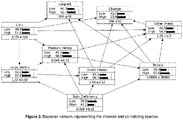
- a Bayesian Network is built including the target species and the species with which it co-habits. Six types of values are calculated: (1) Willingness-to-Pay, (2) Carbon Credits and (3) Economic, (4) E-commerce, (5) Human-Centric and (6) Option Pricing. All of these values are assigned to the species and their sum is the total economic value of the species' population at its current state. Building a second Bayesian Network, with the projected population increase by conservation scenarios, the impact value of a potential investment into the conservation of the species can be estimated.
- the particular advantage of this invention is that it provides a standardised and quantifiable method and process that can be simply and practically applied, using a computer-based calculator. This would enable a user of the calculator to estimate the total economic value of the species they are interested in, as well as the impact value of a potential investment into the conservation of the species.
- Bayesian networks are models that represent the multitude of complex conditional dependencies between variables in a relatively clear way.
- the Bayesian network contains the species population data, the links between the species and their conditional dependency tables that showcase the probabilistic relationships between the species populations.
- the use of the Bayesian networks at each step of this invention is elaborated below, and it is twofold: First, it provides a way to visualize to a degree the ecosystem of the species and ascertain the importance of the population status of the target species for the rest of the species. Second, it allows for the assessment of investment and conservation scenarios, and the results both from the initial Bayesian network and the scenario-based Bayesian networks are utilized in the calculation of the impact value.
- TCM Travel Cost Method
- a user does not provide home location in their profile, metadata from their entire profile are analyzed (Bojic et al., 2015; Li et al., 2013) and home location is assumed as the place from where the user uploaded the largest number of photographs and there is at least a 10-day span between the first and last photo. Home location is determined at the lowest administrative level possible.
- Unique Photo-User-Days i.e. unique user - day combinations are calculated by removing multiple photographs taken by one individual visitor in the same day and calculating the total number of PUDs for each visitor.
- the TCM included two kinds of travel costs: the direct travel cost (DTC (2)), i.e. the amount spent by each user to get to the target ecosystem and the opportunity cost of travel (OTC (3)), i.e. benefit that a person gives up in order to travel.
- DTC (2) direct travel cost
- OTC (3) opportunity cost of travel
- direct travel costs for users that traveled by plane, an average cost of airplane ticket price from home location to the specific area is calculated.
- direct travel cost is calculated by multiplying the average petrol cost per kilometer by the distance traveled from home location to the specific area.
- WTP trip ⁇ 1 / ⁇ DTC where ⁇ DTC is the regression coefficient of the direct travel cost.
- WTP sp w sp ⁇ WTP trip ⁇ v eco
- WTP sp WTP for species sp
- w sp (6) the weight of species sp
- WTP trip is as estimated above
- v eco (5) is the number of visitors to the ecosystem.
- WTP in WTP sp / n sp
- WTP in (1) WTP for one individual of the target species
- WTP sp WTP for species sp
- n sp (4) is the population size of the target species in the particular ecosystem.
- carbon credits (CC (7)) is a market-oriented mechanism to reduce greenhouse gas emissions.
- One carbon credit is a permit that allows the entity that holds it to emit a tonne of carbon dioxide or other greenhouse gases. Carbon credits may be traded between companies of countries to help balance total worldwide emissions, which means that carbon credits hold a monetary value.
- Greenhouse Gases emissions GHGE eco (10) can be estimated using two approaches, depending on data availability for the particular area. The first approach involves downloading GHG emissions data from verified online sources and calculating total GHGE eco (10) for the area covered by the target ecosystem. The second approach involves downloading data for GHG emissions per capita from verified online sources and population density data for the area and estimating GHG emission by multiplying these two values.
- NCS eco (8) w i ⁇ Price per GHG tonne ⁇ NCS eco
- CC the current price for one carbon credit (i.e. for the emission of 1 tonne of GHG) in a carbon market (e.g. EU emissions trading system) must be extracted from a verified source.
- the CC value will be weighted by the relative contribution of the target species to carbon sequestration in the target area. The estimation of CC value may not find application in all species, therefore in some cases it will have a value of 0.
- the calculation of the Economic Value of the target species is based on a novel modification of the traditional discounted cash flow valuation (DCF) model.
- the DCF model is a widely accepted method to calculate the financial value of an equity-based asset (Viebig, Varmaz and Poddig, 2008).
- As a measure of economic value there are 27 high-level sectors or sources that can be linked to biodiversity as an associated economic activity. These sectors are mentioned in Table 1 below.
- Table 1 Advertising Apparel Alcoholic beverages Soft beverages Building materials Business/consumer services Pharmaceutical drugs Education Environmental/waste services Farming/aqriculture Food processing Food wholesalers Green/renewable energy Healthcare products Hotel Household products Packaging/containers Paper/forest products Real estate development Regulation/tourism Research Restaurant/dining Retail (grocery/food) Retail (online/special lines) Employment Government Veterinary services
- FCFF i , T S iT % i , EBIT 1 ⁇ t i + % i , DEPN ⁇ % i , CAPEX + % i , NWC
- FCFF for sector i during year T is based on the estimated sales revenue for sector i during year T multiplied by operating profit for sector i as a percentage of sales revenue plus depreciation for sector i as a percentage of sales revenue less capital expenditure for sector i as a percentage of sales revenue less net working capital for sector i as a percentage of sales revenue.
- FCFF Cost multiplied by quantity
- FCFFs are discounted back at the weighted average cost of capital (WACC) (Grabowski, 2018 (32)), adjusted to include a novel modification. This is based on the industry-accepted method of calculating WACC (adjusted for each specific sector), with an additional risk premium to account for the probability of species extinction.
- WACC i r i , f + ⁇ i ⁇ ERP i + CRP i + SCP i + SRP i ⁇ E i D i + E i + k i ⁇ 1 ⁇ t i ⁇ D i D i + E i
- the SRP (25) acts as the equivalent to the company specific premium that would normally be included in the cost of equity calculation. This is a highly objective addition to the calculation and can be based on a ranking table. Based on expert knowledge, we have predefined a SRP (25) relative to the probability of extinction of the species as per Table 2 below. Table 2 P(Extinction) ⁇ 10% ⁇ 20% ⁇ 30% ⁇ 40% ⁇ 50% ⁇ 60% ⁇ 70% ⁇ 80% ⁇ 90% ⁇ 100% SRP 1% 2% 3% 4% 5% 6% 7% 8% 9% 10%
- EntV (11) To calculate the enterprise value of each sector (EntV (11)), it is necessary to discount the FCFFs annually back for 10 years plus the discounted terminal value.
- the terminal value is the estimated year 11 FCFF running for perpetuity.
- E-commerce value approaches the target species as a potential product in e-commerce platforms.
- the value is assigned to the target species specific population.
- Price data from e-commerce websites is extracted for products related to the target species (i.e. books, toys, movies, clothing etc.), added to the platform within a given calendar year. An average price is then calculated.
- the top five (by follower numbers) relevant influencers on major photo (Instagram) and video sharing (YouTube) platforms are identified and their total number of followers are calculated.
- the most recent click-through (i.e. the ratio of users who click on a specific link to the number of total users who view it) and conversion (i.e. the percentage of users that convert into customers) rates corresponding to each platform is retrieved from a verified source.
- the average number of daily posts converted to sales are calculated for each platform, by multiplying the average number of daily posts per platform by the values of the click-through and conversion rates, which are then converted to an annual number by multiplying it by 365:
- C sp is the average number of daily posts converted to sales
- TF i (34) is the total number of followers of the top five influencers per platform i
- AvPo i (37) is the average daily posts per platform i
- CTR i (35) is the click-through rate for platform i
- CR i (36) is the conversion rate for platform i.
- Multiplying C sp by the average price extracted from the e-commerce platform returns the total e-commerce value of the target species.
- ECV sp C sp ⁇ AP sp / n total ⁇ n sp
- the Human-centric value is the benefit to be gained as a direct effect of the target species population within a specific area. The estimation of this value may not find application in all species or human activities, therefore in some cases it will have a value of 0. If a direct effect is recognized, a second Bayesian network is built which will also include the human related factor of interest. Human related factors may involve human activities such as agricultural yield or tourism. This measure will be assigned to the target species' geographic range. Utilizing the Bayesian network properties, the probabilities for a "low” and "high” return for the specific human factor will be affected by the probabilities for a "low” and "high” population of the target species.
- HCV sp P h
- Carrying Capacity (K) of a population is defined as the maximum population size that a species can have in a specific area with finite resources (Del Monte-Luna et al., 2004). Natural populations tend to follow a logistic growth (as shown in Figure 1 ), which means that as population size increases over time, its growth rate (i.e. change in population size for a certain time period divided by initial population size) decreases until it reaches values around zero at carrying capacity.
- K sp PD sp ⁇ r sp
- K sp carrying capacity (44)
- PD sp (42) population density (number of individuals/km 2 ) of the target species' healthiest population.
- r sp (43) is the maximum known range of the species within the specified area (measured in km 2 ).
- Target species range map geo-processing within the specified area will be performed with QGIS.
- the Minimum Viable Population is theoretically defined as the smallest size that a species' population can have that will ensure its survival despite stochasticity or confronting factors (Gilpin, 1986).
- estimating a species' MVP is to find the population size in a specific area that has a specified probability of survival and genetic diversity over a pre-specified period into the future (Wang et al., 2019).
- the widely accepted thresholds in estimating MVP is for the population to have at least 0.99 probability of survival and at least 0.9 genetic diversity within the pre-specified period (Reed et al., 2003), but these thresholds depend on the target species specific biology and ecology.
- PVA Population Viability Analysis
- PVA simulations are performed within a time-frame of 30 years, which is the average human generation time.
- the method consists of performing PVAs, starting with current population size and progressively decreasing it, until the population size is reached below which, the survival and genetic diversity thresholds specified above, are crossed. This population size will be the MVP for the specific target species in the specific ecosystem.
- a call option is a financial instrument that gives the holder a right to purchase an asset at a specified price (exercise price) on or before a specified expiration date.
- the purchase price of the option is called the premium and represents the price the purchaser of the call pays for the right to exercise the option if it becomes profitable to do so.
- the call option can therefore be used as a hedge against an adverse movement in the price of an underlying asset.
- Various call options can be combined to form an option strategy.
- a Bull Call Spread is an option strategy whereby an investor would purchase one call option at a specified exercise price and sell one call option at a higher specified exercise price. Both call options have the identical expiration dates and based on the same underlying asset.
- the traditional Black Scholes Pricing Model (Chriss, 1997) is adapted into a novel option pricing model for individual species in order to determine the premium for this Bull Call Spread.
- the Black Scholes Pricing Model is a seminal model used to calculate the theoretical value for a put or call option based on six variables, namely (i) volatility, (ii) type of option, (iii) underlying stock price, (iv) time, (v) exercise or strike price, and (vi) risk-free rate.
- the core principles for the biodiversity option value align with the Black Scholes Pricing Model.
- C MVP S 0 N d MVP 1 ⁇ Xe ⁇ rT N d MVP 2
- C MVP (56) is the premium for the long call option at the MVP population level
- N(d MVP1 ) and N(d MVP2 ) are the normal distribution values of d MVP1 (58) and d MVP2 (59) respectively.
- C K S 0 N d K 1 ⁇ Xe ⁇ rT N d K 2
- C K is the premium for the short call option at the carrying capacity population level
- N(d K1 ) and N(d K2 ) are the normal distribution values of d K1 (60) and d K2 (61) respectively.
- the purpose of the method is to extrapolate two key values for the computer-based calculator: (i) a defined and measurable total economic value based on current population size for a predetermined species in a set geolocation and (ii) a measurable financial impact value of conserving the same predetermined species in the same set geolocation.
- Total Species Existence Value TSEV WTP + CC + EV + E ⁇ Com + HC + OV
- a third Bayesian network is built, which includes the projected increase of the species population.
- the increased population values are extracted from the results of a PVA analysis, running a scenario of a conservation effort to increase the species population within a 30-year time period.
- CV the species Conservation Value
- TSEV the species total economic value
- ⁇ ) the probability of a high population size given the projected increase of the population size
- cppl) is the probability of a high population size given the current population size.
- the economic components were identified for the cheetah. Of the 27 potential economic activities, six can be applied to the cheetah: consumer goods, education, employment, hotels, restaurants and tourism, with the Kruger National Park's historic financials, the South African economy and the South African risks being applied when calculating the WACC (32) and growth rates. According to Kruger National Park visitor preference surveys, the cheetah can be attributed 10% of the value created by the Kruger National Park.
- Table 3 shows the applicable annual sales, margins and variable values for each of the six applicable sectors, and the resulting value created by each sector that is attributable to the cheetah.
- the DCF was carried out using 10 years of annual forecasts (2021 to 2030) plus a forecast to perpetuity (terminal value). This was based on the underlying growth in demand from tourists to the Kruger National Park, sourced from historic visitor trends, average prices, regional employment levels and average visitor nights. Table 3.
- the probability of extinction is calculated at less than 10%, and thus a species specific premium of 1% is added.
- the economic value based on the current cheetah population is the sum of these six values, leaving a total economic value for the cheetah population at EUR 13,157,387.
- the human-related factor that currently receives a direct effect from the cheetah population in this particular environment is tourism. Following the method outlined in "Detailed description of the invention", a second Bayesian network was built and the probabilities of "high” or “low” visitor revenue given the probabilities of "high” or “low” cheetah population were calculated.
- the MVP and K (7) populations sizes for the cheetah were calculated to be 18 and 891 correspondingly.
- a population crash scenario for 30 years was modelled, simulating the real threats faced by the cheetah: overhunting and habitat loss.
- the population sizes per year simulated by the model were incorporated into the third Bayesian Network, and the probability for a high population at the MVP population size was calculated.
- the probability for a high population under the K (7) scenario was calculated by running a simulation model for 30 years into the future, with the current conditions faced by the specific cheetah population, which is conserved within a protected area. Within this timeframe, the CC was reached.
Landscapes
- Engineering & Computer Science (AREA)
- Business, Economics & Management (AREA)
- Finance (AREA)
- Accounting & Taxation (AREA)
- Development Economics (AREA)
- Operations Research (AREA)
- Game Theory and Decision Science (AREA)
- Human Resources & Organizations (AREA)
- Entrepreneurship & Innovation (AREA)
- Economics (AREA)
- Marketing (AREA)
- Strategic Management (AREA)
- Technology Law (AREA)
- Physics & Mathematics (AREA)
- General Business, Economics & Management (AREA)
- General Physics & Mathematics (AREA)
- Theoretical Computer Science (AREA)
- Management, Administration, Business Operations System, And Electronic Commerce (AREA)
Priority Applications (1)
| Application Number | Priority Date | Filing Date | Title |
|---|---|---|---|
| EP20020503.7A EP3992897A1 (fr) | 2020-11-01 | 2020-11-01 | Procédé de calcul de la valeur des actifs de la biodiversité |
Applications Claiming Priority (1)
| Application Number | Priority Date | Filing Date | Title |
|---|---|---|---|
| EP20020503.7A EP3992897A1 (fr) | 2020-11-01 | 2020-11-01 | Procédé de calcul de la valeur des actifs de la biodiversité |
Publications (1)
| Publication Number | Publication Date |
|---|---|
| EP3992897A1 true EP3992897A1 (fr) | 2022-05-04 |
Family
ID=73131608
Family Applications (1)
| Application Number | Title | Priority Date | Filing Date |
|---|---|---|---|
| EP20020503.7A Withdrawn EP3992897A1 (fr) | 2020-11-01 | 2020-11-01 | Procédé de calcul de la valeur des actifs de la biodiversité |
Country Status (1)
| Country | Link |
|---|---|
| EP (1) | EP3992897A1 (fr) |
Citations (2)
| Publication number | Priority date | Publication date | Assignee | Title |
|---|---|---|---|---|
| US20040039676A1 (en) * | 2002-08-09 | 2004-02-26 | David Trainer | System and method for reversing accounting distortions and calculating a true value of a business |
| US20200034772A1 (en) * | 2018-07-27 | 2020-01-30 | Rocky Mountain Innovations Insights LLC | Cloud-based, data-driven artificial intelligence and machine learning financial planning and analysis visualization platform |
-
2020
- 2020-11-01 EP EP20020503.7A patent/EP3992897A1/fr not_active Withdrawn
Patent Citations (2)
| Publication number | Priority date | Publication date | Assignee | Title |
|---|---|---|---|---|
| US20040039676A1 (en) * | 2002-08-09 | 2004-02-26 | David Trainer | System and method for reversing accounting distortions and calculating a true value of a business |
| US20200034772A1 (en) * | 2018-07-27 | 2020-01-30 | Rocky Mountain Innovations Insights LLC | Cloud-based, data-driven artificial intelligence and machine learning financial planning and analysis visualization platform |
Non-Patent Citations (30)
| Title |
|---|
| ANDERSEN, L.H.SUNDE, P.PELLEGRINO, I.LOESCHCKE, V.PERTOLDI, C.: "Using population viability analysis, genomics, and habitat suitability to forecast future population patterns of Little Owl Athene noctua across Europe", ECOLOGY AND EVOLUTION, vol. 7, 2017, pages 10987 - 11001 |
| AUGERAUD-VERON, E.FABBRI, G.SCHUBERT, K.: "The value of biodiversity as an insurance device", AMERICAN JOURNAL OF AGRICULTURAL ECONOMICS, vol. 101, no. 4, 2019, pages 1068 - 1081 |
| BARTKOWSKI, B.LIENHOOP, N.HANSJURGENS, B.: "Capturing the complexity of biodiversity: A critical review of economic valuation studies of biological diversity", ECOLOGICAL ECONOMICS, vol. 113, 2015, pages 1 - 14, XP029211145, DOI: 10.1016/j.ecolecon.2015.02.023 |
| BERTRAM, C.REHDANZ, K.: "On the environmental effectiveness of the EU Marine Strategy Framework Directive", MARINE POLICY, vol. 38, 2013, pages 25 - 40 |
| BOJIC, I.MASSARO, E.BELYI, A.SOBOLEVSKY, S.RATTI, C.: "International Conference on Social Informatics", 2015, SPRINGER, article "Choosing the right home location definition method for the given dataset", pages: 194 - 208 |
| BOYLE, K. J.: "In A primer on nonmarket valuation", 2003, SPRINGER, article "Introduction to revealed preference methods", pages: 259 - 267 |
| BULTE, E.VAN SOEST, D. P.VAN KOOTEN, G. C.SCHIPPER, R. A.: "Forest conservation in Costa Rica when nonuse benefits are uncertain but rising", AMERICAN JOURNAL OF AGRICULTURAL ECONOMICS, vol. 84, no. 1, 2002, pages 150 - 160 |
| CHAN, K. M.GOLDSTEIN, J.SATTERFIELD, T.HANNAHS, N.KIKILOI, K.NAIDOO, R.VADEBONCOEUR, N.WOODSIDE, U.: "Cultural services and non-use values", NATURAL CAPITAL: THEORY AND PRACTICE OF MAPPING ECOSYSTEM SERVICES, 2011, pages 206 - 228 |
| CHRISS, N.: "Black-Scholes and beyond : option pricing models", 1997, MCGRAW-HILL |
| CREEL, M.D.LOOMIS, J.B.: "Theoretical and empirical advantages of truncated count data estimators for analysis of deer hunting in California", AMERICAN JOURNAL OF AGRICULTURAL ECONOMICS, vol. 72, 1990, pages 434 - 441 |
| DE VALCK, J.ROLFE, J.: "Comparing biodiversity valuation approaches for the sustainable management of the Great Barrier Reef, Australia", ECOSYSTEM SERVICES, vol. 35, 2019, pages 23 - 31 |
| DEL MONTE-LUNA, P.BROOK, B.W.ZETINA-REJON, M.J.CRUZ-ESCALONA, V.H.: "The carrying capacity of ecosystems", GLOBAL ECOLOGY AND BIOGEOGRAPHY, vol. 13, 2004, pages 485 - 495 |
| DI CORATO, L.MORETTO, M.VERGALLI, S.: "The effects of uncertain forest conservation benefits on long-run deforestation in the Brazilian Amazon", ENVIRONMENT AND DEVELOPMENT ECONOMICS, vol. 23, no. 4, 2018, pages 413 - 433 |
| FEZZI, C.BATEMAN, I.J.FERRINI, S.: "Using revealed preferences to estimate the value of travel time to recreation sites", JOURNAL OF ENVIRONMENTAL ECONOMICS AND MANAGEMENT, vol. 67, 2014, pages 58 - 70 |
| GHERMANDI, A.: "Integrating social media analysis and revealed preference methods to value the recreation services of ecologically engineered wetlands", ECOSYSTEM SERVICES, vol. 31, 2018, pages 351 - 357 |
| GILPIN, M.E.: "Minimal viable populations: processes of species extinction", CONSERVATION BIOLOGY: THE SCIENCE OF SCARCITY AND DIVERSITY, 1986 |
| GRABOWSKI, R. J.: "The Size Effect Continues To Be Relevant When Estimating the Cost of Capital", BUSINESS VALUATION REVIEW, vol. 37, no. 3, 2018, pages 93 - 109 |
| HAGHJOU, M.HAYATI, B.PISHBAHAR, E.MOLAEI, M.: "In Sustainable Agriculture and Agribusiness in Iran", 2019, SPRINGER, article "Estimating the Non-use Values and Related Compensative Surplus of Arasbaran Forests in Iran: An Application of the Choice Experiment Method", pages: 63 - 77 |
| LAURILA-PANT, M.LEHIKOINEN, A.UUSITALO, L.VENESJARVI, R.: "How to value biodiversity in environmental management?", ECOLOGICAL INDICATORS, vol. 55, 2015, pages 1 - 11, XP029169303, DOI: 10.1016/j.ecolind.2015.02.034 |
| LI, L.GOODCHILD, M.F.XU, B.: "Spatial, temporal, and socioeconomic patterns in the use of Twitter and Flickr", CARTOGRAPHY AND GEOGRAPHIC INFORMATION SCIENCE, vol. 40, 2013, pages 61 - 77 |
| PASCUAL, U.MURADIAN, R.BRANDER, L.GOMEZ-BAGGETHUN, E.MARTIN-LOPEZ, B.VERMA, M.ARMSWORTH, P.CHRISTIE, M.CORNELISSEN, H.EPPINK, F.: "The economics of valuing ecosystem services and biodiversity", THE ECONOMICS OF ECOSYSTEMS AND BIODIVERSITY: ECOLOGICAL AND ECONOMIC FOUNDATIONS, 2010, pages 183 - 256 |
| PEARCE, D.ATKINSON, G.MOURATO, S.: "Cost-benefit analysis and the environment: recent developments", ORGANISATION FOR ECONOMIC CO-OPERATION AND DEVELOPMENT, 2006 |
| PEEK, E.: "A study of differences in returns between large and small companies in Europe", INTERNATIONAL CORPORATE FINANCE EJOURNAL, 2016 |
| PETROLIA, D. R.GUIGNET, D.WHITEHEAD, J.KENT, C.CAULDER, C.AMON, K.: "Nonmarket Valuation in the Environmental Protection Agency's Regulatory Process", APPLIED ECONOMIC PERSPECTIVES AND POLICY, 2020 |
| REED, D.H.O'GRADY, J.J.BROOK, B.W.BALLOU, J.D.FRANKHAM, R.: "Estimates of minimum viable population sizes for vertebrates and factors influencing those estimates", BIOLOGICAL CONSERVATION, vol. 113, 2003, pages 23 - 34 |
| SEDDON, N.MACE, G. M.NAEEM, S.TOBIAS, J. A.PIGOT, A. L.CAVANAGH, R.MOUILLOT, D.VAUSE, J.WALPOLE, M.: "Biodiversity in the Anthropocene: prospects and policy", PROCEEDINGS OF THE ROYAL SOCIETY B: BIOLOGICAL SCIENCES, vol. 283, no. 1844, 2016, pages 20162094 |
| SINCLAIR, M.GHERMANDI, A.SHEELA, A.M.: "A crowdsourced valuation of recreational ecosystem services using social media data: An application to a tropical wetland in India", SCIENCE OF THE TOTAL ENVIRONMENT, vol. 642, 2018, pages 356 - 365, XP085421816, DOI: 10.1016/j.scitotenv.2018.06.056 |
| TEALL, J. L.: "Financial Trading and Investing", 2018, ACADEMIC PRESS |
| VIEBIG, J.VARMAZ, A.PODDIG, T.: "Equity valuation models from leading investment banks", 2008, JOHN WILEY & SONS |
| WANG, T.FUJIWARA, M.GAO, X.LIU, H.: "Minimum viable population size and population growth rate of freshwater fishes and their relationships with life history traits", SCIENTIFIC REPORTS, vol. 9, 2019, pages 1 - 8 |
Similar Documents
| Publication | Publication Date | Title |
|---|---|---|
| Achim et al. | The impact of covid-19 on financial management: evidence from Romania | |
| Tinch et al. | Economic valuation of ecosystem goods and services: a review for decision makers | |
| Xu | Short-run price forecast performance of individual and composite models for 496 corn cash markets | |
| Zhang et al. | Using operational and stock analytics to measure airline performance: A network DEA approach | |
| Armsworth | Inclusion of costs in conservation planning depends on limited datasets and hopeful assumptions | |
| Lloyd-Smith et al. | Decoupling the value of leisure time from labor market returns in travel cost models | |
| Misund et al. | Hedging efficiency of Atlantic salmon futures | |
| Dimitriou et al. | Economic impact assessment of mega infrastructure pipeline projects | |
| Longarela-Ares et al. | The influence of economic barriers and drivers on energy efficiency investments in maritime shipping, from the perspective of the principal-agent problem | |
| Wagner | Is export diversification good for profitability? First evidence for manufacturing enterprises in Germany | |
| Jakubik et al. | How to Anticipate Recession via Transport Indices 1 | |
| Schuhmann et al. | Visitors’ willingness to pay for ecosystem conservation in Grenada | |
| Pascoe et al. | Beyond GVP: The value of inshore commercial fisheries to fishers and consumers in regional communities on Queensland’s east coast | |
| Kelly et al. | Family forest owner preferences for forest conservation programs: A New York case study | |
| Kikuchi et al. | The structure of indigenous food crop markets in sub-Saharan Africa: The rice market in Uganda | |
| Isengildina-Massa et al. | Do markets correct for smoothing in usda crop production forecasts? evidence from private analysts and futures prices | |
| Sawadogo et al. | COVID-19, food coping strategies and households resilience: the case of informal sector in Burkina Faso: N. Sawadogo and Y. Ouoba | |
| Rusli et al. | Evaluating the efficiency and productivity of Malaysian logistics companies using epsilon-based measure and Malmquist index during the Covid-19 pandemic | |
| Chen et al. | Tourism expansion and corporate earnings in the tourism industry | |
| Chowdhury | Construction of a Policy Analysis Matrix PAM for Fruits and Vegetables Export Process in Bangladesh | |
| Yifei et al. | Container liner freight index based on data from e-booking platforms | |
| Wankhade et al. | Analysis of quality uncertainty due to information asymmetry | |
| Muhammad | The impact of increasing non-agricultural market access on EU demand for imported fish: implications for Lake Victoria chilled fillet exports | |
| Lew et al. | The economic impact of saltwater sportfishing harvest restrictions in Alaska: an empirical analysis of nonresident anglers | |
| Liu | Should further mergers be allowed? Product differentiation and merger in the external audit market |
Legal Events
| Date | Code | Title | Description |
|---|---|---|---|
| PUAI | Public reference made under article 153(3) epc to a published international application that has entered the european phase |
Free format text: ORIGINAL CODE: 0009012 |
|
| STAA | Information on the status of an ep patent application or granted ep patent |
Free format text: STATUS: THE APPLICATION HAS BEEN PUBLISHED |
|
| AK | Designated contracting states |
Kind code of ref document: A1 Designated state(s): AL AT BE BG CH CY CZ DE DK EE ES FI FR GB GR HR HU IE IS IT LI LT LU LV MC MK MT NL NO PL PT RO RS SE SI SK SM TR |
|
| STAA | Information on the status of an ep patent application or granted ep patent |
Free format text: STATUS: THE APPLICATION IS DEEMED TO BE WITHDRAWN |
|
| 18D | Application deemed to be withdrawn |
Effective date: 20221105 |