EP3993144A2 - Energiespeicherzelle und verfahren zur herstellung davon - Google Patents
Energiespeicherzelle und verfahren zur herstellung davon Download PDFInfo
- Publication number
- EP3993144A2 EP3993144A2 EP21199226.8A EP21199226A EP3993144A2 EP 3993144 A2 EP3993144 A2 EP 3993144A2 EP 21199226 A EP21199226 A EP 21199226A EP 3993144 A2 EP3993144 A2 EP 3993144A2
- Authority
- EP
- European Patent Office
- Prior art keywords
- insulating film
- heat
- power storage
- top surface
- exterior container
- Prior art date
- Legal status (The legal status is an assumption and is not a legal conclusion. Google has not performed a legal analysis and makes no representation as to the accuracy of the status listed.)
- Pending
Links
Images





Classifications
-
- H—ELECTRICITY
- H01—ELECTRIC ELEMENTS
- H01M—PROCESSES OR MEANS, e.g. BATTERIES, FOR THE DIRECT CONVERSION OF CHEMICAL ENERGY INTO ELECTRICAL ENERGY
- H01M10/00—Secondary cells; Manufacture thereof
- H01M10/60—Heating or cooling; Temperature control
- H01M10/65—Means for temperature control structurally associated with the cells
- H01M10/658—Means for temperature control structurally associated with the cells by thermal insulation or shielding
-
- H—ELECTRICITY
- H01—ELECTRIC ELEMENTS
- H01M—PROCESSES OR MEANS, e.g. BATTERIES, FOR THE DIRECT CONVERSION OF CHEMICAL ENERGY INTO ELECTRICAL ENERGY
- H01M50/00—Constructional details or processes of manufacture of the non-active parts of electrochemical cells other than fuel cells, e.g. hybrid cells
- H01M50/10—Primary casings; Jackets or wrappings
- H01M50/116—Primary casings; Jackets or wrappings characterised by the material
- H01M50/124—Primary casings; Jackets or wrappings characterised by the material having a layered structure
- H01M50/1245—Primary casings; Jackets or wrappings characterised by the material having a layered structure characterised by the external coating on the casing
-
- H—ELECTRICITY
- H01—ELECTRIC ELEMENTS
- H01M—PROCESSES OR MEANS, e.g. BATTERIES, FOR THE DIRECT CONVERSION OF CHEMICAL ENERGY INTO ELECTRICAL ENERGY
- H01M10/00—Secondary cells; Manufacture thereof
- H01M10/04—Construction or manufacture in general
-
- H—ELECTRICITY
- H01—ELECTRIC ELEMENTS
- H01G—CAPACITORS; CAPACITORS, RECTIFIERS, DETECTORS, SWITCHING DEVICES, LIGHT-SENSITIVE OR TEMPERATURE-SENSITIVE DEVICES OF THE ELECTROLYTIC TYPE
- H01G11/00—Hybrid capacitors, i.e. capacitors having different positive and negative electrodes; Electric double-layer [EDL] capacitors; Processes for the manufacture thereof or of parts thereof
- H01G11/78—Cases; Housings; Encapsulations; Mountings
-
- H—ELECTRICITY
- H01—ELECTRIC ELEMENTS
- H01M—PROCESSES OR MEANS, e.g. BATTERIES, FOR THE DIRECT CONVERSION OF CHEMICAL ENERGY INTO ELECTRICAL ENERGY
- H01M10/00—Secondary cells; Manufacture thereof
- H01M10/60—Heating or cooling; Temperature control
- H01M10/64—Heating or cooling; Temperature control characterised by the shape of the cells
- H01M10/647—Prismatic or flat cells, e.g. pouch cells
-
- H—ELECTRICITY
- H01—ELECTRIC ELEMENTS
- H01M—PROCESSES OR MEANS, e.g. BATTERIES, FOR THE DIRECT CONVERSION OF CHEMICAL ENERGY INTO ELECTRICAL ENERGY
- H01M50/00—Constructional details or processes of manufacture of the non-active parts of electrochemical cells other than fuel cells, e.g. hybrid cells
- H01M50/10—Primary casings; Jackets or wrappings
-
- H—ELECTRICITY
- H01—ELECTRIC ELEMENTS
- H01M—PROCESSES OR MEANS, e.g. BATTERIES, FOR THE DIRECT CONVERSION OF CHEMICAL ENERGY INTO ELECTRICAL ENERGY
- H01M50/00—Constructional details or processes of manufacture of the non-active parts of electrochemical cells other than fuel cells, e.g. hybrid cells
- H01M50/10—Primary casings; Jackets or wrappings
- H01M50/102—Primary casings; Jackets or wrappings characterised by their shape or physical structure
- H01M50/103—Primary casings; Jackets or wrappings characterised by their shape or physical structure prismatic or rectangular
-
- H—ELECTRICITY
- H01—ELECTRIC ELEMENTS
- H01M—PROCESSES OR MEANS, e.g. BATTERIES, FOR THE DIRECT CONVERSION OF CHEMICAL ENERGY INTO ELECTRICAL ENERGY
- H01M50/00—Constructional details or processes of manufacture of the non-active parts of electrochemical cells other than fuel cells, e.g. hybrid cells
- H01M50/10—Primary casings; Jackets or wrappings
- H01M50/14—Primary casings; Jackets or wrappings for protecting against damage caused by external factors
- H01M50/141—Primary casings; Jackets or wrappings for protecting against damage caused by external factors for protecting against humidity
-
- H—ELECTRICITY
- H01—ELECTRIC ELEMENTS
- H01M—PROCESSES OR MEANS, e.g. BATTERIES, FOR THE DIRECT CONVERSION OF CHEMICAL ENERGY INTO ELECTRICAL ENERGY
- H01M50/00—Constructional details or processes of manufacture of the non-active parts of electrochemical cells other than fuel cells, e.g. hybrid cells
- H01M50/20—Mountings; Secondary casings or frames; Racks, modules or packs; Suspension devices; Shock absorbers; Transport or carrying devices; Holders
- H01M50/204—Racks, modules or packs for multiple batteries or multiple cells
- H01M50/207—Racks, modules or packs for multiple batteries or multiple cells characterised by their shape
- H01M50/209—Racks, modules or packs for multiple batteries or multiple cells characterised by their shape adapted for prismatic or rectangular cells
-
- H—ELECTRICITY
- H01—ELECTRIC ELEMENTS
- H01M—PROCESSES OR MEANS, e.g. BATTERIES, FOR THE DIRECT CONVERSION OF CHEMICAL ENERGY INTO ELECTRICAL ENERGY
- H01M50/00—Constructional details or processes of manufacture of the non-active parts of electrochemical cells other than fuel cells, e.g. hybrid cells
- H01M50/20—Mountings; Secondary casings or frames; Racks, modules or packs; Suspension devices; Shock absorbers; Transport or carrying devices; Holders
- H01M50/233—Mountings; Secondary casings or frames; Racks, modules or packs; Suspension devices; Shock absorbers; Transport or carrying devices; Holders characterised by physical properties of casings or racks, e.g. dimensions
- H01M50/24—Mountings; Secondary casings or frames; Racks, modules or packs; Suspension devices; Shock absorbers; Transport or carrying devices; Holders characterised by physical properties of casings or racks, e.g. dimensions adapted for protecting batteries from their environment, e.g. from corrosion
-
- H—ELECTRICITY
- H01—ELECTRIC ELEMENTS
- H01G—CAPACITORS; CAPACITORS, RECTIFIERS, DETECTORS, SWITCHING DEVICES, LIGHT-SENSITIVE OR TEMPERATURE-SENSITIVE DEVICES OF THE ELECTROLYTIC TYPE
- H01G9/00—Electrolytic capacitors, rectifiers, detectors, switching devices, light-sensitive or temperature-sensitive devices; Processes of their manufacture
- H01G9/0029—Processes of manufacture
-
- H—ELECTRICITY
- H01—ELECTRIC ELEMENTS
- H01G—CAPACITORS; CAPACITORS, RECTIFIERS, DETECTORS, SWITCHING DEVICES, LIGHT-SENSITIVE OR TEMPERATURE-SENSITIVE DEVICES OF THE ELECTROLYTIC TYPE
- H01G9/00—Electrolytic capacitors, rectifiers, detectors, switching devices, light-sensitive or temperature-sensitive devices; Processes of their manufacture
- H01G9/004—Details
- H01G9/08—Housing; Encapsulation
-
- Y—GENERAL TAGGING OF NEW TECHNOLOGICAL DEVELOPMENTS; GENERAL TAGGING OF CROSS-SECTIONAL TECHNOLOGIES SPANNING OVER SEVERAL SECTIONS OF THE IPC; TECHNICAL SUBJECTS COVERED BY FORMER USPC CROSS-REFERENCE ART COLLECTIONS [XRACs] AND DIGESTS
- Y02—TECHNOLOGIES OR APPLICATIONS FOR MITIGATION OR ADAPTATION AGAINST CLIMATE CHANGE
- Y02E—REDUCTION OF GREENHOUSE GAS [GHG] EMISSIONS, RELATED TO ENERGY GENERATION, TRANSMISSION OR DISTRIBUTION
- Y02E60/00—Enabling technologies; Technologies with a potential or indirect contribution to GHG emissions mitigation
- Y02E60/10—Energy storage using batteries
-
- Y—GENERAL TAGGING OF NEW TECHNOLOGICAL DEVELOPMENTS; GENERAL TAGGING OF CROSS-SECTIONAL TECHNOLOGIES SPANNING OVER SEVERAL SECTIONS OF THE IPC; TECHNICAL SUBJECTS COVERED BY FORMER USPC CROSS-REFERENCE ART COLLECTIONS [XRACs] AND DIGESTS
- Y02—TECHNOLOGIES OR APPLICATIONS FOR MITIGATION OR ADAPTATION AGAINST CLIMATE CHANGE
- Y02P—CLIMATE CHANGE MITIGATION TECHNOLOGIES IN THE PRODUCTION OR PROCESSING OF GOODS
- Y02P70/00—Climate change mitigation technologies in the production process for final industrial or consumer products
- Y02P70/50—Manufacturing or production processes characterised by the final manufactured product
Definitions
- the present disclosure relates to a power storage cell and a method of manufacturing the power storage cell.
- a housing of a power storage cell has been conventionally covered with an insulating film.
- An exemplary conventional structure is described in Japanese Patent Laying-Open No. 2013-33668 (PTL 1).
- a juncture is formed at the insulating film.
- the juncture can be closed to achieve insulation protection.
- the insulating film may be contracted to form a hard lump.
- An object of the present disclosure is to provide a power storage cell and a method of manufacturing the power storage cell so as to improve a degree of freedom in designing a peripheral member while achieving insulation protection.
- a power storage cell includes: an exterior container having a top surface, a bottom surface, and a side surface located between the top surface and the bottom surface; and an insulating film that covers at least the side surface of the exterior container.
- the insulating film has a juncture on the side surface of the exterior container, and the juncture on the side surface is heat-sealed.
- a heat-sealed portion on the side surface has a termination portion at a position separated from the top surface or the bottom surface of the exterior container.
- a method of manufacturing a power storage cell includes: providing an insulating film on at least a side surface of an exterior container having a top surface, a bottom surface, and the side surface, the side surface being located between the top surface and the bottom surface; and heat-sealing a juncture of the insulating film on the side surface.
- the heat-sealing includes dissipating heat from a second region of the side surface while heat-sealing a first region of the side surface, the second region being located in a vicinity of the top surface or the bottom surface of the exterior container.
- Fig. 1 is a diagram showing a basic configuration of a battery pack 1.
- Fig. 2 is a diagram showing battery cells 100 and end plates 200 included in battery pack 1.
- battery pack 1 serving as an exemplary "power storage module” includes battery cells 100, end plates 200, and a restraining member 300.
- battery cell 100 is a lithium ion battery, but battery cell 100 may be another battery such as a nickel-metal hydride battery.
- the "power storage module” is not limited to battery pack 1, and a capacitor may be used as a "power storage cell” instead of battery cell 100, for example.
- the plurality of battery cells 100 are provided side by side in a Y axis direction (arrangement direction). Each of battery cells 100 includes an electrode terminal 110. A separator (not shown) is interposed between the plurality of battery cells 100. The plurality of battery cells 100 sandwiched between two end plates 200 are pressed by end plates 200, and are restrained between two end plates 200.
- End plates 200 are disposed at both ends of battery pack 1 in the Y axis direction (arrangement direction). End plates 200 are fixed to a base such as a case that accommodates battery pack 1.
- Restraining member 300 connects two end plates 200 to each other. Restraining member 300 is attached to two end plates 200.
- Restraining member 300 is engaged with end plates 200 with compression force in the Y axis direction being applied to a stack of the plurality of battery cells 100 and end plates 200, and then the compression force is released, thereby exerting tensile force on restraining member 300 that connects two end plates 200 to each other. As a counteraction, restraining member 300 presses two end plates 200 in a direction of bringing them closer to each other.
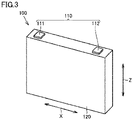
- Fig. 3 is a diagram showing each battery cell 100 in battery pack 1. As shown in Fig. 3 , battery cell 100 is formed to have a flat rectangular parallelepiped shape. Electrode terminal 110 includes a positive electrode terminal 111 and a negative electrode terminal 112. Electrode terminal 110 is formed on a housing 120 having a prismatic shape. An electrode assembly (not shown) and an electrolyte solution (not shown) are accommodated in housing 120.
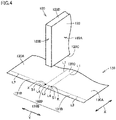
- Fig. 4 is a diagram showing an exemplary shape of an insulating film 130.
- housing 120 of battery cell 100 is covered with insulating film 130.
- the insulating film is composed of an insulating material such as polyethylene terephthalate (PET).
- housing 120 (exterior container) has side surfaces 120A (long side surfaces), side surfaces 120B (short side surfaces), a bottom surface 120C, and a top surface 120D. Side surfaces 120A, 120B are located between bottom surface 120C and top surface 120D.
- Insulating film 130 covers side surfaces 120A, 120B and bottom surface 120C of housing 120. As shown in Figs. 5 to 8 , side surfaces 120A, 120B and bottom surface 120C of housing 120 are covered by folding insulating film 130 that is in the form of a sheet. A portion of insulating film 130 may extend onto top surface 120D of housing 120, or may not reach top surface 120D.
- Insulating film 130 includes: side surface covering portions 130A that cover side surfaces 120A of housing 120; side surface covering portions 130B that cover side surfaces 120B of housing 120; and a bottom surface covering portion 130C that covers bottom surface 120C of housing 120.
- bottom surface covering portion 130C is provided between the pair of side surface covering portions 130A, and side surface covering portions 130B protrudes from side surface covering portions 130A and bottom surface covering portion 130C.
- Each of side surface covering portions 130B includes: first portions 131B protruding outward from the respective side edges of side surface covering portions 130A; and a second portion 132B protruding outward from the side edge of bottom surface covering portion 130C.
- each first portion 131B and second portion 132B of side surface covering portion 130B are not separated from each other at a boundary therebetween and are continuous to each other. Therefore, in a state in which insulating film 130 is folded along housing 120, no pinhole is formed at each intersection K.
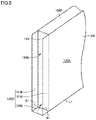
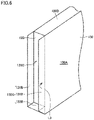
- FIG. 5 to 8 is a diagram showing a step of covering housing 120 of battery cell 100 with insulating film 130. As shown in Figs. 5 to 8 , side surfaces 120A, 120B and bottom surface 120C of housing 120 are covered by folding insulating film 130 that is in the form of a sheet.
- insulating film 130 is folded inward at a boundary line L1 between each side surface covering portion 130A and bottom surface covering portion 130C, thereby covering bottom surface 120C of housing 120 with bottom surface covering portion 130C and thereby covering side surface 120A of housing 120 with side surface covering portion 130A ( Fig. 5 ). Further, insulating film 130 is folded inward at a boundary line L2 between each second portion 132B and bottom surface covering portion 130C, and insulating film 130 is folded inward at a boundary line L3 between each first portion 131B and each side surface covering portion 130A.
- insulating film 130 is folded at a boundary line L4 between first portion 131B and second portion 132B and at a folding line S1 on first portion 131B, with the result that first portion 131B and second portion 132B are layered on side surface 120B of housing 120 ( Figs. 6 and 7 ).
- first portion 131B and second portion 132B on side surface 120B is heated and welded (heat-sealed) to have a watertight structure. That is, junctures 130 ⁇ of the layered portion shown in Fig. 8 are closed by heat-sealing insulating film 130. Thus, entire side surface 120B of housing 120 is covered with insulating film 130, thereby securing electrical insulation protection.
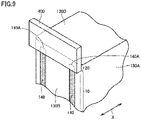
- Fig. 9 is a diagram showing a shape of each of heat-sealed portions 140 of insulating film 130 (overlapped portions of insulating film 130 welded by the heat-sealing).
- each of heat-sealed portions 140 is formed to extend in a height direction (Z axis direction) from bottom surface 120C toward top surface 120D along juncture 130 ⁇ of insulating film 130.
- the plurality of heat-sealed portions 140 may be formed to extend along the Z axis direction.
- Each of heat-sealed portions 140 is terminated at a position (termination portion 140A) separated from top surface 120D of housing 120. Also on the bottom surface 120C side, heat-sealed portion 140 may be terminated at a position separated from bottom surface 120C of housing 120. That is, side surface covering portion 130B of insulating film 130 includes: a first region 10 that is heat-sealed; and a second region 20 that is not heat-sealed. Second region 20 is not heat-sealed but can secure insulation protection comparable to insulation protection secured by first region 10.
- second region 20 that is not heat-sealed is provided in the vicinity of top surface 120D of housing 120, a lump of insulating film 130 contracted by the heat-sealing can be suppressed from being formed in the vicinity of top surface 120D of housing 120 to interfere with a peripheral member such as a bus bar module, and a degree of freedom in designing the peripheral member can be suppressed from being decreased to avoid the interference.
- heat-sealing side surface covering portion 130B heat is dissipated by bringing a jig 400 for promoting heat dissipation into contact with second region 20 located in the vicinity of top surface 120D while heat-sealing first region 10 located on the center side in the Z axis direction by bringing a heat plate (welding plate) into contact with first region 10.
- a heat plate welding plate
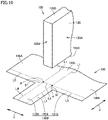
- Fig. 10 is a diagram showing a modification of the shape of insulating film 130.
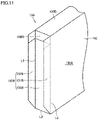
- Fig. 11 is a diagram showing a step of covering housing 120 of battery cell 100 with insulating film 130 shown in Fig. 10 .
- each of side surface covering portions 130B of insulating film 130 includes first portions 131B, second portions 132B, and a third portion 133B.
- First portions 131A and second portions 132B protrude from the respective side edges of side surface covering portions 130A.
- Third portion 133B protrudes from the side edge of bottom surface covering portion 130C.
- side surfaces 120A of housing 120 are covered with side surface covering portions 130A
- side surfaces 120B are covered with side surface covering portions 130B
- bottom surface 120C is covered with bottom surface covering portion 130C.
- first portions 131B, second portions 132B, and third portion 133B of side surface covering portion 130B are layered and this layered portion is welded (heat-sealed) to close the junctures.
- each first portion 131B of side surface covering portion 130B in the X axis direction and the width of each second portion 132B of side surface covering portion 130B in the Y axis direction are equal to each other in a state in which insulating film 130 is unfolded, insulating film 130 is folded at folding line S1 in the boundary portion therebetween, and first portion 131B and second portion 132B are layered on each other.
- the lengths of each second portion 132B and third portion 133B in the X axis direction are shorter than the length of first portion 131B in the Y axis direction. Therefore, when insulating film 130 is folded as shown in Fig. 11 , first portion 131B of side surface covering portion 130B reaches the boundary between side surface 120B and top surface 120D of housing 120, whereas second portion 132B and third portion 133B do not reach top surface 120D.
- insulating film 130 When providing insulating film 130 on housing 120, insulating film 130 is folded inward at boundary line L1 between side surface covering portion 130A and bottom surface covering portion 130C with bottom surface 120C of housing 120 facing bottom surface covering portion 130C of the insulating film as shown in Fig. 10 .
- side surface 120A of housing 120 is covered with side surface covering portion 130A
- bottom surface 120C of housing 120 is covered with bottom surface covering portion 130C.
- insulating film 130 is folded inward at boundary line L2 between third portion 133B of side surface covering portion 130B and bottom surface covering portion 130C.
- side surface 120B of housing 120 is covered with third portion 133B of side surface covering portion 130B.
- insulating film 130 is folded inward at folding line S1 that is a boundary line between first portion 131B and second portion 132B of side surface covering portion 130B, with the result that first portion 131B and second portion 132B of side surface covering portion 130B are layered on each other.
- first portion 131B and second portion 132B of side surface covering portion 130B are folded inward at boundary line L3 with side surface covering portion 130A, with the result that first portion 131B and second portion 132B layered on each other are folded to be on the surface of third portion 133B.
- the layered portion of first portion 131B, second portion 132B, and third portion 133B is heated and is welded (heat-sealed) to have a water-tight structure.
- Fig. 12 is a diagram showing jigs 500 used in the heat-sealing step.
- jigs 500 are provided at both end portions of top surface 120D of housing 120 in the X axis direction, and jigs 500 can prevent those portions from being exposed to warm air in the step of heat-sealing insulating film 130.
- a lump of insulating film 130 contacted can be suppressed from being formed at a shoulder portion of housing 120 to interfere with the peripheral member, and the degree of freedom in designing the peripheral member can be suppressed from being decreased to avoid the interference.
- Fig. 13 is a diagram showing a battery cell 100 according to a modification.
- a member 600 is provided on side surface covering portion 130B of insulating film 130.
- Member 600 is constituted of a separate component such as a separator.
- Insulating film 130 is provided on housing 120 so as to be terminated slightly below top surface 120D of housing 120.
- Member 600 presses side surface covering portion 130B of insulating film 130 to suppress occurrence of further detachment of insulating film 130 when secondary contraction of insulating film 130 occurs due to a use environment.
- Fig. 14 is a diagram showing a structure of an upper corner portion of battery cell 100 located at an end portion in the stacking direction (Y axis direction). As shown in Fig. 14 , a separator 700 is provided between battery cell 100 at the end portion and end plate 200. End plate 200 is composed of a conductor such as aluminum or cast iron. Separator 700 is composed of an insulating material such as a resin, a rubber, or an elastomer.
- insulating film 130 is provided to be terminated at a position lower than top surface 120D of housing 120 by a predetermined height H (for example, about 0.5 mm). It is necessary to secure a predetermined creepage distance L (for example, about 7 mm) from the upper end of insulating film 130 to end plate 200. Therefore, it is necessary to suppress detachment of insulating film 130.
- a predetermined height H for example, about 0.5 mm. It is necessary to secure a predetermined creepage distance L (for example, about 7 mm) from the upper end of insulating film 130 to end plate 200. Therefore, it is necessary to suppress detachment of insulating film 130.
- battery cell 100 of the present embodiment since a lump of insulating film 130 thermally contracted can be suppressed from being formed at the shoulder portion of housing 120 as described above, the degree of freedom in designing the peripheral member around battery cell 100 can be improved while achieving insulation protection.
- heat-sealed portion 140 is provided on side surface 120B; however, the position at which heat-sealed portion 140 is formed is not limited to side surface 120B. Also, in the present embodiment, it has been illustratively described that housing 120 having a prismatic shape is covered with insulating film 130; however, housing 120 of battery cell 100 may have a cylindrical shape.
Landscapes
- Chemical & Material Sciences (AREA)
- Chemical Kinetics & Catalysis (AREA)
- Electrochemistry (AREA)
- General Chemical & Material Sciences (AREA)
- Engineering & Computer Science (AREA)
- Manufacturing & Machinery (AREA)
- Power Engineering (AREA)
- Microelectronics & Electronic Packaging (AREA)
- Sealing Battery Cases Or Jackets (AREA)
- Battery Mounting, Suspending (AREA)
Applications Claiming Priority (1)
| Application Number | Priority Date | Filing Date | Title |
|---|---|---|---|
| JP2020181627A JP7232803B2 (ja) | 2020-10-29 | 2020-10-29 | 蓄電セルおよびその製造方法 |
Publications (2)
| Publication Number | Publication Date |
|---|---|
| EP3993144A2 true EP3993144A2 (de) | 2022-05-04 |
| EP3993144A3 EP3993144A3 (de) | 2022-08-03 |
Family
ID=77998780
Family Applications (1)
| Application Number | Title | Priority Date | Filing Date |
|---|---|---|---|
| EP21199226.8A Pending EP3993144A3 (de) | 2020-10-29 | 2021-09-27 | Energiespeicherzelle und verfahren zur herstellung davon |
Country Status (5)
| Country | Link |
|---|---|
| US (1) | US12040470B2 (de) |
| EP (1) | EP3993144A3 (de) |
| JP (1) | JP7232803B2 (de) |
| KR (1) | KR102718745B1 (de) |
| CN (1) | CN114430060A (de) |
Cited By (4)
| Publication number | Priority date | Publication date | Assignee | Title |
|---|---|---|---|---|
| EP4064434A4 (de) * | 2021-01-28 | 2022-09-28 | Contemporary Amperex Technology Co., Limited | Isolierfilm, batteriezelle, batterie und elektrische vorrichtung |
| DE102022120549A1 (de) * | 2022-08-15 | 2024-02-15 | Volkswagen Aktiengesellschaft | Batterie mit einem Gehäuse und einer elektrisch isolierenden Umhüllung |
| EP4546554A4 (de) * | 2023-02-28 | 2025-12-10 | Contemporary Amperex Technology Hong Kong Ltd | Batteriezelle, batterie und elektrische vorrichtung |
| US12592433B2 (en) | 2023-02-28 | 2026-03-31 | Contemporary Amperex Technology (Hong Kong) Limited | Battery cell, battery, and electrical equipment |
Families Citing this family (2)
| Publication number | Priority date | Publication date | Assignee | Title |
|---|---|---|---|---|
| EP4687195A1 (de) * | 2024-07-30 | 2026-02-04 | Dätwyler Schweiz AG | Wärmedämmschicht |
| CN119786906B (zh) * | 2025-03-11 | 2025-06-06 | 蜂巢能源科技股份有限公司 | 电芯绝缘结构及电芯 |
Citations (2)
| Publication number | Priority date | Publication date | Assignee | Title |
|---|---|---|---|---|
| JP2013033668A (ja) | 2011-08-02 | 2013-02-14 | Sanyo Electric Co Ltd | 電源装置及び電源装置を備える車両 |
| JP2020181627A (ja) | 2015-01-26 | 2020-11-05 | 株式会社半導体エネルギー研究所 | 半導体装置 |
Family Cites Families (15)
| Publication number | Priority date | Publication date | Assignee | Title |
|---|---|---|---|---|
| US5795664A (en) * | 1995-12-05 | 1998-08-18 | Norand Corporation | Rechargeable battery system having intelligent temperature control |
| JP2001307712A (ja) | 2000-04-19 | 2001-11-02 | Nec Mobile Energy Kk | 密閉型電池 |
| JP2002042778A (ja) * | 2000-07-27 | 2002-02-08 | Gs-Melcotec Co Ltd | 電池の製造方法及び電池 |
| JP4636223B2 (ja) | 2003-09-30 | 2011-02-23 | 日本電気株式会社 | ラミネートフィルムの熱融着方法、フィルム外装電池の製造方法およびラミネートフィルム用熱融着装置 |
| JP4666131B2 (ja) | 2003-10-03 | 2011-04-06 | 日本電気株式会社 | ラミネートフィルムの熱融着方法、フィルム外装電池の製造方法およびラミネートフィルム用熱融着装置 |
| US20100028758A1 (en) * | 2008-08-04 | 2010-02-04 | Eaves Stephen S | Suppression of battery thermal runaway |
| JP5591569B2 (ja) | 2010-02-05 | 2014-09-17 | 三洋電機株式会社 | 角形電池及びその製造方法ならびにこれを用いてなる組電池 |
| JP5693327B2 (ja) | 2011-03-29 | 2015-04-01 | Fdk鳥取株式会社 | 電気化学素子の製造方法 |
| WO2014188774A1 (ja) | 2013-05-23 | 2014-11-27 | 日産自動車株式会社 | ラミネート型二次電池の製造方法および製造装置 |
| US9362535B2 (en) * | 2013-12-19 | 2016-06-07 | Ford Global Technologies, Llc | Pouch-type wrap for battery cell |
| US20170250388A1 (en) * | 2014-09-03 | 2017-08-31 | Hitachi Automotive Systems, Ltd. | Prismatic secondary battery |
| DE102015211656A1 (de) | 2014-12-10 | 2016-06-16 | Robert Bosch Gmbh | Batteriezelle mit elektrisch isolierender Folie mit Konturierung |
| JP6748936B2 (ja) * | 2015-09-24 | 2020-09-02 | 株式会社Gsユアサ | 蓄電素子 |
| EP3780254A4 (de) * | 2018-03-30 | 2021-05-19 | SANYO Electric Co., Ltd. | Stromversorgungsvorrichtung, elektrisches fahrzeug mit dieser stromversorgungsvorrichtung und elektrische speichervorrichtung |
| US10944096B2 (en) * | 2018-04-10 | 2021-03-09 | GM Global Technology Operations LLC | Method of manufacturing a lithium metal negative electrode |
-
2020
- 2020-10-29 JP JP2020181627A patent/JP7232803B2/ja active Active
-
2021
- 2021-09-24 US US17/484,095 patent/US12040470B2/en active Active
- 2021-09-27 EP EP21199226.8A patent/EP3993144A3/de active Pending
- 2021-10-25 KR KR1020210142394A patent/KR102718745B1/ko active Active
- 2021-10-27 CN CN202111263733.0A patent/CN114430060A/zh active Pending
Patent Citations (2)
| Publication number | Priority date | Publication date | Assignee | Title |
|---|---|---|---|---|
| JP2013033668A (ja) | 2011-08-02 | 2013-02-14 | Sanyo Electric Co Ltd | 電源装置及び電源装置を備える車両 |
| JP2020181627A (ja) | 2015-01-26 | 2020-11-05 | 株式会社半導体エネルギー研究所 | 半導体装置 |
Cited By (6)
| Publication number | Priority date | Publication date | Assignee | Title |
|---|---|---|---|---|
| EP4064434A4 (de) * | 2021-01-28 | 2022-09-28 | Contemporary Amperex Technology Co., Limited | Isolierfilm, batteriezelle, batterie und elektrische vorrichtung |
| DE102022120549A1 (de) * | 2022-08-15 | 2024-02-15 | Volkswagen Aktiengesellschaft | Batterie mit einem Gehäuse und einer elektrisch isolierenden Umhüllung |
| EP4372870A3 (de) * | 2022-08-15 | 2024-07-24 | Volkswagen Aktiengesellschaft | Batterie mit einem gehäuse und einer elektrisch isolierenden umhüllung |
| EP4546554A4 (de) * | 2023-02-28 | 2025-12-10 | Contemporary Amperex Technology Hong Kong Ltd | Batteriezelle, batterie und elektrische vorrichtung |
| US12592433B2 (en) | 2023-02-28 | 2026-03-31 | Contemporary Amperex Technology (Hong Kong) Limited | Battery cell, battery, and electrical equipment |
| US12614791B2 (en) | 2023-02-28 | 2026-04-28 | Contemporary Amperex Technology (Hong Kong) Limited | Battery cell, battery and electric device |
Also Published As
| Publication number | Publication date |
|---|---|
| CN114430060A (zh) | 2022-05-03 |
| JP7232803B2 (ja) | 2023-03-03 |
| KR102718745B1 (ko) | 2024-10-18 |
| US12040470B2 (en) | 2024-07-16 |
| KR20220057441A (ko) | 2022-05-09 |
| EP3993144A3 (de) | 2022-08-03 |
| JP2022072274A (ja) | 2022-05-17 |
| US20220140416A1 (en) | 2022-05-05 |
Similar Documents
| Publication | Publication Date | Title |
|---|---|---|
| US12040470B2 (en) | Power storage cell and method of manufacturing same | |
| KR101094024B1 (ko) | 이차전지 | |
| EP3675213B1 (de) | Batteriepack | |
| KR102782675B1 (ko) | 배터리 셀 | |
| US20210194048A1 (en) | Separator and solid-state battery module | |
| KR102018692B1 (ko) | 이차 전지 및 이차 전지 제조 방법 | |
| JPWO2017056407A1 (ja) | 電池モジュール | |
| CN114982051A (zh) | 蓄电装置 | |
| KR102769533B1 (ko) | 이차 전지 | |
| EP4024592A2 (de) | Batteriemodul | |
| KR20170096743A (ko) | 전극단자들 사이에 열융착 돌출부를 포함하고 있는 전지셀 | |
| US20220320664A1 (en) | Power storage | |
| JP7707590B2 (ja) | 蓄電装置 | |
| JP2021089861A (ja) | 蓄電装置 | |
| JP6507803B2 (ja) | 電池モジュール | |
| KR20230161188A (ko) | 파우치형 배터리 셀, 이를 구비하는 배터리 셀 조립체 및 배터리 팩 | |
| US20250323385A1 (en) | Electricity storage cell | |
| KR20210136710A (ko) | 배터리 모듈 | |
| EP4607670A1 (de) | Batteriemodul und batteriepack damit | |
| US20230198074A1 (en) | Power storage device | |
| KR20210069400A (ko) | 배터리 모듈 | |
| US20240421423A1 (en) | Secondary Battery and Battery Module Including the Same | |
| US20220320641A1 (en) | Power storage | |
| US20260011848A1 (en) | Battery Pack with Increased Fixation Force of Battery Module Received Therein and Device Including the Same | |
| KR20250152952A (ko) | 전지 셀, 전지 케이스 및 전지 셀 제조 방법 |
Legal Events
| Date | Code | Title | Description |
|---|---|---|---|
| PUAI | Public reference made under article 153(3) epc to a published international application that has entered the european phase |
Free format text: ORIGINAL CODE: 0009012 |
|
| STAA | Information on the status of an ep patent application or granted ep patent |
Free format text: STATUS: REQUEST FOR EXAMINATION WAS MADE |
|
| 17P | Request for examination filed |
Effective date: 20210927 |
|
| AK | Designated contracting states |
Kind code of ref document: A2 Designated state(s): AL AT BE BG CH CY CZ DE DK EE ES FI FR GB GR HR HU IE IS IT LI LT LU LV MC MK MT NL NO PL PT RO RS SE SI SK SM TR |
|
| PUAL | Search report despatched |
Free format text: ORIGINAL CODE: 0009013 |
|
| RAP3 | Party data changed (applicant data changed or rights of an application transferred) |
Owner name: PRIME PLANET ENERGY & SOLUTIONS, INC. |
|
| AK | Designated contracting states |
Kind code of ref document: A3 Designated state(s): AL AT BE BG CH CY CZ DE DK EE ES FI FR GB GR HR HU IE IS IT LI LT LU LV MC MK MT NL NO PL PT RO RS SE SI SK SM TR |
|
| RIC1 | Information provided on ipc code assigned before grant |
Ipc: H01M 50/141 20210101ALI20220628BHEP Ipc: H01M 50/124 20210101ALI20220628BHEP Ipc: H01M 50/103 20210101AFI20220628BHEP |
|
| STAA | Information on the status of an ep patent application or granted ep patent |
Free format text: STATUS: EXAMINATION IS IN PROGRESS |
|
| 17Q | First examination report despatched |
Effective date: 20250721 |