EP3995407A2 - Boîte pliable destinée à la réception d'une coque de compartiment - Google Patents
Boîte pliable destinée à la réception d'une coque de compartiment Download PDFInfo
- Publication number
- EP3995407A2 EP3995407A2 EP21206480.2A EP21206480A EP3995407A2 EP 3995407 A2 EP3995407 A2 EP 3995407A2 EP 21206480 A EP21206480 A EP 21206480A EP 3995407 A2 EP3995407 A2 EP 3995407A2
- Authority
- EP
- European Patent Office
- Prior art keywords
- folding box
- food
- edge
- product holder
- folding
- Prior art date
- Legal status (The legal status is an assumption and is not a legal conclusion. Google has not performed a legal analysis and makes no representation as to the accuracy of the status listed.)
- Withdrawn
Links
Images





Classifications
-
- B—PERFORMING OPERATIONS; TRANSPORTING
- B65—CONVEYING; PACKING; STORING; HANDLING THIN OR FILAMENTARY MATERIAL
- B65D—CONTAINERS FOR STORAGE OR TRANSPORT OF ARTICLES OR MATERIALS, e.g. BAGS, BARRELS, BOTTLES, BOXES, CANS, CARTONS, CRATES, DRUMS, JARS, TANKS, HOPPERS, FORWARDING CONTAINERS; ACCESSORIES, CLOSURES, OR FITTINGS THEREFOR; PACKAGING ELEMENTS; PACKAGES
- B65D5/00—Rigid or semi-rigid containers of polygonal cross-section, e.g. boxes, cartons or trays, formed by folding or erecting one or more blanks made of paper
- B65D5/42—Details of containers or of foldable or erectable container blanks
- B65D5/54—Lines of weakness to facilitate opening of container or dividing it into separate parts by cutting or tearing
- B65D5/545—Lines of weakness to facilitate opening of container or dividing it into separate parts by cutting or tearing for opening containers formed by erecting a "cross-like" blank
-
- A—HUMAN NECESSITIES
- A47—FURNITURE; DOMESTIC ARTICLES OR APPLIANCES; COFFEE MILLS; SPICE MILLS; SUCTION CLEANERS IN GENERAL
- A47G—HOUSEHOLD OR TABLE EQUIPMENT
- A47G23/00—Other table equipment
- A47G23/06—Serving trays
-
- B—PERFORMING OPERATIONS; TRANSPORTING
- B65—CONVEYING; PACKING; STORING; HANDLING THIN OR FILAMENTARY MATERIAL
- B65D—CONTAINERS FOR STORAGE OR TRANSPORT OF ARTICLES OR MATERIALS, e.g. BAGS, BARRELS, BOTTLES, BOXES, CANS, CARTONS, CRATES, DRUMS, JARS, TANKS, HOPPERS, FORWARDING CONTAINERS; ACCESSORIES, CLOSURES, OR FITTINGS THEREFOR; PACKAGING ELEMENTS; PACKAGES
- B65D5/00—Rigid or semi-rigid containers of polygonal cross-section, e.g. boxes, cartons or trays, formed by folding or erecting one or more blanks made of paper
- B65D5/42—Details of containers or of foldable or erectable container blanks
- B65D5/44—Integral, inserted or attached portions forming internal or external fittings
- B65D5/48—Partitions
- B65D5/48002—Partitions integral
- B65D5/48018—Partitions integral formed by folding extensions of side panels of a "cross-like" body blank
-
- B—PERFORMING OPERATIONS; TRANSPORTING
- B65—CONVEYING; PACKING; STORING; HANDLING THIN OR FILAMENTARY MATERIAL
- B65D—CONTAINERS FOR STORAGE OR TRANSPORT OF ARTICLES OR MATERIALS, e.g. BAGS, BARRELS, BOTTLES, BOXES, CANS, CARTONS, CRATES, DRUMS, JARS, TANKS, HOPPERS, FORWARDING CONTAINERS; ACCESSORIES, CLOSURES, OR FITTINGS THEREFOR; PACKAGING ELEMENTS; PACKAGES
- B65D5/00—Rigid or semi-rigid containers of polygonal cross-section, e.g. boxes, cartons or trays, formed by folding or erecting one or more blanks made of paper
- B65D5/42—Details of containers or of foldable or erectable container blanks
- B65D5/44—Integral, inserted or attached portions forming internal or external fittings
- B65D5/52—External stands or display elements for contents
- B65D5/528—Contents attached to or resting on the external surface of the container
- B65D5/5286—Contents attached to or resting on the external surface of the container the container being provided with an opening or weakened area in which an item is inserted
-
- B—PERFORMING OPERATIONS; TRANSPORTING
- B65—CONVEYING; PACKING; STORING; HANDLING THIN OR FILAMENTARY MATERIAL
- B65D—CONTAINERS FOR STORAGE OR TRANSPORT OF ARTICLES OR MATERIALS, e.g. BAGS, BARRELS, BOTTLES, BOXES, CANS, CARTONS, CRATES, DRUMS, JARS, TANKS, HOPPERS, FORWARDING CONTAINERS; ACCESSORIES, CLOSURES, OR FITTINGS THEREFOR; PACKAGING ELEMENTS; PACKAGES
- B65D5/00—Rigid or semi-rigid containers of polygonal cross-section, e.g. boxes, cartons or trays, formed by folding or erecting one or more blanks made of paper
- B65D5/42—Details of containers or of foldable or erectable container blanks
- B65D5/54—Lines of weakness to facilitate opening of container or dividing it into separate parts by cutting or tearing
- B65D5/545—Lines of weakness to facilitate opening of container or dividing it into separate parts by cutting or tearing for opening containers formed by erecting a "cross-like" blank
- B65D5/5455—Lines of weakness to facilitate opening of container or dividing it into separate parts by cutting or tearing for opening containers formed by erecting a "cross-like" blank the lines of weakness being provided in a closure hinged to an edge of the container body
-
- B—PERFORMING OPERATIONS; TRANSPORTING
- B65—CONVEYING; PACKING; STORING; HANDLING THIN OR FILAMENTARY MATERIAL
- B65D—CONTAINERS FOR STORAGE OR TRANSPORT OF ARTICLES OR MATERIALS, e.g. BAGS, BARRELS, BOTTLES, BOXES, CANS, CARTONS, CRATES, DRUMS, JARS, TANKS, HOPPERS, FORWARDING CONTAINERS; ACCESSORIES, CLOSURES, OR FITTINGS THEREFOR; PACKAGING ELEMENTS; PACKAGES
- B65D5/00—Rigid or semi-rigid containers of polygonal cross-section, e.g. boxes, cartons or trays, formed by folding or erecting one or more blanks made of paper
- B65D5/42—Details of containers or of foldable or erectable container blanks
- B65D5/56—Linings or internal coatings, e.g. pre-formed trays provided with a blow- or thermoformed layer
- B65D5/563—Laminated linings; Coatings
-
- B—PERFORMING OPERATIONS; TRANSPORTING
- B65—CONVEYING; PACKING; STORING; HANDLING THIN OR FILAMENTARY MATERIAL
- B65D—CONTAINERS FOR STORAGE OR TRANSPORT OF ARTICLES OR MATERIALS, e.g. BAGS, BARRELS, BOTTLES, BOXES, CANS, CARTONS, CRATES, DRUMS, JARS, TANKS, HOPPERS, FORWARDING CONTAINERS; ACCESSORIES, CLOSURES, OR FITTINGS THEREFOR; PACKAGING ELEMENTS; PACKAGES
- B65D77/00—Packages formed by enclosing articles or materials in preformed containers, e.g. boxes, cartons, sacks or bags
- B65D77/04—Articles or materials enclosed in two or more containers disposed one within another
- B65D77/0413—Articles or materials enclosed in two or more containers disposed one within another the inner and outer containers being rigid or semi-rigid and the outer container being of polygonal cross-section formed by folding or erecting one or more blanks, e.g. carton
- B65D77/0433—Articles or materials enclosed in two or more containers disposed one within another the inner and outer containers being rigid or semi-rigid and the outer container being of polygonal cross-section formed by folding or erecting one or more blanks, e.g. carton the inner container being a tray or like shallow container, not formed by folding or erecting one or more blanks
-
- B—PERFORMING OPERATIONS; TRANSPORTING
- B65—CONVEYING; PACKING; STORING; HANDLING THIN OR FILAMENTARY MATERIAL
- B65D—CONTAINERS FOR STORAGE OR TRANSPORT OF ARTICLES OR MATERIALS, e.g. BAGS, BARRELS, BOTTLES, BOXES, CANS, CARTONS, CRATES, DRUMS, JARS, TANKS, HOPPERS, FORWARDING CONTAINERS; ACCESSORIES, CLOSURES, OR FITTINGS THEREFOR; PACKAGING ELEMENTS; PACKAGES
- B65D81/00—Containers, packaging elements, or packages, for contents presenting particular transport or storage problems, or adapted to be used for non-packaging purposes after removal of contents
- B65D81/36—Containers, packaging elements, or packages, for contents presenting particular transport or storage problems, or adapted to be used for non-packaging purposes after removal of contents adapted to be used for non-packaging purposes after removal of contents
-
- B—PERFORMING OPERATIONS; TRANSPORTING
- B65—CONVEYING; PACKING; STORING; HANDLING THIN OR FILAMENTARY MATERIAL
- B65D—CONTAINERS FOR STORAGE OR TRANSPORT OF ARTICLES OR MATERIALS, e.g. BAGS, BARRELS, BOTTLES, BOXES, CANS, CARTONS, CRATES, DRUMS, JARS, TANKS, HOPPERS, FORWARDING CONTAINERS; ACCESSORIES, CLOSURES, OR FITTINGS THEREFOR; PACKAGING ELEMENTS; PACKAGES
- B65D2203/00—Decoration means, markings, information elements, contents indicators
-
- B—PERFORMING OPERATIONS; TRANSPORTING
- B65—CONVEYING; PACKING; STORING; HANDLING THIN OR FILAMENTARY MATERIAL
- B65D—CONTAINERS FOR STORAGE OR TRANSPORT OF ARTICLES OR MATERIALS, e.g. BAGS, BARRELS, BOTTLES, BOXES, CANS, CARTONS, CRATES, DRUMS, JARS, TANKS, HOPPERS, FORWARDING CONTAINERS; ACCESSORIES, CLOSURES, OR FITTINGS THEREFOR; PACKAGING ELEMENTS; PACKAGES
- B65D2203/00—Decoration means, markings, information elements, contents indicators
- B65D2203/06—Arrangements on packages concerning bar-codes
-
- B—PERFORMING OPERATIONS; TRANSPORTING
- B65—CONVEYING; PACKING; STORING; HANDLING THIN OR FILAMENTARY MATERIAL
- B65D—CONTAINERS FOR STORAGE OR TRANSPORT OF ARTICLES OR MATERIALS, e.g. BAGS, BARRELS, BOTTLES, BOXES, CANS, CARTONS, CRATES, DRUMS, JARS, TANKS, HOPPERS, FORWARDING CONTAINERS; ACCESSORIES, CLOSURES, OR FITTINGS THEREFOR; PACKAGING ELEMENTS; PACKAGES
- B65D2203/00—Decoration means, markings, information elements, contents indicators
- B65D2203/12—Audible, olfactory or visual signalling means
-
- B—PERFORMING OPERATIONS; TRANSPORTING
- B65—CONVEYING; PACKING; STORING; HANDLING THIN OR FILAMENTARY MATERIAL
- B65D—CONTAINERS FOR STORAGE OR TRANSPORT OF ARTICLES OR MATERIALS, e.g. BAGS, BARRELS, BOTTLES, BOXES, CANS, CARTONS, CRATES, DRUMS, JARS, TANKS, HOPPERS, FORWARDING CONTAINERS; ACCESSORIES, CLOSURES, OR FITTINGS THEREFOR; PACKAGING ELEMENTS; PACKAGES
- B65D2401/00—Tamper-indicating means
-
- B—PERFORMING OPERATIONS; TRANSPORTING
- B65—CONVEYING; PACKING; STORING; HANDLING THIN OR FILAMENTARY MATERIAL
- B65D—CONTAINERS FOR STORAGE OR TRANSPORT OF ARTICLES OR MATERIALS, e.g. BAGS, BARRELS, BOTTLES, BOXES, CANS, CARTONS, CRATES, DRUMS, JARS, TANKS, HOPPERS, FORWARDING CONTAINERS; ACCESSORIES, CLOSURES, OR FITTINGS THEREFOR; PACKAGING ELEMENTS; PACKAGES
- B65D5/00—Rigid or semi-rigid containers of polygonal cross-section, e.g. boxes, cartons or trays, formed by folding or erecting one or more blanks made of paper
- B65D5/20—Rigid or semi-rigid containers of polygonal cross-section, e.g. boxes, cartons or trays, formed by folding or erecting one or more blanks made of paper by folding-up portions connected to a central panel from all sides to form a container body, e.g. of tray-like form
- B65D5/22—Rigid or semi-rigid containers of polygonal cross-section, e.g. boxes, cartons or trays, formed by folding or erecting one or more blanks made of paper by folding-up portions connected to a central panel from all sides to form a container body, e.g. of tray-like form held erect by extensions of one or more sides being doubled-over to enclose extensions of adjacent sides
Definitions
- the present invention relates to a folding box for accommodating a compartment tray.
- the present invention relates to a method for producing a folding box for accommodating a compartment tray and a serving box.
- the present invention also relates to a folding box lid of a folding box.
- the present invention relates to a folding box filled with food.
- Serving boxes for the transport of food are known in principle. They usually consist of a folding box into which a compartment tray with several food compartments is placed. A compartment tray, also known as a meal tray, has multiple compartments in which food is placed. A special area of application for serving boxes are hospitals, which have special requirements.
- a patient who is stationed in a hospital eats his or her meal lying down or sitting out of the hospital bed if the patient is not mobile for health reasons. For this purpose, the patient is given prepared serving trays with food, which are subsequently cleaned and refilled.
- the object of the present invention is therefore to address one of the problems mentioned above, to improve the general prior art or to provide an alternative to what was previously known.
- a solution is to be provided with which food is prevented from falling when taken lying down in a hospital bed and the food that is served can be prepared independently and easily accessible by patients.
- a folding box according to claim 1 is proposed.
- the proposed folding box is intended and set up to accommodate a compartment tray.
- the folding box comprises a base surface, a front surface, a rear surface, a cover surface, a first side surface and a second side surface.
- the base area and the front area are connected via a first fold edge with a fold edge length.
- the base and the back are connected by a second folded edge.
- the back surface and the cover surface are connected via a third folded edge.
- the base and the first side are connected via a fourth folded edge and the base and the first side are connected via a fifth folded edge.
- a folding box which is completely closed in a folded state and has a total of six surfaces.
- the surfaces can also be understood as walls with a wall thickness.
- the base area and the top area form the top and bottom of the folding box and can be understood as such.
- the front surface and rear surface can be understood as the front and rear side and the first and second side surface as the right and left side of the folding box.
- the base or bottom is directly connected to all surfaces with the exception of the top surface via a folded edge.
- the folding box is designed as a rectangular carton.
- the front surface has a first and a second perforation section.
- the front face which for example faces the patient in the intended use, is perforated at two different locations, for example along two different, longitudinal stretches on a right and a left side of the front face.
- the front surface is thus perforated at two points with a large number of holes along a stretch in order to be able to tear or detach the front surface at these points with little effort.
- first perforation section extends from a first fold edge point lying on the first fold edge to a first end point of the front surface and that the second perforation section extends from a second fold edge point lying on the first fold edge to a second end point of the front surface.
- the two perforation sections each extend from a point that lies on the first folded edge to a point that lies at one end of the front surface.
- the two points can be arranged, for example, on a straight line orthogonal to the first folding edge, so that a straight perforated line is formed.
- the two points can also be offset so that a diagonal perforated line is created.
- the end points are arranged opposite to the first folded edge, ie at a free end.
- first and second fold edge points are formed at a distance from one another that is greater than half the length of the fold edge.
- the fold edge points have a sufficiently large spacing in order to provide a sufficiently large access opening through which a patient in particular can reach. If the fold edge length is 30 cm, for example, the two fold edge points are at least 15 cm apart, so that an opening in the front panel with a length of more than 15 cm is created when the front panel is detached at the perforation sections and folded down.
- a state of the folding box is described as a folded state in which the folding box is folded or assembled, ie the folding box is in the form of a folded box and encloses a spatial volume.
- the open state describes a state of the folding box in which the folding box is in the folded state, with the top surface and the front surface being open, i.e. in particular the top surface has been opened and the front surface has been loosened or torn and folded down at the perforation sections.
- the lubricating sheet is formed from the base and the front surface when a force is applied to the front surface and the perforation portions are separated.
- the front face can be torn in two places and is thus designed to be folded down, so that the front face and the base face form a flat lubricating base. Since the other surfaces, namely the two side surfaces and the rear surface, are not changed, a three-sided fall protection is formed when the cover surface and the front surface are opened.
- the proposed folding box has fastening and connecting means in order to achieve sufficient stability when the folding box is in the folded state.
- the first and the second perforation section are preferably designed to run parallel to one another and orthogonally to the first folded edge. Accordingly, the two perforation sections run as two straight and parallel lines perpendicularly from the first folding edge to the opposite end of the front surface.
- the first or the second side surface is preferably designed in such a way that it forms a separating barrier in an inner area of the folding box when the folding box is in the folded state. It is therefore proposed that at least one of the two side surfaces is designed with such a length that it can be folded several times and forms a separating barrier in the interior of the folding box.
- the Separation Barrier can also be understood as a partition wall. It goes without saying that the partition can be positioned differently depending on the application. If, for example, a standard drinks bottle is to be separated with the separating barrier, the length of the side surface is adapted accordingly.
- the first or the second side surface has a predetermined partition wall length and at least three folding edges.
- the predetermined length of the dividing wall describes a length from the folding edge of the respective side surface to one end of the respective side wall and is chosen by experts in such a way that a separating barrier is formed in the interior area. In this way, it is advantageously achieved that an additional separating barrier is created within the folding box, with which objects such as foodstuffs or drinks bottles are held in position in the box.
- the lid panel has a detachable perforated area to provide an additional lubricating sheet.
- the cover surface is also perforated, namely perforated in such a way that a detachable surface is formed, which can be detached from the cover surface by the application of force.
- the detachable perforated surface has a side length running parallel to the third fold edge that is greater than half the length of the fold edge. It is therefore proposed that the detachable perforated surface is at least as wide as half the length of the folded edge. It is thus advantageously achieved that the detachable perforated surface is sufficiently large to serve as a lubricating base. For example, if the folded edge length is 30 cm, it is suggested that the detachable perforated area is at least 15 cm wide.
- the base surface, the front surface and/or the cover surface are preferably formed with a food-safe coating in order to prevent food components from entering the flat lubricating base. It is therefore proposed to coat the surfaces that come or can come into contact with food.
- a plastic coating is proposed as the food-safe coating, in particular a PET plastic such as mono-PET. Is the
- Folding box preferably made of cardboard, it is accordingly proposed that the base area, the front area and/or the top area are made of coated cardboard. In addition, it is proposed in a further special embodiment that the other inner surfaces of the folding box are also coated, as described above.
- the top surface has a detachable, perforated surface, in particular as described above, only the detachable, perforated surface of the top surface being designed with a food-safe coating. A material saving of the coating material is thus advantageously achieved.
- the folded edge length is preferably greater than 20 cm.
- the folded edge length is in a range from 20 cm to 40 cm and is in particular 30 cm. It is therefore proposed to use a sufficiently large folding box, which is larger than 20 cm, so that a conventional compartment tray can be placed in it.
- the folding box is preferably designed in one piece in an unfolded state. It is therefore proposed that the folding box consists of one piece and has no glued or fastened components, for example. A state of the folding box in which the folding box is present flat without folding and does not enclose any spatial volume is described as the unfolded state. Thus, no complex connection technology is required to produce the folding box.
- the folding box is preferably made from cardboard. It is therefore proposed that the folding box be made of cardboard or paperboard.
- a folding box for accommodating a compartment tray, which comprises at least one base area, a front area, a rear area, a lid area, a first side area and a second side area, the base area and the front area having a first fold edge with a fold edge length are connected, the base and the rear surface are connected via a second fold edge, the rear surface and the top surface are connected via a third fold edge, the base surface and the first side surface are connected via a fourth fold edge and the base surface and the first side surface are connected via a fifth fold edge are connected, wherein the cover surface has a detachable perforated surface in order to provide a flat lubricating base and the detachable perforated surface has a side length running parallel to the third folding edge which is greater than half the length of the folding edge.
- a folding box with a detachable perforated surface is therefore proposed, in particular as described above.
- a flat lubricating pad is also provided, with the front surface not having any perforation sections in this embodiment.
- the detachable perforated surface be coated with a food safe coating to prevent food particles from entering the lubricating sheet.
- the detachable perforated surface is preferably coated with a plastic, in particular with mono-PET.
- the first or the second side face of the folding box is designed such that it forms a separating barrier in an inner area of the folding box when the folding box is folded, and for this purpose has in particular a predetermined partition wall length and three folding edges. It is therefore proposed to form the side walls as described above.
- the alternative folding box according to the invention is preferably designed according to one of the above embodiments.
- the folding box blank is preferably designed like the folding box according to one of the above embodiments.
- a serving box which has at least one compartment tray and one folding box, the compartment tray being surrounded by the folding box when the folding box is in a folded state.
- the folding box is designed according to one of the above embodiments.
- the folding box be formed using a method according to one of the above embodiments.
- the compartment tray is preferably made of mono-PET. This is particularly beneficial as the serving box is easier to recycle.
- the lid surface has at least one first product holder for accommodating a food product, the first product holder being formed from a large number of incisions, in particular being formed from at least four incisions, each incision extending from a starting point to an end point, wherein the starting point and the ending point of the incisions are located opposite one another, and the starting points and ending points of the plurality the cuts are arranged on a square fold line to form a substantially square product support, and the plurality of cuts intersect at a center point.
- the lid surface has at least one second product holder for accommodating a food product, the second product holder being formed from a large number of incisions, in particular from at least four incisions, each incision extending from a starting point to an end point extends, wherein the starting point and the ending point of the cuts are arranged opposite each other, and wherein the starting points and ending points of the plurality of cuts are arranged on a circular folding edge to form a substantially circular product holder, and wherein the plurality of cuts intersect at a center point .
- the lid surface has at least a third product holder for accommodating a food product, the first product holder being formed from a large number of incisions, in particular being formed from two incisions, with each incision extending from a starting point to an end point , wherein the starting point and the ending point of the cuts are arranged opposite one another, and wherein the starting points and ending points of the plurality of cuts are arranged on a rectangular folded edge, and wherein the plurality of cuts intersect at a center point to form a substantially rectangular product holder, and wherein the plurality of cuts intersect at a midpoint.
- a square, circular and/or rectangular product holder with a large number of incisions in the cover surface, with the incisions intersecting at a center point.
- a square, circular and/or rectangular product holder is formed, which has a large number of triangular folding elements.
- the triangular flap elements are connected to the lid surface at a fold edge on only one side due to the proposed course of the cut, so that the triangular flap elements can be pressed into an inner area of the folding box.
- food products or beverage products can be pressed into the square, circular and/or rectangular product holder from above in order to securely hold the food products introduced in the product holder.
- a circular product holder is beneficial for round food products, a square product holder for square food products, and a rectangular product holder for oblong food products.
- the brackets are generally intended to allow the folding box to be used like a tray.
- the holders protect the food from falling and serve to hold food placed in the holder. Food products such as an apple, yoghurt and a cup of coffee can then be placed in the holder by the hospital staff.
- Food waste can be reduced in this way, since additional products can only be placed in the holder if the patient so wishes.
- the folding box can hold liquids and, for example, can hold liquids that have accidentally been spilled, such as coffee.
- the circular product holder has a radius that lies in a radius range of 2 cm to 7 cm.
- the square product holder has a side length that is in a side length range of 2 cm to 7 cm.
- the rectangular product holder has a first side length and a second side length, the first side length being in a side length range of 10 cm to 18 cm and the second side length being in a side length range of 5 to 10 cm.
- the radius range and the side length ranges described above are particularly suitable for food products such as bottles, fruit or beverage cups with liquids.
- the folding box in the folded state has a readable code on an outside of the folding box, preferably a QR code or a barcode.
- the outside of the carton is an outwardly facing surface of the carton when the carton is folded, e.g.
- An inside of the folding box is a surface of the folding box in the folded state, which faces the inner space that the folding box encloses in the closed state.
- the code is particularly preferably set up to trigger a media conversation on a terminal device by scanning the code, for example a link to a multimedia platform is encoded in the code.
- a patient who is spending time in a hospital, for example, can call up media entertainment to pass the time by scanning the code and calling up videos, for example.
- the folding box in the folded state has an entertainment imprint on an outside or an inside of the folding box, which imprint describes an imprint that is used for entertainment purposes or to pass the time.
- an entertainment imprint for example, a Sudoku, a crossword puzzle, a search image, an article to read are provided as an entertainment imprint.
- the folding box in the folded state has a color code printed on an outside of the folding box for identifying food products, in particular to identify carnivorous, vegetarian or vegan food products. It can thus be seen from the outside which food products are arranged inside the folding box without the folding box having to be opened.
- the folding box in the folded state has a closure seal on an outside of the folding box to identify an open state of the folding box in the folded state.
- the opening status can thus be checked, whether the folding box has already been opened or not.
- a folding box lid of a folding box having a lid surface, the lid surface having at least one first product holder for accommodating a food product, the first product holder being formed from a large number of incisions, in particular from at least four incisions being formed, wherein each cut extends from a starting point to an ending point, the starting point and ending point of the cuts being located opposite each other, and wherein the starting points and ending points of the plurality of cuts are arranged on a square fold line to form a substantially square product support, and wherein the multiplicity of incisions intersect in a central point.
- the top surface of the folding box lid has at least one second product holder for accommodating a food product, with the second product holder being formed from a large number of incisions, in particular from at least four incisions, each incision extending from a starting point to an end point, wherein the starting point and ending point of the cuts are located opposite each other, and wherein the starting points and ending points of the plurality of cuts are arranged on a circular fold line to form a substantially circular product support, and wherein the plurality of cuts are in one cut midpoint.
- the top surface of the folding box lid has at least a third product holder for accommodating a food product, with the first product holder being formed from a large number of incisions, in particular from two incisions, each incision extending from a starting point to an end point extends, wherein the starting point and ending point of the cuts are arranged opposite each other, and wherein the starting points and ending points of the plurality of cuts are arranged on a rectangular folding edge, and wherein the plurality of cuts intersect at a center point to form a substantially rectangular product holder , and where the plurality of incisions intersect at a midpoint.
- the circular product holder of the top surface of the folding box top has a radius that lies in a radius range of 2 cm to 7 cm.
- the square product holder of the top surface of the folding box top has a side length that is in a side length range of 2 cm to 7 cm.
- the rectangular product holder of the top surface of the folding box top has a first edge length and a second edge length, the first edge length being less than 18 cm and the second edge length being less than 10 cm.
- a folding box filled with food is also proposed with at least one food of the first type, one food of the second type and optionally with one food of the third type and one food of the fourth type.
- all foods can be provided as foods of the first, second, third and fourth type, such as edible or drinkable foods, e.g. B. sandwiches, yoghurts, fruit, vegetables or other edible food products.
- beverage products such as non-alcoholic beverages or alcoholic beverages can also be provided.
- the folding box in a folded state is adapted to the food of the first type and second type with a separating barrier formed in an interior area of the folding box and that a first and a second food compartment are formed by the separating barrier.
- At least one food of the first type is arranged in the first food compartment, preferably a food product, in particular a sandwich, a wrap or some other edible food product.
- a food product in particular a sandwich, a wrap or some other edible food product.
- Other examples are: a filled sandwich, a filled pretzel corner, a filled pretzel, a filled bagel. These products are particularly preferred because they can be eaten without cutlery. Food of the first kind can also be understood as a main course.
- At least food of the second type is arranged in the second food compartment, preferably a beverage product, in particular a non-alcoholic beverage, for example drinking water or a soft drink.
- a beverage product in particular a non-alcoholic beverage, for example drinking water or a soft drink.
- a 0.5l water bottle for example, can be placed in the folding box as food of the second type.
- the food of the second kind can thus be understood as a beverage accompaniment.
- the folding box also has at least a first product holder and/or a second product holder for holding the food of the third and fourth type. If required, the food of the third and fourth type can be introduced into this holder.
- the food of the third type is preferably fruit, in particular an apple or a pear.
- a vitamin-rich food is therefore proposed and can be understood as a fruit side dish.
- the food of the third type can therefore only be placed in the product holder when required or ordered.
- the food of the fourth type is a dessert, such as yoghurt or pudding.
- the food of the fourth kind can therefore be understood as a dessert.
- a fifth type of food is provided and proposed, which is preferably a hot drink, such as a cup of coffee or tea.
- a further product holder can be provided to accommodate the fifth type of food, as described above.
- the first and/or second product support is formed from a plurality of incisions, each incision extending from a starting point to an ending point, the starting point and ending point of the incisions being located opposite each other, and the starting points and ending points of the plurality of incisions on a folding edge are arranged, and wherein the plurality of incisions intersect at a center point in order to adapt the folded box with the first and/or second product holder to the food of the third type and fourth type.
- a stocked serving box is therefore proposed, which can also be understood as a catering box.
- the filled serving box can be delivered as a finished end product.
- a serving box can be sold at events, such as camps or concerts.
- the equipped serving box can also be used for old people's homes or be intended for free sale in a supermarket.
- a sale in vending machines, such as snack machines, can also be provided.
- the folding box serves as a tablet for the third, fourth and fifth type of food.
- the folding box thus also serves as a storage location for rubbish, for example if the food is packed in plastic.
- a stocked food box which can have a main meal and a drink inside. If necessary, additional groceries can then optionally be placed in the product holders, for example to provide a hospital patient with groceries as needed. For example, if a patient in the hospital does not want fruit, the box is not subsequently filled with fruit. This can reduce food waste.
- a main meal with a drink can be arranged inside the box.
- the advantage is that the hospital person does not have to serve the main meal and the drink himself, but only has to place the box on the sickbed.
- Another advantage is better hygiene, because with the proposed folding box filled with food, for example, the hospital person is better protected, for example from infections.
- the staff can place a filled food box on a hospital bed or the box can be automatically provided in a machine. Such a box is also more hygienic compared to classic tablets, since these are usually loaded by hand.
- the food intake can also be measured with the folding box filled with food. It is preferably proposed to fill the folding box with a water bottle, in particular a 0.51 water bottle, as the second type of food.
- the box can be given two or three times a day and at the end of the day the amount of liquid can be checked a patient has taken. When the hospital staff picks up the folding box for disposal in the evening, the filling level of the bottles and thus the fluid intake of the patient can be checked afterwards.
- the folding box equipped with food is preferably designed according to one of the above embodiments.
- the first type, second type, third type and fourth type of food are selected in such a way that a balanced diet is provided.
- a diet is preferably balanced if, averaged over a period of several days, about 55% of the energy requirement comes from carbohydrates, at least 15% from proteins and 30% from fats. The foods are therefore selected in such a way that these conditions are met.
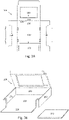
- FIG. 1A shows a folding box 100 in an unfolded state.
- the folding box 100 is intended to accommodate a compartment tray, which is not shown.
- the folding box 100 has a base surface 110, a front surface 120, a rear surface 130, a top surface 140, a first side surface 150 and a second side surface 160.
- the folding box shown is designed in one piece, ie from one piece.
- the base surface 110 and the front surface 120 are connected via a first folded edge 115 with a folded edge length k.
- the folded edge length k is 30 cm, for example.
- the base 110 is also connected to the rear surface 130 and to the first and second side surfaces 150 and 160 directly via the folded edges 125, 145 and 155.
- the base area 110 is indirectly connected to the cover area via the rear area 130 via the folded edges 125 and 135 .
- Fold edges are in the Figures 1A to 6B shown dotted, and also in the Figures 7A to 9 .
- the folding box 100 has a first and a second perforation section, each with a dashed line in the Figure 1A are shown.
- the first perforation section extends from a first fold edge point F 1 lying on the first fold edge to a first end point E 1 of the front surface 120.
- the second perforation section extends from a second fold edge point F 2 lying on the first fold edge to a second end point E 2 of the Front surface 120.
- the two perforation sections are formed orthogonally to the first folding edge 115 as straight lines. The front surface can be detached with little effort along the perforation sections, so that it is possible to fold the front surface.
- the first and the second folding edge point F 1 and F 2 are formed at a distance s from one another.
- the distance s between the two points F 1 and F 2 is greater than half the folded edge length k of the folded edge 115.
- the fold edge length k is 30 cm, for example.
- the two folding edge points F 1 and F 2 are, for example, 26 cm apart. This creates a 26cm wide opening or such a wide access to the interior of the folding box when the front surface is detached along the two perforation sections to in a folded and opened state of the folding box, as in FIG Figure 1B shown to form a flat lubricating base with a three-sided fall protection.
- the folding box shown also has fastening means 170 and connecting means 180 in order to provide sufficient stability of the folding box in the folded state of the folding box.
- FIG Figure 1B shows a folding box 100 in a folded and opened state and is designed as in FIG Figure 1A shown.
- the cover surface 140 is folded open, the perforation sections are released and the front surface 120 is folded down.
- a flat lubricating pad is thus formed from the front surface 120 and the base surface 110 .
- the interior of the folding box 100 is easy to reach through the access that has been created.
- a three-sided fall protection is formed, namely from the rear surface 130 and from the two side surfaces 150 and 160.
- the arrow in the Figure 1B illustrates that the front surface 120 has been folded down or can be folded down after the perforation sections have been released by a force.
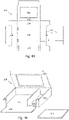
- Figure 2A shows a folding box 100 in an unfolded state in a further embodiment.
- the one in the Figure 2A Folding box 100 shown is like the folding box according to FIG Figure 1A formed, with the difference that the second side surface 160 is formed such that it forms a separating barrier in an inner region of the folding box in the folded state of the folding box.
- the side surface 160 has a predetermined partition wall length m and three fold edges 165 .
- the length of the partition wall is chosen so large that a separation barrier is formed in the interior of the folding box 100 when the folding box is folded, as for example in FIG Figure 2B shown.
- the length of the dividing wall can vary depending on the area of application and can, for example, be chosen so large that the barrier separates a standard drinks bottle with a volume of 0.5 liters from the rest of the interior of the folding box.
- Figure 2B shows a carton 100 in a folded and opened condition and is formed with a separation barrier as in Figure 12 Figure 2A shown.
- the separation barrier shown within the in the Figure 2A The folding box 100 shown is formed in which the side surface 160 is folded at the three folded edges 165 and folded into the interior of the folding box.
- the separation barrier can be used, for example, to separate a water bottle from a compartment tray and thus hold it in position.
- Figure 3A shows a folding box 100 in an unfolded state in a further embodiment.
- the one in the Figure 3A Folding box 100 shown is like the folding box according to FIG Figure 1A formed, with the difference that the folding box in addition to the two perforation sections in the front surface 120 also has a detachable perforated surface 142 in the top surface 140 in order to provide an additional flat lubricating base.
- the detachable perforated surface 142 is rectangular, in particular like a cutting board, and is perforated in such a way that the detachable perforated surface 142 can be removed with little effort.
- the detachable perforated surface 142 has a side length b running parallel to the third fold edge 135, which is greater than half the fold edge length k and is 24 cm, for example.
- the flat lubricating base is created by a closed perforation that runs around a defined and predetermined area.
- FIG. 12 shows a carton 100 in a folded and opened condition and the top panel 140 has a detachable perforated panel 142 as in FIG Figure 3A shown.
- the surface 142 was removed and serves as an additional flat lubricating base.
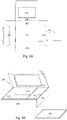
- Figure 4A shows a folding box 100 in an unfolded state.
- the one in the Figure 4A Folding box 100 shown is like the folding box according to FIG Figure 1A formed, with the difference that the second side surface 160 of the folding box 100 is formed such that it forms a separating barrier in an inner region of the folding box in the folded state of the folding box, such as in FIG Figure 2A or 2B shown, and in addition to the two perforation sections in the front surface 120 additionally has a detachable perforated surface 142 in the top surface 140, such as in FIG Figure 3A or 3B shown.
- Figure 4B shows a folding box 100, as in FIG Figure 4A shown in a folded and opened condition and having a separation barrier 160 formed from the side panel 160, as in FIG Figure 2A or 2B shown, and a top panel 140 having a detachable perforated panel 142 as shown in FIG Figure 3A or 3B shown.
- Figure 5A 12 shows a folding carton 100 in an alternative embodiment with a detachable perforated panel 142 in the top panel 140, such as in FIG Figure 3A, 3B , 4A or 4B shown.
- the one in the Figure 5A Folding box 100 shown is like the folding box according to FIG Figure 1A and 1B formed with the difference that the front surface is formed without a perforation section.
- Figure 5B shows a folding box 100, as in FIG Figure 5A shown in a folded and opened condition with the perforated panel 142 detached from the top panel 140 for use as a lubricating sheet.
- Figure 6A 14 shows a folding box 100 with a detachable perforated panel 142 in the top panel 140 and with a separation barrier formed from the side panel 160.
- FIG. The one in the Figure 6A Folding box 100 shown is like the folding box according to FIG Figure 1A formed with the difference that the front surface is formed without a perforation section and that the folding box also has a separating barrier 160 formed from the side surface 160, as in FIG Figure 2A, 2B , 4A or 4B shown.
- Figure 6B shows a folding box 100, as in FIG Figure 6A shown in a folded and opened condition with the separation barrier 160 formed by the side panel 160 in the interior of the folding box and with the perforated panel 142 detached from the top panel 140 to be used as a lubricating sheet.
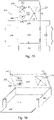
- Figure 7A shows a folding box 100 with a perforated front surface 120 and with a circular product holder 200, with a square product holder 210 and with a rectangular product holder 220.
- Folding box 100 shown is like the folding box according to FIG Figure 1A formed with the difference that the top surface 140 has a circular product holder 200, a square product holder 210 and a rectangular product holder 220.
- the square, circular, and rectangular shaped product holders are formed with a plurality of cuts in the top surface 140, illustrated as solid black lines. The incisions each intersect at a center M.
- three product holders are formed, namely the square, circular and rectangular product holders 200, 210 and 220.
- the three product holders 200, 210 and 220 have a large number of triangular flap elements, with only two flap elements 215 on the product holder 210 are illustrated.
- the triangular flap elements are connected to the lid surface at a fold edge on only one side due to the proposed course of the cut, so that the triangular flap elements can be pressed into an inner area of the folding box.
- food products or beverage products can be pressed into the square, circular and/or rectangular product holder from above in order to securely hold the food products introduced in the product holder.
- Figure 7B shows a folding box 100, as in FIG Figure 7A shown in a folded and opened condition.
- FIG. 1 shows a folding box 100 with a perforated front panel 120 and with a circular product holder 200, with a square product holder 210 and with a rectangular product holder 220 and having a separating barrier formed from the side surface 160 .
- the one in the Figure 8A Folding box 100 shown is like the folding box according to FIG Figure 2A formed with the difference that the top surface 140 has a circular product holder 200, a square product holder 210 and a rectangular product holder 220.
- Figure 8B shows a folding box 100, as in FIG figure 8 shown in a folded and opened condition.
- a separating barrier 305 is formed in an inner area of the folding box 100 .
- a first food compartment 300 and a second food compartment 310 are formed by the separating barrier 305 .
- At least one food product can be arranged in the first food compartment 300, for example a sandwich, a yoghurt, fruit, vegetables, rice pudding or other edible food products.
- At least one beverage product can be arranged in the second food compartment 310, for example non-alcoholic beverages and/or alcoholic beverages such as water, lemonade, coffee or other soft drinks or beer, wine or sparkling wine. These can be placed in the food compartment as a bottle, for example be inserted.
- the isolation barrier 305 is also described in previously Figures 2B , 4B and 6B shown without reference numerals.
- FIG.9 Figure 12 shows a folding box end 400 having a top panel 140, the top panel having a circular product support 200, a square product support 210, and a rectangular product support 220, such as for example Figure 7A described.
Landscapes
- Engineering & Computer Science (AREA)
- Mechanical Engineering (AREA)
- Cartons (AREA)
Applications Claiming Priority (2)
| Application Number | Priority Date | Filing Date | Title |
|---|---|---|---|
| DE102020129088 | 2020-11-04 | ||
| DE102021116457.5A DE102021116457A1 (de) | 2020-11-04 | 2021-06-25 | Faltschachtel zur Aufnahme einer Abteilschale |
Publications (2)
| Publication Number | Publication Date |
|---|---|
| EP3995407A2 true EP3995407A2 (fr) | 2022-05-11 |
| EP3995407A3 EP3995407A3 (fr) | 2022-09-07 |
Family
ID=78770356
Family Applications (1)
| Application Number | Title | Priority Date | Filing Date |
|---|---|---|---|
| EP21206480.2A Withdrawn EP3995407A3 (fr) | 2020-11-04 | 2021-11-04 | Boîte pliable destinée à la réception d'une coque de compartiment |
Country Status (1)
| Country | Link |
|---|---|
| EP (1) | EP3995407A3 (fr) |
Citations (3)
| Publication number | Priority date | Publication date | Assignee | Title |
|---|---|---|---|---|
| DE9005733U1 (de) | 1990-05-16 | 1990-08-23 | Hipp-Werk Georg Hipp, 8068 Pfaffenhofen | Verpackungseinheit für Fertiggerichte |
| EP1452458B1 (fr) | 2003-02-26 | 2008-02-20 | Young's Bluecrest Seafood Limited | Carton pour nourriture |
| FR2982597B3 (fr) | 2011-11-16 | 2014-02-28 | Papeles Y Cartones De Europa S A | Caisse frigorifique pour boissons en bouteille |
Family Cites Families (18)
| Publication number | Priority date | Publication date | Assignee | Title |
|---|---|---|---|---|
| NL44417C (nl) * | 1934-10-23 | 1938-11-15 | Firma Spruit & Co | Vouwdoos voor gebakjes koekjes en soortgelijke waren voorzien van scheurbaan |
| US2924372A (en) * | 1956-11-19 | 1960-02-09 | Lyman D Dunn | Lap tray-container |
| US2833458A (en) * | 1957-09-30 | 1958-05-06 | New Haven Board & Carton Compa | Folding trays |
| US3554432A (en) * | 1968-02-08 | 1971-01-12 | Waddington Ltd J | Cartons |
| US3754642A (en) * | 1971-08-20 | 1973-08-28 | D Stidolph | Waterproof container for perishable products |
| NL7306867A (fr) * | 1973-05-17 | 1974-11-19 | ||
| DE7920049U1 (de) * | 1979-07-13 | 1980-01-31 | Graphia Gundlach Gmbh Hans | Faltschachtel |
| DE8135176U1 (de) * | 1981-11-30 | 1982-05-06 | Deutsche Amphibolin-Werke Von Robert Murjahn, 6105 Ober-Ramstadt | Faltkarton |
| US5009320A (en) * | 1990-10-31 | 1991-04-23 | Kramer William I | Packaging carton |
| US5110038A (en) * | 1991-04-16 | 1992-05-05 | Frank Pantisano | Plate forming and break down pizza box |
| US5335845A (en) * | 1993-08-18 | 1994-08-09 | Liu Yuan Hsin | Partitioned and foldable paper food container |
| US5788081A (en) * | 1996-11-20 | 1998-08-04 | The Mead Corporation | Compartmented tray |
| US7008656B2 (en) * | 2001-02-23 | 2006-03-07 | The Heatermeals Company | Self-heating meal package and tray |
| US7004314B2 (en) * | 2003-05-09 | 2006-02-28 | Weyerhaeuser Company | Multi-product container |
| US20060226206A1 (en) * | 2005-04-11 | 2006-10-12 | Michael Reap | One-piece carton having a plate with a food retaining lip |
| US7464855B2 (en) * | 2006-12-29 | 2008-12-16 | International Paper Company | Combo box and associated blank |
| US9079682B2 (en) * | 2012-10-08 | 2015-07-14 | Phyllis Adams | Bakery boxes having removable parts comprising plates and other tableware |
| US20160022065A1 (en) * | 2014-07-22 | 2016-01-28 | Dan Bach | Food and Beverage Tray |
-
2021
- 2021-11-04 EP EP21206480.2A patent/EP3995407A3/fr not_active Withdrawn
Patent Citations (3)
| Publication number | Priority date | Publication date | Assignee | Title |
|---|---|---|---|---|
| DE9005733U1 (de) | 1990-05-16 | 1990-08-23 | Hipp-Werk Georg Hipp, 8068 Pfaffenhofen | Verpackungseinheit für Fertiggerichte |
| EP1452458B1 (fr) | 2003-02-26 | 2008-02-20 | Young's Bluecrest Seafood Limited | Carton pour nourriture |
| FR2982597B3 (fr) | 2011-11-16 | 2014-02-28 | Papeles Y Cartones De Europa S A | Caisse frigorifique pour boissons en bouteille |
Also Published As
| Publication number | Publication date |
|---|---|
| EP3995407A3 (fr) | 2022-09-07 |
Similar Documents
| Publication | Publication Date | Title |
|---|---|---|
| DE60318228T2 (de) | Lebensmittelträger und verfahren | |
| EP3995407A2 (fr) | Boîte pliable destinée à la réception d'une coque de compartiment | |
| DE102021116457A1 (de) | Faltschachtel zur Aufnahme einer Abteilschale | |
| EP1747735B1 (fr) | Emballage | |
| EP3273833A1 (fr) | Ensemble récipient, procédé et dispositif de fourniture automatique d'une préparation alimentaire | |
| EP1018471A1 (fr) | Récipient pliable | |
| WO2022269491A1 (fr) | Récipient pour la conservation d'aliments | |
| DE10353526B4 (de) | Verpackung zum Transport und Verzehr von verzehrfertigen Schnellbiss-Speisen | |
| DE2022296A1 (de) | Esstisch | |
| DE3043305C2 (de) | Serviertablett | |
| AT525201B1 (de) | Behälter zur Aufbewahrung von Lebensmitteln | |
| DE60002212T2 (de) | Speisetablett zum liefern von mahlzeiten, das zur örtlich unabhängigen einnahme von mahlzeiten geeignet ist | |
| DE20112221U1 (de) | Verpackung für Speisen und Getränke und Verkaufsautomat zu ihrer Abgabe | |
| DE202005008003U1 (de) | Tragvorrichtung aus faltbarem Flachmaterial für eine Mahlzeit | |
| DE4027850C2 (fr) | ||
| EP2547602A2 (fr) | Récipient d'emballage de produits alimentaires et agencement de plusieurs récipients d'emballage de produits alimentaires | |
| DE202020100870U1 (de) | Trinkgefäß mit Halterung für ein Lebensmittel | |
| DE29908710U1 (de) | System-Transportverpackung | |
| DE19849647C2 (de) | Tragvorrichtung zum Transport von Getränkebechern und Getränkegläsern | |
| EP2733083B1 (fr) | Cageot | |
| DE202009007195U1 (de) | Verpackungs- und Serviersystem | |
| DE20208068U1 (de) | Verpackungs- und Speiseschale | |
| EP2084472A1 (fr) | Appareil frigorifique pourvu d'un support pour aliments réfrigérés amovible | |
| DE202025106690U1 (de) | Stapelbare Auflage für ein Trinkgefäß | |
| DE29800008U1 (de) | Variables Menütransportsystem |
Legal Events
| Date | Code | Title | Description |
|---|---|---|---|
| PUAI | Public reference made under article 153(3) epc to a published international application that has entered the european phase |
Free format text: ORIGINAL CODE: 0009012 |
|
| STAA | Information on the status of an ep patent application or granted ep patent |
Free format text: STATUS: THE APPLICATION HAS BEEN PUBLISHED |
|
| AK | Designated contracting states |
Kind code of ref document: A2 Designated state(s): AL AT BE BG CH CY CZ DE DK EE ES FI FR GB GR HR HU IE IS IT LI LT LU LV MC MK MT NL NO PL PT RO RS SE SI SK SM TR |
|
| PUAL | Search report despatched |
Free format text: ORIGINAL CODE: 0009013 |
|
| RIC1 | Information provided on ipc code assigned before grant |
Ipc: B65D 77/04 20060101ALI20220728BHEP Ipc: B65D 81/36 20060101ALI20220728BHEP Ipc: A47G 23/06 20060101ALI20220728BHEP Ipc: B65D 5/56 20060101ALI20220728BHEP Ipc: B65D 5/54 20060101ALI20220728BHEP Ipc: B65D 5/52 20060101ALI20220728BHEP Ipc: B65D 5/48 20060101AFI20220728BHEP |
|
| AK | Designated contracting states |
Kind code of ref document: A3 Designated state(s): AL AT BE BG CH CY CZ DE DK EE ES FI FR GB GR HR HU IE IS IT LI LT LU LV MC MK MT NL NO PL PT RO RS SE SI SK SM TR |
|
| STAA | Information on the status of an ep patent application or granted ep patent |
Free format text: STATUS: REQUEST FOR EXAMINATION WAS MADE |
|
| 17P | Request for examination filed |
Effective date: 20230307 |
|
| RBV | Designated contracting states (corrected) |
Designated state(s): AL AT BE BG CH CY CZ DE DK EE ES FI FR GB GR HR HU IE IS IT LI LT LU LV MC MK MT NL NO PL PT RO RS SE SI SK SM TR |
|
| GRAP | Despatch of communication of intention to grant a patent |
Free format text: ORIGINAL CODE: EPIDOSNIGR1 |
|
| STAA | Information on the status of an ep patent application or granted ep patent |
Free format text: STATUS: GRANT OF PATENT IS INTENDED |
|
| INTG | Intention to grant announced |
Effective date: 20250206 |
|
| STAA | Information on the status of an ep patent application or granted ep patent |
Free format text: STATUS: THE APPLICATION IS DEEMED TO BE WITHDRAWN |
|
| 18D | Application deemed to be withdrawn |
Effective date: 20250607 |