EP3995982A1 - Système et procédé de stockage et de traitement de données personnelles - Google Patents
Système et procédé de stockage et de traitement de données personnelles Download PDFInfo
- Publication number
- EP3995982A1 EP3995982A1 EP20205804.6A EP20205804A EP3995982A1 EP 3995982 A1 EP3995982 A1 EP 3995982A1 EP 20205804 A EP20205804 A EP 20205804A EP 3995982 A1 EP3995982 A1 EP 3995982A1
- Authority
- EP
- European Patent Office
- Prior art keywords
- data
- user
- secure environment
- applications
- application
- Prior art date
- Legal status (The legal status is an assumption and is not a legal conclusion. Google has not performed a legal analysis and makes no representation as to the accuracy of the status listed.)
- Withdrawn
Links
Images






Classifications
-
- G—PHYSICS
- G06—COMPUTING OR CALCULATING; COUNTING
- G06F—ELECTRIC DIGITAL DATA PROCESSING
- G06F21/00—Security arrangements for protecting computers, components thereof, programs or data against unauthorised activity
- G06F21/60—Protecting data
- G06F21/62—Protecting access to data via a platform, e.g. using keys or access control rules
- G06F21/6218—Protecting access to data via a platform, e.g. using keys or access control rules to a system of files or objects, e.g. local or distributed file system or database
- G06F21/6245—Protecting personal data, e.g. for financial or medical purposes
- G06F21/6254—Protecting personal data, e.g. for financial or medical purposes by anonymising data, e.g. decorrelating personal data from the owner's identification
-
- G—PHYSICS
- G06—COMPUTING OR CALCULATING; COUNTING
- G06F—ELECTRIC DIGITAL DATA PROCESSING
- G06F21/00—Security arrangements for protecting computers, components thereof, programs or data against unauthorised activity
- G06F21/60—Protecting data
- G06F21/62—Protecting access to data via a platform, e.g. using keys or access control rules
- G06F21/6218—Protecting access to data via a platform, e.g. using keys or access control rules to a system of files or objects, e.g. local or distributed file system or database
- G06F21/6272—Protecting access to data via a platform, e.g. using keys or access control rules to a system of files or objects, e.g. local or distributed file system or database by registering files or documents with a third party
-
- H—ELECTRICITY
- H04—ELECTRIC COMMUNICATION TECHNIQUE
- H04L—TRANSMISSION OF DIGITAL INFORMATION, e.g. TELEGRAPHIC COMMUNICATION
- H04L63/00—Network architectures or network communication protocols for network security
- H04L63/04—Network architectures or network communication protocols for network security for providing a confidential data exchange among entities communicating through data packet networks
- H04L63/0407—Network architectures or network communication protocols for network security for providing a confidential data exchange among entities communicating through data packet networks wherein the identity of one or more communicating identities is hidden
- H04L63/0421—Anonymous communication, i.e. the party's identifiers are hidden from the other party or parties, e.g. using an anonymizer
Definitions
- the present invention relates to a system and a method for storing and processing user data.
- GDPR European Union's General Data Protection Regulation
- European patent application publication no. EP3447671 A1 in the name of Telefonica S. A. discloses a system for controlling the personal data of a user of a telecommunications network, comprising a database to store the user's data and a data control module to allow the user to manage access permissions to his data.
- a database to store the user's data
- a data control module to allow the user to manage access permissions to his data.
- some desirable features are still missing from the system of EP3447671A1 .
- a third party is only interested in one or more parameters that can be calculated from user data, but does not need the underlying user data.
- a specific example is the one of road tolling: in essence, a road infrastructure operator only needs to know the price the user needs to pay for his usage of the road infrastructure.
- the road infrastructure operator will need the data on when and where the user was driving in order to calculate the user's due amount.
- the road infrastructure operator is fully aware of the user's whereabouts which clearly intrudes on the user's privacy. Furthermore, if the user's whereabouts are leaked, these can easily be abused for malicious intent.
- third parties need to be able to trust the correctness of the user data.
- the road infrastructure operator cannot calculate the correct price for usage of the road infrastructure.
- Current systems for storing and managing personal data cannot guarantee the plausibility and integrity of the stored data.
- a system for storing and processing data pertaining to a user comprising:
- the management application enables the user to perform one or more of:
- the one or more devices comprise a personal device of the user.
- Many personal devices with widespread adoption such as for instance smartphones, smart watches and other wearable devices or notebooks, comprise a processor, storage space, various sensors and wired and/or wireless networking means and can thus be used as a device for generating data pertaining to a user.
- the secure environment is located in a first cloud-computing environment.
- Typical cloud computing environments are substantially always connected to the internet, offer on-demand scalable processing power and storage space, employ redundant storage and feature state-of-the art data protection techniques and protocols.
- cloud-computing environments suitable for use in the system according to the invention are nowadays so common, accessible and widespread that there is little or no need for the installation of dedicated servers for hosting the secure environment and storing user data, thereby possibly minimizing the capital cost, operational cost, time to market and adoption time of the system.
- the data is stored in the secure environment under encrypted form.
- the management application is configured to verify a certification of the one or more applications and to only allow the installation and/or execution of the one or more applications if a predetermined certification criterion is met.
- the system comprises an interface to a second cloud computing environment for the storage of an anonymized non-modifiable copy of a record of the data pertaining to a user.
- non-modifiable copy cannot be tampered with and can be used to check the integrity and plausibility of the data pertaining to the user.
- non-modifiable copy is anonymized and hence does not fall under personal data and/or privacy regulations.
- non-modifiable copy is anonymized and hence does not raise privacy concerns with the user.
- non-modifiable copy can be used as a back-up in the case of data loss.
- the system comprises means to allow one or more external devices to collect a subset of the data pertaining to the user, and/or processed data, derived from the data pertaining to the user, when the user is located within a predetermined distance of the one or more external devices.
- External devices comprise all devices that are not personal devices of the user, including but not limited to personal devices of a second user and infrastructure devices.
- the system comprises means to communicate a subset of the data pertaining to the user, and/or processed data, derived from the data pertaining to the user, to one or more external devices when the user is located within a predetermined distance of the one or more external devices.
- External devices comprise all devices that are not personal devices of the user, including but not limited to personal devices of a second user and infrastructure devices.
- a method for storing and processing data pertaining to a user comprising:
- the management application enables the user to perform one or more of:
- the collecting of the data is done by a personal device of the user.
- Many personal devices with widespread adoption such as for instance smartphones, smart watches and other wearable devices or notebooks, comprise a processor, storage space, various sensors and wired and/or wireless networking means and can thus be used as a device for collecting data pertaining to a user.
- the secure environment is located in a first cloud-computing environment.
- Typical cloud computing environments are substantially always connected to the internet, offer on-demand scalable processing power and storage space, employ redundant storage and feature state-of-the art data protection techniques and protocols.
- the data is stored in encrypted form in the secure environment and only the user knows the corresponding decryption key.
- the installation and execution of the one or more applications in the secure environment are prevented if the one or more applications do not meet a predetermined certification criterion.
- an anonymized non-modifiable copy of a record of the data is stored in a second cloud-computing environment and the address of the anonymized non-modifiable copy is appended to the record of the data.
- the one or more applications can compare the record of the data to the anonymized non-modifiable copy of the record.
- the one or more applications can compare the record of the data to the anonymized non-modifiable copies of one or more other records.
- These anonymized non-modifiable copies of one or more other records do not necessarily comprise the same data type as the record of the data.
- These anonymized non-modifiable copies of one or more other records do not necessarily comprise data pertaining to the user; for instance, they may comprise data pertaining to one or more other users.
- the anonymized non-modifiable copies can be made available to a third party without consent of said user.
- an enforcement provider can compare one or more records of the data pertaining to said user, these one or more records being collected by one or more external devices for the time period during which the user is located within a predetermined distance of the one or more external devices, with data generated by the external devices.
- an enforcement provider can compare one or more records of the data pertaining to said user, these one or more records being communicated to one or more external devices for the time period during which the user is located within a predetermined distance of the one or more external devices, with data generated by the external devices.
- an enforcement provider can make use of means to detect a user.
- These means might comprise one or more sensors, such as for instance a camera.
- the enforcement provider can detect when a user is using the infrastructure without the one or more devices for generating data.
- Some embodiments of the method are adapted to allow the user to access a service provided by a service provider, in that the user is required to grant an application of the service provider permission to be installed in the secure environment, to execute in the secure environment and to send a service-specific subset of the data and/or service-specific processed data, derived from the data, to the service provider.
- the service provider has no insight into the user's data, except for the service-specific subset of the user's data and/or the service-specific processed data, derived from the user's data.
- an enforcement provider can compare one or more records of the data pertaining to the user, these one or more records being communicated to one or more external devices for the time period during which the user is located within a predetermined distance of the one or more external devices, with data generated by the external devices, are adapted to allow submission of the user to an enforcement policy.
- the user is required to grant one or more of his personal devices permission to send an enforcement-specific subset of his data and/or enforcement-specific processed data, derived from his data, to external devices.
- an enforcement provider can compare one or more records of the data pertaining to the user, these one or more records being collected by one or more external devices for the time period during which the user is located within a predetermined distance of the one or more external devices, with data generated by the external devices, are adapted to allow submission of the user to an enforcement policy.
- the user is required to grant the external devices permission to collect an enforcement-specific subset of his data and/or enforcement-specific processed data.
- the enforcement provider can act on behalf of multiple service providers and deliver the required service-specific data to each of the service providers, without the service providers needing to be concerned with the method of obtaining the required service-specific data.
- enforcement provider can act on behalf of a government agency and deliver legally required data about the user to the government agency, without the government agency needing to be concerned with the method of obtaining the legally required data.
- the term "user” refers to a natural or legal person who uses the system or method of the present invention to store and eventually process data pertaining to himself.
- the term “user” may also refer to a natural or legal person who accepts and enables the usage of one or more of his personal devices by the system or method of the present invention, with or without using the system or method of the present invention to store and eventually process data pertaining to himself.
- service provider refers to a natural or legal person who offers services that are available for users of the present system or method.
- the term “enforcement provider” refers to a natural or legal person who offers the service to service providers of ensuring the plausibility and integrity of the data they receive from the user.
- the term “framework provider” refers to a natural or legal person who owns, runs or maintains the system according to the invention.
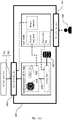
- FIG. 1 (a) -(c) schematically illustrate an embodiment of the system for storing and processing personal data pertaining to a user, according to the present disclosure.
- solid arrows represent the flow of data
- dashed arrows represent the flow of user control
- dash-dotted arrows represent the installation of applications.
- Fig. 1 (a) schematically illustrates data storage by the embodiment of the system.
- One or more devices 200 generate data 300 pertaining to the user 100.
- These devices 200 may comprise personal devices of the user, including but not limited to examples such as a smart phone, smart watch, portable computer or onboard computer of a personal vehicle.
- These devices 200 may also comprise external devices, including but not limited to personal devices of a second user or devices belonging to a service provider, infrastructure operator, enforcement provider or government agency. Specific examples are given further in this document.
- the data 300 pertaining to the user 100 can be generated by the devices 200 using various sensors, measurement and data mining techniques, including but not limited to clocks, GPS receivers, file readers or algorithms.
- the data 300 pertaining to the user 100 may comprise personal data, wherein personal data is defined, according to GDPR, as any information that relates to an identified or identifiable living individual.
- the data 300 is transferred by means of a secure input interface 401 to a secure environment 400 where it is stored.
- the data 300 can be transferred by an appropriate data network.
- the data network may comprise, as the skilled person will appreciate, any suitable combination of segments implemented according to various data networking standards, including for example wired or wireless personal area networks, such as USB, IEEE Std 802.15.1 and .2 (“Bluetooth”), and IEEE Std.
- the data network may use the TCP/IP protocol family.
- the data 300 can be temporarily stored or cached on the devices 200 to ensure that it does not get lost or corrupted if the devices 200 cannot connect to the secure environment 400 through the interface 401, if the connection is lost during data transfer or if the rate of data generation exceeds the transmission rate.
- the secure input interface 401 comprises means to communicate the successful transfer and storage of data 300 to the devices 200.
- the devices 200 erase the data 300 that they stored or cached after receiving the confirmation of successful data transfer and storage from the secure input interface 401.
- secure input interface implies that during transmission of the data 300 from the devices 200 to the secure environment 400, appropriate techniques and protocols are used such that non-authorized third parties cannot tamper with the data 300 being transferred.
- these techniques and protocols may for example provide one or more of authenticity (e.g. by using message authentication codes), non-repudiation (e.g. by using electronic signatures), detection of message loss (e.g. by using message counters), and the like.
- authenticity e.g. by using message authentication codes
- non-repudiation e.g. by using electronic signatures
- detection of message loss e.g. by using message counters
- the skilled person is well aware of the appropriate techniques and protocols that can be implemented to ensure secure data transmission. Examples of protocols from the TCP/IP protocol family that can be used in this context include, but are not limited to, the TLS and SSL protocols.
- the term "secure environment” indicates a digital environment for the persistent and redundant storage of data, wherein non-authorized third parties cannot access, copy, read or modify the data being stored.
- the skilled person is well aware of the appropriate techniques and protocols that can be implemented to ensure secure data storage.
- the secure environment 400 can be located on various physical devices, including but not limited to a personal device of the user, a dedicated server or in a cloud computing environment.
- the secure environment 400 exists on more than one physical device for reasons of redundancy and is synced across these devices.
- the secure environment 400 is connected to the internet.
- the secure environment 400 offers scalable storage space.
- the user 100 remains the owner of his data 300, even when he is not the owner of the physical device on which the secure environment containing his data is located.
- the user 100 can control, by means of a management application 402, which data, generated by the devices 200, can be received by the secure input interface 401 and stored in the secure environment 400.
- the data 300' received by the secure input interface 401 is thus not necessarily equal to the data 300 generated by the devices 200, but can be a subset of the data 300.
- the user's settings are stored in a user profile in the secure environment 400.
- the management application 402 employs appropriate means such that non-authorized third parties cannot modify the user's settings. Such means might comprise single factor or multi-factor authentication methods.
- the user 100 has, through the management application 402, complete insight into his own data.
- the data 300' is encrypted before it is stored in the secure environment as encrypted data 300".
- the used encryption key and the corresponding decryption key are stored in the user profile in the secure environment 400.
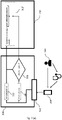
- Fig. 1(b) schematically illustrates the installation of one or more applications 500 (abbreviated as "apps” in the figures for the sake of brevity) by the embodiment of the system.
- the secure environment 400 comprises an application programming interface 403 (hereinafter sometimes abbreviated as "API") that enables the installation of one or more software applications 500 in the secure environment 400.
- API application programming interface
- These applications may be offered by third parties, including but not limited to service providers, infrastructure operators, enforcement operators, government agency or natural persons.
- the applications 500 may be available on demand through various distribution platforms, including but not limited to downloads from an application repository or downloads from an application-specific website.
- When the user 100 requests a specific service he may be prompted to install a service-specific application 500.
- the user 100 requests a specific service he may be obliged to install a service-specific application 500 in order to use the requested service.
- the user 100 may be legally obliged to install government-issued applications. Examples of service-specific applications are given further in
- the user 100 can control, by means of the management application 402, which applications 500 can be installed in the secure environment 400. Preferably, these user settings are stored in the user profile in the secure environment 400. If an non-authorized application attempts to install itself in the secure environment 400, the API 403 will block the installation process of the specific application. Preferably, the user 100 receives a warning when a non-authorized application attempts to install itself in the secure environment 400. Preferably, the user 100 can, by means of the management application 402, uninstall installed applications from the secure environment 400.
- the user 100 can control, by means of the management application 402, whether an application 500 should meet a predetermined certification criterion before it is allowed to install in the secure environment 400.
- Issuing certificates can be a convenient way to separate secure applications from unsecure or malicious applications.
- a malicious application might for instance attempt to communicate data pertaining to the user to other parties than it discloses. These certificates may be issued by various third parties, including but not limited to government agencies, private companies or consumer groups.
- the management application 402 will block the installation process of the specific application.
- the user 100 receives a warning when a non-certified application attempts to install itself in the secure environment 400.
- the API 403 will block the installation process of the specific application.
- the user 100 receives a warning when he tries to install non-certified application in the secure environment 400.
- the secure environment 400 is configured to host the applications 500 to process the data 300' in the secure environment 400.
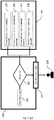
- Fig. 1 (c) schematically illustrates the execution of one application 500' by the embodiment of the system.
- An application 500 can only be executed in the secure environment 400 after it has been installed in the secure environment 400.
- the user 100 can control, by means of the management application 402, which applications 500 are allowed to execute.
- the user 100 receives a warning when a non-authorized application attempts to execute in the secure environment 400.
- the user 100 can also control, by means of the management application 402, when applications 500 are allowed to execute.
- the user 100 receives a warning when an application attempts to execute in the secure environment 400 at a non-authorized moment.
- the secure environment 400 is configured to be capable of hosting more than one application 500 simultaneously.
- an application 500' being executed in the secure environment 400 can read all data 300' in the secure environment 400 and can write data to the secure environment 400 but cannot delete or modify data in the secure environment 400.
- the skilled person is aware of appropriate techniques for controlling the behaviour of applications, such as for example the usage of a temporary running environment, such as a container or virtual machine, inside the secure environment 400.
- the encrypted data 300" has to be decrypted to the un-encrypted data 300' before the running application 500' can read and process it.
- this decryption process happens inside the temporary running environment such that the decrypted data 300' is not exposed to other applications 500.
- this decryption uses a key stored in the user profile, which may be the same key that was used for encryption (this would be the case if a symmetric encryption algorithm is used) or a separate, private key (this would be the case if a public key encryption algorithm is used).
- the system comprises a processor 600 configured to execute the applications 500 in the secure environment 400.
- the term "processor” is not meant to limit this element to a component commercially known as a microprocessor.
- the processor 600 can include any suitable hardware, including but not limited to a CPU, a suitably configured FPGA, an ASIC, or a combination of such components.
- the processor can be mounted in various physical devices, including but not limited to a personal device of the user, a dedicated server or in a cloud computing environment.
- the processor 600 is mounted in a physical device that hosts the secure environment 400.
- the processor 600 is mounted in a physical device that is connected to the internet.
- the system offers scalable processing power.
- the applications 500 are configured to, upon runtime, select a subset 301 of the data 300' and/or generate processed data 302, based on the data 300' and to attempt to communicate this subset 301 or this processed data 302 to a third party outside the secure environment 400 through the API 403.
- the subset 301 or the processed data 302 comprise service-specific data.
- appropriate techniques and protocols are used such that no one, except for the intended receivers, can intercept, copy or read the data being transferred and such that no one can modify the data being transferred.
- the intended receivers may comprise service operators, enforcement operators or government or law enforcement agencies.
- the subset 301 or the processed data 302 comprise service-specific data. Examples of third parties and service-specific data are given further in this document.
- the user 100 can control, by means of the management application 402, which subset 301 of his data 300' or which processed data 302, derived from his data 300', can be sent to outside the secure environment 400 by the one or more applications 500 installed in the secure environment 400. If an application 500 attempts to send non-authorized data outside the secure environment, the management application 402 will block the transmission of this non-authorized data. Preferably, the user 100 receives a warning when an application attempts to send non-authorized data outside the secure environment 400. Preferably, the user 100 can control, by means of the management application 402, when a subset 301 of his data 300' or when processed data 302, derived from his data 300', can be sent to outside the secure environment 400 by the one or more applications 500 installed in the secure environment 400.
- the management application 402 will block the transmission of this data.
- the user 100 receives a warning when an application attempts to send data outside the secure environment 400 at a non-authorized moment.
- the provider(s) of the framework comprising the secure environment 400, the secure input interface 401, the management application 402 and the API 403 do not have insight in the data 300.
- the owner(s) - other than the user 100 - of the physical device(s) on which the data is stored do not have insight in the data 300.
- the owner(s) - other than the user 100 of the physical device(s) on which the data is processed do not have insight in the data 300.
- Some embodiments of the method of the present invention are particularly suited for the exchange of a user's personal data with a service provider delivering a service to the user.
- the flow chart in Fig. 2 illustrates such an embodiment.
- this service provider first requests that the user allows the application of the service provider to be installed in his secure environment by means of the API, at least if the application hasn't been installed yet. If the user does not agree with installing the application, the service provider refuses the user access to the service.
- the application of the service provider is certified according to a widely known and trusted certification standard.
- the service provider will request the user to grant the application the right to execute in the user's secure environment and to send a service-specific subset of the user's data or service-specific processed data, derived from the user's data, to the service provider.
- the service provider gives exact specifications for the service-specific data to be communicated. If the user does not approve the execution of the application and the communication of the service-specific data, the service provider refuses the user access to the service. Preferably, the user can save his preferred allowances for a specific application and/or a specific service provider in the management application.
- the application of the service provider checks whether the required data records, necessary for the service-specific data subset or the calculation of the service-specific processed data, are actually present in the user's secure environment. Preferably, in case the required data records are not present in the secure environment, the user is prompted by the application to allow a suitable device to send data to the secure environment through the secure input interface. If the user refuses to do so, the service provider refuses the user access to the service.
- the service provider grants him access to the requested service.
- the service provider's application runs in the secure environment for the time the user is using the service and communicates the service-specific data to the service provider through the API. While the application has access to all of the data in the user's secure environment, only the service-specific data leaves the secure environment and is communicated to the service provider. This mode of operation presents important advantages, which will be illustrated further in this text by means of specific examples.
- the application of the service provider automatically stops executing in the secure environment and stops communicating service-specific data to the service provider once the user or the service provider indicates that the user is no longer using the service.
- the user is capable of manually interrupting the execution of the application and the transmission of service-specific data.
- the service provider is not certain of receiving correct data from the user. Indeed, in many cases the service-specific data will be used to bill the user and the user will have an incentive to tamper with his data, for instance by partially or completely deleting service-specific data, by only allowing the collection of incomplete data by his personal devices or by manipulating the data generated by his personal device.
- the following embodiments of the system and method address this concern.
- Fig. 3 schematically illustrates an embodiment of the system comprising an interface to a second cloud computing environment.
- the interface 404 connects the secure environment 400 to a second cloud computing environment 700.
- the interface 404 is a secure interface, where the term "secure interface" has the interpretation described above.
- the interface 404 is used to transfer a copy 303' of a data record 303 of the data 300 stored in the secure environment 400 to the second cloud computing environment 700 and to store the copy 303' in this environment 700.
- the copy 303' is anonymized, implying that the copy 303' cannot be related to the user.
- the copy 303' is non-modifiable and is created at substantially the same moment as the original record 303.
- the address of the copy 303' is added to the record 303.
- the anonymized copy 303' can be used as a backup in case the record 303 is deleted or damaged.
- the applications 500 installed in the secure environment can, upon runtime, compare the record 303 to its anonymized copy 303'. In this way, the applications 500 can verify the integrity of the record 303.
- the anonymized non-modifiable copies in the second cloud computing environment can be made available to a third party without consent of the user. Since the anonymized non-modifiable copies cannot be related to the user without access to the corresponding addresses in the user's secure environment, the anonymized copies do not comprise personal data and their proliferation is not subject to personal data and/or privacy regulations.
- the second cloud computing environment stores the anonymized non-modifiable copies of the data of all users.
- the anonymized non-modifiable copies of the user data of all the users of a service comprise a very valuable dataset for the service provider offering the service. The data in this dataset may help the service provider in understanding his clients, improving his service or taking business decisions.
- a specific example of the usage of the anonymized data by a service provider is given further in this document.
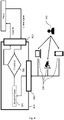
- Fig. 4 schematically illustrates another embodiment of the system that is suitable for ensuring the completeness and integrity of the data delivered to the service provider.
- the device 200 communicates with external devices 201 through an appropriate data network.
- the communication between the device 200 and the external devices 201 comprises wireless communication.
- the employed data network may be the same as the one involved in the communication between the device 200 and the secure input interface 401.
- the employed data network offers bidirectional communication, meaning that both the device 200 and the external devices 201 can send and receive information to and from each other.
- the external devices 201 are equipped with various networking means in order to ensure compatibility of communication with a variety of different devices.
- the device 200 can exchange a subset 301' of the generated user data 300 and/or processed data 302', derived from the generated data 300, with external devices 201 that are within a predetermined range 101 of the device 200 currently generating the data for the secure environment.
- the predetermined range 101 is smaller than 1000, 500, 200, 100 m.
- the predetermined range 101 is larger than 5, 10, 20, 50 m.
- the external devices 201 can be personal devices of other users or infrastructure devices belonging to a service provider, the framework provider, an enforcement provider or a government agency.
- the communication means cannot exchange any data with a device 201' that is outside of the predetermined range 101.
- Fig. 5 schematically illustrates how an enforcement provider can leverage the embodiments of the system described in connection with Fig. 3 and Fig. 4 to ensure the plausibility and integrity of the data being delivered to the service provider.
- the user When the user request to use a service provided by a service provider, the user is required to accept the installation of the service provider's application 500 in his secure environment 400, as well as the execution of the service provider's application and the communication of the data subset 301 and/or processed data 302 to the service provider. This process has been described in the context of Fig. 2 and is not shown in Fig. 5 .
- the user is required to accept the installation of an enforcement provider's application 501 in his secure environment 400, as well as the execution of the enforcement provider's application 501 and the broadcasting of an enforcement-specific subset of data 301' or enforcement-specific processed data 302' by means of the local device 200 generating the user data.
- the enforcement-specific subset 301' and enforcement-specific processed data 302' are thus sent outside the scope of the secure environment 400.
- the enforcement-specific data 301' and 302' is received by the external devices 201 that are within a predetermined distance of the device 200.
- the location of the user corresponds to the location of the device 200 generating data pertaining to the user.
- the enforcement-specific data 301' and 302' does not comprise any other data pertaining to the user than the data that could be observed by a natural person or a sensor within the predetermined distance of the user. In this case, the broadcasting of the enforcement-specific data 301' and 302' does not endanger the privacy of the user and does not violate privacy and/or personal data regulations.
- the enforcement-specific data 301' and 302' comprises the identification of the user.
- the enforcement-specific data 301' and 302' comprises the geographical location of the user, within a predetermined accuracy range, as well as the corresponding time at which the user is in that specific geographical location. Examples of enforcement-specific data are given further in this document.
- the external devices 201 compare the received enforcement-specific data 301' and 302' with the corresponding data generated by themselves. If both datasets match according to a criterion, predetermined by the enforcement operator, the external devices 201 preferably discard the user data 301' and 302'. If both datasets do not match according to the criterion, the external devices 201 inform the enforcement provider that the user has tampered with his data. The enforcement provider can in turn take additional measures or eventually inform the service provider of infrastructure operator.
- the external devices 201 are equipped with means to detect the presence of users within a predetermined distance range, also when no enforcement-specific data 301' and/or 302' is being received from these users. Such absence of enforcement-specific data 301' and/or 302' can trigger external device 201 to inform the enforcement provider that a user is using the service or infrastructure although not providing enforcement-specific data 301' and/or 302'.
- An illustrative example of the above is the case of an external device 201 equipped with a camera that detects a vehicle driving by on a toll road without broadcasting enforcement-specific data 301' and/or 302'.
- the enforcement provider provides the licence plate number of said the detected vehicle as communicated to the enforcement provider by external device 201 to an appropriate entity such as the service provider or government agency for further measures.
- the embodiment of this method allows to enforce the use of operational and active devices 200 by all users and to the appropriate entity to take further measures in case there are users without operational device 200.
- the advantage of the described method with respect to existing enforcement methods is that the enforcement provider only has to take further measures in case enforcement-specific data 301' and/or 302' is absent.
- the enforcement provider application 501 is also running in the secure environment of the user.
- the enforcement provider application 501 compares the records of the required service-specific data 301 and/or 302 to the corresponding anonymized non-modifiable records stored in the second cloud computing environment 700 according to a criterion predetermined by the enforcement provider. This comparison can happen periodically at predetermined instants or at random instants.
- the comparison can also be initiated by a signal from the external devices 201 if the external devices detect 201 a mismatch between the broadcasted enforcement-specific data 301' and 302' and the corresponding data generated by themselves.
- the application 501 If the enforcement provider application 501 detects a match between the service-specific data 301 and/or 302 and the corresponding anonymized non-modifiable records stored in the second cloud computing environment 700, the application 501 does not undertake any action. If on the other hand, the enforcement provider application 501 detects a mismatch between the service-specific data 301 and/or 302 and the corresponding anonymized non-modifiable records stored in the second cloud computing environment 700, the application 501 informs the enforcement provider who can take further measures.
- the embodiment of the method described in the context of Fig. 5 thus provides two independent, complementary ways of detecting data tampering by a user, without exposing non-authorized data of the user to non-authorized third parties.
- This embodiment is independent of the service being used or of the service provider, with the possible exception of the contents of the enforcement-specific data 301' and 302'.
- One enforcement provider can thus serve many service providers and there is no need for the service providers to invest in methods of ensuring the plausibility and integrity of the user's data.
- the same external devices 201 can serve for the enforcement for many different services. Since the external devices 201 comprise the personal devices of all the users of the system and method, there is little need for the enforcement provider to invest in additional external devices. One enforcement provider can thus serve many service providers with a limited infrastructure investment.
- the system and method of the invention enable intelligent tolling, geofencing, speed limit enforcement and car insurance price calculation without the aforementioned disadvantages.
- Fig. 6 (a) -(b) schematically illustrate this specific example, where a user 100 wants to drive a vehicle, such as for instance a car, over a road infrastructure operated by a road infrastructure provider.
- the service provider providing a service that enables the user to drive on the road operated by the road infrastructure provider (such as an electronic toll service provider) will impose conditions on the user 100 before the user 100 can access the road infrastructure.
- These conditions are schematically drawn in Fig. 6 (a) and comprise the following four demands:
- the infrastructure provider grants the user access to the road network with his vehicle.
- the road toll service provider's application 500 can calculate not only the toll rate for the user, but also check whether the user is driving in areas where his vehicle is not allowed or whether the user is exceeding the local speed limit.
- the user since the user will be billed or fined based on the data he provides to the infrastructure operator, the user has a strong incentive to tamper with his data. For instance, the user could designate his mobile phone as the device collecting and communicating the data and could subsequently leave his mobile phone at home, such that it appears as if he does not use the road infrastructure, or the user could simply list an incorrect licence plate for his vehicle.
- Fig. 6 (b) demonstrates how data tampering can be detected.
- the user's local device 200 broadcasts the enforcement-specific data 301' and 302' which is picked up by the external devices 201 within a predetermined distance 101 of the user's device 200.
- the enforcement provider's application 501 compares the service-specific data in the user's secure environment 400 to corresponding anonymized records in the second cloud computing environment 700.
- the external devices 201 compare the received or collected enforcement-specific data 301' and 302' to their own observations. If the enforcement-specific data 301' and 302' corresponds to the observations of the external devices 201 according to a predetermined criterion, the external devices 201 can discard the enforcement-specific data.
- the external devices 201 inform the enforcement provider. Subsequently, the enforcement provider and/or the enforcement provider's application can take measures against the user 100, such as running additional checks or eventually informing the service provider and/or the road infrastructure operator.
- a camera-equipped external device such as a licence plate camera
- the external device can deduce that the user has tampered with his licence plate information and can pass this information, together with the correct licence plate number to the enforcement provider and/or the enforcement provider's application.
- the external device can deduce that the driver of the vehicle does not make use of the service of this (enforcement) service provider.
- the enforcement provider can inform the road infrastructure operator on this.
- an external device can compare the location that is broadcasted by a car passing by to its own location. If both locations are not within a predetermined distance of each other, the external device can deduce that the driver of the vehicle has tampered with his data by tampering with the location data of his data-collecting device and can pass this information, together with the vehicles correct location and associated timestamp to the enforcement provider and/or the enforcement provider's application.
- the required functionality is realized without violating the privacy of the user. If the user does not tamper with his data, the infrastructure provider is only aware of the price that the user is due without having any insight into the underlying whereabouts of the user. The infrastructure provider does not know when, where and for how long the user is using his service, but thanks to the enforcement provider, he has the certainty that the due price has been calculated based on correct data.
- the external devices do receive the enforcement-specific data, this does not infringe on the user's privacy for two reasons. First of all, if the user doesn't tamper with his data, the external devices discard the enforcement-specific data. Secondly, since the enforcement-specific data is limited and is only received by external devices within a predetermined distance of the user's data collecting device (and hence the user) not providing any means for aggregation of said data, this does not differ from other common forms of observation such as being seen by other people on the street.
- Fig. 6 (a) -(b) do not show the presence of anonymized non-modifiable copies of records of user data, stored in a second cloud computing environment 700, for the sake of not overloading the figure, it is very much an advantage for applications in the mobility domain when this feature is implemented as illustrated in Fig. 5 .
- the service provider does not have access to the whereabouts of individual users.
- it would be of immense help to the infrastructure provider if he had access to traffic information on the road network.
- the infrastructure provider obtains access to a complete dataset without infringing the privacy of any of the users.
- the data 300 might comprise information on the vehicle's drivetrain (internal combustion engine, hybrid or electric), the type of fuel used, the dynamic fuel consumption, the parameters set in the motor management system, the output of the exhaust gas sensors or other data that can be read from the vehicle's data network.
- the road infrastructure provider's application 500 might calculate for instance an ecological-footprint-based toll rate, where the user 100 is taxed based on the true consumption and emissions of his vehicle.
- the service provider's application 500 can even calculate the car insurance cost for an insurer (instead of the price for using the road) for the user 100, based on the data in the secure environment, the regulatory requirements, motor engine parameters reflecting the driving behaviour and the pricing policy of the insurance company.
- the following example illustrates the use of the system according to the present invention for the application of contact tracing.
- Contact tracing can be a powerful tool to understand and eventually control the spread of dangerous contagious diseases, such as for instance COVID-19, but is often met with resistance by the population due to privacy concerns.
- the use of the present invention for contact tracing has the potential of alleviating these concerns.
- Fig. 7 (a) schematically illustrates the first and second steps in the use of the present invention for contact tracing applications.
- a user 100 allows that one or more devices 200 register his movement trace and his medical record and subsequently send this aggregated data, by means of a secure input interface 401, to the user's secure environment 400.
- the user's movement trace is stored as a movement trace record 303 and the user's medical history is stored as a medical record 304.
- the user's movement trace record 303 comprises the user's location and the timestamp of the moment when the user was found at this location.
- the user's location is updated at least once every 5 minutes, more preferably at least once every 2 minutes, even more preferably at least once every minute, most preferably at least once every 30 seconds.
- the user's location is updated at least once every 100 metres, more preferably at least once every 50 metres, even more preferably at least once every 20 metres, most preferably at least once every 10 metres.
- the system is capable of adjusting the acquisition rate such that the user's location and timestamp can be sampled more frequently when the system detects that the user is moving at a rapid pace, for instance, more than 100 metres every 30 seconds, or such that the user's location and timestamp can be sampled less frequently when the system detects that the user is moving at a slow pace, for instance, less than 10 metres every 5 minutes.
- the skilled person is aware of suitable algorithms for modifying the acquisition rate.
- the skilled person will also understand that the above mentioned time and space intervals are merely suggestions and can be adapted to specific cases. For instance, when it is well known that a virus can only be transmitted from one person to another when both persons are within a distance of 1,5 metres of each other, spatial sampling with a resolution of 1,5 metres or smaller may be desirable.
- the user's medical record comprises information on whether the user is infected with a recognized dangerous contagious disease.
- the user's medical record comprises the timestamp of the administration of the lab test that determined that the user is infected with a recognized dangerous contagious disease.
- An anonymized non-modifiable copy 303' of the user's movement trace record is stored in the second cloud computing environment 700, as discussed above in the context of Fig. 3 .
- the user grants an application 500 permission to execute in his secure environment 400 and to access his movement trace record 303 and his medical record 304, both stored in this environment.
- the application 500 scans the user's medical record for positive test results for dangerous contagious diseases.
- the application 500 accesses the movement trace record 303 to retrieve the address of the anonymized non-modifiable copy 303' of the movement trace record.
- the application 500 retrieves the anonymized non-modifiable copy 303' of the user's movement trace record and appends this record with the user's test results for the dangerous contagious diseases.
- the application 500 retrieves a list of dangerous infectious diseases to scan for from an officially recognized and certified database. Preferably, the application 500 also reads the timestamp of the administration of the lab tests for the respective dangerous contagious diseases. If the user 100 has recently tested positive for a dangerous contagious disease, the application 500 appends the anonymized record 303' with a positive infection status for the specific disease. If the user 100 has recently tested negative for a dangerous contagious disease, the application 500 appends the anonymized record 303' with a negative infection status for the specific disease. If a user 100 was not tested for a specific disease, or was only tested a long time ago, the application 500 may append the anonymized record 303' with an unknown infection status for the specific disease.
- the application will execute periodically and update the anonymized non-modifiable copy 303' of the user's movement trace record and appends this record with the user's test results for the dangerous contagious diseases accordingly.
- the application 500 takes this specific knowledge into account when appending the user's disease status to the record 303'.
- Fig. 7 (b) schematically illustrates the third step in the use of the present invention for contact tracing applications.
- the content of the second cloud computing environment 700 comprises the anonymized movement trace records with the appended disease status of all users who have agreed with the necessary steps for using the invention for contact tracing purposes.
- the content of the second cloud computing environment 700 comprises the anonymized movement trace records with the appended disease status of a significant part of the population. This might be achieved for instance by legally obliging all users of the system according to the invention to enable the contact tracing application.
- the second cloud computing environment 700 essentially comprises a database of the movement traces of contagious people. It is an additional advantage that this database does not raise privacy concerns with the users or does not violate personal data regulations since the data in the second cloud computing environment is anonymized.
- the user 100 grants an application 501 permission to execute in his secure environment 400 and to access his movement trace record 303 stored in this environment.
- the application 501 compares the user's movement trace record 303 with the anonymized movement trace records stored in the second cloud computing environment 700.
- the application 501 only compares the user's movement trace record 303 with the anonymized movement trace records comprising a positive disease status for a dangerous contagious disease.
- the application 501 thus compares the user's movement trace record 303 to the copies with a positive disease status 305' and 308', but not to the copy with the negative disease status 306' or to the copy with the unknown disease status 307'.
- the application 501 warns the user 100 through the user interface 402. The user 100 might then be recommended to undergo a lab test for the specific disease.
- the overlap criterion can be determined on a per-disease or situational basis. For instance, some diseases might spread over a larger distance than others because they are transmitted through a different mechanism. Likewise, some viruses or bacteria might survive much longer on commonly touched surfaces such as door knobs. Even more, the transmission of some infectious diseases might depend on climatological conditions such as temperature or relative humidity or on the environment, with some disease spreading much more easily in swimming pools or public shower facilities. Preferably, the algorithm embedded in the application 501 takes this specific knowledge into account.
- FIG. 8 schematically illustrates the use of the present invention for the application of tracing possible crime suspects.
- a user 100 must first allow that one or more devices 200 register his movement trace and subsequently send this aggregated data, by means of a secure input interface 401, to the user's secure environment 400.
- the user's movement trace is stored as a movement trace record 303.
- the agency can transmit this information through the API 403 to the secure environment 400 of the user. Subsequently, the user 100 needs to grant an application 500 permission to execute in his secure environment 400 and to access his movement trace record 300.
- the application 500 is a certified application originating from a government agency.
- the user 100 is legally obliged to grant the application 500 permission to install and execute in his secure environment, to access his movement trace and to communicate his identity to the crime investigation agency.
- the application 500 compares the user's movement trace to the location, date and time of the crime. If overlap between the user's movement trace and the crime scene is detected according to a predetermined criterion, the application transmits this information, together with the user's identity, to the crime investigation agency, without requiring the user's further consent. This agency can then add the user to the list of possible suspects. Preferably, if no overlap is detected and the user 100 is not on the crime suspect list yet, the application 500 does not send any information to the crime investigation agency. Preferably, if no overlap is detected and the user 100 is already on the crime suspect list, the application 500 does send the information to the crime investigation agency. This agency can then remove the user from the list of possible suspects. Preferably, the crime investigation agency can determine the overlap criterion a case-by-case basis, thereby accounting for the uncertainty in the estimated location, time and date of the crime under investigation.
- Electronic governance or e-governance is the application of IT for delivering government services to citizens and businesses.
- government services can be made available in a convenient, efficient, and transparent manner.
- a government may need to gather, store and have insight in the personal data of the natural and legal persons residing in its jurisdiction. This holds especially true for the example of the calculation and enforcement of tax rates, tax incentives and the distribution of government benefits.
- citizens and companies have a strong incentive to tamper with their tax filings in order to pay lower taxes.
- tax schemes are often complex and many citizens inadvertently commit errors in their tax filings.
- the disadvantaged are often not aware of the government benefits they are entitled to.
- Fig. 9 schematically illustrates the use of the present invention for the calculation of tax rates.
- the user 100 is requested to enable devices 200 to communicate all personal data that is relevant for taxation purposes to his secure environment 400 through the secure input interface 401.
- This data may comprise for instance data on financial transactions, financial records, investments, real estate ownership, medical records and family composition of the user 100.
- the devices 200 may comprise devices adapted for personal identification or for executing financial transactions such as for instance ATMs, personal computers, smart phones and card readers.
- the devices 200 discard all personal data after this data has been stored in the secure environment 400.
- anonymized non-modifiable copies of the personal data are stored in a second cloud computing environment (not shown in Fig. 9 ) in accordance with the embodiment discussed in the context of Fig. 3 .
- the user 100 is requested to enable the installation and execution of an application 500, adapted for calculating tax rates based on personal data, in his secure environment 400.
- the application 500 is a certified application.
- the application 500 is made available by an official government agency.
- the application 500 checks whether the secure environment 400 comprises all the data necessary for tax rate calculation. In order to do so, the application 500 may consult external databases through the API 403. While consulting the external databases, the application 500 does not transmit any data from the secure environment 400 of the user 100 to the external database.
- the application 500 detects that necessary data is missing from the secure environment 400, the application offers the user 100 the opportunity to manually enter or import the necessary data.
- the application 500 detects that a data record in the secure environment does not agree with the corresponding data record in a consulted external database, the application offers the user 100 the opportunity to manually correct the erroneous record.
- the application 500 calculates the tax rate for the user 100 and transmits the calculated tax rate, together with the user's 100 unique user ID, through the API 403 to the competent authority. Since taxpayers have a very strong incentive to tamper with their data, the use of the invention for the calculation of tax rates as described above is preferably combined with the enforcement methods as described in the context of Fig. 5 , Fig. 6 (a) and Fig. 6 (b) . If the enforcement provider detects that the user 100 attempts to manipulate his data, for instance by prohibiting the transmission of certain required data to the personal environment 400, or by changing or deleting data in the personal environment 400, the enforcement provider informs the competent authority. Optionally, the enforcement provider could also be tasked with checking and/or validating the required data against data from external databases, as described above.
- the present invention can be used to aggregate, store and process data generated by loT devices, such as for instance in the application of smart metering of utilities consumption.
- the utility company installs a smart meter at the grid access point of the consumer, such as for instance a private household or business.
- This smart meter registers the consumer's timestamped consumption and periodically transmits the registered consumption to the utility company.
- This implementation raises multiple concerns and is faced with adversity by many people. Since the meter registers and transmits the timestamped consumption, and since the registration process can happen as often as once every few minutes, the utility company can deduce the consumer's behaviour from the data, such as for instance when people are home, when they are cooking or when they are taking a shower.
- the utility company installs a meter 200 at the grid access point of the user, in this context more aptly named consumer, 100, in accordance with current practice.
- the meter 200 is adapted to register the consumption of one or more of electricity, water, gas, heat or data volume. Multiple meters may be installed, each of the meters adapted to register the consumption of one or more specific utilities. Each of the multiple meters may be installed by a separate utility company.
- the meter 200 registers the consumer's timestamped consumption.
- the meter 200 comprises appropriate networking means, adapted to send data to the secure input interface 401 of the consumer's secure environment 400.
- the consumer 100 is required to enable the reception and storage of his timestamped consumption data 303, generated by his meter 200, in his secure environment 400.
- the consumer 100 is also required to enable the installation and execution of a price calculation application 500 in his secure environment 400.
- the price calculation application 500 is a certified application.
- the price calculation application 500 Based on the consumption data 303 in the secure environment, the price calculation application 500 periodically calculates the consumer's utility bill and transmits the due amount, together with the consumer's user ID, to the utility company using the secure environment's API 403.
- the underlying consumption data 303 is not communicated to the utility company. If the utility company updates its pricing policy, pricing can be adapted through an update of the price calculation application 500.
- the consumer 100 can check his consumption data 303 and his utility bill through the user interface 402.
- an anonymized copy 303' of his consumption record 303 is stored in a second cloud computing environment 700, in accordance with the embodiment discussed in the context of Fig. 3 .
- the utility company has full insight into all of the anonymized records in the second environment 700.
- the use of the invention for smart metering as described above is preferably combined with the enforcement methods as described in the context of Fig. 5 , Fig. 6 (a) and Fig. 6 (b) . If the enforcement provider detects that the consumer 100 attempts to manipulate his data, for instance by prohibiting the transmission of a subset of data from the meter 200 to the personal environment 400, or by changing or deleting consumption data 303 in the personal environment 400, the enforcement provider informs the competent authority.
- the use of the invention for smart metering as described above offers many advantages over the traditional approach. Since the utility company does not have insight into the personal consumption data 303 of the consumer 100, there is no infringement of the consumer's privacy and as the data in the second environment 700 is anonymized, it cannot be exploited for the planning of burglaries or home invasions. Moreover, these advantages can be largely realized with existing infrastructure and without losing any of the advantages of traditional smart metering. Through the presence of the anonymized consumption records in the second environment 700, the utility company has complete insight into the utility demand patterns and the usage of its infrastructure. And through the application 500, the utility company can implement pricing schemes of arbitrary complexity such as for instance spot-pricing, progressive consumption-based pricing or power-consumption dependent pricing. Finally, the consumer 100 can monitor his consumption from any personal device through the user interface 402.
- the present invention can be used for checking the compliance with contract agreements in a business-to-business (B2B) context, without disclosing company-sensitive data, as schematically illustrated in Fig. 11 .
- a first business 100 comes to a contract agreement 102 with a second business 101.
- the second business 101 wants to check whether the first business complies with the specifications of the contract agreement 102.
- the second business 101 would require insight into confidential data of business 100, which is not desirable.
- the first business 100 enables the one or more devices 200 to register confidential data 303 relevant to the contract agreement 102, and to communicate this data through the secure input interface 401 to its secure environment 400 where it is stored.
- the confidential data 303 could comprise for instance sensor data collected during the manufacturing process or storage of physical products.
- the second business 100 enables the installation and execution of a compliance-checking application 500 in its secure environment 400.
- the compliance-checking application 500 has access to all the data in the secure environment 400 and compares the relevant data to the specifications of the contract agreement 102.
- the application 500 may for instance monitor whether specific manufacturing or storage parameters remain within the specifications as agreed to in the contract, or whether billed costs are justified according to the available data.
- the application 500 communicates through the API 403 to the second business 101 whether the first business 100 complies with the contract agreements or not. Preferably, the application 500 also communicates where and how the first business 100 deviates from the contract agreements. It is important to note that the second business 101 does not require any insight whatsoever into the internal data of the first business 100. The skilled person will understand that this example can be extended to a situation with more than two parties to the contract, or to a situation where the compliance check is bilateral or multilateral instead of unilateral.
Landscapes
- Engineering & Computer Science (AREA)
- Theoretical Computer Science (AREA)
- Computer Security & Cryptography (AREA)
- Health & Medical Sciences (AREA)
- Bioethics (AREA)
- General Health & Medical Sciences (AREA)
- Computer Hardware Design (AREA)
- General Engineering & Computer Science (AREA)
- Physics & Mathematics (AREA)
- Software Systems (AREA)
- General Physics & Mathematics (AREA)
- Databases & Information Systems (AREA)
- Medical Informatics (AREA)
- Computing Systems (AREA)
- Computer Networks & Wireless Communication (AREA)
- Signal Processing (AREA)
- Storage Device Security (AREA)
Priority Applications (1)
| Application Number | Priority Date | Filing Date | Title |
|---|---|---|---|
| EP20205804.6A EP3995982A1 (fr) | 2020-11-04 | 2020-11-04 | Système et procédé de stockage et de traitement de données personnelles |
Applications Claiming Priority (1)
| Application Number | Priority Date | Filing Date | Title |
|---|---|---|---|
| EP20205804.6A EP3995982A1 (fr) | 2020-11-04 | 2020-11-04 | Système et procédé de stockage et de traitement de données personnelles |
Publications (1)
| Publication Number | Publication Date |
|---|---|
| EP3995982A1 true EP3995982A1 (fr) | 2022-05-11 |
Family
ID=73138622
Family Applications (1)
| Application Number | Title | Priority Date | Filing Date |
|---|---|---|---|
| EP20205804.6A Withdrawn EP3995982A1 (fr) | 2020-11-04 | 2020-11-04 | Système et procédé de stockage et de traitement de données personnelles |
Country Status (1)
| Country | Link |
|---|---|
| EP (1) | EP3995982A1 (fr) |
Citations (4)
| Publication number | Priority date | Publication date | Assignee | Title |
|---|---|---|---|---|
| WO2018201009A1 (fr) * | 2017-04-28 | 2018-11-01 | Anonos Inc. | Systèmes et procédés pour appliquer des commandes de confidentialité centralisées dans des systèmes décentralisés |
| EP3447671A1 (fr) | 2016-08-05 | 2019-02-27 | Telefonica, S.A. | Système et procédé de contrôle de données personnelles d'un utilisateur dans des réseaux de télécommunications |
| US20190252078A1 (en) * | 2018-02-15 | 2019-08-15 | X Development Llc | Predicting the spread of contagions |
| WO2019236815A1 (fr) * | 2018-06-07 | 2019-12-12 | Convida Wireless, Llc | Anonymisation de données pour la confidentialité d'un abonné de service |
-
2020
- 2020-11-04 EP EP20205804.6A patent/EP3995982A1/fr not_active Withdrawn
Patent Citations (4)
| Publication number | Priority date | Publication date | Assignee | Title |
|---|---|---|---|---|
| EP3447671A1 (fr) | 2016-08-05 | 2019-02-27 | Telefonica, S.A. | Système et procédé de contrôle de données personnelles d'un utilisateur dans des réseaux de télécommunications |
| WO2018201009A1 (fr) * | 2017-04-28 | 2018-11-01 | Anonos Inc. | Systèmes et procédés pour appliquer des commandes de confidentialité centralisées dans des systèmes décentralisés |
| US20190252078A1 (en) * | 2018-02-15 | 2019-08-15 | X Development Llc | Predicting the spread of contagions |
| WO2019236815A1 (fr) * | 2018-06-07 | 2019-12-12 | Convida Wireless, Llc | Anonymisation de données pour la confidentialité d'un abonné de service |
Similar Documents
| Publication | Publication Date | Title |
|---|---|---|
| Oham et al. | B-fica: Blockchain based framework for auto-insurance claim and adjudication | |
| TWI767223B (zh) | 基於區塊鏈的違規事件處理方法及系統 | |
| Jabbar et al. | Blockchain for the Internet of Vehicles: How to use blockchain to secure vehicle-to-everything (V2X) communication and payment? | |
| Rathee et al. | A hybrid framework for multimedia data processing in IoT-healthcare using blockchain technology | |
| CN109302405B (zh) | 基于边缘计算的工业数据检测区块链网络系统及检测方法 | |
| US6904417B2 (en) | Policy notice method and system | |
| Duri et al. | Framework for security and privacy in automotive telematics | |
| Kargl et al. | Differential privacy in intelligent transportation systems | |
| US20220329599A1 (en) | Secure management and provisioning of interaction data using permissioned distributed ledgers | |
| CN117056899A (zh) | 电子凭证的生成方法及装置 | |
| Yi et al. | CCUBI: A cross‐chain based premium competition scheme with privacy preservation for usage‐based insurance | |
| CN117423169A (zh) | 网联计价器远程调价方法、装置、电子设备和存储介质 | |
| KR102081777B1 (ko) | 블록체인을 이용한 교통위반 과태료 관리방법 | |
| CN111444261A (zh) | 一种基于区块链的企业数据共享模型 | |
| Liang et al. | Reputation value-based converged dual-channel digital forensics for blockchain-enabled smart vehicles | |
| EP3995982A1 (fr) | Système et procédé de stockage et de traitement de données personnelles | |
| CN120768671A (zh) | 一种基于区块链的数据安全处理平台 | |
| Jardí-Cedó et al. | Privacy-preserving electronic toll system with dynamic pricing for low emission zones | |
| Chen et al. | Blockchain-enabled transparent traffic enforcement for sustainable road safety in cities | |
| CN115733647A (zh) | 一种智慧城市系统分层分级安全风险识别与防护改进方法 | |
| Galgano et al. | Connected Vehicle Pilot Deployment Program Phase 1, System Requirements Specification (SyRS)–New York City. | |
| Ben Rhaiem et al. | Secure blockchain-based electronic toll collection system: enhancing location verification and smart contract resilience | |
| Batistic | Privacy in Smart Parking | |
| CN120729629B (zh) | 一种基于区块链的交通数据安全加密与流通系统及方法 | |
| Bhangale et al. | Blockchain based driver point system for enhancing road safety |
Legal Events
| Date | Code | Title | Description |
|---|---|---|---|
| PUAI | Public reference made under article 153(3) epc to a published international application that has entered the european phase |
Free format text: ORIGINAL CODE: 0009012 |
|
| STAA | Information on the status of an ep patent application or granted ep patent |
Free format text: STATUS: THE APPLICATION HAS BEEN PUBLISHED |
|
| AK | Designated contracting states |
Kind code of ref document: A1 Designated state(s): AL AT BE BG CH CY CZ DE DK EE ES FI FR GB GR HR HU IE IS IT LI LT LU LV MC MK MT NL NO PL PT RO RS SE SI SK SM TR |
|
| STAA | Information on the status of an ep patent application or granted ep patent |
Free format text: STATUS: THE APPLICATION IS DEEMED TO BE WITHDRAWN |
|
| 18D | Application deemed to be withdrawn |
Effective date: 20221112 |