EP3996340A1 - Asynchroner polarer sender und betriebsverfahren dafür - Google Patents
Asynchroner polarer sender und betriebsverfahren dafür Download PDFInfo
- Publication number
- EP3996340A1 EP3996340A1 EP20205837.6A EP20205837A EP3996340A1 EP 3996340 A1 EP3996340 A1 EP 3996340A1 EP 20205837 A EP20205837 A EP 20205837A EP 3996340 A1 EP3996340 A1 EP 3996340A1
- Authority
- EP
- European Patent Office
- Prior art keywords
- delay
- amplitude
- pulse
- output
- line
- Prior art date
- Legal status (The legal status is an assumption and is not a legal conclusion. Google has not performed a legal analysis and makes no representation as to the accuracy of the status listed.)
- Granted
Links
Images




Classifications
-
- H—ELECTRICITY
- H04—ELECTRIC COMMUNICATION TECHNIQUE
- H04B—TRANSMISSION
- H04B1/00—Details of transmission systems, not covered by a single one of groups H04B3/00 - H04B13/00; Details of transmission systems not characterised by the medium used for transmission
- H04B1/69—Spread spectrum techniques
- H04B1/7163—Spread spectrum techniques using impulse radio
- H04B1/717—Pulse-related aspects
- H04B1/7172—Pulse shape
-
- H—ELECTRICITY
- H04—ELECTRIC COMMUNICATION TECHNIQUE
- H04L—TRANSMISSION OF DIGITAL INFORMATION, e.g. TELEGRAPHIC COMMUNICATION
- H04L25/00—Baseband systems
- H04L25/02—Details ; arrangements for supplying electrical power along data transmission lines
- H04L25/03—Shaping networks in transmitter or receiver, e.g. adaptive shaping networks
- H04L25/03828—Arrangements for spectral shaping; Arrangements for providing signals with specified spectral properties
- H04L25/03834—Arrangements for spectral shaping; Arrangements for providing signals with specified spectral properties using pulse shaping
-
- H—ELECTRICITY
- H04—ELECTRIC COMMUNICATION TECHNIQUE
- H04L—TRANSMISSION OF DIGITAL INFORMATION, e.g. TELEGRAPHIC COMMUNICATION
- H04L25/00—Baseband systems
- H04L25/02—Details ; arrangements for supplying electrical power along data transmission lines
- H04L25/03—Shaping networks in transmitter or receiver, e.g. adaptive shaping networks
- H04L25/03006—Arrangements for removing intersymbol interference
- H04L25/03343—Arrangements at the transmitter end
-
- H—ELECTRICITY
- H04—ELECTRIC COMMUNICATION TECHNIQUE
- H04L—TRANSMISSION OF DIGITAL INFORMATION, e.g. TELEGRAPHIC COMMUNICATION
- H04L25/00—Baseband systems
- H04L25/02—Details ; arrangements for supplying electrical power along data transmission lines
- H04L25/03—Shaping networks in transmitter or receiver, e.g. adaptive shaping networks
- H04L25/03828—Arrangements for spectral shaping; Arrangements for providing signals with specified spectral properties
- H04L25/03834—Arrangements for spectral shaping; Arrangements for providing signals with specified spectral properties using pulse shaping
- H04L25/03853—Shaping by digital methods other than look up tables or up/down converters
-
- H—ELECTRICITY
- H04—ELECTRIC COMMUNICATION TECHNIQUE
- H04L—TRANSMISSION OF DIGITAL INFORMATION, e.g. TELEGRAPHIC COMMUNICATION
- H04L27/00—Modulated-carrier systems
- H04L27/32—Carrier systems characterised by combinations of two or more of the types covered by groups H04L27/02, H04L27/10, H04L27/18 or H04L27/26
- H04L27/34—Amplitude- and phase-modulated carrier systems, e.g. quadrature-amplitude modulated carrier systems
- H04L27/36—Modulator circuits; Transmitter circuits
- H04L27/361—Modulation using a single or unspecified number of carriers, e.g. with separate stages of phase and amplitude modulation
Definitions
- the invention relates to transmitter design for impulse radios (IR), especially as used in ultra-wideband impulse radio (UWB-IR) design.
- IR impulse radios
- UWB-IR ultra-wideband impulse radio
- Impulse radios are popular for communication as well as for localization applications.
- the impulse radios employ a train of pulses with a given pulse repetition frequency (PRF) in order to determine the range or distance between two radios using measurement of time-of-flight.
- PRF pulse repetition frequency
- Similar techniques have also been employed for conventional passive ranging or radar applications, where an impulse radio is used to sense its surroundings by measuring the time-of-flight of the pulses reflected back from surrounding objects.
- impulse radios require amplitude modulation of RF carrier with a short time-domain pulse.
- the impulse radios are required to be operable with low power consumption while complying with strict spectral masks requirements. Said requirements may correspond to the spectral mask specifications for the major regional regulations as well as to the pulse shape requirements according to IEEE 802.15.4a and 802.15.4z standards.
- an object of the invention is to provide an asynchronous polar transmitter and an operation method for the same, which can overcome the aforementioned limitations.
- an asynchronous polar transmitter comprises a baseband generation unit configured to generate phase data bits and amplitude data bits of an output pulse or pulses or chips to be transmitted.
- the polar transmitter further comprises a bandwidth control unit downstream to the baseband generation unit configured to regulate the width, i.e., bandwidth, of the output pulse.
- the polar transmitter comprises a pulse shaping unit downstream to the bandwidth control unit configured to generate a predefined amplitude envelope of the output pulse.
- the pulse shaping unit comprises a delay-line with a plurality of taps resulting a plurality of tap outputs, where each tap output is configured to be amplitude weighted in order to generate the amplitude envelope of the output pulse.
- the taps are in-between the delays or delay elements, each introduces a specific amount of time delay at the respective tap output.
- the tap outputs are further manipulated with respective amplitude weights.
- the inventive solution facilitates an asynchronous pulse shaping approach in order to reduce power dissipation of conventional baseband up-modulated solutions for impulse modulation.
- the output RF pulse is shaped using a delay-line based filter, where the incoming rectangular pulse or pulses are passed through N delay taps.
- each delay tap output is further amplitude weighted in order to generate the pulse to be transmitted.
- the combination of time-weighting and amplitude weighting effectively suppresses the side-lobes in the output spectrum, which minimizes the level of potential spurious emission in adjacent channels.
- delays and/or amplitude weights of the plurality of taps of the delay-line are configured to be controlled individually or collectively or in groups. Therefore, the time-delay of the respective delay elements at their corresponding tap outputs are configurable, either individually or jointly, so that they are not tied to a fixed timing grid. Additionally, the amplitude weights at the tap outputs are configurable, either individually or jointly. This allows for a more efficient and flexible implementation of the polar transmitter.
- the polar transmitter further comprises a carrier signal generation unit configured to modulate a phase of a carrier signal by the phase data bits, thereby generating a phase modulated carrier signal.
- the polar transmitter comprises an amplification unit configured to modulate the amplitude envelope of the output pulse by the phase modulated carrier signal.
- the pulse shaping unit is further configured to control the delay and amplitude weighting at each tap output of the delay-line with respect to a predefined delay time and/or a predefined amplitude. Further preferably, the pulse shaping unit is configured to control the delay and amplitude weighting at each tap output of the delay-line by a white noise and/or a spectrally shaped dithering signal. Therefore, the delay and amplitude weighting control can be toggled by using white or spectrally shaped dithering signal, which advantageously suppress the side-lobes further.
- the pulse shaping unit is further configured to control the delay and amplitude weighting at each tap output of the delay-line with respect to a predefined pulse shape.
- the predefined pulse shape can be randomly selected from a set of suitable pulse shapes. This advantageously results in lower side-lobes as each selected pulse shape has a different spectral output.
- the pulse shaping unit is further configured to control the delay and amplitude weighting at each tap output of the delay-line with respect to a sequence of data bits to be transmitted.
- the bandwidth control unit is further configured to regulate the width of the output pulse with respect to the sequence of data bits to be transmitted. For instance, for pulse sequences of equal polarity, the pulse bandwidth is reduced such that complete overlap occurs. For pulses with alternating polarity, the pulse bandwidth is increased in order to prevent any amplitude overlap, i.e. inter-symbol interference (ISI).
- ISI inter-symbol interference
- a method for operating an asynchronous polar transmitter comprises the step of generating, by a baseband generation unit, phase data bits and amplitude data bits of an output pulse.
- the method further comprises the step of regulating, by a bandwidth control unit downstream to the baseband generation unit, the width of the output pulse.
- the method comprises the step of generating, by a pulse shaping unit downstream to the baseband generation unit, a predefined amplitude envelope of the output pulse.
- the pulse shaping unit comprises a delay-line with a plurality of taps, where each tap output is configured to be amplitude weighted in order to generate the amplitude envelope of the output pulse. Therefore, the combination of time-weighting and amplitude weighting advantageously suppresses the side-lobes in the output spectrum.
- the method further comprises the step of controlling delays and/or amplitude weights of the plurality of taps of the delay-line individually or collectively or in groups.
- the polar transmitter is incorporated.
- the method further comprises the step of controlling the delay and amplitude weighting at each tap output of the delay-line with respect to a predefined delay time and/or a predefined amplitude. Additionally, the method further comprises the step of controlling the delay and amplitude weighting at each tap output of the delay-line by a white noise and/or a spectrally shaped dithering signal.
- the side-lobes in the output spectrum are further suppressed by using white or dithering signal and by toggling the delay and amplitude weighting accordingly.
- the method further comprises the step of controlling the delay and amplitude weighting at each tap output of the delay-line with respect to a predefined pulse shape, especially corresponds to a randomly selected pulse shape from a set of suitable pulse shapes. This advantageously results in lower side-lobes as each selected pulse shape has a different spectral output. Additionally or alternatively, the method further comprises the step of controlling the delay and amplitude weighting at each tap output of the delay-line with respect to a sequence of data bits to be transmitted.
- the polar transmitter 100 comprises a baseband generation unit or digital baseband 101 that generates phase data bits 102 and amplitude data bits 104 of an output pulse 110 to be transmitted by the transmitter 100.
- a bandwidth control unit 103 is provided that regulates the width of the output pulse 110.
- the output 106 of the bandwidth control unit 103 is fed to a pulse shaping unit that generates a predefined amplitude envelope 108 of the output pulse 110.
- a carrier signal generation unit 107 that modulates a phase of a carrier signal 112 by the phase data bits 102, thereby generating a phase modulated carrier signal 114.
- the polar transmitter 100 further comprises an amplification unit 109 that modulates the amplitude envelope 108 of the output pulse by the phase modulated carrier signal 114.
- the asynchronous polar transmitter 100 of Fig. 1 is illustrated in detail.
- the polar transmitter 200 of Fig. 2 further includes exemplary signaling lines and operation frequencies.
- a controller 201 is provided that operates on the baseband generation unit 101 in order to generate the data bits of the output pulse or pulses or chips for a given modulation.
- the baseband generating unit 101 may output 2-bit ternary code representing phase and amplitude of the chips to be transmitted.
- the chips generation rate correspond to the reference clock frequency, which is generated from a phase locked loop 212 operating at a given oscillator clock 211.
- the clock rate 112 is shown as 499.2 MHz. Therefore, the baseband generating unit 101 may generate the 2-bit ternary code, i.e. a phase data bit and an amplitude data bit, at 499.2 MHz.
- the phase data or select bit 102 modulates the phase of the RF carrier in the carrier signal generation unit 107.
- the carrier signal generation unit 107 can be realized, for instance, by an injection locked ring oscillator that supports a wide operation frequency range.
- the injection locking is preferably performed via feed-forward phase locking technique that eliminates the necessity for a phase locked loop.
- the baseband generating unit 101 provides an option to duty cycle the carrier signal generating unit 107, especially the injection locked ring oscillator within, by a duty cycle engine 202, preferably over a single chip period. This advantageously improves the efficiency of the transmitter in terms of energy consumption.
- the rectangular pulse from the baseband generation unit 101 is fed to the bandwidth control unit 103 that tunes the pulse width.
- the baseband generation unit 101 feeds the rectangular pulse with a 2nm width to the bandwidth control unit 103, which may tune the pulse width accordingly.
- This pulse is applied to the pulse shaping unit 105 that generates the desired amplitude envelope, which is modulated by the RF carrier 114 in the amplification unit 109.
- the modulated output is then transmitted through an antenna 210.
- the pulse shaping unit 105 may additionally comprises an on-chip calibration engine 205 in order to calibrate the pulse shaping unit 105 when the transmitter 200 is inactive.
- the amplification unit 109 may comprise a digital power amplifier, for instance a class-D digital power amplifier.
- the transmitter 200 may additionally comprise a frequency estimator 209 in order to estimate an operating frequency at the amplification unit 109.
- Fig. 3 a first exemplary embodiment of the inventive pulse shaping technique according to the first aspect of the invention is illustrated.
- Fig. 3 shows a delay-line based filter 300 that is incorporated with the pulse shaping unit 105.
- the delay-line based filter or the delay-line 300 comprises N delay taps 301 1 , 301 2 , 301 3 ,..., 301 N each corresponds to a respective time delay of a respective delay elements 303 1 , 303 2 , 303 3 ,..., 303 N .
- each delay tap provides a tap output correspond to a cumulative time delay ⁇ 1 , ⁇ 2 , ⁇ 3 , ⁇ 4 ,..., ⁇ N of a preceding number of the delay elements 301 1 , 301 2 , 301 3 ,..., 301 N , respectively.
- the tap outputs at the N delay taps 301 1 , 301 2 , 301 3 ,..., 301 N are further amplitude weighted by means of respective amplitude weights 305 1 , 305 2 , 305 3 ,..., 305 N at each tap output with a gain ⁇ 1 , ⁇ 2 , ⁇ 3 , ⁇ 4 ,..., ⁇ N , respectively.
- the gain values ⁇ 1 , ⁇ 2 , ⁇ 3 , ⁇ 4 ,..., ⁇ N may correspond to a multiplier, either a whole or a fraction number, on the amplitude of the rectangular pulse, e.g. respective to each delayed version of the rectangular pulse.
- the delay ⁇ 1 , ⁇ 2 , ⁇ 3 , ⁇ 4 ,..., ⁇ N and the amplitude weights ⁇ 1 , ⁇ 2 , ⁇ 3 , ⁇ 4 ,..., ⁇ N are fully configurable either individually (per pulse) or in groups (per burst).
- the pulse shaping unit 105 therefore operates asynchronously in order to shape the rectangular pulse 106 coming from the bandwidth control unit 103.
- the delay elements 303 1 , 303 2 , 303 3 ,..., 303 N can be implemented as analog delay elements, for instance by using current-starved buffers whose unit delay ⁇ is programmable by a 4-bit current bias.
- the calibration engine 205 plays a vital role in order to take into account for PVT variations and especially performs on-chip calibration when the transmitter is inactive. In this regard, the output of the delay-line 300 is fed back to its input converting it into a ring oscillator.
- the calibration engine 205 may further comprise a frequency measurement unit in order to measure and calibrate the unit delay ⁇ , thereby optimizing the current bias setting.
- the delayed and additionally amplitude weighted versions of the rectangular pulses are summed in the amplification unit 109, which results in the amplitude envelope.
- the RF carrier 114 in the amplification unit 109 modulates the amplitude envelope, thereby generating the output pulses 110.
- Fig. 4A shows conventional pulse shaping technique for uniform time steps and its resulting spectrum.
- the power spectral density as shown here corresponds to an emulated blackmann window, where the function is emulated uniformly, i.e. with constant time-delays but with custom amplitude weighting.
- the function is shown in time domain on left, where the line 400 corresponds to an ideal blackmann window and the line 401 corresponds to the uniformly emulated blackmann window.
- the horizontal axis represents time in nanoseconds and the vertical axis represents amplitude, e.g. in volts.
- the time steps are kept constant in line 401, however, the steps are weighted with different amplitude.
- the power spectral density is shown for the uniformly emulated blackmann window in frequency domain.
- the horizontal axis represents frequency in Gigahertz and the vertical axis represents power spectral density in dBm/MHz.
- Fig. 4B shows pulse shaping technique for uniform amplitude steps and its resulting spectrum.
- the power spectral density as shown here corresponds to an emulated blackmann window, where the function is emulated non-uniformly, i.e. with constant amplitude weights but with custom time-delays.
- the function is shown in time domain on left, where the line 400 corresponds to an ideal blackmann window and the line 402 corresponds to the non-uniformly emulated blackmann window.
- the horizontal axis represents time in nanoseconds and the vertical axis represents amplitude, e.g. in volts.
- the amplitudes for the steps are kept constant in line 402, however, the steps are delayed with different time-delay. For instance, this can be achieved by keeping the gain values ⁇ 1 , ⁇ 2 , ⁇ 3 , ⁇ 4 ,..., ⁇ N of the delay-line 300 constant while the time-delays ⁇ 1 , ⁇ 2 , ⁇ 3 , ⁇ 4 ,..., ⁇ N are chosen to emulate the window non-uniformly.
- the power spectral density is shown for the non-uniformly emulated blackmann window in frequency domain.
- the horizontal axis represents frequency in Gigahertz and the vertical axis represents power spectral density in dBm/MHz. It can be seen that the spectrum improves significantly for the non-uniformly emulated blackmann window.
- a second exemplary embodiment of the inventive pulse shaping technique according to the first aspect of the invention is illustrated.
- the technique illustrated herein is an extension of the pulse shaping technique of Fig. 3 .
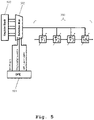
- the delay-line 300 is further enhanced by incorporating a register bank 502, which may store specific settings for the time-delays ⁇ 1 , ⁇ 2 , ⁇ 3 , ⁇ 4 ,..., ⁇ N and/or the amplitude weights ⁇ 1 , ⁇ 2 , ⁇ 3 , ⁇ 4 ,..., ⁇ N . Any given combination of such settings can be preloaded at the register bank and can be implemented on the delay-line 300 in order to generate a defined amplitude envelope.
- a selection multiplexer or MUX 503 generally preloads the settings from the register bank 502 and/or switch between different settings based on the settings provided by the digital front-end (DFE) or digital baseband 501, which may correspond to the baseband generating unit 101.
- DFE digital front-end
- digital baseband 501 which may correspond to the baseband generating unit 101.
- the time-delays ⁇ 1 , ⁇ 2 , ⁇ 3 , ⁇ 4 ,..., ⁇ N and the amplitude weights ⁇ 1 , ⁇ 2 , ⁇ 3 , ⁇ 4 ,..., ⁇ N can be toggled, especially by the settings provided by the DFE 501 through the selection MUX 503, where said control may be toggled by use of white or spectrally shaped dithering signal. This advantageously further suppress the side-lobes.
- the proposed technique facilitates another advantageous possibility to randomly select a pulse shape from a set of suitable pulse shapes. Said selection can occur per pulse or per burst.
- the DFE 501 may apply, based on the data to be transmitted, additional techniques, e.g. dithering.
- the DFE 501 may apply this dithering technique based on packet data (preamble/payload and AM_hold), but also from more general settings (setting(t)).
- Such settings can be random signal changing pulse shape settings at arbitrary intervals by selecting different pulse shape settings from the register bank 502. This results in lower side-lobes as each selected pulse shape has a different spectral output.
- Fig. 6 an exemplary embodiment of the bandwidth controller 600 according to the first aspect of the invention is illustrated.
- the bandwidth controller 600 especially facilitates data-dependent pulse shaping by controlling the width and/or the shape of the pulse based on the sequence of data bits to be transmitted.
- a control line 601 is provided in order to control the logic blocks 602,603 so that the amplitude can be held constant over the required periods of clock pulses based on the bit sequences of the input pulse.
- the period over which the rectangular pulses are held constant is estimated in a bandwidth estimation block 604 and feeds back the information to a counter 605 that counts the respective time-delays.
- the logic blocks are implemented with an OR logic gate 602 and an AND logic gate 603.
- the inputs of the OR logic gate 602 correspond to an amplitude hold signal and the reference clock pulses, where the amplitude hold signal is coupled in a switchable manner.
- the control line 601 controls the operation of the OR logic gate 602 such that for specific periods of the reference clock, the amplitude hold signal is switched onto the input of the OR logic gate 602. Therefore, the OR logic gate 602 outputs pulses when either one or both inputs are 1.
- the output 608 of the OR logic gate 602 is further inputted to the AND logic gate 603 along with the magnitude of the input pulses.
- this output 609 corresponds to the output of the bandwidth controller 600 of which the pulse widths are further modulated by the bandwidth estimation block 604.
- the bandwidth estimation block 604 comprises a first stage multiplexing 606 and a second stage multiplexing 607, where the first stage multiplexing 606 couples in the input pulses i.e. data pulses along with a feedback from the bandwidth estimation block 604.
- the second stage multiplexing 607 outputs the modulated pulses based on the output 609 of the AND logic gate 603.
- the first stage multiplexing 606 and the second stage multiplexing 607 both are controlled by the control line 601.
- Fig. 7A and Fig. 7B pulses according to baseband pulse shaping and data dependent pulse shaping are shown.
- Fig. 7A shows pulses with baseband envelope 701 where the pulse shaping is performed at baseband with 5 th order Butterworth LPF and up-converted to RF.
- Fig. 7B shows how the filtered baseband pulses are mimicked in order to facilitate the data-dependent pulse shaping.
- the pulse output, i.e. the envelope 701 in Fig. 7A is shown in time domain, where the horizontal axis represents time in nanoseconds and the vertical axis represents amplitude, e.g. in volts.
- a sequence of consecutive +1s or - Is in a BPSK modulator can result in a long pulse, while a transition of bits results in shortening of the pulse width. This can be achieved by dynamically changing the pulse bandwidth based on the data sequence.
- the pulse-bandwidth is reduced for pulse sequences of equal polarity such that complete overlap occurs and as a result the pulse amplitude is held constant.
- the pulse bandwidth is increased to prevent inter-symbol interference (ISI). This technique especially allows the transmitter to output the desired waveform without requiring any advanced algorithms to be implemented for I-Q to polar conversion.
- Fig. 7B where the mimicked baseband pulses are shown in time domain, where the horizontal axis represents time in nanoseconds and the vertical axis represents amplitude, e.g. in volts.
- the pulse width is a function of number of consecutive data bits represents as pulse with phase -1 or +1 (e.g. a sequence +1,+1,-1,+1,+1,-1,-1,-1,+1,-1,-1,+1,-1,-1,-1,+1).
- the pulse amplitude is held constant.
- the edges e.g. 703 are the result of said constant pulse amplitude. It can be further seen that the phases are always changed at zero-crossings 704.
- the signal 801 represents the pulse bits in a consecutive sequence and the signal 802 represents the phases of the pulse bits 801.
- the signal 803 represents control signal for holding the amplitude constant as described above. It can be seen that the amplitude is held constant when two or more sequence of -Is or +1s is to be transmitted.
- the signal 804 represents clock signal, for instance at or around a rate of 500MHz.
- the signal 805 results from the amplitude hold signal 803 and the clock signal 804, for instance the output 608 at the logic block of the bandwidth controller 600 and along with the magnitude 806 of the bits to be transmitted, the pulse widths of the pulses 807 to be transmitted are generated.
- the signal 807 corresponds to the output 609 of the bandwidth controller 600, for instance.
- the signal 808 represents the delayed and/or amplitude weighted pulses, and hence corresponds to the output of the pulse shaping unit, for instance.
- the signal 809 represents the summed tap outputs from the tapped delay-line 300 resp. the pulse shaping unit, thereby generating the amplitude envelope to be modulated by the carrier signal 114 at the amplification unit 109.
- Fig. 9A a further expansion of the proposed bit dependent pulse shaping technique is illustrated.
- Fig. 9A shows a single pulse in time domain, where the horizontal axis represents time in nanoseconds and the vertical axis represents amplitude, e.g. in volts.
- the proposed bit-dependent pulse shaping technique is extended, for example by elongating the rising edge of the first pulse and the falling edge of the last pulse of a burst.
- the different rise times and fall times can be seen in Fig. 9A , for instance the rise time 901 is noticeably different (e.g. longer) than the fall time 902 (e.g. shorter).
- the output spectrum of equal rise and fall time 903 is compared with the output spectrum with data-dependent rise and fall time 904 as described above. Further, the output spectrums are compared with the ETSI spectral mask (dashed lines). It can be seen that the power spectrum density for both techniques falls within the limits set by the ETSI mask, however, the data-dependent rise and fall time further improves the output spectrum in terms of side-lobes suppression.
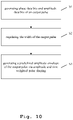
- a first step S1 phase data bits and amplitude data bits of an output pulse are generated.
- the width of the output pulse is regulated.
- a predefined amplitude envelope of the output pulse is generated via amplitude and time weighed pulse shaping.
- the embodiments of the present invention can be implemented by hardware, software, or any combination thereof.
- Various embodiments of the present invention may be implemented by one or more application specific integrated circuits (ASICs), digital signal processors (DSPs), digital signal processing devices (DSPDs), programmable logic devices (PLDs), field programmable gate arrays (FPGAs), processors, controllers, microcontrollers, microprocessors, or the like.
- ASICs application specific integrated circuits
- DSPs digital signal processors
- DSPDs digital signal processing devices
- PLDs programmable logic devices
- FPGAs field programmable gate arrays
- processors controllers, microcontrollers, microprocessors, or the like.
Landscapes
- Engineering & Computer Science (AREA)
- Computer Networks & Wireless Communication (AREA)
- Signal Processing (AREA)
- Power Engineering (AREA)
- Physics & Mathematics (AREA)
- Spectroscopy & Molecular Physics (AREA)
- Transmitters (AREA)
Priority Applications (2)
| Application Number | Priority Date | Filing Date | Title |
|---|---|---|---|
| EP20205837.6A EP3996340B1 (de) | 2020-11-05 | 2020-11-05 | Asynchroner polarer sender und betriebsverfahren dafür |
| US17/518,873 US11689245B2 (en) | 2020-11-05 | 2021-11-04 | Asynchronous polar transmitter and operation method thereof |
Applications Claiming Priority (1)
| Application Number | Priority Date | Filing Date | Title |
|---|---|---|---|
| EP20205837.6A EP3996340B1 (de) | 2020-11-05 | 2020-11-05 | Asynchroner polarer sender und betriebsverfahren dafür |
Publications (2)
| Publication Number | Publication Date |
|---|---|
| EP3996340A1 true EP3996340A1 (de) | 2022-05-11 |
| EP3996340B1 EP3996340B1 (de) | 2024-04-10 |
Family
ID=73138644
Family Applications (1)
| Application Number | Title | Priority Date | Filing Date |
|---|---|---|---|
| EP20205837.6A Active EP3996340B1 (de) | 2020-11-05 | 2020-11-05 | Asynchroner polarer sender und betriebsverfahren dafür |
Country Status (2)
| Country | Link |
|---|---|
| US (1) | US11689245B2 (de) |
| EP (1) | EP3996340B1 (de) |
Families Citing this family (1)
| Publication number | Priority date | Publication date | Assignee | Title |
|---|---|---|---|---|
| CN119906506B (zh) * | 2022-07-06 | 2026-01-13 | 华为技术有限公司 | 通信方法、通信装置及计算机可读存储介质 |
Citations (4)
| Publication number | Priority date | Publication date | Assignee | Title |
|---|---|---|---|---|
| US20080225935A1 (en) * | 2007-03-13 | 2008-09-18 | M/A-Com, Inc. | Method and architecture for digital pulse shaping and rate conversion |
| US20100246716A1 (en) * | 2009-03-30 | 2010-09-30 | Matsushita Electric Industrial Co., Ltd. | Methods and apparatus for reducing high-frequency events in polar domain signals |
| EP2251976A1 (de) * | 2009-05-12 | 2010-11-17 | ST-Ericsson SA | RF-Verstärker mit digitalem Filter für Polarsender |
| EP2733846A1 (de) * | 2012-11-20 | 2014-05-21 | Alcatel-Lucent | Hüllkurvenmodulator und Verfahren für den Betrieb eines Hüllkurvenmodulators |
Family Cites Families (1)
| Publication number | Priority date | Publication date | Assignee | Title |
|---|---|---|---|---|
| CN109644171B (zh) * | 2016-08-31 | 2022-04-08 | 杜塞尔多夫华为技术有限公司 | 滤波后的多载波通信 |
-
2020
- 2020-11-05 EP EP20205837.6A patent/EP3996340B1/de active Active
-
2021
- 2021-11-04 US US17/518,873 patent/US11689245B2/en active Active
Patent Citations (4)
| Publication number | Priority date | Publication date | Assignee | Title |
|---|---|---|---|---|
| US20080225935A1 (en) * | 2007-03-13 | 2008-09-18 | M/A-Com, Inc. | Method and architecture for digital pulse shaping and rate conversion |
| US20100246716A1 (en) * | 2009-03-30 | 2010-09-30 | Matsushita Electric Industrial Co., Ltd. | Methods and apparatus for reducing high-frequency events in polar domain signals |
| EP2251976A1 (de) * | 2009-05-12 | 2010-11-17 | ST-Ericsson SA | RF-Verstärker mit digitalem Filter für Polarsender |
| EP2733846A1 (de) * | 2012-11-20 | 2014-05-21 | Alcatel-Lucent | Hüllkurvenmodulator und Verfahren für den Betrieb eines Hüllkurvenmodulators |
Non-Patent Citations (1)
| Title |
|---|
| G. DE STREEL ET AL.: "SleepTalker: A ULV 802.15.4a IR-UWB Transmitter SoC in 28nm FDSOI Achieving 14 pJ/b at 27 Mb/s With Channel Selection Based on Adaptive FBB and Digitally Programmable Pulse Shaping", IEEE JOURNAL OF SOLID-STATE CIRCUITS, vol. 52, no. 4, 2017, pages 1163 - 1177, XP011644072, DOI: 10.1109/JSSC.2016.2645607 |
Also Published As
| Publication number | Publication date |
|---|---|
| US20220140860A1 (en) | 2022-05-05 |
| US11689245B2 (en) | 2023-06-27 |
| EP3996340B1 (de) | 2024-04-10 |
Similar Documents
| Publication | Publication Date | Title |
|---|---|---|
| EP2383893B1 (de) | Integrierte Schaltung, Kommunikationseinheit und Verfahren für die verbesserte Amplitudenauflösung eines RF-DAW | |
| US7221724B2 (en) | Precision timing generation | |
| US7206356B2 (en) | Wireless transmitter with reduced power consumption | |
| US8233579B2 (en) | Devices comprising delay line for applying variable delay to clock signal | |
| JP4067409B2 (ja) | 通信送信機における高品質パワーランプ増減 | |
| US6985532B2 (en) | Ultra wideband (UWB) transmitter architecture | |
| KR20040045899A (ko) | 멀티 모드 통신 전송기 | |
| US9054789B2 (en) | Method and device for generating ultra wide band pulses | |
| JP2009170968A (ja) | 超広帯域無線送信装置、超広帯域無線受信装置、及び超広帯域無線送受信装置 | |
| KR101744202B1 (ko) | 펄스 생성기 및 펄스 생성 방법 | |
| KR20140022987A (ko) | 가우시안 펄스 생성 장치 및 방법 그리고 가우시안 펄스를 생성하는 초광대역 통신 장치 | |
| Hühn et al. | A new modulator for digital RF power amplifiers utilizing a wavetable approach | |
| US11689245B2 (en) | Asynchronous polar transmitter and operation method thereof | |
| CN114567337A (zh) | 一种基于fpga的超宽带发射机 | |
| US11489517B2 (en) | Dither generation for radio frequency sampling digital-to-analog converters | |
| US20050057319A1 (en) | Pulse modulation | |
| CN111788774B (zh) | 延迟调制时钟分频 | |
| US8204146B2 (en) | Impulse waveform generating apparatus and radio-frequency pulse waveform generating apparatus | |
| US20090219061A1 (en) | Pulse generator circuit and communication apparatus | |
| Tigrek et al. | Utilization of Laurent decomposition for CPM radar waveform design | |
| US7957715B2 (en) | Spectrally constrained local oscillator switching | |
| Park et al. | All-digital synthesizable UWB transmitter architectures | |
| US8358240B2 (en) | Generating a time deterministic, spectrally noncoherent signal | |
| US8036303B2 (en) | Transmitter apparatus | |
| US20250211264A1 (en) | Radio frequency digital-to-analog converter |
Legal Events
| Date | Code | Title | Description |
|---|---|---|---|
| PUAI | Public reference made under article 153(3) epc to a published international application that has entered the european phase |
Free format text: ORIGINAL CODE: 0009012 |
|
| STAA | Information on the status of an ep patent application or granted ep patent |
Free format text: STATUS: THE APPLICATION HAS BEEN PUBLISHED |
|
| AK | Designated contracting states |
Kind code of ref document: A1 Designated state(s): AL AT BE BG CH CY CZ DE DK EE ES FI FR GB GR HR HU IE IS IT LI LT LU LV MC MK MT NL NO PL PT RO RS SE SI SK SM TR |
|
| STAA | Information on the status of an ep patent application or granted ep patent |
Free format text: STATUS: REQUEST FOR EXAMINATION WAS MADE |
|
| 17P | Request for examination filed |
Effective date: 20221017 |
|
| RBV | Designated contracting states (corrected) |
Designated state(s): AL AT BE BG CH CY CZ DE DK EE ES FI FR GB GR HR HU IE IS IT LI LT LU LV MC MK MT NL NO PL PT RO RS SE SI SK SM TR |
|
| GRAP | Despatch of communication of intention to grant a patent |
Free format text: ORIGINAL CODE: EPIDOSNIGR1 |
|
| STAA | Information on the status of an ep patent application or granted ep patent |
Free format text: STATUS: GRANT OF PATENT IS INTENDED |
|
| INTG | Intention to grant announced |
Effective date: 20231208 |
|
| GRAS | Grant fee paid |
Free format text: ORIGINAL CODE: EPIDOSNIGR3 |
|
| GRAA | (expected) grant |
Free format text: ORIGINAL CODE: 0009210 |
|
| STAA | Information on the status of an ep patent application or granted ep patent |
Free format text: STATUS: THE PATENT HAS BEEN GRANTED |
|
| P01 | Opt-out of the competence of the unified patent court (upc) registered |
Effective date: 20240208 |
|
| AK | Designated contracting states |
Kind code of ref document: B1 Designated state(s): AL AT BE BG CH CY CZ DE DK EE ES FI FR GB GR HR HU IE IS IT LI LT LU LV MC MK MT NL NO PL PT RO RS SE SI SK SM TR |
|
| REG | Reference to a national code |
Ref country code: GB Ref legal event code: FG4D |
|
| REG | Reference to a national code |
Ref country code: CH Ref legal event code: EP |
|
| REG | Reference to a national code |
Ref country code: DE Ref legal event code: R096 Ref document number: 602020028665 Country of ref document: DE |
|
| REG | Reference to a national code |
Ref country code: IE Ref legal event code: FG4D |
|
| REG | Reference to a national code |
Ref country code: LT Ref legal event code: MG9D |
|
| REG | Reference to a national code |
Ref country code: NL Ref legal event code: MP Effective date: 20240410 |
|
| REG | Reference to a national code |
Ref country code: AT Ref legal event code: MK05 Ref document number: 1676034 Country of ref document: AT Kind code of ref document: T Effective date: 20240410 |
|
| PG25 | Lapsed in a contracting state [announced via postgrant information from national office to epo] |
Ref country code: NL Free format text: LAPSE BECAUSE OF FAILURE TO SUBMIT A TRANSLATION OF THE DESCRIPTION OR TO PAY THE FEE WITHIN THE PRESCRIBED TIME-LIMIT Effective date: 20240410 |
|
| PG25 | Lapsed in a contracting state [announced via postgrant information from national office to epo] |
Ref country code: NL Free format text: LAPSE BECAUSE OF FAILURE TO SUBMIT A TRANSLATION OF THE DESCRIPTION OR TO PAY THE FEE WITHIN THE PRESCRIBED TIME-LIMIT Effective date: 20240410 |
|
| PG25 | Lapsed in a contracting state [announced via postgrant information from national office to epo] |
Ref country code: IS Free format text: LAPSE BECAUSE OF FAILURE TO SUBMIT A TRANSLATION OF THE DESCRIPTION OR TO PAY THE FEE WITHIN THE PRESCRIBED TIME-LIMIT Effective date: 20240810 |
|
| PG25 | Lapsed in a contracting state [announced via postgrant information from national office to epo] |
Ref country code: BG Free format text: LAPSE BECAUSE OF FAILURE TO SUBMIT A TRANSLATION OF THE DESCRIPTION OR TO PAY THE FEE WITHIN THE PRESCRIBED TIME-LIMIT Effective date: 20240410 |
|
| PG25 | Lapsed in a contracting state [announced via postgrant information from national office to epo] |
Ref country code: HR Free format text: LAPSE BECAUSE OF FAILURE TO SUBMIT A TRANSLATION OF THE DESCRIPTION OR TO PAY THE FEE WITHIN THE PRESCRIBED TIME-LIMIT Effective date: 20240410 Ref country code: FI Free format text: LAPSE BECAUSE OF FAILURE TO SUBMIT A TRANSLATION OF THE DESCRIPTION OR TO PAY THE FEE WITHIN THE PRESCRIBED TIME-LIMIT Effective date: 20240410 |
|
| PG25 | Lapsed in a contracting state [announced via postgrant information from national office to epo] |
Ref country code: GR Free format text: LAPSE BECAUSE OF FAILURE TO SUBMIT A TRANSLATION OF THE DESCRIPTION OR TO PAY THE FEE WITHIN THE PRESCRIBED TIME-LIMIT Effective date: 20240711 |
|
| PG25 | Lapsed in a contracting state [announced via postgrant information from national office to epo] |
Ref country code: PT Free format text: LAPSE BECAUSE OF FAILURE TO SUBMIT A TRANSLATION OF THE DESCRIPTION OR TO PAY THE FEE WITHIN THE PRESCRIBED TIME-LIMIT Effective date: 20240812 |
|
| PG25 | Lapsed in a contracting state [announced via postgrant information from national office to epo] |
Ref country code: ES Free format text: LAPSE BECAUSE OF FAILURE TO SUBMIT A TRANSLATION OF THE DESCRIPTION OR TO PAY THE FEE WITHIN THE PRESCRIBED TIME-LIMIT Effective date: 20240410 |
|
| PG25 | Lapsed in a contracting state [announced via postgrant information from national office to epo] |
Ref country code: AT Free format text: LAPSE BECAUSE OF FAILURE TO SUBMIT A TRANSLATION OF THE DESCRIPTION OR TO PAY THE FEE WITHIN THE PRESCRIBED TIME-LIMIT Effective date: 20240410 |
|
| PG25 | Lapsed in a contracting state [announced via postgrant information from national office to epo] |
Ref country code: PL Free format text: LAPSE BECAUSE OF FAILURE TO SUBMIT A TRANSLATION OF THE DESCRIPTION OR TO PAY THE FEE WITHIN THE PRESCRIBED TIME-LIMIT Effective date: 20240410 |
|
| PG25 | Lapsed in a contracting state [announced via postgrant information from national office to epo] |
Ref country code: LV Free format text: LAPSE BECAUSE OF FAILURE TO SUBMIT A TRANSLATION OF THE DESCRIPTION OR TO PAY THE FEE WITHIN THE PRESCRIBED TIME-LIMIT Effective date: 20240410 |
|
| PG25 | Lapsed in a contracting state [announced via postgrant information from national office to epo] |
Ref country code: PT Free format text: LAPSE BECAUSE OF FAILURE TO SUBMIT A TRANSLATION OF THE DESCRIPTION OR TO PAY THE FEE WITHIN THE PRESCRIBED TIME-LIMIT Effective date: 20240812 Ref country code: PL Free format text: LAPSE BECAUSE OF FAILURE TO SUBMIT A TRANSLATION OF THE DESCRIPTION OR TO PAY THE FEE WITHIN THE PRESCRIBED TIME-LIMIT Effective date: 20240410 Ref country code: NO Free format text: LAPSE BECAUSE OF FAILURE TO SUBMIT A TRANSLATION OF THE DESCRIPTION OR TO PAY THE FEE WITHIN THE PRESCRIBED TIME-LIMIT Effective date: 20240710 Ref country code: LV Free format text: LAPSE BECAUSE OF FAILURE TO SUBMIT A TRANSLATION OF THE DESCRIPTION OR TO PAY THE FEE WITHIN THE PRESCRIBED TIME-LIMIT Effective date: 20240410 Ref country code: IS Free format text: LAPSE BECAUSE OF FAILURE TO SUBMIT A TRANSLATION OF THE DESCRIPTION OR TO PAY THE FEE WITHIN THE PRESCRIBED TIME-LIMIT Effective date: 20240810 Ref country code: HR Free format text: LAPSE BECAUSE OF FAILURE TO SUBMIT A TRANSLATION OF THE DESCRIPTION OR TO PAY THE FEE WITHIN THE PRESCRIBED TIME-LIMIT Effective date: 20240410 Ref country code: GR Free format text: LAPSE BECAUSE OF FAILURE TO SUBMIT A TRANSLATION OF THE DESCRIPTION OR TO PAY THE FEE WITHIN THE PRESCRIBED TIME-LIMIT Effective date: 20240711 Ref country code: FI Free format text: LAPSE BECAUSE OF FAILURE TO SUBMIT A TRANSLATION OF THE DESCRIPTION OR TO PAY THE FEE WITHIN THE PRESCRIBED TIME-LIMIT Effective date: 20240410 Ref country code: ES Free format text: LAPSE BECAUSE OF FAILURE TO SUBMIT A TRANSLATION OF THE DESCRIPTION OR TO PAY THE FEE WITHIN THE PRESCRIBED TIME-LIMIT Effective date: 20240410 Ref country code: BG Free format text: LAPSE BECAUSE OF FAILURE TO SUBMIT A TRANSLATION OF THE DESCRIPTION OR TO PAY THE FEE WITHIN THE PRESCRIBED TIME-LIMIT Effective date: 20240410 Ref country code: AT Free format text: LAPSE BECAUSE OF FAILURE TO SUBMIT A TRANSLATION OF THE DESCRIPTION OR TO PAY THE FEE WITHIN THE PRESCRIBED TIME-LIMIT Effective date: 20240410 Ref country code: RS Free format text: LAPSE BECAUSE OF FAILURE TO SUBMIT A TRANSLATION OF THE DESCRIPTION OR TO PAY THE FEE WITHIN THE PRESCRIBED TIME-LIMIT Effective date: 20240710 |
|
| REG | Reference to a national code |
Ref country code: DE Ref legal event code: R097 Ref document number: 602020028665 Country of ref document: DE |
|
| PG25 | Lapsed in a contracting state [announced via postgrant information from national office to epo] |
Ref country code: DK Free format text: LAPSE BECAUSE OF FAILURE TO SUBMIT A TRANSLATION OF THE DESCRIPTION OR TO PAY THE FEE WITHIN THE PRESCRIBED TIME-LIMIT Effective date: 20240410 |
|
| PG25 | Lapsed in a contracting state [announced via postgrant information from national office to epo] |
Ref country code: EE Free format text: LAPSE BECAUSE OF FAILURE TO SUBMIT A TRANSLATION OF THE DESCRIPTION OR TO PAY THE FEE WITHIN THE PRESCRIBED TIME-LIMIT Effective date: 20240410 |
|
| PG25 | Lapsed in a contracting state [announced via postgrant information from national office to epo] |
Ref country code: CZ Free format text: LAPSE BECAUSE OF FAILURE TO SUBMIT A TRANSLATION OF THE DESCRIPTION OR TO PAY THE FEE WITHIN THE PRESCRIBED TIME-LIMIT Effective date: 20240410 |
|
| PG25 | Lapsed in a contracting state [announced via postgrant information from national office to epo] |
Ref country code: SK Free format text: LAPSE BECAUSE OF FAILURE TO SUBMIT A TRANSLATION OF THE DESCRIPTION OR TO PAY THE FEE WITHIN THE PRESCRIBED TIME-LIMIT Effective date: 20240410 Ref country code: RO Free format text: LAPSE BECAUSE OF FAILURE TO SUBMIT A TRANSLATION OF THE DESCRIPTION OR TO PAY THE FEE WITHIN THE PRESCRIBED TIME-LIMIT Effective date: 20240410 |
|
| PG25 | Lapsed in a contracting state [announced via postgrant information from national office to epo] |
Ref country code: SM Free format text: LAPSE BECAUSE OF FAILURE TO SUBMIT A TRANSLATION OF THE DESCRIPTION OR TO PAY THE FEE WITHIN THE PRESCRIBED TIME-LIMIT Effective date: 20240410 |
|
| PG25 | Lapsed in a contracting state [announced via postgrant information from national office to epo] |
Ref country code: SM Free format text: LAPSE BECAUSE OF FAILURE TO SUBMIT A TRANSLATION OF THE DESCRIPTION OR TO PAY THE FEE WITHIN THE PRESCRIBED TIME-LIMIT Effective date: 20240410 Ref country code: SK Free format text: LAPSE BECAUSE OF FAILURE TO SUBMIT A TRANSLATION OF THE DESCRIPTION OR TO PAY THE FEE WITHIN THE PRESCRIBED TIME-LIMIT Effective date: 20240410 Ref country code: RO Free format text: LAPSE BECAUSE OF FAILURE TO SUBMIT A TRANSLATION OF THE DESCRIPTION OR TO PAY THE FEE WITHIN THE PRESCRIBED TIME-LIMIT Effective date: 20240410 Ref country code: EE Free format text: LAPSE BECAUSE OF FAILURE TO SUBMIT A TRANSLATION OF THE DESCRIPTION OR TO PAY THE FEE WITHIN THE PRESCRIBED TIME-LIMIT Effective date: 20240410 Ref country code: DK Free format text: LAPSE BECAUSE OF FAILURE TO SUBMIT A TRANSLATION OF THE DESCRIPTION OR TO PAY THE FEE WITHIN THE PRESCRIBED TIME-LIMIT Effective date: 20240410 Ref country code: CZ Free format text: LAPSE BECAUSE OF FAILURE TO SUBMIT A TRANSLATION OF THE DESCRIPTION OR TO PAY THE FEE WITHIN THE PRESCRIBED TIME-LIMIT Effective date: 20240410 |
|
| PG25 | Lapsed in a contracting state [announced via postgrant information from national office to epo] |
Ref country code: IT Free format text: LAPSE BECAUSE OF FAILURE TO SUBMIT A TRANSLATION OF THE DESCRIPTION OR TO PAY THE FEE WITHIN THE PRESCRIBED TIME-LIMIT Effective date: 20240410 |
|
| PLBE | No opposition filed within time limit |
Free format text: ORIGINAL CODE: 0009261 |
|
| STAA | Information on the status of an ep patent application or granted ep patent |
Free format text: STATUS: NO OPPOSITION FILED WITHIN TIME LIMIT |
|
| 26N | No opposition filed |
Effective date: 20250113 |
|
| PG25 | Lapsed in a contracting state [announced via postgrant information from national office to epo] |
Ref country code: SI Free format text: LAPSE BECAUSE OF FAILURE TO SUBMIT A TRANSLATION OF THE DESCRIPTION OR TO PAY THE FEE WITHIN THE PRESCRIBED TIME-LIMIT Effective date: 20240410 |
|
| REG | Reference to a national code |
Ref country code: CH Ref legal event code: PL |
|
| PG25 | Lapsed in a contracting state [announced via postgrant information from national office to epo] |
Ref country code: MC Free format text: LAPSE BECAUSE OF FAILURE TO SUBMIT A TRANSLATION OF THE DESCRIPTION OR TO PAY THE FEE WITHIN THE PRESCRIBED TIME-LIMIT Effective date: 20240410 |
|
| PG25 | Lapsed in a contracting state [announced via postgrant information from national office to epo] |
Ref country code: LU Free format text: LAPSE BECAUSE OF NON-PAYMENT OF DUE FEES Effective date: 20241105 |
|
| REG | Reference to a national code |
Ref country code: CH Ref legal event code: PL |
|
| GBPC | Gb: european patent ceased through non-payment of renewal fee |
Effective date: 20241105 |
|
| PG25 | Lapsed in a contracting state [announced via postgrant information from national office to epo] |
Ref country code: CH Free format text: LAPSE BECAUSE OF NON-PAYMENT OF DUE FEES Effective date: 20241130 |
|
| REG | Reference to a national code |
Ref country code: BE Ref legal event code: MM Effective date: 20241130 |
|
| PG25 | Lapsed in a contracting state [announced via postgrant information from national office to epo] |
Ref country code: SE Free format text: LAPSE BECAUSE OF FAILURE TO SUBMIT A TRANSLATION OF THE DESCRIPTION OR TO PAY THE FEE WITHIN THE PRESCRIBED TIME-LIMIT Effective date: 20240410 |
|
| PG25 | Lapsed in a contracting state [announced via postgrant information from national office to epo] |
Ref country code: GB Free format text: LAPSE BECAUSE OF NON-PAYMENT OF DUE FEES Effective date: 20241105 Ref country code: BE Free format text: LAPSE BECAUSE OF NON-PAYMENT OF DUE FEES Effective date: 20241130 |
|
| PG25 | Lapsed in a contracting state [announced via postgrant information from national office to epo] |
Ref country code: FR Free format text: LAPSE BECAUSE OF NON-PAYMENT OF DUE FEES Effective date: 20241130 |
|
| PG25 | Lapsed in a contracting state [announced via postgrant information from national office to epo] |
Ref country code: IE Free format text: LAPSE BECAUSE OF NON-PAYMENT OF DUE FEES Effective date: 20241105 |
|
| PGFP | Annual fee paid to national office [announced via postgrant information from national office to epo] |
Ref country code: DE Payment date: 20251022 Year of fee payment: 6 |
|
| PG25 | Lapsed in a contracting state [announced via postgrant information from national office to epo] |
Ref country code: HU Free format text: LAPSE BECAUSE OF FAILURE TO SUBMIT A TRANSLATION OF THE DESCRIPTION OR TO PAY THE FEE WITHIN THE PRESCRIBED TIME-LIMIT; INVALID AB INITIO Effective date: 20201105 |
|
| PG25 | Lapsed in a contracting state [announced via postgrant information from national office to epo] |
Ref country code: CY Free format text: LAPSE BECAUSE OF FAILURE TO SUBMIT A TRANSLATION OF THE DESCRIPTION OR TO PAY THE FEE WITHIN THE PRESCRIBED TIME-LIMIT; INVALID AB INITIO Effective date: 20201105 |